Showing posts with label superman. Show all posts

Wednesday, July 1, 2026

July 1, 1946: Superman vs. the Ku Klux Klan

July 1, 1946: The Ku Klux Klan, America's leading proponents of bigotry, face one opponent they cannot defeat: Superman.

Superman, of course, is a fictional character. He does not exist in real life. He beat the Klan, anyway. With help.

In 1946, Stetson Kennedy, a human rights activist, 29 years old and a native of Jacksonville, Florida, infiltrated the KKK and other racist/terrorist groups. Concerned that the organization had links to the government and police forces -- which, in the Southern States, it most certainly did -- Kennedy decided to use its findings to strike at the Klan in a different way. (Note: William Stetson Kennedy, his full name, was not related to the Kennedy political family of Massachusetts.)
He contacted the producers of the Superman radio show, which was recorded at station WOR in New York, and syndicated nationally over the Mutual Broadcasting System. He proposed a story where the superhero, voiced by actor and game show host Bud Collyer (born Clayton Johnson Heermance Jr.), battles the Klan. Looking for new villains, and unable to reproduce the effects of some Superman opponents from the comic books due to budgetary reasons, the producers eagerly agreed.

Kennedy provided information, including details of Klan rituals and the like to the writers. The result was a series of episodes, "Clan of the Fiery Cross," in which Superman took on the Klan. The trivialization of the Klan's rituals and natures had a negative impact on Klan recruiting and membership numbers. According to one source, it "led to a steep decline in membership from which the KKK never recovered."

Reportedly, Klan leaders denounced the show, and called for a boycott of Kellogg's products, which sponsored the radio show. However, the story arc earned spectacular ratings, making Superman the most highly rated kids' radio program, and the food company stood by its support of the show. They later sponsored the TV show The Adventures of Superman, starring George Reeves.

Bud Collyer lived until 1969; Stetson Kennedy, until 2011. In 2019, Chinese-American writer Gene Luen Yang and the Japanese-American artist team calling itself Gurihiru adapted the story into a comic book series, Superman Smashes the Klan, setting it in 1946 like the original radio series, and making Chinese-Americans the focus, with assistance from African-Americans, the Daily Planet newspaper, and Superman himself.

Sunday, August 3, 2025

Top 10 DC Comics Villains

Left to right: Dr. Sivana, Captain Cold, Gorilla Grodd,
Talia and Ra's al Ghul, The Penguin, The Joker, Mirror Master,
Lex Luthor, the Trickster, Mr. Element, Catwoman,
Mr. Mxyzptlk, The Scarecrow, The Riddler, Abra Kadabra.

Dishonorable Mention: Darkseid, the Anti-Monitor, Mongul, Ares and Brainiac. As evil as they are, Darkseid, the Anti-Monitor and Mongul know nothing but the desire for conquest. Ares, the Greek god of war and arguably the most significant villain to Wonder Woman, is every bit as "locked into" his role. And Brainiac is an artificial intelligence. Though he thinks on his own, he's still basically running a program. They're actually pretty boring as villains go.

Somewhat Honorable Mention: Selina Kyle, Catwoman, sometimes nemesis and sometimes love interest of Bruce Wayne, the Batman. If you only know her from the 1966-68 Batman TV show, where she was played by Julie Newmar and later Eartha Kitt -- and, in the 1966 film version, by Lee Meriwether -- where she was only a villain, despite her flirting with Batman, then you should give her another look.

She isn't so much a villain as an "anti-hero." She has played both sides. Like Britt Reid, the Green Hornet, she has played the villain to other villains to undermine them from the inside. And, many times, she has proven to be a valuable asset to Batman.

Now, the Top 10:

10. Pamela Isley, Poison Ivy, enemy of Batman. A scientist who, having been empowered by an elemental force, can control plants, became an ecoterrorist. She's the opposite of the corporate polluters she hates: She wants to save the Earth, but doesn't care who has to die to achieve this. Her goal is worthy, but her methods are unacceptable.

9. Albert Desmond, who was first Mr. Element, then Dr. Alchemy, enemy of The Flash. Desmond debuted as a chemist who, in a split personality, developed the identity of Mr. Element, developing an "elemental gun" that could change an object's chemical composition. (The so-called Silver Age of Comics, 1956 to 1973, liked to talk about science, but wasn't very good at observing the laws of physics.)

While in prison, he learned of the existence of the Philosopher's Stone, which could do what his gun could, and more efficiently. Upon his release, he found the Stone, stole it, and created the new persona of Dr. Alchemy.

As various versions of The Flash have sometimes been able to do with the villains in the "Flash Rogues Gallery," Barry Allen got Desmond to go straight. But he had an "astral twin": Alvin Desmond, named nearly the same, born at the exact same time, and also with what would now be called disassociative identity disorder, but also with a psychic link to Albert. He took on the Dr. Alchemy identity, and, without Albert's original personality to morally ground him, became a more dangerous foe.

In a story titled "The Good, the Bad, and the Unexpected," Albert (in this case, "The Unexpected") was unfairly accused of Alvin's crimes. So he resumed his Mr. Element identity, and helped The Flash take the 2nd Dr. Alchemy down.

8. David Hyde, Black Manta, arch-enemy of Aquaman. His origin has been tinkered with a few times. The current version has him as the younger half of father & son crooks, and he blames Aquaman for saving him but not his father from a disaster.

But he is always portrayed as a ruthless underwater mercenary, with a black insect-headed costume (even though the manta ray is a very different-looking creature), particularly focused on Aquaman. In some versions, as Aquaman failed to save Black Manta's father, Black Manta killed Arthur Curry Jr., son of Aquaman and Mera.

In the Super Friends cartoon of the 1970s, he was simply "Manta," and his armor was orange, but he was no less evil, and no less difficult for Aquaman and the other Super Friends (Superman, Wonder Woman, Batman and Robin, and the Wonder Twins) to defeat.

7. Harvey Dent, Two-Face, enemy of Batman. Once Gotham City's crusading District Attorney, and an ally of Police Commissioner Jim Gordon, and of the hero in both his businessman Bruce Wayne and crimefighter Batman personae -- he didn't know they were the same man -- half of his face was scarred by acid.

As a result, he developed the persona of Two-Face, who believed there was no such thing as justice, only chance. He had a two-headed silver dollar, and he took a knife and scarred one side of the coin. (In some versions of his origin, the coin was scarred by the same acid that ruined his face.) If the scarred side came up when he flipped it, he would commit a crime; but if the clean side came up, he wouldn't.

The 2nd Robin, Jason Todd -- who did not yet know that Dent had killed his father, gangster Willis Todd, but Batman did know -- asked how he could prepare for an opponent that unpredictable. Batman explained that Dent was actually their most predictable opponent, because his crimes were always based around the number 2, or duality in some form. Typical of this: He robbed the box office at the ballpark when the Gotham Goliaths played the Minnesota Twins, with 2 outs in the bottom half of the 2nd inning of the 2nd game of a doubleheader. Batman once set a trap for him by having a casino pay out a jackpot of $22 million -- money donated by Bruce Wayne, of course.

To make matters worse, there was a second Two-Face. Within the comics' universe, a TV-movie was made about the case, and the actor playing Dent, Paul Sloane, got mistakenly hit with real acid instead of water, and took up Two-Face's persona. The only way Batman could tell them apart was that Dent was righthanded, and Sloane was lefthanded. Sloane's damage was less severe, and he was cured in both face and mind. Dent has occasionally been cured, but has always had the Two-Face personality take over again.

Why do I put Two-Face on this list? Why not The Penguin? Because he's just a gangster with a theme. The film Batman Returns and the TV shows Gotham and The Penguin (the latter, a spinoff of the 2022 film The Batman) have tried to make him more interesting, but they didn't work for me.

Why not The Riddler? He's a bit more interesting, because he's more of an intellectual challenge for Batman -- although I did notice that, in the 1966-68 TV series, Robin (Dick Grayson) solved more of the riddles than Batman did. But he's not as unhinged, and thus as dangerous, as Two-Face, let alone the Joker.

Why not Bane, the man who "broke the Bat"? Certainly, he's more of a threat, but he's rather boring. Even in The Dark Knight Rises, when he was tied to Ra's al Ghul and his League of Shadows (which he previously was not in the comics), he wasn't that interesting.

6. Thaal Sinestro, arch-enemy of the Green Lantern Corps. Willpower is the green on the Lantern spectrum, and fear is the yellow on it. Once the leader of the Corps, and mentor of Earth's main Lantern, Hal Jordan, he believed that, in order to truly face all enemies, the Corps had to fully understand fear. The Guardians of the Universe, who ran the Corps, refused to accept this, and expelled him. So he became a Yellow Lantern, but it corrupted him. And, in most versions, the Green Lantern power ring is ineffective against the color yellow.

(On Earth-2, their Green Lantern, Alan Scott, got his power from plant life, and thus his ring couldn't be used against anything plant-related, including wood, leading to him occasionally getting hit with wooden objects.)

Turning against the Corps, with all his knowledge of them, made Sinestro not only a particularly effective counterpoint to the Corps, it made him, in effect, their "Anakin Skywalker," even though the character was created in 1961, 16 years before the debut of Star Wars, and 19 years before Anakin's betrayal and conversion to Darth Vader was known. On top of that, Sinestro is usually shown with pointed ears, which speaks more to the Vulcans and Romulans of Star Trek than Star Wars, even though he is frequently highly illogical.

5. Slade Wilson, Deathstroke, arch-enemy of, collectively, the Teen Titans. He's an anti-Captain America: First he was in the U.S. Army, then he received a "super-soldier serum," giving him vastly heightened strength, speed and reflexes. He became a mercenary, and is considered the top assassin in the DC Universe. The Marvel anti-hero Deadpool is considered a ripoff of Deathstroke, to the point where his real name is Wade Wilson.

Deathstroke has fought Batman and Green Arrow, and in the Arrowverse, where Green Arrow was the stand-in for Batman, he and Deathstroke fought each other. In the comics, Deathstroke's vendetta against the Titans began when he swore revenge for the death of his eldest son Grant, a villain who used the name Ravager. His other 2 children, Jericho and Rose, would go on to join the Titans to oppose him, with Rose even taking on the Ravager identity.

4. Ra's al-Ghul, enemy of Batman. This character was created in 1971, and was thus unavailable for the Adam West TV series. Centuries old, and revived from many deaths thanks to a Lazarus Pit, Ra's al-Ghul (Arabic for "The Demon's Head") runs the League of Assassins (known in The Dark Knight 
Trilogy as the League of Shadows), which has found every succeeding world civilization to be corrupt, and has tried to bring it down, becoming responsible for the Sack of Rome in AD 410, the fall of Camelot in 537, the Norman Conquest in 1066, the Black Death in 1340s Europe, the fall of Constantinople in 1453, the Reign of Terror in France in the 1790s, and World War I and the Bolshevik Revolution in the 1910s.

Ra's (usually pronounced "Rahz," but, to match the language, it should be "Raysh"), like Deathstroke and Captain America, has more-than-human strength and reflexes, if not on a truly superhuman level, and is one of the world's deadliest physical combatants, having had the time to master multiple martial arts and hand weapons.

He considers Batman's hometown of Gotham City to be the most corrupt place on Earth (there is some reason to think so), and has specifically targeted it for destruction, seeing Batman, whose secret identity of Bruce Wayne he figured out, as a not merely a worthy opponent, calling him "Detective," but as a possible successor to lead the League of Assassins, through marriage to his daughter, Talia.

Talia, nearly as much of a physical marvel as her father, is fine with this, as she is in love with Bruce. Bruce, whose feelings for her conflict with those of his other main love interest, Catwoman, can't resist her, and she kept the birth of their son, Damian Wayne, secret from him for years. Damian was raised to be his grandfather's successor and a great assassin, flying in the face of Batman's no-kill rule. But when Talia introduced Damian to Bruce, Bruce took him in, set him straight (mostly), and made him the latest in a series of Robins.

In the Arrowverse, given their refusal to use Batman, Ra's al-Ghul became the arch-nemesis of Green Arrow.

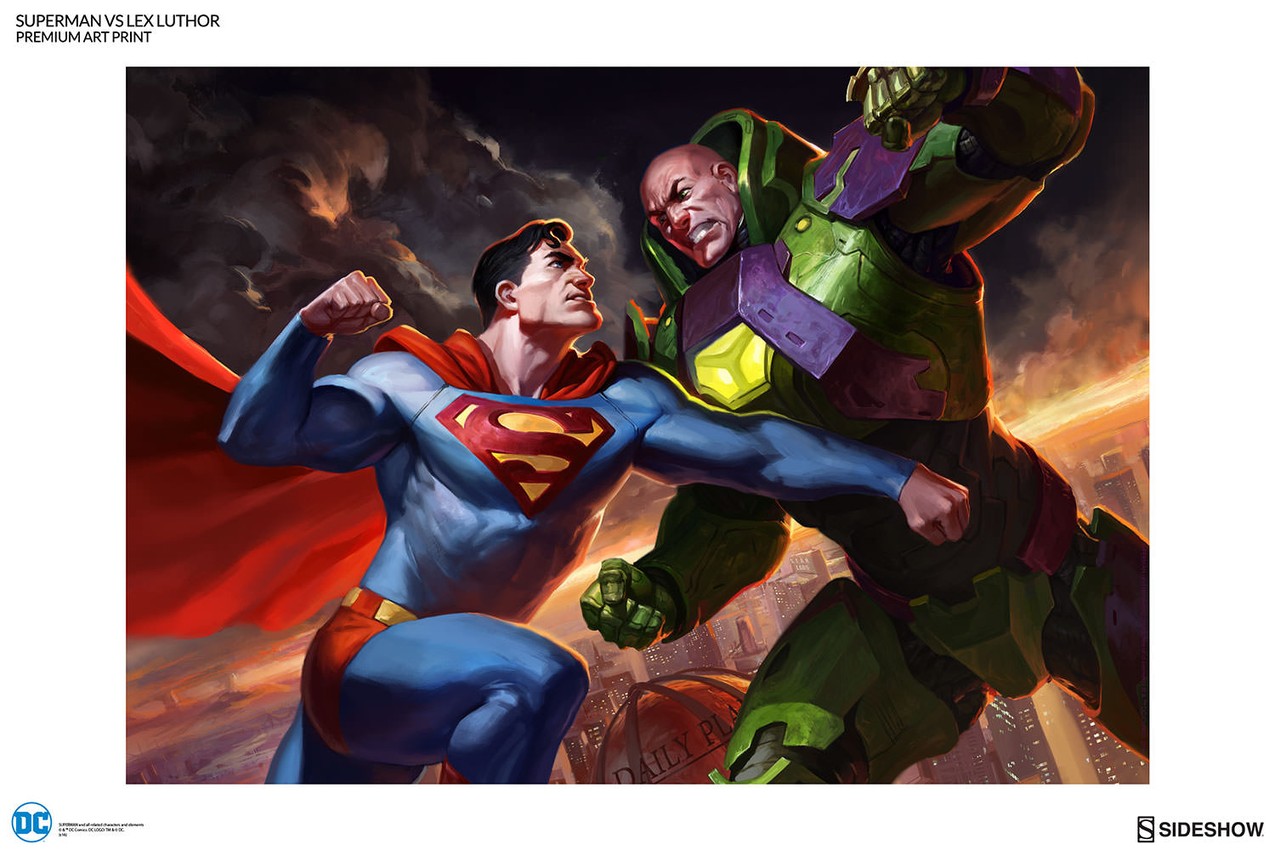
3. Lex Luthor, arch-enemy of Superman. Superman is unusual among superheroes in that, while he does have opponents who wear costumes and develop themes based on their powers and/or personalities, his Number 1 opponent is a mortal man without powers.

From 1940 to 1985, Luthor was usually portrayed as a stereotypical "mad scientist," who wanted to control the world, not such much out of greed or a lust for power, but because he thought he could run it better. And Superman stood in his way.

Eventually, he was given a backstory to explain his specific hatred of Superman: They had grown up together in Smallville, and were friends. One day, the teenage Luthor made a mistake in his lab, and Superboy, as Clark Kent's costumed identity was then known, blew out the fire, but the fumes caused Luthor's hair to fall out, and he blamed Superboy, not his own mistake, for this. And so, his schemes to stop him were personal, unlike his schemes to "take over the world." (This would be copied in Marvel, with Victor Von Doom/Dr. Doom blaming former friend Reed Richards/Mr. Fantastic for his facial scarring, rather than his own mistake.)

After Crisis On Infinite Earths in 1985, there was a complete reboot of DC Comics. Now, Luthor was several years older than Superman, and a contemporary and rival of Daily Planet publisher Perry White. And, like the Marvel superhero Iron Man, he seemed a variation on science wizard Howard Hughes.

This version of him hated Superman not just because he was now getting the headlines in the Planet that Luthor himself used to get, but because Luthor believed that the best of humanity -- himself, and people like him -- should be the best of Earth, not some super-powered alien "interloper."

Wanting to "save humanity" is just Lex's excuse for why he wants to eliminate Superman. If Lex's goal was to save humanity, he wouldn't kill people to achieve his sub-goals, be they building a new machine to help humanity, or synthesizing a helpful new drug, or building a factory to employ thousands of people. If he wanted to do those things, he'd just do them. And if he had to kill people to achieve them, being supposedly one of the smartest people alive -- he confesses that Batman is the only man he considers to be smarter than himself -- he'd find a way around killing to achieve them.

In All-Star Superman, Superman points out that, once Lex became as rich as he is, he could have "saved humanity," whatever those words meant to him, any time he wanted to. And he hasn't even tried. Some of the other brilliant scientists in the DC canon have tried, with limited success, particularly on a local scale (Bruce Wayne, a.k.a. Batman, in Gotham City; Oliver Queen, a.k.a. Green Arrow, in Star City, and so on). Luthor simply uses his genius and his resources for his own benefit.

2. Jack Napier, the Joker, arch-enemy of Batman. Whereas even Luthor would do the right thing if he thought he could benefit from it, the Joker only does things to make himself laugh. And, despite recent adaptations of Luthor as shown in the TV series Superman & Lois and in the 2025 Superman film, the Joker is even more sadistic, determined to prove that, as happened to him, all it takes is one truly bad day to drive a good man insane.

The fact that he was -- depending on the telling; as he put it, "If I have to choose my story, I prefer multiple choice!" -- already a small-time crook, either by choice or forced into it, and was disfigured and shocked into adopting his Joker persona as a result of a confrontation with Batman, makes it all the more poignant: Inadvertently, Batman created his arch-enemy, and he knows it. (The 2019 and 2024 Joker films go against this idea.)

The 1989 Batman film took this to the next level, showing that Napier was not only a gangster and a rotten guy long before he became the Joker, he was also the man who killed Thomas and Martha Wayne in front of a child Bruce. As Batman told him at the film's climax: "I made you? You made me first." This is the only version of the story where the Waynes' killer becomes the Joker: In most versions, it's Joe Chill, who is depicted as either a small-time hood who gets scared, and thus his mugging of the Waynes goes horribly wrong; or a Mob hitman, carrying out the vendetta of a boss that Dr. Wayne offended.

Two oddities, both from movies. In the Tim Burton movies, had the Penguin's plan succeeded, his death toll of over 100,000 would have been greater than any plan yet seen from any live-action version of the Joker. And in the film version of Watchmen, a hero-turned-antihero named the Comedian ends up killing more people, including more innocent people, than any version of the Joker.

So who could be worse than all of these, including Luthor and the Joker? In my opinion, this guy:

1. Eobard Thawne, Professor Zoom, the Reverse-Flash, arch-enemy of Barry Allen, the 2nd Flash. In the 25th Century, Thawne started out admiring the 20th Century hero, The Flash. He wanted to be like Barry Allen. So he found a way to give himself super-speed. Then, just as he's about to debut as his era's speedster hero, Allen comes from the past and saves the people Thawne was supposed to save. Though Barry didn't yet know Thawne existed, Thawne took his action as a deeply personal affront, and began to hate The Flash, and would occasionally go back to the 20th Century to make his life miserable.

He was responsible for the death of Barry's wife, Iris West, although she later returned from the dead. Not satisfied with this, Flash canon was rewritten so that Thawne became Barry's "Joe Chill," but with a twist: He went back further in time, killing Barry's mother Nora, and getting Barry's father Henry blamed for the murder, making Barry "lose" both parents as a boy. But instead of becoming embittered and a villain, Barry still sought justice and became a hero, and still stopped Thawne every time.

In 2011, deciding they needed another reboot, the suits at DC allowed the Flashpoint story: Barry went back in time and saved his mother, but it messed up the entire world. As Barry said in the 2023 Flash film, "I broke the universe!" In the comics version, adapted to an animated film, Thawne decided to lecture him over this:
Yes, Thawne. You are the villain. Barry was not a villain, just a well-intentioned fool.

Tell me, Thawne, when have you ever tried to save a life, instead of end one, or make one miserable? (The Arrowverse's series The Flash and Legends of Tomorrow tried to redeem him this way, but it rang hollow.)

Lex Luthor was an abused kid who lost his hair. The Joker and Two-Face were disfigured and lost everything. Mr. Element/Dr. Alchemy was already mentally ill. Black Manta lost his father, although he blamed the wrong person. Ra's al-Ghul and Poison Ivy want to save the world, though they try it with psychotic methods. Even Sinestro had a point, that no one was willing to listen to, and felt rejected by his own people.

What's your excuse for being a villainous son of a bitch, Thawne? A man who didn't even know you existed at that point, and thus wasn't trying to hurt you, hurt your feelings. He hurt your pride. That's it.

In a way, Thawne, you're even worse than Darkseid, Mongul and Brainiac. Trying to conquer is all they know. You should have been smarter than that. But you weren't. In your origin, you're the worst DC villain of them all. You are the villain.

Thursday, July 24, 2025

Top 10 Superhero Movie Lines of All Time

Rank. Title, Year, Screenplay Author. Explanation. Line. Further explanation, if necessary.

10. Batman & Robin, 1997, Akiva Goldman. At the beginning of the film, we discover that, after the destruction of the Batmobile in the previous film, Batman (George Clooney) hasn't built a new one in which he and Robin (Chris O'Donnell) can ride together, as in the comics and in the 1966-68 TV series.

Robin has a motorcycle, but says, "I want a car!" He knows Batman can afford it, but, instead, chooses to justify it by saying, "Chicks dig the car!" Batman responds by saying, "This is why Superman works alone."

Unlike the 1960s TV series, Christopher Nolan's Dark Knight Trilogy, and, so far, Matt Reeves' Epic Crime Saga, none of which make any suggestion that there are other superheroes in their world, this line confirms that there are other superheroes in the 2 Batman films directed by Joel Schumacher films, and implies the same for the earlier 2 films directed by Tim Burton. But it also suggests that there is, as yet, no Justice League.

It's a fun line. Unfortunately, the movie goes downhill from there.

9. The Dark Knight, 2008, brothers Christopher and Jonathan Nolan. Harvey Dent, the District Attorney, tells Bruce Wayne, who he doesn't know is Batman, "You either die a hero, or you live long enough to see yourself become the villain."

He already had a point. One of the last episodes of the Batman TV series, in 1968, featured a hypnotized, un-costumed Bruce doing the bidding of a villain. There was the synthetic-Kryptonite-affected Superman of Superman III in 1983. And, under a false impression, people had turned on Superman in a 1993 episode of Lois & Clark. After this, the Arrowverse of 2016-24 led to heroes seeing evil versions of themselves or their inspirations; the 2023 Flash movie saw an alternate version of the hero go too far; and the new Superman movie sees a clone used by Lex Luthor as the villain Ultraman.

In The Dark Knight, Dent ends up being tortured and tormented by the Joker, becoming the villain Two-Face. And, an order to save Dent's reputation, Batman has to let himself be publicly seen as the villain.

Dishonorable Mention, because it's delivered by a villain. In this case, though, it's not the Joker, but the secondary villain: Dr. Jonathan Crane, the evil psychiatrist who calls himself the Scarecrow.

Batman tries to break up a deal between Crane and some small-time crooks -- and two copycats try to do the same. He has to stop Crane, and he has to stop the "copybats" so they don't get hurt. One says, "We're trying to help you!" And Batman says, "I don't need help!" And Crane says, "Not my diagnosis!"

Honorable Mention: The next line is the copybat asking, "What gives you the right? What's the difference between you and me?" Batman says, "I'm not wearing hockey pads!" Translation: I'm wearing armor, you're not, so you're a lot more likely to get yourself killed by pretending to be me.

8. Spider-Man, 2002, David Koepp. It's not the hero who says it. Not Spider-Man, a.k.a. Peter Parker. It's his aunt, May Parker. After the Green Goblin attacks the Parker house, May is hospitalized, and Peter asks, "Can I do anything for you?" She says, "You do too much: College, a job, all this time with me. You're not Superman, you know." Proving that, at least in the universe where Spider-Man is played by Tobey Maguire, DC Comics exist.

Honorable Mention: Stan Lee wrote it at the end of the first Spider-Man story, in Amazing Fantasy #15 in 1962: "With great power, there must also come great responsibility." It a retcon, it's Peter's uncle, Ben Parker, who says it, and he says it in this film.

Dishonorable Mention, because it's said by the villain. And, Cliché Alert: The Goblin says to Spidey, "You and I are not so different." Spidey says, "I'm not like you. You're a murderer." And the Goblin says, "Well... to each his own."

7. Wonder Woman, 2017, Allen Heinberg. Why Wonder Woman's origin story was set in World War I, not World War II as usual, I don't know. At any rate, Steve Trevor warns her against trying to cross the "No Man's Land" between the Allies' and the Germans' territory, telling her, "We can't save everyone in this war. This is not what we came here to do." And she says, "No, but it's what I'm going to do." And she does.

6. The Avengers, 2012, Zak Penn and Joss Whedon. Iron Man, for the moment without any version of his armor, is taking a big risk by threatening Loki, who is determined to conquer the Earth with his Chitauri army. But the key line isn't when Tony responds to Loki's "I have an army" with "We have a Hulk."

It's right after that, when he tells an overconfident Loki, "You're missing the point. There's no throne. There is no version of this where you come out on top. Maybe your army comes, and maybe it's too much for us. But it's all on you. Because if we can't protect the Earth, you can be damned well sure we'll avenge it." (Which they ended up having to do, in Avengers: Endgame.)

The implication of Stark's line is, "If we lose to your army, we're coming after you, and your army won't be able to protect you from us."

Honorable Mention: A few minutes later, Loki tells the Hulk, "I am a god, you dull creature!" The Hulk grabs his leg and smashes him around the room, walks away, and says, "Puny god." (The Hulk calling opponents, real and perceived, "puny" is a common feature of the comics.)

Honorable Mention: Earlier in the movie, in Germany, Loki tells the people to kneel before him. And an old man, old enough to remember living under the rule of Adolf Hitler, stands, and says, "Not for men like you." Loki, who thinks of himself as a god, not just as a guy with super-powers, says, "There are no men like me." And the old man, correctly, says, "There are always men like you." 

Honorable Mention: Loki tries to blast the old man, and that's when Captain America arrives to deflect the blast with his shield. Cap tells Loki, "You know, the last time I was in Germany, I saw a man standing above everybody else. We ended up disagreeing."

5. The Incredible Hulk, 1977, Kenneth Johnson (who also directed). This film aired on CBS as a pilot for the TV series of the same name, so, even though it was never released in theaters, it counts.

The Hulk's origin story was re-written so that Dr. David Banner (not "Bruce" like in the comics) is believed dead in an explosion caused by the Hulk, so his story becomes a cross between Frankenstein and The Fugitive -- only, in this case, Dr. Frankenstein, Dr. Kimble, and the Monster are all the same person. Pursuing the man, the creature and the story is an investigative reporter for a trashy supermarket tabloid, Jack McGee.

In a clip that got played in the opening sequence of every episode, McGee makes Banner angry, and Banner, trying to stay calm, because he already knows what will happen if he doesn't, says, "Mr. McGee, don't make me angry. You wouldn't like me when I'm angry." The line has been associated with the Hulk ever since, and has been used, and even parodied, in the 21st Century Marvel movies.

4. Superman, 2025, James Gunn (who also directed). After he's beaten Lex Luthor, who still considers him not human and a threat to Earth -- or, at least, to Luthor's plans, and that much is true --  Superman explains it to him, in a way that not only affirms Superman's humanity, but exposes Luthor as full of shit: "I'm as human as anyone. I love. I get scared. I wake up every morning, and, despite not knowing what to do, I put one foot in front of the other, and I try to make the best choices I can. I screw up all the time. But that is being human. And that's my greatest strength."

3. Watchmen, 2009, David Hayter and Alex Tse. In prison, vigilante Walter Kovacs, a.k.a. Rorschach, has just defended himself from an attack by a fellow inmate in the cafeteria. Everyone is staring at him, and he says, "None of you seem to understand: I'm not locked in here with you, you're locked in here with me!"

2. The Dark Knight Rises, 2012, Christopher and Jonathan Nolan. Just before Batman (Christian Bale) takes off in the Batcopter to get the bomb away from Gotham City, Commissioner Jim Gordon (Gary Oldman) tells him, "I never cared who you were." Batman says, "And you were right."

Gordon: "But shouldn't the people know the hero who saved them?" Batman: "A hero can be anyone. Even a man doing something as simple and reassuring as putting a coat around a young boy's shoulders, to let him know that the world hadn't ended." That's when Gordon remembers being a young cop, 30 years earlier, putting his coat around a boy named Bruce Wayne, who had just lost his parents.

It's the kind of line we wouldn't expect from dark, brooding Batman. It's a reminder that, under the cowl, he's still human.

But we would expect that kind of line from Superman:

1. Superman, 1978, Mario Puzo. Superman (Christopher Reeve) catches a falling Lois Lane (Margot Kidder), and says, "Easy, Miss: I've got you." And she says, "You've got me? Who's got you?"

Honorable Mention: When the sequence is done, Lois asks, "Who are you?" Clark, not yet having chosen a name -- it's Lois who comes up with "Superman" -- simply says, "A friend."

Friday, July 11, 2025

Superhero TV Shows vs. Superhero Movies

David Corenswet

Today, the new Superman movie was released, directed by James Gunn, and starring David Corenswet as the greatest superhero of them all.

UPDATE: Truth: It's great. Justice: It's been done, to both the character and his fans. The American Way: Trump is gonna hate it, but my Dad, who grew up on the comics and George Reeves in The Adventures of Superman, would have loved it.

Are superhero TV shows are better than superhero movies? I say yes, because they don't have to follow the same rules:

1. You can take 45 minutes to show the origin story, and instead of, "Enough already, we want to see the movie!" that's your pilot episode. You're allowed to do that.

2. You don't have to pack all of the action into 2 hours. You can have the hero -- and the villain -- talking plans over with the people they work with, and instead of sounding like some foreign film from the 1960s that doesn't make sense even when you add subtitles, it's "The West Wing meets the Super Friends," and it works. The Arrowverse proved this, even if Smallville (in my opinion) didn't.

3. You can have 5 different villains over the course of a season, develop their characters as well, and bring them back.

4. If you throw in a guest superhero, it works -- especially if it turns out to be the main hero's love interest, who then becomes part of the main cast.

5. It doesn't get ridiculous if the hero has a new love interest every season, the way it would if he had a new one every movie. (This was one of the problems with the Burton-Schumacher era of Batfilms, 1989 to 1997. And with the James Bond films.)

6. There's no pressure to fill 15 minutes of the first hour and the last half hour of the movie with punches and explosions. You can pace yourself. You can have 3 or 4 episodes in a row with no major battles, and it works. And a 3-minute fight in a 1-hour episode can be just as effective as a 15-minute fight in a 2-hour movie.

7. It doesn't have to be the ultimate battle -- indeed, it can't be. Science fiction writer David Gerrold made the point that, in a standalone movie, this has to be the most important moment of the life of the hero, super- or otherwise. Or else, why would we watch the story?

But if it's a series -- Gerrold used both Sherlock Holmes and James Bond as examples -- then none of these adventures has to be the biggest battle of them all, because you want to keep the fans coming back for the hero. Save the ultimate battle for the series finale.

Thursday, July 10, 2025

Superman vs. Luthor

Tomorrow, a new film premieres: Superman, directed by James Gunn, starring David Corenswet as Superman, a.k.a. Clark Kent, a.k.a. Kal-El; Rachel Brosnahan as Lois Lane; and Nicholas Hoult as Lex Luthor.

Superman is unusual among superheroes in that, while he does have opponents who wear costumes and develop themes based on their powers and/or personalities, his Number 1 opponent is a mortal man without powers: Luthor.

Debuting in Action Comics #23, published on February 23, 1940, nearly 2 years after Superman's introduction in Action Comics #1, Luthor was, like Superman himself, created by writer Jerry Siegel and illustrator Joe Shuster. From 1940 to 1985, he was usually portrayed as a stereotypical "mad scientist," whose defining feature was complete baldness, perhaps to contrast with the image of a brilliant scientist being the wild-haired Albert Einstein.

He acted like the previous best-known version of a "superman," Friedrich Nietzsche's Übermensch, which was originally translated as "overman" but came to be thought of as "superman" after his death, as someone "beyond good and evil," beyond any definition of morality, not bound by any religious commandments, a man with "the will to power." Luthor wanted to control the world, not such much out of greed or a lust for power, but because he thought he could run it better. And Superman stood in his way.

Eventually, he was given a backstory to explain his specific hatred of Superman: They had grown up together in Smallville, and were friends. One day, the teenage Luthor made a mistake in his lab, starting a fire. Superboy, as Clark Kent's costumed identity was then known, blew out the fire, but the fumes caused Luthor's hair to fall out, and he blamed Superboy for this. And so, his schemes to stop him were personal, unlike his schemes to "take over the world."

Luthor appeared in his mad scientist form in the 1950 film Atom Man vs. Superman, played by Lyle Talbot; and as a more refined version, with a sadistic sense of humor, played by Gene Hackman, in the Superman films that starred Christopher Reeve: Superman in 1978, Superman II in 1981, and Superman IV: The Quest for Peace in 1987. (Hackman was not available for Superman III in 1983, so Robert Vaughn played Ross Webster, a character that was basically a carbon copy of him.) A cartoon version of Luthor, voiced by G. Stanley Jones, led the opposing group of villains, the Legion of Doom, in the Super Friends cartoons from 1978 to 1985.

After Crisis On Infinite Earths in 1985, there was a complete reboot of DC Comics. Now, Luthor was several years older than Superman, and, instead of Superboy, his childhood friend-turned-enemy was Daily Planet editor Perry White. Unbeknownst to either of them for a while, Lex was the actual father of Perry's son Jerry.

Lex's baldness -- not yet complete in the introductory series The Man of Steel by John Byrne -- was due to nothing more dramatic than advancing age. He hadn't even met Superman yet, much less could blame him for his hair loss, or anything else. He had lived in Metropolis his whole life, had abusive parents (whom his backstory later revealed he'd had killed), and rose to become a tech billionaire, one of the wealthiest men in the world.

Like the Marvel Comics superhero Iron Man, he seemed a variation on science wizard Howard Hughes. But where Iron Man (Tony Stark) and Hughes were merely quirky and difficult to get along with despite having done some heroic things, Luthor was pure evil, using people, and being especially cruel to women, not just because he benefited financially, but because he gained a perverse pleasure from it.

This version of him hated Superman not just because he was now getting the headlines in Metropolis' leading newspaper, The Daily Planet, that Luthor himself used to get, but because Luthor believed that the best of humanity -- himself, and people like him -- should be the best of Earth, not some super-powered alien "interloper."

This version of Luthor first appeared in live-action in the 1993-97 ABC TV series Lois & Clark: The New Adventures of Superman. His portrayer, John Shea, insisted on keeping his real hair, explaining that, if Luthor was one of the richest men in the world, and he went bald, for whatever reason, he would buy the best hairpiece that money can buy. (Which doesn't explain why, on the same network a few years earlier, the well-paid sportscaster Howard Cosell had one of the worst.) Such vanity, as well as other aspects of his personality, led to comparisons to a man then considered a localized annoyance, New York real estate developer Donald Trump.

The 2001-11 The WB/The CW series Smallville rewrote the story again, with Michael Rosenbaum playing a version of Luthor who grew up in the titular rural community, which the 1978 film had placed in Kansas, and every subsequent version of Superman has followed that. The show gradually showed how a strong friendship between Clark and Lex deteriorated until they were arch-enemies.

The 2006 film Superman Returns was a "soft reboot," a sequel to Superman II that acted as though Superman III and IV had never happened. In it, Kevin Spacey did for Luthor what Jack Nicholson, in the 1989 Batman film, did for the Joker in relation to the 1966-68 ABC TV show with Cesar Romero: He reminded us that this guy is no joke, he is a homicidal maniac, he is sadistic, he is supposed to be scary, and he is a serious threat to humanity, both on an individual basis and as a whole.

The "Snyderverse" series of movies had Jesse Eisenberg playing a very different, but no less evil, version of Luthor, with no connection to Smallville. From 2019-21, The CW series Supergirl showed him played by Jon Cryer, who had played the Hackman version's nephew in Superman IV. In 2023, The CW series Superman & Lois introduced the most sadistic version of Luthor yet, played by Michael Cudlitz. Both of these CW versions were consistent with the post-Crisis reboot. In the new film, he's played by Nicholas Hoult.

In most earlier versions, Luthor did not know that Clark Kent was Superman. Early in the 1986 reboot, he learns the truth, but rejects it, believing that Superman would never lower himself to be seen as a normal mortal man -- because he, Luthor, wouldn't lower himself, and his ego leads him to believe that Superman must be just as vain as he is. The classic villain conceit: "We're not so different, you and I." In most recent versions, Luthor starts out not knowing, and eventually learns, although sometimes he loses his memory of learning it.

*

In the DC universe, heroes and villains alike seem to believe: "Lex Luthor is the smartest man on Earth. Except maybe for Batman."

No. He's not. He's a fool.

Let me use the 1978 Gene Hackman version as an example. Suppose you are in the position he was in at the start of the movie's "present day" sequence. You are on the verge of a long-in-the-making plan going into effect. Everything is set. All you need to do is actually carry it out.

But before you can, Superman makes his public debut. Here is somebody who, at least theoretically, has the ability to stop you. What do you do?

If you're actually one of the greatest criminal minds of all time, what you do is... absolutely nothing. That is, you make no adjustments to account for the presence of Superman. You go forward with your plan, as if he hadn't appeared.

You see, you know about him, but he doesn't know about you. He has no idea of what you're planning. You have the element of surprise. Just lie low until you're ready to push the button, and then... push it.

What happens? Superman gets taken by surprise by the news of these missiles going off course. He has time to stop one of them, but probably not the other. People die. Damage is caused. Presumably, enough for you to move on the next phase of your plan.

And Superman still doesn't know who did it. Over the next few days, his reporter's instincts as Clark Kent will kick in, and he'll see Lex Luthor making his move, and put it all together. After all, a reporter is also a detective, and while Batman is "the world's greatest detective," Superman is no slouch in that department. He'll figure out it's you. But you'll have a significant head start. So when he confronts you, will he have enough proof? If you're as smart as you think you are, you will have installed enough "plausible deniability" to get away with it, like Luthor usually did in the post-Crisis, pre-New 52 era of comics (1986-2011).

What you wouldn't do is what Hackman's Luthor did: Find a way to summon Superman to (Cliché Alert) your underground lair, then tell him your plan, then zap him with the Kryptonite, and then (Cliché Alert) leave him to die instead of actually sticking around to make sure that the one guy who can actually stop you (as far as you know) is, in fact, dead.

And, in 2006, for all intents and purposes, Spacey's Luthor did the same thing, the same way: Real estate scam that would kill millions, luring Superman in, killing him with Kryptonite, and then leaving before the killing is actually completed, with the result being that Superman gets saved, and he foils the plan.

Only, in this case, it's worse. The land that 2006 Luthor creates is Kryptonian. How's he going to build anything on it? Shovels? Dynamite? Please! The land is useless to him. He's done all that for nothing. And if that were the extent of it, that would be enough to expose him as a fool, which his ego wouldn't be able to handle.

But that's not the extent of it. Had Superman not gotten that Krypton-dense land off Earth, it would have kept growing until it overwhelmed the Earth and destroyed it. And if there had been enough time to get anybody off Earth and send them to another habitable planet, those people would know that it was Lex Luthor who literally destroyed the world. So instead of a billionaire, Lex goes down as a man who made Hitler, Stalin and Mao look like beginners. Someone who would slightly impress Thanos.

No, let's tell the truth: Lex Luthor is not one of the smartest people on Earth. He is a fool.

*

On the Facebook page Comic Book Clique, someone (unidentified) wrote:

In "Lex Luthor: Man of Steel," Lex doesn't just hate Superman -- he fears what he represents. To Lex, Superman is the end of human potential. Why would humanity keep pushing its limits when a godlike alien is always there to save the day? Lex believes that Superman's presence makes us passive, stunting our ambition and growth.

But it runs deeper than that -- Lex doesn't trust the fate of humanity in the hands of someone who isn't human. No matter how benevolent Superman seems, Lex sees him as an outsider with the power to shape our world without our consent. And that terrifies him.

To Lex, getting rid of Superman isn't villainy -- it's self-preservation. It's about protecting the idea that we should shape our destiny, not an alien god. He sees Superman as the end of free will, of progress, of human greatness.

It's a twisted worldview -- but it's what makes Lex one of the most fascinating villains in comics. He's not trying to destroy us. He's trying to save us... from ourselves.

This is an accurate description of Luthor's thoughts and feelings toward Superman, at least in post-Crisis continuity.

Again, let's tell the truth: Lex Luthor is full of shit.

Wanting to "save humanity" is just Lex's excuse for why he wants to eliminate Superman. If Lex's goal was to save humanity, he wouldn't kill people to achieve his sub-goals, be they building a new machine to help humanity, or synthesizing a helpful new drug, or building a factory to employ thousands of people. If he wanted to do those things, he'd just do them. And if he had to kill people to achieve them, being supposedly one of the smartest people alive -- he confesses that Batman is the only man he considers to be smarter than himself -- he'd find a way around killing to achieve them.

Lex Luthor: Man of Steel, written by Brian Azzarello and illustrated by Lee Bernejo, and showing things from Luthor's perspective, was released in 2005. Immediately afterward came All-Star Superman, considered one of the best Superman stories, written by Grant Morrison and illustrated by Frank Quitely.

In this series, Superman points out that, once Lex became as rich as he is, he could have "saved humanity," whatever those words meant to him, any time he wanted to. And he hasn't even tried. Some of the other brilliant scientists in the DC canon have tried, with limited success, particularly on a local scale (Bruce Wayne, a.k.a. Batman, in Gotham City; Oliver Queen, a.k.a. Green Arrow, in Star City, and so on). Luthor simply uses his genius and his resources for his own benefit.

Indeed, the post-Crisis version of Luthor is a callback to the war profiteers -- and, through the Lex 2000 storyline that saw Luthor get elected President of the United States in the DC universe, the corrupt Senator Barrows -- who appeared in Action Comics #1, at a low point during the Great Depression: The enemies of humanity are greed, hatred, and the use of new technology without morality.

Lex Luthor was a perfect villain for that time, for our current time, and for all time. Which makes Superman the perfect hero, for any and all times.

Sadly, the world has several Luthors, if on a smaller scale, but no Superman. Or, as someone put it, America has over 500 billionaires, but not one of them has become Batman.

I wonder: If Kamala Harris had won last November, finishing Donald Trump forever, would the new Superman movie succeed? I don't know. But, in a world where Trump and Elon Musk have remade America in their own grotesque images, we need inspiration more than ever.

The crest on Superman's chest looks like the letter S. But, within the comics and their related media, it has been rewritten as the crest of Superman's Kryptonian family, the House of El, and their language's symbol for "hope."

The 1940s radio series, and the 1950s TV series, both titled The Adventures of Superman, gave us the line that Superman "fights a never-ending battle for truth, justice, and the American Way!" In the 21st Century, trying to show that Superman is the protector of Earth as a whole, of all of humanity, it's been rewritten as "Truth, Justice, and a Better Tomorrow."

Superman is not real. Too many people come too damned close to being a real Lex Luthor. As much as at any time in human history, we need truth, justice, and a better tomorrow.

Thursday, January 23, 2025

Why Donald Trump and Elon Musk Are Bad Villains

On a Facebook page devoted to the (sadly fictional) character of Superman, someone wrote, "It sure feels like Lex Luthor is president again."

In 1986, following the series Crisis On Infinite Earths, the character of Luthor was rewritten by DC Comics, as not merely a mad scientist, about the same age as Superman, but as a corrupt businessman, several years older. Some people speculated that the character was based on Donald Trump, as he was then.

In the year 2000, within DC continuity, having appeared to have done a lot of good with his fortune, Luthor gets elected President, despite never having served in elective office. Eventually, all that power goes to his head, and he ends up overplaying his hand, allowing Superman and Batman to expose him, and getting impeached and removed from office before he can run for re-election.

On the TV show Smallville, where he was depicted as roughly the same age as Superman, he goes on to become President.

Back to that Facebook entry: Someone responded: "Why would Luthor want to limit his political power by being a senator or governor? He already owns most of those people in the DCU." (Meaning, "The DC Universe.")

That's what so many people don't understand about villainy. So many villains, in movies and in TV cartoons, say they want to "Take over the world."

They never ask themselves a key question: "What would happen if you actually won?"

(Note: I am aware that I use the word "actually" too much, both in speech and in writing. Deal with it.)

If you actually took over the world, you'd actually have to govern. That means it's all on you. That means policing. Firefighting. Garbage pickup. Fixing potholes. Plowing snow. You wanted to be the King. The Emperor. Surprise: What you really are is the damn Mayor of the World. Yeah, you can delegate, but you gotta have guys who actually get it done.

Supposedly, Nikita Khrushchev, dictator of the Soviet Union from 1953 to 1964, said, "You can feed the people with revolutionary slogans today, and tomorrow, and the day after tomorrow. But, the next day, they will say, 'To Hell with you.'" Eventually, there will be a counter-revolution.

That's why the best James Bond villain isn't his arch-rival, Ernst Stavro Blofeld, or any of these other "take over the world" types. It's Raymond Carver, the media mogul played by Jonathan Pryce in the 1997 film Tomorrow Never Dies, obviously based on Rupert Murdoch (and his character was married to a woman played by Teri Hatcher, who was then playing Lois Lane on TV).

Carver found a way to get all the power he wanted, without having the responsibility. That's what Trump wanted, and that's what Elon Musk wanted: To eliminate the truth of Spider-Man's slogan: "With great power, there must also come great responsibility."

They don't care what's left of the world after they get what they want. The smart ones are the ones who don't make their ambitions so obvious, and want to keep the world running while they make their money and keep their power.

Murdoch keeps the world running, and has found ways to benefit when things are going well for most people, and also when they aren't. He's a bad person, but a great villain.

But Trump? and Musk? And Mark Zuckerberg? They see people mocking them, even after their success. And for this, they believe those people must be punished. Trump, Musk and Zuckerberg are bad villains. Poor excuses for villains.

(Jeff Bezos? Remains to be seen whether he's a good villain or a bad villain, but he's definitely exposed himself as a villain.)

Someone, referring to Batman and his villains, once said that a villain wants to make others feel his pain, while a hero wants to prevent others from feeling his pain.

When Bishop Mariann Edgar Budde addressed Trump at the post-Inauguration service, and called on him to show mercy to those who were afraid of the policies he promised -- asking him to act like the man at the center of the religion he claims to follow -- he lashed out against her on social media.

She doesn't want people to feel pain. She's the first hero of the 2025-28 Resistance movement. She will not be the last.

Trump wants people to feel pain. May his pain increase.

Friday, January 3, 2025

January 3, 1985: DC Comics Begins Publishing "Crisis On Infinite Earths"

Issue #7, featuring the death of Supergirl

January 3, 1985, 40 years ago: DC Comics celebrates its 50th Anniversary by rewriting its history, beginning its 12-part series Crisis On Infinite Earths, with an issue dated April 1985.

Essentially, it eliminates Earth-One (which features the current heroes) and Earth-Two (which features the heroes introduced before and during World War II), along with every other "alternate Earth" they'd ever depicted, and combines them into a single narrative.

This provides an explanation of why the WWII-era heroes can still be fighting for justice when they should be elderly -- in many cases, as mentors to the younger versions of their characters, i.e. Jay Garrick, the 1st Flash, doing so for Wally West, the 1st Kid Flash, who becomes the 3rd Flash after the 2nd, Barry Allen, sacrifices his life to save the universe in issue #8. (Barry would later be brought back to life in 2010's Blackest Night, DC's insane attempt at a zombie story.)
It also enables a reboot of the origin stories. Among the notable changes: Clark Kent was never Superboy, his parents Jonathan and Martha Kent are still alive as he begins his career as Superman, and, as Clark, he's not pretending to be the mild-mannered milquetoast he's usually seen as, making him seem more believable as a big-city reporter -- and, in hindsight, resembling George Reeves' 1950s TV Superman more than Christopher Reeve's then-current movie Superman.

Batman's origin is also slightly tweaked. Originally, his butler, Alfred Pennyworth, had worked at Wayne Manor for Thomas and Martha Wayne, then left before they were killed, with Bruce raised by an uncle and his housekeeper; and returned many years later to work for Bruce Wayne, who had already adopted Dick Grayson. He soon found out the hard way that Bruce was Batman and Dick was the 1st Robin.

In this new version, Alfred never left Wayne Manor, raising Bruce after his parents were killed, and assisting him in becoming, and then being, Batman every step of the way.

Not all the changes were popular: In addition to the death of my generation's Flash, Superman's cousin Supergirl, known as Kara Zor-El on Krypton and Linda Danvers on Earth, was killed in issue #7, producing a shocking and oft-imitated cover. And all the other Kryptonians were eliminated, making Superman truly "the Last Son of Krypton." This was dropped in DC's next reboot, the 1994 series Zero Hour.

In 2019, TV network The CW, having done several superhero shows in their "Arrowverse" series, crossed them all over, adapting Crisis On Infinite Earths. In this case, though, not only did Supergirl, now known as Kara Danvers, and the Barry Allen version of the Flash survive, but Barry proves pivotal in developing the final weapon, and Kara is the one who delivers it. In this version, the one who sacrifices himself for the greater good of the multiverse was Green Arrow, who, in order to do it, becomes that universe's version of the Spectre.

The original series was written by Marv Wolfman, and drawn by George Pérez. In the Arrowverse version, Wolfman makes a cameo appearance in the 5th and final episode. Pérez was dealing with serious health issues, and was unable to appear, so he was honored by the writers placing the final showdown with the Anti-Monitor takes place in Pérez Square.

In 2024, a 3-part animated film, Justice League: Crisis On Infinite Earths, premiered, as part of the DC Animated Universe. It is yet another variation on the story, but it is closer to the original comic than to the Arrowverse version.)

Thursday, December 12, 2024

Top 5 Great Things About the Arrowverse (& 5 Things They Got Wrong)

Top row, left to right: Melissa Benoist as Kara Zor-El, Kara Danvers, Supergirl; Brandon Routh as Ray Palmer, The Atom; Stephen Amell as Oliver Queen, Green Arrow, The Spectre; Chyler Leigh as Alex Danvers, Sentinel; Grant Gustin as Barry Allen, The Flash; and Jesse Rath as Querl Dox, Brainiac 5.

Second row, left to right: Ruby Rose as Kate Kane, Batwoman; David Harewood as J'onn J'onzz, the Martian Manhunter.

Third row, left to right: Katherine McNamara as Mia Queen, the 2nd Green Arrow; Tyler Hoechlin as Kal-El, Clark Kent, Superman.

Front row, left to right: Audrey Marie Anderson as Lyla Michaels, Harbinger; Caity Lotz as Sara Lance, White Canary; Elizabeth Tulloch as Lois Lane.

Lower right inset: Arrowverse creator Marc Guggenheim.

*

Last week, with the final episode of Superman & Lois on The CW, the Arrowverse officially came to an end, after 12 years.

Top 5 Great Things About the Arrowverse (& 5 Things They Got Wrong)

10. Got Wrong: Teasing Green Lantern, But Not Delivering. During their version of Crisis On Infinite Earths, the Flash of Earth-90 (John Wesley Shipp reprising his role from the 1990-91 CBS Flash series) recognized John Diggle, a.k.a. Spartan (David Ramsey) as "John," suggesting that his counterpart was Earth-90's Green Lantern -- possibly a version of John Stewart. In the last installment, they showed that Earth-12 had a Green Lantern Corps. And the last episode of Arrow showed Diggle finding a box with something glowing green inside. But a later episode of The Flash showed Diggle rejecting the power ring, believing he would be corrupted by it.

There was a notation for "HAL" on the speed-dial of the pre-Crisis Earth-2's version of Barry Allen, the Flash (Grant Gustin), suggesting Hal Jordan. Ferris Air, Hal's employer, was mentioned on 7 episodes of Arrow and 12 episodes of The Flash. Coast City, Hal's hometown, was mentioned on 7 episodes of Arrow, 12 episodes of The Flash, 2 episodes of Vixen, 1 episode of Supergirl, and 1 episode of DC's Legends of Tomorrow. And in 1 of those episodes of Arrow, set partly in Coast City, a man wearing a bomber jacket with the name "JORDAN" on it is shown, although his face is not.

And, aside from references to the Earth-2 Green Lantern, Alan Scott, on Stargirl, that was it. We never saw an actor play Scott, or Stewart, or Hal Jordan, or Guy Gardner, or Kyle Rayner, or any of the interplanetary GLs. After the flop of the 2011 film with Ryan Reynolds as Jordan, that was disappointing.

9. Got Right: Diversity. The writers and producers of the Arrowverse were unafraid to highlight female heroes, with Supergirl, Batwoman and Vixen as title characters. They were unafraid to highlight black heroes, with Vixen, Black Lightning, and, eventually, Batwoman as title characters. They were unafraid to show an interracial marriage between John Diggle and Lyla Michaels, a.k.a. Harbinger (Audrey Marie Anderson).

They presented gay characters as well, starting on Arrow with Curtis Holt, a.k.a. Mr. Terrific, also a black character (played by Echo Kellum). The character is straight in the comic books. (UPDATE: As portrayed by Edi Gathegi in the 2025 Superman film, he is black, but his love-life is not mentioned.)

Kara Zor-El, a.k.a. Kara Danvers, a.k.a. Supergirl (Melissa Benoist) interacted with several gay characters, including her adoptive sister, Alex Danvers, a.k.a. Sentinel (Chyler Leigh); Kelly Olsen, Jimmy Olsen's sister and Alex's eventual wife, who succeeded Jimmy as the hero Guardian (Azie Tesfai); and Lena Luthor (Katie McGrath), Lex's sister who becomes Kara's best friend.

On DC's Legends of Tomorrow, the co-captains of the time-traveling spaceship Waverider, Sara Lance, a.k.a. White Canary, and Ava Sharpe developed a romance that led to a marriage and, through means too convoluted to discuss here, a pregnancy, though the baby hadn't yet been born when the show was canceled. (In real life, their portrayers, Caity Lotz and Jes Macallan, respectively, were both straight, are married to men as of this writing, and each recently had her 1st child.) 

On Batwoman, as the daughter of Jacob and Gabi Kane, Kate Kane was both female and Jewish, as was Jacob's sister, Martha Kane, who married Thomas Wayne, who wasn't Jewish, and this made their son Bruce (played only in a single hallucination scene, out of costume, by Warren Christie), Kate's 1st cousin, and half-Jewish but not raised as such. And Kate was also gay, for a trifecta of potential discrimination.

When Ruby Rose, the Australian supermodel and genderfluid actress who played Kate, left the show after Season 1 despite being "the Paragon of Courage" in the Arrowverse's version of Crisis On Infinite Earths, under controversial circumstances, a new character, who had never previously appeared in comic books, was created to be the new Batwoman: Ryan Wilder, who was written as female, gay, and black. Cast in the role was Javicia Leslie, who, in real life, is also all three. (UPDATE: Leslie is actually bi, and has since married a man. So has Megan Tandy, who played gay character Sophie Moore. Tandy has also had a baby.)

It didn't bother me that most of the people on the heroic side on Batwoman were gay -- Luke Fox, a.k.a. Batwing (Camrus Johnson), was an exception -- while the show's main villain, Kate's sister Beth, a.k.a. Alice (Rachel Skarsten), was straight. I fully support "Gay people can be heroic, too," but that doesn't mean being straight automatically makes someone the enemy.

Legends also had TV's 1st Muslim superheroes, the siblings Zari and Behrad Tarazi. (They were played by Tala Ashe and Shayan Sobhian, respectively. They are not related to each other in real life, but both are of Iranian descent).

8. Got Wrong: Making Green Arrow Their "Batman." Since they followed Warner Brothers' demand to not have Batman on TV shows, they needed a stand-in for the character, and made Green Arrow a "dark knight." For fans used to the usual version of Oliver Queen -- a billionaire business lord and wisecracking playboy who fights crime by night, but doesn't even get along with Batman -- this was jarring. On the other hand...

7. Got Right: Taking Green Arrow Seriously. Like Robin and Spider-Man, he's been a bit of a quipster, the jokes hiding his pain. Throw in the Robin Hood-like costume, and it's a little difficult to take Ollie seriously. But Arrow had him written as a serious character, with plenty of depth, and Stephen Amell was more than up to the challenge. They could have made him a little less dark, and still made him completely watchable.

6. Got Wrong: The Titans. The casting of Titans was not an issue. But making the show as dark as they did was.

As Batman has said in other media, the point of taking on kids and making them his Robins isn't so that they'll end up like him, but so that they won't. Yet, looking at this version of Dick Grayson (Brenton Thwaites) and Jason Todd (Curran Walters), it's clear that this Earth's version of Bruce Wayne did make them too much like him. Throw in the demonic stuff, and just how ruthless Deathstroke (Esai Morales) could be, and you have something that would have been rated R even without the sex scenes.

Actually, one casting was a terrible mistake. When I saw Iain Glen, at that point best known as Ser Jorah Mormont on Game of Thrones, come out of Wayne Manor to greet Dick, I thought he was a great choice to play Alfred. But he was Bruce instead, a role he was way too old for.

5. Got Right: The Justice Society of America: The Next Generation. Okay, the writers and producers of Stargirl never explained how their version of the original JSA got started in the 1940s and were still alive and relatively young in 2010. But they did a terrific job of showing what it would really be like to be both a teenager and a superhero, with Brec Bassinger as Courtney Whitmore/Stargirl, Yvette Monreal as Yolanda Montez/Wildcat, Cameron Gellman as Rick Tyler/Hourman, and Anjelika Washington as Beth Chapel/Dr. Mid-Nite.

And, in what might be the most trivial piece of trivia of all time, but I noticed it, and liked it: As far as I know, Yvette Monreal is the first actor, of either gender, to play a superhero whose secret identity has the same initials.
 
4. Got Wrong: Teasing Batman, But Not Delivering. Batman, under that name and under his real name of Bruce Wayne, was mentioned on nearly every episode of Batwoman (on the pre-Crisis Earth-1). He was mentioned on episodes of Supergirl (on the pre-Crisis Earth-38). On The Flash, "BRUCE" was another name listed on the phone of the pre-Crisis Earth-2's Flash. Iain Glen played Bruce, but not in costume, on Titans (on Earth-9, pre- and post-Crisis). Kevin Conroy, long the voice of Batman in the DC Animated Universe, played Bruce, but not in costume, on the Batwoman installment of Crisis (on Earth-99).

A much-older (and much-fatter) Burt Ward, who played Dick Grayson, a.k.a. Robin, on the 1966-68 Batman TV series, was shown at the beginning of Crisis. So was Robert Wuhl, who played news photographer Alexander Knox in the 1989 Batman film.

But, in 12 years, except for a shadowy figure whose face would couldn't see on 1 episode of Titans, we never saw Batman in costume. Nor did we ever find out what happened to the main universe's Batman after he left Gotham City. 

3. Got Right: Crisis On Infinite Earths. When the Marvel Cinematic Universe had its Infinity War, it was the end of half of all life in the universe, and they had to fix it. In the 1985 DC Comics series COIE, all the life in every universe was at risk. In the Arrowverse's adaptation, the Anti-Monitor actually went further: He did kill all the life in all the universes -- including, by inference, everyone watching -- except for, as it turned out, 11 individuals: Himself, 9 heroes, and Lex Luthor (Jon Cryer). And the heroes, plus Lex, had to restore life to the universe, and do it without a Superman, a Batman, or a Wonder Woman (though they did have a Supergirl, and a Batwoman, then played by Ruby Rose).

And they did it. In other words, in this way, the Arrowverse topped the MCU -- and the movies' DC Extended Universe. They took the darkest possible storyline, and still provided it with hope. They went for a young audience, and told an uplifting story, in a way that the MCU couldn't quite do, and the dark as hell DCEU didn't even try to do.

Bringing Brandon Routh, from the 2006 film Superman Returns, to play an older Superman of Earth-96, suggesting (but not outright saying) that he was the same Superman that Christopher Reeve played in 4 films from 1978 to 1987, emotionally wounded but still fighting for humanity, was the symbol of all of this.

When Earth-38's Lois Lane asks him why he added black to his S-like House of El crest, he said, "Because, Lois, even in the darkest times, hope cuts through. Hope is the light that lifts us out of the darkness."

2. Got Wrong: No Wonder Woman. The real world's leading female superhero character was mentioned on an episode of Batwoman. There was a notation for "DIANA" on the speed-dial of the pre-Crisis Earth-2's version of Barry Allen, the Flash, suggesting Princess Diana of Themyscira, a.k.a. Diana Prince, a.k.a. Wonder Woman. (In addition to "DIANA," "BRUCE" and "HAL," there was also a "CLARK.")

Themyscira, home of the Amazons and birthplace of Wonder Woman, was shown on an episode of Legends and mentioned on 2 others. And Diana's adoptive sister, Donna Troy, a.k.a. Wonder Girl (Conor Leslie -- white, and thus no relation to Javicia), was a major character on Titans, and mentioned Diana a few times.

But that was all we got. The Arrowverse's version of Crisis On Infinite Earth gave us a nod to Chris Reeve's Superman on Earth-96, and showed Burt Ward's Dick Grayson on Earth-66. (Adam West, who played Batman opposite Ward's Robin on the 1966-68 Batman series, had already died.) But no mention was made of any live-action Wonder Woman: Not Lynda Carter from the 1975-79 TV series, not Adrianne Palicki from the failed 2011 TV pilot, not Gal Gadot from the DCEU, not even Linda Harrison from the failed 1967 TV pilot. (Carter did appear on Supergirl, as Earth-38's President of the United States, though her character was forced to resign when she was exposed as an alien.)

When the end of their Crisis showed that the Multiverse had indeed been restored, including Earth-96 and its Superman, I wanted to see a scene of Ward as Dick, Routh as Clark Kent, and Carter as Diana Prince, standing together at the grave of Bruce Wayne, with an image of West carved into the tombstone. It would have been as close to perfect as they could have gotten, short of West still being alive.

1. Got Right: Superman and Lois Lane. Not just the series titled Superman & Lois, but the dynamic between them. Tyler Hoechlin gave us the best Superman since Chris Reeve, and the best Clark Kent ever. And Elizabeth "Bitsie" Tulloch took Lois to heights she'd never reached before.

No more of the games, with Lois trying to prove Clark is Superman, and Clark trying to prevent her from finding out. No more of Lois as a "damsel in distress" every week. This showed both of them as fully-rounded characters, complete with the difficulties that come from middle age and raising adolescents -- which, sometimes, is harder than saving the world.