Sunday, January 22, 2023

January 22, 1973: Roe v. Wade, LBJ Dies, Down Goes Frazier

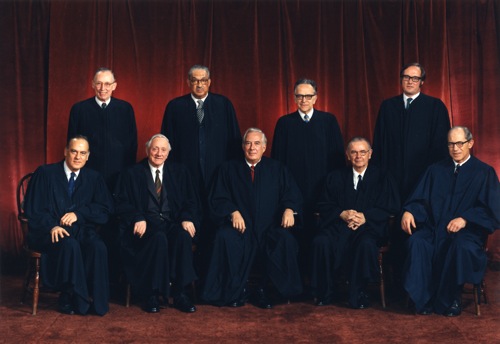
The Justices of the U.S. Supreme Court, 1973. Top row, left to right:
Lewis Powell, Thurgood Marshall, Harry Blackmun, William Rehnquist.
Bottom row, left to right: Potter Stewart, William O. Douglas,
Chief Justice Warren Burger, William J. Brennan, Byron White.

January 22, 1973, 50 years ago: The U.S. Supreme Court announces its decision in the case of Jane Roe, et al. v. Henry Wade, District Attorney of Dallas County -- heretoafter referred as Roe v. Wade for short.

It is the most controversial decision the Court has made since Dred Scott v. Sanford in 1857. And it is a story so big that it overshadows 2 other events on the same day: The death of a former President of the United States, and the Heavyweight Championship of the World changing hands on a spectacular knockout.

In 1968, Norma McCorvey, a 21-year-old Dallas resident, became pregnant for the 3rd time. She had given up her 2nd child for adoption willingly, and was tricked into doing the same for her 1st. She was divorced from the father of her 1st child, and had no means to raise a child.
She sought an abortion, but the law of the State of Texas prohibited in nearly all cases. The only exception was if giving birth would endanger the mother's life. She was referred to attorneys Sarah Weddington and Linda Coffee, who filed a lawsuit in U.S. federal court in March 1970, alleging that Texas' abortion laws were unconstitutional.

To keep her identity a secret, McCorvey was listed in court records with the placeholder name Jane Roe. (Legal placeholder names include John Doe, Jane Doe, Richard Roe, and, in this case, Jane Roe.) The defendant was the District Attorney for Dallas County, Henry Wade, previously best known for having successfully prosecuted Jack Ruby, who had murdered Lee Harvey Oswald before Oswald could be tried for the assassination of President John F. Kennedy.
Three months after filing the suit, on June 2, 1970, Norma McCorvey gave birth to her 3rd child, a girl, and put her up for adoption. A few months later, a 3-judge panel of the U.S. District Court for the Northern District of Texas heard the case, and ruled in her favor. Crawford Martin, the Attorney General of the State of Texas, appealed directly to the U.S. Supreme Court.

It took until January 22, 1973 for the High Court to issue a ruling. It was 7-2 in McCorvey's favor. The reasoning was that the Due Process Clause of the 14th Amendment to the Constitution of the United States provides a "right to privacy" that protects a pregnant woman's right to choose whether to have an abortion.

However, it also ruled that this right is not absolute, and tied the degree of any State's regulation to the trimester of pregnancy which is to be aborted. In other words, the Court provided a loophole which gave anti-abortion activists hope that, one day, the Roe v. Wade decision might be overturned.

The decision was written by Justice Harry Blackmun, who became, to anti-abortion activists, the most hated Justice in the Court's history. He was joined by Chief Justice Warren Burger, and Justices William O. Douglas, William J. Brennan, Potter Stewart, Thurgood Marshall and Lewis Powell.

Dissenting were Justices Byron White and William Rehnquist. Both were Catholic -- but so was Brennan, who supported the aforementioned citation of a right to privacy.

Appointed by Democratic Presidents: Douglas by Franklin D. Roosevelt in 1939, White by John F. Kennedy in 1962, and Marshall by Lyndon Johnson in 1967. The Democrats, ever since, have been the Party favoring abortion rights, but White did not vote that way.

Appointed by Republican Presidents: Dwight D. Eisenhower had appointed Brennan in 1956, and Stewart 1958; while the current President, Richard Nixon, had appointed Burger in 1969, Blackmun in 1970, and Powell and Rehnquist in 1972.

However, Brennan was a Democrat, whom Eisenhower had appointed as a gesture of bipartisanship. Of the other 5, only Rehnquist ruled against the right to an abortion. In 1986, when Burger retired as Chief Justice, President Ronald Reagan rewarded Rehnquist by promoting him to the Chief's chair.

Control of the Supreme Court has been seen as the anti-abortion movement's way of getting Roe overturned. Which is why, in 2016, when hard-core anti-abortion Justice Antonin Scalia died, Senate Majority Leader Mitch McConnell prevented President Barack Obama's appointee to the seat, Merrick Garland, from even getting a hearing in the Senate.

It was also why evangelical "Christian" Republicans, so often hypocritical, were willing to accept Donald Trump, a pathological liar, a man married 3 times and divorced twice, a serial adulterer, a confessor to serial sexual assault, and a man whose words and actions compare very poorly with those of Jesus of Nazareth, as the Republican nominee for President, because they knew he would appoint Justices to the Court that would be acceptable to McConnell, and thus acceptable to them. This allowed the Scalia seat to remain vacant until Trump took office, enabling him to appoint Neil Gorsuch to the seat.

Justice Anthony Kennedy, often the "swing vote" on cases, including the biggest challenge to Roe to that point, Planned Parenthood v. Casey in 1992, surprisingly retired in 2018, and Trump appointed Brett Kavanaugh as his replacement, an alcoholic with, like Trump himself, a record of sexual assault and hatred of women.

And when Justice Ruth Bader Ginsburg died in office in 2020, before Senate Minority Leader Chuck Schumer could do anything about it, McConnell rushed the confirmation of Trump's appointee, Amy Comey Barrett, through the Senate, giving the Court a 6-3 conservative majority that, Court-watchers believed, would overturn Roe when they reached a decision in Dobbs v. Jackson Women's Health Organization

Sure enough, that decision came on June 24, and it did overturn Roe. This angered American women so much that the predicted "Red Wave" of votes that was going to give the Republicans overwhelming control of both houses of Congress was counteracted by "Roevember." The result was that the Republicans did regain control of the House of Representatives, but with a majority of only 4 votes; and the Democrats actually gained a seat in the Senate.

After Roe v. Wade, Henry Wade did not see his reputation take a hit. Liberals didn't blame him for a law in place well before he ever took office, and conservatives did not hold it against him that he lost the case. He retired as District Attorney in 1987, after 36 years, and died in 2001.

Despite having slept around with men, Norma McCorvey more often identified as a lesbian, having spent most of her adult life with a single life-partner, Connie Gonzales, but constantly cheating on her. In 1989, she came forward as Jane Roe, and participated in abortion-rights rallies.

Then, in 1995, she switched sides, becoming an evangelical Catholic -- at least, officially -- and attending anti-abortion rallies. She wrote 2 books, 1 while on each side of the debate, and both of which were exposed for containing lies. She was never really an asset to either side. Apparently, the only thing she truly believed in was publicity.

In 2021, the baby that "Jane Roe" didn't want came forward for an article in the Atlantic Monthly magazine, and a subsequent book by Joshua Prager, The Family Roe. (Prager had gained the cooperation of McCorvey's 1st 2 children and her ex-partner.) 

Shelley Lynn Thornton grew up in the Dallas suburb of Mesquite, Texas, and later in the Seattle suburb of Kent, Washington, knowing that she was adopted and that she had 2 half-sisters living elsewhere. Shortly before her 19th birthday, she was told -- by a "reporter" for the National Enquirer -- who her birth mother was.

She freaked out. Not because she now knew that her birth mother wanted to end her life. But because, even at her age, she knew that both the Enquirer and the right-to-life movement would want to use her. In one of the few decent things the Enquirer has ever done, it kept Shelley's name out of the printed story.

In 1991, Shelley herself became pregnant. She was opposed to abortion, but, to her, "pro-life" meant the fanatics who terrorized women seeking a choice, and blew up clinics, killing people and making themselves hypocrites, and she wanted nothing to do with that label. She didn't want the "Right to Life" movement to use her in any way.

Unlike her mother, she had a supportive boyfriend, and they got married before their son was born. They moved to Tucson, Arizona, and added 2 daughters. She met both of her half-sisters, and got along well with them. But, despite 2 difficult phone calls, years apart, Shelley Thornton never met Norma McCorvey face-to-face.

McCorvey died on February 18, 2017, in the Houston suburb of Katy, Texas, of heart failure, at age 69. In what turned out to be a final interview, what abortion rights activists have called a "deathbed confession," she said she was paid to switch to the anti-abortion side: "I was the big fish. I think it was a mutual thing. I took their money, and they'd put me out in front of the cameras and tell me what to say. That's what I’d say." Making her, I suppose, the Anakin Skywalker of abortion politics.

However unreliable a narrator she may have been, I'll let her have the last word: "If a young woman wants to have an abortion, that's no skin off my ass. That’s why they call it 'choice.'"

Of the 9 Justices on the Court for Roe v. Wade, Rehnquist was the last one on the Court, dying in office in 2005. The last one who voted for reproductive rights was Harry Blackmun, who retired in 1994.

*

January 22, 1973 was a Monday. And Norma McCorvey was not the only Texas resident in the news that day. Former President Lyndon B. Johnson suffered a heart attack at his LBJ Ranch outside Johnson City. (The city was named for his grandfather, and the closest big city is Austin.) He had a private plane on the Ranch, and Secret Service agents loaded him onto it. He was flown to Brooke Army Medical Center at Fort Sam Houston, outside San Antonio, but he was pronounced dead on arrival.
The last known photo

He was 64, and had spent the last 4 years watching Nixon pick apart at his legacy. Actually, while Nixon did dismantle some "Great Society" programs, he kept some, and strengthened others.

That night, at the National Stadium (now named Independence Park) in Kingston, Jamaica, Joe Frazier defended the Heavyweight Championship of the World. His opponent was George Foreman, from Houston. Both men were Olympic Gold Medalists: Frazier in Tokyo in 1964, Foreman in Mexico City in 1968. Both men were undefeated as professionals: Frazier was 29-0, and Foreman, despite being 5 years younger, was 37-0.

In what was known as the Sunshine Showdown (despite taking place at night), Foreman dominated from the opening bell. The rule mandating the fight be ended in the event of 3 knockdowns in 1 round was waived for this fight. Angelo Dundee, Muhammad Ali's trainer, who had also worked with Foreman, was seated at ringside, and, halfway through the 1st round, could be heard on ABC Sports' broadcast yelling, "Frazier's hurt!"

Sitting next to Dundee, Howard Cosell tried to tell the ABC audience what Dundee had said, but couldn't finish it, because Foreman delivered a knockdown blow: "Angie Dundee, Ali's trainer, right next to me, is saying it. You may hear it... Down goes Frazier! Down goes Frazier! Down goes Frazier! The Heavyweight Champion is taking the mandatory 8-count, and Foreman is as poised as can be in a neutral corner!"
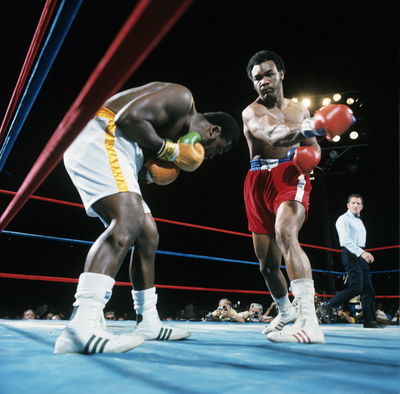
Frazier got up at the count of 2, but took the 8-count, and resumed. With 16 seconds left in the 1st round, Foreman knocked Frazier down again. He got up. Just before the bell rang to end the round, Foreman knocked Frazier down for a 3rd time. There was no "saving by the bell": Had Frazier not gotten up, it would have been over then.

It should have been over then. Instead, referee Arthur Mercante, who had refereed the 1st Ali-Frazier fight in 1971, let the 2nd round begin. Frazier was knocked down a 4th time. Mercante didn't stop it. Frazier was knocked down a 5th time. Mercante didn't stop it. Frazier was knocked down a 6th time. Only then did Mercante stop it. Foreman was the Champion.

In his next fight, on September 1 at Budokan in Tokyo, Japan, Foreman knocked Puerto Rican fighter José "King" Roman out in the 1st round. Next up, on March 26, 1974 in Caracas, Venezuela, Foreman knocked Ken Norton out in the 2nd round.

Roman had never fought Ali. But, now, Foreman had destroyed the only 2 men to defeat Ali as professionals. Yet Ali wanted to fight him to regain the title. People were afraid that Foreman would badly hurt Ali, maybe even kill him. Instead, Ali knocked Foreman out in the 8th round, and proved that he was, indeed, what he had been saying he was: "The Greatest of All Tiiiiiiiime!"

Foreman retired in 1977, became a minister, and, in 1987, returned to boxing to raise money for his church. Discovering that he still had some punching power, he kept at it. He fought Evander Holyfield for the title in 1991, and while he didn't come close to winning, he went the distance and didn't get hurt.

Lots of people, myself included, thought he had proven his point, and that he should stop before he did get hurt. He didn't. In 1994, with the title now in the hands of Michael Moorer, Foreman knocked Moorer out, and, at 45, became the oldest Heavyweight Champion of the World ever.

Monday, January 16, 2023

Last Active Players for Defunct Teams and Leagues

Joe Cirella, an original New Jersey Devil
and the last Colorado Rockie active in the NHL

Major League Baseball:
Boston Braves, 1871-1952: Eddie Matthews, 1968
St. Louis Browns, 1902-1953: Don Larsen, 1967
Philadelphia Athletics, 1901-1954: Vic Power, 1965
Brooklyn Dodgers, 1883-1957: Bob Aspromonte, 1970
New York Giants, 1883-1957: Willie Mays, 1973
"Old" Washington Senators, 1901-1960: Jim Kaat, 1983
Milwaukee Braves, 1953-1965: Phil Niekro, 1987
Kansas City Athletics, 1955-1967: Reggie Jackson, 1987
Seattle Pilots, 1969: Fred Stanley, 1982
"New" Washington Senators, 1961-1971: Toby Harrah, 1986
Montreal Expos, 1969-2004: Bartolo Colón, 2018

National Football League:
Cleveland Rams, 1936-1945: Bob Waterfield, 1952
Chicago Cardinals, 1920-1959: Ken Gray, 1970 
"Old" Los Angeles Chargers, 1960: Ernie Wright, 1972
Dallas Texans, 1960-1962: Len Dawson, 1975
"Old" Oakland Raiders, 1960-1981: Howie Long, 1993
Baltimore Colts, 1953-1983: Rohn Stark, 1987
St. Louis Cardinals, 1960-1987: Mark Royals, 2003
"Old" Los Angeles Rams, 1946-1994: Sean Landeta, 2006
Los Angeles Raiders, 1982-1994: Tim Brown, 2004
"Old" Cleveland Browns, 1946-1995: Matt Stover, 2009
Houston Oilers, 1960-1996: Jon Runyan, 2009
St. Louis Rams, 1995-2015: 2 current, Aaron Donald & Rob Havenstein
San Diego Chargers, 1961-2016: 2 current, Keenan Allen & Joey Bosa 

American Football League (1926): Ray Flaherty, 1935
American Football League (1936-1937): Haven't been able to find rosters
American Football League (1940-1941): John Kimbrough, 1948
All-America Football Conference (1946-1949): Ben Agajanian, 1964
American Football League (1960-1969): Charlie Joiner, 1986
World Football League (1974-1975): Danny White, 1988
United States Football League (1983-1985): Sean Landeta, 2006
XFL (2001): Rod Smart, 2005

National Basketball Association:
Indianapolis Olympians, 1931-1953: Joe Graboski, 1962
Rochester Royals, 1937-1957: Jack Twyman, 1966
Fort Wayne Pistons, 1941-1957: Gene Shue, 1964
Minneapolis Lakers, 1947-1960: Elgin Baylor, 1971
Chicago Zephyrs, 1961-1963: Don Nelson, 1976
St. Louis Hawks, 1955-1968: Paul Silas, 1980 
San Diego Rockets, 1967-1971: Elvin Hayes, 1984 
Cincinnati Royals, 1957-1972: Nate "Tiny" Archibald, 1984
Baltimore Bullets, 1963-1973: Elvin Hayes, 1984
New York Nets, 1968-1977: Julius "Dr. J" Erving, 1987
Buffalo Braves, 1970-1978: Mike Glenn, 1986
New Orleans Jazz, 1974-1979: Rich Kelley, 1986
San Diego Clippers, 1978-1984: Terry Cummings, 2000
Kansas City Kings, 1972-1985: Otis Thorpe, 2001
Washington Bullets, 1973-1997: Juwan Howard, 2013
Vancouver Grizzlies, 1995-2001: Mike Bibby, 2012
"Old" Charlotte Hornets, 1988-2002: Baron Davis and Jamaal Magloire, 2012
Seattle SuperSonics, 1967-2008: 2 current, Kevin Durant, Jeff Green 
New Jersey Nets, 1977-2012: Brooklyn Lopez, active 
New Orleans Hornets, 2002-2012: 2 current, Marco Belinelli, Eric Gordon
Charlotte Bobcats, 2004-2013: 2 current, Kemba Walker, Bismack Biyombo

American Basketball Association, 1967-1976: Moses Malone, 1995

National Hockey League:
Pittsburgh Pirates, 1925-1930: Cliff Barton, 1940
Philadelphia Quakers, 1930-1931: Syd Howe, 1946
"Old" Ottawa Senators, 1902-1934: Flash Hollett, 1946
St. Louis Eagles, 1934-1935: Bill Cowley, 1947
Montreal Maroons, 1924-1938: Herb Cain, 1946
New York Americans, 1925-1942: Pat Egan, 1951
California Golden Seals, 1967-1976: Dennis Maruk, 1989
Kansas City Scouts, 1974-1976: Wilf Paiement, 1988
Cleveland Barons, 1976-1978: Dennis Maruk, 1989
Atlanta Flames, 1972-1980: Kent Nilsson, 1995
Colorado Rockies, 1976-1982: Joe Cirella, 1995
Minnesota North Stars, 1967-1993: Mike Modano, 2011
Quebec Nordiques, 1972-1995: Adam Foote, 2011
"Old" Winnipeg Jets, 1972-1996: Shane Doan, 2017
Hartford Whalers, 1972-1997: Jean-Sébastien Giguère, 2014
Atlanta Thrashers, 1999-2011: current, Zach Bogosian, Andrew Ladd, Evander Kane, Blake Wheeler

World Hockey Association, 1972-1979: Mark Messier, 2004

Saturday, January 14, 2023

January 14, 1973: The Dolphins Finish Undefeated & Elvis Says Aloha

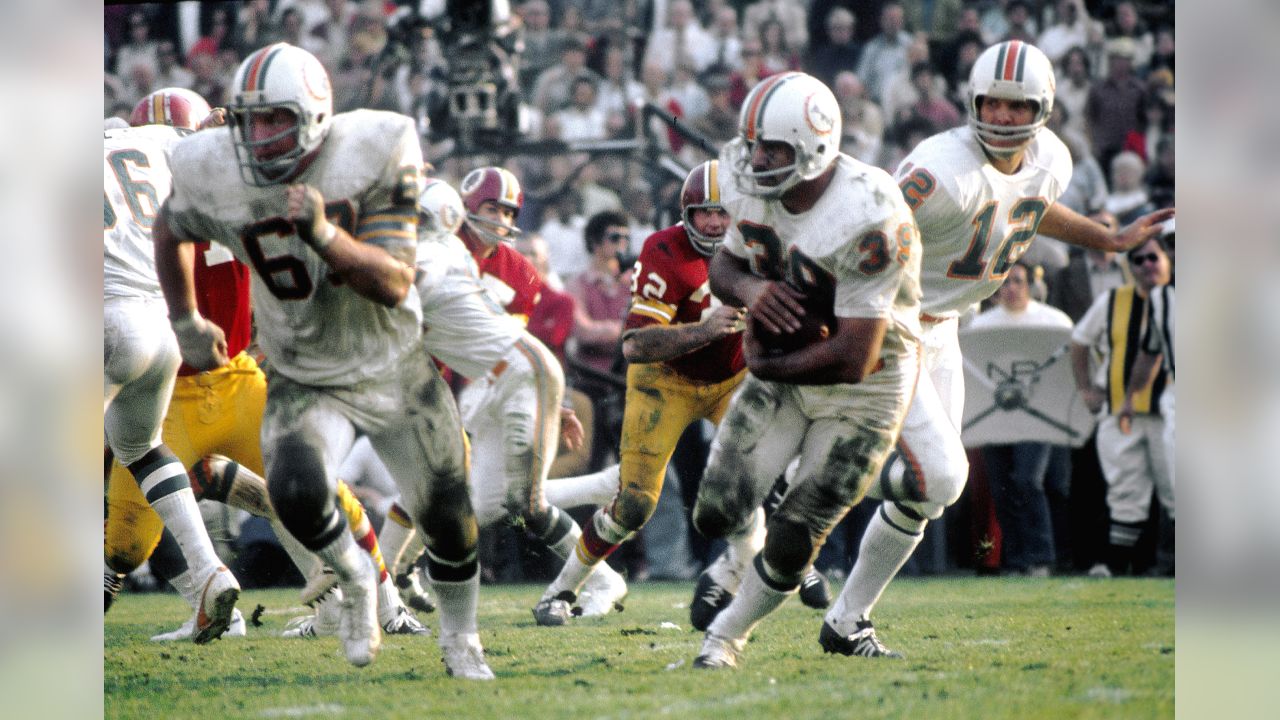
January 14, 1973, 50 years ago: Super Bowl VII is played at the Los Angeles Memorial Coliseum. At stake for both teams was the Championship of the National Football League. At stake for one was the first such title in 30 years. At stake for the other was their first ever, and more: The NFL's 1st undefeated, untied season.

The Miami Dolphins had been founded in 1966. By 1970, they were a Playoff team. For the 1971 season, they reached Super Bowl VI, but lost it to the Dallas Cowboys, 24-3. Now, they were AFC Champions for the 1972 season, and looking for redemption.

Their head coach was also looking for it. Don Shula had been a defensive back for the Cleveland Browns between their NFL Championships of the 1950s, and for the Baltimore Colts before theirs. He became the defensive coordinator for the Detroit Lions, building the 1st defensive line to be known as "The Fearsome Foursome." (The Los Angeles Rams and the San Diego Chargers would also use the name.)

In 1963, he was named head coach of the Colts. He got them into the 1964 NFL Championship Game, but lost to the Browns. In 1968, he won the NFL Championship Game, but lost Super Bowl III to the New York Jets. He was fired after the 1969 season -- and then Don McCafferty took them all the way the next season, winning Super Bowl V.

He was hired by the Dolphins, and built what became known as "the No-Name Defense." This nickname was unfair: While only linebacker Nick Buoniconti has been elected to the Pro Football Hall of Fame, end Bill Stanfill and safeties Dick Anderson and Jake Scott were named to that season's Pro Bowl; and tackle Manny Fernandez would also be an All-Pro.

The offense was led by quarterback Bob Griese, and had 3 good running backs: Larry Csonka, Jim Kiick and Eugene "Mercury" Morris. Griese had receivers Paul Warfield and Howard Twilley, plus Marlin Briscoe, who had previously been one of pro football's earliest black quarterbacks; and tight ends Marv Fleming (who had played for the Green Bay Packers' winners of Super Bowls I and II) and Jim Mandich.

Griese was protected by an offensive line that included center Jim Langer, guards Larry Little and Bob Kuechenberg, and tackles Norm Evans and Doug Crusan. And Garo Yepremian, a bald left-footer from the Mediterranean island nation of Cyprus, was already known as one of the top placekickers in the game.

Shula, Griese, Csonka, Langer, Little, Warfield and Buoniconti have all been elected to the Hall of Fame.

And the regular season couldn't have gone any better. They opened the season by playing the 1st regular season game at Arrowhead Stadium, beating the Kansas City Chiefs, 34-13. They beat the Houston Oilers at home at the Orange Bowl, They struggled to beat the Minnesota Vikings away, 16-14, then beat the New York Jets away and the San Diego Chargers at home.

Their toughest test came at home to the Buffalo Bills, as they had trouble containing O.J. Simpson, and only won 24-23. They rebounded by shutting out the Colts away, beating the Bills 30-16 in Buffalo, and obliterating the New England Patriots 52-0.

Joe Namath and the Jets came to the Orange Bowl, where they had beaten Shula's Colts in Super Bowl III, and held the Dolphins to a 28-24 win. The 'Phins closed by beating the St. Louis Cardinals at home, the Patriots in Foxboro, the New York Giants at Yankee Stadium, and the Colts at home.

The Playoffs were a little more difficult. On Christmas Eve, they beat the Browns at home, 20-14. And on New Year's Eve, they went to Three Rivers Stadium (at the time, home field advantage for the Conference Championships was rotated, rather than given automatically based on best record), and beat the Pittsburgh Steelers 21-7.

That set up a Super Bowl meeting with the Washington Redskins. They had won the NFL Championship in 1937 and 1942, and had lost the NFL Championship Game in 1945. But their reluctance to racially integrate -- they did not do so until 1962, after every other NFL team, every MLB and NBA team, and even 1 NHL team, the Boston Bruins, had done so -- led to a generation of struggle. They integrated, and began to improve, but still didn't make the Playoffs again until 1971.

That was the 1st season as head coach there for George Allen. Unlike Shula, he wasn't much of a player. But, like Shula, he became one of the NFL's top defensive coordinators. In 1963, the Chicago Bears won the NFL Championship and, just as Buddy Ryan as well as head coach Mike Ditka was carried off the field, it was Allen -- not the 68-year-old head coach and owner George Halas -- who was carried off the field. (Ditka was a key player on those '63 Bears.)

Allen got his 1st head coaching job with the Rams, and made them a perennial Playoff team. In 1971, looking for a permanent head coach after the death of Vince Lombardi (who had come out of his Packer retirement to take the Washington reins, and was making progress before he got sick), the Redskins hired Allen.

His idea was "The future is now." He trusted veterans more than rookies. His team became known as "The Over-the-Hill Gang." But the 1972 season proved that they weren't over the hill. Quarterback Billy Kilmer led the NFL in passer rating. The receivers he had to pass to included Charley Taylor (who would become the NFL's all-time leader in receptions), former Packer star Boyd Dowler, and star tight end Jerry Smith. Running back Larry Brown overcame a severe hearing impairment, and was named the League's Most Valuable Player.

As usual, Allen's pride was his defense. He had Verlon Biggs and Ron McDole as ends; Bill Brundige and Diron Talbert as tackles; Jack Pardee, Chris Hanburger and Harold McLinton as linebackers; Pat Fischer and Mike Bass as cornerbacks; and Richie Petitbon (one of his '63 Bears) and Brig Owens as safeties.

The Redskins went 11-3, their losses being 24-23 away to New England, and then, after they were already 11-1 and had clinched the NFC Eastern Division, 34-24 away to the Dallas Cowboys and 24-17 at home to O.J. and the Bills.

As Dick Vermeil later would as head coach of the Philadelphia Eagles, Allen focused like a laser beam on the Cowboys, who in 1966 became the dominant team in the Division that would evolve into the NFC East. As Cowboy defensive end Harvey Martin later put it in an interview, "He had them so high, they were ready to pop. So if you're going to go in there, you better have your guns on." Pretty bold statement to make about Washington, the city where the President of the United States lives, from a man playing in Dallas, a city where a President had recently been shot and killed.

But the Redskins did hate the Cowboys. And so did their fans. The fans were hopped-up about everybody: The current President, Richard Nixon, made the point that, "All anybody cares about in Washington is the Redskins. Nobody cares about the Kennedy Center or the National Gallery of Art." It was true: The city had just lost baseball's Senators, and basketball's Bullets and hockey's Capitals hadn't arrived yet. Sports-wise, the Redskins were it.

And on New Year's Eve, December 31, 1972, 3 hours after the Dolphins had finished off the Steelers, and a few hours before the plane crash that would kill baseball star Roberto Clemente, the NFL Films cameras caught a fan at Robert F. Kennedy Memorial Stadium wearing a Redskin helmet with a single-bar facemask, yelling at the Cowboys, "Die, you dogs, die! Die, you yellow dogs!"

Well, the Cowboys didn't die, but they were completely shut down and humiliated by the game that stood as the masterstroke in the careers of both George Allen and Billy Kilmer: Redskins 26, Cowboys 3. The Cowboys' reign as World Champions, and their 1st glory period, was over, and they went into a transition that allowed them to emerge as Super Bowl winners 5 years later.

So the Redskins were ready to derail the Dolphins' bid for an undefeated season. There was precedent: In 1942, the Bears were undefeated going into the NFL Championship Game, and the Redskins beat them. The Bears were also undefeated going into the Championship Game in 1934, and lost to the Giants.

There had been undefeated seasons in the NFL. In the 1st season, 1920, the Akron Pros went 8-0-3. In 1922, the Canton Bulldogs went 10-0-2. In 1923, the Bulldogs went 11-0-1. In 1929, the Packers went 12-0-1. But that was all before the institution of the NFL Championship Game for the 1933 season, let alone the Super Bowl for the 1966 season. So it had never been done in a full season.

Shula was outwardly calm. But he knew that he was 0-2 in Super Bowls, and had missed his chances as a player with the Browns and the Colts. And he had the flu, a fact he hid from his players, who did notice, as they said in later interviews, that he seemed "neurotic" and "absolutely crazy." Allen was similarly uptight, and accused the media of ruining his team's preparation. The players began to tell each other that they should have left him in Washington.

The year before, when the Dolphins lost Super Bowl VI to the Cowboys, it was the coldest Super Bowl to date, with a kickoff temperature of 39 degrees. (There have been Super Bowls played in domed stadiums, where it was colder than that outside, but not inside.) This time, it was 84 degrees at kickoff. Despite every Super Bowl ever played having been played either in a warm-weather city or under a dome, this remains the highest temperature in the game's history.

The Dolphins scored at the end of each of the 1st 2 quarters. At the end of the 1st, Griese threw a 28-yard touchdown pass to Twilley. At the end of the 2nd, Kiick ran the ball in from 1 yard, to make it 14-0 Miami. The No-Name Defense had limited the Redskins to 72 total yards and only 4 1st downs.

In the 3rd quarter, the Redskins got to the Dolphins' 17-yard line, but Taylor stumbled, and a Kilmer pass bounced off his fingers. Fernandez then sacked Kilmer, and Curt Knight attempted a 32-yard field goal, which went wide right. A successful kick would only have made it 14-3, but it would have given the Redskins a little momentum, with plenty of time to play.

They almost scored a touchdown early in the 4th quarter. Jerry Smith was wide open in the end zone, but Kilmer's pass went awry, and hit the goalpost. (After 1 more season, the NFL moved the goalposts back 10 yards, from the goal line to the end line.) Kilmer tried again, but Scott intercepted him, and returned it 55 yards.

The Dolphins got the ball to the Redskin 34, and on 4th down, Shula thought, "What a hell of a way to remember this game." He sent Yepremian in for a 42-yard field goal. So now, the team that stood to finish 17-0 stood to win 17-0. It was all so... perfect.

But Yepremian's kick was too low, and it was blocked by Brundige, and bounced back to him. Yepremian recovered it. There was still, according to the rules, a chance to gain a 1st down on the play. Brundige bore down on Yepremian, who tried to throw the ball -- with his right hand, despite kicking with his left foot.

What would have happened if he'd thrown with his left hand? We'll never know, but, throwing with his right, the ball went almost straight up, and came down, and bounced off his hands as he tried to catch it himself. Bass caught it for an interception, and he ran down the sideline, and couldn't be caught. Touchdown, Washington. Knight's extra point was good, and, with 2 minutes and 7 seconds left on the clock, it was Miami 14, Washington 7.

Now, suddenly, the game, the title, and the perfect season were all in serious jeopardy, thanks to what became known as "Garo's Gaffe." If the Dolphins didn't hang on and win this game, Yepremian would have become the biggest goat in the history of South Florida sports.

But Allen was a conservative coach, not given to gambling, and he made a historic blunder: He had Knight kick the ball deep. Unlike Jim Haslett to begin the 2nd half for the New Orleans Saints, 37 Super Bowls later, Allen was not willing to try an onside kick, and while there's no guarantee that the 'Skins would have recovered it, it cost him the best chance at a title he would ever have.

But Allen trusted his defense, and, while he was forced to use all his timeouts, plus the 2-minute warning, it almost worked. He forded the Dolphins to punt from their own 36 with 1:14 left. But Kilmer threw 2 incompletions, lost 4 yards on a pass play, and was sacked by Vern Den Herder on the game's final play.

The game was over, and the Dolphins had their perfect season. Scott was named the game's MVP, unusual for a defensive back. The Redskins had nearly as many total yards from scrimmage as the Dolphins, and had more 1st downs and 5 minutes' more time of possession. But the Dolphins' defense had completely shut the Redskins' offense down, as Washington's only score came on special teams.

The Dolphins won their 1973 season opener, extending their winning streak to 18 straight games, and their regular-season winning streak to 16. They won Super Bowl VIII, beating the Minnesota Vikings at Rice Stadium in Houston.

Over the next 11 seasons, Shula would lead them to 2 more Super Bowls, XVII and XIX, but they would lose them both. Shula got them into the 1992 AFC Championship Game, at home, but they lost to the Bills. Through the 2022 season, the Dolphins have never been back to the AFC Championship Game, much less the Super Bowl. Shula retired with 347 wins, more than any coach in NFL history, but with only 2 Super Bowl wins in 6 attempts.

The Redskins remained a contender through the 1970s, but, finally, the Over-the-Hill Gang truly got old. In the early 1980s, new coach Joe Gibbs and general manager Bobby Beathard rebuilt the team, and in 1983, they beat the Dolphins in Super Bowl XVII, winning the franchise's 1st World Championship in 40 years. They lost Super Bowl XVIII, but won Super Bowls XXII and XXVI, making it 4 appearances and 3 wins in 9 years. But they haven't been back since.

Super Bowl VII was the 2nd time the Los Angeles Coliseum had hosted the Super Bowl, after hosting the 1st in 1967. The next 5 Super Bowls to be held in the Los Angeles metropolitan area -- in calendar years 1977, 1980, 1983, 1987 and 1993 -- were held at the Rose Bowl in suburban Pasadena. The NFL instituted a policy that only metro areas with an NFL team could host a Super Bowl (albeit chosen years in advance, in the hopes of assuring a neutral site), so L.A. didn't host one for a long time. But with the restoration to the area of the Rams and the Chargers, in 2022, Super Bowl LVI was played at the new SoFi Stadium in Inglewood.

*

NBC had the rights to cover Super Bowl VII. They also had the rights to air Elvis: Aloha from Hawaii via Satellite. This concert was broadcast all over the world from the Honolulu International Center, now named the Neal S. Blaisdell Center, after the Mayor who got it built. The one major country on Earth that did not broadcast it live was America, because NBC thought it would be too much to ask of their viewers to watch 2 epic events in one day. So they held it back, and broadcast it on April 4, 1973.

Elvis Presley had just turned 38, and had also just finalized his divorce from his wife Priscilla. He came onstage wearing a white jumpsuit with an eagle on the front, an eagle on the back, and a big belt with a double-eagle buckle.
He sang hits from all phases of his career: The early "Memphis Flash" days, his Hollywood exile, and his Las Vegas comeback. As usual, he closed with "Can't Help Falling In Love," which was certainly appropriate on this occasion, because it was used in his 1962 film Blue Hawaii.

It was not one of his better performances. Certainly, he wasn't as into it was he was for his "Comeback Special" in 1968 (also on NBC) or for the Vegas show he did that was included in the 1970 documentary Elvis: That's the Way It Is. He was tired, and the emotional stress of the divorce was weighing on him. He looked like he was still in good shape, but the prescription drugs he was taking had already begun to take their toll. Within 5 years, the King of Rock and Roll was dead.

Tuesday, January 10, 2023

Lovie Smith Appreciation Post

Attend the tale of Lovie Smith. A man you shouldn't tangle with.

Lovie Lee Smith was born on May 8, 1958 in Gladewater, Texas, and grew up in nearby Big Sandy, about 110 miles east of Dallas. He was named for a great aunt, Lavana. He was one of the greatest defensive players that Texas high school football has ever had, and was an All-American linebacker at the University of Tulsa.

He never played professionally, going right into coaching. After returning to his Almas Mater, both Big Sandy High School and Tulsa, he coached at Wisconsin, Arizona State, Kentucky, Tennessee and Ohio State. From 1996 to 2000, he was part of the revival of the Tampa Bay Buccaneers, where he was linebackers coach, helping to make Derrick Brooks a Hall-of-Famer. In 2001, he became the defensive coordinator of the St. Louis Rams, helping them win the NFC Championships, although they lost Super Bowl XXXVI.

In 2004, at a time when there were few black head coaches in the NFL, he was named head coach of the Chicago Bears, and he led them to the 2006 AFC Championship, although they lost Super Bowl XLI. That remains the Bears' only Super Bowl appearance in the last 37 years. He remained their head coach until 2012. He coached the Buccaneers in 2014 and '15. In 2016, he was hired as head coach at the University of Illinois. He led them to a bowl game in 2019, but was fired after a losing season in 2020.

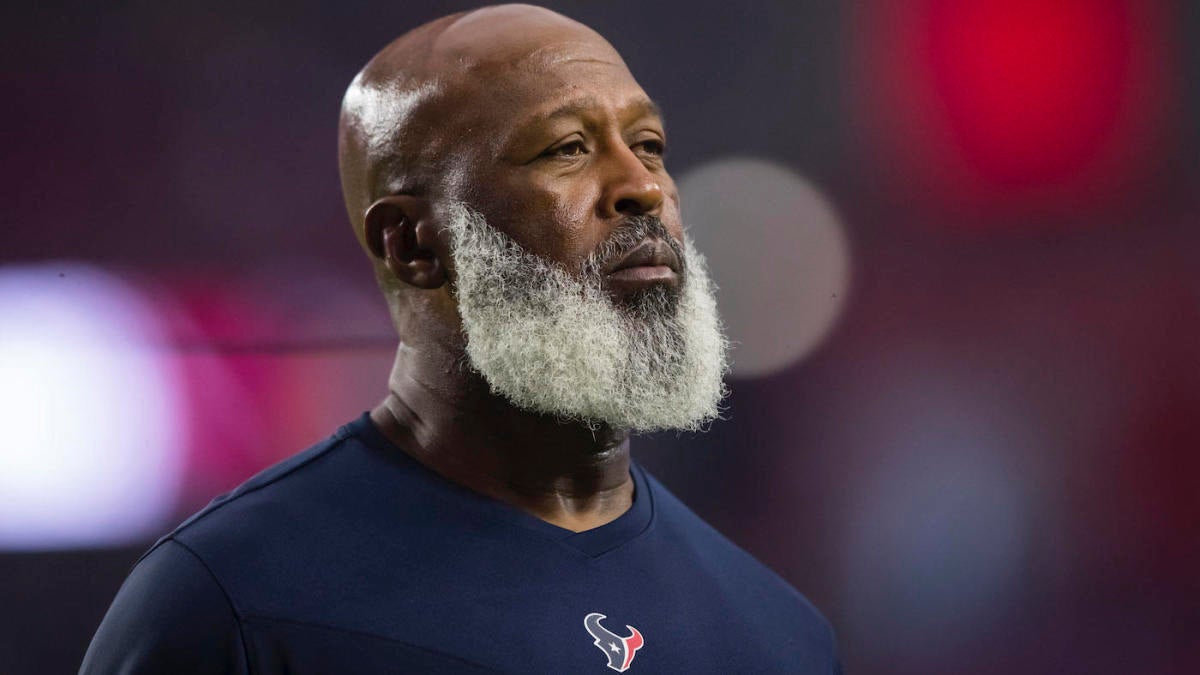
The Houston Texans had interviewed him for their head coaching position in 2012, and hired him as defensive coordinator in 2021, under head coach David Culley. From 2011 to 2019, the Texans had won 6 AFC South Division titles, but were now in rebuilding mode, having lost quarterback Deshaun Watson because they had to drop him after his scandal, and defensive end J.J. Watt after an internal dispute.

Someone in Texans management made the decision to sacrifice at least the next 2 seasons, in the hope of getting big draft picks with which to rebuild. The team finished 4-13 in 2021, giving them the 3rd pick in the 2022 NFL Draft. They used it on a cornerback, Derick Stingley Jr., son of an Arena Football League player and grandson of ill-fated New England Patriots receiver Darryl Stingley. But the Texans really needed a quarterback, and that draft was so weak at that position that only 1 was chosen in the 1st 73 picks.

And Culley, who is black, was made the scapegoat for a poor season, even though he had very little to do with the Texans' struggles. Smith was appointed to replace him, but things were no better. Most of the Texans' problems were in place before Culley, let alone Smith, was there, and there was only so much that Smith could do.

After a season-opening tie with the Indianapolis Colts, the Texans lost 12 of their next 13 games. And 6 of those losses were within one score, so they weren't that far from respectability, if only team management had decided to try a little harder.

The Texans went into their season finale, away to the Colts, with a record of 2-13-1. A loss would have given them the top pick in the 2023 NFL Draft. After the performance he put up this season, including in last night's 65-7 demolition of Texas Christian University, the top pick is likely to be Stetson Bennett, who has now quarterbacked the University of Georgia to back-to-back National Championships.

But Texans management had let Smith know that he would be fired after the game, no matter what. They would go into the 2023 NFL Draft and season with a new head coach. For the 2nd year in a row, they would make the head coach pay for their previous mistakes. At the least, this was a rotten thing to do, to both Culley and Smith. At most, it was a message: We'll hire black coaches to make ourselves look inclusive, but we won't keep them if they lose for us.

Lovie Smith wasn't having it. He knew that if the Texans won their last game, it would be his former team, the Chicago Bears, who also desperately need a new quarterback, who would get the top pick. Lovie followed the lead of a previous black NFL head coach, Herman Edwards, "You play to win the game." More than that, in a great example of what English soccer fans would call "shithousery," he did it to spite the team officials who had set him, and Culley, up for failure. The Texans won, 32-31.

Lovie Smith is a mensch. He has heart, he has guts, and he has just the right amount of pride: Not so much that it would cause his fall, but enough that he will fight for the honor of himself, his players, his team's fans, and his sport. Which, to paraphrase Groucho Marx, is more than the Texans' officials had done.

I don't know what Lovie is going to do next season. I don't know what the Texans are going to do next season. But they are going to do it without either Lovie Smith or Stetson Bennett. And team owners Janice and Cal McNair, and general manager Nick Caserio, have nobody to blame but themselves.

Bravo, Lovie.

Friday, January 6, 2023

The Damar Hamlin Story Exposes the NFL

For nearly 4 full days now, I have resisted writing about what happened to Damar Hamlin of the Buffalo Bills. I wanted to see if there would be improvement in his condition (which there has been); or, to put it politely, not; and, either way, to see what the NFL establishment would do about it.

He was taken to the University of Cincinnati Hospital, following his collapse on the field during this past Monday night's game against the Cincinnati Bengals at Paycor Stadium (formerly Paul Brown Stadium) in Cincinnati.

He attempted to tackle Bengals receiver Tee Higgins, but was hit hard. He was able to get up under his own power, but, within a couple of seconds, fell to the turf. I can't tell from the clip how much the hit had to do with what happened, because I can't tell what happened. It could have been something that would have happened anyway.

Yesterday, after having been intubated, he awakened, and showed no signs of neurological damage. He is breathing on his own. It looks like he is out of the woods. Whether he will ever play again is doubtful.

The game, which was in the 1st quarter, has been officially suspended, a 1st in NFL history. Despite the Playoff implications, the NFL has accepted that the player's life and condition are more important. The League will adjust its Playoff schedule depending on where the Bills and Bengals end up being seeded after this weekend's games. The Bills have clinched the AFC Eastern Division, and the Bengals are likely to win the AFC Northern Division; either could be the top seed in the AFC Playoffs, and thus receive the only bye in the 1st round.


It's not just the injuries. It's not just ripping the fans off with taxpayer-funded stadiums that these billionaires can afford to build themselves, and never miss the money. Ticket prices are exorbitant. So are parking prices. So are concession prices. God forbid your kid wants a jersey or another thingamabob with the team's logo on it.

Someone once pointed out that, with the TV revenue involved, all 16 NFL teams playing home games in a given weekend could keep the fans out, have official attendances of zero, and still make a profit for the week. Because the fans would still watch on television.

Let the record show that I wrote that before COVID proved it true. I continued:

And then there's the perception that the games are rigged. More than any other North American sports league, the NFL has its officials called into question...

NFL fans can't trust the team owners, or the officials, or the League office. And the players are getting killed. Not immediately: While there have been 5 deaths as a result of on-field play in the NFL's 100-year history (counting the AFL), there hasn't been one since Chuck Hughes of the Detroit Lions in 1971. But retired players are dying, and some not dying yet but suffering terribly, from the effects of their playing.

It's actually been 4 players killed. The others have been Stan Mauldin of the 1948 Chicago Cardinals, Howard Glenn of the 1960 New York Titans (Jets), and Stone Johnson of the 1963 Kansas City Chiefs. Mack Lee Hill of the 1965 Chiefs is sometimes counted, but he died in surgery 2 days after an injury. But even if it is only 4, that doesn't reduce the point. I continued:

But we now know things about football that we didn't know before. And then there are the things that we did know, but didn't want to admit. Football changes people. Not just those contractually involved. Fans change.

I attended 18 Phillies home games at Veterans Stadium. Aside from the stadium's bowl sometimes trapping the heat, the team often being bad, and that artificial turf being hideous, my experiences there were good ones. Only once did I ever have a problem with the home fans, and it was a minor, tolerable thing.

I attended 1 Eagles home game there. It was, if you'll pardon the pun, a whole different ballgame. Eagle fans have a reputation for being among the roughest in the League. It is deserved.

Compare Oakland fans for an A's game, where they're passionate, but mostly sane; and for a Raiders game, where they're animals.

Even in the college game, fans get like that. Vandalizing your arch-rival school's statues. Using the kind of language you would never use in polite company. One University of Alabama fan was so mad over losing the "Iron Bowl" to arch-rival Auburn University that he poisoned a pair of trees in downtown Auburn that had become a focal point for the AU community.

So far, we have yet to see an NFL fan do anything like this. But we have seen gun massacres in America. Many of them. How long will it be before a fan takes his frustrations out on fans of his rival team? How long before such a fan drives into the parking lot, whips out an AR-15, and guns down tailgate partiers?

It hasn't happened. But don't tell me it can't.

Maybe the 100th Season is time to come to a painful conclusion: That the National Football League is doing more harm than good, and that the money being made off of it is no longer worth it.

Shut the NFL down. Celebrate this 100th Season, and then shut the League down. Let kids play football in high school and college. And them make them look for work. Let high school and college be what they were always meant to be: Preparations for adult life.

This will not be a popular idea. Too many people have invested too much -- financially and/or emotionally -- to give up pro football.

But it needs to happen. For the players' sake. If your last game is a college bowl game when you're 22, you stand a much better chance of being able to think and move well in your 50s than you do if your last game is an NFL Playoff game when you're 32, or 37, or 40.

The NFL doesn't need to have a 200th Anniversary. Or a 150th. Or a 125th. Or even a 110th.

Let the NFL's 100th Anniversary be its last.

In this, the NFL's 103rd season, my feelings have not changed. If anything, they have deepened.

So here's the best-case scenario: The Bills rebound from this awful occurrence, and give Western New York, which has been hit truly hard the last year, with 2 deadly Winter storms and a racist gun massacre at a supermarket, a lift they could really use: A Super Bowl win.

And then the NFL gets shut down.

It will never happen, of course. There's too much money involved. Not just because the owners are too greedy, but because they have done too good a job of addicting the fans.

It's time for an intervention. And rehab.

Tuesday, January 3, 2023

January 3, 1993: The Buffalo Comeback

January 3, 1993, 30 years ago: The Houston Oilers led the 2-time defending AFC Champion Buffalo Bills, 35-3, with 13:19 left in the 3rd quarter, at Rich Stadium (now Highmark Stadium) in the Buffalo suburb of Orchard Park, New York. To make matters worse, the Bills' Hall of Fame quarterback, Jim Kelly, had been injured earlier in the game, and the Bills were relying on backup QB Frank Reich.

In other words, with a backup at the helm, the Bills had to be a net +32 points over the last 28 minutes of the game, just to tie.

Final score: Bills 41, Oilers 38, in overtime.

It was the greatest comeback in NFL history, and it happened in the Playoffs. It's still the biggest Playoff comeback ever, although a 2022 game saw the Minnesota Vikings erase a 33-point deficit to beat the Indianapolis Colts.

Just 7 days before, at the Astrodome in Houston, the Oilers had beaten the Bills by a whopping 27-3. Which means that, in a little more than a game and a half in a week, they'd outscored the Bills 62-6. That's a high school blowout score.

But the Oilers went into that regular-season finale with a record of 9-6, and had to win just to get into the Playoffs. In contrast, the Bills went in 11-4, having already clinched not just a Playoff berth but a home game in the 1st round. The Bills didn't need to win that game, but the Oilers did. Faced with a Bills team that did have to win, the Oilers probably got overconfident. If you'd hung 62 points on a team in a span of 32 minutes of football, you'd be overconfident, too.

The Oilers were used to playing in the Astrodome, in total climate control. The joke was that the temperature was 72 degrees, with the wind blowing from the north, east, south and west at 1 mile per hour. In Orchard Park that day, it was 34 degrees, and the 14 MPH wind made the temperature 24 with the wind chill factor. And it started to snow. Put it all together, and you have Bills Weather. As Bills head coach Marv Levy told his team in such conditions, "When it's too tough for them, it's just right for us!"

Just as the Dallas Cowboys couldn't quite hold up under "Packer Weather" in "the Ice Bowl" in the 1967 NFL Championship Game, 25 years and 3 days earlier, that other Texas team couldn't hang onto a 4-touchdown lead on the windswept plain just off the shore of Lake Erie.

Unlike Scott Norwood, who, 2 years earlier in Super Bowl XXV, had to kick from 47 yards out on grass, but had great weather for it, Steve Christie's potential game-winner, while just 32 yards away and on turf, was in cold, snow and wind (which is the greatest enemy of any kicker), but went through the uprights.

Christie doesn't get nearly as much credit for winning this game as Norwood gets blame for losing Super Bowl XXV -- and while Christie's kick won only a Wild Card game, there were, as ESPN proved in their Top 5 Reasons You Can't Blame... piece on Norwood, plenty of reasons why he has been unfairly vilified for sending that kick wide right. (They never did an episode on the Bills comeback/Oilers choke.)

Frank Reich stepped in for the injured Kelly, and led 5 touchdown drives in the 2nd half, going 21-for-34 for 289 yards. And, unlike Kelly, who stupidly threw 8 passes over the middle in the last minute of Super Bowl XXV, when he should have been throwing toward the sideline to stop the clock -- to hell with what the Giants' defense was doing, you do not throw over the middle when you need to save time -- in overtime he got the Bills to the Oilers' 15-yard-line, so Christie's field goal would be 32 yards, instead of the 47 yards that Kelly left Norwood to have to kick. Reich had the kind of game that comes just once in a lifetime.

Except it came twice in his lifetime. He had done this before: In 1984, he was quarterbacking the University of Maryland against the University of Miami at the Orange Bowl -- which was an even better home field for them than it was for the Miami Dolphins. (And, by a weird coincidence, UM was Kelly's alma mater, although he was in the USFL at that point.)

Bernie Kosar had led the Hurricanes to a 31-0 halftime lead, and their defense had knocked Stan Gelbaugh out of the game. To be fair, Gelbaugh was only in because Reich himself had been injured a few weeks earlier. But Reich came off the bench, and when it was over, the Terrapins had won, 42-40.

So until 2006, when Michigan State wiped out a 38-3 Northwestern lead to win 41-38, Reich had come off the bench to win the biggest comebacks in the history of both the NCAA and the NFL.

Moreover, the Bills were better than the Oilers. They were, after all, the 2-time defending AFC Champions. They were, after all, at home. As for the Oilers, they had already lost 4 of their last 5 Playoff games, and didn't win another one for another 7 years -- by which point they were the Tennessee Titans.

The Oilers had 3 Pro Football Hall-of-Famers: Quarterback Warren Moon, tackle Bruce Matthews and guard Mike Munchak. The Bills had 5: Kelly, running back Thurman Thomas, receivers James Lofton and Andre Reed, and defensive end Bruce Smith.

It is true that the Bills lost 4 straight Super Bowls, in the 1990 to 1993 seasons. It is also true that they got to 4 straight Super Bowls. Only one other team, the 1971-73 Dolphins, has even gotten to 3 straight.

The Bills had to do this in an AFC East that had Dan Marino's Dolphins, Drew Bledsoe's New England Patriots and a decent Jets side; and in the AFC Playoffs with Moon's Oilers, John Elway's Denver Broncos, Bernie Kosar's Cleveland Browns, Boomer Esiason's Cincinnati Bengals, Marcus Allen's Los Angeles Raiders, Joe Montana's Kansas City Chiefs, and a Pittsburgh Steeler team that had a defense nearly as nasty as their 1970s Steel Curtain. So they always had a tough schedule. Yet they got through it, 4 times in a row.

This loss didn't quite doom the Oilers to having to leave Houston -- you can blame their Astrodome lease and founder-owner Bud Adams' greed for that. Nor did it absolve the Bills for their 4 straight Super Bowl losses. But it did show that they were a team that deserved our respect.

The Oilers didn't blow it, they got beat. Big difference.

One other NFL Playoff game was played that day: The Philadelphia Eagles beat the New Orleans Saints, 36-28 at the Superdome. The shock wasn't that the Eagles won a Playoff game on the road. It's that they did it with Rich Kotite as their head coach.

January 3, 1973: George Steinbrenner Buys the New York Yankees

January 3, 1973, 50 years ago: CBS, the Columbia Broadcasting System, which had bought the New York Yankees for $11.2 million a little over 8 years before, sells the franchise to a consortium led by George M. Steinbrenner III, the 42-year-old native of the Cleveland area who was president of the American Shipbuilding Company.

CBS had far more resources than most tycoons, even one from an industry like shipbuilding -- which wasn't exactly booming in the early 1970s. Yet for all their attempts to "buy a championship," CBS couldn't do it. They didn't even come close.

With the previous regime having gutted the farm system, and the players of the Mickey Mantle generation all seeming to get hurt or old (or both) at once, the Yankees' best finish from 1965 to 1972 was a second-place finish in the American League Eastern Division in 1970, winning 93 games -- a good solid total, but the Baltimore Orioles ran away with the Division, winning 108.

CBS entrusted the running of the Yankees to Mike Burke, a genuine hero of World War II through his service in the Office of Strategic Services (OSS, forerunner of the CIA), and later a successful businessman. But while he loved sports and knew business, he couldn't combine the two.

The Yankees fell behind the crosstown New York Mets both competitively and culturally: Even before the Mets' 1969 "Miracle" World Series, they had become more popular, suggesting that a big chunk of Yankee fandom was people who were Yankee Fans only because the Yankees were winning.

Burke was a good man, but a poor steward of the Pinstripes. It was beginning to look like his best connection to the Yankees was an incidental one, in that Gary Cooper, who played Lou Gehrig in The Pride of the Yankees, played the character based on Burke in Cloak and Dagger

But his deal with Mayor John Lindsay, cut in the wake of the New York Giants football team's decision to leave the City and go to New Jersey, saved the original Yankee Stadium for another 2 generations. So, for all of their respective mistakes, Yankee fans should thank Burke (1916-87) and Lindsay (1921-2000, Mayor 1966-73) for that.

The purchase price was $8.8 million, meaning that, with inflation factored in, CBS probably sold the Yankees at a loss of half the money.

Steinbrenner's group included some interesting names. Nelson Bunker Hunt was a son of oil billionaire and right-wing activist H.L. Hunt; and a brother of Lamar Hunt, who founded the American Football League and the Kansas City Chiefs, and co-founded the Chicago Bulls and Major League Soccer. In 1980, Nelson and brother William attempted to corner the silver market, but that led to a panic on commodity exchanges, and that helped cause the recession of the early 1980s. George knew Hunt through their common love of thoroughbred racing, as both owned racehorses.

Lester Crown, one of the co-founders of the Bulls with Lamar Hunt (who probably met George through Nelson), is the son of the founder of General Dynamics, and was a major banking executive. He has been a great donor to medical causes including a new headquarters for Cook County Hospital
in his hometown of Chicago. (That hospital was built on the site of West Side Park, the Cubs' home before Wrigley Field, and was the basis for the TV show ER.)

John McMullen was a naval engineer, whom George knew from the shipbuilding operation. He served in the Navy during World War II, and the Naval Academy named its hockey rink after him. He sold his stake in the Yankees, saying, "Nothing is so limited as being one of George's limited partners." He then bought another baseball team, the Houston Astros, and a hockey team, the Colorado Rockies. In 1982, he moved the Rockies to the Meadowlands, and they became the New Jersey Devils. His son Peter is now a minority owner of the Devils.

Robert Nederlander is a Broadway producer, and his friendship with George fed George's love of theater, which certainly came into play as Yankee owner on a few occasions.

And then there was John Zachary DeLorean. As an executive with General Motors, he developed 3 of Pontiac's signature cars: The GTO, the Firebird, and the Grand Prix. On the other hand, he also developed 2 of Chevrolet's lesser vehicles, the Vega and the Nova. He founded DeLorean Motor Company and developed the DMC-12, the gull-winged sports car that was customized as the time machine in the Back to the Future movies.


He was arrested for drug trafficking in 1982, but was acquitted, his attorney proving entrapment. However, his legal expenses and the failure of DMC proved his financial undoing.

McMullen and DeLorean both died in 2005, Hunt in 2006. As of January 3, 2023, Crown and Nederlander are still alive, ages 97 and 89, respectively.


When George's consortium bought the Yankees on January 3, 1973, he commanded a press conference, and said that he was bringing in Gabe Paul, the longtime president of the Cleveland Indians, as general manager. George, a native of the Cleveland suburbs, had tried to buy the Indians the year before. He had also owned the Cleveland Pipers of the short-lived American Basketball League in 1961 and '62.


George announced his commitment to building a winner for the Yankee Fans, and for the City of New York. For all that happened afterward, and for all the occasionally screwy ways in which he tried to build a winner could be criticized, his love of the fans and the City could never be seriously doubted.


But he also said this at that presser: "I won't be active in the day-to-day operations of the club at all.  I can't spread myself so thin. I've got enough headaches with my shipping company."


That turned out to be wrong. Very wrong.


Under George, the Yankees rose, winning 5 AL East titles, 3 Pennants and 2 World Championships from 1976 to 1981; fell, rose again but not quite reaching the Playoffs, then fell again as George fell into scandal and was suspended from operating the team; then, with general manager Gene Michael rebuilding the team, rose again, winning 7 AL East titles, 6 Pennants and 4 World Championships from 1996 to 2003. The team won 1 more Pennant and World Series in 2009, before George's death on July 13, 2010, his 38th season owning the team, a team record.