What is a "bearcat"? Is it a bear? Is it a cat? It is neither: It's a creature indigenous to South and Southeast Asia, known there as a binturong, and it resembles a raccoon more than any other North American mammal.
Nevertheless, the official costumed mascot looks more like a cat, and there's a reason for that. During a game against the University of Kentucky in 1914, Norman Lyon, a UC cheerleader and editor of the student paper, countered UK's name, the Wildcats, by citing UC fullback and team captain Leonard Baehr. Because of the pronunciation of this name, like "Bear," he was known as "Teddy." But Lyon got the fans to chant "Baehr-cat."
Eventually, a suited mascot was developed. Up until the 1950s, it was more bear than cat. Since then, it's been more cat. And it's name is simply "The Bearcat."
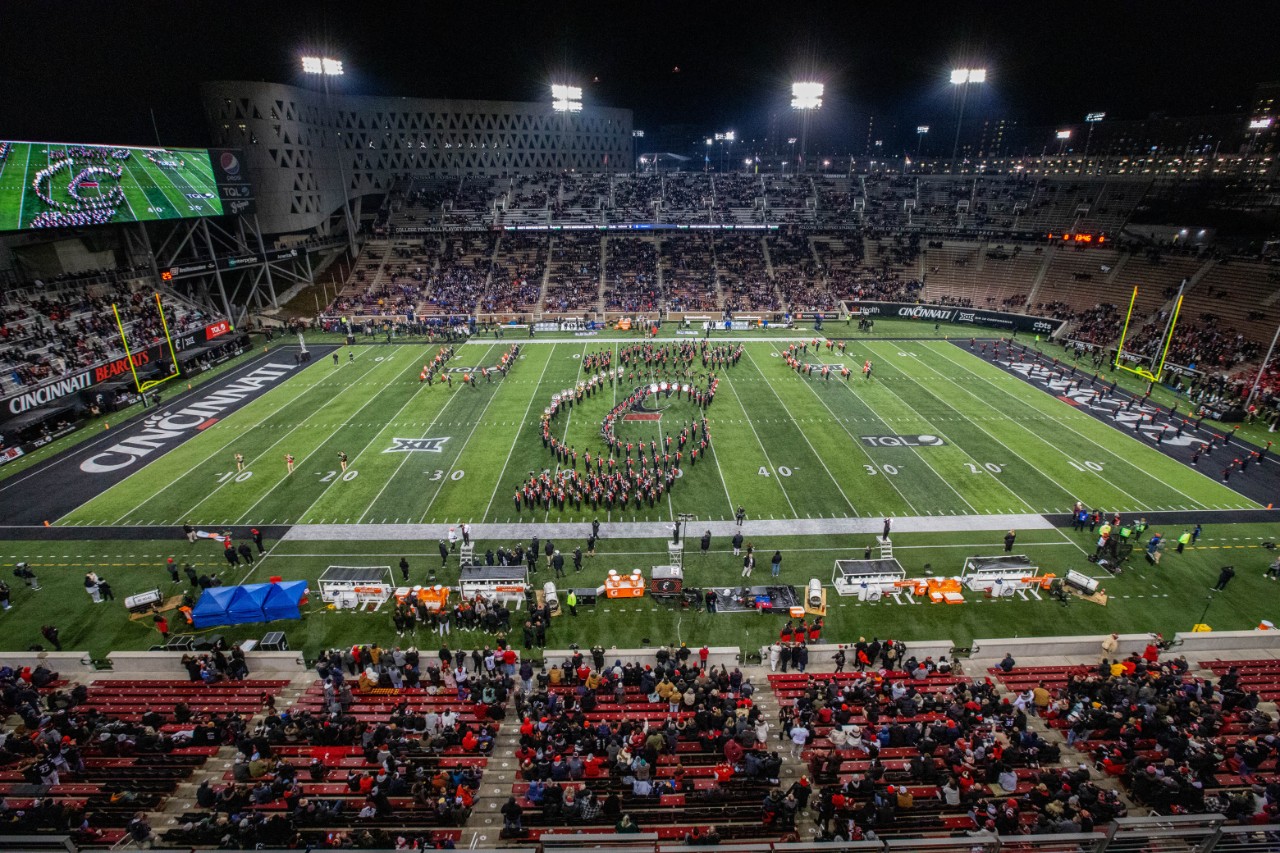
The Bearcat Band plays the National Anthem, and the fight song, "Cheer Cincinnati." Their main formation is an approximation of the team's helmet logo, a letter C that serves as the Bearcat's paw, with 4 claws. While rival Ohio State calls their band "TBDBITL," for "The Best Damn Band In The Land," UC says, "TUCBIDG," meaning, "The UC Band Is Damn Good."
* Great American Ball Park. The Reds have played here since 2003. The park's official address is 100 Joe Nuxhall Way, named for the 1950s-60 Reds reliever and longtime broadcaster who died in 2007. Officially, the streets around it are 2nd Street (3rd base) to the north, Broadway Street (left field, and, no, that's not "Broadway," it's "Broadway Street") to the east, Mehring Way/U.S. Route 27 (right field) to the south and Main Street/Joe Nuxhall Way (1st base) to the west. Extending from the 1st base side is Pete Rose Way.
Great American Ballpark, with Heritage Bank Center next-door
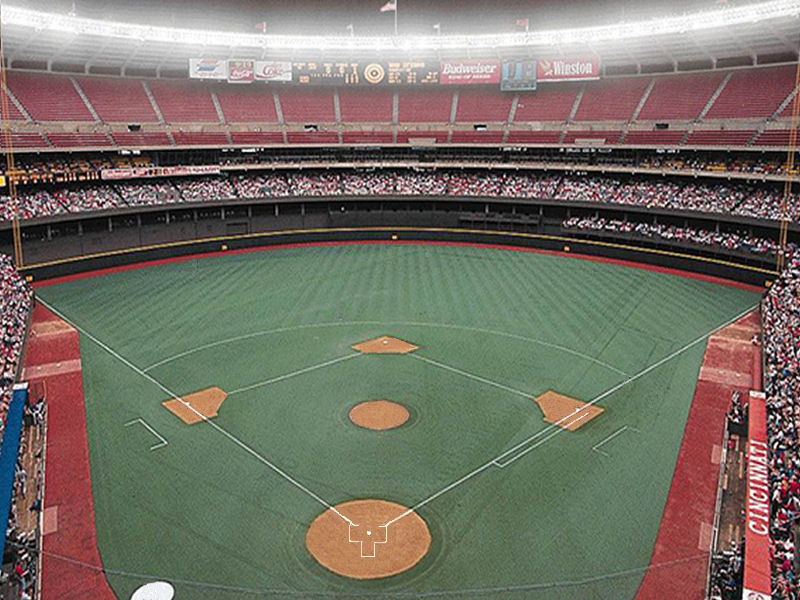
* Site of Riverfront Stadium. The home of the Reds from 1970 to 2002 (known as Cinergy Field from 1996 onward) and the NFL's Bengals from 1970 to 1999 was across Main Street from its baseball replacement, bounded also by 2nd Street, Mehring Way and Vine Street.
Note that they built a stadium on top of a parking deck.
Here, the Reds reached the postseason 9 times (yes, Mrs. Bueller: "Nine times!"), winning 5 Pennants and 3 World Series. The Bengals made the Playoffs here 7 times, winning the AFC Championship in 1981 (beating the San Diego Chargers in what is officially listed as the coldest game in NFL history) and 1988 (on both occasions, going on to lose the Super Bowl to the San Francisco 49ers).
Riverfront was a pioneer in artificial turf, the 1st outdoor stadium in either MLB or the NFL to have it, the 1st to host either league's postseason on it, and the 1st to host a World Series game on it. It switched to real grass for its last 2 seasons, 2001 and 2002.
Nevertheless, a
Thrillist article that came out in 2017 called Riverfront "a Soviet-style concrete and artificial turf dual-sport monolith." Like the other such stadiums opening between 1960 (Candlestick Park) and 1982 (the Metrodome), it served its purpose (saving its city's MLB and/or NFL team), and was rightly demolished.
The National Underground Railroad Freedom Center is now on the site. And just beyond it is the John A. Roebling Suspension Bridge, opened in 1866 and named for its designer, who used it as the basis for his greatest achievement, the Brooklyn Bridge. The bar and restaurant district on the Covington, Kentucky side of the bridge is known as Roebling Point.
* Paul Brown Stadium. Opening in 2000, and named for the legendary coach of the Cleveland Browns and the founding owner and coach of the Bengals, This 65,000-seat stadium has also hosted the University of Cincinnati (including its entire 2014 home schedule while Nippert Stadium was being renovated, thus the Bengals returning the favor of UC letting them play there in their 1st 2 seasons), Ohio State, and Miami University of Ohio.
It's 4 blocks west of Great American Ball Park, and 2 blocks west of where Riverfront Stadium was. Officially, the address is 1 Paul Brown Stadium. It's bounded by 2nd Street, Elm Street, Mehring Way and Central Avenue.
* Heritage Bank Center. Formerly known as the Riverfront Coliseum, The Crown, the Firstar Center, and the U.S. Bank Arena, this building went up across Broadway from Riverfront Stadium (and can be seen from Great American Ball Park) in 1975, and has hosted minor league hockey ever since, including the current Cincinnati Cyclones.
* TQL Stadium. The new stadium for FC Cincinnati opened on May 16, 2021. The address is 1501 Central Parkway, about a mile northwest of downtown, and about 3/4 of a mile east of the site of Crosley Field. Bus 21 or 64. The naming rights are held by Total Quality Logistics, a freight brokerage firm headquartered in the Cincy suburbs.
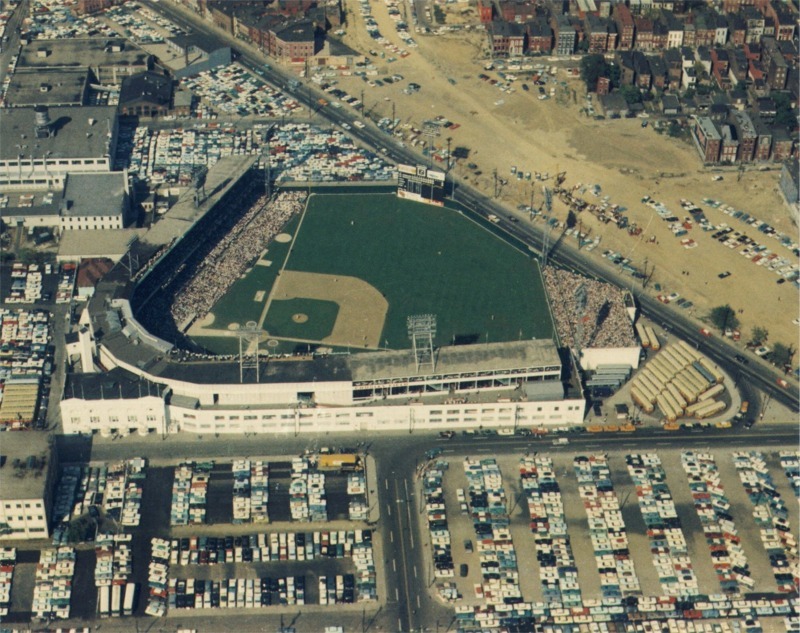
* Crosley Field site. Three different ballparks were at a location bounded by Findlay Street, Western Avenue, Liberty Street and Dalton Avenue, a convenient location for teams coming into the city through the Union Terminal: League Park from 1884 to 1901, the elaborate Palace of the Fans from 1902 to 1911, and the 3rd from 1912 to 1970. First named Redland Field, appliance executive Powel Crosley renamed it for himself when he bought the Reds in 1934.
Photo possibly taken during the 1961 World Series,
since the path for the Expressway has been cleared.
Here, the Reds won the Pennant in 1919, 1939, 1940 and 1961, winning the World Series in 1919 and 1940. The Yankees clinched World Series wins here in 1939 and 1961. Bush Stadium, the former home of the Triple-A team in Indianapolis, stood in for it and Comiskey Park in
Eight Men Out, the film about the Black Sox scandal.
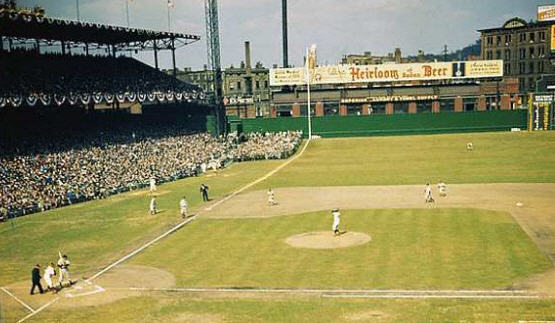
Best known as the first big-league ballpark with lights, in 1935, it had an infamous incline, a.k.a. the "terrace," that was trouble for left fielders; a building behind left field with an ad for the Superior Towel and Linen Service, nicknamed the Laundry Roof, which was torn down in 1960 to make way for Interstate 75 and a rerouted U.S. Route 52, the Mill Creek Expressway; and a right field bleacher section known as the Sun Deck for day games and the Moon Deck for night games.
The "terrace," and the "laundry roof" before its demolition in 1960
Crosley was also home to an NFL team named the Cincinnati Reds in 1933 and '34. There was also a Cincinnati Celts, pronounced with a hard C unlike the Boston basketball team, that played in the NFL from 1920 to 1923, but they were a traveling team, playing no home games.
The Beatles played there on August 21, 1966, and, in one of the ballpark's last events, the Cincinnati Pop Festival was held there on June 13, 1970, featuring Iggy & the Stooges, Mountain, Grand Funk Railroad, Alice Cooper, Traffic, Bob Seger and Mott the Hoople.
Note the terrace in left field, and the Sun Deck in right field
The park was demolished in 1972. An industrial park now stands on the site, a 15-minute walk from Union Terminal. The Number 27 and 49 buses will get you Linn and Findlay, a 7-block walk (counting I-75) from the site.
* Blue Ash Sports Center. A replica of Crosley Field was built in 1988 in suburban Blue Ash, complete with a few original seats. The field's dimensions are the same, and it includes a left-field terrace. The scoreboard shows the correct information (and advertising signs) from the last game, a 5-4 Reds win over the San Francisco Giants on June 24, 1970. The light towers don't look the same, but they are in the right places.
There is, however, no laundry roof behind left field or Sun Deck behind right field. Edd Roush and Ted Kluszewski are dead, and Frank Robinson and Johnny Bench won't show up -- although Pete Rose might, if you offer him enough money.
"New Crosley" is the centerpiece of the Blue Ash Sports Center, which also includes 10 other baseball fields and 2 soccer fields. 11540 Grooms Road, 16 miles northeast of Fountain Square, just inside Interstate 275, Cincinnati's "beltway." Reachable by car only
As for the original 1869 Red Stockings, they played at the Union Cricket Club Grounds, a field with a stand for about 4,000 people. The Union Terminal was built on the site, so if you do come into Cincinnati by train, you're already on the birthplace of professional baseball. 1301 Western Avenue. Bus 1 from downtown.
* Fifth Third Arena. Formerly the Myrl H. Shoemaker Center, the new home of the UC basketball team is adjacent to Nippert Stadium. It seats 13,176 and opened in 1989. The UC Baseball Stadium is also adjacent. It opened in 2004, and in 2006 it was named after UC donor, former Reds owner, cheapskate and Nazi sympathizer Marge Schott. Apparently, the University thought her money was as good as anyone else's. Then again, they also stood by head basketball coach Bob Huggins for years, despite his recruiting violations and drunken driving. In 2020, 16 years after Schott's death, her name was taken off the facility, and it is once again simply "UC Baseball Stadium."
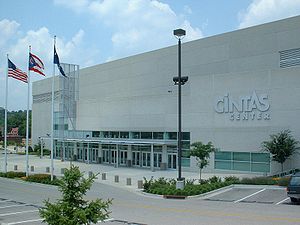
* Cintas Center. Opening in 2000, this is the home of Xavier University basketball. Its tight quarters, seating only 10,250, make it one of the toughest arenas in the country for a visiting team.
And when the Xavier Musketeers and the UC Bearcats play each other, well, let's just say you should pick another game to attend. Since there's no other intracity rivalry of any consequence in Cincinnati (unless you count high school football), this game gets the kind of treatment that Duke-North Carolina, Louisville-Kentucky, and English soccer "derbies" get. As the great college football broadcaster Keith Jackson used to say, "These two teams just... don't... like each other." 1624 Herald Avenue at Clenay Avenue, on the XU campus. Number 4 bus.

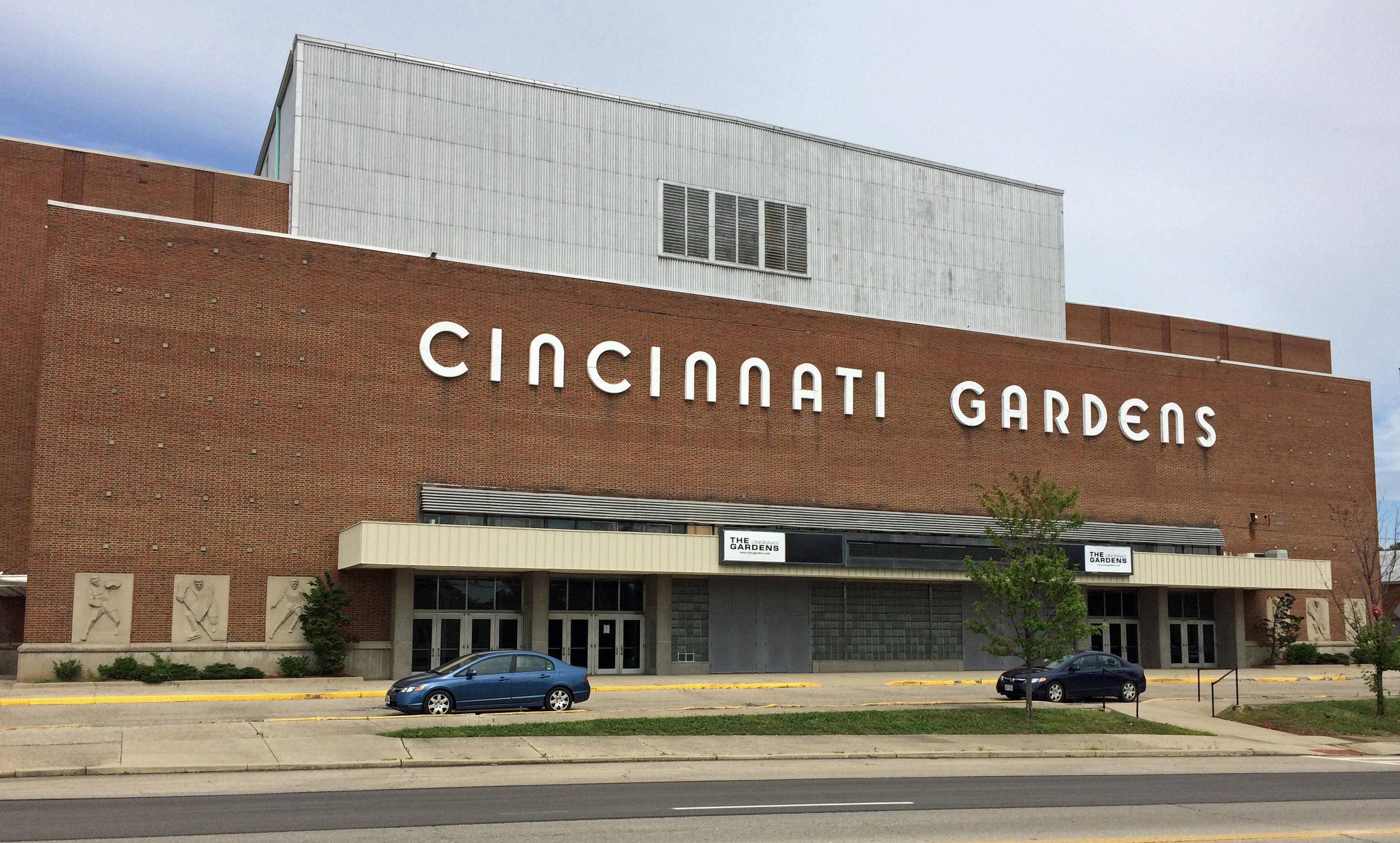
* Site of Cincinnati Gardens. Seating 10,208 people, this was one of the oldest surviving indoor sports arenas in North America, opening in 1949 and hosting the NBA's Cincinnati Royals from 1957 to 1972. Oscar Robertson and Jerry Lucas went from there to Hall of Fame careers, although neither won a title with the Royals. (The Big O did so with the 1971 Milwaukee Bucks, Lucas with the 1973 Knicks.) The Royals moved to Kansas City (and, due to the baseball team having the same name, became the Kansas City Kings, and, in 1985, the Sacramento Kings). The Gardens hosted the 1st nationally-televised NBA game, on January 3, 1965. with the Royals losing to the Boston Celtics, 89-85.

A succession of minor league hockey teams has played there, and it hosted arena football, too. Heavyweight Champion Ezzard Charles, a city native known as the Cincinnati Cobra, defended the title there against Nick Barone on December 5, 1950. The Gardens played host to the Beatles on August 27, 1964; and to Elvis on November 11, 1971 and June 27, 1973.
The Gardens was demolished in 2018, so that property for "light manufacturing" can be built. 2250 Seymour Avenue at Langdon Farm Road, on the northeast side of town, near the Seymour Plaza, Swifton, and Hillcrest shopping centers. Number 43 bus.
Currently without an NBA team,
a recent New York Times article shows basketball allegiances around the country. Since most people in Southern Ohio would rather vote for a Democrat than support a Cleveland-based team, the Cavaliers are not popular here, not even with the now-ended return of LeBron James. The Miami Heat, Los Angeles Lakers and Chicago Bulls were the top 3 choices in that article, although the Heat have no doubt fallen off dramatically without LeBron.
A recent Business Insider article shows the most popular hockey team in each State. Although the Columbus Blue Jackets, as you might guess, lead Ohio, neighboring Kentucky is led by the Nashville Predators, and neighboring Indiana by the Chicago Blackhawks.
It's 109 miles from downtown Cincinnati to Ohio State, 82 miles to the University of Kentucky, 103 miles to the University of Louisville, and 130 miles to Indiana University. And it's 52 miles from downtown Cincinnati to the University of Dayton, whose 13,435-seat University of Dayton Arena (I know, not a very imaginative name), opened in 1969, has hosted more NCAA Tournament games that any other building: 119. (No Final Four has ever been held in Ohio, and none probably ever will, unless they end up putting a dome on Paul Brown Stadium, FirstEnergy Stadium in Cleveland, or Ohio Stadium in Columbus.)
Elvis sang at the University of Dayton's old Fieldhouse on May 27, 1956, and at its "new" Arena on April 7, 1972; October 6, 1974; and October 26, 1976. He also sang at the Hobart Arena in Troy, 77 miles north of Cincinnati and 23 miles north of Dayton, on November 24, 1956.
The Dayton Triangles were an early pro football team, playing from 1913 to 1929, first in the Ohio League -- winning the title in 1913, 1914, 1915 and 1918 -- and then from 1920 to 1929 in the NFL. They were named for Triangle Park, at the confluence of the Stillwater and Miami Rivers, where they erected a 5,000-seat stadium. The Jim Nichols Tennis Center is now on the site. 2424 Ridge Avenue.
But from 1923 onward, they only won 5 games, as the better players didn't want to go to a city as small as Dayton. (Green Bay, the only surviving small city from the NFL's early days, had... other forms of entertainment to lure players.) Then they became... a New York team, being bought by Bill Dwyer, owner of hockey's New York Americans, moved to Ebbets Field and becoming the NFL version of the Brooklyn Dodgers.
Through a convoluted series of transactions, today's Indianapolis Colts are descended from the Dayton Triangles, though not officially recognized as such by the NFL. In other words, if the Colts tried to put up banners saying "World Champions 1913, 1914, 1915, 1918," the NFL wouldn't count it.
In 1856, the 1st university owned and operated by African-Americans was founded: Wilberforce University in Wilberforce, Ohio, about 60 miles northeast of Cincinnati, 20 miles east of Dayton, and 60 miles southwest of Columbus. Central State University, another historically black college and university (HBCU), was founded in Wilberforce in 1887.
Central State is currently in NCAA Division II. Wilberforce has dropped all the way into the NAIA. Wilberforce won the National Championship of black college football in 1931. Central State has won it 8 times: 1948, 1983, 1986, 1987, 1988, 1989, 1990 and 1992.
* Spring Grove Cemetery. If you're a visiting Met fan, you won't care about this. But if you're a visiting Yankee Fan, Spring Grove is the final resting place of Yankee Hall-of-Famers Miller Huggins (a Cincinnati native who played for the Reds) and Waite Hoyt (who broadcast for the Reds.)
Also buried there: Several Generals of the American Civil War, including Joseph Hooker; 4 U.S. Senators, including Salmon P. Chase; 3 Justices of the U.S. Supreme Court, including Chase, who served as Chief Justice; Nicholas Longworth, Speaker of the U.S. House of Representatives and husband of Alice Roosevelt Longworth, daughter of President Theodore Roosevelt; several members of the Taft family, including both of President William Howard Taft's parents, Alphonso and Louise, and his brother, Mayor Charles Taft II; Charles Fleischmann, founder of the yeast company that bears his name; Bernard Kroger, founder of the supermarket chain that bears his name. William Procter and James Gamble, founders of the Cincinnati-based company that bears their names, and several members of their families, including Nippert Stadium namesake James Gamble Nippert.
4521 Spring Grove Avenue. Number 20 bus to Winton Road & Froome Avenue, then a left on Gray Road.
Weeb Ewbank, the only man to coach the Jets to a Super Bowl win, is buried at Oxford Cemetery in Oxford, home to his alma mater, Miami University. (Not the one in Florida -- this Miami came first.) 4385 Oxford Millville Road, about 40 miles northwest of Cincinnati.
Cincinnati isn't a big museum city, but it is a Presidential birthplace, very nearly a Presidential birthplace twice over, and a Presidential burial place. The William Howard Taft National Historic Site, where the 27th President of the United States and the 10th Chief Justice of the Supreme Court of the United States was born and lived the first 25 years of his life, is at 2038 Auburn Avenue on the north side of town. The same Number 43 bus that would take you to Cincinnati Gardens would take you there.
The tomb of William Henry Harrison, the 9th President, who famously won the Battle of Tippecanoe (near Lafayette, Indiana and Purdue University) against Indians (not the Cleveland variety) in 1811 and died only a month after becoming President in 1841, is 16 miles west of downtown in North Bend.
A 10-minute walk from the Tomb is a house at Symmes & Washington Avenues, where "Old Tippecanoe" lived, and his grandson Benjamin Harrison, the 23rd President (1889-93), was born. The Number 50 bus will get you within 2 miles of these sites.
The 1856 Democratic Convention was held at Smith and Nixon's Hall. (There is no connection to the family of President Richard Nixon.) The Renaissance Cincinnati Downtown Hotel is on the site today. Former Secretary of State James Buchanan was nominated for President, and he won, but his Administration was possibly the most disastrous in the nation's history. 36 E. 4th Street at Walnut Street.
The 1876 Republican Convention was held at Exposition Hall. Ohio's sitting Governor, Rutherford B. Hayes, was nominated for President, and "won" the election in "The Fraud of the Century." But the Hall had a bad roof, and was replaced. Cincinnati Music Hall opened in 1878, and, in 1880, the Democrats held their Convention there, nominating Civil War General Winfield Scott Hancock, who lost an incredibly close race to Congressman James Garfield. Music Hall still hosts concerts. 1241 Elm Street at 14th Street, downtown, across from Washington Park.
As I mentioned, the Underground Railroad Museum is on the site of Riverfront Stadium, between the ballpark and the football stadium. Since Cincinnati was on the north side of a river between the free State of Ohio and the slave State of Kentucky, it was a major point on the Underground Railroad. The Cincinnati Museum Center is on the grounds of the Union Terminal.
The Cincinnati Art Museum is at 953 Eden Park Drive, in Johnston Park. The Taft Museum of Art is closer to downtown, at 316 Pike Street. The Number 1 bus will take you to each of them.
The tallest building in Cincinnati is the Great American Tower at Queen City Square, at 660 feet and opening in 2010. 301 E. 4th Street. It surpassed the Carew Tower, a 574-foot Art Deco building at 441 Vine Street, which had been the tallest in town since 1931. (No, it wasn't named for Baseball Hall-of-Famer Rod Carew. Joseph T. Carew had operated the Mabley & Carew department store on the site.)
The transmission tower seen at the beginning of WKRP in Cincinnati belonged to the city's NBC affiliate, WLWT-Channel 5, even though the show was on CBS. The tower has since been dismantled. The building shown as the home of WKRP and referred to on the show as the Osgood R. Flimm Building is the Cincinnati Enquirer Building at 617 Vine Street, just off Fountain Square, so it was (and remains) a media center in real life.
The show was created by Hugh Wilson (who also wrote the opening theme song, sung by Steve Carlisle, and directed the Police Academy movies), and was based upon his experiences working in advertising sales at an Atlanta Top 40 station, with the Gary Sandy character of Andy Travis based on himself. The New WKRP in Cincinnati, which ran in syndication from 1991 to 1993, featured some of the original characters, while the others were each brought back as guest stars at least once.
Cincinnati did have, and still has, a radio and a TV station with the call letters WKRC. CBS owns it now, but didn't when WKRP was running. WKRC's AM frequency is 550.) In 2008, an unrelated independent TV station in Cincinnati, WBQC-LD, took advantage of local nostalgia for the sitcom, promoting its conversion to digital broadcasting by rebranding as "WKRP-TV in Cincinnati."
As far as I can tell, the only other TV show set in Cincinnati has been Harry's Law, starring Kathy Bates as lawyer Harriet "Harry" Korn, which was recently canceled after 2 seasons. There was a series titled John from Cincinnati that ran on HBO in 2007, but it was set in Southern California.
On The West Wing, White House Press Secretary, and later Chief of Staff, Claudia Jean "C.J." Cregg is from Dayton, Ohio. So is her portrayer, Allison Janney. So is Martin Sheen, who played the President on the show, Jed Bartlet.
Aside from Eight Men Out (filmed, as I said, in Indianapolis), the best-known movie set in the city was Rain Man. A few other movies had scenes filmed there, including the sports-connected films Summer Catch (the final scene, where Freddie Prinze Jr.'s character makes his big-league debut at GABP and gets taken deep by Ken Griffey Jr. on his very 1st pitch), Seabiscuit and Mr. 3000.
*
Cincinnati calls itself the Queen City of the Midwest, and thinks of itself as a good, solid, family town. Read: They'd rather slit their economic throats and condemn their women to no say in if and when to have a child than vote for a liberal for national or Statewide office. Although they have elected mostly Democratic Mayors including, in 1977, Jerry Springer. (No joke.)
.png)