Friday, November 20, 2020

November 20, 1960: Chuck Bednarik Knocks Frank Gifford Out

November 20, 1960, 60 years ago: The New York Giants and the Philadelphia Eagles, arch-rivals since the Eagles' founding in 1933, play at Yankee Stadium. The winner was probably going to win the NFL's Eastern Division and play in the NFL Championship Game, as the Giants had in 3 of the last 4 years. Since the hosting alternated between the East and West winners in those days, the winner would also host the title game.

Some cities, like Los Angeles and Miami, like their sports heroes to be flashy. Others, like Philadelphia and Chicago, prefer them to be tough. Blue-collar. They will accept failure, but they will not accept failure to try. They understand it if you fall, as long as you get back up. New York likes to have it both ways: Men like Joe DiMaggio, Joe Namath, Walt "Clyde" Frazier, Derek Jeter.

And one of the flashiest New York athletes was Frank Gifford, Hall of Fame running back for the Giants in the 1950s. Until 1960, it never would have occurred to anyone to call Gifford "tough." What they called this handsome devil out of Bakersfield, California and the University of Southern California was "the Golden Boy." He was already the most popular football player in New York history, so much so that, in the off-season at Yankee Stadium, he got Mickey Mantle's locker.

Chuck Bednarik was tough. How tough was he? He came out of still mill country in Northeastern Pennsylvania, and served as a waist gunner on B-24 bomber in World War II. But he was also smart: He got into the University of Pennsylvania in Philadelphia, and the Ivy League doesn't give athletic scholarships.

He was a rookie on the Eagles' NFL Championship team of 1949, and played center and linebacker for them, even after the switch to two-platoon football. He was "the last of the 60-minute men." Of course, in those days, athletes were paid so little that it was necessarily to get off-season jobs. He sold concrete, and that, rather than his toughness, that earned him the nickname "Concrete Charley."

Both teams had toughness. But the Giants embraced flashiness, while the Eagles ignored it.

The Giants led 10-0 at the half, but blew it. In the 4th quarter, the Eagles' Jimmy Carr picked up a fumble and returned it 38 yards for a touchdown, making it 17-10 Eagles.

With the clock running out, George Shaw, filling in for injured quarterback Charlie Conerly, threw a pass toward Gifford at midfield. Gifford caught the pass, but Bednarik arrived at the same time, and he flattened Gifford, who fumbled. The Eagles recovered.

On the film, this doesn't look like an especially devastating hit. I've seen much worse. What made this the most famous hit in NFL history -- aside from the fact that it was in New York, and involved a New York team, and was seen by a national TV audience -- was how Chuck reacted.

The film shows him reacting to the fumble by jumping around and clapping his hands. Then he pumped his fist, and issued what became his catchphrase: "This fucking game is over!" Which, for all intents and purposes, it was. The final score was, indeed, 17-10 Eagles.

But it was the photograph that proved devastating. It showed Bednarik standing over Gifford, pumping his fist. Gifford is lying on the ground, motionless. Bednarik spent the last 54 years of his life explaining that he didn't even realize Gifford was motionless on the ground in front of him, that he was celebrating the Eagles wrapping up a big win, not the fact that he'd knocked Gifford out. He said he didn't even realize he'd knocked Gifford out.

Legend has it that Gifford was knocked out because, despite wearing a helmet, he hit his head on the frozen grass at Yankee Stadium. This couldn't be true: According to Pro-Football-Reference.com, it was 49 degrees at gametime -- not a particularly notable temperature for mid-November New York, and hardly cold enough to freeze the field.

Gifford was taken to the Giants' locker room. Also taken to the locker room for first aid was a security guard who had a heart attack. Frank's first wife, Maxine, didn't know this, and when she went down to the locker room to see Frank, she heard someone say, "He's dead" -- meaning the security guard. When the guard was wheeled out on a stretcher, with his face covered by a sheet, reporters saw this, and thought it was Gifford.

The rumor began to spread that Bednarik had killed him. And when the photo was seen in newspapers across the country the next day, Bednarik looked like a monster, celebrating his "kill."

It got worse. Bednarik went to see Gifford in the hospital the next day, and was told Gifford couldn't receive visitors. But a new rumor circulated, that Bednarik wouldn't see Gifford. It wasn't that he wouldn't, it was that he couldn't.

Gifford missed the rest of the season, and decided to retire at age 30. But he missed playing, and returned in 1962, switching to receiver for safety reasons. He played 3 more seasons and retired again, becoming one of football's greatest broadcasters.

Gifford always said he never held it against Bednarik. Bednarik said he was tired of people remembering him mainly for one thing. "It was always, 'Oh, you're the guy! You're the guy! You're the guy that got Frank Gifford!'" He was also tired of Howard Cosell, on Monday Night Football, seeing a hard hit, and turning to Gifford and saying, "Just like Chuck Bednarik blindsided you at Yankee Stadium, Giffaroo!"

"Blindsided, my fanny! It was a clean hit," he always said. And it was: Like the infamous Denis Potvin hit on Ulf Nilsson in 1979, or Scott Stevens leveling Eric Lindros in 2000, no penalty was called on it. (And, yes, this profane man would say, "fanny," not "ass." In America, "fanny" means rear end. In Britain, it means the other side, of a woman.)

Both men died in 2015. Bednarik had been dealing with dementia for a few years, almost certainly induced by all that head contact in football. Gifford's 3rd wife, entertainer Kathie Lee Gifford, had also begun to notice him slipping. He, too, was a victim of football-induced head trauma. And that would have been the case even if Bednarik had merely tackled him that day, rather than outright knocking him out.

*

November 20, 1960 was a Sunday. These were the other NFL games played that day:

* The football version of the St. Louis Cardinals, who had been in Chicago until this season, beat the Washington Redskins, 26-14 at Griffith Stadium in Washington.

* The Pittsburgh Steelers beat their arch-rivals, the Cleveland Browns, 14-10 at Forbes Field in Pittsburgh.

* The Chicago Bears beat the Detroit Lions, 28-7 at Wrigley Field in Chicago.

* The Los Angeles Rams beat the Green Bay Packers, 33-31 at Milwaukee County Stadium.

* The San Francisco 49ers beat the Dallas Cowboys, 26-14 at the Cotton Bowl in Dallas. The Cowboys, a 1st-year expansion team, went 0-11-1 that 1st season. Their only non-loss was a tie against the Giants at Yankee Stadium.

* Since there were now 13 teams in the NFL, one team had to have a bye week every week. This week, it was the Baltimore Colts.

This was the 1st season of the American Football League. These were their games on the day:

* The Houston Oilers beat the Denver Broncos, 20-10 at Jeppesen Stadium in Houston.

* The Buffalo Bills beat the Los Angeles Chargers, 32-3 at the Los Angeles Memorial Coliseum.

* The Boston Patriots, the Dallas Texans, the New York Titans and the Oakland Raiders -- the teams now known as the New England Patriots, the Kansas City Chiefs, the New York Jets and the Las Vegas Raiders -- had irregular schedules, and did not play on November 20.

There were 2 games in the NBA. The Boston Celtics beat the Cincinnati Royals, 120-103 at the Cincinnati Gardens. And the Los Angeles Lakers beat the Detroit Pistons, 135-131 at the Olympia Stadium in Detroit. Elgin Baylor scored 52 points for the Lakers.

And the entire NHL, the "Original Six," was in action. The New York Rangers lost to the Detroit Red Wings, 4-3 at the old Madison Square Garden. The Toronto Maple Leafs beat the Boston Bruins, 3-2 at the Boston Garden. And the Montreal Canadiens and the Chicago Black Hawks played to a tie, 1-1 at the Chicago Stadium.

Wednesday, November 18, 2020

Top 5 Reasons You Can't Blame the Minnesota Twins for Not Re-Signing David Ortiz

Who's this skinny guy? The name doesn't sound familiar.

November 18, 1975: David Américo Ortiz Arias is born in Santo Domingo, the capital of the Dominican Republic. Under the name "David Arias," he was drafted by the Seattle Mariners in 1992. In 1996, he was traded to the Minnesota Twins, and began using the name "David Ortiz."

On December 16, 2002, Twins general manager Terry Ryan released him. They haven't won a postseason series since, and haven't won a postseason game since 2004.

On January 22, 2003, Ortiz signed as a free agent with the Boston Red Sox. From this date onward came 482 of his 541 career home runs, all 10 of his All-Star Game appearances, all 7 of his Silver Slugger Awards, all 3 of his RBI leaderships, and all 3 of his World Series wins.

At the time, Torii Hunter was a star center fielder for the Twins. He once told MLB.com, "The worst mistake Terry Ryan ever made was to non-tender David Ortiz. Boston got a diamond in the rough in 2003, and gave him a shot. He led those boys to the World Series championships. David Ortiz turned that franchise around. They might not say it, but I saw it."

Sure seems like the Twins letting him go was a dumb move. It was so dumb!

How dumb was it?

Not as dumb as you might think.

Top 5 Reasons You Can't Blame the Minnesota Twins for Not Re-Signing David Ortiz 

5. The Minnesota Twins. In 2002, they won the American League Central Division. It is true that Ortiz gave them 75 RBIs that season. But they also got 94 from Hunter, 85 from left fielder Jacque Jones, 69 from 3rd baseman Corey Koskie, 64 from 1st baseman Doug Mientkiewicz, 59 from shortstop Cristian Guzman, 49 from catcher A.J. Pierzynski in just 130 games, 46 from reserve outfielder Bobby Kielty in 112, and 45 from reserve outfielder Dustan Mohr in 120.

Ortiz did hit 20 home runs, but in the Metrodome, a.k.a. the Homerdome, that was to be expected. And Hunter (29) and Jones (27) each had more.

Like Ortiz, Jones, Koskie, Mientkiewicz and Pierzynski were lefthanded hitters. Guzman and Kielty were switch-hitters. Kielty, Koskie, Mientkiewicz and Jones all had better on-base percentages than Ortiz. Pretty much all of them were better baserunners. And Ortiz played a grand total of 15 games in the field, at 1st base. His remaining 110 games were as either a designated hitter or a pinch-hitter.

Without Ortiz, the Twins won the Division again in 2003, 2004, 2006, 2009 and 2010, and finished 1 game back in 2008. To put it bluntly, he was surplus to requirements. True, the Twins have never won another postseason series. But to do that, what they really needed was better pitching, something Ortiz couldn't provide. (At least, he never tried. I looked it up: He never threw a pitch in the major leagues.)

4. Injuries. Ortiz suffered a broken wrist in 1998. He broke it again in 2001. Each time, he ended up missing 2 months. The 2nd time, his hitting collapsed upon his return. Even in 2002, his last season in Minnesota, he only appeared in 125 games -- 77 percent of the season.

3. David Ortiz -- as he was then. As a 2016 Sporting News article said: 

Then there was Ortiz, a nice hitter with some pop entering his age 27 season, but a platoon designated hitter.
Ortiz had hit .203/.256/.381 against left-handers in 2002. If you want to fault the Twins for being cheap, that’s within your rights, but if you accept that this was a team trying to contend on a shoestring, it made a good amount of sense to prioritize members of the young core with established track records over paying Ortiz somewhere in the $2 million range.

In other words, if he had wanted to stay in Minnesota, he wasn't exactly helping his own cause with his on-field performance.

2. Cheating. In 2003, his 1st season with the Red Sox, David Ortiz failed a test for performance-enhancing drugs. Everything he achieved in Boston is suspect. Nothing he did, no game or award he won, can be taken seriously.

1. Disgrace. It's bad enough to be remembered as a franchise that exists in its current location because of the prejudice of Calvin Griffith, who left majority-black Washington, D.C. for Minnesota, then mostly white, in 1961. (If knowing about Dave Winfield, Prince and Ilhan Omar didn't remind us that Minneapolis has black people, the protests over the police murder of George Floyd made it unforgettable.) But would you want to be remembered as the team of the most blatant cheater in the history of baseball?

Or, to put it another way: Who really hates the Minnesota Twins? Not very many people. The Twins won the 1987 World Series by beating the St. Louis Cardinals, and the 1991 World Series by beating the Atlanta Braves. But neither team's fans hated the Twins for doing that -- and even if they did then, it's been 33 and 29 years, respectively. You don't see Yankee Fans hating the Miami Marlins for beating them in 2003, do you? And that was considerably more recent. The Mets' last Pennant was in 2015, and they lost the World Series to the Kansas City Royals. Met fans hate the American League, but they don't have any specific disdain for the Royals.

Even the Minnesota-Wisconsin rivalry doesn't really come into effect. The Twins and the Milwaukee Brewers were only in the same Division for 2 years. Divisional Play began in 1969. In 1970, the Seattle Pilots moved to Milwaukee, became the Brewers, and spent that season and 1971 in the AL West with the Twins. In 1972, the "new" Washington Senators, who took the place of the team that became the Twins in 1961, moved to become the Texas Rangers, and the Brewers were kicked over to the AL East. In 1998, the Brewers were moved to the NL.

So now, Twins vs. Brewers is just another Interleague matchup, not a regional feud like Vikings vs. Packers, or Timberwolves vs. Bucks, or Gophers vs. Badgers. Sure, Twins fans want to beat the Brewers, but they just don't play each other often enough to make it a serious rivalry.

But we've seen how neutrals react to teams that are seen to have cheated, truthfully or otherwise. Some fans will never forgive the San Francisco Giants for Barry Bonds. The Yankees and the Red Sox are still considered steroid cheats, even though there is far more evidence against the Red Sox. In the NFL, the New England Patriots are forever branded. People over the age of 50 can remember the Dallas Cowboys and the Oakland Raiders cheating. In hockey, half the sport's fans think Sidney Crosby is a god, and the other half think he's a diving little twerp.

And now, look how everybody outside of South Texas looks at the Houston Astros.

If Ortiz had stayed in Minnesota, and had still used steroids, and had led the Twins to win 3 World Series as he did with the Red Sox, do you think the self-appointed moralizers among baseball fans (Disclaimer: Myself included) would have let them off the hook? Not a chance.

VERDICT: Not Guilty. In the long run, the Minnesota Twins were better off without David Ortiz. Not as well off as the Boston Red Sox were with Ortiz, but better off than they, the Twins, would have been with him.

Saturday, November 14, 2020

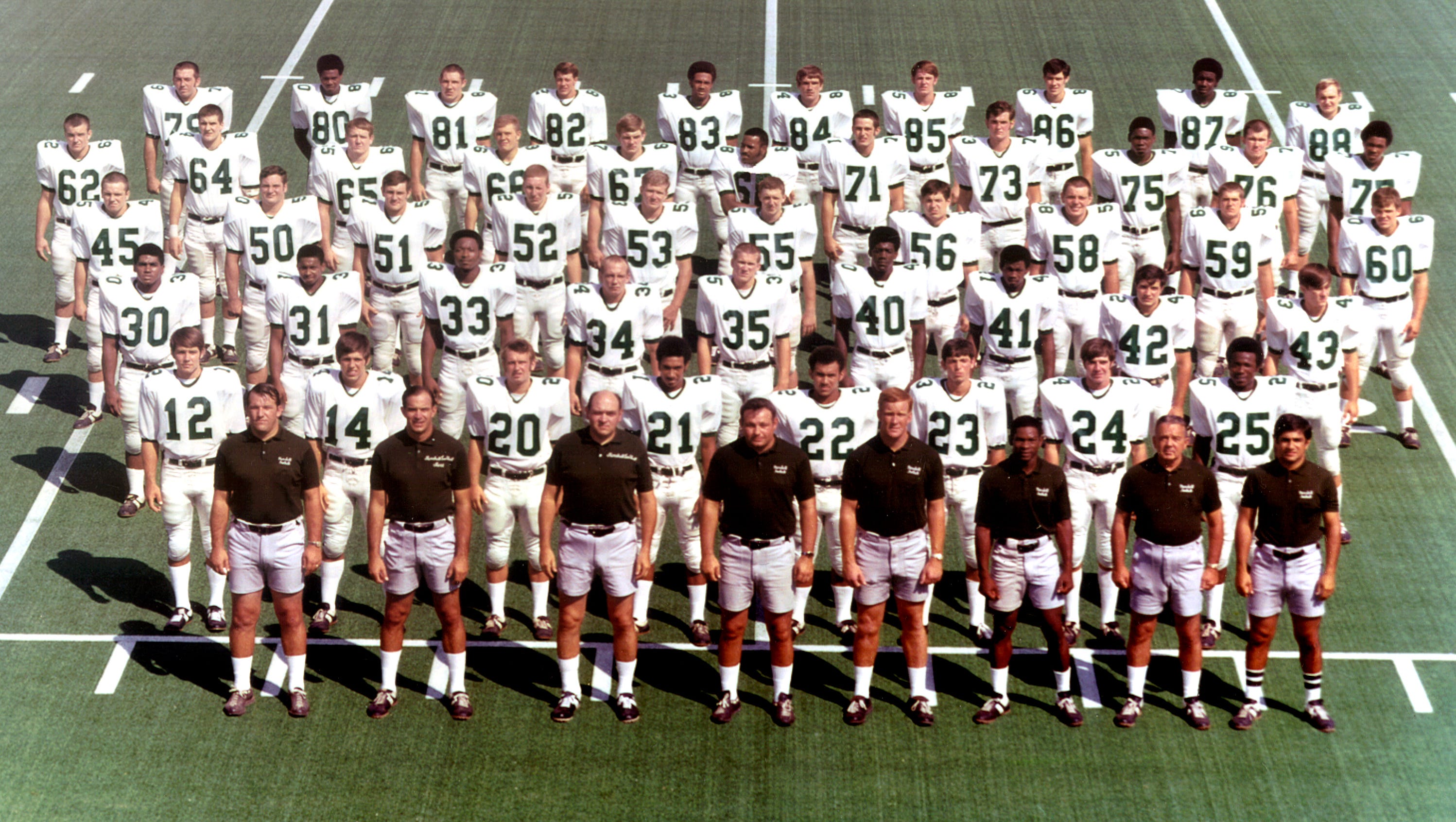
November 14, 1970: They Were Marshall

November 14, 1970, 50 years ago: Southern Airways Flight 932, a DC-9, crashes outside Huntington, West Virginia, near the campus of Marshall University. All 75 people on board are killed, including 37 players on the Marshall football team, and 8 members of the coaching staff, including head coach Rick Tolley. At 30 years old, he wasn't much older than his players.
 
It had been just 43 days since the Wichita State University football team was nearly wiped out by a plane crash, with 31 dead. The Marshall crash remains the worst sports-related tragedy in American history.

Thankfully, we have been spared the kind of disasters seen in international soccer, such as the one that would happen a few weeks later, on January 2, 1971, at Ibrox Stadium in Glasgow, Scotland: 66 people died in a crush of fans between host Rangers and their arch-rivals, Celtic.

Marshall University was founded in 1837, and named for John Marshall, who had recently died after a long tenure as Chief Justice of the United States. It is located in Huntington, West Virginia, on a bank of the Ohio River, near a 3-way State border with Chesapeake, Ohio and Ashland, Kentucky. They began playing football in 1895, 4 years after West Virginia University, in Morgantown at the other end of the State. 

The Thundering Herd were returning from Greenville, North Carolina, where they'd lost 17-14 to East Carolina University. Their one remaining game, away to Ohio University (not Ohio State), was canceled, and they finished 3-6. The Ohio Bobcats were usually considered their main rivals, and "the Battle for the Bell" was always the last game of the season -- until now.

The Herd had beaten Morehead State of Morehead, Kentucky; Xavier University of Cincinnati; and Kent State near Cleveland, a school which had its own tragedy the preceding May 4, the shooting of 13 students, 4 of them fatally, by Ohio National Guardsmen during a protest against the Vietnam War.

Marshall had lost to the University of Toledo, Miami University of Ohio, the University of Louisville, Western Michigan, Bowling Green of Ohio and, mere hours before their deaths, East Carolina.

*

Jack Lengyel, 36, had been the head coach at the College of Wooster outside Cleveland for the preceding 5 seasons. He was hired to rebuild the Marshall team. There were 9 players on the 1970 team who did not board the ill-fated flight. They would form the core of the team that Marshall attempted to field for 1971.

The NCAA granted waivers for "fifth-year seniors" who had not yet gradated, and for freshmen, then prohibited to play varsity sports, a restriction that the NCAA would universally lift the next year. The team was filled out with 35 walk-ons. One was Blake Smith, who had never even attended a football game. He became the placekicker.

President Richard Nixon, a football fan, wrote the team a letter, including these words: "Friends across the land will be rooting for you, but whatever the season brings, you have already won your greatest victory by putting the 1971 varsity on the field." Lengyel read the letter to the team at the start of the 1st day of practice.

September 18, 1971: Marshall played its 1st game since the crash. They traveled to Morehead State, and lost, 29-6 at Jayne Stadium. Although this game was a 4-touchdown loss, the Morehead fans gave the Herd's one touchdown a standing ovation.

September 25, 1971: Marshall won. They hosted Xavier University of Cincinnati at Fairfield Stadium in Huntington, and won, 15-13.

They next lost to Miami in Oxford, Northern Illinois in DeKalb, the University of Dayton at home, and Western Michigan in Kalamazoo. But on October 30, they won again, 12-10 at home to Bowling Green. They then traveled to Kent and lost to Kent State, lost at home to Toledo, and lost at home to Ohio, 30-0.

They went 2-8, never scored more than 18 points in any game, gave up 66 points to Miami and 43 to Toledo, and were shut out in 5 of their last 6 games. But, in spite of losing nearly everybody from the season before, and not to graduation, they ended up winning only one fewer game than they had in 1970.

In 2006, the film We Are Marshall was released, starring Matthew McConaughey as Lengyel, who is still alive, at age 85.

Lengyel continued to coach the team until 1974. Marshall continued to struggle, but began to turn it around in the mid-1980s, making the Playoffs in Division I-AA (now known as the Football Championship Subdivision, of FCS).

They advanced to the Championship Game in 1987, but lost 43-42 to Northeast Louisiana. They made the Quarterfinals in 1988; built a new stadium in 1990, the 38,227-seat Joan C. Edwards Stadium, with the playing surface named James F. Edwards Field for her husband, also a major donor to the school; got back to the Final in 1991, but lost 25-17 to Youngstown State of Ohio; and finally took home the prize in 1992, winning a rematch with Youngstown, 31-28.

They returned to the Final in 1993, but Youngstown took the rubber match, 17-5. Marshall reached the Semifinal in 1994, and the Final again in 1995, losing 22-20 to Montana. They beat Montana in a Final rematch in 1996, 49-29, for their 2nd National Championship.

Formerly members of the Mid-American Conference and the Southern Conference, in 2005 they joined Conference USA. They've won Conference Championships in 1925, 1928, 1931, 1937, 1988, 1994, 1996, 1997, 1998, 1999, 2000, 2002 and 2014; and Division titles short of the Conference title in 2001 and 2013.

Due to changing conference affiliations, their rivalry with Ohio isn't played every year, although it was played last year, and were scheduled to play this year before the COVID-19 epidemic canceled all non-conference games. They will next play in 2025. Ohio leads "The Battle for the Bell," 33-21-6.

After playing each other in 1911, 1914, 1915 and 1923, the 2 biggest football-playing schools in the Mountaineer State, WVU and Marshall, didn't play each other again until 1997, and then not again until 2006 -- again, mainly due to conference affiliation. They then played "The Friends of Coal Bowl" every year from 2006 until 2012. They've played each other 12 times, and West Virginia have won them all.

Marshall's other major rivalry, if it can be called a "rivalry" at all, is with East Carolina, the team their 1970 team was returning from when it perished. They didn't play each other again until 1978, then not again until 2001. But they played every year from 2005 to 2013, before conference affiliations split them up. East Carolina leads the rivalry, 10-5. A moment of silence is held before every game between the teams.

Marshall is currently 7-0, and had been scheduled to play East Carolina this season, but it has been postponed due to the epidemic, and it might not be rescheduled. ECU is 1-5 so far.

UPDATE: On this day, November 14, 2020, the 50th Anniversary of the crash, Marshall beat Middle Tennessee State, 42-14 at Joan Edwards Stadium. But they lost their last 3 games: To Rice, to Alabama-Birmingham in the Conference USA Championship Game, and to the University of Buffalo in the Camellia Bowl in Montgomery, Alabama on Christmas Day, finishing 7-3 and as C-USA East Division Champions.

Friday, November 13, 2020

Paul Hornung, 1935-2020

Can't blame 2020 for this one, but, now, to use a football term, this Year of Hell is just piling on.

Paul Vernon Hornung was born on December 23, 1935 in Louisville, Kentucky. As the scouting report that the Green Bay Packers would later write on him said, he came from a poor family, where his parents separated when he was 2 years old.

He lettered in football, basketball and baseball all 4 years he attended Bishop Benedict Joseph Flaget High School in Louisville.

That school opened in 1942 and was closed in 1974. Other notable alumni included Howard Schnellenberger, who coached the University of Miami to the 1983 National Championship; and Gus Bell, All-Star 3rd baseman and starter of a family that has now seen 3 generations reach Major League Baseball: His son Buddy, and Buddy's son David. (All 3 were born David.)

The University of Louisville was not interested in him, although they would have a good quarterback soon enough: Johnny Unitas. Paul "Bear" Bryant was then the head coach at the University of Kentucky, and had already coached future Pro Football Hall-of-Famer George Blanda there. The Bear was very much interested in Hornung. That Packer scouting report's writer said, "Kentucky offered him the moon but INSISTED THAT HE GO TO" and the rest is illegible, due to a hole-punch and the reflection of the flash bulb used to photograph the report. A prep school, to get his grades up, maybe?

(Moving on to his alma mater, the University of Alabama, Bryant would later have his share of notable quarterbacks, 2 of whom would lead teams to Super Bowl wins: , Joe Namath of the New York Jets, and Ken Stabler of the Oakland Raiders. Hornung's eventual Packer teammate Bart Starr was at Alabama before Bryant got there.)

Hornung's mother, described by the scouting report as a devout Catholic, wanted him to have a good Catholic education, so it was off to South Bend, Indiana, and the University of Notre Dame. The Fighting Irish also offered him the chance to play basketball, but after his sophomore year there, football coach Terry Brennan asked him to give it up, saying sticking to one sport would give him time to focus on his grades.

It worked: He remained academically eligible, and in 1955, playing both halfback on offense and safety on defense, he became a star. In an upset over Number 4 Navy, he ran for 2 touchdowns and intercepted 2 passes. Although Notre Dame lost their big rivalry game to the University of Southern California (USC), Hornung had a combined 354 yards rushing and passing in that game, the highest of any game in the country that season.
In his 1st 2 years at Notre Dame, Hornung helped them go 9-1 and 8-2. But 1956 would be one of the worst years in the school's history. They went just 2-8, their only wins coming at home to Indiana and North Carolina.

They had close losses to USC in Los Angeles, Southern Methodist (SMU) in Dallas, the University of Pittsburgh away, and home to Purdue. But they got clobbered at home by Michigan State (then ranked Number 2), at home by Oklahoma (who had risen to Number 2 and would end the season at Number 1), away to Iowa (then Number 3), and by Navy in Baltimore (essentially a home game for Navy.)

And yet, Hornung, nicknamed "The Golden Boy" while playing at "The Golden Dome," and moved to quarterback, was awarded the Heisman Trophy. He remains the only player from a team with a losing record to ever win it.
It was a close vote, in one of the most loaded senior classes in college football history. Tennessee running back Johnny Majors and Oklahoma running back Tommy McDonald both finished within 100 points of him. Oklahoma center and linebacker Jerry Tubbs was 4th, one of the few offensive linemen ever to get that close to the Trophy, and one of the few defensive players. Syracuse running back Jim Brown finished 5th, Michigan end Ron Kramer 6th, Stanford quarterback John Brodie 7th, Ohio State guard Jim Parker 8th.

Hornung, McDonald, Brown and Parker would all end up in the Pro Football Hall of Fame. Brodie should be. Tubbs and Kramer both made the 1962 Pro Bowl. (Kramer would later become a Packer teammate, but was not related to another, Jerry Kramer.) The only one who didn't go on to have at least a good pro football career was Majors, and he became one of the top college coaches of his generation, leading Pittsburgh to the 1976 National Championship, then returning to Tennessee and leading them to 3 Southeastern Conference titles.

Years later, in his role as a broadcaster, Hornung interviewed Majors, and asked him who he thought should have won the 1956 Heisman Trophy. Without hesitation, Majors said, "Jimmy Brown." Hornung could only say, "If I didn't want the truth, I shouldn't have asked."

*

Today, someone on Twitter posted a picture of the Green Bay Packers' scouting report on Hornung. It cited (and I am quoting directly here, including ALL CAPS where it was used:

* GREAT NATURAL ATHLETE
* GREAT SPEED
* TREMENDOUS competitor
* WILL STAND PUNISHMENT (Yes, this was written in red ink)
* CAN RUN with BALL
* GOOD Punter
* Very Intelligent - Accounting Major - 90 AVE. ("Average" is usually abbreviated "Avg.")
* KICKOFF MAN - Not Consistent - Can put it into end zone
* WONDERFUL POISE
* Has Been Outstanding as Defensive player
* Can throw Long Pass well
* EASY to HANDLE (That would turn out to be wrong.)
* HE WILL NOT GO TO CANADA (His refusal to play in the colder and lesser-paying Canadian Football League was written in red and double-underscored.)
* Weakness: LIKES GIRLS (Double-underscored. Liking girls was not the issue. How much effort he put into pursuing them was the issue.)

Not having won, or even appeared in, an NFL Championship Game since 1944, and coming off a 4-8 season, the Packers had the 1st overall selection in the 1957 NFL Draft. They chose Hornung. It didn't do them much good at first, going 3-9 in 1957 and bottoming out at 1-10-1 in 1958. As the great New York Herald Tribune sports columnist Red Smith put it, "The Packers overwhelmed one opponent, underwhelmed ten, and whelmed one."

For the 1959 season, the Packers brought in a new head coach and general manager, who had played on the 1937 Fordham University line known as "The Seven Blocks of Granite," had coached under Red Blaik at Army, and was what we would now call the offensive coordinator for the New York Giants team that won the NFL Championship Game in 1956 and lost it in 1958: Vince Lombardi.

Lombardi was, to put it bluntly, blunt. He told the Packer players, "We may not win, but we won't be losing with the same people." But he also told them, "Those who stay will be champions." To prove his point, he cut the team's most established player, All-Pro end Billy Howton, for not taking practice seriously enough.

Lombardi and Hornung wouldn't seem to have been a good mix. Although a registered Democrat who contributed to John F. Kennedy's Presidential campaign in 1960, Lombardi was a personal conservative. He liked short hair, sharp suits, and people who were committed to their family, their faith, and their job, and resolved to do well with all three. Hornung was a carouser -- not an easy thing to be in the NFL's smallest city, so he took advantage of roadtrips.

Lombardi saw something in Hornung. What they had in common was that they were Catholics who started out poor. Lombardi knew Hornung was the most talented player he had ever coached, even more than a very similar player he had on the Giants, Frank Gifford. He was able to reach Gifford, so maybe he could reach Hornung.
Left to right: Paul Hornung, Bart Starr, Vince Lombardi

And it did turn out to be a relationship similar to the one that Yankee manager Casey Stengel had with Mickey Mantle: He could never keep the superstar under control off the field, but he got absolute commitment from him in practice and in games.

This is what happened over the next 3 seasons, Lombardi's 1st 3 in Green Bay: They went from 1-10-1 to 7-5 in 1959; went 8-4 to win the Eastern Division title in 1960, but lost the NFL Championship Game to the Philadelphia Eagles; and went 11-3, demolishing the Giants 37-0 in a snowy Championship Game at the stadium later known as Lambeau Field on New Year's Eve 1961, the Packers' 1st title in 17 years. In each of those 3 seasons, Hornung led the NFL in scoring. 

In 1960, he led the NFL in rushing touchdowns with 13, and scored 2 more touchdowns receiving, for 15 touchdowns, meaning 90 points. In placekicking, he was a perfect 41-for-41 on extra points. His field goal kicking wasn't nearly as good, making just 15 out of 28. But that was another 45 points.
That made for a total of 176 points, a new NFL single-season record, in 12 games. Despite the NFL moving to a 14-game schedule the next season, and a 16-game schedule in 1978, that record stood until 2006, when LaDainian Tomlinson of the San Diego Chargers scored 31 touchdowns (doing no kicking) for 186 points, although he didn't surpass Hornung's 176 until the 14th game of the season. And he remains the only man to surpass it.

Hornung also passed for 2 touchdowns, so he accounted for 188 points. Although, if you go by that measure, the record would be a lot higher, 330 points, as Peyton Manning passed for a record 55 touchdowns for the Denver Broncos in 2013.

Hornung was named the NFL's Most Valuable Player in 1961, as his 146 points (10 touchdowns, and he matched his previous season with 41 out of 41 extra points and 15 field goals) remained 2nd-best in NFL history until the 1980s.

But the Berlin Crisis of the Summer of 1961 led to Hornung's U.S. Army Reserve unit being called up. The Army kept him in shape, but he was only able to play on Sundays due to receiving weekend passes. The NFL Championship Game required more than just a weekend off, so Lombardi called President Kennedy, and the Commander-in-Chief gave Hornung the necessary time off. In that Championship Game, Hornung scored the 1st Packer touchdown, and kicked 3 field goals and 4 extra points.

His 19 points remained a record for the NFL championship game, under any official name, for 55 seasons, until 2017, when James White scored 20 (3 touchdowns, including the overtime game-winner, and a 2-point conversion) for the New England Patriots in Super Bowl LI.

In 1962, the Packers went 13-1, still a franchise best, their only loss coming to the Detroit Lions at Tiger Stadium on Thanksgiving Day. Again, they beat the Giants in the Championship Game. Life was good for Paul Hornung.

He had even invented the touchdown celebration. Before him, players would just drop the ball on the ground (hence, the term "touchdown"), or hand or toss the ball to an official. Hornung threw the ball into the stands. In 1965, the NFL began fining players $500 for doing this. So Giants running back Homer Jones began slamming the ball on the ground, calling it a "spike."

In April 1963, NFL Commissioner Pete Rozelle discovering that 2 of the League's biggest stars, Hornung and Lions defensive tackle Alex Karras, had been betting on NFL games, and, as was said at the time, "associating with undesirable persons." Both men confessed, and accepted their punishment: Suspension for the entire upcoming season.

Lombardi put his foot down, and told Hornung that he couldn't gamble anymore, not even on his hometown's signature sporting event: He could not go back to Louisville and so much as attend the Kentucky Derby. Lombardi also told him to stay away from Las Vegas. Hornung agreed.

"Rozelle should have suspended me," he said many years later. "He could have suspended a lot of others, too. A lot of guys bet like I did. I'd bet $100, and never more than $500. The Commissioner was making a point, and the older I got, the more I understood."

Given each man's cooperation, Rozelle reinstated both Hornung and Karras for the 1964 season. Lombardi defied the rumor that he would trade Hornung, and welcomed him back, asking only that he report to Packer camp 2 months early to get back into shape.

He told the media, "You have to know what Hornung means to this team. I have heard and read that he is not a great runner or a great passer or a great field-goal kicker, but he led the league in scoring for three seasons. In the middle of the field he may be only slightly better than an average ballplayer, but inside the twenty-yard line he is one of the greatest I have ever seen. He smells that goal line."

Hornung also did things off the field that Lombardi valued, such as reaching out to newly-acquired players. He would take them along to his speaking engagements, and split his fee with them.

But the suspensions did have a long-term effect on each player's reputation. Hornung was not elected to the College Football Hall of Fame until 1985, his 20th year of eligibility; and not to the Pro Football Hall of Fame until 1986, his 15th year. Karras wasn't elected to the College Football Hall until 1991, his 25th year; and to the Pro Football Hall until 2020, his 45th, and more than 7 years after his death. At least Hornung lived to receive both of the honors in question.

Hornung had no hard feelings toward Rozelle. When the Commissioner retired in 1989, after 29 seasons in charge, Hornung wrote him a letter calling him "the best commissioner of any sports league."

In Hornung's absence, the Packers went 11-2-1 in 1963, finishing 2nd to their arch-rivals, the Chicago Bears, in the Western Division. The 1964 season was something of a transition year, and they went just 8-5-1.

But in 1965, they went 10-3-1, helped by Hornung's last good season, gaining more yards receiving than rushing. They beat the Baltimore Colts in a Playoff for the Division title, and the Cleveland Browns in the NFL Championship Game, with Hornung gaining 105 yards and scoring a touchdown on a Lambeau Field surface that was rendered a muddy mess by a snowfall and the means of removing it.

A pinched nerve in his neck limited him to 9 games, starting just 5, in 1966. This led to him wearing the first neck-protecting rollbar in NFL history, now required equipment. The Packers went 12-2, and beat the Dallas Cowboys in a 34-27 New Year's Day thriller at the Cotton Bowl in the NFL Championship Game.

That turned out to be his last game: He was the only player on the Packer roster who did not play in the subsequent "AFL-NFL World Championship Game," later retroactively renamed "Super Bowl I." Lombardi offered him the chance to play in the 4th quarter, when the game was out of reach, figuring that Hornung would enjoy the distinction of having played in such a historic game. But he didn't feel up to it.

The New Orleans Saints began play in 1967, and selected him in the expansion draft. Given his love of the nightlife, the Crescent City must have seemed like an ideal place to go. He went to their training camp, but the neck injury was too bad. He was examined at the Scripps Clinic in California, and found to have a severing of 3 vertebrae, and damaged nerve roots in his spinal cord. "Another hit, and I could have been a paraplegic," he said.

He was 31, and he announced his retirement before ever playing a game for the Saints, even an exhibition. Without him, the Packers went 9-4-1, won their 5th NFL Championship in 7 seasons, and won Super Bowl II; while the Saints had a typical season for an expansion team, going just 3-11.

He finished his career with 3,711 rushing yards, 130 catches for 1,480 yards, 383 yards and 5 touchdowns passing, 62 total touchdowns scored, 190 extra points in 194 attempts, and 66 field goals in 140 attempts, for 760 points. He was a member of 4 NFL Championship teams.

*

Hornung returned to Louisville, and made a lot of money in real estate. He became a charity fundraiser, donating over $300,000 to Notre Dame, and another $300,000 to the Visiting Sisters Program, in which nuns provide food and clothing for the poor.

In spite of his efforts to be "a good Catholic," the stories of his womanizing became legend. He was quoted as saying, "Never get married in the morning. You never know who you might meet that night." Teammate Max McGee said, "Believe me, Paul was an impact player for the Green Bay Packers. He also was an impact player on half the females in the United States."

But, just as Yogi Berra liked to say, "I didn't really say everything I said," Hornung said, "If I had done half of what they say I did, I would be in a bottle at the Smithsonian Institution."

Formerly married to Patricia Roeder, he married a woman named Angela in 1979, and they remained married until his death. He had 4 children, and they all graduated from Notre Dame.

He went into broadcasting, working for the Minnesota Vikings from 1970 to 1974, TVS' broadcasts of the World Football League in 1974, CBS from 1975 to 1979, ABC on USFL games from 1983 to 1985, and TBS in the 1980s. He was also the 1st host of the syndicated TV series Greatest Sports Legends, and hosted a local cable TV show, The Paul Hornung Sports Showcase. He eventually gave up TV due to the increasing raspiness of his voice.

He was elected the College Football Hall of Fame in 1985, the Pro Football Hall of Fame in 1986, and the Wisconsin Athletic Hall of Fame in 1990. There are 2 Paul Hornung Awards, one for the top high school football player in the Commonwealth of Kentucky, and another given to "the most versatile college football player in the nation."

The Packers elected him to their team Hall of Fame in 1975. Following his retirement as a player in 1967, Lombardi announced at the team's annual press party that no Packer would ever again wear Number 5. However, no official retirement of the number has ever occurred. Only 4 players have worn it since Hornung, the last being placekicker Curtis Burrow in 1988. Notre Dame has also not retired 5 for him, but they don't retire numbers anyway.
Despite his success and his fame, his career statistics do not stand out, partly due to his early retirement, and partly due to the fact that the 16-game season has blown career stats of great players well past his. He was not selected for The Sporting News' 100 Greatest Football Players in 1999, or the NFL Network's 100 Greatest Players in 2010. He was selected for the NFL's All-Decade Team for the 1960s, but not for its 50th Anniversary Team in 1969, its 75th Anniversary Team in 1994, or its 100th Anniversary Team in 2019.

In 1999, Sports Illustrated chose the 50 Greatest Athletes from each State. For Kentucky, they chose the following:

1. Muhammad Ali of Louisville. No surprised that they chose "The Greatest."
2. Mary T. Meagher of Louisville. 3 Gold Medals in swimming at the 1984 Olympics.
3. Wes Unseld of Louisville. 1969 NBA MVP with the Baltimore Bullets, 1978 NBA Champion with the Washington Bullets.
4. Harold "Pee Wee" Reese of Ekron. Shortstop and Captain of 7 Pennant winners with the Brooklyn Dodgers, including the 1955 World Series winners.
5. Cliff Hagan of Owensboro, 2-time basketball National Champion at the University of Kentucky.
6. Paul Hornung of Louisville.

Nevertheless, when I did my Top 10 Athletes from each State, and got to Kentucky on June 1, 2017 (the Anniversary of its achieving Statehood, June 1, 1795), I chose Hornung 2nd behind Ali.

And when Steve Sabol did interviews for NFL Films' coverage of the Hall of Fame's 1998 induction weekend, which had the largest gathering of Hall-of-Famers ever to that point, he asked every player who would be the 1st player they would pick for an all-time team. Many of the players selected a teammate: The old Colts chose Johnny Unitas, the recently-retired 49ers chose Joe Montana, and so on. Some coaches chose players they had coached, such as Don Shula taking Dan Marino.

Hornung said he would take himself. It could easily be said of him, "He's the greatest. Just ask him."

He could not be asked the last few years. He was one of so many players to fall victim to dementia, due to football-related head trauma and advancing age. He died today, November 13, 2020, shortly before what would have been his 85th birthday, in his hometown of Louisville, Kentucky.

With his death there are now:

* 8 surviving players from the 1961 NFL Champion Green Bay Packers: Jerry Kramer, John Roach, Tom Moore, Dale Hackbart, Nelson Toburen, Lee Folkins, Gary Knafelc and Boyd Dowler.

* 10 surviving players from the 1962 NFL Champion Packers: Kramer, Roach, Moore, Toburen, Knafelc, Dowler, Howie Williams, Ed Blaine, Ron Gassert and Gary Barnes.

* 12 surviving players from the 1965 NFL Champion Packers: Kramer, Moore, Dowler, Tom Brown, Junior Coffey, Bill Curry, Ken Bowman, Steve Wright, Bob Long, Marv Fleming, Carroll Dale and Dave Robinson.

* And 16 surviving players from the 1966 NFL Champion Packers, winners of Super Bowl I: Kramer, Dowler, Brown, Curry, Bowman, Wright, Long, Fleming, Dale, Robinson, Red Mack, Jim Grabowski, Phil Vandersea, Donny Anderson, Dave Hathcock and Jim Weatherwax.

* While Hornung was not a member of the 1967 NFL Champion Packers, winners of Super Bowl II, I want to point out that there are still 19 surviving players from that team: Kramer, Dowler, Brown, Bowman, Wright, Long, Fleming, Dale, Robinson, Grabowski, Anderson, Weatherwax, Don Horn, Chuck Mercein, Ben Wilson, John Rowser, Bob Hyland, Jim Flanigan and Dick Capp.

* There are 14 surviving players from the NFL's 1960s All-Decade Team: Packers Kramer, Dowler and Robinson; the Chicago Bears' Dick Butkus; the Cleveland Browns' Jim Brown and Leroy Kelly; the Washington Redskins' Sonny Jurgensen and Charley Taylor; the Detroit Lions' Lem Barney; the Los Angeles Rams' Eddie Meador; the Dallas Cowboys' Bob Lilly and Ralph Neely; the Philadelphia Eagles' Bob Brown; and the St. Louis Cardinals' Jim Bakken.

* There are only 2 living winners of the Heisman Trophy who won it before 1962: 1947 winner Johnny Lujack of Notre Dame, now 2 months short of his 96th birthday; and 1958 winner Pete Dawkins of Army, who is 82.

* And there are 3 living Heisman winners from Notre Dame: Lujack, 1964 winner John Huarte, and 1987 winner Tim Brown. Angelo Bertelli, who was the school's 1st Heisman winner, in 1943, died in 1999. Leon Hart, the 1949 winner, died in 2002. Johnny Lattner, the 1953 winner, died in 2016.

Joe Theismann finished 2nd to Jim Plunkett of Stanford in 1970. Joe Montana had a good college career, but never came close to winning it. In 1977, his junior year, he quaterbacked them to a National Championship, but Earl Campbell of Texas won the Trophy, and Notre Dame players Ken MacAfee finished 3rd and Ross Browner 5. In 1978, his senior year, neither he nor any other Fighting Irish player finished in the Top 10.

Top 5 Reasons You Can't Blame Donald Trump for Losing the 2020 Election

Really? Am I really going to do this? Am I really going to try to deflect blame away from the man who never accepts the blame for anything, and infamously said, "No, I don't take responsibility at all"?

Remember: There will be a verdict afterward, to see if maybe he can be blamed.

Top 5 Reasons You Can't Blame Donald Trump for Losing the 2020 Election

5. Voter Fraud. You can't trust the Democrats to run an honest campaign.

4. Disloyalty. The Lincoln Project is a group of anti-Trump Republicans, running ads against him that hit him every bit as hard as they would normally have hit Democratic nominees for President, Senator, Governor, and so on. They didn't stand by their Party's leader.

Also, Cindy McCain, widow of Senator and 2008 Republican Presidential nominee John McCain, cost Trump Arizona. Where was her loyalty?

Also, the Congressional Republicans focused on their own races, not on their Party's leader. The Republicans gained a few seats in the House of Representatives (but not enough to take control), and they may also hold onto control of the Senate.

(But that's not yet certain, as the 2 Georgia seats are headed for a runoff, and if the Democrats can get the vote out at the same rate that they did in the Presidential contest, that will make the Senate a 50-50 tie, and Vice President-elect Kamala Harris will break the tie and give the Democrats the majority.)

And finally, President Vladimir Putin of Russia and his hackers helped Trump last time. Why didn't they help this time? Where was their loyalty? Has Putin abandoned Trump, too?

Calm down, people. I'm trying to show you what Trump is probably thinking.

3. Black Voters. They were angry at the police brutality incidents, and they came out against Trump for that reason. They also came out for Biden because of his selection of Kamala Harris as his Vice Presidential nominee.

2. The COVID-19 Epidemic. It may have killed enough people to make the difference in some States. Or, it may have convinced enough people that Trump wasn't doing enough to make the difference.
 
1. Joe Biden. He ran a great campaign. This is the one reason here that Trump would never agree with: He simply cannot accept that "Sleepy Joe" ran a better campaign than he did.

But he did. He actually found a proper balance between "The other guy has been horrible" and "Here's why I'm better." He made the case that he was the right person at the right time for the country. In his 2 previous races, in 1988 and 2008, that case wasn't there to be made.

But because of his current place in American culture -- Barack Obama's Vice President, the man who wrote the 1994 Crime Bill and the Violence Against Women Act, and a man who has been shaped by personal tragedy that gives him the empathy to show Americans, to borrow Bill Clinton's words from 1992, "I feel your pain" -- he was the right person.

Not Bernie Sanders. Not Elizabeth Warren. Not Pete Buttigieg. Not Beto O'Rourke. Not even Kamala Harris, who nonetheless made a fine running mate. As Sir Walter Scott wrote, over 200 years ago, "The hour's come, and the man." (It usually gets erroneously written as, "Cometh the hour, cometh the man.") And Joe Biden is the Man of the Hour.

He is the right person for our current conditions. It doesn't mean he'll be the right person for 2025 to 2028 (even if he, about to turn 78, lives at least a full 4 years and runs for re-election), or even for 2022. But the way 2021 is shaping up, he's the one for the next year.

So, do these 5 reasons absolve Trump from blame?

No. Not by a long shot.

VERDICT: Guilty. Let's look at the 5 reasons again:

5. Voter Fraud? Republican State governments, certainly inclined to want a Republican nominee for President to win, have looked for voter fraud. It's been 8 days since the polls closed. They haven't found any.

Also, if the Democrats had been guilty of voter fraud, why would they have allowed Senate Majority Leader Mitch McConnell to be re-elected in Kentucky? Or Senator Lindsey Graham to be re-elected in South Carolina? Or Senator Susan Collins to be re-elected in Maine? Where was the fraud there? It wouldn't make sense to let those people win, if they had the extralegal means to prevent it.

4. Disloyalty? If Trump hadn't been such an ass, screwing everything up, there never would have been a Lincoln Project. And there was good reason for Cindy McCain to endorse Biden: Because of the way Trump treated her husband. Where was her loyalty? It was to John, not to Donald. It was to the country, not to its President.

And if Trump is surprised that Congressional Republicans tried harder to save their own chances than his, then he doesn't know the Republican Party as well as he thought. They have been the Party of Selfishness for over 150 years. He fit right in, but he should have known that he couldn't count on them.

As for Putin, the current rumor is that his health is in decline, possibly due to Parkinson's disease. He may have gotten what he wanted out of Trump: Ending the sanctions on his country.

Just like the Republicans got what they wanted out of Trump: 3 new Justices on the Supreme Court, including a replacement for Ruth Bader Ginsburg. So maybe Trump outlived his usefulness to both the GOP and Putin, so they were less likely to back him.

3. Black Voters? Trump could have come forward and done a "both sides," in a positive way: "Police brutality hurts both sides. It hurts the innocent people who have died, and it hurts their loved ones. But it also hurts the reputation of the police. It needs to stop. There are better ways to enforce the law, and our police departments need to find it."

It would have been Trump's version of "Only Nixon can go to China," but the cops might have listened, and done something about it. Had this happened, the black community might have noticed, and been less inclined to get out the vote against Trump.

Trump could have done it. He had the power, and he had the charisma. What he did not have was the willingness. It would have been so far against his worldview, that he simply could not imagine himself doing it. Indeed, had any other President done it, even a Republican, Trump would have lost his shit over it.

2. The COVID-19 Epidemic? There was no State that was close enough for COVID to have killed off enough Trump supporters to make the difference. As of this writing, Biden leads by:

* 11,434 votes in Arizona, where 6,240 people have died.
* 14,163 votes in Georgia, where 8,655 people have died.
* 20,540 votes in Wisconsin, where 2,627 people have died.
* 36,866 votes in Nevada, where 1,880 people have died.
* 60,233 votes in Pennsylvania, where 9,272 people have died.

To put it another way: In order to make a difference, for every 1 person that died in those States, it would also have had to change the minds of this many people to throw those States from Trump to Biden: 1.6 in Georgia, 1.8 in Arizona, 6.5 in Pennsylvania, 7.8 in Wisconsin, and 19.6 in Nevada.

Did the disease make a difference in any State? Maybe Georgia and Arizona. Swing those States from Biden to Trump, and instead of 306-232 Biden, it would be 279-259 Biden.

So unless you want to make the case that the outrage over the disease would also have thrown the 3rd-closest State won by Biden, Wisconsin, to Trump, then there's no case. And even then, it can be argued that it wasn't so much the disease's fault, but Trump's idiotic response to it.

1. Joe Biden? It wouldn't have mattered how good a campaign Biden ran if Trump had run a good one. Gerald Ford ran a good campaign in 1976, but he couldn't overcome the voters' anger about Watergate, and fell 1 big State short. Bob Dole ran a good campaign in 1996, but lost in a landslide. John Kerry ran a good campaign in 2004, but lost by 1 big State. John McCain ran a reasonably good campaign in 2008, but conditions were so hard against a candidate of the incumbent party that he didn't have much of a chance. Hillary Clinton ran a good campaign in 2016 (Shut the hell up, Brocialists, she did), and she fell 3 States short of winning the Electoral Vote.

If Trump had run as well as he did 4 years ago, he could have won. If he had run as a better man than he was 4 years ago, he probably would have won. But that would have been completely against his nature. He just can't do it.

So, yes, the biggest reason that Donald Trump lost the 2020 election is Donald Trump.

The sooner he accepts this, and finally offers his concession to Biden in private, and to the country in public, the better.

Thursday, November 12, 2020

November 12, 1990: The Body Bag Game

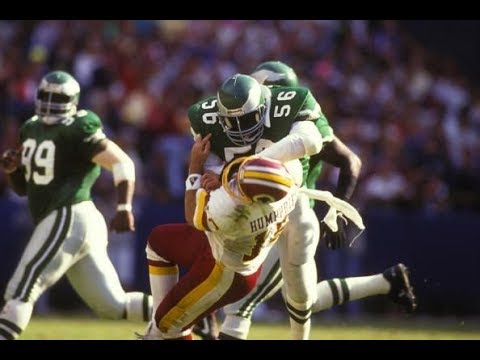
Byron Evans knocks Stan Humphries out of the game.
Jerome Brown looks on.

November 12, 1990, 30 years ago: ABC Monday Night Football broadcasts a game from Veterans Stadium in Philadelphia. The Philadelphia Eagles beat the Washington Redskins, 28-14. Judging by the score, it does not look to a current eye like a particularly notable game.

But it was. It was "The Body Bag Game."

The Redskins, coached by Joe Gibbs, still had a few of the players who had helped them win Super Bowl XVII 8 seasons earlier, and many of the players who had helped them win Super Bowl XXII just 3 seasons earlier. But they were also in something of a transition. Most notably, Doug Williams, the quarterback who was named the Most Valuable Player of Super Bowl XXII, had been cut in a cost-saving measure.

The 3 quarterbacks on the Redskins' roster at this point were Jeff Rutledge, who had led the University of Alabama to a National Championship in 1978, but whose pro career had turned out to be a bust; Stan Humphries, who would one day take the San Diego Chargers to their only Super Bowl, but had thrown all of 10 passes in regular-season NFL games going into this season; and Mark Rypien, who was in his 3rd season as the team's starter, and would go on to lead the Redskins to victory in Super Bowl XXVI and win that game's MVP.

The Eagles were coached by James David "Buddy" Ryan. Once the defensive coordinator for the Chicago Bears, designer of the "46 Defense" that was key to their win in Super Bowl XX, and before that the coach of the New York Jets' defensive line that was a big reason why they won Super Bowl III, he was beloved by his defensive players. But the offensive players on his teams never fully trusted him. The Eagles' quarterback was Randall Cunningham, an incredibly versatile player whose nickname was "The Ultimate Weapon." Ryan didn't have a clue as to how to use him.

But Ryan built a devastating defense in South Philly. Ends Reggie White and Clyde Simmons. Tackles Jerome Brown and Mike Golic. Linebackers Seth Joyner and Byron Evans. Cornerbacks Eric Allen, Izel Jenkins and William Frizzell. Safeties Terry Hoage, Wes Hopkins and Andre Waters. They were good, and they were mean.

How mean were they? In the days leading up to the game, Ryan told reporters the Eagles would beat the Redskins so badly, "they'll have to be carted off in body bags." Big talk, given that, just 3 weeks earlier, in Washington, the Redskins beat the Eagles, 13-7. The Eagles came into this game 4-4, the Redskins 5-3.

It should be noted that Rypien was already injured, and did not play in the game. So Rutledge started for the Redskins. The Eagles knocked him out of the game. Humphries came in. Later on, the Eagles knocked him out, too.

The Redskins were down to just 1 healthy player who had ever played the position of quarterback at any level: Brian Mitchell, a rookie running back who had played quarterback at the University of Southwestern Louisiana (now named simply the University of Louisiana). Pressed into emergency duty, he attempted 6 passes, and completed 3 of them, for 40 yards, and also ran a 1-yard play for a touchdown.

By that point, the Eagles were already up 28-7, with Mitchell's score making the scoreboard at least look respectable. The Eagles got offensive touchdowns on a pass from Cunningham to Heath Sherman and an option pass from Keith Byars to Sherman; and "defensive touchdowns" on a fumble return by Simmons and an interception return by Frizzell.

All told, 9 Redskin players had to leave the game due to injury, and none returned. Did the Eagles play dirty? Well, they were called for 11 penalties, totaling 88 yards. However, I didn't watch the game, even though it was nationally televised, in my case on WABC-Channel 7. So I can't remember what specific penalty calls were made; and I can't find a record with a breakdown of those penalties. But I've also never seen a record of the Redskins, their coaches, or their fans claiming that the Eagles were dirty that night. It's not like they were their South Philadelphia neighbors, the NHL's Flyers.

Both teams ended up winning 5 of their last 7 games to make the Playoffs, and the Redskins returned to The Vet and beat the Eagles, 20-6. The Redskins used the experience to motivate themselves to win the Super Bowl the following season, completing a 9-year run where they went to 4 Super Bowls, winning 3.

Ryan never got the Eagles very far. That loss to the Redskins was his 3rd Playoff game as an NFL head coach, and he lost them all. He was fired after the season, and later coached the Arizona Cardinals for 2 years, without getting them into the Playoffs, and never got another head coaching job. Like so many before him, and a few after him, he proved that a great defensive coordinator does not necessarily make a good head coach.

It would take the Eagles another 14 seasons to reach the Super Bowl, and another 27 seasons to win one.

For the 1991 season, with what became known as "The Body Bag Game" in mind, the NFL instituted the Third Quarterback Rule: If an NFL team went into a game with only 2 healthy quarterbacks, it could dress a 3rd quarterback who was not on the 45-man game-day roster. The catch was that, if he entered the game before the 4th quarter, no other quarterback could return to the game.

There's one more oddity to this game: After 10 seasons with the Redskins, including a Super Bowl XXVI ring and a 1995 Pro Bowl berth, Brian Mitchell played 3 seasons (2000-02) with the Eagles, and became much admired by the hard-to-please Eagle fans. He played 1 last season in 2003, with the New York Giants, and retired with more yards on kick and punt returns, 19,013, than any player in NFL history. His 23,330 career total yards are 2nd all-time, behind only Jerry Rice. He is eligible for the Pro Football Hall of Fame, but is not in it.

For all the talent on their roster, Reggie White is the only Eagle from the Body Bag Game who is in the Hall of Fame. So are Redskins Art Monk (receiver), Russ Grimm (guard) and Darrell Green (cornerback), as well as head coach Joe Gibbs. Jerome Brown was killed in a car crash shortly before preparations for the 1992 season began, having played only 5 seasons. Had he lived, he probably would have made the Hall.

Eagle fans love this game, even though it came to nothing. They like to think of themselves, and their city, as a lot tougher than the pretty boys in the nation's capital of Washington, or fashionable New York, or glitzy Sun Belt cities like Miami, Dallas and Los Angeles.

But ask them now: Which game means more to you, the Body Bag Game, or Super Bowl LII? Even the most posturing of self-proclaimed tough guys will take the Super Bowl win.

Wednesday, November 11, 2020

Howie Meeker, 1923-2020

We lost a big piece of hockey history this week.

Howard William Meeker was born on November 4, 1923 in Kitchener, Ontario, and grew up in nearby New Hamburg. A right wing, he was a star in junior hockey before being drafted into the Canadian Army for World War II. He was badly wounded, but recovered enough to return for the 1945-46 season.

The Toronto Maple Leafs called him up for the 1946-47 season, and, wearing the Number 15 he would wear throughout his career, he scored 27 goals with 18 assists, earning him the Calder Memorial Trophy as NHL Rookie of the Year. Among his achievements was scoring 5 goals in a game, and he remains the only rookie ever to have done that. The Leafs went on to beat the Montreal Canadiens to win the Stanley Cup.

From its founding in 1947 until 1966, the NHL All-Star Game was the new season's opener, and until 1969 it featured the defending Stanley Cup Champions against a team made up of All-Stars from all the other teams combined.

There had been all-star games as benefits for players, but the 1st official NHL All-Star Game was played on October 13, 1947, at Maple Leaf Gardens in Toronto. In addition to Howie Meeker, the Leafs players included Hall-of-Famers Syl Apps as Captain, Walter "Turk" Broda in goal, Harry Watson, Norman "Bud" Poile and Ted "Teeder" Kennedy, plus Bill Barilko. More about him later.

The All-Stars: From the Boston Bruins, Frank Brimsek (an American, and the only non-Canadian in the Game), Woody Dumart, Milt Schmidt and Bobby Bauer; from the Montreal Canadiens, Maurice "the Rocket" Richard; Bill Durnan, Emile "Butch" Bouchard and Ken Reardon; from the Detroit Red Wings, "Black Jack" Stewart, Bill Quackenbush and Ted Lindsay (Gordie Howe was not yet an All-Star); from the Chicago Blackhawks, the brothers Max and Doug Bentley, and Bill Mosienko; and from the New York Rangers, Grant Warwick, Edgar Laprade and Tony Leswick.

Frank "King" Clancy, a former star defenseman with the Leafs and the original Ottawa Senators, was named the referee. Watson opened the scoring, and Bill Ezinicki made it 2-0 Leafs. Max Bentley, later to play for the Leafs himself, closed the gap to 2-1, but Apps quickly took it back. But Warwick scored for the All-Stars, and Richard and Doug Bentley both tallied in the 1st 2 minutes of the 3rd period, and the All-Stars won, 4-3.

This selection would be the peak of Meeker's playing career. He had 34 points in the 1947-48 season, and was selected for another All-Star Game, helping the Leafs to win another Cup. But in 1948-49, he suffered a collarbone injury that limited him to 30 games, and did not return for the Playoffs. The Leafs didn't need him to make it 3 straight Cups. Since that happened, under the format of the time, he went to the next season's All-Star Game anyway.

Detroit took the Cup in 1950, but the Leafs won it back in 1951, beating the Canadiens in 5 games in the Finals. All 5 games went to overtime. In Game 5, a goal by Barilko -- unexpected, as he was what we would now call a "defensive defenseman" -- won the Cup. He would die in a plane crash before the next season, leading the Leafs to retire his Number 5.

Shortly after that season, Meeker ran in a by-election for Canada's House of Commons, to represent Waterloo South, as the previous Member of Parliament for the seat had died. Meeker was a member of the Progressive Conservative Party, making him a right wing in politics as well as in hockey. He won, but only served 2 years, and did not seek the seat in the 1953 general election. As far as I know, he remains the only active athlete to sit in Canada's Parliament.

He last played in the NHL in the 1953-54 season. In 1956, he succeeded King Clancy as Leafs coach, but was unable to get them into the 1957 Stanley Cup Playoffs, and was fired. He was only 34, and could still have been playing.

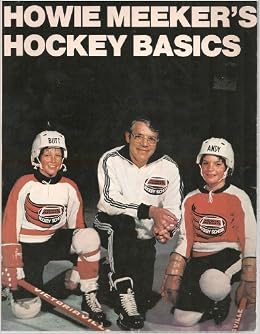
He moved to St. John's, the capital of the Province of Newfoundland and Labrador, and ran a hockey school, in the belief that the sport simply was not being properly taught. In 1973, he published a book, Howie Meeker's Hockey Basics. Based on this book, the Canadian Broadcasting Corporation (CBC) ran the TV show Howie Meeker's Hockey School. If you remember Johnny Bench hosting The Baseball Bunch on NBC in the early 1980s, the idea was the same, although Meeker was never as good in his sport as Bench was in his.
No, I don't know why the kid on the left is called "Butt."

He also joined the broadcast staff of CBC's Hockey Night In Canada. Like John Madden in football and Mike Fratello in basketball, he used a telestrator to show his expertise in analyzing the sport. He would tell the video replayer to "Stop it right there!" to show the key moment in a play. He was also known for the exclamation "Golly gee!" and his advice to "Keep your stick on the ice." He was given the Foster Hewitt Award, the Hockey Hall of Fame's award for broadcasters, elected to the Ontario Sports Hall of Fame, and named to the Order of Canada.
He eventually moved all the way across the country and the continent, from St. John's, Newfoundland, the easternmost city in North America, to the Vancouver area, and participated in charities ranging from the Special Olympics to guide dogs for the blind.

He was married to a woman named Grace for 55 years, until her death. He and 2nd wife Leah lived in Parksville, British Columbia, on Vancouver Island. He had 6 children, 13 grandchildren, and 17 great-grandchildren.

Howie Meeker died this past Sunday, November 8, 2020, shortly after his 97th birthday, at a hospital in the Vancouver suburb of Nanaimo.

He was the last surviving player from the 1st official NHL All-Star Game in 1947. And he was the last surviving member of the Toronto Maple Leafs' Stanley Cup winners of 1947, the last from 1948, the last from 1949, and the last from 1951. So this closes the book on that Leafs dynasty. Marty Pavelich of the 1950 Detroit Red Wings, who just turned 93, is now the earliest surviving Cup winner.