February 13, 1999, 25 years ago: The last National Hockey League game is played at Maple Leaf Gardens in Toronto, after 67 seasons. The host Toronto Maple Leafs lose to the Chicago Blackhawks, 6-2.
The Hawks had also been the opponent, and a victorious one, in the Gardens' 1st game, on November 12, 1931, 2-1. The Leafs' Charlie Conacher scored the 1st goal, but it wasn't enough.
For the 1999 finale, a member of each team that played in that 1st game was on hand for a ceremonial puck drop: George "Red" Horner of the Leafs, and Harold "Mush" March of the Hawks. (March died in 2002, Horner in 2005.) Derek King scored the Leafs' last goal, while Bob Probert, better known for his fighting and his drug abuse, scored the last goal overall.
The Maple Leafs won the Stanley Cup while playing at the Gardens in 1932, 1942, 1945, 1947, 1948, 1949, 1951, 1962, 1963, 1964 and 1967 -- clinching on home ice in '32, '42, '47, '49, '51, '63, '64 and '67. In addition, the New York Rangers clinched the Cup by beating the Leafs at the Gardens in 1933 and 1940, the Detroit Red Wings in 1937, and the Montreal Canadiens in 1959 and 1960.
Leafs player Irvine "Ace" Bailey had been injured by Eddie Shore of the Boston Bruins in a game in Boston in 1933, and never played again. On February 12, 1934, the Gardens hosted a benefit game for him: The Leafs against a team of players from all the other teams in the League. When Shore skated over to the Leafs' bench, where Bailey was in street clothes, and shook hands with him, the Gardens erupted in cheers. The Leafs won the game. In 1947, the Leafs beat an All-Star team from the rest of the League again in the 1st official NHL All-Star Game.
The Gardens became known as "The Shrine of Hockey," with CBC, the Canadian Broadcasting Corporation, broadcasting Hockey Night in Canada from the building on most Saturday nights, first on radio, and then, starting in 1952, on television. It helped to make the Gardens -- even more than Parliament Hill in Ottawa or the Montreal Forum -- the most famous building in Canada.
On November 1, 1946, the Gardens hosted the 1st game in the league that would become the National Basketball Association. But the Toronto Huskies lost it to the New York Knicks, and only lasted that 1 season before folding. Pro basketball would return, briefly: From 1971 to 1975, the Buffalo Braves (the team now known as the Los Angeles Clippers) played 16 "home games" there, and the Toronto Raptors played 6 home games there in 1997, '98 and '99 when the SkyDome (now the Rogers Centre) was unavailable.
Also due to a scheduling conflict, the Rangers played their 1950 Stanley Cup Finals games at Maple Leaf Gardens, possibly costing them the Cup, as they lost to the Red Wings. In the World Hockey Association, the Ottawa Nationals had to move their 1973 Playoff games there, and the Toronto Toros played the 1974-75 and 1975-76 seasons there, before being forced to a smaller arena by the onerous rent charged by Leafs owner Harold Ballard, who, because of his presiding over the declines of both the Leafs and the CFL's Toronto Argonauts, became the most hated man in Canada.
Ballard was cheap, he was evil, and he was crooked. Smythe wasn't flat-out evil, but he was imperious, and he was certainly cheap. At one end of the Gardens was a large portrait of Canada's head of state, the British monarch. From 1931 to 1936, this was King George V. For much of 1936, it was King Edward VIII. Then, until 1952, it was King George VI. Finally, it was Queen Elizabeth II.
In 1968, the seating capacity at the Gardens was raised from 13,718 to 16,316. This was done through installing narrower seats, and removing the Queen's portrait so that more seats could be installed. Smythe, who had sold the team to a consortium including his son Stafford Smythe and Ballard, said of the new seats, "Only a young man could sit in them, and only a fat old rich man could afford them."
As for the removal of the portrait of the woman to whom Canadian citizens still paid a share of their taxes (and still pay them to the British Crown, to this day), Ballard pointed out that, in spite of a visit to the building in 1951, before she became Queen, she didn't pay admission to games: "She doesn't pay me. I pay her. Besides, what the hell position can a queen play?"
Maple Leaf Gardens hosted Game 2 of the 1972 "Summit Series" between Canada and the Soviet Union, a 4-1 win for Canada. It also hosted minor-league hockey: The Toronto Lions of the Ontario Hockey Association, 1931-39; the Toronto Marlboros (or "Marlies") of the OHA and its successor, the Ontario Hockey League, 1931-89; the Toronto Young Rangers of the OHA and the OHL, 1937 to 1948; the Toronto Knob Hill Farms of the Metro Junior A League, in the 1962-63 season; and the Toronto St. Michael's Majors (or "St. Mike's") of the OHL, 1997-2000.
Lacrosse is not considered a major sport in America. In Canada, where it was invented, it is considerably bigger. Canada's National Lacrosse League had the Toronto Tomahawks playing at the Gardens in 1974, and the Toronto Rock in the 1999-2000 season. The Gardens also hosted professional indoor soccer, the "pinball" version of "the beautiful game": The Toronto Blizzard in the 1980-81 and 1981-82 seasons, and the Toronto Shooting Stars in 1996-97.
The Gardens was 1 of 16 buildings to have hosted both Elvis Presley and The Beatles. Because Elvis' manager, Colonel Tom Parker, was an illegal immigrant from the Netherlands, a fact not known during Elvis' lifetime, Elvis could only leave the North American continent to fulfill his U.S. Army obligation from 1958 to 1960. He sang at the Gardens on April 2, 1957. It was the only building to host The Beatles on all 3 of their North American tours: September 7, 1964; August 17, 1965; and August 17, 1966.
It also hosted boxing and "professional wrestling," with Killer Kowalski making that "sport" popular in his native Canada. On March 29, 1966, Muhammad Ali defended the Heavyweight Championship of the World there, defeating Canada's heavyweight champion, George Chuvalo.
Conn Smythe, who had served in the Canadian Army during both World Wars, and enjoyed being called "Major Smythe," resigned from the Gardens' board of directors over the decision to host a fight featuring a man who had already been making statements about how he would refuse to accept being drafted to fight in the Vietnam War. Smythe said of the owners, including his son, that they had "put cash ahead of class."
They could do that because the Leafs were a gold mine. From 1946, when the boys came back from World War II, until 1999, the Leafs never played to an unsold seat. This was in spite of the fact that, after the closing of the dynasty coached and managed by George "Punch" Imlach on May 2, 1967, the Leafs never appeared in another Stanley Cup Finals game at the Gardens -- and still haven't. The building, whose address was 60 Carlton Street, became known as the Carlton Street Cashbox.
The Gardens outlasted the somewhat enlightened despot Smythe, and the tyrant Ballard. It outlasted the Great Depression, World War II, and the high tide of the conflict between the Canadian federal government and Quebec nationalists. It outlasted the League of Nations, the Third Reich, the British Empire and the Warsaw Pact.
It outlasted 20 Mayors of Toronto, 12 Premiers of Ontario (equivalent to the Governor of a State), 10 Prime Ministers of Canada, and 1 Flag of Canada. (The current Maple Leaf Flag replaced the old "Red Ensign" in 1965.) It outlasted Maple Leaf Stadium (home of the minor-league baseball team that gave the NHL Maple Leafs their name), the Mutual Street Arena, the original Varsity Stadium, and Exhibition Stadium.
It outlasted the Montreal Maroons, the New York Americans, the California Golden Seals, the Cleveland Barons, the Atlanta Flames (now the Calgary Flames), the Kansas City Scouts and the Colorado Rockies that they became (now the New Jersey Devils), the Minnesota North Stars (now the Dallas Stars), the Quebec Nordiques (now the Colorado Avalanche), the original version of the Winnipeg Jets (now the Arizona Coyotes), the Hartford Whalers (now the Carolina Hurricanes), and the entire World Hockey Association.
It outlasted the NHL's other "Original Six" arenas, some by plenty: New York replaced "the old Madison Square Garden" with "the new Madison Square Garden" in 1968, Detroit replaced the Olympia Stadium with the Joe Louis Arena in 1979, Chicago replaced the Chicago Stadium with the United Center in 1994, Boston replaced the Boston Garden with the FleetCenter (now the TD Garden) in 1995, and Montreal replaced the Montreal Forum with the Molson Centre (now the Bell Centre) in 1996.
While not home to "Original Six" teams, the Buffalo Memorial Auditorium and the St. Louis Arena were contemporaries, and they were also replaced before 1999. Considerably newer arenas were replaced in Philadelphia, Pittsburgh, Minnesota, Vancouver, Atlanta, Ottawa, Tampa and the San Francisco Bay Area. (And the ones in Minnesota and Atlanta were demolished before the Gardens closed.)
But nothing lasts forever. The ownership group for the NBA's Raptors didn't like playing in the huge SkyDome, and wanted to build their own arena, the Air Canada Centre, next to Toronto's Union Station. Maple Leaf Sports & Entertainment, owners of the Leafs and the Gardens, knew that there was only so much that could be done to modernize the Gardens, and increasing seating capacity, including adding more luxury boxes, was operationally impossible.
So they bought the Raptors, giving their owners shares in MLSE, and had the plans for the ACC to be altered so that it could host hockey as well. Both teams moved in a few days after their last game at the Gardens in February 1999. (In 2018, the ACC was renamed the Scotiabank Arena.)
The Gardens didn't close immediately. It still hosted amateur hockey and professional lacrosse, and the British rock band Oasis gave a concert there in 2000. The last "sporting event" there came in 2004, a re-creation of prizefights of eventual Heavyweight Champion James Braddock for the film Cinderella Man, taking advantage of the Gardens' old-time appearance.
But MLSE didn't want to own a dormant building, and they also didn't want to sell the old arena to anyone who would use it as a competing arena. (There has long been talk of putting a 2nd NHL team in Toronto, and the Maple Leafs have thus far managed to shoot it down.) In 2000, after a massive renovation, the Montreal Forum reopened as a mall, with stores, a movie theater, and other entertainments. It was suggested that the same be done with the Gardens. But a feasibility study showed that it couldn't be done: If the bowls of seating were removed, the exterior walls would collapse.
In 2004, Loblaw Companies, Canada's largest food retailer, bought the Gardens for $12 million. In 2009, they made a deal with Toronto's Ryerson University to renovate the building, to make the playing area a rink with 2,796 seats, while the rest of the building would host retail space.
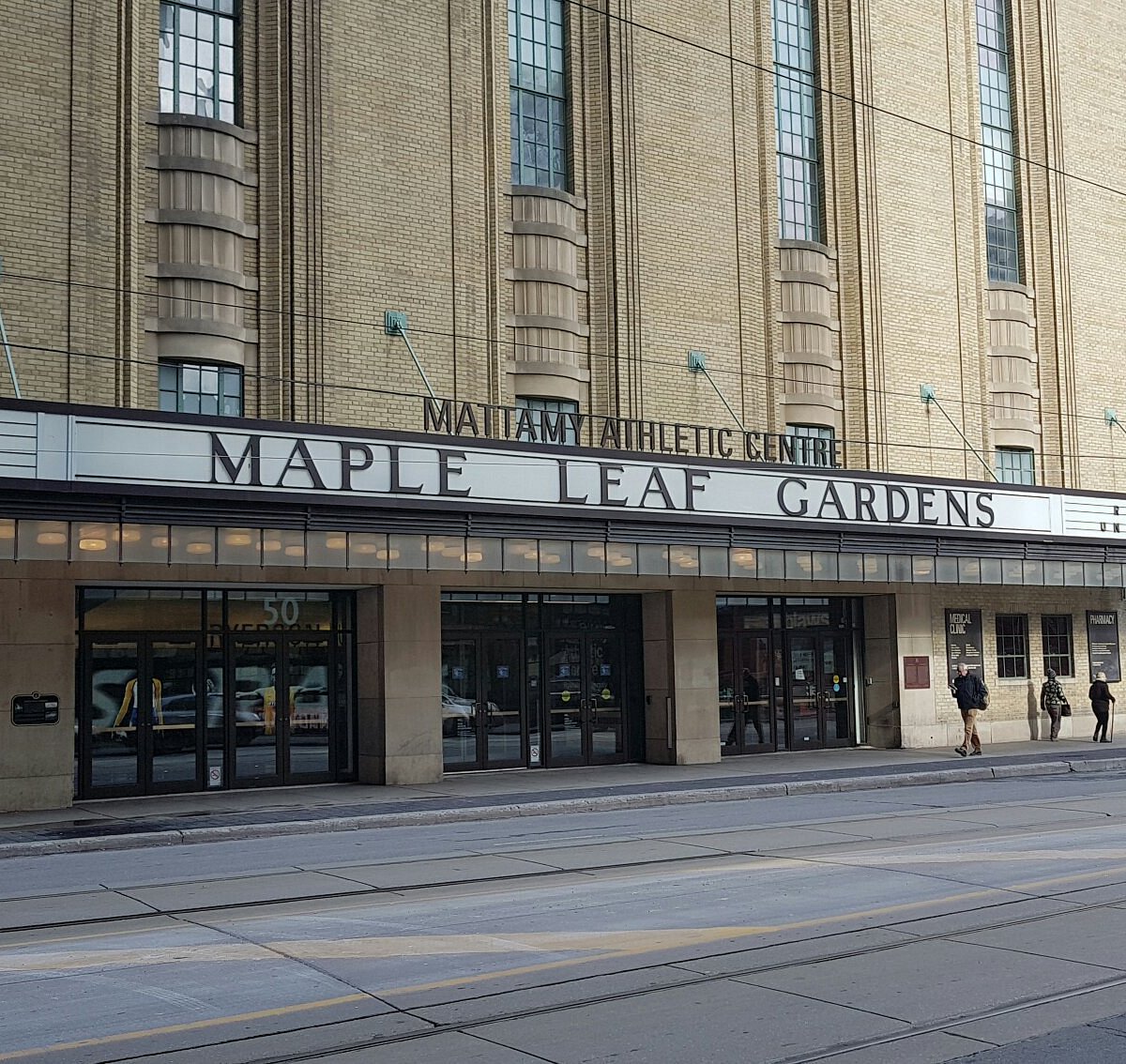
The famed marquee, following the renovation
In 2011, the new Loblaw's store finally opened, with a red dot on the floor marking the original location of centre ice. In 2012, the Mattamy Athletic Centre at the Gardens opened, and has been home to Rynearson's hockey team ever since. From 2013 to 2017, it also hosted the Toronto Predators of the Greater Metro Junior A Hockey League.