Showing posts with label toronto. Show all posts

Wednesday, April 30, 2025

April 30, 1945: The 1st Hockey Hall of Fame Election

James T. Sutherland

April 30, 1945, 80 years ago: The first election for the Hockey Hall of Fame is held, in Toronto. It is announced at the National Hockey League's offices, since the Hall does not yet have a physical location, and won't until 1961.

The Hockey Hall of Fame was established through the efforts of James T. Sutherland, a former president of the Canadian Amateur Hockey Association (CAHA). Sutherland sought to establish it in Kingston, Ontario, as he believed that the city was the birthplace of hockey. (The evidence is murky: It could also have been in Montreal, or in Canada's Maritime Provinces.)

In 1943, the NHL and CAHA reached an agreement that a Hall of Fame would be established in Kingston. Originally called the "International Hockey Hall of Fame," its mandate was to honor great hockey players and to raise funds for a permanent location.

The 1st 9 "honoured members" were, in chronological order:

* Hod Stuart, star of America's 1st great professional team, the Pittsburgh Bankers, and a member of the Montreal Wanderers' 1907 Stanley Cup winners, shortly before his death in a diving accident.
* Frank McGee, star of the Ottawa Silver Seven team that won the Stanley Cup in 1903, 1904, 1905 and 1906. 
* Harvey Pulford, who also played for those Silver Seven teams.
* Tommy Phillips, star of one of the greatest upset wins in hockey history, the 1907 Stanley Cup win of the Kenora Thistles.
* Georges Vezina, for whom the NHL's top goaltender award was named, backstop of the Montreal Canadiens' Stanley Cup winners of 1916 and 1924. 
* Hobey Baker, amateur star at Princeton University, and the only American, the only non-Canadian, elected.
* Eddie Gerard, who played for several Ottawa teams, including the Ottawa Senators' Stanley Cup winners of 1920, 1921 and 1923.
* Howie Morenz, "the Babe Ruth of Hockey," who led the Montreal Canadiens to win the Stanley Cup in 1924, 1930 and 1931.
* Charlie Gardiner, goaltender who fought through what turned out to be a fatal illness to help the Chicago Black Hawks win the 1934 Stanley Cup.

It wasn't just Gardiner: All of them were already dead. McGee had died in combat in World War I, while Baker had died in a training accident in service after the Armistice. Vezina died of tuberculosis in 1926, while still an active player. Pulford had died in 1940, at age 65, the only one to have lived anything resembling a long life.

In addition, the 1st 2 "Builders" were elected: Frederick Stanley, the 16th Earl of Derby, who, as Governor-General of Canada in 1893, had donated the Stanley Cup; and H. Montagu Allan, who had founded the Allan Cup, awarded since 1909 to Canada's annual amateur hockey champions. Hall of Fame founder Sutherland had donated the Memorial Cup in 1919, as a tribute to the dead of World War I, for the championship of Canadian "major junior hockey." He would be elected in the Hall's 2nd class, in 1947.

There would be no physical Hockey Hall of Fame until 1961, when it opened at Exhibition Place in Toronto. It was moved to the former Bank of Montreal building in downtown Toronto in 1993.

Thursday, October 3, 2024

October 3, 1984: The Last North American Soccer League Game

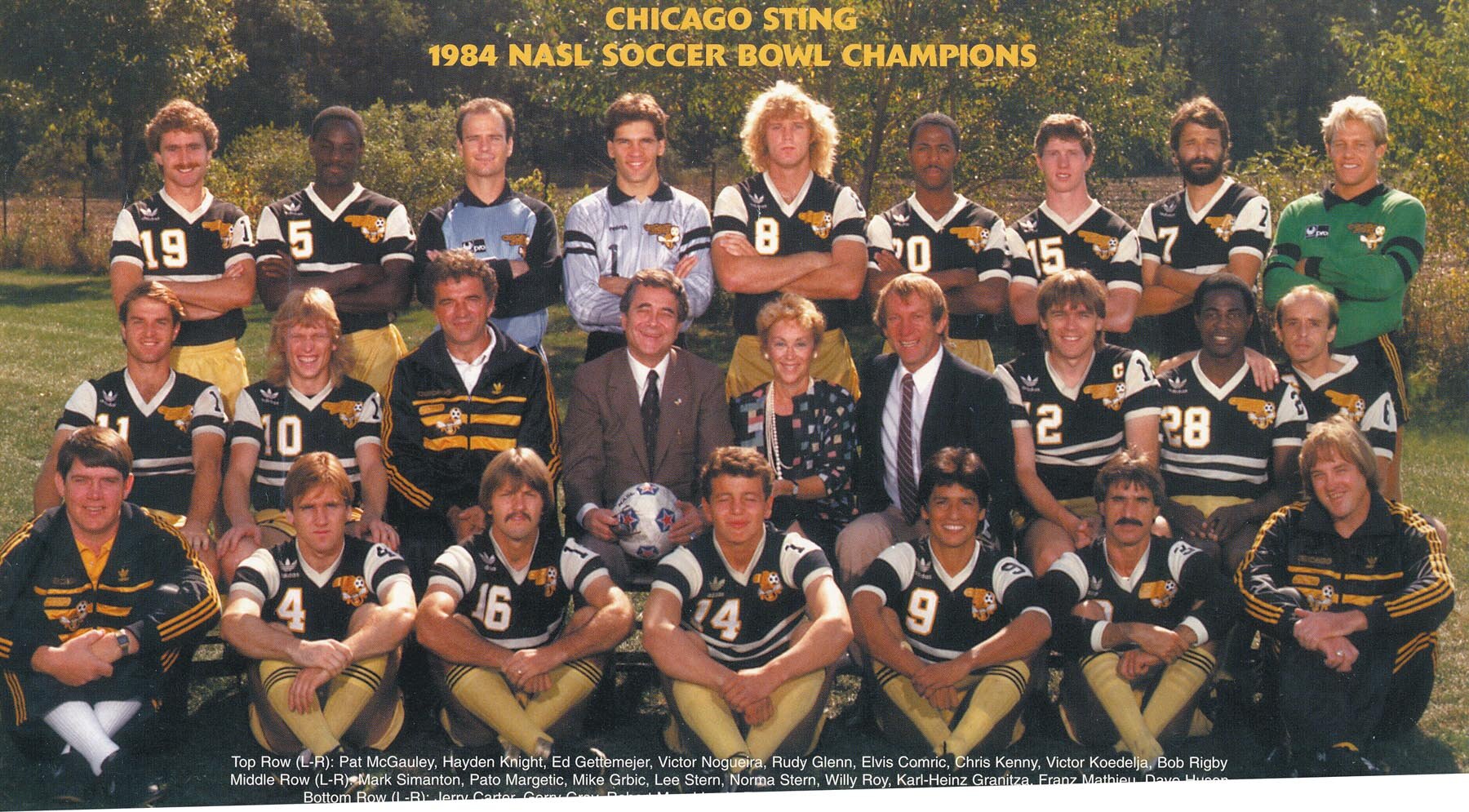
October 3, 1984, 40 years ago: Soccer Bowl '84 is played at Varsity Stadium in Toronto. Playing Soccer Bowl '83 in Canada (albeit all the way across the country in Vancouver) didn't help the Toronto Blizzard the year before, and playing on their actual home field doesn't help them now, as they lose 3-2 to the Chicago Sting.

The Blizzard -- who won the North American Soccer League title in 1976, as "Toronto Metros-Croatia" -- trailed 2-0 after 70 minutes, but scored twice in 3 minutes to equalize. But Patricia "Pato" Margetic, the Argentine striker who'd scored the Sting's 2nd goal, scores in the 82nd to win it.

Attendance at the 21,739-seat Varsity Stadium is just 16,842. No one knows it yet, but this is the last game that the original NASL will ever hold.

The Sting, who had also won the title in 1981, had already announced that this would be their last season in the League, as they had already been admitted to the Major Indoor Soccer League -- which played soccer in arenas on hockey rinks covered with artificial turf, with the boards ensuring the ball wouldn't go out of bounds unless it went over the boards, resulting in higher scores. It was exciting, but it was a bastardized version of the sport, something that no one would have called "The Beautiful Game." Instead, it was called "pinball soccer." 

Clive Toye, who built the New York Cosmos' dynasty, and also the Sting's '81 champs, was now running the Blizzard, and made postgame comments that Sting coach Willy Roy and striker Karl-Heinz Granitza -- both Germans, and the latter would later honor his Chicago experience by running a bar in Berlin named State Street -- were "cheats," and that the Sting were "unworthy champions."

During the ensuing off-season, NASL President Howard Samuels died, and Toye was named interim President. Then the Cosmos folded, due to striker/part-owner Giorgio Chinaglia's mismanagement. Without the flagship franchise, the League was doomed, no matter what Toye did, and he did try.

But when the time came to prepare for a 1985 season, only 2 teams -- the Blizzard and the Minnesota (formerly Fort Lauderdale) Strikers -- were still interested in playing, and the League folded, after 17 seasons. North America was without a "first division" in soccer for 11 years, setting the sport in the United States back a generation. The damage was incalculable.

Another league named the North American Soccer League played from 2011 to 2017, but it was never more than a second division, behind Major League Soccer, founded in 1996. The Chicago Fire would win the MLS Cup in 1998; Toronto FC, in 2017.

*

There was another, much-more-watched, sporting event involving a Chicago team on October 3, 1984. The Chicago Cubs, playing in their 1st postseason series since the 1945 World Series, beat the San Diego Padres, playing in their 1st postseason series since their founding in 1969, in Game 2 of the National League Championship Series. The game, at Wrigley Field in Chicago, ended 4-2 in the Cubs' favor.

The Cubs now needed just 1 more win to win their 1st Pennant in 39 years. It would take them another 32 years to win that Pennant.

The fact that ABC got great ratings for this series in the Chicago area, but lousy ratings everywhere else, led to a decision from the new Commissioner of Baseball, Peter Ueberroth: From now on, all postseason games would have to be played at stadiums that had lights, because the team owners wanted the revenue that came from games on prime-time TV. And Wrigley was the last stadium that didn't have lights.

Ueberroth ruled that, the next time the Cubs made the Playoffs, they would have to play their "home games" at the next-closest stadium in the National League Eastern Division, which they were in. But that would have been Busch Memorial Stadium, home of the St. Louis Cardinals, their arch-rivals. Why not Comiskey Park, home of the crosstown Chicago White Sox? Ueberroth didn't say.

So the process for putting lights up at Wrigley Field began. In 1988, the 1st night game was played there. In 1989, the next time the Cubs won the NL East, they hosted night games in the NLCS. In 1990, they hosted the All-Star Game there, which they also wouldn't have been allowed to do without lights.  Game 4 of the 1984 World Series remains the last World Series game to be played entirely in daylight.

Wednesday, February 14, 2024

February 14, 1934: The Ace Bailey Benefit Game

A colorized photo of Ace Bailey, included in a composite photo
of a Maple Leafs' Centennial Team, 2016

February 14, 1934, 90 years ago: One of the greatest moments in National Hockey League history occurs. But it was brought on by perhaps its ugliest game.

On December 12, 1933, the Boston Bruins were hosting the Toronto Maple Leafs at the Boston Garden. The Bruins still had most of the players who had led them to the 1929 Stanley Cup, including 2 of the greatest defensemen the game has ever known, Eddie Shore and Aubrey "Dit" Clapper. The Leafs, winners of the Cup in 1932, had another, Francis "King" Clancy.

This game, which the Leafs would win 4-1, was in the 2nd period. The Leafs had taken 2 quick penalties, and sent Clancy, defenseman George "Red" Horner, and right wing Irvine Wallace "Ace" Bailey out to defend the 5-on-3 Bruin power play.

Shore, who helped the Bruins win the Stanley Cup in 1929, rushed up the ice. Clancy, charitably listed at 5-foot-7 and 155 pounds, and a winner of the Cup with the Ottawa Senators in 1922, '23 and '27, and with the Leafs in '32, followed him, and checked him into the boards.

Shore got up, and, in his daze, he figured the closest Leaf player to him must have been the one who did it. He guessed wrong: The closest Leaf player to him was Bailey. Shore hit him from the side, and he landed head-first on the ice.
Horner skated over, knowing full well that it wasn't Bailey who had checked Shore, and yelled, "What did you do that for, Eddie?" Shore, not realizing the enormity of what he had done, gave Horner a big grin. What happened next is in dispute: The first source I saw on the story said that Horner hit Shore over the head with the blade of his stick. Another source said that Horner punched Shore, knocking him out in an instant.

Whatever the truth was, Shore was also out cold. The Boston crowd booed the hell out of Horner, who was already known as one of the dirtiest players in the game. But so was Shore, who, with his attitude, his receding hairline, and the fact that he was admired but not especially liked, was practically the Ty Cobb of hockey.

But it quickly became apparent that Bailey was hurt worse. Both men regained consciousness, and were carried off the ice together. Shore apologized. Bailey seemed to forgive him, saying, "It's all part of the game," and then passed out again.

Bailey was taken to Boston City Hospital. He was diagnosed with a fractured skull and an extradural clot on the brain. His father, listening to the game on the radio in Toronto, packed a gun, and immediately boarded a train for Boston, intending to kill Shore.

Leafs owner Conn Smythe found out about this, and talked to his general manager, Frank Selke. Selke had a friend working with the Boston Police, who met Bailey's father at the hotel, and talked him out of the murder plot.

Nevertheless, the BPD said they would charge Shore with manslaughter if Bailey died. Within 24 hours, he underwent 2 spinal taps to relieve intracranial pressure. There was at least one news report that Bailey had died. But, through several procedures, he came out of his coma after 10 days. He hung on, through Christmas and New Year's. In mid-January 1934, he was released from the hospital.

NHL President Frank Calder suspended Horner for 6 games, and Shore indefinitely. Once he was confident that Bailey was going to live, Calder set Shore's suspension at 16 games, or 1/3rd of the season at the time (48 games). Bailey never played again.

Walter Gilhooly, sports editor of the Ottawa Journal, recommended that a benefit game be played, to offset Bailey's loss of income. Calder agreed. The Leafs would host the game, and put their team out against a team made up of players from the rest of the League, 2 from each of the other 8 teams then in it.

The game was played at Maple Leaf Gardens on February 14, 1934. Here were the lineups:

* From the Toronto Maple Leafs, coached by Dick Irvin, once a great player, and the father of eventual Hall of Fame broadcaster Dick Irvin Jr.: Number 1, goaltender George Hainsworth, formerly a star with the Montreal Canadiens; 2, defenseman Red Horner; 3, defenseman Alex Levinsky; 4, defenseman Clarence "Hap" Day; 5, center Andy Blair; 7, defenseman King Clancy; 8, left wing Harold "Baldy" Cotton; 9, right wing Charlie "the Bomber" Conacher; 10, center Joe Primeau; 11, left wing Harvey "Busher" Jackson; 12, left wing Hector "Hec" Kilrea; 14, center Bill Thoms; 15, right wing Ken Doraty; 16, right wing Charlie Sands; 17, left wing Frank "Buzz" Boll.

NHL All-Stars, coached by Lester Patrick of the New York Rangers, also once a great player:

* From the Chicago Black Hawks: 1, goaltender Charlie Gardiner; and 7, defenseman Lionel Conacher, brother of Charlie.

* From the Boston Bruins: 2, defenseman Eddie Shore; and 9, center Nelson "Nels" Stewart, better known as a Montreal Maroon.

* From the Ottawa Senators: 3, right wing Frank Finnigan; and 17, defenseman Al Shields.

* From the Montreal Canadiens: 4, left wing Aurele Joliat; and 16, center Howie Morenz. Morenz, known as "the Babe Ruth of Hockey" -- like Ruth, he had several nicknames -- normally wore 7, but Lionel Conacher was considered the greatest all-around athlete in Canada, and had priority.

* From the Detroit Red Wings: 5, left wing Herbie Lewis; and 14, right wing Larry Aurie.

* From the New York Rangers: 6, defenseman Ivan "Ching" Johnson; and 15, right wing Bill Cook. Somebody decided that the Irish-Canadian Johnson looked Chinese, and nicknamed him Ching. He had seniority over Aurie, who also wore 6; but Lewis had seniority over Cook, who wore 5 with the Rangers.

* From the Montreal Maroons: 10, center Reginald "Hooley" Smith; and 18, right wing Jimmy Ward.

* From the New York Americans: 11, center Norman Himes; and 12, defenseman Norman "Red" Dutton.

Before the game, the other teams' players posed at center ice in their regular sweaters. Then they were given white jerseys with "NHL" on them. And the Leafs had special jerseys, too, with "ACE" on them.
The selection of Shore was controversial. When he skated up to receive his Number 2 jersey, the crowd of 14,074 was silent. Then he skated over to the Leafs bench, where Bailey was sitting in a suit, long coat and fedora. Shore offered his hand, and Bailey shook it. The crowd roared, and the players tapped their sticks on the ice, in what was already a long-established hockey salute.
The ceremony concluded with Smythe giving Bailey his Number 6 jersey, and announced that it would be retired.

Bailey dropped a puck for a ceremonial faceoff, and the game began. Charlie Conacher already had an injured knee, and left the game early. Other than that, there wasn't much hitting, and no penalties were called. Cotton and Jackson scored to put the Leafs up 2-0, before Stewart scored to make it 2-1 Leafs at the end of the 1st period.

Jackson scored again early in the 2nd period. Morenz and Finnigan scored to tie it up. But it was all Leafs the rest of the way: Day scored halfway through the 2nd, and Kilrea, Doraty and Blair scored in the 3rd. The Leafs won, beating the entire rest of the NHL, 7-3.

The game raised $20,909 for Bailey's family, about $494,000 in 2024. Bailey applied to the NHL to be a referee, but was turned down. Smythe hired him to work in the team's front office. He worked there in one capacity or another until a later owner, Harold Ballard, already perhaps the most hated man in the history of Canadian sports, fired him in 1986. Bailey lived until 1992, ironically becoming one of the game's last surviving players.

A later player, Garnet Bailey, no relation, played in the NHL from 1969 to 1978, and was known as Ace Bailey. (An athlete receiving the same nickname as an earlier player with the same surname has happened a few times.) He was working as a scout for the Los Angeles Kings when he died in the destruction of United Airlines Flight 175 at the South Tower of the World Trade Center on September 11, 2001.

Shore continued to play with the Bruins through their 1939 Stanley Cup win. In 1940, he bought the minor-league Springfield Indians of Massachusetts, and remained their owner until his death in 1986. Both he and Bailey were elected to the Hockey Hall of Fame.

Bailey wanted the benefit game to become an annual event, for injured players. That didn't happen. But additional benefit games were held for the families of Morenz, who died of heart trouble in 1937, and the Canadiens' Albert "Babe" Siebert, who drowned in 1939. Both of those games were played at the Montreal Forum: The former was a combined Montreal team, Canadiens and Maroons, against the rest of the NHL. The Maroons folded in 1938, so it was just the Canadiens against the rest of the NHL in Siebert's benefit. Both times, the NHL All-Stars won. In 1947, the NHL finally established an annual All-Star Game.

Charlie Gardiner and Lionel Conacher led the Black Hawks to win the Stanley Cup, 2 months later. But, just 2 months after that, with antibiotics not yet available, Gardiner died of a tonsil infection. Conacher also died young, suffering a heart attack while playing in a charity softball game on Parliament Hill in Ottawa in 1954.

Howie Morenz of the Canadiens broke his leg in a 1937 game, and never left the hospital, suffering a pulmonary embolism. George Hainsworth was killed in a car crash in 1950. Larry Aurie of the Red Wings suffered a stroke while driving in 1952. And Charlie Sands died in 1953.

Nels Stewart in 1957; Normie Himes in 1958; Hooley Smith in 1963; Bill Thomas in 1964; Busher Jackson in 1966; Charlie Conacher in 1967; Hec Kilrea in 1969; Al Shields in 1975; Andy Blair in 1977; Ching Johnson in 1979; Ken Doraty in 1981; Baldy Cotton in 1984; Eddie Shore in 1985; Bill Cook, Aurèle Joliat and King Clancy in 1986; Red Dutton in 1987; Joe Primeau in 1989; Buzz Boll, Hap Day, Jimmy Ward and Alex Levinsky in 1990; Herbie Lewis and Frank Finnigan in 1991; and Red Horner was the last survivor from this game, living until April 27, 2005.

Tuesday, February 13, 2024

February 13, 1999: The Last "Original Six" Arena Closes

February 13, 1999, 25 years ago: The last National Hockey League game is played at Maple Leaf Gardens in Toronto, after 67 seasons. The host Toronto Maple Leafs lose to the Chicago Blackhawks, 6-2.

The Hawks had also been the opponent, and a victorious one, in the Gardens' 1st game, on November 12, 1931, 2-1. The Leafs' Charlie Conacher scored the 1st goal, but it wasn't enough.

For the 1999 finale, a member of each team that played in that 1st game was on hand for a ceremonial puck drop: George "Red" Horner of the Leafs, and Harold "Mush" March of the Hawks. (March died in 2002, Horner in 2005.) Derek King scored the Leafs' last goal, while Bob Probert, better known for his fighting and his drug abuse, scored the last goal overall.

The Maple Leafs won the Stanley Cup while playing at the Gardens in 1932, 1942, 1945, 1947, 1948, 1949, 1951, 1962, 1963, 1964 and 1967 -- clinching on home ice in '32, '42, '47, '49, '51, '63, '64 and '67. In addition, the New York Rangers clinched the Cup by beating the Leafs at the Gardens in 1933 and 1940, the Detroit Red Wings in 1937, and the Montreal Canadiens in 1959 and 1960.

Leafs player Irvine "Ace" Bailey had been injured by Eddie Shore of the Boston Bruins in a game in Boston in 1933, and never played again. On February 12, 1934, the Gardens hosted a benefit game for him: The Leafs against a team of players from all the other teams in the League. When Shore skated over to the Leafs' bench, where Bailey was in street clothes, and shook hands with him, the Gardens erupted in cheers. The Leafs won the game. In 1947, the Leafs beat an All-Star team from the rest of the League again in the 1st official NHL All-Star Game.

The Gardens became known as "The Shrine of Hockey," with CBC, the Canadian Broadcasting Corporation, broadcasting Hockey Night in Canada from the building on most Saturday nights, first on radio, and then, starting in 1952, on television. It helped to make the Gardens -- even more than Parliament Hill in Ottawa or the Montreal Forum -- the most famous building in Canada.

On November 1, 1946, the Gardens hosted the 1st game in the league that would become the National Basketball Association. But the Toronto Huskies lost it to the New York Knicks, and only lasted that 1 season before folding. Pro basketball would return, briefly: From 1971 to 1975, the Buffalo Braves (the team now known as the Los Angeles Clippers) played 16 "home games" there, and the Toronto Raptors played 6 home games there in 1997, '98 and '99 when the SkyDome (now the Rogers Centre) was unavailable.

Also due to a scheduling conflict, the Rangers played their 1950 Stanley Cup Finals games at Maple Leaf Gardens, possibly costing them the Cup, as they lost to the Red Wings. In the World Hockey Association, the Ottawa Nationals had to move their 1973 Playoff games there, and the Toronto Toros played the 1974-75 and 1975-76 seasons there, before being forced to a smaller arena by the onerous rent charged by Leafs owner Harold Ballard, who, because of his presiding over the declines of both the Leafs and the CFL's Toronto Argonauts, became the most hated man in Canada.

Ballard was cheap, he was evil, and he was crooked. Smythe wasn't flat-out evil, but he was imperious, and he was certainly cheap. At one end of the Gardens was a large portrait of Canada's head of state, the British monarch. From 1931 to 1936, this was King George V. For much of 1936, it was King Edward VIII. Then, until 1952, it was King George VI. Finally, it was Queen Elizabeth II.

In 1968, the seating capacity at the Gardens was raised from 13,718 to 16,316. This was done through installing narrower seats, and removing the Queen's portrait so that more seats could be installed. Smythe, who had sold the team to a consortium including his son Stafford Smythe and Ballard, said of the new seats, "Only a young man could sit in them, and only a fat old rich man could afford them."
As for the removal of the portrait of the woman to whom Canadian citizens still paid a share of their taxes (and still pay them to the British Crown, to this day), Ballard pointed out that, in spite of a visit to the building in 1951, before she became Queen, she didn't pay admission to games: "She doesn't pay me. I pay her. Besides, what the hell position can a queen play?"

Maple Leaf Gardens hosted Game 2 of the 1972 "Summit Series" between Canada and the Soviet Union, a 4-1 win for Canada. It also hosted minor-league hockey: The Toronto Lions of the Ontario Hockey Association, 1931-39; the Toronto Marlboros (or "Marlies") of the OHA and its successor, the Ontario Hockey League, 1931-89; the Toronto Young Rangers of the OHA and the OHL, 1937 to 1948; the Toronto Knob Hill Farms of the Metro Junior A League, in the 1962-63 season; and the Toronto St. Michael's Majors (or "St. Mike's") of the OHL, 1997-2000.

Lacrosse is not considered a major sport in America. In Canada, where it was invented, it is considerably bigger. Canada's National Lacrosse League had the Toronto Tomahawks playing at the Gardens in 1974, and the Toronto Rock in the 1999-2000 season. The Gardens also hosted professional indoor soccer, the "pinball" version of "the beautiful game": The Toronto Blizzard in the 1980-81 and 1981-82 seasons, and the Toronto Shooting Stars in 1996-97.

The Gardens was 1 of 16 buildings to have hosted both Elvis Presley and The Beatles. Because Elvis' manager, Colonel Tom Parker, was an illegal immigrant from the Netherlands, a fact not known during Elvis' lifetime, Elvis could only leave the North American continent to fulfill his U.S. Army obligation from 1958 to 1960. He sang at the Gardens on April 2, 1957. It was the only building to host The Beatles on all 3 of their North American tours: September 7, 1964; August 17, 1965; and August 17, 1966.

It also hosted boxing and "professional wrestling," with Killer Kowalski making that "sport" popular in his native Canada. On March 29, 1966, Muhammad Ali defended the Heavyweight Championship of the World there, defeating Canada's heavyweight champion, George Chuvalo.

Conn Smythe, who had served in the Canadian Army during both World Wars, and enjoyed being called "Major Smythe," resigned from the Gardens' board of directors over the decision to host a fight featuring a man who had already been making statements about how he would refuse to accept being drafted to fight in the Vietnam War. Smythe said of the owners, including his son, that they had "put cash ahead of class."

They could do that because the Leafs were a gold mine. From 1946, when the boys came back from World War II, until 1999, the Leafs never played to an unsold seat. This was in spite of the fact that, after the closing of the dynasty coached and managed by George "Punch" Imlach on May 2, 1967, the Leafs never appeared in another Stanley Cup Finals game at the Gardens -- and still haven't. The building, whose address was 60 Carlton Street, became known as the Carlton Street Cashbox.

The Gardens outlasted the somewhat enlightened despot Smythe, and the tyrant Ballard. It outlasted the Great Depression, World War II, and the high tide of the conflict between the Canadian federal government and Quebec nationalists. It outlasted the League of Nations, the Third Reich, the British Empire and the Warsaw Pact.

It outlasted 20 Mayors of Toronto, 12 Premiers of Ontario (equivalent to the Governor of a State), 10 Prime Ministers of Canada, and 1 Flag of Canada. (The current Maple Leaf Flag replaced the old "Red Ensign" in 1965.) It outlasted Maple Leaf Stadium (home of the minor-league baseball team that gave the NHL Maple Leafs their name), the Mutual Street Arena, the original Varsity Stadium, and Exhibition Stadium.

It outlasted the Montreal Maroons, the New York Americans, the California Golden Seals, the Cleveland Barons, the Atlanta Flames (now the Calgary Flames), the Kansas City Scouts and the Colorado Rockies that they became (now the New Jersey Devils), the Minnesota North Stars (now the Dallas Stars), the Quebec Nordiques (now the Colorado Avalanche), the original version of the Winnipeg Jets (now the Arizona Coyotes), the Hartford Whalers (now the Carolina Hurricanes), and the entire World Hockey Association.

It outlasted the NHL's other "Original Six" arenas, some by plenty: New York replaced "the old Madison Square Garden" with "the new Madison Square Garden" in 1968, Detroit replaced the Olympia Stadium with the Joe Louis Arena in 1979, Chicago replaced the Chicago Stadium with the United Center in 1994, Boston replaced the Boston Garden with the FleetCenter (now the TD Garden) in 1995, and Montreal replaced the Montreal Forum with the Molson Centre (now the Bell Centre) in 1996.

While not home to "Original Six" teams, the Buffalo Memorial Auditorium and the St. Louis Arena were contemporaries, and they were also replaced before 1999. Considerably newer arenas were replaced in Philadelphia, Pittsburgh, Minnesota, Vancouver, Atlanta, Ottawa, Tampa and the San Francisco Bay Area. (And the ones in Minnesota and Atlanta were demolished before the Gardens closed.)

But nothing lasts forever. The ownership group for the NBA's Raptors didn't like playing in the huge SkyDome, and wanted to build their own arena, the Air Canada Centre, next to Toronto's Union Station. Maple Leaf Sports & Entertainment, owners of the Leafs and the Gardens, knew that there was only so much that could be done to modernize the Gardens, and increasing seating capacity, including adding more luxury boxes, was operationally impossible.

So they bought the Raptors, giving their owners shares in MLSE, and had the plans for the ACC to be altered so that it could host hockey as well. Both teams moved in a few days after their last game at the Gardens in February 1999. (In 2018, the ACC was renamed the Scotiabank Arena.)

The Gardens didn't close immediately. It still hosted amateur hockey and professional lacrosse, and the British rock band Oasis gave a concert there in 2000. The last "sporting event" there came in 2004, a re-creation of prizefights of eventual Heavyweight Champion James Braddock for the film Cinderella Man, taking advantage of the Gardens' old-time appearance.

But MLSE didn't want to own a dormant building, and they also didn't want to sell the old arena to anyone who would use it as a competing arena. (There has long been talk of putting a 2nd NHL team in Toronto, and the Maple Leafs have thus far managed to shoot it down.) In 2000, after a massive renovation, the Montreal Forum reopened as a mall, with stores, a movie theater, and other entertainments. It was suggested that the same be done with the Gardens. But a feasibility study showed that it couldn't be done: If the bowls of seating were removed, the exterior walls would collapse.

In 2004, Loblaw Companies, Canada's largest food retailer, bought the Gardens for $12 million. In 2009, they made a deal with Toronto's Ryerson University to renovate the building, to make the playing area a rink with 2,796 seats, while the rest of the building would host retail space.
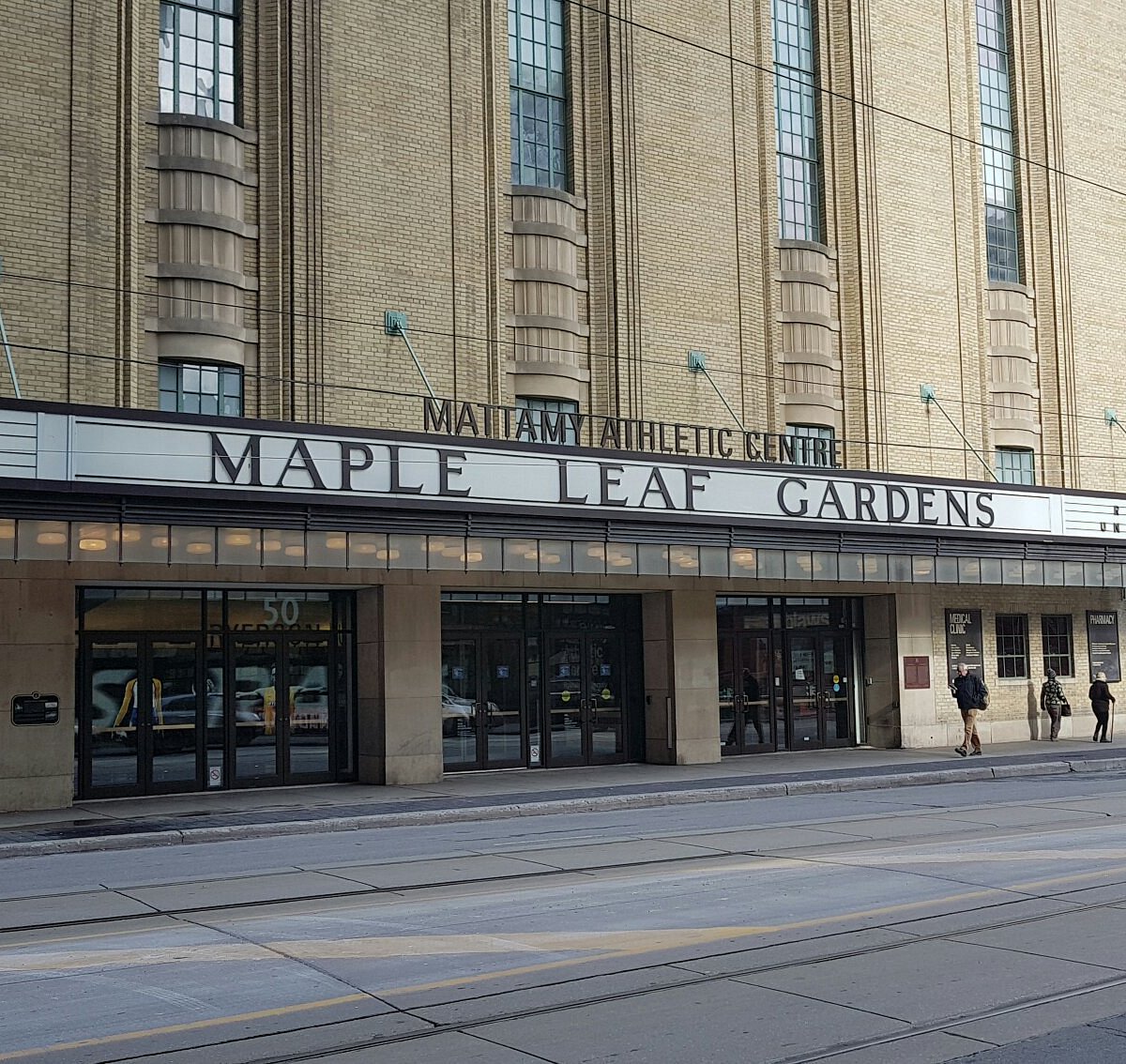
The famed marquee, following the renovation

In 2011, the new Loblaw's store finally opened, with a red dot on the floor marking the original location of centre ice. In 2012, the Mattamy Athletic Centre at the Gardens opened, and has been home to Rynearson's hockey team ever since. From 2013 to 2017, it also hosted the Toronto Predators of the Greater Metro Junior A Hockey League.

Monday, October 31, 2022

Finals Appearances By City, 1903-2022

Philadelphia is currently in 2 finals, with the Phillies and the Union.
The Eagles look ready to make it 3.

Note: Since I'm including all teams from a metropolitan area in the leagues listed below, for any Final that featured 2 teams from the same metropolitan area contests, I'm going to count it twice. Ties are broken by most Finals won.

Leagues included: 

* Baseball: MLB World Series, 1903-2022.
* Football: NFL Championship Games 1933-1965, Super Bowls 1967-2022, CFL Grey Cups 1909-2021.
* Basketball: NBA Finals 1947-2022, WNBA Finals 1997-2022.
* Hockey: NHL Stanley Cup Finals 1918-2022, pre-NHL Stanley Cup Finals 1893-1917.
* Soccer: NASL Finals/Soccer Bowls 1967-1984, MLS Cup Finals 1996-2021, WUSA Finals 2001-2003, WPS 2007-2011, and NWSL Finals 2012-2022.

1. New York, 131: Yankees 40, NFL Giants 19, MLB Giants 13, Rangers 11, Brooklyn Dodgers 9, Knicks 8, Cosmos 6, Mets 5, Islanders 5, New Jersey Devils 5, Liberty 4, New York/New Jersey/Brooklyn Nets 2, Jets 1, New York City FC 1, MetroStars/Red Bulls 1, Sky Blue/Gotham FC 1.

New York is so far ahead, you could take the Yankees out, and it would still have a big lead. 

2. Montreal, 78: Montreal Canadiens 36, Montreal Alouettes 18, Montreal Wanderers 7, Montreal Victorias 5, Montreal Hockey Club 4, Montreal Shamrocks 3, Montreal Maroons 3, Montreal Winged Wheelers 1, St. Hyachinthe-Donnacona Navy 1, Montreal Expos 0, Montreal Impact/CF Montreal 0.

3. Boston, 76: Celtics 22, Bruins 20, Red Sox 13, New England Patriots 13, New England Revolution 5, Boston Braves 2, Boston Redskins 1.

4. Toronto, 71: Argonauts 23, Maple Leafs 21, Toronto Varsity Blues 6, Toronto Balmy Beach 4, Toronto FC 3, Metros/Blizzard 3, Blue Jays 2, Parkdale Canoe Club 2, Raptors 1, Toronto Blueshirts 1, Toronto Wellingtons 1, Toronto Marlboros 1, Toronto Pros 1, Toronto RCAF Hurricanes 1, Toronto Rowing Association 1.

5. Los Angeles, 69: Lakers 26, Dodgers 12, Galaxy 9, Rams 7, Sparks 5, Kings 3, Angels 1, Ducks 2, Los Angeles FC 1, Raiders 1, Aztecs 1, Wolves 1, Sol 1, Clippers 0, Angel City 0, Chivas USA 0.

6. Chicago, 59: Blackhawks 13, Bears 12, Cubs 11, Bulls 6, White Sox 5, Red Stars 3, Sky 2, Fire 2, Cardinals 2, Sting 2, Stags 1, Zephyrs 0.

7. Detroit, 49: Red Wings 24, Tigers 11, Lions 5, Pistons 5, Shock 4.

Given that the NHL only had 6 teams from 1942 to 1967, limiting the number of teams that could be in the Stanley Cup Finals, it shouldn't surprise you that the top 7 cities include the NHL's "Original Six" plus North America's Number 2 metropolitan area in population, Los Angeles.

8. Philadelphia, 44: Phillies 8, Athletics 8, Flyers 8, Eagles 7, 76ers 6, Warriors 3, Independence 2, Union 1, Atoms 1.

9. Winnipeg, 41: Blue Bombers 25, Winnipeg Victorias 7, Brandon Wheat City 2, Winnipeg Hockey Club 1, Winnipeg Rowing Club 1, Winnipeg Maple Leafs 1, Winnipeg 'Pegs 1, Winnipeg RCAF Bombers 2, Winnipeg Tammany Tigers 1, Jets 0.

10. San Francisco Bay Area, 37: Golden State Warriors 9, San Francisco Giants 6, Oakland Athletics 6, San Francisco 49ers 6, Oakland Raiders 4, San Jose Earthquakes 2, San Jose Sharks 1, Oakland Clippers 1, Bay Area CyberRays 1, FC Gold Pride 1, Oakland Seals 0.

11. Hamilton, 36: Hamilton Tiger-Cats 22, Hamilton Tigers 8, Hamilton Flying Wildcats 2, Galt Hockey Club 2, Hamilton Alerts 1, Berlin Dutchmen 1.

12. Edmonton, 35: Eskimos/Elks 25, Oilers 7, Edmonton Hockey Club 2, WCHL Eskimos 1.

13. Washington, 33: Redskins/Commanders 10, D.C. United 5, Bullets/Wizards 3, Senators 3, NHL Capitals 2, Mystics 2, Spirit 2, Freedom 2, Nationals 1, NBA Capitols 1, Darts 1, Whips 1, Diplomats 0.

14. St. Louis, 31: MLB Cardinals 19, Blues 4, Hawks 4, Rams 2, Browns 1, Stars 1, NFL Cardinals 0.

15. Ottawa, 31: Ottawa Rough Riders 13, Old NHA/NHL Ottawa Senators 11, Ottawa Redblacks 3, CFL Ottawa Senators 2, New NHL Ottawa Senators 1, Ottawa Hockey Club 1, Ottawa Capitals 1, Ottawa Victorias 1, Smiths Falls Hockey Club 1.

16. Pittsburgh, 23: Steelers 8, Penguins 8, Pirates 7.

17. Minneapolis, 22: Minneapolis Lakers 6, Minnesota Lynx 6, Minnesota Vikings 4, Minnesota Twins 3, Minnesota North Stars 2, Minnesota Kicks 1, Minnesota Wild 0, Minnesota Timberwolves 0, Minnesota United 0.

18. Seattle, 21: Sounders 6, Storm 4, Seahawks 3, SuperSonics 3, Metropolitans 3, Reign 2, Mariners 0, Kraken 0.

19. Calgary, 21: Stampeders 17, Flames 3, Tigers 1.

20. Cleveland, 21: Browns 9, Indians/Guardians 6, Cavaliers 5, Rams 1, Barons 0.

21. Vancouver, 20: B.C. Lions 10, Vancouver Millionaires 4, Vancouver Canucks 3, Victoria Cougars 2, Victoria Aristocrats 1, Whitecaps 0.

22. Milwaukee-Green Bay, 19: Packers 13, Bucks 3, Braves 2, Brewers 1.

23. Regina, 19: Regina/Saskatchewan Roughriders 18, Regina Rugby Club 1.

24. Baltimore, 18: Orioles 6, Colts 5, Ravens 2, Bullets 2, Stallions 2, Bays 1.

25. Houston, 18: Astros 5, Rockets 4, Dynamo 4, Comets 4, Dash 1, Texans 0, Oilers 0.

26. Dallas, 18: Dallas Cowboys 8, Dallas Stars 3, Texas Rangers 2, Dallas Mavericks 2, Dallas Tornado 2, FC Dallas 1.

27. Atlanta, 16: Braves 6, Dream 3, Falcons 2, Chiefs 2, Beat 2, United 1, Hawks 0, Flames 0, Thrashers 0.

28. Miami, 16: Miami Heat 6, Miami Dolphins 5, Florida/Miami Marlins 2, Florida Panthers 1, Miami Toros 1, Fort Lauderdale Strikers 1, Inter Miami 0, Miami Fusion 0.

29. Denver, 14: Denver Broncos 8, Colorado Avalanche 3, Colorado Rapids 2, MLB Colorado Rockies 1, Denver Nuggets 0, NHL Colorado Rockies 0.

30. Western New York, 14: Buffalo Bills 4, Western New York Flash 3, Syracuse Nationals 3, Buffalo Sabres 2, Rochester Royals 1, Rochester Lancers 1, Buffalo Braves 0.

31. Tampa Bay, 12: Lightning 5, Rowdies 3, Buccaneers 2, Rays 2, Mutiny 0.

39. Portland, 12: Timbers 4, Thorns 4, Trail Blazers 3, Rosebuds 1.

33. Cincinnati, 12: Reds 9, Bengals 3, Royals 0.

34. Kansas City, 11: Royals 4, Chiefs 4, Wizards/Sporting 3, FC Kansas City 2, Current 1, Kings 0, Scouts 0.

35. Phoenix, 10: Phoenix Mercury 5, Phoenix Suns 3, Arizona Diamondbacks 1, Arizona Cardinals 1, Arizona Coyotes 0.

36. Indiana, 8: Indiana Fever 3, Indianapolis Colts 2, Fort Wayne Pistons 2, Indiana Pacers 1.

37. San Antonio, 7: Spurs 6, Silver Stars 1.

38. Carolina, 6: North Carolina Courage 4, Carolina Hurricanes 2, Carolina Panthers 2, Charlotte Sting 1, Charlotte Hornets 0.

39. Kingston, 6: Queen's University Football 3, Queen's University Hockey 3.

40. Salt Lake City, 4: Real Salt Lake 2, Utah Jazz 2.

41. San Diego, 4: Padres 2, Chargers 1, Toros 1, Wave 0, Clippers 0.

42. Hartford, 4: Connecticut Sun 4, New England/Hartford Whalers 0.

43. Las Vegas, 3: Aces 2, Golden Knights 1, Raiders 0.

44. Columbus, 3: Crew 3, Blue Jackets 0.

45. Sarnia, 3: Sarnia Imperials 3.

46. Halifax, 3: Halifax Crescents 1, New Glasgow Cubs 1, Sydney Millionaires 1.

47. Orlando, 2: Magic 2, Orlando City 0, Pride 0.

48. Tennessee, 2: Tennessee Titans 1, Nashville Predators 1, Memphis Grizzlies 0, Nashville SC 0.

49. Oklahoma, 2: Tulsa Roughnecks 1, Oklahoma City Thunder 1.

50. Sacramento, 2: Monarchs 2, Kings 0.

51. Quebec City, 2: Bulldogs 2, Nordiques 0.

52. New Orleans, 1: Saints 1, Pelicans 0, Jazz 0.

53. Jacksonville, 0: Jaguars 0.

54. Louisville, 0: Racing Louisville 0.

Saturday, April 30, 2022

How to Be a Yankee Fan In Toronto -- 2022 Edition

For this coming Monday through Wednesday, the Yankees travel across the U.S.-Canadian border to play away to the Toronto Blue Jays.

After 20 years in the wilderness following their 1992 and '93 World Championships, the Jays got good again in 2014, won the American League Eastern Division again in 2015, won the AL Wild Card Game in 2016, and advance to the AL Championship Series in each of those last 2 seasons. But they got off to a horrendous start in 2017, and fell below .500 again. So, despite having to play "home games" in nearby Buffalo, New York and at their Spring Training complex in Dunedin, Florida, they have become Playoff contenders again.

Why do I so frequently call them "those pesky Blue Jays"? Because it was the Blue Jays, then a 2-year-old expansion team, that the Yankees faced in the first Major League Baseball game I ever saw live, on May 27, 1978. The Yankees, defending World Champions, took a 1-1 tie into the 9th, but Ed Figueroa ran out of gas and lost, 4-1. (Why Billy Martin didn't put in Sparky Lyle, I don't know. I do know he didn't trust the new reliever, Goose Gossage, though Bob Lemon did, and that helped save the season.)

It took 4 games, over a span of 15 years, before I finally saw the Yankees beat the Blue Jays with me in the stadium. I used to keep records of this sort of thing, and I could probably rebuild it if I had the time, but I think my record against the Jays is 2-5 -- and that includes 0-2 in Toronto. Which is a long way to go to not come away with a win.

Being in a foreign country has its particular challenges -- and, yes, for all its similarities to America, Canada is still a foreign country.

Before You Go. Be vaccinated -- or you won't be allowed across the Border. Also, make sure you call your bank and tell them you're going. After all, Canada may be an English-speaking country, and a democracy (if a parliamentary one), and a country with a Major League Baseball team, but it is still a foreign country. If your bank gets a record of your ATM card making a withdrawal from any country other than the U.S., it may freeze the card, and any other accounts you may have with them. So be sure to let them know that you will, in fact, be in Canada for a little while.

And, since June 1, 2009, you need a passport to cross the border in either direction. Even if you have a valid driver's license (or other State-issued ID) and your birth certificate, they ain't lettin' you across into the True North Strong and Free. Not even if you're a Blue Jays season-ticket holder living in Buffalo or if you sing hosannas of praise to Wayne Gretzky. You don't have a passport? Get one. You do have one? Make sure it's valid and up to date. This is not something you want to mess with. Canadian Customs officials do not fuck around: They care about their national security, too.

Do yourself another big favor: Change your money before you go. There are plenty of currency exchanges in New York City, including one on 42nd Street between 7th and 8th Avenue.

Leave yourself $50 in U.S. cash, especially if you're going other than by plane, so you'll have usable cash when you get back to your side of the border. At last check, on the evening of May 31, 2019, US$1.00 = C$1.29 – or, C$1.00 = US 78 cents. However, since the currency exchanges need to make a profit, the current rate may actually favor Canada.  (I was actually in Canada on the day when it most favored the U.S.: January 18, 2002, $1.60 to $1.00 in our favor.)

The multi-colored bill were confusing on my first visit, although we have those now, too. Most banknotes have not changed since I last regularly did Trip Guides. The $5 bill is still blue, and still features Wilfrid Laurier (Prime Minister 1896-1911). The $20 bill remains green, with the nation's head of state, Britain's Queen Elizabeth II. The $50 bill remains red, and features William Lyon Mackenzie King (the longest-serving Prime Minister, 1921-1926, 1926-1930, 1935-1948, including World War II). And the $100 remains yellow, and features Robert Borden (Prime Minister 1911-1920, including World War I).

But the $10 bill has changed. While still purple, it no longer features John A. Macdonald, their 1st Prime Minister (1867-73 and 1878-91). Instead, it features Viola Desmond, the 1st black person, and the 1st woman other than Queen Elizabeth, to appear on Canadian banknotes. She was a businesswoman who, in 1946, challenged racially segregated seating in a movie theater in her native Halifax, Nova Scotia. Essentially, she was Canada's Rosa Parks, 9 years before Mrs. Parks became our Mrs. Desmond.

The tricky part is going to be the coins – and you'll thank me for telling you this, but keep your U.S. coins and your Canadian coins separate, for the simple reason that their penny, nickel, dime and quarter are all the same colors and just about the same size as our respective coins. (To make matters more confusing, as we recently did with our States, they had a Provincial quarter series.)

All coins have Queen Elizabeth's portrait on the front, but she's been Queen since 1952, and depending on how old the coin is, you might get a young woman, or her current 91-year-old self, or anything in between. You might even get a penny or a nickel old enough to feature her father, King George VI. Such a coin is still legal tender, however.

They have a $1 coin, copper-colored, bigger than a quarter, and 11-sided, with a bird on the back. This bird is a loon – not to be confused with the people lunatic enough to buy Maple Leafs season tickets. The coin is thus called the "loonie," although they don't say "ten loonies": They use "buck" for "dollar" the way we would. In fact, the term is connected to Canada: Their first English settlers were the Hudson's Bay Company, and they set the value of a dollar to the price of the pelt of a male beaver, the male of the species being called, as are those of a deer and a rabbit, a buck. (And the female, a doe.)

The nation's French-speakers (Francophones) use the French word for loon, and call it a "huard," but since the Montreal Expos are gone, you probably won't hear that term unless you're a hockey fan and go to see the Rangers, Devils or Islanders in Montreal – or maybe Ottawa, which is on the Ontario-Quebec border and has a lot of French-first-speakers.

Then there's the $2 coin, or "toonie." It's not just two dollars, it's two-toned, and even two-piece. It's got a copper center, with the Queen on the front and a polar bear on the back, and a nickel ring around it. This coin is about the size of the Eisenhower silver dollars we used to have. This is the coin that drives me bonkers when I'm up there.

My suggestion is that, when you first get your money changed before you begin your trip, ask for $1 coins but no $2 coins. It's just simpler. I like Canada a lot, but their money, yikes, eh?

This is Canada, the Great White North, but, being early June, the traditional Canadian cold, and the wind blasting off Lake Ontario, should not be a problem. In which case the Rogers Centre roof will be likely to be closed. So you should pack a winter jacket. If you're going from May onward, even in late September, it will probably be warm enough to not bring any jacket, but bring a light one just in case.

According to the Toronto Star website, for the 3 days in question, afternoon temperatures will be in the low 60s. Nighttime temperatures will be in the low 50s. Showers are expected on Wednesday, so figure to see the dome closed on at least that day.

Toronto is in the Eastern Time Zone, so you won't have to reset your watch or fiddle with your smartphone's clock.

Tickets. It used to be that getting tickets to any Blue Jays home game, not just Yankee games, was hard, because they were selling the SkyDome out, 50,000 per night. It peaked in their 2nd straight World Championship season of 1993, 50,098.

But the strike of 1994, and the decline of the team (the World Championship roster had already begun to be broken up to save money), was the beginning of the end. They fell to 20,209 in 2002, had an uptick back to 29,626 in 2008, but in 2010 they averaged 20,068, 5th-worst in baseball, 3rd in the AL and dead last in the AL East – and that counts games against the well-traveling, not-that-far-away Yankees and Red Sox, not to mention their closest opponents, the Cleveland Indians and Detroit Tigers.

The move of the Montreal Expos to Washington, making them Canada's only Major League Baseball team, didn't seem to have affected attendance much: The increases in home attendance in 2005, '06, '07 and '08 were mainly due to the Jays getting a little better (in 2006 they finished 2nd to the Yankees, the closest they came to postseason play since between 1993 and 2015), and they lost 6,500 fans per game in 2009 and lost another 3,000 in 2010.

The preseason hype of 2014 and the postseason runs of the next 2 years sold a lot of tickets, getting them up to 41,880, about 85 percent of capacity. But as the team has dropped, so has that figure, to about 21,660 in 2019, the last pre-COVID season, or about 42 percent.

You should have no trouble getting tickets, and going to one of the many scalpers on and around the stadium grounds will be totally unnecessary – this is the Jays, not the Leafs, who haven't played to an unsold seat since World War II. (Note that all ticket prices I'm mentioning in this post are in Canadian dollars, which means they're a bit less in U.S. dollars.)

Games against the Yankees are classified as "Premium Games," so they are a bit more expensive than usual. You can get Field Level Bases for $99, 100 Level Outfield for $44, 200 Level Bases for $67, 200 Level Outfield for $40, infield upper deck, the 500 Level, for $25, and outfield upper deck for $21. The 500 Level is really high up, but no worse than the upper decks at the old Yankee Stadium and Shea, and the first few rows shouldn't be all that bad.

Getting There. The best way is by plane. (Note that these prices, unlike the preceding, will be in U.S. dollars.) Air Canada runs flights out of Newark Liberty, John F. Kennedy and LaGuardia International Airport to Toronto's Lester Pearson International Airport (he was Prime Minister from 1963 to 1968 and won the Nobel Peace Prize), and the flight takes about an hour and a half. Book on Air Canada today, and you can get a round-trip nonstop flight for a little over $700. On an American carrier, it will be much more expensive, and it won't be nonstop.

Greyhound runs 9 buses a day from Port Authority Bus Terminal to the Toronto Coach Terminal, at 610 Bay Street. (Countries in the British Commonwealth, including Canada, call a local bus a bus and an inter-city bus a "coach.") The ride averages about 11 hours, and costs $355 round-trip, but an advance purchase can make it $202. The TCT is big and clean, although a little confusing, as it seems to be two separate buildings. You shouldn't have any difficulties with it. It's one block down Bay to Dundas Street, and turn left to get to the Dundas subway station.
Amtrak, however, runs just 1 train, the Maple Leaf, in each direction each day between New York and Toronto, in cooperation with Canada's equivalent, VIA Rail. This train leaves Pennsylvania Station at 7:15 AM and arrives at Union Station at 7:41 PM, a trip of 12 hours and 21 minutes – reaching Customs at 4:29 PM. The return trip leaves Toronto at 8:20 AM, reaches the border at 10:22, and gets back to Penn Station at 9:58 PM.

So if you want to see, for example, this entire upcoming series), you would have to leave New York on Wednesday morning and leave on the following Monday morning, and spend 4 nights in a hotel.
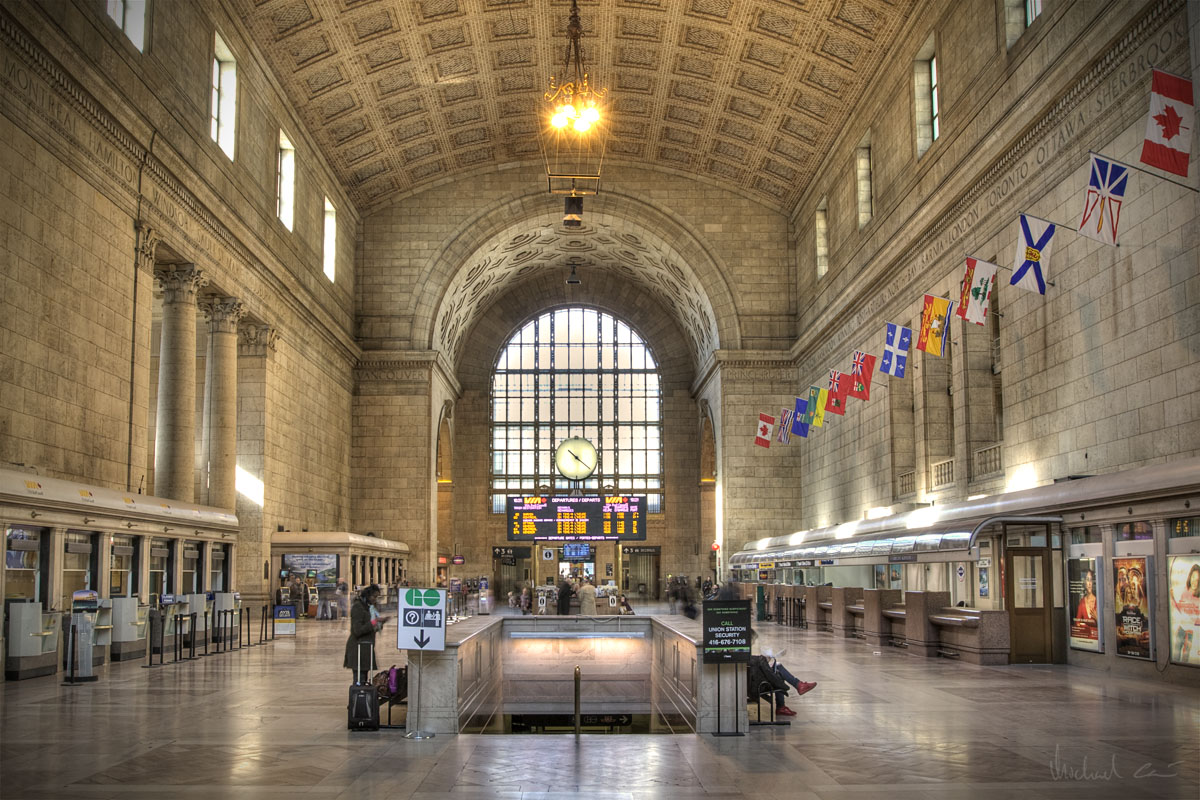
So, while Toronto's Union Station, at 65 Front Street West, is one of the world's great rail terminals, and is the heart of the city (it's the centerpoint of the city's subway system, so it's not just in the heart of the city), taking Amtrak/VIA to Toronto is not particularly convenient. Especially since the Maple Leaf is one of Amtrak's most popular routes, and it could sell out. If you still want to try it, it's US$296 round-trip. That's a lot more than Greyhound.
UPDATE: Amtrak is not running the Maple Leaf this week, so the train is out on this occasion.

If you're driving, it's 500 miles – well, 492 miles from Times Square to downtown Toronto. 
It's 79 miles from downtown to the closest border crossing, the Lewiston-Queenston Bridge at Niagara Falls.

Get into New Jersey to Interstate 80, and take it all the way across the State. Shortly after crossing the Delaware River and entering Pennsylvania, take I-380, following the signs for Scranton, until reaching I-81. (If you've driven to a game of the Yankees' Triple-A farm team, the Scranton/Wilkes-Barre Yankees, you already know this part.) Take I-81 north into New York State. (If you've driven to a game of the Mets' Double-A farm team, the Binghamton Mets, you already know this part.) Continue on I-81 past Binghamton and to Syracuse, where you'll get on the New York State Thruway, which, at this point, is I-90. Continue on the Thruway west, past Rochester, to Buffalo.

What happens next depends on where you cross the border. But first, let's discuss what you should do when you're actually at the border. Because you need to take this seriously. Because Canadian Customs will.

You'll be asked your citizenship, and you'll have to show your passport and your photo ID. You'll be asked why you're visiting Canada. Seeing a Yankees vs. Blue Jays game probably won't (but might) get you a smart-aleck remark about how the Jays are going to win, but they won't keep you out of their country based on that alone.

If you're bringing a computer with you (counting a laptop, but probably not counting a smartphone), you don't have to mention it, but you probably should. Chances are, you won't be carrying a large amount of food or plants; if you were, depending on how much, you might have to declare them.

Chances are, you won't be bringing alcohol into the country, but you can bring in one of the following items duty-free, and anything above or in addition to this must have duty paid on it: 1.5 litres (53 ounces) of wine, or 8.5 litres (300 ounces or 9.375 quarts) of beer or ale, or 1.14 litres (40 ounces) of hard liquor. If you have the slightest suspicion that I'm getting any of these numbers wrong, check the Canada Customs website. Better yet, don't bring booze in. Or out.

As for tobacco, well, you shouldn't use it. But, either way over the border, you can bring up to 200 cigarettes, 50 cigars, and 200 grams (7 ounces) of manufactured tobacco. As for Cuban cigars, last year, President Obama relaxed the embargo: Now, travelers may return to the United States with up to US$100 worth of alcohol or tobacco or a combination of both. (Cuba is also renowned for its rum.) Products acquired in Cuba may be in accompanied baggage, for personal use only. It is still considerably easier to buy these items in Canada than in America, but, now, you can bring them back over the border.

If you've got anything in your car (or, if going by bus or train) that could be considered a weapon, even if it's a disposable razor or nail clippers, tell them. And while Canada does have laws that allow you to bring in firearms if you're a licensed hunter (you'd have to apply for a license to the Province where you plan to hunt), the country has the proper attitude concerning guns: They hate them. They go absolutely batshit insane if you try to bring a firearm into their country. Which, if you're sane, is actually the sane way to treat the issue.

You think I'm being ridiculous? How about this: 7 of the 46 U.S. Presidents -- 9 counting the Roosevelts, Theodore after he was President and Franklin right before -- have faced assassins with guns, 6 got hit and 4 died; but none of the 23 people (including 1 woman) to serve as Prime Minister of Canada has ever faced an assassination attempt. John Lennon recorded "Give Peace a Chance" in Montreal and gave his first "solo concert" in Toronto, but he got shot and killed in New York. In fact, the next time I visit, I half-expect to see a bumper sticker that says, "GUNS DON'T KILL PEOPLE, AMERICANS WITH GUNS KILL PEOPLE."

(Another note about weapons: I'm a fan of the TV show NCIS, which airs in Canada on Global Network TV. If you are also a fan of this show, and you usually observe Gibbs Rule Number 9, "Never go anywhere without a knife," you need to remember that these are rules for members of Gibbs' team, not for civilians. So, this time, forget the knife, and leave it at home. If you really think you're going to need it -- as a tool -- mention the knife to the border guard, and show it to him, and tell him you have it to use as a tool in case of emergency, and that you do not plan to use it as a weapon. Do not mention the words "Rule Number 9" or quote said rule, or else he'll observe his Rule Number 1: "Do not let this jackass into your country, eh?" And another thing: Border guards, and the Royal Canadian Mounted Police, most likely will observe a variation on Gibbs Rule Number 23: "Never mess with a Mountie's Tim Hortons coffee if you want to live.")

And if you can speak French, don't try to impress the Customs officials with it. Or the locals, for that matter. You're going into Ontario, not Quebec. (And even if you were going into Quebec, they're not going to be impressed by your ability to speak their first language.) A, People of French descent are a minority west of Quebec (although singers Alanis Morrissette and Avril Lavigne are both Franco-Ontarians); and, B, They can probably speak English, let alone French, and possibly another language or two, better than you can. If you try to speak French in Toronto, you won't sound like you're from Montreal, and you certainly won't sound like you're from Paris. You'll sound like a smartass. That's if you speak French well. If you don't, you'll sound like a damn fool.

When crossing back into the U.S., in addition to what you would have to declare on the way in (if you still have any of it), you would have to declare items you purchased and are carrying with you upon return, items you bought in duty-free shops or (if you flew) on the plane, and items you intend to sell or use in your business, including business merchandise that you took out of the United States on your trip. There are other things, but, since you're just going for baseball, they probably won't apply to you. Just in case, check the Canadian Customs website I linked to above.

Precisely where will you be crossing the border? It could be at the Peace Bridge, built to commemorate the U.S. and Canada having "the world's longest undefended border," from Buffalo into the Ontario city of Fort Erie.
The Peace Bridge

After going through Customs, this would take you right onto the Queen Elizabeth Way (the QEW). After the Pennsylvania Turnpike, this was North America's 2nd superhighway, and was named not for the current Queen but for her mother, the wife of King George VI, the woman most people now under the age of 65 called the Queen Mother or the Queen Mum. (You know: Helena Bonham-Carter in The King's Speech.)
This road will hug Lake Ontario and go through the Ontario cities of Niagara Falls, St. Catharines and Hamilton before turning north and then east toward Toronto. Toronto's CN Tower is so tall that you may actually see it, across the lake, before you get to Hamilton.

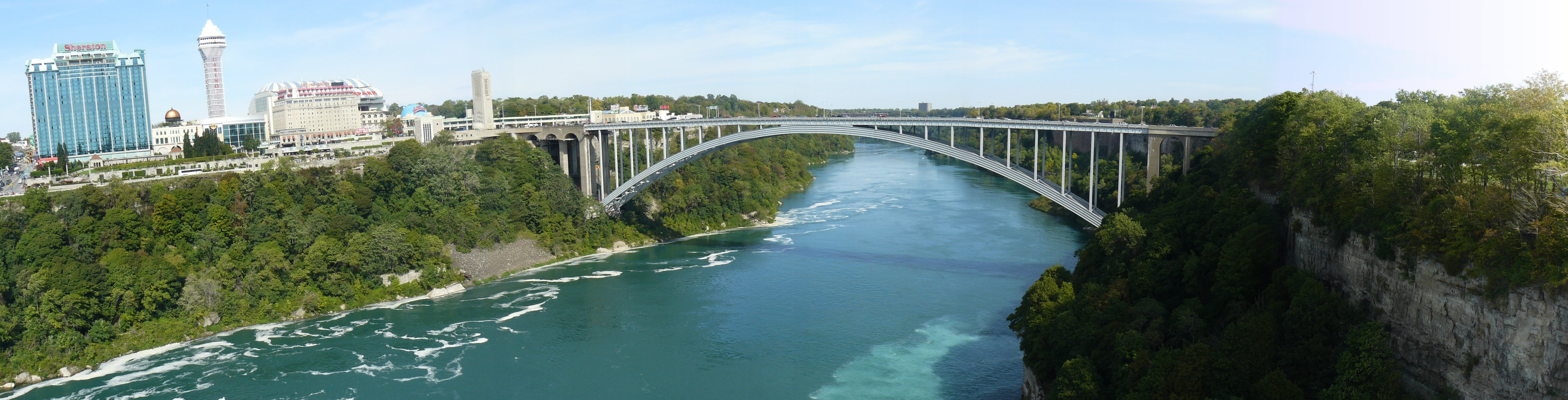
The most common route from Buffalo to Toronto, however, is to go north on I-190, the Thruway's Niagara Extension, to Niagara Falls. After you go through Customs, the road will become Ontario Provincial Highway 405, which eventually flows into the Queen Elizabeth Way.
The Rainbow Bridge

At the edge of the "megacity" of Toronto (Montreal is also now a "megacity"), the QEW becomes the Frederick G. Gardiner Expressway. ("Big Daddy" Gardiner was a major Toronto politician, and was responsible for getting it built.) The Gardiner does not have numbers on its exits.  If you're going for only one game, and are leaving Toronto right afterward (I don't recommend this this: Spend a day in the city), you'll take the Spadina Avenue exit to get to Rogers Centre.

If you make 3 rest stops – I would recommend at or near Scranton and Syracuse, and count Customs, where they will have a restroom and vending machines – and if you don't do anything stupid at Customs, such as fail to produce your passport, or flash a weapon, or say you watch South Park (a show with a vendetta against Canada for some reason), or call Sidney Crosby a cheating, diving pansy (even though he is one) – the trip should take about 11 hours.

Though that could become 12, because Toronto traffic is every bit as bad as traffic in New York, Boston and Washington. As Canada native (Regina, Saskatchewan) Leslie Nielsen would say, I am serious, and don't call me Shirley: Toronto traffic is awful.

Once In the City. Founded as York in 1793, it became the City of Toronto in 1834, the name coming from Taronto, a Native American name for the channel of water between Lake Simcoe and Lake Couchiching. There are 2.7 million people in the city, and just under 6 million in the metro area; in each case, making it larger than any in North America except New York, Los Angeles and Chicago -- unless you count Mexico to be part of "North America" instead of "Central America," in which case add Mexico City to those that are larger.

Since Canada is in the British Commonwealth, there are certain subtle differences. Every measurement will be in the metric system. Dates are written not as Month/Day/Year, as we do it, but as Day/Month/Year as in Britain and in Europe. So the series begins for us on "June 4, 2019" but for them on "4 June 2019." And instead of "6/4/19," they'll write it as "4/6/19." 4th of June, not June 4th.

They also follow British custom in writing time: A game starting at 7:07 PM would be listed as 1907. (Those of you who have served in the military, you will recognize this as, in the words of M*A*S*H's Lt. Col. Henry Blake, "all that hundred-hours stuff.") And every word we would end with -or, they will end with -our; and some (but not all) words that we would end with -er, they end with -re, as in "Rogers Centre."

Another thing to keep in mind: Don't ask anyone where the "bathroom" is -- ask for the "washroom." This difference was a particular pet peeve of mine the first time I arrived at the Toronto Coach Terminal, although it wasn't a problem in Montreal's Gare Centrale, as I knew the signs would be in French.

Every measurement will be in the metric system: Temperatures will be in Celsius, not Fahrenheit; distances will be in "kilometres," not miles (including speed limits, so don't drive 100 thinking it's miles); and gas prices will be per "litre," not per gallon (so don't think you're getting cheap gas, because a liter is a little more than a quart, so multiply the price by 4, and you'll get roughly the price per gallon, and it will be more expensive than at home, not less).

When you arrive, I would recommend buying the Toronto Star and The Globe and Mail. The former newspaper is local, the latter is national, and both are liberal enough to suit my sensibilities (or, should I say, sensible enough to suit my liberalism). And The Star has a very good sports section, and should do a good job covering the Jays, although, being a hockey city in a hockey Province in a hockey country, you'll see a lot of stuff about the Maple Leafs and nearby minor-league, collegiate and "junior" hockey teams no matter what time of year it is.

I would advise against buying the Toronto Sun, because it's a right-wing sensationalist tabloid, and every bit the journalistically sloppy rag that the New York Post is. (It also has conservative "sister papers" called the Sun in Ottawa, Winnipeg, Edmonton and Calgary, although the Vancouver Sun is not connected.) The National Post, while also politically conservative (and thus a national competitor for The Globe and Mail), is a broadsheet and thus conservative in the sense that it is calmer and more sensible with its journalism.

As if being Canada's national media, culture and finance capital wasn't enough, there's another reason why people outside it, and particularly inside the Province of Ontario, hate Toronto: It's the Provincial capital, its Legislative Building located at Queen's Park, just north of downtown. "Queen's Park" has become slang for the government, or for perceived government corruption.
The Ontario Legislative Building.
It looks more collegiate than political.

If you can get to Union Station after leaving your hotel, you may also be able to get out-of-town papers, including the New York ones, as well as Canadian papers such as the Montreal Gazette and the Ottawa Citizen.

Union Station is at the intersection of Bay & Front Streets. Bay runs north-south, and divides Toronto's east and west sides, and the street numberings thereof; the lake serves as the "zero point" for streets running north and south, and thus there's no North and South on street names. Bay Street is also Canada's "Wall Street," the center of Toronto's financial district, and is not particularly well-liked by, well, anybody who isn't conservative in Canada. Toronto has no freeway or tollway that serves as a "beltway."
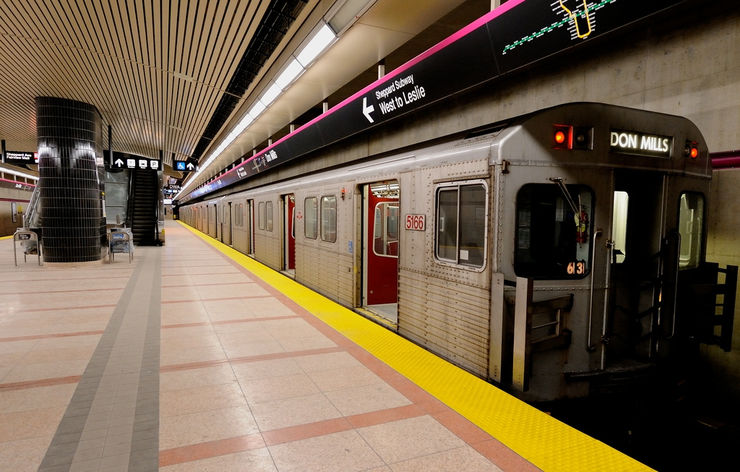
Toronto has a subway, Canada's oldest, opened in 1954 and known as "the Rocket." (I'll bet Montrealers hated that, since it was the nickname of their beloved hockey star Maurice Richard, well before future Blue Jay and Yankee Roger Clemens was even born.)
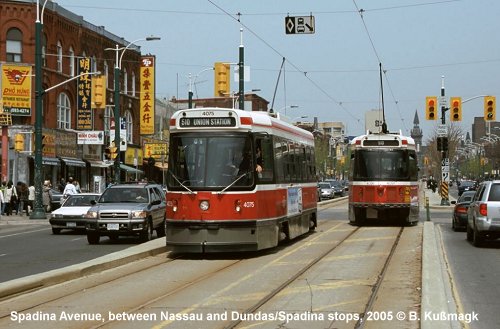
Along with Philadelphia, it was 1 of the last 2 subway systems in North America that still used tokens, but they have phased them out in favor of a farecard system, in their case known as the Presto Card. The fare is C$3.00 (US$2.29), and a DayPass is C$13.00 (US$9.92). They also have a streetcar system, on which the Presto Card can be used.
The drinking age in Ontario is 19. Postal Codes in Toronto begin with the letter M, and those in the suburbs with L. The Area Codes are 416 for the city and 905 in the suburbs, with 437 as an overlay.

Toronto's sales tax is 13 percent. In 2010, this replaced the former Provincial sales tax of 5 percent and the federal GST (Goods & Services Tax) of 8 percent. In other words, the Conservative Party government of Prime Minister Stephen Harper wanted Canadians to think he'd killed the hated GST, when, in fact, Ontarians (who only make up 36 percent of the country) are paying pretty much the same taxes that they did before. See how stupid it is to vote for conservative candidates? It doesn't work in any country.

Toronto Hydro Corporation runs the area's utilities. The city is about 47 percent white, 21 percent East Asian, 13 percent South Asian, 9 percent black, 4 percent Middle Eastern, 3 percent Hispanic, and 1 percent Aboriginal ("Indian" or "First Nations"). About 47 percent of the population is foreign-born, one of the highest percentages in the world. (For comparison's sake, it's 37 percent in New York City.)

But being multicultural hasn't always meant that Toronto is inclusive. There was a riot against Greeks from August 1 to 5, 1918, in the incorrect belief that Greece wasn't fighting Germany in World War I. And on August 16, 1933, there was the Christie Pits Riot. A baseball game between Harbord Playground, with mostly Jewish and Italian players, and St. Peter's Church, which was supportive of the nascent Nazi movement, was interrupted and ultimately ended by a riot between the teams. 

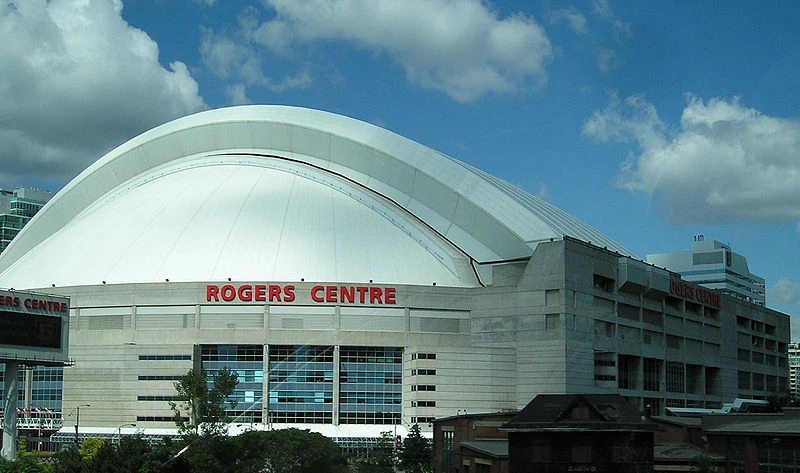
Going In. Originally known as the SkyDome, for its retractable roof, and opening on June 3, 1989 -- 30 years ago this Monday -- the building was renamed the Rogers Centre in 2005, for the new corporate owner of the Jays, Rogers Communications, founded by the late Ted Rogers and featuring several cable-TV networks, most notably Rogers Sportsnet (although TSN, The Sports Network, ESPN's Canada version, is the more popular).
The official address is 1 Blue Jays Way. The stadium doesn't really have surrounding streets, unless you count Bremner Blvd. to the south, as there are buildings, parks and a railroad between. Parking is a whopping C$40 (US$30), so if you drove in, you're better off leaving your car in your hotel's parking deck.

If you're trying to get to Rogers Centre (under both names, they hate it when you use the definite article "the" in its name) from a downtown hotel, it is not going to be fun. The subway doesn't go to the dome. The closest stop is the one for Union Station. And the city's famed streetcars are no help, either. It's a great city for public transportation, unless you're going to Rogers Centre or the CN Tower, which are only the 2 biggest tourist attractions in the city, and right next-door to each other. (When SkyDome opened in 1989, somebody called them a sperm-and-egg pairing.) I'd say they're the 2 biggest tourist attractions in the Province of Ontario, or even the entire country, but, as I said, you'll have to pass Niagara Falls to get to Toronto.

The stadium is, theoretically, just 3 blocks away from Union Station, down Front Street West: York, Simcoe, John. But it's going to seem like a long walk. (Trust me, I've done it.) And Front Street West is perhaps the most touristy street in the entire country, much as Broadway in Midtown Manhattan is.

Most likely, you'll be walking from Union Station along Front Street, or the Skywalk that connects the station to the CN Tower. Gates 2 and 3 are at the northeast corner, Gates 5 and 6 are on the east front, Gate 7 is at the southeast corner, Gates 9 and 9A are at the southwest corner, Gates 10 and 11 are on the west front, and Gates 13 and 14 are at the northwest corner.

There are, as yet, no statues outside the stadium dedicated to Blue Jays greats -- unless you want to count team owner Ted Rogers. But they do have some exterior sculptures depicting fans, which is nice. Even if the statues themselves are not all nice.
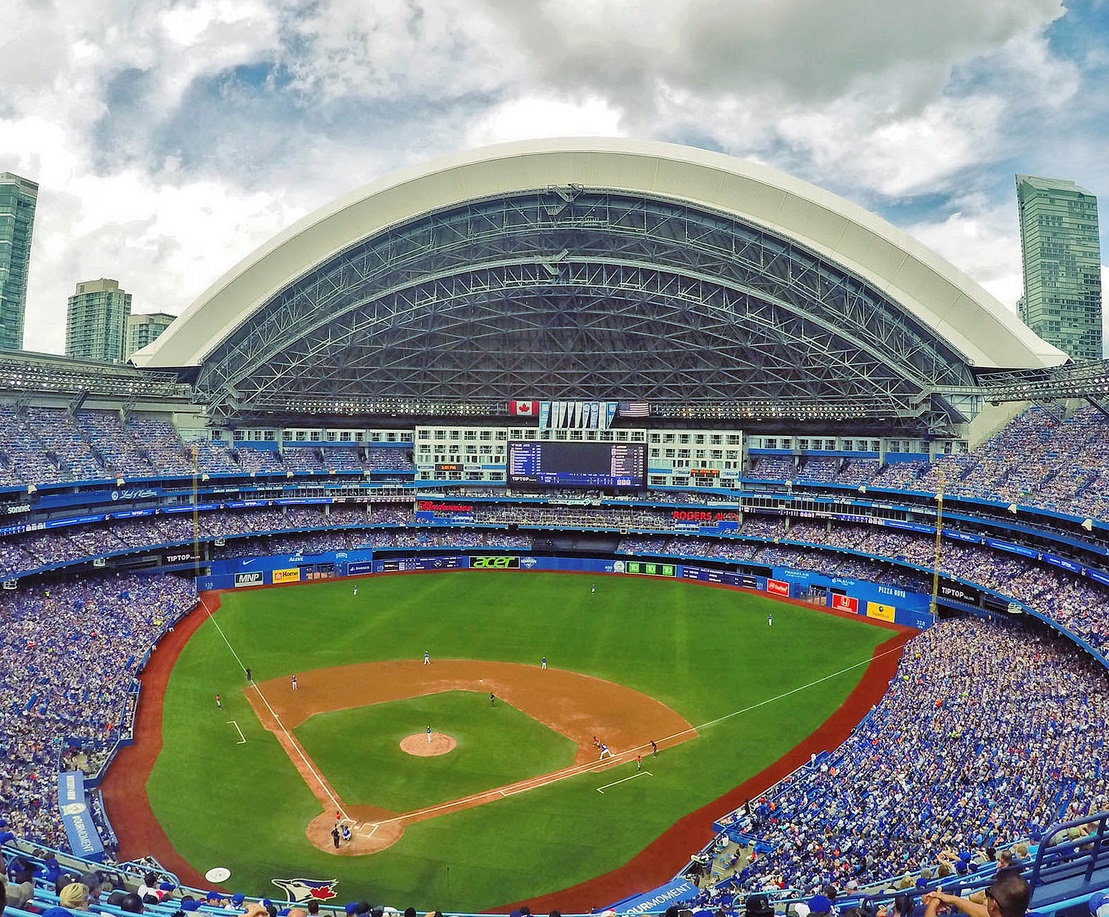
The hallways are carpeted. This makes the stadium feel more like a movie theater (or "theatre," as it would be "spelt" in Canada) than a sports stadium, especially if the roof is closed.  But the carpet that serves as the field is awful, about as bad as the one at Tropicana Field in Tampa Bay. There was a plan in place to switch to natural grass, leaving The Trop as (hopefully, forever) the last stadium in Major League Baseball with artificial turf, and giving the Jays a real grass home field for the 1st time. But those plans are on hold. (And with Arizona having switched to turf, and Texas planning to with their new ballpark next season, the distinction is out the window, anyway.)

The field points north, but that doesn't make a difference, since you can't see outside the place anyway, unless you sit on the 3rd base side and the roof is open, in which case you can see the CN Tower.
The field is symmetrical: Outfield distances are 328 to the poles (exactly 100 "metres"), 375 to the alleys and 400 to "centre." While with the Red Sox on June 3, 2001, Manny Ramirez hit a 491-foot home run, the longest in the stadium's history. 
Rogers Centre hosted the CFL's Toronto Argos for 27 seasons, and has hosted 4 Grey Cups, the last in 2012, won by the Argos. Like the Super Bowl, the Grey Cup site is chosen years in advance as a neutral site, but having only 9 teams in the League, and thus 9 major stadiums in the country, makes the chance of a team getting a home game for the title not at all rare. 

It hosted the Vanier Cup, the National Championship of Canadian college football, from 1989 to 2003, and again in 2007 and 2012. The Three Tenors -- Luciano Pavarotti, Placido Domingo and José Carreras -- sang there on January 4, 1997.

It also hosted a few Buffalo Bills "home games," and the International Bowl, once won by Rutgers. With the new grass field coming in, the stands will be fixed in place, so, no more football. The NBA's Raptors played there from their 1995 debut until the 1999 opening of the Air Canada Centre.

In 2021, there was a plan to replace the Rogers Centre, at its south end, with a smaller, baseball-specific stadium. But the Jays' organization have decided to renovate the current stadium rather than replace it. Without having to consider the needs of the Argos or TFC, they could make it more baseball-friendly, although I'm not sure how that would be done.

Food. You know the economy is bad when a McDonald's closes. And there was a McDonald's in the SkyDome, the 1st in any stadium in the world, but it closed during the 2008-10 recession. The Hard Rock Café, the 1st in any stadium in the world, is also gone.

The stadium has standard baseball food, and although none of it is great, most of it upsets Canadian stomachs far less than do the Jays' relief pitchers. There are several "HogTown Grill" stands -- Hogtown being an old nickname for Toronto, the rusticity of it belying its image as Canada's biggest city. Before the Indian (or, as they would say in Canada, instead of "Native American," "First Nations") name of Toronto was given to the city, the English called it "York" (not to be confused with New York), and "Muddy York Market" (presumably a fresh fruit stand) is behind 106, 110 and 514.  

12 Bar, named in honor of Roberto Alomar, is behind Section 215. Touch 'Em All Joe Bar, obviously named for Joe Carter and his 1993 walkoff, is at 232.

Although Toronto is not as known for Jewish culture and food as much as Montreal is, a Kosher stand called Olde Spadina Avenue is at 132, and Shopsy's Deli is at 124.

In spite of Canada being in the opposite direction, Rogers Centre nods toward Mexico and the Caribbean with the Big Smoke Jerk Chicken Nacho: Crisp corn tortilla chips topped with cheddar cheese sauce, smoked jerk chicken, pico de gallo, scallions, country slaw, and jerk infused sour cream. (Jerk-infused? Another tribute to Alomar, a.k.a. Ol' Spithead?) This item is also available as a sandwich.

There is an ice cream shop at 137. And what would a Canadian gathering place be without a Tim Hortons, or two? Rogers Centre has 'em at 114 and 128.

The "Great Canadian" -- not to be confused with Wayne "The Great One" Gretzky, whose restaurant is across the street from Rogers Centre -- is a hot dog topped with maple baked beans, crumbled Canadian back bacon, caramelized sweet red onions and Canadian cheddar cheese. I would advise against trying it. If you do, you'll be glad Canada has socialized medicine.

The Jays also serve poutine, the French fries, gravy and curd concoction that almost single-handedly undoes all the good that Quebec culture has done for the world. The Jays' take on it includes chicken wings on the bottom, loaded not just with everything else that comes with poutine, but pretty much anything you've ever seen put on a baked potato. Apparently, the Blue Jays' motto is, "If you can't beat 'em, kill 'em by clogging their arteries."

There is also something called "Bread Bottoms" behind 109. I have no idea what this refers to; on my 2005 and '06 visits, I did not notice it, so it may have been added since. Hopefully, it's nothing worse than a bakery stand.

According to a recent Thrillist article on the best food at each MLB stadium, the best food available at Rogers Centre is sausage poutine at Toronto Street Eats, at Section 134. So, clearly, Thrillist is what you will be if you eat that: Full of shit.

Team History Displays. The Jays have championship banners in straightaway center field. (Or "centre field.") They no longer have separate banners for their World Series wins, Pennants and American League Eastern Division Championships of 1992 and 1993, only for the World Series wins. They also have banners for their AL East titles of 1985, 1989, 1991 and 2015, their 2016 Wild Card berth and ALDS win, and for the 1991 All-Star Game which they hosted.

The Jays retired a uniform number for the first time in 2011, when they had their first player elected to the Baseball Hall of Fame: Roberto Alomar -- Number 12, 2nd base, 1991-95. However, after what would once have been quaintly called a "morals charge," Alomar's number has been taken down from the display. They've also retired Number 32 for Roy Halladay, pitcher, 1998-2009. They've given similar treatment to Hall-of-Famer Pat Gillick, the team's general manager from its inception in 1977 until 1995.

Pat's and Robbie's banners flank the championship banners. Roy's has been put to the right of Robbie's.
Their main display of player honors is a "Level of Excellence," between the 300 and 400 Levels (club seats). It honors the following 11 men:

* From the 1985 and 1989 AL East titles: 37, pitcher Dave Stieb; 11, left fielder George Bell; and 1, shortstop Tony Fernandez.

* From the 1992 and 1993 World Championships: Alomar, Stieb (only there for '92), Fernandez (only there for '93, having left and returned); 43, manager Cito Gaston; 29, 1st baseman and right fielder Joe Carter; and 25, 1st baseman Carlos Delgado (only there for '93, and that just barely).

* Since 1993: Halladay.

* Spanning the eras: Gillick; Paul Beeston, executive, 1976-present and chief operating officer 1989-2015; and Tom Cheek, broadcaster, 1977-2005, his "number" being the number of consecutive games he broadcast until illness ended his streak at 4,306, soon ending his life as well.

Jackie Robinson's Number 42 is retired for all of baseball, including the Jays, so no Toronto ballplayer will ever wear it again.
The Level of Excellence previously featured the All-Time Team of the Canadian Football League's most successful franchise, the 16-time Grey Cup winners, the Toronto Argonauts, including their 4 retired numbers: Joe Krol, Number 55, quarterback, 1945-52 and '55; Dick Shatto, Number 22, running back, 1954-65; Danny Nykoluk, Number 60, offensive tackle, 1955-71; and Michael "Pinball" Clemons, Number 31, running back 1989-2000, since 2001 a team administrator, and, by a weird twist, comes from Dunedin, Florida, the only spring-training home the Blue Jays have ever had.

Aside from Dave Winfield, with the team for just 1 season (but a World Championship season), no Blue Jays were named to The Sporting News' 100 Greatest Players in 1999. In 2006, Carter was chosen by Jays fans in 2006 for the DHL Hometown Heroes poll. In 2022, ESPN named its 100 Greatest Baseball Players. Among players who have ever played for the Blue Jays, Rickey Henderson was ranked 23rd, Dave Winfield 56th, Paul Molitor 84th, Roberto Alomar 86th, and Roy Halladay 92nd.

In addition to Alomar, Halladay and Winfield, Rickey Henderson, Paul Molitor, Jack Morris, Phil Niekro and Frank Thomas have played for the Blue Jays and been elected to the Baseball Hall of Fame. Bobby Cox managed them to their 1985 Division title, in between his 2 tenures as manager of the Atlanta Braves, the 2nd of which got him into the Hall of Fame.

There is no mention at Rogers Centre of the 10 Pennants won by the Jays' minor-league predecessors, the Toronto Maple Leafs, for whom the legendary hockey team was named: 1887 (in the original Eastern League, the rest in the International League), 1902, 1912, 1917, 1918, 1926, 1934, 1960, 1965 and 1966.

Those last 3 came as a farm club of the Boston Red Sox, with the 1960 Pennant featuring Carl Yastrzemski, and the last 2 being managed by Dick Williams, who was promoted to the big club and took some of his Leafs with him and, with Yaz and Jim Lonborg and a few others, those ex-Leafs forged the "Impossible Dream" Pennant of 1967.

However, 1967 was also the last year of the franchise, as they were moved by the Sox. It would be 1991 before Toronto got full revenge on the Red Sox for taking their old team away, edging them for the AL East title in the first race where both of them went down to the wire.

A statue of Ted Rogers, Rogers Communications titan and Jays owner from 2000 until his death in 2008 (and thus responsible for neither the team's establishment, nor the stadium's construction, nor the team's current success) stands outside. There are now 3 major league sports venues in Canada with his name on them: The Rogers Centre in Toronto, the Rogers Arena in Vancouver (home of the NHL's Canucks), and Rogers Place in Edmonton (the new home of the NHL's Oilers).
From 1978 to 1986, the Blue Jays and Canada's original MLB team, the Montreal Expos, played a midseason exhibition game for the Pearson Cup, a trophy named for former Prime Minister Lester Pearson. They split the games, 4-4. (One was canceled by the Strike of '81.)
In 1997, Interleague play meant regular-season games between the teams, officially named the All-Canadian Series. In 2003, the Pearson Cup name and trophy were revived, but it only lasted another year, because the Expos moved. The Jays won the season series in 1998, 1999 and 2000; the Expos in 1997 and 2002; and the series was split 3-3 in 2001, 2003 and 2004. Overall, the Jays won 24 games, the Expos 19. Since the Expos were the last to win it outright, the Pearson Cup is now the possession of... the Washington Nationals.

Stuff. The usual types of memorabilia are sold, including jerseys with the names of current Jays players on them. For those of former Jays stars, such as those on the Level of Excellence, sorry, but you'll have to go to Mitchell & Ness in Philadelphia (or their website) to get them.

At least you won't have to look at those blue Js. When the Jays were heading into the 1992 postseason, somebody remembered the previous season's World Series, when the Minnesota Twins brought back the Homer Hankies of 1987, and the Atlanta Braves made the foam tomahawks to do the Tomahawk Chop. So someone made up about a million big bright blue foam objects in the shape of the letter J. A "blue J." Get it, eh? (Not to be outdone, when the Jays played the Chicago White Sox in the 1993 ALCS, white socks were given to Chicago fans to wave around. As far as I know, the Red Sox have never given people red socks to wave around.) The blue Js were still better than the foam headgear I once saw, resembling the bird on the team's then-logo. That looked really ridiculous.

There aren't many good books about the Jays. Nate LeBoutillier (ironically, a French-Canadian) wrote the recently-published, but unimaginatively-titled, The Story of the Toronto Blue JaysIn 2019, Shi Davidi and Dan Shulman published The Big 50: Toronto Blue Jays: The Men and Moments that Made the Toronto Blue Jays.

The Jays are also weak on video. The official World Series highlight films of 1992 and 1993 are available on DVD, but if you're looking for The Essential Games of the Toronto Blue Jays, or The Essential Games of Rogers Centre, you're out of luck. They do, however, have Game 6 of the '93 Series available as part of the official MLB series Baseball's Greatest Games.

In spite of their Playoff runs of the last 2 seasons, and this year's 40th Anniversary of the club, there appear to be no commemorative books and videos.

During the Game. A recent Thrillist article placed the Blue Jays' fans at 28th on the list of "most intolerable fans" -- making them the 3rd most tolerable. For the most part, this is accurate: You do not need to fear wearing your Yankee gear to Rogers Centre. Although quite a few U.S.-based crime dramas (and other shows, and films, particularly those that supposedly take place in Chicago) have been filmed in and around Toronto, it's not a particularly crime-ridden city.

You might get some verbal from the Jays fans, especially after a Jays win over the Yanks, but this will mainly consist of them yelling, "Yankees suck!" And you've heard that before, and you know how to respond: "Five rings since '93, what have you done since then?" (Answer: One Division title in twenty-four years.)

The Tuesday game will be Loonie Dogs Night, featuring hot dogs for a "loonie," a $1.00 coin. Wednesday will be Star Wars Night, as in, "May the 4th be with you."

If it's a day game and it's warm, no threat of rain, and there's no wind, most likely the roof will be open. If it's a night game, or a day game but rainy and/or windy, or not especially warm, the roof will probably be closed. The ball travels farther with the roof closed (this is usually the case with domed stadiums, though the first, Houston's Astrodome, was a pitcher's park), but with a large amount of foul territory, the Rogers Centre is generally regarded as a pitchers' park.

Since you're in Canada, there will be two National Anthems sung. "The Star-Spangled Banner" will probably be sung by about half of the few thousand Yankee Fans who show up, but "O Canada" will be sung by the home fans with considerable gusto.

When I'm at a sporting event where the opposing team is Canadian, I like to sing "O Canada" in French. Montreal Canadiens fans like this when I do it at the Prudential Center. Fans of the other Canadian NHL teams just think it's weird. When I did it in the 2 games I've been to at Rogers Centre, the Jays fans, as I warned they would, simply thought I was a twat. But then, they root for the Jays, and I root for the Yanks, so I'd rather have their opinion of me than my opinion of them. At any rate, the Jays hold auditions for Anthem singers, instead of having a regular.

The Jays' mascot is a blue jay named Ace. From 1979 to 1999, they had a blue jay mascot named B.J. Birdie. B.J. resembled the logo the Jays had at the time, while Ace resembles the one they've had since the 2004 season. From 2000 to 2003, Ace had a girlfriend, named Diamond – baseball or otherwise, "diamonds are a girl's best friend," get it? But they must have broken up, because Ace has been alone since 2004.
Ace, Carrie Underwood and former Jays pitcher Ricky Romero

At the 7th inning stretch, after they sing "Take Me Out to the Ballgame," they go into "OK Blue Jays." It was written by Jack Lenz and Tony Kosinec, and the recorded version is by Keith Hampshire & the Bat Boys. They've used this song since 1983, and it is certified as a gold record in Canada. (That's 50,000 copies, as opposed to the 500,000 you need to sell to get a gold record in the U.S.) It's a very stupid song, but then, so are most baseball-themed songs. It's not like "Here Come the Yankees" is appreciably better. Anyway, their postgame victory song is "Win" by Jay Rock.

On occasion, the Jays will wear throwback uniforms at home – but these will be their original road uniforms of the Exhibition Stadium era, 1977 to 1989. And they will be powder blue. There's a reason why teams stopped wearing that color: It is not particularly athletic-looking! Except maybe at the University of North Carolina.

If the roof is closed, fireworks will shoot out from it following a Jays homer or a Jays win. That's right, indoor fireworks. But the peak of the roof is high enough that you should not be in danger.

After the Game. As I said, Blue Jays fans may try to take a few liberties, especially if their team has beaten the Yankees. Toronto is an international city, every bit as much as New York is, and some of these people may have cut their teeth as sports fans in European soccer. But we're not talking about hooligans here. And, of course, you can just bring up the 27 rings, or the 5 the Yankees have won since Joe Carter touched 'em all 29 years ago. Wow, that means a 35-year-old living in Toronto may have no memory of it. Beats being 60 and having no memory of the Leafs winning the Cup, though.

The official address for the Rogers Centre is 1 Blue Jays Way, which is the street outside the left field corner, which flows into Peter Street. At 99 Blue Jays Way is Wayne Gretzky's Restaurant. But since he betrayed his former fellow players and sided with his current fellow owners in the 2004-05 NHL lockout, I consider him a traitor to the game of hockey, and I will not set foot in his establishment, and I would advise you to avoid it as well.

I would also advise avoiding Jack Astor's, a smart-alecky-named chain of Canadian restaurants that includes one at 144 Front Street West, about halfway between Union Station and the Rogers Centre. I ate there the last time I was in Toronto, and the food and service would be mediocre at half the price. They have only one location in the U.S. -- not surprisingly, in nearby Buffalo, at the Walden Galleria east of downtown.

There's the Canadian Bar & Grill, at the Hyatt Regency at 370 King Street West, 4 blocks from Rogers Centre.  It features what it calls "traditional Canadian cuisine." This includes wild game, as well as regional items like poutine and Newfoundland clam chowder. (Apparently, the word "chowder" came from the Newfies, and theirs is closer to New England's than to the tomato-based abomination known as Manhattan clam chowder. Clam chowder is one of the few things New England does better, a lot better, than New York.)

If rabbit stew isn't your cup of tea, try the Loose Moose Tap & Grill, at 146 Front Street West, 2 blocks from the stadium. There, as they say, you'll "eat like a king then party like a rock star!" You'll be dining like a typical Torontonian, rather than with guys likely to jump into the Monty Python "Lumberjack Song." (If you've never seen that sketch, let me put it this way: Don't ask, and I won't tell.) And the Lone Star Texas Grill, a block away at 200 Front Street West, is jointly owned by several former CFL players, and is a fair takeoff on the U.S. chain Lone Star Steakhouse.

Actually, your best bet may be, as Vancouver native Cobie Smulders of the TV series How I Met Your Mother would put it, "the most Canadian place there is": Tim Hortons. (Note that there is no apostrophe: It's "Hortons," not "Horton's," because Quebec's ridiculous protect-the-French-language law prohibits apostrophes and the company wanted to keep the same national identity through all the Provinces.) They have a 62 percent share of the Canadian coffee market (Starbucks has just 7 percent) and 76 percent of the Canadian baked goods market. They also sell sandwiches, soup, chili, and even (some of you will perk up faster than if you'd drunk their coffee) New York-style cheesecake. It's fast food, but good food. I rate them behind Dunkin Donuts, but ahead of Starbucks.

Tim Horton, a defenceman (that's how they spell it up there) for the Maple Leafs, and businessman Ron Joyce started the doughnut/coffee shop chain in 1964, while in the middle of the Maple Leafs' 1960s dynasty. He played a couple of years for the Rangers, then went to the Buffalo Sabres and opened a few outlets in the Buffalo area. He was still playing at age 44, and the only thing that stopped him was death. Specifically, a 100-MPH, not-wearing-a-seat-belt crash on the Queen Elizabeth Way over Twelve Mile Creek in St. Catharines, Ontario. (In other words, if you're driving or taking the bus from New York to Toronto, you'll pass the location.)

Joyce, whose son Ron Jr. married Horton's daughter Jeri-Lyn, joined with Dave Thomas of Wendy's and merged the two companies in 1995, becoming its largest shareholder, with even more shares than Thomas. Although the companies have since split again, it was mutually beneficial, as Wendy's gained in Canada and Timmy's poked their heads in the U.S. door.

There are now over 3,000 Tim Hortons locations in Canada (including one at Toronto's Union Station and several on Canadian Forces Bases around the world) and over 500 in the U.S. – and they're heavily expanding in New York, including 3 in the Penn Station complex alone (despite Horton himself only briefly having played for the Rangers upstairs at the "new" Madison Square Garden). They are also partnered with Cold Stone Creamery, with an outlet on 42nd Street, a 2-minute walk from Port Authority. These Hosers know what they're doing.

I can find no reference to a bar or restaurant in Toronto where New Yorkers are known to gather. The previous one, the Sports Centre Café, at 49 St. Clair Avenue West, went out of business due to COVID.

If your visit to Toronto is during the European soccer season, as we currently are, and you want to see your favorite club play, your best bet is the Midtown Gastro Hub, at 1535 Yonge St., Line 1 to St. Clair; and the Madison Avenue Pub, 14 Madison Avenue, Line 2 to Spadina. The city's original soccer pub, the Duke of Gloucester, at 649 Yonge Street, also went out of business due to COVID.

Sidelights. Being the largest and most influential city in Canada, Toronto is loaded with tourist traps. This has been spoofed in "The Toronto Song," a bit by the Edmonton-based comedy trio Three Dead Trolls in a Baggie. (It's often cited incorrectly including by myself in previous editions of this piece, as being by the Arrogant Worms. It's not obvious that 3DTB are from Edmonton until the end of the song, by which point they've said everything in Ontario sucks, as do all the other Provinces, except, "Alberta doesn't suck – but Calgary does.")

They're not far off.  Toronto is much cleaner than most American cities: U.S. film crews, trying to save money by filming there, have had to throw garbage onto the streets so it would look more like New York, Boston, Chicago or Los Angeles, and then they have to do it again between takes, because the street-sweepers clean it up that quickly.  But the city does have slums, a serious homeless problem, ridiculous rents, never-ending lakefront high-rise construction (mirroring Mayor Mike Bloomberg's similar projects in New York), and their share of metalheads, punks, Goths and chavs.

I wouldn't call now-long-parted Mayor David Miller a dork, as 3DTB did, although his predecessor, Mel Lastman, was often a Canadian version of Rudy Giuliani. With better hair. You may have heard about recent Mayor Rob Ford: He was a crook, an alcoholic and a crackhead, who was just barely able, through legal action, to keep his office. Alas, cancer prevented him from running for re-election, and he recently died. The current Mayor is John Tory, and his conservatism makes him aptly-named.

Torontonians can't quite decide whether they want to be Canada's New York (national media, culture and finance capital, home of the CBC and CTV, and Bay Street is their "Wall Street"), Canada's Chicago (a gritty blue-collar "drinking town with a sports problem"), or Canada's L.A. (movie-filming center.) Actually, Montreal is Canada's New York, Hamilton its Chicago, and Vancouver its L.A.

Toronto is... Toronto is something else. Scientists have yet to figure out what. But check out these locations:

* Hockey Hall of Fame, 30 Yonge Street, blocked by Yonge, Front, Bay and Wellington. If you go to Toronto and you don't go to the Hockey Hall of Fame, they should deport you from Canada and never let you back in. This place is great, and the actual Stanley Cup is there. Well, 2 of them are, the original bowl that was so damaged that they replaced it in 1970, plus some of the bands with old-time winners on it, and a display copy. The one that gets awarded every year is also stored there in preparation for its annual awarding, then gets to go wherever the winning team's players want to take it for almost a year.
You'll also see why Canadians call hockey jerseys "sweaters": They used to be sweaters, as you'll see in the display cases. You'll also see why they're not sweaters anymore: Holes where they were eaten by moths. Hockey eventually got that right.

They also got the location for their Hall of Fame right: While it's not clear where hockey was invented, and the NHL was founded in Montreal, they put their Hall of Fame in an easily accessible city, unlike baseball (hard-to-reach Cooperstown, New York is NOT where baseball was invented), basketball (Springfield, Massachusetts is where it was invented but it's a depressing town), and pro football (Canton, Ohio is where the NFL was founded but it's so drab and bleak it makes Springfield look like Disney World… Sorry, Thurman). Union Station stop on the TTC subway.

* Exhibition Place. The Canadian National Exhibition is kind of a nationwide "State Fair." It was on the grounds, off Princes Boulevard, that Exhibition Stadium, or the Big X, stood from 1948 to 1999. It was home to the Blue Jays from 1977 to 1989 and the CFL's Argonauts from 1959 to 1988. It hosted only one MLB postseason series, the 1985 ALCS, which the Jays lost to the Kansas City Royals.
It hosted 12 Grey Cups (Canadian Super Bowls), although only one featured the Argos, and that was the 1982 game, won by the Edmonton Eskimos in a freezing rain, with fans chanting, "We want a dome!" The SkyDome/Rogers Centre project soon began, and Exhibition Stadium never hosted another Grey Cup. Rogers Centre has now hosted 4, including the 100th, in November 2012, which the Argos won over the Calgary Stampeders. Exhibition Stadium hosted the Vanier Cup from 1973 to 1975. Exhibition Stadium hosted Soccer Bowl '81, which ended 0-0, and then the Chicago Sting beat the New York Cosmos 2-1 on penalties.

BMO Field (pronounced "BEE-moh," named for, oddly, the Bank of Montreal), home of Canada's Sports Hall of Fame and Major League Soccer's rather unimaginatively named Toronto FC, was built on the site of Exhibition Stadium. It hosted the 2010, 2016 and 2017 MLS Cup Finals, a neutral site for the 1st (Colorado beating Dallas) and the home field for the last (Toronto losing to Seattle and then reversing that result).
The Argonauts moved there in 2016, and, last year, both the Argos and TFC won their leagues' titles, making BMO Field the 1st venue in North American major league sports to have 2 reigning champions since Yankee Stadium from December 28, 1956 to October 10, 1957.

On New Year's Day 2017, in connection with the 100th Anniversary of both the League and the Maple Leafs, BMO Field hosted the NHL Centennial Classic, an outdoor game in which the Leafs beat the Detroit Red Wings 5-4 in overtime. On October 15, 2019, BMO Field hosted the Canadian national soccer team's 2-0 win over the U.S., their 1st win over our team since 1985.

Exhibition stop on the Lakeshore West line of GO, Toronto's commuter-rail service out of Union Station.

The Canadian Premier League, Canada's "top flight" soccer league, features York United FC, playing at York Lions Stadium, home of York University. Toronto FC II will continue to play in the United Soccer League, the 2nd tier of overall North American soccer. They play at the 9,600-seat Allan A. Lamport Stadium at 1151 King Street West, with some games at BMO Field.

North America won a joint bid to host the 2026 World Cup. BMO Field was chosen as 1 of Canada's 2 sites, the others being BC Place in Vancouver.

* Varsity Stadium and Varsity Arena. The home of the athletic complex of the University of Toronto, it includes the 3rd Varsity Stadium on the site, replacing one that stood from 1911 to 2002 and the one before that from 1898 to 1911. It only seats 5,000, but its predecessor could hold 21,739, and hosted more Grey Cups than any other facility, 29, from 1911 to 1957.

The Varsity Blues have won the Yates Cup, emblematic of supremacy in Ontario college football, 25 times from 1898 to 1993; the Vanier Cup, Canada's National Championship, in 1965 and 1993; and, as with their hockey team, they were once much bigger, or perhaps the competition was much smaller, they won the 1st 3 Grey Cups, in 1909, 1910 and 1911, and a 4th in 1920.

Unlike Exhibition Stadium, the Argos won 9 of their 16 Grey Cups at home at Varsity Stadium: 1914, 1921, 1937, 1938, 1945, 1946, 1947, 1950 and 1952. (They also won at Sarnia in 1933, Vancouver in 1983, Winnipeg in 1991, Hamilton in 1996, Edmonton in 1997 and Ottawa in 2004.) It hosted the Vanier Cup from its inaugural game in 1965 to 1972, and again from 1976 to 1988.

Varsity Stadium was home to the various Toronto teams in the North American Soccer League, and was the location of the one and only visit to Canada thus far by North London soccer giants Arsenal, a 1-0 over a team called Toronto Select on May 23, 1973. And it hosted what turned out to be the last NASL game, the 2nd leg of Soccer Bowl '84, with the Toronto Blizzard losing 3-2 to the Chicago Sting.

It hosted the 1969 Rock 'n Roll Revival Concert, as shown in the film Sweet Toronto, featuring John Lennon and his Plastic Ono Band (of course, with Yoko Ono, but also with Eric Clapton), the Doors, Alice Cooper, and founding fathers of rock Chuck Berry, Bo Diddley, Little Richard, Jerry Lee Lewis and Gene Vincent. This was the concert where a live chicken was thrown at Cooper from the seats, and he threw it back, thinking it could fly, but it died, thus beginning his legend.

Next-door is Varsity Arena, built in 1926 and seating 4,116 people. The Varsity Blues have won 10 National Championships in hockey: 1966, 1967, 1969, 1970, 1971, 1972, 1973, 1976, 1977 and 1984. They used to be much bigger, including serving as the Canadian team at the 1928 Winter Olympics in St. Moritz, Switzerland, winning the Gold Medal. The Arena was also the home of the Toronto Toros of the World Hockey Association in the 1973-74 season.
The current Varsity Stadium, with its blue running track,
and Varsity Arena behind the press box

Museum stop on the Yonge-University Line, or St. George stop on the Yonge-University or Bloor-Danforth Lines.

* Rosedale Park, Scholfield and Highland Avenues. This is where the 1st Grey Cup game was held, on December 4, 1909. The University of Toronto defeated the Toronto Parkdale Canoe Club, 26-6. There's now a soccer field on the site of the original stadium.

Unfortunately, the closest subway stop is Summerhill, on the Yonge-University Line, and you'll have to walk a roundabout path to get there. If you really want to see it, you may want to take a cab.

* Maple Leaf Gardens, 60 Carlton Street, at Church Street. Home of the NHL's Toronto Maple Leafs from 1931 to 1999, this was arguably the most famous building in Canada. The Leafs won 11 Stanley Cups while playing here: 1932, 1942, 1945, 1947, 1948, 1949, 1951, 1962, 1963, 1964 and 1967 – and they haven't been back to the Finals since.
The Gardens (always plural, never "The Garden" like in New York and Boston) also hosted the first NHL All-Star Game, a benefit for injured Leafs star Ace Bailey in 1934, one of the Canada-Soviet "Summit Series" games in 1972, and the first Canada Cup in 1976, where Leafs star Darryl Sittler stole the show.

On November 1, 1946, the 1st NBA game was held at the Gardens, with the New York Knicks beating the Toronto Huskies, who folded after that first season of 1946-47. It hosted the Beatles on all 3 of their North American tours (1964, '65 and '66), and Elvis Presley in 1957 – oddly, in his early period, not in his Vegas-spectacle era. Keith Moon's last concert with The Who was there, on October 21, 1976.

The Gardens hosted 2 fights for the Heavyweight Championship of the World. On December 4, 1961, Floyd Patterson defended the title by beating Tom McNeeley. (McNeely's son Peter would later lose to Mike Tyson.) And on March 29, 1996, Canadian champion George Chuvalo went the distance, but still lost, against Muhammad Ali.

But somebody who doesn't give a damn about history, only money, decided the Gardens was obsolete, and the Leafs moved into the Air Canada Centre in 1999.  A plan to turn the arena into a shopping mall and movie multiplex, as was done with the Montreal Forum, was dropped because of the way the building was built: Unlike the Forum, if the Gardens' upper deck of seats was removed, the walls would collapse.

Fortunately, it has been renovated, and is now the Mattamy Athletic Centre at the Gardens, part of the athletic complex of Ryerson University, including its hockey team, with its seating capacity reduced to 2,796 seats, down from its classic capacity which ranged from 12,473 in the beginning to 15,726 at the end, with a peak of 16,316 in the 1970s.
A recent interior photo, set up for curling

The Ryerson Rams have never won a significant hockey title. They had a football program, but it was canceled in 1964, and has never been revived.

So, while the old Madison Square Garden, the old Boston Garden, Chicago Stadium, and the Olympia are gone, and the Montreal Forum has been converted into a mall, one of the "Original Six" arenas is still standing and being used for hockey. It also has a Loblaws supermarket. College stop, on the Yonge-University Line.

* Mutual Street Arena, bounded by Mutual, Shuter, Dundas and Dalhousie Streets. This arena stood at this location from 1912 until 1989, when condos were built there, and was the home of the Toronto Blueshirts, National Hockey Association Champions and Stanley Cup winners 1914, and the Maple Leafs from 1917 to 1931.

The Leafs were known as the Toronto Arenas when they won the first NHL Championship and their first Stanley Cup in 1918, and the Toronto St. Patricks when the won the Cup in 1922. Conn Smythe renamed them the Maple Leafs, after the city's minor-league baseball team, when he bought them in 1927. Queen or Dundas stops on the Yonge-University Line.

* Scotiabank Arena, 40 Bay Street. "The Hangar," the home of the Maple Leafs and the NBA's Toronto Raptors since 1999 (the Raptors played at the SkyDome 1995 to 1999, with a few games at Maple Leaf Gardens), and known as the Air Canada Centre until 2018, it is a modern, 18,800-seat facility with all the amenities, built between Union Station and the Gardiner Expressway. Union Station stops on the Yonge-University Line and the GO and VIA Rail systems.
* Hanlan's Point. This was the home of Toronto baseball teams from 1897 to 1925, and was the site of Babe Ruth's 1st professional game, on April 22, 1914, for the Providence Grays, then affiliated with the Red Sox, much as their modern counterparts the Pawtucket Red Sox are. The Grays played the baseball version of the Maple Leafs, and the Babe pitched a one-hitter and homered in a 9-0 Providence win.
Unfortunately, Hanlan's Point is on one of the Toronto Islands, in Lake Ontario off downtown. The stadium is long gone, and the location is only reachable by Ferry.

* Maple Leaf Stadium, at Stadium Road (formerly an extension of Bathurst Street) and Queens Quay West (that's pronounced "Queen's Key"). Home to the baseball Maple Leafs from 1926 to 1967, it was demolished a year later, with apartments built on the site.
The Leafs won 5 International League Pennants here, and they were the 1st sports team owned by Jack Kent Cooke, who would later own the NBA's Los Angeles Lakers, the NHL's Los Angeles Kings, and the NFL's Washington Redskins. Take the 509 Streetcar from Union Station to Queens Quay West at Dan Leckie Way.

The Raptors' D-League team, named Raptors 905 for the Area Code of Toronto's suburbs, plays at the Hershey Centre. 5500 Rose Cherry Place (named for the late wife of hockey coach-turned-broadcaster Don Cherry), in Mississauga, 16 miles west of downtown. It takes 3 buses to get there. The Orangeville A's of the National Basketball League of Canada play at the Orangeville Athlete Institute. 207321 Ontario Provincial Route 9, in Mono, about 50 miles northwest of downtown.

* Woodbine Racetrack. Opening in 1956 and remodeled in 1993, this is the only horse racing venue outside the United States that has hosted the Breeders' Cup, doing so in 1996. It is home to the Canadian Racing Hall of Fame and the annual Canadian International Stakes. 555 Rexdale Blvd., about 14 miles northwest of downtown. Hard to reach by public transit.

* Fort York, Bathurst Street and Front Street West. You should see at least one place that doesn't have anything to do with sports. In the War of 1812, this place has become more interesting. In that war, the 2nd and last time the U.S. seriously tried to take Canada away from the British Empire, the U.S. Army, led by Zebulon Pike (for whom the Colorado Peak was named), burned the fort and what was then the city of York, now Toronto, on April 27, 1813. However, Pike was killed in the battle. In revenge, the British burned Washington, D.C. 

509 Streetcar to Fleet Street at Bastion Street. Essentially, Fort York is Canada's Alamo. (But not their Gettysburg: That would be Lundy's Lane, in Niagara Falls, and I recommend that you make time for that as well.)

* Royal Ontario Museum, 100 Queens Park at Bloor Street West. "The ROM" is at the northern edge of Queen's Park, which includes the Ontario provincial Parliament complex and the University of Toronto, and is, essentially, next-door to Varsity Stadium. It is Canada's answer to New York's Museum of Natural History. Museum stop on the Yonge-University Line, or St. George stop on the Yonge-University or Bloor-Danforth Lines.

* Canada's Walk of Fame. This consists of stars embedded in sidewalks, similar to the Hollywood Walk of Fame in Los Angeles, except the honorees – 168, including 154 individuals and 14 duos or groups – are from all walks of life. Of these 168, 30 are athletes, but only 1 is a baseball player, the 1st native of Canada in the Baseball Hall of Fame, Ferguson Jenkins. (Larry Walker is now the 2nd Canadian in Cooperstown, but not yet in Canada's Walk of Fame.)

Canada's Walk of Fame is centered on the sidewalk in front of Roy Thomson Hall. 60 Simcoe Street at King Street. St. Andrew station.

* CN Tower, 301 Front Street West at John Street. It rises 1,815 feet above the ground, but with only its central elevator shaft and its 1,122-foot-high observation deck habitable, the Council on Tall Buildings and Urban Habitat (CTBUH) ruled that it was never a candidate for the title of "the world's tallest building." From 1975 until Burj Khalifa opened in Dubai in 2007, it was officially listed as "the world's tallest freestanding structure." The CN stood for Canadian National railways, but with their bankruptcy and takeover by VIA Rail, the CN now stands for Canada's National Tower.

Like the Empire State Building, at night it is lit in colors (or "colours") for special occasions, with its standard colors being the national colors, red and white. Admission is C$44.00 -- US$34.00, making it even more expensive than the Empire State Building's $27.00. It's next-door to the Rogers Centre, and accessible via a skywalk from Union Station.

Toronto has quite a few very tall actual "buildings." First Canadian Place has been the nation's tallest building since it opened in 1975, 978 feet high, northwest corner of King & Bay Streets.  There are 7 other buildings in excess of 700 feet, including, sadly, one built by Donald Trump and named for himself.

Being outside the U.S., there are no Presidential Libraries in Canada. The nation's Prime Ministers usually don't have that kind of equivalent building. Of Canada's 23 Prime Ministers, 15 are dead, but only one is buried in Toronto: William Lyon Mackenzie King, who led the government off and on from 1926 to 1950, longer than anyone, and is buried at Mount Pleasant Cemetery. 375 Mount Pleasant Road, Yonge Street Line to St. Clair, then 74 Bus.

There have been plenty of TV shows set in Toronto, but most Americans wouldn't know them, so I won't list their filming locations. Probably the most familiar, due to its being shown on PBS, is Degrassi Junior High and its related series. Recently, ABC aired the Toronto-based cop series Rookie Blue.

Because Toronto has a lot of surviving Art Deco structures from the 1920s and '30s, it's frequently used as a filming location for period-piece movies, including the movie version of Chicago (despite Chicago also having many such buildings survive). There were also several scenes from the U.S. version of Fever Pitch (which, being Yankee Fans, we consider to be a horror film) that were shot in Toronto. One is the scene of the barbecue in the park: In the background, a statue can be seen. It's Queen Victoria. I seriously doubt that there are any statues of British monarchs left in Boston.

*

For some reason, the Jays list their start times as 1:07 and 7:07, instead of the usual 1:05/7:05 or the old-time 1:00/7:00 – or, as was the case with the Yankees while I was growing up, 2:00/8:00. This reflects what the starting time would be if it was, officially, 7 or 7:05.

Have fun, and remember, you're a guest in their country. Try not to go overboard with Yankeeness.