Showing posts with label chuck bednarik. Show all posts

Friday, November 20, 2020

November 20, 1960: Chuck Bednarik Knocks Frank Gifford Out

November 20, 1960, 60 years ago: The New York Giants and the Philadelphia Eagles, arch-rivals since the Eagles' founding in 1933, play at Yankee Stadium. The winner was probably going to win the NFL's Eastern Division and play in the NFL Championship Game, as the Giants had in 3 of the last 4 years. Since the hosting alternated between the East and West winners in those days, the winner would also host the title game.

Some cities, like Los Angeles and Miami, like their sports heroes to be flashy. Others, like Philadelphia and Chicago, prefer them to be tough. Blue-collar. They will accept failure, but they will not accept failure to try. They understand it if you fall, as long as you get back up. New York likes to have it both ways: Men like Joe DiMaggio, Joe Namath, Walt "Clyde" Frazier, Derek Jeter.

And one of the flashiest New York athletes was Frank Gifford, Hall of Fame running back for the Giants in the 1950s. Until 1960, it never would have occurred to anyone to call Gifford "tough." What they called this handsome devil out of Bakersfield, California and the University of Southern California was "the Golden Boy." He was already the most popular football player in New York history, so much so that, in the off-season at Yankee Stadium, he got Mickey Mantle's locker.

Chuck Bednarik was tough. How tough was he? He came out of still mill country in Northeastern Pennsylvania, and served as a waist gunner on B-24 bomber in World War II. But he was also smart: He got into the University of Pennsylvania in Philadelphia, and the Ivy League doesn't give athletic scholarships.

He was a rookie on the Eagles' NFL Championship team of 1949, and played center and linebacker for them, even after the switch to two-platoon football. He was "the last of the 60-minute men." Of course, in those days, athletes were paid so little that it was necessarily to get off-season jobs. He sold concrete, and that, rather than his toughness, that earned him the nickname "Concrete Charley."

Both teams had toughness. But the Giants embraced flashiness, while the Eagles ignored it.

The Giants led 10-0 at the half, but blew it. In the 4th quarter, the Eagles' Jimmy Carr picked up a fumble and returned it 38 yards for a touchdown, making it 17-10 Eagles.

With the clock running out, George Shaw, filling in for injured quarterback Charlie Conerly, threw a pass toward Gifford at midfield. Gifford caught the pass, but Bednarik arrived at the same time, and he flattened Gifford, who fumbled. The Eagles recovered.

On the film, this doesn't look like an especially devastating hit. I've seen much worse. What made this the most famous hit in NFL history -- aside from the fact that it was in New York, and involved a New York team, and was seen by a national TV audience -- was how Chuck reacted.

The film shows him reacting to the fumble by jumping around and clapping his hands. Then he pumped his fist, and issued what became his catchphrase: "This fucking game is over!" Which, for all intents and purposes, it was. The final score was, indeed, 17-10 Eagles.

But it was the photograph that proved devastating. It showed Bednarik standing over Gifford, pumping his fist. Gifford is lying on the ground, motionless. Bednarik spent the last 54 years of his life explaining that he didn't even realize Gifford was motionless on the ground in front of him, that he was celebrating the Eagles wrapping up a big win, not the fact that he'd knocked Gifford out. He said he didn't even realize he'd knocked Gifford out.

Legend has it that Gifford was knocked out because, despite wearing a helmet, he hit his head on the frozen grass at Yankee Stadium. This couldn't be true: According to Pro-Football-Reference.com, it was 49 degrees at gametime -- not a particularly notable temperature for mid-November New York, and hardly cold enough to freeze the field.

Gifford was taken to the Giants' locker room. Also taken to the locker room for first aid was a security guard who had a heart attack. Frank's first wife, Maxine, didn't know this, and when she went down to the locker room to see Frank, she heard someone say, "He's dead" -- meaning the security guard. When the guard was wheeled out on a stretcher, with his face covered by a sheet, reporters saw this, and thought it was Gifford.

The rumor began to spread that Bednarik had killed him. And when the photo was seen in newspapers across the country the next day, Bednarik looked like a monster, celebrating his "kill."

It got worse. Bednarik went to see Gifford in the hospital the next day, and was told Gifford couldn't receive visitors. But a new rumor circulated, that Bednarik wouldn't see Gifford. It wasn't that he wouldn't, it was that he couldn't.

Gifford missed the rest of the season, and decided to retire at age 30. But he missed playing, and returned in 1962, switching to receiver for safety reasons. He played 3 more seasons and retired again, becoming one of football's greatest broadcasters.

Gifford always said he never held it against Bednarik. Bednarik said he was tired of people remembering him mainly for one thing. "It was always, 'Oh, you're the guy! You're the guy! You're the guy that got Frank Gifford!'" He was also tired of Howard Cosell, on Monday Night Football, seeing a hard hit, and turning to Gifford and saying, "Just like Chuck Bednarik blindsided you at Yankee Stadium, Giffaroo!"

"Blindsided, my fanny! It was a clean hit," he always said. And it was: Like the infamous Denis Potvin hit on Ulf Nilsson in 1979, or Scott Stevens leveling Eric Lindros in 2000, no penalty was called on it. (And, yes, this profane man would say, "fanny," not "ass." In America, "fanny" means rear end. In Britain, it means the other side, of a woman.)

Both men died in 2015. Bednarik had been dealing with dementia for a few years, almost certainly induced by all that head contact in football. Gifford's 3rd wife, entertainer Kathie Lee Gifford, had also begun to notice him slipping. He, too, was a victim of football-induced head trauma. And that would have been the case even if Bednarik had merely tackled him that day, rather than outright knocking him out.

*

November 20, 1960 was a Sunday. These were the other NFL games played that day:

* The football version of the St. Louis Cardinals, who had been in Chicago until this season, beat the Washington Redskins, 26-14 at Griffith Stadium in Washington.

* The Pittsburgh Steelers beat their arch-rivals, the Cleveland Browns, 14-10 at Forbes Field in Pittsburgh.

* The Chicago Bears beat the Detroit Lions, 28-7 at Wrigley Field in Chicago.

* The Los Angeles Rams beat the Green Bay Packers, 33-31 at Milwaukee County Stadium.

* The San Francisco 49ers beat the Dallas Cowboys, 26-14 at the Cotton Bowl in Dallas. The Cowboys, a 1st-year expansion team, went 0-11-1 that 1st season. Their only non-loss was a tie against the Giants at Yankee Stadium.

* Since there were now 13 teams in the NFL, one team had to have a bye week every week. This week, it was the Baltimore Colts.

This was the 1st season of the American Football League. These were their games on the day:

* The Houston Oilers beat the Denver Broncos, 20-10 at Jeppesen Stadium in Houston.

* The Buffalo Bills beat the Los Angeles Chargers, 32-3 at the Los Angeles Memorial Coliseum.

* The Boston Patriots, the Dallas Texans, the New York Titans and the Oakland Raiders -- the teams now known as the New England Patriots, the Kansas City Chiefs, the New York Jets and the Las Vegas Raiders -- had irregular schedules, and did not play on November 20.

There were 2 games in the NBA. The Boston Celtics beat the Cincinnati Royals, 120-103 at the Cincinnati Gardens. And the Los Angeles Lakers beat the Detroit Pistons, 135-131 at the Olympia Stadium in Detroit. Elgin Baylor scored 52 points for the Lakers.

And the entire NHL, the "Original Six," was in action. The New York Rangers lost to the Detroit Red Wings, 4-3 at the old Madison Square Garden. The Toronto Maple Leafs beat the Boston Bruins, 3-2 at the Boston Garden. And the Montreal Canadiens and the Chicago Black Hawks played to a tie, 1-1 at the Chicago Stadium.

Sunday, August 25, 2019

Let the NFL's 100th Anniversary Be Its Last

Johnny Unitas was once considered by many football observers to be the greatest quarterback of all time. It may have been as a result of his having led the Baltimore Colts to victory over the New York Giants in overtime in a thrilling nationally-televised performance in the 1958 NFL Championship Game, but it was a legitimate suggestion. He didn't "invent" or even "re-invent" the position, but he set the standard for all quarterbacks who have followed him.

In 1999, The Sporting News ranked their 100 Greatest Football Players, and listed Unitas 5th, 2nd among quarterbacks only to the much more recently retired Joe Montana. That same year, ESPN ranked their 50 Greatest Athletes, among all sports, and Unitas came in 32nd. In 2004, The Sporting News listed their 50 Greatest Quarterbacks, and, this time, Unitas was 1st and Montana 2nd. In 2010, the NFL Network listed its 100 Greatest Players, and Unitas was 6th, again trailing only Montana among quarterbacks.
Both the Baltimore Ravens, the team that replaced the Colts after they moved to Indianapolis in 1984, and his alma mater, the University of Louisville, placed statues of him outside their current stadiums. The NCAA's award for the best quarterback of the year is named the Johnny Unitas Golden Arm Award. (Unitas was nicknamed "The Man With the Golden Arm" in the wake of a 1955 Frank Sinatra film of that title.)

It wasn't just his talent. He was a genuinely likable guy. He got the job done, time and time again, without bragging about it. He had several Hall of Fame teammates, and went out of his way to credit them -- and they were happy to return the favor. He embraced his legend status, but used it well. He was good to fans, and obliged requests for advice from younger quarterbacks. And well after the Colts left Baltimore, he didn't, staying loyal to the city that made him famous.

Beyond his talent and his personality, the Colt signal-caller from 1956 to 1972 was praised for his courage, battling through injuries, including having to wear a brace to protect both his injured ribs and his injured back for much of his career.
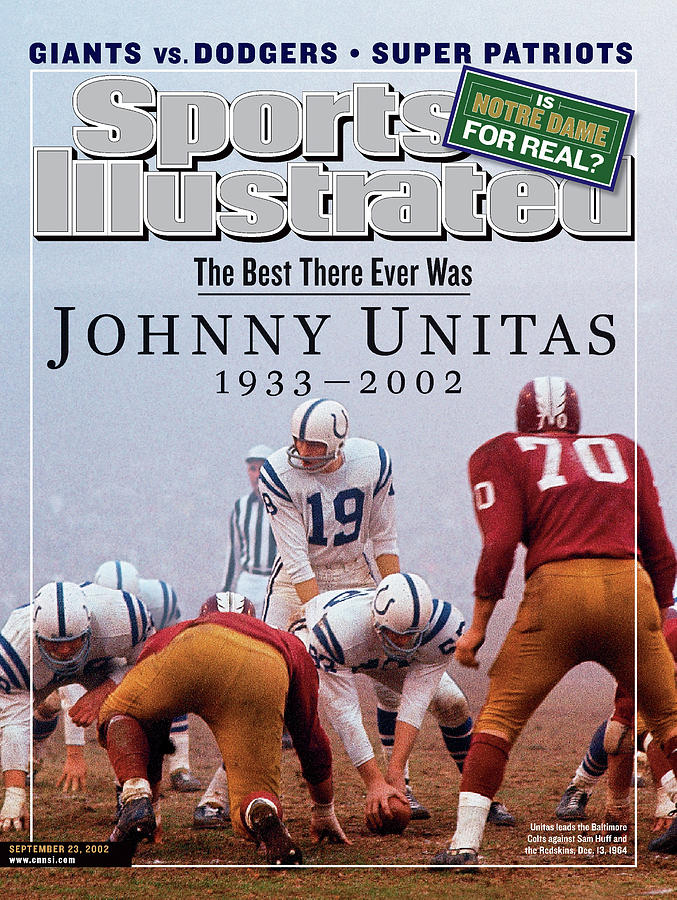
According to the cover, the date is December 13, 1964.
Baltimore Colts 45, Washington Redskins 17,
at Memorial Stadium in Baltimore.
Number 70 for Washington is Hall-of-Famer Sam Huff.

You'll notice, from that Sports Illustrated cover celebrating his life after his death, that he died at the age of 69, Not young, but not especially old, either. The cause of death was a heart attack. That's understandable.

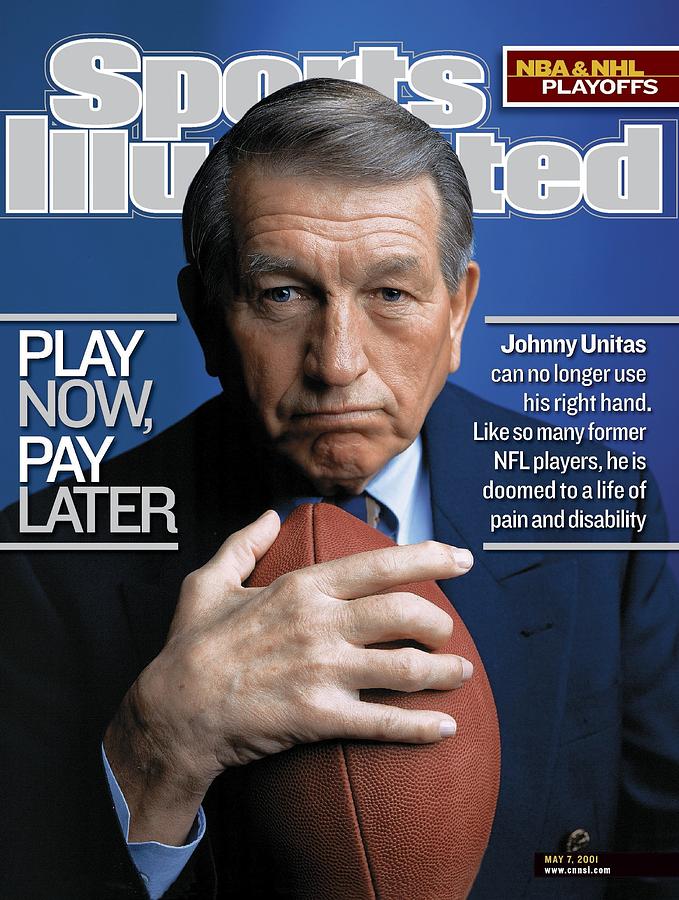
But look at this cover. The date is May 7, 2001, a little over a year before his death. The man often still called the greatest quarterback who ever lived could no longer hold a football properly.
Unitas wasn't the only legend to be seriously injured, long-term, by his play. In the late 1970s and early 1980s, Earl Campbell became one of the greatest running backs anybody ever saw. The 1977 Heisman Trophy winner at the University of Texas went on to star for the Houston Oilers.

He was named Most Valuable Player of the National Football League in each of his 1st 3 seasons. Can you imagine a baseball player being so honored? Only twice (and once was dubious, as Ichiro Suzuki was only a "rookie" by the strictest of standards, the other being Fred Lynn) has a baseball player been named Rookie of the Year and MVP in the same season.

He rushed for 6,457 yards in his 1st 4 seasons. In just 4 years, he was halfway to what was then the all-time record, held by Jim Brown. Pardon me for using a technical term, but that's insane.

He wasn't just fast, either: He was tough. Pete Wysocki, a linebacker for the Washington Redskins, said, "Every time you hit him, you lower your own IQ." Cliff Harris, a safety for the Dallas Cowboys, called him "the hardest-hitting running back I ever played against." Lester Hayes, a cornerback for the Oakland Raiders, said, "Earl Campbell was put on this Earth to play football." And his own head coach, Bum Phillips, was asked if Campbell "was in a class by himself." Bum said, "I don't know, but if he ain't, it don't take long to call the roll."
In that 1999 TSN ranking, "The Tyler Rose" (so named for his Texas hometown) was 33rd. In that 2010 NFL Network ranking, he was 55th. Both the University of Texas and the team the Oilers became, the Tennessee Titans, retired his number. Texas not only dedicated a statue of him outside its stadium, but a 2000 poll named him the greatest player in their history, and that's quite a history.

Like Unitas, he has an NCAA award named for him: In 2013, the Earl Campbell Tyler Rose Award was introduced, to be given to the year's best offensive player with Texas ties. (In other words, playing for a Texas school, or coming from Texas but playing elsewhere.) Also like Unitas, he was elected to the Pro Football Hall of Fame in his 1st year of eligibility.

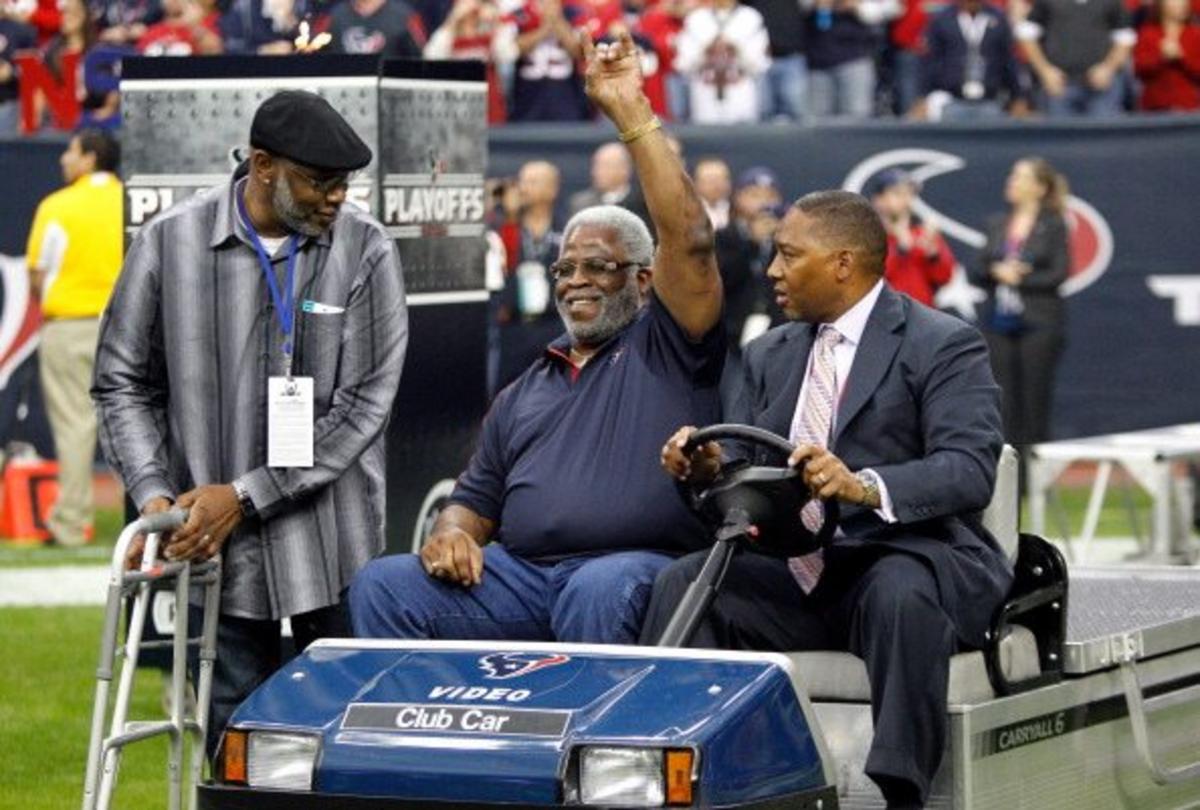
But that was in 1991, when he was only 36. He had already been retired for 5 full years, with 9,407 yards. His playing style led to injuries that forced him to retire early. In 2001, only 46, he had arthritis in his hands so bad, he could barely make a fist; and nerve damage in his legs gave him dorsiflexion, a.k.a. "foot drop." In 2009, he not only had been diagnosed with spinal stenosis, effectively putting him in a wheelchair (occasionally, he could use a walker or even just a cane), but went through rehabilitation to break an addiction to the painkilling drug OxyContin. He is still alive, at age 64, but doesn't make many public appearances.
Campbell, honored at a Houston Texans game

It could be worse. Gale Sayers burst onto the scene in 1965, giving the Chicago Bears perhaps the greatest rookie season any NFL player has ever had, even better than Campbell's. In 1 game, he scored a record-tying 6 touchdowns. He scored a record-setting (since broken) 22 touchdowns that season -- and 22 was also his age.
"Give me 18 inches of daylight. That's all I need."
-- Gale Sayers, interviewed for a 1967 NFL Films production

He should have become the greatest Bears running back of them all, ahead of Red Grange, Bronko Nagurski, Willie Galimore, and the yet-to-come Walter Payton, the man who finally broke Jim Brown's career rushing yards record, before being surpassed himself by the current holder, Emmitt Smith.

He didn't, because he wrecked both knees. In 1969, despite the Bears going through a 1-13 season, the worst in their 100-year history, and teammate Brian Piccolo dealing with cancer, and having no cartilage in his knees, Sayers led the NFL in rushing yards. Piccolo died the next year, and Sayers retired after the 1971 season, the physical and psychological toll the game took on him finally being too much.

He ended up playing only 68 games, a little over 4 seasons' worth under today's 16-game schedule. He finished with just 4,956 yards, about half what Campbell would gain. His 5.0 yards per carry still ranks 2nd in NFL history, behind Brown's 5.2.

Despite the brevity of his career, the 1999 TSN poll and the 2010 NFL Network poll both ranked him 22nd. The Bears and the University of Kansas retired his number. He was elected to the Pro Football Hall of Fame at age 34, the youngest-ever electee to one of the "Big Four" sports halls of fame. (Brown and Sandy Koufax were 36.)

Having more of a post-playing life than most athletes -- or so it appeared -- he made the most of it. He founded a technology services company that took off during the computer revolution of the 1980s, and he used the proceeds to fund charities in the Chicago area and in Kansas. He should have been considered one of the greatest examples of what football can do for a man, and vice versa.

Instead, like Unitas and Campbell, he is one of the saddest examples of what football can do to a man. He took part in one of the "concussion lawsuits" against the NFL in this decade, claiming that he was sometimes sent back into games after suffering a concussion, and that the league -- his team, the officials, the league's administration -- did not do enough to protect him and other players.

He had already been diagnosed with dementia, but that wasn't publicly revealed until 2017. By that point, his memory had been so affected, he could no longer remember how to sign an autograph. He is still alive, but he's not really Gale Sayers anymore. (UPDATE: He died in 2020 -- not from COVID.)

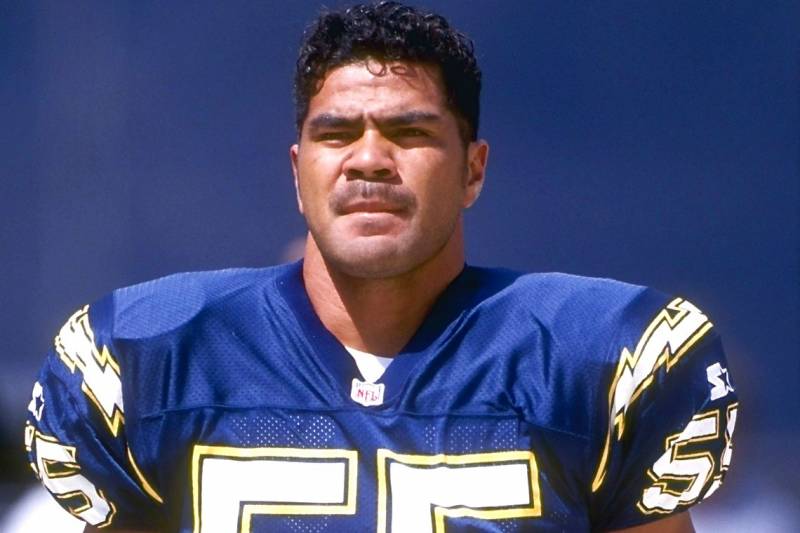
Junior Seau played 20 seasons in the NFL. That's a rarity at any position, but especially for a linebacker. He was named an All-Pro in 12 of those seasons. He was a great player, winning the 1992 Defensive Player of the Year. He was considered a good guy, with his charitable work earning him the 1994 NFL Man of the Year award, which is named for Payton.
The University of Southern California and the San Diego (now Los Angeles) Chargers retired his number. In 2015, he was elected to the Pro Football Hall of Fame in his 1st year of eligibility. He was the 1st player of Samoan descent elected.

He did not live to see his election. He shot and killed himself in 2012, only 43 years old. His family, suspecting that he had sustained undiagnosed concussions during his career, donated his brain to the neurological arm of the National Institutes of Health. The following year, the NIH released its findings: Seau's brain showed signs of chronic traumatic encephalopathy (CTE), which causes impairment of the brain, including mood swings, memory loss, and reduced motor function. In boxers, this used to be known dementia pugilistica, or being "punch-drunk."

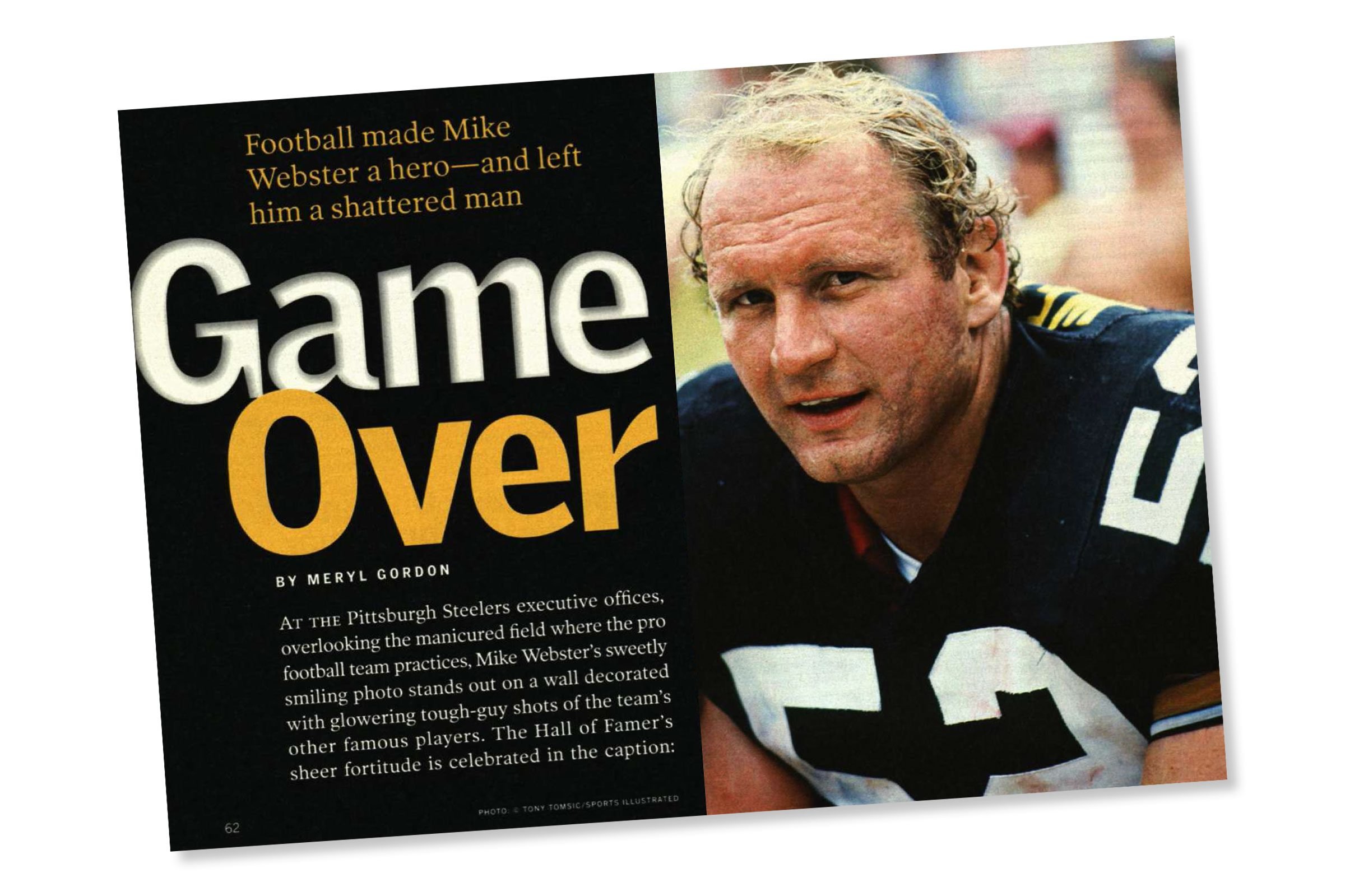
There have been so many others. Mike Webster, Hall of Fame center for the Pittsburgh Steelers, 75th on that 1999 TSN list and 68th on that 2010 NFL Network list, was the 1st former NFL player diagnosed with CTE. "Iron Mike" (he had that nickname before Mike Tyson) had already begun experiencing amnesia as a player in the early 1980s. A doctor later determined that, in 25 years of playing at the high school, college and pro levels, his body, his brain included, had suffered effects comparable to having been in 25,000 car crashes. He died in 2002, only 50.
A 2003 Reader's Digest article about the late Mike Webster

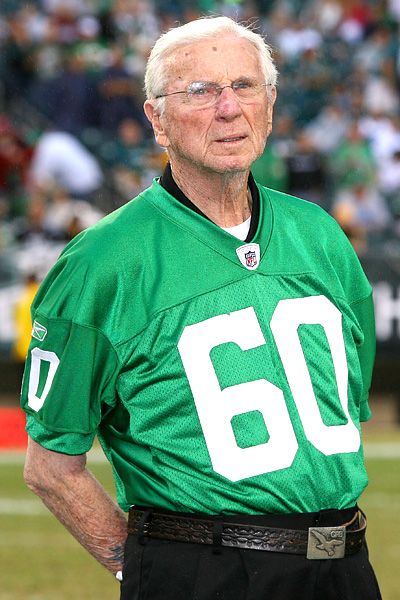
Chuck Bednarik, Hall of Fame center and linebacker for the Philadelphia Eagles in the 1950s, "the last of the 60-minute men," 54th on the 1999 TSN list and 35th on the 2010 NFL Network list, didn't seem to be one of these guys. Into the 21st Century, he was happily sitting for interviews and attending player reunions and memorabilia shows, telling stories about how tough he was, and how tough his time was. As mean as he appeared on the field, he reveled in his role as an NFL elder statesman.
He was called "Concrete Charley," but that was because
  of his off-season job, working for a concrete distributor, not for his toughness.

But in 2006, at an Eagles event, he criticized Reggie White, a former Eagles and Green Bay Packers defensive end, who had just been elected to the Hall of Fame. White, still active in 1999, came in 22nd on the TSN list, and 7th on the 2010 NFL Network list. He had died in 2004, only 43, but from an illness that appears not to have had anything to do with playing football.

When Bednarik was ripped in the media for taking shots at a man no longer around to defend himself, he clarified that he made a mistake, that he actually meant to criticize Terrell Owens. Certainly, Owens, then still active, had already been criticized for his attitude and for wasting his great talent. But how do you get T.O. mixed up with Reggie White? How do you get a still-active receiver mixed up with a recently-deceased defensive lineman? Yes, both men had played for the Eagles, and both men were black, but they looked nothing alike.
Bednarik died in 2015. His family had not publicly revealed it before, but they said he had long been dealing with Alzheimer's disease. He was 90, so it's hardly a shock. If he had been anything other than a football player, we'd have considered it just something that happened.

But this was Concrete Charley. The Last of the 60-Minute Men. Until his death, the living embodiment of NFL toughness. A man from an earlier time, when men were men, damn it, not pussyfooting (a term he liked to use) prima donnas with their ridiculous hair (by white and black players alike) and their touchdown celebrations. Of course, we figured it had to have been caused by all his contact.

Sometimes, it gets to guys sooner. In 2005, Chris Henry was a rookie receiver with the Cincinnati Bengals, and was already getting into legal trouble. It got worse, including domestic violence against the mother of his 3 children. In 2009, he was killed in a truck accident. The following year, it was revealed that his brain had signs of CTE. He was only 26.

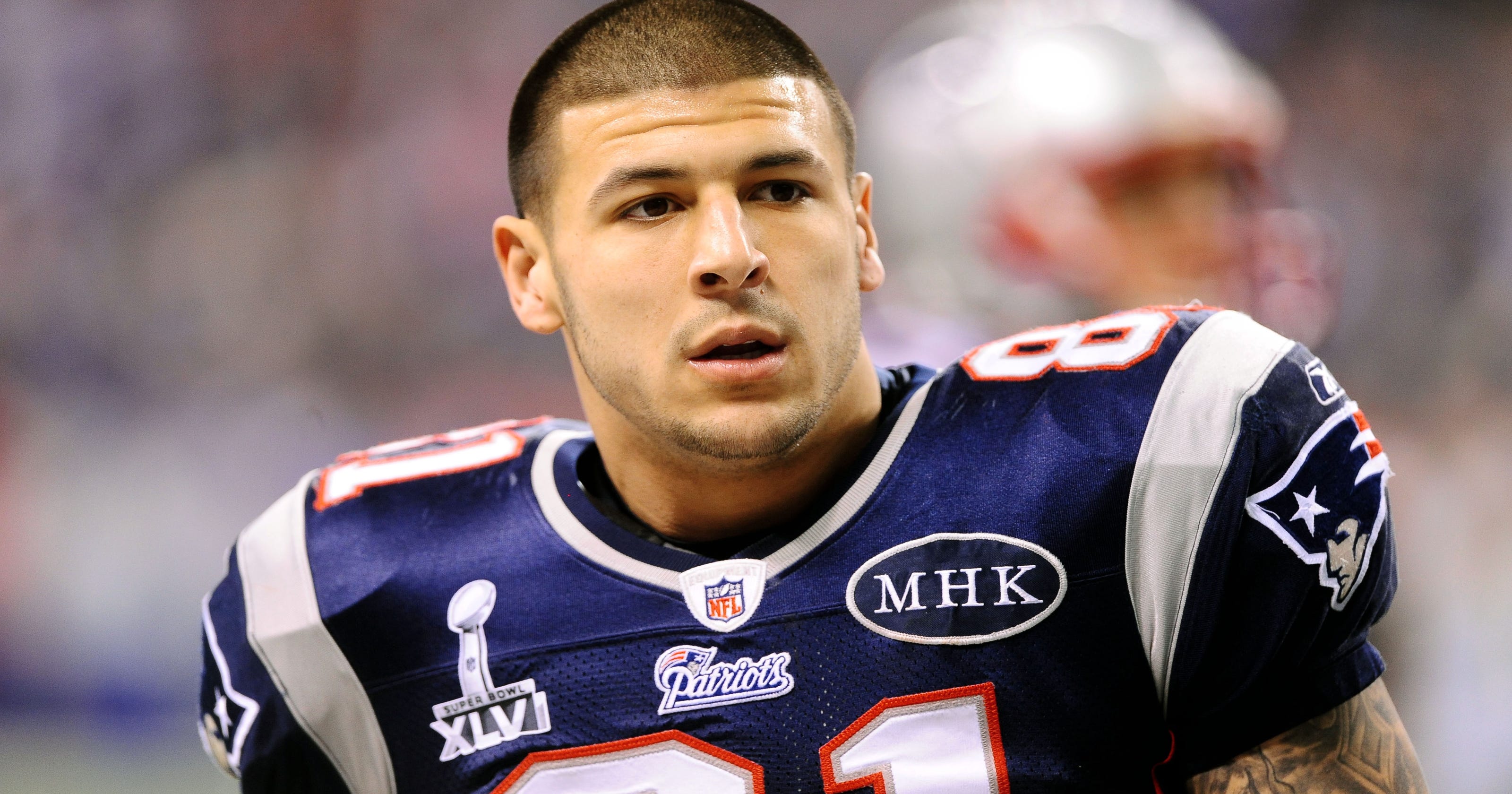
And then there was Aaron Hernandez. At the conclusion of the 2012 season, the tight end was an NCAA Champion at the University of Florida, a 3-year veteran for the New England Patriots, and had already been to a Super Bowl (one of the ones the Pats lost to the Giants). He seemed to have a good career ahead of him. If all had gone well, he would now be approaching his 30th birthday and have 3 Super Bowl rings in 5 appearances, and be on his way to Canton.
But after that 2012 season, he never played another down. And it wasn't because of any injury -- at least, not that anyone could see. In 2013, he was arrested for murder. He was linked to other murders. He was convicted in 2015. In 2017, he hanged himself in his prison cell. He was 27.

Later that year, the Boston University CTE Center released a statement saying that his brain injuries were consistent with Stage 3 CTE -- out of 4 stages -- calling it "the most severe case of CTE medically seen in a person at his age." It certainly would explain the erratic behavior that people who knew him saw, even if the general public wasn't aware of it before his arrest.

These are the highest-profile cases that we know about. There are many others that we don't know about -- or don't know about yet, because their effects on the players currently active are only beginning.

Tom Brady, Hernandez's former quarterback, just turned 42. He wants to play this season. He wants to play next season. He has 6 rings, lots of money, and enough people willing to overlook his, and his team's, cheating that he's an easy first-year inductee into the Hall of Fame. Why go on, and risk permanent injury?

Some guys are smarter than others. Look at the quarterbacks for the Dallas Cowboys. Don Meredith led the Cowboys into the 1966 and 1967 NFL Championship Games. Had they beaten the Green Bay Packers in either, they would have gone to Super Bowl I and/or II. But he retired at age 30. He went into broadcasting, becoming part of the legendary ABC Monday Night Football broadcast team with Howard Cosell and Frank Gifford.

Despite an obvious Southern drawl (Dallas was his hometown), everybody could tell that Dandy Don was smart, and he never showed any sign of mental decline. While his death, in 2010 at 72, was from a brain hemorrhage, no evidence of CTE was found.

Roger Staubach got the Cowboys into 5 Super Bowls, winning 2, but retired after the 1979 season, after suffering 2 concussions that season. "Captain Comeback" was 37, and still seemed to be at the top of his game. But it must have been the right thing to do, as he is now 77, and shows no sign of brain trauma. (Although his U.S. Navy service, following his Naval Academy graduation, did cost him 4 pro seasons, which may have helped his health, even as it hurt his career statistics.)

Troy Aikman quarterbacked the Cowboys to 3 Super Bowl wins in the 1990s, but he retired after the 2000 season, only 34, concerned over concussions and a back injury. He's now 52, and one of the best TV football analysts, and no one questions his brain.

And, following the examples of Meredith and Aikman, Tony Romo retired after 14 seasons as Cowboy quarterback, and went into broadcasting, and is well-regarded at it. He's 39, so it's hard to guess what the long-term effects of his playing will be, but he seems fine now, and not all ex-NFL players seem fine at 39.

Some guys are smarter than others, and some are just luckier. Jack Kemp may have been both: He turned a nearly Hall of Fame career as quarterback of the 1960s Buffalo Bills, retiring at age 34, into 9 terms in Congress, 1 as U.S. Secretary of Housing & Urban Development, and the 1996 Republican nomination for Vice President.

He liked to tell people, "I sustained 11 concussions during my playing career. Nothing left to do but to go into politics!" It always got a big laugh, because people like to think of the politicians they don't like as being dumb or brain-damaged. When Kemp died in 2009, at 74, it was from cancer, rather than anything football-related.

*

Entering this, its 100th season, the National Football League has more problems than just what the regular (I don't want to say "normal") process of the game does to its players' bodies and brains. Even those players who sustain minor injuries can get cut, discarded like an apple core. Contracts? Just pieces of paper to NFL team owners, all of whom are rich enough to hire the best lawyers in America -- and a few owners have been lawyers.

Fans get screwed over, too. Owners tell cities, "Give me a new stadium, with all the modern amenities, paid for with taxpayer dollars, or I will move the team to a city that will give me one." This sometimes happens only 20 or 30 years after the team -- sometimes, under the same owner -- got one with what was then considered "all the modern amenities," paid for with taxpayer dollars, and sometimes not fully paid off. And if a city calls the owner's bluff, and says, "Screw you, we ain't payin'," they soon find out that the owner wasn't bluffing:

* Al Davis, owner of the Oakland Raiders, didn't like his lease at the Oakland Coliseum. He wanted a new stadium. He didn't get it. So in 1982, he moved his team to the Los Angeles Memorial Coliseum -- a considerably older stadium. The advantage was that it was a much bigger stadium, but even a good Raider team couldn't sell 93,000 tickets. He got tired of the lack of luxury suites, so he made a deal with Oakland to build a new section of their Coliseum, with luxury suites, and moved back in 1995. But after his death, his son, Mark Davis, got sick of the Oakland Coliseum's age and inadequacy, and is now in the process of moving the Raiders to Las Vegas. Not too many teams managed to screw 2 different cities over, but the Raiders are now unique in having screwed the same city over twice.

* The Minnesota Vikings played 21 years at Metropolitan Stadium, 1961 to 1981, before moving into the Metrodome. By 2010, not yet reaching its 30th Anniversary, baseball's Twins and the football program at the University of Minnesota had already left it, and the stadium had proved inadequate. After threatening to move to Los Angeles and San Antonio, Vikings owner Zygi Wilf cut a deal with the State of Minnesota. After groundsharing at UM's open-air, too-small 51,000-seat stadium for 2 seasons, they moved into the domed, 66,000-seat U.S. Bank Stadium, on the site of the Metrodome, in 2016.

* Bob Irsay, owner of the Baltimore Colts, threatened to move if he didn't get a new stadium. The City of Baltimore couldn't afford it. The State of Maryland wanted certain concessions in exchange, and didn't get them. The Colts moved to Indianapolis, which had a new stadium, in 1984.

* And yet, that new stadium, the Hoosier Dome, only lasted 25 seasons, before Lucas Oil Stadium opened. The City of Indianapolis knew that, being his father's son, team owner Jim Irsay was probably not bluffing, and so they caved in.

* The Atlanta Falcons have now pulled this stunt twice. They played their 1st 26 seasons, 1966 to 1991, at Atlanta-Fulton County Stadium, then left it for the Georgia Dome, and only played 25 seasons there before moving into a new dome, Mercedes-Benz Stadium, in 2017.

* Art Modell, owner of the Cleveland Browns, threatened to move if he didn't get a new stadium. The City, County and State governments didn't take the threat seriously, and they moved after the 1995 season, becoming the Baltimore Ravens. Cleveland got a new stadium and a new Browns franchise, both debuting in 1999.

* Bud Adams, owner of the Houston Oilers, threatened to move if he didn't get a new stadium. He almost had an agreement to move to Jacksonville in 1988, but he got an agreement for improvements to the Astrodome, and called it off. He later decided that what he'd gotten wasn't enough, and, after the 1996 season, he moved the team, and it became the Tennessee Titans. Jacksonville got the expansion Jaguars in 1995, and Adams' team and the city he once used as leverage are now divisional rivals.

* The Tampa Bay Buccaneers played 22 seasons in Tampa Stadium, 1976 to 1997, before moving into Raymond James Stadium, which has now lasted that long.

* The Cincinnati Bengals played 30 seasons in Riverfront Stadium, 1970 to 1999, before moving into Paul Brown Stadium. (UPDATE: Now named Paycor Stadium. Team owner Mike Brown took his own father's name, the name of the team's founder, off the stadium.)

* The Kingdome lasted 25 seasons, 1976 to 2000, before the Seattle Seahawks left it, temporarily groundsharing with the University of Washington, before a new stadium, now named CenturyLink Field, opened on the same site. (UPDATE: Now named Lumen Field.)

* The Pittsburgh Steelers' Three Rivers Stadium lasted 31 seasons, 1970 to 2000, before being replaced by Heinz Field. (UPDATE: Now named Acrisure Field.)

* The New England Patriots' Foxboro Stadium lasted 31 seasons, 1971 to 2001, before being replaced by Gillette Stadium, after threats by one owner, James Orthwein, to move the team to St. Louis or Baltimore; and by the next owner, current owner Bob Kraft, to move them to Hartford. The State of Connecticut thought they had a deal with Kraft, until the Commonwealth of Massachusetts gave him a better deal.

* The Detroit Lions' Silverdome lasted 27 seasons, 1975 to 2001, before being replaced by Ford Field.

* The Philadelphia Eagles' Veterans Stadium lasted 32 seasons, 1971 to 2002 (plus 1 more for the Phillies), before being replaced by Lincoln Financial Field.

* Dean Spanos, operating owner of the San Diego Chargers, demanded a new stadium to replace the facility best remembered as Jack Murphy Stadium (now named SDCCU Stadium). The city, one of the most conservative in America, is famously taxophobic, and refused to fund it. Spanos moved the team to Los Angeles for the 2017 season. (UPDATE: The old stadium has been torn down. On the site, the smaller Snapdragon Stadium was built, and is home to San Diego State and MLS' San Diego FC.)

* And, here in the New York Tri-State Area, the New York Giants played their 1st 31 seasons, 1925 to 1955, at the Polo Grounds. Not happy with the stadium or the neighborhood, both crumbling, they moved across the Harlem River to Yankee Stadium. But, knowing that they would be kicked out due to its renovation in 1973, they played "home games" at the Yale Bowl in Connecticut and then at Shea Stadium until Giants Stadium could open in 1976.

* The New York Jets played their 1st 4 seasons, 1960 to 1963, at the Polo Grounds, before moving into Shea Stadium. But they only played 20 seasons there, realizing that "The Flushing Toilet" was no good. So they spent 26 years groundsharing with the Giants at the Meadowlands. But the stadium's owners, the New Jersey Sports and Exposition Authority, always gave the Giants first say over everything. Plus, playing home games in a stadium with another team's name on it was demeaning.

* So the Jets threatened to move. They wanted in on Mayor Michael Bloomberg's idea to build an 85,000-seat retractable-roof stadium over the West Side Rail Yards, which would be home to the Yankees, the Jets, other sporting events such as the Super Bowl and the Final Four, concerts and conventions starting in 2008, and also serve as the main stadium for the 2012 Olympics. The deal never happened: The Yankees made a deal with the City for a new Yankee Stadium, the Olympics were awarded to London instead, and the Jets and the other tenants simply wouldn't generate enough revenue to justify the stadium's massive cost, so the City Council said, "Fugeddabouddit."

* So the Jets made the best deal they could, working with the Giants to build a new stadium next-door to Giants Stadium. What's now MetLife Stadium opened in 2010, and each team is half-owner, and they work together to run it and get favorable playing dates. But it meant that Giants Stadium lasted only 34 Giants seasons, albeit with 3 of them ending with the Giants winning the Super Bowl, and just 26 Jets seasons.

(Two ironies about this: There is, sort of, another New York sports team's name on the Jets' home stadium: "MetLife"; and the Yankees did end up playing 2 games in the stadium that was built for the 2012 Olympics, against the Boston Red Sox this past June, in the "MLB London Series.")

*

It's not just the injuries. It's not just ripping the fans off with taxpayer-funded stadiums that these billionaires can afford to build themselves, and never miss the money. Ticket prices are exorbitant. So are parking prices. So are concession prices. God forbid your kid wants a jersey or another thingamabob with the team's logo on it.

Someone once pointed out that, with the TV revenue involved, all 16 NFL teams playing home games in a given weekend could keep the fans out, have official attendances of zero, and still make a profit for the week. Because the fans would still watch on television. (UPDATE: The COVID-forced "behind closed doors" games of 2020 proved this true.)

And then there's the perception that the games are rigged. More than any other North American sports league, the NFL has its officials called into question. It used to be the Cowboys that seemed to be the beneficiaries of cheating. Now, it's the Patriots. And when Commissioner Roger Goodell tried to punish Tom Brady and the team in "Deflategate," he was taken to court and overruled. (Well, sort of: Brady's suspension was reduced.)

And, last season, both Conference Championship Games were ruined by the officials. It's bad enough that the Patriots unfairly got calls that allowed them to beat the Kansas City Chiefs, but the Los Angeles Rams got a call that, had it been made correctly, might have led to the New Orleans Saints winning. Result? The lowest-scoring Super Bowl ever, 13-3. Of course, the Patriots won.

NFL fans can't trust the team owners, or the officials, or the League office. And the players are getting killed. Literally. Not immediately: While there have been 5 deaths as a result of on-field play in the NFL's 100-year history (counting the AFL), there hasn't been one since Chuck Hughes of the Detroit Lions in 1971. But retired players are dying, and some not dying yet but suffering terribly, from the effects of their playing.

If team owners are so concerned over money, and protecting their assets, and treating the players as property (an idea that should have been shattered when baseball's reserve clause was struck down in 1975 -- 44 years ago), why don't they do more to protect those assets?

Which brings me back to the quarterback of the Colts. Not Johnny Unitas, their all-time greatest legend. Yes, kids, even over Peyton Manning. I mean the man who, until yesterday, was the current Colts quarterback, a man with the now-ironic name of Andrew Luck.
Coming out of Stanford University, Luck was the 1st pick of the 2012 NFL Draft. The Colts had that pick in that draft because Manning had sustained a neck injury and missed the entire 2011 season, resulting in the Colts going a League-worst 2-14. The Colts decided that, with Manning being 36, they'd be better off letting him go as a free agent, even though they would get nothing for him as they would in a trade, and drafting his replacement now.

It seemed to work well for both teams. Manning was sent to the Denver Broncos, whom he led to 2 Super Bowls, winning 1, before retiring. Meanwhile, Luck quarterbacked the Colts for 7 seasons, making the Playoffs 4 times, winning 2 AFC South Division titles, and making the 2014 AFC Championship Game -- the Deflategate Game. Despite injuries that plagued him in 2017 (he missed the entire season, and the team went 4-12) and 2018 (his delayed debut got them to 10-6 and a Playoff win away to Houston), he looked like he was headed for the Hall of Fame.

Yesterday, Luck held a press conference, and announced his retirement. He said, "I've been stuck in this process. I haven't been able to live the life I want to live. It's taken the joy out of this game. The only way forward for me is to remove myself from football. This is not an easy decision. It's the hardest decision of my life. But it is the right decision for me."

Andrew Luck is 29 years old. He could have become young Johnny Unitas. But he didn't want to become old Johnny Unitas.

*

This is what the National Football League does.

I don't blame the League for wanting to celebrate the hell out of its 100th Season. (It was founded on September 17, 1920, so this is the 100th Season, not the 100th Anniversary.) There is much to celebrate. Much good has been done by the teams and their players. Much joy has been brought to places where the game has been played.

Places like Los Angeles, Denver, San Diego, Tampa, Jacksonville and Phoenix, not previously thought of as "major league" or "big time," got that way through the NFL (or the AFL, which is now considered part of the NFL's history). Other places, such as Philadelphia, Pittsburgh, Cleveland and Chicago, have had the successes of their football teams give them an emotional lift at times when, due to economic strife or municipal disharmony (or, in the case of Dallas, the stigma of having a President assassinated there), they really needed it. Buffalo and Los Angeles, which wouldn't seem to have much else in common, qualify on both counts.

But we now know things about football that we didn't know before. And then there are the things that we did know, but didn't want to admit. Football changes people. Not just those contractually involved. Fans change.

I attended 18 Phillies home games at Veterans Stadium. Aside from the stadium's bowl sometimes trapping the heat, the team often being bad, and that artificial turf being hideous, my experiences there were good ones. Only once did I ever have a problem with the home fans, and it was a minor, tolerable thing.

I attended 1 Eagles home game there. It was, if you'll pardon the pun, a whole different ballgame. Eagle fans have a reputation for being among the roughest in the League. It is deserved.

Compare Oakland fans for an A's game, where they're passionate, but mostly sane; and for a Raiders game, where they're animals.

Even in the college game, fans get like that. Vandalizing your arch-rival school's statues. Using the kind of language you would never use in polite company. One University of Alabama fan was so mad over losing the "Iron Bowl" to arch-rival Auburn University that he poisoned a pair of trees in downtown Auburn that had become a focal point for the AU community.

So far, we have yet to see an NFL fan do anything like this. But we have seen gun massacres in America. Many of them. How long will it be before a fan takes his frustrations out on fans of his rival team? How long before such a fan drives into the parking lot, whips out an AR-15, and guns down tailgate partiers?

It hasn't happened. But don't tell me it can't.

Maybe the 100th Season is time to come to a painful conclusion: That the National Football League is doing more harm than good, and that the money being made off of it is no longer worth it.

Shut the NFL down. Celebrate this 100th Season, and then shut the League down. Let kids play football in high school and college. And then make them look for work. Let high schools and colleges be what they were always meant to be: Preparations for adult life.

This will not be a popular idea. Too many people have invested too much -- financially and/or emotionally -- to give up pro football.

But it needs to happen. For the players' sake. If your last game is a college bowl game when you're 22, you stand a much better chance of being able to think and move well in your 50s than you do if your last game is an NFL Playoff game when you're 32, or 37, or 40.

The NFL doesn't need to have a 200th Anniversary. Or a 150th. Or a 125th. Or even a 110th.

Let the NFL's 100th Anniversary be its last.

Monday, April 2, 2018

Philadelphia's 10 Greatest Athletes

The Mets were supposed to start a 3-game series with the Philadelphia Phillies at Citi Field this afternoon. It will be a 2-games series starting tomorrow, and today's game has been moved to be part of a single-admission doubleheader on July 9.

Continuing the series I began with St. Louis. I'm using the same rules, which is that, unlike when I did this for the States, only players for a metro area's teams are uses. So you won't see Joe Frazier or any other boxer. Or tennis legend Bill Tilden, or the rowing Kelly family that produced Olympic Gold Medalist John and his son Jack -- not to mention John's daughter, Princess Grace Kelly or Monaco; or her son, Prince Albert II, an Olympic yachtsman who married an Olympic swimmer.

Honorable Mention to Philadelphia Athletics in the Baseball Hall of Fame, who did not make this list: Eddie Collins, Eddie Plank, George "Rube" Waddell, Albert "Chief" Bender, Frank "Home Run" Baker, Mickey Cochrane and Al Simmons.

Honorable Mention to Philadelphia Phillies in the Baseball Hall of Fame, who did not make this list: Sam Thompson, Billy Hamilton, Ed Delahanty, Nap Lajoie, Chuck Klein, Richie Ashburn, Robin Roberts, Jim Bunning and Jim Thome. If Pete Rose is ever reinstated and makes the Hall, he can be added.

Honorable Mention to Philadelphia Eagles in the Pro Football Hall of Fame, who did not make this list: Bill Hewitt, Alex Wojciechowicz, Pete Pihos, Tommy McDonald, Norm Van Brocklin, Sonny Jurgensen, Jim Ringo, Bob Brown, Claude Humphrey, Reggie White and Brian Dawkins.

When The Sporting News listed its 100 Greatest Football Players in 1999, White came in  22nd, while Van Brocklin, until Peyton Manning the only quarterback to lead 2 different franchises to an NFL Championship, wasn't listed at all. When the NFL Network listed its 100 Greatest Players in 2010, 11 years and several great players' added credentials later, White was promoted to 7th, while Van Brocklin was listed at 83rd.

Honorable Mention to Philadelphia Warriors in the Basketball Hall of Fame, who did not make this list: Joe Fulks, Andy Philip, Paul Arizin, Neil Johnston, Tom Gola and Guy Rodgers.

Honorable Mention to Philadelphia 76ers in the Basketball Hall of Fame, who did not make this list: Hal Greer, Chet Walker, Billy Cunningham, Maurice Cheeks, Moses Malone, Charles Barkley and Allen Iverson.

Honorable Mention to Philadelphia Flyers in the Hockey Hall of Fame, who did not make this list: Bernie Parent, Bill Barber, Mark Howe, Eric Lindros and Mark Recchi.

10. Grover Cleveland Alexander, pitcher, Philadelphia Phillies, 1911-17. He was only with the Phils for the 1st 7 seasons of his career, but they were spectacular seasons. He led the National League in wins 6 times, ERA 4 times, and strikeouts 6 times. In 1915, he helped the Philadelphia Phillies win their 1st Pennant. He won Game 1 of the World Series. The Phillies wouldn't win another Series game for 65 years.

In 1916, he pitched 16 shutouts, despite the Phils' Baker Bowl having only a 280-foot right field foul pole. In 1918, fearing that they would lose him to World War I, the Phils traded him to the Chicago Cubs, and he helped them win the Pennant.

But he did have to go off to war. He returned to baseball, and he was still a great pitcher, but he was never the same man. In 1926, the Cubs traded him to the Cardinals, not yet their arch-rivals. He helped the Cards win the Pennant, then beat the Yankees in Games 2 and 6 of the World Series, before being called on to save the day in Game 7. His bases-loaded fanning of Tony Lazzeri in the 7th inning is the most famous strikeout in baseball history, and he finished the game off.

In 1938, he was elected to the Baseball Hall of Fame. Since he pitched before uniform numbers were worn, the Phillies honored him with a "P" monogram, resembling their team logo of the era, in place of a retired number, and elected him to the Philadelphia Baseball Wall of Fame. In 1999, 69 years after his last game and 49 years after his death, The Sporting News ranked him 12th on their 100 Greatest Baseball Players, trailing only Walter Johnson and Christy Mathewson among pitchers.

9. Julius Erving, forward, Philadelphia 76ers, 1977-87. An All-Star 5 times in the ABA and 11 times in the NBA, "Doctor J" became the stylish symbol of 1970s and early '80s basketball. He did something no one thought possible. Philly fans' favorite athletes are the tough guys, the ones who get knocked down, get back up, and do the business. Dr. J. showed them that a man could do that and still look cool. He showed them that it was okay to love a pretty boy.

He got the Sixers into 4 NBA Finals, winning the title in 1983. They retired his Number 6, and dedicated a statue to him outside The Spectrum, moving it to the Wells Fargo Center. He was named to the Basketball Hall of Fame, and was 1 of only 5 players named to the ABA All-Time Team (he was easily the greatest player in that league's 9-year history) and the NBA's 50th Anniversary 50 Greatest Players.

8. Steve Van Buren, running back and cornerback, Philadelphia Eagles, 1944-51. "Moving Van" made 6 Pro Bowls, getting the Eagles to 3 straight NFL Championship Games, as the best running back in the NFL, and as a deadly tackler as a defensive back.

They lost to the Chicago Cardinals in 1947. Then "Supersonic Steve" braved the elements. The day of the 1948 Championship Game, 10 inches of snow fell on Philadelphia, and he almost didn't get to Shibe Park. Somehow, he got through the snow outside, and the snow inside, scoring the game's only touchdown to get the Eagles their 1st World Championship. In 1949, the weather struck again. A rare Southern California rainstorm hit the Los Angeles Coliseum, but he led the Eagles to victory over the Rams. To put it another way: In those 2 seasons, the Eagles won 2 titles; it would take them another 69 years to win another 2.

Injuries forced him to retire after playing his last game in 1951, with 5,860 rushing yards and 69 rushing touchdowns, both records at the time. He was the 1st Eagles player elected to the Pro Football Hall of Fame, in 1965. He was named to the NFL's 1940s All-Decade and 75th Anniversary Team. The Eagles retired his Number 15, and named him to their Hall of Fame and their 75th Anniversary Team.

In 1999, he came in 77th on The Sporting News' 100 Greatest Football Players. Somehow, by 2010, he had grown in the estimation of football historians, because the NFL Network raised his ranking to 58th.

7. Robert "Lefty" Grove, pitcher, Philadelphia Athletics, 1925-33. Here are Grove's won-lost records 1927 to 1933: 20-13, 24-8, 20-6, 28-5, 31-4, 25-10 and 24-8. That's 172-54, or an average of 24-8. This included the American League Pennants of 1929, 1930 and 1931, and the World Series wins of 1929 and 1930. All this before Connie Mack's fractured finances forced him to sell of the A's stars, including Grove to the Boston Red Sox for 1934.

Grove also led the AL in strikeouts his 1st 7 seasons in the major leagues, and in earned run average 9 times, the 1st 5 in Philadelphia. His ERA+ for his career was 148, 151 in his Philly years. That is insane for a starting pitcher. It would be amazing for a reliever. And he did this after the dawn of the Lively Ball Era.

He was elected to the Baseball Hall of Fame, and in 1999 was named to both The Sporting News' 100 Greatest Baseball Players and the Major League Baseball All-Century Team.

6. Jimmie Foxx, 1st base, Philadelphia Athletics, 1925-35. He was only the 2nd man to hit 500 home runs, and his 534 was 2nd-most all-time until 1966. Like Grove, starred on the A's dynasty, where he hit 302 of those home runs, including 58 in 1932, still a record for honest righthanded hitters. Also like Grove, Mack sold him to the Boston Red Sox, and he had a few more good years there.

He was elected to the Baseball Hall of Fame, and named to The Sporting News' 100 Greatest Baseball Players. The Oakland edition of the Athletics hangs banners honoring their World Series wins in Philadelphia, but they don't retire numbers from that period, so Foxx' 3 and Grove's 10 remain in the team's circulation.

5. Bobby Clarke, center, Philadelphia Flyers, 1969-84. Philly fans may have hated "Bob" Clarke, the general manager; but they still love "Bobby" Clarke, the player turned team legend.

The Flyers' 1st great player, and still their all-time greatest, he made 8 NHL All-Star Games, won 3 Hart Trophies as Most Valuable Player, and led the team to the Stanley Cup Finals 4 times, winning it in 1974 and 1975. His overtime winner in Game 2 in 1974, against the Boston Bruins at the Boston Garden, is considered a turning point in team history.

He scored 358 goals and 852 assists. He also helped Team Canada beat the Soviet Union in the 1972 "Summit Series" and in hockey's 1st version of a "World Cup," the 1976 Canada Cup. And he did all of this while dealing with diabetes.

He was awarded the Lester Patrick Trophy for advancement of hockey in America in 1980, while still playing. The Flyers retired his Number 16, and dedicated a statue of Clarke and Bernie Parent lifting the 1974 Stanley Cup, outside the Wells Fargo Center.

He was named to the Hockey Hall of Fame, and to lists of the 100 Greatest Players produced by The Hockey News in 1998 for its 50th Anniversary and the NHL in 2017 for its 100th Anniversary. And, unlike some of these guys, spent his entire major league career in Philadelphia, producing a higher rank than he would have if he were compared to their entire careers.

4. Steve Carlton, pitcher, Philadelphia Phillies, 1972-86. As great as Alexander and Grove were in the short term, Carlton was as good, and for longer. He was a 10-time All-Star, and the 1st man to win the Cy Young Award at least 4 times: 1972, 1977, 1980 and 1982.

In 1971, the Phillies stunk, and were desperate for pitching, sending Rick Wise to the St. Louis Cardinals for Carlton in a "my headache for your headache" trade. In 1972, Carlton went 27-10, a 162-game pace for 118 wins; otherwise, they went 32-87, a pace for 117 losses. On days when he was scheduled to pitch, he told his teammates, "It's Win Day."

By 1976, the Phils had a lot more Win Days. He helped them begin a string of 8 seasons with 6 Playoff berths, and was the starting and winning pitcher in Game 6 of the 1980 World Series, the 1st title the Fightin' Phils ever won -- their ultimate Win Day. He had 329 Win Days, 241 of them for the Phillies.

He was elected to the Baseball Hall of Fame in his 1st year of eligibility. The Phillies retired his Number 32, named him to the Philadelphia Baseball Wall of Fame, and dedicated a statue of him outside the left field corner at Citizens Bank Park. In 1999, The Sporting News listed him 30th on their list of the 100 Greatest Baseball Players.

3. Mike Schmidt, 3rd base, Philadelphia Phillies, 1972-89. A 12-time All-Star, a 10-time Gold Glove winner, a leader of the National League in home runs 8 times and in RBIs 4 times, he has been called the greatest 3rd baseman who ever lived. His 548 home runs led all National Leaguers, and all righthanded hitters, in his generation. (Among American Leaguers and lefthanders in his generation, only Reggie Jackson had more.)

He was named National League Most Valuable Player in 1980, 1981 and 1986 -- the last of these, in spite of the Mets finishing 21 1/2 games ahead of the Philadelphia Phillies. In 1980, he was named MVP of the World Series, the Phillies' 1st title. In 1983, as part of the team's Centennial, fan balloting named him the greatest player in franchise history -- and he still had 163 home runs, an MVP, and a Pennant ahead of him. All told, he helped the Phillies reach the postseason 6 times -- and they'd only done so twice before.

His Number 20 was retired, and he was easily elected to the Baseball Hall of Fame in his 1st year of eligibility. In 1999, he was named to the Major League Baseball All-Century Team, and was ranked 28th on The Sporting News' list of the 100 Greatest Baseball Players, making him not only the highest-ranking 3rd baseman, but the highest-ranking player who debuted after 1967.

Fast facts with which you can amaze your friends: On June 23, 1971, Rick Wise pitched a no-hitter for the Phillies, and the last out was a line drive to 3rd baseman John Vuckovich; on August 15, 1990, Terry Mulholland pitched a no-hitter for the Phillies, and the last out was a line drive to 3rd baseman Charlie Hayes; in between was the entire career of Mike Schmidt, but he never played in a winning no-hitter.

2. Chuck Bednarik, center and linebacker, Philadelphia Eagles, 1949-62. Despite the name of his birthplace -- Bethlehem, Pennsylvania -- he seemed more demon than divinity. He was called "Concrete Charley," but not because he was such a tough hitter on the football field. It was because selling concrete, which he turned out to be very good at, was his off-season job.

The son of Slovakian immigrants came from the mining region of the Lehigh Valley, and was a gunner on a B-24 bomber in the U.S. Army Air Force in World War II. Doesn't sound like an obvious Ivy Leaguer, does he? Surprise: He not only got into the University of Pennsylvania -- and the Ivy League schools have never given out athletic scholarships, so he got in on brains -- but was an All-American for them, finishing 3rd in the Heisman Trophy voting in 1948, an astounding achievement for a center or a linebacker, and he was both.

He was drafted by the Eagles, and was the only player to bridge their 1949 and 1960 NFL Championships. He continued going both ways, even as the NFL adopted "two-platoon football," meaning players would play on only offense or only defense. He was "the Last of the Sixty-Minute Men," and, at age 35, played 58 of the 60 minutes of the 1960 NFL Championship Game, at his former college home of Franklin Field on the Penn campus, tackling Jim Taylor of the Green Bay Packers and holding him down as the clock ran out.

A 1969 poll for the 100th Anniversary of college football named him the greatest collegiate center of all time. He was a 10-time All-Pro in his 14 seasons. The Eagles elected him to their Hall of Fame and their 75th Anniversary Team, and retired his number -- which, in a neat coincidence, happened to be 60. He was elected to the College and Pro Football Halls of Fame, and to the NFL's 1950s All-Decade Team and 75th Anniversary Team.

When The Sporting News listed its 100 Greatest Football Players in 1999, he came in 54th. When the NFL Network listed its 100 Greatest Players in 2010, 11 years and several great players' added credentials later, he was promoted to 35th. His legend had grown.

In a City that puts so much value on toughness, Chuck Bednarik was the toughest bastard of them all.

1. Wilt Chamberlain, center, Philadelphia Warriors 1959-62 and Philadelphia 76ers 1965-68. True, Wilt only played 6 seasons of professional sports in his hometown. But that did include the Sixers' 1966-67 NBA Championship season, when they may have been the greatest team in NBA history.
Here is what Wilton Norman Chamberlain did just in the 1961-62 season, the Warriors' last in Philadelphia before moving to the San Francisco Bay Area. He played all but 4 minutes of the season, including overtimes, meaning that he averaged 48.5 minutes per game, and a regulation game is only 48 minutes long. He led the league in rebounds per game with 25.7. And he averaged 50.4 points per game. We make a big deal about players scoring 50 points in a single game -- Wilt averaged that over the entire season.

On March 2, 1962, at HersheyPark Arena in Hershey, Pennsylvania, Wilt scored 100 points in a 169-147 Warriors win over the Knicks. This included the defiance of his difficulties with shooting free throws, as he set records that still stand with 32 attempts and 28 successfully. He also did it having gotten no sleep the night before. There is no surviving video, just a radio broadcast, so we can't know how many of his shots would have been for 3 points under today's rules. For all we know, those shots might have been worth 120 points under today's rules -- and the next-best single-game point totals in NBA history are 81 by Kobe Bryant, 78 by Wilt Chamberlain, and 73 by both Wilt Chamberlain and David Thompson.

Among records he set as a Philadelphia player, he still holds those for points in a game (100), for a season (4,029), and per game for a season (50.4); for rebounds in a game (55, against the Boston Celtics of Bill Russell, in 1960), for a season (2,149, also in 1960-61), and per game for a season (27.2, in that same 1960-61 season). In 1967-68, his last season in Philadelphia, he led the league in assists. As a center. No one else has ever done that, not in the NBA, not in the WNBA, not in the NCAA (men or women).

He was the 1960 Rookie of the Year. He was an All-Star 13 times, including all 6 seasons in Philly. He was MVP of the regular season 4 times, all with Philadelphia teams, in 1960, 1966, 1967 and 1968. He was MVP of the All-star Game in 1960.

He was the easiest of choices for the Basketball Hall of Fame, and for the NBA's 50th Anniversary 50 Greatest Players. The Warriors and 76ers have both retired his Number 13, and a dual statue of him stands outside the 76ers' new arena, the Wells Fargo Center. It shows 2 figures: Wilt in full height, throwing down a dunk, and seated in street clothes and smiling, holding a ball, as if offering it to the viewer. Of course, he deserves a dual statue: He wasn't quite as tall as 2 adult men, but, culturally, he was twice as big as anybody he played against.

Monday, February 5, 2018

How Long It's Been: The Philadelphia Eagles Were NFL Champions

Norm Van Brocklin hands off to Billy Ray Barnes,
1960 NFL Championship Game, Franklin Field, Philadelphia.

The Philadelphia Eagles are the reigning Champions of the National Football League.

Until late last night, that statement could never have been made in a blog, or on any platform on the Internet, or on ESPN, or even on color television.

Their victory in Super Bowl LII not only made the New England Patriots lose (always a good thing), but it made one of the most hapless franchises in North American sports World Champions.

Well, sort of. Zach Ertz, an Eagles tight end, is married to Julie Ertz, who, as Julie Johnston, played for the U.S. team that won the Women's World Cup in 2015. That's a real "world championship." But I digress.

From Scranton in the north to Rehoboth Beach in the south, from Atlantic City in the east to Harrisburg in the west, people in the Philadelphia metropolitan area have waited a long time for this.

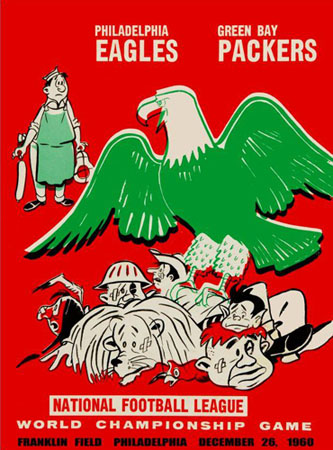
The last time the Eagles won an NFL Championship -- Super Bowl -VI, if you prefer -- it was against the Green Bay Packers, at the start of their run of glory under head coach and general manager Vince Lombardi. It was December 26, 1960, at the University of Pennsylvania's Franklin Field, a 17-13 win.
Tommy McDonald, the shortest member of the Pro Football Hall of Fame, caught a touchdown pass and fell into a snowbank. Ted Dean, a local guy all the way, from Radnor and Villanova University, scored the other touchdown. On the final play, Bart Starr threw a pass to Jim Taylor, but Chuck Bednarik flattened him short of the goal line, and held him down until the clock ran out.

Taylor, as the clock runs out: "Get off me, you son of a bitch!"

Bednarik, seeing that the clock now has run out: "You can get up now, you son of a bitch, this fucking game is over!"
When you're Concrete Charley, you can smoke
a cigarette and a victory cigar at the same time,
and nobody will say a word about it.

After that, the Eagles had one misfortune after another. A 2nd-place finish in 1966, right before the expansion of the NFL Playoffs. The team's collapse right after that. A decade of mediocrity until coach Dick Vermeil rebuilt them. The loss in Super Bowl XV in 1981. Vermeil's "burnout."

Buddy Ryan having the greatest offensive weapon in football in Randall Cunningham, and not knowing what to do with him. Rich Kotite having the best defense in the NFL in 1991, and Cunningham gets lost for the season in the 1st game. The death of Jerome Brown. Losing 3 straight NFC Championship Games, including 2 at home. The loss in Super Bowl XXXIX in 2005. The Terrell Owens saga. Losing the 2008 NFC Championship Game.

And that doesn't even include the perception of Eagles fans: Booers of Santa Claus, people who hate the Dallas Cowboys more than they love their own team, people who will accept a loss if it means their boys knocked an opposing star out of the game, being so delinquent that a police precinct, complete with a jail cell and a courtroom with a working judge, had to be set up in the basement of Veterans Stadium.

Finally, just when it looked like they might actually do it this season, they lost starting quarterback Carson Wentz to a season-ending injury, forcing them to turn to Nick Foles -- who only turned out to be the MVP of the championship game, something no Eagle had ever been. (No one had thought to establish a corresponding award by 1960.)

This time, 57 years of bad luck evened out in 1 season. The Eagles even blew a 12-point lead in the Super Bowl, something that had happened only once before (and that, just the year before, by the Atlanta Falcons, also against the Patriots), and Tom Brady passed for more yards than any quarterback in the history of NFL Championship Games under any name, and they didn't force the Patriots to punt once in 60 minutes. More total yards, both teams combined, than in any game in the NFL's 98-season history. All in full contradiction of a team that's historically been known far more for its defense than for its offense.

And they won the game anyway. With an offense that showed a Philadelphian character, with Ben Franklin inventiveness and Rocky Balboa toughness. Julius Erving flair and Moses Malone grit. Ryan Howard strength and Tug McGraw courage. Penn Quakers intelligence and Temple Owls tenacity. They allowed more points than any winning team had ever allowed in a Super Bowl, and still won the game.

Eastern Pennsylvania, South Jersey, Northern Delaware, the whole Delaware Valley, they had waited so long for this.

Fifty-seven years, one month and 9 days. December 26, 1960 to February 4, 2018. Almost five-eighths of a century. How long has that been?

*

The Eagles were playing at Franklin Field. Veterans Stadium has since been built, and demolished. So has the Spectrum. The Phillies were still playing at Connie Mack Stadium, formerly known as Shibe Park, at 21st & Lehigh. That stadium has also been demolished, as have the Philadelphia Arena (at 46th & Market, across from the Channel 6 studios), the Philadelphia Civic Center (a couple of blocks from Franklin Field), Temple Stadium and the Cherry Hill Arena.

Yet Franklin Field, built in 1922, still stands, still used by the University of Pennsylvania as their football stadium and the site of the Penn Relays, America's greatest track meet. The Palestra, built next door in 1927, still hosts games as "The Cathedral of College Basketball."
Franklin Field, with the Philly skyline in the background

There was no NHL team in Philadelphia, and their NBA team was the Warriors, who moved to San Francisco a year and a half later (and then moved across the Bay in 1971, to Oakland, to play as the Golden State Warriors). The Syracuse Nationals moved to Philadelphia in 1963 to become the 76ers, and split their home games between the Civic Center's Convention Hall and the Arena.

A month before the Eagles' title, Wilt Chamberlain of the Philadelphia Warriors collected 55 rebounds in a single game, still an NBA record, despite the opposing center being Bill Russell of the defending champion Boston Celtics. The Celtics won the game, and that season's title, anyway. The Chicago Blackhawks were about to end the Montreal Canadiens' run of 5 straight Stanley Cups – and it took them a significant drought of their own, 49 years, to win another.

The Pittsburgh Pirates had won the World Series on the Game 7 walkoff home run by Bill Mazeroski. Real Madrid had recently won their 5th straight European Cup -- and, again, both Real Madrid and the Philadelphia Eagles are champions. The Heavyweight Champion of the World was Floyd Patterson. becoming the 1st former heavyweight champion of the world to regain the title, knocking out Ingemar Johansson at the Polo Grounds, as Ingo had gained it a year earlier by knocking Floyd out at Yankee Stadium.

The University of Minnesota was about to win the National Championship of college football, which it had done several times (depending on whose polls you believe), but has never done it again. Ohio State beat the University of California, the defending National Champions, with Darrall Imhoff, to win it in basketball. That Ohio State team had 3 future Basketball Hall-of-Famers. Two would get in as players: Jerry Lucas and John Havlicek. The other, never even a starter on the Buckeyes, would make it to the Hall as a coach: Robert Montgomery Knight.

The NFL had just expanded to Dallas, and there was no reason for a fan of any NFL to say "Dallas sucks": They went 0-11-1, so it was obvious. The NFL was also about to expand to Minnesota. The Cardinals had just left the city of Chicago to the Bears, and moved to St. Louis – where, of course, there was already a baseball named the St. Louis Cardinals.
A ticket from the 1960 NFL Championship Game. Price: $8.00.
In today's money, with inflation? $66. Not that bad.
A ticket for Super Bowl LII, 2018? $5,300.

The American Football League was 6 days away from its 1st championship game, between the Houston Oilers and the Los Angeles Chargers. The Oilers, later to become the Tennessee Titans, won the game, and a few months later, the Chargers moved to San Diego. The AFL's other charter teams were the New York Titans (Jets), the Boston Patriots (New England Patriots), Buffalo Bills, Oakland Raiders, Denver Broncos, and, the team owned by the league's founder, Lamar Hunt, the Dallas Texans (who became the Kansas City Chiefs in 1963).

And you had to win your division to make the NFL Championship Game. There were no Playoffs, unless there was a tie for first in either of the Divisions – as had happened in the East in 1958, and in the West in 1950 and 1957. In 1963, the Packers went 11-2-1, and the Cleveland Browns went 10-4 – but the Chicago Bears went 11-1-2 and the New York Giants went 11-3, and so they were the teams that played for the NFL title. (The Bears won.)
This is what a Philadelphia Eagles championship ring looks like.
At least for another few weeks.

The NFL was only 40 years old. Some of its founding fathers were not only still alive, such as Earl "Curly" Lambeau of the Packers (the new stadium that would bear his name was still called City Stadium), but still involved: George Halas with the Bears, Art Rooney with the Pittsburgh Steelers, George Preston Marshall with the Washington Redskins, and Dan Reeves with the Los Angeles Rams – no relation to the teenage boy of the same name, at this point playing high school football, and later to play for the Cowboys and to be head coach of the Broncos, Giants and Atlanta Falcons.

The aforementioned Lambeau Field and the Los Angeles Memorial Coliseum are the only 2 stadiums used by NFL or AFL teams today that were being used in the 1960 season. The Bears are playing on the same site that they were then, with the same name (Soldier Field). The Cleveland Browns are also playing on the same site that they were then. The Denver Broncos are playing adjacent to their original Mile High Stadium site. But, in each case, it's not the same stadium

The defining football players of my childhood? Roger Staubach had just arrived at the U.S. Naval Academy. Joe Namath was in high school. O.J. Simpson and Mean Joe Greene were in junior high school. Terry Bradshaw and Walter Payton were in grade school. Joe Montana and Earl Campbell were small children. Lawrence Taylor was a few weeks away from his 2nd birthday.

In baseball, there was an American League team in Washington. There was an American League team in Kansas City, but it was the Athletics, formerly of Philadelphia, not the Royals. There was a National League team in Milwaukee, but it wasn't the Brewers. Baseball had only reached the Pacific Coast 3 years earlier. There were no major league teams south of the Potomac and Ohio Rivers.

There was a team called the San Diego Padres, but they weren't in the majors. Those cities, and (for the moment) Minneapolis (and St. Paul), and Dallas (and Fort Worth), and Houston, and Atlanta, and Miami, and Tampa (and St. Petersburg), and Toronto, and Denver, and Phoenix, and Seattle were all then minor-league cities, though most were at least Triple-A. (Oakland had lost its Triple-A team in 1955, before the Dodgers and Giants moved west.) The Yankees were alone in New York, as the Dodgers and Giants had moved out in September 1957, and the Mets wouldn't arrive until April 1962.

All but 1 of the 16 teams then in MLB (the Chicago Cubs) were playing in stadiums with permanent lights, but there were no artificial turf fields, and no domes (retractable or otherwise).

New York, Baltimore, Chicago, Cleveland, Detroit, Pittsburgh, St. Louis, Washington and, for the moment, Los Angeles all had their NFL teams groundsharing with baseball teams. If you count the AFL, add their Los Angeles team, Buffalo and Denver -- the latter 2 sharing with minor-league teams.

This was in spite of the fact that, in Chicago, Detroit, Pittsburgh and Washington, there were nearby college football stadiums that were larger, something the Eagles took advantage of for the 1958 season. The Titans, who became the Jets in 1963, would end up sharing the Polo Grounds with the Mets in 1962 and '63, before sharing Shea Stadium with them from 1964 to 1983.

Baseball had no designated hitter, and no regular season interleague play. And no divisional play or Playoffs, just the World Series: If you won over 100 games and another team won more, you were out of luck.

There was still 1 pro football team not yet racially integrated: With the name of the team providing some irony, it was the Washington Redskins. Owner Marshall said, "We'll start signing Negroes when the Harlem Globetrotters start signing whites."

It may have been that Marshall wasn't racist (or not just that he was racist), but also concerned about his bottom line: The Redskins had a huge radio network, taking advantage of their status as (until the Cowboys came in) the NFL's Southernmost team, and he was afraid of those stations dropping his broadcasts.

Stewart Udall, soon to be named U.S. Secretary of the Interior, would have jurisdiction over the new stadium being built next to the D.C. Armory. He would tell Marshall to integrate his team, or build your own stadium on your own dime, or be stuck at the 27,410-seat Griffith Stadium.

Marshall caved: He allowed the Redskins to draft the 1st black Heisman Trophy winner, Ernie Davis of Syracuse. But Davis said, "I won't play for that son of a bitch." The 'Skins traded Davis to the Cleveland Browns for Bobby Mitchell. Davis developed leukemia, and died without playing a down; Mitchell, already an All-Pro in Cleveland, became a Hall-of-Famer in Washington.

The new head coach of the Giants, Pat Shurmur, had not yet been born. Nor had Todd Bowles of the Jets, Aaron Boone of the Yankees, Mickey Callaway of the Mets, Jeff Hornacek of the Knicks, Kenny Atkinson of the Nets, Doug Weight of the Islanders or John Hynes of the Devils. The oldest current New York Tri-State Area head coach, Alain Vigneault of the Rangers, wouldn't be born for another 5 months.

The Olympics had recently been held in Rome, its biggest American heroes being decathlete Rafer Johnson, triple Gold Medalist Wilma Rudolph, and boxer Cassius Clay, the future Muhammad Ali. The Olympics have since been held in America 4 times, Canada 3 times, Japan 3 times, France twice, Austria twice, Russia twice, Australia, Greece, Italy, Norway, Spain, Germany, Mexico, Korea, Bosnia, China, Britain and Brazil. Korea has hosted it once, and will do so again starting this weekend. The World Cup has since been held in Germany twice, Mexico twice, America, England, France, Italy, Spain, Argentina, Chile, Japan, Korea, South Africa and Brazil.

There were 22 Amendments to the Constitution of the United States. Voters in the the District of Columbia could not vote in Presidential elections, poll taxes were legal in some States, there was no constitutional means for replacing a Vice President or an incapacitated-but-not-dead President, people between their 18th and 21st birthdays could not vote, and Congresses could raise their salaries effective immediately instead of with the start of the next Congress. Each of these would be changed with a later Amendment.

There had been Civil Rights Acts in 1957 and 1960, but they were mainly toothless. There was no such Act desegregating public accommodations, none doing so for voting, none doing so for housing. There was no Medicare, no Medicaid, no Environmental Protection Agency, no Occupational Safety & Health Administration, no Title IX.

Children in public schools could still be forced to say a Christian, most likely Protestant, prayer. Abortion was illegal in all 50 States except in cases of medical emergency. The idea that 2 people of the same gender could marry each other was ridiculous -- but then, so was the idea that corporations were "people," and entitled to the rights thereof.

Dwight D. Eisenhower was in his last 3 weeks as President of the United States. That's right: Until last night, the Eagles hadn't been World Champions since the Ike Age. Richard Nixon was his Vice President. Herbert Hoover and Harry Truman, and the widows of Woodrow Wilson and Franklin Roosevelt, were still alive. John F. Kennedy had just been elected President, Lyndon Johnson Vice President.

Gerald Ford was in the U.S. House of Representatives. Jimmy Carter was farming in Georgia, and thinking about running for the State Senate. Ronald Reagan was still an actor, and still a Democrat, although an increasingly conservative one: He had given speeches denouncing JFK's economic and social plans, saying, falsely and stupidly, "Under the tousled boyish haircut, it is still old Karl Marx."

George Herbert Walker Bush was in the oil business in Texas, and his family included a 14-year-old boy named George, who was a freshman at his father's alma mater, Phillips Academy in Andover, Massachusetts. John McCain was a pilot in the U.S. Navy. Dick Cheney and Joe Biden were in college. Bill Clinton, Donald Trump, and the aforementioned George W. Bush were in high school. Hillary Rodham, Al Gore and Dan Quayle were in junior high school.

Phil Murphy, newly sworn in as Governor of New Jersey, and Andrew Cuomo, now Governor of New York, were both 3 years old. Mike Pence was 18 months old. Barack Obama, Michelle Robinson (Obama), Melania Knauss (Trump), Sarah Heath (Palin), Paul Ryan and Warren Wilhelm Jr. (Bill de Blasio) had not yet been born.

The Governor of New York was Nelson Rockefeller, having already made his 1st run for President. The Mayor of New York City was Robert Wagner Jr., son of the Senator who wrote the bills that became the Social Security Act and the National Labor Relations Board -- making him arguably the 2nd-most-important person in FDR's New Deal. The Governor of New Jersey was Robert B. Meyner.

Since I'm talking about the Eagles, I should mention Philadelphia's and Pennsylvania's chief executives. On the day after Christmas, 1960, when the Eagles last won the NFL Championship, Richardson Dilworth was Mayor. James Tate was the President of the City Council, and would succeed Dilworth as Mayor. Frank Rizzo was a police inspector. Bill Green had just moved from St. Joseph's College to Villanova Law School. Wilson Goode was a minor political activist. Ed Rendell was at the University of Pennsylvania, and would himself go on to Villanova Law. John Street was at Conshohocken High School. Michael Nutter was 3. And current Mayor Jim Kenney was 2.

The Governor of Pennsylvania was David Lawrence, a former Mayor of Pittsburgh. Bill Scranton had just been elected to Congress, after serving as an aide to U.S. Secretaries of State John Foster Dulles and Christian Herter. Ray Shafer was in the State Senate. Milton Shapp was in the electronics business, and would soon serve in the Kennedy Administration. Dick Thornburgh and Bob Casey Sr. were practicing law. Tom Ridge was in high school. Mark Schweiker, Tom Corbett and Tom Wolf were in elementary school.

Alaska had recently become the 49th State, and Hawaii the 50th. There had been Civil Rights Acts in 1957 and 1960, but not yet that of 1964, no Voting Rights Act, Medicare, Medicaid, Fair Housing Act, Title IX or legalized abortion.

The Supreme Court of the United States was about as good as it's ever been: The Justices were Earl Warren (Chief), Hugo Black, Felix Frankfurter, William O. Douglas, John Harlan, Tom C. Clark, Charles Whittaker, Potter Stewart and William J. Brennan, who was the last remainder of these, serving until 1990. The youngest current Justice, Elena Kagan, was 8 months old. Three weeks before the game in question, the Court had ruled that racial segregation on public transportation anywhere in the country was unconstitutional.

Canada's Prime Minister was Louis St. Laurent. Elizabeth II was Queen of England -- that still hasn't changed -- but she was just 34 years old. The English Football League was won by Burnley – which has barely been in the 1st division (under any name) since. The FA Cup was won by Wolverhampton Wanderers. Tottenham Hotspur, of Middlesex, a suburb of London – not until 1965 would the city's boundaries be redrawn to put "Spurs" actually in London – was in the season that would see them win "The Double": Both the League and the FA Cup. They have not won the League (or its successor, the Premier League) since. That means that, until last night, even Spurs had won a league championship since the Philadelphia Eagles. The Soviet Union won the European Championship.

The Archbishop of Canterbury – not "the wanky Tottenham Hotspur" – went to Rome to see the Pope. The Most Rev. Geoffrey Francis Fisher met with Pope John XXIII in the 1st-ever meeting between a head of the Church of England and a head of the Church of Rome. The current Pope, Francis, then Jorge Mario Bergoglio, was still at seminary in his native Argentina, and hadn't even been ordained as a priest. There has since been 12 Presidents of the United States, 12 Prime Ministers of Britain and 6 Popes.

Albert Lutuli, then President of the African National Congress and South Africa's foremost current opponent of apartheid, was just awarded the Nobel Peace Prize, the 1st person from outside Europe and the Americas to receive it. (But he wasn't the 1st black person to get it: Ralph Bunche was, 10 years earlier.)

There were still living veterans of America's "Indian Wars," the Second Anglo-Afghan War, and the Mahdist War. There were still living survivors of the sinking of the USS Maine, Butch Cassidy's Wild Bunch, and the 1903 "Wreck of the Old 97." Raymond P. Kaighn, who played in the 1st basketball game in 1891, was still alive.

Major novels of 1960 included Ian Fleming's James Bond story For Your Eyes Only (there had not yet been any Bond films), Harper Lee's To Kill a Mockingbird, John Updike's Rabbit, Run, and Dr. Seuss' Green Eggs and Ham.

Michael Crichton was a freshman at Harvard University. Tom Clancy, Stephen King and George R.R. Martin were in junior high school. John Grisham was 5 years old. J.K. Rowling hadn't been born yet. No one had yet heard of Jean Brodie, Alex Portnoy, George Smiley, T.S. Garp, Hannibal Lecter, Celie Harris or Bridget Jones.

New non-fiction included Joy Adamson's Born Free, John Howard Griffin's Black Like Me, William L. Shirer's The Rise and Fall of the Third Reich, and, for the first time in English, Elie Wiesel's 1958 Holocaust memoir Night.

Major films of 1960 included Alfred Hitchcock's Psycho, Billy Wilder's The Apartment, a film version of Sinclair Lewis' eerily prescient sendup of evangelism Elmer Gantry, the similarly provocative Inherit the WindG.I. Blues (Sergeant Elvis Presley had recently been discharged from the Army after 2 years), Stanley Kubrick's and Kirk Douglas' blacklist-busting Spartacus, Exodus, Swiss Family RobinsonButterfield 8, the original version of Ocean's 11 with Frank Sinatra and his Rat Pack, and The Alamo with John Wayne playing Davy Crockett.

(Don't forget: The Texans were invaders and slaveholders. So not only the Mexicans were the good guys there in real life, but the Texans were the things that modern-day Texans say they hate the most: Illegal immigrants and criminals.)

George Lucas and Steven Spielberg were in high school. There hadn't been a live-action Batman since Robert Lowery in 1949, and with the previous year's death of George Reeves, Superman was in an interregnum as well. DC Comics was in the process of its "Silver Age" reboot, which included the recent debut of the Justice League of America. But the Marvel Comics revolution hadn't happened yet, so there was no Spider-Man, no Hulk, no Iron Man, no Thor, no Daredevil, no Fantastic Four, no Avengers, no X-Men.

Television shows that debuted in 1960 included Danger Man (a British spy series known as Secret Agent when it later aired in the U.S.), My Three SonsThe FlintstonesThe Andy Griffith ShowRoute 66, and the British soap opera Coronation Street. Oh yeah, and the 1st Presidential debates. As President Bill Clinton would say many years later, "People who saw the debates on TV said Kennedy won, while people who listened to the debates on radio said, 'When am I gonna get a TV?'" Gene Roddenberry was writing for TV, mostly Westerns including Have Gun - Will Travel, and, based on his experience with the Los Angeles Police Department, crime dramas like Highway Patrol.

Jack Paar, upset at his monologue being edited, walked off the set of The Tonight Show – for a month. When he left, he said, "There's got to be a better way to make a living." When he returned, having gotten an apology from the suits at NBC, he said, "As I was saying, before I was interrupted..." The studio audience's laughter was so hard and long, he never finished the sentence. Two years later, he'd had enough, and Johnny Carson became Tonight Show host.

Sinatra and Presley, once on opposing sides of the popular music divide, had forged a truce, and had appeared together on a TV special. Elvis had the current Number 1 song in America, a cover of a 1926 country song, "Are You Lonesome Tonight?" Roy Orbison had just tasted his 1st pop success after a few country hits. The country's biggest female vocalists were Brenda Lee and Connie Francis.

Doo-wop was big, with Dion and Ben E. King, having just gone solo and The Drifters having just replaced King as lead singer with Rudy Lewis. Miles Davis was Miles Ahead when it came to ruling the roost in jazz, but John Coltrane had already taken Giant Steps to stake his own claim.

The world had yet to meet Bob Dylan, Paul Simon and Art Garfunel, the 4 young men who would make up the Beatles, the 5 young men who would make up the Beach Boys, or the 5 young men who would make up the Rolling Stones. But despite being teenagers, Jimmy Page and Eric Clapton were already making money as session guitarists.

Berry Gordy had just founded Motown Records, and The Miracles, led by William "Smokey" Robinson, had just given the company its 1st big hit, "Shop Around." But few people outside Detroit had yet heard of Marvin Gaye, or the people who would sing with The Supremes, The Temptations, or The Four Tops.

Jimi Hendrix was a teenage car thief in Seattle. Janis Joplin had just entered college in Beaumont, Texas. Jim Morrison had just entered junior college in Florida. Barry Gibb had just entered high school in Brisbane, Australia. Rod Stewart had just dropped out of high school in North London.

Elton John was 13 years old. Robert Plant was 12. Billy Joel and Bruce Springsteen were 11. Jeffrey Hyman (Joey Ramone) was 9. John Mellor (Joe Strummer) was 8. John Lydon (Johnny Rotten) was 4. Michael Jackson, Madonna and Prince were 2. Michel Stipe was 11 months old, Paul Hewson (Bono) 7 months.

My father had just entered the Newark College of Engineering (NCE), since absorbed into the New Jersey Institute of Technology (NJIT), and had shaken JFK's hand when he went campaigning up Broad Street in downtown. Right about at that spot, in Newark's Military Park, is a high column with a bust of JFK atop it. My mother had just entered Belleville High School. Neither of them would ever have much use for any of the musical personalities I just mentioned: They both preferred classical music and folk music.

Inflation has been such that what $1.00 would buy then, $8.27 would buy now. A U.S. postage stamp was 4 cents. A subway ride in New York was 15 cents, and in Philadelphia 25 cents. The average price of a gallon of gas was 31 cents, a cup of coffee 10 cents, a McDonald's meal 45 cents (and that's a cheeseburger, fries and a shake, since the Big Mac wasn't introduced until 1968), a movie ticket 75 cents, a new car $2,600, and a new house $16,500. The Dow Jones Industrial Average had closed at 613.23, 2 days before Christmas.

Telephone numbers were still based on "exchanges," based on the letters on a rotary dial. So a number that, today, would be (718) 293-6000 (this is the number for the Yankees' ticket office, so I’m not hurting anyone's privacy), would have been CYpress 3-6000. There were no ZIP Codes, either. They ended up being based on the old system: The old New York Daily News Building, at 220 East 42nd Street, was "New York 17, NY"; it became "New York, NY 10017."

The tallest building in the world was the Empire State Building. The longest suspension bridge was the Golden Gate in San Francisco. There were telephones in some cars, but no "mobile phones" like we now understand that term. Hardly anybody in America had color TV sets. Computers still took up entire walls in office buildings. Steve Jobs, Bill Gates and Tim Berners-Lee were 5 years old.

Credit cards were still a relatively new thing, and there were no automatic teller machines in America. There were artificial kidneys, but no artificial hearts. Transplanting a kidney was possible, but not a heart, lung or liver. The birth-control pill had just hit the market, and Viagra may not even have been an idea yet. Satellites, including some with live animals, had been put into in orbit; but, as yet, no people.

In the waning weeks of 1960, the Congo became independent of Belgium, and Mauritania became independent of France. France's President, Charles de Gaulle, visited Algeria, torn apart by its own war of independence from France, and 127 people died in riots. A military coup, trying to take advantage of Emperor Haile Selassie being overseas, was foiled in Ethiopia.

In America, a United Airlines DC-8 and a TWA Lockheed Constellation collided in midair over Staten Island, killing all 128 people on the planes and 6 more on the ground. The aircraft carrier USS Constellation, under construction at the Brooklyn Navy Yard, caught fire, killing 50 people, and delaying commission of the ship by 7 months. And Penguin Books was found not guilty of obscenity for publishing D.H. Lawrence's novel Lady Chatterley's Lover – finally allowing it to be published in Britain and America, 32 years after it was first published in Italy. 

Keystone Kops director Mack Sennett, matinee idol Clark Gable, and Native Son author Richard Wright died. Diego Maradona, Gary Lineker, Maryam d'Abo (herself a pretty good soccer player), Kenneth Branagh, and John F. Kennedy Jr. – and his future, though brief, girlfriend, Daryl Hannah – were born.

December 26, 1960. The Philadelphia Eagles were World Champions. It has finally happened again.

As the late, great Phillies broadcaster Harry Kalas would have said, "And let the city celebrate!"