Showing posts with label metrodome. Show all posts

Wednesday, November 18, 2020

Top 5 Reasons You Can't Blame the Minnesota Twins for Not Re-Signing David Ortiz

Who's this skinny guy? The name doesn't sound familiar.

November 18, 1975: David Américo Ortiz Arias is born in Santo Domingo, the capital of the Dominican Republic. Under the name "David Arias," he was drafted by the Seattle Mariners in 1992. In 1996, he was traded to the Minnesota Twins, and began using the name "David Ortiz."

On December 16, 2002, Twins general manager Terry Ryan released him. They haven't won a postseason series since, and haven't won a postseason game since 2004.

On January 22, 2003, Ortiz signed as a free agent with the Boston Red Sox. From this date onward came 482 of his 541 career home runs, all 10 of his All-Star Game appearances, all 7 of his Silver Slugger Awards, all 3 of his RBI leaderships, and all 3 of his World Series wins.

At the time, Torii Hunter was a star center fielder for the Twins. He once told MLB.com, "The worst mistake Terry Ryan ever made was to non-tender David Ortiz. Boston got a diamond in the rough in 2003, and gave him a shot. He led those boys to the World Series championships. David Ortiz turned that franchise around. They might not say it, but I saw it."

Sure seems like the Twins letting him go was a dumb move. It was so dumb!

How dumb was it?

Not as dumb as you might think.

Top 5 Reasons You Can't Blame the Minnesota Twins for Not Re-Signing David Ortiz 

5. The Minnesota Twins. In 2002, they won the American League Central Division. It is true that Ortiz gave them 75 RBIs that season. But they also got 94 from Hunter, 85 from left fielder Jacque Jones, 69 from 3rd baseman Corey Koskie, 64 from 1st baseman Doug Mientkiewicz, 59 from shortstop Cristian Guzman, 49 from catcher A.J. Pierzynski in just 130 games, 46 from reserve outfielder Bobby Kielty in 112, and 45 from reserve outfielder Dustan Mohr in 120.

Ortiz did hit 20 home runs, but in the Metrodome, a.k.a. the Homerdome, that was to be expected. And Hunter (29) and Jones (27) each had more.

Like Ortiz, Jones, Koskie, Mientkiewicz and Pierzynski were lefthanded hitters. Guzman and Kielty were switch-hitters. Kielty, Koskie, Mientkiewicz and Jones all had better on-base percentages than Ortiz. Pretty much all of them were better baserunners. And Ortiz played a grand total of 15 games in the field, at 1st base. His remaining 110 games were as either a designated hitter or a pinch-hitter.

Without Ortiz, the Twins won the Division again in 2003, 2004, 2006, 2009 and 2010, and finished 1 game back in 2008. To put it bluntly, he was surplus to requirements. True, the Twins have never won another postseason series. But to do that, what they really needed was better pitching, something Ortiz couldn't provide. (At least, he never tried. I looked it up: He never threw a pitch in the major leagues.)

4. Injuries. Ortiz suffered a broken wrist in 1998. He broke it again in 2001. Each time, he ended up missing 2 months. The 2nd time, his hitting collapsed upon his return. Even in 2002, his last season in Minnesota, he only appeared in 125 games -- 77 percent of the season.

3. David Ortiz -- as he was then. As a 2016 Sporting News article said: 

Then there was Ortiz, a nice hitter with some pop entering his age 27 season, but a platoon designated hitter.
Ortiz had hit .203/.256/.381 against left-handers in 2002. If you want to fault the Twins for being cheap, that’s within your rights, but if you accept that this was a team trying to contend on a shoestring, it made a good amount of sense to prioritize members of the young core with established track records over paying Ortiz somewhere in the $2 million range.

In other words, if he had wanted to stay in Minnesota, he wasn't exactly helping his own cause with his on-field performance.

2. Cheating. In 2003, his 1st season with the Red Sox, David Ortiz failed a test for performance-enhancing drugs. Everything he achieved in Boston is suspect. Nothing he did, no game or award he won, can be taken seriously.

1. Disgrace. It's bad enough to be remembered as a franchise that exists in its current location because of the prejudice of Calvin Griffith, who left majority-black Washington, D.C. for Minnesota, then mostly white, in 1961. (If knowing about Dave Winfield, Prince and Ilhan Omar didn't remind us that Minneapolis has black people, the protests over the police murder of George Floyd made it unforgettable.) But would you want to be remembered as the team of the most blatant cheater in the history of baseball?

Or, to put it another way: Who really hates the Minnesota Twins? Not very many people. The Twins won the 1987 World Series by beating the St. Louis Cardinals, and the 1991 World Series by beating the Atlanta Braves. But neither team's fans hated the Twins for doing that -- and even if they did then, it's been 33 and 29 years, respectively. You don't see Yankee Fans hating the Miami Marlins for beating them in 2003, do you? And that was considerably more recent. The Mets' last Pennant was in 2015, and they lost the World Series to the Kansas City Royals. Met fans hate the American League, but they don't have any specific disdain for the Royals.

Even the Minnesota-Wisconsin rivalry doesn't really come into effect. The Twins and the Milwaukee Brewers were only in the same Division for 2 years. Divisional Play began in 1969. In 1970, the Seattle Pilots moved to Milwaukee, became the Brewers, and spent that season and 1971 in the AL West with the Twins. In 1972, the "new" Washington Senators, who took the place of the team that became the Twins in 1961, moved to become the Texas Rangers, and the Brewers were kicked over to the AL East. In 1998, the Brewers were moved to the NL.

So now, Twins vs. Brewers is just another Interleague matchup, not a regional feud like Vikings vs. Packers, or Timberwolves vs. Bucks, or Gophers vs. Badgers. Sure, Twins fans want to beat the Brewers, but they just don't play each other often enough to make it a serious rivalry.

But we've seen how neutrals react to teams that are seen to have cheated, truthfully or otherwise. Some fans will never forgive the San Francisco Giants for Barry Bonds. The Yankees and the Red Sox are still considered steroid cheats, even though there is far more evidence against the Red Sox. In the NFL, the New England Patriots are forever branded. People over the age of 50 can remember the Dallas Cowboys and the Oakland Raiders cheating. In hockey, half the sport's fans think Sidney Crosby is a god, and the other half think he's a diving little twerp.

And now, look how everybody outside of South Texas looks at the Houston Astros.

If Ortiz had stayed in Minnesota, and had still used steroids, and had led the Twins to win 3 World Series as he did with the Red Sox, do you think the self-appointed moralizers among baseball fans (Disclaimer: Myself included) would have let them off the hook? Not a chance.

VERDICT: Not Guilty. In the long run, the Minnesota Twins were better off without David Ortiz. Not as well off as the Boston Red Sox were with Ortiz, but better off than they, the Twins, would have been with him.

Wednesday, September 30, 2020

How Long It's Been: The Minnesota Twins Won a Postseason Game

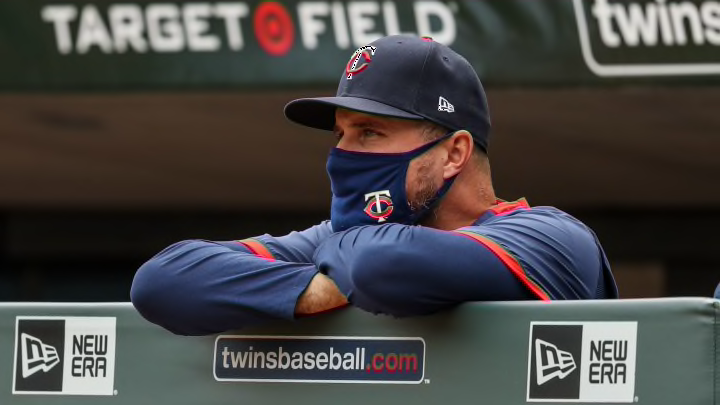
Yeah, you better hide your face after this performance.

Today, the Houston Astros beat the Minnesota Twins, 3-1 at Target Field in Minneapolis. Ordinarily, this would not be especially noteworthy.

Except, in the altered MLB postseason format of 2020, this made for a 2-game sweep of the American League Wild Card Playoff for the Astros. This also made for the 18th consecutive postseason game the Twins played that they lost.

That's 18 consecutive holes in the postseason win column for the Twins. Eighteen holes. Hell of a place for a golf course.

In 2006, they got swept in the AL Division Series by the Oakland Athletics. In the 1970s, '80s or '90s, that wouldn't have been a big deal. But since the 1990 AL Championship Series, the A's have played 13 postseason rounds, and gone 1-12. That's the only one they've won. And yet, they still have a better postseason record than the Twins.

The Twins got swept in the ALDS 3 straight by the Yankees in 2009, and again in 2010, and again in 2019. They also lost the 2017 AL Wild Card Game to the Yankees.

"Gee, Mike," you may be thinking, "maybe they should stop playing the Yankees in the postseason." Well, this time, they played somebody else, and it did no good.

This is how bad the Twins have become in the postseason: They can't even beat a non-cheating Houston Astros!

And it wasn't always like this: From 1987 to 2002, they were 19-10 in postseason games. They were especially tough at home in the World Series: They went 3-1 at Metropolitan Stadium in 1965 (but lost Game 7 to the Los Angeles Dodgers), and 4-0 at the Metrodome in 1987 and 1991.

Oddly, the last postseason game the Twins won was against the Yankees. It was even at the old Yankee Stadium. It was Game 1 of the 2004 American League Division Series. It was a 2-0 win. Since then, they are 0-18.

So, in 5 days, it will have been a full 16 years. October 5, 2004. How long has that been?

*

The winning pitcher in that game was Johan Santana. He is now 41 years old, hasn't thrown a pitch in a regular-season MLB game since 2012, is now better-remembered as a Met, and, contrary to what was thought after his 1st season as a Met, is never going to be elected to the Hall of Fame. A home run was hit in that game by Jacque Jones. He is now 45, and last played in 2008.

Speaking of the Hall of Fame, the following players who were active in that 2004 season have since been elected to it: Derek Jeter, Mariano Rivera, Mike Mussina, Mike Piazza, Pedro Martinez, Greg Maddux, Tom Glavine, John Smoltz, Chipper Jones, Ken Griffey Jr., Randy Johnson, Edgar Martinez, Craig Biggio, Jeff Bagwell, Barry Larkin, Roberto Alomar, Larry Walker, Frank Thomas, Ivan Rodriguez, Jim Thome, Trevor Hoffman, Vladimir Guerrero and Roy Halladay.

This was the last season for the Montreal Expos. The next Spring, they would become the Washington Nationals. Other major league sports teams that have since moved: The St. Louis Rams and San Diego Chargers both moved back to Los Angeles, the Oakland Raiders moved to Las Vegas, the New Jersey Nets moved to Brooklyn, the Seattle SuperSonics became the Oklahoma City Thunder, the Atlanta Thrashers became the new Winnipeg Jets, and the San Jose Earthquakes became the Houston Dynamo, to be replaced by an expansion team that took on the Earthquakes name.

The Twins, the Yankees, the Mets, the aforementioned Washington Nationals, the Philadelphia Phillies, the San Diego Padres, the St. Louis Cardinals, the Miami Marlins, the Atlanta Braves and the Texas Rangers have moved into new ballparks. The Twins moved from the Hubert H. Humphrey Metrodome -- as Billy Martin said, perhaps channeling his pal Yogi Berra, "It's a shame a great guy like HHH had to be named after it" -- to Target Field in 2010.

In addition, 11 NFL teams, 9 NBA teams, 6 NHL teams, and 16 MLS teams have moved to new stadiums; while the NBA's 2nd edition of the Charlotte Hornets; the NHL's Vegas Golden Knights; and 15 MLS teams, including Minnesota United and New York City FC (representing the cities involved in the baseball game in question), have debuted.

For a few days more, the Boston Red Sox had not won the World Series since 1918. The Chicago White Sox had not won one since 1917. The Chicago Cubs had not won one since 1908. The Giants had not won one since moving to San Francisco. The Expos/Nationals franchise and the Houston Astros had never won a World Series. The Expos/Nats, the Colorado Rockies, the Tampa Bay Rays, the Texas Rangers had never won a Pennant. The Rays had never even made the postseason.

All of those facts were true then, but are no longer.

Bob Feller, Bobby Doerr, Stan Musial, Red Schoendienst, Phil Rizzuto, Yogi Berra, Ralph Kiner, Duke Snider, Robin Roberts, Monte Irvin, George Kell, Ernie Banks, Jim Bunning, Al Kaline, Frank Robinson, Al Lopez, Lou Brock, Lee MacPhail, Tom Seaver, Earl Weaver, Sparky Anderson, Gary Carter, and Twins legends Harmon Killebrew and Kirby Puckett were all then living members of the Hall of Fame. All have since died.

Andrew McCutchen, Buster Posey, Clayton Kershaw, Jacob deGrom, DJ LeMahieu, Stephen Strasburg, Madison Bumgarner, Jose Altuve and Gerrit Cole were in high school. Luke Voit and Mike Trout were 13 years old; Christian Yelich, Kris Bryant and Aaron Judge were 12; Mookie Betts, Bryce Harper, Gary Sanchez and Michael Fullmer were 11; Corey Seager, Clint Frazier and Carlos Correa were 10; Gleyber Torres was 7; Juan Soto was 5; and Elvis Luciano was 4.

Ron Gardenhire was the Twins' manager then. He just stepped down as manager in Detroit, for health reasons. The current Twins manager, Rocco Baldelli, had just turned 23, and was in his 2nd major league season, with the Rays.

Current Yankee manager Aaron Boone was sitting out the entire season, due to an injury. Luis Rojas of the Mets was in the Expos/Nationals farm system. Lindy Ruff of the Devils was the head coach of the Buffalo Sabres. Barry Trotz of the Islanders was the head coach of the Nashville Predators. Adam Gase of the Jets was an assistant coach with the Detroit Lions. Tom Thibodeau of the Knicks was an assistant coach with the Houston Rockets. David Quinn of the Rangers was an assistant coach at Boston University.

Steve Nash of the Nets was playing for the Phoenix Suns. Chris Armas of the Red Bulls was playing for the Chicago Fire. Ronny Deila of NYCFC was playing for Viking FK of Stavanger in his native Norway. Joe Judge of the Giants was at Mississippi State University. And Walt Hopkins of the Liberty was at the University of Nevada.

The defending World Champions were the Florida (now Miami) Marlins in baseball, the New England Patriots * in football, the Detroit Pistons in basketball, the Tampa Bay Lightning in hockey (and they are again), and D.C. United in MLS. The Heavyweight Champions of the World were John Ruiz according to the WBA, Vitaly Klitsckho according to the WBC, and Chris Byrd according to the IBF.

The Olympic Games have since been held in Canada, Italy, China, Britain, Russia, Brazil and Korea. The World Cup has since been held in Germany, South Africa, Brazil and Russia.

Massachusetts had just become the 1st State to legalize same-sex marriage. Medical marijuana had been legalized by 10 States: California, Oregon, Alaska, Washington, Maine, Hawaii, Nevada, Colorado, Vermont and Montana. But no State had yet legalized it for recreational use. And the idea that corporations were entitled to the legal rights of people was considered a radical fringe notion. With the recent death of Ruth Bader Ginsburg, Clarence Thomas and Stephen Breyer were the only Justices then on the Supreme Court who are still on it now.

The President of the United States was George W. Bush, then running for re-election. Gerald Ford, Jimmy Carter, George H.W. Bush, Bill Clinton, their wives, and the widows of Lyndon Johnson and Ronald Reagan were still alive. Barack Obama was in the Illinois State Senate, and was running for the U.S. Senate. Joe Biden was in it. Kamala Harris had recently been elected the District Attorney for the City and the County of San Francisco.

Donald Trump had recently begun the next step in his career as a con man, hosting The Apprentice on NBC. He was already 58 years old, and the idea of him running for public office had been suggested before, but had been laughed off every time.

The Governor of the State in question, Minnesota, was Tim Pawlenty. The current Governor, Tim Walz, was a high school history teacher and football coach. The Mayor of Minneapolis was R.T. Ryback. The current Mayor, Jacob Frey, was 23, and a law student at Villanova University.

The Governor of the State of New York was George Pataki. The Mayor of the City of New York was Michael Bloomberg. The Governor of New Jersey was Jim McGreevey, which rhymes with skeevy, which describes the reason he would soon have to resign. The current holders of those offices? Andrew Cuomo was practicing law, in between serving in public offices. Bill de Blasio was on the New York City Council, and Phil Murphy was a senior director at Goldman Sachs.

There were still living veterans of World War I, the Mexican Revolution, the Bolshevik Revolution, the Irish Civil War and Benito Mussolini's March On Rome. There were still living survivors of the Galveston Hurricane of 1900, the San Francisco Earthquake of 1906, and the sinkings of the RMS Titanic and the RMS Lusitania.

Shirin Ebadi, an Iranian human rights activist, was the current holder of the Nobel Peace Prize. The Pope was John Paul II. The current Pope, Francis, was then Jorge Mario Bergoglio, Archbishop of Buenos Aires.

The Prime Minister of Canada was Paul Martin, and of Britain, Tony Blair. The monarch of both nations was Queen Elizabeth II -- that hasn't changed. Arsenal had just gone through an entire Premier League season as unbeaten Champions, but their record 49-game League unbeaten streak was about to be broken -- by cheating -- by the current holders of the FA Cup, Manchester United. There have since been 3 Presidents of the Unite States, 5 Prime Ministers of Britain, and 3 Popes.

Major novels of 2004 included Philip Roth's The Plot Against America, imagining if Nazi Germany had a clandestine plot to place a puppet in the White House in the 1940 election, a fictionalied version of Charles Lindbergh. It was made into an HBO miniseries this past year, and the Trump Administration's actions over the preceding 3 years made it seem plausible.

Five of the Harry Potter novels had been published, and three of the Song of Ice and Fire novels. The 1st Lisbeth Salander novel was 1 years away; the 1st Hunger Games novel, 3 years.

Major films of the Autumn of 2004 included the baseball movie Mr. 3000, the tennis movie Wimbledon, the football movie Friday Night Lights, Team America: World Police, Sideways, the 1st Saw film, the 1st Incredibles film, the 1st National Treasure film, The Polar Express, and Ray, starring Jamie Foxx as Ray Charles, who had died earlier in the year, and lived just long enough to hear (though, of course, not see) the final version.

What turned out to be the last season of Star Trek: Enterprise premiered. George Lucas was putting the finishing touches on what he then thought would be the last Star Wars film, Episode III: Revenge of the Sith. Daniel Craig was about to be cast as James Bond. Brandon Routh was about to be cast as Superman. Christian Bale had been cast as Batman. Tobey Maguire was playing Spider-Man. Christopher Eccleston was about to be cast as The Doctor.

The TV shows Stargate Atlantis, Entourage, Rescue Me, Jack & Bobby, CSI:NY, Boston Legal and Desperate Housewives had recently premiered. Soon to premiere were Ghost Hunters, The Backyardigans, The Biggest Loser, House, and the reboot of Battlestar Galactica.

Also recently premiering was Listen Up!, a fictionalized version of the life of Tony Kornheiser, played by Jason Alexander. It showed the Long Island native's home life, and also his ESPN talk show with fellow Washington Post columnist Michael Wilbon, a Chicago native, played by Cosby Show veteran Malcolm-Jamal Warner. Despite Warner having long dreadlocks, as opposed to the real guys being famously bald, and playing an ex-football player rather than a fellow columnist, the show got decent ratings, but production costs ran high, and CBS canceled it after 1 season.

Few people had yet heard of the Kardashians. No one had yet heard of Bella Swan, Michael Scott, Don Draper, Walter White, Jax Teller, Richard Castle, Leslie Knope, Sarah Manning, Jane "Eleven" Hopper or Maggie Bell.

The Number 1 song in American was "Goodies" by Ciara, now married to Seattle Seahawks quarterback Russell Wilson. Britney Spears had just married Kevin Federline. Billy Joel had just married his 3rd wife, food critic and chef Katie Lee. Green Day released American Idiot. Michael Jackson was awaiting trial.

Inflation was such that what $1.00 bought then, $1.38 would buy now. A U.S. postage stamp cost 37 cents, and a New York Subway ride $2.00. The average price of a gallon of gas was $1.92, a cup of coffee $2.22, a McDonald's meal (Big Mac, fries, shake) $5.18, a movie ticket $6.21, a new car $22,068, and a new house $286,300. The Dow Jones Industrial Average closed that day at 10,177.68.

The tallest building in the world was Taipei 101 in the capital of Taiwan. Smartphones were available, but hardly widespread. The TV show NCIS was in its 2nd season, and it would be a while before anybody started wondering why at Mark Harmon's character Leroy Jethro Gibbs was still using a flip-phone. The leading home video game system was Xbox. The iPod, Skype, MySpace and Facebook had all debuted. YouTube, Twitter, Tumblr, Pinterest, Intagram, the iPhone and the iPad were all yet to come.

In the Autumn of 2004, Chechen rebels took over 1,100 children hostage at a school in Beslan, Russia. Russian security forces stormed the building, resulting in over 300 deaths, so, not exactly a success. Suicide bombers killed 34 people at a Red Sea resort in Taba, Egypt. Susilo Bambang Yudhoyono was sworn in as the 1st directly elected President of Indonesia. The 1st European Constitution was signed in Rome.

George W. Bush was narrowly re-elected President over Senator John Kerry of Massachusetts, despite having started both an unpopular war and a recession. The Boston Red Sox beat the Yankees to win the American League Pennant, and then beat the St. Louis Cardinals to win their 1st World Series since 1918.

As depressing as that was for me, I was thrilled that my alma mater, East Brunswick High School, saw its football team make the Central Jersey Group IV Playoffs, advance to the Final at Rutgers Stadium, and beat Jackson Memorial, to win its 1st State Championship since 1972 -- their 1st since the current Playoff system had gone into effect in 1974.

Johnny Ramone, and Rodney Dangerfield, and Christopher Reeve died. So did legendary English soccer managers Brian Clough and Bill Nicholson, and English soccer legend Emlyn Hughes. Few people yet famous had been born that year, but they include Millie Bobby Brown, Teagan Croft, and LeBron Raymone James Jr., a.k.a. Bronny James. Although just 6-foot-2, not exactly tall for a basketball player, he is playing at a private high school in the Los Angeles suburbs, and it has been said that Ohio State, Kentucky and Duke are already recruiting him.

October 5, 2004. The Minnesota Twins beat the New York Yankees in Game 1 of the American League Division Series. Since then, over 16 years, they have played 18 postseason games, and lost them all.

Will they break that streak next year? Stay tuned.

UPDATE: On October 3, 2023, the Twins beat the Toronto Blue Jays, 3-1 at Target Field, in Game 1 of the ALDS, ending their postseason losing streak at 18 games and 19 years.

Friday, June 27, 2014

How to Be a Yankee Fan In Minnesota -- 2014 Edition

After a short but intense 5-game homestand against The Scum and the Strays, the Yankees will head out onto the road for the remainder of the first half of the season, to play the Minnesota Twins in Minneapolis, the Cleveland Indians, and the Baltimore Orioles.

Then comes the All-Star Break, and the All-Star Game will also be in Minnesota this year. This will be the 3rd time the Twins have hosted, and in the 3rd different ballpark: 1965 at Metropolitan Stadium, 1985 at the Metrodome, and 2014 at Target Field.

In the photo above, you can see Target Field.  Behind that, the Target Center. (The Target store company is headquartered in Minneapolis.) Behind that, downtown Minneapolis. And, in the upper-left corner, the Metrodome.

By a weird twist, when my twin nieces were born, 7 summers ago, the Yankees were playing, you guessed it, the Twins. The Yankees won. Nevertheless, the girls have become Yankee Fans.

I’ll teach them the irony of it all, but, personally, I have nothing against the Minnesota ballclub. I used to, but then they got out of the (George Carlin word)ing Metrodome.

I know, I sometimes curse on this page, but these “How to Be a Yankee/New York Fan In…” pages are meant to be family-friendly.

Before You Go. It's a little soon to post the weather forecast, but, since the Twins do not play in the Metrodome anymore, you should consult the Minneapolis Star-Tribune and St. Paul Pioneer Press websites for their forecasts. Seeing as how this will be early July, including the 4th, the legend of cold Minnesota winters that last from October to early May will not apply in this series.

Minnesota is in the Central Time Zone, 1 hour behind New York. Adjust your timepieces accordingly.

Tickets. The Twins’ success of the last 2000s (but not, as yet, the 2010s) and the building of Target Field led to an average per-game attendance of 39,112 in 2011, pretty much a sellout every night, in spite of their not having a very good season (mainly due to injuries). But last season, the novelty of the new park had worn off, and they averaged 30,588, and they're averaging 27,042 so far this season. So getting tickets shouldn't be a big problem. Still, I advise getting them ahead of time.

The Twins use "demand-based pricing." For games against the Yankees, and for regional rivals like the Milwaukee Brewers and the Chicago White Sox, prices are higher because the demand is greater. Here are the listings for the Yankee games: Diamond Box, $68; Field Box, $56; Home Plate Terrace, $54; Skyline View, $29; Field View, $26; LF Bleachers (the U.S. Bank Home Run Porch), $30; RF Bleachers (Grandstand), $32. In other words, despite the Twins’ history of frugal (or even blatantly cheap) ownership, it’ll be expensive.

There's no mention of the Twins setting off fireworks on the 4th (Friday, probably because it's an afternoon game, a 2:10 PM Central time start). But, as it's the 75th Anniversary of Lou Gehrig Day, they're giving away Gehrig bobbleheads to the first 10,000 fans.

Getting There. It’s 1,199 road miles from Times Square in New York to Nicollet Mall in downtown Minneapolis (the spot where Mary Tyler Moore threw her hat in the air in the opening sequence of her 1970-77 CBS sitcom), and 1,204 miles from Yankee Stadium to Target Field. Knowing this, your first reaction is going to be to fly out there.

But it’s kind of an expensive flight. Even if you order early, chances are you’ll have to pay at least $950 round-trip for a flight from Newark to Minneapolis-St. Paul International Airport. And you'll have to change planes in Chicago – or even Dallas (which would piss off not just the New York Giants football fan that you might be, but also the Minnesota Vikings fans you may be flying to Minneapolis with). But when you do get there, the Number 55 light rail takes you from the airport to downtown in under an hour, so at least that is convenient.

Bus? Not a good idea. Greyhound runs 3 buses a day between Port Authority and Minneapolis, all with at least one transfer, in Chicago and possibly elsewhere as well. The total time, depending on the number of stops, is between 26 and 31 hours, and costs $507 round-trip, although it can be dropped to $449 with advanced purchase. The Greyhound terminal is at 950 Hawthorne Avenue, at 9th Street North, just 3 blocks from Nicollet Mall, 2 from the Target Center arena, and from there just across the 7th Street overpass over Interstate 394 from Target Field.

Train? An even worse idea. Amtrak will make you leave Penn Station on the Lake Shore Limited at 3:40 PM Eastern Time, arrive at Union Station in Chicago at 9:45 AM Central Time, and then the Empire Builder, their Chicago-to-Seattle run, will leave at 2:15 PM and arrive in St. Paul (not Minneapolis) at 10:31 PM. From there, 730 Transfer Road, you’d have to take the Number 16 or 50 bus to downtown Minneapolis. And it’s $692 round-trip.

If you decide to drive, it’s far enough that it will help to get someone to go with you and split the duties, and to trade off driving and sleeping. You'll need to get into New Jersey, and take Interstate 80 West. You'll be on I-80 for the vast majority of the trip, through New Jersey, Pennsylvania and Ohio. In Ohio, in the western suburbs of Cleveland, I-80 will merge with Interstate 90. From this point onward, you won’t need to think about I-80 until you head home; I-90 is now the key, through the rest of Ohio and Indiana.

Just outside Chicago, I-80 will split off from I-90, which you will keep, until it merges with Interstate 94. For the moment, though, you will ignore I-94. Stay on I-90 through Illinois, until reaching Madison, Wisconsin, where you will once again merge with I-94. Now, I-94 is what you want, taking it into Minnesota and the Twin Cities, with Exit 233A being your exit for downtown Minneapolis.

If you do it right, you should spend about an hour and a half in New Jersey, 5 hours and 15 minutes in Pennsylvania, 4 hours in Ohio, 2 and a half hours in Indiana, an hour and a half in Illinois, 2 and a half hours in Wisconsin, and half an hour in Minnesota. That’s 17 hours and 45 minutes. Counting rest stops, preferably halfway through Pennsylvania and just after you enter both Ohio and Indiana, outside Chicago and halfway across Wisconsin, and accounting for traffic in New York, the Chicago suburbs and the Twin Cities, it should be no more than 23 hours, which would save you time on both Greyhound and Amtrak, if not on flying.

Once In the City. The team's original ballpark was in the suburb of Bloomington, on the Minneapolis side of the Mississippi River, but roughly equidistant from the downtowns of both Minneapolis and St. Paul. (Not quite: Minneapolis' City Hall is 9.6 miles away, St. Paul's is 11.1 miles.) The team is called "Minnesota," because they didn't want to slight either city. It is called the "Twins" because Minneapolis and St. Paul are the "Twin Cities."

Well, these "twins" are not identical: They have different mindsets, and, manifesting in several ways that included both having Triple-A teams until the MLB team arrived, have been known to feud as much as San Francisco and Oakland, Dallas and Fort Worth, Baltimore and Washington, if not as much as Manhattan and Brooklyn. Minneapolis has about 390,000 people, St. Paul 285,000, and the combined metropolitan area about 3.4 million, ranking 16th in the U.S. -- roughly the combined population of Manhattan, The Bronx and Staten Island -- or that of Manhattan and Queens. Denver is the only metropolitan area with teams in all 4 sports that's smaller.

"Minneapolis" is a combination of the Dakota tribal word for water, and the Greek word for city. It was founded in 1867 with the name St. Anthony Falls, and, of course, St. Paul, founded in 1854, is also named for an early Christian saint. In Minneapolis, Hennepin Avenue separates the numbered Streets from North and South, and the Mississippi River is the "zero point" for the Avenues, many (but not all) of which also have numbers.

Each city once had 2 daily papers, now each is down to 1: Minneapolis had the Star and the Tribune, merged in 1982; St. Paul the Pioneer and the Dispatch, merged into the Pioneer Press and Dispatch in 1985, with the Dispatch name dropped in 1990. Today, they are nicknamed the Strib and the Pi Press.

The sales tax in the State of Minnesota is 6.875 percent. It's 7.775 in Minneapolis' Hennepin County, and 7.625 percent in St. Paul's Ramsey County. Bus and Light Rail service is $2.25 per ride during rush hours, $1.75 otherwise.

Going In. Target Field is at the northwest edge of downtown Minneapolis, in a neighborhood called the Warehouse District. The Metro Transit Hiawatha Line, Minneapolis’ light rail system, has a Target Field Station.

Target Field is bounded by 5th Street (left field), 3rd Avenue (right field), 7th Street (1st base) and the Hiawatha Line (3rd base). Parking lots are all over downtown, although if you’ve driven all this way, most likely you’ll be staying at a hotel and walking or taking public transit from there.  The official address is 1 Twins Way.

If you’re walking from downtown, you’ll most likely be arriving over the I-394 overpass and entering at the right field or home plate gates. If you’re arriving by light rail, the station is outside the left field gate. If you're driving, parking is between $10 and $15, depending on the event.

The gates are numbered in honor of the men whose numbers had already been retired when the ballpark opened: Center field, Gate 3, Harmon Killebrew; Left field, Gate 6, Tony Oliva; Home plate, Gate 14, Kent Hrbek; Right field corner, Gate 29, Rod Carew; and another in right field, Gate 34, Kirby Puckett. Gate 29 has Target Plaza, with statues of those players, and also of former owners Calvin Griffith, and Carl and Eloise Pohlad, parents of current owner Jim Pohlad.  The Twins' team Hall of Fame display is also there.

The ballpark faces northeast, and in stark contrast to the Metrodome, the place is open at right field, has no stupid roof with stupid lighting, and has, yes, real grass. If you are old enough to remember the Twins' original home, Metropolitan Stadium, the double-decked left field bleachers will be reminiscent of that stadium, but, from some angles, will also bear a resemblance to Jack Murphy/Qualcomm Stadium in San Diego and the old Mile High Stadium in Denver (if you remember the baseball configurations of those stadiums). Looking at the 1st base/right field stands, you may see a resemblance to Camden Yards in Baltimore. Target Field does seem to have a mixture of 1970s funkiness (which, aside from round entrance ramps, was rarely incorporated into the designs of the ballparks in use in that decade) and 1990s-to-the-present convenience.

Outfield distances are 339 to left, 377 to left-center, 411 to center, 365 to right center and 328 to right – favoring lefthanded hitters, although the ball doesn’t fly out of the yard the way it did at Metropolitan Stadium or the Metrodome. In its brief history, the longest home run hit at Target is a 491-footer by Jim Thome in 2011. Ben Oglivie of the Milwaukee Brewers hit the longest at the Metrodome, 481 feet, although I can't find a reference to a date. The longest at The Met, as you  might guess, was by Harmon Killebrew, 525 feet in 1967.

Above center field is a sign saying “TARGET FIELD,” with the words separated by the Target store logo. Above that is the original team logo, with two ballplayers against an outline of the state. One is wearing an M logo on his sleeve, another an StP logo on his, and they’re reaching across a river to shake hands. This symbolizes the old minor-league teams in the American Association, the Minneapolis Millers and the St. Paul Saints, who went out of business when the original Washington Senators moved to Minnesota to become the Twins in 1961.

Food. Considering that Minnesota is Big Ten Country, you would expect their ballpark to have lots of good food, in particular that Midwest staple, the sausage, including German, Italian, Polish and Kosher varieties. Fortunately, you would be right, as the influence of regional rivals Chicago and Milwaukee has taken hold. Something called Kramarczuk’s Food Network Creations is at Section 114 (lower level behind home plate), and Mexican and Asian specialties also dot the walkways.

At Section 133 (right-center-field bleachers), they have “State Fair Classics” -- the State Fair, held from late August to Labor Day, in the small town of Falcon Heights, between the Twin Cities, is a very big deal, known as "The Great Minnesota Get-Together." These "classics" include Pork Chops on a Stick, Roasted Corn on the Cob, Corn Dogs, and Walleye Fingers – think a fish version of "chicken fingers." It's not something I would eat, but walleyes, a native fish, are very popular in Minnesota. The start of walleye fishing season, usually around May 10, is so big there, the Twins always request to be on the road that weekend, so as not to hurt attendance.

Being Midwestern, the Twins believe in beer and lots of it. (In their early days, the Twins heavily identified with Hamm's Beer, which was headquartered in St. Paul. Hamm's has since been bought out, although the brand is still sold in the Upper Midwest.) Being American, the Twins believe in ice cream and lots of it.

Team History Displays. The Twins are now in their 2nd half-century of play, so they certainly have some history. They have banners representing their titles on the exterior promenade of the ballpark: The 1965 American League Pennant, the 1969 and 1970 AL Western Division Championships, the 1987 and 1991 World Championships, and the 2002, 2003, 2004, 2006, 2009 and 2010 AL Central Division Championships. The Twins have never reached the Playoffs via the Wild Card.

No mention is made of the titles won as "the old Washington Senators": The 1924 World Championship and the 1925 and 1933 AL Pennants. Nor is any mention made of the American Association Pennants won by the Millers (1896, 1910, ’11, ’12, ’15, ’32, ’35, ’55, ’58 and ’59) and the Saints (1924 and ’48).

The Twins’ retired numbers are shown in stanchions on the facing of the upper deck in left field: 3, Harmon Killebrew, 3rd base & 1st base, 1961-74; 6, Tony Oliva, right field, 1962-76 and serving the club in several capacities since; 10, Tom Kelly, 1st baseman 1975, manager 1986-2001; 14, Kent Hrbek, 1st base, 1981-94; 28, Bert Blyleven, pitcher, 1970-76 and 1985-88; 29, Rod Carew, 2nd base and 1st base, 1967-78; and 34, Kirby Puckett, center field, 1984-95 -- plus Jackie Robinson's universally-retired 42. Oddly, the numbers are listed in order of their retirement from right to left, as opposed to left to right (or numerically), so that, from left to right, they read: 42, 10, 28, 34, 14, 6, 29, 3. Killebrew (who died in 2011), Oliva, Carew, Hrbek, and Kirby Puckett Jr., standing in for his father, threw out the ceremonial first balls for the first game at the new park on April 12, 2010.

As stated, the Twins' team Hall of Fame is outside the park at Gate 29, with the statues. The members include:

From the 1965-70 teams: Killebrew, Oliva, Carew, catcher Earl Battey, shortstop Zoilo Versalles, left fielder Bob Allison, and pitchers Camilo Pascual, Jim Kaat and Jim Perry.

From the 1987 & ’91 teams: Kelly, Blyleven, Hrbek, Puckett, shortstop Greg Gagne, 3rd baseman Gary Gaetti, and pitchers Frank Viola and Rick Aguilera.

From the 2000s: Pitchers Brad Radke and Eddie Guardado.

And spanning the eras: Founding owner Calvin Griffith, original team executive George Brophy, Hall of Fame broadcaster Herb Carneal, owner Carl Pohlad, minor-league director Jim Rantz, media relations director Tom Mee, and public address announcer Bob Casey.

No mention is made of Millers legends Joe Cantillon, Joe Hauser, Ted Williams, Willie Mays, Monte Irvin, Ray Dandridge, Hoyt Wilhelm, Orlando Cepeda, Felipe Alou and Carl Yastrzemski. (The Millers were a Red Sox farm team, then the Giants, then the Red Sox again.) Or of Saints legends Duke Snider and Roy Campanella. (The Saints were a Dodger farm team.)

In 1999, Killebrew, Carew and Puckett were named to The Sporting News' 100 Greatest Baseball Players.

Stuff. The Twins have Team Stores throughout the ballpark. The usual items that can be found at a souvenir store can be found there.

Books about the Twins are not exactly well-known. The staff of the Star-Tribune put together Minnesota Twins: The Complete Illustrated History in 2010. Newly-published is Stew Thornley's Minnesota Twins Baseball: Hardball History on the Prairie. Cool of the Evening: The 1965 Minnesota Twins is Jim Thielman’s look at Minnesota’s 1st major league Pennant winner. Bill Gutman, Dave Weiner and Tony Seidl wrote From Worst to First! The Improbable 1991 Seasons of the Atlanta Braves and the Minnesota Twins.

There is, as yet, no Essential Games of the Minnesota Twins, or of either Metropolitan Stadium or the Metrodome. But the official 1987 and 1991 World Series highlight film packages are available.

During the Game. Because of their Midwest/Heartland image, Twins fans like a “family atmosphere.” Therefore, while they don’t especially like the Yankees, they will not directly antagonize you. You’ll probably be all right if you don’t say anything unkind about Killebrew or Puckett, especially now that they’re both dead. I would also advise against saying anything complimentary about the Green Bay Packers, the University of Wisconsin, the Dallas Stars (the hockey team that used to be the Minnesota North Stars) or Norm Green (the owner who moved them).

The Twins' mascot is TC Bear -- TC for Twin Cities, and it's probably a bear in honor of that once-familiar Minnesota mascot/TV pitchanimal, the Hamm's Bear. They don't have a song to use after “Take Me Out to the Ballgame” in the 7th Inning Stretch, or a postgame victory song, but they do have a theme song, "We're Gonna Win, Twins!"

They still sell the Homer Hankies made famous during their 1987 postseason run. They did not, however, originate the idea: In 1977, the Cleveland Indians, desperate for attendance, held “Hate the Yankees Hanky Night.”

The Twins have "The Race at Target Field." It's a takeoff on the Milwaukee Brewers' Sausage Race, with five Minnesota-inspired characters: Louie the Loon (a bird, not a crazy man), Wanda the Walleye (fish), Babe the Blue Ox (from the legend of Paul Bunyan), Skeeta the Mosquito (apparently they got him in a trade with the Houston Astros), and Bullseye the dog (mascot of Target, and apparently a descendant of former Bud Light pitchdog Spuds Mackenzie). No revival of the Hamm's Bear.

After the Game. An unfortunate part of the Twins’ legacy is the fact that, when Washington Senators owner Clark Griffith, who would never have moved the team, died in 1955, his son Calvin Griffith wanted out of the increasingly-black D.C. At a Lions Club dinner in 1978, he freely admitted that he moved the Twins to Minnesota because it was mostly white. So the Twins exist primarily because of racism – albeit that of just one man. Nevertheless, this racial homogeneity has kept Minneapolis comparatively safe – although the Twin Cities have since attracted more blacks, and had already produced some famous black people, including baseball legend Dave Winfield and music superstar Prince Rogers Nelson. (Along with the fictional character of Synclaire James, played by Kim Coles on the New York-based show Living Single.) At any rate, regardless of the races of the people you see on the streets, you should be safe.

If you want to be around other New Yorkers, I’m sorry to say that listings for where they tend to gather are slim. But I have one listing for a place that seems to cater to football Giants fans: O'Donovan's Irish Pub, at 700 1st Avenue North at 7th St.

Another restaurant that may be of interest to New York baseball fans is Charley's Grill, at 225 3rd Avenue South at 2nd Street.  It was popular among visiting players from other American Association cities when they came to play the Millers and the Saints. Legend has it that, when the Yankees gathered for spring training in 1961, they were trying to figure out which restaurants in the new American League cities were good, and someone who'd recently played for the Denver Bears mentioned Charley's. But Yogi Berra, who'd gone there when the Yanks' top farm team was the Kansas City Blues, said, "Nobody goes there anymore. It's too crowded." Well, someone must still be going there, because it's still open.  (That Yogi said the line is almost certainly true, but the restaurant in question was almost certainly Ruggiero's, a place in his native St. Louis at which he and his neighbor Joe Garagiola waited tables.)

Sidelights. Minnesota’s sports history is long, but very uneven. Teams have been born, moved in, moved around, and even moved out. But there are some local sites worth checking out.

* Site of the Hubert H. Humphrey Metrodome and the new Vikings stadium. Home of the Twins from 1982 to 2009, the University of Minnesota football team from 1982 to 2008, and the NFL’s Vikings from 1982 to 2013, that infamous blizzard and roof collapse in 2010 brought the desire to get out and build a new stadium for the Vikes to the front burner, and it has finally led to action.

The Twins won the 1987 and 1991 World Series here – going 8-0 in World Series games in the Dome, and 0-6 in Series games outside of it. The Vikings, on the other hand, are just 6-4 in home Playoff games since moving there – including an overtime defeat in the 1998 NFC Championship Game after going 14-2 in the regular season.

From October 1991 to April 1992, the Metrodome hosted 3 major events: The World Series (Twins over Atlanta Braves), Super Bowl XXVI (Washington Redskins over Buffalo Bills), and the NCAA Final Four (Duke beating Michigan in the Final). It also hosted the Final Four in 2001 (Duke won that one, too, over Arizona).

In May 2012, faced with the serious possibility of the Vikings moving without getting a suitable stadium (Los Angeles, Las Vegas and San Antonio had been rumored as locations, in descending order of likelihood), the Minnesota State legislature approved funding for a new stadium for the Vikings, to be built on the site of the Metrodome and on adjoining land.

The damn thing has now been fully demolished -- in a piece of poetic justice, just as it was built and completed ahead of schedule and under budget, so did the demolition take place. The people of Minnesota seemed to be proud of its having been built on the cheap and on time, but it served its purpose, to keep the Twins and Vikings from moving for a generation, and now replacement stadiums are achieving the same purpose. Billy Martin, who hated the place, had the best word on it, though the awkward wording of it may have been inspired in part by his pal Yogi Berra: "It's a shame a great guy like HHH had to be named after it." (Billy's first managing job was with the Twins, at the Met in 1969.)

The Vikings will play at TCF Bank Stadium in 2014 and '15, before the new stadium opens in 2016. The new stadium might also allow Minnesota United to get promoted to Major League Soccer. 900 South 5th Street at Centennial (Kirby Puckett) Place. Metrodome station on Light Rail.

* Mall of America and sites of Metropolitan Stadium and the Metropolitan Sports Center. In contrast to their performance at the Metrodome, the Vikings were far more successful at their first home, while the Twins were not (in each case, playing there from 1961 to 1981). The Vikings reached 4 Super Bowls while playing at The Met, while the Twins won Games 1, 2 and 6 of the 1965 World Series there, but lost Game 7 to the Los Angeles Dodgers on a shutout by Sandy Koufax. (So the Twins are 11-1 all-time in World Series home games, but 0-9 on the road.) The Vikings were far more formidable in their ice tray of a stadium, which had no protection from the sun and nothing to block an Arctic blast of wind.

In fact, the Met had one deck along the 3rd base stands and in the right field bleachers, two decks from 1st base to right field and in the left field bleachers, and three decks behind home plate. Somebody once said the stadium looked like an Erector set that a kid was putting together, before his mother called him away to dinner and he never finished it. At 45,919 seats, it had a capacity that was just fine for baseball; but at 48,446, it was too small for the NFL.

Prior to the 1961 arrivals of the Twins and Vikings, the Met hosted the Minneapolis Millers from 1956 to 1960, and 5 NFL games over the same stretch, including 4 “home games” for the Packers. (Viking fans may be sickened over that, but at least University of Minnesota fans can take heart in the University of Wisconsin never having played there.) The experiments worked: The Met, built equidistant from the downtowns of Minneapolis and St. Paul, in the southern suburb of Bloomington, was awarded the MLB and NFL teams, and Midway Stadium, built in 1957 as the new home of the St. Paul Saints (at 1000 N. Snelling Avenue in the city of St. Paul, also roughly equidistant from the two downtowns), struck out, and was used as a practice field by the Vikings before being demolished in 1981.

The NHL’s Minnesota North Stars played at the adjoining Metropolitan Sports Center (or Met Center) from 1967 to 1993, before they were moved to become the Dallas Stars by owner Norm Green, earning him the nickname Norm Greed. The Stars reached the Stanley Cup Finals in 1981 and 1991, but never won the Cup until 1999 when they were in Dallas.

The Beatles played at Metropolitan Stadium on August 21, 1965 -- making one of only 3 facilities to host an All-Star Game, a Finals and a Beatles concert in the same year. (The others were the Boston Garden and Maple Leaf Gardens in 1964.) Elvis Presley sang at the Met Center on November 5, 1971 and October 17, 1976.

8000 Cedar Avenue South, at 80th Street -- near the airport, although legends of planes being an issue, as with Shea Stadium and Citi Field, seem to be absent. A street named Killebrew Drive, and the original location of home plate, have been preserved. A 45-minute ride on the Number 55 light rail (MOA station).

* Site of Nicollet Park. Home of the Millers from 1912 to 1955, it was one of the most historic minor-league parks, home to Ted Williams and Willie Mays before they reached the majors. With the Met nearing completion, its last game was Game 7 of the 1955 Junior World Series, in which the Millers beat the International League Champion Rochester Red Wings. A few early NFL games were played there in the 1920s. A bank is now on the site. Nicollet and Blaisdell Avenues, 30th and 31st Streets. Number 465 bus.

* Site of Lexington Park. Home of the Saints from 1897 to 1956, it wasn’t nearly as well regarded, although it did close with a Saints win over the arch-rival Millers. The site is now occupied by retail outlets. Lexington Parkway, University Avenue, Fuller & Dunlap Streets.

* Xcel Energy Center and site of the St. Paul Civic Center. Home of the NHL’s Minnesota Wild since their debut in 2000, and site of the 2008 Republican Convention that nominated John McCain for President and Sarah Palin for Vice President. (The GOP met in Minneapolis in 1892, renominating President Benjamin Harrison at the Industrial Exposition Building at 101 Central Avenue SE. It was torn down in 1940, and condos are on the site now.)

The place is a veritable home and hall of fame for hockey in Minnesota, the most hockey-mad State in the Union, including the State high school championships that were previously held at the Civic Center.

That building was the home of the Minnesota Fighting Saints of the World Hockey Association from 1973 to 1977. The Fighting Saints had played their first few home games, in late 1972, at the St. Paul Auditorium. Elvis sang at the Civic Center on October 2 and 3, 1974, and April 30, 1977. The Civic Center is also where Bruce Springsteen and Courteney Cox filmed the video for Bruce’s song “Dancing In the Dark.” 199 Kellogg Blvd. West. at 7th Street.

* Target Center. Separated from Target Field by I-394 and 2nd Avenue, this arena has been home to the NBA’s Minnesota Timberwolves since the team debuted shortly after its 1989 opening. The T-Wolves have only made the Western Conference Finals once, and are probably best known as the team Kevin Garnett and GM (and Minnesota native) Kevin McHale couldn’t get over the hump, before Garnett went to McHale’s former team, the Boston Celtics. The WNBA’s Minnesota Lynx also play here. 600 N. 1st Avenue at 6th Street.

* Site of Minneapolis Auditorium. Built in 1927, from 1947 to 1960 this was the home of the Minneapolis Lakers – and, as Minnesota is “the Land of 10,000 Lakes” (11,842, to be exact), now you know why a team in Los Angeles is named the Lakers. (The old Utah Jazz coach Frank Layden said his team and the Lakers should switch names, due to L.A.'s "West Coast jazz" scene and the Great Salt Lake: "Los Angeles Jazz" and "Utah Lakers" would both make more sense.)

The Lakers won the National Basketball League Championship in 1948, then moved into the NBA and won the Championship in 1949, 1950, 1952, 1953 and 1954. In fact, until the Celtics overtook them in 1963, the Minneapolis Lakers were the most successful team in NBA history, and have still won more World Championships than all the other Minnesota major league teams combined: Lakers 5, Twins 2, the rest a total of 0.

They were led by their enormous (for the time, 6-foot-10, 270-pound) center, the bespectacled (that’s right, he wore glasses, not goggles, on the court) Number 99, George Mikan. The arrival of the 24-second shot clock for the 1954-55 season pretty much ended their run, although rookie Elgin Baylor did help them reach the Finals again in 1959. Ironically, the owner of the Lakers who moved them to Los Angeles was Bob Short – who later moved the “new” Washington Senators, the team established to replace the team that moved to become the Twins.

The Auditorium hosted the NCAA Final Four (although it wasn't yet called that) in 1951, won by Kentucky over Kansas State. Elvis sang there early in his career, on May 13, 1956. The Auditorium was demolished in 1989, and the Minneapolis Convention Center was built on the site. 1301 2nd Ave. South, at 12th Street. Within walking distance of Target Field, Target Center and the Metrodome.

* University of Minnesota. TCF Bank Stadium, the new home of the University of Minnesota football team, opened in 2009. It was designed to resemble a classic 1920s college football stadium, with a reddish-brown brick exterior and a horseshoe shape, much like the 56,000-seat Memorial Stadium, where the Golden Gophers played from 1924 to 1981, before the Metrodome was built.

Its capacity of 50,805 makes it the 2nd-smallest stadium in the Big Ten, ahead of only Northwestern’s Ryan Field/Dyche Stadium, but the Gophers’ lack of success over the last 40 years or so has been overcome: They have regularly filled it. The Vikings played a home game here in 2010 after the Metrodome roof collapse, but the capacity (much like that of the even smaller Metropolitan Stadium) makes it insufficient as a permanent new home for the Vikings. The Vikings played a home game at “Old Memorial” in 1969 due to the Twins making the Playoffs that season.

The new stadium is at 2009 University Avenue SE, at 420 SE 23rd Avenue. Stadium Village stop on the light rail Green Line.

"Old Memorial" was a block away from where the new stadium now stands, on Walnut Street between University Avenue and Beacon Street. The Vikings played a home game there in 1969 due to the Twins making the Playoffs that season and having dibs on Metropolitan Stadium. The McNamara Alumni Center now stands on the site, and the arched entrance to Memorial has been preserved and stands inside.

The Gophers play their basketball games at Williams Arena, a classic old barn built in 1928, across Oak Street from the open west end of TCF Bank Stadium. Across 4th Street from Williams is Mariucci Arena, home of the hockey team that has won National Championships in 1974, '76, '79, 2002 and '03. Named for John Mariucci, a member of the Chicago Blackhawks' 1938 Stanley Cup winners who coached the Gophers, the arena was built in 1993, after the team previously played hockey at Williams.

Legend has it that 4th Street is the "Positively 4th Street" used as the title of a song by former UM student Robert Zimmerman, a.k.a. Bob Dylan, although, as is often the case with Dylan songs, there is no mention of the title in the songs. Whether the "friend" who's "got a lot of nerve" was a fellow UM student, I don't know. It's also been suggested that the 4th Street in question is the one in New York's Greenwich Village.

* Museums. The Twin Cities are very artsy, and have their share of museums, including one of the five most-visited modern art museums in the country, the Walker Art Center, at 1750 Hennepin Avenue. Number 4, 6, 12 or 25 bus. The Minneapolis Institute of Arts is at 2400 3rd Avenue South. Number 17 bus, then walk 2 blocks east on 24th Street. The Science Museum of Minnesota is at 120 W. Kellogg Blvd. in St. Paul, across from the Xcel Center.

Fort Snelling, originally Fort Saint Anthony, was established by the U.S. Army in 1819, where the Mississippi and Minnesota rivers meet, to guard the Upper Midwest. It served as an Army post until World War II. It is now a museum, with historical demonstrations based on its entire history, from the post-War of 1812 period to the Civil War, from the Indian Wars to the World Wars. 101 Lakeview Avenue in St. Paul, across from the airport. An hour’s ride on the Blue light rail.

Minnesota is famous for Presidential candidates that don’t win. Governor Harold Stassen failed to get the Republican nomination in 1948, and then ran several more times, becoming, pardon the choice of words, a running joke. Senator Eugene McCarthy opposed Lyndon Johnson in the Democratic Primaries in 1968, but lost his momentum when Robert Kennedy got into the race and LBJ got out, then ran in 1976 as a 3rd-party candidate and got 1 percent of the popular vote. Vice President Walter Mondale was the Democratic nominee in 1984, losing every State but Minnesota in his loss to Ronald Reagan. In the 2012 election cycle, the moderate former Governor Tim Pawlenty and the completely batty Congresswoman Michele Bachmann ran, and neither got anywhere.

Most notable is Hubert Horatio Humphrey. Elected Mayor of Minneapolis in 1945 and 1947, he became known for fighting organized crime, which put a price on his head, a price it was unable to pay off. In 1948, while running for the U.S. Senate, he gave a speech at the Democratic Convention, supporting a civil rights plank in the party platform, a movement which culminated in his guiding the Civil Rights Act of 1964 through the Senate as Majority Whip. He ran for the Democratic nomination for President in 1960, but lost to John F. Kennedy, then was elected LBJ’s Vice President in 1964. He won the nomination in 1968, but lost to Richard Nixon by a hair. He returned to the Senate in 1970, and ran for President again in 1972, but lost the nomination to George McGovern. He might have run again in 1976 had his health not failed, as cancer killed him in 1978 at age 66. His wife Muriel briefly held his Senate seat.

Not having been President (he's come closer than any other Minnesotan ever has), he has no Presidential Library, but there is the Hubert H. Humphrey School of Public Affairs at the University of Minnesota, 301 19th Avenue South, only a short walk from the Dome that would be named for him. Hubert and Muriel are laid to rest in Lakewood Cemetery, 3600 Hennepin Avenue. Number 6 bus.

The tallest building in Minnesota is the IDS Center, at 80 South 8th Street at Marquette Avenue, rising 792 feet high. The tallest in the State outside Minneapolis is Wells Fargo Place, at 30 East 7th Street at Cedar Street in St. Paul, 472 feet.

Nicollet Mall is a pedestrians-only shopping center that stretches from 2nd to 13th Streets downtown. At 7th Street, in front of Macy's, in roughly the same location that Mary Tyler Moore as Mary Richards threw her hat in the air in the opening to The Mary Tyler Moore Show, is a statue of "Mare" doing that. It was the first in a series of statues commissioned by TV Land that now includes Jackie Gleason outside Port Authority, Henry Winkler in Milwaukee, Bob Newhart in Chicago, Andy Griffith and Ron Howard in Raleigh, Elizabeth Montgomery in Salem, Massachusetts and Elvis in Honolulu. However, the show had no location shots in Minneapolis.

The sitcom Coach, which aired on ABC from 1989 to 1996, was set at Minnesota State University. At the time, there was not a real college with that name. But in 1999, Mankato State University was renamed Minnesota State University, Mankato; and in 2000, Moorhead State University became Minnesota State University, Moorhead. The University of Minnesota was originally a model for the school on the show, but withdrew its support: Although some game action clearly shows the maroon and gold of the Golden Gophers, the uniforms shown in most scenes were light purple and gold. In one Season 1 episode, the Gophers are specifically mentioned as one of the Screaming Eagles' opponents, suggesting that Minnesota State might have been in the Big Ten. Show creator Barry Kemp is a graduate of the University of Iowa -- like Wisconsin, a major rival of the Gophers -- and most of the exterior shots you see of the campus were filmed there. In addition, the main character, Hayden Fox, was named after then-Iowa coach Hayden Fry. No scenes were actually shot in Minnesota, not even Hayden's oft-snowy lake house.

St. Paul is the capital of the State of Minnesota. The Capitol Building is at University Avenue and Capital Blvd. It's a half-hour ride from downtown on the Number 94 bus (named because most of its route is on I-94).

*

Bob Wood, a native of Kalamazoo, Michigan, and a graduate of Michigan State University, wrote a pair of sports travel guides: Dodger Dogs to Fenway Franks, about his 1985 trip to all 26 stadiums then in MLB; and Big Ten Country, about his 1988 trip to all the Big Ten campuses and stadiums. (Penn State, Nebraska, and soon-to-be members Rutgers and Maryland were not yet in the league).

The Metrodome was the only stadium that featured in both books, although if either were updated to reflect current reality, it would feature in neither. In Big Ten Country, Wood said, “Now, don't get me wrong. It's not that I don't like Minneapolis. How can you not like Minneapolis?... No, Minneapolis is lovely. It’s the Metrodome that sucks!”

Thankfully, the Twins now play at Target Field, and, from what I understand, Minneapolis and St. Paul are still terrific cities, including for sports. A Yankee Fan should definitely take in a Yankees-Twins game there.

Monday, October 12, 2009

Twins Tweaked: 106 Down, 8 to Go!

Yankees 4, Twins 1. Sweep. Bye-bye, Twins. So long and good riddance, Metrodome. Bring on the Whatever They're Calling Themselves This Year Angels of Anaheim.

Prior to last night, Andy Pettitte's last postseason appearance was in the Bug Game in the 2007 ALDS, and while he pitched well that night, the Yankees lost in extra innings. Based on my perception (somewhat justified, as a previous post showed) that he usually follows a good postseason start with a bad one, but usually a bad one with a good one, I didn't know what to expect last night. 

Well, he did a pretty good job, allowing just 1 run in 6 1/3 innings in that Homerdome. And, thanks to homers in the top of the 7th by Alex Rodriguez and Jorge Posada, he emerged as the winning pitcher, even though Carl "the Human Disabled List" Pavano, again, hurt the Yankees. (The bastard.)

When the Mets won the World Series 40 years ago (yes, it was that long ago), New York Post writer Leonard Shecter wrote that they were evening out 7 years of horrible luck in 1 season. Maybe that's what's happening here: A-Rod is wiping out 5 years of postseason disappointment (4 awful postseasons and 1e season where they didn't even get that far) in 1 spectacular postseason.

Hopefully, it won't be just 1 postseason series. After all, there's 8 more wins left to take. But the fact that A-Rod is not being counted on to be the man has been frequently cited as the reason he's done so well, thus far, this October. He has responded to the pressure the way Derek Jeter usually responds to it: "Pressure? I love pressure! I eat pressure for lunch! I drink pressure's... milkshake! Slurrrrp! I drink it up!"

Now here you are, in the 9th, two men out and three men on. Nowhere to look but inside, and you'll have to deal with pressure!
-- Billy Joel, Yankee Fan

Now comes the hard part: Because of the whacked-out schedule Bud Selig approved, we don't get to play Game 1 of the ALCS until Friday night. It allows Joe Girardi to set his pitching rotation any way he wants, but the Yanks could also get stale in that time. Then again, so could the Angels, who swept the Red Sox. Hee hee hee hee...

*

October 12, 1910, 99 years ago today: Bob Sheppard is born in Richmond Hill, Queens. He played quarterback for St. John's University in Queens, and later taught public speaking there. In between, he taught public speaking at John Adams High School in the Ozone Park section of Queens. This means he could, arguably, have had, as one of his students, Grace Darton, JAHS Class of '42 – my Grandma. (Sadly, family concerns forced her to drop out, so she never did graduate.)

When the NFL had a team called the Brooklyn Dodgers, speech professor Sheppard did the public-address announcements for their games. Yankees co-owner Dan Topping heard this, and asked Sheppard to do the Yankees' games. He accepted, and from 1951 until 2007, he hardly ever missed a game. Ill health has forced him to miss the 2008 and 2009 seasons, but... 57 years! On top of that, from 1956 to 1996, 40 seasons, he did the football Giants' games.

Think about that: Perfect games by Don Larsen, David Wells and David Cone. He introduced Mickey Mantle for his entire career, Roger Maris for his 61st homer, Chris Chambliss and Aaron Boone for their Pennant-winning walkoffs, Reggie Jackson for his Mr. October blasts, and Sparky Lyle, Goose Gossage and Mariano Rivera as they came in to nail down the win.

And, at a time when pro football was turning into a two-platoon game, when guys began to play only offense or only defense, and offense was still glamorous, his introductions of guys like Sam Huff, Andy Robustelli and Emlen Tunnell made defense something to cheer, something to aspire to be. This, well before Lawrence Taylor, Harry Carson and Michael Strahan ran the Big Blue Wrecking Crew. And he introduced quarterbacks such as Charley Conerly, Y.A. Tittle, Fran Tarkenton, Phil Simms and Eli – but also Norm Snead, Joe Pisarcik, Dave Brown and Kerry Collins. Oh well.

Sheppard saw it all, and announced it all. He even read off the words on every Monument Park plaque as they were unveiled – every one, that is, except the ones that came before him: Miller Huggins in 1932, Jacob Ruppert in 1940, Lou Gehrig in 1941 and Babe Ruth in 1949. But from Ed Barrow's in 1954 through Red Ruffing's in 2004, he read them all off. All except one. In 2000, in honor of his 50th Anniversary with the team, the Yankees gave Sheppard himself a plaque, and the P.A. announcer for the ceremony was Walter Cronkite.

Sheppard is a generous gentleman, and was a complete professional, from sounding like an announcer, not a shameless shill (unlike such braying animals as Bob Casey of the Minnesota Twins, may he rest in peace, and Ray Clay of the Chicago Bulls); to accepting with humility the appellation that Reggie gave him: "The Voice of God." Such is the appeal of Sheppard, and such is the pull of Derek Jeter, that Jeter asked that a recording of Sheppard introduce him before every at-bat, for the rest of his career, even after Sheppard dies.

Well, today, Bob Sheppard turns 99. I hope he's feeling better, even if he never announces another game, and I hope he'll let the Yankees honor him at the new Stadium on his 100th birthday – hopefully, there'll be a Playoff game at home on October 12, 2010.

*

October 12, 1492: Christoffa Corombo – as he was known in his native Genoa, or Christophorus Columbus as he was known in Latin, or Cristobal Colon as his patron, Queen Isabella I of Spain, calls him – finally gets his ships to land. He believes he has reached South Asia. He names the island on which he lands San Salvador, after Jesus. Eventually, the island will be taken over by the English, and renamed Watling Island. Today, it is a part of the Bahamas.

Eventually, the man the English-speaking world knows as Christopher Columbus will make 4 voyages west, never fully realizing he was in what became known as "the New World," always thinking he was in Asia. But he does start the wave of European exploration that will make the Americas – eventually named for rival Italian explorer Amerigo Vespucci – possible.

Yet, considering previous voyages of the Vikings (and, some believe, the Chinese), it is disingenuous to say, "Columbus discovered America." In fact, he never set foot on the soil of the continental U.S., coming the closest when he reached Puerto Rico. As far as I can tell, it was Juan Ponce de Leon, who came with Columbus on his second voyage in 1493, that was the first European to set foot on present-day U.S. soil, reaching Florida in 1513. (Vespucci did reach land in what's now called South America, but not North America.)

It's also not true that Columbus "proved the world is round." By 1492, most people already believed that. Even so, it would be 1522, and the conclusion of the Ferdinand Magellan expedition, before anyone sailed all the way around the world, and proved through firsthand experience that the world was round.

Today, there is a Triple-A minor league baseball team in Columbus, Ohio, and a Double-A team in Columbus, Georgia. And, of course, a major league team in Washington, District of Columbia.

October 12, 1906: Joe Cronin is born in San Francisco. Both shortstop and manager for the Washington Senators, he led them to the 1933 American League Pennant, still the last Pennant ever won by a Washington baseball team (unless you count the Homestead Grays of the Negro Leagues, and even then they split their "home" games between Washington and Pittsburgh). Senators owner Clark Griffith, himself a former pitcher good enough to make the Hall of Fame even if he hadn't been a pioneering team owner, liked Cronin so much he let him marry his daughter Mildred.

But when Boston Red Sox owner Tom Yawkey offered the perennially broke Griffith big bucks for Cronin, he sold his son-in-law off. Yawkey made Cronin his shortstop and manager, but ego made Cronin the manager keep Cronin the player at shortstop long after his skills had deteriorated. This caused the Red Sox to trade away the star shortstop of their Louisville farm team, Harold "Pee Wee" Reese. True, this allowed Johnny Pesky to become an All-Star shortstop once Cronin finally accepted that he didn't have it anymore, but it also led the greatest of all Red Sox, Ted Williams, to say that if the Sox had Phil Rizzuto at short, they would have won "all those Pennants" instead of the Yankees.

Finally, in 1946 – a year after he finally retired as a player, coincidence? – Cronin led the Red Sox to the Pennant, but lost the World Series to the St. Louis Cardinals, a loss often blamed on… drumroll please… shortstop Pesky "holding the ball." Cronin only lasted another year as manager, then was "promoted" to team president. He left the team presidency in 1959 when he was offered the presidency of the American League, a post he held until 1973.

That the Red Sox did not become the last team to integrate is often blamed on owner Yawkey and his drinking buddy, 1950s manager Pinky Higgins, who famously declared that there would never be a (racial slur beginning with N) on the team as long as he was manager. And, once Yawkey fired him, the Sox then integrated. However, Yawkey hired him back, and at that point, Higgins managed more black players than his fired successor/predecessor. Could it be that the real Yawkey drinking buddy/roadblock to integration was Cronin? After all, the year that the Sox integrated, with Pumpsie Green, was 1959, the very year Cronin left to become AL President.

Cronin is a member of the Baseball Hall of Fame, and his Number 4 has been retired by the Red Sox. But if he hadn't managed the Sox to that '46 Pennant, I wonder if he would have deserved these honors. After all, he wasn't a great shortstop as long as his contemporaries Rizzuto, Reese, Luke Appling, Lou Boudreau or Marty Marion. And, as far as I can tell, he was the first manager ever to walk out to the mound and tell his pitcher, "Don't give him anything good to hit – but don't walk him."

*

October 12, 1910: With the AL season ending a week earlier than the NL‚ the champion Philadelphia Athletics tune up with a 5-game series against an AL all-star team‚ which includes Ty Cobb of the Detroit Tigers‚ Tris Speaker of the Boston Red Sox‚ Doc White and Ed Walsh of the Chicago White Sox‚ and Walter Johnson of the Washington Senators.

The A's drop 4 out of 5 to the all-stars‚ but Mack will later state‚ "Those games‚ more than anything else‚ put the Athletics in a condition to outclass the National League champions." These are not baseball's first "all-star games," officially or otherwise, but they were very consequential as far as determining the World Champions of baseball.

October 12, 1913: Following the World Series, which his New York Giants lost to the A's, John McGraw hosts a reunion for Hughie Jennings and the old NL version of the Baltimore Orioles, 20 years after their first Pennant.

After a night of heavy drinking‚ McGraw blames his longtime friend‚ business partner‚ and teammate Wilbert Robinson, perhaps baseball's first great pitching coach, for too many coaching mistakes in the 1913 Series. "Uncle Robbie" replies that McGraw made more mistakes than anybody. McGraw fires him. Eyewitnesses say Robbie douses McGraw with a glass of beer and leaves.

Six days later, Robbie will begin a legendary 18 years as manager‚ replacing Bill Dahlen. The team will carry the nickname Robins‚ as well as Dodgers‚ during his tenure. Robbie and Mac won't speak to each other for 17 years, and after winning 3 straight Pennants together, McGraw will win just 1 Pennant in the next 7 years, while Robbie will win 2.

This is not, by a long shot, the beginning of the rivalry between the Giants and the Dodgers – certainly not the beginning of the baseball or even the civic rivalry between Manhattan and Brooklyn. But it is the beginning of a rivalry that ruined one of baseball’s great friendships, not resolved until both men were retired and near death.

Still, they both ended up in the Hall of Fame – neither lived to see the Hall's establishment, though – and are buried in the same Baltimore cemetery.

October 12, 1916: The Boston Red Sox defeat the Brooklyn Dodgers, 4-1, and win the World Series by the same margin. After winning back-to-back World Series – still the only manager in the history of Boston baseball to do so – Bill Carrigan announces his retirement.

He will return to the post in 1927, but, without future Hall-of-Famers such as Tris Speaker, Harry Hooper and, uh, Babe Ruth, he will finish at the bottom of the American League instead of the top.

*

October 12, 1920: The Cleveland Indians win 1r first World Series, in Game 7 of the best-5-out-of-9 Series, 3-0 over Uncle Robbie's Dodgers/Robins, as Stan Coveleski outduels fellow future Hall-of-Famer Burleigh Grimes for his 3rd win of the Series. It will be 21 years before the Dodgers get back into the Series; for the Indians, 28 years.

October 12, 1929, 80 years ago today: Game 4 of the 1929 World Series, at Shibe Park in Philadelphia, remains one of the wildest in postseason history. Having started a seemingly washed-up Howard Ehmke in Game 1 and having it work, Philadelphia Athletics owner-manager Connie Mack starts 45-year-old Jack Quinn. This seems to work, too, until the 6th, when the Chicago Cubs start scoring. By the time they stop, they lead, 7-0.

Cub manager Joe McCarthy starts Charlie Root, who would later become a victim of McCarthy’s Yankees, including Babe Ruth's "called shot," though Root was actually a fine pitcher for many years. Root enters the bottom of the 7th with an 8-0 lead.

Then the A's come storming back. Hack Wilson, a great slugger but not the best of outfielders even when not drunk or hungover, misjudges a fly ball from Mule Haas, and it turns into a 3-run inside-the-park home run. One of the runners scoring on the play is Al Simmons, and the great slugger storms into the dugout, yelling, "We're back in the game, boys!" and his momentum causes him to crash into Mack – already 67 years old. Simmons apologizes profusely, but Mack, a former big-league catcher, has been crashed into before, is just as enthused, and tells him, "That's all right, Al."

The A's score a Series record 10 runs in the inning, and ace Lefty Grove finishes the Cubs off, as 10-8 remains the final score. The A's close down the shellshocked Cubs the next day.

October 12, 1938: Leo Durocher, already the Brooklyn Dodgers' shortstop, is named their manager. He will hold the post for nearly 10 years, nearly all of them controversial. He had previously been a coach on the field for Frankie Frisch on the St. Louis Cardinals when they won their "Gashouse Gang" World Series in 1934.

However, unlike Joe Cronin in Boston, Durocher would recognize that his shortstop skills were fading, and allow Pee Wee Reese, whom the Dodgers had purchased from the Red Sox, to succeed him in the field and in the lineup.

October 12, 1944: Frank Sinatra appears at the Paramount Theater in New York's Times Square. About 25,000 others, mostly teenage girls – "bobbysoxers" in the lingo of the day – were turned away, and vented their frustrations by smashing store windows.

It becomes known as the Columbus Day Riot, and for those Sinatra fans who grew up to have kids screaming over Elvis Presley and/or the Beatles, complaining that they never acted that way over a musical act they liked, well, guess what, old-timers, you did. The Jonas Brothers ain't no Beatles, Justin Timberlake ain't no Elvis, and singers from Bobby Darin to Harry Connick Jr. to Sean Combs have deluded themselves, but none of them is in Sinatra's league. The man has more charisma dead than any of them do alive.

What does this have to do with sports? Well, by itself, nothing. But Sinatra was a big sports fan. He sang "There Used to Be a Ballpark" about Ebbets Field, although he remained a Dodger fan after they moved to L.A. He was a great boxing fan who talked Life magazine into making him their official photographer for the 1971 "Super Fight" between Muhammad Ali and Joe Frazier – and he took good pictures.

On a Pittsburgh Steeler roadtrip to San Diego, the Steeler fan club known as "Franco's Italian Army," named after the half-black, half-Italian running back Franco Harris, invited Sinatra, then living in nearby Palm Springs, and offered to make him an "Honorary General" in the Army. He posed for pictures with them, and accepted the gift of an army helmet with generals' stars on it.

October 12, 1948: The Yankees hire Casey Stengel as their manager. Stengel had just managed the Oakland Oaks – including former star big-league catcher Ernie Lombardi and a 20-year-old sparkplug local boy from West Berkeley named Billy Martin – to the Pacific Coast League Pennant, so chances were that some big-league team would have snapped him up.

But his 2 previous big-league managing jobs, with the Brooklyn Dodgers and the Boston Braves, were terrible. And he was 58 years old, and looked even older. And he had a reputation as a "clown," for such antics as tipping his cap and letting a bird fly out from under it, and protesting the weather to an umpire by walking out of the dugout with an umbrella. This was not a man who would manage "the Yankee way," sportswriters said.

Then again, Casey really didn't have the players in Flatbush or in Allston. Once he proved everyone wrong by winning the 1949 Pennant, he said, with a mixture of pride and humility, "I couldn't have done it without my players." Finally having the horses, Casey went on to manage the Yankees for 12 years, winning 10 Pennants and 7 World Series. He is still the most successful manager in baseball history.

October 12, 1954: The AL owners approve the shift of the Athletics franchise to Kansas City. Roy and Earle Mack, sons of the now-senile Connie Mack, sell the team to Arnold Johnson, a Chicago-based trucking magnate, 25 years to the day after the A's' magnificent 10-run inning in the '29 World Series. Johnson's bid is $3‚375‚000 for the team and stadium‚ Shibe Park, recently renamed Connie Mack Stadium. He says he will sell to the Phillies for $1‚675‚000.

One of the offers for the team is from a wealthy Texas group that proposes to move the A's to Los Angeles, but Kansas City, long a hotbed of minor league and Negro League baseball, gets major league status for the first time since the Kansas City Packers of the Federal League in 1915 – or, if you don’t count that, since the Kansas City Cowboys of the old American Association in 1889.

October 12, 1955: The St. Louis Cardinals fire manager Harry "the Hat" Walker, and replace him with former big-league pitcher Fred Hutchinson. Walker, like his brother Fred "Dixie" Walker, a former Dodgers slugger, was a really good hitter in his day, but not such a good manager. (He would, however, return to the Cards as a coach, and later manage the Pittsburgh Pirates, and would also take the Houston Astros to their first Pennant race in 1969.)

But his day as a player was done. He had used himself as a pinch-hitter in the '55 season, but his firing means that, for the 1st time in the history of baseball, there are no current player-managers.

Joe Torre ('77 Mets), Don Kessinger ('79 White Sox) and Pete Rose ('85 and '86 Reds) would briefly be player-managers, before Torre and Rose retired as players and Kessinger was fired (and subsequently retired as a player). But from this point forward, player-managers would be frowned upon. The last player-manager to get his team into a Pennant race was Lou Boudreau with the '51 Red Sox. The last to win a Pennant, much less a World Series, was Boudreau with the '48 Indians.

October 12, 1965: Following the departure of the Braves for Atlanta, a Milwaukee-based used-car salesman founds Milwaukee Brewers Baseball Club, Inc., named for the former minor-league team from the city, in the hopes of attracting an expansion team or buying an existing team and moving it to the Beer City. The salesman's name is Allan Huber Selig.

Yes, Bud Selig. The man who founded the Milwaukee Brewers, and has been Commissioner of Baseball since 1992, started out as a used-car salesman. He had become rich and famous by selling cars to the Braves players, including selling rookie catcher Joe Torre his first car.

October 12, 1967: Baseball and the Summer of Love converge on Fenway Park in Boston for Game 7 of the World Series, as a fan holds up a sign saying, "THE RED SOX ARE VERY BEAUTIFUL PEOPLE."

But manager Dick Williams' prediction of "Lonborg and champagne" does not happen: On only 2 days' rest, Gentleman Jim is shelled, and even opposing pitcher Bob Gibson, himself on only 3 days rest (and having won Game 7 in '64 on just 2) hits a home run off him. The Cardinals win, 7-2, for Gibson’s 3rd win of the Series, the team’s 2nd title in 4 seasons, and their 7th World Championship.

For the Red Sox, "the Impossible Dream" came to an end 1 game too soon, but the season did revitalize the franchise, restoring its profitability and its place of veneration among the people of New England. They lost the World Series, but they cannot be called a failure.

Without this season, the Red Sox might have ended up leaving Fenway Park, sharing a stadium out in Foxboro with the NFL's Patriots. Or owner Tom Yawkey, who really wanted out of Fenway, might have moved them out of Boston entirely. So, even more than 2004, this is the most important season in Red Sox history.

Years later, after the Red Sox failures of 1975, '78 and '86, but before the triumphs of 2004 and ’07, Boston Globe columnist Dan Shaughnessy would write that, of all Red Sox teams, this one is absolved from criticism by "Red Sox Nation" – which, essentially, began that summer.

By the same – pardon my choice of words here – token, this was an incredibly important season in St. Louis. The holdovers from the 1964 season proved it was no fluke, and, much more so than the '64 team, the '67 team, with its mixture of white stars (Tim McCarver, Dal Maxvill and an aging but still power-hitting Roger Maris), black stars (Gibson, Lou Brock, Curt Flood) and Hispanic stars (Orlando Cepeda and Julian Javier) showed St. Louis, still thinking of itself as a Southern city, what integration could really do. Fans in Brooklyn had learned that 20 years earlier.

Yet, somehow, the '64-'68 Cards, as good as they were, have not been celebrated by Baby Boomers as much as have the 1950s and '60s Yankees, the 1950s Dodgers, the '60 and '71 Pirates, the '62-'66 Dodgers, the '62-'66 Giants, the '66-'71 Orioles, the '67 Red Sox, the '68 Tigers and the '69 Mets. Hopefully, that's mainly because St. Louis was, and is, one of baseball's smallest markets. Still, the Cardinals were then, and are now, one of baseball's most profitable and most admired franchises.

October 12, 1969, 40 years ago today: The Mets win a World Series game for the 1st time, taking Game 2 at Memorial Stadium in Baltimore. Al Weis' 9th-inning single breaks up a pitchers' duel between the Mets' Jerry Koosman (who is relieved in the bottom of the 9th by Ron Taylor and the Orioles' Dave McNally.

This is also the day on which the film Frequency begins, telling the tale of an atmospheric phenomenon that allows a 1999 NYPD detective and Met fan, played by Jim Caviezel, to use his father's old ham-radio set to talk to his father, a 1969 fireman, played by Dennis Quaid. This was the day the father died in a fire, when the son was just 6, and the son is able to warn him.

The result is that the father, and the person he tries to rescue from the fire, get out alive. But interfering with time means that, because she wasn't preparing for her husband's funeral, the cop's mother, a nurse, saves the life of a serial killer who would otherwise have died, and several more women end up dying – including the mother herself, played by Elizabeth Mitchell (who, unlike Quaid, is actually younger than Caviezel).

Now, instead of having his mother but not his father from 1969 to 1999, he now has his father but not his mother from 1969 to 1989 – the father living long enough to see the son make Detective, but dying from smoking. But, using the ham radio, father and son, roughly the same age as each other, track down the killer, played by Shaun Doyle, a really creepy guy who currently appears on Big Love, and really should have played the Joker in the new Batman movie, and not just to save Heath Ledger's life.

The kicker is that, as a result of his 1969 confrontation with the killer, the father begins to be suspected for the killings (which do not yet include his wife) by a young cop, played by Andre Braugher, who will be the son's mentor and boss in 1999. The way the father gets out of this and back on the killer's trail is that Game 5 of the Series is being shown on a TV behind them, and, having been told what's going to happen by his son from 30 years in the future, he tells the cop (whose nickname is Satch, after baseball legend Satchel Paige) about the Cleon Jones shoe-polish incident and subsequent Donn Clendenon home run. When it happens, the cop releases him, and… well, you'll just have to see the movie. It's a fantastic thriller, and I highly recommend it – even though the Mets are glorified in it.

Also on this day, with a connection to the Mets, Jose Valentin is born in Manati, Puerto Rico. The infielder last played in the majors for the Mets in 2007, and his only trip to the postseason has been with the AL Central Champion White Sox in 2000.

However, he now owns, and plays for, the greatest of all Puerto Rico sports franchises, the Cangrejeros de Santurce – the Santurce Crabbers, the hometown team of Roberto Clemente, which, like teams in other Caribbean leagues, plays in Major League Baseball's off-season.

Other Hall-of-Famers who have played for the Crabbers, sometimes (in the pre-free agency era) making more money there than on the U.S. mainland, are Josh Gibson, Satchel Paige, Roy Campanella, Willie Mays, Frank Robinson, Bob Gibson, Orlando Cepeda, Tony Perez, Jim Palmer, Reggie Jackson and Robin Yount. And also Earl Weaver and Tom Lasorda, but they were Crabbers as players, not managers.

October 12, 1970: Tanyon Sturtze is born in Worcester, Massachusetts. Not a Yankee pitcher I care to say anything else about.

Charlie Ward is also born on this day, in Thomasville, Georgia. The 1993 Heisman Trophy winner led Florida State to that season's National Championship, but no NFL team would draft him, so he played for the NBA's Knicks, not for the Giants or the Jets. Which is too bad, because, for a time, when the Giants had Dave Brown and Kent Graham, and the Jets had Neil O'Donnell and Bubby Brister, Ward was the best quarterback in New York. He did, however, play in the 1999 NBA Finals for the Knicks.

Kirk Cameron is also born on this day, in the Los Angeles suburb of Panorama City, California. He has spent most his time since Growing Pains went off the air making Christian Fundamentalist themed films, including the movie versions of the Left Behind fables. His sister Candace Cameron, one of the stars of Full House, married hockey star Valeri Bure (who also has a famous brother, hockey legend Pavel Bure).

October 12, 1972: The Oakland Athletics defeat the Detroit Tigers, 2-1, and take the American League Pennant. The winning run is scored by Reggie Jackson on the front end of a double-steal, but Reggie tears his hamstring, and is unable to play in the World Series. He will make up for that many times, as he is the only man to win World Series MVPs with two different teams, the A's in '73 and the Yankees in '77.

October 12, 1977: The Dodgers pounce on aching Yankee starter Catfish Hunter, and win Game 2, 6-1, and tie up the Series. Billy Martin is criticized for putting Catfish on the mound when he'd been injured and hadn't pitched in a month, but it allowed Billy to start Mike Torrez in Game 3, rookie sensation Ron Guidry in Game 4, and Don Gullett in Game 5, all on full rest.

During the ABC broadcast, the camera on the Goodyear blimp caught the image of an abandoned school on fire, just a few blocks east of Yankee Stadium. But Howard Cosell never actually said the words that inspired the title of Jonathan Mahler's book about life in New York City in 1977, and of the ESPN miniseries about it: "Well, there it is, ladies and gentlemen: The Bronx is burning."

October 12, 1980: The Phillies win the Pennant with a 10-inning 8-7 win over the Astros in the deciding Game 5 at the Astrodome. Each of the last 4 games of this epic series was decided in extra innings. The Phils‚ down by 3 runs to Nolan Ryan in the 8th‚ rally to tie, and center fielder Garry Maddox makes up for his Playoff goof of 2 years earlier by doubling home the winning run and catching the final out.

Although Tug McGraw had been on the mound when the Phils clinched the Division in Montreal, and would be on the mound when they clinched the World Series at home, he was already out of the Pennant-clincher before it ended. Dick Ruthven, the Phils' Number 2 starter behind Steve Carlton, turned out to be the pitcher on the mound at the end. This was the Phils' 1st Pennant in 30 years, and only the 2nd by a Philadelphia team in 49.

October 12, 1982: The Milwaukee Brewers win the 1st World Series game in franchise history, clobbering the St. Louis Cardinals, 10-0 at Busch Memorial Stadium. Paul Molitor sets a Series record, becoming the first player to collect 5 hits in a game. Robin Yount gets 4 hits.

October 12, 1986: Game 5 of the ALCS. One loss away from elimination and trailing 5-2 entering the 9th‚ the Red Sox stage one of the most improbable comebacks in post-season history, winning 7-6 over the Angels in 11 innings.

After Don Baylor's 9th-inning home run reduces the deficit to 5-4‚ reserve outfielder Dave Henderson slugs a 2-out‚ 2-run home run off Donnie Moore to give Boston a 6-5 lead. California ties the score with a run in the bottom of the 9th, but Henderson‚ who had appeared to be the goat when he dropped Bobby Grich's long fly ball over the fence for a home run in the 7th inning‚ delivers a sacrifice fly in the 11th for the winning run.

The Sox would win the Pennant 3 days later. Three years later, still despondent over having given up the home run that blew the Pennant for the Angels, Moore shoots his wife, then himself. She lived, he didn’t. A loss in a baseball game may be a terrible disappointment, but there is a difference between disappointment, however great, and tragedy.

Henderson would also hit the home run that appeared to give the Sox Game 6 of the World Series, and their first title in 68 years. That they did not finish the job, and how they so failed, has become legend. If they had, Henderson would have become a god in New England. That he is not is no fault of his.

He would later help Oakland with 3 straight Pennants, and he was invited to throw out the ceremonial first ball before Game 3 of this year's ALDS between the Red Sox and Angels. Unfortunately for the Sox, it didn't work any more than the Yankees bringing out Bucky Dent to do the honors before Game 7 of the 2004 ALCS between the Yanks and the Sox.

October 12, 1987: The Minnesota Twins defeat the Detroit Tigers, 9-5, and win their 1st Pennant in 22 years. This was a major upset, as the Twins had won just 85 games in the regular season, and many people (including myself) were picking the Tigers to win it all. We did not reckon with the power of the Metrodome.

Fortunately, the only people who will have to do so now are people whose favorite NFL team goes in there to play the Vikings.

October 12, 1988: Orel Hershiser shuts out the Mets, and the Dodgers win Game 7 and the Pennant, 6-0. New York – the National League "half" of it, anyway, the half that should have cared about this – finally had a chance to stick it to the evil O'Malley family, and they blew it. The Mets, whose fans did not realize that their "dynasty" had ended without really becoming one, would not return to the NLCS for 11 years – but that's sooner than did the Dodgers, who waited 20 years.

October 12, 2003: Joan Kroc, former owner of the San Diego Padres (inheriting them from her husband, McDonald's tycoon Ray Kroc) dies at age 85. She had recently been the formerly "anonymous angel" who donated a huge sum to disaster relief when floods hit the Upper Midwest.

On this same day, the best possible thing that could happen in the Yanks-Red Sox ALCS does happen: Rain. An extra 24 hours gives everyone a chance to cool off a little. In yesterday's post, I said that Pedro Martinez wasn’t even fined for what he did to Don Zimmer. I stand corrected: He was fined, $50,000. But he still wasn't suspended.

This ended up not mattering from a competitive standpoint, as he only started one more game in the series and the Yankees won it. Still, it’s the principle of the thing: If you or I were walking down the street and grabbed a 72-year-old man by the head and threw him to the ground, we wouldn’t be in a hotel room talking to a representative of the Commissioner of Baseball, we would be in a cell talking to our lawyer.

October 12, 2005: In Boston, it's Larry Barnett (1975 World Series Game 3). In St. Louis, it's Don Denkinger (1985 World Series Game 6). In Orange County, California, the most hated of all umpires is Doug Eddings.

Game 2 of the ALCS at U.S. Cellular Field in Chicago. The Angels are up 1 game to 0 in the ALCS. Game 2 is tied 1-1 with the White Sox batting in the bottom of the 9th and 2 out. White Sox catcher A. J. Pierzynski faces Angels relief pitcher Kelvim Escobar, who quickly gets 2 strikes. Pierzynski swings at Escobar's 3rd pitch, a split-fingered fastball that comes in very low. Angels catcher Josh Paul says after the game, "I caught the ball, so I thought the inning was over."

Eddings later said the ball had not been legally caught, but he made no audible call that the ball hit the ground. Pierzynski, already having had a reputation as a rough player, takes a couple of steps toward the dugout, but then, noticing that he had not heard himself called out, turns and runs to 1st base while most of the Angels are walking off the field. He makes it to 1st base safely.

A pinch-runner, Pablo Ozuna, replaces Pierzynski and steals 2nd base, and scores on a base hit by 3rd baseman Joe Crede for the winning run.

The controversy surrounding the play concerns both whether Eddings' ruling that the ball hit the ground was correct, and the unclear mechanic for signaling the ruling. Eddings did not indicate no-catch signals during the game. In fact, in the 2nd inning of the same game, Eddings had ruled "no catch" on a 3rd strike to Garret Anderson of the Angels, but the White Sox were not aware of the ruling until Eddings called Anderson out as he entered the dugout. At the time, professional umpiring mechanics did not dictate a specific "no catch" signal or a "no catch" verbalization after an uncaught third strike. A mechanic has subsequently been added.

After the game, Eddings explained his actions: "My interpretation is that was my 'strike three' mechanic, when it's a swinging strike. If you watch, that's what I do the whole entire game. ... I did not say, 'No catch.' If you watch the play, you do watch me: As I'm making the mechanic, I'm watching Josh Paul, and so I'm seeing what he's going to do. I'm looking directly at him while I'm watching Josh Paul. That's when Pierzynski ran to first base."

Angels fans remain convinced that Eddings screwed them over and cost them a Pennant – and, since the ChiSox went on to sweep the Houston Astros in 4 straight, that Eddings also cost them the World Series. They are wrong: The video clearly shows the ball touching the ground, and Angels catcher Benjie Molina should have tried to throw Pierzynski out at first. He didn’t, therefore Pierzynski was entitled to the base. Eddings was right, and Pierzynski acted within the rules of the game.

And here's the key: The series was still tied. While the next 3 games were going to be in Chicago, theoretically the Angels still had as much chance to win the Pennant as the Pale Hose did. They could have shut their traps, gotten their acts together, and gone out and won Game 3 in Chicago, taken a 2-1 lead in the series, and it would have been a very different story.

Instead, like the '85 Cards on the Denkinger/Jorge Orta play, and like the '78 Dodgers on the Reggie Jackson "Sacrifice Thigh," they let the incident get into their heads. They lost 3 straight and the Pennant. They did not deserve to win that one. The White Sox, thinking clearly, did.