On July 16, the Twins will add the 36 of Jim Kaat, pitcher, who reached the team with the Senators in 1959, and stayed in Minnesota 1961-73, remaining in the majors until 1983, including parts of 1979 and 1980 with the Yankees. He won a Pennant with the Twins in 1965; Division titles with the Twins in 1969 and '70, and with the Philadelphia Phillies in 1976, '77 and '78; and finally won a World Series with the St. Louis Cardinals in 1982, at age 43.
"Kitty" was the last active player who had played for the "Old Senators," and the last active player who had appeared in the 1950s. He became a longtime broadcaster, including with the Yankees in 1986 and '87, and again from from 1995 to 2006. He could have been elected to the Hall of Fame as either a player or a broadcaster.
He has finally been elected, as a player, and so the Twins are now honoring him with the retirement of his number. Oliva has also finally been elected, joining Killebrew, Carew, Blyleven and Puckett.
Oddly, the numbers are listed in order of their retirement from right to left, as opposed to left to right (or numerically), so that, from left to right, they read: 42, 7, 10, 28, 34, 14, 6, 29, 3. Killebrew (who died in 2011), Oliva, Carew, Hrbek, and Kirby Puckett Jr., standing in for his father, threw out the ceremonial first balls for the first game at the new park on April 12, 2010.
No mention is made of Millers legends Joe Cantillon, Joe Hauser, Ted Williams, Willie Mays, Monte Irvin, Ray Dandridge, Hoyt Wilhelm, Orlando Cepeda, Felipe Alou and Carl Yastrzemski. (The Millers were a Red Sox farm team, then the Giants, then the Red Sox again.) Or of Saints legends Duke Snider and Roy Campanella. (The Saints were a Dodger farm team.)
With the Milwaukee Brewers having switched to the National League, ending the baseball version of the Minnesota-Wisconsin rivalry that gets rough in pro football, and especially in college sports in general (not really in basketball, and not in hockey because Milwaukee doesn't have an NHL team), it's hard to say who the Twins' biggest rivals are. Maybe, because of distance, the Chicago White Sox. The Twins lead their all-time series with the Brewers 251-234, and lead the one with the White Sox 502-456. (This does not count the Twins' record as the 1901-60 version of the Washington Senators against the White Sox.)
If a Twins player hits a home run, an image of Bullseye on the scoreboard will wag his tail.
But you won't have to go far to get a postgame meal, or just a pint: O'Donovan's Irish Pub is right across the street, at 700 1st Avenue North at 7th St. During football season, it has been known to cater to New York Giants fans.
Another restaurant that may be of interest to New York baseball fans is Charley's Grill. It was popular among visiting players from other American Association cities when they came to play the Millers and the Saints. Legend has it that, when the Yankees gathered for spring training in 1961, they were trying to figure out which restaurants in the new American League cities were good, and someone who'd recently played for the Denver Bears mentioned Charley's. But Yogi Berra, who'd gone there when the Yanks' top farm team was the Kansas City Blues, said, "Nobody goes there anymore. It's too crowded."
The most famous Minnesota sports bar, Stub & Herb's, has been parked on the University of Minnesota campus at 227 SE Oak Street, on the corner of Washington, since 1939, when UM football was not only good, but great. Stadium Village on light rail.
If you visit Minnesota during the European soccer season, Brit's Pub is at 1110 Nicollet Mall, and may also be to your liking.
Sidelights. On November 30, 2018,
Thrillist published a list of "
America's 25 Most Fun Cities," and Minneapolis came in 23rd.
Minnesota's sports history is long, but very uneven. Teams have been born, moved in, moved around, and even moved out. But there are some local sites worth checking out.
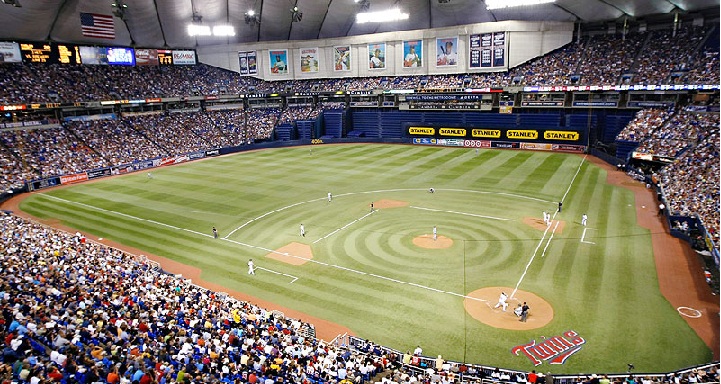
* U.S. Bank Stadium and site of the Hubert H. Humphrey Metrodome. Home of the Twins from 1982 to 2009, the University of Minnesota football team from 1982 to 2008, the NFL's Vikings from 1982 to 2013, and the NBA's Timberwolves in their debut season of 1989-90, it was named for the State's favorite son, Mayor of Minneapolis (1945-48), U.S. Senator from Minnesota (1949-64 & 1971-78), Vice President of the United States (1965-69), and Democratic nominee for President (1968, he also ran in 1960 and 1972).
The Twins won the 1987 and 1991 World Series there – going 8-0 in World Series games in the Dome, and 0-6 in Series games outside of it. The Vikings, on the other hand, were just 6-4 in home Playoff games while playing there – including an infamous overtime defeat in the 1998 NFC Championship Game after going 14-2 in the regular season.
From October 1991 to April 1992, the Metrodome hosted 3 major events: The World Series (Twins over Atlanta Braves), Super Bowl XXVI (Washington Redskins over Buffalo Bills), and the NCAA Final Four (Duke beating Michigan in the Final). It also hosted the Final Four in 2001 (Duke won that one, too, over Arizona).
But it was inadequate on multiple levels. It was bad for football (the great running back Billy Sims ended his career by landing on his knee on the artificial turf), and worse for baseball (the gray roof not only blotted out the sky, but made it hard to see fly balls). Billy Martin, whose 1st managing job was with the 1969 Twins, hated the place, and had the best word on it, though the awkward wording of it may have been inspired in part by his pal Yogi: "It's a shame a great guy like HHH had to be named after it."
A blizzard tore a hole in the roof in 2010, which brought the Vikings' desire to get out and build a new stadium to the front burner, and finally led to action. In May 2012, faced with the serious possibility of the Vikes moving if they didn't get a suitable stadium (Los Angeles, Las Vegas and San Antonio, in descending order of likelihood, had been rumored as locations), the Minnesota State legislature approved funding for a new stadium, to be built on the site of the Metrodome and on adjoining land.
The damn thing was demolished, and, in a piece of poetic justice, just as it was built and completed ahead of schedule and under budget, so did the demolition take place. The people of Minnesota seemed to be proud of its having been built on the cheap and on time, but it served its purpose, to keep the Twins and Vikings from moving for a generation, and now replacement stadiums are achieving the same purpose.
The Vikings played at TCF Bank Stadium in 2014 and '15, and moved into U.S. Bank Stadium last September. The Vikings continued the Minnesota-Wisconsin rivalry by beating the Green Bay Packers in its 1st regular season game.
It hosted Super Bowl LII in 2018 (Philadelphia Eagles over New England Patriots, and the 2019 Final Four (Virginia over Texas Tech). It will likely host both events again. It hosted Italian soccer giants AC Milan against English teams Chelsea in 2016 and Tottenham Hotspur in 2018 (losing to both), and a win by the U.S. women's national team over Switzerland in 2016. 900 South 5th Street at Centennial (Kirby Puckett) Place. Metrodome station on Light Rail.
* Mall of America and sites of Metropolitan Stadium and the Metropolitan Sports Center. In contrast to their performance at the Metrodome, the Vikings were far more successful at their 1st home, while the Twins were not -- in each case, playing there from 1961 to 1981.
The Vikings reached 4 Super Bowls while playing at The Met, while the Twins won Games 1, 2 and 6 of the 1965 World Series there, but lost Game 7 to the Los Angeles Dodgers on a shutout by Sandy Koufax. (So the Twins are 11-1 all-time in World Series home games, but 0-9 on the road.) The Vikings were far more formidable in their ice tray of a stadium, which had no protection from the sun, and nothing to block an Arctic blast of wind.
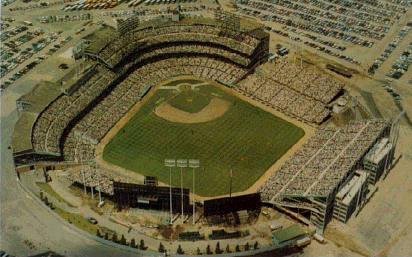
Metropolitan Stadium was a typical 1950s stadium:
Functional, but not interesting once the novelty wore off,
and too far from the city, designed for people with cars.
In fact, the Met had one deck along the 3rd base stands and in the right field bleachers, two decks from 1st base to right field and in the left field bleachers, and three decks behind home plate. Somebody once said the stadium looked like an Erector set that a kid was putting together, before his mother called him away to dinner, and he never finished it. At 45,919 seats, it had a capacity that was just fine for baseball; but at 48,446, it was too small for the NFL.
Prior to the 1961 arrivals of the Twins and Vikings, the Met hosted the Minneapolis Millers from 1956 to 1960, and 5 NFL games over the same stretch, including 4 "home games" for the Packers. Viking fans may be sickened over that, but at least University of Minnesota fans can take heart in the University of Wisconsin never having played there.
The experiments worked: The Met, built equidistant from the downtowns of Minneapolis and St. Paul, in the southern suburb of Bloomington, was awarded the MLB and NFL teams, and Midway Stadium, built in 1957 as the new home of the St. Paul Saints (at 1000 N. Snelling Avenue in the city of St. Paul, also roughly equidistant from the 2 downtowns), struck out, and was used as a practice field by the Vikings before being demolished in 1981.
Midway Stadium was also a typical 1950s stadium.
The NHL's Minnesota North Stars played at the adjoining Metropolitan Sports Center (or Met Center) from 1967 to 1993, before they were moved to become the Dallas Stars by owner Norm Green, earning him the nickname Norm Greed. The Stars reached the Stanley Cup Finals in 1981 and 1991, but never won the Cup until 1999 when they were in Dallas. Larry Holmes successfully defended the Heavyweight Championship of the World at the Met Center on July 7, 1980, knocking out Minnesota native Scott LeDoux.
The Beatles played at Metropolitan Stadium on August 21, 1965 -- making it 1 only 3 facilities to host an All-Star Game, a Finals and a Beatles concert in the same year. (The others were the Boston Garden and Maple Leaf Gardens in 1964.) Elvis Presley sang at the Met Center on November 5, 1971 and October 17, 1976.
The Mall of America opened on the site of the stadium in 1992, and remains the largest shopping mall in the United States. An IKEA was built on the site of the Met Center. 8000 Cedar Avenue South, at 80th Street -- near the airport, although legends of planes being an issue, as with Shea Stadium and Citi Field, seem to be absent. A street named Killebrew Drive, and the original location of home plate, have been preserved. A 45-minute ride on the Number 55 light rail (MOA station), which, unfortunately, didn't open until after the stadium and the arena were gone.
* Site of Nicollet Park. Home of the Millers from 1912 to 1955, it was one of the most historic minor-league parks, home to Ted Williams and Willie Mays before they reached the majors. With the Met nearing completion, its last game was Game 7 of the 1955 Junior World Series, in which the Millers beat the International League Champion Rochester Red Wings.
A few early NFL games were played there in the 1920s, including home games by a team known as the Minneapolis Marines and the Minneapolis Red Jackets. A bank is now on the site. Nicollet and Blaisdell Avenues, 30th and 31st Streets. Number 465 bus.
* Site of Lexington Park. Home of the Saints from 1897 to 1956, it wasn't nearly as well regarded, although it did close with a Saints win over the arch-rival Millers. The site is now occupied by retail outlets. Lexington Parkway, University Avenue, Fuller & Dunlap Streets.
* Xcel Energy Center and site of the St. Paul Civic Center. Home of the NHL's Minnesota Wild since their debut in 2000, and site of the 2008 Republican Convention that nominated John McCain for President and, yes, Sarah Palin for Vice President. (The GOP met in Minneapolis in 1892, renominating President Benjamin Harrison at the Industrial Exposition Building at 101 Central Avenue SE. It was torn down in 1940, and condos are on the site now.)
The Three Tenors -- Luciano Pavarotti, Placido Domingo and José Carreras -- sang at the Xcel Center on December 16, 2002. The place is a veritable home and hall of fame for hockey in Minnesota, the most hockey-mad State in the Union, including the State high school championships that were previously held at the Civic Center.
That building was the home of the Minnesota Fighting Saints of the World Hockey Association from 1973 to 1977. The Fighting Saints had played their first few home games, in late 1972, at the St. Paul Auditorium.
The Civic Center hosted the Frozen Four in 1989, 1991 and 1994. The Xcel has hosted it in 2002 and 2011, and will again in 2018. It hosted the Big Ten Hockey Tournament in 2014 and 2016.
Elvis sang at the Civic Center on October 2 and 3, 1974, and April 30, 1977. The Civic Center is also where Bruce Springsteen and Courteney Cox filmed the video for Bruce's song "Dancing In the Dark."
199 W. Kellogg Blvd., at W. 7th Street, in downtown St. Paul, about 9 miles from downtown Minneapolis. The Number 94 bus goes straight there from downtown Minneapolis, in about 25 minutes. The Green Line light rail goes from Nicollet Mall to St. Paul Central Station. From there, it's a 15-minute walk to the arena. Total travel time: About 40 minutes.
The arena is the westernmost part of the RiverCentre complex, which includes the Roy Wilkins Auditorium, the Saint Paul RiverCentre and the Ordway Center for the Performing Arts. The Wilkins, formerly the St. Paul Auditorium, was built in 1932. On May 13, 1956, early in his career, Elvis Presley sang there in the afternoon, and at the Minneapolis Auditorium in the evening.
* Target Center. Separated from Target Field by I-394 and 2nd Avenue, this arena has been home to the NBA's Minnesota Timberwolves since 1990, after they played their debut season at the Metrodome.
The T-Wolves have only made the Western Conference Finals once, and are probably best known as the team Kevin Garnett and GM (and Minnesota native) Kevin McHale couldn't get over the hump, before Garnett went to McHale's former team, the Boston Celtics. The Minnesota Lynx also play here, and have won the WNBA Championship in 2011, 2013 and 2015. 600 N. 1st Avenue at 6th Street.
* Site of Minneapolis Auditorium. Built in 1927, from 1947 to 1960 this was the home of the Minneapolis Lakers – and, as Minnesota is "the Land of 10,000 Lakes" (11,842, to be exact), now you know why a team in Los Angeles is named the Lakers. (The old Utah Jazz coach Frank Layden said his team and the Lakers should switch names, due to L.A.'s "West Coast jazz" scene and the Great Salt Lake: "Los Angeles Jazz" and "Utah Lakers" would both make more sense than their current names.)
The Lakers won the National Basketball League Championship in 1948, then moved into the NBA and won the Championship in 1949, 1950, 1952, 1953 and 1954. In fact, until the Celtics overtook them in 1963, the Minneapolis Lakers were the most successful team in NBA history, and have still won more World Championships than all the other Minnesota major league teams combined: Lakers 5, Twins 2, the rest a total of 0. (Unless you count the Lynx, who make it Lakers 5, everybody else 5.)
They were led by their enormous (for the time, 6-foot-10, 270-pound) center, the bespectacled (that's right, he wore glasses, not goggles, on the court) Number 99, George Mikan. The arrival of the 24-second shot clock for the 1954-55 season pretty much ended their run, although rookie Elgin Baylor did help them reach the Finals again in 1959.
Elvis sang there early in his career, on May 13, 1956. The Auditorium was demolished in 1989, and the Minneapolis Convention Center was built on the site. 1301 2nd Ave. South, at 12th Street. Within walking distance of Target Field, Target Center and the Metrodome.
* Minneapolis Armory. Built in 1936 for the Minnesota National Guard, the Lakers used it as their home court part-time throughout their Minneapolis tenure, and full-time in their final season in Minneapolis, 1959-60. Ironically, the owner of the Lakers who moved them to Los Angeles was Bob Short – who later moved the "new" Washington Senators, the team established to replace the team that moved to become the Twins.
It was later the video-filming site for Minneapolis native Prince's "1999" and Aerosmith's "I Don't Want to Miss a Thing." It's been kept standing as an indoor parking lot. 500 6th Street, downtown.
* Minnesota United. Originally NSC Minnesota and then the Minnesota Stars, this team began play in 2010, and, except for the occasional game moved to the Metrodome for more seats, played its home games at a 10,000-seat stadium at the National Sports Center in Blaine, about 15 miles north of downtown Minneapolis. 1700 105th Avenue NE at Davenport Street NE. Hard to reach by public transportation: You'll need at least 2 buses, and to then walk a mile and a half.
The team was promoted from the new North American Soccer League to Major League Soccer, and began play this season, at U.S. Bank Stadium, and will play the 2018 season there as well. For the 2019 season, they hope to open their 19,916-seat soccer-specific stadium, Allianz Field, in St. Paul, at about 400 N. Snelling Avenue, at the intersection of St. Anthony Avenue, just off I-94/U.S. 12/U.S. 52, about a mile and a half south of the site of old Midway Stadium. Green Line light rail to Snelling Avenue.
* University of Minnesota. TCF Bank Stadium, the new home of the University of Minnesota football team, opened in 2009. It was designed to resemble a classic 1920s college football stadium, with a reddish-brown brick exterior and a horseshoe shape, much like the 56,000-seat Memorial Stadium, where the Golden Gophers played from 1924 to 1981, before the Metrodome was built. In 2021, it was renamed Huntington Bank Stadium.
Its capacity of 50,805 makes it the 2nd-smallest stadium in the Big Ten, ahead of only Northwestern's Ryan Field, but the Gophers' lack of success over the last 40 years or so has been overcome: They have regularly filled it.
Before moving in for the 2014 and '15 seasons, the Vikings played a home game there in 2010, following a snow-caused collapse of the Metrodome roof. The Vikings lost to the Chicago Bears, and it turned out to be Brett Favre's last NFL game. The Vikings played a home game at "Old Memorial" in 1969, due to the Twins making the Playoffs that season, and having scheduling dibs on Metropolitan Stadium.
TCF Bank Stadium has also hosted an outdoor game for UM hockey, and on February 21, 2016, it played host to a 6-1 win by the Wild over the Chicago Blackhawks. It hosted a match between soccer teams Manchester City of England and Olympiacos of Athens, Greece.
The new stadium is at 2009 University Avenue SE, at 420 SE 23rd Avenue. Stadium Village stop on the light rail Green Line.
"Old Memorial" was a block away from where the new stadium now stands, on Walnut Street between University Avenue and Beacon Street. The Vikings played a home game there in 1969 due to the Twins making the Playoffs that season and having dibs on Metropolitan Stadium. The McNamara Alumni Center now stands on the site, and the arched entrance to Memorial has been preserved and stands inside.
The Gophers play their basketball games at Williams Arena, a classic old barn built in 1928, across Oak Street from the open west end of TCF Bank Stadium. It hosted the NCAA basketball championship, the Final Four, in 1951; and the hockey equivalent, the Frozen Four, in 1958 and 1966.
Across 4th Street from Williams is Mariucci Arena, home of the hockey team that has won National Championships in 1974, '76, '79, 2002 and '03. Named for John Mariucci, a member of the Chicago Blackhawks' 1938 Stanley Cup winners who coached the Gophers, the arena was built in 1993, after the team previously played hockey at Williams.
Legend has it that 4th Street is the "Positively 4th Street" used as the title of a song by former UM student Robert Zimmerman, a.k.a. Bob Dylan, although, as is often the case with Dylan songs, there is no mention of the title in the songs. Whether the "friend" who's "got a lot of nerve" was a fellow UM student, I don't know. It's also been suggested that the 4th Street in question is the one in New York's Greenwich Village.
* Duluth. Minnesota's largest city outside the Twin Cities region is 155 miles to the northeast, at the western edge of Lake Superior. It was home to the State's 1st NFL team. They played the 1923, '24 and '25 team as the Duluth Kelleys, because they were sponsored by the Kelley-Duluth Hardware Store. They played the 1926 and '27 season as the Duluth Eskimos, and featured Hall-of-Famers Ernie Nevers and John "Johnny Blood" McNally.
They played at Athletic Park, which opened in 1903 and served as home of the minor-league Duluth White Sox from 1903 to 1916, and the Duluth Dukes from 1934 to 1940. It seated 6,000, and was replaced by the 4,2000-seat Wade Stadium on the same site in 1941. That was home to the Dukes until 1970, to a new Duluth-Superior Dukes from 1993 to 2002, and to the Duluth Huskies since 2003. In their various leagues, the Dukes/Huskies won Pennants in 1937, 1956, 1961, 1963, 1969, 1970 and 1997. 101 N. 35th Avenue West, about 3 miles southwest of downtown.
The 6,764-seat Duluth Entertainment Center hosted the hockey team at the University of Minnesota at Duluth from 1966 to 2010, one of the better hockey programs (if not as accomplished as their cousins down in Minneapolis). It also hosted the Frozen Four in 1968 and 1981, and Elvis on October 16, 1976 and April 29, 1977. The 6,726-seat Amsoil Arena -- smaller, but much more convenient -- was built next-door in 2010, and UMD moved in. Both are downtown and have an address of 350 Harbor Drive.
* Museums. The Twin Cities are very artsy, and have their share of museums, including one of the five most-visited modern art museums in the country, the Walker Art Center, at 1750 Hennepin Avenue. Number 4, 6, 12 or 25 bus. The Minneapolis Institute of Arts is at 2400 3rd Avenue South. Number 17 bus, then walk 2 blocks east on 24th Street. The Science Museum of Minnesota is at 120 W. Kellogg Blvd. in St. Paul, across from the Xcel Center.
Fort Snelling, originally Fort Saint Anthony, was established by the U.S. Army in 1819, where the Mississippi and Minnesota rivers meet, to guard the Upper Midwest. It served as an Army post until World War II. It is now a museum, with historical demonstrations based on its entire history, from the post-War of 1812 period to the Civil War, from the Indian Wars to the World Wars. 101 Lakeview Avenue in St. Paul, across from the airport. An hour's ride on the Blue light rail.
Minnesota is famous for Presidential candidates that don't win. Governor Harold Stassen failed to get the Republican nomination in 1948, and then ran several more times, becoming, pardon the choice of words, a running joke. Senator Eugene McCarthy opposed Lyndon B. Johnson in the Democratic Primaries in 1968, but lost his momentum when Robert Kennedy got into the race and LBJ got out, then ran in 1976 as a 3rd-party candidate and got 1 percent of the popular vote.
Vice President Walter Mondale was the Democratic nominee in 1984, losing every State
butMinnesota in his loss to Ronald Reagan. In the 2012 election cycle, the moderate former Governor Tim Pawlenty and the completely batty Congresswoman Michele Bachmann ran, and neither got anywhere.
Most notable is Hubert Horatio Humphrey. Elected Mayor of Minneapolis in 1945 and 1947, he became known for fighting organized crime, which put a price on his head, a price it was unable to pay off. In 1948, while running for the U.S. Senate, he gave a speech at the Democratic Convention, supporting a civil rights plank in the party platform, a movement which culminated in his guiding the Civil Rights Act of 1964 through the Senate as Majority Whip.
He ran for the Democratic nomination for President in 1960, but lost to John F. Kennedy, then was elected LBJ's Vice President in 1964. He won the nomination in 1968, but lost to Richard Nixon by a hair. He returned to the Senate in 1970, and ran for President again in 1972, but lost the nomination to George McGovern. He might have run again in 1976 had his health not failed, as cancer killed him in 1978 at age 66. His wife Muriel briefly held his Senate seat.
Not having been President (he's come closer than any other Minnesotan ever has), he has no Presidential Library, but there is the Hubert H. Humphrey School of Public Affairs at the University of Minnesota, 301 19th Avenue South, only a short walk from the Dome that would be named for him. Hubert and Muriel are laid to rest in Lakewood Cemetery, 3600 Hennepin Avenue. Number 6 bus.
The tallest building in Minnesota is the IDS Center, at 80 South 8th Street at Marquette Avenue, rising 792 feet high. The Foshay Tower, at 821 Marquette Avenue, was the previous tallest, from 1929 to 1973, 447 feet. The tallest in the State outside Minneapolis is Wells Fargo Place, at 30 East 7th Street at Cedar Street in St. Paul, 472 feet.
Nicollet Mall is a pedestrians-only shopping center that stretches from 2nd to 13th Streets downtown. At 7th Street, in front of Macy's, in roughly the same location that Mary Tyler Moore as Mary Richards threw her hat in the air in the opening to
The Mary Tyler Moore Show, is a statue of "Mare" doing that. However, the show had no location shots in Minneapolis.
The dedication: Bronze Mary at left, Real Mary at right
Mary's statue was the 1st in a series commissioned by TV Land that now includes Jackie Gleason as Ralph Kramden in
The Honeymooners outside Port Authority Bus Terminal, Henry Winkler in
Happy Days (a statue known as the Bronze Fonz) in Milwaukee, Bob Newhart as Bob Hartley in
The Bob Newhart Show in Chicago, Andy Griffith and Ron Howard as Andy and Opie Taylor in
The Andy Griffith Show in Raleigh, Elizabeth Montgomery as Samantha Stephens in the "witch city" of Salem, Massachusetts (even though
Bewitched was set in Westport, Connecticut), and Elvis Presley outside the Blaisdell Center in Honolulu where he played the concert for his 1973 TV special.
The Many Loves of Dobie Gillis, Little House On the Prairie and
Orphan Black were set in Minnesota, although not shot there.
The Adventures of Rocky & Bullwinkle was set in the fictional town of Frostbite Falls, Minnesota. Of course, being animated, it had no location shots.
The sitcom
Coach, which aired on ABC from 1989 to 1996, was set at Minnesota State University. At the time, there was not a real college with that name. But in 1999, Mankato State University was renamed Minnesota State University, Mankato; and in 2000, Moorhead State University became Minnesota State University, Moorhead.
The University of Minnesota was originally a model for the school on the show, but withdrew its support: Although some game action clearly shows the maroon and gold of the Golden Gophers, the uniforms shown in most scenes were light purple and gold. In one Season 1 episode, the Gophers are specifically mentioned as one of the Screaming Eagles' opponents, suggesting that Minnesota State might have been in the Big Ten.
Show creator Barry Kemp is a graduate of the University of Iowa -- like Wisconsin, a major rival of the Gophers -- and most of the exterior shots you see of the campus were filmed there. In addition, the main character, Hayden Fox, was named after then-Iowa coach Hayden Fry. No scenes were actually shot in Minnesota, not even Hayden's oft-snowy lake house.
Movies filmed in Minnesota include the baseball films
Little Big League and
Major League: Back to the Minors, the George Clooney 1920s football film
Leatherheads,
The Bishop's Wife (1947, later remade as
The Preacher's Wife),
Airport (the 1970 film that helped inspire the decade's disaster film craze), the Western
The Great Northfield, Minnesota Raid, the
Grumpy Old Men movies, Kevin Smith's
Mallrats,
Juno, and, most memorably due to its use of the Minnesota accent, the Coen Brothers'
Fargo (which now has a TV version shot there).
St. Paul is the capital of the State of Minnesota. The Capitol Building is at University Avenue and Capital Blvd. It's a half-hour ride from downtown on the Number 94 bus (named because most of its route is on I-94).
*
Bob Wood, a native of Kalamazoo, Michigan, and a graduate of Michigan State University, wrote a pair of sports travel guides:
Dodger Dogs to Fenway Franks, about his 1985 trip to all 26 stadiums then in MLB; and
Big Ten Country, about his 1988 trip to all the Big Ten campuses and stadiums. (Penn State, Nebraska, and soon-to-be members Rutgers and Maryland were not yet in the league).
The Metrodome was the only stadium that featured in both books, although if either were updated to reflect current reality, it would feature in neither. In
Big Ten Country, Wood said, "Now, don't get me wrong. It's not that I don't like Minneapolis. How can you not like Minneapolis?... No, Minneapolis is lovely. It's the Metrodome that sucks!"