Showing posts with label indiana hoosiers. Show all posts

Sunday, March 29, 2026

March 29, 1976: College Basketball's Last Undefeated Team

Left to right: Bob Knight, Scott May and Quinn Buckner.
Knight was hardly the only basketball coach to favor
plaid sportsjackets -- it was the 1970s, after all --
but he hadn't yet started wearing his more familiar red sweaters.

March 29, 1976, 50 years ago: Indiana University beats the University of Michigan, 86-68, at The Spectrum in Philadelphia, to win the NCAA Division I Men's Basketball Tournament. The Hoosiers finish the season 32-0. It remains the last undefeated National Championship season in college basketball.

Head coach Bobby Knight -- sometimes listed as "Bob Knight," which he apparently preferred -- always thought his previous season's team was better. They went 31-1, beating teams that were, at the time the Hoosiers played them, ranked Number 7, away to Kansas on December 4; Number 11, away to Notre Dame on December 11; Number 15, home to Kentucky on December 7; Number 17, away to Michigan on January 6; and Number 20, home to Purdue on January 25.

They won the Big Ten Conference title, going a perfect 18-0 in the league, and beat Texas-El Paso and Oregon State in the NCAA Tournament, before Kentucky beat them in the Elite Eight, 92-90 in Dayton, Ohio.

They did this without Larry Bird, who began the schoolyear as a freshman at IU, but found the transition difficult, and transferred to Indiana State University, which he eventually led to an NCAA Final.

With guard Quinn Buckner and forward Scott May returning for their senior years, and center Kent Benson returning as a junior, Knight was more determined than ever to win it all. They opened the season on November 29, 1975, ranked Number 1, playing defending National Champions UCLA, ranked Number 2 but playing with a head coach other than John Wooden for the 1st time since 1949 (Gene Bartow), at the St. Louis Arena, on national television. Indiana won convincingly, 84-64.

It was only the beginning. They beat Number 8 Notre Dame at home on December 11. They beat Number 14 Kentucky in Louisville. In the week between Christmas and New Year's, they won the ECAC Holiday Festival at Madison Square Garden, beating schools from 3 different Boroughs of New York City: Columbia, of Manhattan, 106-63; Manhattan College, which is located not in Manhattan but in The Bronx, 97-61; and Number 17 St. John's, of Queens, 76-69.

They beat Number 19 Michigan away on January 10. They needed overtime to beat Michigan at home at Assembly Hall in Bloomington, but did it, 72-67. They finished the regular season 27-0, again going through the Big 10 18-0.

The NCAA Tournament put them in Notre Dame's Joyce Center in South Bend, Indiana for their 1st round game, but they beat St. John's, then ranked Number 17, again. In Baton Rouge, Louisiana, they beat Number 6 Alabama and Number 2 Marquette, to put them in the Final Four at The Spectrum in Philadelphia. Again, they played UCLA, then ranked Number 5, and beat them, 65-51. In the Final, they had to play Michigan for a 3rd time, and Michigan were ranked Number 9. This time, it wasn't close: Indiana won, 86-68. They were 32-0, undefeated, and National Champions.

None of Knight's "Big Three" became professional stars. Buckner played in the NBA from 1976 to 1986, was a member of the Boston Celtics' 1984 NBA Champions, and later became a broadcaster. May played from 1976 to 1981, mostly for the Chicago Bulls. Benson played from 1977 to 1988, for 4 different teams. Both May and Benson later played in Italy's league.

Knight led Indiana to a 2nd National Championship in 1981, and a 3rd in 1987. They had previously won in 1940 and 1953, both under Branch McCracken. So Knight got the program to where it had won 5 titles. He also became, for a time, the winningest coach in college basketball history, before he was surpassed by a former assistant of his, Mike Krzyzewski of Duke. Eventually, his excesses could no longer be stood by IU administrators, and he was fired in 2000.

March 29, 1976 was a Monday. Tennis star Jennifer Capriati was born.

Wednesday, November 1, 2023

Bob Knight, 1940-2023

Bobby Knight was like a box of chocolates. You never knew what you were going to get. You could get something very sweet. You could also get something messy, and nuts. A teacher and bully. A hero one minute, and a villain the next.

NOTE: This is adapted from a post I wrote for his 75th birthday.

Robert Montgomery Knight was born on October 25, 1940 in Massillon, Ohio. Growing up outside Columbus, where the St. Louis Cardinals had a Triple-A farm team, he became a tremendous baseball fan, especially of the Cardinals, a fandom he maintained for the rest of his life, despite being closer to the Cincinnati Reds and the team then known as the Cleveland Indians.

But basketball would be his sport. He was the 6th man on the Ohio State University team that won the 1960 National Championship, coached by Fred Taylor, and led by 2 men who would be named to the NBA's 50 and 75 Greatest Players for their anniversary teams, Jerry Lucas and John Havlicek. Like Vince Lombardi and Bill Parcells, he was an assistant coach at the U.S. Military Academy at West Point, New York. Unlike them, Bob Knight became head coach at "Army."

(He always seemed to be listed as "Bobby Knight" until well into his Indiana tenure, but he seems to always be listed as "Bob Knight" once he got older. As you can see, he signed autographs "Bob Knight.")

In 1971, he moved on to Indiana University, and led them to 11 Big Ten Conference Championships, 5 NCAA Final Fours, and 3 National Championships: In 1976 (still the last undefeated season in men's college basketball history), 1981 and 1987. Among his players were Kent Benson, Scott May, Quinn Buckner, Hall-of-Famer Isiah Thomas and Steve Alford, now the head coach at the University of Nevada, having won 657 games as a collegiate head coach.

He also coached the U.S. team to the Gold Medal at the 1984 Olympics in Los Angeles. This may have been the best basketball team ever assembled to that point, including Alford, Patrick Ewing, Chris Mullin, and North Carolina stars Michael Jordan and Sam Perkins. (As I said: The best ever assembled to that point.)

But controversy followed him, ranging from assaulting a police officer at a preseason tournament in Puerto Rico, to sexist comments, to profanity-laden press conferences, to the infamous chair toss to protest the officiating in a 1985 loss to in-State arch-rival Purdue University, to assaulting his own players, including his own son, Pat Knight. IU finally had no choice but to fire him in 2000, but he resurfaced at Texas Tech, and brought them more NCAA Tournament success than they'd ever had before.

Bob married Nancy Falk in 1963, and had 2 sons, Tim and Pat, before divorcing in 1985. In 1988, Bob married Karen Edgar, a former high school basketball coach in Oklahoma. Pat Knight served as his assistant at Indiana in that last season, 1999-2000, and at Texas Tech from 2001 to 2008. He succeeded his father as their head coach, until 2011. He then served as head coach at Lamar University for 3 years. Since 2014, Pat has been a scout for the NBA's Indiana Pacers.

With 902 wins, Bob became the winningest coach in men's college basketball history, although he has been surpassed by his former assistant at West Point, Duke University coach Mike Krzyzewski. And not once in 41 seasons of head coaching (1965-71 with Army, 1971-2000 with Indiana, 2001-08 with Texas Tech) was he ever accused of breaking NCAA or conference rules. And his players graduated.

And, like Joe Paterno, who left under a more horrible controversy than anything that's been thrown at Knight -- or Knight's friend from Ohio State, football coach Woody Hayes -- Knight was a heavy donor to his schools' libraries. Top that, Rick Pitino and John Calipari.

He became a college basketball pundit on ESPN, leaving in 2015, due to declining health. In 2020, just before the COVID shutdown, and 20 years after he was fired, peace was made, and IU welcomed him back to Assembly Hall in Bloomington. Visibly ill, and visibly moved, he got a standing ovation.

Bob Knight died today, November 1, 2023, a week after his 83rd birthday. As the man in the red sweater himself -- adopting those after ditching his former plaid jackets -- said, "When my time on Earth is gone, and my activities here are passed, I want they bury me upside-down, so my critics can kiss my ass."

Tuesday, March 30, 2021

March 30, 1981: President Ronald Reagan Is Shot

March 30, 1981, 40 years ago: President Ronald Reagan is shot in an assassination attempt. It happens as he's walking to his car outside the Washington Hilton.

It was 2:27 PM. A few minutes later, the news reached my mother and me, at the library in East Brunswick, New Jersey. I don't remember why I was there, instead of in school: It was a Monday, not during Spring Break (Easter wasn't until April 19 that year), and I was in the 6th grade, at a school that let out at 2:35. Maybe it was a half-day, due to parent-teacher conferences, or something like that.

No President had been assassinated since John F. Kennedy on November 22, 1963. My mother was in her senior year of high school; my father, in his senior year of college. Both were sent home early. There were 2 assassination attempts against Gerald Ford in September 1975, but neither came close to succeeding. So this was the first close call that I could remember, and it remains the only one.

Reagan was at the Hilton to give a speech at a luncheon of labor union executives. In his previous career, Reagan was not merely an actor, but served a term as President of an actors' union, the Screen Actors Guild. But he had turned on his fellow actors, and named names of those he suspected of Communist ties, and was never trusted by actors again. By 1965 -- at 54, hardly an age at which actors were, then as now, considered to be done -- his acting career was over.

He went into politics, and was elected Governor of California in 1966 and 1970. Supporters of his made a halfhearted effort to get the Republican Party to nominate him for President in 1968. In 1976, he nearly derailed the nomination of the incumbent President, Gerald Ford, who then lost to Jimmy Carter. In 1980, Reagan gave it one more try, and beat Carter.

Reagan was not friendly toward labor unions once he left SAG. This became obvious later in the year: Having survived the shooting, he exercised his authority as President to fire the striking members of PATCO, the union of air-traffic controllers. American organized labor has never recovered from the Reagan Years.

But that was yet to come. There was no reason to believe Reagan was shot due to his stance on labor. Secret Service Agents immediately pounced on the shooter: John W. Hinckley Jr., a mentally ill man who never should have had access to a gun. A court would find him not guilty by reason of insanity, and he remained incarcerated at a hospital for the criminally insane until 2016. He is 65 years old. With some irony, he shares his birthday, May 29, with John F. Kennedy.

Hinckley, not particularly caring that anyone other than Reagan might be hit, also shot White House Press Secretary James Brady. He was paralyzed, and an early report said that he had died. He was confined to a wheelchair, and became an advocate for gun control. He lived until 2014.

Secret Service Agent Timothy McCarthy was wounded. He remains the only Secret Service Agent ever to, as the common saying goes, "take a bullet for the President." In spite of this, he was the least seriously wounded man in the attempt. He later became his Illinois hometown's chief of police, and is still alive, age 71.

Also still alive is Thomas Delahanty, a D.C. police officer. He was there as part of Reagan's security detail because his usual duty had been interrupted: He was part of a police dog unit, and his dog was sick. The shooting happened so fast that he couldn't do much about it, and he's always regretted that. He was released from the hospital a day before Reagan was. He returned to the Pittsburgh area from whence he came, and is now 85.

Reagan was taken to George Washington University Hospital, a few blocks away. He was able to walk in, and said to the staff, "Please tell me you're all Republicans." But he was closer to death than anyone realized: The bullet had just missed his heart, and he ended up losing a lot of blood.

In the recovery room, the first people he saw were some of his staff members: White House Chief of Staff James Baker, Baker's deputy Michael Deaver, and White House Press Secretary Lyn Nofziger. Reagan looked at them, and said, "Who's minding the store?" When his wife Nancy was let in, Reagan quoted Jack Dempsey's line after losing the Heavyweight Championship of the World to Gene Tunney in 1926, when Reagan was in high school: "Honey, I forgot to duck."

He was released on April 11. He made a full recovery, although speculation on what the experience did to him, and to Nancy, psychologically has run rampant. He was re-elected in 1984, and served out his 2nd term.

In 1994, he announced that he had Alzheimer's disease. This had been suspected by the public as early as his re-election campaign. Even before that, in spite of his wit and sense of humor, Reagan was often thought of as not particularly intelligent. Certainly, he was intellectually lazy, and believed many things that were untrue, even ridiculous. He died in 2004.

March 30, 1981 was scheduled as the day of the Final of the NCAA men's basketball tournament, to be held at The Spectrum in Philadelphia. Had Reagan died -- or, perhaps, if his life were still in danger as tipoff approached -- the game might have been postponed. Instead, with the knowledge that he was in recovery, the game went forward, with a moment of silence held after player introductions.

Indiana University beat the University of North Carolina, 63-50. Bobby Knight's Hoosiers included Hall-of-Famer Isiah Thomas. Dean Smith's Tar Heels included Hall-of-Famer James Worthy. (Michael Jordan was in his senior year at Emsley A. Laney High School in Wilmington, North Carolina, but had committed to play at UNC. Laney was a prominent businessman in Wilmington.)

Sunday, November 12, 2017

How to Be a Rutgers Fan at Indiana

The football team at Rutgers University lost to Penn State yesterday, 35-6. Once upon a time, losing by 29 points away to Penn State would have been understandable. That was before Greg Schiano led Scarlet Knight fans to dream... and then walked away when the project was half-done.

RU plays away to Indiana University next Saturday.

Before You Go. Bloomington, Indiana is further south than Atlantic City. Despite being in the Midwest, it is not on a Great Lake, bringing strong winds and "lake effect snow." So the weather won't be substantially different from what we get in the Middle Atlantic States. The website of the Indianapolis Star is predicting high 40s for next Saturday afternoon, and low 30s for the evening. Bring a winter jacket.

Indiana used to be 1 of 2 States, Arizona being the other, where Daylight Savings Time was an issue; however, since 2006 -- 4 years after a West Wing episode lampooned this -- the State has used it throughout. There will be no need to adjust your timepieces.

Tickets. Indiana football is not Indiana basketball. They've sold out 2 of 5 home games this season. The last 2 seasons, only 1 of 13. You can probably get tickets for this game.

In both levels, front seats are $60, then they drop in price, until you get to the back, where they're $10.

Getting There. It's 761 miles from Times Square in Manhattan to downtown Bloomington, and 734 miles from Rutgers Stadium in Piscataway to Memorial Stadium. Knowing this, your first reaction is going to be to fly out there. This might be a problem, since Bloomington doesn't have a big airport. You'd have to fly to Indianapolis. Round-trip, non-stop, that could be had for under $600.
The State House, Indianapolis

If you take Amtrak, it will be simple to go out: You would board the Cardinal at Penn Station on Friday at 6:45 AM, and arrive at Union Station in Indianapolis on Saturday at 5:20 AM. Unfortunately, the Cardinal only runs 3 times a week, so you'll have a day and a half to kill in Indianapolis before the game. Going back, you'll leave Indy at 11:59 PM on Saturday, getting back to New York at 9:58 PM on Sunday. Round-trip fare would be $344. Union Station is at 350 S. Illinois Street, corner of South Street.

Getting to Indianapolis by plane or train, you'd still have to get to Bloomington, 52 miles away. You could rent a car. Or you could use Miller Transportation. Bloomington is a stop on their Indianapolis-to-Louisville bus run, so you might not have to rent a car at the Indianapolis airport. It's $36 round-trip. The bus leaves from Union Station, while Bloomington's bus terminal is at 301 S. Walnut Street.

Greyhound, however, does go to Bloomington, although you'd have to change buses in Indianapolis. The fare is $428, but it can drop to $394 with advanced purchase. The station is at 154 W. South Street, at Illinois Street, around the corner from Union Station. (That's right, "West South Street," but that's South Street, west of downtown.)

If you decide to drive, it's far enough that it will help to get someone to go with you and split the duties, and to trade off driving and sleeping. You'll need to get on the New Jersey Turnpike, and take Interstate 78 West across New Jersey, and at Harrisburg get on the Pennsylvania Turnpike, which at this point will be both I-70 and I-76.

When the two Interstates split outside Pittsburgh, stay on I-70 west. You'll cross the northern tip of West Virginia, and go all the way across Ohio (through Columbus), and halfway through Indiana. Exit 79B will take you to State Route 37 South, which will take a little under an hour to take you into Bloomington.

If you do it right, you should spend about an hour and 15 minutes in New Jersey, 5 hours in Pennsylvania, 15 minutes in West Virginia, 3 hours and 45 minutes in Ohio, and 2 hours in Indiana. That's going to be 12 hours and 15 minutes. Counting rest stops, preferably 6 of them, and accounting for traffic in both New York and Indianapolis, it should be about 15 hours.

Once In the City. Indiana was the 19th State admitted to the Union, on December 11, 1816. It is home to 6.6 million people. About half of them love the Indiana Hoosiers and hate the Purdue Boilermakers, and the other half are the other way around. Bloomington, founded in 1818, is home to about 85,000 permanent residents. The city is about 83 percent white, 8 percent Asian, 5 percent black and 4 percent Hispanic. Indiana University was founded there in 1820.
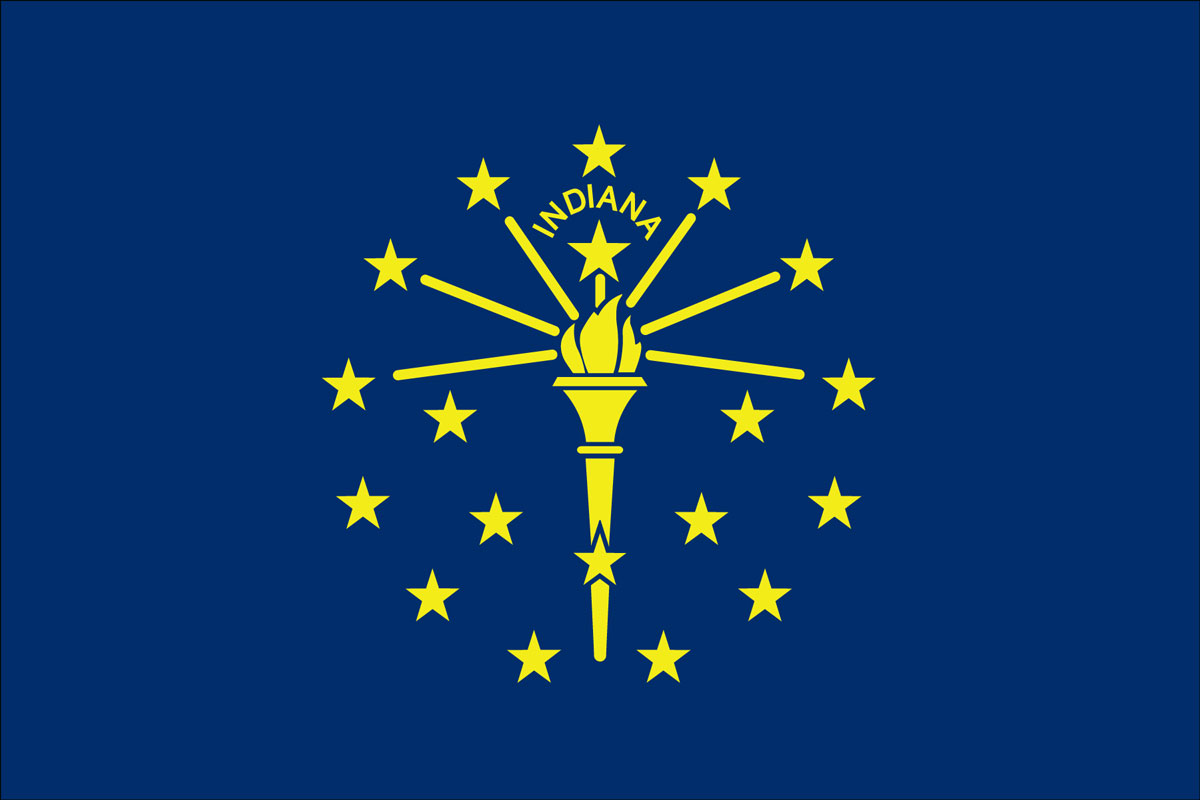
Note the 19 stars, as Indiana was the 19th State,
with 13 outer stars representing the original 13 States.

Kirkwood Avenue divides street addresses into North and South, and Walnut Street divides them into East and West. Bloomington has no freeway "beltway." The sales tax in the State of Indiana is 7 percent. ZIP Codes in Bloomington start with the digits 474, and the Area Code is 812, with 930 overlaid. There's no subway, but IndyGo offers a $4.00 all-day pass for its buses. The City of Bloomington Utilities runs the electricity.
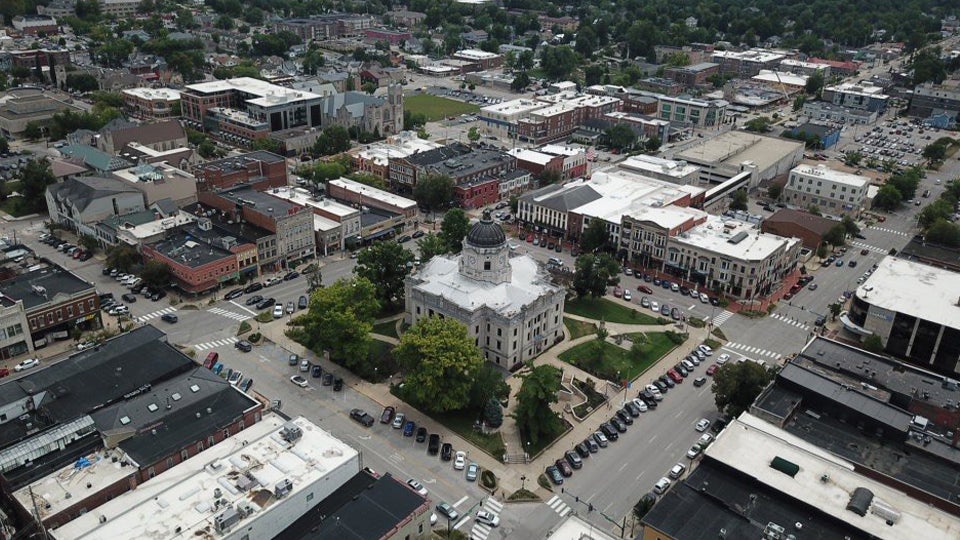
Downtown Bloomington

In addition to the Statewide Indianapolis Star, Bloomington has a local daily paper, The Herald-Times, and the student-operated Indiana Daily Student.

In addition to its flagship campus in Bloomington, IU has IU East in Richmond, IU Fort Wayne, IU Kokomo, IU Northwest in Gary, IU South Bend, IU Southeast in New Albany, and 2 co-ops with arch-rival Purdue: Indiana University - Purdue University Indianapolis (IUPUI), and another in Columbus, Indiana (IUPUC).

Notable non-sports IU alumni include: 


* Entertainment: Pianist-composer Hoagy Carmichael, singer Sylvia McNair, Star Trek writer Jeri Taylor.

Literature: Hunger Games author Suzanne Collins.

Business: Mark Cuban, also the owner of the Dallas Mavericks.

Science: MythBusters co-host Jamie Hyneman.

Journalism: Jane Pauley, Tavis Smiley.

Politics: Vice President Mike Pence, also former Congressman and Governor of Indiana; and President Michael D. Higgins of Ireland.

* And Wikipedia co-founder Jimmy Wales.

Going In. The official address of Memorial Stadium is 1001 E. 17th Street, at N. Dunn Street, about a mile north of downtown and the main campus. Assembly Hall, home of the legendary Indiana basketball program, is just to the east. Public buses don't get all that close, so you might need to use the A-Route on the campus bus system. If you drive in, parking is $20.

Since it opened in 1960, after World War II, it is a memorial to IU students and faculty who died in both World Wars, as opposed to most campus stadiums with the name, which were generally built in the 1920s, in the aftermath of World War I -- including the previous Memorial Stadium at Indiana, which I'll mention in "Sidelights."

Like the Prudential Center, home of the New Jersey Devils, it's known as "The Rock," and it's easy to see why. In Big Ten Country, his book about his visits to all the Big Ten campuses in the 1988 football season, Michigan State graduate Bob Wood wrote that it looked like a couple of dams surrounding a football field. But that was before the north end zone was filled in, with an entrance gate befitting a war memorial building. Nevertheless, it remains perhaps the least attractive Big Ten stadium.
Nice try, IU, but it still doesn't remind anybody of Ohio Stadium.

The Stadium is a horseshoe, with the field running north-to-south, open at the south end. It opened
with 48,344 seats, and was expanded to over 52,000 in 1969, and has had about that many since, currently 52,929. It switched to artificial turf in 1970, switched back to real grass in 1998, and returned to plastic in 2008.
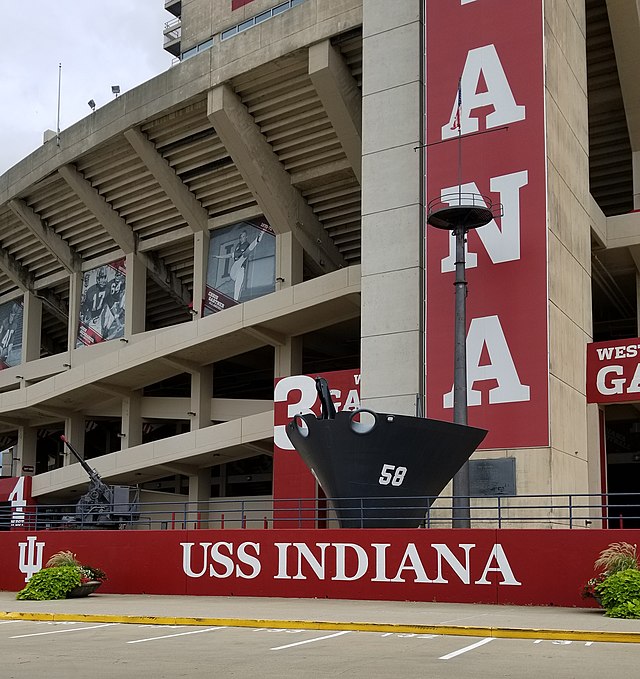
The prow, mainmast, and two guns of the battleship USS Indiana are erected at the western entrance of the stadium. The battleship saw extensive service in the Pacific Theater of World War II, including the Battle of Iwo Jima. It was retired after The War, not making it to Korea.
Food. Indiana is in the heart of the Midwest, right-smack-dab in the middle (or what used to be the middle, before Penn State, and then Nebraska, Rutgers and Maryland were admitted) of Big Ten Country, where tailgate parties are practically a sacrament. So you would expect there to be great food inside the Hoosiers' stadium. According to the school website:

Located throughout the stadium you will find Eisenberg hot dogs, half pound foot long steak dogs, Johnsonville Brats, nachos, popcorn, dippin dots, frozen lemonade and specialty pretzels.
To provide additional fun food options on the IU Athletics campus on gamedays, food trucks will be located in Hoosier Village prior to kickoff. 
 
Free beverage refills will be provided for all who buy the special souvenir cup at stadium concessions stands this season.


Complete your game day with State Faire mini donuts on the East Concourse. Watch as your donuts are baked in front of your eyes as you wait. Sure to be a hit with fans young and old, our mini donuts can't be beat.

Try Papa John's personal pan pizza sold at all traditional concessions stands. Chick Fil A is available on the West Concourse, East Concourse and in the balcony. Fresh popped Kettle Korn and Lemon Shake Ups are located on both the East and West Concourses as is Honey Baked Ham. Maui Wowi smoothies and Hawaiian Coffees are located on the West Concourse.

Credit and debit cards are accepted at all concession stands and select specialty carts.

Concession Stand Menu
  • Hoosier Dogs
  • Foot Long Steak Dogs
  • Johnsonville Brats
  • Sourdough Gourmet Pretzel
  • Nachos
  • Popcorn
  • Peanuts in the Shell
  • Candy
  • Cracker Jacks
  • Bottled Water
  • Fountain Coke Products

Specialty Carts (located throughout the stadium)
  • Gourmet Pretzels
  • Frozen Lemonade
  • Frozen Strawberry Lemonade
  • Lemon Shake Ups
  • Dippin Dots
  • Assorted bottled coke product
  • Bratwurst
  • Cheddar Dogs
  • State Faire Mini Donuts

Chick-Fil-A, Honey Baked Ham, Maui Wowi Smoothies and Kountry Kids Kettle Korn are located on both the East and West concourses.

Chick-fil-A? Papa John's? Oh, hell, no. But the rest should contain enough viable (taste-wise and humanity-wise) options for you.

Team History Displays. In terms of all-time record, Indiana is the least-successful football program in the Big Ten. Even oft-mocked Rutgers and Northwestern are better (with the "classic Big Ten" schools in bold):

1. Michigan: 942-336-36, .731
2. Ohio State: 894-324-53, .724
3. Nebraska: 893-378-40, .696
4. Penn State: 874-386-42, .687
5. Michigan State: 691-452-44, .601
6. Wisconsin: 695-489-53, .583
7. Minnesota: 670-500-42, .570
8. Iowa: 640-553-39, .535
9. Maryland: 634-575-43, .524
10. Purdue: 601-555-48, .519
11. Illinois: 587-561-51, .511
12. Rutgers: 641-622-42, .507
13. Northwestern: 503-642-44, .442
14. Indiana: 462-632-45, .425

Those 632 losses are the most of any school in the Football Bowl Subdivision (FBS, formerly known as Division I-A). The .425 percentage ranks 9th-worst.

They've won the Big Ten title outright only once, in 1945, at a time when World War II was over, but most of the men serving in it had yet to be discharged, and those who had and had been in college at the time were not yet able to resume their studies, much less their sports. They also shared the Big Ten title in 1967, a 3-way tie with arch-rival Purdue and Minnesota. Neither of those schools has won so much as a share of it since, either: 50 years.

Indiana has been to the Rose Bowl exactly once, on New Year's Day, 1968, in the wake of their Big Ten Tri-Championship. Their timing was bad, as they ran smack into Number 1-ranked USC and O.J. Simpson. No, they didn't "get killed," but they did lose 14-3.

They've been to 11 bowl games, and won only 3: The 1979 Holiday Bowl, the 1988 Liberty Bowl and the 1991 Copper Bowl. They did reach a bowl game last season, the Foster Farms Bowl, at the San Francisco 49ers' new stadium in Santa Clara, California, but lost to Utah. They played at Yankee Stadium in the 2015 Pinstripe Bowl, and lost an overtime thriller to Duke -- which sounds more like a great basketball game, although the score would have been a little low, 44-41.

None of their achievements, as meager as they are, are displayed on the press box or on flagpoles. However, on the outside of the stadium, they do have some large portraits of former IU All-Americans.
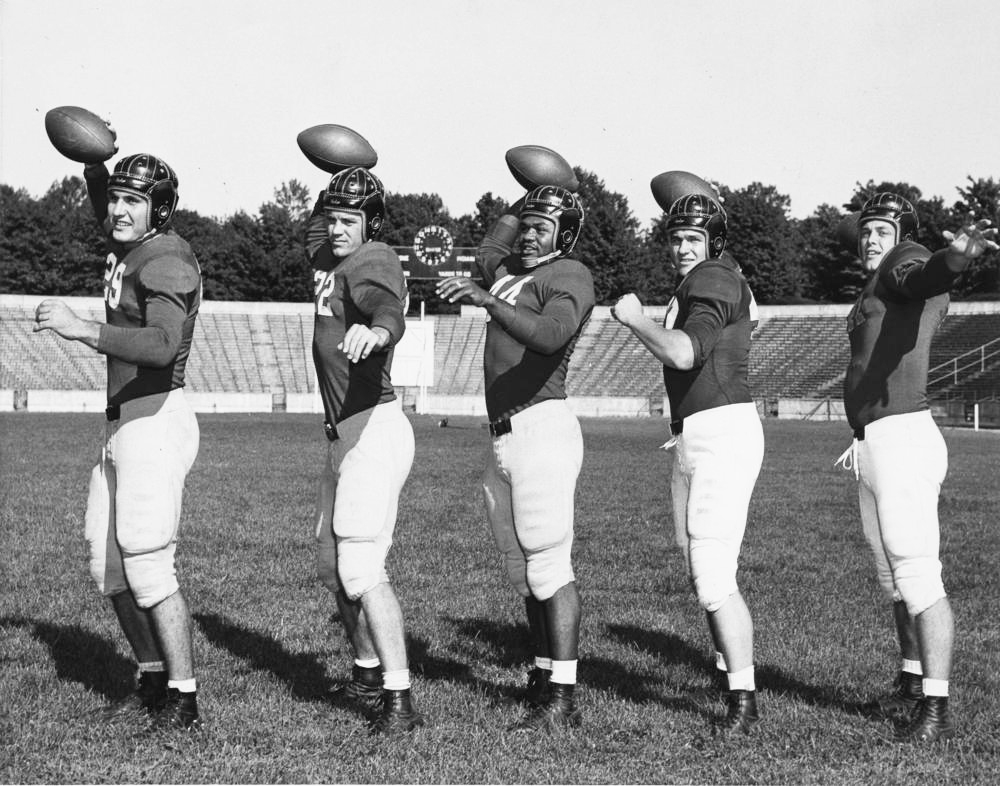
There are 5 Indiana players in the College Football Hall of Fame. One, end Pete Pihos, played on the 1945 Big Ten Champions, and the 1948 and 1949 NFL Champion Philadelphia Eagles, and is also their lone Pro Football Hall-of-Famer.
Number 44, in the middle, is George Taliaferro.
Next to him on the right, Number 40, is Pete Pihos.

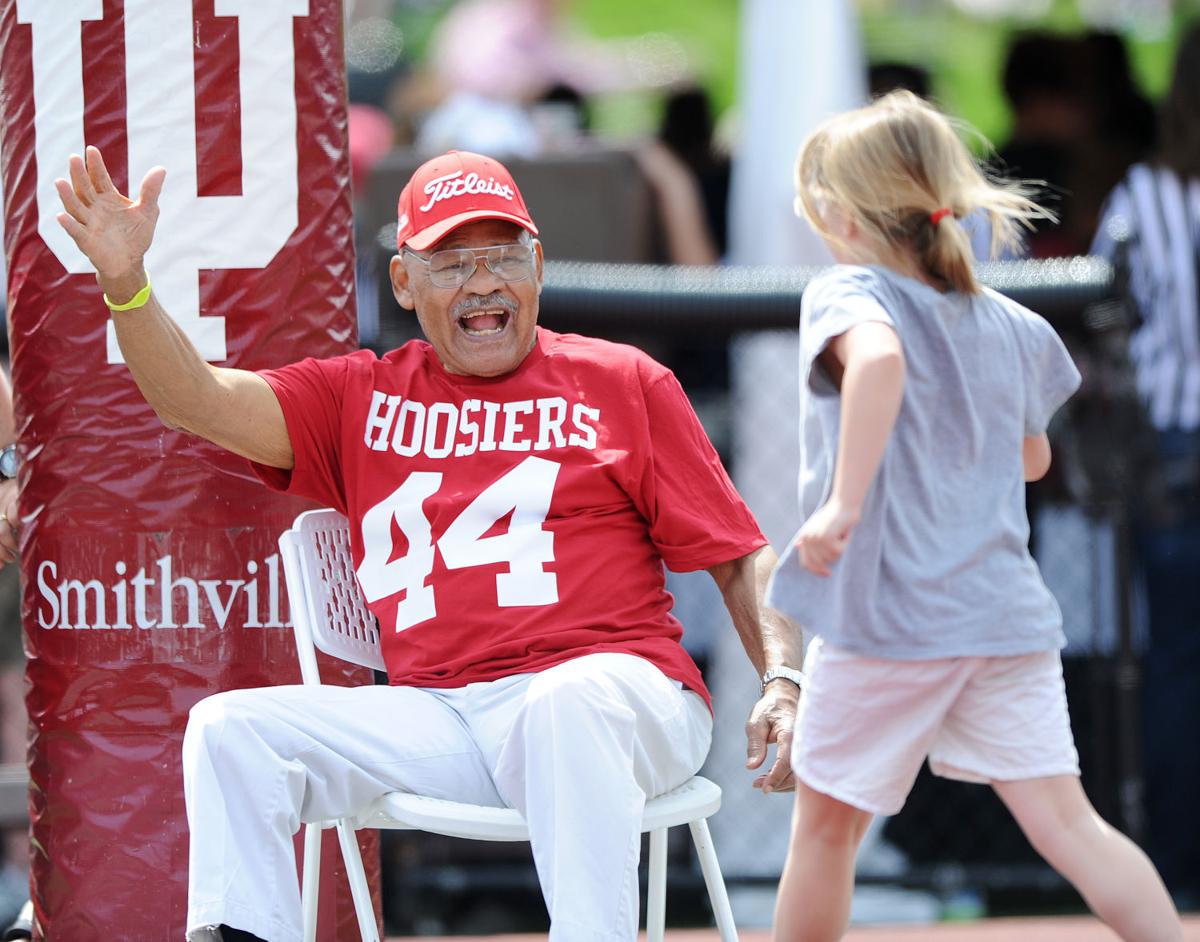
George Taliaferro, a running back on the 1945 Big Ten titlists, became the 1st black player drafted by an NFL team, the 1949 Chicago Bears. He went instead to the Los Angeles Dons of the All-America Football Conference, then played from 1950 to 1954 with the team that became the Baltimore Colts, closed his career as Pihos' teammate again with the 1955 Eagles. He is now 90 years old, and an uncle of Lorenzo Taliaferro of the Baltimore Ravens.
A recent photo of George Taliaferro, at the IU Spring Game

UPDATE: Taliaferro died on October 8, 2018.

Another, running back Anthony Thompson, was on their 1988 Liberty Bowl winners, and finished 2nd to Andre Ware of Houston for the 1989 Heisman Trophy. His Number 32 is the only number retired by the program, and he went on to play 3 years for the team then known as the Phoenix Cardinals and 2 years for the Los Angeles Rams.
Also honored are Zora Clevinger, a 2-way back at the dawn of the 20th Century, who went on to coach Nebraska Wesleyan, Tennessee and Kansas State in football, and all 3 of those schools plus Indiana in baseball and basketball as well; John Tavener, a center during World War II, but before the '45 titlists, and who never played pro ball; and Bill Ingram, who coached Indiana in 1923, '24 and '25, then went to the Naval Academy and coached them to an undefeated 1926 season and a retroactively-awarded National Championship.

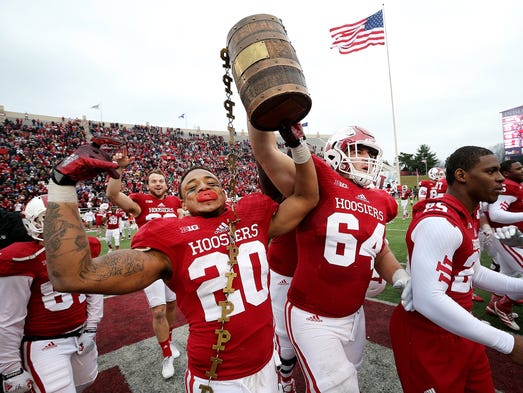
Indiana's biggest rivalry, in all sports, is with Purdue, from West Lafayette, Indiana, 100 miles to the north. The Hoosiers and the Boilermakers first met in 1891, and since 1925 have competed for one of college football's most familiar trophies (or, rather, one of the most familiar names among football trophies), the Old Oaken Bucket.

It has a chain, and after every game, a new brass I or P is added to it. Whichever team wins it puts it on display so that the chain seems to have a lot more of their letter on it. That's harder for the Hoosiers, as the Boilers lead in "Bucket Games," 56-31-3, and the rivalry overall, 72-41-6, although Indiana has won the last 4. They will play each other for the Bucket on Saturday, November 26, in West Lafayette. (UPDATE: Through the 2019 season, Purdue leads 74-42-6 overall, and 60-32-3 for the Bucket.)
Indiana also has a trophy game with Michigan State, for the Old Brass Spittoon. Michigan State won it this year, and has now won 8 of the last 9, and leads 46-16-2 overall.
Indiana vs. Kentucky is a bitter rivalry in basketball, but neither school has been very successful in football. They've only played each other 36 times, and not since 2005 due to conference commitments. It couldn't be much closer: Indiana leads 18-17-1. In 1987, they introduced a trophy, not especially old, called the Old Bourbon Barrel, but retired it in 1999 after a Kentucky player died from alcohol-related reasons.

Stuff. There's no big team store at Memorial Stadium, but there is a Varsity Shop in Assembly Hall, just to the east. The Indiana University Bookstore is at 900 E. 7th Street, downtown.

Don't look for books or videos about Indiana football. You're much more likely to find them about Indiana basketball. And since the shadow of Bobby Knight still looms large, 17 years after he left, some of those books will be complimentary, but some won't be.

During the Game. Because of their Midwestern/Heartland image, Hoosier fans like a "family atmosphere." They don't much like New York or New Jersey, but they won't bother Rutgers fans just for being Rutgers fans, or for wearing Scarlet Night gear in their stadium. As long as you don't say anything bad about Bobby Knight, you should be okay.

In 1979, when Rutgers went to Knoxville to play Tennessee, and the UT student paper had the headline, "What's a Rutgers?" Rutgers showed them, by winning. Well, Indiana fans are always getting asked, "What's a Hoosier?"

Suggestions have ranged from a 19th Century construction leader named Samuel Hoosier, who decided that men from Indiana were better workers than men from Kentucky, and the Indiana men became known as "Hoosier's men" and finally "Hoosiers" (but no such man has ever been found in any official records); to accented speech producing the words "Who's here?" or even, following a frontier fight that led to lost body parts, "Whose ear?"

So we really still don't know. And, since we don't know what a Hoosier is, other than "a person from Indiana," the school doesn't really have a mascot. Good fans, maybe; good cheerleaders, certainly; a good band, definitely; but no mascot.
The Indiana Marching Hundred

Not that they haven't tried. From 1959 to 1965, they had a live bulldog named Ox. After Ox died, instead of getting a new dog, they introduced a bison. But neither a bison nor a bulldog made any sense, nor would an actual ox have. They introduced a guy in a suit named Hoosier Pride in 1979, but the student body hated it, and it was dropped, and no attempt has been made since.

In 2005, head coach Terry Hoeppner found a limestone boulder -- the same kind of Indiana limestone that was quarried to build the exterior of the Empire State Building -- on the IU practice field, and he had it removed and put it into the north end of the stadium. He had the players touch the rock for luck as they came onto the field, a practice done with stadium rocks at other schools, most notably Clemson.

Did it work? Not for Hoeppner: He died of cancer 2 years later. But in his memory, the players still touch "Hep's Rock" as they come onto the field.

Fight songs include "Indiana, Our Indiana" and "Indiana Fight." The alma mater is "Hail to Old IU." There's also "Chimes of Indiana."

After the Game. Most of the area to the north and east of the stadium is additional property of the IU athletic department. Most of the area to the south is parking. Most of the area to the west is residential. While your safety will not be an issue, hunger might be, and your best chance of getting a postgame meal is to get back downtown.

In Big Ten Country, Michigan State graduate Bob Wood's book about his visits to all the Big Ten campuses in the 1988 football season, he decided that the best breakfast in Bloomington was at Runcible Spoon, at 412 E. 6th Street; the best bar was Nick's English Hut, at 423 E. Kirkwood Avenue, 2 blocks from Runcible Spoon, and both of them just to the west of the main IU campus; and the best burger was at Mustard's, at 300 S. College Mall Road, a spot now occupied by a Steak 'n Shake.

If your visit to Bloomington is during the European soccer season, as we are now in, your best bet to see your club is at the Uptown Cafe, 102 E. Kirkwood Avenue, downtown.

Sidelights. Indianapolis is often said to be boring: Its most common nickname is "India-no-place." But Bloomington is not Indianapolis.

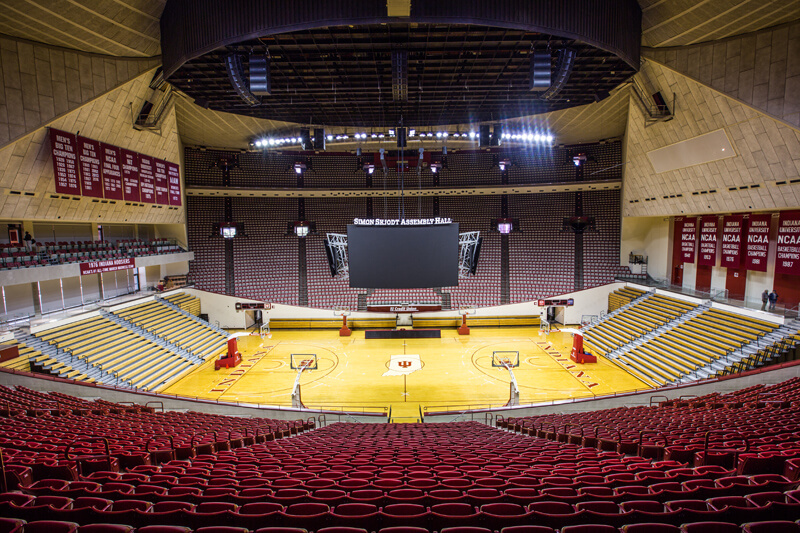
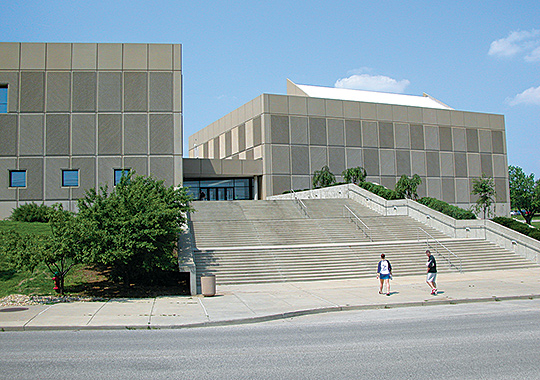
Just to the east of Memorial Stadium is the 17,222-seat Assembly Hall, opened in 1971, and sharing the stadium's address of 1001 East 17th Street. The playing surface is named Branch McCracken Court, after the coach of Indiana's 1940 and 1953 National Championship teams.
In 2016, the building was renamed Simon Skjodt Assembly Hall, after a $40 million donation for renovations by Cynthia Simon Skjodt, daughter of Indiana Pacers owner Mel Simon and wife of Paul Skjodt, who played for the Indianapolis Checkers and now owns the Indianapolis Ice hockey team.
Hoosier Heaven

(Mel's son, David Simon, runs the company that Mel and his brother Herb Simon founded, the Simon Property Group, which runs several malls, including New Jersey's Menlo Park, Quaker Bridge, Jersey Gardens, Newport Centre; and New York's Roosevelt Field and Woodbury Commons.)

In addition to being the closest thing to Hoosier Heaven, Elvis Presley sang at Assembly Hall on June 27, 1974 and May 27, 1976. 

From 1960 to 1971, Indiana played hoops at the 9,000-seat Gladstein Fieldhouse, which still stands, to the east of Assembly Hall. From 1928 to 1960, it played at the 8,000-seat Indiana Fieldhouse, now named the Wildermuth Intramural Center, at the main campus, at 1025 E. 7th Street.
Wildermuth Intramural Center

UPDATE: The facility was named for Ora Wildermuth, a former University trustee. In 2018, after a 9-year lobbying effort, his name was removed from it, due to his public opposition to racial integration on the campus in the 1940s.

The building is now named the William Leon Garrett Fieldhouse. Bill Garrett played basketball at Indiana from 1948 to 1951, and was the 1st black starting player on a team in what's now known as the Big Ten. He never played in the NBA, but played 3 seasons with the Harlem Globetrotters, and then coached high school ball in Indiana, winning a State Championship. He died of a heart attack in 1974, only 45 years old, just 3 years after the considerably older Wildermuth.
Along with Duke, North Carolina, Kentucky, Kansas and UCLA, Indiana is 1 of the top 6 most successful college basketball programs. They have won 5 National Championships: As I said, in 1940 and 1953 under Branch McCracken; and in 1976 (still the last undefeated season in college basketball, including beating previously undefeated Rutgers in the NCAA Semifinal in Philadelphia), 1981 and 1987. They've reached 8 Final Fours: The preceding, 1973, 1992 and 2002. They've never won the Big Ten Tournament, which bean in 1998; but they've won the regular season title 22 times, most recently in 2016.

Hoosier All-Americans include McCracken himself, 1930; Everett Dean, 1921, who coached Stanford to the 1942 National Championship; Vern Huffman, 1936, who later played for the Detroit Lions; his brother Marv Huffman, 1940; Bob "Slick" Leonard, 1954, who coached the Indiana Pacers to 3 ABA Championships; Walt Bellamy, 1961, later a star with the Knicks; the twins Dick and Tom Van Arsdale, 1965, later starring with the Cincinnati Royals and the Phoenix Suns; George McGinnis, 1971, one of Leonard's Pacers; Quinn Buckner, Scott May and Kent Benson of the undefeated 1976 team; Mike Woodson, 1980, later coach of the Knicks; Isiah Thomas, 1981, star of the Detroit Pistons but, regrettably, also involved with the Knicks; Steve Alford, 1987, later coach at Indiana, and now at UCLA; Calbert Cheaney, 1992; Eric Gordon, 2008, last season's NBA Sixth Man of the Year; and Yogi Ferrell, 2016, now of the Dallas Mavericks.

McCracken, Bellamy, McGinnis and Thomas are in the Basketball Hall of Fame as players; Dean, Leonard and Knight as coaches.

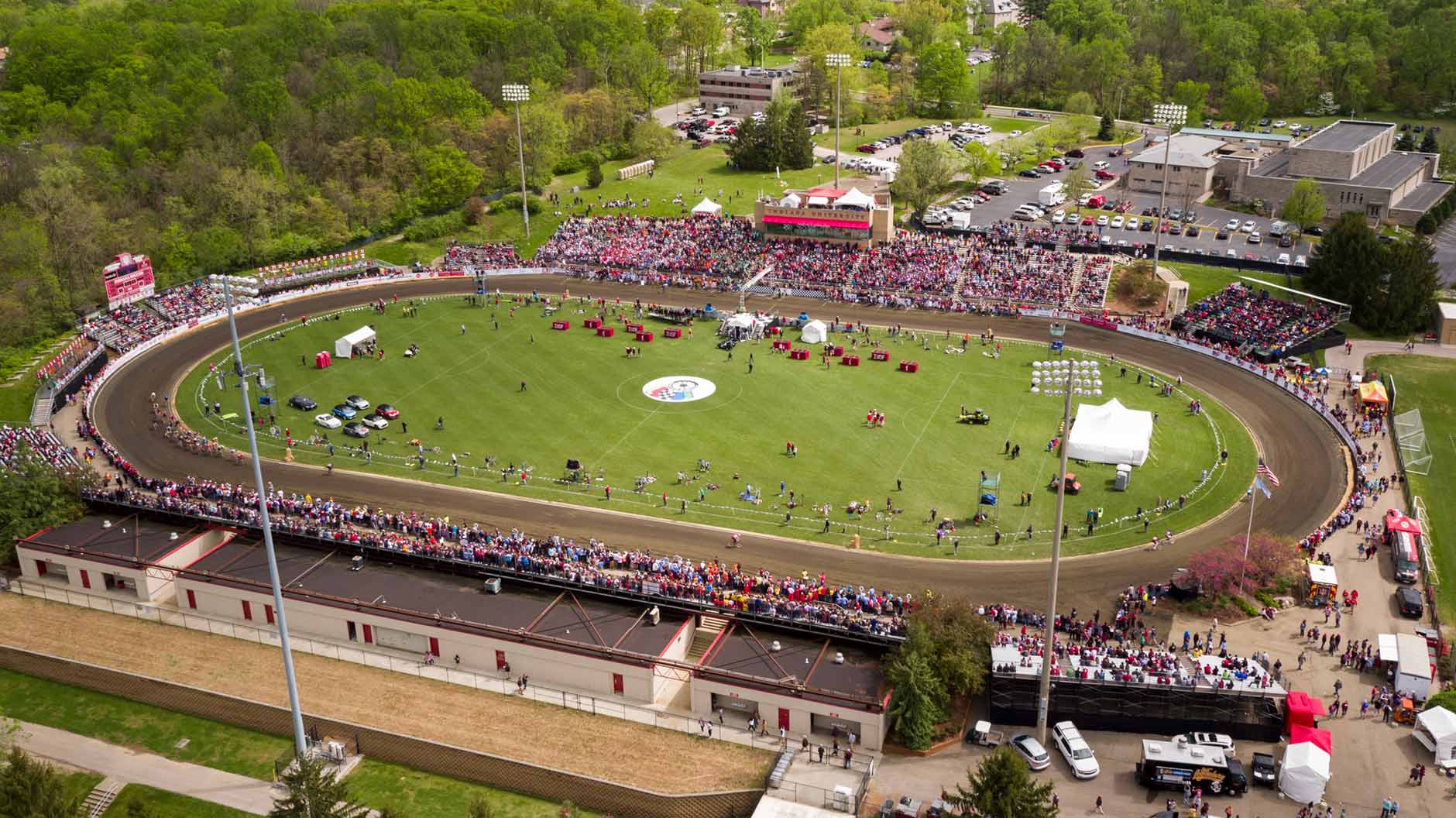
The original Memorial Stadium was a memorial to World War I, built in 1925, seating 20,000. Later known as Tenth Street Stadium, it hosted the Little 500 bicycle race, which was depicted in the 1979 cycling movie Breaking Away. It was demolished in 1982, and the Indiana University Arboretum is now on the site.
Tenth Street Stadium

Indiana's soccer program, founded in 1973, is one of the most successful college soccer programs in America. They've won 8 National Championships: In 1982, 1983, 1988, 1998, 1999, 2003, 2004 and 2012. They play at the 6,500-seat Bill Armstrong Stadium, named for the president of the Indiana University Foundation. It now hosts the Little 500 bicycle race, replacing Tenth Street Stadium. Armstrong appeared in Breaking Away as the race announcer. 1606 N. Fee Lane, to the east of Memorial Stadium and Assembly Hall.
IU is also known for its swimming program, long led by head coach James "Doc" Counsilman. A bomber pilot in World War II with a doctorate in physiology from the University of Iowa, he coached the Hoosier swim program from 1957 to 1990, including 6 straight National Championships from 1968 to 1973. Among those he coached was Mark Spitz, who went on to win 9 Olympic Gold Medals, setting the standard shattered by Michael Phelps.
Like Bob Knight, Counsilman competed at Ohio State before coaching at Indiana. Unfortunately, he was there during World War II, and he never got to compete in the Olympics, as they were canceled in 1940 and 1944. In 1979, at age 58, he set a record that still stands, as the oldest person to swim the English Channel. He lived until 2004, age 83.

The program is based at the Student Recreational Sports Center, at 1601 E. Law Lane, at the eastern edge of campus, between the main academic center and the athletic complex.
As you might guess, the most popular NFL team in Indiana is the Indianapolis Colts, except for the State's northwestern corner, aligned with the Chicago Bears; and its southeaster, aligned with the Cincinnati Bengals. The most popular NHL team is easily the Chicago Blackhawks, 233 miles to the northwest; neither the St. Louis Blues, 228 miles to the west, nor the Columbus Blue Jackets, 224 miles to the northeast, make much inroads.

Baseball is a little more complicated. An April 23, 2014 New York Times article -- written before the Chicago Cubs won the 2016 World Series, mind you -- showed that, among people in the Bloomington area who had a favorite baseball team, the Cubs were the favorite of 20 percent, the Cincinnati Reds 15, the Boston Red Sox 13, and the Yankees 12.

The Chicago White Sox and the St. Louis Cardinals, both of whom had won at least 1 World Series in the preceding 10 years and were considerably closer than the Yanks and Red Sox, didn't even register above 10 percent. (The Reds are 129 miles to the east, the Cardinals 227 miles to the west, the White Sox 228 miles to the northwest, the Cubs 239 miles to the northwest.)

The closest minor-league team to Bloomington is the Indianapolis Indians of the International League, winners of 10 Pennants, and playing at 12,230-seat Victory Field, at 501 W. Maryland Street at West Street in Indianapolis, 51 miles to the northeast.

Bloomington is home to the Eskenazi Museum of Art, at 1133 E. 7th Street; the Mathers Museum of World Cultures, at 416 N. Indiana Avenue; the Farmer House Museum, at 529 N. College Avenue; and the WonderLab Science Museum, at 308 W. 4th Street.

The Beatles never played a concert in Indiana. In addition to Assembly Hall, Elvis sang in the State on December 4 through 7, 1955 at the Lyric Theater, at 121 N. Illinois Street, in Indianapolis (a parking deck is on the site now); at the Fort Wayne Memorial Coliseum on March 30, 1957, June 12, 1972, and October 25, 1976; at Roberts Memorial Stadium in Evansville on June 13, 1972 and October 24, 1976; at the Notre Dame Athletic Center (now the Joyce Center) on September 30 and October 1, 1974 and October 20, 1976; at the Hulman Civic Center in Terre Haute on July 9, 1975; and at the Market Square Arena in Indianapolis on June 26, 1977, which turned out to be his last concert.

The tallest building in the State of Indiana is the Salesforce Tower, formerly known as the Bank One Tower and the Chase Tower, with a roof 700 feet high and spires rising to 830 feet. 111 Monument Circle.

William Henry Harrison, 9th President of the United States and former Territorial Governor (died just 1 month after his 1841 Inauguration), and his grandson, Benjamin Harrison, 23rd President (1889-1893), both lived in Indiana (as did Abraham Lincoln as a boy). But Grouseland, the house of William Henry, is 130 miles away in Vincennes. The site of his big battle, Tippecanoe, is just northeast of the Purdue campus in West Lafayette. The Benjamin Harrison Presidential Site is just north of downtown, at 1230 N. Delaware Street. Number 19 bus.

Only 4 TV shows are known to have been set in Indiana, 3 in Indianapolis. Close to Home and the U.S. version of the British hit Men Behaving Badly are best forgotten. But the CBS sitcom One Day at a Time, which aired from 1975 to 1984, and starred Bonnie Franklin and launched Mackenzie Phillips and Valerie Bertinelli to stardom, was groundbreaking: It was not only the first TV show to show a divorced single mother (rather than a widowed one), but it actually made Indianapolis seem like a fun place to be.

The other was Breaking Away, based on the bicycle racing movie of the same name. It was set in Bloomington, seat of IU, but filmed in Athens, Georgia, seat of the University of Georgia.

Other shows set in Indiana, but in fictional locations, have been Parks and Recreation in Pawnee, and the current hit Stranger Things in Hawkins. The Fugitive established the hometown of Dr. Richard Kimble (Dave Janssen) as Stafford, not far from South Bend, and the final episode, at the time of its August 29, 1967 airing the most-watched program in U.S. TV history, took place there, although the amusement park where the climactic scene took place was filmed in Southern California.

Movies set in Indianapolis are also rare. Some early scenes of Close Encounters of the Third Kind
were set there, before moving out to the iconic Devil's Tower National Monument in Wyoming. The 2015 cult hit The Fault In Our Stars was set there, but filmed in Pittsburgh.

Of course, the most famous movie set in Indiana is Hoosiers, which was filmed in the State, and whose climactic game, a dramatization of the 1954 State Final, was filmed at the actual location, Butler University's Hinkle Fieldhouse. In reality, Milan High School did defeat the much larger school, Muncie Central. But they had also been to the Final 2 years earlier (losing it), with some of the same players, so while it was an upset, it wasn't like Milan was a total unknown. An underdog, yes; a tremendous longshot, no.

*

Indiana is the most basketball-crazy State of them all. Their love of football also extends to the IU Hoosiers, as well as to the Purdue Boilermakers, the Notre Dame Fighting Irish, and the Indianapolis Colts. A visit to the IU campus in Bloomington could be not only fun, but a good chance for Rutgers to get a rare Big Ten road victory.

Saturday, November 5, 2016

RU Bad, EB Worse

The Rutgers football team lost today, blowing a lead at home to Indiana, 33-27. They are now 2-7.

Their next game is next Saturday at noon, away to Michigan State. They also fell to 2-7 today, losing away to Illinois. Somebody's got to win that game, right?

The East Brunswick football team lost last night, to New Brunswick, 35-21. It was our 1st loss to New Brunswick since 1965, the early days of our program.

That sounds very bad for New Brunswick, however, there are "only" 11 losses over those 51 years, as we stopped playing them in 1974 due to our enrollment soaring and theirs crashing. We have played them a couple of times since, including on Halloween Night in 2008.

They are now coached by Don Sofilkanich, a former EB lineman who was a year behind me at the school. He previously revived the fortunes of Shore Conference school Asbury Park. Maybe, instead of "Sof" (pronounced "soaf"), we should call him The Boss.

EB has 2 games remaining. The 1st is our "consolation game," a game the New Jersey State Interscholastic Athletic Association (NJSIAA) added a few years back for teams that don't qualify for the State Playoffs, against an opponent yet to be determined, but, for the sake of fairness,with an enrollment similar to ours and with a record similar to our 1-7, probably next Friday night, site to be determined (but if it's a school without lights, it will almost certainly be at our place).

The 2nd is our annual Thanksgiving beatdown from Old Bridge, the Purple Bastards. And it's at their shit pit at the intersection of Routes 9 & 516. Oy.

*

I will continue doing these through November 8, the latest date on which America's Election Day can fall.

November 5, 1605: Guy Fawkes, a Catholic fanatic, is arrested beneath the House of Lords at Britain's Parliament, for plotting to blow it up, taking with it the Protestant King James I, his wife Queen Anne, and his sons Prince Henry and Prince Charles. The idea was to place James' daughter, Princess Elizabeth, on the throne. She was just 9 years old, and would, under their order, be raised as, and be married to, a Catholic.

In hindsight, the plot was doomed to failure. The gunpowder was too damp: Lighting it would have had little effect, and aside from whoever lit it, nobody would have died. And if it had worked? Instead of the people of England rising up in celebration, the reaction would have been like America's after Pearl Harbor and 9/11, or after Britain's after the Brighton bombing of 1985 failed to kill Prime Minister Margaret Thatcher: A moment of fear, followed by righteous rage. The conspirators would not have lived to see Christmas, no matter what they did.

Although all the conspirators were caught and hanged, Fawkes is generally the only one remembered. Today, Britain chooses to "Remember, remember, the 5th of November, the gunpowder treason and plot," and it's known as Guy Fawkes Night, commemorated with fireworks and bonfires -- leading to its other name, Bonfire Night.

There are those, of course, who commemorate the plot, rather than its failure, but these are less Fawkes' fellow Catholic fanatics, and more people who don't like the government: Fawkes is often called "the only man ever to enter Parliament with honest intentions."

The 1982 graphic novel V for Vendetta features an antihero wearing a mask designed to look like Fawkes, and his attempt to take down a tyrannical government in a dystopian future (1997 in the book, 2038 in the film). The film based on it (with some considerable differences) It was supposed to be released on November 5, 2005, the 400th Anniversary, but after the London bombings of July 7 of that year, it was considered to be too soon, and it was pushed back to March 17, 2006 -- St. Patrick's Day.

Except, in both book and film, "V" got one big thing very wrong: The government Fawkes was trying to bring down was actually more tolerant toward his faith than the one that came before (under Queen Elizabeth I), while the one he wanted to impose would have been a faith-based dictatorship that would have brooked no dissent -- much like the one "V" was trying to bring down. Not the only inconsistency in the character.

What does Guy Fawkes or his Night have to do with sports? Not much, I just like the story, and the story that uses it.

*

November 5, 1869: The Cincinnati Red Stockings complete their 1st season as the 1st openly professional baseball team, going 65-0, and playing from coast (Boston) to coast (San Francisco), doing as much to spread the growth of the game than any other team had ever done.

Hail the Champions:

* Pitcher, Asa Brainard, from whose name we supposedly get the word "ace," a native of Albany, New York, 1841-1888.
* Center fielder and manager, Harry Wright, born in Sheffield, England, and grew up in New York, 1835-1895.
* 3rd baseman, Fred Waterman, Manhattan, 1845-1899.
* Left fielder, Andy Leonard, born in Ireland and grew up in Newark, 1846-1903
* 2nd baseman, Charlie Sweasy, Newark, 1847-1908
* Catcher, Doug Allison, Philadelphia, 1846-1916.
* Substitute, but mainly an outfielder, Dick Hurley, Honesdale, Pennsylvania, born in 1847, and history has lost track of him, the last record of him being in 1916.
* 1st baseman, Charlie Gould, the only one actually from Cincinnati, 1847-1917.
* Right fielder, Cal McVey, born in Montrose, Iowa and grew up in Indianapolis, 1849-1926,
* Shortstop, George Wright, Yonkers, brother of Harry, the last survivor, 1847-1937.

So it was a pair of Wright Brothers in southern Ohio who, essentially, invented professional baseball, just as another such air invented the airplane. Harry and George are in the Baseball Hall of Fame, 1 of only 2 pairs of brothers both in. The other is Paul and Lloyd Waner.

November 5, 1872: President Ulysses S. Grant is re-elected, defeating Horace Greeley, with 55 percent of the vote to 43, and 286 Electoral Votes.

This was a weird election. The Republican Party was split over the corruption in the Grant Administration (though Grant himself has never been accused of wrongdoing). A group of "Liberal Republicans" nominated Horace Greeley, publisher of the New York Tribune, formerly one of the nation's leading voices against slavery, briefly a Congressman in 1848-49, and one of the Party's founders in 1854.

Greeley favored Western expansionism, popularizing the slogan, "Go west, young man, and grow up with the country!" But he didn't come up with the words himself: John Babsone Lane Soule first used it in the Terre Haute Express in Indiana in 1851.

Greeley had long lambasted the Democratic Party as the party of slavery, but, not wanting to divide the opposition to the Republicans, they swallowed their pride, and also nominated Greeley. As a result, pretty much every attack that Greeley had hurled at the Democrats for a quarter of a century was hurled back at him, including that he supported racist policies, even the nascent Ku Klux Klan. In addition, his wife Mary got sick, and on October 12, he effectively stopped campaigning to be by her side. She died 5 days before the election, and he won only 6 States, all formerly slaveholding States: Maryland, Kentucky, Tennessee, Georgia, Missouri and Texas.

All this took a terrible toll on his own health, and he died at age 61 on November 29, before the Electoral Votes could be cast -- thus becoming the only person ever entitled to receive Electoral Votes for President, but unable to receive them.

Did I say the election was weird? Susan B. Anthony and Victoria Woodhull voted -- Anthony for Grant, Woodhull for herself, the 1st woman known to have run for President. Even if the million-to-one shot came in, and she won, she couldn't have served at first, anyway: She didn't reach the minimum age of 35 until September 23, 1873, over 6 months into the term.

Both were arrested on Election Day: Anthony for voting, and Woodhull for obscenity, for printing, in a magazine she and her sister Tennessee Claflin ran (the 1st women in America to do so -- and they were also the 1st to run a Wall Street brokerage firm), the story of the infidelity of the Rev. Henry Ward Beecher, yet another former abolitionist and yet another founder of the Republican Party. Ironically, Beecher had supported women's right to vote, but, though apparently a practitioner of free love, he denounced it in general, and Woodhull in particular, from his pulpit. That's why Woodhull was charged with obscenity (the story was sexual in nature), not with liberal (the story was true), and Beecher's reputation did not improve.

Woodhull was held in jail for a month, and released. She ran again in 1884 and 1892, with almost no notice. She moved to England with her 3rd husband, and died there in 1927, and was buried there. Beecher died in 1887. He and Greeley are both buried in Green-Wood Cemetery in Brooklyn, along with several early baseball stars.

*

November 5, 1873: Edwin Harold Flack is born in London, and grows up in Berwick, Victoria, Australia. He was Australia's 1st Olympian: The only person from the country selected for the 1896 Olympics in Athens, Greece. He became the 1st Gold Medalist in the 800 meters, and the 1st in the 1,500 meters. He was also a renowned tennis player, and lived until 1935.

November 5, 1891, 125 years ago: Alfred Earle Neale is born in Parkersburg, West Virginia. An outfielder, he played 8 seasons, batting .259, and won the World Series with the 1919 Cincinnati Reds, but it is football for which "Greasy" Neale is remembered.

He played professional football before there was an NFL, including as a player-coach, for some of the teams that would go on to found the League: The Canton Bulldogs in 1917, the Dayton Triangles in 1918, and the Massillon Tigers in 1919. He coached at the University of Virginia and West Virginia University, and in 1941 was named the head coach of the Philadelphia Eagles, leading them to 3 straight NFL Championship Games, winning in 1948 and 1949.

He retired after a disappointing 1950 season, and never coached at any level again. He died in 1973, having lived long enough to see himself elected to the College and Pro Football Halls of Fame.

*

November 5, 1904: Ralph Weiland (no middle name) is born in Seaforth, Ontario. In 1929, rookie center "Cooney" Weiland helped the Boston Bruins win their 1st Stanley Cup. He also helped them win the Cup in his last season, 1939, and coached them to another in 1941.

From 1950 to 1971, he was the head coach at nearby Harvard University. He was succeeded by Bill Cleary, who had played for him, and was 1 of 4 Harvard players on the U.S. team that won the Gold Medal at the 1960 Winter Olympics in Squaw Valley, California. (As in 1980, they beat the Russians, but not in the Final.)

He died in 1980. His uniform number, 7, is retired by the Bruins, but not for him: For Phil Esposito.

November 5, 1909: Frank Moss (no middle name) is born in Leyland, Lancashire, England. He was the goalkeeper for the Arsenal teams that won the 1933, 1934 and 1935 Football League titles.

On November 14, 1934, he was 1 of 7 Arsenal players to play for England (who, in those days, did not compete in the World Cup) against World Cup winners Italy at the Arsenal Stadium, a.k.a. Highbury. In a driving rain, and in one of the dirtiest games ever played, known as the Battle of Highbury, England won 3-2.

On March 16, 1935, Moss dislocated his left shoulder. There were no substitutes allowed in English soccer until 1966, so he switched positions with left wing Wilf Copping, and scored Arsenal's opener in a 2-0 win over Everton. But he was unable to play in Arsenal's 1936 FA Cup-winning run, and retired in 1937. He briefly managed Edinburgh team Heart of Midlothian, a.k.a. Hearts, but World War II led him to enlist. He survived the war, but never worked in sports again. He died in 1970, only 60 years old.

November 5, 1912: Woodrow Wilson is elected the 28th President of the United States. The Governor of New Jersey and the former President of Princeton University, he remains the only New Jersey-based politician ever to become President, although he was born in Virginia and raised in Georgia and South Carolina.

He wins because the Republican Party is split between the conservative wing, led by incumbent President William Howard Taft, and the progressive wing, led by former President Theodore Roosevelt, who believes that Taft and his allies have betrayed what he tried to do from 1901 to 1909.

It's actually a 4-way race, also including the Socialist Party nominee, labor union leader Eugene V. Debs. In the popular vote, it's Wilson 6.3 million, Roosevelt 4.1 million, Taft 3.5 million, and Debs 900,000. (Debs would slightly top that total when he ran while in prison in 1920, but with a lower percentage of the vote.) In popular vote percentage, it's Wilson 41.8, Roosevelt 27.4, Taft 23.2, Debs 6.0 -- meaning that, combined, the 2 Republicans got 50.6 percent, a majority, making Wilson a plurality President.

But it's Electoral Votes that matter. Wilson won 435, Roosevelt 88 (winning Michigan, Minnesota, Pennsylvania, South Dakota, Washington, and 11 of the 13 then available in California), Taft 8 (winning only Utah and Vermont -- Debs won 2 Counties in Minnesota and 1 in North Dakota, but no States).

Wilson won 40 of the 48 States then in the Union -- New Mexico and Arizona having gained Statehood that very year, and voting for President for the 1st time. The Republican split probably threw enough States to Wilson, including big ones like New York and Illinois, to give him between 200 and 300 Electoral Votes that he wouldn't ordinarily have won. In other words, given his experience and stances, he probably should have lost, if not in a landslide. But Taft's conservatism and TR's ego split the GOP, and Wilson got in.

November 5, 1916, 100 years ago: James Reubin Tabor is born in New Hope, Alabama. A 3rd baseman for the Boston Red Sox, on July 4, 1939 (while the Yankees were holding Lou Gehrig Day at Yankee Stadium), he hit 4 home runs and drove in 11 runs in a doubleheader win over the Philadelphia Athletics -- both remain single-day American League records.

His drinking short-circuited his career, to the point where the Sox hired private detectives to follwo him. He last played in the major leagues with the 1947 Philadelphia Phillies, and was part of the Southern abuse of Jackie Robinson when they played the Brooklyn Dodgers. He last played in the minor leagues in 1952, and died the next year, not yet 37 years old. 

November 5, 1936, 80 years ago: Uwe Seeler (no middle name) is born in Hamburg, Germany. The striker is the greatest player in the history of German soccer team Hamburger SV, having helped them win the national championship (pre-Bundesliga) in 1960 and the DFB-Pokal (German Cup) in 1963. He was the top scorer in the Bundesliga's 1st season, 1963-64, and later served as a club executive.

He played for West German in 4 World Cups, captaining them in the Final in 1966, losing to England in extra time. He is still alive. His daughter married a Turkish immigrant, and their son, Levin Öztunalı, is a 20-year-old midfielder for German club Mainz.

November 5, 1938: Rutgers Stadium opens in Piscataway, New Jersey, across the Raritan River from the Rutgers College (now Rutgers University) campus in New Brunswick. For the 1st time since they played the 1st college football game against each other in 1869 -- 69 years minus 1 day earlier -- Rutgers beats Princeton, 20-18.

Also on this day, César Luis Menotti is born in Rosario, Argentina. A forward, he started for hometown soccer team Rosario Central, but is better known as a manager. He led Huracán to the 1973 league title, and took Argentina to victory in the 1978 World Cup on home soil. There was controversy, but he has never been personally implicated in it. He also managed his country in the 1982 World Cup, and last managed in Mexico in 2007.

Argentina had a vicious fascist government when he won them the World Cup. In a 1982 interview, he explained that this was against his own views:

There's a right-wing football and a left-wing football. Right-wing football wants to suggest that life is struggle. It demands sacrifices. We have to become of steel and win by any method... obey and function, that's what those with power want from the players. That's how they create retards, useful idiots that go with the system.

November 5, 1940: President Franklin D. Roosevelt is elected to an unprecedented 3rd term as President. The Democrat defeats the Republican nominee, Wall Street lawyer Wendell L. Willkie, 449 Electoral Votes to 82, with 55 percent of the popular vote to 45.

Willkie wins only 10 States: His home State of Indiana, Colorado, Iowa, Kansas, Michigan, Nebraska, North Dakota, South Dakota, and the 2 States that FDR ended up never winning in his 4 runs, Maine and Vermont.

Gee, maybe running a conservative businessman as their nominee for President isn't a good idea for the Republican Party. After all, they did it before with Herbert Hoover. Alas, they would do it again with both George Bushes, and Mitt Romney. Well, at least they haven't nominated another conservative businessman with no political experience whatsoever, and who was once a registered Democrat, but is actually a womanizer whose stances are all over the map. Wait a minute... Okay, unlike Donald Trump, Wendell Willkie was sane, and loved his country more than he loves himself.

And yet, someone determined that if Roosevelt's percentage was dropped by a little more than 3 percent in a few key States, he still would have won the popular vote, but lost the Electoral Vote by the slimmest of margins. He essentially won because he won what were then the 16 most populous Counties in America, in the biggest of cities, including all 5 Boroughs of New York.

This split convinced liberals that they were the real America; but also convinced conservatives that the liberals only won because they got the votes of immigrants, Catholics, Jews, black people -- people who, in their minds, weren't wholly American; and, thus, they could also claim to be "the party of the real America."

To be completely honest, if it wasn't for the war raging in Europe and the threat of Adolf Hitler, FDR would not have run for a 3rd term. And, if he had, and had run only on his domestic record, the New Deal, which had eased the Great Depression tremendously but had still not produced prosperity after 7 1/2 years, he would have lost. And, had he retired after 2 terms, any other Democratic nominee, no matter what his experience, would not have had FDR's domestic or foreign record, and would have lost, even to an opponent as inexperienced as Willkie.


Top 5 Reasons You Can’t Blame Franklin Roosevelt for Running for a 3rd Term in 1940

5. He Was Allowed. There was no law to stop him. The Republicans put forward the 22nd Amendment, limiting Presidents to 2 terms, after he was dead.

4. He Loved the Job. He frequently said, "I love it!" Why should he give up a job he loved, presuming the human resources department (the voters) would let him keep it?

3. The Republican Field. Thanks to landslide losses in the Congressional elections of 1922, 1926, 1930, 1932, 1934 and 1936, they had no one who was a credible 33rd President of the United States.

2. The Democratic Field. Thanks to a landslide loss in the Congressional election of 1938, and FDR's mistrust of Vice President Jack Garner and Postmaster General Jim Farley, the Democrats didn't exactly have an obvious successor to FDR, either.

1. Adolf Hitler. He had to be stopped. And no one else, in either party, had the experience and the judgment to handle him.


November 5, 1946, 70 years ago: The Boston Celtics play their 1st home game at the Boston Garden. Only 4,329 fans attend, and it's delayed for an hour, because a Celtic player damaged a wooden backboard with a dunk during warmups. A new backboard was brought in from the Boston Arena (now Matthews Arena). The Celtics lose 57-55 to the Chicago Stags.

The Stags, and the original NBA teams of Washington, Toronto, Pittsburgh, Cleveland, Detroit and St. Louis would quickly fail. The Celtics might have as well, had their owner, Walter Brown, not also owned the Garden, the NHL's Bruins, and the Ice Capades. He was able to keep the team going long enough to hire Red Auerbach as head coach, and the rest is history.

Oh, the player who became the 1st NBA player to break a backboard? A 6-foot-5 Brooklynite out of New Jersey's Seton Hall University, who would play 1 game for the Dodgers in 1949, coming to bat once as a pinch-hitter, never playing the field for them. He then got traded to the Chicago Cubs, and played 66 games at 1st base for them in the 1951 season. The Cubs' top farm team at the time was the Los Angeles Angels of the Pacific Coast League. While playing in L.A., this athlete found off-season work as a stuntman, and, like John Wayne, moved from that to acting, mostly in Westerns. His name was Chuck Connors, famed for his portrayal of Lucas McCain, the lead character of The Rifleman.

*

November 5, 1952: William Theodore Walton III is born in the San Diego suburb of La Mesa, California. Bill Walton was a loner, Dottie. A rebel. Yet he wanted to play basketball for the best coach in the college game, John Wooden of UCLA. Wooden wanted him, too, and may have been the only coach who could make him fulfill his potential.

Together, they won the National Championship in 1972 and 1973, and forged an 88-game winning streak from 1971 to 1974 that remains the record for men's college basketball. (The University of Connecticut women's team broke the record with a 90-game streak, 2008-10.) He battled injuries during his pro career, but still won NBA Championships with the 1977 Portland Trail Blazers and the 1986 Boston Celtics.

He has since become an analyst on basketball broadcasts, and his son Luke Walton won 2 NBA Championships as a Los Angeles Lakers player, and is now their head coach, having assisted Steve Kerr on the Golden State Warriors' 2015 title.

Also on this day, Oleh Volodymyrovych Blokhin is born in Kyiv, Ukraine. His name usually written as Oleg Blokhin in English-language publications, the forward starred for Dynamo Kyiv, winning the Soviet Top League 8 times from 1971 to 1986, the Soviet Cup 5 times, and the European Cup Winners' Cup in 1975. That year, he won the Ballon d'Or as World Player of the Year.

He played for the Soviet Union in the 1982 and 1986 World Cups, and managed Ukraine in the 2006 World Cup and on home soil in Euro 2012.

November 5, 1963: Tatum Beatrice O'Neal is born in Los Angeles. The Oscar-winning actress and daughter of actor Ryan O'Neal, she has 2 connections to sports: Playing kid pitcher Amanda Whurlitzer in The Bad News Bears in 1976, and being married to tennis legend John McEnroe from 1986 to 1994. They had 3 kids, all now grown: Kevin, Sean and Emily.

Also on this day, Jean-Pierre Papin is born in Boulogne-sur-Mer, France. The forward helped Club Brugge win the Belgian Cup in 1986. With Olympique de Marseille, some of it as a teammate of the about-to-be-mentioned Abedi Pele, he won France's top division in 1989 (including the Coupe de France for a Double), 1990, 1991 and 1992. He was France's top scorer 5 straight seasons, from 1988 to 1992, and won the Ballon d'Or (Golden Ball) as World Player of the Year in 1991.

He then signed with Milan and won Serie A in 1993 and 1994. Ironically, he lost to Marseille in the 1993 Champions League Final, but Milan won it in 1994, beating Barcelona. He won the 1996 UEFA Cup with Bayern Munich. He helped France reach 3rd place in the 1986 World Cup, but arrived at the national team too late to win Euro 1984, and retired too soon to win the 1998 World Cup. He was named L'OM Player of the Century by the club's fans. He has since managed 4 French clubs, but is currently out of soccer.

November 5, 1964: Abedi Ayew is born in Kibi, Ghana. Known professionally as Abedi Pele, after the legendary Brazilian soccer player, the midfielder is the greatest player his country has ever produced. He helped Olympique de Marseille, a.k.a. L'OM, win France's top division in 1991, 1992 and 1993, reach the European Cup Final in 1991 (losing to Red Star Belgrade), and, in the tournament's 1st season under the name of the UEFA Champions League, win it in 1993 (defeating AC Milan).

He led Ghana to win the African Cup of Nations in 1982, but because they never qualified for the World Cup during his career, he never played in one. He now runs Nania FC in Ghana's 2nd division.

His brothers Kwame Ayew and Sola Ayew were also professional players. His sons Ibrahim (known as Rahim Ayew, playing for Gibraltar club Europa) and  André (known as Dede Ayew, and playing for West Ham United) represented Ghana at the 2010 World Cup. André and Jordan (Aston Villa) played in the 2014 World Cup.

November 5, 1966, 50 years ago: Mohammed Alí Amar is born in Ceuta, Spain. A Spaniard of Turkish descent, known professionally as Nayim, he was part of the La Masia youth program at Barcelona, and won the Copa del Rey (King's Cup) with them in 1988. He went to North London club Tottenham Hotspur, and won the FA Cup with them in 1991, filling in for their star Paul Gascoigne after "Gazza" wrecked his knee on a stupid tackle, the injury that would ruin his career.

Nayim went back to Spain, to Real Zaragoza, and helped them win the 1994 Copa del Rey. This qualified them for the 1994-95 UEFA Cup Winners' Cup, and they reached the Final in Paris, against the real North London club, Arsenal. With extra time winding down, and penalties looming, Nayim hit a 40-yard lob, and Arsenal goalkeeper David Seaman could do nothing about it. Zaragoza won 2-1. He is now their assistant manager.

Tottenham fans still sing Nayim's name, to tease Arsenal fans. They don't seem to grasp that his goal to win that trophy had absolutely nothing to do with them. Indeed, since that 1991 FA Cup win (in which "Spurs" beat Arsenal to reach the Final), Arsenal have won 15 trophies, Tottenham just 2. If you don't count the League Cup, the count becomes Arsenal 14, Tottenham 0. Nobody ever went broke by betting on Tottenham fans being stupid.

November 5, 1968: Eight years after losing one of the closest Presidential elections, former Vice President Richard Nixon wins one that's nearly as close. The Republican nominee wins 301 Electoral Votes, with 43.4 percent of the popular vote. With the incumbent, President Lyndon Johnson, having dropped out of the race, the Democratic Party nominated Vice President Hubert Humphrey, who won 191 Electoral Votes, with 42.7 percent of the vote. Former Governor George Wallace of Alabama ran a 3rd-party candidacy based on racism, crime and anti-Communism, and won 5 States (Alabama, Arkansas, Georgia, Louisiana and Mississippi, plus 1 Electoral Vote in Alabama) for 46 Electoral Votes, with 13.5 percent of the vote.

Nixon's popular vote advantage, not that it mattered, was just 512,000 votes. (He lost to John F. Kennedy by 118,000 votes in 1960.) Wallace did not win, but almost certainly threw to Nixon, the following States: Alaska, California, Delaware, Florida, Illinois, Kentucky, Missouri, New Jersey, North Carolina, Ohio, South Carolina, Tennessee and Wisconsin. That's 197 Electoral Votes. If Humphrey had gotten even 40 percent of those, 79, he would have won.
Nixon won because liberals, sadded over the assassination of Senator Robert F. Kennedy, disillusioned by the candidacy of Senator Eugene McCarthy, and by Humphrey's refusal to oppose LBJ on the Vietnam War sooner than his September 30 speech in Salt Lake City, mainly stayed home. Nearly as much as 2000, the 1968 Presidential election is proof that every vote counts.

*

November 5, 1970: Javier López Torres is born in Ponce, Puerto Rico. Known professionally as Javy López, the catcher was a 3-time All-Star for the Atlanta Braves. He reached the postseason with them 11 times, winning the National League Pennant in 1992, 1995 (also winning the World Series), 1996 (being named NL Championship Series Most Valuable Player) and 1999. He now works in the Braves' organization.

November 5, 1971: Robert Marc Jones is born in Wrexham, Wales. Wrexham? The right back practically killed 'em. He helped Liverpool win the 1992 FA Cup and the 1995 League Cup. He and his wife now run a chain of nursery schools, and works in their youth setup, where his son Declan is a trainee.

November 3, 1973: Johnny David Damon is born at Fort Riley, Kansas, where his father is stationed in the U.S. Army, and grows up in the suburbs of Orlando. He starred for 7 different teams, all in the American League. He led the AL in stolen bases in 2000, and was a 2-time All-Star. He appeared in the postseason with the Oakland Athletics in 2001, and with the Boston Red Sox in 2003, 2004 and 2005.

It was Damon who called the 2004 Sox "a bunch of idiots," giving them their tagline, and his grand slam in Game 7 of the 2004 AL Championship Series buried the Yankees and the alleged Curse of the Bambino, on the way to winning the World Series.

But, as did Babe Ruth, Wade Boggs, Roger Clemens and others before him, the Red Sox decided they no longer wanted him, and his contract was allowed to run out. The Yankees signed him, and he helped them reach the Playoffs in 2006 and 2007, and win the 2009 World Series. His double steal to foil the Philadelphia Phillies' shift led to the run that won Game 4, and was the defining play of that Series.

But the Yankees let him go, too, and he reached the postseason once more, with the 2011 Tampa Bay Rays. He will be eligible for the Baseball Hall of Fame in 2018, with a batting average of .284, 2,769 hits, 235 home runs, 408 stolen bases, and 2 World Series rings -- but no Gold Gloves. I don't think he quite has the stats to get in.

Like another recent Yankee outfield hero, Paul O'Neill, he has campaigned for Donald Trump. I'll forgive them on Wednesday.

On the same day as Damon, Alexei Valeryevich Yashin is born in Sverdlovsk, Russia. The center starred for the Ottawa Senators in the 1990s and the New York Islanders in the 2000s. He is now general manager of Russia's national women's hockey team. Speaking of women and hockey, he is the longtime partner of Carol Alt, the former supermodel who was once married to Rangers defenseman Ron Greschner.

November 5, 1974: Jerry Darnell Stackhouse is born in Kinston, North Carolina. In 1995, the guard led the University of North Carolina to the Final Four, and was named National Player of the Year. Although he left the team for the NBA early, he stayed at UNC and got his degree.

He was a 2-time NBA All-Star with the Detroit Pistons, and finished his playing career with the Nets in their 1st season in Brooklyn, 2012-13. He is now the head coach of Raptors 905, the Toronto Raptors' top farm team, in the Toronto satellite city of Mississauga, Ontario (hence "905," the Area Code). This puts him on the short list to be a future NBA head coach, especially of the Raptors.

November 5, 1976, 40 years ago: Oakland Athletics owner Charlie Finley trades his manager, Chuck Tanner, to the Pittsburgh Pirates for catcher Manny Sanguillen and $100,000. He says, "I'll trade a manager for a player anytime," but who's kidding who? He wanted the money.

This was a big mistake: After managing the A's, already having been broken up by Finley for the sake of money, to a 2nd place finish in his 1st season with them (after 5 years running the Chicago White Sox, including a near-division title in 1972), Tanner goes on to win the 1979 World Series with the Pirates, including Sanguillen, whom Finley had traded back.

I don't know if Tanner could have avoided the competitive meltdown the A's had in the late 1970s, but the A's surely would have been better off with him as field boss instead of Jack McKeon, Bobby Winkles, McKeon again, and finally Jim Marshall, before Finley hired Billy Martin for 1980 and sold the team, allowing them to rebound.

November 5, 1977: Richard Ian Wright is born in Ipswich, Suffolk, England. No relation to that other Ian Wright who played for Arsenal, his goalkeeping helped get hometown club Ipswich Town promoted to the Premier League in 2000. Afterward, Arsenal signed him as David Seaman's backup, and he won Premier League and FA Cup medals in 2002.

He continued to suit up until this past season, when, unable to get a single game for Manchester City ahead of Joe Hart for 4 years, he retired.

*

November 5, 1982: Bryan Allan LaHair is born outside Boston in Worcester, Massachusetts. A 1st baseman and right fielder, he played for the Seattle Mariners in 2008, and the Chicago Cubs in 2011 and 2012. He now plays in New Jersey, for the Somerset Patriots of the Atlantic League.

November 5, 1983: Juan Bautista Morillo is born in San Pedro de Macorís, Dominican Republic. A member of the Colorado Rockies' Pennant winners of 2007, he hasn't thrown a professional pitch since 2013.

November 5, 1984: Nicholas Alexander Folk is born in Hollywood, California. The kicker was a Pro Bowler as a rookie with the Dallas Cowboys in 2007. The Jets' kicker since 2010, he holds the career record for best extra-point percentage. He is also a New York Red Bulls' season-ticket holder, and a member of the fan group the Viking Army.

November 5, 1986, 30 years ago: Kasper Peter Schmeichel is born in Copenhagen, Denmark. The son of legendary Manchester United goalkeeper Peter Schmeichel, Kasper is the goalie for Leicester City, winning last season's improbable Premier League title. He played for Denmark in Euro 2012.

November 5, 1987: Ovinton J'Anthony Mayo is born in Huntington, West Virginia. The guard was a high school basketball sensation, and it seems that every major college coach wanted him. The stories of how O.J. Mayo and his family made coaches jump through hoops to get him have become legend.

He went to USC, and, like a famous football player at that school named O.J., wore Number 32. But he played only 1 season there, and turned pro. It didn't work out quite the way he hoped, as he spent 4 seasons with the Memphis Grizzlies, 1 with the Dallas Mavericks, and 3 with the Milwaukee Bucks.

This past July, he was banned from the NBA for life because of a drug violation -- not the first time he's had drug issues. He is eligible for reinstatement in 2 years -- meaning that, the next time he plays in the NBA, which would be late October 2018 at the earliest, he could be just short of turning 31, and probably very rusty. He may be done.

November 5, 1988: The expansion Miami Heat make their NBA debut, at the now-demolished Miami Arena. They probably thought that picking the Los Angeles Clippers as their 1st opponent would help.

Just as their arch-rivals, the Orlando Magic, will do a year later when they choose the Nets, the Heat chose wrong: The Clips win, 111-91. Dwayne "the Pearl" Washington comes off the bench to lead the Heat with 16 points, but the Clips get 22 from Ken Norman and 21 from Reggie Williams.

*

November 5, 1992: Odell Cornelious Beckham Jr. is born in Baton Rouge, Louisiana. Although he went to a private high school in New Orleans, the receiver returned to Baton Rouge to play at LSU. He is now in his 3rd season with the New York Giants. In each of his 1st 2, he was named an All-Pro.

Also on this day, Marco Verratti (no middle name) is born in Pescara, Italy. The midfielder led his hometown club Delfino Pescara to the title in Italy's Serie B (and thus promotion to Serie A) in 2012. That got the attention of Paris Saint-German. In his 1st 4 seasons with them, he has led them to win France's Ligue 1 all 4 times, and the Coupe de France (and thus a Double) in the last 2. He played for Italy in the 2014 World Cup, but missed Euro 2016 due to injury.

November 5, 1994: A 45-year-old overweight minister wins the Heavyweight Championship of the World. It doesn't sound possible. It is, when it's George Foreman.

Wearing the same trunks he wore 20 years minus a week earlier, when he lost the title to Muhammad Ali, Big George knocks Michael Moorer out in the 10th round at the MGM Grand Garden in Las Vegas. He thus breaks Jersey Joe Walcott's record as oldest Heavyweight Champion (38).

He doesn't hold the title for long, as organizational shenanigans beyond his control forced him to give it up. But he had made his point. Today, who remembers the guys who made George Foreman give up the title (except for Ali)? Ah, but everybody remembers George, and everybody likes George. Which was not the case the first time around: After retiring from boxing in 1977, he totally changed his life, and became a different and better person.

November 5, 1995: The expansion Vancouver Grizzlies make their NBA debut, at the new General Motors Place (now the Rogers Arena). They win their premiere, beating the Minnesota Timberwolves 100-98. Christian Laettner scores 26 for the T-Wolves to lead all scorers, but the Grizz get 18 off the bench from ex-Laker star and future Net head coach Byron Scott, 17 from ex-Knick Greg Anthony, and 16 from James "Blue" Edwards.

The Grizzlies never make the Playoffs in Vancouver, and they move to Memphis in 2001. The NBA has shown no indication that they will give the city a 2nd team.

November 5, 1996, 20 years ago: President Bill Clinton is re-elected, winning 379 Electoral Votes to Senate Majority Leader Bob Dole's 159. Clinton wins 49.2 percent of the popular vote, while Dole wins 40.7, and Reform Party candidate Ross Perot wins 8.4 percent but no Electoral Votes.