Showing posts with label metropolitan stadium. Show all posts

Sunday, December 28, 2025

December 28, 1975: The Cowboys' Hail Mary, Full of Disgrace

December 28, 1975, 50 years ago: The Minnesota Vikings host the Dallas Cowboys in an NFC Divisional Playoff game at Metropolitan Stadium, in the Minneapolis suburb of Bloomington, Minnesota. Each team had dominated, and would continue to dominate, its respective Division through the 1970s: The Vikings, the NFC Central; the Cowboys, the NFC East. The Cowboys had lost Super Bowl V and won Super Bowl VI; the Vikings had lost Super Bowls IV, VIII and IX, and were going for their 3rd straight NFC Championship.

The game's 1st half was relatively quiet, with only one score, a touchdown by the Vikings in the 2nd quarter that made it 7-0. The Cowboys tied it with a touchdown in the 3rd quarter. So the game was dominated by each team's defensive unit, the Cowboys' "Doomsday Defense" and the Vikings' "Purple People Eaters."

Early in the 4th quarter, Toni Fritsch, the Cowboys' Austrian-born placekicker, kicked a 24-yard field goal, and they led 10-7. But quarterback Fran Tarkenton, named the NFL's Most Valuable Player that season, led a touchdown drive that gave Minnesota a 14-10 lead with 5:24 left in regulation.

The Cowboys could not gain a 1st down on their next drive, so the Vikings got the ball with 3:12 left. With Tarkenton as a running quarterback, known as "Fran the Scrambler" -- as was the Cowboys' Roger Staubach, a.k.a. "Roger the Dodger" -- the Vikings kept the ball on the ground to run out the clock, forcing the Cowboys to use up all their timeouts.

But on a 3rd & 2 play, Charlie Waters sacked Tarkenton for a 3-yard loss, with the clock stopping for the 2-minute warning. Tarkenton later said, "That play cost us the game. It wasn't the Hail Mary pass. We had the game in control, but didn't make the play."

The Vikings punted, and the Cowboys got the ball back on their 15-yard line, with 1:51 left, and no timeouts, including the already-used 2-minute warning. Staubach got to the Cowboys' 31, then took a low snap and fumbled it, resulting in a 4th & 16 from the 23. He threw a pass to Drew Pearson, who was pushed out of bounds by Nate Wright before he caught it. Under the rule of the time, this counted as a reception. The rule was changed in 2008. The rule might not have been fair, but it was in place.

Staubach got the Cowboys to the 50-yard line with 32 seconds left. Staubach threw a long pass, usually called a "bomb" in those days. Being Catholic, he called it a "Hail Mary," putting that expression into the football lexicon.

The pass was intended for Pearson, who was again covered by Wright. Pearson pushed Wright, which should have resulted in a penalty for offensive pass interference. No penalty was called, and Pearson caught the pass, and took it in for a touchdown. The Cowboys led, 17-14.

To make matters worse for Tarkenton, he found out that his father -- named, with retroactive irony, the Reverend Dallas Tarkenton -- died while watching the game on television, back in their hometown of Athens, Georgia.

The Cowboys went on to beat the Los Angeles Rams for the NFC Championship, before losing Super Bowl X to the Pittsburgh Steelers. The Vikings rebounded to win the NFC Championship the next year, but lost Super Bowl XI to the Oakland Raiders. That made them 0-4 in Super Bowls, a total that would later be matched by the Denver Broncos and the Buffalo Bills. Through the 2021 season, the Vikings haven't even been to a Super Bowl since 1977. The Bills are still 0-4, but the Broncos have improved to 3-5.)

Viking fans have had to put up with a lot, but they still fume over the penalty that was not called on Staubach's pass. It wasn't a "Hail Mary, full of grace": It was full of disgrace. It remains the most infamous moment in the history of sports in the State of Minnesota.

The question needs to be asked, though: What if the penalty had been called? The Cowboys could still have won the game, anyway. Not for nothing was Staubach known as "Captain Comeback." And if the Vikings still won? They would have had to face the Rams in the NFC Championship Game, in Los Angeles. And if they'd won that, they would have had to face the Steel Curtain.

In this counterfactual scenario, I don't like their chances. They went to 4 Super Bowls between the seasons of 1969 and 1976, and they weren't the better team in any of them, and lost them all. So maybe their grievance over this game is bigger than it should be.

In hindsight, though, Pearson paid a price: It took until 2021 for him to be elected to the Pro Football Hall of Fame, his 33rd year of eligibility. For years, fans have speculated that there is a general bias against the Cowboys for the Hall: Mel Renfro had to wait 14 years; Rayfield Wright, 22 years; Bob Hayes, 30 years (and died before being elected); Cliff Harris, 36 years; Chuck Howley, 45 years.

Some are still waiting to get in: Don Meredith and Don Perkins have been eligible since 1974 (and both are dead), Lee Roy Jordan since 1981, Charlie Waters since 1987, Jay Novacek since 2001, and Darren Woodson since 2010. Howley was elected in 2023, his 45th year of eligibility. He was 86 years old, but at least he was still alive. Jordan died earlier this year.

In Pearson's case, it seemed as though the statistical case was there: 489 receptions, 7,822 yards, 48 touchdowns, all big numbers for a 1970s receiver. It was widely believed that one play was keeping him out: Nobody had ever punished the Cowboys for this unfair result, so the Hall voters punished Pearson as an individual. Regardless, he is in now. And, unlike Hayes -- and the still-not-in Meredith, Perkins and Jordan -- he lived long enough to see it.

Tuesday, October 14, 2025

October 14, 1965: The Mystique of Sandy Koufax

October 14, 1965, 60 years ago: A World Series loaded with storylines comes to a classic end.

After surviving a long and hard National League Pennant race with their arch-rivals, the San Francisco Giants, the Los Angeles Dodgers were in the Series for the 3rd time in the last 7 seasons. If you count their time in Brooklyn, it had been 9 times (with 3 other near-misses) in 19 years.

Although 2-time former batting champion Tommy Davis had been injured for most of the season, they still had the premier base thief of the era, Maury Wills, the starting pitching tandem of lefthander Sandy Koufax and righthander on Drysdale, and an exceptional defense. It surprised no one that they were back in the Fall Classic.

But the American League Champions were a surprise, because they were not the New York Yankees. For various reasons, the team that had won 29 of the last 44 AL Pennants, including the last 5, had collapsed, falling to 6th place.

After a few years of improvement, the Minnesota Twins, who had been the Washington Senators until 1960, surged to 1st place. Although their main slugger, Harmon Killebrew, had an injury-plagued season that kept his power stats down, they also had power in Bob Allison and Don Mincher, their own 2-time batting champion in Tony Oliva, and their own Wills equivalent in shortstop Zoilo Versalles.

"Zorro" batted .273, and led the AL in total bases, doubles, triples and runs scored -- but also in strikeouts -- and finished 2nd to Oliva in hits. He added 19 home runs and 77 RBIs from the leadoff spot in the order. He was also awarded a Gold Glove. Versalles and Koufax were named their respective Leagues' Most Valuable Players.

For the Twins franchise, it was their 1st Pennant since 1933, as the Senators, and they were seeking their 1st World Series since 1924. The Minneapolis Millers of the American Association had won a Pennant as recently as 1958.

It was a bitter reality for Senators fans, who lost their team because owner Calvin Griffith was not only a cheapskate, but a racist, who wanted to move from a majority-black city to one with hardly any black people. (That has since changed, tremendously.) An expansion team named the Washington Senators replaced them, but was terrible, and became the Texas Rangers for the 1972 season. To make matters worse, the Twins' Pennant-clinching game was against the "New Senators." The Washington Nationals finally came along in 2005, and won a World Series in 2019.

The Dodgers were favored, due to their pitching and their overall experience. But they had a problem: Game 1 was scheduled for October 6. On the Jewish calendar, that coincided with Yom Kippur, the Day of Atonement, the faith's holiest day. And Koufax was Jewish.

It doesn't fall on the same day of the Christian calendar every year. In 1934, it fell on September 19, and the Detroit Tigers had a key game on that date, and their biggest star, Hank Greenberg, sat it out. The Tigers ended up winning the Pennant, anyway. But Koufax told manager Walter Alston that he wouldn't pitch Game 1. So it would be Drysdale instead, starting against a black pitcher, Jim "Mudcat" Grant.

October 6, 1965: In Britain, serial killer Ian Brady was arrested for murder in Manchester. His accomplice, Myra Hindley, was arrested 5 days later. Steve Scalise, later elected to Congress from Louisiana, was born.

The 1st World Series game ever played in Minnesota got underway at Metropolitan Stadium, selected for a site in suburban Bloomington because it was roughly the same distance from downtown Minneapolis and downtown St. Paul, and the Twins wanted to pander to both of the "Twin Cities" by not offending either one.

The Dodgers' Ron Fairly opened the scoring with a home run in the top of the 2nd inning. But Mincher hit one to tie the game in the bottom of the 2nd. And the bottom dropped out on Drysdale in the bottom of the 3rd. He gave up 6 runs on 6 hits, including a 3-run homer by Versalles, plus a walk and an error. When Alston came to the mound to take him out, he said, "I bet you wish I was Jewish, too!" Meaning, that he wasn't available to have such a bad outing. In contrast, Grant cruised after the Mincher homer, going the distance, and the Twins won, 8-2.

October 7, 1965: The Soviet Union announced that their probe, Lunik 7, had landed on the Moon. What they didn't say was that it landed so hard, it was destroyed, and was unable to send any information back to Earth. British intelligence picked this up, and told the NATO alliance, including the U.S.

The refusal to pitch on Yom Kippur raised Koufax from the level of a superstar to that of an all-time Jewish-American icon. But the extra day of rest did neither him nor the Dodgers any good. He and Twins starter Jim Kaat traded goose eggs until the bottom of the 6th, but an error by Wills to start that inning opened the door to 2 Minnesota runs. The teams traded runs in the 7th, and Kaat helped his own cause with a 2-RBI single in the 8th. The Twins won, 5-1.

The Series went west, and the Twins had a 2-0 lead, and they had already beaten Koufax and Drysdale once each. Their confidence was at an all-time high.

October 8, 1965: A travel day in the Series. The International Olympic Committee accepted West Germany and East Germany as separate nations, to present separate teams starting in 1968. They would continue to do so through 1988.

The Post Office Tower, now the BT Tower, opened in London. At 619 feet, it was then the tallest structure in the United Kingdom.

President Lyndon B. Johnson ended Bethesda Naval Medical Center, in the Washington suburb of Bethesda, Maryland, for surgery to remove his gall bladder. He stayed for 2 weeks, and upon his return to the White House, enjoyed showing the White House press corps his scar. In 2022, my mother, who was then older than LBJ lived to be, had her gall bladder removed. She was released 2 days later.

October 9, 1965: At a nursing home in Seriate, Italy, 8 elderly women died, and another 7 were seriously injured, after all 15 had been given seemingly routine injections of a "heart tonic" as part of their regular treatment. The deaths all happened within 2 hours after they were given the shots. No cause was ever found, and no one was ever punished for the deaths.

The Dodgers were desperate. They had the home crowd behind them, but they would be facing Twins pitcher Camilo Pascual. If Koufax had the best curveball in the NL at the time, then Pascual had the best one in the AL.

But John Roseboro singled home 2 runs in the bottom of the 4th, Lou Johnson doubled 1 home in the 5th, Wills doubled 1 home in the 6th, and Claude Osteen pitched a 4-hit shutout. The Dodgers won, 4-0, and were back in the Series.

October 10, 1965: A 24-day strike by New York City's newspapers ends. However, it will end up being the final blow for the New York Herald-Tribune (a.k.a. The Trib), the New York Journal-American, and the New York World-Telegram & Sun (a.k.a. The World-Telly). All would fold the following Spring, leaving The New York Times, the Daily News, and the New York Post.

Actor Chris Penn was born. He became an actor, like his brother, Sean Penn, but never achieved the same level of notoriety, and died of heart disease in 2006.

The starters for Game 4 would be the same as those of Game 1. This time, the Dodgers got to Grant early, scoring a run in the 1st and another in the 2nd. Killebrew and the Dodgers' Wes Parker traded home runs in the 4th. Oliva hit a home run in the 6th, but the Dodgers answered right back, chasing Grant with 3 runs. Johnson added a homer in the 8th.

Drysdale was on his game, going the distance and striking out 11. The Dodgers won, 7-2, to tie the Series. And Koufax would be pitching Game 5. True, he would have only 3 days' rest, but so had Drysdale.

October 11, 1965: Dorothea Lange, who documented the effects of poverty during the Great Depression through her photography, including the iconic 1936 photo Migrant Mother, died at the age of 70. And the Indianapolis Times, a newspaper founded in 1888, published its last issue.

Pitching through pain, Koufax allowed just 4 hits and 1 walk, striking out 10. Kaat didn't make it out of the 3rd inning. In the 7th, Koufax himself had an RBI single off Jim Perry. The Dodgers won, 7-0, and now led the Series 3-2.

The Twins' sky-high confidence had vanished in 3 days. However, they would be going home, where they had already beaten the Dodgers twice. And if they won Game 6, they would have to face either Drysdale on 3 days' rest or Koufax on 2 in Game 7, so they liked their chances.

This was also (probably) the day on which Orlando Hernández Pedroso was born in Villa Clara, Cuba. "El Duque," brother of fellow pitcher and fellow Cuban escapee Livan Hernández, pitched for the 2 most demanding bosses in the Western Hemisphere: Fidel Castro and George Steinbrenner. He won 4 World Series: 1998, 1999 and 2000 with the Yankees, and 2005 with the Chicago White Sox.

October 12, 1965: Another travel day in the Series. Hirokazu Yasuhara, the Japanese video game designer who created Sonic the Hedgehog, was born.

October 13, 1965: Grant pitched on just 2 days' rest, and he was fine. He went the distance, allowed just 1 run, a homer by Fairly in the 7th, and hit a home run of his own in the 6th. Allison hit a home run in the 4th, and the Twins won, 5-1. The Series was going to a Game 7.

Twins manager Sam Mele decided to start Jim Kaat for the 3rd time. Alston decided to skip over Drysdale and go with Koufax. Both men would be going on 2 days' rest. The difference was, Kaat had been knocked out of Game 5 early. Koufax had pitched a complete game.

What's more, the circulatory issue in his left arm, which would lead him to retire after 1 more season, made throwing his amazing curveball too painful. He was going to the mound with everybody in the ballpark, including the Twins' hitters, knowing that he was going to throw a fastball on every single pitch.

And the Twins had a good lineup, and The Met was a hitter-friendly ballpark. And, so far, every game in the Series had been won by the home team.

October 14, 1965, 60 years ago: American poet Randall Jarrell was hit by a car in Chapel Hill, North Carolina, and died. He was only 51 years old, and had been prescribed heavy drugs due to depression. And Steve Coogan, the British comedian famous for playing inept newscaster Alan Partridge, was born in the Manchester suburb of Middleton.

Jim Gilliam singled for the Dodgers in the top of the 1st, but it came to nothing. With 2 outs in the bottom of the 1st, Koufax walked Oliva and Killebrew, but struck Earl Battey out to end the threat. The Dodgers began the top of the 3rd by Roseboro hitting a double, Koufax drawing a walk, and both men advancing on a groundout by Wills. But neither Gilliam nor Willie Davis (no relation to the injured Tommie) could bring them around. Versalles singled with 1 out in the bottom of the 3rd, but did not score.

The top of the 4th began with Johnson hitting a home run, Fairly a double, and Parker a single. Down 2-0, Mele took Kaat out, and replaced him with Al Worthington. He ended the threat, but, essentially, the game was over. In spite of his pain, Koufax sent the Twins down 1-2-3 in the 4th. With 1 out in the 5th, he allowed a double to Frank Quilici and a walk to Rich Rollins, but got out of it.

The Dodgers got 2 men on in the 6th, and 2 more in the 7th, but none of them scored. Koufax sent the Twins down 1-2-3 in the 6th, the 7th, and the 8th. In the 9th, he got Oliva to ground out, but Killebrew singled to left. That brought the tying run to the plate with only 1 out. Koufax must have been in agony at this point. But he struck Battey out on 3 pitches. With a 2-2 count, he struck Allison out to end it. Dodgers 2, Twins 0. The Dodgers were the World Champions, and Koufax accepted handshakes -- with, of course, his pain-free right hand.

He had thrown 122 pitches to 33 batters. He allowed no runs on 3 hits and 3 walks striking out 10. The game was still in doubt when he threw his last pitch.

For the 2nd time, the 1st in 1963, Sandy Koufax was named the Most Valuable Player of the World Series. This was after he had refused to pitch on his religion's holiest day. Whatever he had to atone for, refusing to pitch on that day was not part of it.

Would his place in history actually be higher if he had lost Game 7, and his refusal to pitch on Yom Kippur had cost the Dodgers the World Series? It would have been a point of pride for some American Jews, and for people of any faith who like to say, "It's only a game" (or "It's just a game").

Instead, in spite of how much it hurt, he got to have it all: He was true to his faith, he was true to himself, and he got the job done for his team. Because of this, Sandy Koufax is one of the few baseball players ever who can truly be said to have had a "mystique."

The Dodgers won the Pennant again in 1966, but lost the World Series to the Baltimore Orioles. Koufax then bowed to the pain and retired, just short of turning 31. Three years after that, Drysdale also had to retire due to injury, only 33. The Dodgers went into rebuilding mode, and began building a team that won 5 Pennants and a World Series between 1974 and 1981 -- and then, with another rebuild, made it 8 Division titles, 6 Pennants and 2 World Series between 1974 and 1988.

The Minnesota Twins would fall just short of the Pennant in 1967, and win the newly-created AL Western Division in 1969 and 1970, but lose the AL Championship Series both times. In 1982, they and the NFL's Minnesota Vikings left Metropolitan Stadium for the Metrodome in downtown Minneapolis. The Twins won the World Series in 1987 and 1991. Each time, they won all their home games, and lost all their away games. To this day, the Twins' all-time record in World Series games is 0-9 on the road, but 11-1 at home. The only loss was 1965 Game 7.

There are 5 members of the 1965 Dodgers who are still alive, 60 years later. Koufax, 1st baseman Wes Parker and 2nd baseman Dick Tracewski played in Game 7. On the roster, but not playing in that game, were 2nd baseman Jim Lefebvre and pitcher Claude Osteen.
Sandy Koufax, throwing out a ceremonial first ball
in the 2018 World Series

Playing for the Twins in this game, and still alive, are 5 men: Right fielder Tony Oliva, center fielder Joe Nossek, and 3 pitchers named Jim: Jim Kaat, Jim Merritt and Jim Perry. Also on the roster and still alive: 1st baseman Rich Reese, 2nd baseman Bernie Allen, 3rd baseman Frank Kostro, center fielder Jimmie Hall, right fielder Andy Kosco, catcher John Sevchik, and pitchers Camilo Pascual, Al Worthington, Dick Stigman, Bill Pleis, Jerry Fosnow, Pete Cimino and Garry Roggenburk. So, 18 players.

Worthington is 1 of 6 surviving former New York Giants. Roggenburk, along with the late Rich Rollins and Don Mincher, and the late Dodger Tommy Davis, would play for the ill-fated 1969 Seattle Pilots.

Koufax is also 1 of the last 4 living former Brooklyn Dodgers, and the last survivor of their 1955 World Series winners. If he makes it to December 30, he will be 90 years old.

He shares that birthday with:

* From sports: Baseball players Frank Torre, A.J. Pierzynski; football players Jim Marshall, Mel Renfro and Carson Wentz, and executive Ron Wolf; basketball players Steve Mix, Kenyon Martin and LeBron James; hockey pioneer Lester Patrick; soccer stars Gordon Banks, Berti Vogts, Charlie Nicholas; boxer Laila Ali (daughter of Muhammad Ali); disgraced sprinter Ben Johnson; and, if you count golf as a sport, which I don't, Eldrick "Tiger" Woods.

* From show business: Authors Rudyard Kipling and Douglas Coupland; actors Joseph Bologna, Russ Tamblyn, Fred Ward, Daniel Sunjata; actresses Jeannette Nolan, Concetta Tomei, Patricia Kalember, Sheryl Lee Ralph, Tracey Ullman, Eliza Dushku, Kristin Kreuk and Caity Lotz; TV director James Burrows; singers Bo Diddley, Skeeter Davis, Del Shannon, Paul Stookey (of Peter, Paul & Mary), Michael Nesmith and Davy Jones of The Monkees, Patti Smith, Jeff Lynne, Suzy Bogguss, Tyrese Gibson, Ellie Goulding, and Kim Tae-hyung (a.k.a. V of BTS); Miss America Pageant host Bert Parks;  rock musician and producer Felix Pappalardi; and TV journalists Meredith Vieira and Matt Lauer. And, sort of, "Hollywood Madam" Heidi Fleiss.

* And from politics: Coca-Cola founder and Atlanta Mayor Asa Griggs Candler, New York Governor and 1928 Democratic Presidential nominee Alfred E. Smith, Japanese general and war criminal Hideki Tojo, Fox News host Sean Hannity, and former Secretary of State Mike Pompeo.

Monday, December 26, 2016

How Long It's Been: The Minnesota Vikings Reached a Super Bowl

December 26, 1976, 40 years ago: The Minnesota Vikings, a.k.a. the Purple People Eaters, beat the Los Angeles Rams 24-13 at Metropolitan Stadium in Bloomington, Minnesota, and win their 4th NFL/NFC Championship in the last 8 seasons.

They advanced to Super Bowl XI, where they lost to the Oakland Raiders, 32-14. They fell to 0-4 in Super Bowls, having also lost Super Bowl IV to the Kansas City Chiefs, Super Bowl VIII to the Miami Dolphins, and Super Bowl IX to the Pittsburgh Steelers.

Like the ancient Israelites, the Vikings have now been in the wilderness for 40 years -- and even before that, they didn't go all the way. The 2016 season is the franchise's 56th, and while they are on target to make the Playoffs again, they have never, not even once, gone as far as the rules allowed them to go.

Even in 1969, the last year of the pre-merger National Football League, they were NFL Champions, but they were not World Champions, having lost Super Bowl IV. That means that, while they have won an NFL Championship more recently than the Cleveland Browns (1964), the Philadelphia Eagles (1960), the Detroit Lions (1957) and the Cardinals (the current Arizona franchise won it in Chicago in 1947), those teams have won World Championships, while the Vikings have not.

It's been 40 years since the Vikings even reached a Super Bowl. How long has that been?

*

What the team in question was like then.

The Vikings were coached by Harry "Bud" Grant, who is still alive at age 89. They featured quarterback Fran Tarkenton, center Mick Tinglehoff, offensivle tackle Ron Yary, defensive ends Jim Marshall and Carl Eller, defensive tackle Alan Page, and safety Paul Krause. Each of these 8 men is in the Pro Football Hall of Fame. They, running back Chuck Foreman, linebacker Matt Blair and team "medical adviser" Fred Zamberletti are in the Vikings' Ring of Honor.

Metropolitan Stadium, home of the Vikings and Twins at the time, has been torn down. So has the neighboring Metropolitan Sports Center, home of the NHL's North Stars. Both have been replaced by the Mall of America. The Metrodome, which became the home of the Vikings and Twins in 1982, has also been torn down, and the Vikings' new home, U.S. Bank Stadium, was built on the site. The North Stars have moved, and been replaced by the Wild. The NBA's Timberwolves have also begun play.

Only 6 NFL stadiums in use in 1976 were in use in the 2016 season: The Los Angeles Memorial Coliseum, Lambeau Field in Green Bay, Arrowhead Stadium in Kansas City, Rich Stadium (now New Era Field) outside Buffalo, and, for the moment, the Oakland Coliseum and San Diego Stadium (now Qualcomm Stadium).

The NFL had 26 teams. There was one in Baltimore, but it was the Colts, not the Ravens. There was one in Houston, but it was the Oilers, not the Texans. The Los Angeles Rams and Oakland Raiders have moved, and moved back. The Colts, the Oilers/Titans, the original Cleveland Browns, and the St. Louis football Cardinals have all moved. There had not yet been a team in the States of North Carolina, Tennessee, Indiana and Arizona. There are now.

The Raiders, Rams, Pittsburgh Steelers, San Francisco 49ers, Washington Redskins, Chicago Bears, New York Giants, Tampa Bay Buccaneers, New Orleans Saints and Seattle Seahawks had yet to win their 1st Super Bowl. The Rams, Steelers, Bears, Giants, Oilers/Titans, Buccaneers, Saints, Seahawks, Denver Broncos, Philadelphia Eagles, San Francisco 49ers, Cincinnati Bengals, New England Patriots, Buffalo Bills, San Diego Chargers, Atlanta Falcons and St. Louis/Arizona Cardinals had yet to reach their 1st Super Bowl. Each of these achievements has since been reached. Hell, the Bucs had gone 0-14 in 1976, their 1st season, so they had yet to win their 1st game.

NFL team founding owners George Halas of the Bears, Art Rooney of the Steelers, George Preston Marshall of the Redskins and Earl "Curly" Lambeau of the Green Bay Packers, were still alive. Halas and Rooney were still running their teams. Charter (1963) inductees to the Pro Football Hall of Fame Halas, Lambeau, Red Grange, Sammy Baugh, Dutch Clark, Red Grange, Mel Hein, Cal Hubbard, Don Hutson, John "Johnny Blood" McNally and Bronko Nagurski were still alive.

Joe Namath and O.J. Simpson were painfully running out the string. Roger Staubach was the NFL's defining player on offense, Mean Joe Greene on defense. Walter Payton was in his 2nd season. Ron Jaworski and Joe Montana were in college. Ray Lewis was a year and a half old. Peyton Manning was 9 months old. Tom Brady, Drew Brees, Tony Romo, Eli Manning, Troy Polamalu, Ben Roethlisberger and Aaron Rodgers weren't born yet.

Current Giants head coach Ben McAdoo wasn't born yet, either. John Hynes of the Devils was a year old. Kenny Atkinson of the Nets was 9, Jack Capuano of the Islanders was 10. Todd Bowles of the Jets, Joe Girardi of the Yankees and Jeff Hornacek of the Knicks were in junior high school. Alain Vigneault of the Rangers was in high school. Terry Collins of the Mets was managing in the Pittsburgh Pirates' minor-league system.

The Steelers, the Cincinnati Reds, the Boston Celtics and the Montreal Canadiens were the current holders of their sports' World Championships. The Heavyweight Champion of the World was Muhammad Ali.

The Olympic Games have since been held in America (4 times), Canada (twice), Russia (twice), Bosnia, Korea, France, Spain, Norway, Japan, Australia, Greece, Italy, China, Britain and Brazil. The World Cup has since been held in America, Argentina, Spain, Mexico, Italy, France, Japan, Korea, Germany, South Africa and Brazil.

Jimmy Carter had just been elected President of the United States, defeating and succeeding Gerald Ford. Former President Richard Nixon, and the widows of Presidents Lyndon Johnson, John F. Kennedy, Dwight D. Eisenhower and Harry Truman were still alive.

Ronald Reagan was now out of office, having failed to wrest the Republican Party's nomination for President from Ford. George H.W. Bush was Director of the CIA, and his son George W. was failing in the energy business. Bill Clinton had just been elected to office for the 1st time, as Attorney General of the State of Arkansas. Hillary Clinton was about to start working for the Rose Law Firm in New York. Barack Obama was in high school in Hawaii. Donald Trump was making his bones as a racist slumlord, just like his dear old dad.

The Governor of Minnesota at the time was Wendell Anderson, a former hockey player -- but he had just appointed himself to a vacancy in the U.S. Senate, caused by the election of Walter Mondale as Vice President. Current Governor Mark Dayton was an aide to Mondale. Anderson was succeeded as Governor by his Lieutenant Governor, Rudy Perpich. The Governor of New York was Hugh Carey. The Mayor of New York was Abe Beame. The Governor of New Jersey was Brendan Byrne. Andrew Cuomo was at Fordham University. Bill de Blasio and Chris Christie were in high school.

Betty Williams and Mairead Corrigan were just awarded the Nobel Peace Prize, for their work to ease tensions in Northern Ireland. The Pope was Paul VI. The Prime Minister of Canada was Pierre Trudeau, father of current PM Justin Trudeau. Queen Elizabeth II was on the throne of Britain -- that hasn't changed -- and James Callaghan was Prime Minister. Liverpool were holders of the Football League title, Southampton of the FA Cup, and Bayern Munich of the European Cup.

Major novels of 1976 included The Deep by Peter Benchley, The Boys from Brazil by Ira Levin, and Interview with the Vampire by Anne Rice. Judy Blume published her children's books Blubber and Tales of a Fourth Grade Nothing, Alex Haley published Roots: The Saga of an American Family; Erma Bombeck published The Grass Is Always Greener Over the Septic Tank, and William F. Buckley Jr. published Saving the Queen, his 1st novel featuring the secret agent Blackford Oakes. Stephen King was working on The Shining, George R.R. Martin was teaching English at Clarke University in Iowa, and J.K. Rowling was 11 years old.

No one had yet heard of T.S. Garp, Arthur Dent, Jason Bourne, Hannibal Lecter, Kinsey Millhone, Celie Harris, Forrest Gump, Jack Ryan, Alex Cross, Bridget Jones, Robert Langdon, Lisbeth Salander, Bella Swan or Katniss Everdeen.

Recently released films included the film version of King's Carrie, Network, Rocky, Silver Streak, the original version of Freaky Friday, Dino De Laurentiis' version of King Kong, and the Barbra Streisand version of A Star Is Born. Gene Roddenberry was trying to get a new Star Trek TV series on TV, but would have to turn it into a feature film instead. George Lucas was working on Star Wars. Steven Spielberg was working on Close Encounters of the Third Kind.

No one had yet heard of Michael Myers, Jake & Elwood Blues, Max Rockatansky, Jason Voorhees, Ash Williams, John Rambo, the Terminator, the Ghostbusters, Freddy Kreuger, Marty McFly, Robocop, John McClaine, Jay & Silent Bob, or Austin Powers.

Recently-debuted TV shows included What's Happening!!, Alice, In Search Of... , The Krofft Supershow, The Scooby-Doo/Dynomutt Hour, Baa Baa Black Sheep, Charlie's Angels, Holmes & Yo-Yo, Mr. T and Tina, The Muppet Show; the next series of each half of The Odd Couple: The Tony Randall Show and Jack Klugman's Quincy, M.E.; the game shows The Gong Show, Family Feud and Double Dare; and a short-lived sitcom version of Ball Four, written by and starring the pitcher who wrote the original book, Jim Bouton. The show failed to smoke 'em inside. None of the Kardashian siblings had yet been born.

Panelists on the episode of Match Game that aired that day were Orson Bean, Brett Somers, Charles Nelson Reilly, Mary Wickes, Richard Dawson and Betty White.

No one had yet heard of J.R. Ewing, Mork from Ork, William Adama, Arnold Jackson, Ken Reeves, Bo & Luke Duke, or any of the familiar TV characters of the 1980s, the 1990s, or the early 21st Century.

A live-action Superman movie was being planned, which would star Christopher Reeve. For the moment, Bob Holiday, in the 1966 Broadway musical It's a Bird... It's a Plane... It's Superman, was the most recent live-action Man of Steel. The last live-action Batman was Adam West. On the cartoon Super Friends, they were voiced by Danny Dark and Olan Soule, respectively. Lynda Carter was starring in Wonder Woman, Danny Seagren was playing Spider-Man on the PBS kids' show The Electric Company. Roger Moore was playing James Bond, and Tom Baker was playing The Doctor.

"Tonight's the Night (Gonna Be Alright)" by Rod Stewart was the Number 1 song in America. The Ramones had recently founded American punk by releasing their self-titled debut album, and the Sex Pistols had effectively announced the British version with a profanity-laced TV appearance. The Eagles released Hotel California. The Band played its farewell concert in San Francisco, filmed by Martin Scorcese for his documentary The Last Waltz. Guitarist Tommy Bolin died of a drug overdose.

All 4 former Beatles were still having hits. So was Elvis Presley, but no one yet knew that he was in the last 8 months of his life. Frank Sinatra was still selling out arenas, Bob Dylan had recently completed his Rolling Thunder Revue, and Michael Jackson was still mainly thought of as the leader of his brothers' group.

Inflation was such that what $1.00 bought then, $4.15x would buy now. A U.S. postage stamp cost 13 cents, and a New York Subway ride 50 cents. The average price of a gallon of gas was 59 cents, a cup of coffee 35 cents, a McDonald's meal (Big Mac, fries, shake) $1.32, a movie ticket $2.13, a new car $3,175, and a new house $43,400. The Dow Jones Industrial Average's last close, 2 days before Christmas, was 985.62.

There were video games, but they were still new; arcades were dominated by pinball and other analog games of skill. Portable telephones existed, but they certainly couldn't fit in your pocket. Personal computers/ The Apple II and the Commodore PET were a few months away from being introduced. When people meant AT&T, they said, "the phone company." The Internet? Hardly anyone had even heard of it. Steve Jobs, Bill Gates and Tim Berners-Lee were all 21 years old, and just getting started in the computer industry. There were birth control pills, but no Viagra.

In December 1976, reggae star Bob Marley, his wife Rita, and his manager Don Taylor were shot in an assassination attempt in Kingston, Jamaica. All survived, but Rita and Don nearly didn't. Bob was supposed to perform a concert for national unity 2 days later. He did. The Viet Cong, successful, was disbanded, and absorbed into the Vietnam People's Army. The United Nations adopted the Convention on the Prohibition of Military or Any Other Hostile Use of Environmental Modification Techniques. In other words, the UN banned torture.

Chicago Mayor Richard J. Daley, and composer Benjamin Britten, and Hall of Fame baseball manager Danny Murtaugh died. Matthew Shepard, and Donovan McNabb, and Takeo Spikes were born.

December 26, 1976. The Minnesota Vikings advanced to the Super Bowl, for the 4th time in the last 8 years.

They haven't done it since. They didn't make the Playoffs this season. Will they ever do it again? Stay tuned.

Monday, February 15, 2016

Top 5 Reasons You Can't Blame the Washington Senators for Moving to Minnesota

George Washington was said by a contemporary, General Henry "Light-Horse Harry" Lee, to have been "First in war, first in peace, and first in the hearts of his countrymen."

But the Washington Senators were a historically bad baseball team, said to have been "First in war, first in peace, and last in the American League."

From the 1901 foundation of the AL until 1960, only 18 times out of 60 did the Senators finish with a record of .500 or better. Only 14 times did they finish as high as 3rd in the AL. Only 6 times did they finish within 7 games of 1st place. They won Pennants in 1924, 1925 and 1933, but 1924 remains the only World Series won by a Washington baseball team. After the 1933 Pennant, only once in 27 years did they even get within 13 games of the Pennant: In 1945, they finished a game and a half out.

The Senators were so identified with losing that, in 1954, Douglas Wallop made them the protagonists of his novel, titled The Year the Yankees Lost the Pennant. The St. Louis Browns had already moved to Baltimore, but, for 1 more season, the Athletics would still be in Philadelphia. He also could have used a fictional team in a city that didn't yet have a big-league ballclub. Or he could have used the Brooklyn Dodgers and had them beat the Yankees in the World Series, which didn't happen in real life until 1955.

It was a retelling of the Faust legend: In Wallop's imagined, as-yet-future 1958, a frustrated middle-aged Senators fan named Joe Boyd says he'd sell his soul to the Devil if it meant that the Senators would win the Pennant. The Devil shows up, and takes him up on the offer, turning him into powerful young slugger Joe Hardy, who arrives in Washington and sparks the Senators on a run. (It may have been influenced by Bernard Malamud's The Natural: His story of mysterious slugger Roy Hobbs came out 2 years earlier. And both players were power-hitting right fielders.)

Spoiler alert: Just when it all seems to be going wrong, the tables get turned, and the Senators win the Pennant anyway.

Ironically, in 1954, for the 1st time since 1948, the Yankees did lose the Pennant. In 1955, the novel was turned into a Broadway musical, titled Damn Yankees. In 1958, it was filmed. It came very close to violating the Hays Code that censored movies at the time: Not only was "damn" considered a profanity (Gone With the Wind got in trouble for having Clark Gable say, "Frankly, my dear, I don't give a damn," but since the line was in the book, it was kept for the film), and a song-and-dance number shows men copying a chorus line, including doing high kicks, while wearing only towels.
Tab Hunter as Joe Hardy, and Gwen Verdon as Lola,
in the film version

In real life, Clark Griffith owned the Senators in part starting in 1912, and in a controlling interest from 1919, until his death in 1955. He was a former player, legitimately a Hall-of-Famer based on his pitching, but was essentially elected for his role in founding the American League. His street cred as a great pitcher lent status to the fledgling League, convincing several players to jump from the National League.

He was the 1st manager of the Chicago White Sox, won the League's 1st Pennant in 1901, then in 1903 became the manager of the New York Highlanders, pieced together from the remnants of the dissolved Baltimore Orioles, and nearly got them to the Pennant in 1904, and to another 2nd place finish in 1906, before retiring as a player and being fired as manager. That team, of course, became the Yankees.

"The Old Fox" had no income aside from the Senators, the ballpark he renamed Griffith Stadium, and his Montana ranch. He had to run the team on a shoestring. If not for mortgaging his ranch and receiving rent from the NFL's Washington Redskins, he would have been wiped out.

In spite of his childhood in segregated Missouri, Griffith had no problem integrating his team. Unlike his tenant, George Preston Marshall, who kept the Redskins as the last all-white team in American professional sports (not counting the mostly-Canadian, and thus mostly-white, NHL), he was willing to add black players, and had already been a pioneer in Latin America by adding white Cubans, eventually adding black Cubans, too.

Griffith died in 1955. He had no children, but had raised 4 nephews and 2 nieces as his own. One of the nieces, Mildred Robertson, married Joe Cronin, who was the shortstop and manager of the 1933 Pennant-winning Senators. When Red Sox owner Tom Yawkey offered Griffith a bundle to take Cronin as shortstop and manager, Griffith, cash-short as always, could not resist.

Yawkey's friendship with Cronin meant that Griffith couldn't lure him back as his heir as Red Sox owner. The conflict of interest also prevented Mildred from being heir, and women in sports leadership roles were frowned upon then, anyway. This is why the other niece, Thelma Griffith Haynes (who, like Mildred, married a Senators player, pitcher Joe Haynes), wasn't made the heir. One of the nephews, Sherry Robertson, was a Senators player and coach, and 2 others, Jimmy and Billy, were minor executives, but none was trusted as the heir.

That left the oldest of the nephews as heir: Calvin Griffith, who took his uncle's family name. He made Thelma the club treasurer, and she gave him her vote on all matters of importance, thus giving him control of 52 percent of club ownership.

By the time teams started moving to other cities in the 1950s, the Senators were a target for minor-league cities looking to move up. In 1958, Calvin Griffith publicly promised he would never move the Senators. Two years later, he broke that promise, moving to the "Twin Cities" of Minneapolis-St. Paul, becoming the Minnesota Twins.

The timing turned out great for Minnesota, and lousy for Washington. By their 2nd season, 1962, the Twins finished 2nd in the AL. In 1965, they won the Pennant. They came close again in 1967, and when Divisional Play began, they won the AL Western Division in 1969 and 1970.

Meanwhile, the replacement team the AL put in Washington, also named the Senators, was, as is typical for expansion teams, terrible, and didn't have a winning season until 1969, and moved after the 1971 season to become the Texas Rangers.

But the Twins declined, because, like his uncle, Griffith wouldn't spend on the team. This time, though, it wasn't out of necessity. It was by choice.

Walleyes are a popular fish in Minnesota. So much so that Griffith successfully appealed to the AL to always have the Twins be scheduled for a roadtrip on the 2nd weekend of May, which is the start of the walleye fishing season. Griffith was so cheap (How cheap was he?), a joke made the rounds that he would go out that weekend, catch his legal limit of walleyes, then take them to the supermarket, and trade them for a year's supply of Mrs. Paul's fish sticks.

Like most MLB owners of the era, he didn't put up with dissent at all. This, more than a late-season fight with one of his players, is why Billy Martin, despite winning the AL West in 1969, his 1st season as a big-league manager, was fired right thereafter. And when star players such as Tony Oliva and later Rod Carew demanded more money, they were marginalized.
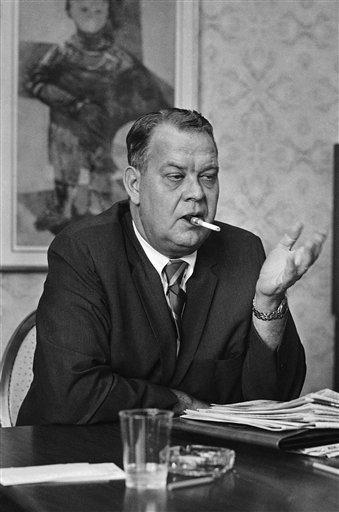
In 1978, Griffith was a featured guest at a Lions Club dinner in the Minneapolis suburb of Waseca. And he told them this:

I'll tell you why we came to Minnesota. It was when we found out you only had 15,000 blacks here. Black people don't go to ballgames, but they'll fill up a rassling ring and put up such a chant it'll scare you to death. We came here because you've got good, hardworking white people here. 

This is in contrast to Washington: Aside from federal government employees, the District of Columbia's residents had already become majority-black by the time Griffith inherited the team in 1955. Indeed, the site of Griffith Stadium is now occupied by Howard University Hospital, the medical center and medical school, of the leading "historically black college" in America, a.k.a. "the Black Harvard."

Not only was the neighborhood around Griffith Stadium almost totally black by 1955, but the one around the site of the planned new stadium, the one opened in 1961 as District of Columbia Stadium and known since 1969 as Robert F. Kennedy Stadium, was also mostly black. And, to Griffith, that meant poverty and crime, affecting the mostly-white Senators fans.

When Carew heard that Griffith had said what he said at the Lions Club dinner, he said he would never play for him again. Before the 1979 season, he was traded.

In 1984, fed up with the rising costs of running a Major League Baseball team, Griffith sold the Twins to Carl Pohlad, a billionaire financier -- who still ran the team very cheaply, but spent enough to win the World Series in 1987 and 1991.

Griffith died in 1999, and, today, a statue of him stands outside Target Field, home of the Twins since 2010. The statue is warranted, as, technically, he's the father of the franchise. On the other hand, he was a racist asshole. So it's a bit poetic that the statue is bronze, and thus very dark.
Calvin Griffith, the way he preferred to be: Surrounded by white.

After more than a generation of failures for the old Senators, 11 years of it for the new Senators, an interregnum of more than a third of a century, and now the slow climb and postseason failures of the Nationals, Washington, D.C, still hasn't won a Pennant, in either League, since 1933, or a World Series since 1924.

It could be argued that Griffith screwed over both D.C. and Minnesota. After all, not only did D.C. get the short end of the stick, but Minnesota fans had to sit through 21 years of cold Aprils outdoors at Metropolitan Stadium, and then had to endure the Metrodome, one of the worst stadiums ever to host big-league baseball. And, let's not forget, the team didn't win a World Series throughout his ownership, in either place, 1956 to 1984.

And, considering they had a new stadium -- 2, in fact, 1 in suburban Bloomington for the Minneapolis Millers and 1 in St. Paul for the St. Paul Saints -- the Twin Cities were going to get a major league team whether the Senators moved there or not. So we can't say, "Minnesota wouldn't have gotten a Major League Baseball team if not for Calvin Griffith."

But this isn't about whether he was a good guy. (He wasn't.) Or even about whether he was a good owner. (He wasn't.) It's about whether the move was the right idea. (Even if he publicly gave an evil reason for it.) Was moving the Senators, and moving them to Minnesota, justified, for non-racist reasons? Let's find out: You've heard the case for the prosecution. Here's the case for the defense:

Top 5 Reasons You Can't Blame the Washington Senators for Moving to Minnesota

5. Ballparks. What became known as Griffith Stadium opened in 1911, on the site of the Senators' 1st home, which burned down early that year. (The same thing happened with the Polo Grounds in New York that year.) The new stadium was built in concrete and steel, and by Opening Day -- only a month after the fire -- 16,000 seats were ready and filled by fans, among them President William Howard Taft. (In a retroactive irony, considering Calvin Griffith, the stadium was built mostly by black construction workers.)

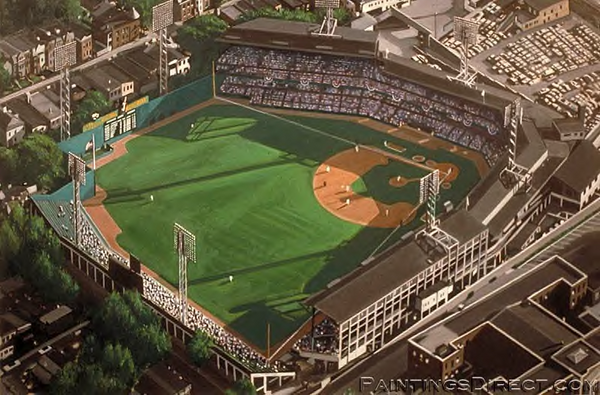
Construction was declared complete in late July. The stadium was expanded in 1924, just in time for their World Championship season. This expansion gave the double decks down the baseline a greater height than those behind home plate. This, plus the angling of the center field fence around a tree, resulted in a very strange look for the stadium.
Even with a bleacher section in front of the left field wall, in addition to the one behind it, for football, the stadium's capacity topped out at around 35,000. (Redskin fans complaining about RFK Stadium having just 56,000 fans, and wondering when they'd get a larger stadium, forgot that RFK was the larger stadium.) For baseball, Griffith Stadium's capacity was 27,410, the lowest in the major leagues after the Cleveland Indians stopped playing home games in 21,000-seat League Park after 1946 and moved all their games into the 85,000-seat Municipal Stadium.
A painting based on a black & white photo.
The center field "notch" can be clearly seen.

In contrast, in 1956, Metropolitan Stadium opened -- advertised as being equidistant from the downtowns of both Minneapolis and St. Paul, thus appealing to both cities without slighting either -- with 18,000 seats. By 1960, it had been expanded to 30,000 seats, with potential for more. (It was 40,000 by the 1965 Pennant season and 45,914 for the Playoff season of 1970. But it never seated more than 48,446 for football, which, combined with Minnesota's cold weather, led to the building of the Metrodome.)

The Met also had a weird look: One deck along the 3rd base line and in center and right field, two decks down the 1st base line and in left field, and three decks behind home plate. Somebody said it looked like an Erector set that a kid was playing with, and then his mother called him away to dinner, and he never finished it.
A postcard of The Met

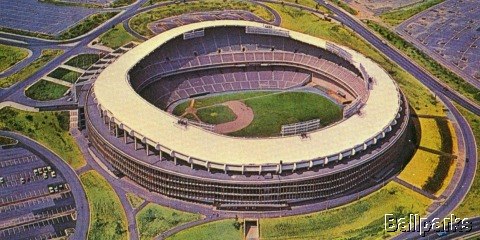
The D.C. government, then under the control of the federal government, wouldn't build the Senators a new ballpark. But the federal government, through its Department of the Interior, was willing to, and did build D.C. Stadium, which originally seated 43,500 for baseball and would peak at 45,596. (The Department of the Interior still runs what's now Robert F. Kennedy Memorial Stadium.)

But it wouldn't be ready for baseball until April 1962 (it was ready for football in October 1961), and so Griffith needed a more appropriate stadium as soon as possible. Minnesota had one. It also had a real hunger for the majors, as you'll see next.

4. The Twin Cities. The Minneapolis Millers and the St. Paul Saints battled it out for local, and American Association, supremacy throughout the 1st 6 decades of the 20th Century. The Millers won 10 Pennants, in 1896, 1910, '11, '12, '15, '32, '35, '55, '58 and '59. The Saints won 2, in 1924 and '48.

The Millers were a Boston Red Sox farm team in 1938, so Ted Williams played for them. They were a New York Giants farm team in 1951, so they became Willie Mays' last team before reaching the majors. Other Millers who went on to major league success include Roger Bresnahan, Jimmy Collins, Gavvy Cravath, Red Faber, Zack Wheat, Hoyt Wilhelm, Bill White, Orlando Cepeda, Felipe Alou and Carl Yastrzemski. (They were again a Red Sox farm team when the Twins arrived.) Great players for the Saints included Ginger Beaumont, Lefty Gomez, Duke Snider and Roy Campanella.

In addition to their natural geographical rivalry, for a time, the Millers were a farm team of the Giants, and the Saints of the Brooklyn Dodgers, and the Giant-Dodger rivalry also came into play there.

Minnesota wanted major league ball very badly. They almost got it for the 1958 season: As the Millers' parent club, and wanting to get out of the Polo Grounds and its deteriorating Washington Heights neighborhood, Giants owner Horace Stoneham decided in 1957 to move to Minneapolis and Metropolitan Stadium. But Dodger owner Walter O'Malley decided to move to Los Angeles, and talked Stoneham into going to San Francisco instead. (This also explained the Giants giving up the Millers as their top farm club.)
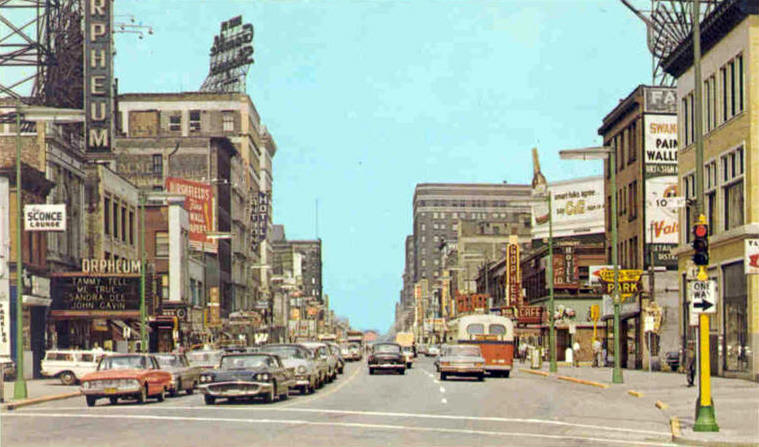
Hennepin Avenue, downtown Minneapolis, 1961

The Twins came in for the 1961 season, and, despite the team being in what turned out to be the last year of noncontention, attendance went up from 9,655 per home game in the last Washington season to 15,611, over 2,000 more than they had ever gotten in Washington. (They peaked at 13,254 in the baseball-hungry 1st season after World War II, 1946.)

And the fan bases of the Millers and the Saints came together to root for one team, just as the Giant and Dodger fan bases would soon do for the Mets. Indeed, the original Twins logo, which has been revived and updated at Target Field, reflects this. Note the M and StP monograms as they reach across the river to form a human bridge. Their names are Minnie and Paul.
And while the Minneapolis Lakers got moved to Los Angeles in the summer of 1960, the NFL brought the Land of Lakes into the fold with the Minnesota Vikings in 1961. And the NHL's 1967 expansion included the Minnesota North Stars. Both the ABA and the WHA would put teams in Minnesota, and it was the problems with the leagues, not the Twin Cities market, that doomed those teams.

No, if you were an MLB team owner in the 1950s, and you wanted to move, Minneapolis-St. Paul was a great place to go. Whatever their flaws, Horace Stoneham and Calvin Griffith both knew this.

3. The Baltimore Orioles. It's only 40 miles between the sites of Memorial Stadium in Baltimore and Griffith Stadium in Washington. The arrival of the O's in 1954 ate up a lot of the Senators' support in the suburbs of Maryland.

It wasn't just the difference in talent that emerged, with the O's becoming contenders in 1960, coming close to the Pennant in 1964, winning the whole thing in 1966 and 1970, and also winning Pennants in 1969 and 1971. In the 18 seasons from the Orioles' arrival in 1954, as very much still an extension of the sad-sack Browns, until the Senators left in 1971, there was never a season in which Washington topped Baltimore in per-game attendance.

And while the Orioles had a more modern stadium with a serious advantage in parking from 1954 to 1961, the last season of Griffith Stadium, that advantage was more than wiped out by Opening Day 1962: D.C. Stadium had more parking. And the neighborhood advantage was also eliminated: People talk about how bad the neighborhood around RFK Stadium is, but it's never been as bad as was faced at Yankee Stadium, or Comiskey Park in Chicago, or Tiger Stadium in Detroit were in those stadiums' last few decades. And it's not like there isn't a ghetto between downtown Baltimore and Memorial Stadium.

It also didn't help that the Orioles and the Senators were in the same league. With the former exception of New York, which had 3 teams from 1903 to 1957, every other 2-team city had their teams split between the Leagues: Boston (1901-1952), St. Louis (1902-1953), Philadelphia (1901-1954), Chicago (1901-present), Los Angeles (1961-present), New York (1962-present), San Francisco/Oakland (1968-present).

Even in different cities in the same State, it worked out that way: Ohio (1901-present), Missouri (1955-67 and 1969-present), Florida (1998-present), Texas (1972-2013). Until the Houston Astros got bumped over to the American League in 2014, Pennsylvania was the only exception among 2-team States. (California, of course, has 5 teams: 3 in the NL, 2 in the AL.)

But when the Orioles arrived in 1954, from then until 1971, there were 2 teams in the same League within 40 miles. Had they been in different Leagues, as the O's and Nats have been since 2005, fans could see American League games and players in Baltimore, and National League games and players in Washington. (Or, had things turned out differently, vice versa.)

Just as Orioles owner Peter Angelos stood in the way of an expansion or moved team in Washington in the 1990s, claiming he would lose 1/4 of his fan base if that happened, Calvin Griffith knew in the latter half of the 1950s that a lot of Marylanders were going to Baltimore instead of Washington to get their baseball. And the newly-arrived Orioles weren't going anywhere. So the old Senators had to go.

As it turned out, Angelos was wrong: The Orioles' attendance took a nosedive in 2002, 3 years before the Nationals arrived. Why? Because 2001 was Cal Ripken's last year. The loyalty of a lot of fans, both in the Baltimore area and in the Washington area, was to him, not to the Orange & Black. Once Cal retired, not nearly as many fans started coming up from Prince Georges County, the District, or Virginia to see the Orioles, who no longer provided either Cal or winning baseball.

Maybe that's why Angelos dropped his objection when Commissioner Bud Selig announced that the Montreal Expos were being moved to Washington: He knew his best excuse had been exposed as a bad guess.

2. They Were Immediately Replaced. The American League, under pressure from the politicians who wanted easy access to baseball, added an expansion team to Washington, along with the Los Angeles Angels, for the 1961 season. So it's not like Washington was without baseball, however bad it may have been. (The "New Senators" were so bad that, as the Vietnam War escalated and D.C. became a cauldron of protest, they were called "last in war, last in peace, and last in the American League.")
RFK Stadium, set up or baseball, in the "New Senators" era

No, Washington still had a baseball team. Until 1971. And you can't blame Calvin Griffith for that move:

1. Washington, D.C. It simply wasn't a good baseball town at the time. Essentially, there were 2 things that mattered in D.C.: The federal government and the Redskins. President Richard Nixon said, "All anybody in Washington cares about is the Redskins. They don't give a damn about the Smithsonian or the Kennedy Center." (And that wasn't just sour grapes over losing to John F. Kennedy in 1960: Government officials might have cared about it, but Washingtonians never really have.)

The fans who tended to show up, first at Griffith Stadium, and then at D.C./RFK Stadium, were middle-class federal government employees, who came from all over the country. Even when they did go to games, it was usually to root for their hometown teams. A Congressional aide from Chicago going to see the Senators play the Chicago White Sox was going to root for the White Sox. An Army Lieutenant from New Hampshire, working at the Pentagon, getting an evening's pass would go to the ballpark and root for the Boston Red Sox to beat the Senators.

When Bob Short -- who, oddly enough, was also the owner who moved the Lakers out of Minnesota in 1960 -- announced that the new Senators were moving to Dallas after the 1971 season, Congress did not pressure the baseball establishment to get them a new team. Commissioner Bowie Kuhn, despite growing up in D.C., did nothing to stop that move. When the final home game was played on September 30, 1971, only 14,461 fans showed up. (And rioted at the end, blowing a win for the Senators and getting the game forfeited to the Yankees.) And when a deal to move the San Diego Padres to Washington for the 1974 season began to fall apart, neither Kuhn nor Congress stepped in to save it.

It also didn't help that the locations weren't great. It wasn't just that Griffith Stadium and, later, RFK Stadium were built in black neighborhoods. It was that the public transportation wasn't great. It wasn't until 1976 that Washington's Metro opened, with the Stadium-Armory stop making it easy to get from anywhere in the metro area to RFK. It wouldn't be until 1991 that the Shaw-Howard University stop opened, providing access to the former location of Griffith Stadium.

It was even worse if you were trying to get to a University of Maryland football or basketball game: The College Park station didn't open until 1993. And Largo Town Center, the Landover station used for the Redskins' new stadium, didn't open until 2004, 7 years after the Bullets/Wizards and Capitals left that area and moved into downtown Washington -- and the Redskins moved out there, across the Beltway from the Capital Centre site.

Despite the old Senators/Twins franchise's ups and downs, the worst season the Twins have ever had for per-game attendance, 8,129 in 1974, is still better than what they got in 51 of their 60 seasons in Washington. And despite the ups and downs of the new Senators/Rangers, the best per-game attendance they got in their 11 seasons in Washington, 11,335 in 1969, has been topped in all but their 1st 2 seasons in Arlington, Texas. (Not since 1988 have they even gotten below 24,000.)

Today, with the Nationals in town, a relatively new ballpark (Nationals Park opened in 2008), easily accessible via public transportation (the Navy Yard station on the Green Line), a heavily-grown market due to the explosion of the D.C. suburbs in both Maryland and Virginia, a growing white middle class and a growing black middle class, a regional TV network (MASN) to drum up local support, and a promotions arm of Major League Baseball that knows a hell of a lot more of what it's doing than it did in 1960 and 1971, would anyone even think of moving the current MLB team out of Washington? As their biggest current star, Bryce Harper, might say, "That's a clown question, bro."
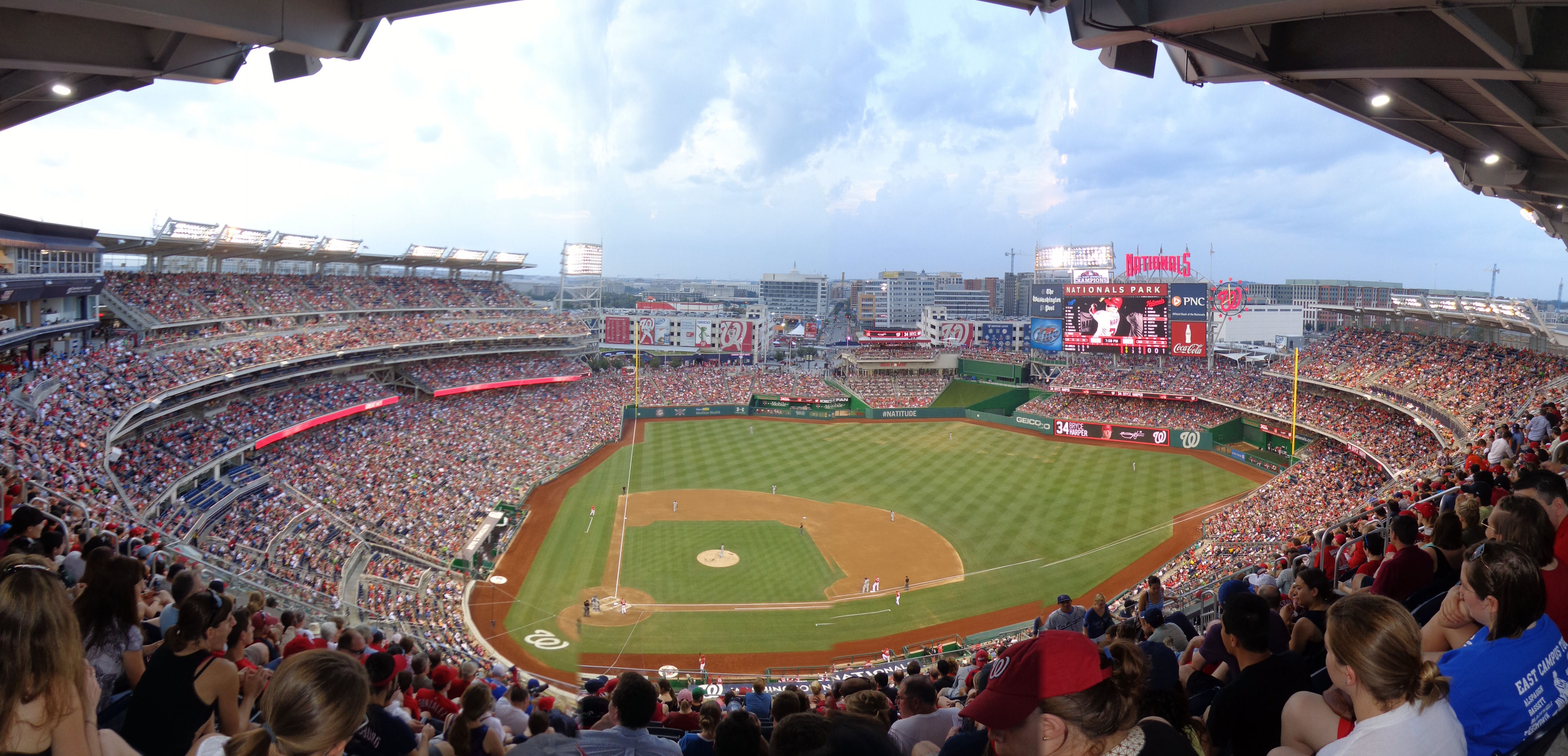
A recent full house at Nationals Park

It was not a clown question in 1960, or in 1971. Now, no one would move the Nationals. But can Calvin Griffith -- guilty though he was of racism and cheapness -- be blamed for moving the old Senators to Minnesota in 1960?

VERDICT: Not Guilty.

In 2015, with both teams in Playoff contention most of the way, and good public transportation to both Nationals Park in Washington and the 1992-opened Oriole Park at Camden Yards in Baltimore, the Nationals averaged 32,343 fans per game; the Orioles, 29,374 -- in each case, better than the O's got in the days in which they drove the new Senators to Texas, and a lot better than the O's got in the days in which they drove the old Senators to Minnesota.

Friday, June 27, 2014

How to Be a Yankee Fan In Minnesota -- 2014 Edition

After a short but intense 5-game homestand against The Scum and the Strays, the Yankees will head out onto the road for the remainder of the first half of the season, to play the Minnesota Twins in Minneapolis, the Cleveland Indians, and the Baltimore Orioles.

Then comes the All-Star Break, and the All-Star Game will also be in Minnesota this year. This will be the 3rd time the Twins have hosted, and in the 3rd different ballpark: 1965 at Metropolitan Stadium, 1985 at the Metrodome, and 2014 at Target Field.

In the photo above, you can see Target Field.  Behind that, the Target Center. (The Target store company is headquartered in Minneapolis.) Behind that, downtown Minneapolis. And, in the upper-left corner, the Metrodome.

By a weird twist, when my twin nieces were born, 7 summers ago, the Yankees were playing, you guessed it, the Twins. The Yankees won. Nevertheless, the girls have become Yankee Fans.

I’ll teach them the irony of it all, but, personally, I have nothing against the Minnesota ballclub. I used to, but then they got out of the (George Carlin word)ing Metrodome.

I know, I sometimes curse on this page, but these “How to Be a Yankee/New York Fan In…” pages are meant to be family-friendly.

Before You Go. It's a little soon to post the weather forecast, but, since the Twins do not play in the Metrodome anymore, you should consult the Minneapolis Star-Tribune and St. Paul Pioneer Press websites for their forecasts. Seeing as how this will be early July, including the 4th, the legend of cold Minnesota winters that last from October to early May will not apply in this series.

Minnesota is in the Central Time Zone, 1 hour behind New York. Adjust your timepieces accordingly.

Tickets. The Twins’ success of the last 2000s (but not, as yet, the 2010s) and the building of Target Field led to an average per-game attendance of 39,112 in 2011, pretty much a sellout every night, in spite of their not having a very good season (mainly due to injuries). But last season, the novelty of the new park had worn off, and they averaged 30,588, and they're averaging 27,042 so far this season. So getting tickets shouldn't be a big problem. Still, I advise getting them ahead of time.

The Twins use "demand-based pricing." For games against the Yankees, and for regional rivals like the Milwaukee Brewers and the Chicago White Sox, prices are higher because the demand is greater. Here are the listings for the Yankee games: Diamond Box, $68; Field Box, $56; Home Plate Terrace, $54; Skyline View, $29; Field View, $26; LF Bleachers (the U.S. Bank Home Run Porch), $30; RF Bleachers (Grandstand), $32. In other words, despite the Twins’ history of frugal (or even blatantly cheap) ownership, it’ll be expensive.

There's no mention of the Twins setting off fireworks on the 4th (Friday, probably because it's an afternoon game, a 2:10 PM Central time start). But, as it's the 75th Anniversary of Lou Gehrig Day, they're giving away Gehrig bobbleheads to the first 10,000 fans.

Getting There. It’s 1,199 road miles from Times Square in New York to Nicollet Mall in downtown Minneapolis (the spot where Mary Tyler Moore threw her hat in the air in the opening sequence of her 1970-77 CBS sitcom), and 1,204 miles from Yankee Stadium to Target Field. Knowing this, your first reaction is going to be to fly out there.

But it’s kind of an expensive flight. Even if you order early, chances are you’ll have to pay at least $950 round-trip for a flight from Newark to Minneapolis-St. Paul International Airport. And you'll have to change planes in Chicago – or even Dallas (which would piss off not just the New York Giants football fan that you might be, but also the Minnesota Vikings fans you may be flying to Minneapolis with). But when you do get there, the Number 55 light rail takes you from the airport to downtown in under an hour, so at least that is convenient.

Bus? Not a good idea. Greyhound runs 3 buses a day between Port Authority and Minneapolis, all with at least one transfer, in Chicago and possibly elsewhere as well. The total time, depending on the number of stops, is between 26 and 31 hours, and costs $507 round-trip, although it can be dropped to $449 with advanced purchase. The Greyhound terminal is at 950 Hawthorne Avenue, at 9th Street North, just 3 blocks from Nicollet Mall, 2 from the Target Center arena, and from there just across the 7th Street overpass over Interstate 394 from Target Field.

Train? An even worse idea. Amtrak will make you leave Penn Station on the Lake Shore Limited at 3:40 PM Eastern Time, arrive at Union Station in Chicago at 9:45 AM Central Time, and then the Empire Builder, their Chicago-to-Seattle run, will leave at 2:15 PM and arrive in St. Paul (not Minneapolis) at 10:31 PM. From there, 730 Transfer Road, you’d have to take the Number 16 or 50 bus to downtown Minneapolis. And it’s $692 round-trip.

If you decide to drive, it’s far enough that it will help to get someone to go with you and split the duties, and to trade off driving and sleeping. You'll need to get into New Jersey, and take Interstate 80 West. You'll be on I-80 for the vast majority of the trip, through New Jersey, Pennsylvania and Ohio. In Ohio, in the western suburbs of Cleveland, I-80 will merge with Interstate 90. From this point onward, you won’t need to think about I-80 until you head home; I-90 is now the key, through the rest of Ohio and Indiana.

Just outside Chicago, I-80 will split off from I-90, which you will keep, until it merges with Interstate 94. For the moment, though, you will ignore I-94. Stay on I-90 through Illinois, until reaching Madison, Wisconsin, where you will once again merge with I-94. Now, I-94 is what you want, taking it into Minnesota and the Twin Cities, with Exit 233A being your exit for downtown Minneapolis.

If you do it right, you should spend about an hour and a half in New Jersey, 5 hours and 15 minutes in Pennsylvania, 4 hours in Ohio, 2 and a half hours in Indiana, an hour and a half in Illinois, 2 and a half hours in Wisconsin, and half an hour in Minnesota. That’s 17 hours and 45 minutes. Counting rest stops, preferably halfway through Pennsylvania and just after you enter both Ohio and Indiana, outside Chicago and halfway across Wisconsin, and accounting for traffic in New York, the Chicago suburbs and the Twin Cities, it should be no more than 23 hours, which would save you time on both Greyhound and Amtrak, if not on flying.

Once In the City. The team's original ballpark was in the suburb of Bloomington, on the Minneapolis side of the Mississippi River, but roughly equidistant from the downtowns of both Minneapolis and St. Paul. (Not quite: Minneapolis' City Hall is 9.6 miles away, St. Paul's is 11.1 miles.) The team is called "Minnesota," because they didn't want to slight either city. It is called the "Twins" because Minneapolis and St. Paul are the "Twin Cities."

Well, these "twins" are not identical: They have different mindsets, and, manifesting in several ways that included both having Triple-A teams until the MLB team arrived, have been known to feud as much as San Francisco and Oakland, Dallas and Fort Worth, Baltimore and Washington, if not as much as Manhattan and Brooklyn. Minneapolis has about 390,000 people, St. Paul 285,000, and the combined metropolitan area about 3.4 million, ranking 16th in the U.S. -- roughly the combined population of Manhattan, The Bronx and Staten Island -- or that of Manhattan and Queens. Denver is the only metropolitan area with teams in all 4 sports that's smaller.

"Minneapolis" is a combination of the Dakota tribal word for water, and the Greek word for city. It was founded in 1867 with the name St. Anthony Falls, and, of course, St. Paul, founded in 1854, is also named for an early Christian saint. In Minneapolis, Hennepin Avenue separates the numbered Streets from North and South, and the Mississippi River is the "zero point" for the Avenues, many (but not all) of which also have numbers.

Each city once had 2 daily papers, now each is down to 1: Minneapolis had the Star and the Tribune, merged in 1982; St. Paul the Pioneer and the Dispatch, merged into the Pioneer Press and Dispatch in 1985, with the Dispatch name dropped in 1990. Today, they are nicknamed the Strib and the Pi Press.

The sales tax in the State of Minnesota is 6.875 percent. It's 7.775 in Minneapolis' Hennepin County, and 7.625 percent in St. Paul's Ramsey County. Bus and Light Rail service is $2.25 per ride during rush hours, $1.75 otherwise.

Going In. Target Field is at the northwest edge of downtown Minneapolis, in a neighborhood called the Warehouse District. The Metro Transit Hiawatha Line, Minneapolis’ light rail system, has a Target Field Station.

Target Field is bounded by 5th Street (left field), 3rd Avenue (right field), 7th Street (1st base) and the Hiawatha Line (3rd base). Parking lots are all over downtown, although if you’ve driven all this way, most likely you’ll be staying at a hotel and walking or taking public transit from there.  The official address is 1 Twins Way.

If you’re walking from downtown, you’ll most likely be arriving over the I-394 overpass and entering at the right field or home plate gates. If you’re arriving by light rail, the station is outside the left field gate. If you're driving, parking is between $10 and $15, depending on the event.

The gates are numbered in honor of the men whose numbers had already been retired when the ballpark opened: Center field, Gate 3, Harmon Killebrew; Left field, Gate 6, Tony Oliva; Home plate, Gate 14, Kent Hrbek; Right field corner, Gate 29, Rod Carew; and another in right field, Gate 34, Kirby Puckett. Gate 29 has Target Plaza, with statues of those players, and also of former owners Calvin Griffith, and Carl and Eloise Pohlad, parents of current owner Jim Pohlad.  The Twins' team Hall of Fame display is also there.

The ballpark faces northeast, and in stark contrast to the Metrodome, the place is open at right field, has no stupid roof with stupid lighting, and has, yes, real grass. If you are old enough to remember the Twins' original home, Metropolitan Stadium, the double-decked left field bleachers will be reminiscent of that stadium, but, from some angles, will also bear a resemblance to Jack Murphy/Qualcomm Stadium in San Diego and the old Mile High Stadium in Denver (if you remember the baseball configurations of those stadiums). Looking at the 1st base/right field stands, you may see a resemblance to Camden Yards in Baltimore. Target Field does seem to have a mixture of 1970s funkiness (which, aside from round entrance ramps, was rarely incorporated into the designs of the ballparks in use in that decade) and 1990s-to-the-present convenience.

Outfield distances are 339 to left, 377 to left-center, 411 to center, 365 to right center and 328 to right – favoring lefthanded hitters, although the ball doesn’t fly out of the yard the way it did at Metropolitan Stadium or the Metrodome. In its brief history, the longest home run hit at Target is a 491-footer by Jim Thome in 2011. Ben Oglivie of the Milwaukee Brewers hit the longest at the Metrodome, 481 feet, although I can't find a reference to a date. The longest at The Met, as you  might guess, was by Harmon Killebrew, 525 feet in 1967.

Above center field is a sign saying “TARGET FIELD,” with the words separated by the Target store logo. Above that is the original team logo, with two ballplayers against an outline of the state. One is wearing an M logo on his sleeve, another an StP logo on his, and they’re reaching across a river to shake hands. This symbolizes the old minor-league teams in the American Association, the Minneapolis Millers and the St. Paul Saints, who went out of business when the original Washington Senators moved to Minnesota to become the Twins in 1961.

Food. Considering that Minnesota is Big Ten Country, you would expect their ballpark to have lots of good food, in particular that Midwest staple, the sausage, including German, Italian, Polish and Kosher varieties. Fortunately, you would be right, as the influence of regional rivals Chicago and Milwaukee has taken hold. Something called Kramarczuk’s Food Network Creations is at Section 114 (lower level behind home plate), and Mexican and Asian specialties also dot the walkways.

At Section 133 (right-center-field bleachers), they have “State Fair Classics” -- the State Fair, held from late August to Labor Day, in the small town of Falcon Heights, between the Twin Cities, is a very big deal, known as "The Great Minnesota Get-Together." These "classics" include Pork Chops on a Stick, Roasted Corn on the Cob, Corn Dogs, and Walleye Fingers – think a fish version of "chicken fingers." It's not something I would eat, but walleyes, a native fish, are very popular in Minnesota. The start of walleye fishing season, usually around May 10, is so big there, the Twins always request to be on the road that weekend, so as not to hurt attendance.

Being Midwestern, the Twins believe in beer and lots of it. (In their early days, the Twins heavily identified with Hamm's Beer, which was headquartered in St. Paul. Hamm's has since been bought out, although the brand is still sold in the Upper Midwest.) Being American, the Twins believe in ice cream and lots of it.

Team History Displays. The Twins are now in their 2nd half-century of play, so they certainly have some history. They have banners representing their titles on the exterior promenade of the ballpark: The 1965 American League Pennant, the 1969 and 1970 AL Western Division Championships, the 1987 and 1991 World Championships, and the 2002, 2003, 2004, 2006, 2009 and 2010 AL Central Division Championships. The Twins have never reached the Playoffs via the Wild Card.

No mention is made of the titles won as "the old Washington Senators": The 1924 World Championship and the 1925 and 1933 AL Pennants. Nor is any mention made of the American Association Pennants won by the Millers (1896, 1910, ’11, ’12, ’15, ’32, ’35, ’55, ’58 and ’59) and the Saints (1924 and ’48).

The Twins’ retired numbers are shown in stanchions on the facing of the upper deck in left field: 3, Harmon Killebrew, 3rd base & 1st base, 1961-74; 6, Tony Oliva, right field, 1962-76 and serving the club in several capacities since; 10, Tom Kelly, 1st baseman 1975, manager 1986-2001; 14, Kent Hrbek, 1st base, 1981-94; 28, Bert Blyleven, pitcher, 1970-76 and 1985-88; 29, Rod Carew, 2nd base and 1st base, 1967-78; and 34, Kirby Puckett, center field, 1984-95 -- plus Jackie Robinson's universally-retired 42. Oddly, the numbers are listed in order of their retirement from right to left, as opposed to left to right (or numerically), so that, from left to right, they read: 42, 10, 28, 34, 14, 6, 29, 3. Killebrew (who died in 2011), Oliva, Carew, Hrbek, and Kirby Puckett Jr., standing in for his father, threw out the ceremonial first balls for the first game at the new park on April 12, 2010.

As stated, the Twins' team Hall of Fame is outside the park at Gate 29, with the statues. The members include:

From the 1965-70 teams: Killebrew, Oliva, Carew, catcher Earl Battey, shortstop Zoilo Versalles, left fielder Bob Allison, and pitchers Camilo Pascual, Jim Kaat and Jim Perry.

From the 1987 & ’91 teams: Kelly, Blyleven, Hrbek, Puckett, shortstop Greg Gagne, 3rd baseman Gary Gaetti, and pitchers Frank Viola and Rick Aguilera.

From the 2000s: Pitchers Brad Radke and Eddie Guardado.

And spanning the eras: Founding owner Calvin Griffith, original team executive George Brophy, Hall of Fame broadcaster Herb Carneal, owner Carl Pohlad, minor-league director Jim Rantz, media relations director Tom Mee, and public address announcer Bob Casey.

No mention is made of Millers legends Joe Cantillon, Joe Hauser, Ted Williams, Willie Mays, Monte Irvin, Ray Dandridge, Hoyt Wilhelm, Orlando Cepeda, Felipe Alou and Carl Yastrzemski. (The Millers were a Red Sox farm team, then the Giants, then the Red Sox again.) Or of Saints legends Duke Snider and Roy Campanella. (The Saints were a Dodger farm team.)

In 1999, Killebrew, Carew and Puckett were named to The Sporting News' 100 Greatest Baseball Players.

Stuff. The Twins have Team Stores throughout the ballpark. The usual items that can be found at a souvenir store can be found there.

Books about the Twins are not exactly well-known. The staff of the Star-Tribune put together Minnesota Twins: The Complete Illustrated History in 2010. Newly-published is Stew Thornley's Minnesota Twins Baseball: Hardball History on the Prairie. Cool of the Evening: The 1965 Minnesota Twins is Jim Thielman’s look at Minnesota’s 1st major league Pennant winner. Bill Gutman, Dave Weiner and Tony Seidl wrote From Worst to First! The Improbable 1991 Seasons of the Atlanta Braves and the Minnesota Twins.

There is, as yet, no Essential Games of the Minnesota Twins, or of either Metropolitan Stadium or the Metrodome. But the official 1987 and 1991 World Series highlight film packages are available.

During the Game. Because of their Midwest/Heartland image, Twins fans like a “family atmosphere.” Therefore, while they don’t especially like the Yankees, they will not directly antagonize you. You’ll probably be all right if you don’t say anything unkind about Killebrew or Puckett, especially now that they’re both dead. I would also advise against saying anything complimentary about the Green Bay Packers, the University of Wisconsin, the Dallas Stars (the hockey team that used to be the Minnesota North Stars) or Norm Green (the owner who moved them).

The Twins' mascot is TC Bear -- TC for Twin Cities, and it's probably a bear in honor of that once-familiar Minnesota mascot/TV pitchanimal, the Hamm's Bear. They don't have a song to use after “Take Me Out to the Ballgame” in the 7th Inning Stretch, or a postgame victory song, but they do have a theme song, "We're Gonna Win, Twins!"

They still sell the Homer Hankies made famous during their 1987 postseason run. They did not, however, originate the idea: In 1977, the Cleveland Indians, desperate for attendance, held “Hate the Yankees Hanky Night.”

The Twins have "The Race at Target Field." It's a takeoff on the Milwaukee Brewers' Sausage Race, with five Minnesota-inspired characters: Louie the Loon (a bird, not a crazy man), Wanda the Walleye (fish), Babe the Blue Ox (from the legend of Paul Bunyan), Skeeta the Mosquito (apparently they got him in a trade with the Houston Astros), and Bullseye the dog (mascot of Target, and apparently a descendant of former Bud Light pitchdog Spuds Mackenzie). No revival of the Hamm's Bear.

After the Game. An unfortunate part of the Twins’ legacy is the fact that, when Washington Senators owner Clark Griffith, who would never have moved the team, died in 1955, his son Calvin Griffith wanted out of the increasingly-black D.C. At a Lions Club dinner in 1978, he freely admitted that he moved the Twins to Minnesota because it was mostly white. So the Twins exist primarily because of racism – albeit that of just one man. Nevertheless, this racial homogeneity has kept Minneapolis comparatively safe – although the Twin Cities have since attracted more blacks, and had already produced some famous black people, including baseball legend Dave Winfield and music superstar Prince Rogers Nelson. (Along with the fictional character of Synclaire James, played by Kim Coles on the New York-based show Living Single.) At any rate, regardless of the races of the people you see on the streets, you should be safe.

If you want to be around other New Yorkers, I’m sorry to say that listings for where they tend to gather are slim. But I have one listing for a place that seems to cater to football Giants fans: O'Donovan's Irish Pub, at 700 1st Avenue North at 7th St.

Another restaurant that may be of interest to New York baseball fans is Charley's Grill, at 225 3rd Avenue South at 2nd Street.  It was popular among visiting players from other American Association cities when they came to play the Millers and the Saints. Legend has it that, when the Yankees gathered for spring training in 1961, they were trying to figure out which restaurants in the new American League cities were good, and someone who'd recently played for the Denver Bears mentioned Charley's. But Yogi Berra, who'd gone there when the Yanks' top farm team was the Kansas City Blues, said, "Nobody goes there anymore. It's too crowded." Well, someone must still be going there, because it's still open.  (That Yogi said the line is almost certainly true, but the restaurant in question was almost certainly Ruggiero's, a place in his native St. Louis at which he and his neighbor Joe Garagiola waited tables.)

Sidelights. Minnesota’s sports history is long, but very uneven. Teams have been born, moved in, moved around, and even moved out. But there are some local sites worth checking out.

* Site of the Hubert H. Humphrey Metrodome and the new Vikings stadium. Home of the Twins from 1982 to 2009, the University of Minnesota football team from 1982 to 2008, and the NFL’s Vikings from 1982 to 2013, that infamous blizzard and roof collapse in 2010 brought the desire to get out and build a new stadium for the Vikes to the front burner, and it has finally led to action.

The Twins won the 1987 and 1991 World Series here – going 8-0 in World Series games in the Dome, and 0-6 in Series games outside of it. The Vikings, on the other hand, are just 6-4 in home Playoff games since moving there – including an overtime defeat in the 1998 NFC Championship Game after going 14-2 in the regular season.

From October 1991 to April 1992, the Metrodome hosted 3 major events: The World Series (Twins over Atlanta Braves), Super Bowl XXVI (Washington Redskins over Buffalo Bills), and the NCAA Final Four (Duke beating Michigan in the Final). It also hosted the Final Four in 2001 (Duke won that one, too, over Arizona).

In May 2012, faced with the serious possibility of the Vikings moving without getting a suitable stadium (Los Angeles, Las Vegas and San Antonio had been rumored as locations, in descending order of likelihood), the Minnesota State legislature approved funding for a new stadium for the Vikings, to be built on the site of the Metrodome and on adjoining land.

The damn thing has now been fully demolished -- in a piece of poetic justice, just as it was built and completed ahead of schedule and under budget, so did the demolition take place. The people of Minnesota seemed to be proud of its having been built on the cheap and on time, but it served its purpose, to keep the Twins and Vikings from moving for a generation, and now replacement stadiums are achieving the same purpose. Billy Martin, who hated the place, had the best word on it, though the awkward wording of it may have been inspired in part by his pal Yogi Berra: "It's a shame a great guy like HHH had to be named after it." (Billy's first managing job was with the Twins, at the Met in 1969.)

The Vikings will play at TCF Bank Stadium in 2014 and '15, before the new stadium opens in 2016. The new stadium might also allow Minnesota United to get promoted to Major League Soccer. 900 South 5th Street at Centennial (Kirby Puckett) Place. Metrodome station on Light Rail.

* Mall of America and sites of Metropolitan Stadium and the Metropolitan Sports Center. In contrast to their performance at the Metrodome, the Vikings were far more successful at their first home, while the Twins were not (in each case, playing there from 1961 to 1981). The Vikings reached 4 Super Bowls while playing at The Met, while the Twins won Games 1, 2 and 6 of the 1965 World Series there, but lost Game 7 to the Los Angeles Dodgers on a shutout by Sandy Koufax. (So the Twins are 11-1 all-time in World Series home games, but 0-9 on the road.) The Vikings were far more formidable in their ice tray of a stadium, which had no protection from the sun and nothing to block an Arctic blast of wind.

In fact, the Met had one deck along the 3rd base stands and in the right field bleachers, two decks from 1st base to right field and in the left field bleachers, and three decks behind home plate. Somebody once said the stadium looked like an Erector set that a kid was putting together, before his mother called him away to dinner and he never finished it. At 45,919 seats, it had a capacity that was just fine for baseball; but at 48,446, it was too small for the NFL.

Prior to the 1961 arrivals of the Twins and Vikings, the Met hosted the Minneapolis Millers from 1956 to 1960, and 5 NFL games over the same stretch, including 4 “home games” for the Packers. (Viking fans may be sickened over that, but at least University of Minnesota fans can take heart in the University of Wisconsin never having played there.) The experiments worked: The Met, built equidistant from the downtowns of Minneapolis and St. Paul, in the southern suburb of Bloomington, was awarded the MLB and NFL teams, and Midway Stadium, built in 1957 as the new home of the St. Paul Saints (at 1000 N. Snelling Avenue in the city of St. Paul, also roughly equidistant from the two downtowns), struck out, and was used as a practice field by the Vikings before being demolished in 1981.

The NHL’s Minnesota North Stars played at the adjoining Metropolitan Sports Center (or Met Center) from 1967 to 1993, before they were moved to become the Dallas Stars by owner Norm Green, earning him the nickname Norm Greed. The Stars reached the Stanley Cup Finals in 1981 and 1991, but never won the Cup until 1999 when they were in Dallas.

The Beatles played at Metropolitan Stadium on August 21, 1965 -- making one of only 3 facilities to host an All-Star Game, a Finals and a Beatles concert in the same year. (The others were the Boston Garden and Maple Leaf Gardens in 1964.) Elvis Presley sang at the Met Center on November 5, 1971 and October 17, 1976.

8000 Cedar Avenue South, at 80th Street -- near the airport, although legends of planes being an issue, as with Shea Stadium and Citi Field, seem to be absent. A street named Killebrew Drive, and the original location of home plate, have been preserved. A 45-minute ride on the Number 55 light rail (MOA station).

* Site of Nicollet Park. Home of the Millers from 1912 to 1955, it was one of the most historic minor-league parks, home to Ted Williams and Willie Mays before they reached the majors. With the Met nearing completion, its last game was Game 7 of the 1955 Junior World Series, in which the Millers beat the International League Champion Rochester Red Wings. A few early NFL games were played there in the 1920s. A bank is now on the site. Nicollet and Blaisdell Avenues, 30th and 31st Streets. Number 465 bus.

* Site of Lexington Park. Home of the Saints from 1897 to 1956, it wasn’t nearly as well regarded, although it did close with a Saints win over the arch-rival Millers. The site is now occupied by retail outlets. Lexington Parkway, University Avenue, Fuller & Dunlap Streets.

* Xcel Energy Center and site of the St. Paul Civic Center. Home of the NHL’s Minnesota Wild since their debut in 2000, and site of the 2008 Republican Convention that nominated John McCain for President and Sarah Palin for Vice President. (The GOP met in Minneapolis in 1892, renominating President Benjamin Harrison at the Industrial Exposition Building at 101 Central Avenue SE. It was torn down in 1940, and condos are on the site now.)

The place is a veritable home and hall of fame for hockey in Minnesota, the most hockey-mad State in the Union, including the State high school championships that were previously held at the Civic Center.

That building was the home of the Minnesota Fighting Saints of the World Hockey Association from 1973 to 1977. The Fighting Saints had played their first few home games, in late 1972, at the St. Paul Auditorium. Elvis sang at the Civic Center on October 2 and 3, 1974, and April 30, 1977. The Civic Center is also where Bruce Springsteen and Courteney Cox filmed the video for Bruce’s song “Dancing In the Dark.” 199 Kellogg Blvd. West. at 7th Street.

* Target Center. Separated from Target Field by I-394 and 2nd Avenue, this arena has been home to the NBA’s Minnesota Timberwolves since the team debuted shortly after its 1989 opening. The T-Wolves have only made the Western Conference Finals once, and are probably best known as the team Kevin Garnett and GM (and Minnesota native) Kevin McHale couldn’t get over the hump, before Garnett went to McHale’s former team, the Boston Celtics. The WNBA’s Minnesota Lynx also play here. 600 N. 1st Avenue at 6th Street.

* Site of Minneapolis Auditorium. Built in 1927, from 1947 to 1960 this was the home of the Minneapolis Lakers – and, as Minnesota is “the Land of 10,000 Lakes” (11,842, to be exact), now you know why a team in Los Angeles is named the Lakers. (The old Utah Jazz coach Frank Layden said his team and the Lakers should switch names, due to L.A.'s "West Coast jazz" scene and the Great Salt Lake: "Los Angeles Jazz" and "Utah Lakers" would both make more sense.)

The Lakers won the National Basketball League Championship in 1948, then moved into the NBA and won the Championship in 1949, 1950, 1952, 1953 and 1954. In fact, until the Celtics overtook them in 1963, the Minneapolis Lakers were the most successful team in NBA history, and have still won more World Championships than all the other Minnesota major league teams combined: Lakers 5, Twins 2, the rest a total of 0.

They were led by their enormous (for the time, 6-foot-10, 270-pound) center, the bespectacled (that’s right, he wore glasses, not goggles, on the court) Number 99, George Mikan. The arrival of the 24-second shot clock for the 1954-55 season pretty much ended their run, although rookie Elgin Baylor did help them reach the Finals again in 1959. Ironically, the owner of the Lakers who moved them to Los Angeles was Bob Short – who later moved the “new” Washington Senators, the team established to replace the team that moved to become the Twins.

The Auditorium hosted the NCAA Final Four (although it wasn't yet called that) in 1951, won by Kentucky over Kansas State. Elvis sang there early in his career, on May 13, 1956. The Auditorium was demolished in 1989, and the Minneapolis Convention Center was built on the site. 1301 2nd Ave. South, at 12th Street. Within walking distance of Target Field, Target Center and the Metrodome.

* University of Minnesota. TCF Bank Stadium, the new home of the University of Minnesota football team, opened in 2009. It was designed to resemble a classic 1920s college football stadium, with a reddish-brown brick exterior and a horseshoe shape, much like the 56,000-seat Memorial Stadium, where the Golden Gophers played from 1924 to 1981, before the Metrodome was built.

Its capacity of 50,805 makes it the 2nd-smallest stadium in the Big Ten, ahead of only Northwestern’s Ryan Field/Dyche Stadium, but the Gophers’ lack of success over the last 40 years or so has been overcome: They have regularly filled it. The Vikings played a home game here in 2010 after the Metrodome roof collapse, but the capacity (much like that of the even smaller Metropolitan Stadium) makes it insufficient as a permanent new home for the Vikings. The Vikings played a home game at “Old Memorial” in 1969 due to the Twins making the Playoffs that season.

The new stadium is at 2009 University Avenue SE, at 420 SE 23rd Avenue. Stadium Village stop on the light rail Green Line.

"Old Memorial" was a block away from where the new stadium now stands, on Walnut Street between University Avenue and Beacon Street. The Vikings played a home game there in 1969 due to the Twins making the Playoffs that season and having dibs on Metropolitan Stadium. The McNamara Alumni Center now stands on the site, and the arched entrance to Memorial has been preserved and stands inside.

The Gophers play their basketball games at Williams Arena, a classic old barn built in 1928, across Oak Street from the open west end of TCF Bank Stadium. Across 4th Street from Williams is Mariucci Arena, home of the hockey team that has won National Championships in 1974, '76, '79, 2002 and '03. Named for John Mariucci, a member of the Chicago Blackhawks' 1938 Stanley Cup winners who coached the Gophers, the arena was built in 1993, after the team previously played hockey at Williams.

Legend has it that 4th Street is the "Positively 4th Street" used as the title of a song by former UM student Robert Zimmerman, a.k.a. Bob Dylan, although, as is often the case with Dylan songs, there is no mention of the title in the songs. Whether the "friend" who's "got a lot of nerve" was a fellow UM student, I don't know. It's also been suggested that the 4th Street in question is the one in New York's Greenwich Village.

* Museums. The Twin Cities are very artsy, and have their share of museums, including one of the five most-visited modern art museums in the country, the Walker Art Center, at 1750 Hennepin Avenue. Number 4, 6, 12 or 25 bus. The Minneapolis Institute of Arts is at 2400 3rd Avenue South. Number 17 bus, then walk 2 blocks east on 24th Street. The Science Museum of Minnesota is at 120 W. Kellogg Blvd. in St. Paul, across from the Xcel Center.

Fort Snelling, originally Fort Saint Anthony, was established by the U.S. Army in 1819, where the Mississippi and Minnesota rivers meet, to guard the Upper Midwest. It served as an Army post until World War II. It is now a museum, with historical demonstrations based on its entire history, from the post-War of 1812 period to the Civil War, from the Indian Wars to the World Wars. 101 Lakeview Avenue in St. Paul, across from the airport. An hour’s ride on the Blue light rail.

Minnesota is famous for Presidential candidates that don’t win. Governor Harold Stassen failed to get the Republican nomination in 1948, and then ran several more times, becoming, pardon the choice of words, a running joke. Senator Eugene McCarthy opposed Lyndon Johnson in the Democratic Primaries in 1968, but lost his momentum when Robert Kennedy got into the race and LBJ got out, then ran in 1976 as a 3rd-party candidate and got 1 percent of the popular vote. Vice President Walter Mondale was the Democratic nominee in 1984, losing every State but Minnesota in his loss to Ronald Reagan. In the 2012 election cycle, the moderate former Governor Tim Pawlenty and the completely batty Congresswoman Michele Bachmann ran, and neither got anywhere.

Most notable is Hubert Horatio Humphrey. Elected Mayor of Minneapolis in 1945 and 1947, he became known for fighting organized crime, which put a price on his head, a price it was unable to pay off. In 1948, while running for the U.S. Senate, he gave a speech at the Democratic Convention, supporting a civil rights plank in the party platform, a movement which culminated in his guiding the Civil Rights Act of 1964 through the Senate as Majority Whip. He ran for the Democratic nomination for President in 1960, but lost to John F. Kennedy, then was elected LBJ’s Vice President in 1964. He won the nomination in 1968, but lost to Richard Nixon by a hair. He returned to the Senate in 1970, and ran for President again in 1972, but lost the nomination to George McGovern. He might have run again in 1976 had his health not failed, as cancer killed him in 1978 at age 66. His wife Muriel briefly held his Senate seat.

Not having been President (he's come closer than any other Minnesotan ever has), he has no Presidential Library, but there is the Hubert H. Humphrey School of Public Affairs at the University of Minnesota, 301 19th Avenue South, only a short walk from the Dome that would be named for him. Hubert and Muriel are laid to rest in Lakewood Cemetery, 3600 Hennepin Avenue. Number 6 bus.

The tallest building in Minnesota is the IDS Center, at 80 South 8th Street at Marquette Avenue, rising 792 feet high. The tallest in the State outside Minneapolis is Wells Fargo Place, at 30 East 7th Street at Cedar Street in St. Paul, 472 feet.

Nicollet Mall is a pedestrians-only shopping center that stretches from 2nd to 13th Streets downtown. At 7th Street, in front of Macy's, in roughly the same location that Mary Tyler Moore as Mary Richards threw her hat in the air in the opening to The Mary Tyler Moore Show, is a statue of "Mare" doing that. It was the first in a series of statues commissioned by TV Land that now includes Jackie Gleason outside Port Authority, Henry Winkler in Milwaukee, Bob Newhart in Chicago, Andy Griffith and Ron Howard in Raleigh, Elizabeth Montgomery in Salem, Massachusetts and Elvis in Honolulu. However, the show had no location shots in Minneapolis.

The sitcom Coach, which aired on ABC from 1989 to 1996, was set at Minnesota State University. At the time, there was not a real college with that name. But in 1999, Mankato State University was renamed Minnesota State University, Mankato; and in 2000, Moorhead State University became Minnesota State University, Moorhead. The University of Minnesota was originally a model for the school on the show, but withdrew its support: Although some game action clearly shows the maroon and gold of the Golden Gophers, the uniforms shown in most scenes were light purple and gold. In one Season 1 episode, the Gophers are specifically mentioned as one of the Screaming Eagles' opponents, suggesting that Minnesota State might have been in the Big Ten. Show creator Barry Kemp is a graduate of the University of Iowa -- like Wisconsin, a major rival of the Gophers -- and most of the exterior shots you see of the campus were filmed there. In addition, the main character, Hayden Fox, was named after then-Iowa coach Hayden Fry. No scenes were actually shot in Minnesota, not even Hayden's oft-snowy lake house.

St. Paul is the capital of the State of Minnesota. The Capitol Building is at University Avenue and Capital Blvd. It's a half-hour ride from downtown on the Number 94 bus (named because most of its route is on I-94).

*

Bob Wood, a native of Kalamazoo, Michigan, and a graduate of Michigan State University, wrote a pair of sports travel guides: Dodger Dogs to Fenway Franks, about his 1985 trip to all 26 stadiums then in MLB; and Big Ten Country, about his 1988 trip to all the Big Ten campuses and stadiums. (Penn State, Nebraska, and soon-to-be members Rutgers and Maryland were not yet in the league).

The Metrodome was the only stadium that featured in both books, although if either were updated to reflect current reality, it would feature in neither. In Big Ten Country, Wood said, “Now, don't get me wrong. It's not that I don't like Minneapolis. How can you not like Minneapolis?... No, Minneapolis is lovely. It’s the Metrodome that sucks!”

Thankfully, the Twins now play at Target Field, and, from what I understand, Minneapolis and St. Paul are still terrific cities, including for sports. A Yankee Fan should definitely take in a Yankees-Twins game there.