Friday, January 5, 2024

January 5, 1964: A Title for San Diego

 
January 5, 1964, 60 years ago: The American Football League Championship Game is played for the 1963 season. It marks a turning point for the League. In its 1st 3 seasons, it was a pass-happy league, without much defense. But now, a team was able to combine big offense with big defense.

Barron Hilton received the Los Angeles franchise of the AFL at its founding in 1959. He named the team the Chargers, after the credit card he founded, Carte Blanche. He was the son of hotel magnate Conrad Hilton, the brother of Elizabeth Taylor's 1st husband Conrad Nicholson Hilton Jr. a.k.a. Nicky Hilton, and the grandfather of Paris and Nicky Hilton. He turned out to be the last surviving member of "The Foolish Club," the 8 original AFL owners.

After reaching the 1st AFL Championship Game in the 1960 season, he realized that, even with his money, he couldn't compete with the NFL's Rams and college football's USC and UCLA for the attention of Los Angeles' football fans. So he moved the team down the Coast, and they became the San Diego Chargers. They reached the title game again in 1961, with the same result, losing to the Houston Oilers.

Head coach Sid Gillman built a high-powered offense, with 2 quarterbacks, Tobin Rote and John Hadl. Rote had filled in for an injured Bobby Layne, and led the Detroit Lions to victory in the 1957 NFL Championship Game, 59-10 over the Cleveland Browns. It was a bit of foreshadowing. Oddly, Hadl had also been drafted by the Lions, but the AFL offered more money than the NFL.
Sid Gillman

These passers' favorite target was Lance Alworth, whose running reminded someone of a deer, and so he was nicknamed "Bambi." He would end up as the 1st former AFL player elected to the Pro Football Hall of Fame. (Contrary to what some people believe, it's not the NFL Hall of Fame.) Gillman's offense also had running backs Paul Lowe and Keith Lincoln, tight end Jacque MacKinnon, guard Walt Sweeney, and offensive tackle Ron Mix. Mix would join Alworth in Canton.
Lance Alworth

But it was the defense that marked the '63 Chargers as being different from previous AFL teams. They were one of the teams in the 1960s that called its defensive line "The Fearsome Foursome": Ends Ron Nery and Earl Faison, and tackles Ernie Ladd (also a successful professional wrestler, before that competition became a scripted joke) and Bill Hudson. The linebackers were pretty good, too: Chuck Allen, Frank Buncom and Emil Karas.
Ernie Ladd

Another distinctive feature of San Diego's 1st major league sports team was their uniforms. It wasn't just the lightning bolts on the helmets. From 1960 to 1973, they wore jerseys that had been called "collegiate blue" (probably a reference to UCLA, with whom they shared the Los Angeles Coliseum in 1960), "electric blue" (which matched the "charger" theme) and "powder blue" (which is what it usually gets called today).

The Chargers went 11-3, their only losses coming at the hands of the Denver Broncos and, twice, the Oakland Raiders. They won the AFL Western Division, which meant that, being that it was an odd-numbered year, they would get to host the AFL Championship Game at Balboa Stadium.
Their opponents were the Boston Patriots, who finished only 7-6-1, but that was good enough to tie the Buffalo Bills for 1st place in the Eastern Division. And 2 of the losses were to the Chargers. To be fair, 5 of the 6 losses were by 7 points or less, and the Pats did beat the Bills in Buffalo in a Playoff to get to the Championship Game.

The title game -- postponed a week, due to the postponement of the regular-season games of November 24, 1963, and that due to the assassination of President John F. Kennedy 2 days earlier -- would not be close. It turned out to be the biggest blowout in the 10-year history of AFL Championship Games. Since the 1970 merger with the NFL, only once has the winning team in the AFC Championship Game matched the Chargers' point total, the 1990-91 Buffalo Bills; and no team has surpassed it. No team has scored this many in the NFC Championship Game, either.

The Chargers wasted little time. Rote took a quarterback sneak for a touchdown. Lincoln scored on a 67-yard run. The Patriots scored on Larry Garron's 7-yard touchdown run, to close to within 14-7, but that was as close as they would get. Lowe ran 58 yards for a touchdown, and it was 21-7 San Diego after a quarter.

George Blair of the Chargers and Gino Cappelletti of the Patriots traded field goals in the 2nd quarter. But the fact that the Chargers were able to score 24 points in the 1st half, none of them on touchdown passes, was telling. Before the half ended, Rote threw a 14-yard touchdown pass to Don Norton, and it was 31-10.

Rote threw a 48-yard touchdown pass to Alworth in the 3rd quarter, and was relieved by Hadl in the 4th. But this proved not to be a mercy move by Gillman: Hadl threw a 25-yard touchdown pass to Lincoln, and later scored on a sneak. Final score: Chargers 51, Patriots 10. It remained the most dominating performance in the AFL's 10-year history.

The Chargers reached the Championship Game again in 1964 and 1965, losing to the Bills both times. The Kansas City Chiefs won the AFL title in 1966 and 1969; the Raiders in 1967; and the New York Jets in 1968. Each of these teams had a "Mad Bomber" quarterback -- Jack Kemp, Len Dawson, Daryle Lamonica and Joe Namath, respectively -- but each also followed the Chargers in the other way, too: The philosophy that "Defense wins championships."

Charger fans, and aficionados of the old AFL, are convinced that the Chargers could have beaten the NFL Champion Chicago Bears had there been a Super Bowl at the time. They are wrong: The Bears had a defense unlike any the AFL had yet seen, including on the Chargers.
This is what a Chargers championship ring looks like.
But "World Champions"? No.

The Chargers appeared in 5 of the 10 AFL Championship Games; the Oilers, 4; the Bills and the Chiefs, 3 each; the Raiders, 2; the Patriots and the Jets, 1 each; and the Denver Broncos, and the expansion Miami Dolphins and Cincinnati Bengals, none.

But the Chargers got old, and by 1973, as mentioned by the sportswriter character Oscar Madison on the TV series The Odd Couple, they and the Oilers were the 2 worst teams in the NFL. Alworth got a Super Bowl ring, but it was with the 1971-72 Dallas Cowboys.

In 1974, the Chargers switched to dark blue jerseys and helmets. In 1978, they became one of a few teams that preferred to wear white jerseys at home, and it did look better. They went back to dark blue at home in 1984, occasionally wore powder blue as "throwback uniforms" for a few years, and in 2019, their 60th season, they began wearing powder blue as their regular home color. They have also gone back to the white helmets.

The Chargers reached the 1981 AFC Championship Game, but lost it to the Bengals. They reached the 1994 AFC Championship Game, and beat the Pittsburgh Steelers in a thriller, but got clobbered by the San Francisco 49ers in Super Bowl XXIX. They reached the 2007 AFC Championship Game, but lost to the Patriots, revenge finally achieved.

In 1966, Barron Hilton sold the Chargers to Gene Klein. In 1984, Klein, who loved football but hated the business of it, sold the team to Alex Spanos. In his memoir, First Down and a Billion, he closed every chapter with the words, "Thank you, Alex."

In 1967, the Chargers moved to San Diego Stadium, which was renamed Jack Murphy Stadium in 1981 and Qualcomm Stadium in 1997. Spanos handed control of the team over to his son Dean in 1993, and Dean Spanos, a member of a billionaire family, continually demanded that either the City of San Diego or the County of San Diego use taxpayer money to build him a new stadium. He threatened to move the team back to Los Angeles, or perhaps to another city, if he didn't get the stadium.

A ballot initiative only got 43 percent of the vote, and so Dean proved he wasn't bluffing, and moved the team back to its original home. San Diego fans were angry, but seem to value their integrity more than their football team.  

The 1963 Chargers remain the only major league sports team in San Diego that has gone as far as the rules of the time have allowed them to go. The San Diego Padres have won National League Pennants in 1984 and 1998, but lost the World Series each time.

The city lost the NBA's Rockets (1967-71) to Houston and the NBA's Clippers (1978-84) to Los Angeles. It's never had an NHL team or an MLS team. The ABA's Conquistadors and the WHA's Mariners each folded before their respective leagues did. And neither the WFL (1974-75) nor the USFL (1983-85) saw fit to put a team in what was already being called "America's Finest City," despite the Chargers being in decline on both occasions, with the Don Coryell "Air Coryell" teams being successful in between.

The San Diego Sockers won the Major Indoor Soccer League title 10 times in 11 seasons from 1982 to 1992, but, despite its name, the MISL could hardly be called major league. The old North American Soccer League could have been called that, but the Sockers never got past the Semifinals.

There has been speculation of a "curse" on San Diego sports. The most common one is that it is the result of letting Alworth go after the 1970 season, hence "The Curse of Bambi." What's more, the fact that the Chargers' title came before the advent of the Super Bowl means that it gets discounted: Even before the distance of time became what it is now, NFL fans have come to regard any title won before the Super Bowl, NFL or AFL, as not a "real" championship. And the fact that it came in the sad interregnum between the Kennedy assassination and the arrival of The Beatles is another reason it tends to get forgotten.

As for the Patriots, who changed their name to the New England Patriots when they moved to suburban Foxborough, Massachusetts in 1971, they didn't make the Playoffs again until 1976, didn't reach the Super Bowl until the 1985 season, and didn't win one until the 2001 season. After that, though, they were off to the races.

There are 14 surviving players from the 1964 AFL Champion San Diego Chargers: Lance Alworth, Ron Mix, Gerry McDougall, Paul Lowe, Dick Westmoreland, Dick Harris, George Blair, Bobby Jackson, Bud Whitehead, Don Rogers, Bobby Lane, Larry Park, Paul Maguire and Bob Petrich.

Thursday, January 4, 2024

January 4, 1999: The 1st Bowl Championship Series Game

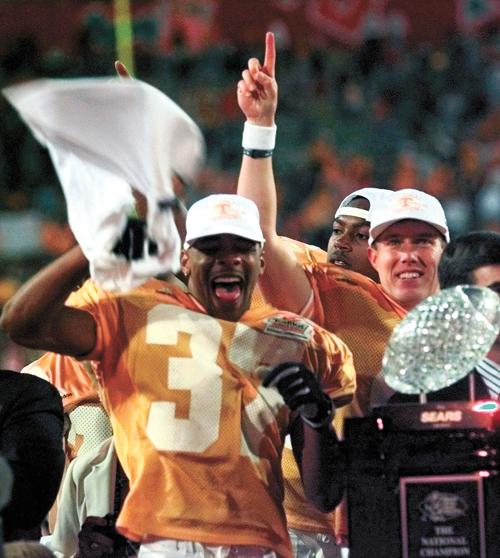
January 4, 1999, 25 years ago: The Fiesta Bowl is played at Sun Devil Stadium on the campus of Arizona State University, in the Phoenix suburb of Tempe, Arizona. It was the 1st game played under the Bowl Championship Series system, with the intention of selecting a definitive National Champion, something college football had never had before.

The Fiesta Bowl had hosted de facto National Championship games before, because it didn't have an automatic league tie-in: The Rose Bowl in the Los Angeles suburb of Pasadena, California had the Big Ten and Pacific-10 Champions play each other; the Big Eight, and now Big Twelve, Champions were locked into the Orange Bowl in Miami; the Southeastern Conference Champions were locked into the Sugar Bowl in New Orleans; and the Champions of the now-defunct Southwest Conference were locked into the Cotton Bowl Classic in Dallas.

But, effective with the 1998 season, the BCS was determined to make it official. As a result, the NCAA allowed Conference Champions to opt out of their usual bowls, and play in the BCS National Championship Game, if they finished the last pre-bowl national poll ranked Number 1 or Number 2.

The Number 1 team in the last 1998 poll was the University of Tennessee, coached by Phillip Fullmer. For 4 years, the Volunteers had been an elite team, led by quarterback Peyton Manning, but they couldn't get past the University of Florida in the SEC. Now, their quarterback was the less-heralded Tee Martin, but they had a better all-around team, going 12-0, beating teams then ranked Number 2 (Florida), 7 (Georgia, away), 10 (Arkansas), 17 (Syracuse, away), and 23 (Mississippi State, in the SEC Championship Game).

The Number 2 team was Florida State University, coached by Bobby Bowden. The Seminoles opened the season by beating Number 14 Texas A&M at the Kickoff Classic at the Meadowlands, but then stumbled with a 24-7 loss away to North Carolina State.

They followed it by dropping 62 points on Duke, and beating Number 18 USC. They beat Clemson 48-0, then went to Atlanta and beat Number 20 Georgia Tech. They beat Number 12 Virginia, and won the Atlantic Coast Conference Championship. And they had to get past Number 4 Florida, beating them, 23-12 -- and they didn't need overtime to beat Florida, as Tennessee did. Perhaps that's why, despite having a loss, the Seminoles were favored by 5 1/2 points.

The 'Noles had been National Champions in 1993. The Vols, despite many good teams over the years, last won a National Championship in 1951.

The 1st quarter ended scoreless. In the 1st minute of the 2nd quarter, Martin threw a short touchdown pass to Shawn Bryson. On the next drive, the Vols' Dwayne Goodrich intercepted Marcus Outzen, and took it in 54 yards for a touchdown. It was 14-0 Tennessee.

Outzen drove the Seminoles to the Volunteer 1-yard line, and William McCray scored. Still fuming over missed field goal attempts earlier in the decade, Bowden had recruited Sebastian Janikowski, a 6-foot-1, 255-pound native of WaƂbrzych, Poland, who grew up in Florida, and became the top high school kicker in the nation. But Janikowski missed the extra point on this touchdown. He made up for it on the last play of the 1st half, kicking a 34-yard field goal. It was Tennessee 14, Florida State 9, and still anybody's ballgame.

Goodrich, whose interception had been key, and had been assigned to cover Outzen's favorite receiver, All-American Peter Warrick, did not return for the 2nd half, having sustained an ankle injury. He was replaced by Gerald Griffin, who had hardly played, but limited Warrick to a single catch.

The 3rd quarter saw no scoring. With 9:17 left in the 4th, Martin threw to the superbly named Peerless Price, and he took it 79 yards for a touchdown. But as had Janikowski, Vols kicker Jeff Hall missed the extra point. With 6 minutes left, Hall again followed Janikowski's pattern, and kicked a field goal, from 23 yards out. It was 23-9 Tennessee.

Florida State wasn't done. There was still time for the 2 scores they needed. Outzen got them to within 7 yards, and scored on his own run with 3:42 left, to make it 23-16. Their defense forced a fumble by Travis Henry, and they had a last shot with 2 minutes to go. But Outzen threw a pass that was intercepted by Steve Johnson, and that was the ballgame, and the National Championship: Tennessee had won.

The BCS didn't always work as intended. There would always be a team stuck at Number 3, sometimes even Number 4, that thought it deserved to get into the final game. Finally, taking effect with the 2013 season (settled in early January 2014), a College Football Playoff National Championship system was set up.

Except that the new system, as had the BCS, allows teams that didn't even win their Conference, sometimes not even their Division -- read: Alabama or a team that lost the SEC Championship Game or West Division to Alabama -- to be one of the last 4.

There is no perfect system. It may just be that the hated BCS is the best system we have yet had.

In 2023, Sun Devil Stadium was renamed Mountain America Stadium.

Also on January 4, 1999, the New Jersey Devils' Swiss star Nico Hischier was born.

Tuesday, January 2, 2024

January 2, 1984: Miami Shocks Nebraska In the Orange Bowl

Bernie Kosar, on an NBC screen capture

January 2, 1984, 40 years ago: The Orange Bowl is played, at the stadium of the same name in Miami. The usual date, New Year's Day, fell on a Sunday, so, not wanting to compete with the NFL for TV viewers, the game was pushed back a day.

Since winning back-to-back National Championships in 1970 and 1971, the University of Nebraska had won 6 Big Eight Conference Championships, 2 Orange Bowls, a Sugar Bowl and a Cotton Bowl. But they hadn't won another National Championship. They only lost 1 game in 1982, by 3 points, away to Penn State.

In 1983, head coach Tom Osborne's Cornhuskers put up one of the most stunning seasons in college football history in 1983. They were ranked Number 1 to open the season, and their 1st game was the Kickoff Classic at the Meadowlands, against Number 4 Penn State, the defending National Champions. The 'Huskers crushed Joe Paterno's Nittany Lions, 44-6.

What followed was the most devastating offensive display in the history of college football. With quarterback Turner Gill handing off to Heisman Trophy winner Mike Rozier, and Outland Trophy winner Dean Steinkuhler blocking for them, they beat Wyoming at home, 56-20. They went into the Metrodome and beat Minnesota 84-13. That is not a misprint: Eighty-four to thirteen. They beat UCLA at home, 42-10. They beat Syracuse at home, 63-7.

Their next game was a tough one: Away to Number 20 Oklahoma State. Nebraska won that one, 14-10. They won away to Missouri, 34-13; beat Colorado at home, 69-19; won away to Kansas State, 51-25; beat Iowa State at home, 72-29; beat Kansas at home, 67-13. They closed the regular season by beating arch-rival Oklahoma away, 28-21, clinching the Big Eight Conference Championship.

They outscored their opponents 634-186. In other words, in the 1983 regular season, the average score of a Nebraska football game was Cornhuskers 53, Opponents 10. Fifty-three to ten.

To be fair: Some of these opponents were better than others. Minnesota finished 1-10, and, in other games, gave up 69, 61, 58, 56 and 50. Kansas State finished 3-8, Colorado and Iowa State 4-7, Kansas 4-6-1. But Penn State finished 8-4-1, both Oklahoma and Oklahoma State 8-4, UCLA 7-4-1 and as Pac-10 Champions, Wyoming and Missouri 7-5. UCLA won the Rose Bowl, Penn State the Aloha Bowl, Oklahoma State the Bluebonnet Bowl. Missouri reached the Holiday Bowl.

As Big 8 Champions, they were locked into the Orange Bowl, at the Orange Bowl stadium in Miami. It was also the home stadium of the University of Miami. And that would be their opponents.

The Hurricanes were coached by Howard Schnellenberger, who, with his stocky build and his big mustache, looked more like an old big-city butcher than a football coach. But he was smart, and was recruited by Bear Bryant to play end, both offensively and defensively, at Kentucky.

After playing in the Canadian Football League, he became one of Bryant's assistants at Alabama, and recruited Joe Namath. He then served as an assistant to George Allen with the Los Angeles Rams, and to Don Shula with the Miami Dolphins, including the undefeated season of 1972-73.

In 1979, the University of Miami hired him as head coach. He coached them to a 9-3 season in 1980, 9-2 in 1981, and 7-4 in 1982. They were then an independent, so there was no conference title for them to win. But they won the 1981 Peach Bowl, would have gone to a bowl game for the 1981 season had they not been on probation, and were denied a bowl bid for 1982.

In 1983, they opened the season with a bad 28-3 loss away to Number 16 Florida. But they cruised from there: Beating Houston away, 29-7; Purdue at home, 35-0; Number 13 Notre Dame at home, 20-0; Duke away, 56-17; Louisville at home, 42-14; Mississippi State away, 31-7; Cincinnati away, 17-7; Number 12 West Virginia at home, 20-3; East Carolina at home, 12-7; and Florida State away, 17-16.

So here's how the bowl games stood: Number 1 Nebraska vs. Number 5 Miami in the Orange Bowl; Number 2 Texas vs. Number 7 Georgia in the Cotton Bowl in Dallas; Number 3 Auburn vs. Number 8 Michigan in the Sugar Bowl in New Orleans; and Number 4 Illinois vs. unranked UCLA in the Rose Bowl in Pasadena.

But in the early afternoon, on CBS, Georgia beat Texas, 10-9. So that eliminated the Longhorns. In the late afternoon, on ABC, UCLA crushed Illinois, 45-9. (Students at Caltech, responding to a recent prank by MIT students at the Harvard-Yale game, hacked the Rose Bowl scoreboard, so that it read "CALTECH 38 MIT 9.") So that eliminated the Fighting Illini.

In those days, the Orange Bowl and the Sugar Bowl were usually held at the same time, the former on NBC, the latter on ABC. Auburn's hope was that they would beat Michigan solidly, and that Miami would pull the tremendous upset against Nebraska. Miami's hope was that they would pull the upset, and then Michigan would upset Auburn.

What followed was one of the lamest games in New Year's Day bowl history -- and one of the most stunning football games ever played at any level.

Nebraska were favored by 10 1/2 points. Most fans expected Miami to put up a fight, but Nebraska to win solidly. And yet, Miami stopped their opening drive, and blocked a field goal attempt. Miami quarterback Bernie Kosar threw a touchdown pass to Glenn Dennison. Miami held Nebraska again, and Jeff Davis kicked a field goal. Miami intercepted Gill, and Kosar threw another touchdown pass to Dennison.

At the end of the 1st quarter, it was Miami 17, Nebraska 0. The nation -- or, at least, its football fans -- were stunned. Meanwhile, in the Superdome, Michigan quarterback Steve Smith ran for a touchdown, and put the Wolverines up 7-0 on Auburn.

Despite having a potent wishbone attack led by the next season's Heisman winner, running back Vincent "Bo" Jackson, Auburn couldn't score in the 2nd quarter, either. It was still 7-0 at the half, and it was looking like Miami had a shot at the National Championship: They were Number 5, they were beating Number 1, Number 2 and Number 4 had already lost, and Number 3 were losing.

Nebraska got back on track, intercepted Kosar, and drove into Miami territory. With a 3rd & 5 on the Hurricane 19, Gill took the snap, and ran to his right. So did fullback Mark Schellen, who appeared to have the ball. So did tight end Monte Engebritson. It looked like a power sweep.

Except Gill didn't give the ball to Schellen. He just set it on the ground. Officially, it was a fumble. But none of the Miami players saw it. Steinkuhler, by design, did, picked it up, and ran for a touchdown. Had it been a pass, he would have been an ineligible receiver. But, under the rules of the time, when the ball was fumbled, all offensive players were permitted to pick it up and run it forward. It was a trick play known as the fumblerooski, and would be outlawed in 1992.

For the moment, though, it was 'Canes 17, 'Huskers 7. Gill led another drive, ending with a quarterback sneak. At halftime, it was Miami 17, Nebraska 14. The upset was still on, but the sense that Nebraska had shaken off the shock of Miami's initial attack, and was ready to run their momentum straight down the Hurricanes' throats, was now strong.

It got stronger when Miami fumbled early in the 3rd quarter, and Nebraska tied it 17-17 on a Scott Livingston field goal. But the fact that they got only a field goal, not a touchdown, would matter later on. Meanwhile, in New Orleans, Al Del Greco kicked a 31-yard field goal to close Auburn to within 7-3 of Michigan.

Miami got its act together, and Kosar engineered 2 more touchdown drives, capped by runs by Alonzo Highsmith and Albert Bentley. At the end of the 3rd quarter, it was 31-17 Miami. And Rozier, after running for 147 yards, had to leave the game with an injured ankle.

Midway through the 4th quarter at the Sugar Bowl, Del Greco kicked a 32-yard field goal, to close Auburn to within 7-6 of Michigan. They still had a chance.

So did Nebraska. With 7 minutes left, Gill got them to the 1-yard line, and Jeff Smith ran it over for a touchdown. That made it 31-23. Osborne could have gone for a 2-point conversion here, and made a big difference. Instead, he went for the 1-point kick, and it was 31-24 Miami.

With 58 seconds left in the Sugar Bowl, Del Greco attempted a 19-yard field goal. It was good, and Auburn beat Michigan, 9-7. The Tigers had done what they absolutely had to do: Win. But they did it by just 2 points, and without having scored a touchdown. Would it be enough to convince poll voters, in case Miami hung on to beat Nebraska?

The Orange Bowl also came down to the last minute. Davis missed a field goal that would have iced it for the 'Canes. Gill drove the 'Huskers down, and Smith broke off a 24-yard run, scoring with 48 seconds left. It was Miami 31, Nebraska 30.

Going for one, and a 31-31 tie, presuming Nebraska's defense could hold Miami for the last 48 seconds, would have left Nebraska at 12-0-1, and almost certainly gained them the National Championship. Going for two, and a 32-31 win, would not only guarantee the 13-0 Cornhuskers the National Championship, but perhaps certify them as the greatest college football team of all time, especially since they could, in this scenario, add to their resume, "Their last test was their greatest, and they passed it." But fail on the conversion, and there would be no title, and the poll voters would have to choose between Miami and Auburn.

There was a principle at hand: If you can't gain 3 yards on 1 play to win 1 game, you don't deserve to win the National Championship.

There was also a memory to contend with: That of the 1966 "Game of the Century" between Notre Dame and Michigan State. As Notre Dame head coach, Ara Parseghian went for a tie, knowing it wouldn't cost him the National Championship, whereas a loss would have. But, in the ensuing 17 years, the words had been spoken many times: "Parseghian had no guts."

Osborne was not going to be accused of having no guts. He knew that, for all Parseghian had achieved, that 10-10 tie was the thing for which he was most remembered. "We were trying to win the game," Osborne said at the time. "I don't think you go for a tie in that case. You try to win the game. We wanted an undefeated season and a clear-cut National Championship."

Clear-cut. Because Americans hate ties. Long ago, though the identity of the coach who first said it depends on who's telling the story, a coach lost a game on a 1-yard run attempt rather than kick a tying field goal, and explained to the reporters, "A tie is like kissing your sister."

It's not like in European soccer, where a win is worth 3 points to your team in the league standings (or "table"), and a tie (or "draw") is worth 1 point. A tie that gave Nebraska the 1983 National Championship would have satisfied very few people -- outside the State of Nebraska, anyway. Americans hate ties, to the point that the NHL no longer has them. Sure, with a tie, Nebraska would still have been National Champions. But any pretense to "Greatest Team Ever" status would have been gone.

The ball was placed on Miami's 3-yard line. Once again, Gill rolled to his right, and looked for Smith. But Smith was double-covered, and Miami's Kenny Calhoun knocked the pass away. It was still Miami 31, Nebraska 30. Nebraska kicked off, and Miami ran out the clock, and won the game.

When the Associated Press and United Press International released their polls the next day, they both awarded Miami the National Championship. The AP (the sportswriters) gave 11-1 Miami 47 1/2 1st-place votes, 11-1 Auburn 7, and 12-1 Nebraska 4 1/2. UPI (the coaches) gave Miami 30, Nebraska 6, and Auburn 4.

Auburn won a major bowl game. They won the Sugar Bowl, the 2nd-best thing an SEC team could do in those pre-Playoff days, behind winning the National Championship. And they were ranked Number 3, and the teams ranked Number 1 and Number 2 had both lost. But their performance in that game was so weak, both polls put them behind Miami, and UPI also put them behind a defeated Nebraska.

This would begin a run for Miami of 12 seasons in which they were, effectively, in 6 National Championship Games, winning 4 of them (in the seasons of 1983, 1987, 1989 and 1991). They would win another in 2001, and come very close in 2000 and 2002.

Schnellenberger wouldn't be there for any more of it. After 1 more season, he left Coral Gables to become head coach at the University of Louisville, in the city where he grew up. He built them into a powerhouse, winning a Fiesta Bowl over Alabama, and later returned to the Miami area as head coach at Florida Atlantic University.

The '84 Orange Bowl would haunt Nebraska. They lost the Orange Bowl to Miami again in 1988 (thus blowing a shot at the title and letting Miami win it), and lost it to Florida State in 1994 (again blowing the title to a team from Florida).

Finally, on January 1, 1995, they again went to the Orange Bowl, again played Miami, and beat them 24-17, to win the 1994 National Championship, finally getting the monkey off Osborne's back. They would win the National Championship again in 1995, and share the 1997 title with Michigan, the last "split poll" title. That 1995 team is considered by some to be what the 1983 team should have been: The greatest team in college football history.

Monday, January 1, 2024

January 1, 2014: The NHL's Biggest Crowd

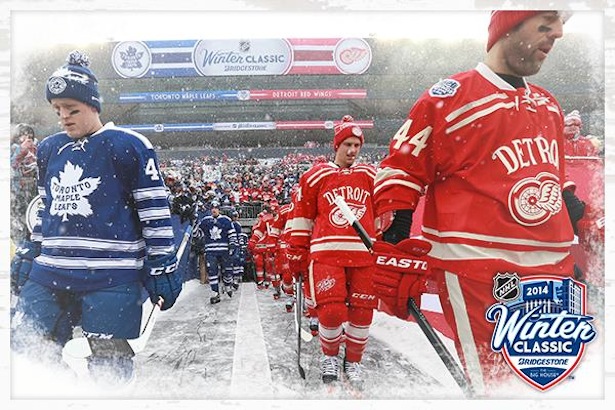
January 1, 2014, 10 years ago: The NHL Winter Classic is held at Michigan Stadium, on the campus of the University of Michigan, in Ann Arbor, 37 miles west of downtown Detroit.

In 2001, Michigan had visited Michigan State in East Lansing for an outdoor hockey game at MSU's Spartan Stadium. The game was known as "The Cold War," and attracted 74,544 fans, a record for a hockey game anywhere. It ended in a 3-3 tie.

In 2010, the Wolverines returned the favor, and invited the Spartans to play at game at Michigan Stadium. "The Big Chill at the Big House" was a 5-0 Wolverine win, in front of 104,173 fans, a new worldwide hockey record.

That gave the Detroit Red Wings the idea of hosting a regular-season NHL game at Michigan Stadium. With the Winter Classic having been established for the 2007-08 season, the precedent had been set. It was announced that the 2013 Winter Classic would be played in Ann Arbor.

The Toronto Maple Leafs were selected as the opponent. This would be the 1st time a Canadian team had been selected to play in the Winter Classic, home or away. Although the Chicago Blackhawks are the Wings' traditional arch-rivals, the Leafs are a bit closer, 231 miles to 284. (Actually, the closest team to the Wings is now the Columbus Blue Jackets, 200 miles even. But they're one of the newest NHL teams, while the Wings, the Hawks and the Leafs are all part of the "Original Six.")

But before the 2012-13 season could begin, the NHL's team owners locked the players out. Since the NHL's players union, like the NFL's but unlike MLB's and the NBA's, is very weak, there wasn't much that could be done. The game was canceled on November 2, 2012. After the was lockout settled, the game was rescheduled on April 7, 2013 for January 1, 2014.

The Wings wore their traditional home red, combining an early version of their Winged Wheel logo with their original uniforms as the 1926-27 Detroit Cougars. The Leafs, despite being the visitors, were permitted to wear their traditional home blue, with a jersey inspired by their 1930s uniforms, but with the Leaf logo being specifically the 1st one they had used, in the 1927-28 season. (From 1917 to 1919, they were the Toronto Arenas. From 1919 to 1927, they were the Toronto St. Patricks, and wore green.)
There was no scoring in the 1st period. In the 2nd period, Daniel Alfredsson, the longtime Ottawa Senator defenseman, and no friend of the Leafs, scored to put Detroit on the board. But with 37 seconds left in the period, James van Riemsdyk, from Middletown, Monmouth County, New Jersey, evened it up.

Tyler Bozak put Toronto up 2-1 early in the 3rd. With 5:32 left in regulation, the tying goal was scored by Justin Abdelkader. He was a Michigan native, from Muskegon, and was Jordanian Arab on his father's side and Polish on his mother's, fulfilling 2 of the Detroit area's biggest ethnic groups. With the Wings in 2008, he became the 1st player of Middle Eastern descent to have his name put on the Stanley Cup.

There was no scoring in the overtime, and the game went to a shootout. Alfredsson shot first, and missed. van Riemsdyk went first for the Leafs, but Jimmy Howard stopped him. Pavel Datsyuk scored for the Wings, and Joffrey Lupul tied it for the Leafs. Jonathan Bernier stopped a shot by Tomas Tatar, and then Tyler Bozak scored to win it for the Leafs. Despite Detroit outshooting 43-26, the game went into the books as a 3-2 Toronto win.
Tyler Bozak

Attendance was claimed at 105,491. That would have been an all-time hockey record. However, University of Michigan officials claimed that the actual paid attendance was less than the 104,173 for "The Big Chill at the Big House." Regardless, it's still an NHL record.

*

January 1, 2014 was a Wednesday. There was 1 other game played in the NHL that day: The Tampa Bay Lightning beat the Vancouver Canucks, 4-2 at the Rogers Arena in Vancouver.

There were 5 games played in the NBA:

* The Dallas Mavericks beat the Washington Wizards, 87-78 at what's now the Capital One Arena in Washington.

* The Toronto Raptors beat the Indiana Pacers, 95-82 at what's now the Scotiabank Arena in Toronto.

* The Minnesota Timberwolves beat the New Orleans Pelicans, 124-112 at the Target Center in Minneapolis.

* The Philadelphia 76ers beat the Denver Nuggets, 114-102 at what's now the Ball Arena in Denver.

* And the Los Angeles Clippers beat the Charlotte Hornets, 112-85 at what's now the Crypto.com Arena in Los Angeles. Blake Griffin scored 31 points to lead all players on the day.

In the New Year's Day college football bowl games:

* Rose Bowl, Pasadena, California: Number 4 Michigan State beat Number 5 Stanford, 24-20. 

* Fiesta Bowl, at what's now State Farm Stadium in the Phoenix suburb of Glendale, California: Number 15 Central Florida 52, Number 6 Baylor 42.

* Gator Bowl, at what's now TIAA Bank Stadium in Jacksonville: Unranked Nebraska beat Number 23 Georgia, 24-19.

* Capital One Bowl, at what's now Camping World Stadium in Orlando: Number 8 South Carolina beat Number 19 Wisconsin, 34-24.

* Outback Bowl, at Raymond James Stadium in Tampa: Number 14 Louisiana State (LSU) beat unranked Iowa, 21-14.

* Heart of Dallas Bowl, played at the Cotton Bowl stadium, now that the Cotton Bowl Classic had been moved to the Cowboys' stadium in Arlington: North Texas beat Nevada-Las Vegas, 36-14.

The Sugar Bowl was played on January 2, the Cotton Bowl on January 3, and the BCS National Championship Game on January 6, at the Rose Bowl. Number 1 Florida State beat Number 2 Auburn, 34-31.

Also on January 1, Arsenal beat Welsh team Cardiff City, 2-0 at the Emirates Stadium in North London.  

January 1, 1994: Florida State Finally Does It

 
January 1, 1994, 30 years ago: The Orange Bowl is played, at the stadium of the same name in Miami. The University of Nebraska hasn't won the National Championship since the 1971 season, 32 years earlier. Florida State University has never won it. Both teams have had some agonizing close calls the last few years. Something's got to give.

Bobby Bowden had been an assistant coach at Florida State before becoming the offensive coordinator, and then the head coach, at West Virginia. After taking the Mountaineers to victory in the 1975 Peach Bowl, FSU asked him to come back.

He inherited a mess. As he said at the time, "At West Virginia, the bumper stickers say, 'BEAT PITT.' At Florida State, they say, 'BEAT ANYBODY.'" It took him just 2 years to turn them into a 10-2 team and winners of the Tangerine Bowl.

The Seminoles were not in a league until joining the Atlantic Coast Conference in 1992. But they put together some great teams. In 1979, they had an undefeated regular season, 11-0. In 1980, they went 10-1. But, both seasons, they lost a chance at the National Championship by losing the Orange Bowl.

In 1987, they went 11-1 and won the Fiesta Bowl. In 1988, they went 11-1 and won the Sugar Bowl. But, both times, they lost a regular season game to the University of Miami, one of their main rivals, costing them a shot at the National Championship. In 1989 and 1990, they went 10-2.

The 1991 season seemed like the year. They began the season ranked Number 1, and won their 1st 10 games. And then it all fell apart. In back-to-back games -- though with a bye week in between -- they faced Number 2 Miami at home at Doak Campbell Stadium in Tallahassee, and lost 17-16; and then faced their other main rivals, Number 5 University of Florida, away, and lost 14-9. A win over Texas A&M in the Cotton Bowl did little to console them, as Miami won the National Championship for the 4th time in the last 9 seasons.

Could 1992 be the year? They won their 1st 5 games, then had to go to the Orange Bowl stadium to play Miami: The Hurricanes were Number 2, the Seminoles Number 3, so it was a big game, if not the big game of the regular season, as it was the year before. Miami won, 19-16. Florida State won the rest of their games, including a return to the Orange Bowl where they beat Nebraska, but finished Number 3. Miami lost the Sugar Bowl to Alabama, costing them another National Championship.

In both 1991 and 1992, Miami won because Florida State missed a last-play field goal: The 1st time, by Gerry Thomas from 34 yards; the 2nd time, by Dan Mowrey from 39. Both were wide and to the right. These games are now known as Wide Right I and Wide Right II.

Seminole fans could only console themselves by calling on Miami's "thug" image, saying, "You can't spell SCUM without UM." In time, a free sneakers scandal would lead to Miami (and Florida) fans saying, "FSU" stood for "Free Shoes University."

Again in 1993, Florida State opened the season at Number 1. And they tempted fate by recruiting Scott Bentley, a native of the Denver suburbs and the country's highest-ranked high school kicker, and letting him be put on the cover of Sports Illustrated's 1993 College Football Preview Issue. It was as if they were telling "The Dreaded SI Cover Jinx," "Come on, then!"

As it turned out, Bentley missed 7 extra points in the team's 1st 5 games. Not 7 field goals. Seven extra point attempts. The Jinx was punishing Bentley for his team's defiance.

As it turned out, it didn't matter: It was only Bentley, not the team as a whole, that was getting punished. They won those 1st 5 games: 42-0 over Kansas in the Kickoff Classic at the Meadowlands, 45-7 away to Duke, 57-0 home to Number 17 Clemson, 33-7 away to Number 13 North Carolina, and 51-0 home to Georgia Tech.

This time, with Miami coming into Doak Campbell with the Number 3 ranking, the Seminoles left no doubt, winning 28-10. No last-play, or even last-minute, heroics necessary. They followed this with a 40-14 win home to Number 15 Virginia, a 54-0 home win over Clemson, and a 49-20 win away to Maryland.

That set up a showdown with Number 2 Notre Dame in South Bend, Indiana. NBC tried billing it as "The Game of the Century," and it lived up to the hype, being in doubt until a last-gasp FSU pass was broken up in the end zone. Notre Dame won, 24-17, and rose to Number 1.

It looked like the Seminoles' dreams had been shattered again. But the very next week, Notre Dame were upset by Boston College on a last-play field goal. Meanwhile, Florida State beat North Carolina State 62-3 to clinch the ACC title, and won 33-21 away to Number 7 Florida to regain the Number 1 ranking.

Since winning back-to-back National Championships in 1970 and 1971, Nebraska had won 11 Big Eight Conference Championships, 3 Sugar Bowls, 2 Orange Bowls and a Cotton Bowl. But they hadn't won another National Championship. They only lost 1 game in 1982, by 3 points, away to Penn State. They put up one of the most stunning seasons in college football history in 1983, but lost the Orange Bowl to Miami on a missed 2-point conversion, starting Miami's quasi-dynasty.

Expectations for 1993 were not especially high, as the Cornhuskers started out ranked Number 9. Putting up 76 points on North Texas, 50 on Texas Tech, 49 on Missouri, 49 on Iowa State, 48 on Colorado State, and 45 on Kansas State were not unusual for The 'Huskers under head coach Tom Osborne.

What did get people's attention was a nationally-televised 14-13 win over UCLA at the Rose Bowl stadium; a 21-17 win away to Colorado, which had been the top team in the Big 8 the last few years; and a 21-7 day-after-Thanksgiving win over their arch-rivals, Number 16 Oklahoma.

It pushed Nebraska up to Number 2, and set up a New Year's Day prime-time matchup between Osborne's 'Huskers and Bowden's 'Noles. One of these teams was going to end their years of heartbreak, while the other was going to extend it. It was college football's equivalent of having a World Series between the pre-2004 Boston Red Sox and the pre-2016 Chicago Cubs.

Nebraska were undefeated. Florida State were not. And yet, Florida State were favored by 17 1/2 points. Was it because they had the Heisman Trophy winner, quarterback Charlie Ward? It shouldn't have been: Nebraska had the country's best defense. Was it because Nebraska had a history of choking? It shouldn't have been: So did Florida State.

Was it because Florida State were used to playing on this field? Not really: So were Nebraska. And being in the same State didn't make any difference: It was 482 miles from Doak Campbell Stadium to the Orange Bowl, so this was no "home game" for the Seminoles and their fans.

The 1st quarter ended scoreless, but it shouldn't have been: Nebraska returned a punt for a touchdown, but it was called back due to an illegal block, which the instant replay showed didn't happen. Bentley opened the scoring with a field goal midway through the 2nd quarter. Nebraska scored a touchdown, but with time running out in the half, Bentley kicked another field goal. It was Nebraska 7, Florida State 6.

Nebraska got robbed again early in the 3rd quarter. William Floyd appeared to have scored a touchdown for FSU, but the replay showed that he fumbled before crossing the goal line. The 2-point conversion attempt failed, and the Seminoles led 12-7. Bentley kicked another field goal, and it was 15-7 Seminoles at the end of the quarter. By all rights, it should have been 14-9 Cornhuskers.

At the beginning of the 4th quarter, Lawrence Phillips scored a touchdown for Nebraska. Just as it had on the same field 10 years earlier, the 2-point conversion attempt did not go Nebraska's way, and it was still 15-13 Seminoles. Time began to run out. But quarterback Tommie Frazier drove the 'Huskers down, and with 1:16 left, Byron Bennett kicked a 27-yard field goal. Nebraska led, 16-15.

But it wasn't over yet. The 'Noles still had Heisman winner Ward. He got them down to a 1st & goal on the Nebraska 3-yard line. The 'Husker defense held, and, with 21 seconds left, Scott Bentley finally had his date with destiny. It was an attempt from 22 yards out. Basically, an extra point attempt. If he makes it, he's a Seminole hero for all time. If he misses it, he's the biggest flop in team history. He nailed it, and his teammates piled onto him.

But the game still wasn't over. The Seminoles were penalized for excessive celebration. That, and a bad kickoff -- by Bentley, mind you -- gave the 'Huskers the ball at their own 43. They only needed about 25 yards for a game-winning field goal.

Frazier got Nebraska to the Seminole 28, with a pass to Trumane Bell. That would make a field goal attempt 45 yards. Not easy on natural grass, but with hardly any wind, certainly possible. But the clock seemed to run out when Bell went down. Thinking their coach had finally won his National Championship, some Florida State players dumped the Gatorade on Bowden.

But referee John Soffey ruled that Bell was down with 1 second left. By NCAA rules, the clock must stop to move the first down marker. This gave Nebraska time to get their field goal unit on in time. If Bennett made his attempt, it would have been the cruelest loss yet for Florida State: Losing on a last-play field goal when you thought you already had the National Championship won.

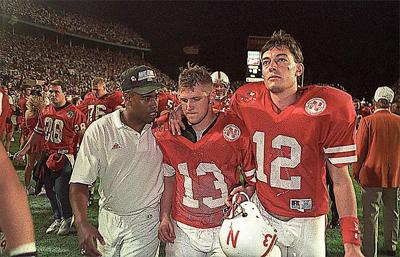
Bennett missed. Not wide right, but wide left.
Like Ralph Branca, a victim of big-game fate
in baseball in 1951, he wore Number 13.

Now, Florida State were the National Champions -- clinching it with the other team missing a field goal attempt. No one cared about the irony, or that they hadn't played especially well: They were Champions at last.

It was another crushing defeat for Nebraska. Finally, the next season, they went all the way -- and in the perfect way, beating Miami on their own field in the Orange Bowl game. This started a run of 3 National Championships in 4 seasons.

Byron Bennett would not be a part of it. The man who thought he'd made the field goal to get Tom Osborne his 1st National Championship as a head coach -- he'd been an assistant to Bob Devaney in 1970 and '71 -- and then missed the one that would have really done it, became a parole officer in Dallas, and then a high school football coach. He's done rather well at it.

Bobby Bowden would lead Florida State to another National Championship in 1999. His successor, Jimbo Fisher, did so in 2013.

Scott Bentley remained with Florida State through the 1996 season, and graduated. In 1997, the Atlanta Falcons signed him as a kickoff specialist, but released him after 2 games. The Denver Broncos picked him up, as a backup to Jason Elam, and he played 1 game, kicking 2 field goals in 3 attempts and going 4-for-4 on extra points. He remained a kickoff specialist, playing 2 games in 1999 for the Kansas City Chiefs; and, in 2000, 1 more for the Broncos and 6 for the Washington Redskins, making 1 field goal, for 50 yards. He is now an operations manager for Amazon.com.

One other note: This game was broadcast on NBC, with Dick Enberg and former Cincinnati Bengals star Bob Trumpy in the booth, and legendary USC and Buffalo Bills running back O.J. Simpson as the sideline reporter. If what happened between Florida State and Nebraska on January 1, 1994 was shocking, what Simpson did in the week of June 12 to 17, 1994 was even more so.

In the other New Year's Day bowl games:

* Rose Bowl, Pasadena, California: Number 9 Wisconsin beat Number 14 UCLA, 21-16.

* Sugar Bowl, Superdome, New Orleans: Number 8 Florida beat Number 3 and previously undefeated West Virginia, 41-7. West Virginia fans were hoping that the Orange Bowl, being played at the same time, would be a dull, or mistake-filled, game, giving them hope for the National Championship. But Florida, who'd lost only to Florida State and Auburn, put a quick stop to that.

* Cotton Bowl, Dallas: Number 4 Notre Dame beat Number 7 Texas A&M.

* Fiesta Bowl, Sun Devil Stadium, Tempe, Arizona: Number 16 Arizona beat Number 10 Miami, 29-0. Arizona did this despite playing on the home field of their arch-rivals, Arizona State.

* Hall of Fame Bowl, Tampa Stadium: Number 23 Michigan beat unranked North Carolina State, 42-7.

* Florida Citrus Bowl, Orlando, Florida: Number 13 Penn State beat Number 6 Tennessee, 31-13.

* Carquest Bowl, Joe Robbie Stadium, Miami Gardens, Florida: Number 15 Boston College beat unranked Virginia, 31-13. This game debuted in 1990 as the Blockbuster Bowl, and has gone through many names. It moved to Orlando in 2001, and took up the former name of the Florida Citrus Bowl, the Tangerine Bowl. Still in Orlando, it is now known as the Cheez-It Bowl. 

January 1, 1954: Too Full of Alabama

January 1, 1954, 70 years ago: The Cotton Bowl Classic is played in the Cotton Bowl stadium in Dallas. And it includes a bizarre play.

From its founding in the 1936 season until the dissolution of the Southwest Conference in 1996, the Classic featured, with a few exceptions, the Champions of the SWC against another team that had a really good season.

In 1953, the SWC Champion was Rice University of Houston. At the time, this was not unusual: They had previously won in 1934, 1937, 1946 and 1949. They won again in 1957. After that, the program went downhill, and they have only won their league twice since: The SWC in 1994, and Conference USA in 2013.

In 1953, Rice went 8-2. They lost by 5 points to Southern Methodist (SMU) and 6 points to Kentucky, then coached by former University of Alabama end Paul "Bear" Bryant. But they beat 2 ranked teams, Florida and Baylor, and also beat Texas. They did not play the University of Houston, which would become their arch-rival. But on the Saturday after Thanksgiving, they beat Number 17 Baylor, 41-19, to rise to Number 6 in the rankings.

Alabama had a weird season. They were ranked Number 5 in the preseason, but in their 1st 6 games, the lost to Mississippi Southern in Montgomery, tied Louisiana State (LSU) in Mobile, beat Vanderbilt in Nashville (big deal), beat the University of Tulsa at home in Tuscaloosa (big deal), tied Tennessee in Birmingham, and died Mississippi State in Tuscaloosa. 2-1-3.

But they beat Georgia away, Chattanooga at home, and Georgia Tech in Birmingham. They lost to Maryland away, before winning the Iron Bowl against Auburn in Birmingham, finishing 6-2-3 and winning the Southeastern Conference Championship. So they were invited to face Rice in the 1954 Cotton Bowl Classic.

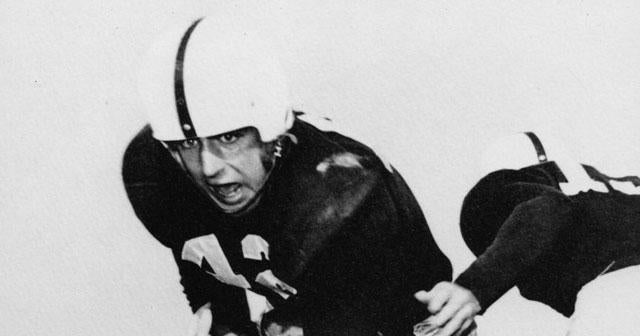
Bart Starr, later to lead the Green Bay Packers to 5 NFL Championships including the 1st 2 Super Bowls, played both ways in this game, and intercepted a pass. He then quarterbacked Alabama to an early drive, and a 2-yard run by Tommy Lewis gave the Crimson Tide a 6-0 lead.

But in the 2nd quarter, the Owls equalized on a 79-yard touchdown run by Dicky Moegle. (Later in life, he would change the spelling of his name to match its pronunciation: "Maegle.") LeRoy Fenstemaker, Rice's quarterback and kicker, made the extra point, to take a 7-6 lead.

With 8:34 left in the 2nd quarter, and Rice having the ball on their own 5-yard line, Fenstemaker handed off to Moegle, and he broke free, and ran down the sideline occupied by the Alabama team. No Tide player on the field was going to catch him.

But Lewis, Alabama's co-captain, jumped off the sideline, and tackled Moegle at the Alabama 42. He figured he would get penalized for illegal participation, being a 12th man on the field, and that the referee would put the ball at the spot of the foul, and then mark off 5 yards, giving Rice the ball at the Alabama 37.
Tommy Lewis

Referee Cliff Shaw thought otherwise. There is a rule known as the "Palpably Unfair Act": A referee may award a touchdown when he believes that there has been a flagrant rule violation, and said violation is the only thing that would have prevented a touchdown.

Certainly, Lewis' violation was flagrant. It is possible that Moegle could have tripped and fallen, or suffered a sudden attack of illness that caused him to fall short of the end zone. But no 'Bama player was going to legally tackle him. So Shaw awarded the touchdown. Rice led 14-6, following the only application of this rule ever made in a major college football game. It has never happened in an NFL game, either.

Moegle scored a 3rd touchdown in the 3rd quarter, and a run by Buddy Grantham in the 4th quarter capped the day for Rice, as they won 28-6.

Two days later, both Moegle and Lewis were guests on The Ed Sullivan Show, broadcast live from New York on CBS. Moegle couldn't figure out why Lewis was invited. Why was he being rewarded for breaking the rules? Sullivan, a big sports fan, asked Lewis why he did it. He said, "I guess I was just too full of Alabama."

Surely, Moegle must have been thinking that Lewis was too full of something.

Lewis played for the Ottawa Rough Riders of the Canadian Football League in 1956 and 1957, went into coaching, and died in 2014. Moegle was drafted by the San Francisco 49ers, made the Pro Bowl as a rookie safety in 1955, and ended up playing 7 seasons in the NFL. He later broadcast for the Houston Oilers and managed hotels in Texas, and was elected to the College Football and Texas Sports Halls of Fame. He died in July 4, 2021.

Alabama did not win another SEC Championship until 1961, and it turned out to be the 1st National Championship they won with Bear Bryant as head coach. He restored them to a position of glory, and they remain one of college football's elite programs.

Rice haven't been so lucky. They didn't win another bowl game until December 30, 2008, winning the Texas Bowl against Mid-American Conference team Western Michigan.

In the other New Year's Day bowl games:

* Rose Bowl, Pasadena, California: Number 3 Michigan State beat Number 5 UCLA, 28-20.

* Orange Bowl, Miami: Number 4 Oklahoma upsets Number 1 Maryland, 7-0. This was the season in which Bud Wilkinson's Sooners began a 47-game winning streak, a record that still stands.

* Sugar Bowl, Tulane Stadium, New Orleans: Number 8 Georgia Tech beat Number 10 West Virginia, 42-19.

* Gator Bowl, Jacksonville, Florida: Number 12 Texas Tech beat Number 17 Auburn, 35-13.

* Sun Bowl, Kidd Field, El Paso, Texas: Texas Western beat Mississippi Southern, 37-14. Neither of those teams was ranked in the national Top 20. Both have since changed their names: Mississippi Southern College became the University of Southern Mississippi in 1962; and Texas Western, the home team, became the University of Texas at El Paso (UTEP) in 1967, a year after winning the NCAA basketball title.

* Tangerine Bowl, from the stadium of the same name, Orlando, Florida: East Texas State and Arkansas State played to a 7-7 tie. Despite both being undefeated, neither team was nationally ranked: The Tangerine Bowl usually played 2 of the stronger "small college" teams in the South against each other.  The game was renamed the Florida Citrus Bowl for the 1982 season. The stadium still stands, now named Camping World Stadium.

In 1996, East Texas State, located in Commerce, Texas, became part of the Texas A&M system, and is now named Texas A&M University-Commerce. Since the reorganization of the NCAA in 1973, they have played in Division II. Arkansas State, located in Jonesboro, remain at the top level, the Football Bowl Subdivision, what used to be known as Division I-A. However, they have changed the name not of the school, but of the team: In 2008, they switched from Indians to Red Wolves.

January 1, 1934: Columbia Win the Rose Bowl

January 1, 1934, 90 years ago: The football team of Columbia University wins the Rose Bowl.

Stop laughing. It happened.

When the Ivy League was founded as an official college football league in 1954, its teams agreed not to participate in postseason play. That choice still stands. But before that, the teams were permitted to do so. This included the Rose Bowl. Brown played in it in 1916, and lost to Washington State. The University of Pennsylvania lost to Oregon in 1917. Harvard beat Oregon in 1920.

But then, it didn't happen again until the 1933 season. Coached by Lou Little, Columbia were 7-1, having beaten Lehigh, Virginia, Penn State, Navy, Lafayette and Syracuse at home at Baker Field in Upper Manhattan; and Cornell away. Their only loss had been 20-0, away to undefeated Princeton, coached by Fritz Crisler, who did not accept a bowl bid. (Crisler gave Princeton a "winged" design on their helmets, and took it with him to Michigan, who are now the first team fans think of when they think of the design.) The Rose Bowl not yet being automatic between the Champions of the league known today as the Pac-12 and the Champions of the Big 10, they were invited to play in it, and they accepted.

Stanford's teams were called the Indians until 1972, then the Cardinals until 1981, and finally just the Cardinal, after the shade of red they wore, rather than the bird known for the color. In 1933, they were 8-1-1: They beat San Jose State, UCLA, Santa Clara, the University of San Francisco, the Olympic Club of San Francisco, Montana and arch-rivals the University of California at home at Stanford Stadium in the San Francisco suburb of Palo Alto; and USC at the Los Angeles Coliseum. They lost away to the University of Washington, and tied Northwestern away. Among their players was David Packard, co-founder of Hewlett-Packard.

It had rained for 3 days before the New Year, and the field at the Rose Bowl stadium in the Los Angeles suburb of Pasadena, California was described by a Columbia historian as a lake. Attendance was 35,000, the lowest at the game since 1920.

Stanford were heavily favored, having allowed just 5 touchdowns all season. And it rained again, so the field was even worse. The 1st quarter ended scoreless. Early in the 2nd quarter, Columbia quarterback Cliff Montgomery called a trick play: He handed off to Al Barabas, and faked a handoff to Ed Brominski, and he and Barabas ran in opposite directions. The Indians were fooled, going after Brominski, while Barabas ran 83 yards for a touchdown.

That was the game, right there: The muddy field prevented Stanford from getting anything going, and the 7-0 lead held. Columbia had pulled off one of the greatest upsets in college football history, and became the last Ivy League team, and the last college football team from New York City, to win a bowl game.

Whether this remains the greatest win in Columbia history is debatable: On October 25, 1947, they dealt Army their 1st loss in 4 years, in a game known as the Miracle of Morningside Heights.

It would take until the next year for the Orange Bowl and the Sugar Bowl to be first played, and 2 more years for the Cotton Bowl.