Showing posts with label miami hurricanes. Show all posts

Wednesday, January 1, 2025

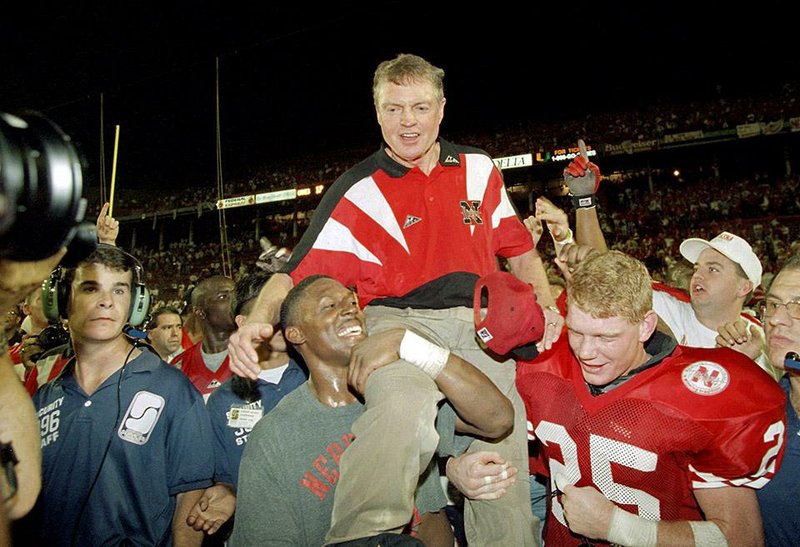
January 1, 1995: Nebraska Redeemed

January 1, 1995, 30 years ago: The World Trade Organization (WTO) begins operation. The History Channel is launched.

And the Orange Bowl is played in Miami, at the stadium of the same name. It was also the home field for the football team at the University of Miami, who were ranked Number 3 in the country, and invited to play in it.

The Number 1 team in the country was also invited to play in it. This was the University of Nebraska.

In spite of Nebraska being ranked higher, all signs pointed to a Miami win.

Since winning back-to-back National Championships in 1970 and 1971, Nebraska had won 12 Big Eight Conference Championships, 3 Sugar Bowls, 2 Orange Bowls and a Cotton Bowl. But they hadn't won another National Championship. They only lost 1 game in 1982, by 3 points, away to Penn State. They put up one of the most stunning seasons in college football history in 1983, but lost the Orange Bowl to Miami on a missed 2-point conversion.

That started Miami on a quasi-dynasty that saw them awarded that season's National Championship, and win it again in 1987, 1989 and 1991, and just miss it in 1986, 1988 and 1992. So in a stretch of 10 seasons, they reached an official or unofficial game for the National Championship 7 times, winning 4 of them. In those 10 seasons, they ended up Number 1 in the final poll 4 times, Number 2 twice, and Number 3 3 times.

But Nebraska couldn't get over the hump. Head coach Tom Osborne had been an assistant to Bob Devaney on those early 1970s titles, but since taking over in 1973, he couldn't win one himself. From 1982 to 1993, 12 seasons, the Cornhuskers had regular seasons of 11-1, 12-0, 9-2, 9-2, 9-2, 10-1, 11-1, 10-1, 9-2, 9-1-1, 9-2 and 11-0. They lost 3 Orange Bowls to Miami. And just 1 year earlier, on New Year's Day 1994, they thought they had the National Championship won with a last-minute field goal over Florida State. But they gave up a field goal, and then missed one on the last play.

At this point, the Chicago Cubs hadn't won a World Series in 86 years, the Boston Red Sox hadn't won one in 76 years, the New York Rangers had just ended a Stanley Cup drought at 54 years, and Nebraska football, while their drought was a much shorter 33 years, it was similarly tinged with painful close calls.

So when football fans found out that Nebraska's opponents for the de facto National Championship game were the Miami Hurricanes, it seemed like, as baseball legend Yogi Berra would have said, "Déjà vu all over again."

This was a typical Nebraska team, pounding weak opponents and doing enough, sometimes just enough, to beat the stronger ones. They opened the season ranked Number 4, and beat Number 24 West Virginia in the Kickoff Classic at the Meadowlands. They hung 70 points on the University of the Pacific, 49 on Number 13 UCLA, 45 on Kansas, 42 on Texas Tech, 42 on Wyoming, 42 on Missouri.

Kansas State was ranked Number 16 when Nebraska went there and won, 17-6. The 'Huskers essentially wrapped up the Big Eight Conference title when, ranked Number 3, they beat Number 2 Colorado at home, 24-7. And they went to arch-rival Oklahoma and beat them, 13-3.

Miami were 10-1 under head coach Dennis Erickson. Their only loss was to Number 17 Washington, but it did come at the Orange Bowl. They did manage to beat Number 3 Florida State, Number 10 Syracuse, Number 13 Virginia Tech, and Number 25 Boston College, winning the Big East Conference title.

Cliché Alert: In football, home-field advantage is said to be worth 3 points. The Las Vegas oddsmakers took that into account, and installed Miami as favorites by 1 point.

Midway through the 1st quarter, Dan Prewitt kicked a field goal to put Miami on the board. At the end of the quarter, Frank Costa threw a touchdown pass to Trent Jones, and now the Hurricanes were up 10-0. It was looking like another bad ending for Nebraska.

But the 'Huskers made the only score of the 2nd quarter, as Brook Berringer threw a touchdown pass to Mark Gilman. The teams went into the locker room with the score 10-7 Miami, and the game still either team's to win.

Early in the 3rd quarter, Costa threw to Jonathan Harris, who ran 44 yards for a touchdown. It was 17-7 Miami, and with 28 minutes to go, it looked like Nebraska were beaten. Within 2 minutes, Nebraska had to punt the ball away. But with 11:35 left in the 3rd, Dwayne Harris sacked Costa in the end zone for a safety. The 3rd quarter ended 17-9 in Miami's favor.

Theoretically, it was now a one-score game. Quarterback Tommie Frazier drove the 'Huskers down the field. With 7:38 left in regulation, running back Cory Schlesinger scored on a 15-yard run. Frazier threw to Eric Alford for the 2-point conversion, the play that had doomed Nebraska on that very field 11 years earlier (and had helped to do so 1 year earlier). This time, it was successful, and the game was tied, 17-17.

Miami could do nothing with their next possession. Nebraska got the ball back, and Frazier drove them again. With 2:46 left, Schlesinger broke off a nearly identical run, and rumbled into the end zone. The extra point was good, and Nebraska led. Their defense held, and they were 24-17 victors.

The Nebraska Cornhuskers were redeemed. Tom Osborne had his National Championship. And his greatest victory had just been won on the site of his greatest defeat.

Two weeks later, Erickson resigned from Miami, to become head coach of the NFL's Seattle Seahawks. He did not do well there. In contrast, Osborne won another National Championship in 1995, and another in 1997 (albeit with the polls split, one poll choosing Nebraska, the other choosing Michigan).

Schlesinger played 12 seasons in the NFL, mostly as a blocking back for the Detroit Lions, making 3 Pro Bowls. Despite quarterbacking the 'Huskers to back-to-back National Championships, Frazier was not drafted, because NFL teams were afraid of his history of blood clots. He played 1 season with the CFL's Montreal Alouettes, but his illness took hold again, and he had to retire. Like Turner Gill, the quarterback on the 1983 Nebraska team that crashed through everybody before losing the title to Miami, he went into coaching. He was still better off than his backup, Berringer, who was killed in a plane crash in 1996.

Only 1 other bowl game was played that New Year's Day: Number 23 North Carolina State beat Number 16 Mississippi State in the Peach Bowl, at the Georgia Dome in Atlanta.

The rest of the major bowl games were played the next day, January 2 -- and it could have been argued that Nebraska still didn't have the National Championship won. Penn State was undefeated, and playing in the Rose Bowl. They beat Oregon, 38-20, and their fans still claim the 1994 season as a National Championship.

But both the final AP poll (the Associated Press, the sportswriters) and the final UPI poll (United Press International, the coaches) gave it to Nebraska. I guess they didn't want to take Osborne's great moment away. Or maybe they already knew about the harm that was being caused in Joe Paterno's program.

The reason there were comparatively few bowl games played on New Year's Day is that it was a Sunday, and it was the 1st round of the NFL Playoffs. Two games were played in those Playoffs. The Cleveland Browns beat the New England Patriots, 20-13, in what turned out to be the last postseason game, in any sport, at Cleveland Municipal Stadium. The Browns didn't win another Playoff game for 16 years. And the Chicago Bears beat the Minnesota Vikings, 35-18 at the Metrodome in Minneapolis.

January 1, 1935: The 1st Orange Bowl & the 1st Sugar Bowl

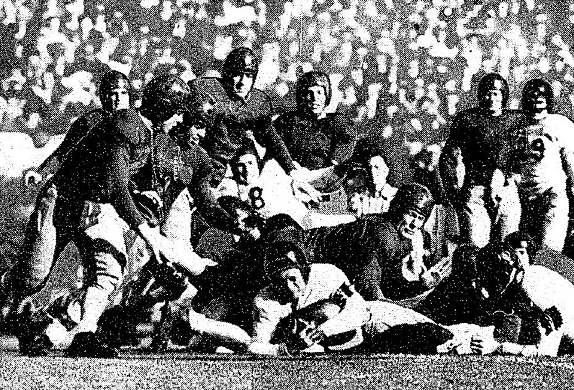
January 1, 1935, 90 years ago: The 1st Orange Bowl is played, at Miami Field in Miami. Unlike in a few later appearances, having the home-field advantage did not help the University of Miami, as they lost to Bucknell University, 26-0.

The Bison defense held the Hurricanes to just 4 1st downs and 28 yards total offense en route to the victory. The Bucknell offense gained 278 yards, and earned its 6th shutout of the season.

The Orange Bowl was pattered after the Rose Bowl in Pasadena, California, with its pregame Tournament of Roses Parade. The Fiesta of the American Tropics parade was held in 1926, but there was no game. Then came the Florida land bust that year, and then the Great Depression in 1929, killing Florida tourism.

In 1932, trying to revive Florida tourism, Miami was ready to try again. A parade was held on January 1, 1933, and a Festival of Palms Bowl was played at Moore Park on January 2, with the University of Miami beating Manhattan College, 7-0. In 1934, again at Moore Park, Miami lost to Duquesne University of Pittsburgh. For the following season, the organizing committee received official sanction from the NCAA, and, for that reason, the 1935 edition was not only the 1st to carry the Orange Bowl name, but is recognized as the 1st Orange Bowl, rather than the 3 earlier Festival of Palms Bowls.

And so, every year, from 1936-37 to 2001-02, the King Orange Jamboree Parade would be held in downtown Miami on New Year's Eve, and the Orange Bowl on New Year's Day, except when January 1 fell on a Sunday, moving the game back to January 2. Traditionally, NBC televised both. The Parade's attendance dropped, and it was canceled in 2002.

Bucknell, in Lewisburg, Pennsylvania, downgraded its football program in 1948. In 1973, with the NCAA reclassifying, they were put in Division II. In 1978, they were promoted to Division I-AA, which was renamed the Football Championship Subdivision (FCS) in 2006. They have played at the same stadium since 1924. In 1989, it was renamed Christy Mathewson-Memorial Stadium, in honor of the school's most famous graduate, the New York Giants pitcher who was 1 of the 1st 5 players elected to the Baseball Hall of Fame.

Clarke Hinkle, star running back for the Green Bay Packers in the 1930s, before this Orange Bowl, remains Bucknell's greatest football player. They have never again appeared in a bowl game, and have never won a conference championship.

Miami, on the other hand, would have a decent football history until the 1980s, when they became a bit indecent, but also one of the best programs in the game. In 1937, they moved into Burdine Stadium, built on the site of Miami Field, named for the late Roddy Burdine, department store owner and major booster of the City of Miami. The stadium was renamed the Miami Orange Bowl in 1959, and would host 5 Super Bowls, including the New York Jets' famed upset of the Baltimore Colts in Super Bowl III.
The Miami Dolphins played at the Orange Bowl from 1966 to 1986, then moved into Joe Robbie Stadium in suburban Miami Gardens in 1987. The Orange Bowl game was first played there in 1997 and 1998, moved back to its namesake stadium in 1999, and has been played at the Miami Gardens facility, now named Hard Rock Stadium, from 2000 onward. The University of Miami last played at the Orange Bowl in 2007, and moved to Miami Gardens. The stadium was demolished in 2008, and the new home of the Miami Marlins, now named LoanDepot Park, opened on the site in 2012.
From 1968 to 1996, the Champion of the Big Eight Conference was officially awarded a berth in the Orange Bowl, something that had unofficially been done since 1954. It was accepted all but twice, by Nebraska in 1974 and 1975, in favor of a better shot at the National Championship. They paid dearly for this, losing both times. Since the 2014 season, the Champion of the Atlantic Coast Conference has been guaranteed a berth in the Orange Bowl, unless it qualifies for the National Championship Playoff.

The Orange Bowl has featured 16 teams that won the National Championship for the preceding calendar year: Miami in 1988 and 1992; Oklahoma in 1954, 1987 and 2001; Nebraska in 19871, 1972, 1995 and 1997; Georgia Tech in 1952; Alabama in 1965; Clemson in 1982;  Notre Dame in 1990; Colorado in 1991; and Florida State in 1994.

*

January 1, 1935 was a Tuesday. This was also the day the 1st Sugar Bowl was played, at Tulane Stadium in New Orleans. Tulane University beat Temple University, 20-14.
The most notable play of the game came in the 2nd quarter, when Tulane's quarterback, John McDaniel, caught a Temple kickoff, ran to the right to draw tacklers, then threw a lateral pass to his teammate Monk Simons, who ran 75 yards for the touchdown. Two more Tulane touchdowns in the second half outweighed Temple's early lead.

Tulane had been built on a sugar plantation, and sugar was long the leading crop in the State of Louisiana. Hence, the game was named for a local crop. New Orleans civic leaders wanted to copy Pasadena, California's Rose Bowl for a few years, and finally got it set up for 1934-35. There was no pregame parade, however.

Tulane had been one of the South's leading football schools, winning titles in the Southern Intercollegiate Athletic Association in 1920, and the Southern Conference in 1925, 1929, 1930 and 1931. That league was the forefather of both the Southeastern Conference (SEC) and the Atlantic Coast Conference (ACC).

In 1933, Tulane was a founding member of the SEC, and won the title in 1934, giving them the credibility to host the bowl game. They would win the SEC again in 1939 and 1949, but went into decline, and left the league after the 1965 season, surpassed in football importance in their State by Louisiana State University (LSU), and even by the black college rivalry between Grambling State and Southern University. They would later win the title in Conference USA in 1998, and are now members of the American Athletic Conference (AAC), having won the AAC title in 2022.

The game was held at Tulane Stadium from 1935 until 1975. In 1975, the Louisiana Superdome opened, and the game has been held there every year since, with the exception of 2006, when it was held at the Georgia Dome in Atlanta, due to repairs on the Superdome from Hurricane Katrina.
Tulane Stadium

Temple have also never again reached the football heights they reached in the 1930s. They devalued their program in 1958, but began moving back up in 1991, becoming members of the Big East Conference. In 2013, they joined the American Athletic Conference (AAC), winning it in 2016.

After the inaugural Sugar Bowl, they didn't go to another bowl game until the 1979 season, and then not again until 2009. They won the Garden State Bowl in 1979, the New Mexico Bowl in 2011, and the Gasparilla Bowl in 2017. But they've never been to another traditional New Year's Day bowl game.

Tulane Stadium hosted Super Bowls IV, VI and IX, and was home to the NFL's New Orleans Saints from 1967 to 1974, before they and the Green Wave moved into the Superdome for the 1975 season. Tulane Stadium was demolished in 1979, the 1st of the 4 classic New Year's Day bowl game facilities to go. (The Orange Bowl followed in 2008, while the Rose Bowl and Cotton Bowl stadiums still stand.) In 2014, Yulman Stadium was opened on the site of Tulane Stadium.
The Superdome

The Sugar Bowl has usually invited the SEC Champion, although this was not made official until the 1976 season. With the advent of the Bowl Championship Series (BCS) in the 1998 season, hosting the SEC Champion was no longer a given. Given the success of the SEC since the start of the National Championship Playoff in 2014, it's been almost impossible.

The Sugar Bowl has featured the National Champions of the preceding calendar year 23 times: Louisiana State University (LSU) in 1959 and 2007; the University of Mississippi (Ole Miss) in 1960, 1961 and 1963; Alabama in 1962, 1979, 1980 and 1993; the University of Miami in 1990 and 2001; Texas Christian University (TCU) in 1939; Texas A&M in 1940; Oklahoma in 1950; Maryland in 1952; Georgia Tech in 1953; Notre Dame in 1974; the University of Pittsburgh in 1977; Georgia in 1981; Penn State in 1983; Florida in 1997; Florida State in 2000; and Ohio State in 2021.

Also on this day, the Rose Bowl was played at the stadium of the same name, outside Los Angeles in Pasadena, California. Alabama completed an undefeated season, ruining Stanford's, 29-13. The Cotton Bowl debuted on New Year's Day 1937.

Saturday, November 23, 2024

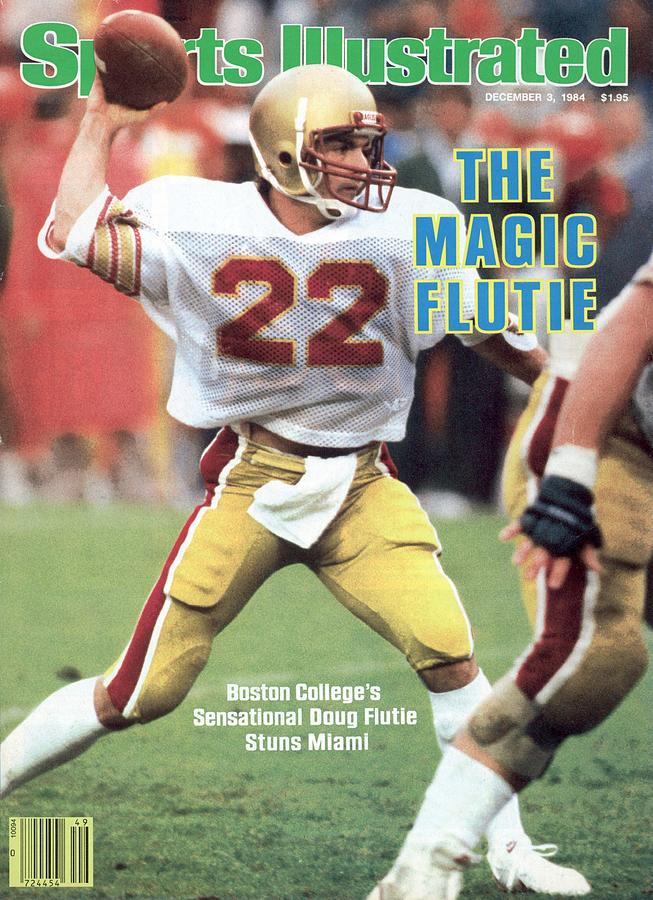
November 23, 1984: Doug Flutie's Miracle In Miami

November 23, 1984, 40 years ago: It is the day after Thanksgiving, and this was the early days of retail treating it as "Black Friday," the biggest shopping day of the year, which has come to, traditionally, set the tone for the Christmas season: Either they will make big profits, and be "in the black"; or they will be wearing black for mourning.

Thanksgiving weekend is also a time for football. The day before, many high school games were played, much more so than are played today. I was a sophomore at East Brunswick High School in Central New Jersey, and my Bears came back from a 27-13 deficit to beat Colonia High School of Woodbridge, 33-27, and clinch the Championship of the Middlesex County Athletic Conference and an undefeated regular season. It's often regarded as the greatest football game in the school's history. Unfortunately, we lost the Central Jersey Group IV Final, costing us a "State Championship" and an undefeated full season, something, to this day, we've never had.

There was only one college football game that Thanksgiving Day, a minor rivalry to everyone but those connected to the schools playing: Miami University of Ohio beat the University of Cincinnati, 31-26 at Nippert Stadium in Cincinnati. Miami University, in Oxford, Ohio, was founded in 1809, 8 years before Ohio gained Statehood. In contrast, the University of Miami, in suburban Coral Gables, Florida, wasn't founded until 1925.

In the NFL, both of the traditional home teams won: The Detroit Lions beat the Green Bay Packers, 31-28 at the Silverdome in Pontiac, Michigan; and the Dallas Cowboys beat the New England Patriots, 20-17 at Texas Stadium in Irving.

There was only one college game played on the day after Thanksgiving, on CBS. So anybody who wanted to watch a football game at that point was watching it. At the time, there was a Big East Conference, but they did not sponsor a football competition. If they did, this game would have decided its Championship. The fact that both teams involved have since moved to the Atlantic Coast Conference (ACC) should not attract from what that meant.

The University of Miami were the defending National Champions, having shocked the University of Nebraska in the previous season's Orange Bowl game, in the stadium of the same name, which was the Hurricanes' usual home field.

Bernie Kosar quarterbacked them as a freshman, and now, as a sophomore, had led them to an 8-3 record. They had won the Kickoff Classic at the Meadowlands, beating then-Number 1 Auburn. They beat Number 17 Florida on neutral ground in Tampa. They beat Number 16 Notre Dame away. But they had lost to Number 14 Michigan away, losing the Number 1 ranking in the process. They had lost to Number 15 Florida State at home.

And, in their last game before this one (they had a week off in between), they lost an embarrassing one: They led Maryland 31-0 at the half, and lost, 42-40. For many years thereafter, it was the biggest comeback in NCAA Division I-A (now FBS, the Football Bowl Subdivision) history. The Maryland quarterback was Frank Reich, substituting for the injured Boomer Esiason. In the 1992 NFL Playoffs, subbing for the injured Jim Kelly -- who had played at Miami -- Reich led the Buffalo Bills to what is still the biggest comeback in NFL history, from 35-3 down to beat the Houston Oilers, 41-38 in overtime.

Their opponents for this game would be Boston College. BC had some good teams in the 1930s and '40s, but hadn't done much since. In 1981, they were struggling, losing to the University of Pittsburgh, ranked Number 2 in the country, and coach Jack Bicknell turned to a 5-foot-9 3/4-inch freshman quarterback from nearby Natick, Massachusetts, and said, "Okay, Flutie, see what you can do."

And Doug Flutie went in, and nearly pulled the upset. They ended the season 5-6. The next season, Sports Illustrated noted that Flutie would be the starting quarterback, and whoever was writing the article finished with, "Good luck, Flutie."

Flutie made his own luck, leading BC to an 8-3-1 record. Their non-wins were all against then-ranked teams: A tie away to Number 16 Clemson, and losses away to Number 16 West Virginia, home to Number 8 Penn State, and to Number 18 Auburn in the Citrus Bowl. It was their 1st bowl game in 39 years.

As a junior in 1983, Flutie led them to a 9-3 season, losing at home to Number 12 West Virginia, away to unranked Syracuse, and in the Liberty Bowl to Notre Dame. On October 29, in a game too big for their 32,000-seat on-campus Alumni Stadium, they played defending National Champion (but, at the time, unranked) Penn State at Sullivan Stadium, home of the NFL's New England Patriots (later renamed Foxborough Stadium). Before a crowd of 56,605, and millions more watching on ABC, the Eagles beat the Nittany Lions, 27-17. Flutie, already the classic "local boy makes good," became a national star.

BC were 7-2 going into their game with Miami. They had beaten Number 9 Alabama in Birmingham, but had lost 2 games, away to Number 20 West Virginia and away to Penn State -- by a combined 8 points. BC were ranked Number 10, Miami Number 12. In spite of these rankings, Miami were a 6-point betting favorite. (Keep in mind: In football, home-field advantage is traditionally said to be worth 3 points.) Flutie was the favorite for the Heisman Trophy, although Kosar was also a contender for it. The winning quarterback would get his Heisman vote totals boosted significantly.

The game was played at the Orange Bowl, in a driving rainstorm throughout. It was almost as if there was a real hurricane going on. It kicked off at 2:30 PM Eastern Time, and BC jumped out to a 14-0 lead. Miami scored a touchdown before the 1st quarter ran out, and tied the game with a touchdown early in the 2nd quarter.

BC scored on a run by Flutie, then Miami scored on a Kosar touchdown pass, then BC did so on a touchdown pass from Flutie to his college roommate, Gerard Phelan. At halftime, the score was Boston College 28, Miami 21. So there had already been as much action as in most full games.

In the 3rd quarter, Miami scored another touchdown, and the teams traded field goals. The quarter ended with the game tied, 31-31. BC kicked another field goal to make it 34-31, but Melvin Bratton broke off a 52-yard run to make it 38-34 Miami. It seemed like Miami had the game won. Flutie led a drive that ended with a touchdown, and it was 41-38 BC. But Kosar led a drive that ended with another touchdown run by Bratton, and it was 45-41 Miami.

BC got the ball back with 28 seconds left in regulation, on their own 20 yard line. Flutie got the Eagles to the Hurricanes' 48-yard line. There were 6 seconds left. Time for one more play. A field goal wouldn't have helped, it would have been 65 yards anyway, and the weather and the wet grass would have made it a tricky proposition regardless of how close it was. There was no choice: The play had to result in a touchdown.

Before the play, CBS announcer Brent Musberger said, "One thing is certain: Those brave folks who sat out here in the Orange Bowl, and put up with this terrible weather, saw a whale of a football game, and they should give both teams a rousing ovation when this one is over." His broadcast partner, former Notre Dame coach Ara Parseghian, whose career included a 10-10 tie with Michigan State in 1966, known as "The Game of the Century," followed this with, "This is one of the better ones that I've seen."

Flutie called "55 Flood Tip": No running backs, and all eligible receivers run straight routes to the end zone. He was flushed out of the pocket by the Miami defense, and had to scramble. He had to attempt his 46th pass of the game, on the run, throwing from his own 37-yard line, meaning the ball had to fly at least 63 yards, into a 30-mile-per-hour wind, and through the rain.

Flutie heaved the ball. Since a Roger Staubach to Drew Pearson play in the 1975 NFL Playoffs, such a pass had been known as a "Hail Mary." Some Catholics find the expression offensive. In this case, given that Boston College is a Catholic school -- specifically, Jesuit -- it might have been appropriate.

Three Miami defensive backs blanketed receiver Kelvin Martin. There would be no way he could catch the ball. Phelan was behind them. It would require perfect placement of both man and ball for him to catch it. He did. Boston College 47, Miami 45. Ballgame. No chance to try for an extra point, with everyone running onto the field, and no need for it.

"Caught by Boston College!" Musberger yelled. "I don't believe it! It's a touchdown! The Eagles win it! I don't believe it! Phelan is at the bottom of that pile!" The entire team piled onto Phelan. As Musberger noted, "Jack Bicknell is the only person over there on the sidelines! He couldn't get the headset off fast enough! Doug Flutie has done it! And your heart goes out to Bernie Kosar. He did everything he could."

Kosar had passed for 447 yards, then a school record, with 2 touchdowns. And Bratton had run for 4 touchdowns. It was all for naught, as Flutie passed for 472 yards, becoming the 1st major college quarterback with 10,000 career passing yards. He also threw for 3 touchdowns. Miami punted only once all game; BC, just 3 times.

The game became known as the Miracle in Miami, and if there was any doubt before the game that Flutie would win the Heisman Trophy, that doubt disappeared into Phelan's hands. Ohio State running back Keith Byars finished 2nd. Robbie Bosco, who quarterbacked Brigham Young University to a controversial National Championship, finished 3rd. Kosar was 4th. Jerry Rice of Mississippi Valley State, who went on to become the greatest receiver in football history, finished 9th. Bo Jackson of Auburn, who would win it the next season, did not finish in the Top 10 this season.

Miami went on to lose the Fiesta Bowl to UCLA. Kosar would have a good pro career with the Cleveland Browns, before winning a Super Bowl ring as Troy Aikman's backup on the Dallas Cowboys.

Flutie's last college game was in the Cotton Bowl, and BC beat the University of Houston. But NFL teams passed on him due to his lack of height. This was so dumb. How dumb was it? Well, let's absolve the following teams, because they drafted Hall-of-Famers: The San Francisco 49ers, Rice; the Buffalo Bills, Bruce Smith; and the Minnesota Vikings, Chris Doleman. And, besides, the 49ers had Joe Montana, while the Bills had the rights to Jim Kelly. And several other teams drafted All-Pros. But lots of teams needed a quarterback, and didn't draft Flutie, and struggled for years to come.

Flutie signed with the New Jersey Generals of the United States Football League, and led them to the Playoffs. When the USFL folded, the Chicago Bears signed him, against the wishes of head coach Mike Ditka. Ditka refused to start him over an already-injured Jim McMahon, and the Bears haven't won a Super Bowl since. In 1987, the Bears traded Flutie to his hometown New England Patriots, but they kept him as a backup to Tony Eason, and didn't get too far, and released him after the 1989 season, and got even worse.

Flutie signed with the Vancouver-based BC Lions of the Canadian Football League. In 1992, he was traded to the Calgary Stampeders, and he led them to the CFL Championship, the Grey Cup. He did the same for the Toronto Argonauts in 1996 and '97. All 3 times, he was named the game's Most Valuable Player. He was named the CFL's Most Outstanding Player 6 times in 7 years from 1991 to 1997.

Finally, at the age of 36, the NFL could ignore him no longer. With Kelly having retired after the 1996 season, the Bills signed Flutie, and he led them to the Playoffs, made the Pro Bowl, and was named the NFL Comeback Player of the Year. He got them back into the Playoffs in 1999, but coach Wade Phillips benched him for the Playoff game against the Tennessee Titans, in favor of Rob Johnson. The Bills lost, and didn't make the Playoffs again for 18 years.

Flutie played 4 years for the San Diego Chargers, and closed his career with the Patriots, as a backup to Tom Brady. In his last game, against the Miami Dolphins, on New Year's Day 2006, he did something no NFL player had done since 1941: He converted a dropkick. It was good for a point-after-touchdown, and the Patriots won.

Doug Flutie is not in the Pro Football Hall of Fame. It is, quite specifically, not "The National Football League Hall of Fame." It includes a few players who would not have made it if not for their performances in the All-America Football Conference (1946-49) and the 1960s version of the American Football League, including Billy Shaw, who played 9 seasons for the Bills, all in the AFL, and never played a down in the NFL.

Still, voters for it tend not to consider CFL statistics. There are really only 2 NFL players who are not in the Hall whose qualifications would be noticeably boosted if their CFL tenures were included, and they're both quarterbacks: Joe Theismann and Doug Flutie. Another quarterback, Warren Moon, is the only player in the Hall with significant CFL performance, although Bud Grant won 4 Grey Cups as a coach in Winnipeg before becoming a Hall of Fame coach in Minnesota.

Oddly, for all the exposure BC got from the Flutie years, their Alumni Stadium wasn't expanded to its present 44,500 seats until the 1994 season.

Tuesday, January 2, 2024

January 2, 1984: Miami Shocks Nebraska In the Orange Bowl

Bernie Kosar, on an NBC screen capture

January 2, 1984, 40 years ago: The Orange Bowl is played, at the stadium of the same name in Miami. The usual date, New Year's Day, fell on a Sunday, so, not wanting to compete with the NFL for TV viewers, the game was pushed back a day.

Since winning back-to-back National Championships in 1970 and 1971, the University of Nebraska had won 6 Big Eight Conference Championships, 2 Orange Bowls, a Sugar Bowl and a Cotton Bowl. But they hadn't won another National Championship. They only lost 1 game in 1982, by 3 points, away to Penn State.

In 1983, head coach Tom Osborne's Cornhuskers put up one of the most stunning seasons in college football history in 1983. They were ranked Number 1 to open the season, and their 1st game was the Kickoff Classic at the Meadowlands, against Number 4 Penn State, the defending National Champions. The 'Huskers crushed Joe Paterno's Nittany Lions, 44-6.

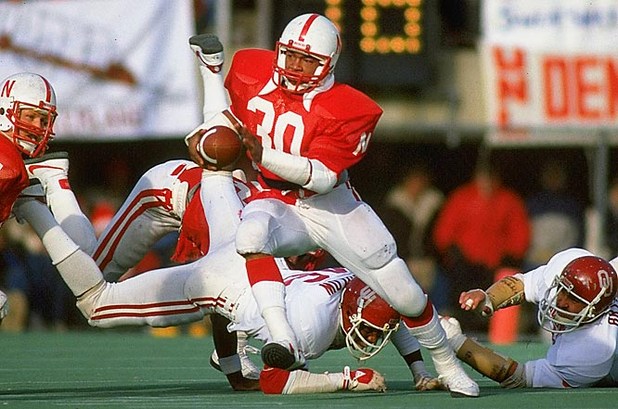
What followed was the most devastating offensive display in the history of college football. With quarterback Turner Gill handing off to Heisman Trophy winner Mike Rozier, and Outland Trophy winner Dean Steinkuhler blocking for them, they beat Wyoming at home, 56-20. They went into the Metrodome and beat Minnesota 84-13. That is not a misprint: Eighty-four to thirteen. They beat UCLA at home, 42-10. They beat Syracuse at home, 63-7.

Their next game was a tough one: Away to Number 20 Oklahoma State. Nebraska won that one, 14-10. They won away to Missouri, 34-13; beat Colorado at home, 69-19; won away to Kansas State, 51-25; beat Iowa State at home, 72-29; beat Kansas at home, 67-13. They closed the regular season by beating arch-rival Oklahoma away, 28-21, clinching the Big Eight Conference Championship.

They outscored their opponents 634-186. In other words, in the 1983 regular season, the average score of a Nebraska football game was Cornhuskers 53, Opponents 10. Fifty-three to ten.

To be fair: Some of these opponents were better than others. Minnesota finished 1-10, and, in other games, gave up 69, 61, 58, 56 and 50. Kansas State finished 3-8, Colorado and Iowa State 4-7, Kansas 4-6-1. But Penn State finished 8-4-1, both Oklahoma and Oklahoma State 8-4, UCLA 7-4-1 and as Pac-10 Champions, Wyoming and Missouri 7-5. UCLA won the Rose Bowl, Penn State the Aloha Bowl, Oklahoma State the Bluebonnet Bowl. Missouri reached the Holiday Bowl.

As Big 8 Champions, they were locked into the Orange Bowl, at the Orange Bowl stadium in Miami. It was also the home stadium of the University of Miami. And that would be their opponents.

The Hurricanes were coached by Howard Schnellenberger, who, with his stocky build and his big mustache, looked more like an old big-city butcher than a football coach. But he was smart, and was recruited by Bear Bryant to play end, both offensively and defensively, at Kentucky.

After playing in the Canadian Football League, he became one of Bryant's assistants at Alabama, and recruited Joe Namath. He then served as an assistant to George Allen with the Los Angeles Rams, and to Don Shula with the Miami Dolphins, including the undefeated season of 1972-73.

In 1979, the University of Miami hired him as head coach. He coached them to a 9-3 season in 1980, 9-2 in 1981, and 7-4 in 1982. They were then an independent, so there was no conference title for them to win. But they won the 1981 Peach Bowl, would have gone to a bowl game for the 1981 season had they not been on probation, and were denied a bowl bid for 1982.

In 1983, they opened the season with a bad 28-3 loss away to Number 16 Florida. But they cruised from there: Beating Houston away, 29-7; Purdue at home, 35-0; Number 13 Notre Dame at home, 20-0; Duke away, 56-17; Louisville at home, 42-14; Mississippi State away, 31-7; Cincinnati away, 17-7; Number 12 West Virginia at home, 20-3; East Carolina at home, 12-7; and Florida State away, 17-16.

So here's how the bowl games stood: Number 1 Nebraska vs. Number 5 Miami in the Orange Bowl; Number 2 Texas vs. Number 7 Georgia in the Cotton Bowl in Dallas; Number 3 Auburn vs. Number 8 Michigan in the Sugar Bowl in New Orleans; and Number 4 Illinois vs. unranked UCLA in the Rose Bowl in Pasadena.

But in the early afternoon, on CBS, Georgia beat Texas, 10-9. So that eliminated the Longhorns. In the late afternoon, on ABC, UCLA crushed Illinois, 45-9. (Students at Caltech, responding to a recent prank by MIT students at the Harvard-Yale game, hacked the Rose Bowl scoreboard, so that it read "CALTECH 38 MIT 9.") So that eliminated the Fighting Illini.

In those days, the Orange Bowl and the Sugar Bowl were usually held at the same time, the former on NBC, the latter on ABC. Auburn's hope was that they would beat Michigan solidly, and that Miami would pull the tremendous upset against Nebraska. Miami's hope was that they would pull the upset, and then Michigan would upset Auburn.

What followed was one of the lamest games in New Year's Day bowl history -- and one of the most stunning football games ever played at any level.

Nebraska were favored by 10 1/2 points. Most fans expected Miami to put up a fight, but Nebraska to win solidly. And yet, Miami stopped their opening drive, and blocked a field goal attempt. Miami quarterback Bernie Kosar threw a touchdown pass to Glenn Dennison. Miami held Nebraska again, and Jeff Davis kicked a field goal. Miami intercepted Gill, and Kosar threw another touchdown pass to Dennison.

At the end of the 1st quarter, it was Miami 17, Nebraska 0. The nation -- or, at least, its football fans -- were stunned. Meanwhile, in the Superdome, Michigan quarterback Steve Smith ran for a touchdown, and put the Wolverines up 7-0 on Auburn.

Despite having a potent wishbone attack led by the next season's Heisman winner, running back Vincent "Bo" Jackson, Auburn couldn't score in the 2nd quarter, either. It was still 7-0 at the half, and it was looking like Miami had a shot at the National Championship: They were Number 5, they were beating Number 1, Number 2 and Number 4 had already lost, and Number 3 were losing.

Nebraska got back on track, intercepted Kosar, and drove into Miami territory. With a 3rd & 5 on the Hurricane 19, Gill took the snap, and ran to his right. So did fullback Mark Schellen, who appeared to have the ball. So did tight end Monte Engebritson. It looked like a power sweep.

Except Gill didn't give the ball to Schellen. He just set it on the ground. Officially, it was a fumble. But none of the Miami players saw it. Steinkuhler, by design, did, picked it up, and ran for a touchdown. Had it been a pass, he would have been an ineligible receiver. But, under the rules of the time, when the ball was fumbled, all offensive players were permitted to pick it up and run it forward. It was a trick play known as the fumblerooski, and would be outlawed in 1992.

For the moment, though, it was 'Canes 17, 'Huskers 7. Gill led another drive, ending with a quarterback sneak. At halftime, it was Miami 17, Nebraska 14. The upset was still on, but the sense that Nebraska had shaken off the shock of Miami's initial attack, and was ready to run their momentum straight down the Hurricanes' throats, was now strong.

It got stronger when Miami fumbled early in the 3rd quarter, and Nebraska tied it 17-17 on a Scott Livingston field goal. But the fact that they got only a field goal, not a touchdown, would matter later on. Meanwhile, in New Orleans, Al Del Greco kicked a 31-yard field goal to close Auburn to within 7-3 of Michigan.

Miami got its act together, and Kosar engineered 2 more touchdown drives, capped by runs by Alonzo Highsmith and Albert Bentley. At the end of the 3rd quarter, it was 31-17 Miami. And Rozier, after running for 147 yards, had to leave the game with an injured ankle.

Midway through the 4th quarter at the Sugar Bowl, Del Greco kicked a 32-yard field goal, to close Auburn to within 7-6 of Michigan. They still had a chance.

So did Nebraska. With 7 minutes left, Gill got them to the 1-yard line, and Jeff Smith ran it over for a touchdown. That made it 31-23. Osborne could have gone for a 2-point conversion here, and made a big difference. Instead, he went for the 1-point kick, and it was 31-24 Miami.

With 58 seconds left in the Sugar Bowl, Del Greco attempted a 19-yard field goal. It was good, and Auburn beat Michigan, 9-7. The Tigers had done what they absolutely had to do: Win. But they did it by just 2 points, and without having scored a touchdown. Would it be enough to convince poll voters, in case Miami hung on to beat Nebraska?

The Orange Bowl also came down to the last minute. Davis missed a field goal that would have iced it for the 'Canes. Gill drove the 'Huskers down, and Smith broke off a 24-yard run, scoring with 48 seconds left. It was Miami 31, Nebraska 30.

Going for one, and a 31-31 tie, presuming Nebraska's defense could hold Miami for the last 48 seconds, would have left Nebraska at 12-0-1, and almost certainly gained them the National Championship. Going for two, and a 32-31 win, would not only guarantee the 13-0 Cornhuskers the National Championship, but perhaps certify them as the greatest college football team of all time, especially since they could, in this scenario, add to their resume, "Their last test was their greatest, and they passed it." But fail on the conversion, and there would be no title, and the poll voters would have to choose between Miami and Auburn.

There was a principle at hand: If you can't gain 3 yards on 1 play to win 1 game, you don't deserve to win the National Championship.

There was also a memory to contend with: That of the 1966 "Game of the Century" between Notre Dame and Michigan State. As Notre Dame head coach, Ara Parseghian went for a tie, knowing it wouldn't cost him the National Championship, whereas a loss would have. But, in the ensuing 17 years, the words had been spoken many times: "Parseghian had no guts."

Osborne was not going to be accused of having no guts. He knew that, for all Parseghian had achieved, that 10-10 tie was the thing for which he was most remembered. "We were trying to win the game," Osborne said at the time. "I don't think you go for a tie in that case. You try to win the game. We wanted an undefeated season and a clear-cut National Championship."

Clear-cut. Because Americans hate ties. Long ago, though the identity of the coach who first said it depends on who's telling the story, a coach lost a game on a 1-yard run attempt rather than kick a tying field goal, and explained to the reporters, "A tie is like kissing your sister."

It's not like in European soccer, where a win is worth 3 points to your team in the league standings (or "table"), and a tie (or "draw") is worth 1 point. A tie that gave Nebraska the 1983 National Championship would have satisfied very few people -- outside the State of Nebraska, anyway. Americans hate ties, to the point that the NHL no longer has them. Sure, with a tie, Nebraska would still have been National Champions. But any pretense to "Greatest Team Ever" status would have been gone.

The ball was placed on Miami's 3-yard line. Once again, Gill rolled to his right, and looked for Smith. But Smith was double-covered, and Miami's Kenny Calhoun knocked the pass away. It was still Miami 31, Nebraska 30. Nebraska kicked off, and Miami ran out the clock, and won the game.

When the Associated Press and United Press International released their polls the next day, they both awarded Miami the National Championship. The AP (the sportswriters) gave 11-1 Miami 47 1/2 1st-place votes, 11-1 Auburn 7, and 12-1 Nebraska 4 1/2. UPI (the coaches) gave Miami 30, Nebraska 6, and Auburn 4.

Auburn won a major bowl game. They won the Sugar Bowl, the 2nd-best thing an SEC team could do in those pre-Playoff days, behind winning the National Championship. And they were ranked Number 3, and the teams ranked Number 1 and Number 2 had both lost. But their performance in that game was so weak, both polls put them behind Miami, and UPI also put them behind a defeated Nebraska.

This would begin a run for Miami of 12 seasons in which they were, effectively, in 6 National Championship Games, winning 4 of them (in the seasons of 1983, 1987, 1989 and 1991). They would win another in 2001, and come very close in 2000 and 2002.

Schnellenberger wouldn't be there for any more of it. After 1 more season, he left Coral Gables to become head coach at the University of Louisville, in the city where he grew up. He built them into a powerhouse, winning a Fiesta Bowl over Alabama, and later returned to the Miami area as head coach at Florida Atlantic University.

The '84 Orange Bowl would haunt Nebraska. They lost the Orange Bowl to Miami again in 1988 (thus blowing a shot at the title and letting Miami win it), and lost it to Florida State in 1994 (again blowing the title to a team from Florida).

Finally, on January 1, 1995, they again went to the Orange Bowl, again played Miami, and beat them 24-17, to win the 1994 National Championship, finally getting the monkey off Osborne's back. They would win the National Championship again in 1995, and share the 1997 title with Michigan, the last "split poll" title. That 1995 team is considered by some to be what the 1983 team should have been: The greatest team in college football history.

Thursday, January 2, 2020

Top 5 Reasons You Can't Blame Tom Osborne for Nebraska Losing the 1983 National Championship

January 2, 1984: The University of Nebraska, ranked Number 1 in the nation, plays the University of Miami, ranked Number 5, in the Orange Bowl. The game was played on January 2 because January 1, New Year's Day, fell on a Sunday.

Nebraska had put together one of the greatest seasons in college football history. They began it ranked Number 1, and opened in the Kickoff Classic at the Meadowlands, against Number 4 Penn State, and won 44-6.

The Cornhuskers scored more points than anyone had seen in the modern era. They beat Minnesota away 84-13. They beat Iowa State 72-29. They beat Colorado 69-19. They beat Kansas 67-13. They beat Syracuse 63-7. They beat Wyoming 56-20. They beat Kansas State away 51-25. They beat UCLA 42-10.

Not all their games were easy. They went to Missouri and beat them "only" 34-13. In what was then their biggest rivalry, they went to Oklahoma and beat them 28-21. Aside from Penn State, the only ranked team they played was Number 20 Oklahoma State, away, and escaped with a 14-10 win. Still, they were 12-0, scoring 624 points and allowing just 186, for an average score of 52-15.

How good was that opposition: Minnesota went just 1-10, beating only Rice, who also went 1-10. Kansas State went 3-8. Kansas went 4-6-1. Iowa State and Colorado both went 4-7.

But Penn State went 8-4-1, won the Aloha Bowl, and finished ranked Number 17. Oklahoma went 8-4, and probably would have been ranked and gotten a bowl bid, had they not been on probation. Oklahoma State also went 8-4, won the Bluebonnet Bowl, and was ranked Number 18. UCLA went 7-4-1, won the Pac-10 and the Rose Bowl, and was ranked Number 13. Wyoming went 7-5. So did Missouri, who went to the Holiday Bowl, but lost. Syracuse went 6-5. So the 'Huskers were doing more than just running up the score on weak opposition.

Head coach Tom Osborne was named National Coach of the Year. Running back Mike Rozier won the top 2 Player of the Year awards, the Heisman Trophy and the Maxwell Award. Guard Dean Steinkuhler won the top 2 Lineman of the Year awards, the Outland Trophy and the Lombardi Trophy. Rozier, Steinkuhler and receiving Irving Fryar were named 1st team All-Americans; quarterback Turner Gill, 2nd team. Each of those was named to the All-Big Eight Conference 1st team, along with offensive tackle Scott Raridon and center Mark Traynowicz.
Mike Rozier

Rozier and Steinkuhler would go on to become All-Pros with the Houston Oilers. Fryar would go to the Pro Bowl with the New England Patriots, the Miami Dolphins and the Philadelphia Eagles, and get to a Super Bowl with the Patriots. Running backs Doug DuBose and Tom Rathman would go on to win a Super Bowl with the San Francisco 49ers. (Rathman would win 2 with them.) Defensive end Jim Skow would reach a Super Bowl with the Cincinnati Bengals. Gill is now an administrator at the University of Arkansas, after winning conference titles as head coach at the University of Buffalo and Liberty University.

The Hurricanes, then an independent, were no slouches. Their previous 3 seasons saw them go 9-3, 9-2 and 7-4, and they were 10-1 this season. After losing their opener at Number 16 Florida, they had shut out Purdue and Number 13 Notre Dame, held Number 12 West Virginia to 3, and held 4 teams to just 7 points: Houston, Mississippi State, Cincinnati and East Carolina (and only the last of these was at home).

But they only had 2 games that compared to Nebraska's blowouts, winning 56-17 away to Duke and 42-14 at home to Louisville. Their last game before the Orange Bowl was away to arch-rival Florida State, and they escaped 17-16 winners.

Unlike later Miami teams, coach Howard Schnellenberger's '83 'Canes were not loaded with future NFL talent, but they did have Bernie Kosar, a redshirt freshman quarterback, who would later make some noise. And they would be playing the Orange Bowl game in the Orange Bowl stadium, their home field. Nevertheless, Nebraska went into the game favored by 10 1/2 points -- maybe the greatest insult an 10-1 team playing at home had ever received.

The day's other bowl games played into both teams' hands. In the early game, the Cotton Bowl in Dallas, Number 2-ranked Texas lost to Georgia. In the afternoon, the Rose Bowl in Pasadena saw Number 4 Illinois lose to UCLA. And, while the Orange Bowl was going on, Number 3 Auburn was struggling against Michigan in the Sugar Bowl in New Orleans.

So the National Championship was likely to come down to the winner of the Orange Bowl: Nebraska would have won the title with a win, anyway; while, if Miami won, and Auburn lost, or if Auburn didn't win convincingly, Miami could jump from 5th to 1st.

*

And, just as the New York Jets had done to the Baltimore Colts in Super Bowl III on the same field, 15 years to the month earlier, the 'Canes shocked everybody. They held Nebraska to a field goal attempt by Mark Hagerman on the 1st possession of the game, and blocked it.

With the momentum on their side, and with a key interception later, the 'Canes jumped out to a 17-0 lead in the 1st quarter. Only Colorado and Iowa State had managed more than that on Nebraska in 3 quarters, before the backup defenders had been put in.

Nebraska settled down, and closed to within 17-14 at the half. Early in the 3rd quarter, a Miami fumble gave Nebraska the ball deep in Hurricane territory, but, again, the 'Canes held the 'Huskers to a field goal attempt, which Hagerman made, to tie the game at 17.

Before the quarter ended, Kosar engineered 2 more touchdown drives, to make it 31-17 Miami. Rozier, the best player in the country all season long -- he got 482 1st-place votes for the Heisman Trophy, and Brigham Young quarterback Steve Young was next-best with 153 -- had to leave the game with an ankle injury, taking the 'Huskers' best weapon away. And Jeff Smith, subbing for Rozier, got off a 40-yard run, but was stripped of the ball at the 1-yard line, and Miami recovered.

Early in the 4th quarter, Nebraska was held to another field goal attempt, and, unlike the early blocked attempt, Hagerman simply missed this one. Nebraska later scored a touchdown to make it 31-24, and then it was Miami's turn to miss a field goal attempt.

With less than 2 minutes to go, Gill passed to Fryar, who got inside the Miami 35-yard line. On 2nd and 8 from the Miami 24, Fryar was wide open in the end zone, but dropped Gill's pass. It went to 4th and 8, and Gill threw to Smith, who got into the end zone. That made it 31-30.

Now, Osborne had a decision to make: Kick the extra point, make it 31-31, and settle for a tie -- or, maybe, go for the onside kick, hope you get into field goal range, but also risk Miami winning it with a field goal -- or go for a 2-point conversion and a 32-31 win, with Miami still having time to maybe get into field goal range. Earlier in the week, he was asked about this very situation, and said, "I hope it doesn't come up."

It now had. With overtime not available (and this would remain true for college football until the 1996 season), Osborne decided to go for 2. The ball was placed on Miami's 3-yard line. Once again, Gill rolled to his right, and looked for Smith. But Smith was double-covered, and Kenny Calhoun knocked the pass away.
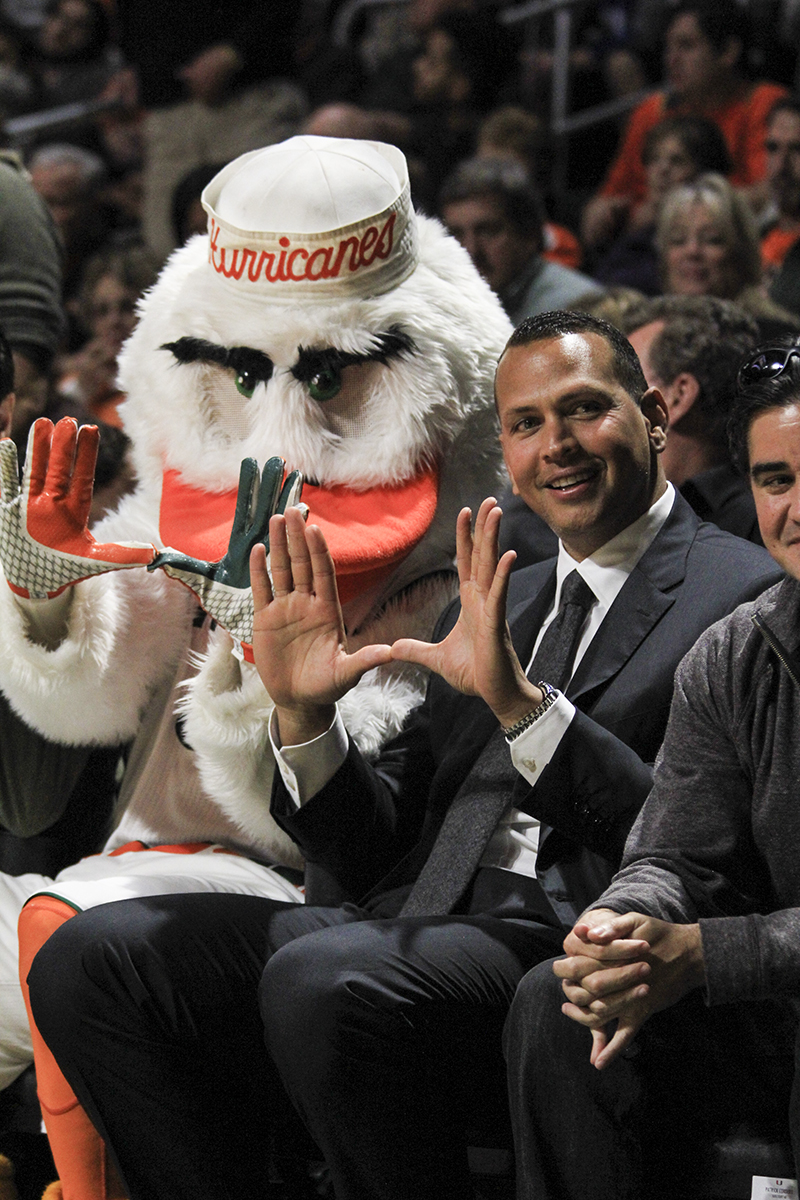
A recent photo of Kenny Calhoun, "Throwing the U"

Nebraska kicked off, and Miami ran out the clock. Auburn ended up winning the Sugar Bowl only 9-7, and, when the Associated Press and United Press International released their polls the next day, they both awarded Miami the National Championship. The AP (the sportswriters) gave 11-1 Miami 47 1/2 1st-place votes, 11-1 Auburn 7, and 12-1 Nebraska 4 1/2. UPI (the coaches) gave Miami 30, Nebraska 6, and Auburn 4.
Bernie Kosar, on an NBC screen capture

With a little bit of irony, Jeff Smith, rather than Mike Rozier, was the man on the cover of Sports Illustrated after the season-opening win over Penn State. Therefore, when "The Dreaded SI Cover Jinx" hit Nebraska, it was the player who had the chance to clinch the National Championship, 4 months later, that it gave a delayed hit.
*

This would begin a run for Miami of 12 seasons in which they were, effectively, in 6 National Championship Games, winning 4 of them (in the seasons of 1983, 1987, 1989 and 1991). They would win another in 2001 and come very close in 2002.

The '84 Orange Bowl would haunt Nebraska, which last won the National Championship in 1971, and had some other close calls. They would lose the Orange Bowl to Miami again in 1988 (thus blowing a shot at the title and letting Miami win it), and lose it to Florida State in 1994 (again blowing the title to a team from Florida).

Finally, on January 1, 1995, they again went to the Orange Bowl, again played Miami, and beat them 24-17, to win the 1994 National Championship, finally getting the monkey off Osborne's back. (He had been an assistant to Bob Devaney when they won the title in 1970 and '71.)
They would win the National Championship again in 1995, and share the 1997 title with Michigan, the last "split poll" title. That 1995 team is considered by some to be what the 1983 team should have been: The greatest team in college football history.

Osborne then retired, with a career record of 255-49-3, having coached 53 All-Americans, 13 Conference Championships (the last in the Big 12, the others in the Big 8), and 3 National Championships. In 2000, '02 and '04, he was elected to Congress from Nebraska as a Republican. He retired rather than run again in the 2006 election, to accept the post of the University of Nebraska's athletic director, a post he held until 2013. The playing surface at their Memorial Stadium is named Tom Osborne Field. He is still alive, 82 years old.

*

Did Osborne make the right choice in going for 2 in the '84 Orange Bowl?

Top 5 Reasons You Can't Blame Tom Osborne for Nebraska Losing the 1983 National Championship

5. Miami Stepped Up. In situations like this, it's easy to make Reason Number 1 "The opposition was better." Only the most deluded of Hurricanes fans would say their team was better than the Cornhuskers'

But if the Hurricanes hadn't played so well, becoming college football's answer to the 1960 Pittsburgh Pirates, to Nebraska's Yankees -- or, to use an earlier-cited example from the same stadium, the Jets to the Cornhuskers' Colts -- Nebraska wouldn't have been in the position where Osborne had to make the critical decision.

4. Nebraska Blew It. All season long, they had gotten the job done, until now. And they had come back from 17-0 and 31-17 to get to 31-30. There was plenty of reason to believe they could gain 3 yards on this one play. But, between the missed field goal, the blocked field goal, the fumbled sure touchdown, and the dropped passes on the last drive, they had their chances, and they blew them.

Think about it: Had either of Hagerman's missed field goals gone through, that last touchdown would have made it 33-31 Nebraska. True, there was enough time left on the clock where the conversion would have been more meaningful at 35-31 than at 34-31, but not by that much. Had Hagerman made both of those misses, it would have been 36-31, and Miami would have needed a touchdown no matter what.

Even Osborne blew it: If he had gone for 2 on the preceding touchdown, and made it, that would have made the score 31-25, and he could have won the game 32-31 with an extra point kick on the touchdown in question. Nobody talks about that choice.

3. Principle. If you can't gain 3 yards on 1 play to win 1 game, you don't deserve to win the National Championship.

2. Ara Parseghian. As head coach of Notre Dame in 1966, he went for a tie against Michigan State, knowing it wouldn't cost him the National Championship, whereas a loss would have. But, in the ensuing 17 years, the words had been spoken many times: "Parseghian had no guts."
Osborne was not going to be accused of having no guts. He knew that, for all Parseghian had achieved, that 1966 10-10 tie was the thing for which he was most remembered. "We were trying to win the game," Osborne said at the time. "I don't think you go for a tie in that case. You try to win the game. We wanted an undefeated season and a clear-cut National Championship."

Clear-cut. Because...

1. America Hates Ties. Long ago, though the identity of the coach who first said it depends on who's telling the story, a coach lost a game on a 1-yard run attempt rather than kick a tying field goal, and explained to the reporters, "A tie is like kissing your sister."

It's not like in European soccer, where a win is worth 3 points to your team in the league standings (or "table"), and a tie (or "draw") is worth 1 point. A tie that gave Nebraska the 1983 National Championship would have satisfied very few people -- outside the State of Nebraska, anyway. America hates ties, to the point that the NHL no longer has them.

Sure, with a tie, Nebraska would still have been National Champions. But any pretense to "Greatest Team Ever" status would have been gone.

After all, as Herman Edwards, then still playing cornerback for the Philadelphia Eagles, would later put it while coaching the New York Jets, "This is what the greatest thing about sports is: You play to win the game!"

VERDICT: Not Guilty. A lot of people would have understood it if he had gone for the tie and, presumably, still won the National Championship. But 32-31 and 13-0 would have been better than 31-31 and 12-0-1.

Besides, the '95 Orange Bowl win over Miami, and the resulting National Championship, was all the sweeter because of the '84 Orange Bowl loss to Miami.

Sunday, October 1, 2017

How to Go to the Florida State-Miami Game

Florida's State Capitol complex in Tallahassee

This Saturday, Florida State University hosts the University of Miami in a battle of historical (well, recently historical) intrastate college football titans.

Before You Go. It's Florida. Hot and humid are to be expected. Temperatures are being projected for the mid-80s in the afternoons and the high 60s for the evenings, all weekend long. Stay hydrated, and wear a hat. To be sure, check the website of their newspaper, The Tallahassee Democrat.

While Florida is in the South, you won't need a passport, and you won't need to change your money. Most of the State is in the Eastern Time Zone, although, just a little bit west of Tallahassee, the westernmost part of the Panhandle is in the Central Time Zone.

Tickets. FSU hosted 6 games at Doak Campbell Stadium last season, and all 6 had crowds of over 75,000. In contrast, of the 6 games that UM hosted at Hard Rock Stadium last season, only the game against FSU topped 61,000. It would be far easier to get tickets to this game if it were in Miami Gardens. But, this being an odd-numbered year, it's in T-town.

At Florida State, for this one game, sideline seats are $115, and end zone seats are $100. For other home games, midfield seats are $65, further seats are $45, and end zone seats are $35.

At Miami, sideline seats are $85, and zone seats are $20. They might also be significantly higher if they had the FSU game at home this season.

Getting There. It's 1,283 miles from Times Square in New York to downtown Miami, and 1,069 miles to Tallahassee. Knowing this distance, your first reaction is going to be to fly down there. 

To Miami, this is not a horrible idea, as the flight is just 3 hours, but you'll still have to get from the airport to wherever your hotel is. If you're trying to get from the airport to downtown, you'll need to change buses – or change from a bus to Miami's Tri-Rail rapid transit service. And it is possible, if you order quickly, to find nonstop flights for under $500 round-trip.

To Tallahassee, it's a lot trickier. You'll have to change planes in Orlando, and you'd have to wait until Monday morning to fly back out, as there's only 1 plane out on Saturday, and it's before kickoff; and none on Sunday! It would be fairly cheap, under $800, but 3 nights in a hotel? In Tallahassee? I don't think so! And there's no bus or train service to downtown, or to the campus. You'll have to rent a car or get a taxi to go the 6 miles northeast to downtown.

The train is not a very good idea, to either city. Amtrak doesn't go to Tallahassee. As for Miami, you'll have to leave Penn Station on Amtrak's Silver Star at 11:02 AM and arrive in Miami at 5:58 the next day's evening, a 31-hour ride. The return trip will leave at 8:10 AM and return to New York at 11:00 AM, "only" 27 hours – no, as I said earlier, there's no time-zone change involved. Round-trip, it'll cost $310. And the station isn't all that close, at 8303 NW 37th Avenue. Fortunately, there's a Tri-Rail station there that will take you downtown.

How about Greyhound? There are 6 buses leaving Port Authority every day with connections to Miami, only one of them nonstop, the 10:30 PM to 4:20 AM (2 days later) version. The rest require you to change buses in Richmond and Orlando. (I don't know about changing buses in Orlando, but I have changed buses in Richmond, and I can tell you: It is not fun.) The ride, including the changeovers, takes about 30 hours. Round-trip fare is $466, but you can get it for $192 on advanced-purchase.

The station is at 4111 NW 27th Street and, ironically, is right across 42nd Avenue from the airport. It's worth the fact that it'll cost twice as much to simply fly down. Plus, you might be reminded of the end of the movie Midnight Cowboy, and nobody wants to be reminded of that.

To Tallahassee, it's $466 round-trip, but $318 with advanced-purchase. The station is at 112 W. Tennessee Street, downtown.

If you want to drive, it'll help to get someone to go down with you, and take turns driving. You'll be going down Interstate 95 (or its New Jersey equivalent, the Turnpike) almost the whole way. It'll be about 2 hours from the Lincoln Tunnel to the Delaware Memorial Bridge, 20 minutes in Delaware, and an hour and a half in Maryland, before crossing the Woodrow Wilson Bridge, at the southern tip of the District of Columbia, into Virginia. Then it will be 3 hours or so in Virginia, another 3 hours in North Carolina, about 3 hours and 15 minutes in South Carolina, a little under 2 hours in Georgia, and about 6 hours and 15 minutes in Florida before you reach downtown Miami.

Given rest stops, preferably in one in each State from Maryland to Georgia and 2 in Florida, you're talking about a 28-hour trip.

To Tallahassee, the directions are the same until you get to Jacksonville. There, take Interstate 10 West. That'll be about 18 hours, or 24 with rest stops.

Once In the City. "Tallahassee" is a Muskogean tribal word for "old fields" or "old town." Founded in 1824, and the capital of the Territory from then onward and the State since joining the Union in 1845, it is home to about 190,000 people, with a metropolitan area of about twice that, about 378,000, including over the State Line in southernmost Georgia.
A lot of people don't realize it, because Miami is Florida's most famous city, but the most populous city in the State is Jacksonville. However, while Miami has about 450,000 people within the city limits, there are 6.4 million living in the metro area, making it far and away the largest in the South, not counting Texas. As a whole, Florida has about 20.6 million people.
Because Florida is so hot (How hot is it?), and air-conditioning didn't become common until the mid-20th Century, Miami was founded rather late by the standards of the East coast, in 1825, and wasn't incorporated as a city until 1896. The name is derived from the Mayaimi tribe of Native Americans. Miami Avenue is the east-west divider, Flagler Street the north-south. The city has no beltway.

The Herald is the only major newspaper left in the city, but the Sun-Sentinel of Fort Lauderdale should also be available. And, considering how many ex-New Yorkers are around, you might also be able to get the Times, the Daily News, or, if you're really desperate (or really conservative), the Post.

The sales tax in Florida is 6 percent, but it's 7 percent within Miami-Dade County. ZIP Codes in Tallahassee start with the digits 323. The Area Code is 850. ZIP Codes in Miami start with the digits 330, 331 and 332; in the Fort Lauderdale area, 333; and in the Palm Beach area, 334 and 349. Florida Power & Light runs the Miami area's electricity, and Gulf Power Company does so for Tallahassee.

No longer thought of as a haven for retired Jewish New Yorkers, Miami is the most Hispanic city east of Texas: 70 percent, with half of that, 34 percent of the total, being of Cuban origin, many of them refugees from the 1959 Castro Revolution and their descendants.

It should be noted, though, that, after 2 generations, there are Cubans in South Florida who don't remember living under the Castros, and find out that things weren't so great under the Batista regime, either, and thus don't automatically vote Republican because of the single issue.

The city is 19 percent black, 10 percent white, and only about 1 percent Asian. Miami-Dade County as a whole is about 65 percent Hispanic, 17 percent black, 15 percent white, 2 percent Asian, and 1 percent Middle Eastern. North of the river is mostly black, and a few miles north of that mostly white; while south of the river is mostly Hispanic.

Miami had a race riot in downtown in 1980, after the acquittal of policemen who had beaten a black man to death late the previous year; a riot in the Overtown section in early 1989, after a white policeman ran over a black bicyclist; and a riot in the Wynwood section in late 1990, after the acquittal of officers who had beaten a drug dealer to death.

In contrast, Tallahassee is about 53 percent white, 35 percent black, 6 percent Hispanic and 4 percent Asian. Which is not to say that the Florida Panhandle has been free of racial issues. The northernmost part of Florida is definitely the Deep South, and the Pandhandle's coast is known as "the Redneck Riviera" and "Floribama." And Escambia High School in Pensacola, all-white until 1969 and previously with "Rebels" as a mascot, faced riots over that name in 1972 and 1976, before it was changed to "Gators." (Emmitt Smith is a graduate.)

Since 1984, Miami has had a rapid-transit rail service, Metrorail. However, the ballpark isn't all that close to it. You will need to take the Number 7 bus from downtown. The fare for the Metrorail and the Metrobus is $2.25.
A Metrorail train at a downtown station

Starting in early 2018, Brightline rail service will connect Miami with Fort Lauderdale and West Palm Beach, with an extension to Orlando, hoping to open it in 2020.

Unusually, Tallahassee's bus lines have letters rather than numbers. A single ride is $1.25. Their north-south divider is Park Avenue, and their east-west divider is Adams Street. Neither Miami nor Tallahassee has a beltway.

The Florida Institute was founded in Tallahassee as an all-male seminary via a State charter in 1851, which FSU now recognizes as its founding date, although it didn't begin holding classes until 1857. In 1858, it absorbed the Tallahassee Female Academy, which had been founded in 1843.

In 1861, as Florida seceded from the Union and joined the Confederate States of America, the school became the Florida Military and Collegiate Institute. When Florida was readmitted to the Union in 1868, the school became the West Florida Seminary. It became Florida State College in 1901, and Florida State University in 1947. It was racially integrated in 1962, and its student demonstrations got it nicknamed "the Berkeley of the South."

Florida State played football from 1902 to 1905, but dropped the program, not starting up again until 1947. In 1982, 100 miles to the west, they opened a 2nd campus, Florida State University Panama City.

FSU's non-sports alumni have included:

* Journalism: Kathleen Parker, WNBC-Channel 4 meteorologist Janice Huff, Jenn Sterger.

Business: Spanx founder Sara Blakely.

Politics, representing Florida unless otherwise stated: Governors Reubin Askew, Mel Martinez (also former Secretary of Housing and Urban Development), Charlie Crist, and Parris Glendening and Larry Hogan, both of Maryland; Senators Martinez and Kay Hagan of North Carolina; former Mayor Art Agnos of San Francisco; the current President of the African nation of Botswana, Mokgweetsi Masisi; and former National Organization for Women President Patricia Ireland.

Literature: Hunter S. Thompson, Doug Marlette, Jeff Shaara.

Entertainment: Singers Rita Coolidge, Luis Fonsi, Scott Stapp and Mark Tremonti of Creed, and Brian Kelley of Florida Georgia Line; drummer Butch Trucks of The Allman Brothers Band; actors Burt Reynolds, Vic Morrow, Robert Urich, Sonny Shroyer, Paul Gleason, Henry Polic and Casper Van Dien; actresses Nancy Kulp, Faye Dunaway, Polly Holliday, Christine Lahti, Traylor Howard, Cheryl Hines, and Joanna Garcia; director Barry Jenkins; model and former volleyball star Gabrielle Reece; and Miss America 1997 Tara Dawn Holland Christensen.

Jim Morrison of The Doors, born to a Navy family in Melbourne, Florida, famously told a Miami concert crowd, "I'm from Florida! I went to Florida State! Then I got smart, and moved to California!" He got booed. Then he got in real trouble. (He did actually attend FSU, from September 1962 to December 1963. He was arrested for a prank after a football game, and transferred to UCLA to attend its renowned Film School, where he met a pianist and aspiring director from Chicago named Ray Manzarek. The rest is history.)

The University of Miami was founded in 1925, but, despite its name, its main campus has always been in adjoining Coral Gables. It was desegregated in 1961, a year sooner than FSU. UF beat both of them, in 1958. Its Leonard M. Miller School of Medicine is in downtown Miami, near the Civic Center rail station. Its Rosenstiel School of Marine and Atmospheric Science is at Virginia Key, accessbile via the Rickenbacker Causeway across Biscayne Bay. Its South Campus is 12 miles away, at the former Richmond Naval Air Station. 

UM's non-sports alumni include:

Journalism: Cristina Saralegui, Ana Navarro.

Literature: Mark Medoff and Donald Justice.

Entertainment: Singers Grace Slick of Jefferson Airplane, Gloria Estefan of Miami Sound Machine, Bruce Hornsby, Ann Curless of Expose, Enrique Iglesias, and Natalie Gelman; songwriter Jerry Herman; Will Lee of David Letterman's band; actors Majel Barrett Roddenberry, Michael Dunn, Charles Grodin, Jo Ann Pflug, Ernie Sabella, Gail Edwards, Dawnn Lewis, Ray Liotta, Steven Bauer, Wayne Brady, Dwayne "The Rock" Johnson and Tessie Santiago; comedian Finesse Mitchell; screenwriter David Isaacs; directors Frank Perry and Bob Clark.

Gene Roddenberry, Sylvester Stallone, Jaco Pastorius, Pat Metheny, Ben Folds and Patti Scialfa Springsteen attended UM, but did not graduate. An Amy Lee did, but this one was in Jimmy Buffett’s Coral Reefer Band, and isn't the lead singer of Evanescence.

Law: Los Angeles prosecutor Vincent Bugliosi and noted defense attorney Roy Black.

Politics: Senator Marco Rubio of Florida; former Republican National Committee Chairman Reince Priebus; and the current Prime Minister of the Central American nation of Belize, Dean Barrow.

Going In. Doak Campbell Stadium is 2 miles west of downtown Tallahassee, at 403 Stadium Drive West. Bus F or T. If you drive in, parking is $5.00. The field has always been natural grass, and points northwest-to-southeast. Florida State's bench is on the west side, the visitors' on the east side.

Officially, it is Bobby Bowden Field at Doak S. Campbell Stadium. Campbell was the University's president from 1941 to 1957, including 1947, when the Florida State College for Women was made co-educational by an act of the State Legislature. Knowing that a State University in a Southern State wasn't worth a damn without a sports program, he got one started, and the stadium opened in 1950.

It only had 15,000 seats at the time, and just 25,000 as late as 1963. Coach Bill Petersen expanded it to 40,500 in 1964, but it was no bigger by the time Bobby Bowden arrived from West Virginia in 1976. And the program was in shambles, having gone 4-18 the preceding 2 years and winless in 1973. As Bowden put it: "At West Virginia, the bumper stickers said BEAT PITT. Here, they say BEAT ANYBODY."

So he did. He totally overhauled the program, which allowed him to expand "The Doak" to 47,413 seats in 1978, 51,904 in 1980, 55,246 in 1982, 60,519 in 1985, 70,123 in 1992, 80,000 in 1996, and 82,300 in 2003. Its current capacity is listed as 79,560.

He outrecruited Miami, Florida, and other Southern schools for the Sunshine State's best talent. He got them to believe they could beat the good teams by, in the era when they were still an independent (before joining the Atlantic Coast Conference in 1992), scheduling the tough teams, and beating them. He built skyboxes and dorms, and made the place look like a castle. Which is why it became known as "The House That Bobby Built," because very little of the structure he inherited remains. It's also why the field was named in 2004, while he was still coaching. (He retired after the 2009 season.)
He also emphasized an established FSU tradition, the Sod Cemetery: Every time the Seminoles win an away game in which they are the underdog, or at the University of Florida, or at bowl games, or, since the ACC established a championship game, said game, the team captains cut out a small piece of sod -- real or artificial -- and have it planted inside the gates of Harkins Field, their practice facility.

This started in 1962, and by 1970, it had been done 23 times in 9 seasons. But in the 5 seasons before Bowden arrived, 1971 to 1975, it hadn't been done at all. Although the 'Noles lost their 1st 3 games under Bowden, and 6 of their 1st 8, on October 9, 1976, they went up to The Hub and beat Boston College, and took a piece of Alumni Stadium turf home with them. (Last season, when they beat Michigan in the Orange Bowl, they brought back the 100th piece of sod for their Cemetery. There have been 11 each from visits to the University of Florida and the University of Miami.)
The Sod Cemetery, with its caretaker, Douglas Mannheimer

It launched the program on an era of greatness. In only Bowden's 2nd season, he got the team to beat Florida away again, and win the Tangerine Bowl (now the Florida Citrus Bowl). In 1980, they won away to Louisiana State and Nebraska; in 1981, Ohio State and Notre Dame. On New Year's Day 1988, they won their 1st major bowl game, the Fiesta Bowl. FSU was now a top-level program, and Bowden became one of the great characters of college football -- even if some of his players were of questionable character.
The Seminoles have been to 47 bowl games, winning 27. These include the 1988 and 1990 Fiesta Bowls; the 1989, 1995, 1998 and 2000 Sugar Bowls; the 1992 Cotton Bowl; and the 1993, 1994, 1996, 2013 and 2017 Orange Bowls. The only major they haven't won is the Rose Bowl.

UPDATE: On October 6, 2017, Thrillist compiled a list of their Best College Football Stadiums, the top 19 percent of college football, 25 out of 129. Doak Campbell came in 16th:

There is, quite plainly, no more awesome crowd effect than 80,000 Seminole faithful chantingtheir vaunted Tomahawk Chop in unison. Whether you love the ‘Noles or your second-favorite team is their opponent, if you don’t get chills when Osceola slams his spear into the ground to a spiritual chorus of singing fans, you’re pretty much dead inside. The stadium itself is a bacchanal worthy of one of the greatest party schools in history, with human scenery that, many years, is more entertaining than the product on the field. Though when the team is good, Doak might be the most fun you can have in northern Florida. 

As for the Hurricanes: Since 2008, they have no longer played their games at the historic Orange Bowl, which was demolished to make way for the new Marlins Park. Instead, they did what the runners of the Orange Bowl did, and moved operations into the Dolphins' stadium.

When it opened on August 16, 1987, it was named Joe Robbie Stadium, for the Dolphins' owner, who had it built for them and for a hypothetical MLB team that became the Marlins.

Since then, it's been named Pro Player Park (briefly in 1996), Pro Player Stadium (1996 to 2005, including both of the then-Florida Marlins' World Series wins), Dolphins Stadium (2005 to 2006), Dolphin Stadium (no more S on the end, 2006 to 2009), Land Shark Stadium (2009 to 2010), Sun Life Stadium (2010 until this past August 17), and now Hard Rock Stadium (with the Hard Rock Cafe franchise buying the naming rights). If you're keeping track, that's 8 names in 29 years, or a new name every 3 years, 7 1/2 months.

It's 15 miles north of downtown Miami, in a location that's been called, at various times, Miami, Miami Lakes, Miami Gardens, Carol City and Opa-Locka. Sounds like a bad variety show sketch.

The best way to get there from downtown is to take I-95 North to the Florida Turnpike (renamed the Ronald Reagan Turnpike, and, contrary to "conservative principles," the Gipper did believe in good roads), to Exit 2X for Northwest 199th Street. NW 199th is also known as Dan Marino Boulevard, named after some guy who never won a championship, college or pro.

The Stadium is between 199th and 203rd, and between the Turnpike and 27th Avenue, across 203rd and Snake Creek from Calder Race Course. The exact address is 347 Don Shula Drive, for the coach who won the Dolphins' 2 titles and the record number of NFL coaching wins he has. Parking is expensive: $40. Tailgating is permitted.
Before the renovation, with the seats in Dolphin aqua & orange

Public transportation there is a bit trickier. You'd have to take Metrorail from downtown to M.L. King Rail Station, then transfer to the Number 27 bus, riding that to NW 199th Street & NW 27th Court. And then you'd have to walk down 199th for about 15 minutes and turn into the parking lot. Not exactly ideal. (Somehow, I don't think a situation like this, especially with a transit station with his name on it, was part of Martin Luther King's dream. But he certainly would have approved of a racially mixed crowd watching racially mixed teams playing each other.)

In spite of South Florida's climate – the stadium probably gets more rain than any other in the NFL, including Seattle – umbrellas are not permitted inside. "Safety concerns," No, I'm not making that up, it's on the Dolphins' website. The field runs northwest-to-southeast, and has always been natural grass.

The stadium recently underwent a major renovation, including a roof to protect the fans from the elements (but not the players -- shades of the Dallas Cowboys' last 2 stadiums), new video boards, and wider seats. This renovation reduced seating capacity from 75,540 to 65,326.
Post-renovation

It has been home to the Dolphins since 1987; the Orange Bowl game in 1996, 1997, 1998 and since 2000; the University of Miami football team since 2008 (their games were the last thing the Orange Bowl stadium hosted before its demolition to make way for Marlins Park); the Marlins from 1993 to 2011; and the Champs Sports Bowl from 1990 to 2000.
It's hosted 5 Super Bowls: XXIII (1989, San Francisco over Cincinnati), XXIX (1995, San Francisco over San Diego), XXXIII (1999, Denver over Atlanta), XLI (2007, Indianapolis over Chicago, and the only Super Bowl that's yet been rained on) and XLIV (2011, Green Bay over Pittsburgh). Hard Rock Stadium has been awarded Super Bowl LIV, for February 2, 2020.

It has hosted 6 college football National Championship games: 1997-98, Nebraska over Tennessee; 2001-01, Oklahoma over Florida State; 2004-05, USC over Oklahoma; 2008-09, Florida over Oklahoma; 2012-13, Alabama over Notre Dame; and 2015-16, Clemson over Oklahoma. It will host the title game again for the 2020-21 season.

It's also hosted 2 World Series: 1997, Marlins over Cleveland; and 2003, Marlins over, uh, let's move on. It hosted 4 BCS National Championship Games: 2001 (Oklahoma over Florida State), 2005 (USC over Oklahoma), 2009 (Florida over Oklahoma) and 2013 (Alabama over Notre Dame).

The stadium is also a premier U.S. soccer venue. On August 6, 1989, North London giants Arsenal played Argentine club Independiente, each team coming off winning its national league title. Arsenal won, 2-1, but only 10,042 fans came out to see it in the oppressive Summer Florida heat. (Perhaps this is why Arsenal did not play in North America again for 25 years, coming to Red Bull Arena in 2014.) Other major club teams to play there include Mexico's Chivas of Guadalajara; England's Chelsea of London, Everton of Liverpool and Manchester United; Spain's Real Madrid, Barcelona and Valencia; and Italy's AC Milan, Internazionale and Juventus.

The U.S. national team has played there 4 times: A 1-0 loss to Colombia on April 22, 1990; a 1-1 draw with Bolivia on February 18, 1994; a 3-1 loss to Sweden on February 20, 1994; and a 1-0 win over Honduras on October 8, 2011. Other national teams to play there have been England, Croatia, Mexico, Brazil, Educador, Peru, Venezuela, Chile, Ghana and South Korea.

UPDATE: It has been selected by FIFA as one of the host venues for the 2026 World Cup.

The Three Tenors -- Luciano Pavarotti, Placido Domingo and José Carreras -- sang there on March 8, 1997.

Food. The only information I have about Doak's concessions is that they're run by Aramark, formerly the Harry M. Stevens Company; and that they have Chick-fil-A stands, Coke products rather than Pepsi, and, since it's a college stadium, no alcoholic beverages.

With a great Hispanic, and especially Cuban, heritage, and also being in Southeastern Conference country (hello, tailgating), you would expect the football stadium in Miami to have great food at their stadium. Centerplate runs their concessions, and the stadium renovations include better options. From the Miami Herald:

* Sloppy Joe's (based on the famous Key West bar) at Sections 106, 144 and 317.
* Kosher Central (Hey, a lot of ex-New Yorker Jews in South Florida) at 111.
* BurgerFi at 114, 124 and 350.
* Craft Beer Tap Room at 117 and 147.
* Versailles (A French theme?) at 119 and 317.
* Sushi Maki at 126.
* Bodega Taqueria at 142, 329 and 345.
* Paradise Cups at 155.

Team History Displays. Up until the late 1970s, the University of Miami had some brief flashes of football glory, but nothing special. Florida State University could only wish they had been even that lucky. Then Howard Schnellenberger arrived in Coral Gables, and Bobby Bowden arrived in Tallahasse, and the rest is history. Relatively recent history, but history nonetheless: Since 1976, FSU is 382-106-23, for a winning percent of .770; since 1980, UM is 332-122, or .731.

This, of course, was complicated by the fact that both teams were longtime independents: You can't win a Conference Championship unless you're in a Conference. Florida State was in the Dixie Conference from 1948 to 1950, then was an independent, and joined the ACC in 1992.

They won the Dixie Conference all 3 years they were in it: 1948, 1949 and 1950. Then they won the ACC in 1992, 1993, 1994, 1995, 1996, 1997, 1998, 1999, 2000, 2002, 2003, 2005, 2012, 2013 and 2014; for a total of 15 ACC titles, and 18 Conference Championships. They also won the ACC Atlantic Division in 2010, but lost the ACC Championship Game; they have a 4-1 record in it since it was established in 2005.

And they won National Championships in 1993, 1999 and 2013, while losing what amounted to National Championship Games in 1996, 1998 and 2000. The Moore Athletic Center, at the north end of the stadium, holds their various trophies, and is available for tours, including on game days.
Florida State have retired 10 numbers. Only 25, of receiver Fred Biletnikoff (senior year, 1964), and 34, of receiver Ron Sellers (1968), precede Bowden. The honorees under his tenure have been 50, defensive tackle Ron Simmons (1980); 2, cornerback Deion Sanders, 1988; 27, cornerback Terrell Buckley (1991); 55, linebacker Marvin Jones (1992); 17, quarterback Charlie Ward (1993); 10, linebacker Derrick Brooks (1994); 28, running back Warrick Dunn (1996); and 16, quarterback Chris Weinke (2000). So: 2, 10, 16, 17, 25, 27, 28, 34, 50 55.

(With NFL number restrictions making it impossible for Brooks to wear 10, he chose 55 in honor of Jones, and the Tampa Bay Buccaneers retired it for him.)

Bowden, Biletnikoff, Sellers, Simmons, Sanders, Ward and Brooks have been elected to the College Football Hall of Fame.So was Darrell Mudra, Bowden's immediate predecessor. He took 6 different schools to either a league title or a bowl game (or both), both before and after coaching at FSU. Whatever he did right elsewhere, it didn't work in Tallahassee. Biletnikoff, Sanders, Brooks, and offensive tackle Walter Jones (1996) have been elected to the Pro Football Hall of Fame. Ward (1993), Weinke (2000) and Jameis Winston (2013) won the Heisman Trophy.

The FSU Athletic Hall of Fame has 259 athletes, including 97 football figures. In addition to those already mentioned, names you might recognize include 1990s Green Bay Packers Leroy Butler and Edgar Bennett, 2000s Baltimore Raven Peter Boulware, and a couple of guys who played for FSU back in the 1950s, and were even roommates, but are better known for things other than playing football: Coach turned studio analyst Lee Corso, and actor Burt Reynolds, now far past being one of the biggest stars in Hollywood (as he was in the 1970s and '80s), but still a big Seminole booster (legally, as far as we know). (UPDATE: Burt died on September 6, 2018.)


Among the other members are former baseball stars Johnny Grubb, Terry Kennedy, Paul Sorrento, Luis Alicea, Jody Reed, Doug Mientkiewicz and J.D. Drew; basketball stars Dave Cowens and Sam Cassell; and golfer Paul Azinger.

Also, Dick Howser, the former Florida State player, Yankee coach and manager, and 1985 World Series winner as manager of the Kansas City Royals, who died of a brain tumor in 1987, and whose name is now on the NCAA's player of the year trophy, the baseball equivalent of the Heisman. Also, Ron Fraser, who became one of the great college baseball coaches -- ironically, at Miami.

Each side of Doak Campbell Stadium has a statue. At the north, by Gates A, B, L amd M, by Moore Athletic Center, is one of Bowden, pointing. At the east, by Gate K, is one showing a Seminole Family, the native people of Florida, for whom the team is named. At the west, by Gate C, is one named Sportsmanship, one player helping another up. And at the south, Gates F and G, is one showing their mascot, Chief Osceola, aboard his horse, Renegade, rearing back. The statue is labeled "Unconquered."
Miami was awarded the National Championship for 1983 (after shocking Number 1 Nebraska in the Orange Bowl on January 2, 1984), 1987, 1989, 1991 and 2001. They also famously lost national championship games (official and otherwise) for 1986, 1992 and 2002. But that 5-3 record is still better than that of their landlords: The Dolphins are 2-3, and, while the Hurricanes have at least been in 2 of these games since January 1993, the Dolphins have been in none.

They joined the Big East in 1991, and won it in 1991, 1992, 1994, 1995, 1996, 2000 2001, 2002 and 2003. They joined the ACC in 2004, but have not yet won it: They finished 1st in the Coastal Division in 2012, but due to the previous year's athletic booster scandal, they offered to make themselves ineligible for postseason games in exchange for the NCAA lessening their penalties, which was accepted, and so they have never played in the ACC Championship Game. 

Miami won the Orange Bowl (on home soil) in (the season of, not the calendar year of) 1945, 1983, 1987, 1988, 1991 and 2003 -- the last of these being the only one since the Orange Bowl game was moved out of the Orange Bowl stadium, and none since the team moved out of the Orange Bowl stadium.

They also won the Sugar Bowl in 1989, 2000; the Cotton Bowl in 1990; the Rose Bowl in 2001; the Gator Bowl in 1951 and 1999; the Liberty Bowl in 1966; the Peach Bowl in 1980 and 2004; the Carquest Bowl in 1996; the MicronPC Bowl in 1998 and 2006; and the Russell Athletic Bowl last year, ending a 10-year drought. The only major bowl they haven't won is the Fiesta Bowl.

Despite their 1980s glory, the Hurricanes appear not to have been considered for the Lambert Trophy, annually given to "the best college football team in the East," until the turn of the 21st Century. But they then won in 4 straight seasons, 2000 to 2003 -- and not since.

Despite all their legends, the Hurricanes have retired only 4 numbers, 2 of them from before their 1980s dynasty: 10, quarterback George Mira, 1963; 14, quarterback Vinny Testaverde, 1986; 26, safety Sean Taylor, 2003; and 89, defensive end Ted Hendricks, 1968.

Despite their record from 1983 onward, Miami is surprisingly underrepresented in the College Football Hall of Fame. From before Schnellenberger's arrival, Hendricks, 1950s running back Don Bosseler, and coaches Jack Harding (1937-47) and Andy Gustafson (1948-63) were elected. From the 1980s onward, Testaverde, safety Bennie Blades, defensive tackle Russell Maryland and quarterback Gino Torretta are in.

But not Mira, or Biletnikoff. Nor Bernie Kosar, the quarterback who led that 1st National Championship. Nor any of the coaches who won National Championships at The U: Schnellenberger, Jimmy Johnson, Dennis Erickson or Larry Coker.

Testaverde (1986) and Torretta (1992) were awarded the Heisman Trophy. 1950s center Jim Otto, early 1980s quarterback Jim Kelly, late 1980s receiver Michael Irvin, late 1980s defensive tackle Cortez Kennedy, and early 1990s defensive tackle Warren Sapp are in the Pro Football Hall of Fame, but not the College Football Hall of Fame. Only Hendricks is in both Halls, although a case for Canton could be made for Maryland.

There is no open display for these titles and player honors at Hard Rock Stadium: The Hurricanes are the tenants, and the Dolphins are the landlords, displaying their honors: The Dolphins Honor Roll, which currently honors the undefeated 1972 team and 26 individuals, including retired number honorees Bob Griese (12), Dan Marino (13) and Larry Csonka (39); and a statue of Marino outside the stadium, with streets named for Marino and longtime coach Don Shula.

The Florida Sports Hall of Fame is located at Lake Myrtle Sports Park in Auburndale, 232 miles northwest of downtown Miami, and 220 miles northwest of Hard Rock Stadium. Aside from the colleges (Florida, Florida State and Miami), the Dolphins have more honorees than any other team: Robbie, Shula, Griese, Csonka, Warfield, Little, Buoniconti, Anderson, Marino, Moore, 1970s placekicker Garo Yepremian, Griese's 1972-73 backup Earl Morrall (who was the losing Colts quarterback under Shula in the Jets' Super Bowl III win), coach Jimmy Johnson (who's probably in there mainly for his coaching at the University of Miami) and owner Wayne Huizenga.

In 2002, the Florida Sports Foundation created the Florida Cup, to be given to either Florida, Florida State or Miami if it can defeat the other 2 in a single season. Miami got it in 2002, 2003 and 2008; Florida in 2008; and Florida State in 2013. A separate Makala Trophy, named for a Florida-based native tribe, is awarded to the winner of the Florida-Florida State game.
It's a trophy, but it's not really a cup.

Overall, Florida has beaten Florida State and Miami in the same season 16 times: 1958, 1959, 1960, 1963, 1968, 1969, 1971, 1972, 1973, 1974, 1975, 1976, 1982, 1983, 1985 and 2008.

Florida State has beaten Florida and Miami in the same season 14 times: 1964, 1978, 1979, 1989, 1993, 1996, 1998, 1999, 2010, 2011, 2013, 2014, 2015 and 2016 -- but has only gotten the Florida Cup in 2013, since that was a year in which the Gates and 'Canes also played each other.

Miami has beaten Florida and Florida State in the same season 13 times: 1951, 1953, 1955, 1956, 1962, 1980, 1981, 1986, 1987, 2000, 2002, 2003 and 2004.

Overall, having met every season since 1958, usually on Thanksgiving weekend, Florida leads Florida State 34-25-2, but the Seminoles have won 6 of the last 7 meetings. This record includes 1994, when the Gators went into Tallahassee and took a 31-3 lead into the 4th quarter, but the Seminoles came back to tie, 31-31.

The old saying "a tie is like kissing your sister" did not apply in this case: For the Seminoles, it was like kissing their sister's really hot best friend; for the Gators, it was like kissing their mother-in-law. "The Choke at Doak" was seen on national television, and was a big reason why overtime was soon instituted in college football, ending ties forever. A rematch was granted for the 1995 Sugar Bowl, and the Seminoles settled it, 23-17.

The record also includes 1996, when FSU, ranked Number 2, beat Number 1-ranked UF at Doak, but UF then won the SEC Championship Game, at which a fan, remembering "The Fifth Quarter at the French Quarter" 2 seasons earlier, held up a sign saying, "GOD WANTS A REMATCH," and the rematch happened at the 1997 Sugar Bowl, and the Gators crushed the Seminoles 52-20, to win the National Championship despite their regular-season loss.

Florida State and Miami have been meeting since 1951, and every season since 1966. Miami leads 31-30, but since avenging their last-play field goal misses in 1991 and 1992 -- Wide Right I and Wide Right II -- from 1993 onward, the Seminoles lead the rivalry 16-9; since 2005, 10-2; since 2010, 7-0.

The Gators-Hurricanes rivalry is no less nasty, making this not a love triangle, but a hate triangle. But the Gators staying in the SEC, while the Hurricanes have gone to the Big East and now the ACC, and the Gators already annually having the Seminoles as a non-league opponent, has pushed this rivalry aside. Except for 1943, they met every year from 1938 to 1987, but only 6 times since then, and 2 of those in bowl games (the 2001 Sugar and the 2004 Peach). The 2013 game is their only meeting since the 'Canes moved to the Dolphin Tank. They are set to meet again in 2019, on neutral soil in Orlando. Miami leads, 29-26, including 12-4 since 1978.

UPDATE: Through the 2019 season, Florida leads Florida State 36-26-2, Miami leads Florida 29-27, and Miami leads Florida State 34-30.

Stuff. The Seminole Sportshop is located at the south end of Doak Campbell Stadium. The University Bookstore is at 104 N. Woodward Avenue, across from the Oglesby Union (the student union), about a 20-minute walk northeast of the stadium.

There's a Dolphins' Team Store on in the Grand Plaza of Hard Rock Stadium, at the south entrance. I don't know if it also sells Hurricanes items. The University of Miami Bookstore is probably a better choice for team stuff, on the Coral Gables campus, at 1306 Stanford Drive, next to the Donna E. Shalala Student Center. (She served as the school's president after previously serving as President Bill Clinton's Secretary of Health & Human Services, and before that as Chancellor of the University of Wisconsin.

Lew Freedman, who's written books on subjects ranging from Amelia Earhart to the 1964 Alaska earthquake, and on several sports subjects, wrote The Rise of the Seminoles: FSU Football Under Bobby Bowden. And Bruce Feldman wrote Cane Mutiny: How the Miami Hurricanes Overturned the Football Establishment.

The Miami Hurricanes Football Modern Dynasty Series Box Set DVD came out in 2003. Most of the available DVDs about Florida State concern individual seasons, or even individual games.

During the Game. This rivalry is mean! (How mean is it?) Seminole fans like to say, "You can't spell 'SCUM' without 'UM'!" Hurricane fans like to say, "You can't spell 'FSU sucks!' without 'FSU'!" While the 'Canes no longer play in the inner city, the attitude that got their former rivalry with Notre Dame nicknamed "Catholics vs. Convicts" (as if the Fighting Irish were actually innocent) has carried over into the suburban Dolphins stadium. If you go to a 'Noles-'Canes game, get on the home fans' good side, stay that way, and stay away from the visiting fans.

Many college football programs have a ceremonial "spirit walk" into the stadium, and current coach John James "Jimbo" Fisher has introduced it to FSU. Called the War Path, the band, the Marching Chiefs, and the cheerleaders, the Golden Girls, start from the College Town district on Madison Street, and do their thing and head into Doak Campbell Stadium.

Florida State's mascot is Chief Osceola, modeled after the real Chief of that name, who fought the Second Seminole War from 1836 to 1838, when he died from malaria. At the start of every game, he rides an Appaloosa horse, Renegade, onto the field, and holds a burning spear aloft, until reaching midfield, where he dismounts and throws it into the ground. The current leaders of the Seminole Tribe not only do not object to this, as various Native American groups have to the Cleveland Indians and Washington Redskins names, they sanction it.
They also sanction the War Chant. The Marching Chiefs began it during a 1984 game with Auburn. It is accompanied by a gesture known as the Tomahawk Chop. When Deion Sanders played with the Atlanta Braves, he introduced it to their games, and they use it, too. It's also been adopted by the Kansas City Chiefs, and at least 2 soccer teams, Santos Laguna in Mexico and Galatasaray in Istanbul, Turkey.
"Oh, oh, whoa-oh... whoa-oh... oh, whoa-oh... "
At least they don't use the big red foam tomahawks,
like the Braves' fans use.

Just as Garnet & Gold are colors almost exclusive to Florida State, so, too, is Green & Orange completely identified with the Miami Hurricanes -- although why you would name your team after the worst thing to happen to your area is hard to explain. There's no New York Terrorists or Detroit Riot. Then again, there's teams called the Chicago Fire and the San Jose Earthquakes.

Miami's mascot is Sebastian the Ibis, which debuted as a drawn symbol in 1926 and a costumed mascot in 1957. He was named after San Sebastian Hall, the dormitory that was home to the 1st student to wear the costume, John Stormont. Folklore says that the ibis is the last creature to take shelter before a hurricane hits, and the first to return, the sign that it's safe to do so.

He leads the players out of the tunnel, and they do so bathed in smoke from a dry ice machine, a feature adopted during their 1980s dynasty. At this point, and after every Hurricane score and win, a cannon named Tommy Touchdown is fired.

He wears Number 0. From 1984 to 1992, he was played by John Routh. He left the job because he'd been hired by the Florida Marlins (now the Miami Marlins) to be their mascot, Billy the Marlin. Routh also began Sebastian's now-traditional C-A-N-E-S spellout and cheer. He's now the director of the University of Miami Sports Hall of Fame.

The feathered arrow on Florida State's helmet is a design that was used by the Washington Redskins in the 1960s, and is also common in high schools with variations on "Indian" team names. It's easy enough to understand. So what's the logo on Miami's helmets? Everyone accepts it as a stylized letter U, but what does it mean?

In 1973, the athletic department was looking for a distinctive logo, and any "M" or "UM" could easily have been confused with another school. Publicist Julian Cole, a Miami graduate, and graphic artist Bill Bodehamer, who had previously designed the Dolphins' 1st logo (a green dolphin wearing a white helmet with an orange M on it, jumping through an orange hoop) in 1966, designed the green and orange "split U" logo.

Julian's daughter Lisa Cole said the message of the U logo was, "This is the university," or "The U" for short. It made sense, because this was before Florida Atlantic and Florida International decided to go big and become Miami-area universities with big-time athletic programs: The Hurricanes were it. That it was 1973, the year of the Mets' "Ya Gotta Believe" Pennant, led to the "U Gotta Believe" slogan. (Although the team only went 5-6 that year.)

By 1979, UM President Henry K. Stafford wanted to replace the U logo, but students launched a "Save the U" campaign. It wasn't just the Athletic Department: Other University departments had adopted the logo as a symbol.

In 1992, UM cheerleader Bill Tigano introduced the make-the-U-with-your hands gesture, a.k.a. "Throwing the U," to counter Florida's Gator Chomp and Florida State's Tomahawk Chop. He had a point: It didn't make sense for 2 of the State's Big 3 to have a trademark gesture, and for 1 not to.
Sebastian and Alex Rodriguez "Throwing the U"

A 7-foot, nearly 1,000-pound steel and aluminum "U statue" was dedicated in 2012, with the idea of it being a tourist attraction and meeting point, like the old Yankee Stadium's Big Bat, Michigan State's Sparty statue and USC's Tommy Trojan. It's on the Foote University Green, between the Iron Arrow Mound and "The Rock." (Not to be confused with professional "wrestler" turned actor Dwayne "The Rock" Johnson, who played football at Miami.)

After the Game. The area around the Orange Bowl was a bit rough. It still is, despite the new Marlins Park having been built there. But the Dolphins' stadium is an island in a sea of parking. Don't make a nuisance of yourself, and you'll be left alone. The same goes at Doak Campbell Stadium, which doesn't have a reputation for fan misbehavior (except when the Florida Gators are the opponent, and, even then, the animosity is more between the players than the fans).

Lake Bradford Road, southeast of Doak, has several chain restaurants, including McDonald's, Subway, Whataburger, Checkers, Popeye's and Denny's.

As for Miami home games, that whole "island in a sea of parking" thing has its advantage, promoting safety; and its disadvantage, not much in the way of postgame meal-provision. There's some chains on 27th Avenue between 195th and 199th Streets, southwest of the stadium, but that's about it. You might be better off going downtown.

J.C. Wahoo's Sports Bar and Grill is supposedly the home of the South Florida fan club of the Giants. But it's at 3128 N. Federal Highway (yes, the same U.S. Route 1 that goes through The Bronx and New Jersey), between Northeast 31st and 32nd Streets, 40 miles north of downtown -- further north than Fort Lauderdale, or even Pompano Beach, almost up to Boca Raton. It's not even all that close to the stadium.

The South Florida Jets Fan Club meets at Hammerjack's, at 5325 S. University Drive in Davie, a bit closer to the stadium, but still 24 miles north of downtown.

Don't bother looking for Dan Marino's restaurants: They've all closed. He's had financial setbacks, partly due to paying his extramarital baby mama millions of dollars in hush money.

If you visit Miami during the European soccer season (now drawing to a close but starting again in mid-August), the Fado Irish Pub chain has an outlet downtown, at 900 S. Miami Avenue. Brickell on Metrorail, Tenth Street Promenade on Metromover. Another possibility, especially if you're a Liverpool fan, is Churchill's Pub, at 5501 NE 2nd Avenue, 4 miles north of downtown, in Little Haiti. Bus 9.

Sidelights. Dick Howser Stadium, FSU's baseball facility, is just to the north of Doak Campbell Stadium. Their basketball facility, the Donald L. Tucker Civic Center, is at 505 W. Pensacola Street, downtown, a mile and a half to the east, along West Madison Street, a.k.a. the "Madison Mile." The 12,000-seat arena opened in 1981 as the Leon County Civic Center, and previously hosted minor-league basketball and hockey.
There is one other major college in Tallahassee, a result of the longstanding segregation that was struck down in the 1960s. This was also true of several other Southern cities. For example: White people in Baton Rouge went to Louisiana State University (LSU), while black people went to nearby Southern University.

So it was with Tallahassee, which has Florida A&M University. The school has a renowned football team, but an even more renowned marching band, sometimes called the best in the country -- and the only schools that tend to dispute it are other "historically black colleges and universities" or HBCUs.

The FAMU Rattlers play football at Bragg Memorial Stadium, at 1500 Wahnish Way, about 2 miles southeast of Doak, and a mile south of the Tucker Civic Center. Built in 1957 and seriously renovated in 1982, it seats 25,000, and a plan has been proposed to further modernize it, and expand it to 35,000.

They've won the Division I-AA National Championship in 1978; and the National Championship of black college football 14 times: 1938, 1942, 1950, 1952, 1953, 1954, 1957, 1959, 1961, 1962, 1977, 1978, 1998 and 2001.
From 1945 to 1969, including 8 National Championships, their head coach was Jake Gaither, who said of football players, "I like 'em agile, mobile and hostile" -- pronouncing the last 3 letters like "aisle." But integration came, and, before his death in 1994, he admitted, "Now, if they're agile, mobile and hostile, they go to Florida State."

Some of the agile, mobile and hostile who've played at FAMU: Willie Galimore, Bob Hayes, Ken Riley, Hubert Ginn and Terry Mickens. And then there was the enormous Nate Newton. Well, he was certainly hostile.

Surprisingly for a city its size, Tallahassee has no professional baseball team. Indeed, you gotta drive a long way to get to one. The Class A Florida State League has 12 teams, including the Tampa Yankees and the St. Lucie Mets. But Daytona Beach is the closest of those teams to Tallahassee, and that's 263 miles to the southeast. So it's really the Central and South Florida State League.

The Jacksonville Jumbo Shrimp, formerly the Jacksonville Suns, are 1 step closer to the majors, in the Class AA Southern League, but that's 170 miles east. Also in the SL are the Pensacola Blue Wahoos, 197 miles to the west.

The Florida State University Museum of Fine Arts is at 525 W. Tennessee Street (U.S. Route 90). The Museum of Florida History is a block east of the Tucker Civic Center, at 500 S. Bronough Street.

A block east of that is the most important site in Florida's recent history, the State Supreme Court, where a recount of the State's 2000 Presidential vote was ordered by a unanimous 7-0 vote (regardless of the party of the Governor who appointed the Justices), before stopped by a 5-4 vote the U.S. Supreme Court. 500 S. Duval Street.

The State Capitol complex includes a tower that is the tallest building in the city, 345 feet high. 400 S. Monroe Street, a block east of the Supreme Court, and a block south of City Hall. The complex contains a museum.

While several TV series have episodes that mention Tallahassee, no show has ever been set there. The most notable movie set, or filmed, there is Recount, about the 2000 election.

The Beatles performed in Miami Beach. Elvis Presley sang in Miami, Miami Beach, Tampa, St. Petersburg, Orlando, Jacksonville, Daytona Beach, Fort Myers, Lakeland, Ocala, Pensacola, Sarasota and West Palm Beach early in his career; and in Miami, Tampa, St. Petersburg, Orlando, Jacksonville, Hollywood, Lakeland and West Palm Beach later on. But neither the King nor the Fab Four ever gave a concert in Tallahassee.

I've mentioned Miami's sidelights in my entries for the Marlins, the Dolphins, the Heat and the Florida Panthers. You can read them there. But I will make 2 exceptions, for the Hurricanes' old football home, and their basketball home.

Marlins Park was, as I said, built on the site of the stadium known as Burdine Stadium from its 1937 opening until 1959 and the Miami Orange Bowl thereafter. It was best known for hosting the Orange Bowl game on (or close to) every New Year's Day from 1938 to 1995, and the NFL's Miami Dolphins from their debut in 1966 until 1986.

It was home to the University of Miami football team from 1937 to 2007 (famed for its fake-smoke entrances out of the tunnel). It was also the home of, if you count the All-America Football Conference of the 1940s, the first "major league" team in any of the former Confederate States: The 1946 Miami Seahawks. But the black players on the Cleveland Browns would not accept being housed away from their white teammates in segregated Florida, and in that league, what the Browns wanted, the Browns got. So the Seahawks (in no way connected the NFL's Seattle team of the same name) were moved to become the Baltimore Colts after just 1 season.
The Orange Bowl game hosted de facto National Championships for the seasons of 1938-39, Tennessee over Oklahoma; 19556-56, Oklahoma over Maryland; 1971-72, Nebraska over Alabama; 1981-82, Clemson over Nebraska; 1983-84, Miami over Nebraska; 1987-88, Miami over Oklahoma; 1990-91, Colorado over Notre Dame; 1991-92, Miami over Nebraska; 1993-94, Florida State over Nebraska; and 1994-95, Nebraska finally getting revenge over both Miami and their own history in the building.

The Orange Bowl stadium also hosted the Bert Bell Benefit Bowl, a game involving the 2nd-place teams in each of the NFL's divisions from 1960 to 1969, a charity game, a glorified exhibition. Also known as the Playoff Bowl, it was considered so lame that Green Bay Packers coach Vince Lombardi publicly called it "the only game I never want to win" – and he didn't. The stadium also hosted the Miami Toros of the North American Soccer League from 1972 to 1976, including the 1974 NASL Final, which the host Toros lost on penalties to the Los Angeles Aztecs.

And it hosted 5 Super Bowls, most notably (from a New York perspective) Super Bowl III, when the Jets beat the Colts in one of the greatest upsets in sports history, on January 12, 1969. It also hosted Super Bowls II (1968, Green Bay over Oakland), V (1971, Baltimore over Dallas), X (1976, Pittsburgh over Dallas) and XIII (1979, also Pittsburgh over Dallas). All subsequent South Florida Super Bowls, including the one the Giants won in 2012, Super Bowl XLVI, have been held at the Dolphins' stadium.

The U.S. national soccer team played 19 matches at the Orange Bowl, from 1984 to 2004. They didn't do so well, though, winning only 2 of them, drawing 10 and losing 7. And the biggest crowd they could get was 49,000 -- you'd think that, being in a heavily Hispanic city, they could draw "futbol" fans. Instead, most of the Hispanics came to see them play Latin American teams, and root for those teams.

It was also the home of the North American Soccer League's Miami Gatos and Miami Toros, before they moved up I-95 to become the Fort Lauderdale Strikers. Arsenal played their 1st game in North America at the Orange Bowl, on May 31, 1972, beating the Gatos 3-2. Only 4,725 attended, which is why you shouldn't schedule a soccer game for Miami during Memorial Day Weekend.

The Orange Bowl was where the Dolphins put together what remains the NFL's only true undefeated season, in 1972. The Canton Bulldogs had gone undefeated and untied in 1922, but there was no NFL Championship Game in those days. The Chicago Bears lost NFL Championship Games after going undefeated and untied in the regular seasons of 1932 and 1942. And the Browns went undefeated and untied in the 1948 AAFC season, but that's not the NFL. The Dolphins capped their perfect season by winning Super Bowl VII, and then Super Bowl VIII.

And yet, despite having reached the Super Bowl 5 times, and Miami having hosted 10 of them, the Dolphins have never played in a Super Bowl in their home region. They've done so in New Orleans, in Houston, in the San Francisco Bay Area, and twice in the Los Angeles area. They also haven't been to one in 33 seasons, which includes all of their history in their new stadium. Curse of Joe Robbie, anyone?

Miami's basketball team played at the Miami Beach Convention Center from 1958 to 1984, the Knight Center auditorium from 1984 to 1988, and the Miami Arena (also the original home of the Miami Heat and the Florida Panthers) from 1988 to 2003.

In 2003, The U opened the arena now named the Watsco Center, at 1245 Dauer Drive. It seats 7,972, making it small by ACC standards, but unless the Miami basketball program starts to get as good as the football program used to be, that should be enough. If not, they can shift bigger home games to the downtown American Airlines Arena. It hosted a Presidential Debate between Bush and John Kerry in 2004. 
In 1973, The U opened a new baseball stadium. Hurricanes fan George Light donated the money necessary for its construction, and it's named Mark Light Field, in memory of George's son, who died of muscular dystrophy.

The Hurricanes have reached the College World Series 25 times, and won 4 National Championships: 1982, 1985, 1999 and 2001. This was possible through the work of Ron Fraser, a native of Nutley, Essex County, New Jersey, who coached them from 1962 to 1993. Jim Morris replaced him, and has kept the success going. The school's baseball legends include Alex Fernandez, Danny Graves, Pat Burrell, Aubrey Huff and Ryan Braun.

They do not include Alex Rodriguez. Born in Manhattan, A-Rod grew up in Miami, and signed a letter of intent to play baseball at UM, but turned pro instead and never attended. Nevertheless, in 2003, he donated $3.9 million to renovate the baseball complex. In his honor, it was renamed Alex Rodriguez Park at Mark Light Field. 6201 San Amaro Drive, off Dixie Highway (U.S. Route 1) and Ponce de Leon Blvd.
Unlike St. Louis taking Mark McGwire's name off Interstate 70, the steroid revelations about A-Rod have not affected the ballpark's name. Nor has it forced A-Rod off the University of Miami Board of Trustees.

The entire University of Miami campus is served by the University Station on Miami Metrorail.

For the moment, the tallest building in Miami, and in the entire State of Florida, is the 800-foot Four Seasons Hotel and Tower, which opened in 2003 at 1435 Brickell Avenue. Financial District station on Metromover. But the city's building boom, including the bayfront "Biscayne Wall" is going so quickly that it's about to be surpassed by the 868-foot Panorama Tower, at 1101 Brickell Avenue. Tenth Street Promenade station on Metromover. And that won't last long as the tallest, since it will be surpassed in 2020 by the 1,005-foot One Bayfront Plaza, at 100 S. Biscayne Blvd. Bayfront Park station on Metromover.

The tallest of Miami's older buildings is the Freedom Tower, built in 1925 as the home of the now-defunct Miami News. It now houses Miami-Dade College and a Museum. 600 Biscayne Blvd., downtown, across from the American Airlines Arena. Freedom Tower station on Metromover.

*

Florida State vs. Miami can be a rough rivalry. As Keith Jackson, who broadcast the game for ABC Sports, would say, "These two teams just... don't... like each other." But it is quite the spectacle, worth the trip. So is any game played by either school.