Showing posts with label sugar bowl. Show all posts

Friday, January 2, 2026

January 2, 1956: The 1st Integrated Bowl Game In the South

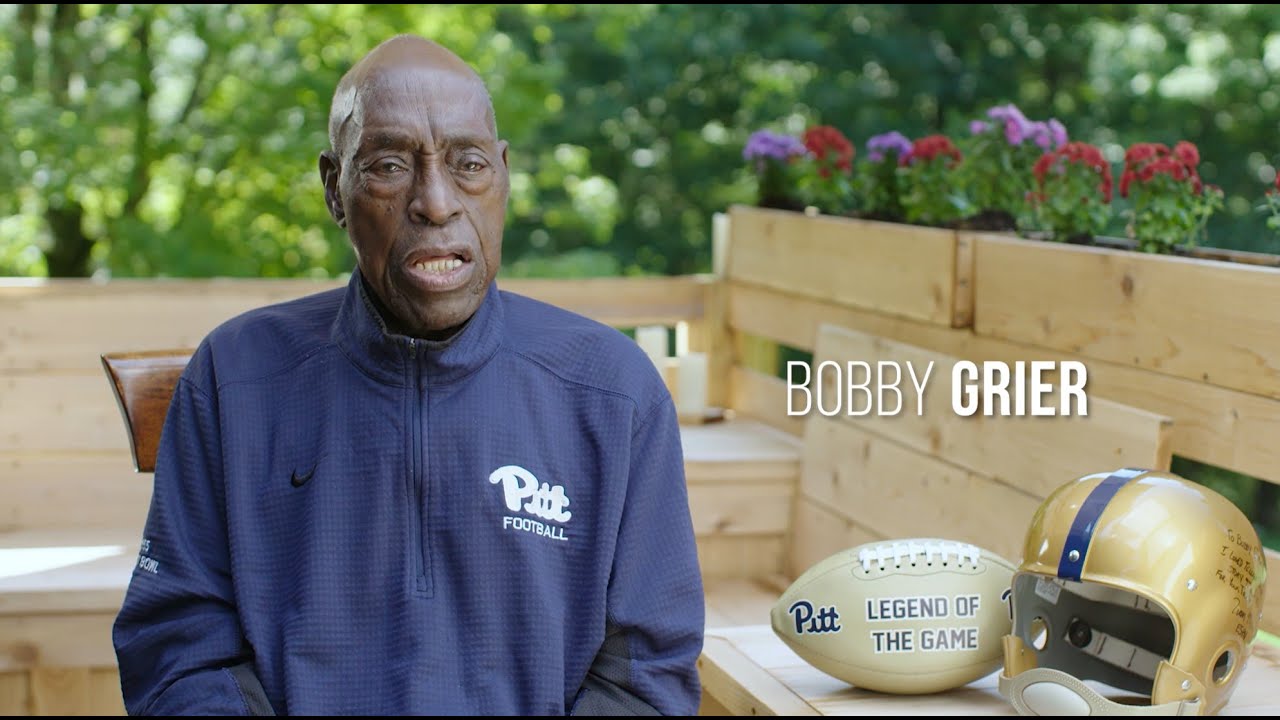
Bobby Grier

January 2, 1956, 70 years ago: The college football season comes to an end, with the traditional New Year's Day bowl games, pushed back a day because January 1 was a Sunday.

This Monday saw the playing of the Sugar Bowl, at Tulane Stadium in New Orleans. The Georgia Institute of Technology, a.k.a. Georgia Tech, entered the game at 8-1-1, having lost to Auburn and been tied by Tennessee; however, they had beaten the University of Miami, Florida and Duke, each of them ranked at the time. Tech came in ranked Number 7.

However, they were only 3rd in the Southeastern Conference. Mississippi, instead of accepting the usual invitation given by the Sugar Bowl to the SEC Champions, instead accepted an invitation to play in the Cotton Bowl. "Ole Miss" and Tech did not play each other that season. Auburn, who finished 2nd, were not invited by the Sugar Bowl, and ended up losing the Gator Bowl to the 5th-place team in the SEC, Vanderbilt. (Tennessee finished 4th.) So the Sugar Bowl invited Georgia Tech.

Their opponents were the University of Pittsburgh. An Independent, Pitt were only 7-3, losing to Oklahoma, Navy and Miami. However, they had beaten ranked teams Duke and West Virginia, and teams from other regions, Nebraska and the University of California. They came into the game ranked Number 11.

Pitt's best player was Bobby Grier, a fullback and a linebacker, as most college football teams were still sending players to play what was known as "single-platoon football," the same players playing on both offense and defense. Grier, a native of the football-mad town of Massillon, Ohio, was black.

Segregationists didn't want Grier to play in the Sugar Bowl. Governor Marvin Griffin of Georgia sent a telegram to Tech's Board of Regents, in an attempt to pressure the school's president, Blake Van Leer, to pull the team out of the game. Van Leer was already catching heat for pushing through a vote to allow women in Georgia Tech.

But Van Leer, who had held the office since 1944, refused to be bullied by the ignorant redneck Governor: He told a meeting of the Faculty Senate, "Either we're going to the Sugar Bowl, or you can find yourself another damn president of Georgia Tech." The Senate gave him a standing ovation.

This was one month after Rosa Parks refused to stand up on a bus in Montgomery, Alabama, with the bus boycott ongoing; 4 months after the murder of 14-year-old Emmett Till in Money, Mississippi; and a year and a half after the U.S. Supreme Court struck down public school segregation in the case of Brown v. Board of Education of Topeka, Kansas.
Grier, supported by his white teammates 

As it turned out, there was no law that could prevent Grier from playing in the game, and, for the 1st time, a bowl game in the South had a black player in it.

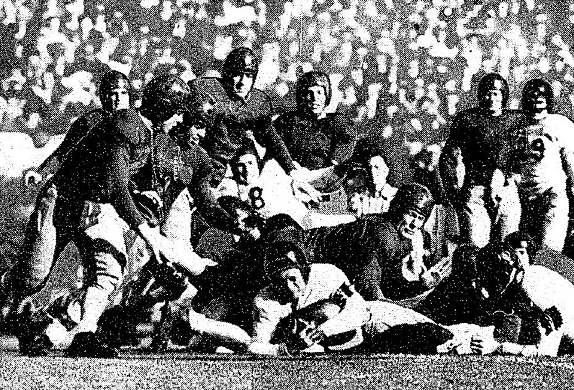
Georgia Tech won the game, 7–0. The margin of victory mostly resulted from a disputed pass interference penalty, in the 1st quarter. It was called on Grier, giving Georgia Tech a 1st and goal on the Pitt 1-yard line. The Yellow Jackets scored the game's only touchdown on the next play. Photographic evidence later strongly indicated the referee's call was incorrect.

The irony of the bad call is that it was made by referee Rusty Coles, who was from the Pittsburgh area, and who had no objective in making the wrong call, but simply made a mistake, which he admitted after seeing the game films.

Grier finished the game as its leading rusher with 51 yards. After the game, he protested the pass interference call, but praised the Georgia Tech players, saying, "They were good sportsmen, perhaps the best I've played against all season. They played hard, but clean. It was a good game. But believe me. I didn't push that man."

As it turned out, the State of Georgia needed to find a new president of Georgia Tech, anyway: Blake Van Leer died of a heart attack on January 24, 1956, just 22 days after the game. Edwin D. Harrison was named the new president. In 1960, he oversaw a vote by an overwhelming majority of Tech students to endorse the integration of qualified applicants, regardless of race.

Bobby Grier did not play professional football. Instead, he enlisted in the U.S. Air Force, and later served as an administrator at a community college in the Pittsburgh area. In 2022, he was elected to the Pitt Athletics Hall of Fame. He died in 2024.
January 2, 1956 was, as I said, a Monday. These other bowl games were played that day:

* Oklahoma beat Maryland, 20-6, in the Orange Bowl, at Burdine Stadium in Miami. In 1959, the stadium was renamed the Orange Bowl. This was, effectively, the National Championship Game: Oklahoma, in the middle of their 47-game winning streak, still a college football record, were ranked Number 1, and had won the Big Seven Conference title; while Maryland were ranked Number 3, and had won the Atlantic Coast Conference title.

Oklahoma were favored by 7 points. If Maryland had pulled the upset, it's likely that they would have been awarded the National Championship, regardless of whether Number 2 Michigan State won the Rose Bowl. At the very least, there could have been a split in the polls. But Oklahoma won, making the Rose Bowl academic.

* Michigan State did their part, beating the University of California at Los Angeles, 17-14, in the Rose Bowl, in the stadium of the same name in the Los Angeles suburb of Pasadena, California. Michigan State were ranked Number 2, and Champions of the Big Ten Conference. UCLA were ranked Number 4, and Champions of the Pacific Coast Conference. But Oklahoma's 2-touchdown win put the National Championship out of reach for Michigan State.

* Mississippi beat Texas Christian University, 14-13, in the Cotton Bowl, in the stadium of the same name in Dallas. As previously stated, Ole Miss were the SEC Champions, and went into the game ranked Number 10. TCU were the Champions of the Southwest Conference, and were ranked Number 6.

* Wyoming beat Texas Tech, 21-14 in the Sun Bowl, at Kidd Field in El Paso, Texas. Wyoming finished 4th in the Skyline Conference, while Texas Tech were the Champions of the Border Conference.

* Juniata College and Missouri Valley College played to a tie, 6-6 in the Tangerine Bowl, in the stadium of the same name in Orlando, Florida. The Tangerine Bowl game was a showcase for what were then called "small college" teams. Both the game and the stadium would become bigger, and become known as the Citrus Bowl.

Juniata, of Huntingdon, Pennsylvania, then an Independent, now competes in NCAA Division III. Missouri Valley, of Marshall, Missouri, were the Champions of the Missouri College Athletic Union, and now compete in the NAIA -- for all intents and purposes, NCAA Division IV.

Sunday, August 3, 2025

August 3, 1975: The Superdome Opens

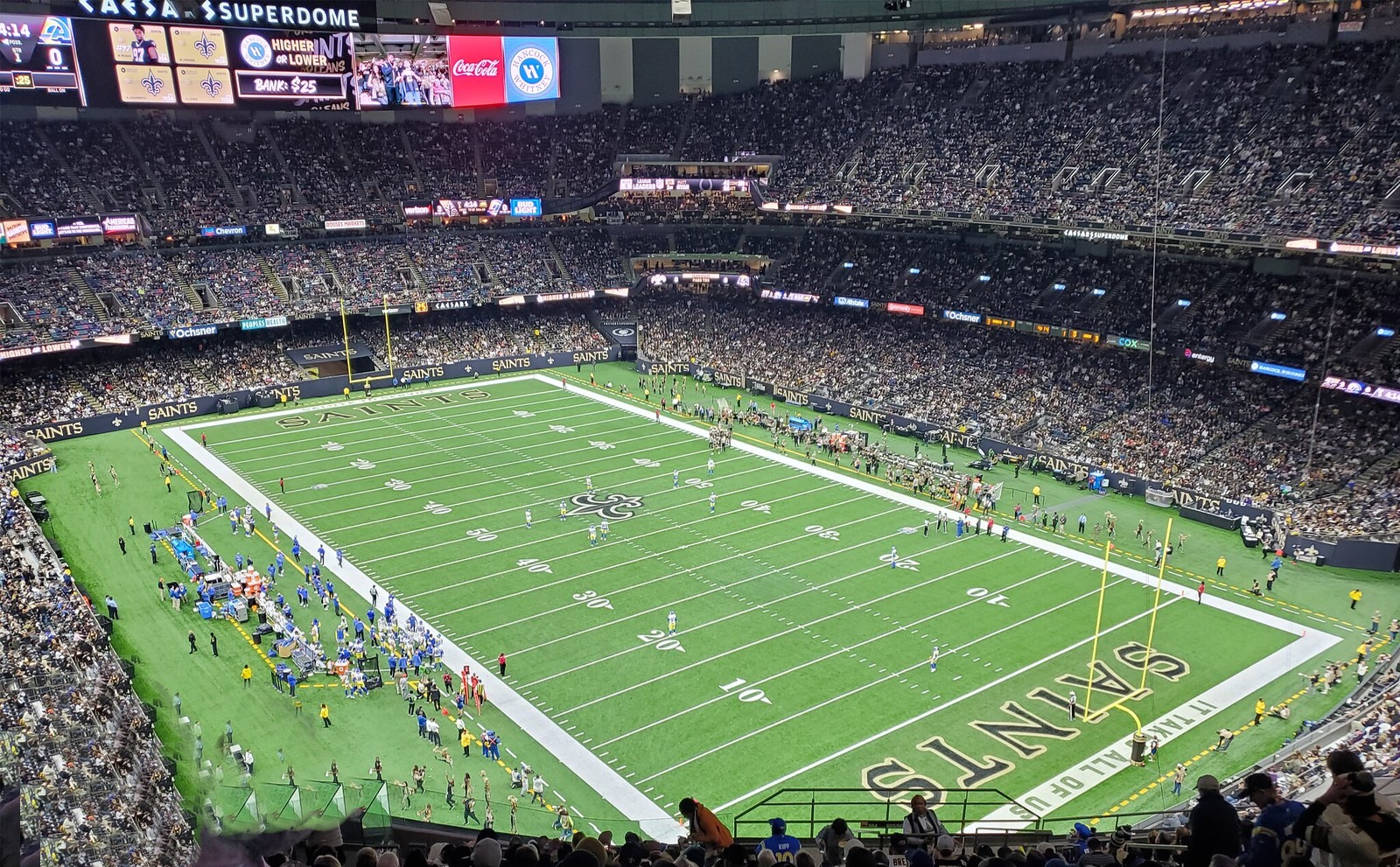
August 3, 1975, 50 years ago: The Louisiana Superdome opens in downtown New Orleans. Trumpeter Al Hirt and clarinetist Pete Fountain, both based in that city known as the birthplace of jazz, perform at the opening concert.

The "Big Mushroom" was designed to take the place of Tulane Stadium, on the campus of Tulane University, as the home of the school's football team, and of the NFL's New Orleans Saints, and of 2 of college football's most popular games, the Sugar Bowl and the historically black schools' Bayou Classic. On the very day of the Superdome's dedication, Tulane Stadium was condemned. It was demolished in 1979.

Between August 28 and September 14, 1975, the Superdome continued to celebrate its grand opening, with appearances by Bob Hope, Telly Savalas, Dorothy Lamour, Karen Valentine, and Raquel Welch. The Allman Brothers, The Marshall Tucker Band, Wet Willie, The Charlie Daniels Band, The O'Jays, The Isley Brothers, The Temptations, Donald Byrd and the Blackbyrds, and the Ringling Brothers and Barnum & Bailey Circus also performed. On October 3, Johnny Cash led a concert that included his wife June Carter, Waylon Jennings and his wife Jessi Colter, and Merle Haggard.

The 1st football game in the Superdome was on August 6, an exhibition game in which the Saints lost to the Houston Oilers, 13-7. Their 1st regular-season game in the building was on September 28, a 21-0 loss to the Cincinnati Bengals. Tulane's dome debut was better, a 14-3 win over the University of Mississippi.
On November 29, the Bayou Classic was played there for the 1st time. The Grambling State University Tigers defeated the Southern University Jaguars, 33-20. And on December 31, New Year's Eve, the Sugar Bowl was first held there. Alabama beat Penn State, 13-6. 'Bama coach Paul "Bear" Bryant was not wearing his famous houndstooth hat. When asked why, he said, "My mama told me never to wear a hat indoors." He had never coached a game under a dome before.

With the closing (but not, as of this writing, the demolition) of the Astrodome in Houston, the Superdome is the oldest actively used domed stadium in the United States. It has hosted the Super Bowl more times than any other venue:

1. 1978, Super Bowl XII: Dallas Cowboys 27, Denver Broncos 10.
2. 1981, Super Bowl XV: Oakland Raiders 27, Philadelphia Eagles 10.
3. 1986, Super Bowl XX: Chicago Bears 46, New England Patriots 10.
4. 1990, Super Bowl XXIV: San Francisco 49ers 55, Denver Broncos 10.
5. 1997, Super Bowl XXXI: Green Bay Packers 35, New England Patriots 21.
6. 2002, Super Bowl XXXVI: New England Patriots 20, St. Louis Rams 17.
7. 2013, Super Bowl XLVII: Baltimore Ravens 34, San Francisco 49ers 31.
8. 2025, Super Bowl LIX: Philadelphia Eagles 40, Kansas City Chiefs 22.

It has hosted 6 NCAA Final Fours:

1. 1982, North Carolina over Georgetown.
2. 1987, Indiana over Syracuse.
3. 1993, North Carolina over Michigan.
4. 2003, Syracuse over Kansas.
5. 2012, Kentucky over Kansas.
6. 2022, Kansas over North Carolina.
The NBA's New Orleans Jazz played there from 1975 until their 1979 move to Salt Lake City, as the Utah Jazz. Muhammad Ali regained the Heavyweight Championship of the World from Leon Spinks there in 1978, and Sugar Ray Leonard regained the Welterweight Championship from Roberto Duran there in 1980.

It also hosted some preseason baseball games: Minnesota vs. Houston in 1976; the New York Yankees vs. Baltimore in 1980; the Yankees vs. the New York Mets, Philadelphia and Pittsburgh in 1981; the Yankees vs. Montreal and Texas in 1982; the Yankees vs. Montreal and Toronto in 1983; Philadelphia vs. St. Louis in 1984; San Francisco vs. Oakland in 1989; Los Angeles vs. Oakland in 1991; the Mets vs. Oakland in 1993; the Yankees vs. Boston in 1994; and the Chicago Cubs vs. Minnesota in 1999.
Baseball doesn't look right in the Superdome, does it?

The Class AAA New Orleans Pelicans played their home games there in 1977. New Orleans tried to get the Oakland Athletics to move there in 1979, and the Pittsburgh Pirates for 1982, but were unsuccessful.

It has also hosted a Mass by Pope John Paul II in 1987, and the 1988 Republican National Convention, which nominated George H.W. Bush for President.

In 2005, Hurricane Katrina nearly ruined New Orleans, including causing serious damage to the Superdome. It was used as a shelter for those who had lost their homes, with disastrous results. The Saints split their home games that season between Tiger Stadium on the Louisiana State campus in Baton Rouge and the Alamodome in San Antonio; Tulane used 5 different smaller college stadiums in Louisiana; the Bayou Classic was moved to what's now named NRG Stadium in Houston; and the Sugar Bowl to the Georgia Dome in Atlanta. The Superdome reopened the following September 25.

Current seating capacity is 73,208. The post-Katrina renovation of 2005-06 was designed solely to make it usable again. Another renovation was undertaken in 2011, to do some modernization -- which also ended the building's baseball capability. There has been talk of a new domed stadium to replace it, but no plans are underway.

Naming rights were sold in 2011, making it the Mercedes-Benz Superdome. The 2017 move of the Saints' arch-rivals, the Atlanta Falcons, to the new Mercedes-Benz Stadium confused matters, and Mercedes-Benz allowed their naming rights on the Superdome to lapse. In 2021, it became the Caesars Superdome, with the rights bought by the Caesars casino company.
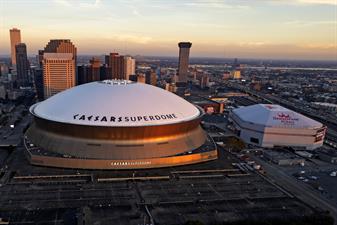
The Superdome (left) and the Smoothie King Center

The New Orleans Arena opened next-door in 1999. Since 2014, it has been named the Smoothie King Center. Since 2002, it has been home to the NBA team known as the New Orleans Hornets until 2013, and the New Orleans Pelicans ever since.

Wednesday, January 1, 2025

January 1, 1935: The 1st Orange Bowl & the 1st Sugar Bowl

January 1, 1935, 90 years ago: The 1st Orange Bowl is played, at Miami Field in Miami. Unlike in a few later appearances, having the home-field advantage did not help the University of Miami, as they lost to Bucknell University, 26-0.

The Bison defense held the Hurricanes to just 4 1st downs and 28 yards total offense en route to the victory. The Bucknell offense gained 278 yards, and earned its 6th shutout of the season.

The Orange Bowl was pattered after the Rose Bowl in Pasadena, California, with its pregame Tournament of Roses Parade. The Fiesta of the American Tropics parade was held in 1926, but there was no game. Then came the Florida land bust that year, and then the Great Depression in 1929, killing Florida tourism.

In 1932, trying to revive Florida tourism, Miami was ready to try again. A parade was held on January 1, 1933, and a Festival of Palms Bowl was played at Moore Park on January 2, with the University of Miami beating Manhattan College, 7-0. In 1934, again at Moore Park, Miami lost to Duquesne University of Pittsburgh. For the following season, the organizing committee received official sanction from the NCAA, and, for that reason, the 1935 edition was not only the 1st to carry the Orange Bowl name, but is recognized as the 1st Orange Bowl, rather than the 3 earlier Festival of Palms Bowls.

And so, every year, from 1936-37 to 2001-02, the King Orange Jamboree Parade would be held in downtown Miami on New Year's Eve, and the Orange Bowl on New Year's Day, except when January 1 fell on a Sunday, moving the game back to January 2. Traditionally, NBC televised both. The Parade's attendance dropped, and it was canceled in 2002.

Bucknell, in Lewisburg, Pennsylvania, downgraded its football program in 1948. In 1973, with the NCAA reclassifying, they were put in Division II. In 1978, they were promoted to Division I-AA, which was renamed the Football Championship Subdivision (FCS) in 2006. They have played at the same stadium since 1924. In 1989, it was renamed Christy Mathewson-Memorial Stadium, in honor of the school's most famous graduate, the New York Giants pitcher who was 1 of the 1st 5 players elected to the Baseball Hall of Fame.

Clarke Hinkle, star running back for the Green Bay Packers in the 1930s, before this Orange Bowl, remains Bucknell's greatest football player. They have never again appeared in a bowl game, and have never won a conference championship.

Miami, on the other hand, would have a decent football history until the 1980s, when they became a bit indecent, but also one of the best programs in the game. In 1937, they moved into Burdine Stadium, built on the site of Miami Field, named for the late Roddy Burdine, department store owner and major booster of the City of Miami. The stadium was renamed the Miami Orange Bowl in 1959, and would host 5 Super Bowls, including the New York Jets' famed upset of the Baltimore Colts in Super Bowl III.
The Miami Dolphins played at the Orange Bowl from 1966 to 1986, then moved into Joe Robbie Stadium in suburban Miami Gardens in 1987. The Orange Bowl game was first played there in 1997 and 1998, moved back to its namesake stadium in 1999, and has been played at the Miami Gardens facility, now named Hard Rock Stadium, from 2000 onward. The University of Miami last played at the Orange Bowl in 2007, and moved to Miami Gardens. The stadium was demolished in 2008, and the new home of the Miami Marlins, now named LoanDepot Park, opened on the site in 2012.
From 1968 to 1996, the Champion of the Big Eight Conference was officially awarded a berth in the Orange Bowl, something that had unofficially been done since 1954. It was accepted all but twice, by Nebraska in 1974 and 1975, in favor of a better shot at the National Championship. They paid dearly for this, losing both times. Since the 2014 season, the Champion of the Atlantic Coast Conference has been guaranteed a berth in the Orange Bowl, unless it qualifies for the National Championship Playoff.

The Orange Bowl has featured 16 teams that won the National Championship for the preceding calendar year: Miami in 1988 and 1992; Oklahoma in 1954, 1987 and 2001; Nebraska in 19871, 1972, 1995 and 1997; Georgia Tech in 1952; Alabama in 1965; Clemson in 1982;  Notre Dame in 1990; Colorado in 1991; and Florida State in 1994.

*

January 1, 1935 was a Tuesday. This was also the day the 1st Sugar Bowl was played, at Tulane Stadium in New Orleans. Tulane University beat Temple University, 20-14.
The most notable play of the game came in the 2nd quarter, when Tulane's quarterback, John McDaniel, caught a Temple kickoff, ran to the right to draw tacklers, then threw a lateral pass to his teammate Monk Simons, who ran 75 yards for the touchdown. Two more Tulane touchdowns in the second half outweighed Temple's early lead.

Tulane had been built on a sugar plantation, and sugar was long the leading crop in the State of Louisiana. Hence, the game was named for a local crop. New Orleans civic leaders wanted to copy Pasadena, California's Rose Bowl for a few years, and finally got it set up for 1934-35. There was no pregame parade, however.

Tulane had been one of the South's leading football schools, winning titles in the Southern Intercollegiate Athletic Association in 1920, and the Southern Conference in 1925, 1929, 1930 and 1931. That league was the forefather of both the Southeastern Conference (SEC) and the Atlantic Coast Conference (ACC).

In 1933, Tulane was a founding member of the SEC, and won the title in 1934, giving them the credibility to host the bowl game. They would win the SEC again in 1939 and 1949, but went into decline, and left the league after the 1965 season, surpassed in football importance in their State by Louisiana State University (LSU), and even by the black college rivalry between Grambling State and Southern University. They would later win the title in Conference USA in 1998, and are now members of the American Athletic Conference (AAC), having won the AAC title in 2022.

The game was held at Tulane Stadium from 1935 until 1975. In 1975, the Louisiana Superdome opened, and the game has been held there every year since, with the exception of 2006, when it was held at the Georgia Dome in Atlanta, due to repairs on the Superdome from Hurricane Katrina.
Tulane Stadium

Temple have also never again reached the football heights they reached in the 1930s. They devalued their program in 1958, but began moving back up in 1991, becoming members of the Big East Conference. In 2013, they joined the American Athletic Conference (AAC), winning it in 2016.

After the inaugural Sugar Bowl, they didn't go to another bowl game until the 1979 season, and then not again until 2009. They won the Garden State Bowl in 1979, the New Mexico Bowl in 2011, and the Gasparilla Bowl in 2017. But they've never been to another traditional New Year's Day bowl game.

Tulane Stadium hosted Super Bowls IV, VI and IX, and was home to the NFL's New Orleans Saints from 1967 to 1974, before they and the Green Wave moved into the Superdome for the 1975 season. Tulane Stadium was demolished in 1979, the 1st of the 4 classic New Year's Day bowl game facilities to go. (The Orange Bowl followed in 2008, while the Rose Bowl and Cotton Bowl stadiums still stand.) In 2014, Yulman Stadium was opened on the site of Tulane Stadium.
The Superdome

The Sugar Bowl has usually invited the SEC Champion, although this was not made official until the 1976 season. With the advent of the Bowl Championship Series (BCS) in the 1998 season, hosting the SEC Champion was no longer a given. Given the success of the SEC since the start of the National Championship Playoff in 2014, it's been almost impossible.

The Sugar Bowl has featured the National Champions of the preceding calendar year 23 times: Louisiana State University (LSU) in 1959 and 2007; the University of Mississippi (Ole Miss) in 1960, 1961 and 1963; Alabama in 1962, 1979, 1980 and 1993; the University of Miami in 1990 and 2001; Texas Christian University (TCU) in 1939; Texas A&M in 1940; Oklahoma in 1950; Maryland in 1952; Georgia Tech in 1953; Notre Dame in 1974; the University of Pittsburgh in 1977; Georgia in 1981; Penn State in 1983; Florida in 1997; Florida State in 2000; and Ohio State in 2021.

Also on this day, the Rose Bowl was played at the stadium of the same name, outside Los Angeles in Pasadena, California. Alabama completed an undefeated season, ruining Stanford's, 29-13. The Cotton Bowl debuted on New Year's Day 1937.