Showing posts with label sonny jurgensen. Show all posts

Sunday, March 15, 2026

March 15, 1926: Norm Van Brocklin Is Born

March 15, 1926, 100 years ago: Norman Mack Van Brocklin is born in Parade, South Dakota, and grows up in the San Francisco suburb of Walnut Creek, California. He left high school to enter the U.S. Navy during World War II, and starred at the University of Oregon, before playing for the Los Angeles Rams, debuting with them in 1949.

This led to perhaps the NFL's 1st great "quarterback controversy," as the Rams already had Bob Waterfield, who had already led them to the NFL Championship in 1945, their last season in Cleveland. In 1949, Waterfield started 11 of 12 games, and the Rams reached the NFL Championship Game, but lost it to the Philadelphia Eagles. In 1950, Van Brocklin started 7 games, Waterfield 5, and again, they reached the Championship Game, losing it to the Cleveland Browns. Both times, Waterfield started, but Van Brocklin did play.

In 1951, Waterfield started 10 games, Van Brocklin only 2. One of those was on September 28, against the woebegone football version of the New York Yankees. He completed 27 of 41 passes for 554 yards. Despite all the advances in the passing game over the last 75 years, that is a single-game record that still stands. Once again, the Rams reached the Championship Game. Once again, head coach Joe Stydahar, previously a Hall of Fame lineman with the Chicago Bears, named Waterfield the starter. This time, the Rams beat the Browns.

In 1952, Van Brocklin started 7 games, Waterfield 5. Waterfield then retired. Van Brocklin got them back to the Championship Game in 1955. In 1958, he was traded to the Philadelphia Eagles. In training camp in 1959, a young tackle was injured, and Van Brocklin taught him how to watch film. That tackle never played a down of pro ball, but a coach was born that day: John Madden. He also tutored the Eagles' young backup quarterback, future Hall-of-Famer Christian "Sonny" Jurgensen.
I think that's Ray Nitschke,
the Packers' Hall of Fame linebacker, behind him.

In 1960, Van Brocklin led the Eagles to a 12-2 record, winning the NFL Championship Game over the Green Bay Packers, 17-13 at Franklin Field in Philadelphia. This made him the 1st quarterback to lead 2 different teams to the NFL title. There have been 2 since: Peyton Manning and Tom Brady *.

After that game, Van Brocklin retired as a player, and, with Eagles head coach Buck Shaw also retiring, fully expected to be named head coach. He wasn't, and 1960 remained their last NFL Championship for 57 years. The Curse of the Dutchman? Oddly, when they won again in the 2017 season, it was in part because they had to change quarterbacks late in the season, as Carson Wentz got hurt, and Nick Foles led them the rest of the way.

For the 1961 season, Van Brocklin was named the 1st head coach of the expansion Minnesota Vikings, leading them through 1966. He tutored their 1st starting quarterback, future Hall-of-Famer Fran Tarkenton. From 1968 to 1974, he coached the Atlanta Falcons. He never reached the Playoffs as a coach.
Tarkenton and Van Brocklin

He died on May 2, 1983, only 57 years old, after battling brain cancer: After leaving the hospital, he said he got a brain transplant: "They gave me a sportswriter's brain, to make sure I got one that hadn't been used." A 9-time Pro Bowler, he is in the Pro Football Hall of Fame. Oddly, neither the Rams nor the Eagles have retired his Number 11.

Friday, February 6, 2026

Sonny Jurgensen, 1934-2026

Who led the NFL in touchdown passes in the 1960s? It wasn't Johnny Unitas, or Bart Starr, or Joe Namath, or Fran Tarkenton. It was Sonny Jurgensen.

Christian Adolph Jurgensen III was born on August 23, 1934 in Wilmington, North Carolina. He starred in football, baseball and basketball at New Hanover High School. Other notable alumni include fellow NFL stars Roman Gabriel, Clyde Simmons and Alge Crumpler; baseball star Trot Nixon; and TV journalist David Brinkley.

"Sonny" was chosen to start at quarterback for the North Carolina all-stars in the annual Shrine Bowl against the South Carolina All-Stars in Charlotte. He then went to Duke University in Durham, where he was not only a quarterback, but a fine defensive back, and led them to the 1954 ACC title and a win over Nebraska in the 1955 Orange Bowl. It's funny how, with all the great basketball players who have gone to Duke, the school's greatest athlete from the State that they're actually in is a football player.

He became Norm Van Brocklin's backup on the Philadelphia Eagles, winning the 1960 NFL Championship. Van Brocklin retired, and Sonny became the starter in 1961, making the 1st of 5 Pro Bowl teams, leading the NFL in passing yards 5 times and in touchdown passes twice.

In 1964, the Eagles named Joe Kuharich as head coach. Kuharich was a massive prude, and Sonny liked the nightlife, so Joe traded Sonny to the Washington Redskins for their starting quarterback of the time, Norm Snead.

This trade was so dumb! How dumb was it? Over the rest of the decade, the Eagles floundered, while the Redskins got better, eventually becoming the team (albeit quarterbacked by Billy Kilmer, with Sonny as an aging backup) that won the 1972 NFC Championship.

I mentioned that Sonny threw more touchdown passes in the 1960s than any other quarterback. Guess which quarterback threw more interceptions in the 1960s than any other. Did I telegraph the punch enough? It was Norm Snead. And Joe Kuharich traded Sonny for Norm.

It took the Redskins a while to go from terrible to great, and by the time the process was finished, so was Sonny, pretty much. Typical of this period of Washington football was their game against the Giants on November 27, 1966, at District of Columbia Stadium (renamed Robert F. Kennedy Memorial Stadium in 1969). The 'Skins scored 72 points, the 2nd-highest total in NFL history. But their defense was so weak, the Giants scored 41. The 113 combined points remains an NFL record. Sonny only threw 16 passes, completing 10, for 145 yards, for 3 touchdowns and no interceptions. But a balanced rushing attack got 209 yards for Washington.

On September 15, 1968, the Redskins beat the Chicago Bears, 38-28 at Wrigley Field in Chicago. Sonny went 14-for-21 for 276 yards, 4 touchdowns, and no interceptions. In the 2nd quarter, with the ball on his own 1-yard line, Sonny threw the ball to Gerry Allen, who caught the ball at the Washington 35, and ran the remaining 65 yards. It was a 99-yard touchdown pass, tying an unbreakable NFL record. It was the 5th time it had happened. It has now happened 11 times, although not since 2011, when Eli Manning and Victor Cruz combined for it.

Sonny Jurgensen led the NFL in pass completions 4 times, 5 times in passing yards, 5 times in yards per game, twice in passing touchdowns, made 5 Pro Bowls, and had the highest career "quarterback rating" of any player before the 1978 rule changes that opened up the passing game: 82.6.

Vince Lombardi, who coached the Redskins in the last season of his life, 1969, said, "If we would have had Sonny Jurgensen in Green Bay, we'd never have lost a game." And this is a man who had Bart Starr, the only man to quarterback 5 NFL Championship teams without cheating. Although the thought of Sonny Jurgensen and Paul Hornung playing together on Saturday night before they played together on Sunday afternoon is a scary thought.

Lombardi began the Redskins' resurgence, but he died of cancer in 1970. In 1971, George Allen was named head coach, and Jurgensen should have been his kind of guy, a seasons veteran for Allen's "Over-the-Hill Gang." But injuries struck him, and Billy Kilmer was named the starter. It was Kilmer who led them to the Playoffs in 1971, and to the NFC Championship in 1972. Jurgensen did not play in Super Bowl VII, and the Redskins lost to the Miami Dolphins.

It was the NFL's 1st real quarterback controversy since Van Brocklin and Bob Waterfield on the early 1950s Los Angeles Rams. Just as with the Mickey Mantle and Roger Maris home run record chase in 1961, fans took sides, putting "I Love Billy" or "I Love Sonny" bumper stickers on their vehicles. The defensive-minded Allen preferred Kilmer's conservative, ball-control style of play to Jurgensen's more high-risk approach. Despite the controversy, Jurgensen was helpful to his rival. Even until his death, Kilmer still stayed at Jurgensen's house when he was in town.

In 1974, at the age of 40 and in his final season, Jurgensen won his 3rd NFL passing crown, even though he was still splitting time with Kilmer. In the final game of his NFL career, Jurgensen made his 1st and only appearance as a quarterback in an NFL postseason game, in the Redskins' 19–10 loss to the Rams in the Divisional Round of the Playoffs. He came off the bench in relief of Kilmer, and completed 6 of 12 passes, but also threw 3 interceptions.

Sonny was named to the College and Pro Football Halls of Fame, the Duke Sports Hall of Fame, the NFL's 1960s All-Decade Team, the Philadelphia Eagles Hall of Fame and the Washington Redskins Ring of Fame. In 1975, just after he retired, he and Hall of Fame linebacker Sam Huff formed a beloved broadcasting team for the Redskins. Sam retired from this role in after the 2012 season, Sonny after 2018.
For most of their history, the team now known as the Washington Commanders did not officially retire uniform numbers, with Sammy Baugh's 33 being the lone exception. But Sonny Jurgensen's Number 9 has only been given out once since he retired after the 1974 season.

That was in 2002, by new head coach Steve Spurrier, to one of his former University of Florida quarterbacks, Shane Matthews. He also gave Number 7, worn by Joe Theismann, to another of his Florida quarterbacks, Danny Wuerffel. Redskin fans were so angry that, before the regular season started, Spurrier got the message, and switched Wuerffel to 17 (which was Kilmer's number, but there was no outcry over that) and Matthews to 6. In 2022, at the age of 88, Sonny Jurgensen finally got his Number 9 retired by the Washington Commanders.

He met his 1st wife, Suzanne Long, while they were students at Duke. They had 2 sons, Greg and Scott, before later divorcing. Jurgensen married Margo Hurt in 1967. That couple also had 2 sons, Erik and Gunnar.

Sonny died on February 6, 2026, at 91. That day, on ESPN's Pardon the Interruption, co-hosts Tony Kornheiser and Michael Wilbon, both former sports columnists for The Washington Post, paid tribute to an old friend. In spite of his not having won a title there (his only title coming as a Philadelphia backup), Tony said, "Sonny Jurgensen could possibly be the most popular pro athlete in Washington, ever." Mike, who had been part of a pregame and postgame show with Sonny in the 1980s, said, "I am honored and humbled to have been able to work with Sonny Jurgensen."

With Sonny's death, there are 6 surviving players from the 1960 NFL Champion Philadelphia Eagles: Jerry Reichow, Billy Ray Barnes, Ted Dean, Theron Sapp, J.D. Smith and John Wilcox.

Monday, April 1, 2024

April 1, 1964: The Dumbest Trade In NFL History

April 1, 1964, 60 years ago: The Philadelphia Eagles trade quarterback Sonny Jurgensen to the Washington Redskins, for quarterback Norm Snead. This was the dumbest trade in NFL history.

Christian Adolph Jurgensen III was not only a quarterback at Duke, but a fine defensive back, and led them to the 1954 ACC title and a win over Nebraska in the 1955 Orange Bowl. He became Norm Van Brocklin's backup on the Philadelphia Eagles, winning the 1960 NFL Championship. Van Brocklin retired, and Sonny became the starter in 1961, making the 1st of 5 Pro Bowl teams, leading the NFL in passing yards 5 times and in touchdown passes twice.

But in 1964, the Eagles named Joe Kuharich as head coach. Kuharich was a massive prude, and Sonny liked the nightlife, so Joe traded Sonny to the Washington Redskins for their starting quarterback of the time, Norm Snead.

This trade was so dumb! How dumb was it? Over the rest of the decade, the Eagles floundered, while the Redskins got better, eventually becoming the team (albeit quarterbacked by Billy Kilmer, with Sonny as an aging backup) that won the 1972 NFC Championship.

Sonny Jurgensen had the highest career "quarterback rating" of any player before the 1978 rule changes that opened up the passing game: 82.6. Vince Lombardi, who coached the Redskins in the last season of his life, 1969, said, "If we would have had Sonny Jurgensen in Green Bay, we'd never have lost a game." And this is a man who had Bart Starr, the only man to quarterback 5 NFL Championship teams without cheating. Although the thought of Sonny Jurgensen and Paul Hornung playing together on Saturday night before they played together on Sunday afternoon is a scary thought.

Sonny also threw more touchdown passes in the 1960s than any other quarterback -- more than Starr, more than Johnny Unitas, more than Joe Namath. Guess which quarterback threw more interceptions in the 1960s than any other. Did I telegraph the punch enough? It was Norm Snead. And Joe Kuharich traded Sonny for Norm.
Norm didn't seem to have a clue about the trade.
Or about much else.

Snead was named to 5 Pro Bowls, but bounced around. The Eagles let him go after the 1970 season. He played for the Minnesota Vikings in 1971; the New York Giants in 1972, '73 and '74; the San Francisco 49ers in 1974 and '75; and 1 more season with the Giants, in 1976.

His Number 16 was retired -- by Wake Forest University, not by any of the pro teams for which he played. (Okay, the Giants did retire Number 16, but for Frank Gifford. And the 49ers retired it, but for Joe Montana.) He later served as head coach for a vocational-and-technical high school in his hometown of Newport News, Virginia.

Sonny was named to the College and Pro Football Halls of Fame, the NFL's 1960s All-Decade Team, the Philadelphia Eagles Hall of Fame and the Washington Redskins Ring of Fame. He retired after the 1974 season. The next season, he and Hall of Fame linebacker Sam Huff formed a beloved broadcasting team for the Redskins. Sam retired from this role in after the 2012 season, Sonny after 2018.

For most of their history, the team now known as the Washington Commanders did not officially retire uniform numbers, with Sammy Baugh's 33 being the lone exception. But Sonny Jurgensen's Number 9 has only been given out once since he retired after the 1974 season.
That was in 2002, by new head coach Steve Spurrier, to one of his former University of Florida quarterbacks, Shane Matthews. He also gave Number 7, worn by Joe Theismann, to another of his Florida quarterbacks, Danny Wuerffel. Redskin fans were so angry that, before the regular season started, Spurrier got the message, and switched Wuerffel to 17 (there was no outcry over getting him Kilmer's number) and Matthews to 6.

Joe Kuharich died on January 25, 1981 -- by a strange coincidence, the day in which the Eagles played in their 1st NFL championship game since refusing to hire Norm Van Brocklin as head coach. It was Super Bowl XV, and they lost to the Oakland Raiders. He was 63. Sam Huff died on November 13, 2021, at 87. In 2022, at the age of 88, Sonny Jurgensen finally got his Number 9 officially retired by the Washington Commanders. Norm Snead died on January 14, 2024, at 84.

April 1, 1964 was also the day that Scott Stevens was born in Kitchener, Ontario, Canada. A tough-guy defenseman for the Washington Capitals, he captained the New Jersey Devils to 3 Stanley Cup wins: In 1995, 2000 and 2003. His Number 4 became the 1st number retired by the Devils.

Thursday, April 5, 2018

Washington's 10 Greatest Athletes

Today, the Mets started a series away to the Washington Nationals.

Washington's 10 Greatest Athletes

Honorable Mention to Washington Senators in the Baseball Hall of Fame, who didn't otherwise make the Top 10: Sam Rice, Bucky Harris, Goose Goslin, Joe Cronin, Heinie Manush, Rick Ferrell, Early Wynn and Harmon Killebrew. (The Killer only played his 1st 5 seasons in Washington. If the "Old Senators" hadn't moved, or he'd gone to the "New Senators" at some point, he'd be on this list. He will definitely be on it when I do it for Minnesota.)

Honorable Mention to Homestead Grays in the Baseball Hall of Fame: Cumberland Posey, Jud Wilson, Cool Papa Bell, Ray Brown, Buck Leonard and Josh Gibson. There is a consensus that, at the very least, Bell, Leonard and especially Gibson would have been superstars had baseball been integrated. But we'll never know, and Negro League stats are woefully incomplete.

Honorable Mention to the 3 big stars of the Washington Nationals' 4 (so far) National League Eastern Division Championships in this decade: Ryan Zimmerman, Stephen Strasburg and Bryce Harper. Would any of them be in the Top 10 if the Nats had won so much as a Pennant? I'm not sure. Would any be in it if they'd won the District's 1st World Series title since 1924? As Harper would say, "That's a clown question, bro."

Honorable Mention to Washington Redskins in the Pro Football Hall of Fame, who didn't otherwise make the Top 10: Turk Edwards, Wayne Millner, Bill Dudley, Bobby Mitchell, Sam Huff, Paul Krause, Chris Hanburger, Ken Houston, Russ Grimm and Bruce Smith.

Mitchell started in Cleveland and went to Washington, and if he'd spent his entire career in either city, would be a solid candidate for either's Top 10. Huff would be in the Top 10 if he'd spent his entire career in Washington. If he'd spent his entire career in New York, he might be in their Top 10.

Krause spent most of his career in Minnesota, and will be in the Twin Cities' Top 10. Houston spent half his career in the city whose name is his own, and will be in the Houston Top 10. Bruce, who spent most of his career in Buffalo, will definitely be in the Top 10 when I do this for Western New York.

Very Honorable Mentions to Charley Taylor and Art Monk: Each of these Redskins, at one point, was the NFL's all-time leader in receptions. When The Sporting News named their 100 Greatest Football Players in 1999, Houston was ranked 61st, Taylor 85th, Monk 91st. None of them was included in the NFL Network's 2010 list of the 100 Greatest Players.

Honorable Mention to Washington Bullets or Washington Wizards in the Basketball Hall of Fame, who didn't otherwise make the Top 10: Bernard King and Mitch Richmond.

Honorable Mention to Washington Mystics stars: Chamique Holdsclaw, Nikki McCray, Alana Beard and Crystal Langhorne.

Honorable Mention to Washington Capitals in the Hockey Hall of Fame, who didn't otherwise make the Top 10: Scott Stevens, Larry Murphy, Dino Ciccarelli and Adam Oates.

Honorable Mention to D.C. United players who were chosen for Major League Soccer's 10th Anniversary Best XI in 2005: Jeff Agoos, Eddie Pope, Marco Etcheverry and Jaime Moreno.

10. Rod Langway, defenseman, Washington Capitals, 1982-93. After starting his career with the Montreal Canadiens, and winning the Stanley Cup as a rookie in 1979, he never got close to the Cup again. But he became one of the top defensemen in the game in D.C. (Landover, actually), something he couldn't do with Larry Robinson running the show in Montreal.

He made 6 All-Star Games, 4 with the Caps. He won back-to-back Norris Trophies for best defenseman in 1983 and '84. He only scored 51 goals in his 14 NHL seasons, but had 278 assists. The Caps retired his Number 5, and was elected to the Hockey Hall of Fame.

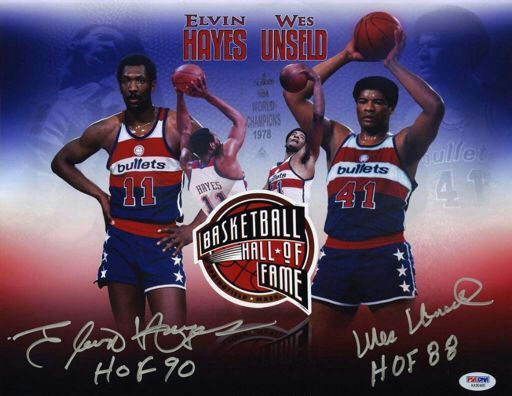
9. Wes Unseld, center, Washington Bullets, 1973-81. The big center spent his entire career with the Bullets, arriving in Baltimore in 1968 and making the move down the Baltimore-Washington Parkway in 1973. He was both Rookie of the Year and Most Valuable Player in the NBA in 1969, although both of those were in Baltimore. He was a 5-time All-Star, though only the last was in Washington.

He got the Bullets into the NBA Finals in 1971, 1975, 1978 and 1979, and finally led them to the title in 1978, winning the Finals MVP. The Bullets retired his Number 41 (before becoming the Wizards), and he was named to the Basketball Hall of Fame and the NBA's 50th Anniversary 50 Greatest Players.

8. Mike Gartner, right wing, Washington Capitals, 1979-89. He played another 9 seasons in the NHL, and never once appeared in the Stanley Cup Finals -- coming closest when the Rangers traded him in 1994, just before they could win it.

It's too bad, because he was fantastic, scoring 708 goals, and making 7 All-Star Games, 4 with the Caps. He was elected to the Hockey Hall of Fame, the Caps retired his Number 11, and he was named to the 100 Greatest Hockey Players by both The Hockey News in 1998 and the NHL on its 100th Anniversary in 2017.

7. John Riggins, running back, Washington Redskins, 1976-86. He wasn't pretty. He wasn't graceful. He wasn't tactful. He was just a great fullback. He helped the University of Kansas win the 1968 Big Eight Championship, then played 5 seasons for the Jets, and 4 for the Washington Redskins.

Then he held out for the entire 1980 season, and returned, saying, "I'm bored, I'm broke, and I'm back." Good thing he did, because, 2 years later, he was named Most Valuable Player of Super Bowl XVII, the Redskins' 1st NFL Championship in 40 years.

He only played in 1 Pro Bowl, in 1975, but in 1983, he set an NFL record with 24 rushing touchdowns, and won the Bert Bell Award as NFL MVP, helping the Redskins get into Super Bowl XVIII, although they lost. He rushed for 11,352 yards and 104 touchdowns. He was named to the Pro Football Hall of Fame, the Redskins Ring of Fame, and the NFL's 1980s All-Decade Team.

6. Sonny Jurgensen, quarterback, Washington Redskins, 1964-74. In 1964, the Philadelphia Eagles named Joe Kuharich as head coach. Kuharich was a massive prude, and the Eagle's All-Pro quarterback, Christian Adolph Jurgensen III, liked the nightlife. So Kuharich traded Sonny to the Washington Redskins for their starting quarterback of the time, Norm Snead.

This trade was so dumb! How dumb was it? Over the rest of the decade, the Eagles floundered, while the Redskins got better, eventually becoming the team (albeit quarterbacked by Billy Kilmer, with Sonny as an aging backup) that won the 1972 NFC Championship.

Sonny also threw more touchdown passes in the 1960s than any other quarterback. Guess which quarterback threw more interceptions in the 1960s than any other. Did I telegraph the punch enough? It was Norm Snead. And Joe Kuharich traded Sonny for Norm.

Sonny had the highest career "quarterback rating" of any player before the 1978 rule changes that opened up the passing game: 82.6. He led the NFL in passing yards 5 times and in touchdown passes twice -- at a time when the other contenders for the title of best quarterback in the NFL were Johnny Unitas, Y.A. Tittle and Bart Starr. Vince Lombardi, who coached Starr in Green Bay and the Redskins in the last season of his life, 1969, said, "If we would have had Sonny Jurgensen in Green Bay, we'd never have lost a game."

Sonny was named to the College and Pro Football Halls of Fame, the NFL's 1960s All-Decade Team, the Philadelphia Eagles Hall of Fame and the Washington Redskins Ring of Fame. He and Hall of Fame linebacker Sam Huff formed a beloved broadcasting team for the Redskins.

The Redskins don't officially retire numbers (Sammy Baugh's 33 is the lone exception), but Jurgensen's Number 9 has only been given out once since he retired after the 1974 season. That was in 2002, by new head coach Steve Spurrier, to one of his former University of Florida quarterbacks, Shane Matthews. He also gave Number 7, worn by Joe Theismann, to another of his Florida quarterbacks, Danny Wuerffel. Redskin fans were so angry that, before the regular season started, he switched Wuerffel to 17 (no outcry over getting Kilmer's number) and Matthews to 6. At 83, Sonny remains that beloved in the Potomac Valley.

5. Elvin Hayes, forward, Washington Bullets, 1972-81. The Big E reached the Bullets in their last season in Baltimore, and may still be the best player the franchise has ever had, making 12 NBA All-Star Teams (7 in Washington), and helping them reach the NBA Finals 3 times, winning the 1978 NBA Championship.

His Number 11 was retired by the Bullets (before becoming the Wizards). He was named to the Basketball Hall of Fame. and the NBA's 50th Anniversary 50 Greatest Players.

4. Darrell Green, cornerback, Washington Redskins, 1983-2002. Those dates alone should tell you something: He played 20 seasons in the NFL, and not as a placekicker or a punter. He played 295 games, the most of any defensive player in the League's 98-season history. He might be the best Washington football player of the last 70 years, and he might also be the fastest player in NFL history.

He arrived too late to be a member of their team that won Super Bowl XVII, but he got them into Super Bowl XVIII (lost), Super Bowl XXII (won), and Super Bowl XXVI (won). He made 7 Pro Bowls, his last at age 38.

He was the oldest man to play either of the defensive back positions, cornerback or safety, nearly 43. He was the oldest to have a gain of at least 35 yards, also nearly 43. He was the oldest with an interception, nearly 42. He was the oldest to return an interception for a game-winning touchdown in overtime, nearly 36; and the 2nd-oldest to return any interception for a touchdown, nearly 38.

He wasn't just a great player: He was a great guy, winning the Walter Payton NFL Man of the Year award in 1996. He was named to the College and Pro Football Halls of Fame, the NFL's 1990s All-Decade Team, and the Redskins' Ring of Fame.

In 1999, The Sporting News ranked him 81st on its list of the 100 Greatest Football Players. In 2010, the NFL Network ranked him 75th on their list of the 100 Greatest Players. In other words, 11 years later, when other defensive backs had cemented their legacy, Green had actually grown in the estimation of many people.

3. Alex Ovechkin, left wing, Washington Capitals, 2005-present. He's only 32 years old, but already has 604 career goals (making him the all-time leader among Russian- or Soviet-born players), a record 20 of them in overtime. He scored 65 goals, a record for his position, in 2007-08.

When the Maurice Richard Trophy was established for the leading goalscorer in 1998-99, he became the the 1st player to win that, the Art Ross Trophy for leading scorer (goals and assists), the Lester B. Pearson Award (most outstanding player according to a players' vote) and the Hart Memorial Trophy (Most Valuable Player as judged by the sportswriters) in the same season, 2007-08.

A 9-time All-Star, he's won the Calder Memorial Trophy (Rookie of the Year) in 2006, the Hart in 2008, '09 and '13; the Ross in 2008; the Richard in 2008, '09 and '13; and Pearson in 2008, '09 and '10; and the Kharlamov Trophy (named for Valery Kharlamov, the great Soviet winger of the 1970s, and given to the best Russian-born player) in 2006, '07, '08, '09, '10, '14 and '15.

Team success has eluded him, as the Caps haven't reached the Conference Finals since he arrived. And he's never competed for Russia in the Olympics. But in 2017, he was named one of the NHL's 100th Anniversary 100 Greatest Players. Unless he does something on the level of Pete Rose or O.J. Simpson, he is sure to be elected to the Hockey Hall of Fame, and for the Capitals to retire his Number 8.

2. Walter Johnson, pitcher, Washington Senators, 1907-27. As Lawrence Ritter and Donald Honig put it in their 1981 book The 100 Greatest Players In Baseball History, "He had only one pitch, a fastball -- but what a fastball!" He used it to build statistics that simply don't look real, and to build a reputation such that, in a 1916 game, Ray Chapman of the Cleveland Indians, doomed to become the only MLB player to die as a result of an on-field injury, walked away from an at-bat. The umpire told him he had 1 strike left, and he said, "Take it. I don't want it."

"The Big Train" debuted in 1907, and won 417 games, 2nd-most behind Cy Young, and the most in American League history. And he did this for the Washington Senators, who, even in his day, were known as "First in war, first in peace, and last in the American League." He had a 2.17 career ERA, a 147 ERA+ -- so his greatness wasn't just a result of the Dead Ball Era -- and a 1.061 WHIP.

He had 3,508 strikeouts. Not only did that stand as a record from 1921, when he surpassed the 2,803 of Cy Young, until 1983, when Nolan Ryan surpassed him, but, from July 22, 1923, when he surpassed the 3,000-strikeout barrier, until July 17, 1974, when Bob Gibson also did, he was the only member of the 3,000 Strikeouts Club. While his strikeout record has now been surpassed by 8 pitchers, his record of 110 shutouts has never been approached. (Grover Cleveland Alexander is next-best with 90.)

He led the AL in wins 6 times, ERA 5 times, and strikeouts 12 times. He led the League in all 3 -- the Pitching Triple Crown -- in 1913, 1918 and 1924. In 1913, he went 36-7, with a 1.14 ERA -- an ERA+ of 259, meaning he was 159 percent better at preventing earned runs than the average pitcher that season. He pitched a no-hitter in 1920. It took until 1924 for the Senators to win a Pennant, and, after losing 2 games in the Series, he came on in relief in Game 7 and was the winning pitcher. He won another Pennant with the Senators in 1925.

His last game was on September 30, 1927. It was the game in which Babe Ruth set a new record with his 60th home run of the season. Oddly, Johnson came on as a pinch-hitter. He was a decent hitter by pitchers' standards, batting .235 with 24 home runs and 255 RBIs in 21 seasons.

In 1936, he was 1 of the 1st 5 players elected to the Baseball Hall of Fame. Sadly, his wife Hazel died of heatstroke in 1930, and he died of a brain tumor in 1946, only 59 years old. A monument to him was erected outside the Senators' Griffith Stadium, and moved to Walter Johnson High School when it was established in 1956 in the suburb of Bethesda, Maryland, where Johnson lived. A statue of him stands outside Nationals Park in Washington.

In 1999, The Sporting News ranked him 4th on their list of the 100 Greatest Players, 1st among pitchers, and trailing only Babe Ruth, Willie Mays and Ty Cobb among all players. That same year, 82 years after he threw his last professional pitch, he was still familiar enough to fans for them to vote him onto the Major League Baseball All-Century Team.

1. Sammy Baugh, quarterback, safety, punter, Washington Redskins, 1937-52. Maybe Slingin' Sammy wasn't quite "the first quarterback," but he was the 1st truly great passer in football. He was drafted by the Redskins in 1937, their 1st year in D.C., and, that year, he did something that no other human being had done before, and none has since: He led a team to the NFL Championship as a rookie quarterback. Johnny Unitas didn't do it. Nor did Joe Montana. Nor did Tom Brady. Otto Graham did it in the AAFC, and in his 1st season in the NFL, but not as a rookie and an NFL quarterback.
A 6-time Pro Bowler, he and Sid Luckman of the Chicago Bears reinvented the quarterback position, just as Don Hutson of the Green Bay Packers was doing to the position of end, inventing the wide receiver. Baugh and Luckman played each other in 4 NFL Championship Games, with Baugh's Redskins winning in 1937 and 1942, and Luckman's Bears winning in 1940 and 1943.

In 1943, Baugh led the NFL in passer rating, punting yards, and interceptions -- made, not thrown. Think about that: In one year, he was Tom Brady (without cheating), Shane Lechler and Darius Slay at the same time.

He played until 1952, and remains one of the greatest quarterbacks ever, and still has the highest career punting yard average. In 1960 and 1961, he was the 1st head coach of the New York Jets (then the New York Titans.) In 1963, he was a charter inductee into the Pro Football Hall of Fame, and he turned out to be the last survivor of those, living until 2008.

TCU retired his Number 45, and his 33 is the only number officially retired by the Redskins. He was named to the Redskins Ring of Fame, the NFL 1940s All-Decade Team, and the NFL 75th Anniversary Team. In 1999, The Sporting News ranked him 11th on its list of the 100 Greatest Football Players. In 2008, ESPN named ranked him 5th on their list of the Top 25 College Football Players of All Time. In 2010, the NFL Network ranked him 14th on their list of the 100 Greatest Players.
Interviewed for the NFL's 75th Anniversary TV special in 1994, he said, "I love the way they play today. I wish I was playing now." The football world isn't sure if they agree: They might want to watch him, but they wouldn't want to play against him.

Tuesday, November 21, 2017

Top 10 Athletes From North Carolina

November 21, 1788: North Carolina becomes the 12th State to ratify the Constitution of the United States.

Note: The dates on the State Flag are as follows: May 20, 1775: The Mecklenburg Declaration of Independence, in which Mecklenburg County, including present-day Charlotte, declared independence from Britain, for all the authority that had; and April 12, 1776: The Halifax Resolves, called by the Provincial Congress of North Carolina, recommending independence, and helping pave the way for the nationwide Declaration on July 4.

Top 10 Athletes From North Carolina

Honorable Mention to Buck Leonard of Rocky Mount. He may have been the best baseball player from the state, but without definitive Major League statistics, we can't be sure. But he was elected to the Baseball Hall of Fame, and was 1 of 5 players who played all or mainly in the Negro Leagues who was named to The Sporting News' 100 Greatest Baseball Players. (The others were Satchel Paige, Josh Gibson, Cool Papa Bell and Oscar Charleston.)

Honorable Mention to Steph Curry of Charlotte. Wardell Stephen Curry II grew up there while his father, Dell Curry, played for the Charlotte Hornets. Already a 5-time All-Star, a 2-time Most Valuable Player, and a 2-time NBA Champion for the Golden State Warriors, he is likely to make the Top 10 if I do this list again in, say, 5 years.

Indeed, you could make a damn good basketball team out of the guys from North Carolina who didn't make the Top 10. Sam Jones of Laurinburg, a 5-time All-Star and a 10-time NBA Champion with the Boston Celtics, who retired his Number 24. Walt Bellamy of New Bern, a 4-time All-Star, and a Hall-of-Famer twice over, in his own right and as a member of the U.S. team that won the Gold Medal at the 1960 Olympics in Rome.

More recently, Cedric "Cornbread" Maxwell of Kinston, 1981 (Finals MVP) and 1984 NBA Champion with the Boston Celtics, who retired his Number 31. Bob McAdoo of Greensboro, 1975 NBA MVP and 1982 and 1985 NBA Champion with the Los Angeles Lakers. Bobby Jones of Charlotte, 1983 NBA Champion with the Philadelphia 76ers, who retired his Number 24. Dominique Wilkins of Washington, Number 21 retired by the Atlanta Hawks. And Meadowlark Lemon, perhaps the most famous of all the Harlem Globetrotters. All of those are in the Basketball Hall of Fame.

Also Lou Hudson of Greensboro, Number 23 retired by the Hawks. Phil Ford of Rocky Mount, Number 12 retired by North Carolina. Buck Williams of Rocky Mount, Number 52 retired by the New Jersey (now Brooklyn) Nets. Brad Daugherty of Black Mountain, Number 43 retired by the Cleveland Cavaliers. John Lucas of Durham, All-American at Maryland, 1976 ACC Athlete of the Year, helped the Houston Rockets reach the 1986 NBA Finals. (His son, John Lucas III, grew up in Houston while his father played there, and would thus qualify for Texas.)

Honorable Mention to Julie Shea of Raleigh. The North Carolina State runner was awarded the 1979-80 Honda-Broderick Cup as female collegiate athlete of the year. She later served on the Raleigh City Council.

Honorable Mention to Megan Hodge of Durham. The Penn State volleyball player was awarded the Honda-Broderick Cup for the 2009-10 schoolyear, and won a Silver Medal with the U.S. team at the 2012 Olympics in London.

Honorable Mention to Kim Jacob of Raleigh. The University of Alabama gymnast won the Honda Broderick Cup as the outstanding female college athlete in the 2013-14 schoolyear.

Honorable Mention to Tracey Bates of Raleigh, a member of the U.S. team that won the 1st Women's World Cup in 1991. Now using her married name of Tracey Leone, she is one of the most highly-regarded coaches in U.S. women's soccer.

Honorable Mention to Wes Ferrell of Greensboro. He went 193-128 as a major league pitcher, was a 2-time All-Star (and it would have been more if the All-Star Game had begun earlier than 1933), pitched a no-hitter in 1931, and hit more home runs than any other pitcher in baseball history: 37. (Babe Ruth, of course, did not stay a pitcher.)

Both the Cleveland Indians and the Boston Red Sox have elected him to their team Halls of Fame. Unfortunately, the closest he ever came to a Pennant was with the 1938 Yankees, and he was injured and unable to pitch in the World Series.

Honorable Mention to Rick Ferrell of Greensboro. An 8-time All-Star, including in the 1st 6 All-Star Games, Rick batted .281 in his career, and retired as the major leagues' all-time leader in games caught, 1,918. He was elected to the Hall of Fame on that basis, although there are people who believe that the wrong Ferrell brother was elected. The closest he came to a Pennant was just missing with the 1945 Washington Senators.

Honorable Mention to Jim Beatty of Charlotte. On February 10, 1962, at the Los Angeles Invitational at the Los Angeles Sports Arena, he became the 1st man to break the 4-minute mile indoors: 3 minutes, 58.9 seconds. He never won an Olympic medal, though.

Honorable Mention to Charlie Justice of Asheville. Until Lawrence Taylor (who I included on the Virginia version of this list), "Choo-Choo" was the greatest football player the University of North Carolina ever had, so nicknamed because he reminded a teammate of a runaway train. He finished 2nd in the Heisman Trophy voting twice, to Doak Walker of Southern Methodist in 1948 and to Leon Hart of Notre Dame in 1949. North Carolina retired his Number 22.

Injuries cut short his professional career with the Washington Redskins, but he was nonetheless named to their 70th Anniversary 70 Greatest Redskins in 2002, a year before his death.

Honorable Mention to Charlie Sanders of Richlands. The Hall of Fame tight end had his Number 88 retired by the Detroit Lions.

Honorable Mention to Carl Eller of Winston-Salem. The Hall of Fame tight end was a National Champion teammate of Bobby Bell at the University of Minnesota, and opposed him for the Minnesota Vikings in Super Bowl IV. He was elected to the College and Pro Football Halls of Fame and the Minnesota Vikings Ring of Honor.

Honorable Mention to Dwight Clark of Charlotte. The 2-time Pro Bowler put the San Francisco 49ers into their 1st Super Bowl with "The Catch" off a Joe Montana pass to win the 1981 NFC Championship Game. He helped the 49ers win Super Bowls XVI and XIX, and they retired his Number 87.

Honorable Mention to Madison Bumgarner of Hickory. "MadBum" is only 28, but is already 104-76 in his major league pitching career. A 4-time All-Star, he has helped the San Francisco Giants win the 2010, 2012 and 2014 World Series. Given a minimum of 25 innings pitched, he holds the record for lowest career World Series ERA (0.25), and lowest career postseason road ERA (0.50). He is also the only pitcher ever to hit 2 grand slams.

He was named Most Valuable Player of both the National League Championship Series and the World Series in 2014, winning Game 7 with 5 innings of scoreless relief on 2 days' rest. Sports Illustrated named him their Sportsperson of the Year. He could well rise up this list.

Honorable Mention to Darren Holmes of Asheville. The relief pitcher reached the postseason with the 1995 Colorado Rockies, the 1999 Arizona Diamondbacks, the 2000 St. Louis Cardinals and the 2002 and '03 Atlanta Braves. He won only 1 Pennant, but that 1 is why he's here: He was a member of the 1998 World Champion Yankees. He is now the pitching coach of the Colorado Rockies.

Dishonorable Mention to Christopher Trotman "Trot" Nixon of Durham. With his Boston Red Sox teammates, he was named one of Sports Illustrated's 2004 Sportspeople of the Year. But we know members of that team cheated. He may have been one of them.

The Petty and Earnhardt families, both from North Carolina, were auto racers, and auto racing is not a sport, therefore they are disqualified from this discussion.

Now, the Top 10:

10. Gaylord Perry of Williamston. Or should that be "Dishonorable Mention"? He claimed to use the spitball, but was he full of spit, or full of something else? Despite publishing a memoir titled Me and the Spitter while still in the middle of his career, he wasn't caught throwing an illegal pitch until his 21st season in the major leagues.

A 5-time All-Star, he became the 1st man ever to win the Cy Young Award in both Leagues, in the American League with the 1972 Cleveland Indians, and in the National League with the 1978 San Diego Padres, which also, at the time, made him the oldest pitcher ever to win the Cy. He pitched a no-hitter for the San Francisco Giants in 1968.

In spite of his long career, long enough to win 314 games and strike out 3,534 batters, he only reached the postseason 3 times: The World Series as a rookie with the 1962 Giants, the NL Championship Series with the 1971 Giants, and the ALCS with the 1980 Yankees. He was elected to the Baseball Hall of Fame, the Giants retired his Number 36, and both the Giants and the Indians elected him to their team Halls of Fame.

Honorable Mention to Jim Perry of Williamston. Gaylord's lefthanded older brother won 215 games in the majors, giving them 529 wins, more than any brother combination before them, and only Phil and Joe Niekro have surpassed them.

Jim was a 3-time All-Star, won the 1965 AL Pennant with the Minnesota Twins and the 1975 AL Western Division title with the Oakland Athletics (his final season), and, with the 1970 Twins, won the Cy Young Award, making Gaylord's award in 1972 the 1st, and still only, time any of the major awards (also including the Most Valuable Player and the Rookie of the Year) have been won by 2 brothers. Both brothers are still alive: Jim just turned 82, and Gaylord is 79.

9. Enos Slaughter of Roxboro. A 10-time All-Star, he helped the St. Louis Cardinals win 4 National League Pennants in 6 years, including winning the 1942, '44 and '46 World Series. In Game 7 of the '46 Series, he made the most famous baserunning move in baseball history, scoring from 1st base on a single by Harry Walker (who did, to be fair, advance to 2nd with the play at the plate) to score the go-ahead run in the 8th inning. It became known as Slaughter's Sprint and The Mad Dash.

He said he didn't purposely spike Jackson Robinson in 1947. He did later get along with black teammates. He helped the Yankees win the 1956 and 1958 World Series. His lifetime batting average was an even .300. He was elected to the Baseball Hall of Fame, and the Cardinals retired his Number 9 (he wore 17 with the Yankees) and dedicated a statue of him outside Busch Stadium.

8. David Thompson of Shelby. Before there was Luke of Star Wars, Thompson was such an aerial basketball artist that he was called the Skywalker. He led the North Carolina State team that ended the UCLA dynasty in the 1974 NCAA Semifinal, then beat Al McGuire's Marquette in the Final, to get N.C. State its 1st National Championship. He was National Player of the Year in 1975, and was a 3-time Atlantic Coast Conference Player of the Year. That last achievement is something that no UNC or Duke player can claim.

He then went to the Denver Nuggets, leading them to the Finals in the ABA's last season, enough to get him named the league's last Rookie of the Year and to the ABA All-Time Team. They went into the NBA, where he was named a 4-time All-Star. On the last day of the 1978 regular season, he scored 73 points, at the time a record for any player other than Wilt Chamberlain.

Injuries and drugs would cut his career short. After getting clean, he got involved in youth programs. He became such a role model that no less than Michael Jordan asked him to give his induction speech at the Basketball Hall of Fame. Thompson was inducted himself in 1996. His Number 44 is the only one retired by N.C. State. Dan Issel was already wearing 44 on the Nuggets, so Thompson wore 33, and the Nuggets retired that number for him.

7. Hoyt Wilhelm of Cornelius. In his 1st major league at-bat, with the 1952 New York Giants, he hit a home run. In his 2nd, he hit a triple. He never hit another home run or another triple in a career that lasted until 1972. He didn't need to: He was the 1st man elected to the Baseball Hall of Fame on the basis of relief pitching.

He did start some games, including pitching a no-hitter against the Yankees for the Baltimore Orioles in 1958. He remains the last pitcher to pitch a complete-game no-hitter against the Yankees. (It took 6 pitchers to finish a no-hitter against them for the Houston Astros in 2003.) He went 143-122 for his career.

But he gained his fame in relief, with a knuckleball that drove hitters (and his own catchers and managers) crazy. He made 8 All-Star Teams, helped the Giants win the World Series in 1954, and the Atlanta Braves win the 1st-ever National League Western Division title in 1969. He broke Cy Young's career record for most games pitched, 906, with the 1967 Chicago White Sox. With the 1970 Braves, he became the 1st pitcher to appear in 1,000 games, raising the record to 1,070. (Today, there are 16 pitchers to appear in 1,000 games, with Jesse Orosco leading with 1,252.)

He was named to the Baseball Hall of Fame and the Baltimore Orioles Hall of Fame. His 2.52 career ERA is the lowest of any pitcher in the post-1920 Lively Ball Era. No team has retired his number, and he didn't always wear Number 49, but that number became so identified with him that other knuckleballers took it up, including Tim Wakefield, and Tom Candiotti, who played Wilhelm in the film 61* (though he wore 15, as Wilhelm did with the Orioles).

6. Luke Appling of High Point. A 7-time All-Star, he batted .388 in 1936, the highest average for a shortstop in the 20th Century. He won the American League battle title that year, and again in 1943. He batted .310 for his career, and had 2,749 hits, though only 45 were home runs. Oddly, he is often given credit (as is the later slugger Ralph Kiner) for coming up with the saying, "Home run hitters drive Cadillacs, singles hitters drive Fords."

But he is in the Baseball Hall of Fame, and the Chicago White Sox retired his Number 4 and dedicated a statue of him at Guaranteed Rate Field.

5. Sonny Jurgensen of Wilmington. It's funny how, with all the great basketball players who have gone to Duke University, the school's greatest athlete from the State that they're actually in is a football player.

Christian Adolph Jurgensen III was not only a quarterback at Duke, but a fine defensive back, and led them to the 1954 ACC title and a win over Nebraska in the 1955 Orange Bowl. He became Norm Van Brocklin's backup on the Philadelphia Eagles, winning the 1960 NFL Championship. Van Brocklin retired, and Sonny became the starter in 1961, making the 1st of 5 Pro Bowl teams, leading the NFL in passing yards 5 times and in touchdown passes twice.

But in 1964, the Eagles named Joe Kuharich as head coach. Kuharich was a massive prude, and Sonny liked the nightlife, so Joe traded Sonny to the Washington Redskins for their starting quarterback of the time, Norm Snead. This trade was so dumb! How dumb was it? Over the rest of the decade, the Eagles floundered, while the Redskins got better, eventually becoming the team (albeit quarterbacked by Billy Kilmer, with Sonny as an aging backup) that won the 1972 NFC Championship.

Sonny Jurgensen had the highest career "quarterback rating" of any player before the 1978 rule changes that opened up the passing game: 82.6. Vince Lombardi, who coached the Redskins in the last season of his life, 1969, said, "If we would have had Sonny Jurgensen in Green Bay, we'd never have lost a game." And this is a man who had Bart Starr, the only man to quarterback 5 NFL Championship teams without cheating. Although the thought of Sonny Jurgensen and Paul Hornung playing together on Saturday night before they played together on Sunday afternoon is a scary thought.

Sonny also threw more touchdown passes in the 1960s than any other quarterback -- more than Starr, more than Johnny Unitas, more than Joe Namath. Guess which quarterback threw more interceptions in the 1960s than any other. Did I telegraph the punch enough? It was Norm Snead. And Joe Kuharich traded Sonny for Norm.

(The Eagles haven't won a title since 1960. Are they under the Curse of Sonny, for this trade? Or are they under the Curse of the Dutchman, for not naming Van Brocklin head coach after his 1960 retirement as a player, giving the job first to Nick Skorich and then to Kuharich? What could they have done with Van Brocklin coaching and Jurgensen quarterbacking? We'll never know.)

(UPDATE: A few weeks after I wrote this, the Eagles won Super Bowl LII. With intended starter Carson Wentz injured after going 11-2, Nick Foles took them the rest of the way, and won the title. Maybe the Eagles having 1 good quarterback, such as Ron Jaworski, Randall Cunningham or Donovan McNabb, was never enough: Maybe, as with Van Brocklin and Jurgensen, they needed 2.)

Sonny was named to the College and Pro Football Halls of Fame, the NFL's 1960s All-Decade Team, the Philadelphia Eagles Hall of Fame and the Washington Redskins Ring of Fame. He and Hall of Fame linebacker Sam Huff formed a beloved broadcasting team for the Redskins.

The Redskins don't officially retire numbers (Sammy Baugh's 33 is the lone exception), but Jurgensen's Number 9 has only been given out once since he retired after the 1974 season. That was in 2002, by new head coach Steve Spurrier, to one of his former University of Florida quarterbacks, Shane Matthews. He also gave Number 7, worn by Joe Theismann, to another of his Florida quarterbacks, Danny Wuerffel. Redskin fans were so angry that, before the regular season started, Spurrier got the message, and switched Wuerffel to 17 (there was no outcry over getting him Kilmer's number) and Matthews to 6. At 83, Sonny remains that beloved in the Potomac Valley.

4. Jim "Catfish" Hunter of Hertford. An 8-time All-Star, he reached 7 postseasons, winning the World Series with the Oakland Athletics in 1972, 1973 and 1974, and the Yankees in 1977 and 1978, also winning a Pennant with the '76 Yankees and a Division title with the '71 A's.

He pitched a perfect game with the A's in 1968, and won the American League Cy Young Award in 1974. There are 4 pitchers who won 200 major league games before their 31st birthday: Cy Young, Christy Mathewson, Walter Johnson, and Catfish Hunter. Unfortunately, a shoulder injury cut his career short, and he ended just 224-166. But he was still elected to the Baseball Hall of Fame, and the A's retired his Number 27. (The Yankees gave him Number 29, and have not retired it, or given him a Plaque in Monument Park at Yankee Stadium. They should.)

His status as the man who opened baseball's free agent era isn't really a factor here, but it did help him earn a status as 1 of 2 professional athletes -- imprisoned boxer Rubin "Hurricane" Carter is the other -- to have had a song written about him by Bob Dylan: "Catfish, million-dollar man, nobody can throw a ball like Catfish can." I cite the song even though it has him striking out his once-and-future teammate, my favorite athlete of all time, Reggie Jackson.

3. Bobby Bell of Shelby. It's hard to imagine a guy that big, especially back then, as a quarterback, but he was one in high school. He went to the University of Minnesota, and helped them win the National Championship as a center and a defensive tackle in 1960 and 1962. He won the 1962 Outland Trophy as "the nation's outstanding interior lineman."

With the Kansas City Chiefs, he was moved to linebacker. His coach, Hank Stram, said, "He could play all 22 positions on the field, and play them well." He was a 9-time All-Star, 6 times in the AFL and 3 in the NFL. He helped them win the 1966 and 1969 AFL Championships at Super Bowl IV. He was the 1st linebacker to return 6 interceptions for touchdowns, and only Derrick Brooks has matched that feat.

Minnesota and the Chiefs both retired Number 78 for him. He was named to the College and Pro Football Halls of Fame, the AFL All-Time Team, the NFL 1970s All-Decade Team, The Sporting News' 1999 list of the 100 Greatest Football Players (ranking 66th), and the NFL Network's 2010 list of the 100 Greatest Players (ranking 69th).

2. James Worthy of Gastonia. "Big Game James" was the leader of the North Carolina team that won the 1982 National Championship. A 7-time All-Star, he won the 1985, 1987 and 1988 NBA Championships with the Los Angeles Lakers, and won the Bill Russell Award as Finals MVP in 1988.

His Number 52 was retired by North Carolina, and his Number 42 was retired by the Lakers. (Their Number 52 was being worn by, and was eventually retired for, Jamaal Wilkes.) He was named to the Basketball Hall of Fame and the NBA's 50th Anniversary 50 Greatest Players.

He is not the most famous member of that '82 Tar Heel team, but after seeing Space Jam and Worthy's turn as a Klingon captain on Star Trek: The Next Generation, I can say with confidence that Worthy is the best actor to have played on that team.

1. Michael Jordan of Wilmington. No, he's not the greatest basketball player who ever lived. That's Wilt Chamberlain, as I'll explain when I do this for Pennsylvania in a few days. But he did define an era of basketball.
He hit the shot that gave North Carolina the winning margin in the 1982 National Championship Game, as a freshman. He was National Player of the Year in 1984, giving up his senior year to turn pro.

At the 1984 Olympics in Los Angeles, he was a member of the best amateur basketball team that has ever been assembled. When the International Olympic Committee allowed professionals starting in 1992 in Barcelona, he was the centerpiece of the U.S. "Dream Team" that may have been the best team ever assembled, under any circumstances, in any sport. (It was so good, that year's college player of the year, Christian Laettner, was the 12th man, and is the only one not yet in the Basketball Hall of Fame.)

He played 15 seasons in the NBA, and was a 14-time All-Star -- the only time not making it was in 1994-95, when he ended the 1st of his 3 "retirements" too late to qualify for the All-Star Game. He won the 1985 NBA Rookie of the Year award, 5 NBA MVP awards, 3 All-Star Game MVP awards, and 6 Bill Russell Awards as MVP of the NBA Finals. Whether he deserved all 6 of those is debatable, but the fact is that he got into 6 NBA Finals, won them all, and none of them got to a Game 7.

His Number 23 was retired by North Carolina and the Chicago Bulls. The Bulls dedicated a statue of him outside the United Center. In 1991, Sports Illustrated named him its Sportsman of the Year. He was named to the NBA's 50th Anniversary 50 Greatest Players before his 34th birthday. Of course, he was elected to the Basketball Hall of Fame.

In 2016, President Barack Obama awarded him the nation's highest civilian honor, the Presidential Medal of Freedom. He also awarded it to Jordan's coach, Dean Smith, in 2013; and early black golf star Charlie Sifford in 2014. George H.W. Bush awarded it to Richard Petty in 1992.

True, Jordan never won a title without Phil Jackson and Scottie Pippen. And he got all the calls. And he made a fool of himself coming out of his 2nd retirement to play for the Washington Wizards. And, so far, he has been a busy as the owner of the Charlotte Hornets. And his personal life turned out to be messy. And the contrast between his "Republicans buy sneakers, too" copout in 1990 and LeBron James' "I Can't Breathe" T-shirt and tweet calling Donald Trump "U bum" should not be forgotten.

Nobody's perfect. Not even Michael Jordan. But for millions of people who never saw Wilt, Russell, Oscar, Clyde, Kareem, Dr. J, or young Magic, he still is basketball.