Showing posts with label john riggins. Show all posts

Thursday, April 5, 2018

Washington's 10 Greatest Athletes

Today, the Mets started a series away to the Washington Nationals.

Washington's 10 Greatest Athletes

Honorable Mention to Washington Senators in the Baseball Hall of Fame, who didn't otherwise make the Top 10: Sam Rice, Bucky Harris, Goose Goslin, Joe Cronin, Heinie Manush, Rick Ferrell, Early Wynn and Harmon Killebrew. (The Killer only played his 1st 5 seasons in Washington. If the "Old Senators" hadn't moved, or he'd gone to the "New Senators" at some point, he'd be on this list. He will definitely be on it when I do it for Minnesota.)

Honorable Mention to Homestead Grays in the Baseball Hall of Fame: Cumberland Posey, Jud Wilson, Cool Papa Bell, Ray Brown, Buck Leonard and Josh Gibson. There is a consensus that, at the very least, Bell, Leonard and especially Gibson would have been superstars had baseball been integrated. But we'll never know, and Negro League stats are woefully incomplete.

Honorable Mention to the 3 big stars of the Washington Nationals' 4 (so far) National League Eastern Division Championships in this decade: Ryan Zimmerman, Stephen Strasburg and Bryce Harper. Would any of them be in the Top 10 if the Nats had won so much as a Pennant? I'm not sure. Would any be in it if they'd won the District's 1st World Series title since 1924? As Harper would say, "That's a clown question, bro."

Honorable Mention to Washington Redskins in the Pro Football Hall of Fame, who didn't otherwise make the Top 10: Turk Edwards, Wayne Millner, Bill Dudley, Bobby Mitchell, Sam Huff, Paul Krause, Chris Hanburger, Ken Houston, Russ Grimm and Bruce Smith.

Mitchell started in Cleveland and went to Washington, and if he'd spent his entire career in either city, would be a solid candidate for either's Top 10. Huff would be in the Top 10 if he'd spent his entire career in Washington. If he'd spent his entire career in New York, he might be in their Top 10.

Krause spent most of his career in Minnesota, and will be in the Twin Cities' Top 10. Houston spent half his career in the city whose name is his own, and will be in the Houston Top 10. Bruce, who spent most of his career in Buffalo, will definitely be in the Top 10 when I do this for Western New York.

Very Honorable Mentions to Charley Taylor and Art Monk: Each of these Redskins, at one point, was the NFL's all-time leader in receptions. When The Sporting News named their 100 Greatest Football Players in 1999, Houston was ranked 61st, Taylor 85th, Monk 91st. None of them was included in the NFL Network's 2010 list of the 100 Greatest Players.

Honorable Mention to Washington Bullets or Washington Wizards in the Basketball Hall of Fame, who didn't otherwise make the Top 10: Bernard King and Mitch Richmond.

Honorable Mention to Washington Mystics stars: Chamique Holdsclaw, Nikki McCray, Alana Beard and Crystal Langhorne.

Honorable Mention to Washington Capitals in the Hockey Hall of Fame, who didn't otherwise make the Top 10: Scott Stevens, Larry Murphy, Dino Ciccarelli and Adam Oates.

Honorable Mention to D.C. United players who were chosen for Major League Soccer's 10th Anniversary Best XI in 2005: Jeff Agoos, Eddie Pope, Marco Etcheverry and Jaime Moreno.

10. Rod Langway, defenseman, Washington Capitals, 1982-93. After starting his career with the Montreal Canadiens, and winning the Stanley Cup as a rookie in 1979, he never got close to the Cup again. But he became one of the top defensemen in the game in D.C. (Landover, actually), something he couldn't do with Larry Robinson running the show in Montreal.

He made 6 All-Star Games, 4 with the Caps. He won back-to-back Norris Trophies for best defenseman in 1983 and '84. He only scored 51 goals in his 14 NHL seasons, but had 278 assists. The Caps retired his Number 5, and was elected to the Hockey Hall of Fame.

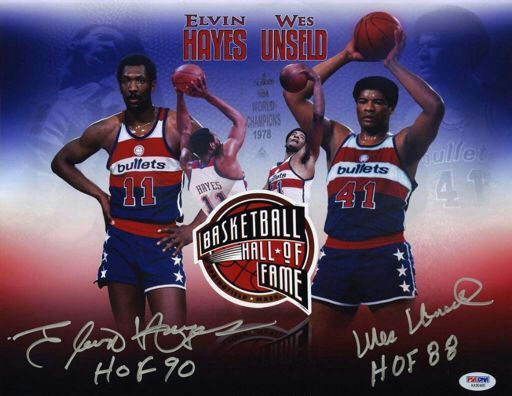
9. Wes Unseld, center, Washington Bullets, 1973-81. The big center spent his entire career with the Bullets, arriving in Baltimore in 1968 and making the move down the Baltimore-Washington Parkway in 1973. He was both Rookie of the Year and Most Valuable Player in the NBA in 1969, although both of those were in Baltimore. He was a 5-time All-Star, though only the last was in Washington.

He got the Bullets into the NBA Finals in 1971, 1975, 1978 and 1979, and finally led them to the title in 1978, winning the Finals MVP. The Bullets retired his Number 41 (before becoming the Wizards), and he was named to the Basketball Hall of Fame and the NBA's 50th Anniversary 50 Greatest Players.

8. Mike Gartner, right wing, Washington Capitals, 1979-89. He played another 9 seasons in the NHL, and never once appeared in the Stanley Cup Finals -- coming closest when the Rangers traded him in 1994, just before they could win it.

It's too bad, because he was fantastic, scoring 708 goals, and making 7 All-Star Games, 4 with the Caps. He was elected to the Hockey Hall of Fame, the Caps retired his Number 11, and he was named to the 100 Greatest Hockey Players by both The Hockey News in 1998 and the NHL on its 100th Anniversary in 2017.

7. John Riggins, running back, Washington Redskins, 1976-86. He wasn't pretty. He wasn't graceful. He wasn't tactful. He was just a great fullback. He helped the University of Kansas win the 1968 Big Eight Championship, then played 5 seasons for the Jets, and 4 for the Washington Redskins.

Then he held out for the entire 1980 season, and returned, saying, "I'm bored, I'm broke, and I'm back." Good thing he did, because, 2 years later, he was named Most Valuable Player of Super Bowl XVII, the Redskins' 1st NFL Championship in 40 years.

He only played in 1 Pro Bowl, in 1975, but in 1983, he set an NFL record with 24 rushing touchdowns, and won the Bert Bell Award as NFL MVP, helping the Redskins get into Super Bowl XVIII, although they lost. He rushed for 11,352 yards and 104 touchdowns. He was named to the Pro Football Hall of Fame, the Redskins Ring of Fame, and the NFL's 1980s All-Decade Team.

6. Sonny Jurgensen, quarterback, Washington Redskins, 1964-74. In 1964, the Philadelphia Eagles named Joe Kuharich as head coach. Kuharich was a massive prude, and the Eagle's All-Pro quarterback, Christian Adolph Jurgensen III, liked the nightlife. So Kuharich traded Sonny to the Washington Redskins for their starting quarterback of the time, Norm Snead.

This trade was so dumb! How dumb was it? Over the rest of the decade, the Eagles floundered, while the Redskins got better, eventually becoming the team (albeit quarterbacked by Billy Kilmer, with Sonny as an aging backup) that won the 1972 NFC Championship.

Sonny also threw more touchdown passes in the 1960s than any other quarterback. Guess which quarterback threw more interceptions in the 1960s than any other. Did I telegraph the punch enough? It was Norm Snead. And Joe Kuharich traded Sonny for Norm.

Sonny had the highest career "quarterback rating" of any player before the 1978 rule changes that opened up the passing game: 82.6. He led the NFL in passing yards 5 times and in touchdown passes twice -- at a time when the other contenders for the title of best quarterback in the NFL were Johnny Unitas, Y.A. Tittle and Bart Starr. Vince Lombardi, who coached Starr in Green Bay and the Redskins in the last season of his life, 1969, said, "If we would have had Sonny Jurgensen in Green Bay, we'd never have lost a game."

Sonny was named to the College and Pro Football Halls of Fame, the NFL's 1960s All-Decade Team, the Philadelphia Eagles Hall of Fame and the Washington Redskins Ring of Fame. He and Hall of Fame linebacker Sam Huff formed a beloved broadcasting team for the Redskins.

The Redskins don't officially retire numbers (Sammy Baugh's 33 is the lone exception), but Jurgensen's Number 9 has only been given out once since he retired after the 1974 season. That was in 2002, by new head coach Steve Spurrier, to one of his former University of Florida quarterbacks, Shane Matthews. He also gave Number 7, worn by Joe Theismann, to another of his Florida quarterbacks, Danny Wuerffel. Redskin fans were so angry that, before the regular season started, he switched Wuerffel to 17 (no outcry over getting Kilmer's number) and Matthews to 6. At 83, Sonny remains that beloved in the Potomac Valley.

5. Elvin Hayes, forward, Washington Bullets, 1972-81. The Big E reached the Bullets in their last season in Baltimore, and may still be the best player the franchise has ever had, making 12 NBA All-Star Teams (7 in Washington), and helping them reach the NBA Finals 3 times, winning the 1978 NBA Championship.

His Number 11 was retired by the Bullets (before becoming the Wizards). He was named to the Basketball Hall of Fame. and the NBA's 50th Anniversary 50 Greatest Players.

4. Darrell Green, cornerback, Washington Redskins, 1983-2002. Those dates alone should tell you something: He played 20 seasons in the NFL, and not as a placekicker or a punter. He played 295 games, the most of any defensive player in the League's 98-season history. He might be the best Washington football player of the last 70 years, and he might also be the fastest player in NFL history.

He arrived too late to be a member of their team that won Super Bowl XVII, but he got them into Super Bowl XVIII (lost), Super Bowl XXII (won), and Super Bowl XXVI (won). He made 7 Pro Bowls, his last at age 38.

He was the oldest man to play either of the defensive back positions, cornerback or safety, nearly 43. He was the oldest to have a gain of at least 35 yards, also nearly 43. He was the oldest with an interception, nearly 42. He was the oldest to return an interception for a game-winning touchdown in overtime, nearly 36; and the 2nd-oldest to return any interception for a touchdown, nearly 38.

He wasn't just a great player: He was a great guy, winning the Walter Payton NFL Man of the Year award in 1996. He was named to the College and Pro Football Halls of Fame, the NFL's 1990s All-Decade Team, and the Redskins' Ring of Fame.

In 1999, The Sporting News ranked him 81st on its list of the 100 Greatest Football Players. In 2010, the NFL Network ranked him 75th on their list of the 100 Greatest Players. In other words, 11 years later, when other defensive backs had cemented their legacy, Green had actually grown in the estimation of many people.

3. Alex Ovechkin, left wing, Washington Capitals, 2005-present. He's only 32 years old, but already has 604 career goals (making him the all-time leader among Russian- or Soviet-born players), a record 20 of them in overtime. He scored 65 goals, a record for his position, in 2007-08.

When the Maurice Richard Trophy was established for the leading goalscorer in 1998-99, he became the the 1st player to win that, the Art Ross Trophy for leading scorer (goals and assists), the Lester B. Pearson Award (most outstanding player according to a players' vote) and the Hart Memorial Trophy (Most Valuable Player as judged by the sportswriters) in the same season, 2007-08.

A 9-time All-Star, he's won the Calder Memorial Trophy (Rookie of the Year) in 2006, the Hart in 2008, '09 and '13; the Ross in 2008; the Richard in 2008, '09 and '13; and Pearson in 2008, '09 and '10; and the Kharlamov Trophy (named for Valery Kharlamov, the great Soviet winger of the 1970s, and given to the best Russian-born player) in 2006, '07, '08, '09, '10, '14 and '15.

Team success has eluded him, as the Caps haven't reached the Conference Finals since he arrived. And he's never competed for Russia in the Olympics. But in 2017, he was named one of the NHL's 100th Anniversary 100 Greatest Players. Unless he does something on the level of Pete Rose or O.J. Simpson, he is sure to be elected to the Hockey Hall of Fame, and for the Capitals to retire his Number 8.

2. Walter Johnson, pitcher, Washington Senators, 1907-27. As Lawrence Ritter and Donald Honig put it in their 1981 book The 100 Greatest Players In Baseball History, "He had only one pitch, a fastball -- but what a fastball!" He used it to build statistics that simply don't look real, and to build a reputation such that, in a 1916 game, Ray Chapman of the Cleveland Indians, doomed to become the only MLB player to die as a result of an on-field injury, walked away from an at-bat. The umpire told him he had 1 strike left, and he said, "Take it. I don't want it."

"The Big Train" debuted in 1907, and won 417 games, 2nd-most behind Cy Young, and the most in American League history. And he did this for the Washington Senators, who, even in his day, were known as "First in war, first in peace, and last in the American League." He had a 2.17 career ERA, a 147 ERA+ -- so his greatness wasn't just a result of the Dead Ball Era -- and a 1.061 WHIP.

He had 3,508 strikeouts. Not only did that stand as a record from 1921, when he surpassed the 2,803 of Cy Young, until 1983, when Nolan Ryan surpassed him, but, from July 22, 1923, when he surpassed the 3,000-strikeout barrier, until July 17, 1974, when Bob Gibson also did, he was the only member of the 3,000 Strikeouts Club. While his strikeout record has now been surpassed by 8 pitchers, his record of 110 shutouts has never been approached. (Grover Cleveland Alexander is next-best with 90.)

He led the AL in wins 6 times, ERA 5 times, and strikeouts 12 times. He led the League in all 3 -- the Pitching Triple Crown -- in 1913, 1918 and 1924. In 1913, he went 36-7, with a 1.14 ERA -- an ERA+ of 259, meaning he was 159 percent better at preventing earned runs than the average pitcher that season. He pitched a no-hitter in 1920. It took until 1924 for the Senators to win a Pennant, and, after losing 2 games in the Series, he came on in relief in Game 7 and was the winning pitcher. He won another Pennant with the Senators in 1925.

His last game was on September 30, 1927. It was the game in which Babe Ruth set a new record with his 60th home run of the season. Oddly, Johnson came on as a pinch-hitter. He was a decent hitter by pitchers' standards, batting .235 with 24 home runs and 255 RBIs in 21 seasons.

In 1936, he was 1 of the 1st 5 players elected to the Baseball Hall of Fame. Sadly, his wife Hazel died of heatstroke in 1930, and he died of a brain tumor in 1946, only 59 years old. A monument to him was erected outside the Senators' Griffith Stadium, and moved to Walter Johnson High School when it was established in 1956 in the suburb of Bethesda, Maryland, where Johnson lived. A statue of him stands outside Nationals Park in Washington.

In 1999, The Sporting News ranked him 4th on their list of the 100 Greatest Players, 1st among pitchers, and trailing only Babe Ruth, Willie Mays and Ty Cobb among all players. That same year, 82 years after he threw his last professional pitch, he was still familiar enough to fans for them to vote him onto the Major League Baseball All-Century Team.

1. Sammy Baugh, quarterback, safety, punter, Washington Redskins, 1937-52. Maybe Slingin' Sammy wasn't quite "the first quarterback," but he was the 1st truly great passer in football. He was drafted by the Redskins in 1937, their 1st year in D.C., and, that year, he did something that no other human being had done before, and none has since: He led a team to the NFL Championship as a rookie quarterback. Johnny Unitas didn't do it. Nor did Joe Montana. Nor did Tom Brady. Otto Graham did it in the AAFC, and in his 1st season in the NFL, but not as a rookie and an NFL quarterback.
A 6-time Pro Bowler, he and Sid Luckman of the Chicago Bears reinvented the quarterback position, just as Don Hutson of the Green Bay Packers was doing to the position of end, inventing the wide receiver. Baugh and Luckman played each other in 4 NFL Championship Games, with Baugh's Redskins winning in 1937 and 1942, and Luckman's Bears winning in 1940 and 1943.

In 1943, Baugh led the NFL in passer rating, punting yards, and interceptions -- made, not thrown. Think about that: In one year, he was Tom Brady (without cheating), Shane Lechler and Darius Slay at the same time.

He played until 1952, and remains one of the greatest quarterbacks ever, and still has the highest career punting yard average. In 1960 and 1961, he was the 1st head coach of the New York Jets (then the New York Titans.) In 1963, he was a charter inductee into the Pro Football Hall of Fame, and he turned out to be the last survivor of those, living until 2008.

TCU retired his Number 45, and his 33 is the only number officially retired by the Redskins. He was named to the Redskins Ring of Fame, the NFL 1940s All-Decade Team, and the NFL 75th Anniversary Team. In 1999, The Sporting News ranked him 11th on its list of the 100 Greatest Football Players. In 2008, ESPN named ranked him 5th on their list of the Top 25 College Football Players of All Time. In 2010, the NFL Network ranked him 14th on their list of the 100 Greatest Players.
Interviewed for the NFL's 75th Anniversary TV special in 1994, he said, "I love the way they play today. I wish I was playing now." The football world isn't sure if they agree: They might want to watch him, but they wouldn't want to play against him.

Monday, January 29, 2018

Top 10 Athletes From Kansas

January 29, 1861: Kansas is admitted to the Union as the 34th State.

Top 10 Athletes From Kansas

From here on out, "KCK" means "Kansas City, Kansas." Residents of the area use that for the Kansas version, and "KCMO" when they mean "Kansas City, Missouri."

Honorable Mention to Dean Smith of Emporia. As a player, he helped the University of Kansas win the 1952 National Championship, but went right into coaching. He coached the University of North Carolina for 36 years, winning the Atlantic Coast Conference 17 times in the regular season, 13 times in the ACC Tournament, and both 7 times. He reached 11 Final Fours, and won the National Championship in 1982 and 1993, the NIT in 1971, and the Olympic Gold Medal coaching the U.S. team in Montreal in 1976.

He won more games than any college basketball coach before him, 879, and after retiring with another Final Four berth in 1997, Sports Illustrated named him Sportsman of the Year. North Carolina's arena, the Dean E. Smith Student Activities Center (a.k.a. the Dean Dome), was named for him not just while he was still alive, but while he was still coaching. He is in the Basketball Hall of Fame.

Somewhat Honorable Mention to Adolph Rupp of Halstead. Like Dean, he learned his basketball from University of Kansas coach Forrest "Phog" Allen (who I made an Honorable Mention for his home State, Missouri). He played on Kansas' 1922 and 1923 National Championship teams, and was just getting warmed up: It was his 876 coaching wins that was the all-time record until Dean surpassed it.

At the University of Kentucky, "the Baron of the Bluegrass" won the Southeastern Conference Championship 28 times in the regular season, 13 times in the SEC Tournament, and all 13 times, he'd also won it in the regular season. He got the Wildcats to 6 Final Fours, and won 4 National Championships: 1948, 1949, 1951 and 1958.

"Somewhat Honorable" because, whether intentionally or not, he became a symbol of the white South's refusal to integrate, as his all-white team faced Texas-El Paso (then Texas Western) with an all-black stating five in the 1966 NCAA Final, and lost. But he did integrate before his mandated (by State law) retirement, and is rightly in the Basketball Hall of Fame.

Honorable Mention to Harold E. "Bud" Foster of Newton. He coached the University of Wisconsin to 3 titles in the league now known as the Big Ten, and won the 1941 National Championship. He is in the Basketball Hall of Fame.

Honorable Mention to Paul Endacott of Lawrence. The best player on that Kansas team that won the 1922 and 1923 National Championships, his Number 12 was retired, and he's in the Basketball Hall of Fame.

Honorable Mention to Ernest Schmidt of Nashville. He is in the Basketball Hall of Fame for starring for what's now named Pittsburg State University in Pittsburg (no H), Kansas in the 1930s, winning 47 straight games.

Honorable Mention to Dean Kelley and Allen Kelley of Dearing. Both guards, the brothers were members of the University of Kansas team that won the 1952 National Championship. Dean was a member of the U.S. team that won the Gold Medal at the 1952 Olympics in Helsinki, and Allen of the U.S. team that won the Gold Medal at the 1960 Olympics in Rome, and was collectively elected to the Basketball Hall of Fame.

Honorable Mention to Charles Wilbur "Bullet Joe" Rogan of KCK. Negro League records are woefully incomplete, but his pitching helped the Kansas City Monarchs win Negro League Pennants in 1923, 1924, 1925, 1929 and 1937 -- including as player-manager in 1929. He is in the Baseball Hall of Fame.

Honorable Mention to Steve Little of Overland Park. In 1977, playing for the University of Arkansas, he kicked a 67-yard field goal, tying the record set just 2 weeks earlier by Russell Erxleben of Texas.

Honorable Mention to Joe Williams of Wichita. In 1978, playing for Wichita State, he kicked a 67-yard field goal to tie the NCAA record. He never played in the NFL, but the other 2 who kicked a 67-yarder should have been so lucky: Both flopped in the NFL, Erxleben is now in prison for securities fraud for the 2nd time, and Little was paralyzed in a 1980 car crash and died in 1999.

Honorable Mention to Jim Bausch of Wichita. At the 1932 Olympics in Los Angeles, he won the Gold Medal in the decathlon, and received the James E. Sullivan Memorial Award as the nation's outstanding amateur athlete.

Honorable Mention to Glenn Cunningham of Elkhart. He won the 1933 Sullivan Award. In 1934, he set a world record in the mile run: 4 minutes, 6.8 seconds, helping to popularize the idea that it could be done in under 4 minutes. Although his record stood for 2 years, it would not be until 1954 that the 1st sub-4 mile would be achieved. His only Olympic Medal was Silver, in the 1,500 meters in Berlin in 1936.

Honorable Mention to Jackie Stiles of KCK. In the 2000-01 season, playing at the school now known as Missouri State University, she became the 1st women's college basketball player to score over 1,000 points in a season. She was thus awarded the Honda-Broderick Cup as the outstanding female collegiate athlete of the schoolyear.

She was a WNBA All-Star as a rookie with the 2001 Portland Fire, and is now back at Missouri State, as head coach.

Honorable Mention to Yankee World Series Winners from Kansas: Ralph Houk of Lawrence (backup catcher 1947, 1952 and 1953; coach 1958; manager 1961 and 1962), Mike Torrez of Topeka (1977) and Paul Lindblad of Chanute (1978, also won with the 1973 Oakland Athletics).

Now, the Top 10:

10. Joe Tinker of KCK. The shortstop is one of the most dubious elections to the Baseball Hall of Fame, elected with his double-play partners, 2nd baseman Johnny Evers and 1st baseman Frank Chance, in the only multiple entry in Cooperstown history.

However, he did succeed Honus Wagner as the best shortstop in baseball, helping win 5 Pennants for Chicago: The National League with the Cubs in 1906, 1907, 1908 and 1910; and the Federal League with the Whales in 1915.

9. Jim Ryun of Wichita. In 1966, he set the world record for the mile run: 3 minutes, 51.3 seconds. That year, he won the James E. Sullivan Memorial Award as the outstanding amateur athlete in America, and Sports Illustrated's Sportsman of the Year award. A year later, he lowered the record to 3:51.1, and continued to hold the record until 1975. He also held the world record for 1,500 meters from 1967 to 1974. However, his only Olympic Medal was a Silver in the 1,500 at Mexico City in 1968.

8. Jess Willard of St. Clere. He was 6-foot-6 1/2 and about 270 pounds. Certainly, a heavyweight. Had he fought Jack Johnson before April 5, 1915, he surely would not have beaten him to become Heavyweight Champion of the World. But, by that point, Johnson was 37, and tired of running from American law, and ready to give up, and "The Pottawatomie Giant" fulfilled the dream of American racists, becoming "The Great White Hope."

World War I meant that he had only 1 official title defense before Jack Dempsey destroyed him in Toledo on the 4th of July 1919. And he probably wouldn't have been able to handle any of the great heavyweights who followed Dempsey, either. Nevertheless, he was the Heavyweight Champ for 4 years, and was elected to the International Boxing Hall of Fame.

7. William Roy "Link" Lyman of McDonald. A 2-way tackle, standing 6-foot-2 and weighing 233 pounds, he was a huge University of Nebraska lineman long before that was cool. To put it another way: He was about the same size as Bronko Nagurski, but reached the NFL a few years earlier.

A 5-time All-Pro, he helped the Canton Bulldogs win 3 straight NFL Championships, in 1922, 1923 and 1924. He also played for the Chicago Bears, along with Nagurski and Red Grange, and won another Championship in 1933.

At the time of his retirement, his 286 games played was a record -- and he played nearly every minute of all of those games. He later served as an assistant coach at Nebraska, and was an early inductee into the Pro Football Hall of Fame.

6. Maurice Greene of KCK. At the 1999 World Championships of Track & Field, he set a new record for the 100 meters: 9.79 seconds, cleanly matching the drug-aided time of Ben Johnson at the 1988 Olympics. At the 2000 Olympics in Sydney, he won Gold Medals in the 100 meters (making him the unofficial "Fastest Man Alive" and anchoring the 4x100-meter relay. He won a Silver Medal in the relay and a Bronze Medal in the 100 at the 2004 Olympics in Athens. For 20 years now, he has held the world record in the 60-meter dash.

5. Lynette Woodard of Wichita. The all-time leading scorer in the history of women's college basketball, she was the 1st female basketball player at the University of Kansas to get her number retired, 31. She won the 1980-81 Honda-Broderick Cup.

She had no WNBA at that point in her career, and the U.S. boycotted the 1980 Olympics in Moscow. But she was a member of the team that won the 1984 Gold Medal in Los Angeles. Still with no U.S. league to play in, she played in Italy, until nepotism worked in her favor: A cousin of their former star Geese Ausbie, in 1986 she became the 1st woman to play for the Harlem Globetrotters.

She played for them until 1993, then began playing in Japan. When the WNBA was founded in 1997, despite being nearly 38 years old, she signed with the Cleveland Rockers, and played for the Detroit Shock in 1998. She is now a member of the Basketball Hall of Fame and the head coach of the women's basketball team at Winthrop University in the Charlotte suburb of Rock Hill, South Carolina.

4. Mike McCormack of KCK. An 8-time All-Pro, he won NFL Championships with the Cleveland Browns in 1954 and 1955. His coach, Paul Brown, said, "I consider McCormack the finest offensive tackle who ever played pro football." He was elected to the Pro Football Hall of Fame and the Browns Ring of Honor.

He went into coaching, and although he failed as a head coach in Philadelphia in Baltimore, he helped the Washington Redskins win the 1972 NFC Championship. He was named the 1st general manager of the Carolina Panthers, and in just 5 years of work -- 2 seasons on the field -- he got the expansion team into the NFC Championship Game. He lived long enough to see a statue of him dedicated outside the Panthers' Bank of America Stadium.

3. John Riggins of Centralia. He wasn't pretty. He wasn't graceful. He wasn't tactful. He was just a great fullback. He helped the University of Kansas win the 1968 Big Eight Championship, then played 5 seasons for the Jets, and 4 for the Washington Redskins.

Then he held out for the entire 1980 season, and returned, saying, "I'm bored, I'm broke, and I'm back." Good thing he did, because, 2 years later, he was named Most Valuable Player of Super Bowl XVII, the Redskins' 1st NFL Championship in 40 years.

He only played in 1 Pro Bowl, in 1975, but in 1983, he set an NFL record with 24 rushing touchdowns, and won the Bert Bell Award as NFL MVP, helping the Redskins get into Super Bowl XVIII, although they lost. He rushed for 11,352 yards and 104 touchdowns. He was named to the Pro Football Hall of Fame, the Redskins Ring of Fame, and the NFL's 1980s All-Decade Team.

But he's not the best running back from Kansas. This guy might've been the best running back from anywhere:

2. Barry Sanders of Wichita. Red Grange played his last game in 1934, Elroy "Crazylegs" Hirsch his in 1957, Frank Gifford in 1964, and Gale Sayers in 1971. I can watch film of these twisting, turning, seemingly impossible-to-catch running backs, and marvel at their feats, but I was not contemporary to their feats.

In contrast, I saw Barry Sanders' entire career as it unfolded, and I'm not sure he was human. What Bill Cosby -- back when we still liked and admired him -- said of Sayers, I say of Sanders: He seemed to be an amoeba, splitting in two when a tackler went after him, and coming back together to finish his run.

He was only 5-foot-8, but he won the 1988 Heisman Trophy at Oklahoma State University. In 2008, ESPN named ranked him 2nd only to Grange on their list of the Top 25 College Football Players of All Time. He played 10 seasons with the Detroit Lions, and made the Pro Bowl in all of them. He was NFL Offensive Rookie of the Year in 1989, and MVP in 1991 and 1997. He rushed for 15,269 yards and 99 touchdowns, and added 352 receptions for 2,921 yards and 10 touchdowns.

And then, in 1999, just 1,457 yards short of Walter Payton's all-time record, and about to turn 31 so he was in his prime and could've broken the record that year, he retired. Maybe it was the right decision: We've seen so many players suffer from arthritis due to the constant pounding their bodies took, and from dementia from blows to the head, including the aforementioned Sayers.

The Lions retired his Number 20 (a joint ceremony with Lem Barney and Barry's fellow Heisman Trophy winner, Billy Sims of arch-rival Oklahoma). He was named to the College and Pro Football Halls of Fame -- making him the shortest player in Canton -- and the NFL's 1990s All-Decade Team. In 1999, The Sporting News listed him 12th on their list of the 100 Greatest Football Players. In 2010, the NFL Network ranked him 17th on their list of the 100 Greatest Players.

1. Walter Johnson of Humboldt. Although he went to high school in Fullerton, Orange County, California, the family was 14 when it left Kansas, so, clearly, he learned to play baseball in that State on the Great Plains. And he's on the short list for the title of Greatest Pitcher Who Ever Lived.
This photo has been colorized. As far as I know,
no originally-color photo of the Big Train exists.

As Lawrence Ritter and Donald Honig put it in their 1981 book The 100 Greatest Players In Baseball History, "He had only one pitch, a fastball -- but what a fastball!" He used it to build statistics that simply don't look real, and to build a reputation such that, in a 1916 game, Ray Chapman of the Cleveland Indians, doomed to become the only MLB player to die as a result of an on-field injury, walked away from an at-bat. The umpire told him he had 1 strike left, and he said, "Take it. I don't want it."

"The Big Train" debuted in 1907, and won 417 games, 2nd-most behind Cy Young, and the most in American League history. And he did this for the Washington Senators, who, even in his day, were known as "First in war, first in peace, and last in the American League." He had a 2.17 career ERA, a 147 ERA+ -- so his greatness wasn't just a result of the Dead Ball Era -- and a 1.061 WHIP.

He had 3,508 strikeouts. Not only did that stand as a record from 1921, when he surpassed the 2,803 of Cy Young, until 1983, when Nolan Ryan surpassed him, but, from July 22, 1923, when he surpassed the 3,000-strikeout barrier, until July 17, 1974, when Bob Gibson also did, he was the only member of the 3,000 Strikeouts Club. While his strikeout record has now been surpassed by 8 pitchers, his record of 110 shutouts has never been approached. (Grover Cleveland Alexander is next-best with 90.)

He led the AL in wins 6 times, ERA 5 times, and strikeouts 12 times. He led the League in all 3 -- the Pitching Triple Crown -- in 1913, 1918 and 1924. In 1913, he went 36-7, with a 1.14 ERA -- an ERA+ of 259, meaning he was 159 percent better at preventing earned runs than the average pitcher that season. He pitched a no-hitter in 1920. It took until 1924 for the Senators to win a Pennant, and, after losing 2 games in the Series, he came on in relief in Game 7 and was the winning pitcher. He won another Pennant with the Senators in 1925.

His last game was on September 30, 1927. It was the game in which Babe Ruth set a new record with his 60th home run of the season. Oddly, Johnson came on as a pinch-hitter. He was a decent hitter by pitchers' standards, batting .235 with 24 home runs and 255 RBIs in 21 seasons.

In 1936, he was 1 of the 1st 5 players elected to the Baseball Hall of Fame. Sadly, his wife Hazel died of heatstroke in 1930, and he died of a brain tumor in 1946, only 59 years old. A monument to him was erected outside the Senators' Griffith Stadium, and moved to Walter Johnson High School when it was established in 1956 in the suburb of Bethesda, Maryland, where Johnson lived. A statue of him stands outside Nationals Park in Washington.

In 1999, The Sporting News ranked him 4th on their list of the 100 Greatest Players, 1st among pitchers, and trailing only Babe Ruth, Willie Mays and Ty Cobb among all players. That same year, 82 years after he threw his last professional pitch, he was still familiar enough to fans for them to vote him onto the Major League Baseball All-Century Team.

Washington Post baseball columnist Thomas Boswell said it best: "We live in a disposable society. But we don't dispose of Babe Ruth. We don't dispose of Walter Johnson. We view these men as friends, and as contemporaries though they are dead."

Tuesday, February 14, 2012

Top 10 Greatest New York Jets

Continuing the series I began, on the Top 10 players of each of the Tri-State Area's major league teams. On to the J, E, T, S, Jets, Jets, Jets!

Honorable Mention to members of the Jets' Ring of Honor at MetLife Stadium who are not otherwise in this Top 10: Winston Hill, Gerry Philbin, Mark Gastineau, Al Toon, and coach Weeb Ewbank. Also to Wayne Chrebet and Dennis Byrd, who are not yet in the Ring of Honor, but have had their numbers removed from circulation, though not officially retired. (UPDATE: In 2012, the Jets officially retired Byrd's Number 90.)

Also to Jim Turner, Art Powell and Bob Talamini, who, like Hill, Philbin, Ewbank, and the men at Numbers 8, 3 and 1 on this list, were named to the American Football League's All-Time Team.

Also to the members of the Jets' "All-Time Four Decade Team" named in 2003, who are neither in this Top 10, nor in the Ring of Honor, nor on the AFL All-Time Team: Matt Snell, Randy Rasmussen, Bill Baird, Bruce Harper, Pat Leahy, Chuck Ramsey, Jim Sweeney,  Mickey Shuler, Greg Buttle, Kyle Clifton, Marvin Powell, Kevin Mawae, Jason Fabini, Mo Lewis, James Hasty, Aaron Glenn, John Abraham and Victor Green.

Also to Richard Todd and Ken O’Brien, and to active Jets Mark Sanchez and Darrell Revis. And to coach Bill Parcells: "You are what your record says you are." And to coach Herman Edwards: "You play to win the game!" And to Ed Anzalone, a.k.a. Fireman Ed, the best-known Jets fan.

And to Sonny Werblin, for building the Super Bowl III Champions; to Leon Hess, part of the Jets' ownership from 1963 until 1984 and sole owner from then until his death in 1999; and to Robert Wood Johnson IV, a.k.a. Woody Johnson: Although he's a major Republican donor, I have to credit him for, along with Giants owners John Mara and Steve Tisch, getting MetLife Stadium built; it is a huge improvement over Giants Stadium, and not just from the Jets' perspective.

I am not, however, awarding an Honorable Mention to coach Rex Ryan -- not unless he finally keeps his promise. (As former Yankee star Jim Bouton would say, "Yeah, surrrre!")

10. John Riggins, Number 44, running back, 1971-75. It's easy to forget, for all his runs behind those Washington Redskin "Hogs," but Riggo played 5 years for the Jets, and until Curtis Martin just got in, he was the only member of the Pro Football Hall of Fame who played at least 3 seasons with the Jets with none of those seasons being the 1968-69 Super Bowl season.

9. Vinny Testaverde, Number 16, quarterback, 1998-2003 & 2005. No, he wasn't Namath's backup in Super Bowl III – he wasn't quite that old. (Babe Parilli, an All-American at Kentucky and an AFL start with the then-Boston Patriots, was Joe’s backup then.) But he did come within a half of doing what only Namath has done, quarterbacking the Jets into a Super Bowl. Like Y.A. Tittle with the early-Sixties Giants, he seemed to do more after age 34 than before it.

8. Larry Grantham, Number 60, linebacker, 1960-72. Along with Gerry Philbin, he led the Jet defense that should be remembered as the real heroes of Super Bowl III. Remember, the Baltimore Colts went 13-1 in the regular season, and went into Cleveland Municipal Stadium (at the time, NFL Championship Game sites were rotated between divisions, not based on record), against the Browns, the only team that had beaten them, and crushed them, 31-0. And the Jets held that offense to 7 points. Which is good, because, despite all the hype, Namath only led them to 1 touchdown (and 3 field goals).

Grantham was there at the beginning, playing as the New York Titans in front of under 5,000 people at the disintegrating old Polo Grounds, and was there at the Orange Bowl when glory was finally achieved.

7. Wesley Walker, Number 85, receiver, 1977-89. How soon we forget: Al Toon, Keyshawn Johnson, Wayne Chrebet, and now Santonio Holmes and Plaxico Burress have gotten bigger headlines, but Walker did more for the Jets than any of them.

He hauled in 15 Richard Todd passes in the Jets' 1982 Playoff wins against the Cincinnati Bengals at Riverfront and the Raiders at the Los Angeles Coliseum. He caught the winning pass from Ken O’Brien in the 51-45 win over the Miami Dolphins at the Meadowlands in 1986. He caught 438 passes for 8,306 yards and 71 touchdowns. He should be in the Hall of Fame.

6. Marty Lyons, Number 93, defensive tackle, 1979-89. An incredibly underrated player, he should be in the Pro Football Hall of Fame, and isn't even in the Jets' Ring of Honor yet. The anchor of the University of Alabama's National Championship defense in 1978, he became the centerpiece of the New York Sack Exchange. He's become the Jets' radio analyst, and runs a charitable foundation.

5. Joe Klecko, Number 73, defensive end, 1977-87. With Gastineau, Lyons and Abdul Salaam, he formed the New York Sack Exchange, which got a lot of headlines but did not achieve what the Giant defenses of 1956-63, 1986-90 and 2007-present did.

A knee injury probably kept him out of Canton, but he is the only defensive player to have his number retired by the Jets. Dwight Stephenson, the Hall of Fame center for the Miami Dolphins (whose career was ended by an alleged cheap shot by Lyons), has called Klecko one of the 2 best interior linemen he ever faced. Anthony Munoz, the Hall of Fame tackle of the Cincinnati Bengals, says he had "perfect technique," and puts him in a group with Mean Fred Dean, Lee Roy Selmon and Bruce "Bad Things" Smith as the best defensive ends he played against. Yet another Hall-of-Famer, Buffalo Bills guard Joe DeLamielleure, puts him on equal footing with Merlin Olsen and Mean Joe Greene – truly high praise.

Joe is the father of Dan Klecko, a defensive tackle won won 2 Super Bowls with the Patriots and another with the Colts.

4. Freeman McNeil, Number 24, running back, 1981-92. With Johnny Hector, he formed "The Two-Headed Monster," and rushed for over 8,000 yards, making him the Jets' all-time leader until Number 2 on this list came along.

3. Don Maynard, Number 13, receiver, 1960-72. For those of us who tend to think of Riggins as a Redskin, for a long time, Maynard was the only Jet besides You Know Who in the Hall of Fame. Somebody had to catch You Know Who's passes, to be Raymond Berry to his Johnny Unitas, Lynn Swan to his Terry Bradshaw, Jerry Rice to his Joe Montana.

Maynard was a rookie with the 1958 Giants, and played in that year's NFL Championship Game, often called "The Greatest Game Ever Played," but the Giants lost to the Baltimore Colts.  As far as I know, the only men to be involved in that game and Super Bowl III 10 years later, often cited as the 2 most important games in NFL history, are Maynard, Johnny Unitas, Colt center/linebacker Dick Szymanski, and Ewbank, who coached the winning team each time.

Lou Michaels played for the Colts in Super Bowl III, and his brother Walt was the Jets' coach when they reached the 1982 AFC Championship Game. Had they won that game to get into Super Bowl XVII, Walt would have gotten an Honorable Mention here.

2. Curtis Martin, Number 28, running back, 1998-2005. Yet another figure in the Jets-Patriots rivalry, Parcells brought him in when he moved from Foxboro to East Rutherford. He is the Jets' only 10,000-yard rusher, and slightly trails Tiki Barber of the Giants as New York football's all-time leading rusher (although he's ahead of Tiki if you count his Patriot years). He was just elected to the Hall of Fame, and deservedly so.

1. Joe Namath, Number 12, quarterback, 1965-76. You were expecting someone else? True, he only reached the Playoffs twice. Statistically speaking, Joe's credentials for the Hall of Fame are actually kind of skimpy.

But, like his contemporaries Muhammad Ali and Walt Frazier, there was a perfect mix of man and moment: The late Sixties, great sports achievement, a change in style, and the growth of mass media and advertising to properly complement them. Just as Johnny U was the perfect quarterback for the preceding era, Broadway Joe was the right man, in the right sport, in the right position, in the right place, in the right time.