Showing posts with label sammy baugh. Show all posts

Tuesday, December 16, 2025

December 16, 1945: The Cleveland Rams' Championship Farewell

Number 24 is Jim Gillette, who scored the winning touchdown.

December 16, 1945, 80 years ago: The NFL Championship Game is played. The winning team... moves to another city.

You know how, when the Cleveland Browns announced during the 1995 season that they were moving, their fans had such a fit, and talked about how loyal they were? Well, at the time, they were averaging 66,772 fans per home game, which, given the capacity of Cleveland Municipal Stadium, was an average of about 14,000 empty seats.

The Cleveland Rams would have gladly taken that. Founded in 1936, they had hoped to use Municipal Stadium for their home games, but ticket demand was usually so low, instead, they played at 22,000-seat League Park, or the even smaller Shaw Stadium, a high school facility.

In 1945, Adam Walsh was named head coach. He was the center on Notre Dame's 1924 National Championship team, leading the line known as the Seven Mules, so named because they blocked for the backfield known as the Four Horsemen. He saw to it that they drafted UCLA quarterback Bob Waterfield.
Bob Waterfield. Teammate Fred Gehrke,
a graphic artist, invented the modern helmet logo
by painting rams' horns on the helmets in 1948.

And they went 9-1, their best season yet. They played all their home games at League Park, and averaged just 19,402 fans. Granted, a lot of would-be fans were still overseas, as the end of World War II did not mean that every serviceman went home at once. Still, their away games did better: A crowd of 46,219 saw them beat the New York Giants at the Polo Grounds, 40,017 saw them beat the Detroit Lions at Briggs Stadium (later renamed Tiger Stadium), and 38,149 saw their only loss, to the Philadelphia Eagles at Shibe Park.

Since it was the Western Division Champion's turn to host the NFL Championship Game, Rams owner Dan Reeves -- no relation to the later coach of the same name -- booked Municipal Stadium for it, hoping for a big crowd. Certainly, he got the right opponent: The Eastern Division Champions were the Washington Redskins, with superstar quarterback Sammy Baugh, in their 5th Championship Game in the last 9 seasons. (They'd won in 1937 and 1942, and lost in 1940 and 1943.)

But the weather did not cooperate: At kickoff time, it was 8 degrees below zero, the coldest NFL Championship Game ever to that point. (That temperature has only been exceeded once, and that once with an asterisk: The 1967 NFL Championship Game, "The Ice Bowl," was not the World Championship Game.) As a result, in the football-mad State of Ohio, where Ohio State had played to 4 crowds of 69,000 or more that season, only 32,178 fans paid their way into the big stadium on the shore of Lake Erie.

From 1933 to 1973, the goalposts were on the goal line, not the end line. In the 1st quarter of this game, Baugh faded back from his own 5-yard line, into the end zone, and made a bad throw, which hit the goal post. Under the rule of the time, this was a safety for the Rams, who now led, 2-0. It would matter. 
Sammy Baugh

Each team scored a touchdown in the 2nd quarter. Baugh left the game due to bruised ribs, and Frank Filchock came into replace him. The backup to Slingin' Sammy was called Flingin' Frank, and he threw a 38-yard touchdown pass to Steve "Jack Rabbit" Bagarus. Waterfield threw a 37-yard touchdown pass to Jim Benton, and it was 9-7 Cleveland at the half.

In the 3rd quarter, Waterfield threw a 44-yard touchdown pass to Jim Gillette. However, Waterfield, also the Rams' placekicker, missed the extra point, and it was 15-7. Early in the 4th quarter, Filchock threw an 8-yard touchdown pass to Bob Seymour. Joe Aguirre kicked the extra point, and it was 15-14 in the Rams' favor.
Joe Aguirre

But Aguirre, nicknamed "Hot-Toe," blew 2 chances to win the title, missing 2 field goals in the 4th quarter. The 15-14 score held, and the difference wasn't just Aguirre's toe going cold, it was Baugh's end-zone goof.

Redskins owner George Preston Marshall, who had been the driving force behind several notable rule changes, led the NFL to change the rule for the 1946 season: A forward pass that strikes the goal post would now be ruled an incomplete pass. That rule held until the posts were moved back to the end line for the 1974 season, making such a play impossible: It would have required crossing the end line, which has always been a safety.

Reeves lost $64,000 owning the Rams in the 1945 season. And, with the war over, a new league was being formed, the All-America Football Conference. And they would have a Cleveland team, soon to be named the Browns. Reeves knew that it would be folly to stay in Cleveland.

So he went to the previously untapped market of Los Angeles, and moved the Rams there. Since football is only played once a week, teams taking trains to the West Coast and back was the same kind of problem it would have been for baseball teams before jet travel made it easier. Over a decade before baseball's Brooklyn Dodgers moved there, the Los Angeles Rams became the toast of the town, reaching 4 NFL Championship Games between 1949 and 1955, winning in 1951.

Ironically, Joe Aguirre also went west in 1946, kicking for the AAFC's Los Angeles Dons. They did well at the box office, but couldn't outdraw the Rams, and folded with the league. Aguirre went to the Canadian Football League, and was its leading scorer in 1950 and 1954. But he never won a title in any league.

The Redskins got old in a hurry. And Marshall's policy of refusing to sign black players held the team back in the 1950s. Marshall's eventually fatal illness and incapacity held the team back in the 1960s. It would be 27 years before the team reached another championship game, under any name.

Thursday, April 5, 2018

Washington's 10 Greatest Athletes

Today, the Mets started a series away to the Washington Nationals.

Washington's 10 Greatest Athletes

Honorable Mention to Washington Senators in the Baseball Hall of Fame, who didn't otherwise make the Top 10: Sam Rice, Bucky Harris, Goose Goslin, Joe Cronin, Heinie Manush, Rick Ferrell, Early Wynn and Harmon Killebrew. (The Killer only played his 1st 5 seasons in Washington. If the "Old Senators" hadn't moved, or he'd gone to the "New Senators" at some point, he'd be on this list. He will definitely be on it when I do it for Minnesota.)

Honorable Mention to Homestead Grays in the Baseball Hall of Fame: Cumberland Posey, Jud Wilson, Cool Papa Bell, Ray Brown, Buck Leonard and Josh Gibson. There is a consensus that, at the very least, Bell, Leonard and especially Gibson would have been superstars had baseball been integrated. But we'll never know, and Negro League stats are woefully incomplete.

Honorable Mention to the 3 big stars of the Washington Nationals' 4 (so far) National League Eastern Division Championships in this decade: Ryan Zimmerman, Stephen Strasburg and Bryce Harper. Would any of them be in the Top 10 if the Nats had won so much as a Pennant? I'm not sure. Would any be in it if they'd won the District's 1st World Series title since 1924? As Harper would say, "That's a clown question, bro."

Honorable Mention to Washington Redskins in the Pro Football Hall of Fame, who didn't otherwise make the Top 10: Turk Edwards, Wayne Millner, Bill Dudley, Bobby Mitchell, Sam Huff, Paul Krause, Chris Hanburger, Ken Houston, Russ Grimm and Bruce Smith.

Mitchell started in Cleveland and went to Washington, and if he'd spent his entire career in either city, would be a solid candidate for either's Top 10. Huff would be in the Top 10 if he'd spent his entire career in Washington. If he'd spent his entire career in New York, he might be in their Top 10.

Krause spent most of his career in Minnesota, and will be in the Twin Cities' Top 10. Houston spent half his career in the city whose name is his own, and will be in the Houston Top 10. Bruce, who spent most of his career in Buffalo, will definitely be in the Top 10 when I do this for Western New York.

Very Honorable Mentions to Charley Taylor and Art Monk: Each of these Redskins, at one point, was the NFL's all-time leader in receptions. When The Sporting News named their 100 Greatest Football Players in 1999, Houston was ranked 61st, Taylor 85th, Monk 91st. None of them was included in the NFL Network's 2010 list of the 100 Greatest Players.

Honorable Mention to Washington Bullets or Washington Wizards in the Basketball Hall of Fame, who didn't otherwise make the Top 10: Bernard King and Mitch Richmond.

Honorable Mention to Washington Mystics stars: Chamique Holdsclaw, Nikki McCray, Alana Beard and Crystal Langhorne.

Honorable Mention to Washington Capitals in the Hockey Hall of Fame, who didn't otherwise make the Top 10: Scott Stevens, Larry Murphy, Dino Ciccarelli and Adam Oates.

Honorable Mention to D.C. United players who were chosen for Major League Soccer's 10th Anniversary Best XI in 2005: Jeff Agoos, Eddie Pope, Marco Etcheverry and Jaime Moreno.

10. Rod Langway, defenseman, Washington Capitals, 1982-93. After starting his career with the Montreal Canadiens, and winning the Stanley Cup as a rookie in 1979, he never got close to the Cup again. But he became one of the top defensemen in the game in D.C. (Landover, actually), something he couldn't do with Larry Robinson running the show in Montreal.

He made 6 All-Star Games, 4 with the Caps. He won back-to-back Norris Trophies for best defenseman in 1983 and '84. He only scored 51 goals in his 14 NHL seasons, but had 278 assists. The Caps retired his Number 5, and was elected to the Hockey Hall of Fame.

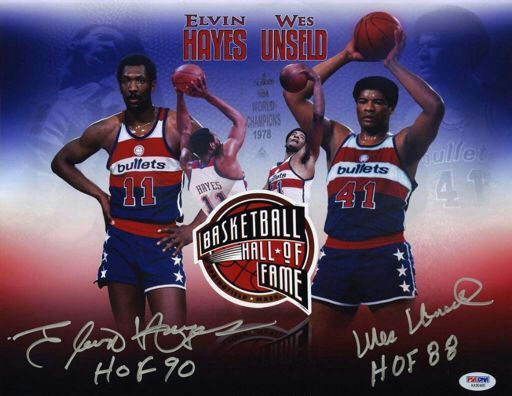
9. Wes Unseld, center, Washington Bullets, 1973-81. The big center spent his entire career with the Bullets, arriving in Baltimore in 1968 and making the move down the Baltimore-Washington Parkway in 1973. He was both Rookie of the Year and Most Valuable Player in the NBA in 1969, although both of those were in Baltimore. He was a 5-time All-Star, though only the last was in Washington.

He got the Bullets into the NBA Finals in 1971, 1975, 1978 and 1979, and finally led them to the title in 1978, winning the Finals MVP. The Bullets retired his Number 41 (before becoming the Wizards), and he was named to the Basketball Hall of Fame and the NBA's 50th Anniversary 50 Greatest Players.

8. Mike Gartner, right wing, Washington Capitals, 1979-89. He played another 9 seasons in the NHL, and never once appeared in the Stanley Cup Finals -- coming closest when the Rangers traded him in 1994, just before they could win it.

It's too bad, because he was fantastic, scoring 708 goals, and making 7 All-Star Games, 4 with the Caps. He was elected to the Hockey Hall of Fame, the Caps retired his Number 11, and he was named to the 100 Greatest Hockey Players by both The Hockey News in 1998 and the NHL on its 100th Anniversary in 2017.

7. John Riggins, running back, Washington Redskins, 1976-86. He wasn't pretty. He wasn't graceful. He wasn't tactful. He was just a great fullback. He helped the University of Kansas win the 1968 Big Eight Championship, then played 5 seasons for the Jets, and 4 for the Washington Redskins.

Then he held out for the entire 1980 season, and returned, saying, "I'm bored, I'm broke, and I'm back." Good thing he did, because, 2 years later, he was named Most Valuable Player of Super Bowl XVII, the Redskins' 1st NFL Championship in 40 years.

He only played in 1 Pro Bowl, in 1975, but in 1983, he set an NFL record with 24 rushing touchdowns, and won the Bert Bell Award as NFL MVP, helping the Redskins get into Super Bowl XVIII, although they lost. He rushed for 11,352 yards and 104 touchdowns. He was named to the Pro Football Hall of Fame, the Redskins Ring of Fame, and the NFL's 1980s All-Decade Team.

6. Sonny Jurgensen, quarterback, Washington Redskins, 1964-74. In 1964, the Philadelphia Eagles named Joe Kuharich as head coach. Kuharich was a massive prude, and the Eagle's All-Pro quarterback, Christian Adolph Jurgensen III, liked the nightlife. So Kuharich traded Sonny to the Washington Redskins for their starting quarterback of the time, Norm Snead.

This trade was so dumb! How dumb was it? Over the rest of the decade, the Eagles floundered, while the Redskins got better, eventually becoming the team (albeit quarterbacked by Billy Kilmer, with Sonny as an aging backup) that won the 1972 NFC Championship.

Sonny also threw more touchdown passes in the 1960s than any other quarterback. Guess which quarterback threw more interceptions in the 1960s than any other. Did I telegraph the punch enough? It was Norm Snead. And Joe Kuharich traded Sonny for Norm.

Sonny had the highest career "quarterback rating" of any player before the 1978 rule changes that opened up the passing game: 82.6. He led the NFL in passing yards 5 times and in touchdown passes twice -- at a time when the other contenders for the title of best quarterback in the NFL were Johnny Unitas, Y.A. Tittle and Bart Starr. Vince Lombardi, who coached Starr in Green Bay and the Redskins in the last season of his life, 1969, said, "If we would have had Sonny Jurgensen in Green Bay, we'd never have lost a game."

Sonny was named to the College and Pro Football Halls of Fame, the NFL's 1960s All-Decade Team, the Philadelphia Eagles Hall of Fame and the Washington Redskins Ring of Fame. He and Hall of Fame linebacker Sam Huff formed a beloved broadcasting team for the Redskins.

The Redskins don't officially retire numbers (Sammy Baugh's 33 is the lone exception), but Jurgensen's Number 9 has only been given out once since he retired after the 1974 season. That was in 2002, by new head coach Steve Spurrier, to one of his former University of Florida quarterbacks, Shane Matthews. He also gave Number 7, worn by Joe Theismann, to another of his Florida quarterbacks, Danny Wuerffel. Redskin fans were so angry that, before the regular season started, he switched Wuerffel to 17 (no outcry over getting Kilmer's number) and Matthews to 6. At 83, Sonny remains that beloved in the Potomac Valley.

5. Elvin Hayes, forward, Washington Bullets, 1972-81. The Big E reached the Bullets in their last season in Baltimore, and may still be the best player the franchise has ever had, making 12 NBA All-Star Teams (7 in Washington), and helping them reach the NBA Finals 3 times, winning the 1978 NBA Championship.

His Number 11 was retired by the Bullets (before becoming the Wizards). He was named to the Basketball Hall of Fame. and the NBA's 50th Anniversary 50 Greatest Players.

4. Darrell Green, cornerback, Washington Redskins, 1983-2002. Those dates alone should tell you something: He played 20 seasons in the NFL, and not as a placekicker or a punter. He played 295 games, the most of any defensive player in the League's 98-season history. He might be the best Washington football player of the last 70 years, and he might also be the fastest player in NFL history.

He arrived too late to be a member of their team that won Super Bowl XVII, but he got them into Super Bowl XVIII (lost), Super Bowl XXII (won), and Super Bowl XXVI (won). He made 7 Pro Bowls, his last at age 38.

He was the oldest man to play either of the defensive back positions, cornerback or safety, nearly 43. He was the oldest to have a gain of at least 35 yards, also nearly 43. He was the oldest with an interception, nearly 42. He was the oldest to return an interception for a game-winning touchdown in overtime, nearly 36; and the 2nd-oldest to return any interception for a touchdown, nearly 38.

He wasn't just a great player: He was a great guy, winning the Walter Payton NFL Man of the Year award in 1996. He was named to the College and Pro Football Halls of Fame, the NFL's 1990s All-Decade Team, and the Redskins' Ring of Fame.

In 1999, The Sporting News ranked him 81st on its list of the 100 Greatest Football Players. In 2010, the NFL Network ranked him 75th on their list of the 100 Greatest Players. In other words, 11 years later, when other defensive backs had cemented their legacy, Green had actually grown in the estimation of many people.

3. Alex Ovechkin, left wing, Washington Capitals, 2005-present. He's only 32 years old, but already has 604 career goals (making him the all-time leader among Russian- or Soviet-born players), a record 20 of them in overtime. He scored 65 goals, a record for his position, in 2007-08.

When the Maurice Richard Trophy was established for the leading goalscorer in 1998-99, he became the the 1st player to win that, the Art Ross Trophy for leading scorer (goals and assists), the Lester B. Pearson Award (most outstanding player according to a players' vote) and the Hart Memorial Trophy (Most Valuable Player as judged by the sportswriters) in the same season, 2007-08.

A 9-time All-Star, he's won the Calder Memorial Trophy (Rookie of the Year) in 2006, the Hart in 2008, '09 and '13; the Ross in 2008; the Richard in 2008, '09 and '13; and Pearson in 2008, '09 and '10; and the Kharlamov Trophy (named for Valery Kharlamov, the great Soviet winger of the 1970s, and given to the best Russian-born player) in 2006, '07, '08, '09, '10, '14 and '15.

Team success has eluded him, as the Caps haven't reached the Conference Finals since he arrived. And he's never competed for Russia in the Olympics. But in 2017, he was named one of the NHL's 100th Anniversary 100 Greatest Players. Unless he does something on the level of Pete Rose or O.J. Simpson, he is sure to be elected to the Hockey Hall of Fame, and for the Capitals to retire his Number 8.

2. Walter Johnson, pitcher, Washington Senators, 1907-27. As Lawrence Ritter and Donald Honig put it in their 1981 book The 100 Greatest Players In Baseball History, "He had only one pitch, a fastball -- but what a fastball!" He used it to build statistics that simply don't look real, and to build a reputation such that, in a 1916 game, Ray Chapman of the Cleveland Indians, doomed to become the only MLB player to die as a result of an on-field injury, walked away from an at-bat. The umpire told him he had 1 strike left, and he said, "Take it. I don't want it."

"The Big Train" debuted in 1907, and won 417 games, 2nd-most behind Cy Young, and the most in American League history. And he did this for the Washington Senators, who, even in his day, were known as "First in war, first in peace, and last in the American League." He had a 2.17 career ERA, a 147 ERA+ -- so his greatness wasn't just a result of the Dead Ball Era -- and a 1.061 WHIP.

He had 3,508 strikeouts. Not only did that stand as a record from 1921, when he surpassed the 2,803 of Cy Young, until 1983, when Nolan Ryan surpassed him, but, from July 22, 1923, when he surpassed the 3,000-strikeout barrier, until July 17, 1974, when Bob Gibson also did, he was the only member of the 3,000 Strikeouts Club. While his strikeout record has now been surpassed by 8 pitchers, his record of 110 shutouts has never been approached. (Grover Cleveland Alexander is next-best with 90.)

He led the AL in wins 6 times, ERA 5 times, and strikeouts 12 times. He led the League in all 3 -- the Pitching Triple Crown -- in 1913, 1918 and 1924. In 1913, he went 36-7, with a 1.14 ERA -- an ERA+ of 259, meaning he was 159 percent better at preventing earned runs than the average pitcher that season. He pitched a no-hitter in 1920. It took until 1924 for the Senators to win a Pennant, and, after losing 2 games in the Series, he came on in relief in Game 7 and was the winning pitcher. He won another Pennant with the Senators in 1925.

His last game was on September 30, 1927. It was the game in which Babe Ruth set a new record with his 60th home run of the season. Oddly, Johnson came on as a pinch-hitter. He was a decent hitter by pitchers' standards, batting .235 with 24 home runs and 255 RBIs in 21 seasons.

In 1936, he was 1 of the 1st 5 players elected to the Baseball Hall of Fame. Sadly, his wife Hazel died of heatstroke in 1930, and he died of a brain tumor in 1946, only 59 years old. A monument to him was erected outside the Senators' Griffith Stadium, and moved to Walter Johnson High School when it was established in 1956 in the suburb of Bethesda, Maryland, where Johnson lived. A statue of him stands outside Nationals Park in Washington.

In 1999, The Sporting News ranked him 4th on their list of the 100 Greatest Players, 1st among pitchers, and trailing only Babe Ruth, Willie Mays and Ty Cobb among all players. That same year, 82 years after he threw his last professional pitch, he was still familiar enough to fans for them to vote him onto the Major League Baseball All-Century Team.

1. Sammy Baugh, quarterback, safety, punter, Washington Redskins, 1937-52. Maybe Slingin' Sammy wasn't quite "the first quarterback," but he was the 1st truly great passer in football. He was drafted by the Redskins in 1937, their 1st year in D.C., and, that year, he did something that no other human being had done before, and none has since: He led a team to the NFL Championship as a rookie quarterback. Johnny Unitas didn't do it. Nor did Joe Montana. Nor did Tom Brady. Otto Graham did it in the AAFC, and in his 1st season in the NFL, but not as a rookie and an NFL quarterback.
A 6-time Pro Bowler, he and Sid Luckman of the Chicago Bears reinvented the quarterback position, just as Don Hutson of the Green Bay Packers was doing to the position of end, inventing the wide receiver. Baugh and Luckman played each other in 4 NFL Championship Games, with Baugh's Redskins winning in 1937 and 1942, and Luckman's Bears winning in 1940 and 1943.

In 1943, Baugh led the NFL in passer rating, punting yards, and interceptions -- made, not thrown. Think about that: In one year, he was Tom Brady (without cheating), Shane Lechler and Darius Slay at the same time.

He played until 1952, and remains one of the greatest quarterbacks ever, and still has the highest career punting yard average. In 1960 and 1961, he was the 1st head coach of the New York Jets (then the New York Titans.) In 1963, he was a charter inductee into the Pro Football Hall of Fame, and he turned out to be the last survivor of those, living until 2008.

TCU retired his Number 45, and his 33 is the only number officially retired by the Redskins. He was named to the Redskins Ring of Fame, the NFL 1940s All-Decade Team, and the NFL 75th Anniversary Team. In 1999, The Sporting News ranked him 11th on its list of the 100 Greatest Football Players. In 2008, ESPN named ranked him 5th on their list of the Top 25 College Football Players of All Time. In 2010, the NFL Network ranked him 14th on their list of the 100 Greatest Players.
Interviewed for the NFL's 75th Anniversary TV special in 1994, he said, "I love the way they play today. I wish I was playing now." The football world isn't sure if they agree: They might want to watch him, but they wouldn't want to play against him.

Friday, December 29, 2017

Top 10 Athletes From Texas

December 29, 1845: Texas is admitted to the Union as the 28th State.

Top 10 Athletes From Texas

This was a tough one, due not to the immense size of Texas' land area, but to the large population base. Had I decided to only rank the State's Top 10 Football Players, it would have been tough to narrow it down.

Byron Nelson, Ben Hogan, Kathy Whitworth, Lee Trevino, Ben Crenshaw and Jordan Spieth are all golf legends, but they don't count for this list, because golfers are not athletes. Trevino was, however, named Sportsman of the Year by Sports Illustrated in 1971. Nor is auto racing a sport, which eliminates Texans A.J. Foyt and Johnny Rutherford.

Assault, the horse that won the Triple Crown in 1946, was born at King Ranch outside Corpus Christi. Wild Again, the horse that won the 1st Breeders' Cup Classic in 1984, was born at Black Chip Stables in Clarendon, in the Panhandle.

Honorable Mention to Yankees from Texas who contributed to World Series wins: Cliff Johnson of San Antonio (1977 and 1978), Randy Choate of San Antonio (2000), and, especially, Andy Pettitte of the Houston suburb of Deer Park (1996, 1998, 1999, 2000 and 2009).

Now, we come to an elephant in the room: Steroids and other performance-enhancing drugs. Chuck Knoblauch of Houston (1998, 1999 and 2000)? Accused in the Mitchell Report, which, as we now know, has no credibility. Accused by Brian McNamee, ditto. Mike Stanton of Midland (1998, 1999 and 2000)? Also named in the Mitchell Report, and accused by Kirk Radomski. Innocent until proven guilty.

And Roger Clemens of Houston (1999 and 2000)? Aside from Barry Bonds, no player has been more harshly accused. But he is the one player who, thus far, has legally beaten the rap. That doesn't mean we have to like him. It does mean that we have to stop assuming that he's guilty. As was said in another courtroom, You should never assume, because, when you ASSUME, you make an ASS of U and ME.

Honorable Mention Baseball Hall-of-Famers who didn't make the Top 10: Ross Youngs of San Antonio, and Negro Leaguers Andrew "Rube" Foster of Calvert, Smokey Joe Williams of Seguin, and Willie Wells of Austin.

Honorable Mention to Nolan Ryan of the Houston suburb of Alvin. It's a little ironic that he won his only World Series, indeed his only Pennant, with the 1969 Mets, before he became a star. But he might not have become a star if the Mets hadn't made that dumb trade with the California Angels after the 1971 season.

"The Ryan Express," owner of one of the fastest pitches ever, set records for strikeouts in a game (19), a season (383 in 1973), and in a career (5,714). Most K's in a game has been broken, but, unless the way pitchers are handled changes, his records for a season and a career will probably never be broken).

He pitched 7 no-hitters, shattering the old record of 4. He reached the postseason with the Angels in 1979. In 1980, with his hometown Astros, he became the 1st player paid $1 million a season (about $3.2 million in today's money). He helped them reach the postseason in 1980 and 1986. He made 8 All-Star Games, his last at age 42.

But he never won a Cy Young Award. His career record of 324-292 gives him one of the lowest winning percentages of any Hall of Fame pitcher. He was the all-time leader in batters walked 6 years before he was the all-time leader in batters struck out. He is often called the most overrated player of all time.

He did have some bad luck. In 1987, he led the National League in strikeouts and earned run average, but went 8-16 because the Astros stopped hitting. That season included the only time I ever saw him pitch, and it was typical of that season: He was 40 years old, and still pitching superbly, but lost 2-1 to the Philadelphia Phillies at Veterans Stadium. He was still a solid pitcher at 44, for the Texas Rangers, and kept pitching until he was 46, a record-tying 27 major league seasons.

He is a member of the 300 Win and 3,000 Strikeout Clubs, and in 1999 became a member of the Baseball Hall of Fame (his 1st year of eligibility), The Sporting News' 100 Greatest Baseball Players, and the Major League Baseball All-Century Team. He is the only player to have his number retired 3 by teams: 30 by the Angels, 34 by the Astros and Rangers. He has a statue outside Globe Life Park in Arlington, and a nearby highway is named the Nolan Ryan Freeway.

Honorable Mention to a whole slew of football players who didn't make the Top 10. The Heisman Trophy winners alone are astounding: Davey O'Brien of Dallas, 1938; Earl Campbell of Tyler, 1977; Billy Sims of Hooks, 1978; Tim Brown of Dallas, 1987, he and O'Brien make Dallas' Woodrow Wilson High School the only high school in the country with 2 winners; Andre Ware of the Houston suburb of Dickinson, 1989; Ty Detmer of San Marcos, 1990; Robert Griffin III of Copperas Cove, 2011; and Baker Mayfield of the Austin suburb of Lake Travis, 2017, the current holder.

Also, the following have made the Pro Football Hall of Fame. On offense: Campbell, Brown, Bobby Layne of Dallas and Yale Lary of Fort Worth (each winning 3 NFL Championships with the Detroit Lions), Y.A. Tittle of Marshall, Raymond Berry of Paris (2 NFL Championships with the Baltimore Colts), Forrest Gregg of the Dallas suburb of Sulphur Springs (5 NFL Championships with the Green Bay Packers), Charley Taylor of the Dallas suburb of Grand Prairie (once the all-time leader in receptions), Gene Upshaw of Robstown (3 Super Bowl wins with the Oakland/Los Angeles Raiders), Eric Dickerson of Sealy (still the single-season rushing yardage record holder),

On defense: Mean Joe Greene of Temple (4 Super Bowl wins with the Pittsburgh Steelers), and Mike Singletary of Houston (Captain of the Chicago Bears' Super Bowl XX winners).

Also: Harvey Martin of Dallas (MVP of Super Bowl XII), Vince Young of Houston (led the University of Texas to the 2005 National Championship), Drew Brees of Austin (MVP of Super Bowl XLIV and 2010 Sports Illustrated Sportsperson of the Year), Adrian Peterson of Palestine (over 12,000 rushing yards), Von Miller of the Dallas suburb of DeSoto (MVP of Super Bowl 50), and Dez Bryant of Lufkin (528 receptions, and he just turned 29).

In 2008, ESPN named ranked Vince Young 10th and Earl Campbell 12th on their list of the Top 25 College Football Players of All Time.

UPDATE: Nick Foles is a graduate of Westlake High School in Austin, as is Brees. Before Super Bowl LII, Brees, still the starting quarterback for the New Orleans Saints, called him to give him a pep talk. Foles, who wasn't even the starting quarterback for the Philadelphia Eagles when the season began, led the Eagles to victory, and was named the game's MVP.

Dishonorable Mention to Russell Erxleben of Seguin. In 1977, playing for the University of Texas, he set an NCAA record that has since been tied, but never broken: He kicked a 67-yard field goal. He went into the securities business, and is now in prison for fraud -- for the 2nd time.

Honorable Mention to members of the Basketball Hall of Fame who didn't make the Top 10: Slater Martin of the Houston suburb of Elmina, Jay Arnette of Austin, Zelmo Beaty of Woodville, Clyde "the Glide" Drexler of Houston, Dennis Rodman of Dallas, and Sheryl Swoopes of the Lubbock suburb of Brownfield.

Arnette, who played a few years with the Cincinnati Royals, was elected to the Hall, collectively, with his teammates on the U.S. team that won the Gold Medal at the 1960 Olympics in Rome. Drexler was a member of the "Dream Team" at the 1992 Olympics in Barcelona, and was named to the NBA's 50th Anniversary 50 Greatest Players.

Honorable Mention to Carla Overbeck of the Dallas suburb of Richardson. She was a member of the U.S. team that won the 1999 Women's World Cup, collectively named Sportswomen of the Year by Sports Illustrated. She had previously won the 1st Women's World Cup in 1991, and the Gold Medal at the 1996 Olympics in Atlanta. She is a member of the National Soccer Hall of Fame.

Honorable Mention to Bobby Morrow of San Benito. The sprinter won 3 Gold Medals at the 1956 Olympics in Melbourne, and Sports Illustrated named him Sportsman of the Year. In 1957, he was given the James E. Sullivan Memorial Award as the outstanding American amateur athlete of the year.

Honorable Mention to Randy Matson of Pampa. In 1964, he won the Silver Medal in the shot put at the Olympics in Tokyo. In 1967, he won the Sullivan Award. In 1968, in Mexico City, he won the Gold Medal.

Honorable Mention to Michael Johnson of Dallas. He won a Gold Medal as a member of a U.S. relay team at the 1992 Olympics in Barcelona. In 1996, he won Gold Medals in the 200 and 400 meters in Atlanta, and received the Sullivan Award. He won the 400 again in 2000 in Sydney, giving him 4 Olympic Gold Medals.

Honorable Mention to Chip Rives of Dallas. While a football player at Wake Forest University, he was named 1 of 8 "Athletes Who Care" by Sports Illustrated, who received the Sportspeople of the Year award, for leading a toy drive. He became a film producer, and specializes in sports documentaries.

Honorable Mention to Paulie Ayala of Fort Worth. He was recognized as Bantamweight Champion of the World by the WBA from 1999 to 2002, and named Fighter of the Year by The Ring magazine in 1999.

Honorable Mention to winners of the Honda-Broderick Cup as the leading female collegiate athlete of the schoolyear, all basketball players: Kamie Ethridge of Lubbock and the University of Texas, 1985-86; Teresa Weatherspoon of Pineland and Louisiana Tech, 1987-88; and Brittney Griner of Houston and Baylor University, 2011-12.

Dishonorable Mention to Lance Armstrong of the Dallas suburb of Plano. All those Tours de France, and the 2002 Sports Illustrated Sportsperson of the Year. But it doesn't matter how inspirational you were if you're exposed as a cheat.

Dishonorable Mention to Mike Timlin of Midland and Keith Foulke of the Houston suburb of Huffman. Members of the 2004 Boston Red Sox, the team collectively awarded Sportspeople of the Year by Sports Illustrated. And Foulke was named World Series Most Valuable Player. But, as I said, cheaters don't get counted here. As far as I know, Timlin and Foulke were not, themselves, culpable. But they benefited from those who were.

Dishonorable Mention to Josh Beckett of the Houston suburb of Spring. Named World Series MVP with the 2003 Florida Marlins, he also won it with the Red Sox in 2007. But there's a reason he's called Super Punk, above and beyond the cheating of teammates on both ballclubs.

Dishonorable Mention to Johnny Manziel of the San Antonio suburb of Kerrville. He won the Heisman in 2012, but has been disgraceful ever since.

Now, the Top 10:

10. Dick Lane of Austin. In 1952, "Night Train" was a hit record by Jimmy Forrest, and Lane was a rookie cornerback with the Los Angeles Rams. It became his nickname, particularly sticking after a game against the Washington Redskins, when he clobbered Charlie Justice, whose nickname was also train-related: A newspaper headline read, "Night Train Derails Choo Choo."

He was known as a ferocious tackler, specializing in "the horse-collar tackle," later outlawed. A 2009 NFL Films documentary rated him the Number 2 tackler of all time, behind Dick Butkus. But it was his speed that really fit the nickname. That speed enabled him to set an incredible record: In that 12-game season, he intercepted 14 passes. Even in a 16-game schedule, that has never been matched.

A 7-time Pro Bowler, he also starred with the Chicago Cardinals and the Detroit Lions, but never appeared in a Playoff game. He was named to the Pro Football Hall of Fame, the NFL's 1950s All-Decade Team, and its 50th and 75th Anniversary All-Time Teams. In 1999, The Sporting News ranked him 20th, the highest-ranking defensive back, on its 100 Greatest Football Players.

9. Ernie Banks of Dallas. "Mr. Cub" is so identified with Chicago that it's easy to forget that it's not where he's from. Indeed, he's from Big D, not the City of the Big Shoulders. It's just as well that he played baseball: Nobody ever played football and said, "Let's play two!"

A 14-time All-Star, he won back-to-back National League Most Valuable Player awards in 1958 and 1959, despite the Cubs not being anywhere near the Pennant race. He won a Gold Glove in 1960, and finished his career with 2,583 hits, including 512 home runs, an astonishing number for a player who spent the 1st half of his career as a shortstop, before moving to 1st base.

The Cubs retired his Number 14, and erected a statue of him outside Wrigley Field. He was named to the Baseball Hall of Fame, The Sporting News' 100 Greatest Baseball Players, and the Major League Baseball All-Century Team. in 2013, President Barack Obama awarded him the nation's highest civilian honor, the Presidential Medal of Freedom

In spite of the achievements of Red Grange, Walter Payton, Bobby Hull and even Michael Jordan, Ernie may still be, even after his death, the most popular athlete in Chicago's history.

8. George Foreman of Houston. There have been 2 George Foremans -- and, no, that's not a reference to his having named all 5 of his sons George. They're the same guy, but very different men.

The 1st George was a proud winner of the Gold Medal in Heavyweight boxing at the 1968 Olympics in Mexico City, then a ferocious beast who worked his way up the ranks until 1973, when he destroyed first Joe Frazier to take the Heavyweight Championship of the World, and then Ken Norton, the only 2 men who had yet beaten Muhammad Ali.

Big George was scary. In the leadup to his fight with Ali in Kinshasa, Zaire (now the Democratic Republic of the Congo) on October 30, 1974, Ali was talking to film and TV cameras, saying what he was going to do in order to win back the title, going on and on. George, by then 40-0 as a professional, was succinct: He looked into the camera, and said, "I'm gonna kill you." And then he smiled, as if to say he was kidding. But there were people who thought that he might actually end Ali's life in the ring.

Ali surprised everybody, dominating the fight -- it wasn't all "rope-a-dope" -- and knocking Foreman out in the 8th round. George didn't really recover: He regained his contender status, and won The Ring magazine's Fighter of the Year award in 1976, having already won it in 1973. But a loss to Jimmy Young in 1977 ended his fight career.

Or so everyone thought. George took stock of his life, found religion, and became an ordained minister. He said that Young had knocked the Devil out of him. He spent most of his boxing earnings on building a youth center in Houston. To keep it going, he returned to the ring, as an old (already 38), bald, fat guy who charmed the people he used to scare. Until he got into the ring, and then, he was all business.

In 1990, he went into Boardwalk Hall, next-door to Caesars Atlantic City, to face former heavyweight challenger Gerry Cooney. The promoters called it "The War at the Shore," but the comedians called it "Two Geezers at Caesars." Some war: George knocked Gerry out in 2 rounds. He was serious!

In 4 years, he went 23-0, and actually got another shot at the title, and went the full 12 rounds with Evander Holyfield at age 42. Most people, myself included, thought he'd proved his point, and that he should get out of the ring before he got hurt. He didn't think so, and kept going. On November 5, 1994, 20 years to the week after "The Rumble In the Jungle," wearing the same trunks he wore that night, he went into the ring at the MGM Grand Garden outside Las Vegas, against Michael Moorer, who held the WBA and IBF Heavyweight Titles. George knocked him out in the 10th round. At 45, he was the oldest Heavyweight Champion of the World ever.

He held it until 1997, losing to Shannon Briggs. His final record was 76-5. He had become beloved, knocking guys out, selling his George Foreman Grill, doing commercials for other products. In 2016, he, fellow sports legend Terry Bradshaw, and acting icons William Shatner and Henry Winkler toured Asia together for the NBC miniseries Better Late Than Never, earning him a new generation of fans. They've since filmed a 2nd season, in Europe, which will air in the coming weeks. As hard as it was to believe in 1974 -- or even 1987 -- now, everybody loves George Foreman.

7. Tris Speaker of the Dallas suburb of Hubbard. Like Edwin "Duke" Snider, Richie "Whitey" Ashburn and Edward "Whitey" Ford, his prematurely light hair got him a nickname, "The Grey Eagle." (Always written that way, never as "Gray.") In the 1910s and 1920s, he was right up there with Ty Cobb as the best all-around player in baseball.

He was an incredible hitter, with a .345 lifetime batting average, and 3,514 career hits, a total still surpassed only by Cobb, Pete Rose, Hank Aaron and Stan Musial. He holds the career record for doubles with 792. He was also the best-fielding outfielder of his time, and he still holds the career record for assists by an outfielder with 449.

He helped the Boston Red Sox win the World Series in 1912 and 1915, was traded to the Cleveland Indians, became their player-manager, and won the Series with them in 1920. He was elected to the Baseball Hall of Fame with its 2nd class in 1937, and ranked 27th on The Sporting News' 1999 list of the 100 Greatest Baseball Players.

Despite allegations that he was a member of the Ku Klux Klan, in 1947 Speaker came out of retirement, at the request of Indians owner Bill Veeck, to assist the American League's 1st black player, Larry Doby, in learning how to play center field, which he hadn't played before. Speaker assisted the other black players that Veeck brought in as well, and won another World Series ring as one of their coaches in 1948. Although he is in the Indians' team Hall of Fame (and the Red Sox' as well), the uniform number he wore as a coach, 43, is not retired.

6. Jack Johnson of Galveston. In 1908, he became the 1st black man to win the Heavyweight Championship of the World. This "conquest" of the white man, and his flamboyant lifestyle, made him the most hated man in America. Even many black people hated him, for making them look bad. He didn't care. Even when convicted on a bullshit charge in 1912, and forced to flee the country and fight elsewhere, he was still going to be Jack Johnson.

Until he finally got tired of it. Did he throw that fight to Jess Willard in Cuba in 1915? It was just as hot for Willard. Or maybe, at 37, everything just caught up with him. He still stands as one of the greatest heavyweights ever, a man Muhammad Ali admired tremendously.

5. Doak Walker of Dallas. You'd go by "Doak," too, if your name was Ewell Doak Walker Jr. Despite delaying his college career to serve in the U.S. Merchant Marine in World War II, he did for Texas running backs what Sammy Baugh did for Texas quarterbacks: Raised the role to the status of icon.

He helped Dallas' Southern Methodist University (SMU) win the 1947 and 1948 Southwest Conference Championships and the 1949 Cotton Bowl. He won the Heisman Trophy in 1948 and finished 2nd in the voting in 1949. He brought so many fans to SMU games that they had to move their home games to the Cotton Bowl stadium. It wasn't enough: The Bowl had to be double-decked, and it became known as "The House That Doak Built."

He was drafted by the Detroit Lions, where he was reunited with his Highland Park High School teammate and University of Texas rival, quarterback Bobby Layne. He won NFL Rookie of the Year in 1950, and NFL Championships in 1952 and 1953. He was named to 5 Pro Bowls.

Despite only playing 6 professional seasons, he was elected to the College and Pro Football Halls of Fame, and SMU and the Lions both retired his Number 37. The NCAA instituted the Doak Walker Award for the best running back of the year. In 2008, ESPN named ranked him 4th on their list of the Top 25 College Football Players of All Time.

4. Rogers Hornsby of Fort Worth. He was a racist, a compulsive gambler, and a rotten guy. He also might have been the greatest righthanded pure hitter who ever lived. His .358 lifetime batting average is a record for righthanders. He batted .402 over a 5-year stretch from 1922 to 1926, including .424 in 1924, the highest in Major League Baseball since 1894.

He won 7 National League batting titles, 2 home run titles, 4 RBI titles, and all 3, the Triple Crown, in 1922 and 1925. He was named NL Most Valuable Player in 1925 and 1929. He collected 2,930 hits, and had 301 home runs. That doesn't sound like much now, but when he played his last game in 1937, only Babe Ruth, Lou Gehrig and Jimmie Foxx had more. And in 1926, as both 2nd baseman and manager, he led the St. Louis Cardinals to the World Championship. He also won Pennants with the Chicago Cubs in 1929 and 1932.

But he went on to make 2 troubling discoveries: He was respected, but hated, and teams couldn't wait to get rid of him, his ego, and his private troubles; and he was a far better manager with himself as a player than without, frequently frustrated when his players weren't very good, let alone as good as he was.

He was named to the Baseball Hall of Fame and the Major League Baseball All-Century Team. When The Sporting News named its 100 Greatest Baseball Players in 1999, Hornsby came in 9th, the highest-ranked 2nd baseman. The Cardinals named him to their team Hall of Fame, and dedicated a statue to him outside Busch Stadium. While uniform numbers began to be used during his career, he never wore the same number long enough to be identified with it, so a Cardinal "STL" logo stands in for a retired number along with their other honorees.

3. Mildred "Babe" Didrikson Zaharias of Beaumont. Yes, I know, I said golfers were not athletes, but she was a star in actual sports before that. She was an expert softball pitcher, an All-State basketball player, and a good bowler, but starred in track & field. At the 1932 Olympics in Los Angeles, she won Gold Medals in the 80-meter hurdles and the javelin throw, and the Silver Medal in the high jump. Had there then been a women's decathlon, or its current women's sports equivalent, the heptathlon, she probably would have won that, too.

After competing in track and basketball professionally, she switched her attention to golf in 1935. At the time, there were 3 major championships for women: The Western Open, which she won in 1940, 1944, 1945 and 1950; the Titleholders Championship, which she won in 1947, 1950 and 1952; and the U.S. Women's Open, which she won in 1948, 1950 and 1954. So, no "Grand Slam" available, but a "Triple Crown" in 1950.

She won the 1954 U.S. Women's Open having already come back from colon cancer once. It came back. When she died in 1956, only 45 years old, she said, "I can't die now, I'm just learning how to play golf."

She was elected to the World Golf Hall of Fame, was a charter inductee into the LPGA Hall of Fame, and the Associated Press named her the greatest female athlete of the Half-Century in 1950, and then of the Century in 1999. Sports Illustrated named her the 2nd-greatest female athlete of the 20th Century, behind Jackie Joyner-Kersee.

She was married to George Zaharias, who quit his career as a professional wrestler to become her manager. In 1975, the movie Babe starred Susan Clark as Didrikson and former football star Alex Karras, himself a Greek-American former athlete, as Zaharias. Art imitated life: Clark and Karras got married.

But she competed at a time when the competition among female athletes was not extensive. That was not the case for this lady, who faced much sterner on-field tests:

2. Mia Hamm of Wichita Falls. She might be the greatest female soccer player of all time. She won the National Championship all 4 years she was at the University of North Carolina. She won the 1993-94 Honda-Broderick Cup. She helped the U.S. team win the 1st Women's World Cup in 1991. She helped them win it again in 1999, and with her teammates was named one of Sports Illustrated's Sportswomen of the Year.

She won Olympic Gold Medals with the U.S. team in 1996 in Atlanta and 2004 in Athens. Until 2013, she held the record for most goals scored in international soccer play, regardless of gender. She is now a member of the National Soccer Hall of Fame, and was the 1st woman elected to the World Football Hall of Fame. She is married to former baseball star Nomar Garciaparra, and they are part-owners of Major League Soccer expansion franchise Los Angeles FC.

But when you think "Sports in Texas," the 1st sport you think about is football, rather than futbol. And this man might have been the greatest all-around football player of all time:

1. Sammy Baugh of Temple. Maybe Slingin' Sammy wasn't quite "the first quarterback," but he was the 1st truly great passer in football. He played football, baseball and basketball at Texas Christian University (TCU) in Fort Worth. He nearly led their football team to the National Championship in 1935, and did lead them to win the 1936 Sugar Bowl and the 1st Cotton Bowl in 1937.

He was drafted by the Washington Redskins in 1937, and, that year, he did something that no other human being had done before, and none has since: He led a team to the NFL Championship as a rookie quarterback. Johnny Unitas didn't do it. Nor did Joe Montana. Nor did Tom Brady. Otto Graham did it in the AAFC, and in his 1st season in the NFL, but not as a rookie and an NFL quarterback.
A 6-time Pro Bowler, he and Sid Luckman of the Chicago Bears reinvented the quarterback position, just as Don Hutson of the Green Bay Packers was doing to the position of end, inventing the wide receiver. Baugh and Luckman played each other in 4 NFL Championship Games, with Baugh's Redskins winning in 1937 and 1942, and Luckman's Bears winning in 1940 and 1943.

In 1943, Baugh led the NFL in passer rating, punting yards, and interceptions -- made, not thrown. Think about that: In one year, he was Tom Brady (without cheating), Shane Lechler and Darius Slay at the same time.

He played until 1952, and remains one of the greatest quarterbacks ever, and still has the highest career punting yard average. In 1960 and 1961, he was the 1st head coach of the New York Jets (then the New York Titans.) In 1963, he was a charter inductee into the Pro Football Hall of Fame, and he turned out to be the last survivor of those, living until 2008.

TCU retired his Number 45, and his 33 is the only number officially retired by the Redskins. He was named to the Redskins Ring of Fame, the NFL 1940s All-Decade Team, and the NFL 75th Anniversary Team. In 1999, The Sporting News named him to its 100 Greatest Football Players. In 2008, ESPN named ranked him 5th on their list of the Top 25 College Football Players of All Time.
Interviewed for the NFL's 75th Anniversary TV special, he said, "I love the way they play today. I wish I was playing now." The football world isn't sure if they agree: They might want to watch him, but they wouldn't want to play against him.

Thursday, January 22, 2015

Top 10 Quarterbacks of All Time

The Super Bowl is coming up. What is the purpose of a quarterback? To lead his team to victory -- ultimately, in the Super Bowl.

That's how great quarterbacks are measured. Dan Marino: Great passer, but never won a Super Bowl. Earl Morrall, Doug Williams, Jeff Hostetler, Mark Rypien, Trent Dilfer, Brad Johnson? Not sensational quarterbacks, but all won a Super Bowl, and so all are ahead of Marino.

Period.

Top 10 Quarterbacks of All Time

You'll notice that Russell Wilson of the Super Bowl-bound Seattle Seahawks is not on this list. Check back in 10 years. Same for Ben Roethlisberger, Drew Brees, Aaron Rodgers and Joe Flacco.

You'll notice that Tom Brady of the Super Bowl-bound New England Patriots is not on this list. You know why.

And you'll notice that neither of the Manning brothers is on this list. Eli's not here because, although I once called him the greatest quarterback in New York history in a previous post on this blog, and still think so, I don't think he's ahead of any of these guys.

Peyton's not here because, for all his talent, and for all his records, he is the most disappointing quarterback of all time. Yes, he's won a title. So has Alex Rodriguez. Now, I'm not saying Peyton cheats -- although I think shilling for Papa John is a greater slap in the face of the people watching him than A-Rod using steroids -- but I am saying that I get the feeling that, if Brady and the Patriots hadn't cheated, Peyton still might have only the 1 ring.

10. Bob Griese. No, he wasn't a great passer. But think of it this way: 15 quarterbacks have led their team to back-to-back NFL Championships. One of those led his team to an undefeated season, from kickoff of Week 1 to the final gun of the title game. And that was Bob Griese of the 1972-73 Miami Dolphins.

True, you can have a lucky year. But he led his team to 2 straight titles, 3 straight Super Bowl appearances, and they dominated the AFC East in the 1970s. Someone directed that offense. That someone was Bob Griese.

If you don't like his son Brian, for whatever reason, don't hold it against Bob.

9. Roger Staubach. I hate the Dallas Cowboys, as does everyone with taste. But he was "Captain Comeback." I take him ahead of Troy Aikman because Aikman had better weapons. Aikman had Emmitt Smith his whole career, while Staubach only had a great running back, Tony Dorsett, towrd the end. Aikman had Michael Irvin and Jay Novacek to pass to his entire career, while Staubach's options were Drew Pearson and... Golden Richards?

8. Sid Luckman. The 1st quarterback to master the T formation in the NFL, he led the Chicago Bears to 4 titles in the 1940s -- and it might have been more if he didn't miss 2 seasons in World War II.

7. Sammy Baugh. Along with Luckman, the 1st modern quarterback. Also the only quarterback to lead his team to an NFL championship, under any name, as a rookie.

6. Otto Graham. The only quarterback to get his team into his league's championship game 10 straight seasons. That's all 4 that were played in the All-America Football Conference, leading the Cleveland Browns to win all 4: 1946, 1947, 1948 and 1949. Then 6 in the NFL, winning in 1950, 1954 and 1955, losing in 1951, 1952 and 1953.

5. Bart Starr. The only quarterback to win 5 NFL Championships, taking the Green Bay Packers all the way in 1961, 1962, 1965 1966 and 1967, including the 1st 2 Super Bowls, in which he was the MVP. Brett Favre may hold a lot of records, but he wasn't better than Starr. He might make the Top 20, but not the Top 10.

4. Terry Bradshaw. Maybe I'm a little biased, because, along with Staubach, he was the defining quarterback of my childhood. You could add Fran Tarkenton to that, but he went 0-3 in Super Bowls. You could also add Joe Namath, but after fulfilling his guarantee in Super Bowl III, he never won another Playoff game -- and only appeared in 1 more.

TB won 4 Super Bowls, and was the MVP in 2 of them. He told his teammates, "You might not win with me, but you can't win without me." Like Broadway Joe, Luziana Terry backed it up. In Super Bowl XIII, Cowboy linebacker Thomas "Hollywood" Henderson said the Cowboys would win 31-0 and that, "Terry Bradshaw is so dumb, he couldn't spell 'cat' if you spotted him on the C and the A." Well, he got the Cowboy score right: The Steelers won 35-31. Bradshaw said, "Ask Hollywood how dumb I am now." He proved that, while his brain might not work as well as yours and mine does outside of a football milieu, within it, he was pretty goldurn smart.

3. John Elway. Before Favre, he won more games than any quarterback. And while it took him 4 tries, he did eventually win a Super Bowl. And then another, going out as on top as any athlete ever has, winning the World Championship and the MVP in the title game that turned out to be his last game.

2. Johnny Unitas. He replaced Baugh (or maybe Graham) as the defining figure among quarterbacks, and he may still be. When I was a kid, the answer to, "Who is the greatest quarterback who ever lived?" was, inevitably, "Johnny U."

He made the Baltimore Colts "America's Team" before the Dallas Cowboys ever played a down, made the NFL must-see-TV, and made the quarterback the greatest glamour position in American sports. And he was always grounded about it: He knew he was great, but he never went out of his way to tell people he was.

I never saw Unitas play during his career -- he played his 1st NFL game in Dwight D. Eisenhower's 1st term as President and his last in Richard Nixon's 2nd term -- but I've seen plenty of film of him. There is no doubt in my mind that he would excel just as much in today's game, especially with the liberalization of rules concerning passing and receiving, and with the bigger linemen of today to protect him from the bigger and faster defenders of today. And, despite those iconic black high-top shoes, he could even run a little.

1. Joe Montana. This was a tough call. Maybe I picked Montana simply because, unlike Unitas, who was already in the Hall of Fame before I ever heard of him, I got to see Montana all the way through.
Despite winning 4 Super Bowls with the San Francisco 49ers, and being awarded the MVP in 3 of them, I think the difference between Johnny U and Joe Cool is just a hair. And I mean one of Johnny's little short crew-cut hairs, not one of Joe's long blond hairs.

Tuesday, February 18, 2014

Sports "Mount Rushmores"

Yesterday was the 3rd Monday in February, Presidents' Day.

Or, as it used to be known, "Washington's Birthday Observed."

When I was a kid, we got Abraham Lincoln's birthday, February 12 (1809), off from school, no matter what day of the week it was. If it fell on a Saturday or Sunday, we got the following Monday, the 13th or 14th, off. Then, we got the 3rd Monday off, even if it wasn't actually George Washington's birthday (February 22, 1732).

Jarrett Payton, a radio talk-show host and former NFL player, and son of the legendary Walter Payton, asked a question on the Facebook page dedicated to his father: "Who are your top 4 NFL players of all-time? Who would be on your Mt. Rushmore?"

This is a very good question, and, considering that the NFL is closing in on its Centennial (September 17, 2020), and considering the variance of the different positions that a football player can play, it requires a lot of serious thought.

Here's how I handle it: Not by determining who are the 4 greatest players in NFL history, but by looking at the roles of the 4 Presidents whose faces are on the original Mount Rushmore, near Rapid City, South Dakota, and determining which NFL figures match their, pardon the unintentional pun, profiles.

George Washington: First President. Father of Our Country. General who, as much as anyone else, liberated us. Statesman who, more than anyone else, united us. Set the precedents for all who follow.

There's only 1 person in NFL history who matches, and his name was also George, and he also had a "father" nickname: Papa Bear, George Halas. Co-founder of the NFL. Founder of the team that became the Chicago Bears. Quality player by the standards of his time. Coach who led them to 8 NFL Championships between 1921 and 1963. Owner of the team from 1920 to his death in 1983.

Even in 1977, when NFL Films released a documentary titled Their Deeds and Dogged Faith, footage was included of Halas at Bears' training camp in the northern suburb of Lake Forest, Illinois. The announcer, John Facenda, said that seeing George Halas running Bears' training camp is like going to Mount Vernon, and seeing George Washington still in residence.

But if we're only including players, then we need to decide which one was enough of a pioneer. So that disqualifies Halas. But it doesn't leave him out of the discussion.

You see, in 1925, the NFL was in trouble. Professional football was popular in mid-size cities like Rochester, New York; Canton, Ohio; Muncie, Indiana; Rock Island, Illinois (part of the "Quad Cities" area with Moline and the Iowa cities of Davenport and Bettendorf); and Duluth, Minnesota. The only one of these that survived the Great Depression was Green Bay, Wisconsin.

But teams in the bigger cities had failed: Boston, Washington, Cleveland, Detroit, Indianapolis, Milwaukee, Minneapolis. The only big cities whose teams were doing well as Calvin Coolidge started his one full term as President were Philadelphia and Chicago. (And even the Philadelphia team of the time, the Frankford Yellow Jackets, didn't survive the Depression. And one of the two Chicago teams, the Cardinals, would eventually have to move.)

Certainly, New York wasn't doing well: Already, a New York Giants and a New York Yankees had failed in the NFL. The 1925 season was the 1st one for the New York Giants team founded by Tim Mara, and attendance at the Polo Grounds was pathetic.

Enter Halas, who signed the greatest player in college football, and put him in a Bears uniform just 5 days after his last college game (that was legal at the time), on Thanksgiving Day against the Bears' arch-rivals, the Chicago Cardinals: Red Grange.

The Bears went east to face the Giants, and the Harlem Horseshoe was packed to the gills: It seated about 56,000, but it's said that 75,000 squeezed in to see the University of Illinois star known as "the Galloping Ghost." The gate receipts saved the NFL's New York franchise, and maybe the league as a whole. Twenty years later, when the days of early financial struggle, the Depression and World War II were over, the Giants were still standing, and still are today, winners of 8 NFL Championships including 4 Super Bowls.

And it's thanks to Papa Bear and the Galloping Ghost: They saved the game, and they united the game, just like Washington did for the country.

If there were an NFL Mount Rushmore, and you confined it to players, not coaches or executives, Red Grange would be on it.

Thomas Jefferson: Author of the Declaration of Independence, 3rd President, the man behind the Louisiana Purchase which began westward expansion (the last of these being the real reason that sculptor Gutzon Borghlum put him on the mountain).

In 1937, by leading the Washington Redskins to the Championship with the passing game -- and he is still 1 of only 2 rookies to quarterback a team to the NFL title -- Sammy Baugh, for all intents and purposes, invented the glamor position of the NFL, the quarterback. This gave pro football its true independence from the college game, thus making him the league's equivalent to Jefferson.

The other rookie to do it? Bob Waterfield, in 1945, with the Cleveland Rams.

Abraham Lincoln: The 16th President, the man who fought a Civil War to save the Union, the man who freed the slaves.

Admittedly, finding a man who had the equivalent impact in the NFL is a ludicrous maneuver. Lincoln is right up there with Washington when you're looking for the greatest man America has ever produced.

Sam Huff, linebacker for the Giants in the late 1950s and early 1960s, was the 1st man to make defense glamorous, thus giving all men who played the game an equal chance to get famous. This doesn't really make him equivalent to Abe Lincoln. On the other hand, if it wasn't for Sam, no one would have cared about Gino Marchetti, Big Daddy Lipscomb, Dick Butkus, Mean Joe Greene, Ronnie Lott, Lawrence Taylor, Ray Lewis or Richard Sherman. And Howie Long would not be sitting next to Terry Bradshaw on Fox NFL Sunday -- nor Deion Sanders next to Dan Marino on The NFL Today.

Theodore Roosevelt: The 26th President, who, in a lot of ways, moved both the office and the country into not just the 20th Century, but the modern world. Borghlum put him on the mountain because, although the only President (so far) born in New York City, TR (who didn't mind the initials but hated being called "Teddy") had spent a good deal of time in the West, and no President has done more to promote the image of the American West, due to his environmentalism and his championing, and expansion, of the National Park System.

Picking an NFL player analogue to him is a bit tougher. NFL stadiums aren't exactly National Parks, the NFL's foreign-based games aren't really Panama Canals, and football isn't exactly good for the environment.

I could say Vince Lombardi, because, like TR, he was a short, pugnacious New York native who refused to accept anything less than the best of himself, his line of work, and his country, and he helped move the game into the modern era.

But I'm looking for players, not coaches. Considering how he dragged the NFL into the modern era, in some ways against its will, it could be Joe Namath. Like TR, Broadway Joe is a New York icon. And, like TR, he was, and remains, more powerful as a symbol than he was as, as TR would say, "the man in the arena."

So, my Mount Rushmore of the NFL is Red Grange, Sammy Baugh, Sam Huff and Joe Namath.

*

The Yankees have been defined by 4 players: Babe Ruth, Lou Gehrig, Joe DiMaggio and Mickey Mantle. As great as they were, as iconic as they have been, even such legends as Yogi Berra, Whitey Ford, Thurman Munson, Reggie Jackson, Don Mattingly, Derek Jeter and Mariano Rivera can't match those 4. So that's the Yankees' "Mount Rushmore."

The Mets? Uh... Tom Seaver, Gary Carter, Mike Piazza and... uh... David Wright? That doesn't even stand up to a 1969-to-present Yankee Mount Rushmore of Reggie, Donnie, Derek and Mo. And that's when you figure in that Mattingly never won a Pennant, because, so far, neither has Wright (who did, to be fair, come a round closer in 2006 than Mattingly came in 1995, easily the closest that either man came).

But a Mount Rushmore for the entire game? Who the "inventor of baseball" is has been debated for over a century, and it still isn't exactly settled. But Harry Wright, player and manager for the 1st professional team, the 1869-70 Cincinnati Red Stockings, is the closest thing baseball has to a "George Washington."

It doesn't make sense to let a black man stand in for Thomas Jefferson, who owned slaves; yet Jackie Robinson was black players' declaration of independence from both the color line and the Negro Leagues -- which, as long as they existed, were an excuse for the color line: "They have their own leagues, let them play there."

The closest thing we have to an "Abe Lincoln" is Curt Flood, who sacrificed his career, if not his life, to set the players free.

Theodore Roosevelt? Now, the chronology gets messed up, but who else but Babe Ruth? Aside from Wright, Robinson and Flood, is there any other man about whom it can be said, "After he did what he did, the game was never the same, and for the better"?

So, my Mount Rushmore of Baseball is Harry Wright, Babe Ruth, Jackie Robinson and Curt Flood.

*

The NBA? The Boston Celtics could be said to have a Mount Rushmore: Bob Cousy, Bill Russell, John Havlicek and Larry Bird. No, Paul Pierce doesn't make it, any more than Franklin Roosevelt or Jack Kennedy or, God forbid, Ronald Reagan gets onto the original.

The Los Angeles Lakers could also have one, not including George Mikan of the Minneapolis Lakers: Jerry West, Wilt Chamberlain, Kareem Abdul-Jabbar and Magic Johnson. Shaquille O'Neal and Kobe Bryant have this in common: Neither one displaces one of those four.

For the whole league? Mikan is the George Washington, since he was the pro game's 1st superstar. Russell is the Thomas Jefferson, since, despite his dedication to Red Auerbach, he showed that players could have an independent streak. Michael Jordan is the Abe Lincoln, since he, more than any player before or since, embraced endorsement culture, and set players free from their mere multi-million-dollar contracts. And, again, the chronology gets out of whack, since there could be no one who more aptly fits TR's "speak softly and carry a big stick" mantra than Wilt Chamberlain.

*

The NHL? The Montreal Canadiens, despite being in Canada rather than America, have one: Howie Morenz, Maurice Richard, Jean Béliveau and Guy Lafleur. Patrick Roy doesn't make it. Nor, despite having the trophy for best goaltender of the year named in his memory, does Georges Vezina.

For the whole league? That's tough. The 1st NHL superstar was Phantom Joe Malone, the greatest player of the 1910s and early '20s, who won Stanley Cups with his hometown Quebec Bulldogs in 1912 and '13, had the best goals-per-game average ever when he scored 44 in the league's 20-game 1st season in 1917-18 (the same pace in today's 82 games would be 180 goals, nearly double Wayne Gretzky's record of 92), becoming the 1st and still only NHL player to score 7 goals in a game in 1920, and wrapping up his career by winning another Cup with the Canadiens in 1924, as a teammate of Morenz and Vezina. So he's the NHL's "George Washington."

Richard would be the Jefferson, since the Rocket was a revolutionary figure for both players at large and for French Canadians.

Hard to say who the Lincoln would be, although Gretzky's impact on the game was an "emancipation proclamation" for players (in that they could have some say in where they could go) and for the game itself (in that it emerged from a "civil war" between those who were holding it back and those who wanted to push it forward).

TR? Would it be Gordie Howe, thus messing up the chronology again? Would it have to be the greatest American player? If so, who is that? Jeremy Roenick? Brian Leetch? Mike Modano? Chris Chelios? No, let's make it Howe, who is still the greatest player ever, and who definitely spoke softly and carried a big stick. No hockey player ever more "crowded hours," to use another term TR loved.