Showing posts with label gold glove. Show all posts

Saturday, February 21, 2026

Bill Mazeroski, 1936-2026

Only one human being, living or dead, has ever hit a home run in the bottom of the 9th inning of a Game 7 to win a World Series. Now, he is no longer living.

And the odd thing is, he was a great fielder first, and a timely hitter second.

William Stanley Mazeroski was born on September 5, 1936 in Wheeling, West Virginia, and grew up on the other side of the Ohio River, in Tiltsonville, Ohio. He starred in baseball and basketball in high school.

In 1988, Sports Illustrated published an article on "The Valley Boys." The were all from the same area in southeastern Ohio: Mazeroski, knuckleballing baseball pitchers Phil and Joe Niekro, basketball star Alex Groza, his football-playing brother Lou Groza, and basketball star John Havlicek. Mazeroski turned out to be the last survivor of that group.

Also contemporaries from that place and time, but not mentioned in the article: Bill's Pirate teammate Gene Freese, football coach Lou Holtz, and football stars Bob Gain, Calvin Jones, Chuck Howley and Bob Jeter. Baseball relief pitcher Rollie Fingers, a bit younger, moved with his family to California before he reached high school.

Mazeroski turned down college scholarship offers from nearby schools Duquesne, Ohio State and West Virginia to play baseball. He signed with the Pittsburgh Pirates as a shortstop, but made a lot of errors. Branch Rickey, running the Pirates after building winners of multiple Pennants with the St. Louis Cardinals and then the Brooklyn Dodgers, saw how good he was at turning double plays, and had him moved to second base. It was a decision that changed the history of baseball.

He made his major league debut on July 7, 1956, at the Polo Grounds in New York. Batting 8th, playing 2nd base, and wearing the Number 9 he would wear throughout his career, he went 1-for-3, as the Pirates lost to the New York Giants, 3-2.

In 1958, despite playing his home games at Pittsburgh's Forbes Field, whose dimensions were similar to those of the pre-renovation original Yankee Stadium -- 300 feet to right field, but 457 to center, and 360 to left, not good for a righthanded hitter like Mazeroski or his teammate Roberto Clemente -- Mazeroski hit 19 home runs, which would remain his career high. He batted .275 with 68 RBIs. It was the 1st of 7 seasons that would see him reach the All-Star Game, and the 1st of 8 in which he would win the National League's Gold Glove at 2nd base.

After a dropoff in 1959, in 1960, he batted .273, with 11 home runs and 64 RBIs. He helped the Pirates win their 1st NL Pennant since 1927 -- 33 years. They hadn't won a World Series since 1925, and were facing the team that had beaten them in 1927, the New York Yankees, who were heavily favored.

The Yankees won Game 2, 16-3. They won Game 3, 10-0. They won Game 6, 12-0. But the Pirates won Game 1, 6-4. They won Game 4, 3-2. And they won Game 5, 5-2. The Series went to a Game 7. On that Thursday afternoon, 36,683 people jammed themselves into Forbes Field. Millions more listened to Pirates announcer Bob Prince and Yankees announcer Mel Allen call the game for television on NBC. Still more millions listened to NBC radio, with Baltimore Orioles announcer Chuck Thompson and Chicago Cubs announcer Jack Quinlan.
Forbes Field

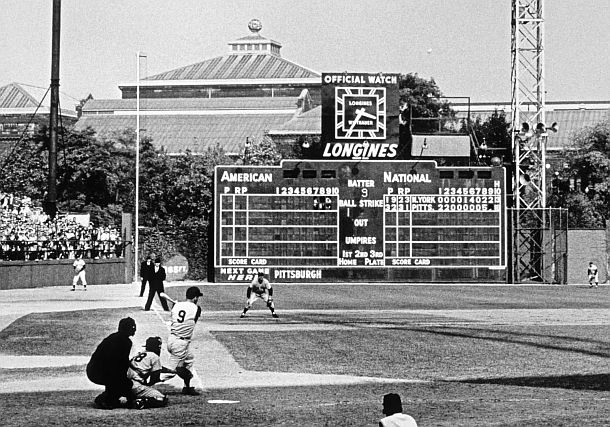
The game went back and forth, and was tied, 9-9, going to the bottom of the 9th inning. On NBC radio, Chuck Thompson, usually the voice of the Baltimore Orioles, said, "Well, a little while ago, when we said this one was going right down to the wire, little did we know." Mazeroski led off, against Yankee pitcher Ralph Terry. His 1st pitch was high, ball 1. Terry threw a 2nd pitch. The time was 3:36 PM. Thompson's call on radio:

Here's a swing, and a high fly ball, going deep to left, this may do it! Back to the wall goes Berra, it is over the fence, home run, the Pirates win!
In case you're curious, the building behind the scoreboard
is the Carnegie Library of Pittsburgh.

"I don't know it's out," Mazeroski recalled during a Pirates telecast in 2015, 55 years after the fact. "I don’t know it's a home run. But I know I;m going to end up on third if he misplays that ball off the wall. So I;m busting my tail getting around there, and by the time I hit second base, I looked down the line and the fans went crazy. From second base, I didn't touch the ground all the way in."

After pausing to let the cheering be heard, Thompson started again, and was so excited, he got the score wrong at first:

Ladies and gentlemen, Mazeroski has hit a one-nothing pitch over the left field fence at Forbes Field to win the 1960 World Series for the Pittsburgh Pirates by a score of ten to nothing! Once again, that final score, the Pittsburgh Pirates, the 1960 World Champions, defeat the New York Yankees. The Pirates ten, and the Yankees nine! And Forbes Field is an insane asylum!

Mel Allen, so often accused of being a "homer" for the Yankees, called it this way on TV for NBC:

There's a drive into deep left field, look out now! That ball is going, going, gone! And the World Series is over! Mazeroski hits it over the left field fence, and the Pirates win it, 10–9, and win the World Series!

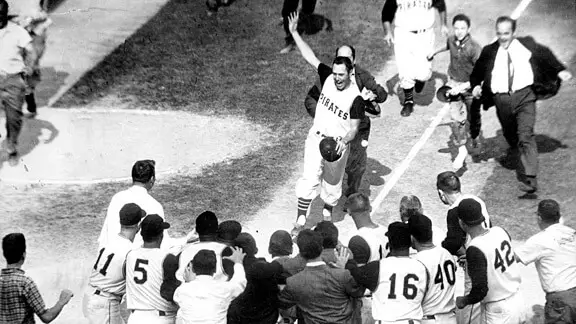
The ball went over Berra's head, at around the 406-foot mark in left field, and landed among the cherry trees in Schenley Park. Mazeroski took off his batting helmet and swung it around as he circled the bases. 
The ball was found by Andy Jerpe, 14 years old. Mazeroski would sign the ball for him, but he foolishly used the ball in a neighborhood game, and it was lost. No one knows where it is now. The Pirates don't have it. Neither does the Baseball Hall of Fame.

The Yankees outscored the Pirates 55-27 during the Series, but the Pirates won it, 4 games to 3. Richardson had a Series record 12 RBIs, and remains the only player from a losing side to be named the MVP of a World Series. Mazeroski? He batted .320 in that Series, and that was his 2nd homer in it, for his 5th RBI in it, and he played his usual good games in the field. He got robbed. But I'm sure he'd rather have the title.

Not being old enough to remember 1960, I can hardly begrudge the Pirates that amazing victory. But there are Yankee Fans who are old enough to remember, and it still hurts. It shouldn't: They won the next two World Series, and another seven since. And Mazeroski was always a good guy.

There's a bronze statue of a young Mazeroski -- arms outstretched, cap in his right hand, right leg kicked up behind him -- along the Allegheny River outside PNC Park. The likeness is surrounded by a brick wall that includes an actual section of the outfield wall over which Mazeroski homered; the 406-foot marker is still visible in white.

Another part of Forbes Field's outfield wall still stands in place in Pittsburgh's Oakland neighborhood, just off Roberto Clemente Drive, and there’s a plaque recognizing the spot where Mazeroski homered. Every Oct. 13, the "Game 7 Gang" gathers at that site, listens to the radio broadcast and celebrates the anniversary of Mazeroski's famous home run at exactly 3:36 PM.
"That doesn't happen anywhere else, does it?" Mazeroski said with a smile in February 2020, approaching the 60th Anniversary of the event.

*

He never again batted higher .271. He never again hit more than 16 home runs in a season. He peaked at 82 RBIs in 1966. But it's as a fielder that he became best-known. He led NL 2nd basemen in double plays turned every year from 1960 to 1967. He led them in fielding percentage in 1960, '65 and '66, and retired with a career .983 fielding percentage. He led them in assists 9 times, and led all of the big leagues in 5 of those seasons. He still holds the Major League record for double plays turned by a 2nd baseman, with 1,706.

For the record, the holders at the other positions are: 1st base, Mickey Vernon, 2,044; shortstop, Omar Vizquel, 1,734; 3rd base, Brooks Robinson, 618; catcher, Ray Schalk, 222; center field, Tris Speaker, 146; pitcher, Greg Maddux, 98; right field, Harry Hooper, 86; left field, Joe Vosmik, 23.

Mazeroski was involved in 2 triple plays in his career, in 1966 and 1968. He never hit into one in real life. But on June 27, 1967, at Shea Stadium, he was filmed staging such an event for the film version of The Odd Couple: Just before the regular game, he was filmed batting against Jack Fisher of the Mets. The play required 2 takes, as he hit the 1st ball foul. The point of the scene was that a phone call from Felix Ungar (played by Jack Lemmon) to Oscar Madison (Walter Matthau) in the press box at Shea causes Oscar to miss a triple play that ends the game in victory for the Mets. (Felix's surname was spelled "Ungar" in the play and the film, "Unger" in the TV show.)

Mazeroski and Clemente were the only 1960 Pirates still there when they won the World Series again in 1971. Mazeroski retired after the 1972 season, with a lifetime batting average of .260, and 2,016 hits including 138 home runs.

For many years, he was considered one of the best players not in the Baseball Hall of Fame. The argument for him was that the best-fielding player, ever, at every position should be in, and he was the best-fielding 2nd baseman ever. The argument against him is that he wasn't good enough of a hitter, and that nobody's defense made enough of a difference to put him over the top. In 2001, he was finally elected.

People who were against his election to the Hall have claimed that the real reason he's in is that home run. I would make the exact opposite argument: 

I think the home run changed people's perception of him. Think about it: The 1st thing that comes to mind when you hear his name is, "He hit the home run that won the 1960 World Series." Imagine that the Series had ended any other way, even one favorable to the Pirates. Suppose Mazeroski had led the inning off with a single, and scored the title-winning run on somebody else's hit. Then, the 1st thing that would come to mind when you hear his name is, "He's the greatest-fielding 2nd baseman who ever lived." He probably would have gotten in much sooner.
At a still-standing, ivy-covered piece of the
Forbes Field outfield wall, October 13, 2010,
the 50th Anniversary of the home run.


The Pirates retired his Number 9, and dedicated a statue of him outside PNC Park, depicting him running around the bases, swinging his batting helmet around. They also elected him to their team Hall of Fame. He was also elected to the National Polish-American Sports Hall of Fame.


He retired to a suburb of Pittsburgh. In 1987, he ran for the Democratic Party's nomination for Westmoreland County Commissioner, but lost. Eventually, he and his wife the former Milene Nicholson, moved to Panama City, Florida, enabling him to go down to Bradenton to serve as a Spring Training instructor for the Pirates. They had 2 sons: Darren, who became a college baseball coach; and Dave, an atmospheric scientist.


On October 23, 1993, Joe Carter became the 2nd player to end a World Series by hitting a home run, for the Toronto Blue Jays over the Philadelphia Phillies, at the SkyDome (now named the Rogers Centre) in Toronto. However, that was in a Game 6, not a Game 7. It appears that Mazeroski and Carter never met.


Bill Mazeroski died yesterday, February 20, 2026, in the Pittsburgh suburb of Landsale, Pennsylvania. He was 89 years old.


With his death, there are 3 surviving players from the 1960 World Champion Pittsburgh Pirates: Bob Skinner, Vernon Law and Bennie Daniels.


There are 4 surviving players who played in Game 7 of that World Series: Skinner and Law of the Pirates, and Bobby Richardson and Tony Kubek of the Yankees. Kubek, famously, had to leave the game when a ground ball hit a pebble in Forbes Field's poor infield and struck him in the throat, helping to keep the Pirates' 8th-inning rally alive, and make Mazeroski's 9th-inning heroism possible.


And there are 11 surviving players from the 1971 World Champion Pittsburgh Pirates: Al Oliver, Steve Blass, Manny Sanguillén, Bob Robertson, Gene Alley, Richie Hebner, Luke Walker, Bob Johnson, Milt May, Dave Cash and Carl Taylor.


How did Mazeroski want his career to be remembered: For his Hall of Fame defense, or for hitting arguably the greatest home run of all time?


"Oh," he said, laughing, "I'll take the home run."


If it had been me, so would I.

Thursday, April 4, 2024

April 4, 1924: Gil Hodges Is Born

April 4, 1924, 100 years ago: Gilbert Ray Hodge is born in Princeton, Indiana. By the 1930 Census, the family name had been changed to "Hodges."
 
Gil served in the U.S. Marine Corps during World War II. He was an 8-time All-Star. He won the Gold Glove at 1st base the 1st 3 times it was awarded. He helped the Dodgers win the World Series in Brooklyn in 1955 and in Los Angeles in 1959. His 370 home runs don't sound like much now, but at the time of his retirement, they ranked 10th all-time. He peaked at 42 in 1954, including 4 in 1 game, and by 1960, was still considered enough of a slugger to be invited to appear on the game show Home Run Derby.

In 1963, he was named the manager of the Washington Senators. In 1968, he was named manager of the New York Mets. In 1969, he led the Mets to win the World Series. He died of a heart attack at the end of Spring Training in 1972, just short of his 48th birthday. He was the 1st of the Brooklyn Boys of Summer to die. (Of the players that Roger Kahn covered in the book, only Carl Erskine is still alive.)
 
The Dodgers and Mets have both retired Gil’s Number 14, and, long after his death, he was finally elected to the Baseball Hall of Fame. On April 4, 1978, what would have been Hodges' 54th birthday, the Marine Parkway Bridge, which connected the neighborhoods of Marine Park in Brooklyn to Rockaway, Queens was renamed the Marine Parkway-Gil Hodges Memorial Bridge. Part of Bedford Avenue, though in Midwood, not the part that borders the site of Ebbets Field, is named Gil Hodges Way.

Wednesday, September 27, 2023

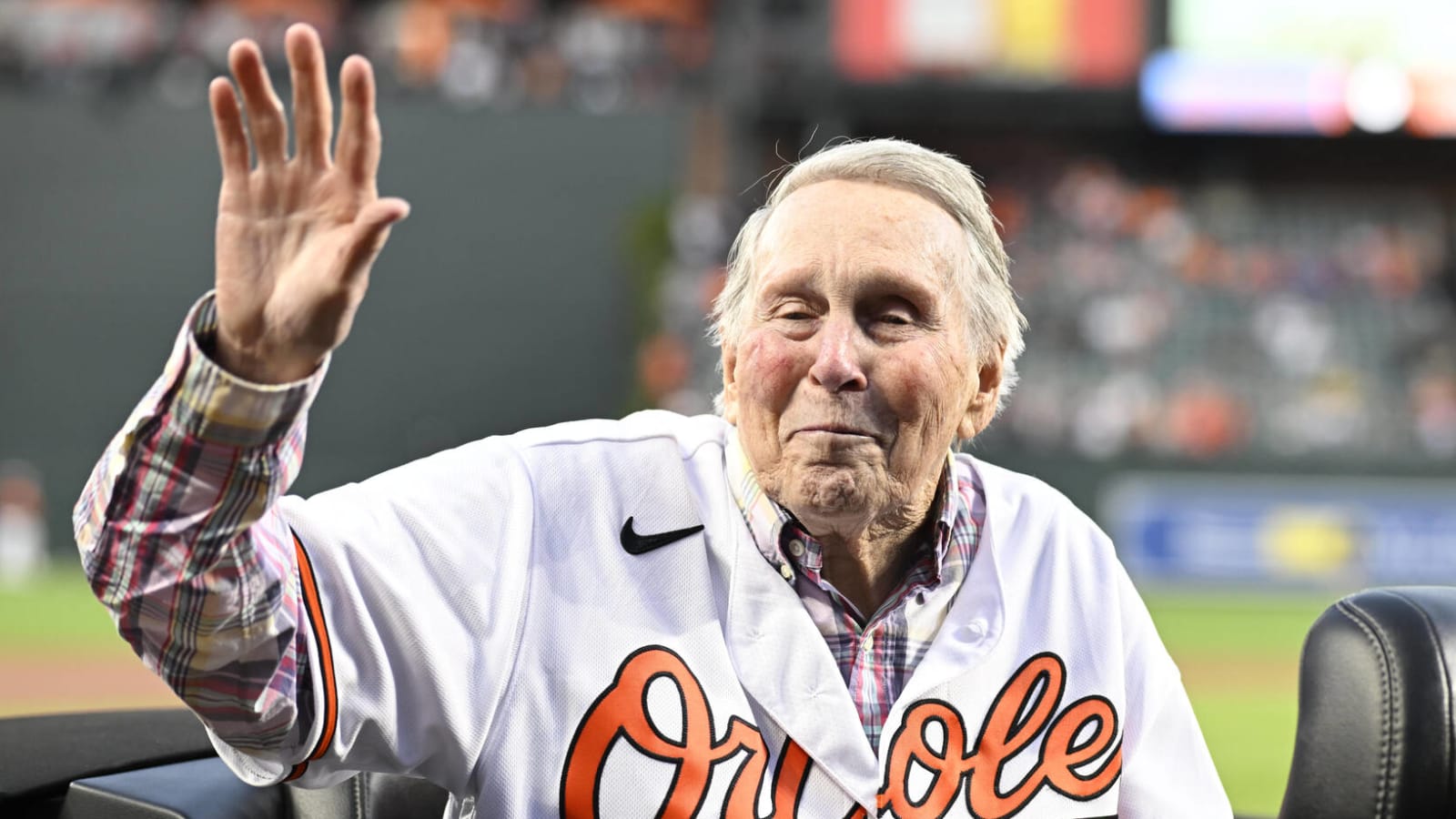
Brooks Robinson, 1937-2023

After the 1970 World Series, one of its umpires, Ed Hurley, spoke of Brooks Robinson, the 3rd baseman of the victorious Baltimore Orioles, said, "He came down from a higher league."

Now, he is in one.

Brooks Calbert Robinson Jr. was born on May 18, 1937 in Little Rock, Arkansas. He graduated from Central High School, 2 years and a Summer before the integration crisis there. The University of Arkansas offered him a basketball scholarship. But scout Art Ehlers signed him for the Baltimore Orioles.

He made his major league debut on September 17, 1955, just 4 months after his graduation. Batting 6th, playing 3rd base, and wearing Number 40, he popped up to the catcher in the 2nd inning, singled to left in the 4th, popped up to 2nd base in the 6th, and singled a run home in the 8th inning. He fielded just 1 grounder, successfully. The Orioles beat the Washington Senators, 3-1 at Memorial Stadium in Baltimore. No one knew it yet, but, in only the Orioles' 2nd season in Baltimore, they had found their signature player.

After spending most of the 1956 and '57 seasons in the minor leagues, he became the regular 3rd baseman in 1958, wearing the Number 5 that he would wear for the rest of his career. In 1960, he batted .294, hit 14 home runs, had 88 RBIs, made his 1st All-Star Game, received his 1st AL Gold Glove, and helped the O's into their 1st Pennant race, finishing 2nd in the American League, 8 games behind the Yankees. He finished 3rd in the voting for the AL Most Valuable Player, behind Yankee stars Roger Maris and Mickey Mantle.

He wouldn't miss the All-Star Game again until 1975, playing in 18 (there were 2 a year from 1958 to 1962); and he would receive the Gold Glove for AL 3rd basemen every year until then, 16 years. In 1964, he batted he .317, hit 28 home runs, and led the AL with 118 RBIs. These would all be career highs, and helped the Orioles finish just 2 games behind the Yankees. He was named the MVP, the 1st Oriole to receive the honor.

After the 1960 season, he married Constance Butcher, a flight attendant for United Airlines. They had sons Brooks David, Chris and Michael, and daughter Diana.

In the 1965-66 off-season, the Orioles traded for power-hitting right fielder Frank Robinson. He was black, while Brooks was a white Southerner, and had just lost his position as the best player on the team, through no fault of his own. It didn't stop him from making a friend of Frank, who told the media, "It's easy to tell us apart: I wear 20, and he wears 5."

Frank was immediately named team Captain, and he won the Triple Crown and the MVP. The Orioles won their 1st Pennant, and their 1st World Series. But that was Frank's season, and Frank's Series. Brooks' moment in the sun was yet to come. The team was not one of the 4 that took the 1967 AL race down to the wire, and they were a distant 2nd to the Detroit Tigers in 1968.

The 1969 season was the 1st in Divisional play, and the O's won 109 games to take the AL Eastern Division, then swept the Minnesota Twins in 3 straight to win the 1st AL Championship Series. But they were upset in the World Series by the New York Mets.

For Brooks, the Series was summed up in the top of the 9th inning of Game 4: Trailing 1-0, he had a chance to drive in the tying and winning runs against a tiring Tom Seaver, and sent a shot into right field, but was robbed by a spectacular catch by Ron Swoboda. It did get the trying run home on a sacrifice fly, but the Mets won in the 10th, and won Game 5.

In 1970, it looked like a repeat: 108 wins, running away with the AL East, sweeping the Twins in the ALCS, and a World Series, this time against the Cincinnati Reds. Their Big Red Machine won 102 games, and were favored to beat the Orioles. But, at age 33, with the attention of the sports world on him like never before, Brooks Robinson went from beloved in Baltimore and respected around baseball, but not much of a star, to all-time legend.

Game 1, at Cincinnati's Riverfront Stadium. This was the 1st World Series game ever played on artificial turf, and the 1st in which both teams wore names on the backs of their uniforms. And it was the 1st World Series with a black umpire, Emmett Ashford, who had become MLB's 1st black umpire in 1966, and was retiring at the end of the season: At the time, 55 was a mandatory retirement age for umpires, but he was allowed to come back for one more season and officiate in a World Series. The Jackson 5 sang the National Anthem.

Brooks, 1st baseman John "Boog" Powell, that season's AL MVP, and catcher Elrod Hendricks hit home runs. Brooks made a backhanded stop of a grounder by Lee May, spinning, and firing a throw that bounced into Boog's glove, getting May out. Jim Palmer outpitched Gary Nolan. Orioles 4, Reds 3.

Game 2, in Cincinnati. Boog hit another homer in the 4th inning, and the O's tacked 5 runs on in the 5th. As with Game 1, Brooks went 1-for-4 with an RBI, but the hit was a single, not a homer. Orioles 6, Reds 5. With fans seeing vacuum cleaners being used on the artificial turf, they began calling Brooks "The Human Vacuum Cleaner," and "Mr. Hoover," after the brand of vacuum cleaner. 

Game 3, back on the natural grass and dirt infield of Memorial Stadium in Baltimore. Brooks took over the game immediately. In the top of the 1st, he snared a Tony Pérez grounder, and started a double play. In the bottom of the 1st, the Orioles loaded the bases, and Brooks doubled home 2 runs. In the top of the 2nd, he made a tough play to throw out Tommy Helms. In the 6th, Johnny Bench hit a liner that should have gone through the hole, but Brooks snared it on the fly.

Dave McNally pitched a complete game, and became the 1st pitcher ever to hit a grand slam in a World Series game. (Through 2022, he's still the only one.) Frank Robinson and Don Buford added home runs. Orioles 9, Reds 3. What had been predicted as a tight Series was now in danger of becoming a dominating sweep, as with the Orioles over the defending Champion Los Angeles Dodgers in 1966.

Game 4, in Baltimore. The Orioles came in with a 17-game winning streak: Their last 11 of the regular season, 3 straight in the ALCS, and the 1st 3 of the Series. Brooks went 4-for-4, taking Nolan deep on a home run. But the Reds showed up, scoring 3 runs in the 8th inning, and saved some face. Reds 6, Orioles 5.

Game 5, in Baltimore, on October 15. The Reds scored 3 runs in the top of the 1st, and, for a moment, the greatest comeback in sports history seemed possible. But Baltimore put a stop to that, scoring 2 runs in each of their 1st 3 innings, allowing Mike Cuellar to settle down and keep Cincinnati off the scoreboard until next April. Brooks went 1-for-5, and robbed Bench again. Orioles 9, Cincinnati 3.

Baltimore were the World Champions of baseball. Just 3 months later, the Colts won Super Bowl V, and Baltimore were the World Champions of baseball and football at the same time. And 3 months after that, the Bullets reached the NBA Finals. Alas, a 4-game Finals sweep by the Milwaukee Bucks an MLB-NFL-NBA treble, which has still never been achieved.

(The Raiders prevented Oakland from doing it in 1974-75. Pittsburgh doesn't have an NBA team, so there was no chance in 1979-80. The Rams couldn't make it happen for Los Angeles in 1981-82, and neither then nor the Raiders could make it happen in 1988-89. The Knicks blew New York's chance in 1986-87. And the Celtics blew Boston's chance in 2004-05.)

Brooks Robinson had shown the world the peak of fielding at 3rd base. He was awarded the Series' Most Valuable Player award. With it came a new car. Bench said, "If we had known he wanted a car that badly, we'd all have chipped in and bought him one." And, just as, earlier in the year, the Boston Bruins had won the Stanley Cup, and this was said about their great star, Bobby Orr, umpire Ed Hurley said of Brooks, "He came down from a higher league."

Before him, there had been Jimmy Collins, Harold "Pie" Traynor, and Eddie Mathews. People now began to speak of Brooks Robinson as the greatest 3rd baseman of all time. Since then, there has been Mike Schmidt, George Brett, Wade Boggs, Chipper Jones, Adrián Beltré, and, for the 2nd half of his career, Alex Rodriguez. Most baseball observers still rank Brooks as the greatest 3rd baseman in American League history, behind only Schmidt overall.

He helped the Orioles win another Pennant in 1971, as part of the "Leather Curtain" that gave Baltimore the best infield defense in the sport, with shortstop Mark Belanger, 2nd baseman Davey Johnson, and 1st baseman Boog Powell. But the O's lost that World Series to the Pittsburgh Pirates. He would help them win the AL East again in 1973 and 1974, losing the ALCS to the Oakland Athletics both times.

A thumb injury in 1975 was the beginning of his end, and he lost his starting job to Doug DeCinces in 1976. In 1977, at 42, he played only 24 games, the last on August 13. With catcher Rick Dempsey coming off the Disabled List, and a roster spot necessary, Brooks announced his retirement on August 21. Brooks Robinson Day was held on September 18, 1977, and his Number 5 became the 1st number ever retired in Baltimore sports.

He finished with a lifetime batting average of .267; 2,848 hits including 482 doubles, 68 triples and 268 home runs, decent totals for a man who spent 23 seasons in a pitcher's park like Memorial Stadium. Those 23 seasons were the most that any player had spent with any one team, a record tied by Carl Yastrzemski of the Boston Red Sox in 1983, but never broken.

Jim Murray, the great sports columnist of The Los Angeles Timeswrote during Robinson's career that "In the future, Brooks Robinson will be the standard every third baseman will be measured by." In his 2015 biography Brooks: The Biography of Brooks Robinson, Doug Wilson said, "That statement has withstood the test of time."

In 1983, Brooks was elected to the Baseball Hall of Fame. When the Orioles established their team Hall of Fame, he and Frank Robinson were the 1st 2 honorees. He was also elected to the Arkansas Sports Hall of Fame. When the Orioles played their last game at Memorial Stadium on October 6, 1991, he and Colts quarterback legend Johnny Unitas threw out ceremonial first balls -- in Unitas' case, a football. In 2012, a statue of Brooks was dedicated outside their new home, Oriole Park at Camden Yards.

In 1999, The Sporting News ranked their 100 Greatest Baseball Players. Brooks was ranked 80th, trailing Traynor (70th), Mathews (63rd) and Schmidt (28th) among 3rd basemen. That year, fans voted Brooks and Schmidt as the 3rd basemen on the Major League Baseball All-Century Team. In 2022, 23 years after TSN did their rankings, ESPN ranked their 100 Greatest Baseball Players, and Brooks came in 67th, trailing Mathews (64th), Boggs (45th), Brett (43rd), A-Rod (26th) and Schmidt (18th).
Brooks broadcast for the Orioles from 1978 to 1993. He formed a group that ran several minor-league teams, including the York Revolution, in York, Pennsylvania, where he had once played minor-league ball for the York White Roses. Their ballpark, WellSpan Park, has the address of 5 Brooks Robinson Way. That ballpark also has a statue of him. A 3rd statue is in downtown Baltimore, on Washington Boulevard.

Brooks survived cancer in 2009, but an infection in 2011 affected his health thereafter. He died yesterday, September 26, 2023, in the Baltimore suburb of Owings Mills, Maryland, at the age of 86.

Frank Robinson predeceased him in 2019. He once said, "I've never known anyone, in any profession, more adored than Brooks."

With his death, there are now 7 surviving players from the 1966 World Champion Baltimore Orioles: Luis Aparicio (the only title won by the Hall of Fame shortstop, better known for playing for the Chicago White Sox), Jim Palmer, Boog Powell, Davey Johnson (also the manager of the 1986 World Champion New York Mets), Russ Snyder, Wally Bunker and Eddie Fisher (no relation to the singer of the same name).

There are 9 surviving players from the 1970 World Champion Orioles: Palmer, Powell, Johnson, Merv Rettenmund, Bobby Grich, Pete Richert, Terry Crowley, Eddie Watt and Dave Leonhard.

And there are 10 surviving players from the 1999 selections for the All-Century Team: Willie Mays, Sandy Koufax, Pete Rose, Nolan Ryan, Johnny Bench, Mike Schmidt, Roger Clemens, Mark McGwire, Ken Griffey Jr., and the man who replaced Brooks Robinson as the signature player of the Baltimore Orioles, Cal Ripken Jr.

Saturday, December 4, 2010

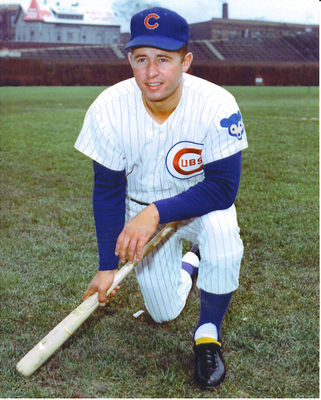
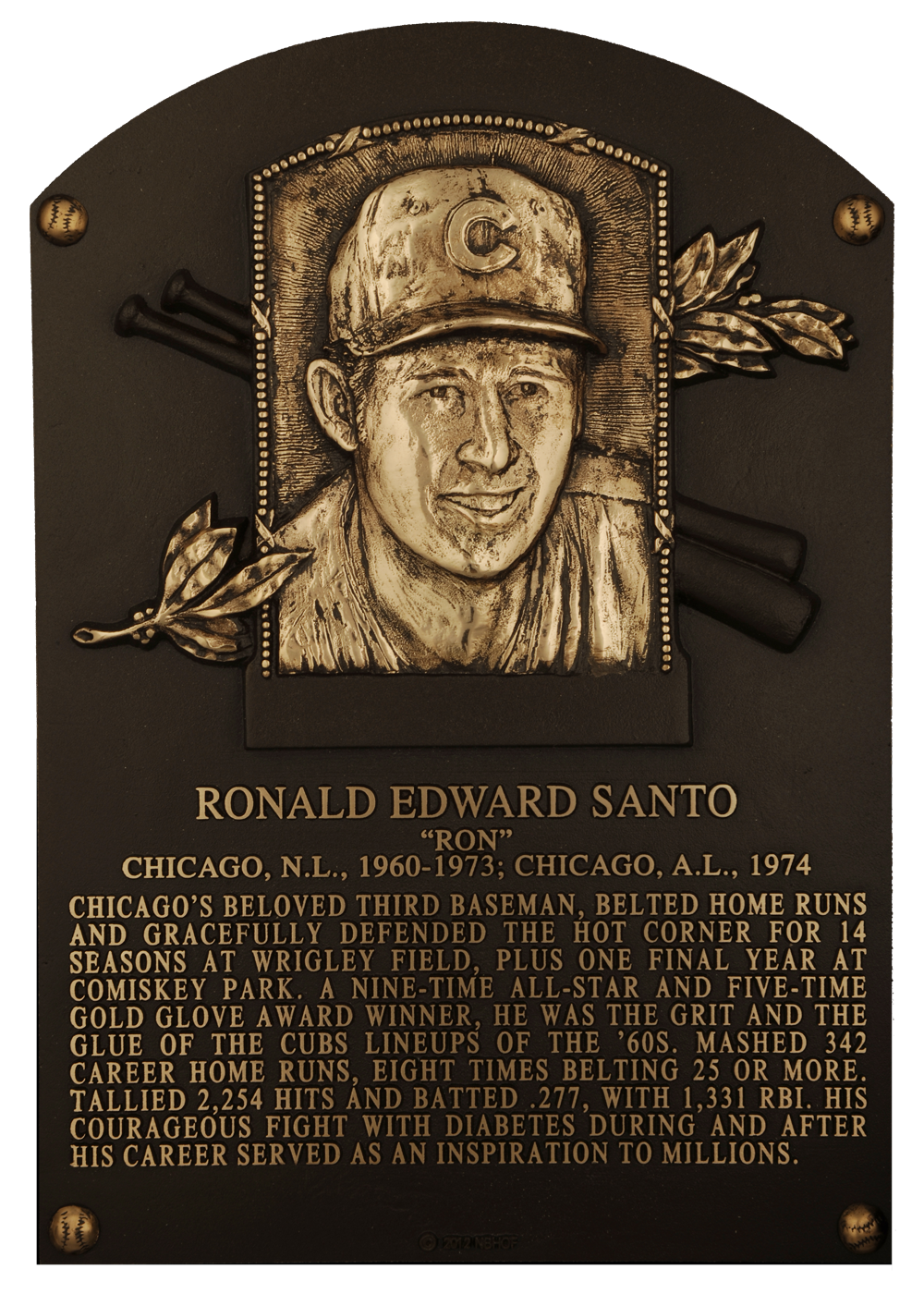
Ron Santo, 1940-2010

Here in the New York Tri-State Area, we had a man named Phil Rizzuto. He was once a great star player for one of our baseball teams, the New York Yankees. Then he spent decades as a beloved broadcaster. For years, he waited to be elected to the Hall of Fame. Finally, at age 76, he was. He lived another 13 years.

Nearby, in the Delaware Valley, they had a man named Rich Ashburn. He was once a great star player for their baseball teams, the Philadelphia Phillies. Then he spent decades as a beloved broadcaster. For years, he waited to be elected to the Hall of Fame. Finally, at age 68, he was. He lived another 2 years.

In Chicago -- or "Chicagoland," as the metropolitan area is sometimes known -- they had a man named Ron Santo. He was once a great star player for one of their baseball teams, the Chicago Cubs. Then he spent decades as a beloved broadcaster. For years, he waited to be elected to the Hall of Fame.

That did not happen in his lifetime. He died this week, at age 70. He still isn't in. You blew it, Hall of Fame.

Does Santo really deserve to be in the Hall of Fame? I'm not going to cite his broadcasting, because that's hard to measure. But by looking at his playing statistics, we can see some things and make some conclusions.

Ronald Edward Santo was born on February 25, 1940 in Seattle, Washington. He graduated from Franklin High School in Seattle, Class of 1958, and was signed by the Cubs as an amateur free agent in 1959.

Other prominent Franklin High graduates include former All-Star pitcher and 1961 Pennant-winning Cincinnati Reds manager Fred Hutchinson, former St. Louis Cardinals running back Terry Metcalf, former Jets cornerback James Hasty, former NFL single-game rushing yardage record-holder Corey Dillon, basketball player Jason Terry, noted Seattle sportswriter Royal Brougham, actor Keye Luke, saxophone player Kenny G, former Washington Governor  and U.S. Secretary of Commerce Gary Locke and former Budget Director Franklin Raines.

Ron Santo made his major league debut with the Cubs on June 26, 1960 -- meaning he was a part of Cub fans' lives for half a century. He remained with the Cubs until 1973, and spent his last season across town with the White Sox, playing his finale on September 29, 1974.
Dick Allen playing for the White Sox? That looks right.
Ron Santo playing for the White Sox? That's so wrong.

He was 6 feet even, and during his playing days was 190 pounds. He batted and threw righthanded, and while he also played a few games at 1st base, 2nd base, shortstop and left field, he played most of his games at 3rd base.

His lifetime batting average was .277. Nothing to write home about. But he did have 4 seasons batting .300 or higher, peaking with .313 in 1964. His career OPS+ -- that's on-base percentage plus slugging percentage, in comparison to the rest of the league -- was 125, meaning it was 25 percent better than the average player in MLB at the time.

He collected 2,254 hits in 15 seasons. He hit 342 home runs, and before you remind me that the wind blows out at Wrigley Field and the power alleys are very close, 368 feet from home plate, let me remind you that, half the time, the wind blows in, and the foul poles are 355 (left) and 353 (right) feet from home plate, making it a pitcher's park every bit as often as it's a hitter's park. He peaked with 33 home runs in 1965. In 4 seasons, he had at least 100 RBIs -- and in 3 others, he had at least 98, peaking at 123 in 1969.

He led the NL in on-base percentage twice, walks 4 times, sacrifice flies 3 times and triples once. He was named to the All-Star Game in 9 seasons, and 5 times was awarded a Gold Glove -- not easy at the beginning of his career, because Ken Boyer of the St. Louis Cardinals was winning them.

Santo did all of this despite having diabetes. He became the 1st active major league athlete to reveal that he had the disease, presaging such sports stars as Jim "Catfish" Hunter and Bobby Clarke. By a macabre coincidence, the aforementioned Richie Ashburn also had diabetes, although it was not diagnosed until well after he retired as a player, and he likely did not have it at the time.

It was cancer, along with the diabetes having weakened him, that killed Santo; Ashburn's heart was weakened by diabetes, and he suffered a heart attack; Rizzuto, despite being notoriously accident-prone after his playing days, became increasingly frail in his 80s and, while his mind was clear -- those of you who remember his last few years as a broadcaster, save your jokes -- until the end, he spent his last 3 years in a hospice due to organ failure. Essentially, the Scooter died of old age.

Baseball-Reference.com, on its "Hall of Fame Monitor," where a "Likely HOFer" is at 100, has Santo at 88. On its "Hall of Fame Standards," where the "Average HOFer" is at 50, Santo is at 41. In both cases, he falls short.

On their top 10 "Most Similar Batters," none are in the Hall, although some fall just a little short: Dale Murphy, the aforementioned Ken Boyer, Gary Gaetti, Ruben Sierra, Chili Davis, Bobby Bonilla, Brian Downing, Graig Nettles, Ron Cey and Robin Ventura.

There are currently 13 3rd basemen in the Hall of Fame. Three of these are Negro Leaguers, for whom the statistics are woefully incomplete: Jud Wilson, Judy Johnson and Ray Dandridge. The other 10 are, in chronological order:

* Jimmy Collins, 1890s Boston Beaneaters (Braves) and 1900s Boston Pilgrims (Red Sox).
* Frank "Home Run" Baker, 1910s Philadelphia Athletics.
* Harold "Pie" Traynor, 1920s and '30s Pittsburgh Pirates.
* Fred Lindstrom, 1920s and '30s New York Giants.
* George Kell, 1940s and '50s Detroit Tigers.
* Eddie Mathews, 1950s and '60s Milwaukee Braves.
* Brooks Robinson, 1960s and '70s Baltimore Orioles.
* Mike Schmidt, 1970s and '80s Philadelphia Phillies.
* George Brett, 1970s and '80s Kansas City Royals.
* Wade Boggs, 1980s Boston Red Sox and 1990s New York Yankees.

Lindstrom -- often called one of the "Frisch Five" that former teammate Frankie Frisch pushed on his fellow members of the Hall's Veterans Committee in spite of not being worthy enough -- and Kell are borderline candidates, but I wouldn't throw either of them out. Collins (completely) and Baker (almost completely) played in the pre-1920 Dead Ball Era, so their hitting statistics can't really be compared, although Collins was said to be a superb fielder.

But let's judge these guys based on what we do have available, to see where Santo ranks against the 3rd basemen who actually have made the Hall out of MLB.

I'm also going to add 4 players currently active who are now best known as 3rd basemen and, statistically at least, seem headed for the Hall:

* Matt Williams, 1990s San Francisco Giants.
* Larry Wayne "Chipper" Jones Jr., 1990s and 2000s Atlanta Braves.
* Alex Rodriguez, 1990s Seattle Mariners and 2000s New York Yankees.
* Scott Rolen, 1990s Philadelphia Phillies and 2000s St. Louis Cardinals.

I will not, however, add the following players, all of whom were, at least for a time, 3rd basemen: Harmon Killebrew, Dick Allen and Jim Thome are counted as 1st basemen, Pete Rose as a left fielder, Gary Sheffield as a right fielder, and Paul Molitor as a designated hitter.

So, counting those, plus Santo, we're talking about 15 players.

Here's how those 15 rank:

All-Star Game appearances -- excepting Collins and Baker, who preceded its 1933 establishment, and Traynor and Lindstrom, who barely overlapped its start: Santo ranks 8th of 11, ahead of only Chipper, Williams and Rolen. Counting those seasons, 1959 to '62, when there were 2 ASGs a season as only 1: Robinson made 15, Brett and A-Rod (so far) 13, Schmidt and Boggs 12, Kell 10, Matthews and Santo 9, Chipper (so far) 6, Williams and Rolen (so far) 5, Traynor 2.

Postseason appearances -- keeping in mind that this is weighted in favor of those who played in the post-1969 Divisional Play Era and especially in the post-1995 Wild Card Era: Santo is tied for last with Kell, the only 2 who never made it. Chipper has made it 12 times (3 Pennants, 1 World Series win), A-Rod 9 (1 P & WS), Brett 7 (2 P, 1 WS), Williams 7 (2 P, 1 WS), Schmidt 6 (2 P, 1 WS), Boggs 6 (2 P, 1 WS), Baker 6 (6 P, 3 WS), Robinson 6 (4 P, 2 WS), Collins 4 (4 P, 1 WS and that doesn't count 1897 & '98 with the Beaneaters and 1904 with the Red Sox when there was no WS), Mathews 3 (2 P, 1 WS -- plus 1959 when the Braves & Dodgers tied for the P and the Dodgers won a Playoff), Rolen 3 (including this year with the Reds, 1 Pennant & WS), Traynor 2 (2 P), and Lindstrom 2 (2 P, 1 WS).

Seasons in the top 10 in Most Valuable Player voting -- keeping in mind that, when Collins played, there was no MVP of any kind, whereas Baker, Traynor and Lindstrom did have one available to them although it wasn't the current MVP award that started in 1931: Santo ranks in a tie for 6th out of 14. A-Rod 10 (won 3), Schmidt 7 (won 3), Robinson 7 (won 1), Jones 6 (won 1), Traynor 6, Brett 4 (won 1), Mathews, Santo, Boggs and Williams 4 each, Baker and Kell 3 each, Lindstrom 2 and Rolen 1.

OPS+, essentially measuring the player's run-producing ability -- keeping in mind that Collins and Baker (in spite of his "Home Run" nickname) played in the pre-1920 Dead Ball Era: Santo ranks 8th of 15, higher than already-HOFers Collins, Kell, Lindstrom, Traynor and Robinson, and ahead of possibles Rolen and Williams.

Power-Speed Number -- and, no, I have no idea how it's computed, but, again, keep in mind that Collins and Baker were Dead Ball Era players: Santo ranks 12th of 15, ahead of Kell, Robinson and Boggs.

Gold Gloves -- keeping in mind the award didn't start until 1957: Santo ranks 4th of 15, but only 4th of 10 among players who were, essentially, eligible, and 4th of 9 once you consider that A-Rod has still spent the majority of his career at shortstop. Counting only those Gold Gloves won at 3rd: Robinson 16, Schmidt 10, Rolen 8, Santo 5, Williams 4, Boggs and A-Rod 2 each, Brett 1. But the Gold Glove is a lot like the Grammy: The only people who believe in it are the people whose favorite candidate actually won. So let's move on to...

Fielding Percentage -- keeping mind that pre-World War II players had much smaller gloves, so this is weighted toward modern players: Santo ranks 10th of 15. Among the post-World War II (1946-present) 3rd basemen on this list, he is ahead of only Chipper and Brett. Granted, sabermetricians and/or statheads will tell you that fielding percentage is a lousy indicator of fielding ability, so let's move on to...

Fielding Range -- another one where I have no idea how it's computed. Santo ranks 5th of 15, trailing only Collins, Baker, Traynor and Robinson.

And finally, not to be confused with VORP, Value Over Replacement Player -- and, like the great broadcaster Jon Miller, who said so on Ken Burns' Baseball: The Tenth Inning, I have no idea how it's computed...

WAR, Wins Above Replacement, yet another stat where I don't know how it's computed. Santo ranks 8th out of these 15, behind Schmidt, A-Rod, Mathews, Boggs, Brett, Chipper and Robinson, but ahead of Rolen, Baker, Collins, Williams, Traynor, Kell and Lindstrom.

*

Does this make Santo sound qualified for the Hall of Fame? Maybe not.

Consider this: There are only 2 3rd basemen in the Hall who were, essentially, his contemporaries, whose careers were centered on the 1960s: Mathews (and I'm being generous here, as he played from 1952 to '68) and Robinson.

Contrast that with other positions in that era:

1st Base, 4: Harmon Killebrew, Orlando Cepeda, Willie McCovey and Willie Stargell. Pops is listed in the Hall's records as a left fielder, but I remember him mainly as a 1st baseman.

Right Field, 4: Hank Aaron, Roberto Clemente, Frank Robinson and Al Kaline.

Left Field, 3: Santo's teammate Billy Williams, Carl Yastrzemski and Lou Brock.

2nd Base, 2: Bill Mazeroski and Joe Morgan.

Shortstop, 2: Luis Aparicio and Ernie Banks, the 2 Chicago players, the latter Santo's teammate.

Center Field, 2: Mickey Mantle and Willie Mays.

Catcher, essentially none: A little overlap at the beginning with Yogi Berra and at the end with Johnny Bench and Carlton Fisk. When Joe Torre goes in, he might be remembered as a manager first and a catcher second, but he'll go in as a manager, not as a player.

Pitchers, 11: Whitey Ford, Hoyt Wilhelm, Sandy Koufax, Don Drysdale, Bob Gibson, Jim Bunning, Juan Marichal, Gaylord Perry, Jim "Catfish" Hunter and Santo's teammate Ferguson "Fergie" Jenkins. Now, 11 seems like a lot, but with the 4-man rotations in place then, divide 11 by 4, and you've got 2.75.

So would it be all that unfair to elect a 3rd 3rd baseman from that era? Especially since, considering when Mathews started, Santo might really be only the 2nd?

*

Ron Santo may be best remembered for jumping up and "clicking his heels" after Cub victories in 1969, when they led the National League Eastern Division (in that 1st year of divisional play) for most of the season. A sad footnote was that his diabetes led to the amputations of both his legs below the knee, meaning that, while he was able to walk with prostheses, he no longer had heels to click.
Of course, the Cubs didn't win the NL East in 1969, falling apart in their infamous "September Swoon" and losing to the Mets, symbolized by a series at Shea Stadium where a black cat ran onto the field and around Santo on the on-deck circle. This gave rise to the idea that the Cubs are "cursed," often attributed to a bar owner named William "Billy Goat" Sianis.

From that 1969 Cubs team, Ernie Banks, Billy Williams and Ferguson Jenkins have been elected to the Hall of Fame. (As has their manager, Leo Durocher, although that was for things he did well before he got there.) If they had won even the Pennant, it might have been different, and Santo might have gotten in.

"New York didn't need that Pennant," the great newspaper columnist Mike Royko, then with the Chicago Daily News, wrote. "All Chicago wanted was that one lousy Pennant. It would have kept us happy until the end of the century. But New York took it from us, and I can never forgive them for that."

But Santo did not get in while he was still alive. The Cubs retired his Number 10, but he did not get into the Hall. According to the rules of the Veterans Committee, he will not be eligible on the ballot this coming week, but will next be eligible in the Veterans Committee election of 2012.

Meanwhile, the Boston Red Sox, who hadn't won the World Series since 1918, have done so twice (albeit fraudulently), in 2004 and 2007. The Chicago White Sox, Chicago's "other team," hadn't won one since 1917, and won it in 2005 (and still get outdrawn by the Cubs). The San Francisco Giants, who hadn't won one since 1954 (as the New York Giants), won this year. The Cubs still haven't won a World Series since 1908. Since Roosevelt was President. Theodore Roosevelt.

The Texas Rangers, who had never won a Pennant, won one this year. The Cubs still haven't won one since 1945.

Maybe the Cubs really are cursed. Maybe the idea of the Cubs being cursed isn't all that funny anymore.
P.S.: Keith did a great job last night on Countdown with Keith Olbermann, giving his (not really) Worst Person in the World "award" to the Hall voters.

Face it, when you beat out an oil company (Hess, who fired a man who chased down the bastard who robbed the station and got him arrested, for leaving his post?!?) and a Republican Senator (Scott Brown, who said he wanted to help the unemployed, then voted against extending unemployment benefits, then went off to host a $100-a-plate Christmas party), you've really scraped the bottom of the barrel.

UPDATE: Ron Santo was cremated, and his ashes were scattered on the playing surface at Wrigley Field. On August 10, 2011, a statue of him was dedicated outside the ballpark. On December 5, 2011, he was finally elected to the Baseball Hall of Fame by the Golden Era Committee.
About time.

Wednesday, November 10, 2010

Derek Jeter Deserved His Gold Glove

Derek Jeter, Robinson Cano and Mark Teixeira won Gold Gloves yesterday.

They all deserved the honor.

Yes, even Jeter.

"Advanced fielding metrics rank him as mediocre at best at shortstop these days." -- Lisa Swan, Subway Squawkers

Advanced fielding metrics? I'm not going to doubt Lisa's "True Yankee Fan" status just because she likes Alex Rodriguez and Joe Girardi more than Derek Jeter and Joe Torre, respectively. Besides, she's merely backing up the point of the actually offensive (and she frequently agrees he's offensive) Wallace Matthews of ESPN (and formerly of the New York Post, that great bastion of irresponsible journalism):

You really don't need to consult any statistics or advanced fielding metrics to know what your own eyes told you if you watched enough Yankees games this season, which is that there can really be no argument that both Teixeira and Cano are among the best, if not the best, at their respective positions.

And neither did you need any numbers to tell that Jeter is not.

This is not to say he is a bad shortstop. Far from it. At 36, Jeter remains sure-handed and rifle-armed. His instincts, as always, are perfect -- his fundamentals rock-solid. Along with Cano -- and some would say, because of Cano -- he still turns a terrific double play. Any ball hit right at him is a guaranteed out.

And that is both a compliment and an indictment. Because if it isn't hit right at him, and I mean right at him, then it's a base hit. 

Talk about damning with faint praise.

"Theoretical physicists will tell you that an elephant can hang from a cliff with his tail tied to a daisy. But use your eyes." -- Jim Garrison

"Statistics are like women; mirrors of purest virtue and truth, or like whores to use as one pleases." -- Theodor Billroth

"There are two kinds of statistics, the kind you look up and the kind you make up." -- Rex Stout

"The average human has one breast and one testicle." -- Des McHale. Ouch. Actually, at the rate humanity is going, it may be down to one breast and .8 balls.

"Say you were standing with one foot in the oven and one foot in an ice bucket. According to the percentage people, you should be perfectly comfortable." -- Bobby Bragan, although I've also seen this attributed to another mediocre player turned cagey manager, Eddie Stanky.

"He uses statistics as a drunken man uses lampposts, for support rather than for illumination." -- Andrew Lang. I'm not sure who he is, but I first saw this attributed to broadcaster Vin Scully.

"Statistics are like bikinis: What they reveal can be good, but what they don't reveal can be more important." -- Aaron Levenstein, whoever he was.

"Lucy, tell your statistics to shut up." -- Charles Schulz as Charlie Brown, Peanuts

Derek Jeter has 5 Gold Gloves now. He deserves them all.

Go ahead, cite your statistics. They may suggest that I am wrong. They will never prove it.

As I've said many times, facts can be true or false, but opinions can never be proven right or wrong, only agreed with, or not.