Showing posts with label wgn. Show all posts

Tuesday, July 29, 2025

Ryne Sandberg, 1959-2025

The Chicago Cubs are the oldest continuously-operating professional sports franchise in the United States of America, having been founded in 1870 as the Chicago White Stockings. They have had many heroes. Some have been problematic: Adrian "Cap" Anson, Mike "King" Kelly, Lewis "Hack" Wilson, "Slammin' Steroids" Sammy Sosa. Some have been golden: Frank Chance "The Peerless Leader," Charles "Gabby" Hartnett, "Mr. Cub" Ernie Banks.

Ryne Sandberg was one of the golden heroes of Chicago Cub baseball.

Ryne Dee Sandberg was born on September 18, 1959 in Spokane, Washington. His father, Derwent "Sandy" Sandberg, was a Yankee Fan, and named his son after the Yankees' top reliever at that time, Ryne Duren.

In the late 1970s, there were 3 great athletes in the Spokane area, each of them a high school star in baseball, in basketball, and as a quarterback in football: Ryne Sandberg of North Central; Mark Rypien of Shadle Park, North Central's arch-rivals, who went on to play for the Washington Redskins, and was the Most Valuable Player of Super Bowl XXVI; and John Stockton of Gonzaga Prep, who starred for the Utah Jazz.

Also graduates of North Central: Singer-actor Bing Crosby and actress Dyan Cannon. Shadle Park produced a few other pro athletes, including Rypien's brother Brett. Gonzaga Prep produced Pro Football Hall-of-Famer Ray Flaherty, House Speaker Tom Foley, actress Julia Sweeney, and Stockton's son David, who briefly played for the Sacramento Kings.

Like Rypien later did, Sandberg signed a letter of intent to play quarterback at Washington State University, in nearby Pullman. But he chose baseball instead, and was drafted by the Philadelphia Phillies in 1978. He debuted with them on September 2, 1981: Wearing Number 37, and pinch-running for Bob Boone in the top of the 9th inning, he was singled home by Pete Rose, but the Phils lost to the Atlanta Braves, 3-2 at Atlanta-Fulton County Stadium.

At this point, Sandberg was mainly a 3rd baseman. But it was too soon to need a successor to Mike Schmidt. So, on January 27, 1982, the Phillies traded him and starting shortstop Larry Bowa to the Chicago Cubs, for their starting shortstop, Iván de Jesús. Cub general manager Dallas Green, who had managed the Phillies to win the 1980 World Series, moved him to 2nd base, and gave him Number 23.

The 1984 season would be an epic one. The Cubs were now owned by The Tribune Company, which owned, among other things, the Chicago Tribune newspaper, radio station WGN (which stood for what the Trib used to call itself, "the World's Greatest Newspaper"), TV station WGN-Channel 9, and its new nationwide cable "SuperStation WGN."

Since Wrigley Field did not yet have lights, Cub home games were nationally broadcast in the afternoons. The whole country could hear broadcaster Harry Caray -- previously broadcasting for the crosstown Chicago White Sox, and, for many years before that, for the Cubs' arch-rivals, the St. Louis Cardinals -- the Cubs got off to a great start, and became a national phenomenon, far beyond the "Chicagoland" area.

On June 15, then the trading deadline, they picked up pitcher Rick Sutcliffe, and he went on to win the National League's Cy Young Award. On June 23, the Cubs played the Cardinals at Wrigley, and NBC covered it for their national Saturday Game of the Week.

In the 9th inning, and again in the 10th inning, Sandberg tied the game by hitting home runs off Bruce Sutter, the Hall of Fame reliever that the Cubs had let get away, helping the Cards win the 1982 World Series. The Cubs won it in the 11th inning, 12-11. Now, baseball fans who didn't have cable -- it wasn't even a majority of Americans yet -- had Cub fever. 

The fact that it turned out to be the New York Mets, who had been dreadful for several years, who bounced back and battled the Cubs for the NL Eastern Division title, thus the biggest and 3rd-biggest markets getting involved, made it an even bigger story. When they had their magical season of 1969, cut short by the Mets' own "Miracle," they made themselves beloved in the Chicago area; but in 1984, they excited the whole country.

And it turned out to be not that close: The Cubs went 96-65, and won the Division by 6 1/2 games. It was their 1st postseason appearance since winning the Pennant in 1945. Sandberg was named the NL's Most Valuable Player. He was named to the 1st of 10 All-Star Games. He won the 2nd of 9 Gold Gloves.

With that great 1984 season, Ryne Sandberg, Rick Sutcliffe and Harry Caray not only thrilled a nation, but saved Wrigley Field for at least two more generations. A fine legacy to leave. I was a Yankee Fan, and the fact that the Cubs were driving Met fans up the wall made it fun to watch. The 1984 Cubs
made a world that scared the hell out of an already-troubled 14-year-old kid, on multiple levels, a bit more bearable.

And they beat the NL Western Division Champions, the San Diego Padres, in their 1st postseason appearance, in the 1st 2 games of the NL Championship Series, in front of adoring crowds at Wrigley. But the Padres took all 3 games in San Diego, including a walkoff extra-inning home run by Steve Garvey in Game 4, and a key error by 1st baseman Leon Durham in Game 5 -- presaging the one 2 years later in the World Series, by former Cub 1st baseman Bill Buckner.

It was a result that was heartbreaking for anyone who didn't root for the Padres (or the Mets, or the White Sox, or the Cardinals), and as staggering as, the next month, Walter Mondale losing 49 out of 50 States to Ronald Reagan in the Presidential election.

The Cubs couldn't sustain it, and struggled for most of Sandberg's tenure with the team. Finally adding lights to Wrigley Field in 1988 didn't help much. They did win another NL East title in 1989. They lost the NLCS to the San Francisco Giants, although there was no heartbreaking moment: They simply got beat by a better team. In 1990, the Cubs hosted the All-Star Game, and Sandberg led the NL with 40 home runs, and reached 100 RBIs for the 1st time, but they were nowhere near a Playoff berth.

The switch to the 3-Division setup in 1994, and the move of the Cubs to the NL Central Division, didn't help much. Sandberg got off to a slow start, and on June 13, for reasons that had nothing to do with the upcoming strike, he announced his retirement at the age of 34. He admitted, "The reason I retired is simple: I lost the desire that got me ready to play on an everyday basis for so many years."

When the strike ended in 1995, he still sat out the entire season. He returned in 1996, and broke Joe Morgan's career record for home runs by a 2nd baseman. He played his last game on September 21, 1997. He finished with a .285 batting average, 2,386 hits, including 403 doubles, 76 triples (a very high figure for the post-1920 Lively Ball Era), 282 home runs, 277 of them as a 2nd baseman. (Jeff Kent now holds the record, with 351.)

He also stole 344 bases. Here's a list of the players with at least as many home runs and at least as many stolen bases as Ryne Sandberg, in chronological order: Bobby Bonds, Rickey Henderson, Barry Bonds, Craig Biggio and Bobby Abreu. That's it. That's the list. (Barry Bonds had already exceeded Sandberg in both categories before, it is believed, he started cheating. Willie Mays almost did it, stealing 339.)

The trade of Sandberg from The Vet to Wrigley has been called one of the most lopsided trades in baseball history. It's not. Let the record show that, from 1982 to 1997, when Sandberg played his last game, the Phillies won 2 Pennants, in 1983 and 1993; while the Cubs won none.

The Cubs retired his Number 23, and dedicated a statue of him outside Wrigley Field. In 1999, he was named as one of the 100 finalists to the Major League Baseball All-Century Team. In 2005, he was elected to the Baseball Hall of Fame. As a member, he lobbied for the election of fellow Cubs legends Ron Santo and Andre Dawson. Both were elected, but while Dawson lived long enough to see it (and is still alive as of this writing), Santo didn't.

In 2007, Sandberg returned to the Cubs' organization as a minor-league manager. In 2010, with the Des Moines-based Iowa Cubs, he was named the Pacific Coast League's Manager of the Year. (Iowa in the Pacific Coast League? Geography has never been baseball's strong suit. After all, the NL once had Chicago and St. Louis in the East, and Atlanta and Cincinnati in the West. The NFL has been even worse: They still have Dallas in the NFC East.)

In 2011, Sandberg returned to the Phillies' organization, and managed their top farm team, the Allentown, Pennsylvania-based Lehigh Valley IronPigs, to their 1st Playoff appearance. Baseball America magazine named him the 2011 Minor League Manager of the Year.

In 2013, he was named the Phils' 3rd base coach. When Charlie Manuel, who had managed them to win the 2008 World Series, was fired on August 16, Sandberg was named manager. But the timing was bad: The Phils' 2007-11 quasi-dynasty had collapsed, and there was little he could do. After the 2015 season, he was fired. His managerial record was 119-159.

In 2016, the Cubs named him a team ambassador. That was the year they finally won their 1st Pennant since 1945, and their 1st World Series since 1908. Like Billy Williams, Fergie Jenkins and Rick Sutcliffe, but unlike Ernie Banks, Ron Santo, Jack Brickhouse and Harry Caray, Ryne Sandberg had lived to see this magical moment.

He married twice. With his high school sweetheart, Cindy, he had son Justin and daughter Lindsey. With his 2nd wife, Margaret, he raised her 3 children from a previous marriage. Ryne's nephew, Jared Sandberg, played 3rd base for the Tampa Bay Devil Rays from 2001 to 2003.
Ryne and Margaret Sandberg, Opening Day 2024

Early in 2024, Ryne Sandberg announced that he had prostate cancer. He died yesterday, July 28, 2025, at his home in the Chicago suburbs, at the age of 65. Although he didn't win a Pennant with the Cubs, he remains one of the most beloved athletes in Chicago history.

Saturday, December 4, 2010

Ron Santo, 1940-2010

Here in the New York Tri-State Area, we had a man named Phil Rizzuto. He was once a great star player for one of our baseball teams, the New York Yankees. Then he spent decades as a beloved broadcaster. For years, he waited to be elected to the Hall of Fame. Finally, at age 76, he was. He lived another 13 years.

Nearby, in the Delaware Valley, they had a man named Rich Ashburn. He was once a great star player for their baseball teams, the Philadelphia Phillies. Then he spent decades as a beloved broadcaster. For years, he waited to be elected to the Hall of Fame. Finally, at age 68, he was. He lived another 2 years.

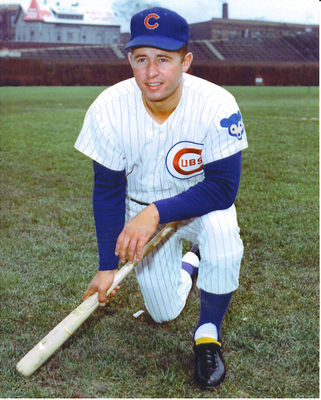
In Chicago -- or "Chicagoland," as the metropolitan area is sometimes known -- they had a man named Ron Santo. He was once a great star player for one of their baseball teams, the Chicago Cubs. Then he spent decades as a beloved broadcaster. For years, he waited to be elected to the Hall of Fame.

That did not happen in his lifetime. He died this week, at age 70. He still isn't in. You blew it, Hall of Fame.

Does Santo really deserve to be in the Hall of Fame? I'm not going to cite his broadcasting, because that's hard to measure. But by looking at his playing statistics, we can see some things and make some conclusions.

Ronald Edward Santo was born on February 25, 1940 in Seattle, Washington. He graduated from Franklin High School in Seattle, Class of 1958, and was signed by the Cubs as an amateur free agent in 1959.

Other prominent Franklin High graduates include former All-Star pitcher and 1961 Pennant-winning Cincinnati Reds manager Fred Hutchinson, former St. Louis Cardinals running back Terry Metcalf, former Jets cornerback James Hasty, former NFL single-game rushing yardage record-holder Corey Dillon, basketball player Jason Terry, noted Seattle sportswriter Royal Brougham, actor Keye Luke, saxophone player Kenny G, former Washington Governor  and U.S. Secretary of Commerce Gary Locke and former Budget Director Franklin Raines.

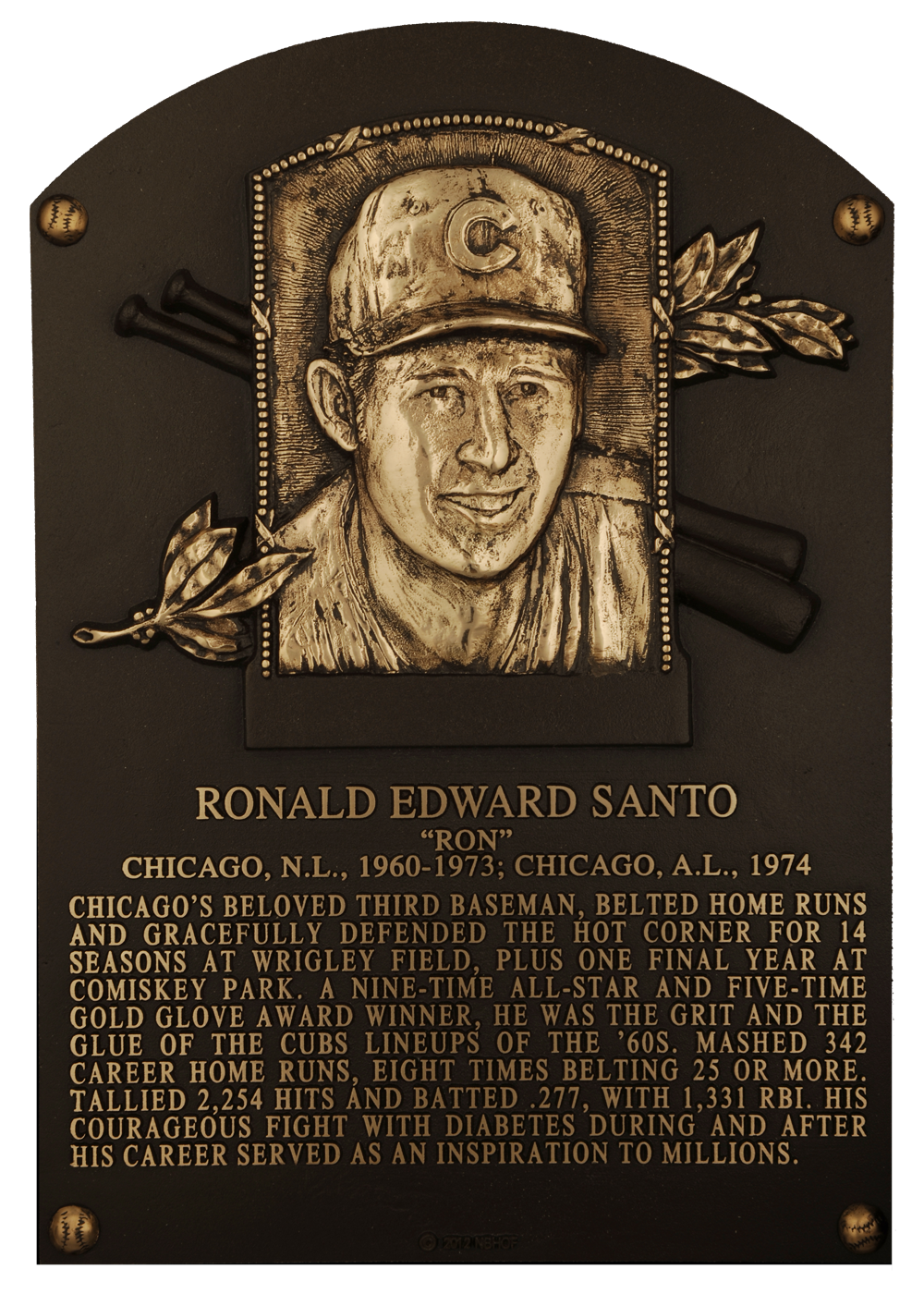
Ron Santo made his major league debut with the Cubs on June 26, 1960 -- meaning he was a part of Cub fans' lives for half a century. He remained with the Cubs until 1973, and spent his last season across town with the White Sox, playing his finale on September 29, 1974.
Dick Allen playing for the White Sox? That looks right.
Ron Santo playing for the White Sox? That's so wrong.

He was 6 feet even, and during his playing days was 190 pounds. He batted and threw righthanded, and while he also played a few games at 1st base, 2nd base, shortstop and left field, he played most of his games at 3rd base.

His lifetime batting average was .277. Nothing to write home about. But he did have 4 seasons batting .300 or higher, peaking with .313 in 1964. His career OPS+ -- that's on-base percentage plus slugging percentage, in comparison to the rest of the league -- was 125, meaning it was 25 percent better than the average player in MLB at the time.

He collected 2,254 hits in 15 seasons. He hit 342 home runs, and before you remind me that the wind blows out at Wrigley Field and the power alleys are very close, 368 feet from home plate, let me remind you that, half the time, the wind blows in, and the foul poles are 355 (left) and 353 (right) feet from home plate, making it a pitcher's park every bit as often as it's a hitter's park. He peaked with 33 home runs in 1965. In 4 seasons, he had at least 100 RBIs -- and in 3 others, he had at least 98, peaking at 123 in 1969.

He led the NL in on-base percentage twice, walks 4 times, sacrifice flies 3 times and triples once. He was named to the All-Star Game in 9 seasons, and 5 times was awarded a Gold Glove -- not easy at the beginning of his career, because Ken Boyer of the St. Louis Cardinals was winning them.

Santo did all of this despite having diabetes. He became the 1st active major league athlete to reveal that he had the disease, presaging such sports stars as Jim "Catfish" Hunter and Bobby Clarke. By a macabre coincidence, the aforementioned Richie Ashburn also had diabetes, although it was not diagnosed until well after he retired as a player, and he likely did not have it at the time.

It was cancer, along with the diabetes having weakened him, that killed Santo; Ashburn's heart was weakened by diabetes, and he suffered a heart attack; Rizzuto, despite being notoriously accident-prone after his playing days, became increasingly frail in his 80s and, while his mind was clear -- those of you who remember his last few years as a broadcaster, save your jokes -- until the end, he spent his last 3 years in a hospice due to organ failure. Essentially, the Scooter died of old age.

Baseball-Reference.com, on its "Hall of Fame Monitor," where a "Likely HOFer" is at 100, has Santo at 88. On its "Hall of Fame Standards," where the "Average HOFer" is at 50, Santo is at 41. In both cases, he falls short.

On their top 10 "Most Similar Batters," none are in the Hall, although some fall just a little short: Dale Murphy, the aforementioned Ken Boyer, Gary Gaetti, Ruben Sierra, Chili Davis, Bobby Bonilla, Brian Downing, Graig Nettles, Ron Cey and Robin Ventura.

There are currently 13 3rd basemen in the Hall of Fame. Three of these are Negro Leaguers, for whom the statistics are woefully incomplete: Jud Wilson, Judy Johnson and Ray Dandridge. The other 10 are, in chronological order:

* Jimmy Collins, 1890s Boston Beaneaters (Braves) and 1900s Boston Pilgrims (Red Sox).
* Frank "Home Run" Baker, 1910s Philadelphia Athletics.
* Harold "Pie" Traynor, 1920s and '30s Pittsburgh Pirates.
* Fred Lindstrom, 1920s and '30s New York Giants.
* George Kell, 1940s and '50s Detroit Tigers.
* Eddie Mathews, 1950s and '60s Milwaukee Braves.
* Brooks Robinson, 1960s and '70s Baltimore Orioles.
* Mike Schmidt, 1970s and '80s Philadelphia Phillies.
* George Brett, 1970s and '80s Kansas City Royals.
* Wade Boggs, 1980s Boston Red Sox and 1990s New York Yankees.

Lindstrom -- often called one of the "Frisch Five" that former teammate Frankie Frisch pushed on his fellow members of the Hall's Veterans Committee in spite of not being worthy enough -- and Kell are borderline candidates, but I wouldn't throw either of them out. Collins (completely) and Baker (almost completely) played in the pre-1920 Dead Ball Era, so their hitting statistics can't really be compared, although Collins was said to be a superb fielder.

But let's judge these guys based on what we do have available, to see where Santo ranks against the 3rd basemen who actually have made the Hall out of MLB.

I'm also going to add 4 players currently active who are now best known as 3rd basemen and, statistically at least, seem headed for the Hall:

* Matt Williams, 1990s San Francisco Giants.
* Larry Wayne "Chipper" Jones Jr., 1990s and 2000s Atlanta Braves.
* Alex Rodriguez, 1990s Seattle Mariners and 2000s New York Yankees.
* Scott Rolen, 1990s Philadelphia Phillies and 2000s St. Louis Cardinals.

I will not, however, add the following players, all of whom were, at least for a time, 3rd basemen: Harmon Killebrew, Dick Allen and Jim Thome are counted as 1st basemen, Pete Rose as a left fielder, Gary Sheffield as a right fielder, and Paul Molitor as a designated hitter.

So, counting those, plus Santo, we're talking about 15 players.

Here's how those 15 rank:

All-Star Game appearances -- excepting Collins and Baker, who preceded its 1933 establishment, and Traynor and Lindstrom, who barely overlapped its start: Santo ranks 8th of 11, ahead of only Chipper, Williams and Rolen. Counting those seasons, 1959 to '62, when there were 2 ASGs a season as only 1: Robinson made 15, Brett and A-Rod (so far) 13, Schmidt and Boggs 12, Kell 10, Matthews and Santo 9, Chipper (so far) 6, Williams and Rolen (so far) 5, Traynor 2.

Postseason appearances -- keeping in mind that this is weighted in favor of those who played in the post-1969 Divisional Play Era and especially in the post-1995 Wild Card Era: Santo is tied for last with Kell, the only 2 who never made it. Chipper has made it 12 times (3 Pennants, 1 World Series win), A-Rod 9 (1 P & WS), Brett 7 (2 P, 1 WS), Williams 7 (2 P, 1 WS), Schmidt 6 (2 P, 1 WS), Boggs 6 (2 P, 1 WS), Baker 6 (6 P, 3 WS), Robinson 6 (4 P, 2 WS), Collins 4 (4 P, 1 WS and that doesn't count 1897 & '98 with the Beaneaters and 1904 with the Red Sox when there was no WS), Mathews 3 (2 P, 1 WS -- plus 1959 when the Braves & Dodgers tied for the P and the Dodgers won a Playoff), Rolen 3 (including this year with the Reds, 1 Pennant & WS), Traynor 2 (2 P), and Lindstrom 2 (2 P, 1 WS).

Seasons in the top 10 in Most Valuable Player voting -- keeping in mind that, when Collins played, there was no MVP of any kind, whereas Baker, Traynor and Lindstrom did have one available to them although it wasn't the current MVP award that started in 1931: Santo ranks in a tie for 6th out of 14. A-Rod 10 (won 3), Schmidt 7 (won 3), Robinson 7 (won 1), Jones 6 (won 1), Traynor 6, Brett 4 (won 1), Mathews, Santo, Boggs and Williams 4 each, Baker and Kell 3 each, Lindstrom 2 and Rolen 1.

OPS+, essentially measuring the player's run-producing ability -- keeping in mind that Collins and Baker (in spite of his "Home Run" nickname) played in the pre-1920 Dead Ball Era: Santo ranks 8th of 15, higher than already-HOFers Collins, Kell, Lindstrom, Traynor and Robinson, and ahead of possibles Rolen and Williams.

Power-Speed Number -- and, no, I have no idea how it's computed, but, again, keep in mind that Collins and Baker were Dead Ball Era players: Santo ranks 12th of 15, ahead of Kell, Robinson and Boggs.

Gold Gloves -- keeping in mind the award didn't start until 1957: Santo ranks 4th of 15, but only 4th of 10 among players who were, essentially, eligible, and 4th of 9 once you consider that A-Rod has still spent the majority of his career at shortstop. Counting only those Gold Gloves won at 3rd: Robinson 16, Schmidt 10, Rolen 8, Santo 5, Williams 4, Boggs and A-Rod 2 each, Brett 1. But the Gold Glove is a lot like the Grammy: The only people who believe in it are the people whose favorite candidate actually won. So let's move on to...

Fielding Percentage -- keeping mind that pre-World War II players had much smaller gloves, so this is weighted toward modern players: Santo ranks 10th of 15. Among the post-World War II (1946-present) 3rd basemen on this list, he is ahead of only Chipper and Brett. Granted, sabermetricians and/or statheads will tell you that fielding percentage is a lousy indicator of fielding ability, so let's move on to...

Fielding Range -- another one where I have no idea how it's computed. Santo ranks 5th of 15, trailing only Collins, Baker, Traynor and Robinson.

And finally, not to be confused with VORP, Value Over Replacement Player -- and, like the great broadcaster Jon Miller, who said so on Ken Burns' Baseball: The Tenth Inning, I have no idea how it's computed...

WAR, Wins Above Replacement, yet another stat where I don't know how it's computed. Santo ranks 8th out of these 15, behind Schmidt, A-Rod, Mathews, Boggs, Brett, Chipper and Robinson, but ahead of Rolen, Baker, Collins, Williams, Traynor, Kell and Lindstrom.

*

Does this make Santo sound qualified for the Hall of Fame? Maybe not.

Consider this: There are only 2 3rd basemen in the Hall who were, essentially, his contemporaries, whose careers were centered on the 1960s: Mathews (and I'm being generous here, as he played from 1952 to '68) and Robinson.

Contrast that with other positions in that era:

1st Base, 4: Harmon Killebrew, Orlando Cepeda, Willie McCovey and Willie Stargell. Pops is listed in the Hall's records as a left fielder, but I remember him mainly as a 1st baseman.

Right Field, 4: Hank Aaron, Roberto Clemente, Frank Robinson and Al Kaline.

Left Field, 3: Santo's teammate Billy Williams, Carl Yastrzemski and Lou Brock.

2nd Base, 2: Bill Mazeroski and Joe Morgan.

Shortstop, 2: Luis Aparicio and Ernie Banks, the 2 Chicago players, the latter Santo's teammate.

Center Field, 2: Mickey Mantle and Willie Mays.

Catcher, essentially none: A little overlap at the beginning with Yogi Berra and at the end with Johnny Bench and Carlton Fisk. When Joe Torre goes in, he might be remembered as a manager first and a catcher second, but he'll go in as a manager, not as a player.

Pitchers, 11: Whitey Ford, Hoyt Wilhelm, Sandy Koufax, Don Drysdale, Bob Gibson, Jim Bunning, Juan Marichal, Gaylord Perry, Jim "Catfish" Hunter and Santo's teammate Ferguson "Fergie" Jenkins. Now, 11 seems like a lot, but with the 4-man rotations in place then, divide 11 by 4, and you've got 2.75.

So would it be all that unfair to elect a 3rd 3rd baseman from that era? Especially since, considering when Mathews started, Santo might really be only the 2nd?

*

Ron Santo may be best remembered for jumping up and "clicking his heels" after Cub victories in 1969, when they led the National League Eastern Division (in that 1st year of divisional play) for most of the season. A sad footnote was that his diabetes led to the amputations of both his legs below the knee, meaning that, while he was able to walk with prostheses, he no longer had heels to click.
Of course, the Cubs didn't win the NL East in 1969, falling apart in their infamous "September Swoon" and losing to the Mets, symbolized by a series at Shea Stadium where a black cat ran onto the field and around Santo on the on-deck circle. This gave rise to the idea that the Cubs are "cursed," often attributed to a bar owner named William "Billy Goat" Sianis.

From that 1969 Cubs team, Ernie Banks, Billy Williams and Ferguson Jenkins have been elected to the Hall of Fame. (As has their manager, Leo Durocher, although that was for things he did well before he got there.) If they had won even the Pennant, it might have been different, and Santo might have gotten in.

"New York didn't need that Pennant," the great newspaper columnist Mike Royko, then with the Chicago Daily News, wrote. "All Chicago wanted was that one lousy Pennant. It would have kept us happy until the end of the century. But New York took it from us, and I can never forgive them for that."

But Santo did not get in while he was still alive. The Cubs retired his Number 10, but he did not get into the Hall. According to the rules of the Veterans Committee, he will not be eligible on the ballot this coming week, but will next be eligible in the Veterans Committee election of 2012.

Meanwhile, the Boston Red Sox, who hadn't won the World Series since 1918, have done so twice (albeit fraudulently), in 2004 and 2007. The Chicago White Sox, Chicago's "other team," hadn't won one since 1917, and won it in 2005 (and still get outdrawn by the Cubs). The San Francisco Giants, who hadn't won one since 1954 (as the New York Giants), won this year. The Cubs still haven't won a World Series since 1908. Since Roosevelt was President. Theodore Roosevelt.

The Texas Rangers, who had never won a Pennant, won one this year. The Cubs still haven't won one since 1945.

Maybe the Cubs really are cursed. Maybe the idea of the Cubs being cursed isn't all that funny anymore.
P.S.: Keith did a great job last night on Countdown with Keith Olbermann, giving his (not really) Worst Person in the World "award" to the Hall voters.

Face it, when you beat out an oil company (Hess, who fired a man who chased down the bastard who robbed the station and got him arrested, for leaving his post?!?) and a Republican Senator (Scott Brown, who said he wanted to help the unemployed, then voted against extending unemployment benefits, then went off to host a $100-a-plate Christmas party), you've really scraped the bottom of the barrel.

UPDATE: Ron Santo was cremated, and his ashes were scattered on the playing surface at Wrigley Field. On August 10, 2011, a statue of him was dedicated outside the ballpark. On December 5, 2011, he was finally elected to the Baseball Hall of Fame by the Golden Era Committee.
About time.