Only one human being, living or dead, has ever hit a home run in the bottom of the 9th inning of a Game 7 to win a World Series. Now, he is no longer living.
And the odd thing is, he was a great fielder first, and a timely hitter second.
William Stanley Mazeroski was born on September 5, 1936 in Wheeling, West Virginia, and grew up on the other side of the Ohio River, in Tiltsonville, Ohio. He starred in baseball and basketball in high school.
In 1988, Sports Illustrated published an article on "The Valley Boys." The were all from the same area in southeastern Ohio: Mazeroski, knuckleballing baseball pitchers Phil and Joe Niekro, basketball star Alex Groza, his football-playing brother Lou Groza, and basketball star John Havlicek. Mazeroski turned out to be the last survivor of that group.
Also contemporaries from that place and time, but not mentioned in the article: Bill's Pirate teammate Gene Freese, football coach Lou Holtz, and football stars Bob Gain, Calvin Jones, Chuck Howley and Bob Jeter. Baseball relief pitcher Rollie Fingers, a bit younger, moved with his family to California before he reached high school.
Mazeroski turned down college scholarship offers from nearby schools Duquesne, Ohio State and West Virginia to play baseball. He signed with the Pittsburgh Pirates as a shortstop, but made a lot of errors. Branch Rickey, running the Pirates after building winners of multiple Pennants with the St. Louis Cardinals and then the Brooklyn Dodgers, saw how good he was at turning double plays, and had him moved to second base. It was a decision that changed the history of baseball.
He made his major league debut on July 7, 1956, at the Polo Grounds in New York. Batting 8th, playing 2nd base, and wearing the Number 9 he would wear throughout his career, he went 1-for-3, as the Pirates lost to the New York Giants, 3-2.
In 1958, despite playing his home games at Pittsburgh's Forbes Field, whose dimensions were similar to those of the pre-renovation original Yankee Stadium -- 300 feet to right field, but 457 to center, and 360 to left, not good for a righthanded hitter like Mazeroski or his teammate Roberto Clemente -- Mazeroski hit 19 home runs, which would remain his career high. He batted .275 with 68 RBIs. It was the 1st of 7 seasons that would see him reach the All-Star Game, and the 1st of 8 in which he would win the National League's Gold Glove at 2nd base.
After a dropoff in 1959, in 1960, he batted .273, with 11 home runs and 64 RBIs. He helped the Pirates win their 1st NL Pennant since 1927 -- 33 years. They hadn't won a World Series since 1925, and were facing the team that had beaten them in 1927, the New York Yankees, who were heavily favored.
The Yankees won Game 2, 16-3. They won Game 3, 10-0. They won Game 6, 12-0. But the Pirates won Game 1, 6-4. They won Game 4, 3-2. And they won Game 5, 5-2. The Series went to a Game 7. On that Thursday afternoon, 36,683 people jammed themselves into Forbes Field. Millions more listened to Pirates announcer Bob Prince and Yankees announcer Mel Allen call the game for television on NBC. Still more millions listened to NBC radio, with Baltimore Orioles announcer Chuck Thompson and Chicago Cubs announcer Jack Quinlan.
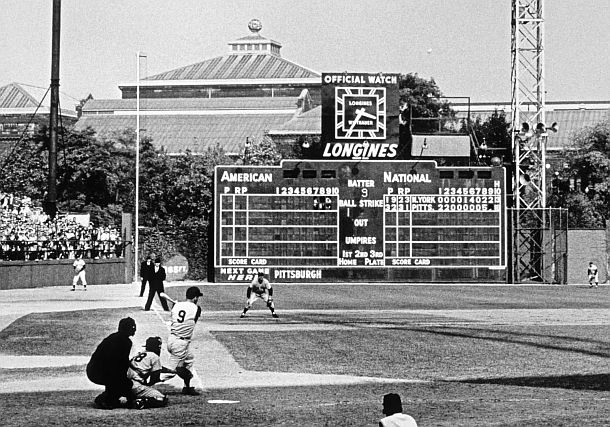
The game went back and forth, and was tied, 9-9, going to the bottom of the 9th inning. On NBC radio, Chuck Thompson, usually the voice of the Baltimore Orioles, said, "Well, a little while ago, when we said this one was going right down to the wire, little did we know." Mazeroski led off, against Yankee pitcher Ralph Terry. His 1st pitch was high, ball 1. Terry threw a 2nd pitch. The time was 3:36 PM. Thompson's call on radio:
Here's a swing, and a high fly ball, going deep to left, this may do it! Back to the wall goes Berra, it is over the fence, home run, the Pirates win!
In case you're curious, the building behind the scoreboard
is the Carnegie Library of Pittsburgh.
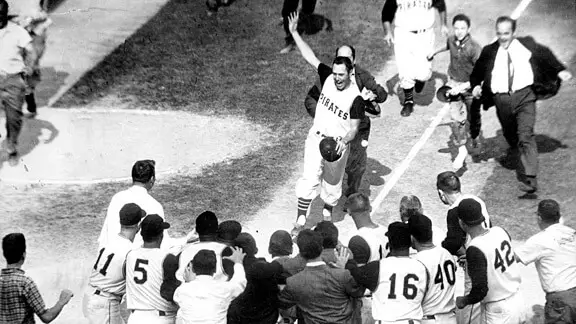
"I don't know it's out," Mazeroski recalled during a Pirates telecast in 2015, 55 years after the fact. "I don’t know it's a home run. But I know I;m going to end up on third if he misplays that ball off the wall. So I;m busting my tail getting around there, and by the time I hit second base, I looked down the line and the fans went crazy. From second base, I didn't touch the ground all the way in."
After pausing to let the cheering be heard, Thompson started again, and was so excited, he got the score wrong at first:
Ladies and gentlemen, Mazeroski has hit a one-nothing pitch over the left field fence at Forbes Field to win the 1960 World Series for the Pittsburgh Pirates by a score of ten to nothing! Once again, that final score, the Pittsburgh Pirates, the 1960 World Champions, defeat the New York Yankees. The Pirates ten, and the Yankees nine! And Forbes Field is an insane asylum!
Mel Allen, so often accused of being a "homer" for the Yankees, called it this way on TV for NBC:
There's a drive into deep left field, look out now! That ball is going, going, gone! And the World Series is over! Mazeroski hits it over the left field fence, and the Pirates win it, 10–9, and win the World Series!
The ball went over Berra's head, at around the 406-foot mark in left field, and landed among the cherry trees in Schenley Park. Mazeroski took off his batting helmet and swung it around as he circled the bases.
The ball was found by Andy Jerpe, 14 years old. Mazeroski would sign the ball for him, but he foolishly used the ball in a neighborhood game, and it was lost. No one knows where it is now. The Pirates don't have it. Neither does the Baseball Hall of Fame.
The Yankees outscored the Pirates 55-27 during the Series, but the Pirates won it, 4 games to 3. Richardson had a Series record 12 RBIs, and remains the only player from a losing side to be named the MVP of a World Series. Mazeroski? He batted .320 in that Series, and that was his 2nd homer in it, for his 5th RBI in it, and he played his usual good games in the field. He got robbed. But I'm sure he'd rather have the title.
Not being old enough to remember 1960, I can hardly begrudge the Pirates that amazing victory. But there are Yankee Fans who are old enough to remember, and it still hurts. It shouldn't: They won the next two World Series, and another seven since. And Mazeroski was always a good guy.
There's a bronze statue of a young Mazeroski -- arms outstretched, cap in his right hand, right leg kicked up behind him -- along the Allegheny River outside PNC Park. The likeness is surrounded by a brick wall that includes an actual section of the outfield wall over which Mazeroski homered; the 406-foot marker is still visible in white.
Another part of Forbes Field's outfield wall still stands in place in Pittsburgh's Oakland neighborhood, just off Roberto Clemente Drive, and there’s a plaque recognizing the spot where Mazeroski homered. Every Oct. 13, the "Game 7 Gang" gathers at that site, listens to the radio broadcast and celebrates the anniversary of Mazeroski's famous home run at exactly 3:36 PM.
"That doesn't happen anywhere else, does it?" Mazeroski said with a smile in February 2020, approaching the 60th Anniversary of the event.
*
He never again batted higher .271. He never again hit more than 16 home runs in a season. He peaked at 82 RBIs in 1966. But it's as a fielder that he became best-known. He led NL 2nd basemen in double plays turned every year from 1960 to 1967. He led them in fielding percentage in 1960, '65 and '66, and retired with a career .983 fielding percentage. He led them in assists 9 times, and led all of the big leagues in 5 of those seasons. He still holds the Major League record for double plays turned by a 2nd baseman, with 1,706.
For the record, the holders at the other positions are: 1st base, Mickey Vernon, 2,044; shortstop, Omar Vizquel, 1,734; 3rd base, Brooks Robinson, 618; catcher, Ray Schalk, 222; center field, Tris Speaker, 146; pitcher, Greg Maddux, 98; right field, Harry Hooper, 86; left field, Joe Vosmik, 23.
Mazeroski was involved in 2 triple plays in his career, in 1966 and 1968. He never hit into one in real life. But on June 27, 1967, at Shea Stadium, he was filmed staging such an event for the film version of The Odd Couple: Just before the regular game, he was filmed batting against Jack Fisher of the Mets. The play required 2 takes, as he hit the 1st ball foul. The point of the scene was that a phone call from Felix Ungar (played by Jack Lemmon) to Oscar Madison (Walter Matthau) in the press box at Shea causes Oscar to miss a triple play that ends the game in victory for the Mets. (Felix's surname was spelled "Ungar" in the play and the film, "Unger" in the TV show.)
Mazeroski and Clemente were the only 1960 Pirates still there when they won the World Series again in 1971. Mazeroski retired after the 1972 season, with a lifetime batting average of .260, and 2,016 hits including 138 home runs.
For many years, he was considered one of the best players not in the Baseball Hall of Fame. The argument for him was that the best-fielding player, ever, at every position should be in, and he was the best-fielding 2nd baseman ever. The argument against him is that he wasn't good enough of a hitter, and that nobody's defense made enough of a difference to put him over the top. In 2001, he was finally elected.
People who were against his election to the Hall have claimed that the real reason he's in is that home run. I would make the exact opposite argument:
I think the home run changed people's perception of him. Think about it: The 1st thing that comes to mind when you hear his name is, "He hit the home run that won the 1960 World Series." Imagine that the Series had ended any other way, even one favorable to the Pirates. Suppose Mazeroski had led the inning off with a single, and scored the title-winning run on somebody else's hit. Then, the 1st thing that would come to mind when you hear his name is, "He's the greatest-fielding 2nd baseman who ever lived." He probably would have gotten in much sooner.
At a still-standing, ivy-covered piece of the
Forbes Field outfield wall, October 13, 2010,
the 50th Anniversary of the home run.
The Pirates retired his Number 9, and dedicated a statue of him outside PNC Park, depicting him running around the bases, swinging his batting helmet around. They also elected him to their team Hall of Fame. He was also elected to the National Polish-American Sports Hall of Fame.
He retired to a suburb of Pittsburgh. In 1987, he ran for the Democratic Party's nomination for Westmoreland County Commissioner, but lost. Eventually, he and his wife the former Milene Nicholson, moved to Panama City, Florida, enabling him to go down to Bradenton to serve as a Spring Training instructor for the Pirates. They had 2 sons: Darren, who became a college baseball coach; and Dave, an atmospheric scientist.
On October 23, 1993, Joe Carter became the 2nd player to end a World Series by hitting a home run, for the Toronto Blue Jays over the Philadelphia Phillies, at the SkyDome (now named the Rogers Centre) in Toronto. However, that was in a Game 6, not a Game 7. It appears that Mazeroski and Carter never met.
Bill Mazeroski died yesterday, February 20, 2026, in the Pittsburgh suburb of Landsale, Pennsylvania. He was 89 years old.
With his death, there are 3 surviving players from the 1960 World Champion Pittsburgh Pirates: Bob Skinner, Vernon Law and Bennie Daniels.
There are 4 surviving players who played in Game 7 of that World Series: Skinner and Law of the Pirates, and Bobby Richardson and Tony Kubek of the Yankees. Kubek, famously, had to leave the game when a ground ball hit a pebble in Forbes Field's poor infield and struck him in the throat, helping to keep the Pirates' 8th-inning rally alive, and make Mazeroski's 9th-inning heroism possible.
And there are 11 surviving players from the 1971 World Champion Pittsburgh Pirates: Al Oliver, Steve Blass, Manny Sanguillén, Bob Robertson, Gene Alley, Richie Hebner, Luke Walker, Bob Johnson, Milt May, Dave Cash and Carl Taylor.
How did Mazeroski want his career to be remembered: For his Hall of Fame defense, or for hitting arguably the greatest home run of all time?
"Oh," he said, laughing, "I'll take the home run."
If it had been me, so would I.




No comments:
Post a Comment