
Before Elroy Face, relief pitching was a thing. But, aside from the New York Yankees, hardly anybody used it well. The man known as "The Baron of the Bullpen" helped to change that.
Elroy Leon Face was born on February 20, 1928 in Stephentown, New York, outside Albany. He learned to pitch by throwing stones at windows, breaking them. He was too young to be drafted into World War II, but served in the U.S. Army in 1946 and 1947. Before the 1949 season, the Philadelphia Phillies signed him. Despite a sensational minor league record, both starting and relieving, he was made eligible for the minor league draft. After the 1950 season, he was drafted by the Brooklyn Dodgers. After the 1952 season, he was drafted again, by the Pittsburgh Pirates.
The Pirates went 42-112 in 1952, one of the worst seasons in major league history. Singer-actor Bing Crosby was a part-owner, and, that year, in the film The Road to Bali, when Dorothy Lamour asked him, "Do they still have pirates in America?" he answered, "Yes, but they're usually in the basement."
It was the year that general manager Branch Rickey, having had so much success running the Dodgers, and before that running the St. Louis Cardinals, traded away the team's best player, Ralph Kiner, to save money and spend it on prospects, telling the best slugger in the National League, "We finished 8th with you, and we can finish 8th without you." It was the year that Ron Necciai struck out 27 batters and pitched a no-hitter for their Class D farm team, and then struck out 24 in a 2-hitter in his next start, only to be immediately called up to the Pirates, and go 1-6 with a 7.08 ERA in 55 innings, and never appeared in the major leagues again.
It was the year of which catcher Joe Garagiola said, "In an 8-team League, we should have finished 9th." Garagiola built his broadcasting career on telling stories on 3 subjects: Growing up in St. Louis across the street from Yogi Berra, playing on the Cardinals with Stan Musial, and the ineptitude of the early 1950s Pirates.
"Roy" Face made his major league debut on April 16, 1953, and he got shelled, allowing 3 runs on 4 hits, getting only 1 out. It was a wild game at Forbes Field in Pittsburgh, and the Pirates beat the Chicago Cubs, 14-12. Wearing Number 26 and using a sidearm righthanded delivery, Face went 6-8 that season, mostly in relief.
He spent the 1954 season with the Pirates' Class AA team, the New Orleans Pelicans. The Pirates wanted him to learn an off-speed pitch. The one he chose was forkball, in which the pitcher holds the ball in the middle with his index and middle fingers. It was a precursor to the split-fingered fastball, first used by Bullet Joe Bush with the 1910s Boston Red Sox. Face learned it from Joe Page, the once-great Yankee reliever, who was playing out the string with the Pirates.
Face was called back up for 1955, and became the best relief pitcher in the National League. He led the NL in games pitched in 1956 and 1960; in games finished in 1958, 1960, 1961 and 1962; and, though it wouldn't be an official statistic until 1969, in saves in 1958, 1961 and 1962. He made the NL All-Star Team in 1959, 1960 and 1961.
In 1959, he had one of the greatest seasons any pitcher has had in the post-1920 Lively Ball Era. He went 18-1, his .947 winning percentage still a record for any pitcher with at least 13 decisions. His only loss was to the Los Angeles Dodgers on September 11. His ERA was 2.70, and he had 10 saves. He finished 7th in the voting for NL Most Valuable Player.
In 1960, he was a less-impressive 10-8, but helped the Pirates win the Pennant for the 1st time in 33 years. Against the Yankees in the World Series, he saved Games 1, 4 and 5, becoming the 1st pitcher to save 3 games in a single Series. But he pitched 3 innings in Game 7, blowing a save. Nevertheless, the Pirates won, 10-9, on Bill Mazeroski's home run in the bottom of the 9th inning, for their 1st World Championship in 35 years.
In 1961, Face went 6-12, but saved 17. In 1962, he set a major league record with 28 saves. He struggled a bit over the next 2 seasons, but rebounded over the next 3. In 1967, he surpassed Warren Spahn with the most games pitched in NL history.
Late in the 1968 season, his contract was purchased by the Detroit Tigers. However, at age 40, he made only 2 appearances, on September 2 and 3, and did not appear again. He was not included on the World Series roster, though the Tigers did go on to win. The Tigers released him just before the next season started. He was signed by the expansion Montreal Expos, appearing in 44 games, going 4-2 with 5 saves, but was released after his appearance on August 15, 1969, the weekend of Woodstock.
He never appeared in another major league game, although he pitched in 8 games for the Hawaii Islanders of the Class AAA Pacific Coast League in 1970. He retired with 846 games in NL play, a record which stood until a later Pirate reliever, Kent Tekulve, surpassed him in 1986. His record was 104-95, with a 3.48 ERA, and 191 saves, then 2nd only to the still-active Hoyt Wilhelm. As an NL record, it stood until 1982, surpassed by Bruce Sutter.
Although he has not been elected to the Baseball Hall of Fame, and the Pirates have not retired his Number 26, they have elected him to their team Hall of Fame.
As generations of men in his family had before him, he worked as a carpenter in the off-season. For many years, he was the carpentry foreman at a State psychiatric hospital near his home in the Pittsburgh suburb of North Versailles, Pennsylvania.
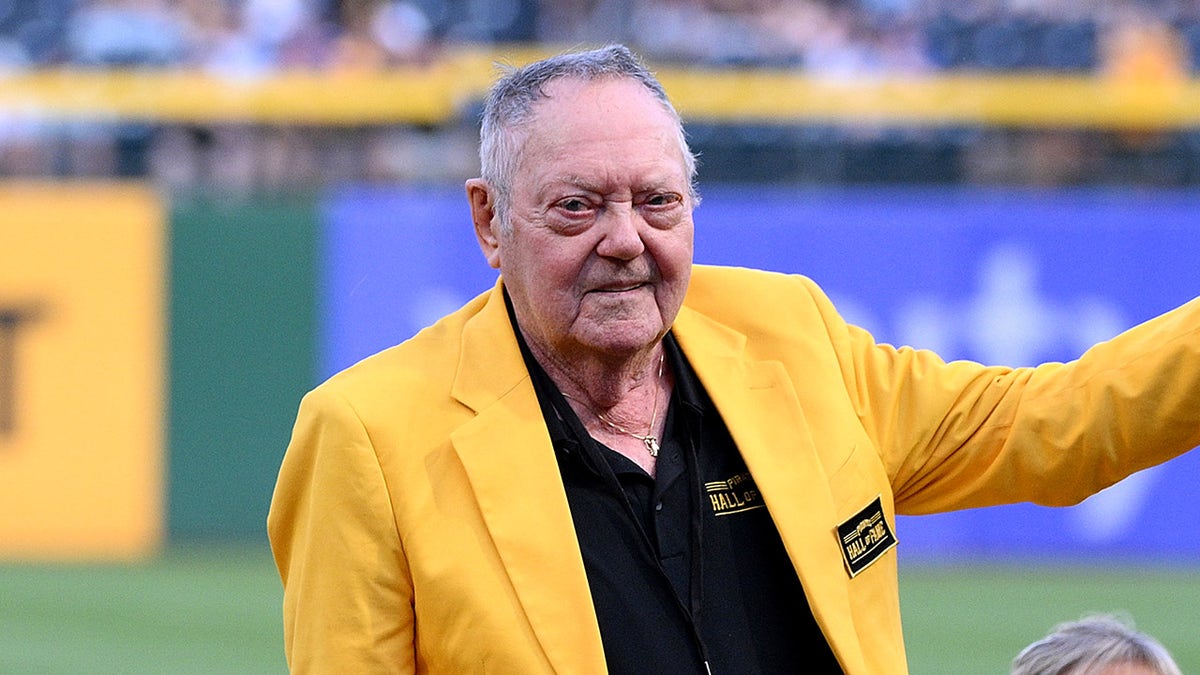
He died this past Thursday, February 12, 2026, at home in North Versailles. He was 97 years old. He was survived by his daughters Michelle and Valerie, his son Elroy Jr., and his sister Jacqueline. He was predeceased by his wife, the former Roberta Williams, known as Bo Face.
With his death, there are now 4 surviving players from the 1960 World Champion Pittsburgh Pirates: Bill Mazeroski, Bob Skinner, Vernon Law and Bennie Daniels.


1 comment:
Wish he lived for two more years.
R.I.P.
Post a Comment