Sunday, July 7, 2024

July 7, 1974: The Netherlands' Lost Final

Johan Cruyff and Franz Beckenbauer in the Final.
The fact that the Dutch wore a bright color
and the Germans wore black and white
seemed symbolic of each country's soccer style.

July 7, 1974, 50 years ago: Rarely is a sports competition remembered less for the team that won than for the team, or one of the teams, that lost. The 1974 World Cup was one of them.

The tournament was being held in West Germany, and the Dutch team seemed to have the best of all Dutch worlds:

From AFC Ajax, of Amsterdam (currently or formerly), came forwards Johan Cruyff and Piet Kiezer, midfielder Johan Neeskens, right wing Johnny Rep centerback Arie Haan, right back Wim Suurbier, and left back Ruud Krol.

(Note: Since his name was usually written as "Cruyff" for the English-speaking world, that's how I'm going to spell it in this post, even though it was always written as "Cruijff" in his homeland.)

* From Feyenoord, of Rotterdam, who formed the country's greatest rivalry with Ajax, came goalkeeper Eddy Treijtel; defenders Wim Rijsbergen, Wim Jansen, Rinus Israel and Harry Vos; and midfielders Willem van Hanegem and Theo de Jong.

* From PSV Eindhoven came defender Pleun Strik and twin brother midfielders René and Willy van de Kerkhof.

* From Twente Enschede came goalkeeper Piet Schrijvers and defender Kees van Ierssel.

* From FC Amsterdam came starting goalkeeper Jan Jongbloed.

* From Belgian club Anderlecht came forward Rob Rensenbrink.

* And from Anderlecht's arch-rivals, Club Brugge, came midfielder Ruud Giels. While Belgium is mostly divided among ethnic French (Wallonia) and ethnic Dutch (Flanders), both Anderlecht and Brugge are on the Dutch side of the country.

The Netherlands -- often incorrectly called "Holland," but that name only refers to 2 provinces of the kingdom, albeit those containing Amsterdam and Rotterdam, the 2 largest cities -- defeated Uruguay 2-0, drew 0-0 with Sweden, and demolished Bulgaria 4-1 to advance to the 2nd Group Stage. There, they beat Argentina 4-0, East Germany 2-0, and defending champions Brazil 2-0.

It was beginning to look easy. They had played 6 games, and had an aggregate advantage of 14-1. With their flowing football, flowing hair and bright orange uniforms, they had captivated the entire world -- especially since this was, for many countries, still the early days of color television.

On July 7, 1974, at the Olympiastadion in Munich, the dream seemed to be coming true. The Dutch lined up for the Final against a West Germany side dominated by players from Bundesliga winners Bayern Munich, including defender Franz Beckenbauer, goalie Sepp Meier and forward Gerd Müller. In only the 1st minute of the game, Crujiff advanced into the penalty area, and Bayern's Uli Hoeness brought him down. A penalty was rightly awarded, the 1st ever awarded in a World Cup Final, and Neeskens converted to give the Dutch a lead before 2 minutes had passed.
The Olympiastadion in Munich

But the Dutch may have scored too soon, and rested on their laurels. The Germans fought back, and got a legitimate penalty of their own in the 25th minute. Müller scored in the 43rd to give West Germany the lead. The half soon came, and Cruyff argued with the referee, Englishman Jack Taylor, and was booked for this.

The Dutch came a little unglued, and although they fell no further behind, neither did they get any closer. West Germany won, 2-1. It was not a home soil victory: Indeed, in the 2nd half, they had a goal waved off for offside, and were denied what looked like another legitimate penalty.

Playwright Johan Timmers wrote, "The defeat of 1974 is the biggest trauma that happened to Holland in the 20th Century, apart from the floods of 1953 and World War II." Historian Bastiaan Bommeljé wrote, "It should have been the epiphany of the sixties. Instead it turned out to be its requiem. The team was a product of an age that had put all its money on youth and the promise of youth and the idea that good times will be here when a new generation takes over."

In his book Brilliant Orange: The Neurotic Genius of Dutch Soccer, David Winner wrote, "The most talented group of footballers their country -- almost any country -- ever produced blew it. How? Why? It's a riddle wrapped in a mystery inside an enigma." He cited a 20th Anniversary survey that showed that nearly everyone old enough to watch remembered exactly where they were, and, on that basis, he compared it to the assassination of President John F. Kennedy in 1963.

Despite the defeat in the Final, Cruyff, since 1973 playing his "club football" for FC Barcelona in Spain, was awarded the Ballon d'Or (Golden Ball), as World Player of the Year, for the 3rd time in the last 4 years. There was no doubt that he was now the best player in the world, even if he couldn't quite get his country to the greatest prize of all.

In 1977, Cruyff announced his retirement from international soccer, refusing to play in the 1978 World Cup in Argentina. For 30 years, it was believed that he was protesting the military dictatorship that took over Argentina in 1976, after the country was awarded the tournament. But in 2008, he revealed the truth: There was a threat against his family, and it got into his head, and he didn't think he would be at his best for the tournament.

Again, the Netherlands reached the Final, even without Cruyff. This time, it was a home soil victory, as the Argentines' mere qualification for the Final under the system then in place was dubious, and they scored 2 dubious goals in extra time to win 3-1. There were some Dutch players who were quoted as saying they didn't know if they would leave the stadium alive if they won.

Cruyff has been called the greatest player that Europe has ever produced. However, the lack of a World Cup sticks out on his resume, as it does for players like Puskás, Argentina's Di Stéfano and (so far) Lionel Messi, France's Raymond Kopa, Wales' John Charles, Northern Ireland's George Best, Italy's Paolo Maldini, and Portugal's Eusébio and (so far) Cristiano Ronaldo. (UPDATE: In 2022, Argentina, with Messi, won the World Cup.)

For some of those players (particularly Charles and Best), it's because their countrymen were not up to their level. For Maldini, it was down to luck: He was considered too young to make the national side in 1982 and too old in 2006, despite his 25 years of top-flight football.

But the Netherlands has had so much talent, yet their only major tournament win has been Euro 88. They would lose the World Cup Final again in 2010, to Spain. No other country that's been in at least 3 Finals has failed to win at least 1.

One more note: The Olympiastadion in Munich is 1 of 3 stadiums to have hosted an Olympic Games, a World Cup Final and a UEFA European Cup/Champions League Final. The others are the Olympiastadion in Berlin and the old Wembley Stadium in London. In a few days, the Stade de France outside Paris will make it 4. 

Friday, July 5, 2024

The Top 10 Holiest Sites In Rock and Roll

July 5, 1954, 70 years ago: Elvis Presley makes his 1st professional recording, a cover of "That's All Right" by Arthur "Big Boy" Crudup, at the Memphis Recording Service, home of Sun Records.

Yes, 70 years ago. A lifetime.

Top 10 Holiest Sites In Rock and Roll

Note that all but one of these sites is in the United States of America.

10. The Cleveland Arena, Cleveland, Ohio. Built in 1937, it was home to various professional sports teams, including serving as the original home of the NBA's Cleveland Cavaliers from 1970 to 1974.
On March 21, 1952, it was the site of the Moondog Coronation Ball, considered the first rock and roll concert, organized by disc jockey Alan Freed. The concert was shut down after the first song by fire authorities due to overcrowding. It was estimated 20,000 people were in the arena or trying to enter it, when the capacity was roughly half that.

Although the 1988 film Heartbreak Hotel, starring Keith David as Elvis, depicts a 1972 concert at the Cleveland Arena, Elvis never performed there. He did perform at the Public Auditorium, and at the Coliseum in suburban Richfield, but never at the Arena. Nor did The Beatles, who did also perform at the Public Auditorium.

The Arena was demolished in 1977. The headquarters of the Cleveland Chapter of the American Red Cross now occupies the site. 3717 Euclid Avenue, 2 miles east of Public Square. Local bus service is available.

Honorable Mention in the same city: Because of that first concert, the Rock and Roll Hall of Fame Foundation awarded Cleveland the site for its physical location and museum. 1100 East 9th Street. It is part of the lakefront entertainment district that also includes Cleveland Browns Stadium, which was built on the site of Cleveland Municipal Stadium, part of The Beatles' 1966 tour. 100 Alfred Lerner Way, 2 blocks west, with the Great Lakes Science Center in between. All reachable by bus, and the North Coast station of Cleveland's rapid-transit rail system.

WJW, with Freed from 1951 to 1954, operated out of what's now the National City Bank Building, 619 Euclid Avenue, downtown.

9. Yasgur's Farm, Bethel, New York. The dairy farm had a natural bowl, making it as close to an ideal amphitheatre location as the promoters of the Woodstock Music & Art Fair, already denied a permit by the Town of Woodstock itself, were going to get. The Museum at Bethel Woods is on the site, and pays tribute to the festival of August 15 to 18, 1969.
200 Hurd Road, 105 miles northwest of Midtown Manhattan. You'd have to drive: The closest public transportation is bus service to Monticello, 13 miles away. At least, unlike that weekend, the New York State Thruway is unlikely to be closed, man.

The actual Town of Woodstock is about 60 miles to the northeast. Another 5 miles to the northeast of that is "Big Pink," the house where Bob Dylan convalesced from his 1966 motorcycle crash, and where The Band recorded, both with and without him. 56 Parnassus Lane, Saugerties, New York, 108 miles north of Midtown Manhattan. Again, forget about public transit.

8. The Fillmore, San Francisco, California. There were 2 separate venues used by promoter Bill Graham to show off the psychedelic sound of the City By the Bay. The original, built in 1912 as Majestic Hall, became the Fillmore Auditorium in 1954. Graham staged shows there from December 1965 to July 1968.
He moved to the former El Patio Ballroom, because it was twice as large (3,000 seats) and, in his opinion, in a better neighborhood. He renamed it the Fillmore West, as he was now operating a Fillmore East in New York. He closed this venue on the 4th of July 1971, leading singer Don McLean to write, "I went down to the sacred store, where I'd heard the music years before, but the man there said the music wouldn't play."

Since 2007, the original Fillmore has been operated by Live Nation. 1805 Geary Blvd. The Fillmore West became an auto dealership, but was renovated in 2018 and turned back into a music venue. 10 South Van Ness Avenue.

Honorable Mention in the same metropolitan area: Golden Gate Park, on the west side of the city, was the home of the Human Be-In in 1967, and other Hippie-related events. The Park includes Kezar Stadium. Now a 10,000-seat high school football stadium, there was previously (1925-1989) a 60,000-seat stadium on the site. The original home of the NFL's San Francisco 49ers, it hosted the SNACK Benefit in 1975. 670 Stanyan Street.

Stanyan Street is the eastern edge of Golden Gate Park. Haight Street extends eastward from the park. Four blocks to the east is the intersection of Haight and Ashbury Street, which became the center of the Hippie community. 1500 Haight, and 600 Ashbury.

The Cow Palace, formerly a nickname for the Grand National Livestock Pavilion, has been the Bay Area's main concert venue since it opened in 1941. It's also a former home of the NBA's Golden State Warriors and the NHL's San Jose Sharks. 2600 Geneva Avenue in Daly City, just south of the City Line.

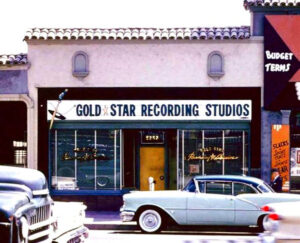
7. Gold Star Studios, Los Angeles, California. From 1950 to 1984, this place, owned by David S. Gold and Stan Ross -- named for GOLD and STA(n) R(oss) -- saw the recording of enough hit records to fill a jukebox.
The studio was renowned for its unique custom-designed recording equipment and its echo chambers, all designed and built by Gold, utilized heavily by producers, most notably Phil Spector for his "Wall of Sound" (and, since Sonny Bono was one of his musicians, Sonny & Cher recorded there), and by Brian Wilson for the Beach Boys' hits. Also recorded there: "Summertime Blues" by Eddie Cochran; "Tequila" by The Champs, "The Chipmunk Song," "Windy" by The Association, and "Drift Away" by Dobie Gray. 6252 Santa Monica Boulevard, in the Hollywood area.

Honorable Mention in the same metropolitan area: I've got to mention the studios of the "Big Three" networks. NBC: 3000 W. Alameda Avenue, Burbank, home to Rowan & Martin's Laugh-In, Elvis Presley's 1968 "Comeback Special," and, from 1972 to 2014, The Tonight Show. CBS: 7800 Beverly Blvd., Hollywood. ABC: 4151 Prospect Avenue, Hollywood, home to American Bandstand from 1964 to 1989.

The Avalon Hollywood was known as the El Capitan Theatre in 1952, when Richard Nixon made his "Checkers Speech" there. From 1964 to 1970, it was known as the Hollywood Palace, and ABC taped The Hollywood Palace there, as their West Coast, Saturday night, previously-recorded answer to CBS' East Coast, Sunday night, live Ed Sullivan Show. 1735 N. Vine Street, just a mile south of the site of Gold Star.

The Hollywood Bowl has been a major concert venue since it opened in 1922, including The Beatles playing there in 1964 and 1965. 2301 N. Highland Avenue.

And speaking of Bandstand...

6. ABC Studio, Philadelphia, Pennsylvania. The Alphabet Network's ABC affiliate, Channel 6, WFIL from 1947 to 1971, and WPVI since, taped American Bandstand at this studio from 1952 to 1964, just a few weeks after moving from every Monday to Friday afternoon to Saturday afternoons. The building is still there, at 4548 Market Street, although Channel 6 has moved most of its operations out to City Line Avenue, near the campus of St. Joseph's University.
Honorable Mention in the same metropolitan area: Sigma Sound Studios was the home of "The Sound of Philadelphia," produced by Philadelphia International Records, the music empire built in the late 1960s and cranking out a bunch of hits in the 1970s, led by songwriters Kenny Gamble & Leon Huff. Opening in 1968, the building closed in 2014, and the current plan is to turn it into residential use. 212 N. 12th Street.

The Spectrum was the site of many big concerts from its 1967 opening until its 2010 closing. A smaller venue named Xfinity Live! is now on the site. 1100 Pattison Avenue, across from Citizens Bank Park.

The Convention Hall of the Philadelphia Civic Center, built in 1931, was home to the Philadelphia Warriors from 1952 to 1962, the 76ers from 1963 to 1967, several political conventions (Democratic and Republican), and a few major concerts, including both the Beatles and the Stones on early tours. Torn down in 2005, the Perelman Center for Advanced Medicine, part of the University of Pennsylvania Hospital complex, is on the site now. 3400 Civic Center Blvd.

John F. Kennedy Stadium, formerly Municipal Stadium, built in 1926, hosted The Beatles in 1966, the U.S. version of Live Aid in 1985, and many other concerts before it was closed for safety reasons in 1989, and demolished in 1992. The new arena for the 76ers and the Flyers, currently named the Wells Fargo Center, is on the site now. 3601 S. Broad Street. From 1971 to 1992, Veterans Stadium, The Spectrum and JFK Stadium were all in a line, north-to-south. All have since been replaced.

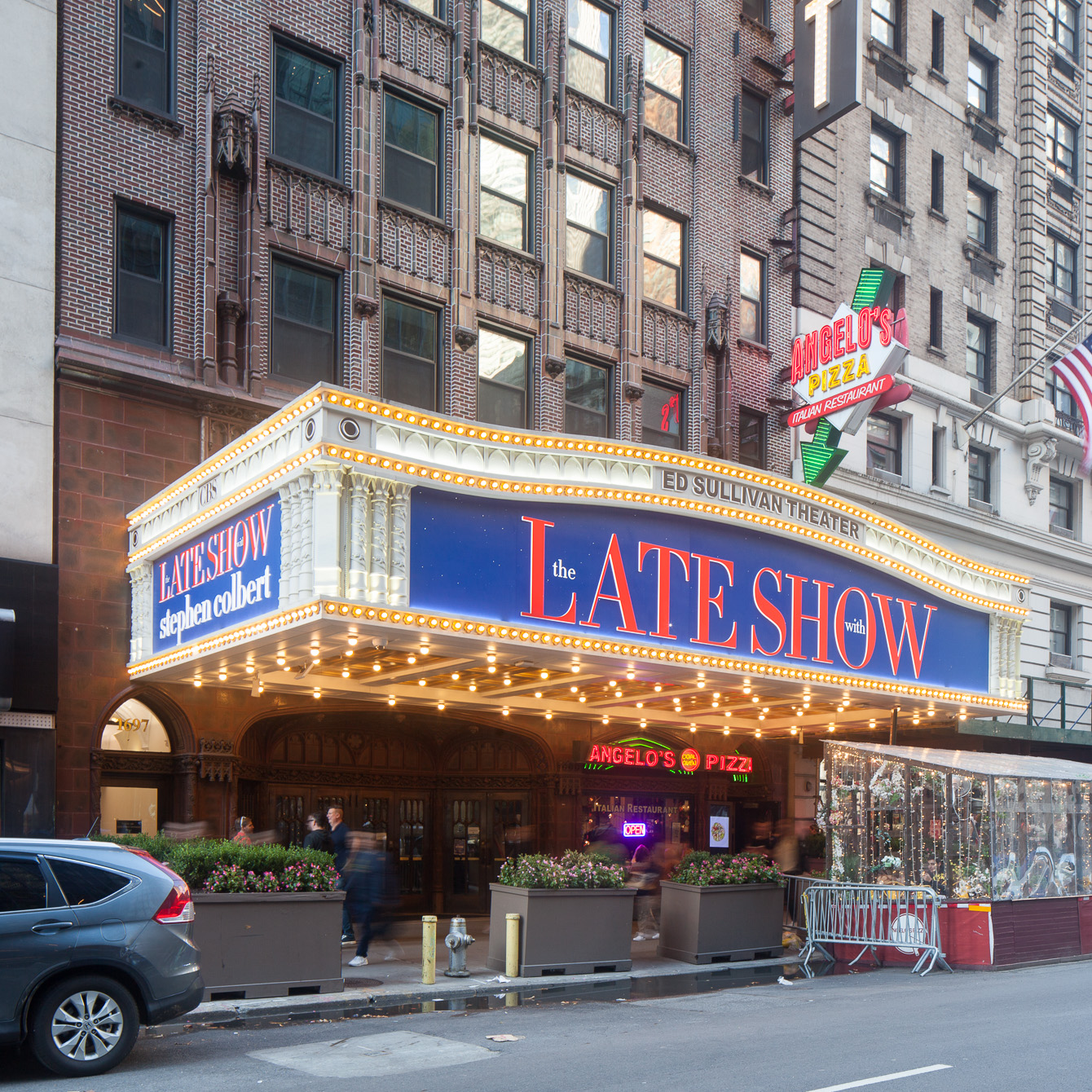
5. The Ed Sullivan Theater, New York, New York. The Ed Sullivan Show aired on CBS from 1948 to 1971, at the venue known as CBS Studio 50 until 1967. Ed was progressive in some ways, willing to air rock and roll acts, and black performers of all kinds, when most variety-show hosts wouldn't.

Ed would be best known for airing the 1st live U.S. performance of The Beatles on February 9, 1964. He also helped to humanize Elvis Presley in 1956 and 1957. Controversial performances would be put on by Bo Diddley in 1955, Buddy Holly in 1958, and The Rolling Stones and The Doors in 1967. 1697 Broadway, between 53rd and 54th Street in Midtown Manhattan. It now hosts The Late Show with Stephen Colbert.
Honorable Mention in the same city: RCA Studios, 155 East 24th Street, in the Gramercy Park neighborhood of Manhattan. Not only were some of Elvis Presley's earliest hits recorded here, but so were the following: The 1st jazz recording, "Livery Stable Blues" by The Original Dixieland Jazz Band in 1917; Hoagy Carmichael's original 1930 version of "Georgia On My Mind"; Artie Shaw's 1938 version of "Begin the Beguine"; Glenn Miller's recordings of "In the Mood" and "PEnnsylvania 6-5000"; and the Isley Brothers' original 1959 version of "Shout." A rather ordinary-looking apartment building is there now.

The Pythian Temple, at 135 West 70th Street, between Columbus (9th) Avenue and Broadway, on the Upper West Side of Manhattan, was where Bill Haley & His Comets recorded "Rock Around the Clock" for Decca Records in 1954. The building is still there, but has been converted into condominiums, as "The Pythian."

Columbia Studios, 799 7th Avenue at 52nd Street, in the Theater District. It was the recording site for Bob Dylan, Simon & Garfunkel, and Billy Joel. It was demolished in 1983, and the Equitable Building went up on the site.

The Apollo Theater, 253 West 125th Street, in Manhattan's Harlem. If James Brown's 1962 show, recorded for his album Live at the Apollo, was the only rock and roll (or rhythm & blues) show held there, that would be enough to include it here.

Shea Stadium, where stadium concerts as we know them were invented, by The Beatles, on August 15, 1965. Other notable shows: Grand Funk Railroad in 1971, The Who with The Clash as the opening act in 1982, The Police in 1983, The Rolling Stones in 1989, Elton John and Eric Clapton in 1992, and Billy Joel playing the last show there in 2008.

The Fillmore East, 105 2nd Avenue, at East 6th Street. Formerly part of the Yiddish theater circuit, Bill Graham staged concerts there from March 8, 1968 until June 27, 1971. A bank is on the site now.

4. Chess Records, 2120 South Michigan Avenue, Chicago, Illinois. Not just home to Chuck Berry and Bo Diddley laying a big part of the foundation of rock and roll, but also to blues legends Muddy Waters (McKinley Morganfield), Howlin' Wolf (Chester Burnett) and Willie Dixon. One of the Stones' early songs was an instrumental titled "2120 South Michigan Avenue."
Honorable Mention in the same city: The site of Comiskey Park, site of a 1965 Beatles concert, and "Disco Demolition Night" in 1979. 324 West 35th Street, across from the current home of the Chicago White Sox, now named Guaranteed Rate Field, at 333 West 35th.

3. Hitsville U.S.A., 2648 Berry Gordy Jr. Boulevard (West Grand Boulevard), Detroit, Michigan. It's where Gordy established "the Motown Sound." Now a museum.
Honorable Mention in the same city: Pretty much every place the NBA's Pistons and the NHL's Red Wings played hosted big concerts. The Olympia Stadium, at 5920 Grand River Avenue, is gone now. So is the Joe Louis Arena, 19 Steve Yzerman Drive, on the riverfront. But next-door to the site of The Joe, Cobo Hall, now Huntington Place, still stands, at 1 Washington Blvd. In suburban Royal Oak, the Royal Oak Music Theatre opened in 1928, and has been a rock landmark since 1976. 318 W. 4th Street.

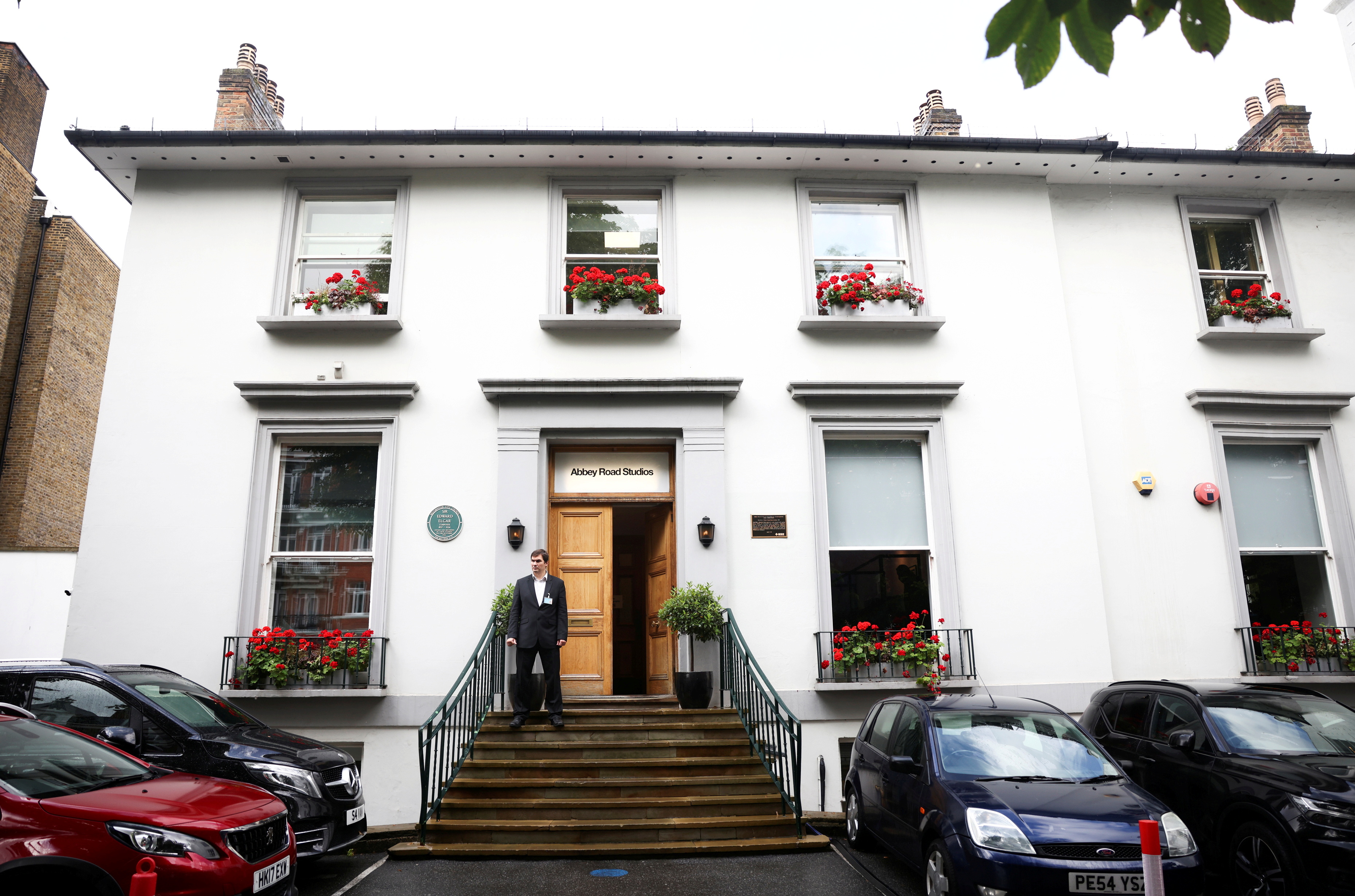
2. Abbey Road Studios, 3 Abbey Road, London, England. Where The Beatles recorded. The crosswalk from the cover of the Abbey Road album is right there, in front of Abbey House, at 1A Abbey Road.
Honorable Mention in the same city: Marylebone Station, where the opening scene of A Hard Day's Night was shot, Melcomb Place at Harewood Avenue; the Royal Albert Hall, Kensington Gore; Wembley Stadium. The Scala Theatre, site of the TV studio at the end of A Hard Day's Night, was at 21 Tottenham Street, but was demolished in 1969.  

But rock and roll was invented in America, if not (quite) at the location I'm about to mention, so I had to choose an American location for Number 1:

1. Sun Records, 704 Union Avenue, Memphis, Tennessee. It's a museum now, and that's all right, now, mama, any way you do.

Honorable Mention in the same city: Graceland, Elvis' home, 3764 Elvis Presley Boulevard (Bellevue Boulevard until 1972), a.k.a. U.S. Route 51. It's in the Southaven section of town, south of downtown, actually closer to the Mississippi State Line than to downtown Memphis. Elvis bought it because it was set back from the road, into the woods, and thus isolated. It is not isolated anymore. The whole area has become like a Six Flags theme park.

American Sound Studios, 827 Thomas Street. Elvis went to this studio, run by Chips Moman, to record his big singles of his early Vegas years, including "Suspicious Minds." Others recording here include: Aretha Franklin, Bobby Womack, Wilson Pickett, Joe Tex, Merrilee Rush, The Box Tops, B.J. Thomas, and Dusty Springfield for her album Dusty In Memphis.

July 5, 1954: Elvis Presley's 1st Recording Session

July 5, 1954, 70 years ago: Elvis Presley makes his 1st professional recording, a cover of "That's All Right" by Arthur "Big Boy" Crudup.

At the time, Elvis was a 19-year-old kid with a high school education, driving a truck for Crown Electric Company of Memphis, Tennessee, where he and his family, previously from Tupelo, Mississippi, had lived since he was 13.

He wanted to be a singer. He admired gospel singers, both white and black. He admired rural singers, both white men singing "country and western music" and black men singing "the blues." He admired pop singers, in particular Dean Martin, one of the biggest stars in America in 1954.

Elvis wasn't especially ambitious -- not yet, anyway. He just wanted to make enough money to get himself and his parents, Vernon and Gladys, out of poverty. He had been born in what was known as a "shotgun shack," and now they were living in what we in the Northeast would charitably call "garden apartments," but, though all-white, as Tennessee was very much racially segregated, it was definitely a ghetto.

So Elvis did have an ambition, if not an especially big one. What he needed was someone to recognize his talent.

*

In 1950, Sam Phillips opened the Memphis Recording Service, at 706 Union Avenue. It was a studio, not a company producing records. In 1951, he produced "Rocket 88," credited to Jackie Brenston and His Delta Cats. This was an all-black band playing what was then being called "race music," but would soon be called "rhythm and blues," or "R&B." (In contrast, people began calling "Country and Western" music "C&W.")

In fact, the band was actually Ike Turner and His Kings of Rhythm, for whom Brenston was the lead singer. Yes, that Ike Turner, the one who later discovered, trained, renamed, married and abused Tina.

There is dispute as to what was "the first rock and roll record." "Rocket 88" is a frequently-named contender, and it was soon recorded by a white band, The Saddlemen, and became a minor hit. The leader and lead singer of The Saddlemen was Bill Haley, who named his next band The Comets, and helped move the music that Cleveland disc jockey Alan Freed had named "rock and roll" forward tremendously.

The Brenston version of "Rocket 88" made Phillips enough money to found a record label for his studio, Sun Records. Some of the biggest names in Memphis, already a great music city, black and white alike, came to him to record. Sam didn't care: The only color he cared about was green. Money.

Sam was ambitious. He said, "If I can find me a white boy who can sing like a black man, I could make a billion dollars." He really did say, "billion," with a B. To put that in perspective: With inflation factored in, $1 billion in 1954 would be worth about $10.9 billion in 2022. We're not quite talking Bill Gates money, but we are talking money that, to that point, very few Americans had reached. The Rockefellers. The Fords. The Mellons. Maybe a few other families.
And Sam was careful in his terminology. Not because he was tired of hearing grown men called "boy" because they were black (although that may also have been true), but because he thought it would be easier to sell records made by a white teenager who had the voice and feeling -- it would later be called "soul" -- of a mature black man.

So Sam had an especially big ambition. What he needed was someone to fulfill it.

*

This is not 1954. Most of you have heard of Elvis Presley. Some of you, but far fewer, have heard of Sam Phillips. That is unfortunate, given the jumpstart Sam gave to rock and roll. Even fewer of you have heard of Arthur "Big Boy" Crudup. And that is a tragedy.

Crudup was born in Mississippi in 1905. By 1939, he was barely getting by as a street singer, when he was discovered. Over the 1940s, he had a few hits with his blues songs. One, recorded in 1946, was "That’s All Right." This song became popular in the South, with both black bluesmen and white country singers. In 1954, it became the 1st song professionally recorded by Elvis. Elvis later recorded another of Crudup' songs at Sun Records, "My Baby Left Me."
By the time Elvis started recording, Crudup had stopped, because he wasn’t getting his royalties: "I realized I was making everybody rich, and here I was, poor.” He died in 1974, at 68, having won a case in court, but getting very little of what he was now legally owed. Today, when he is remembered at all, it is for writing Elvis’ first song.

*

On July 18, 1953, Elvis went to the Memphis Recording Service, because he wanted to hear how he sounded. This was the equivalent of making an audition tape. He paid $3.98, about $43.57 in today's money. About half a day's pay. This allowed him to record a two-sided record.

One side was "My Happiness." Written in 1933, it didn't become a hit until 1948, when Ella Fitzgerald recorded it. It became a hit again in 1958, for Connie Francis.

The other side was "That's When Your Heartaches Begin." Written in 1937, it became a hit in 1941, when it was recorded by the all-black vocal group The Ink Spots. After becoming famous, Elvis would record a much more professional version, which in 1957 became the B-side to "All Shook Up."

So Elvis recorded these 2 songs. Nothing happened: Sam didn't notice either recording. On January 4, 1954, Elvis went back to Sun, and recorded a 2nd acetate: Hy Heath's "I'll Never Stand in Your Way" and Fred Rose's "It Wouldn't Be the Same Without You." Still, nothing happened. At some point, Elvis made another recording, a 1918 song by Nora Bayes titled "Without You." (Not to be confused with "It Wouldn't Be the Same Without You," or with the later Harry Nilsson song titled "Without You.")

On May 26, Sam heard that record, and bought it for a quarter -- with inflation, probably the best $2.72 anybody's ever spent. But the name of the singer wasn't on it. He took it back to Sun, and played it for his assistant, Marion Keisker. She recognized the voice as "the young truck driver." They checked their records (books, not platters), and found Elvis. Marion called him, and said Sam wanted him to come down.

On the 4th of July, Sam took Elvis to the home of Winfield Scott "Scotty" Moore, a local guitarist, and, backed by Moore and standup bass fiddle player Bill Black, auditioned him. Neither Scotty nor Bill was especially impressed with Elvis, but they agreed to meet at the Sun studio the next day, to see what they could do.

The first song they tried was "I Love You Because," written in 1949 by country singer Leon Payne, and a hit for pop singer Eddie Fisher in 1952. They weren't impressed. They tried a few other country songs, but nothing worked. So they took a break.

Elvis and Bill stayed in the room, while Sam and Scotty went into another room to smoke and talk. Bored, Bill started playing around with his bass. Elvis started mimicking it on his guitar. Apparently, it reminded him of "That's All Right," because that's what he started singing. Sam heard it: Here was a white kid singing a black man's song, and it felt real, not faked. A tribute, not a mockery.

Sam had found his white boy. Scotty went back in, and a proper recording of the song was made. They also recorded "Blue Moon of Kentucky" by Bill Monroe, the fiddler (violinist) who invented bluegrass music.

Three days later, Sam took the record to Dewey Phillips (no relation), a disc jockey at WHBQ in Memphis. (It was at 560 on the AM dial. It's now an all-sports station.) Dewey played it. Within a week, Sun had 6,000 advance orders for "That's All Right." It was released on July 19.

Elvis started playing live dates with Scotty and Bill, each of them getting 25 percent of his earnings. Sun would release 5 double-sided singles for Elvis in 1954 and 1955, and his touring from Florida to Texas, especially on the live radio broadcast Louisiana Hayride out of Shreveport, made him one of the biggest draws in the South. He was billed as "The Memphis Flash." People listening to his records and his radio shows couldn't see him jiggling around onstage, but they loved his voice and his personality.

But by November 1955, Sam needed money. He wasn't making the billion dollars. So he sold Elvis' contract to RCA Victor Records for $40,000 -- about $466,000 in today's money. On January 10, 1956, in Nashville, Tennessee, Elvis, Scotty, Bill, additional guitarist Chet Atkins, drummer D.J. Fontana, and pianist Floyd Cramer recorded Elvis' 1st RCA single, "Heartbreak Hotel." It was released nationally 17 days later. When Billboard magazine released its April 21 issue, it listed "Heartbreak Hotel" as the Number 1 song in the country.

Sam no longer had Elvis, and he didn't have the billion dollars. What he did have was the $40,000, enough to record some new performers he wanted to try. These included Carl Perkins, Jerry Lee Lewis, Roy Orbison and Johnny Cash.

Sam never did make his billion dollars, but he made a few million. He actually made more money investing in a new company that had been started in Memphis: The Holiday Inn hotel chain. He was the 1st non-performer inducted into the Rock and Roll Hall of Fame in 1986, happily capitalized off his connection to Elvis, and lived until 2003. He was 80 years old.

Marion Keisker left Memphis in 1957, and enlisted in the U.S. Air Force. She became an information officer, and rose to the rank of Captain. Discharged in 1969, she joined the National Organization for Women. She died in 1989, at 72.

Elvis continued to sing "That's All Right" in his concerts up until his death in 1977. Bill Black died of cancer in 1965. Chet Atkins lived until 2001. Scotty Moore and D.J. Fontana joined Elvis for his 1968 NBC "Comeback Special." Moore lived until 2016, Fontana until 2018.

July 5, 1954 was a big day in rock and roll for another reason. The man believed to be the coiner of the very phrase "rock and roll," disc jockey Alan Freed, had left Cleveland, and, on this night, played his 1st show in New York, on 1010 AM, WINS.
From this day onward, thanks in large part to Alan Freed, Sam Phillips and Elvis Presley, the world would never be the same.

Thursday, July 4, 2024

July 4, 1954: The Miracle of Bern

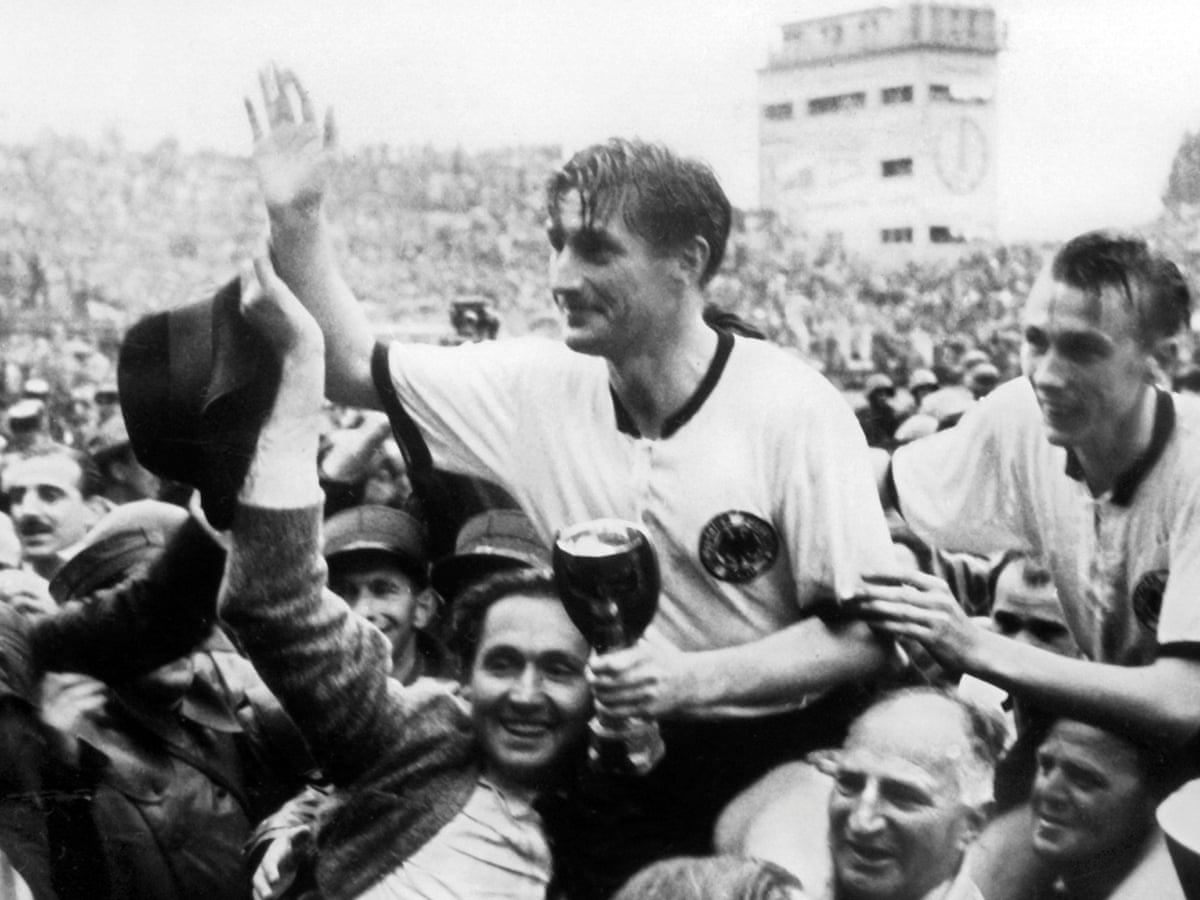
West German Captain Fritz Walter,
with the Jules Rimet Trophy

July 4, 1954, 70 years ago: The World Cup Final is held at the Wankdorf Stadium in Bern (sometimes written as "Berne"), the capital of Switzerland. Due to the cancellations of the tournament for 1942 and 1946, and the 1950 edition being held in Brazil, it is the 1st World Cup held in Europe since 1938.

It is also the 1st time the tournament is held in a country where the predominant language is German. Western Switzerland, bordering France, uses French as its main language (about 23 percent of the country's population); some southern and eastern regions, bordering Italy, use Italian (about 8 percent); and a few eastern parts of the country speak a language called Romansh (about 0.5 percent). But most of the country (68 percent) uses German. Germany would eventually host the World Cup in 1974 and 2006, while Austria has never hosted it, although they co-hosted Euro 2008 with Switzerland.

Among the Quarterfinals, played in 104-degree heat in Stade Olympique de la Pointaise in Lausanne, was a match between hosts Switzerland and neighboring Austria. The players' feet were as hot as the weather, and the game ended 7-5 to Austria. It remains the highest-scoring game in World Cup history.

Fittingly, West Germany were one of the teams in the Final. Among the punishments for its predecessor state, Nazi Germany, after World War II was a slower integration into postwar Europe. The Federal Republic of Germany, a.k.a. West Germany, allied with the Western democracies; while the German Democratic Republic (which was neither democratic nor a republic), a.k.a. East Germany, were controlled by the Soviet Union. Both were formed in 1949, and neither was admitted to FIFA, the governing body for world soccer, in time for qualifying for the 1950 World Cup.

Josef "Sepp" Herberger had managed the national team, known in Germany as Die Mannschaft, from 1936 until its 1942 disbanding due to the war. In spite of having been a member of the Nazi Party, there seemed to be no one more qualified to rebuild the team than he. He built the team around players from 1. FC Kaiserslautern, in the western Rhineland, including star forward Fritz Walter (who was named national team Captain) and his brother Ottmar Walter.
Sepp Herberger

In the Group Stage, they beat Turkey, but lost to Hungary, forcing a playoff with Turkey to get into the knockout stage, which West Germany won. They beat Yugoslavia in the Quarterfinal and Austria in the Semifinal.

No one was surprised that they lost to Hungary, or even that the score was 8-2. Known as "the Golden Team," "the Magnificent Magyars" and "the Magical Magyars," from 1950 to 1956, they used an early form of what the Netherlands would later call "Total Football" to put up a record of 58 wins, 10 draws, and only 1 loss.

Manager Gusztáv Sebes built the team around forwards Ferenc Puskás, Sándor Kocsis and Nándor Hidegkuti; midfielders Zoltán Czibor and József Bozsik, and goalkeeper Gyula Grosics. Hidegkuti played his "club football" for MTK Hunagaria (now MTK Budapest), while the rest played for Budapest Honvéd.

There was no European Championship tournament for them to compete in until 1960. But they won the Gold Medal at the 1952 Olympics in Helsinki, Finland. In 1953, they won the Central European International Cup, competing against Austria, Czechoslovakia, Italy and Switzerland.

Later that year, they became the 1st team from outside the British Isles to defeat England on English soil, 6-3 in front of 105,000 stunned spectators at London's Wembley Stadium. A rematch in Budapest the next year was even less of a contest, a 7-1 loss that is still the heaviest that England's national team have ever faced. Puskás, known as the Galloping Major for his service in the Hungarian Army, was now considered the best player in the world.
Ferenc Puskás

Hungary beat South Korea and West Germany in the Group Stage, to top their group. However, in the West Germany game, Puskás was kicked in the ankle by Germany centerback Werner Liebrich, and sustained a hairline fracture. It didn't seem to matter much, as Hungary then beat both 1950 Finalists: Brazil in the Quarterfinal, and defending Champions Uruguay in the Semifinal. They were heavy favorites for the Final against the Germans, especially after it was announced that Puskás was ready to play.

But the night before the Final, a village fair took place in front of the hotel that lasted until the early morning hours, and disrupted the players' sleep. By contrast, the German team resided in the tranquil lake town of Spiez, where it was unaffected from such disturbances. The Spirit of Spiez became proverbial in Germany for describing the team's morale and comradeship.

West Germany came back quickly. In the 10th minute, Fritz Walter fired a shot that was deflected by midfielder József Zakariás, but it went right to Max Morlock, a forward from 1. FC Nürnberg (Nuremberg), who closed Die Mannschaft to within 2-1. In the 18th minute, Helmut Rahn of Rot Weiss Essen (Red and White, of Essen) tied the game.

In the 23rd minute, Hidegkuti nearly scored, but German goalkeeper Toni Turek, of Fortuna Düsseldorf, made a spectacular save. Four minutes later, Hidegkuti hit the goalpost. Early in the 2nd half, Turek made a save on Puskás, and then Kocsis hit the crossbar. In the 72nd minute, Grosics made a great save on Rahn.

In the 84th minute, Rahn pretended to pass to Ottmar Walter, then fired past Grosics. Herbert Zimmerman, calling the game for German national radio, yelled, "Aus dem Hintergrund müßte Rahn schießen. Rahn schießt! Tor! Tor! Tor! Tor!" (Meaning, "Rahn should shoot from deep. Rahn shoots! Goal! Goal! Goal! Goal!" "Tor" can also mean "gate": The native name for the Brandenburg Gate in Berlin is Brandenberger Tor.)
Helmut Rahn
After 8 seconds of letting the roar of the crowd tell the story, Zimmerman resumed: "Tor für Deutschland! Drei zu zwei führt Deutschland. Halten Sie mich für verrückt, halten Sie mich für übergeschnappt!" (Goal for Germany! Germany lead 3-2. Call me mad, call me crazy!" Shades of 3 years earlier, in New York, when Russ Hodges broadcast, "The Giants win the Pennant!")
But the game was not over, and Hungary did not give up. Just 2 minutes later, Puskás appeared to have tied the game when he converted a pass from forward Mihály Tóth. But the goal was controversially ruled offside. In the 90th and last minute of regular time, Turek made one more save, on Czibor. 
West Germany won, 3-2. I mentioned that the Magnificent Magyars only lost 1 game from 1950 to 1956. This was it, at the worst possible time.

It became known as "The Miracle of Bern." In his book Tor! The Story of German Football -- named in part for Zimmerman's call -- Uli Hesse wrote that it was the 1st time since the end of the war that the German people were allowed to feel good about themselves and their country again, and helped to make Die Mannschaft a vital part of German cultural life.

West Germany reached the Final again in 1966, losing to England; in 1974, beating the Netherlands on home soil; in 1982, losing to Italy; in 1986, losing to Argentina; and in 1990, beating Argentina. Shortly after that World Cup, the country was reunified. A united Germany reached the Final in 2002, losing to Brazil; hosted the tournament in 2006, but lost a Semifinal to Italy; and beat Argentina in the Final in 2014, for their 4th World Cup win, matching Italy's total, and trailing only Brazil's 5.

Hungary, however, have never been a soccer power again. The Soviets' crushing of the 1956 Revolution shattered the national team, forcing its players to play in other countries. They reached the Quarterfinals of the World Cup in 1962 and '66, but haven't done even that well since. They last qualified for the tournament in 1986.

The Wankdorf Stadium, or Wankdorfstadion, was built in the Bern neighborhood of Wankdorf in 1925, as the home of the team BSC Young Boys. It later hosted the 1961 European Cup Final, where Benfica beat Barcelona. It was torn down in 2001, and was replaced by a new stadium of the same name on the same site in 2008.
The Wankdorf Stadion

Kaiserslautern's home was renamed Fritz-Walter-Stadion in 1985, and was one of the host venues for the 2006 World Cup. Walter died in 2002. That year, Budapest's Népstadion (People's Stadium), which had opened as a showcase for Hungary's national team in 1953, at the height of its powers, was renamed Puskás Ferenc Stadion. (Hungarian naming convention puts the surname first). Puskás died in 2006. In 2016, the stadium named for him was demolished, and replaced with the new Puskás Aréna on the same site in 2019.

Jenő Buzánszky was the last surviving player from Hungary's "Magnificent Magyars," living until 2015. Horst Eckel was the last surviving player from the West German team that won, living until 2021.

Tuesday, July 2, 2024

July 2, 1964: The Civil Rights Act Becomes Law

July 2, 1964, 60 years ago: President Lyndon B. Johnson signs the Civil Rights Act of 1964 into law. Among those attending the signing ceremony is Dr. Martin Luther King Jr., then the nation's leading civil rights activist.

Angry over various events holding African-Americans back, President John F. Kennedy gave a nationally-televised speech on June 10, 1963, asking Congress for a bill that would ban racial and religious discrimination "in facilities which are open to the public: Hotels, restaurants, theaters, retail stores, and similar establishments."

There were 3 key hurdles to the bill's passage. Many Congressional committees were then chaired by powerful Southern Democrats, unwilling to help civil rights. The bill had to pass the House Judiciary Committee. Fortunately, it was then chaired by Emmanuel Celler, a Jewish New Yorker, who got it through. The next step was being passed by the House Rules Committee, then chaired by Howard W. Smith, a racist from Virginia.

And before that could happen, Kennedy was assassinated on November 22, 1963. Johnson, his Vice President and a Texan who favored the bill, became President, and demanded that the bill pass.

Smith knew the rules of the U.S. House of Representatives as well as anyone. But so did Celler, who had a plan: He filed a petition to discharge the bill from the Rules Committee, and move it directly to the House floor, for a vote by the full House. That required the support of a majority of House members.

When the Winter recess began, Celler was 50 votes short, but letters, telegrams and phone calls were coming in to members on the fence. Smith "read the room," and realized that he would be utterly humiliated if the bill was discharged, so he told the Rules Committee members they could vote their conscience, and it passed.

On February 10, 1964, the full House voted 290-130 to pass it. It went on to the Senate, and Southern Democrats filibustered it for 54 days. But Northern and Western Democrats, and Republicans who were conservative but believed that civil rights could be good for business, worked on breaking the filibuster. In particular, 2 Senators led the way: Hubert Humphrey of Minnesota, the Democrats' "Whip"; and Everett Dirksen of Illinois, the Republicans' Leader. Each man's personal popularity was enough.

On June 19, 1964, the Senate passed the bill. The vote was 73-27. The Senators who voted No:

* Democrats: Lister Hill and John Sparkman of Alabama, William Fulbright and John McClellan of Arkansas, Spessard Holland and George Smathers of Florida, Richard Russell and Herman Talmadge of Georgia, Allen Ellender and Russell Long of Louisiana, James Eastland and John Stennis of Mississippi, Sam Ervin and Everett Jordan of North Carolina, Strom Thurmond and Olin Johnston of South Carolina, Albert Gore and Herbert Walters of Tennessee, Harry Byrd and Willis Robertson of Virginia, and Harry's cousin Robert Byrd of West Virginia.

* Republicans: Norris Cotton of New Hampshire, Bourke Hickenlooper of Iowa, Edwin Mechem of New Mexico, John Tower of Texas, Milward Simpson of Wyoming, and Barry Goldwater of Arizona.

The only Southern Senator of either Party to vote for the bill was Ralph Yarborough of Texas, an ally of LBJ's, who was with him in the car behind the one carrying JFK, Governor John Connally, and their wives when JFK was assassinated in Dallas. One of the reasons JFK went to Dallas in the first place was because, after Tower won LBJ's Senate seat, becoming the 1st Republican Senator in the South since Reconstruction, Texas' Democrats were split between factions led by Yarborough (a liberal) and Connally (a conservative who would later switch to the Republicans).

Robert Byrd, the Senate Majority Leader from 1977 to 1988, would later renounce his racist past. Ervin didn't, but redeemed himself somewhat with his Chairmanship of the Select Committee investigating Watergate in 1973 and '74.

Thurmond had been Governor of South Carolina in 1948, and briefly left the Democratic Party to run for President on the ticket of the States' Rights Party, all former Democrats. From that point onward, Southern Democrats who opposed civil rights were known as "Dixiecrats." Thurmond launched a filibuster designed to stop the Civil Rights Act of 1957, lasting a little over 24 hours, setting a record previously held by Huey Long of Louisiana, Russell's father. When the CRA of 1964 became law, Thurmond became the 1st major Democratic official in the South to switch to the Republican Party.

Gore was running for re-election, and was, by his own later admission, afraid to vote for the bill. He had previously voted for the Civil Rights Acts of 1957 and 1960. His re-election secure, he went on to vote for the Voting Rights Act of 1965, the confirmation of Thurgood Marshall as the 1st black Justice on the U.S. Supreme Court, and the Fair Housing Act of 1968. He lost his next bid for re-election in 1970, but that's been attributed to his opposition to the Vietnam War, rather than to his pro-civil rights votes. His son, usually known as Al Gore, would also be elected to both houses of Congress, serve as Bill Clinton's Vice President, and be the Democratic nominee for President in 2000.

Robertson was the father of Marion G. "Pat" Robertson, the Virginia Beach-based televangelist who ran for the Republican nomination for President in 1988, and was a major figure in "Christian" conservatism, often on the back of various forms of bigotry, until his death in 2023.

Cotton -- no relation to current Republican Senator Tom Cotton of Arkansas -- also ended up voting for every other Civil Rights Act from 1957 to 1968, including the Voting Rights Act of 1965, as well as the 24th Amendment, banning poll taxes. (Gore was not present for the vote on that.) He voted against the Civil Rights Act of 1964, he said, on the grounds that part of it was unconstitutional.

Goldwater, like Cotton, claimed the bill was unconstitutional. Although he was the conservative movement's favorite son at the time, he had never previously been accused of racism. Indeed, in Arizona, a State then with few Black people, Hispanics and Native Americans praised him for his efforts on their behalf.

Hickenlooper was the great-uncle of John Hickenlooper, now a Senator from Colorado, previously that State's Governor and Mayor of Denver -- and a Democrat. Simpson was the father of a later Senator from Wyoming, Alan Simpson.

The bill the Senate passed was slightly different from the one passed by the House, so the House had to approve it again. That took until July 2, and the vote was 289-126. Now, it headed to the President's desk, and LBJ wasted no time: He called in the media, and he called in key figures, including Dr. King, and the Attorney General, who was also the previous President's brother, Robert F. Kennedy.

It was Johnson who began the tradition of the President using a different pen to sign each letter of his name, including the period after the middle initial B. This way, he could give out 15 ceremonial pens -- 6 for "Lyndon," 2 for "B.," and 7 for "Johnson" -- and 15 different people could truthfully say, "I have the pen that made this bill a law."

On the film, he can be heard telling RFK to give pens to his deputies, Nicholas Katzenbach and Burke Marshall, as well as to take one for himself. The best-known photograph of the ceremony, shown above, shows LBJ giving a pen to MLK.

A generous gesture, given that LBJ and RFK couldn't stand each other, for reasons that don't matter here. Soon, RFK would resign as Attorney General -- he probably would have if his brother lived, anyway, to run the re-election campaign -- and ran for a U.S. Senate seat from New York. He won it -- but won by a smaller margin than Johnson did in the State.

By this point, Goldwater had already secured the Republican nomination for President, beating out pro-civil rights candidates like Governors Nelson Rockefeller of New York and William Scranton of Pennsylvania, and former Senator Henry Cabot Lodge of Massachusetts.

But people who cared about civil rights -- for or against -- didn't care why Goldwater voted against the Act, only that he did. Southerners who would never have voted for the nominee of "the Party of Lincoln" before this voted for Goldwater, because he voted the way they wanted. And Midwesterners and Westerners that would have normally voted Republican went for Johnson.

On Election Day, November 3, Johnson won 61.0 percent of the national popular vote, still an all-time record, while Goldwater got just 38.4 percent. Johnson won 44 States with 486 Electoral Votes, Goldwater 6 with 52. Goldwater won Mississippi, Alabama, South Carolina, Louisiana and Georgia, all in the South; and his home State of Arizona, barely, with 50.4 percent, a winning margin of 4,782 votes.

He came close in some other Southern States. He got 48.8 percent in Florida, 46.1 in Virginia, and was the 1st Republican in the 20th Century to top 40 percent in Tennessee, Oklahoma, North Carolina and Arkansas.

He also got 49.1 percent in Idaho, 47.4 in Nebraska, 45.1 in Utah and 45.0 in Kansas. But if he had won every State where he got at least 45 percent, that still would have given him only 98 Electoral Votes. Even if he had won every State where he got at least 40 percent, including California (40.8, then with 40 EVs) and Illinois (40.5, 26), he still would have had only 199, well short of the necessary majority of 270.

To be fair, the false perception that Goldwater was racist was not the only reason he lost. But it didn't help. As no less than Jackie Robinson, a Republican who had worked for Rockefeller, put it, "It would make everything I worked for meaningless if baseball were integrated, but America's political parties were segregated."

Johnson knew it, too: "I think we have just given the South to the Republican Party for a generation." It's now been 3 generations. There have been blips since, but:

* Virginia has voted for the Democratic nominee for President in every election since 2008. But, before that, it hadn't voted for one since 1976, Jimmy Carter; and not for a non-Southern Democratic nominee since 1948, Harry Truman.

* Georgia voted for Joe Biden in 2020. Other than that, they haven't voted for the Democratic nominee since Bill Clinton in 1992.

* Florida last voted for the Democratic nominee in 2012, Barack Obama.

* North Carolina last voted for the Democratic nominee in 2008, Obama. Other than that, they haven't voted for the Democratic nominee since 1976; and not for a non-Southern Democratic nominee since 1948.

* Arkansas, Tennessee and Louisiana last voted for the Democratic nominee in 1996, Bill Clinton. Arkansas last voted for a non-Southern Democratic nominee in 1956, Adlai Stevenson; Louisiana in 1952, Stevenson; and Tennessee in 1948. Tennessee didn't even vote for native son Al Gore in 2000, although that's been attributed to guns as much as to race. This is also the case for West Virginia, which was a reliably Democratic State until 2000.

* Texas, Mississippi, Alabama and South Carolina last voted for the Democratic nominee in 1976, and haven't voted for a non-Southern Democratic nominee since 1960, John F. Kennedy.

Oklahoma last voted for the Democratic nominee in 1976, and hasn't voted for a non-Southern Democratic nominee since 1948.

We will never know how many of the 21 Democrats who voted against the Civil Rights Act of 1964 would have done so if they weren't afraid of their respective electorates dumping them for more racist candidates in Democratic Primaries, or switching to Republican candidates.

What we do know is that racism, like all other forms of bigotry, is an inherently conservative trait, and the American Southeast remains conservative. And when conservatism meant switching from Democratic to Republican, they did, and have stayed as such.

And what has voting Republican gotten them? Extended poverty and lousy services.

Neil Young may be Canadian, and ineligible to vote in America, but he was right: "Southern man, better use your head." And Lynyrd Skynyrd were wrong: A Southern man does need him around, anyhow.

The last surviving Senator who voted for the Civil Rights Act of 1964 was Birch Bayh of Indiana, who lived until 2019. The last one who voted against it was George Smathers of Florida, who lived until 2007.

Given the decisions of the Roberts Court from 2005 onward, and especially from 2022 onward, I wonder how long it will be before they declare the Civil Rights Act of 1964 unconstitutional.

Monday, July 1, 2024

Have the Yankees Snapped Out of It?

In North American sports, July 1 means two things. One is Canada Day, the anniversary of Canadian independence, which means that Canada's one remaining team in Major League Baseball, the Toronto Blue Jays, not only plays an afternoon game at home, but, despite actually having "Blue" in their name, will wear red jerseys.

The other is Bobby Bonilla Day, a day when we mock the Mets for making a stupid deal with a stupid player with a smart agent. Happy such to all who celebrate.

Anyway... Both the Mets and the Blue Jays were a problem for the Yankees this week. The Yankees went out to Citi Field last Tuesday night, and their injury-induced slump continued. In his 2nd start after coming off the Injured List, Gerrit Cole allowed 6 runs in 4 innings. In other words, if 4 innings hadn't been his limit, he should have been taken out at that point, anyway. After 6 innings, they were behind 9-1, the run coming on a home run by Juan Soto. It was ugly.

They scored a run in the 7th, and then 5 in the 8th, 3 on a home run by Aaron Judge. But they couldn't get anything in the 9th inning, and lost, 9-7.

The Wednesday night game was much the same, without the comeback attempt. Luis Gil, so good for most of the season, got rocked again. Judge hit his 30th homer of the season, but the Mets won, 12-2. Take out the top of the 8th, and the Mets won on aggregate, 21-4.

So the fans of the Small Club in Flushing had their cup final, as would be said in England.

*

Maybe getting out of the City would do the Yankees some good. Or even out of the country. At first, no: They lost 9-2 to the Jays at the Rogers Centre on Thursday night. Carlos Rodón allowed 5 runs in the 1st inning, and 3 in the 2nd, including 2 home runs by George Springer, a former cheating Houston Astro nemesis.

Between them, over the last 7 1/3rd innings, Rodón and relievers Phil Bickford and Jake Cousins allowed just 1 run on 4 hits and no walks, but the damage was done. Trent Grisham hit a home run for the Yankees.

On Friday night, the Yankees turned the tables. Former Blue Jay (and former Met) Marcus Stroman allowed a run in the 1st inning, and didn't get out of the 5th. At one point, he could be seen yelling at Gleyber Torres in the dugout. Torres had come under fire, from fans and media alike, for being lazy, for not running out ground balls, and for sloppy fielding.

It must have woken him up: In the top of the 6th, he homered, and so did Soto, part of a 6-run inning. The Yankees scored 2 in the 8th, and 7 in the 9th. Their linescore over the last 5 innings was 06027. That is the ZIP Code for East Hartland, Connecticut, near Hartford. Michael Tonkin was the pitcher when the Yankees took the lead, and so he was the winning pitcher, as the Yankees won, 16-5.

Did that snap the Yankees out of their slump? Hardly: They lost the Saturday afternoon game, 9-3. Nestor Cortés didn't pitch badly, but Bickford allowed 5 runs in the 6th to throw the game away. Torres went 2-for-4, and Austin Wells hit a home run.

Over the last 10 games, the Yankees had allowed an average of 8.2 runs per game, scoring 5.1, and going 2-8. But, yesterday afternoon, they went back to the way they'd been playing most of the year, scoring 2 in the 1st, including another home run by Judge, and 2 in the 2nd. (Judge is having another Hall of Fame season, but it feels like it's being wasted.)

Cole was much better, allowed to pitch 5 full innings. Torres went 2-for-5. The Yankees won, 8-1, and gained a split of the series with the pesky Blue Jays. 

*

So we begin July, having played more than half the regular season. The Yankees are 54-32, and are officially tied with the Baltimore Orioles in the American League Eastern Division, although we trail them by 1 game in the all-important loss column, and by .003, percentage-wise, which is what really matters. The Boston Red Sox are 8 1/2 back, the Tampa Bay Rays 11, the Toronto Blue Jays 14 1/2.

From March 28 to June 14, the Yankees played at a 112-50 pace. Then, the annual injury crisis kicked in and they've played at a 65-97 pace. That can't go on.

Here's the latest on the significant players out due to injury, in descending order of believed availability:

* Giancarlo Stanton: He resumed activity on a treadmill on Thursday. He could be back right after the All-Star Break.

* Scott Effross: The pitcher is currently in minor-league rehab. It would probably be best to leave him there until returning from the All-Star Break.

* Clarke Schmidt: He has resumed throwing. He probably won't be back before August 1.

Jasson Domínguez: He was mere days away from returning from his last injury when he was stricken with a new one. He may be available by August 1.

* Cody Poteet: Of course, the pitcher meant to take the place of the injured Schmidt gave us a little taste of talent, and then got hurt himself. He may be available by August 1.

* Ian Hamilton: The relief pitcher has been rehabbing, but not yet officially throwing. It would be a shock to see him back before August 1.

* Anthony Rizzo: He is currently expected to return in mid-August.

Jonathan Loáisiga: He had Tommy John surgery. Hopefully, see you in 2025.

The Yankees have today off, then start a 3-game home series with the Cincinnati Reds, including a 4th of July matinee. Then the Red Sox come to The Bronx for the 1st time all season. I hope we pound them. Then comes the All-Star Break, a good time to see if they've snapped out of the slump, or not.

July 1, 1974: Great Adventure Opens

July 1, 1974, 50 years ago: The Great Adventure theme park opens in Jackson, Ocean County, New Jersey, about 60 miles southwest of Midtown Manhattan, and 50 miles northeast of Center City Philadelphia.

It took the place of such already-gone amusement parks as Steeplechase Park in Brooklyn's Coney Island (which closed in 1964, leaving Astroland as Coney's only remaining amusement park), Palisades Amusement Park in the town of the same name in Bergen County (closed in 1971), and Woodside Amusement Park in Philadelphia's Fairmount Park (closed in 1955). It essentially meant the demise of Willow Grove Park in Bucks County, Pennsylvania in 1975. But it also meant a closer option for Philadelphia-area people than the Jersey Shore, 60 miles away at its closest point.

New York businessman Warner LeRoy bought the land from the parachute-making Switlik family, and built the park. The main part of the park was called the Enchanted Forest, and it included roller coasters, a log flume, a monorail, and Wild West-themed rides. Its arcades and eateries, including the ice cream-themed Yum Yum Palace, and its drive-through safari, became beloved by young people in New Jersey, New York, Pennsylvania and Delaware.

In 1977, the Six Flags amusement-park company bought Great Adventure. A deal was cut with Warner Brothers to have their cartoon characters, like Bugs Bunny, in costumes. They also cut deals with DC Comics for rides based on their characters, such as Superman and Batman.
The classic rainbow & stars logo

On May 11, 1984, a fire at the Haunted Castle killed 8 teenagers from Queens, and forever cast a pall over the park. But it remains open to this day.

It's hard to believe it's been 50 years. It doesn't seem like something that goes back as far as Richard Nixon. To me, it will always bring up thoughts of the late 1970s, the Jimmy Carter years, or the early 1980s, the 1st Ronald Reagan term. It was an escape from the nonsense of the outside world, which was probably why that '84 fire stands out so much in New Jersey's collective memory: The outside world broke through the bubble.

A wonderland carved out of the Pine Barrens, for, as the Ringling Brothers/Barnum & Bailey Circus put it, "children of all ages." To this day, many of us refuse to use the corporate name of Six Flags. The original name was perfect: Great Adventure.