Showing posts with label quebec city. Show all posts

Wednesday, July 1, 2020

Top 5 Reasons You Can't Blame Marcel Aubut for the Quebec Nordiques Moving to Denver

July 1, 1995, 25 years ago: The deal to move the Québec Nordiques to Denver is made official, approved by the National Hockey League. They become the Colorado Avalanche.

Previously, Denver had been home to the Denver Spurs of the World Hockey Association in the 1975-76 season, then the Colorado Rockies of the NHL from 1976 to 1982. The Spurs failed after 1 season, the Rockies after 6. The Rockies moved to the Meadowlands, becoming the New Jersey Devils.

Starting in the WHA in 1972, the Nordiques reached the Finals in 1975, losing to the Houston Aeros. They made the Finals again in 1977, and beat the Winnipeg Jets. They made the Playoffs in their last 5 seasons in the WHA, and were 1 of the 4 teams that were absorbed into the NHL in 1979.

They didn't do so well. They only won 2 regular-season Division titles, in the Adams Division in 1985 and the Northeast Division in 1995. They got to the Conference Finals in 1982 and 1985, but fell apart by 1987.

They went 12-61-7 in 1989-90, by which time Marcel Aubut had gone from team president under their ownership group to majority owner; 16-50-14 in 1990-91, and 20-48-12 in 1991-92. They got back to the Playoffs in 1993 and 1995. But even though they were once again finding success on the ice, they were losing money, and ended up moving.

The Avalanche have been considerably more successful than their predecessors, either the Nordiques or the previous Denver teams. In just their 1st season, 1995-96, they did something they never came all that close to doing in Québec City: They won the Stanley Cup. The players did the right thing: They took the Cup back to Québec City, where it hadn't been won by a native team ever, except for the 1912 and 1913 Quebec Bulldogs.

The Avs won another Cup in 2001, beating, with some irony, the former Denver NHL team, the Devils. They've also reached the Conference Finals in 1997, 1999, 2000 and 2002. After a down period, they won a Playoff round last season, and got to Game 7 of the Conference Semifinals.

Québec City, meanwhile, has done their best to get a new team. They've built a new arena, the Videotron Centre. They've got a fan movement going. And they've seen several NHL teams have pathetically low attendance, including, in recent times, the Avalanche. But also the Carolina Hurricanes (who used to be a WHA-NHL team, the New England/Hartford Whalers), the Arizona Coyotes (who used to be a WHA-NHL team, the original version of the Winnipeg Jets), the Atlanta Thrashers (who moved to become the new Winnipeg Jets), the Florida Panthers, the New York Islanders, and, alas, the Devils.

But NHL Commissioner Gary Bettman hates Canada, and knows that a team in Québec City won't generate as much revenue as, say, a Sun Belt team. He's been proven right with the Tampa Bay Lightning, the Dallas Stars, the Anaheim Ducks and, ugh, the Vegas Golden Knights. But he's also been proven wrong with Miami (the Panthers), Atlanta and Arizona.

As for Québec City hockey, they have the Québec Remparts of the Québec Major Junior Hockey League, reaching that league's Finals in 2006 and 2015, although they lost both times. They've reached the Playoffs every season of their existence, since their establishment in 1997. And, by QMJHL standards, they're very well-supported.

Maybe it's time to move a team to Québec. The NHL overlooked Bettman's love of the Sun Belt and his hatred of Canada, and righted a wrong, and allowed the Atlanta-to-Winnipeg move of 2011. And, while Minnesota isn't in Canada (no matter how cold it gets there), they allowed an expansion team to replace the North Stars, who had moved to Dallas, righting a wrong there. Maybe they can do it again, for Québec City.

The move of the Nordiques was wrong, wasn't it? Sure, the Avs have done well at times, but shouldn't Denver have waited for the expansions of the end of the 20th Century? It was just 3 more seasons for the Nashville Predators, 4 more for the Thrashers, and 5 more for the Columbus Blue Jackets and the Minnesota Wild.

It was wrong for Aubut to sell the Nordiques to someone who would move the team out of Québec City, right? T-shirts reading "Marcel Aubut: Wanted Dead or Alive" were often seen in Québec in the late 1990s. And he walked away with $15 million from the sale (about $25 million in today's money). All Nordiques fans got was... those lousy T-shirts?

Top 5 Reasons You Can't Blame Marcel Aubut for the Québec Nordiques Moving to Denver

First, some reasons that didn't make the final cut: The Best of the Rest.

Marcel Aubut. He had already kept them afloat once, and gotten them what should have been their biggest break: Surviving the WHA and entering the NHL.

Not every good WHA team survived. The Houston Aeros made the Playoffs in each of the league's 1st 6 seasons, making the Finals 3 times, winning 2 titles, but they didn't even make it to the last season of 1978-79, much less to the merger.

The Cleveland Crusaders, the Minnesota Fighting Saints and the San Diego Mariners each made the Playoffs 3 times. So did the franchise that began as the Ottawa Nationals, and became the Toronto Toros and the Birmingham Bulls, once in each city. But none of these teams got to the final WHA season.

The Cincinnati Stingers, the Indianapolis Racers, and the Philadelphia Blazers/Calgary Cowboys franchise each made the Playoffs twice. The Chicago Cougars, the Los Angeles Sharks and the Phoenix Roadrunners each made it once, but none was still in business for the final WHA season.

The Nordiques were defending champions in 1977-78, but were still on the verge of folding when they were bought by the Carling-O'Keefe Brewery. They appointed Aubut, then a noted Québec City lawyer, as their new president.

To his credit, since 1995, he has tried to get a new team for the city. He was instrumental in helping get the Videotron Centre built. He does seem to be sorry for what he did, unlike most team owners who cause their team to move, due to either their greed, their mismanagement, or factors beyond their control. Keep that in mind as we go on: Sometimes, there are factors beyond the team owner's control.

He was respected enough to have been elected President of the Canadian Olympic Committee -- the 1st Francophone ever so honored. He was re-elected in 2014.  He resigned in 2015, after allegations of sexual harassment. He has apologized for his behavior, and has never been criminally charged, nor sued.

Gary Bettman. If he wants an NHL team to move, it moves, as we have seen.

However, for once, an NHL team moved from a cold weather city, especially in Canada, to a city in America's South or West, and Bettman was not the person most responsible. No question about it, he didn't want the Nordiques to stay in Québec City. But even if he had, I'm not sure there's much he could have done about it. There were other factors at work, as you will soon see.

The Montréal Canadiens. The rivalry between the Habs and the Nords was vicious at times, peaking in a long, nasty fight in a Playoff game at the Montreal Forum on April 20, 1984, known as the Good Friday Massacre.
In French, it is known as La Bataille du Vendredi Saint.

The Nords beat the Habs in the Playoffs in 1982 and 1985; but lost to them in 1984, 1987 and 1993. And they just couldn't compete with them for the hearts and minds of the Province of Québec. All those Stanley Cups the Canadiens won before the Nordiques were even founded. All those legends, including Georges Vezina, Howie Morenz, Maurice and Henri Richard, Doug Harvey, Jacques Plante, and Jean Beliveau, who grew up near Québec City. He and Plante both played for the Quebec Aces of the old Quebec Senior Hockey League.

And even when the Nords were succeeding in the WHA, the Habs won 6 Cups in the 1970s. Yvan Cournoyer, Ken Dryden, Guy Lafleur, Larry Robinson. Finally, Québec City native Patrick Roy starred for them in goal -- and then, to rub it in, Roy joined the team after the move to Colorado, and helped them win 2 Cups. (Lafleur ended his career with the Nords, but it was hardly the same thing.)

No matter how much the media tried to make the Nords the team of French speakers and Québec
nationalists, and the Habs the team of English speakers and Canadian nationalists, it just didn't work in the Nords' favor. The Canadiens would always be the Province's favorite team. Or, being that it's Canada, its favourite team.

It was pretty much the same thing as New England: The Whalers would never be as popular as the Boston Bruins, not even in Connecticut. Even in North and Central Jersey, the Devils still haven't eliminated fandom for the New York Rangers. The Anaheim Ducks have the same problem, with many people in Orange County not yet giving up on the Los Angeles Kings.

Eric Lindros. If he had signed with the Nords, would they have stayed? Maybe not: Eventually, he would have demanded a salary that Aubut probably could not have paid. Or, maybe his presence would have driven up revenues enough to pay his salary and save the team.

But it was never going to happen. Whether it was his decision, or that of his parents, Carl and Bonnie, who would later drive the Philadelphia Flyers' management nuts (and Ed Snider and Bob Clarke didn't need the help), Lindros wasn't going to play for the Nordiques. Upon his election to the Hockey Hall of Fame in 2016, he told ESPN he didn't have a problem with the city, or with its fans, or with having to learn French. It was all about Aubut: "I was not going to play for that individual, period."
Eric Lindros, making peace with Québec City, 2017

Now, the Top 5:

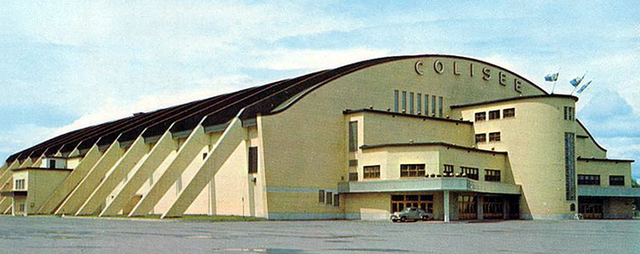
5. Le Colisée de Québec. It had been built in 1949, for the Quebec Aces of the Quebec Senior Hockey League, with 10,034 seats. When the Nordiques arrived in 1972, capacity was roughly the same.

A condition for them entering the NHL was a larger arena. An expansion got capacity up to 15,750, but it remained an old-time arena. By the time the Nords left in 1995, only the Montreal Forum, Maple Leaf Gardens in Toronto, and the Buffalo Memorial Auditorium were older; the Gardens was the only one of those left at the start of the 1996-97 season, and in the 1998-99 season, even that was closed.
The arena in its last years, known as Colisée Pepsi

A new arena was necessary, and it was not soon in coming. Denver had that part of the answer:

4. Denver. If an NHL team was going to move in 1995, Denver was a great place to go. It was a city of about 600,000 people with a metropolitan area of about 3 million. It had the McNichols Sports Arena, built in 1975, and by 1995 having a capacity of 17,171; and a plan to build a new arena, which became the Pepsi Center (ironically, having the same sponsor that the Colisée would have in its last years), which opened in 1999 and seated 18,007 for hockey. (UPDATE: In 2020, it was renamed the Ball Arena. Good name for an NBA venue, not so much for the NHL.)
Pepsi Center

True, both the NHL and the WHA had failed in Denver in the 1970s. But the 1990s had seen the city embrace baseball, with the Colorado Rockies name revived; and keep its interest in football with the Broncos and basketball with the Nuggets. Colorado was ready to try hockey again.

3. The Québec Major Junior Hockey League. It's not just the Remparts. It has teams from all over the Province, from Gatineau on the Québec side of the Ottawa River across from the national capital to Rimouski in the Gaspé Peninsula, a span of 456 miles. Because of the QMJHL, the people of Québec don't really miss the Nordiques.

LHJMQ (Ligue de hockey junior majeur du Québec) also includes teams in the Provinces of New Brunswick, Nova Scotia and Prince Edward Island. That nearly doubles the span, to 835 miles. 

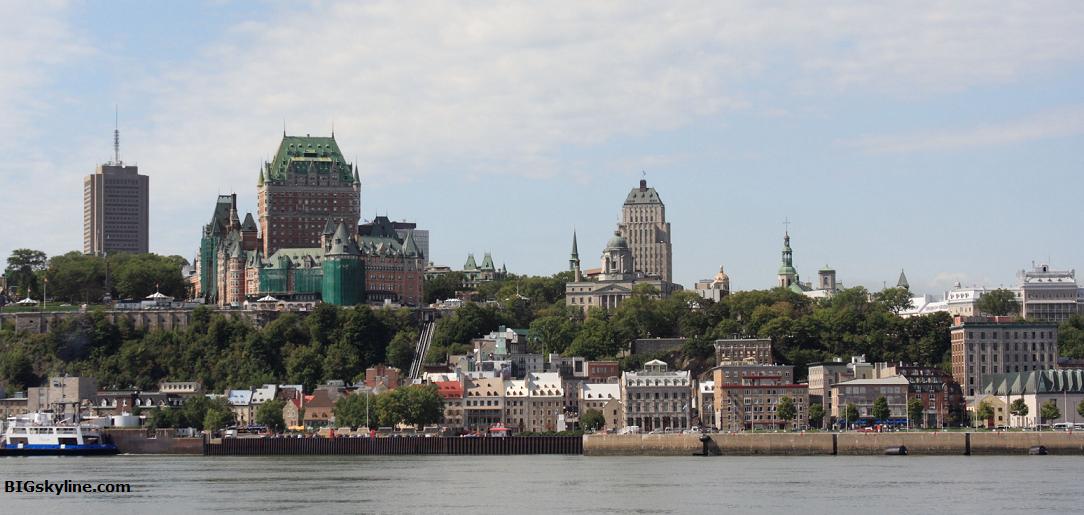
2. Demographics. Québec City is home to 532,000 people. There are cities in North America with fewer people and at least one major league sports team. But, as is the case with pretty much every major Canadian city except Montreal, Toronto and Vancouver, the metropolitan area doesn't have much in the way of suburbs. What suburbs it does have makes the overall population rise to only about 800,000.
Québec City

It simply isn't big enough of a metropolitan area to support a major league team, in any sport. Certainly not in the NHL, with 41 home games a year to sell to fans, in the cold Winter months.

But the big culprit is politics. And I don't mean NHL politics, led by dictator Gary Bettman. I mean actual politics. A very nasty form, which is tinged by national pride (for both a real country and a proposed country), language, and even religion, all of it carrying accusations of discrimination:

1. The Parti Québecois. First, they won the Provincial election in 1976, and launched a sovereignty referendum in 1980. It failed by a vote of 60 percent to 40. Then they lost the 1985 election. But they regained power in 1994, partly due to the federal government's alleged slights to the Province and its culture.

Behind party leader and Premier (like the Governor of one of our States) Jacques Parizeau, the PQ (or "Pequistes") launched a new referendum in 1995, and both sides campaigned very hard for it, including with competing rallies in downtown Montreal, the city where it was always going to be decided, and with ugly charges on both sides. In the end, on October 30, 1995, the vote was nearly an even 50-50 split.
Jacques Parizeau, Premier of Québec 1994-96,
very nearly the 1st President of the Republic of Québec

It just barely failed. With a turnout of 93.5 percent of registered voters, here was the result: Non, 2,362,648 votes, or 50.58 percent; Oui, 2,308,360 votes, or 49.42 percent. The number of spoiled ballots, ballots that could not be accepted for whatever reason, was larger than the Non side's margin of victory, 54,288 votes -- shades of what would happen in Florida 5 years later.

That was 4 months after the Nordiques moved. That was the PQ's only concern in 1995: Separating from Anglophone Canada. Prior to the move, or to the rumors of a move, the PQ were not the least bit interested in building a new arena to keep the Nordiques, or modernizing the old one. They just wanted to stick it to the federal government in Ottawa, to "protect the French language," and to promote Québec's status from that of a "distinct society" within Canada to an independent nation of its own.

Anything else was simply pas notre département. This would also include building a new ballpark for the Montreal Expos: They weren't willing to do that, either, any more than the City of Montreal was.

The PQ was more interested in stepping to Ottawa than in stepping up for its own people. Said people finally accepted this in 2003, and restored the Liberal Party to power in the Provincial election. By then, restoring the Provincial capital to the NHL had ceased to be a priority.

VERDICT: Not Guilty. Marcel Aubut is no saint, but he's also not a major reason why the Québec Nordiques moved. And he still has a chance, and apparently still has the desire, to get the city restored to the NHL.

Wednesday, January 13, 2016

Faux Flashback: How to Be a Devils Fan In Quebec City

Tonight, the Devils play in Denver, the city from whence they came in 1982, against the Colorado Avalanche, the team formerly known as the Quebec Nordiques.

There is a movement to bring the NHL back to Quebec City. So far, it hasn't succeeded. I hope it will.

Until then, you can imagine what it was like to visit, in this post I found in my archives, from March 1, 1995, leading up to our March 6 contest, our last visit to Quebec City.

(Not really. I barely knew the Internet existed at that point. Humor me. Updates are in italics.)

Note that, while I know there's an accent mark, all that copying-and-pasting of "Québec," and then fixing the font, was too much of a pain in the ass to do.

*

Before You Go. Quebec City is in the Eastern Time Zone, so you won't have to turn your watch back. But it's in Canada, which is not only a lot colder (so bundle up), but a foreign country. If you have a passport, bring it. If not, you'll need a copy of your birth certificate.

As of June 1, 2009, you have to have a valid, up-to-date passport to cross the U.S.-Canadian border. You should also bring your driver's license (or other State-issued photo ID). If you don't have a valid passport, you will need a valid photo ID and a copy of your birth certificate in order to get the passport. This is not something you want to mess with. Canadian Customs officials do not fuck around: They care about their national security, too.

Do yourself another big favor: Change your money before you go. There are plenty of currency exchanges in New York City, including one on 42nd Street between 7th and 8th Avenue. There are also a few in New Jersey: Travelex has exchange centers at Newark Liberty International Airport, and at 4 malls: Garden Sate Plaza in Paramus, Jersey Gardens in Elizabeth, Menlo Park Mall in Edison and Bridgewater Commons. 


Leave yourself $50 in U.S. cash, especially if you’re going other than by plane, so you’ll have cash on your side of the border. 


Make sure you call your bank and tell them you’re going. After all, Canada may be an English-speaking country (at least co-officially, with French, although Quebec is French-first), and a democracy (if a parliamentary one), and a country with teams in America's major leagues, but it is still a foreign country. If your bank gets a record of your ATM card making a withdrawal from any country other than the U.S., it may freeze the card, and any other accounts you may have with them. So be sure to let them know that you will, in fact, be in Canada for a little while.

Quebec City is the capital of the Province of Quebec, and the epicenter of Quebec nationalism. In Montreal, most people you will meet can, and are willing to, speak English. In Quebec City, it's French all the way: They are very paranoid about protecting the French language, and many people won't even speak to you in English, even if they can. You won't see many bilingual signs, either. So a working knowledge of French will help. A lot.

Seven months later, on October 30, 1995, the Province held a soveriegnty referendum, 15 years after solidly losing one. This time, it was defeated by the slimmest of margins. The Quebec independence movement came so close to getting what it wanted, a mandate from the people to do it, but didn't. The movement has significantly waned since, and I don't expect another referendum anytime soon.

Tickets. The Colisee de Quebec seats 15,399, making it one of the smaller arenas in the NHL. And this is the Province of Quebec, the most hockey-mad place on Earth. Getting tickets will be tough.

I don't know what ticket prices for a Nords game were in 1995. I don't know what prices are for a Remparts game at the new Centre Videotron are, and it wouldn't matter anyway, since they'd be less than for NHL games.

Getting There. It's 517 miles from Times Square to downtown Quebec City, and 512 miles from the Meadowlands to the Colisee. It's one of those tricky distances: Too far to get there any way other than flying, but so close that the stuff you gotta do to get in and out of the airports won't save you as much time as you think. Quebec City is 96 miles from the U.S. border at its closest crossing point, Sandy Bay Township, Maine; 158 miles from downtown Montreal; amd 187 miles from Lacolle Inspection Station, the usual border crossing for travelers from New York to Montreal.

(Of the major cities in Atlantic Canada, a.k.a. the Maritime Provinces: St. John, New Brunswick is 607 miles from Times Square, and 75 miles from the nearest border crossing; Charlottetown, Prince Edward Island is 803 and 271; Halifax, Nova Scotia, is 862 and 330; and St. John's, Newfoundland and Labrador is a whopping 1,666 and 1,133.)

Air Canada runs flights from Newark to Quebec City's Jean Lesage International Airport (named for the 1960s Premier who led the "Quiet Revolution"), but not nonstop: You'll have to change planes in either Montreal (understandable) or Toronto (considerably less understandable, since it's in the opposite direction).

Greyhound runs buses there, and Amtrak and its Canadian equivalent, VIA Rail, operate rail service, though, in each case, you'll have to transfer in Montreal.

It's 518 miles between the new arenas, the Prudential Center here and the Videotron Centre there. Posting fares for Air Canada, Greyhound or Amtrak & VIA Rail is pointless, since they're not going to be the same as they were when the Nordiques were still in town.

If you're driving, then, depending on from where in New Jersey you're leaving, take either the Garden State Parkway or Route 17 up to Interstate 87. It will be concurrent with the New York State Thruway until you reach Albany. Remain on I-87 as it becomes the Adirondack Northway, all the way up to the border at Champlain, New York and Lacolle, Quebec.

When you get to the border, you'll be asked your citizenship, and you'll have to show your passport and your photo ID. You'll be asked why you're visiting Canada. 

If you're bringing a computer with you (counting a laptop, but probably not counting a smartphone), you don't have to mention it, but you probably should. Chances are, you won't be carrying a large amount of food or plants; if you were, depending on how much, you might have to declare them.

Chances are, you won't be bringing alcohol into the country, but you can bring in ONE of the following items duty-free, and anything above or in addition to this must have duty paid on it: 1.5 litres (53 ounces) of wine, or 8.5 litres (300 ounces or 9.375 quarts) of beer or ale, or 1.14 litres (40 ounces) of hard liquor. If you have the slightest suspicion that I'm getting any of these numbers wrong, check with Canada Customs, either by mail or at the Canadian consulate in New York. Better yet, don't bring booze in. Or out.


Of course, within a short time after this would have been posted had there been blogs in 1995, you could have checked the Canada Customs website, which is what you should do if you're going now. 

As for tobacco, well, you shouldn't use it. But, either way over the border, you can bring up to 200 cigarettes, 50 cigars, and 200 grams (7 ounces) of manufactured tobacco. 


If you've got anything in your car (or, if going by bus or train, in your luggage) that could be considered a weapon, even if it's a disposable razor or nail clippers, tell them. And while Canada does have laws that allow you to bring in firearms if you're a licensed hunter (you'd have to apply for a license to the Province where you plan to hunt), the country has the proper attitude concerning guns: They hate them. They go absolutely batshit insane if you try to bring a firearm into their country. Which, if you're sane, is actually the sane way to treat the issue.

And if you can speak French, don't try to impress the Customs officials with it. The locals might appreciate that you're trying to speak to them in their primary language, but they won't be especially impressed by any ability to speak it, and any such ability won't make it any easier for you to get through Customs.

When crossing back into the U.S., in addition to what you would have to declare on the way in (if you still have any of it), you would have to declare items you purchased and are carrying with you upon return, items you bought in duty-free shops or (if you flew) on the plane, and items you intend to sell or use in your business, including business merchandise that you took out of the United States on your trip. There are other things, but, since you're just going for hockey, they probably won't apply to you. Just in case, check the Canadian Customs website I linked to above.

As for Cuban-made cigars, forget it: They are illegal to possess on American soil. You want to buy one in Canada, that's legal, but you gotta smoke it there.

In 2015, President Obama loosened the embargo so that you can import up to $100 worth of Cuban-made tobacco per traveler.

After going through Customs, I-87 will become Autoroute 15, which will take you into the Montreal

area. Get on Autoroute 30, which will take you to the Trans-Canada Highway. Exit 315 will get you into Quebec City.

If you make 3 rest stops, counting Customs, where they will have a restroom and vending machines -- and if you don’t do anything stupid at Customs, such as fail to produce your passport, or flash a weapon -- the trip should take about 9 hours. Though that could become 10, because Montreal traffic is pretty bad, though not as bad as Toronto, which is every bit as bad as traffic in New York, Boston and Washington.

Once In the City. Quebec is the largest of Canada's 10 Provinces by area, and 2nd to Ontario in population. The name comes from an Algonquin word meaning "where the river narrows," the river in question being the St. Lawrence, which takes in the outflow of the Great Lakes to the Atlantic Ocean, and on which both of the Province's major cities sit, Montreal and Quebec City (Ville de Québec in French). Actually, the city sits between 2 rivers, the St. Lawrence and the St. Charles.

Quebec City is the oldest major city in North America, first settled by Jacques Cartier (who soon thereafter first settled Montreal) in 1535, and founded as a city on July 3, 1608 by Samuel de Champlain. That makes it 16 years older than New Amsterdam/New York, 22 years older than Boston, 34 years older than Montreal, and 74 years older than Philadelphia. It was under the governance of France from 1608 to 1759, of Britain from then until 1867, and of Canada ever since, despite the sovereignty movement's efforts.

At the time, that meant it was French for 39 percent of its history, British for 28, and Canadian for 33. Now, it's been French for 37, British for 26, and Canadian for 37 -- a plurality, but not yet a majority.
The Provincial Parliament building, home to the National Assembly.
Note the name, "National"; and the flag at the top:
The Fleurdelyse, not the Maple Leaf.

It's home to about 460,000 people, but, because Canadian cities (the big 3, Montreal, Toronto and Vancouver, being exceptions) don't really have extensive suburbs, the metropolitan area is small, only about 750,000 people, and that, along with Canadian taxes, the U.S.-Canada currency exchange rate, and the perceived obsolescence of the Colisee are why the Nordiques are in danger of moving, despite being, for the moment, very good both on the ice and at the box office.

Today, the city is home to about 530,000 people, and the metro area to 800,000. Whether the passion for hockey and the brand-new arena will be enough to get a new team, either expansion or moved, and sustain it, remains to be seen.

According to Statistics Canada, 94.6 percent of the population has French as their 1st language, while only 1.5 percent have English. And -- this is the term Canada uses -- "visible minorities" make up only 3 percent, the smallest proportion of any major North American city. But, due to French being the dominant language, African immigrants have begun to arrive, every bit as much as they have in Montreal. Over 90 percent of the city is Catholic, which is also the high-water mark in North America. Eat your heart out, Boston.

The city's newspapers include Le Soleil (The Sun) and Le Journal de Quebec (The Journal), but both print only French editions. Avenue de Salaberry divides street addresses into East and West (Est et Ouest), and while there's no North and South (Nord et Sud) addresses, address numbers on north-south streets increase heading away from the St. Charles and toward the St. Lawrence, the opposite of how it's done in Montreal. Also like Montreal, the streets are on diagonals, and not exactly north-east-south-west.

The city has a bus service, but no subway or subway-like service, having done away with trams and streetcars decades ago.

Over 20 years on, they're considering a light rail service, but nothing official has been done about it yet.

The drinking age in Quebec is 18. Postal Codes in eastern Quebec begin with the letter G. The Area Code is 418. Hydro-Québec runs the electricity for the Province.

A new Area Code, 581, was added as an overlay in 2008.

Going In. Located 3 1/2 miles northwest of downtown, Le Colisee de Quebec is located at 250 Blvd. Wilfrid-Hamel, at Avenue du Colisee. Take the Number 3 bus from D'Youville to des Allies, and from there, it's less than a 10-minute walk.

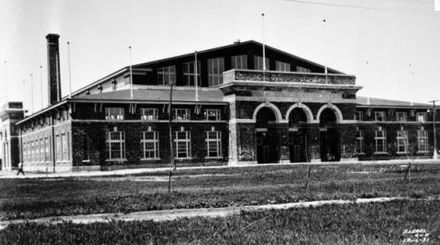
The original Colisee was built in 1930, but burned down on March 15, 1949. It was rebuilt and opened on December 8, 1949. Because the biggest hockey star in the city at that point was Jean Béliveau of the Quebec Citadelles, the Colisee became known as the House That Béliveau Built.
The 1930 Colisee

The Colisee was home to the Citadelles in that 1st season, 1949-50, and then the Quebec Aces (with Béliveau until 1953) in the Quebec Senior Hockey League, and then the American Hockey League, from 1950 to 1971. The Quebec Ramparts of the Quebec Major Junior Hockey League played there from 1969 to 1985, with Guy Lafleur as their 1st star before, like Béliveau, he moved on to the Canadiens. And the Quebec Nordiques debuted there in the World Hockey Association in 1972, moving to the NHL in 1979.
The 1949 Colisee, before its expansion

The 1949 Colisee seated just over 10,000, until the Nords' admission to the NHL required an expansion. When the 1981-82 season began, it seated 15,250, and has been set at 15,399 since 1987.
After the 1981 renovation and the selling of the naming rights

The final capacity for the Colisee, renamed Le Colisee Pepsi, was listed as 15,176. Since the Nords left, the Quebec Rafaels played there in the International Hockey League from 1996 to 1998, a reborn version of the Citadelles did so in the AHL from 1999 to 2002, and a reborn Remparts from 1999 to 2015, moving to the new Videotron Centre. It has the same mailing address, and is accessed by the same bus route. There's no point in telling you how much parking cost, then or now, until they get a new NHL team.
This overhead photo, shows how the new arena dwarfs the old one.

The rink is aligned from northwest to southeast. The Nordiques attack twice toward the southeast goal.
Post-1981 interior of the Colisee

Food. The Colisee, like most old arenas, has 1 level of concourse for 2 or more levels of seats. This is poor design, as we have seen at the not-so-old Meadowlands. Concession stands are generic, and both they and bathrooms will have very long lines. Get to the game early, and take care of both your input and your output before pregame introductions.

Team History Displays. The Colisee honors all of Quebec City's hockey history, hanging banners for:

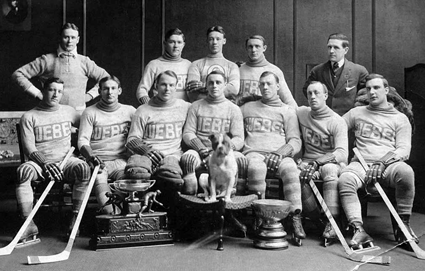
* The 1912 and 1913 Quebec Bulldogs, the only Stanley Cups won in the city.
The 1913 Bulldogs, with "Phantom Joe" Malone in the center.
Notice how much smaller the Stanley Cup was then.

* The 1944 Quebec Aces, winners of the Allan Cup, Canada's amateur championship.

* The 1952 Quebec Aces, winners of the Alexander Cup, led by Béliveau.
Béliveau as an Ace

* The 1971 Quebec Remparts, winners of the Memorial Cup, junior hockey's championship, led by Lafleur.
Lafleur as a Rempart

* The 1977 Quebec Nordiques, winners of the WHA Championship, the Avco Cup.
Real Cloutier of the '77 Nords

* The 2006 Quebec Remparts, winners of the Memorial Cup, coached (and part-owned) by Quebec City's native son Patrick Roy.

* Lesser titles won by the Remparts.

Remparts banners

Other Quebec City-area teams that have won the Memorial Cup are Rimouski Océanic in 2000, and the Shawinigan Cataractes in 2012.

The Nordiques have retired 3 numbers: 3, for defenseman Jean-Claude Tremblay, who played for them throughout their WHA years after starring for the Canadiens; 8, for left wing Marc Tardif, another ex-Canadien who played on their 1977 title team, and into the NHL years; and 26, for center Peter Stastny, who, along with his brothers Anton and Marian defected from Czechoslavakia and played for the Nords. Peter, of course, went from the Nords to the Devils. His Number 26 was retired this past February 26.

The Remparts have retired 1 number, Number 4, for Guy Lafleur, who returned to Quebec City to wrap up his playing career with the Nordiques.

Just after this article would have been posted, on March 16, 1995, the Nords retired a 4th number, 16, for left wing Michel Goulet. All 4 of their numbers were put back into circulation by the Avalanche.

Since the Nords left, the Remparts have also retired 12, for left wing Simon Gagne; 22, for right wing Alexander Radulov; and 44, for defenseman Marc-Edouard Vlasic. Gagne, now retired, starred for the Philadelphia Flyers. Vlasic now plays for the San Jose Sharks, but has never become a star. Radulov was a journeyman in North America, getting the occasional "cup of coffee" with the Nashville Predators, but has reached stardom in his native Russia, serving as Captain of the country's most history-laden hockey team, CSKA Moscow.
Tremblay, Tardif, Goulet, Christian Bordeleau, Rich LeDuc, Serge Bernier and Richard Brodeur -- no relation to the Devils' Martin -- were named to the WHA All-Time Team. Peter Stastny (but not Anton or Marian), last Nords and 1st Avs Captain Joe Sakic, Béliveau, Lafleur, and 1912-13 Bulldogs star "Phantom" Joe Malone were named to The Hockey News' 100 Greatest Players in 1998. Stastny and Sakic were named to the NHL's 100th Anniversary 100 Greatest Players in 2017.

Since the Nords started out as a WHA team, and only NHL players were eligible, none of their players were named to the Team Canada that beat the Soviet Union in the 1972 "Summit Series." All of those players were named to Canada's Walk of Fame, but no Nordiques player was. But, for his overall contributions to the game, Béliveau was named to it. No player from the 1980 U.S. Olympic team that beat the Soviets ever played for the Nordiques.

Stastny and Mats Sundin, who went on to greater fame with the Toronto Maple Leafs, have been elected to the International Ice Hockey Federation (IIHF) Hall of Fame.

Stuff. There isn't really room at the Colisee for a big team store, but souvenir stands are all around.
There wouldn't have been many books or DVDs about the Nordiques at the time. In 1989, Ross Rennie wrote Quebec Nordiques for the official NHL Today series, but that's all I could find on Amazon.com.

During the Game. The rivalry between the Nordiques and the Canadiens, split along various lines -- linguistic, historical (the Habs are the game's most successful team, the Nords hardly successful at all), Quebec nationalism vs. Canadian nationalism, a city that's both Provincial capital and provincial hating the city both big and big-business vs. a cosmopolitan city that hates the Provincial government -- is the nastiest in the NHL. Canadiens vs. Toronto Maple Leafs? Canadiens vs. Boston Bruins? Rangers vs. Islanders? Rangers vs. Devils? Devils vs. Flyers? Philadelphia vs. Pittsburgh? Detroit vs. Chicago? Please: This is true hatred, which reached its peak in a 1984 Playoff fight known as the Good Friday Massacre (La Bataille Vendredi Saint) at the Montreal Forum.

But Nordiques fans have no reason to dislike people from New Jersey. Sure, head coach Jacques Lemaire, assistant coach Larry Robinson, and players Claude Lemieux, Stephane Richer, Tom Chorske and Martin Brodeur all have Montreal connections, and might get booed. But we're New Jersey, not Provincial rival Montreal, or national cultural capital Toronto, or even seat of federal government Ottawa. We're not even Canadian. They don't hate us, because that would be pointless. So as long as you don't given any indication of liking the Habs, the Leafs, or the Ottawa Senators, your safety will not be an issue.

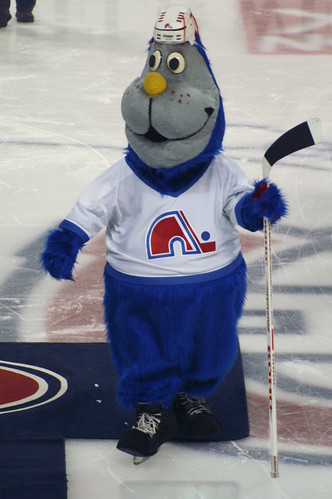
All arena announcements will be in French -- not English. Lucie Blachette sings the National Anthem. Unlike in Montreal, here, "O, Canada" is sung entirely in French. The mascot is a big blue apelike thing. We New Jerseyans can appreciate his name: Badaboum, pronounced "Ba-da-boom," like the Italian-American expression that usually begins "Ba-da-bing."
Badaboum!

Nordiques fans are passionate. These people are more French than North American, and their songs and chants, very well organized, can make the Colisee sound like a European soccer stadium. But, as I said, they won't attack you. They're more "ultra" than "hooligan."

After the Game. Win, lose or tie, no one is going to take their frustrations of the game out on you, as long as you don't provoke anyone. Keep to yourself, and they'll do the same.

The Colisee is tucked away in a residential area, and there aren't any notable postgame eateries or bars nearby. To get a postgame meal, or even just a pint, you'll have to get back downtown.

Sidelights. Quebec City's sports history is nearly all about hockey. They've never had a team in MLB, or the NBA, or even in the CFL. But there have been minor-league baseball teams.

The Quebec Athletics played in 1940, '41 and '42, folding due to the manpower shortage of World War II. A new team played as the Quebec Alouettes in 1946, '47 and '48, and as the Quebec Braves in 1949, '50 and '51. The Quebec Indians were a Cleveland farm team from 1958 to 1970, and the Quebec Carnavals, appropriately, were a farm team of the Montreal Expos from 1971 to 1977, playing their last 2 seasons as the Quebec Metros. But the city has been without baseball since then.

All of these teams played at Stade Municipal, which opened in 1939. It seats 4,800 people, and is known for short fences: 315 feet to both foul poles, 380 to center field. 1938 Rue de Cardinal Maurice Roy, at Rue de la Croix-Rouge (Red Cross), about a mile and a half northwest of downtown. Number 28 bus to Croix-Rouge, then a 15-minute walk.
In 1999, the Quebec Capitales began play in the Northern League, an independent league, moving to the Northeast League and now to the Can-Am League. They've won Pennants in 2006, 2009, 2010, 2011, 2012 and 2013 -- 6 Pennants, including 5 in a row. In 2015, they made the Playoffs again, but lost to our own New Jersey Jackals. They have also used Stade Municipal since their inception.

Because of its small metropolitan area, Quebec City would rank 30th in the NHL, ahead of only Winnipeg; 7th in the CFL, ahead of Winnipeg, Hamilton and Saskatchewan, and far below any NFL team; and easily dead last in either MLB or the NBA. While a CFL team has been considered, the only team it's ever got a chance of getting is a revived Nordiques in the NHL. And the city has no pro soccer team.

It's not clear who Quebec City's favorite MLB team is. It could well be the Red Sox, due to proximity. Or the Blue Jays, due to national pride. Or, as nationalists, resistant to both English Canada and America, maybe they simply don't care. According to an article in the May 12, 2014 New York Times, their NBA fandom is almost evenly split between the Boston Celtics, the Los Angeles Lakers and the Miami Heat.

Quebec city is home to the main campus of the Université du Québec (its Montreal campus is known as UQAM), and to Université Laval. But they don't play college football or basketball on what we would call a Division I level.

That is still true of UQ, but not of UL. UL started a football program in 1996, and have won the Vanier Cup, the championship of Canadian college football, 8 times: 1999, 2003, 2004, 2006, 2008, 2010, 2012 and 2013. They play at PEPS Stadium, which has a permanent capacity of 12,257 seats, but is expandable to 19,000. It has hosted the Vanier Cup 4 times, including in 2010 and 2013 when UL won it at home. 2380 Rue de PEPS, about 5 miles southwest of downtown. Bus 807.

UPDATE: They won it again in 2016. How many times is that, Ed Rooney? "Nine times!"

The Université du Québec à Trois-Rivières (UQTR, "Three Rivers") is 82 miles southwest of Quebec City. Its hockey team was National Champion in 1987 and 1991.

They've since won it again in 2001 and 2003.

The Citadelle of Quebec, on the Plains of Abraham, was the colonial capital of New France, and the place where the Battle of Quebec ended on September 13, 1759 -- the day that ensured that Canada would be ruled by Britain, not France, but also set up the ways Britain paid for this "French and Indian War," which resulted in the American Revolution. This makes it, along with Saratoga, Yorktown, Buena Vista and Gettysburg, one of the most important battles ever fought on North American soil. (Fort McHenry was mainly a naval battle.)

It is not only a museum, but an active Canadian Forces base. 1 Côte de la Citadelle, in the Historic District of Old Quebec, within walking distance of downtown. The entire Old Quebec district is worth walking around, because there just aren't any American cities with buildings approaching 400 years old -- most don't even have very many that are 200 years old.

Quebec's other major museum is the Musee de la Civilisation. It is both a historical and a natural history museum. Think the New York Historical Society and its neighbor, the Museum of Natural History, in one complex. 85 Rue Dalhousie, downtown.

The Chateau Frontenac is a hotel that was built on the site of the residence of Britain's colonial governors. In 1943, it hosted the Quebec Conference, a meeting of President Franklin D. Roosevelt and Prime Ministers William Lyon Mackenzie King of Canada and Winston Churchill of Britain to discuss Allied military policy in World War II. 1 Rue des Carrieres, downtown.

The tallest building in Quebec City is Édifice Marie-Guyart,, 579 feet tall counting its antenna. Built in 1972, its architecture is typical of North American skyscrapers of the 1950s, '60s and '70s, and, as Dick Smothers would say, That was not a compliment. 1035 Rue de la Chevrotiere, at Blvd. Rene-Levesque. The Provincial Parliament is adjacent, at 1045 Rue des Parlementaires, at Blvd. Rene-Levesque.

Most movies and TV shows set in Quebec City would be familiar only to Canadians, and not to Americans. The most notable TV show set there is Lance et Compte -- a rough translation of "He Shoots, He Scores" -- about a fictional hockey team, Le Nationale, whose uniforms had a QN logo reminiscent of the ON used by the Ottawa Nationals of the WHA. It aired on CBC from 1986 to 1989, and a revival series has aired on French-language TVA since 2004. Interestingly enough, one of the actors on the original series was named Marc Messier. (No relation to ol' Lex Luthor himself.)

*

Postscript: The Nordiques beat the Devils, 6-3. On April 30, the last game between the teams under those names was played at the Meadowlands, and the Devils won, 4-2. Within 2 months, the Devils had won their 1st Stanley Cup, and the Nordiques had moved to Denver.

May the NHL once day return to Quebec City.