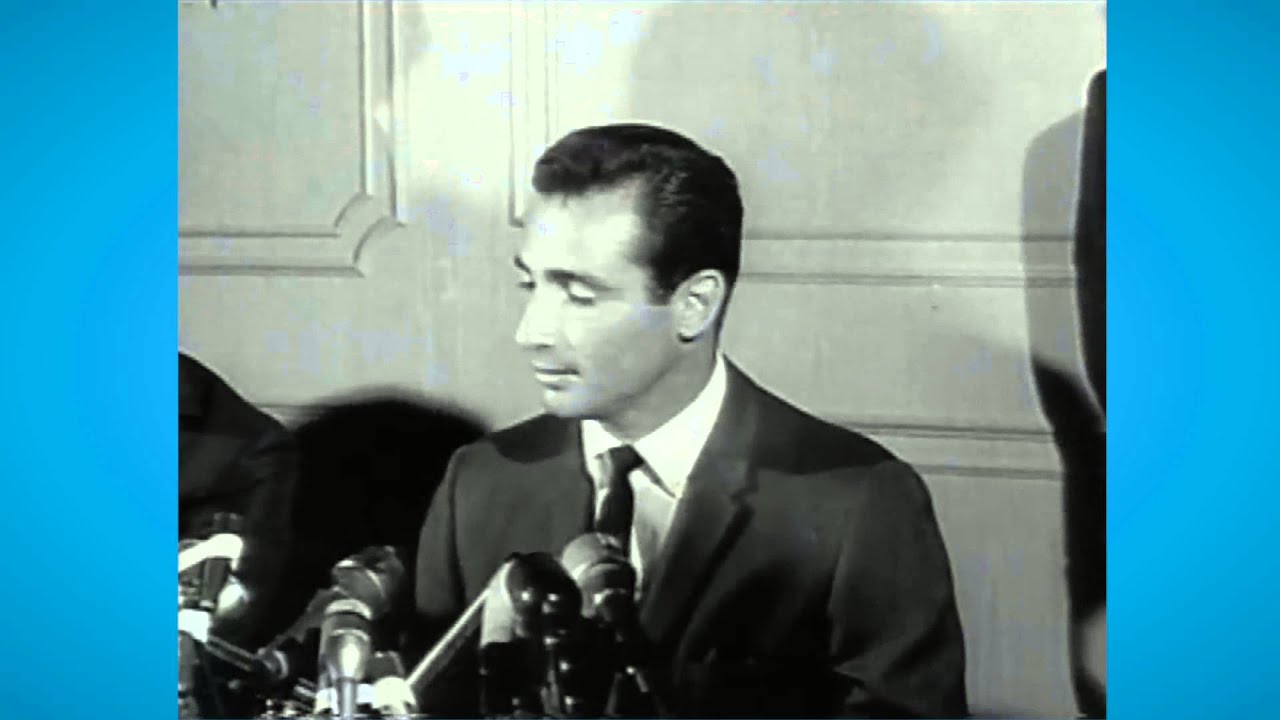
November 18, 1966, 60 years ago: Sandy Koufax, superstar pitcher for the Los Angeles Dodgers, announces his retirement from Major League Baseball, in a press conference at the Beverly Wilshire Hotel in the Los Angeles suburb of Beverly Hills, California. He is a few weeks short of his 31st birthday.
This is the most stunning retirement in the history of professional sports, even more so than Jim Brown's retirement from the NFL 4 months earlier, before turning 30.
It was stunning because Koufax had just completed a season in which he went 27-9, with a 1.73 ERA. He led the Dodgers to a Pennant, and had just won the Cy Young Award. For the past 6 seasons, after finding his control after a difficult start to his career, he had 129 wins, 35 of them by shutout, 4 of them by no-hitter, 1 of those by perfect game, and 1,713 strikeouts, winning 3 Cy Young Awards -- at a time when the Award was given to the best pitcher in both Leagues.
Counting 1959, before he found his control, he had helped the Dodgers win 4 Pennants and 3 World Series, being named the Most Valuable Player in 2 of them. In 1963, he was named the MVP of the National League in the regular season and of the World Series, the 1st time that feat had ever been pulled off. It has since been matched only by Willie Stargell in 1979 and Mike Schmidt in 1980. It's also been done in the American League by Frank Robinson in 1966 and Reggie Jackson in 1973. So, a total of 5 times since the establishment of the World Series MVP in 1955.
But he had pitched 1,192 2/3rds innings in the last 4 seasons, and that was despite missing the last 7 weeks of the 1964 season with the 1st diagnosed instance of arthritis in his elbow. All that pitching was taking a toll on his arm. His arthritis had been caused by a circulatory problem that threatened further use of the arm.
When he pitched a complete-game 2-hit shutout against the Minnesota Twins in Game 7 of the 1965 World Series, he did it throwing only fastballs. It hurt too much to throw a curve. (In other words, all those Twins hitters, including 500 Home Run Club member Harmon Killebrew and 2-time batting champion Tony Oliva, knew exactly what was coming, every time, and it didn't help.)
In Spring Training of 1966, Koufax told sportswriter Phil Collier of the San Diego Union that the upcoming season would be his last. He told Collier that if he kept the secret until right before the official announcement, he could have the scoop. Collier kept the secret, and Koufax kept his part of the bargain.
At the press conference announcing his retirement, a reporter asked, "The question is, 'Why?', Sandy." His answer:
The question is, "Why?" I don't know if cortisone is good for you or not. But, uh, to take a shot every other ballgame is, uh, more than I wanted to do, and to walk around with a constant upset stomach because of the pills, and to be high half the time during the ballgame because you're taking painkillers. I don't want to -- I don't want to have to do that.
He was asked about the loss of income. Before the season, he had held out for $125,000 (about $1.31 million in 2026 money). His response:
Well, the loss of income. Uh, let's put it this way: If there were a man who did not have use of one of his arms, and you told him it would cost a lot of money, and he could buy back that use, he'd give 'em every dime he had, I believe. That's my feeling. And, in a sense, maybe, this is what I'm doing. I don't know.
You know, I got a lot of years to live after baseball, and just, I would like to live them with complete use of my body. I don't regret one minute of the last twelve years, but I think I would regret one year that was too many.
In 1972, in his 1st year of eligibility, Koufax was elected to the Baseball Hall of Fame. At the age of 36 years and almost 1 month, he was the youngest person ever elected to it, and remains so. This broke the record set in 1939 when the writers voted in Lou Gehrig, then 36 and 5 months, in a special election, because they knew he was dying.
For comparison's sake: In pro football, the youngest player ever elected is Gale Sayers, who was 34, having retired due to injuries to both knees; in basketball, it is Ed Macauley, who was 32, having retired because he didn't think he could be a player and a coach at the same time, and he wanted to coach; and in hockey, it is Bobby Orr, who was 31, had injuries to both knees like Sayers, and had the usual waiting period waived for him, due to his big impact on the sport in his comparatively short career.
Just before the 1993-94 season began, Michael Jordan, then 30, considered the best player in the NBA, and one of its best players ever, announced his retirement. It remains the only retirement announcement more shocking than Koufax's. However, Jordan wasn't injured, the Basketball Hall of Fame did not waive its waiting period to elect him, and, by late in the 1994-95 season, he was ready, willing and able to return. Koufax never did.
(It didn't occur to me until just now that the Basketball Hall of Fame did not waive the waiting period for Jordan, because everyone believed he was coming back. This feeds the suspicion that his 1st retirement was really a "backdoor suspension" for gambling offenses. He wasn't elected after his 2nd retirement in 1998, either, because he returned again before the 5 years was up. In 2009, having had 5 full seasons pass since his 3rd retirement, he was elected.)
In 1999, despite being one of the living nominees for the Major League Baseball All-Century Team, Koufax did not attend the All-Star Game at Fenway Park in Boston, where many of the living nominees were introduced in a pregame ceremony. When he was chosen for the Team, he and all the other living honorees did attend the pregame ceremony honoring them before Game 2 of the World Series at Turner Field in Atlanta.
As of November 18, 2026, Sandy Koufax is approaching his 91st birthday, and appears to be in good health. His left arm has held up enough to allow him to pitch in old-timers games in his 40s and 50s, and to throw out the occasional ceremonial first ball, including in the Dodgers' World Series appearances in 2017 and 2018. (He did not attend in 2020, due to COVID restrictions. He did attend in 2024 and 2025, but did not throw out ceremonial pitches.)
Because of the combination of his greatness, his status as a Jewish baseball player who refused to pitch in a World Series game because it fell on Yom Kippur, his early retirement, which keeps us guessing as to what he could have done if not for his injury, and his guarding of his privacy to the point where he doesn't make many public appearances, he is one of the few living baseball players who can genuinely be said to have a "mystique."
Built in 1928, the Beverly Wilshire Hotel, where the press conference was held, opened at the intersection of Wilshire Boulevard and Rodeo Drive. Elvis Presley often stayed there while filming movies, and John Lennon lived there during his 1973-74 separation from Yoko Ono, which he called his "Lost Weekend." It's been a filming location for several movies and TV shows.


No comments:
Post a Comment