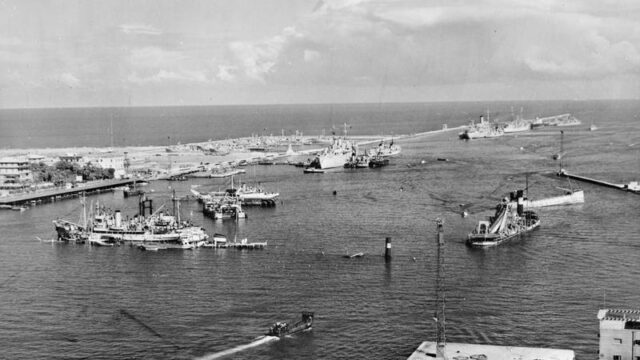
October 29, 1956, 70 years ago: On the orders of President Gamal Abdel Nasser, Egypt closes the Suez Canal, triggering a crisis that could have blown up into World War III.
Israel considered this an act of war, and invaded on October 29, with the primary objective of re-opening the Straits of Tiran and the Gulf of Aqaba. After issuing a joint ultimatum for a ceasefire, on October 31, Great Britain and France joined the Israelis in an attempt to depose the Egyptian dictator, and regain control of the Canal.
However, President Dwight D. Eisenhower refused to take sides, hoping that isolating Britain and France would prevent a wider war, which, at worst, bring the Soviet Union into it on Egypt's side, thus meaning World War III; and, at the least, would unduly affect Israel. "Ike" turned out to be right, and Britain and France withdrew on November 7, ending the crisis. The Canal reopened on April 24, 1957.
This is often seen as the end of Britain and France as true world powers. The Suez Crisis was a major factor in both Anthony Eden's resignation as Prime Minister of Britain, which occurred on January 9, 1957, a little over 2 months later; and in the fall of France's Fourth Republic, and its replacement with the Fifth Republic, in 1958.
But stuff like this is why the rest of the Middle East doesn't trust Israel. Since 1974, even though it is on the continent of Asia, Israel's national sports teams have been denied entry into Asian tournaments, because Muslim countries in Asia refuse to allow Israeli athletes onto their soil. Since 1992, they have competed in European tournaments.
The Suez Crisis was a huge regional boost for Nasser. A key figure in the coup that overthrew King Farouk in 1952, he set the standard for Middle East dictators to follow, with his cult of personality, his prominent mustache, and his willingness to wear whatever was required for the occasion, be it business suit, military uniform or religious attire.

But he lost the next war with Israel, the Six-Day War of June 1967. And his health was poor: He was a heavy smoker, and by this point had arteriosclerosis and diabetes. He died in 1970, only 52 years old. He was succeeded by his Vice President, Anwar Sadat, who would launch yet another war against Israel in 1973, lose it, and then do something unthinkable to Nasser: Make peace.
Also on this day, NBC debuts its new evening news program, The Huntley-Brinkley Report. With the Suez Crisis beginning that day, the Hungarian Revolution ongoing, and a Presidential election campaign entering its final stages, the timing was excellent. In other words, it could be said that this was one of those days where "everything happened."
Including the birth of Wilfredo Gómez. The Puerto Rican boxer known as "Bazooka" was the Super Bantamweight Champion from 1979 to 1983, the Featherweight Champion in 1984, and the Super Featherweight Champion in 1985 and 1986. He died on October 10, 15 days ago, at the age of 69.