Showing posts with label eddie murray. Show all posts

Monday, October 16, 2023

How Long Has It Been: The Baltimore Orioles Won a World Series (Or Even a Pennant)

October 16, 1983, 40 years ago: Eddie Murray slams a pair of home runs and Scott McGregor pitches a 5-hitter, as the Baltimore Orioles beat the Philadelphia Phillies, 5-0 at Veterans Stadium, and win the World Series 4-1. Baltimore catcher Rick Dempsey‚ who hit .385 with 4 doubles and a home run‚ is the named the Series' Most Valuable Player.

The Orioles win their 3rd World Series, following 1966 and 1970. This one marks a unique double: Edward Bennett Williams, famed trial lawyer, majority owner of the Orioles, and minority owner and former majority owner of the Washington Redskins, becomes the only man ever to be an owner of the current World Series and Super Bowl champions at the same time.

NFL rules prohibit a majority owner from being a majority owner in another sport, so before buying the Orioles, Williams sold some of his stake in the Redskins to Jack Kent Cooke, former owner of the Los Angeles Lakers and Kings, builder of the Forum arena outside L.A., and the last owner of the minor-league baseball team that gave its name to an NHL powerhouse, the Toronto Maple Leafs.

The 1983 World Series win caps a period where the Orioles have finished 1st 8 times in 18 years, and have at least been competitive almost continuously since 1960. But, due to their core players getting old and later mismanagement by owner Peter Angelos, they have not played a World Series game since.

The last out is a line shot to shortstop Cal Ripken Jr., son and namesake of the Orioles' longtime 3rd base coach. He will play another 18 seasons, but never appear in another World Series.

It's been 40 years. How long has that been?

*

There was only 1 holdover from their previous World Series win, in 1970. It was Jim Palmer, and he was a holdover from their 1966 win, too. In 1983 Game 3, he became the 1st pitcher to win a World Series game in 3 different decades. He remains the only one.

He, 1st baseman Eddie Murray, and shortstop Cal Ripken Jr. reached the Baseball Hall of Fame. Joe Altobelli had taken over as manager from Earl Weaver, who took them to the 1970 title, and also to Pennants in 1969, 1971 and 1979. Hank Bauer managed the 1966 title, so Weaver basically got into the Hall of Fame with 1 World Series win.

The Houston Astros, the Kansas City Royals, the franchise then known as the Montreal Expos, had never won a World Series. The Braves hadn't won in 26 years, including their entire tenure in Atlanta. The Giants hadn't won in 29 years, including their entire tenure in San Francisco. The Cleveland Indians hadn't won in 35 years. The Twins hadn't won in 59 years, including their entire tenure in Minnesota. The Boston Red Sox hadn't won in 65 years. The Chicago White Sox had just won the American League Western Division, but hadn't won the World Series in 66 years. The Chicago Cubs hadn't won in 75 years.

The Astros, the Expos franchise, and the San Diego Padres had never won a Pennant. The Padres, the Seattle Mariners, the Texas Rangers and the Toronto Blue Jays had never even won a Division title. The Expos were still in Montreal, the Astros were still in the National League, the Milwaukee Brewers were still in the American League, and the Cleveland team was still known as the Indians.

All of those facts are no longer true.

Only 6 ballparks in use that season are still in use: Fenway Park in Boston, Wrigley Field in Chicago, the Oakland Coliseum, Royals Stadium (now Kauffman Stadium) in Kansas City, and both Los Angeles area stadiums, Dodger Stadium and Anaheim Stadium (now Angel Stadium of Anaheim).

There was an NFL team in Baltimore (for 5 more months, anyway), but it was the Colts, not the Ravens. There was an NFL team in Houston, but it was the Oilers, not the Texans. There were NBA teams in Kansas City, San Diego and Seattle. There were NHL teams in Quebec City and Hartford. And the USFL and the original North American Soccer League were still operating.

Carl Hubbell, Hank Greenberg and Lefty Gomez were still alive. Of the defining players of my childhood, Carl Yastrzemski and Johnny Bench had just retired; Willie Stargell had done so a year earlier; Reggie Jackson and Rod Carew were pursuing milestones in Anaheim, the former, 500 home runs, the latter, 3,000 hits; Tom Seaver and Nolan Ryan were now elder statesmen; and Mike Schmidt, Dave Winfield, Carlton Fisk, George Brett were roughly at their peaks.

Derek Jeter was 9 years old, Alex Rodriguez was 8, David Ortiz was 7, Jimmy Rollins was 4, Albert Pujols and CC Sabathia were 3, David Wright was 10 months, Justin Verlander was 8 months, Miguel Cabrera was 6 months; and Zack Greinke (born 5 days later), Max Scherzer, Buster Posey, Clayton Kershaw, Stephen Strasburg, Madison Bumgarner, Freddie Freeman, Giancarlo Stanton, Jose Altuve and Gerrit Cole, much less anyone younger than them, hadn't been born yet.

Current Orioles manager Brandon Hyde was 13 years old, while current Phillies manager Rob Thomson was at the University of Kansas. Tom Thibodeau of the Knicks was an assistant coach at Salem State College. Lane Lambert of the Islanders was playing for the Detroit Red Wings. Lindy Ruff of the Devils was playing for the Buffalo Sabres. Buck Showalter of the Mets was playing for the Columbus Clippers, the Yankees' Class AAA affiliate. Peter Laviolette of the Rangers and Sandy Brondello of the Liberty were in high school. Aaron Boone of the Yankees was 10, Jacque Vaughn of the Nets and Brian Dabol of the Giants were 8, Robert Saleh of the Jets was 4, Troy Lesesne of the Red Bulls was 11 days from being born, and Nick Cushing of NYCFC was born the next year.

The Orioles dethroned the St. Louis Cardinals as World Champions. The titleholders in the other sports were the Washington Redskins in football, the Philadelphia 76ers in basketball, and the New York Islanders in hockey. The Sixers and Isles have never won another title, either. The Heavyweight Champion of the World was Larry Holmes.

The Olympic Games have since been held in America 3 times; twice each in Canada, Korea, Japan and China; and once each in Bosnia, France, Spain, Norway, Australia, Greece, Italy, Britain, Russia and Brazil.

The World Cup has since been held in America, Mexico, Italy, France, Germany, South Africa, Brazil, Russia and Qatar.

There were 26 Amendments to the Constitution. The idea that two people of the same gender could be legally recognized as married was ridiculous -- but so was the idea that corporations were "people."
The President of the United States was Ronald Reagan. The Governor of the State of New York was Mario Cuomo. The Mayor of the City of New York was Ed Koch. The Governor of New Jersey was Tom Kean Sr. The Mayor of the Orioles' City of Baltimore was William Donald "Dud" Schaefer. The Governor of their home State of Maryland was Harry Hughes, who would be succeeded by Schaefer.

The current holders of those offices? Joe Biden was a U.S. Senator from Delaware, Kathy Hochul was in law school at The Catholic University of America in Washington, Eric Adams was at the New York Policy Academy, Phil Murphy was a rookie at Goldman Sachs, Governor Wes Moore of Maryland had just turned 5, and Mayor Brandon Scott was born the next year.

There were still living veterans of the Spanish-American War, the Philippine Campaign, the Boxer Rebellion, the Boer War, the Russo-Japanese War and the Potemkin Mutiny. Polish Cold War hero Lech Wałęsa was about to be awarded the Nobel Peace Prize. The Pope was John Paul II. The current Pope, Francis, was Father Jorge Mario Bergoglio, teaching in San Miguel, Argentina.

The Prime Minister of Canada was Pierre Trudeau, and of Britain, Margaret Thatcher. The monarch of both countries was Queen Elizabeth II. Liverpool F.C. were the holders of the Football League title, and Manchester United of the FA Cup.
 
There have since been 7 Presidents of the United States, 8 Prime Ministers of Britain, and 3 Popes.

Major novels of 1983 included Hollywood Wives by Jackie Collins, On Wings of Eagles by Ken Follett, Ironweed by William Kennedy, The Little Drummer Girl by John le Carre, and Christine and Pet Sematary by Stephen King. George R.R. Martin published the murder mystery/fantasy The Armageddon Rag. J.K. Rowling had just started at the University of Exeter.

This was the year of the blockbuster film sequel, including Star Wars Episode VI: Return of the Jedi, Superman III with Christopher Reeve (playing "Evil Superman" and Clark Kent fighting each other thanks to Richard Pryor), Smokey and the Bandit Part 3 (the working title had been Smokey IS the Bandit, which is essentially the plot, with Sheriff Justice taking up the Enoses' latest challenge, and Burt Reynolds only appears at the end), the Dirty Harry film Sudden Impact (introducing Clint Eastwood's line "Go ahead, make my day"), the Saturday Night Fever sequel Staying Alive, and battling James Bond films: The official Octopussy with Roger Moore, and the unofficial Never Say Never Again with a one-time-only return for Sean Connery, in what is essentially a remake of Thunderball. Peter Davison was playing The Doctor.

This was the year Tom Cruise became a star with All the Right Moves and Risky Business. Eddie and the Cruisers and The Big Chill helped to launch the 1960s nostalgia wave that didn't quite catch on in the late 1970s with film versions of Beatlemania and Hair. Brainstorm, Natalie Wood's last film, delayed because of her death 2 years earlier, finally premiered.

October 1983 also saw the premieres of film versions of Stephen King's The Dead Zone and Tom Wolfe's Mercury astronaut drama The Right Stuff. Steven Spielberg, John Landis, Joe Dante and George Miller had recently teamed up, each directing a segment of Twilight Zone: The Movie. And Leonard Nimoy was shooting, as director and (though not billed, as to avoid what we would now call spoilers) actor, Star Trek III: The Search for Spock.

Major TV shows that had just debuted included the M*A*S*H spinoff AfterMASH, Webster, Scarecrow & Mrs. King, the game show Love Connection, The Sally Jessy Raphael Show, the cartoon Inspector Gadget, a new cartoon version of Alvin and the Chipmunks, and a cartoon that took G.I. Joe into a far less wholesome direction.

NBC debuted a bunch of new series that turned out to be laughably bad. These included The Rousters, with Chad Everett as the leader of a family of carnival promoters that was descended from Wild West hero Wyatt Earp, including a crazy brother played by Jim Varney (basically doing his Ernest P. Worrell character) and a crazier mother played by Maxine Stuart that made Granny Clampett look like Jessica Fletcher. Hoyt Axton and Mimi Rogers also starred on this turkey, which NBC said was "going to sink The Love Boat." It sank in the harbor.

NBC also tried to copy Three's Company, only instead of a guy chef with 2 women, 1 of them a bouncy blonde, We Got It Made was a bouncy blonde maid with 2 guys. That was less ridiculous than Bay City Blues, a bad show about a bad minor-league baseball team. (The fact that the baseball season and the TV season don't match up well is a big reason why, unlike football and basketball, there's never really been a successful TV show about baseball.)

The following month, 2 shattering programs were broadcast: ABC's nuclear thriller The Day After, and Sesame Street's episode discussing the death of Mr. Hooper (whose portrayer, Will Lee, had died a year earlier).

More ridiculous still was Mr. Smith, about an orangutan in a science lab that got exposed to radiation and developed an I.Q. over 200, making him smarter than the scientists working on him. But that was still better than Manimal, with Simon MacCorkindale as a shapeshifter. Was that supposed to be NBC's attempt to copy CBS' The Incredible Hulk? If so, it didn't work, and it remains a pop-culture joke on the level of My Mother the Car from the '60s and Cop Rock from the '90s.

No one had yet heard of Forrest Gump, Jack Ryan, the Teenage Mutant Ninja Turtles, the Terminator, the Ghostbusters, Freddy Kreuger, Marty McFly, Bart Simpson, Robocop, Codename V, John McClane, Zack Morris, the Seinfeld Four, Deadpool, Buffy Summers, Fox Mulder, Ross Geller & Rachel Greene, Bridget Jones, Xena, Carrie Bardshaw, Jed Bartlet, Tony Soprano, Master Chief, Leroy Jethro Gibbs, Rick Grimes, Lisbeth Salander, Bella Swan, Don Draper, Katniss Everdeen, Walter White or Richard Castle.

The Number 1 song in America was "Total Eclipse of the Heart," sung by Bonnie Tyler, written by Jim Steinman. R.E.M. made its TV debut on Late Night with David Letterman. Michael Jackson was riding the crest of Thriller, and was now the biggest pop-culture star in the world. The Clash fired guitarist Mick Jones. Def Leppard singer Joe Elliott had to apologize for his onstage remark that El Paso, Texas was "that place with all the greasy Mexicans."

Cyndi Lauper released She's So Unusual, featuring "Girls Just Want to Have Fun" and "Time After Time." John Mellencamp released Uh-Huh, featuring "Pink Houses." KISS released Lick It Up, and appeared in public without their makeup for the 1st time. Motley Crue released Shout at the Devil. Quiet Riot's Metal Health was about to become the 1st metal album to top Billboard magazine's album charts. Billy Joel was riding the success of An Innocent Man, The Police of Synchronicity.

Inflation was such that what $1.00 bought then, $2.35 would buy now. A U.S. postage stamp cost 20 cents, and a New York Subway ride 75 cents. The average price of a gallon of gas was $1.22, a cup of coffee $1.13, a McDonald's meal (Big Mac, fries, shake) $2.55, a movie ticket $3.18, a new car $10,607, and a new house $97,800. The Dow Jones Industrial Average closed the preceding Friday at 1,263.52.

The tallest building in the world was the Sears Tower in Chicago. The birth control pill was long-established, but there was, as yet, no Viagra. The 1st analog cellular system widely deployed in North America was introduced in October 1983: The Advanced Mobile Phone System (AMPS). There were personal computers, but almost nobody had yet heard of the Internet. Even VCRs weren't in every home yet. Home video games were a battle between the Atari 5200 SuperSytem and ColecoVision -- Nintendo's systems were yet to come. Chrysler introduced the 1st minivan, the Dodge Caravan.

In October 1983, a U.S. Marine barracks was blown up by terrorists in Beirut, Lebanon, killing 305 people, including 241 Marines. Two days later, another group of Marines invaded Grenada, settling things down there after the overthrow and assassination of Prime Minister Maurice Bishop. Argentina held a democratic election, ending 7 years of brutal military rule. And a pair of close calls both nearly led the Soviets to launch a nuclear first strike.

Knute Rockne, All-American star Pat O'Brien, and NFL founder George Halas, and Willie "Puddin' Head" Jones, 3rd baseman for the 1950 Phillies' "Whiz Kids," died. Jesse Eisenberg, and Joey Votto, and Zack Greinke were born.

October 16, 1983. The Baltimore Orioles won the World Series. They have not even won a Pennant since.

They would seem to have the talent to do so again. We shall see.

Thursday, April 5, 2018

Baltimore's 10 Greatest Athletes

Johnny Unitas (left) and Brooks Robinson,
throwing out ceremonial first balls
before the last Orioles game at Memorial Stadium,
October 6, 1991.

The Yankees are starting a home series against the Baltimore Orioles today.

Baltimore's 10 Greatest Athletes

Honorable Mention to Orioles in the Baseball Hall of Fame, who did not otherwise make the Top 10: Robin Roberts, Hoyt Wilhelm, Luis Aparicio and Roberto Alomar. Each of these men is better known for playing for another team, but each played at least 4 seasons in Baltimore.

Honorable Mention to the 1890s Orioles in the Baseball Hall of Fame: John McGraw, Willie Keeler, Hugh Jennings, Joe Kelley, Wilbert Robinson and Dan Brouthers. McGraw, Jennings and Robinson were all elected to the Hall as managers, but all could have been elected as players. (Unlike the Basketball and College Football Halls of Fame, the Baseball Hall of Fame does not have separate elections for players and managers/head coaches.)

Honorable Mention to members of the Pro Football Hall of Fame, who did not otherwise make the Top 10: From the Colts, Art Donovan, Raymond Berry, Jim Parker, John Mackey and Ted Hendricks; from the Ravens, Jonathan Ogden and Rod Woodson. Joe Flacco and Ed Reed might join them. (UPDATE: Reed was elected in 2019.)

When The Sporting News ranked its 100 Greatest Football Players in 1999, Parker came in 24th, Berry 40th, Mackey 48th, and Hendricks 64th. When the NFL Network ranked its 100 Greatest Players in 2010, Parker was 32nd, Berry 36th, Mackey 42nd, Ogden 72nd, Hendricks 82nd and Reed 88th.

Honorable Mention to members of the Basketball Hall of Fame, who did not otherwise make the Top 10: Harry "Buddy" Jeannette, player-coach of the 1948 NBA Champion Baltimore Bullets, the team that went out of business in 1954; and from the 1963-73 Bullets, Gus Johnson and Wes Unseld.

10. Earl Monroe, guard, Bullets, 1967-72. Before joining Walt Frazier in the backcourt of the Knicks team that went on to win the 1973 NBA Championship, "Earl the Pearl" was the great rival of "Clyde," making him say, "I dreamed about many women, but Earl was the only man I dreamed about." In other words, the Pearl gave Clyde nightmares.

Earl was a 4-time All-Star, 2 with the Bullets. He was the 1968 NBA Rookie of the Year, and helped the Bullets win the 1971 Eastern Conference Championship, but they got swept in 4 straight by the Milwaukee Bucks. He was named to the Basketball Hall of Fame and the NBA's 50th Anniversary 50 Greatest Players, and got his number retired by both of his teams: 10 by the Wizards and 15 by the Knicks.

9. Frank Robinson, right field, Orioles, 1966-72. This is a joke, right? Frank Robinson, the man who made the O's champions, only 9th? Keep in mind, he only played 6 full seasons in Charm City.

His 1st season there was 1966. He was immediately named Captain, won the Triple Crown, and led them to their 1st Pennant and 1st World Series win. They won 3 straight American League Pennants, and won the 1970 World Series, losing in 1969 and 1971.

Over his career, he hit 586 home runs, fell just 57 hits short of 3,000, and became the only man to win the Most Valuable Player award in both Leagues. He was named to the Baseball Hall of Fame, and in 1999 The Sporting News ranked him 22nd on their list of the 100 Greatest Baseball Players.

Both the Cincinnati Reds and the Orioles retired Frank's Number 20 – in fact, he was the 1st Oriole to have his number retired. The Orioles put a statue of him outside Camden Yards, and, along with teammate Brooks Robinson, was part of the 1st induction class into the team's Hall of Fame. He was also the 1st black manager in each League. In 2005, George W. Bush awarded him the nation's highest civilian honor, the Presidential Medal of Freedom.

8. Gino Marchetti, defensive end, Colts, 1953-66. Sid Gillman, a Hall of Fame coach then running the Los Angeles Rams, called him "the greatest player in football. It's a waste of time to run around this guy's end. It's a lost play. You don't bother to try it."

And Forrest Gregg, the Hall of Fame offensive tackle for the Green Bay Packers, called "the finest player I ever coached" by Vince Lombardi, said, "Marchetti was the best all-around player I ever played against. Great pass rusher. Great against the run. And he never let you rest."

An 11-time Pro Bowler, Gino was the Captain of the 1958 and 1959 NFL Champion Colts. He played 13 seasons -- and was never assessed a 15-yard penalty. In an interview for John Madden's All-Madden All-Millennium Team in 1999, he seemed quite proud of pointing that out. He was a beast in total control, like Mean Joe Greene, Mike Singletary or Reggie White -- not an out-of-control psychopath like Dick Butkus, Jack Lambert or Lawrence Taylor.

He broke his ankle late in regulation of that 1958 NFL Championship Game, "the Greatest Game Ever Played," but refused to go to the locker room. He had to see what happened with his own eyes. (Can you imagine Ray Lewis doing that? If you can, remember that, in his era, there'd have been a TV in the trainer's room.)

He was named to the NFL's 1950s All-Decade, 50th Anniversary and 75th Anniversary Teams, and to the Pro Football Hall of Fame. The Colts retired his Number 89, and, with the other Colts Hall-of-Famers, was elected by the Ravens to their Ring of Honor. In 1999, The Sporting News ranked him 15th on its list of the 100 Greatest Football Players. In 2010, the NFL Network ranked him 39th on their 100 Greatest Players.

7. Ray Lewis, linebacker, Ravens, 1996-2012. I don't know what happened that night in Atlanta, so I don't know what he did. He should still be presumed innocent until proven guilty, and all we know for sure what he is guilty of is trying to protect his friends from criminal prosecution. This assessment is about on-field performance.

Some performance. The linebacker made 13 Pro Bowls. He was named NFL Defensive Player of the Year in 2000 and 2003. He helped the Ravens win Super Bowls XXXV and XLVII, winning the game's Most Valuable Player award in the former and retiring a World Champion after the latter.

He is a member of the Pro Football Hall of Fame and the NFL's 2000s All-Decade Team, and, while still active, came in 18th on the NFL Network's 100 Greatest Players. The Ravens do not officially retire numbers, but have not given his Number 52 back out since he retired. Inside M&T Bank Stadium, they have placed him on their Ring of Honor; outside it, along with Johnny Unitas of the city's previous team, the Colts, they dedicated a statue of him. A section of Baltimore's North Avenue has been named Ray Lewis Way.

6. Eddie Murray, 1st base, Orioles, 1977-88. He was the American League's Rookie of the Year in 1977, helped the Orioles win the Pennant in 1979, and helped them with the World Series in 1983. The next season, someone (I forget who) wrote that we'd been hearing for so long that he was going to become a great player that we didn't realize that he had already become one. He later won another Pennant, with the 1995 Cleveland Indians, and came back to the Orioles and helped get them to another AL Championship Series in 1996.

He was an 8-time All-Star, and a 3-time Gold Glove. Only 5 men have both at least 500 home runs and at least 3,000 hits, and only 3 reached both without steroid suspicion: Hank Aaron, Willie Mays and Eddie Murray. Pretty good company.

He was a 1st-ballot election to the Baseball Hall of Fame, and the Orioles retired his Number 33 and dedicated a statue to him outside Camden Yards. In 1999, The Sporting News ranked him 77th on their list of the 100 Greatest Baseball Players.

5. Jim Palmer, pitcher, Orioles, 1965-84. In 1966, he won Game 2 of the World Series, outpitching Sandy Koufax in what turned out to be his last appearance. He helped the Orioles reach their 1st 8 postseasons (narrowly missing 3 others), including all 6 of their Pennants and all 3 of their World Series wins: 1966, 1970 and 1983. In the process, he became, and remains, the only man to win World Series games in 3 different decades.

A 6-time All-Star, he was the AL Cy Young Award winner in 1973, 1975 and 1976. He led the AL in wins 3 times and ERA twice. He pitched a no-hitter in 1969, and won 4 Gold Gloves. He was 268-152 for his career.

He was elected to the Baseball Hall of Fame, and ranked 64th on The Sporting News' 100 Greatest Baseball Players in 1999. The Orioles retired his Number 22 and elected him to their team Hall of Fame. He is now a broadcaster for the Orioles. The NCIS character of medical examiner Dr. Jimmy Palmer, played by Brian Dietzen, was named for him.

4. Cal Ripken, shortstop, Orioles, 1981-2001. Everyone thinks of the streak, 2,632 consecutive games. Sports Illustrated named him their Sportsman of the Year for 1995, the year he surpassed Lou Gehrig's record of 2,130. Whether staying in the lineup as he got older and slower was advisable is a debate for another time. But he wouldn't have gotten close to Gehrig's record if he hadn't been a great player.

How great? A 19-time All-Star, a 2-time Gold Glove, and the only man to this day to win a League's Rookie of the Year and its MVP in back-to-back seasons, 1982-83. He won another MVP in 1991. He helped the Orioles win the 1983 World Series and reach back-to-back ALCS in 1996-97. He had 3,184 hits and 431 home runs.

The Orioles retired his Number 8, and put a statue of him outside Camden Yards. He was named to the Baseball Hall of Fame and the Major League Baseball All-Century Team, and in 1999 The Sporting News ranked him 78th on their list of the 100 Greatest Baseball Players.

3. Lenny Moore, running back, Colts, 1956-67. If you're under the age of 60, and you don't know your history, the Reading Rocket might be the greatest football player you've never heard of.

A 7-time Pro Bowler, he was NFL Rookie of the Year in 1956. He helped the Colts win their 1958-59 back-to-back titles. He was named NFL Most Valuable Player in 1964, a season that was the middle of a streak of 18 consecutive appearance with a touchdown. (Though not 18 straight games, as it included 3 games he missed due to injury.) That's still a record, recently tied by LaDainian Tomlinson.

He rushed for 5,174 yards and 63 touchdowns. That's impressive. He caught 364 passes for 6,039 yards and 48 touchdowns. That's impressive. Put them together? Nobody put that together in those days. Nobody except Lenny Moore. This guy was playing 21st Century offense in the Eisenhower years.

He was elected to the Pro Football Hall of Fame and the NFL's 1950s All-Decade Team and it's 50th Anniversary Team. The Colts retired his Number 24, and, with the other Colts Hall-of-Famers, was elected by the Ravens to their Ring of Honor.

In 1999, The Sporting News ranked him 71st on its list of the 100 Greatest Football Players. In 2010, the NFL Network ranked him 94th on their 100 Greatest Players. In both cases, he was seriously shortchanged.

Lenny Moore is 84 years old, and retired from working with the Maryland Department of Juvenile Services. He knew how hard it was to be a poor black kid in his time, and he wanted to make it easier for those who came after him.

2. Brooks Robinson, 3rd base, Orioles, 1955-77. In 1960, he won his 1st Gold Glove at 3rd base, and made his 1st All-Star Team. In 1964, he was the 1st Oriole named American League Most Valuable Player. In 1966, he helped the Orioles win their 1st Pennant and their 1st World Series. In 1970, he won another World Series, redefining the way people viewed the playing of 3rd base, and winning the Series MVP. In 1974, he played in his last All-Star Game, his 18th, and made his 6th postseason appearance. In 1975, he won his last Gold Glove, his 16th.

In 1977, he retired, had his Number 5 retired, and, with Frank Robinson (no relation), became the 1st 2 inductees into the Orioles' Hall of Fame. In 1983, he was elected to the Baseball Hall of Fame. In 1991, he was invited to throw out the ceremonial first ball before the last Orioles game at Memorial Stadium (along with Johnny Unitas of the Colts, who threw a football). In 1999, he was ranked 80th on The Sporting News' 100 Greatest Baseball Players and the Major League Baseball All-Century Team. In 2012, the Orioles dedicated a statue of him outside Camden Yards.

1. Johnny Unitas, quarterback, Colts, 1956-72. This is how good the Colts franchise was by the time they won Super Bowl V in 1971: It could be legitimately argued that they had NFL history's greatest quarterback, Unitas; all-around offensive player, Lenny Moore; guard, Jim Parker; receiver, Raymond Berry; tight end, John Mackey; defensive end, Gino Marchetti; and defensive tackle, Art Donovan.
The Golden Arm with a gift for the Iron Man

In 1998, Steve Sabol of NFL Films saw that the largest gathering of members ever was coming to the Pro Football Hall of Fame's induction ceremony. So he got as many of them for interviews as he could, and asked them what one player that they'd ever seen would be the man around whom they would build a team. Some players had to think hard, including Lenny Moore. Lenny decided, though: "Unitas. Unitas."

His full name was John Constantine Unitas. The comic book character Hellblazer is named John Constantine, but, as the character is British, he certainly wasn't named for the Lithuanian-American Johnny U. Nevertheless, there were times when Johnny U seemed like a comic book hero, as he was nicknamed The Golden Arm. Or, if you didn't like the Baltimore Colts, maybe a James Bond villain?)

He was little-regarded coming out of St. Justin's High School, a small school in Pittsburgh, and the only college that really wanted him was the University of Louisville. He wasn't much better-regarded coming out of there, but given later circumstances, they retired his Number 16. The Pittsburgh Steelers drafted him, and cut him in preseason. He played semi-pro ball until 1956, when the Baltimore Colts signed him.

He led the Colts to the NFL Championship Game in 1958, and led them in a comeback against the New York Giants at Yankee Stadium, first forcing overtime, then winning the title, in what's been called "The Greatest Game Ever Played" and, thanks to the union of the NFL and television, the day the NFL grew up. He beat them again in Baltimore in 1959. He set a record in throwing a touchdown pass in 47 straight games (since broken).

He got the Colts into another NFL Championship Game in 1964, but lost. He was injured for most of the 1968 season, but they won the NFL Championship anyway, and when they fell behind the Jets in Super Bowl III, he came off the bench and began what could have been a counter-miracle, but the Jet defense stopped him. He got them into Super Bowl V, but was injured and missed the 2nd half, but still got his 3rd World Championship.

A 10-time Pro Bowler, he was a 3-time NFL MVP, in 1959, 1964 and 1967. When he retired after the 1973 season, he held most of the career passing records. He was named the starting quarterback on the NFL's 1960s All-Decade, 50th Anniversary and 75th Anniversary Teams. He was elected to the Pro Football Hall of Fame, and the Colts retired his Number 19.

The Colts moved to Indianapolis in 1984, and when the Baltimore Ravens debuted in 1996, at Memorial Stadium, Johnny U, in his blue Colts jersey, presented the game ball to the purple-clad Ravens and their opponents, the Oakland Raiders. A statue of him now stands outside the Ravens' new M&T Bank Stadium, and, with the Colts' other Hall-of-Famers, he was named to the Ravens' Ring of Honor.

In 1999, The Sporting News ranked him 5th on its list of the 100 Greatest Football Players, behind only fellow Pittsburgh area native Joe Montana among quarterbacks. In 2004, TSN changed their minds, and ranked him 1st, right ahead of Montana, on their list of the NFL's 50 Greatest Quarterbacks. In 2010, the NFL Network ranked him 6th on their 100 Greatest Players, again trailing only Montana among quarterbacks. 

Could he have played in the modern era? I am absolutely convinced that he could have. I've seen plenty of footage of Unitas: Not only did he have great passing form, but, rare among quarterbacks of the 1960s, he could run. How he could be that mobile while wearing those iconic black high-top cleats, and frequently a back brace to protect his injured back and ribs, I don't know, but he was. Given today's protection, he would have been just fine, and maybe even, still, what everybody called him when I was growing up: "The greatest quarterback who ever lived."

Wednesday, June 28, 2017

Anthony Young, 1966-2017

The unluckiest man in baseball has been unlucky for the last time.

Anthony Wayne Young was born on January 19, 1966 in Houston. He went to the University of Houston in the mid-1980s, a time when Carl Lewis, Hakeem Olajuwon and Clyde Drexler were recent graduates. He was drafted as a righthanded pitcher by the New York Mets in 1987.

He made his major league debut on August 5, 1991. He pitched 2 1/3rd innings in relief of Pete Schourek, and allowed a run. As a result of a double switch, he was placed in the 5th spot in the batting order, but did not come to the plate. The Mets lost 7-2 to the Chicago Cubs at Shea Stadium.

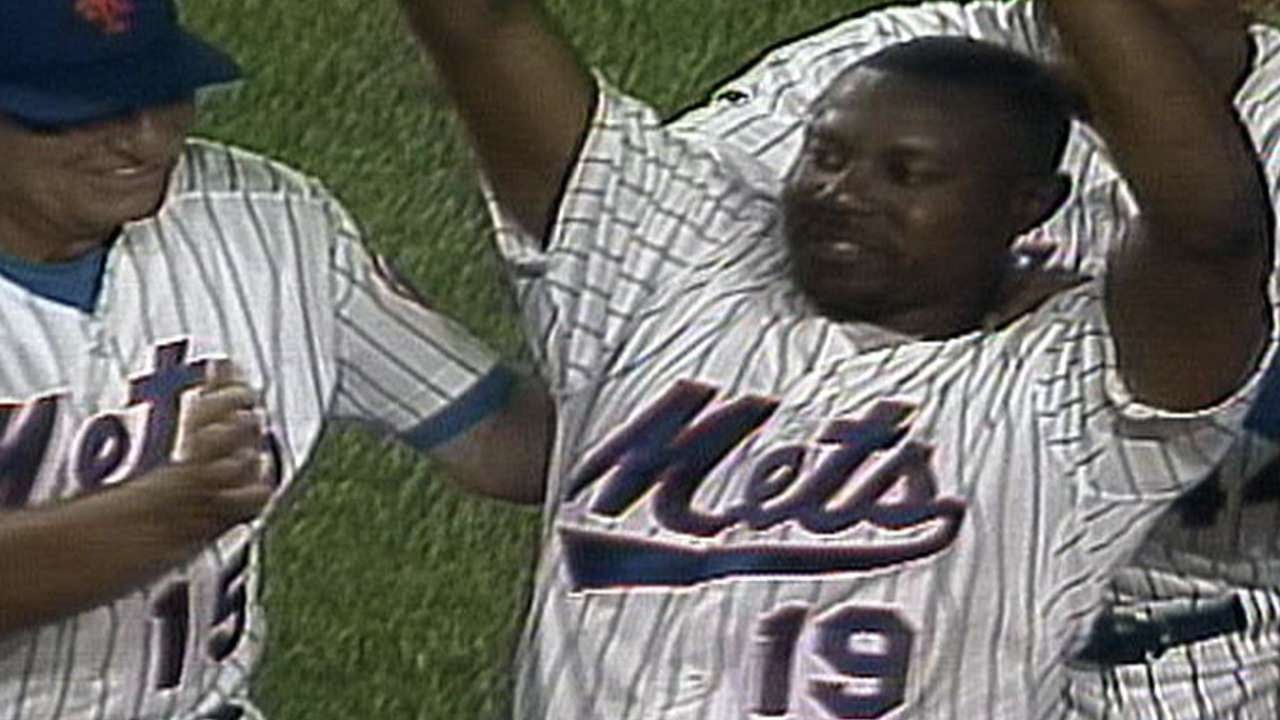
The next season, he switched from Number 33 to 19. Unfortunately, these were the 1992 Mets, The Worst Team Money Could Buy, according to the title of a book by sportswriter Bob Klapisch. On April 19, he was the winning pitcher, despite allowing 2 runs in 3 1/3rd innings of relief, as the Mets beat the Montreal Expos 11-6 at the Olympic Stadium. This was followed by relief appearances without decisions in Philadelphia and Atlanta.

Then, on May 6, he was the losing pitcher as the Mets lost 5-3 to the Cincinnati Reds at Riverfront Stadium. He kept losing, finishing the year with a record of 2-14, although he did have 15 saves.

The streak continued into 1993. He broke the record of 23 consecutive losing decisions, by Cliff Curtis of the 1910-11 Boston Doves (forerunners of the Braves). He eventually lost 27 straight decisions: 0-14 as a starter and 0-13 as a reliever.

If 1992 was a competitive disaster for the Mets, 1993 was one both competitively and morally. It was the year Bobby Bonilla threatened Klapisch in the locker room, captured on video; Bret Saberhagen put bleach in a water gun and squirted it at reporters and Vince Coleman set off a firecracker in the Dodger Stadium parking lot, injuring a toddler. That followed a 5-4 10th inning loss in which Young walked home a run with the bases loaded, extending his streak to 0-27.

Manager Jeff Torborg was fired, and noted disciplinarian Dallas Green was brought in. Green was able to stop the tomfoolery, but not the losing. And it was hardly just Young: Even stars like Saberghagen and future Hall-of-Famer Eddie Murray were underachieving.

It's not that Young was particularly bad, either: Included in that streak was 12 straight save opportunities successfully converted, and a streak of 23 2/3rds consecutive scoreless innings. Those 27 losses included 13 "quality starts," but the Mets went just 4-23 in those games -- and in none of those 4 wins could the win be credited to Young. I don't remember the details, but I do remember that either the 24th, 25th or 26th straight loss was one in which he stood to be the winning pitcher, but he was betrayed by his defense.

Fans sent him good luck charms: Four-leaf clovers, horseshoes, rabbits' feet. Psychics called the Met offices, offering their help. No less than Hall-of-Famer Bob Feller, one of the greatest pitchers then living, wrote him a letter of encouragement. He was introduced to Cliff Curtis' descendants, who wished him well. Jay Leno invited him to appear on The Tonight Show when the streak ended, and he accepted. It got to be like the stories of Catholics praying for Gil Hodges of the Brooklyn Dodgers during his hitless run in the 1952 World Series.

"Finally!" I remember Len Berman saying on WNBC-Channel 4 on the night of July 28, 1993. Young was 0-13 on the year, 0-for-his-last-27, and Green brought him in to pitch the 9th inning against the expansion Florida Marlins at Shea. He didn't help himself, but an error by catcher Todd Hundley also contributed to the Marlins scoring a run. But in the bottom of the 9th, Jeff McKnight singled, Dave Gallagher sacrificed him to 2nd, Ryan Thompson tied the game with a single, and Murray doubled Thompson home with the winning run. Mets 5, Marlins 4. WP: Young (1-13).

After the game, reporters asked Young if it felt like "the monkey is off your back." He said, "It wasn't a monkey, it was a zoo."

Years later, he said, "I got a bad rap on that. I always said I didn't feel like I was pitching badly. It just happened to happen to me. I don't feel like I deserve it, but I'm known for it."

The Mets traded him to the Cubs before the 1994 season, and he finished his career with the Houston Astros in 1996. His career record was 15-48 -- 15-21 without the streak -- but his career ERA was 3.89, giving him an ERA+ of 100, exactly average, and his WHIP was 1.387, bad for a reliever, but for a guy who was a starter and a reliever, not especially shabby.

He returned to the Houston area, married, had 3 children, worked in a chemical plant, and coached in local youth leagues.
But earlier this year, he was diagnosed with an inoperable brain tumor. It took his life yesterday, June 27, 2017. He was just 51 years old.

Anthony Young did not deserve to lose 27 straight decisions. He did not deserve to have his 51st and 52nd years be full of pain and misery. He certainly did not deserve to have his 52nd year be his last.

May he rest in peace. God knows he earned it.

UPDATE: He was buried in Forest Park Cemetery in Houston.

Monday, March 31, 2014

Los Angeles' All-Time Baseball Team

The Los Angeles Dodgers' "territory" might well be the best of them all. As Duke Snider pointed out, the Southern California climate allows you to play all year long, when much of the country is too cold to play. This results in Southern California producing a disproportionately large amount of good players. This is also why the Sun Belt produces most of the College World Series winners.

Eligibility has nothing to do with whether the player in question actually rooted for the Dodgers growing up, or even if the Dodgers were already in Los Angeles at the time. The only requirement is that the player had to have been trained as a player – "grew up," for want of a better term – in one of the following California Counties: Kern, Los Angeles, San Bernardino, San Luis Obispo, Santa Barbara and Ventura.

Orange and Riverside Counties are, for my purposes, the "territory" of the Whatever They're Calling Themselves This Season Angels of Anaheim. San Diego and Imperial Counties are for the San Diego Padres. Alameda, Contra Costa, Sacramento, San Joaquin, Solano and Stanislaus Counties are the ones I've assigned to the Oakland Athletics. And the rest are for the San Francisco Giants, who are also a serious contender for having the best "talent pool" of any of the 30 teams.

6. Los Angeles' All-Time Baseball Team

How strong is this team? I can take either of 3 starting pitchers, and end up with a Hall-of-Famer at every position except catcher -- and even that has an asterisk, as Gary Carter was born in Culver City, Los Angeles County, but grew up in Fullerton, in the Angels' home of Orange County.

1B Eddie Murray of Watts, Los Angeles. He is 1 of only 4 men – 3 to do it honestly – to collect 3,000 hits and hit 500 home runs. He won 3 Gold Gloves, and probably would have won more if Don Mattingly hadn't come along. He helped the Baltimore Orioles win the 1979 American League Pennant and the 1983 World Series. The Orioles retired his Number 33, and he's been elected to the Hall of Fame. When The Sporting News announced its 100 Greatest Baseball Players in 1999, he came in at Number 77.

Honorable Mention to Bob Watson of Fremont, Los Angeles, and Cecil Fielder of La Puente. (Son Prince grew up in Melbourne, Florida, and thus qualifies for the Tampa Bay Rays' all-time regional team.) Mark McGwire of Claremont is ineligible, and you know why. (Although, when The Sporting News announced its 100 Greatest Baseball Players in 1999, he came in at Number 91.) Same with Jason Giambi of Covina. And neither one was better than Murray, anyway.

2B Jackie Robinson of Pasadena. Let me tell you how strong this position is for the Dodger region: Bobby Doerr of the Fremont section of Los Angeles is in the Hall of Fame. Chase Utley of Long Beach sure looked like he'd make it as of 2009. Freddy Sanchez of Burbank was a batting champion and a 3-time All-Star.

And none of them match the performance – let alone the impact on the game and on society at large – of Jack Roosevelt Robinson. Indeed, so much has been made of Jackie Robinson the pioneer that Jackie Robinson the player often gets forgotten.

He won the NL Rookie of the Year award the 1st year it was given, 1947, He won the NL batting title and Most Valuable Player award in 1949. He was a 6-time All-Star, batted .311 lifetime, had a 132 OPS+, and in just 10 seasons had 1,518 hits (so he could have gotten to 3,000), 273 doubles, 54 triples, 137 homers and 197 stolen bases. And with his aggressive baserunning, he changed how the game was played, not just by whom.

Of course, Hall of Fame, All-Century Team, and Number 42 retired not just by the Dodgers (even though he played for the Brooklyn version, retiring before they moved to L.A.), but by Commissioner Bud Selig for all of baseball. When The Sporting News announced its 100 Greatest Baseball Players in 1999, he came in at Number 44. And, to think, I almost didn’t include Jackie because he was born in Georgia, though his mother moved the family to Pasadena when he was 1 year old.

SS Robin Yount of Woodland Hills, Los Angeles. Born in the Chicago area, he went to Taft High School in L.A. This guy never got the credit he deserved. He and Hank Greenberg are the only players to win MVPs at 2 different positions, Yount doing so at shortstop in 1982, when he led the Milwaukee Brewers to what is still their only Pennant, and in center field in 1989.

Playing in Milwaukee instead of Chicago or another bigger city meant he only made 3 All-Star Games, but after debuting in 1974 at age 18, he gave the Brewers 20 years, 3,142 hits including 583 doubles, 126 triples and 251 home runs, and 271 stolen bases.

Of all players with at least as many stolen bases as he has, only Willie Mays has at least as many home runs and at least as many hits, although Yount has more doubles than Mays (but not more hits, triples, homers or steals), and his ex-teammate Paul Molitor has more hits and steals and nearly as many homers. Career OPS+ 115.

The Brewers have retired Yount's Number 19, which Molitor wore to honor him went he went to the Toronto Blue Jays and found his Brewers number, 4, was already being worn. The Brewers also dedicated a statue of Yount outside Miller Park. He was easily elected to the Hall of Fame, and while he's not the most popular player in Milwaukee baseball history -- both Hank Aaron and Eddie Mathews were more celebrated there -- if you're a Wisconsinian my age or younger, he's the best you've ever had.

Honorable Mention to Nomar Garciaparra of Bellflower. From age 23 to 29, he was one of the best baseball players you'll ever see. At age 32, he briefly recaptured his former greatness. But injuries turned him from "What a player!" to "What might have been."

This guy hit .357 and .372 in back-to-back seasons (as a righthanded hitter!), 4 times hit over 40 doubles (twice reaching 50), and 4 times reached 100 RBIs (twice reaching 120.) He seemed like a sure bet for 3,000 hits and the Hall of Fame. As it is, he finished with a career batting average of .313, .361 on-base, .521 slugging, .882 OPS and 124 OPS+.

But he also finished with "just" 1,747 hits and 229 home runs. And note that the Boston Red Sox did not win a World Series until after they traded him, then won another 3 years after that. Hmmmm... He does rather fit "the steroid profile"... But no serious accusation has ever been made against him.

I wonder if the Sox will ever retire his Number 5? And, by marrying Mia Hamm, he's no longer even the most accomplished athlete in his own marriage. On the other hand, he's married to Mia Hamm, which ain't bad at all. Fortunately, their kids look like Mom, and not like "Nosemar."

Honorable Mention to 2 other Red Sox shortstops, Rick Burleson of Downey and Vern "Junior" Stephens of Long Beach; and to Mike Young of Covina.

Honorable Mention also to Osborne Earl Smith, born in Mobile, Alabama and a graduate of Locke H.S. in Watts, Los Angeles, where he played 1 season with Murray. He won 13 Gold Gloves, made 15 All-Star Teams, collected 2,460 hits, and helped the St. Louis Cardinals win the 1982 World Series and the 1985 and 1987 NL Pennants -- but his career OPS+ is just 87. I don't care how good Ozzie's defense was: His bat would kill rallies, so Nomar, once a really good fielder himself, is the starter. Still, he's in the Hall of Fame, and Cards have retired his Number 1.

3B Eddie Mathews of Santa Barbara. Born in Texarkana, Texas, he and his family moved to California when he was 6 years old, probably to escape the Dust Bowl and head for "the land of milk and honey." He is the only man to play for the Braves in all 3 cities, he reached them in 1952 in Boston, stayed with them until 1966, their first season in Atlanta, and was the most popular player on the team for all 13 years in Milwaukee.

He also has the distinction, with New York Giants catcher Wes Westrum, of being on the cover of the first issue of Sports Illustrated magazine, dated August 16, 1954. Apparently, there was no "Dreaded SI Cover Jinx" yet: Mathews went on to have a great career, and the Giants won the World Series that year.

He and Hank Aaron set a record for most home runs by teammates, 863. (While they were together, from 1954 to 1966, Aaron hit 442, Mathews 421.) He hit a total of 512 home runs, including 47 in 1953, a team record that Aaron would later tie, but not until Andruw Jones in 2005 would it be surpassed.

He led the Milwaukee Braves to the 1957 World Championship, hitting a walkoff 10th-inning homer in Game 4 and fielding the final out in Game 7, and the 1958 Pennant. Won another World Series while playing out the string with the 1968 Detroit Tigers. He also managed the Braves, including in 1974 when Aaron hit Number 715.

He's in the Hall of Fame, and his Number 41 was retired by the Braves. When The Sporting News announced its 100 Greatest Baseball Players in 1999, he came in at Number 63.

Honorable Mention to George Brett of El Segundo. Born in West Virginia, and older brother Ken Brett (who nearly makes this team as a pitcher) was born in Brooklyn, but they grew up in Dodger territory. Mr. Kansas City Royal is the only man to win batting titles in 3 different decades: 1976, 1980 (.390!) and 1990. The Royals have been to the postseason 7 times with him, never without him. 1980 AL Pennant, 1985 World Championship.

He had a career batting average of .305, and an OPS+ of 135. He is a member of the 3,000 Hit Club, and hit 317 homers despite playing his home games at Royals/Kauffman Stadium. Hall of Fame, Number 5 retired. When The Sporting News announced its 100 Greatest Baseball Players in 1999, he came in at Number 55.

Also, Honorable Mention to Darrell Evans of Pasadena, Doug DeCinces of Sepulveda and Terry Pendleton of Oxnard. Evan Longoria of Bellflower still has a ways to go.

LF Ralph Kiner of Alhambra. He was born in New Mexico, but lived most of his off-season life in the Los Angeles area. He only played 10 seasons due to a back injury cutting short his career at age 32. But he led the National League in homers in each of his 1st 7 seasons, had 2 50-homer seasons while playing his home games in spacious Forbes Field, put together a career OPS+ 149 (wow), and hit 369 home runs.

At his pace, if he'd been able to play until he was 40, he would have had close to 600 homers, and might have been a serious threat to get to Babe Ruth's then-record of 714 home runs well before Hank Aaron got close to it.

He's in the Hall of Fame, and his Number 4 was retired by the Pittsburgh Pirates. When The Sporting News announced its 100 Greatest Baseball Players in 1999, he came in at Number 90. And if patience is a virtue, then Ralph is a saint, for he was been an employee of the New York Mets, as a broadcaster, from Day One, April 11, 1962, until his recent death, 52 seasons.

Honorable Mention to Roy White of Compton, and Garret Anderson and Ryan Braun, both of Granada Hills, Los Angeles. Also to the Meusel brothers of Los Angeles, who would have been perennial All-Stars had the All-Star Game existed in the 1920s: Bob of the Yankees and Emil of the Giants. (Emil was known as Irish, even though the family was German.)

And to Joe Rudi, born in Modesto, the home territory of the A's, for whom he would play in both Modesto in the minors and Oakland in the majors, but grew up in Downey, in the Dodgers' territory. And to George Foster of the 1970s Cincinnati "Big Red Machine," born in Alabama but raised in Lawndale, California, who hit 348 home runs, including 52 in 1977, most in NL play between 1965 and 1998.

CF Edwin Donald "Duke" Snider of Compton. That's right, Da Duke o' Flatbush went straight outta Compton to the little ballpark on the edges of Flatbush, Bed-Stuy and Crown Heights. Ya wanna make somethin' of it?

It's a strange thing: The 2 best players the Brooklyn Dodgers ever had, Jackie Robinson and Duke Snider, were both from Los Angeles (or close to it); while the best player the Los Angeles Dodgers have ever had, Sandy Koufax, was born in Brooklyn, but did nothing for the Dodgers until well after they moved.

The Duke, at least, not only had one of his best seasons, including a great World Series, in 1955, but was still a solid contributor to their 1959 Series win in his hometown. And at the time of his 1964 retirement, his 407 home runs were 10th all-time. He's in the Hall of Fame, and the Dodgers retired his Number 4. When The Sporting News announced its 100 Greatest Baseball Players in 1999, he came in at Number 83.

Honorable Mention to George Hendrick and Eric Davis, both graduates of Fremont H.S. And to Lyman Bostock of Manual Arts H.S. in Los Angeles, a .311 career hitter with a 123 OPS+ when he was shot and killed in 1978, not yet 28 years old. Fremont and Manual Arts are both in South Central, but not as far south as Watts.

Bryce Harper is from Las Vegas, Nevada, which, due to its proximity to L.A. and its Hollywood connection, is in the Dodgers' market. But he's had only 2 MLB seasons, and has split his games almost evenly between the 3 outfield positions (104 left, 101 center, 81 right), so even if I wanted to put him in this soon, where would I? Don't tell me, "That's a clown question, bro." Harper will have to wait.

RF Tony Gwynn Sr. of Long Beach. The greatest player the San Diego Padres have ever had, he helped them win their only 2 Pennants, in 1984 and 1998. His .394 in the strike-shortened 1994 season remains the highest in MLB since 1941. Hall of Fame, Number 19 retired, 3,000 Hit Club. When The Sporting News announced its 100 Greatest Baseball Players in 1999, he came in at Number 49.

His brother Chris Gwynn once batted .300 for the Kansas City Royals, but his son Tony Gwynn Jr. grew up in Poway, and thus qualifies (by background, if not by talent) for the San Diego All-Time Team, rather than the Los Angeles one.

Honorable Mention to Floyd Caves "Babe" Herman, born in Buffalo but raised in Glendale. Phil Rizzuto, who grew up watching him with the Brooklyn Dodgers, thought Herman should be in the Hall of Fame. The Scooter had a case: Herman batted .324 lifetime, an OPS+ of 141, hit 399 doubles even though he had his last full big-league season at age 33, and in 1930 batted .393 with 241 hits, 48 doubles, 11 triples, 35 homers, 130 RBIs and 18 stolen bases.

The problem was that Babe played his first few seasons for the "Daffiness Boys" Dodgers, and he was the daffiest of them all. He frequently protested that he was never, as commonly thought, hit on the head by a fly ball. When asked if he was ever hit on the shoulder by one, he said that didn't count.

He never, as commonly thought, tripled into a triple play. But in 1926, thanks to a baserunning mistake by Dazzy Vance, a Hall of Fame pitcher not used to reaching third base, Herman did double into a double play, resulting in the old joke that the Dodgers have three men on base: "Yeah? Which base?"

He moved west well before the Dodgers themselves did, playing for a "hometown" team, the Hollywood Stars of the Pacific Coast League,  and starring there, batting .346 at age 41, before returning to a Dodger roster ravaged by the World War II draft for a cup of coffee in 1945.

Additional Honorable Mentions to Tom Brunansky of West Covina, Dwight Evans of Chatsworth, Los Angeles, and Jeff Burroughs of Long Beach. What about Darryl Strawberry of Crenshaw, Los Angeles? Well, he's gone back to the Mets for employment – nothing wrong with that – but he’s been saying that not only would the 1986 Mets have beaten the 2009 Yankees, but they would’'e beaten the 1998 Yankees. If he believes that, then he must've started dipping into his stash again.

C Earl Battey of Watts, Los Angeles. This is the only position in this team's starting lineup that doesn't have a Hall-of-Famer, or a future HOFer. But Battey was no slouch. He was the backup to Sherman Lollar with the 1959 AL Champion Chicago White Sox, but the Sox made a bonehead move trading him to the Washington Senators.

The Senators became the Minnesota Twins, and Battey became one of the best catchers in baseball, reaching 4 All-Star teams and winning 3 Gold Gloves. He helped the Twins win the 1965 AL Pennant and very nearly the World Series – ironically, striking out against Sandy Koufax for the last out, against his hometown team (although that Game 7 was played in Bloomington, Minnesota).

Honorable Mention to Mike Lieberthal of Westlake Village, Los Angeles, whose stats almost all top Battey's, but is hurt by the fact that the Philadelphia Phillies won a Pennant in 1993, Lieberthal arrived in 1994, his last season with them was 2006, and they've made the postseason every year since he left. He's their Donnie Regular Season Baseball. Good guy, but that record hurts him here.

SP Bob Lemon of Long Beach. A hitter converted into a pitcher, he helped the Cleveland Indians win the 1948 World Series and the 1954 AL Pennant. He later managed the Yankees to the 1978 World Championship, which makes him the manager of this team as well. Hall of Fame, Number 21 retired by the Indians. As he himself would have said to one of his players, "Nice job, Meat."

SP Don Drysdale of Van Nuys. At Van Nuys High, he was a baseball teammate of Robert Redford. The speedy, headhunting righthander helped the Dodgers win the World Series in 1959, '63 and '65, teaming with Sandy Koufax to form one of the few righty-lefty Hall of Fame pairs ever.

In 1968, he pitched 58 2/3rds consecutive scoreless innings, breaking a Walter Johnson record that stood for 55 years, and would stand for another 20 until another Dodger, Orel Hershiser, broke it. Unfortunately, an injury ended his career at age 33 the next season (as one ended Koufax' career at 31), but he still reached the Hall. The Dodgers retired his Number 53, and the Disney Volkswagen "Herbie the Love Bug" got Number 53 in Big D's honor.

Don later became one of the game's most respected broadcasters, and married basketball star Ann Meyers -- the only husband-and-wife pair to both be elected to their sports' halls of fame.

SP Jim Lonborg of Santa Maria. "Gentleman Jim" won 22 games for the Red Sox in their 1967 "Impossible Dream" season, including the tense finale against the Twins, to clinch the Pennant, all while doing National Guard duty on some weekends, never knowing if he'd be called up to serve in the Vietnam War. (He wasn't.) He won Games 2 and 5 of the World Series against the St. Louis Cardinals, but was called on to outpitch Bob Gibson in Game 7 on 2 days' rest (Gibson had 3), and got pounded.

He broke his leg in a skiing accident in the offseason, and was never the same, although he became a fine reliever for the Phillies, and helped them win the NL East in 1976, '77 and '78. He retired to become a dentist. On Cheers, the photo of a righthanded pitcher wearing Number 16, hanging over the bar, meant to be Sam Malone (Ted Danson), is actually Lonborg.

Lonborg won the AL's Cy Young Award in 1967, the 1st year it was given out to the most valuable pitcher in each League, and the NL winner was also from the L.A. area: Mike McCormick of Alhambra and the San Francisco Giants.

SP Scott McGregor of El Segundo. He was a teammate of Murray's on the late Seventies, early Eighties Orioles. He arguably should have been the Most Valuable Player of the 1983 World Series. He went 138-108 for his career, was a 1981 All-Star, and the Orioles elected him to their team Hall of Fame.

The Yankees let him, and the actual '83 WS MVP, Rick Dempsey, get away in a 1976 trade for pitcher Grant Jackson. That trade was necessary to win the '76 Pennant, but in '79, when Dempsey was becoming one of the game's best catchers, and McGregor was part of an Oriole rotation that helped them win the Pennant, and Thurman Munson was aching and then dead and the Yankees really needed another starter, it became a bad trade.

SP Jack McDowell of Sherman Oaks, Los Angeles. Black Jack was the ace of the White Sox team that won the AL Central in 1993 (he won the AL Cy Young Award) and was in 1st place in 1994 when the strike hit.

But the Yankees traded for him, and his performance in the 1995 Playoffs against the Seattle Mariners became legendary for the wrong reasons. He blew it, and got booed off the mound at Yankee Stadium. He lifted his middle finger to the fans, and while the New York Post called him JACK THE FLIPPER on its back page, the Daily News, for once, went further than the Post, and called him JACK ASS. After blowing a lead in Game 5 of that series, and the series itself, the Yankees let him go.

He went to the Indians and helped them win the AL Central in 1996, but it was all downhill from there. Injuries meant that he was only 33 when he threw his last major league pitch. He finished with a record of 127-87, and has since gone on to a music career, first with a band named V.I.E.W, now one named Stickfigure.

SP Greg Maddux of Las Vegas, Nevada. This is a bit of a cheat on my part, since his father was in the U.S. Air Force, and Greg was born while his father was stationed in San Angelo, Texas, then in Madrid, Spain, before moving to Las Vegas, where Greg attended high school. But it does appear that he got his most serious baseball training in Vegas, so I'm putting him there.

With 355 wins, he is the winningest living pitcher, 1 ahead of Roger somebody. He had 3,371 strikeouts, a career ERA+ of 132, and a WHIP of 1.143. 8 All-Star Teams, 4 Cy Young Awards (and just missed 3 others), and a record 18 Gold Gloves. (OK, he's a pitcher, but, still... )

His Number 31 has been retired by both the Cubs (NL East title 1989) and the Atlanta Braves (World Champions 1995, NL Pennants in 1996 and '99). He is a newly-elected, soon to be inducted, member of the Hall of Fame. When The Sporting News announced its 100 Greatest Baseball Players in 1999, he came in at Number 39, the highest-ranking pitcher then active.

Honorable Mention to Larry Dierker of Woodland Hills, Los Angeles. A terrific pitcher for the Houston Astros in the 1970s, he later broadcast for them, managed them to the NL Central title in 1997, ’98 and ’99 before a bout with cancer (which, thankfully, he survived) ended his managing career. Number 49 retired.

Honorable Mention to Mike Scott of Santa Monica, whose greatness, and thus his place on this team, must be doubted because he was 110-81 when his home park was the Astrodome, but just 14-27 when it was Shea Stadium – and that was a pitcher’s park, too.
RP Dan Quisenberry of Santa Monica. The submarining righthander for the Royals helped them reach the 1980 World Series, got the last out of the 1985 World Series, and once held the record for saves in a season, 45. To this day, the Royals have never won a Pennant without him.

In fact, the L.A. region has one heck of a bullpen: Honorable Mention to Jesse Orosco of Santa Barbara, Todd Worrell and Tim Worrell of Arcadia, Rod Beck of Van Nuys, and Robb Nen of Los Alamitos. Strange that both Quiz and Beck died young.

Sunday, June 27, 2010

Los Angeles' All-Time Baseball Team

Yes, that's Jackie Robinson in a
UCLA baseball uniform, circa 1940

The Yankees led 3-0 yesterday on a Mark Teixeira home run, but A.J. Burnett imploded for the 5th start in a row, and the Dodgers beat the Yankees 9-3 at O'Malley's Temple of Greed.

Anyway, in commemoration of this Yankee visit to Los Angeles, I finally managed to go through a massive list of players – over 850 to choose from – to do an all-time all-star team of players from the Los Angeles Dodgers' "territory."

Eligibility has nothing to do with whether the player in question actually rooted for the Dodgers growing up, or even if the Dodgers were already in Los Angeles at the time.

The only requirement is that the player had to have been trained as a player – "grew up," for want of a better term – in one of the following California Counties: Kern, Los Angeles, San Bernardino, San Luis Obispo, Santa Barbara and Ventura.

Orange and Riverside Counties are, for my purposes, the "territory" of the Whatever They're Calling Themselves This Season Angels of Anaheim. San Diego and Imperial Counties are for the San Diego Padres. Alameda, Contra Costa, Sacramento, San Joaquin, Solano and Stanislaus Counties are the ones I've assigned to the Oakland Athletics. And the rest are for the San Francisco Giants, who may end up with the 2nd-best "talent pool" of any of the 30 teams.

But with so many to choose from, the L.A. area may be the best of the bunch. How strong is this team? I can take either of 2 starting pitchers, promote one of my "Honorable Mentions" at shortstop, and end up with a Hall-of-Famer at every position except catcher -- and even that has an asterisk, as Gary Carter was born in Culver City, Los Angeles County, but grew up in Fullerton, in the Angels' home of Orange County.

Los Angeles' All-Time Baseball Team

1B Eddie Murray of Los Angeles.
One of only 4 men – 3 to do it honestly – to collect 3,000 hits and hit 500 home runs. (UPDATE: It's now 6, 4 honestly.) And he won 3 Gold Gloves, and probably would have won more if Don Mattingly hadn’t come along. Helped the Baltimore Orioles win the 1979 American League Pennant and the 1983 World Series. Number 33 retired. Hall of Fame. Ranked 77th on The Sporting News' 100 Greatest Baseball Players.

Honorable Mention to Bob Watson of Fremont, Los Angeles, and Cecil Fielder of La Puente. (His son Prince Fielder grew up in Melbourne, Florida, and thus qualifies for the Tampa Bay Rays' all-time regional team.) Mark McGwire of Claremont is ineligible, and you know why. Same with Jason Giambi of Covina. And neither one was better than Murray, anyway.

2B Jackie Robinson of Pasadena. Let me tell you how strong this position is for the Dodger region: Bobby Doerr of Fremont, Los Angeles is in the Hall of Fame. Chase Utley of Long Beach probably will be. (UPDATE: So much for that idea.) Freddy Sanchez of Burbank is already a 3-time All-Star. And none of them match the performance – let alone the impact on the game and on society at large – of Jack Roosevelt Robinson.

Of course, Hall of Fame, All-Century Team, ranked 44th on The Sporting News' 100 Greatest Baseball Players, and Number 42 retired not just by the Dodgers (even though he played for the Brooklyn version, retiring before they moved to L.A.), but by Commissioner Bud Selig for all of baseball.

And, to think, I almost didn't include Jackie because he was born in Georgia, though his mother moved the family to Pasadena when he was 1 year old. Going the other way, Hall-of-Famer Joe Gordon was born in Los Angeles, but grew up in Portland, Oregon.

SS Nomar Garciaparra of Bellflower. From age 23 to 29, he was one of the best players you'll ever see. At age 32, he briefly recaptured his former greatness. But injuries turned him from "What a player!" to "What might have been?"

This guy hit .357 and .372 in back-to-back seasons (as a righthanded hitter!), 4 times hit over 40 doubles (twice reaching 50), and 4 times reached 100 RBIs (twice reaching 120.) He seemed like a sure bet for 3,000 hits and the Hall of Fame. As it is, he finished with a career batting average of .313, .361 on-base, .521 slugging, .882 OPS and 124 OPS+.

But "just" 1,747 hits and 229 home runs. And note that the Boston Red Sox did not win a World Series until 3 months after they traded him, and another 3 years after that. Hmmmm... He does rather fit "the steroid profile"... But no serious accusation has ever been made against him.

I wonder if the Sox will ever retire his Number 5? And, by marrying Mia Hamm, he's no longer even the most accomplished athlete in his own marriage. On the other hand, he's married to Mia Hamm, which ain't bad at all. Fortunately, their kids look like Mom, and not like "Nosemar."

Honorable Mention to 2 other Red Sox shortstops, Rick Burleson of Downey and Vern "Junior" Stephens of Long Beach; and to Mike Young of Covina.

Honorable Mention also to Osborne Earl Smith, born in Mobile, Alabama and a graduate of Locke H.S. in Los Angeles. He won 13 Gold Gloves, made 15 All-Star Teams, collected 2,460 hits, and helped the St. Louis Cardinals win the 1982 World Series and the 1985 and 1987 NL Pennants -- but his career OPS+ is just 87.

I don't care how good Ozzie's defense was: His bat would kill rallies, so Nomar, once a really good fielder himself, is the starter. Still, Ozzie is in the Hall of Fame, the Cards have retired his Number 1, and he was ranked 87th on The Sporting News' 100 Greatest Baseball Players.

3B Eddie Mathews of Santa Barbara. Born in Texarkana, Texas, but moved with his family to California when he was 6 years old, probably to escape the Dust Bowl and head for "the land of milk and honey."

The only man to play for the Braves in all 3 cities, he reached them in 1952 in Boston, stayed with them until 1966, their first season in Atlanta, and was the most popular player on the team for all 13 years in Milwaukee. Also has the distinction, with New York Giants catcher Wes Westrum, of being on the cover of the first issue of Sports Illustrated magazine, dated August 16, 1954. (Apparently, there was no "Dreaded SI Cover Jinx" yet: Mathews went on to have a great career.)

With Hank Aaron, he set a record for most home runs by teammates, 863. (While they were together, from 1954 to 1966, Aaron hit 442, Mathews 421.) Hit a total of 512 home runs, including 47 in 1953, a team record that Aaron would later tie, but not until Andruw Jones in 2005 would it be surpassed. Led the Milwaukee Braves to the 1957 World Championship, hitting a walkoff 10th-inning homer in Game 4 and fielding the final out in Game 7, and the 1958 Pennant. Won another World Series while playing out the string with the 1968 Detroit Tigers. Also managed Braves, including in 1974 when Aaron hit Number 715.

Hall of Fame, Number 41 retired by Braves, ranked 63rd on The Sporting News' 100 Greatest Baseball Players.

Honorable Mention to George Brett of El Segundo. Born in West Virginia, and older brother Ken Brett (who nearly makes this team as a pitcher) was born in Brooklyn, but they grew up in Dodger territory. Mr. Kansas City Royal. Only man to win batting titles in 3 different decades: 1976, 1980 (.390!) and 1990. Royals have been to postseason 7 times with him, never without him. (UPDATE: That's not longer true.) 1980 AL Pennant, 1985 World Championship. Career batting average of .305, OPS+ of 135, 3,000 Hit Club, 317 homers despite playing his home games at Royals/Kauffman Stadium.

Hall of Fame, Number 5 retired, and ranked 55th on The Sporting News' 100 Greatest Baseball Players.

Also, Honorable Mention to Darrell Evans of Pasadena, Doug DeCinces of Sepulveda and Terry Pendleton of Oxnard. Evan Longoria of Bellflower still has a ways to go.

LF Ralph Kiner of Alhambra. Born in New Mexico, but has lived most of his off-season life in the Los Angeles area. He only played 10 seasons due to a back injury cutting short his career at age 32. But he led the National League in homers in each of his first 7 seasons, had 2 50-homer seasons while playing his home games in spacious Forbes Field, put together a career OPS+ 149 (wow), and hit 369 home runs.

At his pace, if he'd been able to play until he was 40, he would have had close to 600 homers, and might have been a serious threat to get to Babe Ruth's then-record of 714 home runs well before Hank Aaron got close to it.

Hall of Fame, Number 4 retired by the Pittsburgh Pirates, ranked 90th on The Sporting News' 100 Greatest Baseball Players. And if patience is a virtue, then Ralph is a saint, for he has been an employee of the New York Mets, as a broadcaster, from Day One, April 11, 1962. A wonderful man, now 87 years old.

Honorable Mention to Roy White of Compton, and Garret Anderson and Ryan Braun, both of Granada Hills, Los Angeles. (UPDATE: This was before the PED revelations about Braun.) Also to the Meusel brothers of Los Angeles, who would have been perennial All-Stars had the All-Star Game existed in the 1920s: Bob of the Yankees and Emil, a.k.a. "Irish," of the Giants. And to Joe Rudi, born in Modesto, the home territory of the A's, for whom he would play in both Modesto in the minors and Oakland in the majors, but grew up in Downey, in the Dodgers' territory. And to George Foster of the 1970s Cincinnati "Big Red Machine," born in Alabama but raised in Lawndale, California, who hit 348 home runs, including 52 in 1977, most in NL play between 1965 and 1998.

CF Duke Snider of Compton. That's right, Da Duke o' Flatbush went straight outta Compton to the little ballpark on the edges of Flatbush, Bed-Stuy and Crown Heights. Ya wanna make somethin' of it?

Strange thing is, the 2 best players the Brooklyn Dodgers ever had, Jackie Robinson and Duke Snider, were both from Los Angeles (or close to it); while the best player the Los Angeles Dodgers have ever had, Sandy Koufax, was born in Brooklyn, but did nothing for the Dodgers until well after they moved. The Duke, at least, not only had one of his best seasons, including a great World Series, in 1955, but was still a solid contributor to their 1959 Series win in his hometown.

And at the time of his 1964 retirement, his 407 home runs were 10th all-time. Hall of Fame, Number 4 retired, ranked 84th on The Sporting News' 100 Greatest Baseball Players.

Honorable Mention to George Hendrick and Eric Davis, both graduates of Fremont H.S. in Los Angeles. And to Lyman Bostock of Manual Arts H.S. in Los Angeles, a .311 career hitter with a 123 OPS+ when he was shot and killed in 1978, not yet 28 years old.

RF Tony Gwynn Sr. of Long Beach. The greatest player the San Diego Padres have ever had. Helped them win their only 2 Pennants, in 1984 and 1998. His .394 in the strike-shortened 1994 season remains the highest in MLB since 1941.

Hall of Fame, Number 19 retired, 3,000 Hit Club, ranked 57th on to The Sporting News' 100 Greatest Baseball Players. His brother Chris Gwynn once batted .300 for the Kansas City Royals, but his son Tony Gwynn Jr. grew up in Poway, thus qualifies (by background, if not yet by talent) for the San Diego All-Time Team, rather than the Los Angeles one.

Honorable Mention to Floyd Caves "Babe" Herman, born in Buffalo but raised in Glendale. Phil Rizzuto, who grew up watching him with the Brooklyn Dodgers, thought Herman should be in the Hall of Fame. The Scooter had a case: Herman batted .324 lifetime, an OPS+ of 141, hit 399 doubles even though he had his last full big-league season at age 33, and in 1930 batted .393 with 241 hits, 48 doubles, 11 triples, 35 homers, 130 RBIs and 18 stolen bases.

The problem was that Babe played his first few seasons for the "Daffiness Boys" Dodgers, and he was the daffiest of them all. He frequently protested that he was never, as commonly thought, hit on the head by a fly ball. When asked if he was ever hit on the shoulder by one, he said that didn't count. He never, as commonly thought, tripled into a triple play. But in 1926, thanks to a baserunning mistake by Dazzy Vance, a Hall of Fame pitcher not used to reaching 3rd base, Herman did double into a double play, resulting in the old joke that the Dodgers have 3 men on base: "Yeah? Which base?"

Moved west well before the Dodgers themselves did, playing for a "hometown" team, the Hollywood Stars of the Pacific Coast League and starring there, batting .346 at age 41, before returning for a cup of coffee to a Dodger roster ravaged by the World War II draft in 1945.

Additional Honorable Mentions to Tom Brunansky of West Covina, Dwight Evans of Chatsworth, Los Angeles, and Jeff Burroughs of Long Beach. What about Darryl Strawberry of Crenshaw, Los Angeles? Well, he's gone back to the Mets for employment – nothing wrong with that – but he's been saying that not only would the 1986 Mets have beaten the 2009 Yankees, but they would've beaten the 1998 Yankees. If he believes that, then he must've started dipping into his stash again.

C Earl Battey of Watts, Los Angeles. He was the backup to Sherman Lollar with the 1959 AL Champion Chicago White Sox, but the Sox made a bonehead move trading him to the Washington Senators. The Senators became the Minnesota Twins, and Battey became one of the best catchers in baseball, reaching 4 All-Star teams and winning 3 Gold Gloves. He helped the Twins win the 1965 AL Pennant and very nearly the World Series – ironically, striking out against Sandy Koufax for the last out, against his hometown team (although that Game 7 was played in Bloomington, Minnesota).

Honorable Mention to Mike Lieberthal of Westlake Village, Los Angeles, whose stats almost all top Battey's, but is hurt by the fact that the Philadelphia Phillies won a Pennant in 1993, Lieberthal arrived in 1994, his last season with them was 2006, and they've made the postseason every year since he left. He’' their Donnie Regular Season Baseball. Good guy, but that record hurts him here.

SP Bob Lemon of Long Beach. A hitter converted into a pitcher, helping the Cleveland Indians win the 1948 World Series and the 1954 AL Pennant. Later managed the Yankees to the 1978 World Championship, which makes him the manager of this team as well. Hall of Fame, Number 21 retired by the Indians. As he himself would have said to one of his players, "Nice job, Meat."

SP Don Drysdale of Van Nuys. At Van Nuys High, he was a baseball teammate of Robert Redford. Speedy, headhunting righthander helped the Dodgers win the World Series in 1959, '63 and '65, teaming with Sandy Koufax to form one of the few righty-lefty Hall of Fame pairs ever.

In 1968, he pitched 58 2/3 consecutive scoreless innings, breaking a Walter Johnson record that stood for 55 years, and would stand for another 20 until another Dodger, Orel Hershiser, broke it. Unfortunately, an injury ended his career at age 33 the next season (as one ended Koufax's career at 31), but he still reached the Hall. Number 53 retired, and "Herbie the Love Bug" got Number 53 in Big D's honor. Later became one of the game's most respected broadcasters.

His 2nd wife was former UCLA women's basketball star Ann Meyers. They are the only husband and wife both in their respective sports' halls of fame. (Unless Nomar gets elected to the Hall as a manager, which seems unlikely.)

SP Jim Lonborg of Santa Maria. "Gentleman Jim" won 22 games for the Red Sox in their 1967 "Impossible Dream" season, including the tense finale against the Twins, to clinch the Pennant, all while doing National Guard duty on some weekends, not knowing if, as Curt Simmons was to Korea to nearly cost the Phillies the Pennant in 1950, he'd be called up to serve in the Vietnam War. (He wasn't.) He won Games 2 and 5 of the World Series against the St. Louis Cardinals, but was called on to outpitch Bob Gibson in Game 7 on 2 days' rest (Gibson had 3), and got pounded.

He broke his leg in a skiing accident in the offseason and was never the same, although he became a fine reliever for the Phillies and helped them win the NL East in 1976, '77 and '78. Retired to become a dentist. On Cheers, the photo of a righthanded pitcher wearing Number 16, hanging over the bar, meant to be Sam Malone (Ted Danson), is actually Lonborg.

Lonborg won the AL's Cy Young Award in 1967, the 1st year it was given out to the most valuable pitcher in each League, and the NL winner was also from the L.A. area: Mike McCormick of Alhambra and the San Francisco Giants.

SP Larry Dierker of Woodland Hills, Los Angeles. A terrific pitcher for the Houston Astros in the 1970s, later broadcast for them, managed them to the NL Central title in 1997, '98 and '99 before a bout with cancer (which, thankfully, he survived) ended his managing career. Number 49 retired.

SP Scott McGregor of El Segundo. Was a teammate of Murray's on the late Seventies, early Eighties Orioles. Arguably should have been the Most Valuable Player of the 1983 World Series. The Yankees let him, and the actual '83 WS MVP, Rick Dempsey, get away in a 1976 trade for pitcher Grant Jackson.

That trade was necessary to win the '76 Pennant, but in '79, when Dempsey was becoming one of the game's best catchers, and McGregor was part of an Oriole rotation that helped them win the Pennant, and Thurman Munson was aching and then dead and the Yankees really needed another starter, it became a bad trade.

SP Jack McDowell of Sherman Oaks, Los Angeles. Black Jack was the ace of the Chicago White Sox team that won the AL Central in 1993 (he won the AL Cy Young Award) and was in 1st place in 1994 when the strike hit.

But the Yankees traded for him, and his performance in the 1995 Playoffs against the Seattle Mariners became legendary for the wrong reasons. He blew it, and got booed off the mound at Yankee Stadium. He lifted his middle finger to the fans, and while the New York Post called him JACK THE FLIPPER on its back page, the Daily News, for once, went further than the Post, and called him JACK ASS. After blowing a lead in Game 5 of that series, and the series itself, the Yankees let him go.

He went to the Indians and helped them win the AL Central in 1996, but it was all downhill from there. There was no obvious injury, he just lost it. It got into his head. He's since gone on to a music career, first with a band named V.I.E.W, now one named Stickfigure.

Honorable Mention to Mike Scott of Santa Monica, whose greatness, and thus his place on this team, must be doubted because he was 110-81 when his home park was the Astrodome, but just 14-27 when it was Shea Stadium – and that was a pitcher's park, too.

I was going to add Barry Zito, who was born in Las Vegas, which is considerably closer to Los Angeles than to San Francisco, Phoenix or Denver, to this team, as he is easily the best of the 23 MLB players to have been born in Nevada. But he grew up in San Diego, and thus qualifies there, not here.

RP Dan Quisenberry of Santa Monica. The submarining righthander for the Kansas City Royals got the last out of the 1985 World Series, and once held the record for saves in a season, 45.

In fact, the L.A. region has one heck of a bullpen: Honorable Mention to Jesse Orosco of Santa Barbara, Todd Worrell and Tim Worrell of Arcadia, Rod Beck of Van Nuys, and Robb Nen of Los Alamitos. Strange that both Quiz and Beck died young.