Thursday, December 22, 2011

Who Are the Real Sportsmen of the Year? Part I

Sports Illustrated magazine names a Sportsman of the Year every December. Sometimes it's a tie: Sportsmen. Sometimes it's a Sportswoman. On a few occasions, it's been a Sportsman and Sportswoman.

This was the case this year: Mike Krzyzewski, the head coach of the men's basketball team at Duke University in North Carolina; and Pat Summitt, the head coach of the women's basketball team at the University of Tennessee.

Coach K's Blue Devils lost in the Regional Semifinal (a.k.a. the Sweet Sixteen) of the Men's NCAA Tournament. Coach Summitt's Volunteers (a.k.a. the Lady Vols) lost in the Regional Final (a.k.a. the Elite Eight) of the Women's NCAA Tournament.

So why were they given this prestigious honor -- which, unlike the Person of the Year awarded by SI's parent magazine, Time, is not for the person who most affected the news, but a genuine expression of appreciation?

Coach K -- who, for some reason, pronounces his name not by starting with a K, "Kruh-SHEV-skee," like it should be, but "Shuh-SHEV-skee" -- has won 4 National Championships, and last season surpassed Bobby Knight, to whom he was once an assistant, to become the all-time leader in wins by a college men's head basketball coach. As of this morning, he has won 910 games. So he did have an achievement worth mentioning this calendar year.

Coach Summitt, whose 8 National Championships trail only the late UCLA men's coach John Wooden with 10, was already the women's leader in the same category -- indeed, she leads all college basketball coaches, regardless of gender, with 1,080 wins as of her most recent contest.

This year, she announced that she had been diagnosed with early-onset dementia, Alzheimer's type. She still plans to coach through the end of this season, at least. On occasion, SI has awarded Sports(person(s)) of the Year for bravery as much as for achievement.

But, essentially, these are lifetime achievement awards. Both Krzyzewski and Summitt have had, competitively speaking, better years. And there were other deserving candidates.

SI has done this before. Since their founding in 1954, they have given out a Sportsman of the Year award every year, and not always to the right person -- and sometimes, not for the right reason.

Here's their list, and here's who I would have chosen, if not SI's choice.

1954 Roger Bannister. As great as Willie Mays, Otto Graham and Tom Gola were in that 1st year of the magazine's publication, SI got this one right. The four-minute mile was seen as a tremendous barrier.

A Swedish runner named Gunder Hägg had run the mile in 4 minutes, 1.4 seconds in 1945, and that record had stood for 9 years, and people were thinking that the 4-minute barrier would never be broken. There were even scientists who thought that, if it was broken, the strain on the man who did it would be such that he would die.

But Bannister, a medical student at England's University of Oxford (usually incorrectly written as "Oxford University"), knew from his studies of both medicine and athletics that it was possible, and, on May 6, 1954, at the Iffley Road Track on the Oxford campus, he did it in 3 minutes, 59.4 seconds.

His record was broken a few weeks later by Australian runner John Landy, but then, at the British Empire Games (now the Commonwealth Games) in Vancouver, Bannister, while not reclaiming the record, beat Landy.
Photo taken of Bannister at the Empire Games,
identifiable by the English Rose on his shirt.
Landy's outline of Australia is obscured, but note
the Canadian Maple Leaf on the 3rd-place finisher.

He then retired, becoming a neurologist rather than compete in the 1956 Olympics. (He'd finished 4th in the 1500 meters in the 1952 Games.) Sir Roger is now retired from medicine, although he still lectures. The record is now 3 minutes, 43.13 seconds, set in 1999 by Hicham El Guerrouj of Morocco.

1955 Johnny Podres. He was the pitcher who made the difference for the Brooklyn Dodgers in finally winning a World Series on the team's 8th try -- the last 5 defeats coming at the hands of the Yankees, whom they finally beat.

But was he really more deserving than Otto Graham, who came out of retirement to quarterback the Cleveland Browns to another NFL Championship, then retired at the top of his game again? I don't think so. Podres and Graham are both dead.

1956 Bobby Morrow. I had to look up his name to find out who he was: An American runner who won 3 Gold Medals at that year's Olympics, in Melbourne, Australia.

The real Sportsman of the Year was Bill Russell, who led the basketball team at University of San Francisco to a 2nd straight National Championship and the longest winning streak the sport had yet seen (later broken by Wooden's UCLA in 1971-74), and then led the U.S. team to the Olympic Gold Medal, before revolutionizing the pro game with the Boston Celtics (although the bulk of that happened after this calendar year).

Morrow was a white man from Texas. Russell was a black man born in Louisiana (though living his "formative years" in Oakland, California). Gee, I wonder why SI made the choice they made. Both Morrow and Russell are still alive.

1957 Stan Musial. You'll never get me to say an unkind word about Stan the Man, and he did have a fantastic season. But this was SI's first lifetime achievement award (hereafter abbreivated as LAA). Truly, Stan's best years were before SI began publishing.

How about Maurice Richard? In the spring, the Rocket led the Montreal Canadiens to yet another Stanley Cup. In the fall, he scored the 500th goal of his career, at a time when only 3 other players even had 300. True, it would have been a LAA for him as much as for Stan, but he did win a championship that year, something Stan hadn't done since 1946. (The Rocket also won one that year.) The Man is still alive, but the Rocket is dead.

1958 Rafer Johnson. The UCLA student set a world record in the decathlon, 2 years after winning an Olympic Silver Medal, and 2 years before winning a Gold with another record. SI names its first black SOTY. No argument here. He is still alive.

1959 Ingemar Johansson. The Swede knocked out Floyd Patterson at Yankee Stadium to take the Heavyweight Championship of the World. Funny, but when Floyd knocked Ingo out at the Polo Grounds the next year to become the 1st man to reclaim that title (a significant achievement, since many had tried), SI did not name him Sportsman of the Year. Again, the honoree was white, and the man who got gypped was black.

Anyway, Ingo, who is dead, remains the last white man and the last native of the continent of Europe to be an undisputed Heavyweight Champion. Then again, when was the last time we had an undisputed one of any race, of any continent? Lennox Lewis, in 2004, a black man from Britain, a nation that likes to remind us that, technically, they are not "in Europe."

Anyway, I can't think of a SOTY choice appreciably better than Ingo, although Johnny Unitas (NFL Champion Baltimore Colts) and Darrell Imhoff (NCAA basketball champion California) are possibilities.

1960 Arnold Palmer. If you presume that golf is a sport, Arnie was a very good choice: He won the Masters and the U.S. Open, and was the leading money-winner on the PGA Tour. If, like me, you do not think golf is a real sport, then it could be Patterson. It could also be the man who was chosen the next year. Arnie is still alive, Floyd is dead.

1961 Jerry Lucas. The Ohio State forward was hailed as a "scholar-athlete," and that was no joke: He remains one of the most celebrated intellectuals in sports history, a master of memory who has created a correspondence course to help people expand their own memory skills. He led Ohio State to the National Championship the year before, dethroning Imhoff and Cal, but in '61 the Buckeyes lost in the Final to the University of Cincinnati. This result would be repeated in '62, as Lucas and fellow future Hall-of-Famer John Havlicek completed their college careers.

There's no question that Lucas was deserving, but was he the most deserving? Admittedly, single-season home run record breaker Roger Maris was not much of a "sportsman," but his achievement, so much derided by the sports media of the time, has only grown in impressiveness in the half-century since. Lucas is still alive, Maris is dead.

1962 Terry Baker. The most celebrated lefthanded quarterback of his time, the Oregon State signal-caller was, like Lucas, hailed as a scholar-athlete. While he did win the Heisman Trophy and lead his school to a very successful season, they did not win their conference (the league now known as the Pac-12).

His pro career was a bust: The Los Angeles Rams drafted him despite already having Roman Gabriel, and he barely played. Although his degree was in mechanical engineering, he went to law school, and practiced law until retiring. He is still alive. A good choice for Sportsman of the Year, if not the best one.

I can understand why they didn't select Mickey Mantle of the World Champion Yankees: He wasn't exactly a good interview, and wasn't always a class act. But what about Russell? He led the Celtics to another title. What about Wilt Chamberlain? He only had the greatest season, individually speaking, that any basketball player is ever likely to have. What about Maury Wills, who made baseball fans rediscover the stolen base? What about Frank Mahovlich, who brought the Toronto Maple Leafs back to the Stanley Cup?

Since SI (with one exception) has never given this award out twice, I'm not going to give it to Russell a 2nd time. I'm giving it to Wilt. He's dead, Baker is still alive.

1963 Pete Rozelle. The word SI uses is "Sportsman," not "Athlete." This was the 1st time they gave it to a non-athlete. Consider the challenges Rozelle faced, when just 37 years old and in his 4th season as NFL Commissioner: The League's expansion, the bidding war for players with the AFL, the Paul Hornung and Alex Karras gambling scandal, and the decision, with very little time to make it, to play games 48 hours after the assassination of President John F. Kennedy.

Whether the JFK decision was right or wrong (and he later decided it was wrong), Rozelle was an incredibly consequential figure in this year. And, if it was a mistake, he still found a way to make it with class. SI got this one right. Rozelle is dead.

1964 Ken Venturi. He had come back from a car crash to win the U.S. Open. So his selection was understandable. But was he a better selection than Olympic heroes like Don Schollander, Dawn Fraser, Wyomia Tyus? World Series star Bob Gibson? Jim Brown, the best football player of his time (perhaps of all time), who won his only NFL Championship that season? Mahovlich, who won his 3rd straight Stanley Cup?

At any rate, like Bill Walton, Venturi overcame a youthful stutter to become a broadcaster in his sport. He is still alive.

1965 Sandy Koufax. No argument here. Koufax is still alive.

1966 Jim Ryun. He set the record in the mile run, and held it for 9 years. A year later, he would set the record in the 1,500 meters. His career as a right-wing Republican Congressman from Kansas should not obscure his athletic achievements.

But was he the sportsman of the year, capitalized or otherwise? Frank Robinson singlehandedly turned the Baltimore Orioles from pretenders to 1st-time Pennant winners and World Champions, winning the Triple Crown and becoming the 1st man to win baseball Most Valuable Player awards in both leagues.

Don Haskins coached Texas Western University (soon to become the University of Texas at El Paso, or UTEP) to the National Championship with an all-black starting lineup, defeating the all-white University of Kentucky. Bobby Hull became the 1st hockey player to score more than 50 goals in a season, breaking the record held by Maurice Richard and his former Montreal Canadien teammate Bernie "Boom-Boom" Geoffrion.

Certainly, having only once chosen a non-athlete to that point, they might have hesitated to give it to a manager in baseball or a head coach in one of the other sports, thus hurting Haskins' chances. I'd have chosen Robinson 1st, Haskins 2nd, Ryun 3rd, Hull 4th. Ryun, Robinson and Hull are still alive, Haskins is dead.

1967 Carl Yastrzemski. The last man to win baseball's Triple Crown, he led the Boston Red Sox to their "Impossible Dream" Pennant. Wilt Chamberlain, who led the Philadelphia 76ers to their (and his) 1st NBA title, could have been selected. So could John Wooden, or his star center Lew Alcindor (who became Kareem Abdul-Jabbar in 1972), who led UCLA to an undefeated National Championship. Then there was the star of college football's National Championship, O.J. Simpson of the University of Southern California. (At the time, we didn't know what he would do in 1994.)

If they'd chosen after New Year's Eve, when Vince Lombardi coached the Green Bay Packers to the NFL Championship in the Ice Bowl, maybe they would have thought differently.

But Yaz seemed such an inspirational figure that I'm going to say that SI got it right. Yaz, Lew/Kareem and O.J. are still alive; Wilt, Wooden and Lombardi are dead.

1968 Bill Russell. SI finally selects him, for becoming the 1st black head coach to win a World Championship in any sport, unless you count Fritz Pollard of the 1920 Akron Pros in the NFL's 1st season (when it was still, more or less, a semipro league). As we discovered in the 1970s and '80s, Russell wasn't much of a coach when he didn't have Bill Russell as a player. He is still alive.

1969 Tom Seaver. In spite of a 3rd straight title by Wooden and Alcindor/Abdul-Jabbar (they went 88-2 over that span), Seaver was "The Franchise" for the Miracle Mets. Certainly, he was a more sellable star to conservative sports fans than Joe Namath, the star of that other New York sports team to win a World Championship in that calendar year. (The Knicks won their 1st title the following year.) Seaver is still alive.

Part II will follow tomorrow.

Monday, December 19, 2011

Top 10 Washed-Up New York Sports Acquisitions

The New York Knicks have signed Baron Davis. Up until 2008, it would have been a great pickup. Now? He's injury-prone, and "an old 32."

Typical Knicks, getting a player after he's washed-up. Also typical Mets. Also typical Rangers.

Top 10 Washed-Up New York Sports Acquisitions

Note that I am not including returning players such as Roger Clemens and Mark Messier, who were great the 1st time around but awful when they came back. I'm also not going to include Vinny Testaverde, who came to the Jets at age 35 and had 3 very good seasons for them thereafter. Nor LaDainian Tomlinson, who rushed for over 900 yards for the Jets last year; he may be just about done now, but I still think it was a smart pickup.

I'm also not going to include Tom Glavine. He had his difficulties with the Mets, but he did win 15 games in 2006 and 13 in '07, even if he is remembered for his last game -- actually, inning -- in a Met uniform. The truth is, if the Mets had won just one more game in the '07 season, Glavine would have pitched for them in the Playoffs.

Nor can I include Randy Johnson with the Yankees. He was a bust in his 2 postseasons with them, but he won 17 games in each season, and they wouldn't have reached the postseason without him. Nor will I include Eddie Murray with the Mets: As bad as they were in the 1992 and '93 seasons, he had 93 and 100 RBIs in those years; he may not have been part of the solution, but, clearly, neither was he part of the problem.

And I'm not going to include Willie Mays. As bad as he looked in it, he did help the Mets reach the 1973 World Series.

10. Mickey Lolich. From 1964 to 1972, "the original portly portsider" (he was 230, svelte compared to David Wells and CC Sabathia) was one of the best pitchers in baseball, helping the Detroit Tigers win the 1968 World Series and the 1972 American League Eastern Division title, and took the AL Cy Young Award in 1971. In 1975, he surpassed Warren Spahn to become the all-time leader in strikeouts by a lefthanded pitcher.

Unfortunately, by this point, he was 35 and no longer as effective, and the Tigers' aging roster couldn't be blamed for all of it. But the Mets took a chance, sending Rusty Staub to Detroit for Lolich.

In retrospect, it might not have been so bad a trade: His ERA was 3.32, his ERA+ was 102, and his WHIP was 1.225, hardly bad figures (even if he, himself, had a "bad figure"). But he went 8-13 for a Met team that finished 3rd. Frankly, the Mets could really have used Rusty's bat.

Frustrated, he retired. After sitting out 1977, he pitched 2 more years for the Padres and hung 'em up for good. He's not quite at Hall of Fame level, but he did win 217 games, and his 2,832 strikeouts are still 3rd all-time among lefthanders, and, now that Bert Blyleven is finally in, he's 1st among pitchers eligible for the Hall but not in.

9. Glenn "Chico" Resch, Devils. From 1975 to 1981, he was a viable backup goaltender to Hall-of-Famer Billy Smith on the rising New York Islanders, winning a Stanley Cup ring. Late in the '81 season he was traded to the Colorado Rockies, who became the New Jersey Devils for the 1982-83 season. (And are not to be confused with the baseball team of the same name, established in Denver in 1993.)

In 1982 (Rockies) and '84 (Devils), Chico led all NHL goalies in losses, and lost even more in '83 despite it not being enough to lead the League. To put it politely, there was a reason why he was a backup, and it wasn't because Billy Smith was great.

In 1986, the Devils traded Chico to the Philadelphia Flyers, and he soon retired. Today, we know him as a beloved broadcaster for the Mulberry Street Marauders. But as a player, hoo, boy!

In fact, those original Devils had several former Rangers and Islanders, in a vain attempt to bring fans of those teams into the Brendan Byrne Arena in East Rutherford: Carol Vadnais, Bob MacMillan, Garry Howatt, Bob Lorimer, Hector Marini, Yvon Vautour. The best of them was Steve Tambellini, a 24-year-old center who scored 25 goals... so, naturally, they traded him in the off-season. And now you know why, shortly thereafter, Wayne Gretzky called them "a Mickey Mouse organization."

8. Jacques Plante, Rangers. From 1955 to 1963, the Montreal Canadiens' netminder was the best goalie in the NHL. Then the Rangers traded Lorne "Gump" Worsley for him, in a "my headache for your headache trade."

Worsley, who wanted out of the old Madison Square Garden really badly, became a Hall-of-Famer in Montreal, while Plante allowed more goals than any player in the League in 1963-64. It was his last season as a full-time starter, although he still played regularly in the NHL until 1973.

The Rangers also picked up a pair of Plante's Montreal teammates too late, Bernie "Boom-Boom" Geoffrion and Doug Harvey, although Harvey did have something left when the Rangers got him.

7. Antonio McDyess, Knicks. From 1996 to 2001, with the Denver Nuggets, he was one of the best forwards in the NBA. Then he started getting hurt, making him "washed-up" even if he wasn't "old." The Knicks got him for the 2003-04 season, when the warning signs were already there. He was a Knick for 18 games, averaging 8.4 points per game, about half what he'd been averaging to that point. They dumped him off to the Phoenix Suns, and while he's still playing (age 36), he's never been the same.

6. Vince Coleman, Mets. Unlike Eddie Murray, he played for the 1992 and '93 (and '91) Mets and was very much part of the problem. Though just 29 when they got him, injuries left him a shell of the man who'd stolen 551 stolen bases the preceding 6 years. His batting average dropped from .292 to .255, and his steals from 77 to 37.

He improved only slightly for the last 2 years, and wasn't just an overpaid bust, but a disciplinary problem. He played just 4 more seasons and played his last game at age 35.

5. Frank Tanana, Mets. Unlike some on the 1993 Mets, Tanana's problems were not disciplinary; he was just done. The former workhorse lefty for the Angels had won 13 games for his hometown Tigers in each of the preceding 2 seasons, but the Mets apparently didn't notice that his ERA had risen from 3.77 to 4.39 in that span.

He was 39, and had won 233 games before coming to Flushing Meadow. He went 7-15 for that awful team, with a 4.35 ERA (so it wasn't all the fault of shoddy defense and weak offense), became one of the few players ever to be involved in a trade between the New York teams, pitched 3 games for the Yankees, losing 2, and called it a career.

Fast facts with which you can amaze your friends: Tanana and Rick Reuschel are the 2 pitchers who gave up one at least of Hank Aaron's 755 home runs and at least one of Barry Bonds' 762.

4. Brett Favre, Jets. After 16 years with the Green Bay Packers, during which he won a Super Bowl and put himself in position to hold many career records for quarterbacks, Favre retired. Then he unretired and signed with the Jets for the 2008 season, age 39. He led the Jets to an 8-3 record. He appeared to have been the 2nd coming of Y.A. Tittle, who came to the Giants at age 35 and led them to 3 straight NFL Championship Games; and, while they didn't win any of them, it was hardly his fault.

But then Favre lost 4 of the last 5, including a 24-17 defeat at home to the Miami Dolphins, ending the season at 9-7 and missing the Playoffs. Favre retired again, and just like that, all those FAVRE 4 jerseys that the Jets had sold become not collector's items, but reminders of how they wasted a season on a legend-turned-bum.

Of course, Favre didn't stay retired this time, either: He played 2 more years for the Minnesota Vikings, neither of them satisfying. And Favre's "retirement" from the Jets did lead the team to draft Mark Sanchez, which may well work out. (UPDATE: Well, Sanchez did get them to 2 AFC Championships Games, but... )

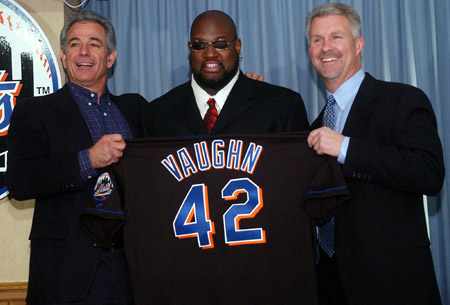
3. Mo Vaughn, Mets. From 1992 to 2000, Mo was one of the best hitters in baseball, first for the Boston Red Sox, then for the Anaheim Angels. But he missed the entire 2001 season due to injury, and even when he had played, he was considered moody by his Angel teammates. The club was happy to dump him off to the Mets for Kevin Appier. He was 34, and should have had a few good years left.

Instead, his already problematic weight rose to above his batting average (.259), he couldn't field anymore, and he was never an effective player again. He lasted just 2 years with the Mets, and retired. He might have been on a Hall of Fame path; now, he wouldn't get in even if we didn't know he was a steroid user.

Ironically, he left the Angels because he didn't think they were committed to winning, while he thought the Mets were. The Mets then entered a brief period of mediocrity, while the Angels, the year after trading Mo, won what remains their only Pennant and World Series.

2. Roberto Alomar, Mets. Came in the same off-season as Vaughn, and was an even bigger bust -- certainly not a fatter one, but a bigger one. He'd been an All-Star for 4 different teams: The San Diego Padres, the Toronto Blue Jays, the Baltimore Orioles and the Cleveland Indians. He'd batted at least .295 for all of them, won a Gold Glove with the latter 3, reached the postseason with the latter 3 (including World Series rings with the 1992 and '93 Jays), and had reached 100 RBIs in 2 of his last 3 seasons. He, too, was 34, and should have had about 5 good years left.

His batting average dropped 70 points in just 1 season. That's not a misprint: Seventy. .336 to .266. His OPS+ went from 150 to 89, his homers from 20 to 11, and his RBIs from 100 to 53 -- nearly half. True, Jacobs Field in Cleveland is a hitters' park and Shea Stadium was a pitchers' park, but OPS+ does take "park factor" into account. And he played in 149 games, so the reason for the dropoff certainly wasn't injury or illness. He got the living hell booed out of him by the Flushing faithful, and when he was traded the next mid-season for 3 nonentities, it was seen as a "Free At Last" moment.

He lasted only another year, and I genuinely believed that Roberto Alomar had become the only player ever to play his way out of the Hall of Fame, without the viable explanation -- barring evidence to the contrary -- of injury, illness, substance abuse, disciplinary issues (like Dick Allen or Denny McLain, although McLain was also hurt), or personal problems.

However, Alomar has since been elected to the Hall of Fame, the 1st ever to go in wearing a Blue Jays cap. With this in mind, the Jays made him their 1st-ever retired number, 12. Suffice it to say that 12 will not be retired for him on the Mets, and while Vaughn was the last Met to wear 42, it remains retired, for all of baseball, for Jackie Robinson. (The St. Louis Cardinals have also retired it for Bruce Sutter, and the Yankees will do so for Mariano Rivera.)

1. Collectively, the early Mets. Like the Devils a generation later, the original Mets snapped up as many ex-Yankees, ex-Giants and ex-Dodgers as they could get, in order to bring in fans with fond memories of such men.

Gene Woodling, who'd won 5 straight World Series as a Yankee left fielder, wasn't so bad, hitting .274; but he was 39 and could no longer run well enough to play the field.

Yogi Berra, after being fired as Yankee manager after the 1964 season, was signed as one of Casey Stengel's coaches on the 1965 Mets, and even played a few games, but it was obvious he was past it.

Don Zimmer, who'd helped the Dodgers win the 1955 World Series as a rookie, seemed like a good choice, having played well for the Chicago Cubs the year before; but he batted just .077 in 14 games, and was traded to his hometown team, the Cincinnati Reds, and while he still had a bad year, he shook it off and played 3 more reasonably good seasons.

Joe Pignatano, a Brooklyn native, played for the Dodgers in their last season in the Borough, 1957, and with Roy Campanella's paralysis he stepped up to be a decent backup to John Roseboro for a while, including the 1959 World Championship. But, as a Met, well, let's just say that, as a catcher, he made a good 1st base coach and minor-league manager, which is what he was when I first saw him in the late 1970s.

As a player, 1962 was his last season, and, in his last at-bat, he grounded into a triple play. That sounds like a joke, or an apocryphal story, the kind people make up about the early Mets or the 1930s Dodger "Daffiness Boys," but it's absolutely true.

Roger Craig, who pitched on the Dodgers' 1955 (Brooklyn) and 1959 (Los Angeles) titlists, was 32 and should've had 5 or 6 good years left, but went 10-24 and 5-22 in the Mets' 1st 2 years. To be fair, his ERA+ was 92 each year, so, while he was substandard, he wasn't as awful as his record suggests. A story which definitely happened says that manager Casey Stengel walked out to the mound to talk to him, and he said, "I'm doin' the best I can, Skip, what else can I do?" and Casey said, "You could strike them out. Don't you know we can't handle grounders?"

The Mets traded him to the St. Louis Cardinals for 1964, and he helped them win the World Series. As did Ray Sadecki, who would later pitch reasonably well for a more mature Met squad.

Charlie Neal started out in Brooklyn, and, by the standards of the 1962 Mets, was a very good player. But in '63, he seemed to get old overnight, even though he was just 32: His batting average went from .260 to .211. He was traded to the Reds, and retired at the end of the season.

Clem Labine was a mainstay of the 1950s Dodgers, one of the players immortalized in Roger Kahn's book The Boys of Summer. He also helped the Pittsburgh Pirates win the 1960 World Series, making him one of the few pitchers ever to beat the Yankees in 2 World Series (also doing so in 1955). He was 35 in 1962, so he should have been able to help the Mets. Nothing doing: He pitched in 3 games, faced 19 batters, allowed 5 hits and 6 runs ("only" 5 earned). He never pitched in the majors again.

Then there was Duke Snider. Injuries had taken their toll on the former Duke of Flatbush, but he was still capable of belting a few homers for the Dodgers despite playing in the fledgling Dodger Stadium in 1962. The Mets got him for the next season, and he did hit 14 homers for them, pushing his career total to over 400. But at 36, he didn't have much left.

But the saddest story might have been Gil Hodges. At 38, a truly beloved member of the Boys of Summer (he'd married Joan Lombardi, a Brooklyn girl, and kept his home in the Borough even after the move), he'd hit 361 home runs, 10th all-time at that point. But injuries limited him to 167 plate appearances over 1962 and '63. He would, of course, manage the Mets to their 1969 "Miracle," but died of a heart attack just before the 1972 season, right before his 48th birthday.

In comparison, former Philadelphia Phillies star Richie Ashburn, 35 in the Mets' 1st season, was still a capable player. In fact, he was named team MVP. But he retired at the end of the season anyway, claiming he didn't want to be "the most valuable player of the worst team in history."

Wednesday, December 14, 2011

MLB Promotion & Relegation 2011

Promotion and relegation, which is done in foreign soccer leagues (but not in North America's "Major League Soccer"), couldn't be done in the U.S. Not because of the vast distances involved (the Jet Age renders that a bad argument), but because of the ties of minor league baseball, basketball and hockey teams to major league clubs, as part of their "farm systems."

But if it was done, here would be the relegations and promotions for Major League Baseball for the 2011-12 off-season:

American League East: Relegated, Baltimore Orioles; Promoted, Patwucket Red Sox. As bad as their parent club finished this year, the Triple-A team, outside Providence, gives their fans some hope for the near future.

American League Central: Relegated, Minnesota Twins, after winning the Division 6 of the preceding 9 years. Promoted, Omaha Storm Chasers, formerly the Omaha Royals of the American Association, now Champions of... the Pacific Coast League? Since when is Nebraska on the Pacific Coast? Apparently, since the American Association folded and its teams were merged into the PCL.

American League West: Relegated, Seattle Mariners; Promoted, Sacramento River Cats.

National League East: Relegated, Florida (now Miami) Marlins; Promoted, Durham Bulls.

National League Central: Relegated, Houston Astros. Promoted, Columbus Clippers, former top farm team of the Yankees, now (much better geographically) of the Cleveland Indians. They won this year's Pennant in the International League.

National League West: Relegated, San Diego Padres. Promoted, Round Rock Express, the team outside Austin, Texas, owned by Nolan Ryan and two of his sons (and sort-of named for Nolan).

Of the 7 teams to finish first in a Division of a Triple-A league, the Reno Aces had the lowest winning percentage, and are thus the odd team out, for that reason, rather than for geographic reasons. I suppose a Playoff between the 6th and 7th seeds could be held -- or, perhaps, one-game Playoffs between 4th and 7th, and 5th and 6th, and the winner would then be the new 4th seed.

Sunday, December 11, 2011

Happy Birthday, Arsenal!

December 11, 1886, 125 years ago today: The Arsenal Football Club played its 1st game. It was on the Isle of Dogs, at a ground recently occupied by Millwall Football Club, against a team named Eastern Wanderers, which went out of business a few years later. The new club won, 6-0.

They were originally a works team -- what we in the U.S. would call a company team, as both the Chicago Bears and Green Bay Packers began -- at the Royal Arsenal (hence the nickname "The Gunners," which led to their fans later being tagged "The Gooners") in Woolwich (the 2nd W is silent), in what was then the county of Kent but is now part of Southeast London.

They called themselves Dial Square Football Club, after the section of the Arsenal where they worked. On Christmas Day, December 25, 1886, they met at the nearby Royal Oak pub, to make things more official, and changed their name to the Royal Arsenal Football Club.

The 1st game under the new name, and the 1st game that could be called a "home game" for them, was on January 8, 1887, at Plumstead Common, 2 miles away, against a nearby club called Erith, and Royal Arsenal won, 6-1.
(The Royal Arsenal at Woolwich. Photo dated 1960.)

In 1893, they turned professional and were admitted to England's Football League, but had to change their name, as a law prohibited any professional team from having "Royal" in its name. (This is not the case in Spain, where there are professional soccer teams named Real Madrid, Real Mallorca, Real Betis, etc.)

So they took on the name of their locality, and were Woolwich Arsenal from then until 1913, when they moved to a new stadium at Highbury in North London, "The Arsenal" until 1919 and "Arsenal Football Club" since, although "The Arsenal" is frequently still used, especially by the club's fans.

They could have changed their name to "Highbury Arsenal," or "Islington Arsenal," even though neither the Borough of Islington nor the Highbury neighborhood had any connection to the Royal Arsenal, aside from the club. As a result, Arsenal are 1 of only 2 professional clubs in England without a locality as part of their official name. The other is Port Vale, located in Stoke-on-Trent, Staffordshire.
Not quite the 1st Arsenal team, but perhaps the earliest known team photo, 1888.

Good old Arsenal, we're proud to say your name.
While we sing this song, we'll win the game!

Happy Anniversary, and come on you Gunners! (COYG)

Saturday, December 10, 2011

Ryan for Fregosi: 40 Years Later


This is an update of an article I've posted before. I'm doing it today because it's the anniversary.

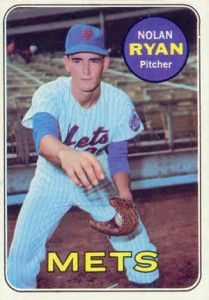
December 10, 1971, 40 years ago today: The New York Mets trade 4 players to the California Angels for shortstop Jim Fregosi.

At this point, there was nothing wrong with wanting a healthy Jim Fregosi on your team. He would be just 30 years old on Opening Day 1972, had been an American League All-Star 6 times, won a Gold Glove in 1967, and until slumping to 89 in 1971, had never had an OPS+ (on-base percentage + slugging percentage, in relation to the league average) lower than 108 in his first 8 full seasons in the majors, peaking at 141 in 1964.

His highest batting average had been .290, in 1967; peak home runs, 22, and peak runs batted in, 82, both in 1970. In 1968, he led the AL in triples with 13. The franchise was just 11 seasons old at that point, but Fregosi was, without a doubt, the greatest player the Angels had yet had.

Certainly, Fregosi was a better player than the Mets' incumbent starting shortstop, Derrel McKinley "Bud" Harrelson. Although Harrelson had helped the Mets win the 1969 World Series, and had won the '71 season's National League Gold Glove for shortstops and was selected for the last 2 All-Star Games, Harrelson couldn't hit a lick. His highest single-season OPS+ was 82, well below Fregosi's slump season. His peak batting average thus far was .254, and he would top that only twice; his peak RBI year was 42, and his peak home run year was... 1 -- in each case, it would remain so.

Clearly, what the Mets needed to do was make Harrelson a backup, a "defensive replacement." Or maybe the Mets could move him to 3rd base, where 1969 starter Wayne Garrett had badly tailed off, and incumbent starter Bob Aspromonte was at the end of the line. (Bob was a Brooklyn native, now best known as the last active player who had played for the Brooklyn Dodgers. He was also the brother of the somewhat better Ken Aspromonte.)

Instead, the Mets kept Harrelson at short, and moved Fregosi to 3rd. At first, it seemed to work, but then Fregosi got hurt, finished the season with only 32 RBIs and an OPS+ of just 89, and was never the same again. His 382 plate appareances that season would be far and away more than he'd ever have again.

Between the ages of 21 and 28, Jim Fregosi was, statistically speaking, similar to Alan Trammell, the longtime Detroit Tiger shortstop who is maybe one step short of being elected to the Baseball Hall of Fame (and would be in, as would his double-play partner Lou Whitaker, if they could go in as a unit, like the Chicago Cubs' early 20th Century combo "Tinker to Evers to Chance"). But between the ages of 29 and 36, Fregosi was just another broken-down player.

At 36, in 1978, the Angels fired manager Dave Garcia, and asked Fregosi, then playing out the string with the Pittsburgh Pirates, to come back; he instantly accepted the job, retired as a player, and in 1979, his first full season on the job, led the Angels to the AL Western Division title, their first postseason berth.

*

Did the Mets blow it by trading 4 players for an injured formerly solid player? Not necessarily. We have to take a look at those 4 players, to see if the Mets gave up anything worth having.

* Frank Estrada. He was a backup catcher who'd played 1 big-league game, for the Mets in '71, and never appeared in another. No loss there.

* Don Rose. A pitcher, he'd also reached the majors for 1 game with the '71 Mets, put up a 1-4 record for the '72 Angels, and by April 1974 had appeared in the majors for the last time. No loss there.

* Leroy Stanton. He was a right fielder, and he turned out to be a good player, putting up OPS+ seasons of 110, 116 and 123, before slumping a bit in 1976, and being left unprotected in the expansion draft. Taken by the Seattle Mariners, he put up an OPS+ of 130 in 1977, before an injury ended his career the next season at just 32 years old.

Still, the Mets could have used someone like that from 1972 to 1977, particularly after trading Rusty Staub after the '75 season -- another dumb Met trade, as they got Mickey Lolich. Staub for Lolich would have been a good trade, even after the '71 season; but not after '75. (Interestingly, on Baseball-Reference.com's "Similar Batters" list, Number 1 on Stanton's list is... Ron Swoboda. Former Yankee World Champions Gary Thomasson and Ricky Ledee are also in his top 4.)

*

And now, to confront the elephant in the room: The remaining player sent from Flushing Meadow to Anaheim.

* Lynn Nolan Ryan of the Houston suburb of Alvin, Texas.

At the time of the trade, he was a month and a half short of his 25th birthday. He had a career won-lost record of 29-38. Not good, especially when you consider that the Mets had won 100 games in 1969, 83 in 1970 and 83 again in 1971. He struck out a lot of batters, but also walked a lot, giving him a WHIP (Walks and Hits, divided by Innings Pitched) of almost 1.6 in '71. His ERA was nearly 4, not good in the NL of the time, which was pitching-friendly with a lot of concrete multipurpose oval stadiums (3 new ones in the preceding season and a half), and, of course, no designated hitter.

With Ryan having been disappointing thus far, and with Tom Seaver, Jerry Koosman, Gary Gentry and a somewhat-still-effective Ray Sadecki in their rotation, the Mets could afford to let Ryan go. Or so it seemed at the time.

In 1972, his 1st season in the AL, Ryan led the League in both walks and wild pitches... but also led it in strikeouts with a whopping 329, and shutouts with 8, forging a 19-16 record for a team that won just 75 games. A decent Angels team would probably have made him a 23-game winner.

In 1973, he set a new major league record (since the 1893 adoption of the 60 feet, 6 inches pitching distance, anyway) with 383 strikeouts. That record has never even been approached, except by Ryan himself, the next season, with 367. Nor is it likely to be approached, unless managers suddenly decide to stop babying pitchers and let them pitch 7+ innings every 4 days instead of the post-1990 idea of only letting them pitch 6 to 7 innings every 5 days.

By the close of the 1974 season, Ryan had 3 seasons of 300+ strikeouts, 4 no-hitters, 3 games with at least 19 strikeouts (he would add a 4th, although "only" 1 of those came without the benefit of extra innings), 91 wins (but also 86 losses), a career ERA of 3.01 (not bad considering he was now in the DH-affected AL), and 1,572 strikeouts -- and he was only 27.

Putting aside for a moment all the things Ryan would achieve after 1974 -- 233 more wins, 3 more no-hitters, and enough additional strikeouts to place himself 4th on the all-time list even if you only count from 1975 onward -- this was still a bad trade for the Mets.

Add in everything Ryan did from Opening Day 1972 until his retirement after the close of the 1993 season, and Ryan-for-Fregosi -- even if you forget about the decently talented Stanton -- looks like a candidate for the title of "The Worst Baseball Trade Ever" -- and not just the worst Met trade.

*

But is it? There is another elephant in the room. (You ever smell a room with 2 elephants in it? Smells worse than the Mets... most of the time.)

Big question no one ever seems to ask: Would having Nolan Ryan have helped the Mets any from 1972 onward?

It's easy to say, as does Greg Prince, author of the book and blog Faith and Fear in Flushing, that the Mets lost the 1973 World Series to the Oakland Athletics because manager Yogi Berra pitched Tom Seaver in Game 6 and Jon Matlack in Game 7, each on just 3 days' rest.

And Yogi wasn't that "old school": He was only 48, and had seen his mentor, Casey Stengel, adapt to changing conditions pretty well when they were together on the Yankees from 1949 to 1960. And it's not like Yogi had a lot of choice: Koosman had started Game 5, and couldn't have pitched again unless rain pushed Game 7 back a day; Sadecki had pitched in relief in Game 4; and he and George Stone, the Mets' other starter, had pitched in the Series only in relief and weren't much better options.

Besides, if you're a Met fan, who would you rather have, pitching a game that could win you the World Series, in a park that really, really favored pitchers, as the Oakland Coliseum always has: Tom Seaver on 3 days rest, or... any other pitcher then active? Especially knowing that, if Tom Terrific couldn't go the full 9, you had a workhorse reliever in Tug McGraw?

If the Mets had Ryan in '73, that would have been a huge boost for them. Not just in the Series. Don't forget, due to the closeness of the race, and rainouts, the Mets did not clinch the NL East until October 1, the day after the season had originally been scheduled to end, and even then they had to play a doubleheader at Wrigley Field to get Games 161 and 162 in. They clinched in Game 161 when they won and the Pirates lost, making Game 162 meaningless, and more rain led to the umpires canceling it.

Having Ryan's 21-16 in the rotation instead of the combined 8-12 of Sadecki and Jim McAndrew might have gotten the Division clinched sooner, thus enabling the Mets to set up their NL Championship Series rotation better; having Ryan there, against the Cincinnati Reds, might have gotten the Pennant clinched before Game 5, thus helping the Mets set up better in the Series.

Or... would it? Ryan's career postseason record is mixed. He saved the Mets' bacon in Game 3 of the '69 NLCS against the Atlanta Braves, and did so again in Game 3 of the World Series against the Baltimore Orioles -- all thise before he became NOLAN RYAN.

After that, he next appeared in postseason play in 1979, and while he pitched well for the Angels, it wasn't enough, as they lost the game and the Pennant to the Orioles.

In 1980, now with his hometown Houston Astros, he blew the Pennant-clinching Game 5 of the NLCS, at the Astrodome no less, enabling the Phillies to win their first Pennant in 30 years (and then their first World Championship in 98 years of trying). At that point in their history, blowing a Pennant to the Phillies was like losing to Suzanne Somers on Jeopardy!

(This was when she was playing Chrissy Snow on Three's Company, well before she proved her smarts as a fitness expert and a businesswoman. She wasn't a dumb blonde, she just played one on TV.)

In the strike-forced Division Series of 1981, Ryan pitched well for the Astros, but in the process, he only got a split of two decisions against the Los Angeles Dodgers. And he made just one other postseason appearance, in the 1986 NLCS with the Astros, losing Game 2, and pitching well but not getting the decision in a Game 5 his team lost... to the Mets.

Add on the fact that, from 1974 to 1983, the Mets were not in one single Pennant race, and it's hard to say how much difference Ryan would have made then.

Then there's the Mets' glory years from 1984 to 1990. Then again, for all their talk, there wasn't a whole lot of glory. Could Ryan, who pitched remarkably well even until he was 44 in 1991, have made a difference there?

*

So, really, what might have been the impact of the Mets keeping Nolan Ryan after 1971? Keeping in mind that, like Anaheim Stadium (or whatever the California Angels are calling it, and themselves, these days), Shea Stadium was a pitchers' park extraordinaire; but also that Ryan had a career winning percentage of just .526, is the all-time leader in walks, and is among the all-time leaders in wild pitches, we can surmise the following:

1973: We can presume that Ryan would have made a difference. The Mets clinch the Division sooner, and Ryan pitches well in the NLCS, where the Met rotation is Seaver-Koosman-Ryan-Matlack (in that order), clinching in Game 4, instead of Seaver-Koosman-Matlack-Stone-Seaver (as it was in RL), going the full 5.

The World Series? Instead of Matlack for Games 1, 4 and 7; Koosman for Games 2 and 5, and Seaver for Games 3 and 6; we get Seaver for Games 1 and 4, and potentially 7; Koosman for Games 2 and maybe 5; and Ryan for Games 3 and maybe 6, with Matlack as the long man if one is necessary.

Ken Holtzman pitched great for the A's in that Series in real life, so the Mets probably still lose Game 1 in this timeline. The Mets win Game 2 anyway. Against a tired Seaver, the A's needed 11 innings to win the real Game 3; against a rested Ryan, the Mets might win, and there's your difference. Presuming the Mets still win Games 4 and 5, get the riot police ready, it's another Shea Stadium clincher. New York Mets, 1969 and 1973 World Champions.

After this, the Mets aren't in contention again until...

1984: Ryan was only 12-11, but the Astros weren't very good that year. Without him, the Mets finished 6 1/2 games behind the Cubs. Would having Ryan have made 7 games' worth of difference? Probably not: After Dwight Gooden and Ron Darling, the Mets' rotation had Walt Terrell, Bruce Berenyi and a not-yet-there Sid Fernandez. Having Ryan instead of one of those might have made it closer, but the Cubs would still have won the NL East.

1985: Hard to say. Ryan was 10-12 for another under-hitting Astro team, with a 3.8 ERA and a 1.3 WHIP. If he were in the rotation instead of Ed Lynch...

The Mets finished 3 games behind the St. Louis Cardinals. I don't know if Ryan would have made 3 games' difference in this season. If he had, do the Mets beat the Los Angeles Dodgers in the NLCS? Maybe, the Dodgers had Tom Niedenfuer in their pen; Jack Clark hitting a Pennant-clincher in the top of the 9th in Game 6 wasn't a surprise, but Ozzie Smith hitting a walkoff in the bottom of the 9th of Game 5 was. I can certainly imagine Niedenfuer giving up homers to Lenny Dykstra in Game 5 (or maybe Lenny still hits his in Game 3) and Gary Carter in Game 6.

The Series, against the Kansas City Royals? I don't know, because the Cards did lose, and if Cardinal fans still curse the name of umpire Don Denkinger over a quarter of a century later, what would Met fans say if that same call were made? I think the Mets win the '85 Pennant, but lose the Series.

1986: No, Ryan makes no difference here. How can he? The Mets won the World Series. The only difference is that the Mets beat the Reds in the NLCS, since the Astros don't have Ryan. (Then again, the Astros won the NL West by 10, so maybe they win it anyway.)

1987: This is the season Ryan, at age 40, led the NL in ERA and strikeouts, but had an 8-16 record, because the Astros remembered that they are the Houston Astros: Great pitching, good defense, can't hit the ground if they fell off a ladder.

I saw Ryan pitch that year, at Veterans Stadium in Philadelphia, as a friend of the family had a relative who briefly pitched for the Astros. I got to sit right behind home plate as Ryan, still mighty fast at 40, was zippin' 'em in there. Being 75 feet away from Mike Schmidt as he batted against Nolan Ryan, even at that stage of each man's career, was awesome. It was a typical game for Ryan that season: The Phils won, 2-1, beating Ryan with a Randy Ready single in the 8th.

Anyway, in 1987, the Mets finished 2nd to the Cards again, 3 games back. Ryan definitely would have made a difference here, and the Mets would probably have beaten the San Francisco Giants for the Pennant. But the Minnesota Twins were not going to lose any World Series games in the Metrodome. Nobody beat the Twins in the Dome in October. Nobody. (Except, as it turned out, the 2003, '04 and '09 Yankees, who clinched 3 ALDS in that disgraceful facility.) So the Mets reach their 3rd straight Series, but win only 1.

1988: The Mets lost the NLCS to the Dodgers in Game 7... or, rather, they lost it in Game 4, when Mike Scioscia took Gooden deep in the 9th. The Mets started, in the 7 games, Gooden, David Cone, Darling, Gooden, El Sid, Coney, Darling. Ryan had a good year, but I'm not sure where he starts. In all honesty, I can't say with any certainty that he makes a difference in this series.

1989: In his first season with the Texas Rangers, Ryan had his last big season in terms of wins, 16, for an 83-win team. The Mets finished 2nd to the Cubs again, 6 games back. Maybe with Ryan, now 42 but still effectve, the Mets don't make that dumb trade for Frank Viola, and win the Division.

But I don't think they win the Pennant, unless there's another dumb trade they don't make, Kevin Mitchell to the San Diego Padres for Kevin McReynolds. Mitchell's trade, soon after, from the Padres to the Giants made the Giants a postseason team in '87 and '89, and they beat the Cubs soundly in the NLCS; they would have done the same to the Mets.

1990: The Mets finished 2nd, 4 games behind the Pirates. Ryan had a pretty good season, and if he'd been in the rotation instead of the sinking-fast El Sid, they might have won the Division. On the other hand, as I said, if they still had Ryan, they wouldn't have traded for Viola, who won 20 in his one good season for the Mets. No, having Ryan at this point probably hurts them.

1991: In Ryan's last effective season -- as a fastball pitcher at age 44! How come no one ever tested him for steroids? -- the Mets collapse, finishing 20 1/2 back of the Pirates. Having Ryan wouldn't have helped. Having him in the disastrous '92 and '93 seasons, Ryan's last 2, wouldn't have helped, either.

So, in their history, real and alternate...

Real Life Mets, 1962 to 2011, without Nolan Ryan after 1971: 7 postseason appearances, 4 Pennants, 2 World Championships. Not great, but plenty of teams haven't done that well, including some teams that have been around longer.

Alternate Mets, 1962 to 2011, with Nolan Ryan from 1971 (really, from 1966) to 1993: 10 postseason appearances, 6 Pennants, 3 World Championships. Not a huge improvement, but a significant one. After all, when you've only won 2 World Series, winning a 3rd is significant. Ask fans of the Chicago White Sox. And those of the Chicago Cubs.

*

My, my, this room is getting cramped. Do you know why? Because there's a 3rd elephant in the room.

It's what happened to the Mets after the 1973 World Series. Team chairman M. Donald Grant -- who "didn't know beans about baseball," according to '69 Met scout and later highly successful big-league manager Whitey Herzog -- broke up the team, piece by piece. In 1977, he got rid of Seaver by playing him (and his wife Nancy) off the Anaheim-based Ryan (and his wife Ruth), with the help of New York Daily News columnist Dick Young, a once-great (and once-liberal) sportswriter who had became embittered, pedantic and pedestrian (and arch-conservative).

When Ryan signed with the Astros in 1980, it made him baseball's first $1 million-a-year player. At the time, if you asked most fans to name 5 current players who might be worth that, I think most of them would have had Ryan as one of the 5. (The others would have been Reggie Jackson, Mike Schmidt, Steve Carlton and maybe Dave Winfield.)

Grant would not have been one of those who believed that Ryan, or any player, was worth $1 million a year. (Then again, he was not a baseball fan in the classic sense.) It is likely that Grant would have gotten rid of Ryan well before the 1979-80 off-season.

After all, he had already traded several fan favorites before Seaver and Dave Kingman in the June 15, 1977 "Midnight Massacre" moves: Swoboda in 1970-71, Tommie Agee in 1972-73, Harrelson and Tug McGraw in 1974-75; Staub, Stone and Cleon Jones in 1975-76, and Garrett during the 1976 season; Matlack and John Milner would follow in 1977-78, and so would Koosman in 1978-79. And, unlike Fred and Jeff Wilpon letting Jose Reyes go in 2011-12, Grant didn't let those guys go because he desperately needed to save money, but because he greedily wanted to.

So, chances are, keeping Nolan Ryan beyond the 1971 season would have meant giving him up well before 1984. Therefore, the most likely scenario is that the Mets would have increased their winnings by 1 World Championship, and no other postseason berths.

Then again, think of how much 1 more World Series win would have meant to Met fans from 1973 onward.

A Met fan born between October 17, 1962 (who presumably would have been aware of baseball by October 16, 1969) and October 17, 1977 (the day before the Yankees won another Series) could have told a Yankee Fan born during that same stretch, "The Mets have won more World Series in our lifetime than the Yankees have!" And from October 16, 1969 until October 17, 1978, and again from October 27, 1986 to October 26, 1996 -- 19 of their 34 years -- that would have been true. And for all 34 years, the Mets would have been either ahead of the Yankees or tied with them (it would have been 2-2 from '78 to '86).

Of course, we're talking about the Mets here. Even with Tom Seaver, they found a way to lose the 1973 World Series. So who can say, with even 99 percent certainty, that they wouldn't have found a way to blow it with both Seaver and Nolan Ryan? After all, for much of their history, the Yankees have usually found a way to win; while, except for '69 and '86, the Mets have usually found a way to lose.

Friday, December 9, 2011

Marxist Mets

The title of this entry might fool you. I don't mean that the New York Mets have gone Communist, or that they seek to control the means of production. Let's face it, they have not exactly being doing a good job of producing anything. Or controlling anything, for that matter.

What I mean is that the Mets' story is getting to be like Karl Marx' view of history: Repeating itself, first as tragedy, then as farce.

As Lisa Swan of Subway Squawkers pointed out in an article, it was never Fred Wilpon who took a joke franchise and made it champions from 1980 to 1986. It was Wilpon and Nelson Doubleday and Frank Cashen.

Whereas when it was Freddy the Freeloader and his son Jeff making the decisions, well, it's been a different story. To continue the Marx analogy, Met fans have nothing left to lose but their lunches. By the Wilpons selling the team, Met fans have a World Series to win. Metheads of the world, unite! Occupy Citi Field! Not the seats -- the Wilpons' offices!

But in spite of several learned observations, Lisa makes one mistake. Let's clear one thing up: Jose Reyes is getting more money from the Marlins than he'd be getting anywhere else, except the Yankees, the Red Sox, the Angels (who've now splurged for Albert Pujols and C.J. Wilson) and maybe the Phillies -- none of whom showed any interest in Reyes, at least not publicly.

Whoever can be counted among "the victims of Bernie Madoff," Jose Reyes is not one of them. He might be one of the few people who benefits from the whole Madoff schmeer.

Wednesday, December 7, 2011

New Jersey's NBA Goodbye Is Set; Dr. Sócrates, 1954-2011


And another awkward goodbye for sports in this area: The revised, post-lockout NBA schedule has been released. The Knicks open at Madison Square Garden on December 25 -- you may know it as "Christmas Day" -- at noon against the Boston Celtics. These are, of course, the only two remaining 1946 charter members of the NBA still playing in their original cities.

Also playing on Christmas Day (all times Eastern):

* 2:30, a rematch of last season's (and the 2006 season's) NBA Finals, the Miami heat at the Dallas Mavericks.

* 5:00, the two most successful franchises of the last 25 years, the Chicago Bulls at the Los Angeles Lakers.

* 8:00, two of the up-and-coming teams of the league, the Orlando Magic at the Oklahoma City Thunder.

* 10:30, the Los Angeles Clippers at the Golden State Warriors in Oakland -- two teams that could have been arch-rivals, but instead are notorious underachievers.

*

The Nets open the next day, at the Verizon Center in D.C., against the Washington Wizards. Formerly known as the Washington Bullets. And the Capital Bullets. And the Baltimore Bullets. And the Chicago Zephyrs. And the Chicago Packers. They may the Los Angeles Angels of Anaheim look like a paragon of nomenclatural stability.

The last Nets home opener in New Jersey will be the next day, December 27, against the Atlanta Hawks at the Prudential Center.
The Nets' New Jersey finale -- barring the Playoffs, but who's kidding who -- will be on Monday night, April 23, at the Prudential Center. Somewhat appropriately, it will be against the team to whom the New York Nets had to sell Julius Erving just to get into the NBA in 1976, the Philadelphia 76ers. Instantly, they went from being the best team in the ABA to being the worst team in the NBA, moved to the Rutgers Athletic Center in 1977, changing their name to the New Jersey Nets, to the Meadowlands in 1981, and to the Prudential a year ago.

The last day of the NBA regular season will be Thursday, April 26, and the Nets will play their last game as the New Jersey Nets at the Air Canada Centre against the Toronto Raptors. Come November 2012, it will be home games at the Barclays Center in Brooklyn, as the Brooklyn Nets.
Damn you, Bruce Ratner. R.I.P. New Jersey Nets, 1977-2012.

*

Sócrates is dead. No, not the ancient Greek philosopher. Well, yeah, him, too, but he's been dead for 2,410 years. I mean the Brazilian soccer legend.

Sócrates Brasileiro Sampaio de Souza Vieira de Oliveira was born on February 19, 1954 in Belém, in the State of Pará, in northern Brazil, far from the huge cities of the country's south, Rio de Janeiro and São Paulo. He began playing professionally as a midfielder for Botagfogo-SP Ribeirão Preto in the State of São Paulo -- not to be confused with Botafogo de Futebol e Regatas (football and rowing), of Rio, one of the most-supported clubs in the world.

In 1978, he signed São Paulo club Corinthians, and he became a legend. He led them to the São Paulo State Championship in 1979, 1982 and 1983. In the 1982 World Cup in Spain, wearing the Number 8, he was the biggest star on a Brazil team that thrilled the world with its stylish play, much as the 1970 Brazil team led by Pelé did. Sócrates was their main playmaker, a two-footed shooter known for his white headband, and for making blind heel passes to teammates like Zico, Éder Assis and Roberto Dinamite.

As the man himself said, in words that would be agreed upon by Dutch visionary Johan Cruijff and Arsenal manager Arsène Wenger, "Beauty comes first. Victory is second. What matters is joy."

However, this was the era of the World Cup being decided by 2 group stages, and, despite a goal by Sócrates, Italy knocked them out thanks to a hat trick by Juventus star Paolo Rossi -- who titled his memoir I Made Brazil CryThat Brazil team is often called the best team not to make a World Cup Final.

Sócrates also played for Brazil in the 1986 World Cup in Mexico (now wearing Number 18 and, like Chicago Bears quarterback Jim McMahon at the same time, making his white headband iconic), but they lost to France on penalties in the Quarterfinal.
The Italians must have seen something in Sócrates, because in 1984, he was signed by Florence-based Fiorentina. But he may have gotten homesick, because he returned to Brazil after just 1 season, playing for Rio's Flamengo (winning the Rio State Championship in 1986) and São Paulo's Santos (Pelé's old club), before concluding his career in 1989 with the club with whom he started, Botafogo-SP.

He later managed them, and also Ecuador's leading club, LDU Quito, and Rio club Cabofriense. In 2004, at 50, he made a 1-game (12-minute, as it turned out) comeback with Yorkshire side Garforth Town.

His father was a prominent civil servant, and so, unlike most Brazilian boys of his generation, Sócrates was able to go to college. He went to medical school, and became a practicing physician, and was known in the public imagination as Doctor Sócrates.

I know: It sounds like the name of a comic-book supervillain. But he was a hero. When the Brazilian military coup happened in 1964, he was 10 years old, and saw his father get rid of the thing he valued the most: His large book collection.

Knowing that wasn't right, Sócrates spent much of his soccer career also engaging in political agitation, founding the Corinthians Democracy movement (possibly in tribute to the ancient Greeks, inventors of democracy and originators of the names both he and his club bore). On March 15, 1985, an elected government took office, and Sócrates and the others who opposed the military dictatorship were vindicated.

Soccer writer Adrian North compared him to one of his political heroes, Argentine revolutionary Ernesto "Che" Guevara, who was no hero: "Che believed to change the world, he needed a voice and a gun. Socrates believed he could change his country by amplifying his voice through football."
"I smoke. I drink. I think."
Ernest Hemingway would have loved him.
So would Jack Kerouac, until the subject turned to politics.

Ironically, this brilliant man who was also a physician smoked, and it led to a few ailments that combined to lead to his death 3 days ago. He was only 57, and left behind a wife and 6 children.

Dilma Rousseff, President of Brazil: "On the field, with his talent and sophisticated touches, he was a genius. Off the field... he was active politically, concerned with his people and his country."

Ronaldo (the bald Brazilian, not the gel-haired Portuguese): "Sad start to the day. Rest in peace Dr. Socrates."

Paolo Rossi: "His death is piece of our history that's broken off and gone away."

We call our sports stars "heroes." Doctor Sócrates really was a hero, for his country and for the world, for his time and for all time.