Wednesday, April 9, 2025

April 9, 1925: Babe Ruth's "Bellyache Heard 'Round the World"

Ruth being loaded into the ambulance at Penn Station.
Every paper in the country had this photo then, but it's rare now.

April 9, 1925, 100 years ago: Babe Ruth, the biggest star in baseball, is rushed to the hospital. It becomes known as "The Bellyache Heard 'Round the World."

History remembers the great New York Yankees slugger as a big jolly fat man who loved children and delivered for his fans, baseball's answer to Santa Claus -- or, as his contemporary, sportswriter Jimmy Canon, put it, "Santa Claus drinking his whiskey straight, and complaining of a bellyache." But for much of his career, his 6-foot-2 frame carried a strapping 215 pounds, hardly fat at all.

But his massive appetites, including for food and drink, got him in trouble. He was overweight for much of the 1922 season, and used farmwork at his home in Sudbury, Massachusetts, 23 miles west of downtown Boston, to get in shape for the 1923 season. He remained in good shape for 1923 and 1924.

But the 1924-25 off-season saw him out of control. By the time he got to Hot Springs, Arkansas -- where Spring Training had been invented in 1885 by Cap Anson of the team now known as the Chicago Cubs, to "boil the beer out" of his players, Ruth was 256 pounds. On this annual "Babe Boil," he lost 30 pounds.

But Hot Springs had become a resort town, with all kinds of illegal establishments, from bars (it was the middle of Prohibition) to casinos to houses of otherwise ill repute -- to satisfy yet another of the Babe's irresistible-force appetites, while his wife, Helen, and their daughter, Dorothy, were left behind in Sudbury.

He suffered abdominal pains and a fever in Hot Springs, before joining the Yankees in St. Petersburg, Florida. The Yankees had previously trained in New Orleans, but, already known as America's biggest party city, it offered too many temptations for the Great Bambino. So they moved to St. Pete, where they stayed until 1961.

(They moved to Fort Lauderdale in 1962, and the Mets took up the Yankees' former complex at Miller Huggins Field, renaming it Huggins-Stengel Field. The Mets moved to Port St. Lucie in 1988, and the Yankees moved to Tampa in 1996. Huggins-Stengel Field is still in use for amateur baseball.)

While in St. Pete, Ruth fell ill again. On April 7, as the team's train headed north, it stopped in Asheville, North Carolina, where the Yankees were to play an exhibition game. Ruth collapsed on the platform, and was hospitalized. The team played the game without him.

Trying to get back to New York, he missed a train connection, making him unable to meet the team in Washington. This story got around the world, and, like a "game of telephone," it got wilder until a newspaper in London printed that the Sultan of Swat was dead at the age of 31. (He was actually 30. How he didn't know his own birthdate is a story for another time.) He sent a telegram to Helen, telling her to meet him in New York, so she would know he was alive.

As his train got through New Jersey on its way to Pennsylvania Station on April 9, Ruth, having just had a typically huge breakfast, lost consciousness in the train's rest room. He was taken to his sleeping compartment, and, upon arrival, its window had to be removed to get him out on a stretcher. He went into convulsions in the ambulance, and it took 6 attendants to hold him down. He was given a sedative, and taken to St. Vincent's Hospital at 14th Street and 7th Avenue in Greenwich Village.

What did Ruth have? Sportswriter W.O. McGeehan wrote that Ruth's illness was due to binging on hot dogs and soda pop before a game -- a "safe for public consumption" story. Because of this, it became known as "The Bellyache Heard 'Round the World." A report from his doctor, issued through the Yankees' front office, said that Ruth had a "fistula" -- essentially, a gastric ulcer. Also, a safe story.

Decades later, a distant cousin on his father's side said that Crohn's disease, an inflammation of the colon (the large intestine), runs in the Ruth family. This would explain the symptoms, but Crohn's tends to be a chronic issue, and this was the only time in Ruth's life that he suffered such symptoms.

Given Ruth's carousing, there has been a rumor ever since that he was suffering from some sort of sexually-transmitted disease. Supposedly, this was confirmed by Yankee general manager Ed Barrow. But Ruth underwent surgery on April 17, and surgery has never been a typical treatment for either syphilis or gonorrhea, the 2 main venereal diseases.

In 1959, in her memoir, Claire Ruth, the Babe's 2nd wife, wrote that it was something that couldn't be mentioned in polite company at the time, but not V.D.: It was a torn groin muscle. But that wouldn't have explained the fever or the faintings.

In his 1938 memoir Farewell to Sport, sportswriter Paul Gallico wrote, "A baseball player lay close to death and an entire nation held its breath, worried and fretted, and bought every edition of the newspapers to read the bulletins as though the life of a personal friend or a member of the family were at stake." (And, remember, this was before his epic 1927 season, or his 1932 "called shot.") There was no 24-hour TV news or social media to spread the stories, true or otherwise. Even radio broadcasting was still in its infancy.

On April 24, with the Babe still hospitalized, Helen collapsed on the grounds of St. Vincent's, having "a complete nervous breakdown." She couldn't take all the talk about his illness, and the various things that could have caused it.

They separated not long thereafter. He wasn't too Catholic to cheat on her, but he was too Catholic to ever divorce her. She eventually left him for another man, and died in a house fire in 1929. Ruth seemed genuinely sad at her funeral. However, just three months later, he married Claire, who had basically been the real Mrs. Ruth since 1923.

Ruth didn't make his season debut until June 1, and had his worst season as a Yankee. Several other Yankees weren't hitting, either. Indeed, between June 1, 1925 -- also the day Lou Gehrig's playing streak began -- and April 13, 1926, the next season's Opening Day, the starters were replaced at 1st base, 2nd base, shortstop, center field and catcher. Respectively: Wally Pipp was replaced by Gehrig, Aaron Ward was replaced by Tony Lazzeri, Everett Scott was replaced by Mark Koenig, Whitey Witt was replaced by Earle Combs; and Wally Schang was replaced by a platoon of Mike Gazella, Pat Collins and Benny Bengough. (It is odd that the 1927 Yankees, often considered the greatest team of all time, were weak at the most important position, catcher.)

What's more, Ruth talked to the one athlete in the 1920s who could match him for press attention, the Heavyweight Champion of the World, Jack Dempsey. Dempsey lent Ruth one of his trainers, Artie McGovern. This made Ruth perhaps the 1st person in America, other than prizefighters like Dempsey and actors, to have what would now be called a personal trainer. He whipped Ruth back into shape.

The results speak for themselves: Year, Ruth's age, batting average, home runs, RBIs, OPS+, Yankees' finish:

1926, 31: .372, 47, 153, 226, 91-63, Won Pennant, but lost World Series
1927, 32: .356, 60, 165, 225, 110-44, Won World Series
1928, 33: .323, 54, 146, 206, 101-53, Won World Series
1929, 34: .345, 46, 154, 193, 88-66, 2nd place
1930, 35: .359, 49, 153, 211, 86-68, 3rd place
1931, 36: .373, 46, 162, 218, 94-59, 2nd place
1932, 37: .341, 41, 137, 201, 107-47, Won World Series 

Tuesday, April 8, 2025

April 8, 1975: Frank Robinson Becomes Baseball's 1st Black Manager

April 8, 1975, 50 years ago: The Cleveland Indians beat the New York Yankees, in their season opener at Cleveland Municipal Stadium. The Indians are managed for the 1st time by Frank Robinson. This makes Robinson the 1st black manager in Major League Baseball.

In 1961, Frank Robinson led the Cincinnati Reds to the National League's Pennant, and was named its Most Valuable Player. For the 1966 season, they traded him to the Baltimore Orioles. It was a big mistake, and the best thing that ever happened to the Orioles other than their move from being the St. Louis Browns in 1954: Robinson was immediately named team Captain, won the Triple Crown, led them to their 1st American League Pennant and their 1st World Series win, and was named the AL's MVP. Until Shohei Ohtani did it in 2024, he was the only player to win the MVP in both Leagues. The Orioles won the Pennant again in 1969, 1970 and 1971, and the World Series again in 1970.

After the 1973 season, New York Yankees owner George Steinbrenner saw manager Ralph Houk quit, and he had to scramble to find a new manager. He considered hiring Frank Robinson, who was then playing for the team then named the California Angels. This would have made him the 1st black manager in the major leagues, a little over a year after a dying Jackie Robinson spoke at the 1972 World Series, and said he wanted to "see a black face managing in baseball."

George didn't care about making history: He wanted the best man for the job, and, in the Autumn of 1973, having already been denied the right to hire Dick Williams, winner of the last 2 World Series as manager of the Oakland Athletics, by A's owner Charlie Finley, he thought the best remaining choice that might be available was Frank Robinson.

Gene Autry, the legendary entertainer who owned the Angels, wouldn't let Robinson go. Was it because Autry didn't want a black manager in MLB? No. Was it because he simply didn't want to lose Frank? No, as you'll soon see. It was because he didn't like George, and didn't want to give him the satisfaction.

Nevertheless, Autry could have named Frank the 1st black manager in the major leagues, but on September 12, 1974, he traded Frank to the Cleveland Indians for Ken Suarez, Rusty Torres and cash. (The last part is ironic: The Indians were constantly short on cash, and Autry was one of the richest owners. In another irony, the next manager Autry hired was Dick Williams.) 

After the season, Indians manager Ted Bonda fired manager Ken Aspromonte. Who to hire? Bonda knew that, racial history aside, Frank was qualified for the job. He'd been Captain of a 2-time World Series winner, and had managed in the Caribbean Winter Leagues. Bonda knew that if he didn't hire him as manager, somebody else might, and he didn't want to lose him, either as a still-active player or as a potential manager.

So, on October 3, 1974, he did the right thing for history, as well as the right thing for his team. He signed Frank at a salary of $175,000 to do both jobs. Frank said his only regret was that Jackie, no relation, didn't live to see the day.

I could have done this entry for that day. But it wouldn't have been official until he actually managed a regular-season game. And, besides, that 1st such game makes for a better story.

On April 8, 1975, for the 1st time, a regular-season game in Major League Baseball was played with a black man managing one of the teams. Frank had already posed for the cover of Sport magazine, handing a lineup card to the cameraman. Now, at Cleveland Municipal Stadium, in front of 56,715 fans, he did it for real, giving his lineup card to home plate umpire Nestor Chylak, who would join Frank in the Hall of Fame.

Gaylord Perry, also on his way to the Hall, started for the Indians, and George "Doc" Medich did so for the Yankees. In the bottom of the 1st inning, after Oscar Gamble popped up to 3rd base, Frank Robinson, having made himself the Indians' designated hitter and put himself 2nd in the batting order, hit a home run off Medich, the 575th of his career, which would end with 586.

The Yankees took a 3-1 lead in the top of the 2nd, the Indians made it 3-2 in the bottom of the 2nd, and, in the bottom of the 4th, Robinson's former Baltimore teammate John "Boog" Powell -- who said the Indians' all-red uniform made him, rotund as he was, "look like the world's largest Bloody Mary" -- hit a home run to tie the game. Boog broke the tie with an RBI double in the 6th, and the Indians went on to win, 5-3.
Boog had a point.

But the Indians never had enough money to build a contending team. Early in the 1977 season, Frank Robinson became the 1st black manager to get fired -- not because he wasn't as good as most white managers, but because he was as good as most of them, and that wasn't good enough.

In 1981, he achieved another both-leagues distinction: The San Francisco Giants made him the 1st black manager in the NL. The next year, in his 1st year of eligibility, he was elected to the Baseball Hall of Fame.

He would later return to the Orioles, coming within 2 games of managing them to an AL Eastern Division title in 1989. He was also the manager of the Montreal Expos when they moved to become the Washington Nationals in 2004-05. He died in 2019, at age 83.

In 1978, having been the 1st black player in the American League and the 2nd black player in the previously all-white major leagues, Larry Doby became the 2nd black manager in MLB, finishing out the season with the Chicago White Sox.

As of Opening Day of the 2025 MLB season, 10 of the 30 current teams have never had a black manager: The New York Yankees, the Arizona Diamondbacks, the Atlanta Braves, the Boston Red Sox, the Miami Marlins, the Minnesota Twins, the Oakland Athletics, the Philadelphia Phillies, the St. Louis Cardinals and the San Diego Padres.

The the D-backs, Braves, the Red Sox, the Marlins, the Cardinals and the Padres have each had a Hispanic manager, but not an African-American one. Dave Roberts was interim manager of the Padres for 1 game, but not a "permanent" manager for them, as he has been for the Los Angeles Dodgers, so the Padres still count as not having hired a black manager.

Monday, April 7, 2025

Yankees Take 2 of 3 In Pittsburgh

Yesterday, as the game at PNC Park in Pittsburgh went to extra innings, there were about 8,000 fans left, and one of them managed to start a chant of "Yankees suck!"

The Pittsburgh Pirates haven't had a winning season in 7 years. They have missed the Playoffs the last 9 seasons, and 29 of the last 32. And they haven't won a Pennant, much less a World Series, in 46 years.

I'm just saying: If you want to say that the opposing team "sucks," make sure your own team has a better recent record than the Pirates.

However you want to define "recent." And that includes having played 28 innings at home without having won a game.

The Yankees went into Pittsburgh on Friday, for the Pirates' home opener. Max Fried had a considerably better 2nd start for the Yankees than his 1st start. Fernando Cruz wasn't very good out of the bullpen, but Brent Headrick and Devin Williams were. The Yankees got a home run from Aaron Judge, 3 hits and an RBI from Anthony Volpe, and 3 hits and 4 RBIs from Oswaldo Cabrera, and beat the Pirates, 9-4.

Marcus Stroman started the Saturday game, and he was no good, allowing 4 runs in 4 innings. But the Pirates' starter was named Bailey Falter, and that's what he did: He faltered, giving up 7 runs in 4 innings, including 2 home runs to Trent Grisham. Grisham had 4 RBIs, Volpe 3 on 2 hits, and Paul Goldschmidt went 3-for-4 with an RBI. The Yankees won, 10-4, with Mark Leiter Jr. credited with the win in relief.

The Yankees may have used up all the runs in their new "torpedo bats," because they went 3-for-12 with runners in scoring position on Sunday. Every Yankee starter got on base at least once, and Grisham went 2-for-5 with 2 RBIs, but Volpe was the only other Yankee to get on base more than once.

Will Warren copied Stroman by allowing 4 runs in 4 innings, and it looked like that would be it. Andrew Heaney struck out 10 Yankees, walking only 1 (Judge, one of those "unintentional intentional walks," designed to prevent a home run). A comeback in the 9th tied the game, but the Yankees fell victim to the "ghost runner" rule in the bottom of the 11th, and lost, 5-4. Williams was tagged with the loss, but might not have lost if not for the stupid rule.

So, a week and change into the season, the Yankees are 6-3. They lead the American League Eastern Division by half a game over the Boston Red Sox, a game and a half over the Toronto Blue Jays, 2 over the Tampa Bay Rays, and 2 1/2 over the Baltimore Orioles.

Having taken 2 out of 3 in Pittsburgh, the roadtrip continues, as they play 3 afternoon games against the Detroit Tigers.

Friday, April 4, 2025

Yankees Salvage Series Finale vs. Arizona

The Yankees began the season by sweeping the Milwaukee Brewers, outscoring them 36-14 over 3 games. Things were looking good.

Then the Arizona Diamondbacks came into Yankee Stadium II for 3 games. Suffice it to say, they got better pitching.

Will Warren pitched 5 innings for the Yankees on Tuesday night, allowing 2 runs on 1 hit and 4 walks. Former Baltimore Orioles pitcher Corbin Burnes did not pitch well, and gave up home runs to Jasson Domínguez and Anthony Volpe. The Yankees led 4-2 after 7 innings.

But Tim Hill and Mark Leiter Jr. flopped in the 8th, allowing 5 runs between them. A homer by Ben Rice in the 9th made no difference, and the Diamondbacks won, 7-5.

Between them, Carlos Rodón over 6 innings and Yoendrys Gómez over 3 allowed only 3 hits on Wednesday night. But, Cliché Alert: Walks can kill you. And, between them, they walked 7 batters. The Yankees trailed 4-0 going to the bottom of the 9th. Volpe hit another homer, but it wasn't enough, and the Diamondbacks won, 4-3.

The Yankees were now 3-2 on the season, and people were beginning to wonder if their success in the Milwaukee series was a fluke, or because the Brewers are simply a bad team, despite having made the Playoffs in the last 2 seasons, and 6 of the last 7.

Carlos Carrasco, a former Cleveland Indians (now Guardians) ace, now 38 years old, started last night, and allowed 3 runs in 5 1/3rd innings. Add Adam Ottavino to the list of failed Yankee pitchers that general manager Brian Cashman has brought back. I guess Cashman didn't notice that Ottavino had been released by the Red Sox after a bad Spring Training. Or that he'd been awful with the Mets the last 2 seasons. Or that he was 39. But he wasn't part of the problem last night, pitching to 3 batters and getting 2 of them out.

Ryan Yarbrough was part of the problem, allowing a grand slam to Geraldo Perdomo in the 7th. Suddenly, a 9-3 Yankee lead, aided by home runs by Aaron Judge, Trent Grisham and Jazz Chisholm, was 9-7. Luke Weaver was needed for a 4-out save, and the Diamondbacks did not score again. Carrasco had his 1st win as a Yankee, the 111th of his career.

The Yankees are now 4-2, half a game behind the Toronto Blue Jays in the American League Eastern Division. They hit the road, going to Pittsburgh and Detroit. They'll be lucky in one respect: The rotation means that they won't face the Pirates' Paul Skenes, the most exciting young pitcher in baseball.

Wednesday, April 2, 2025

April 2, 1995: Baseball's Longest Strike Ends

Jorge Posada and fellow Puerto Rican Sonia Sotomayor,
at the new Yankee Stadium in 2009,
after her confirmation to the U.S. Supreme Court

April 2, 1995, 30 years ago: A federal judge grants an injunction against Major League Baseball, preventing its team owners from unilaterally implementing a new collective bargaining agreement and using replacement players. This ends the Strike of '94. MLB and the Players Association reach an agreement that will start the new season on April 25.

The Judge was a 40-year-old Yankee Fan from The Bronx. I was so grateful to her for giving me back my baseball, I was willing to marry her. (Give me a break: She was very attractive back then.) At the very least, I wanted her on the Supreme Court of the United States.

The former, obviously, didn't happen. The latter did, in 2009. Her name was Sonia Sotomayor.

The next day, April 3, I went into New York, took the Subway up to Yankee Stadium, and bought a ticket for Opening Day. Main Level Reserved, Section 2, right behind home plate. $24. (About twice that in today's money.) The gates were open -- security was different in those pre-9/11 days. And I was able to walk to my seat, and just sat there for about 15 minutes, taking it all in.

Walking out, I saw a section of the outer wall's plaster displaced. I picked up a 2-by-3-inch piece, and took it home. To this day, I have a piece of the old Yankee Stadium, even if it probably dated, at most, only to the 1973-76 renovation. There was also some graffiti on the wall. When Opening Day came on April 26, the plaster was repaired, the graffiti was painted over, both looked like there had never been anything wrong, and the Yankees won.

Tuesday, April 1, 2025

April 1, 1985: Villanova's Perfect Game

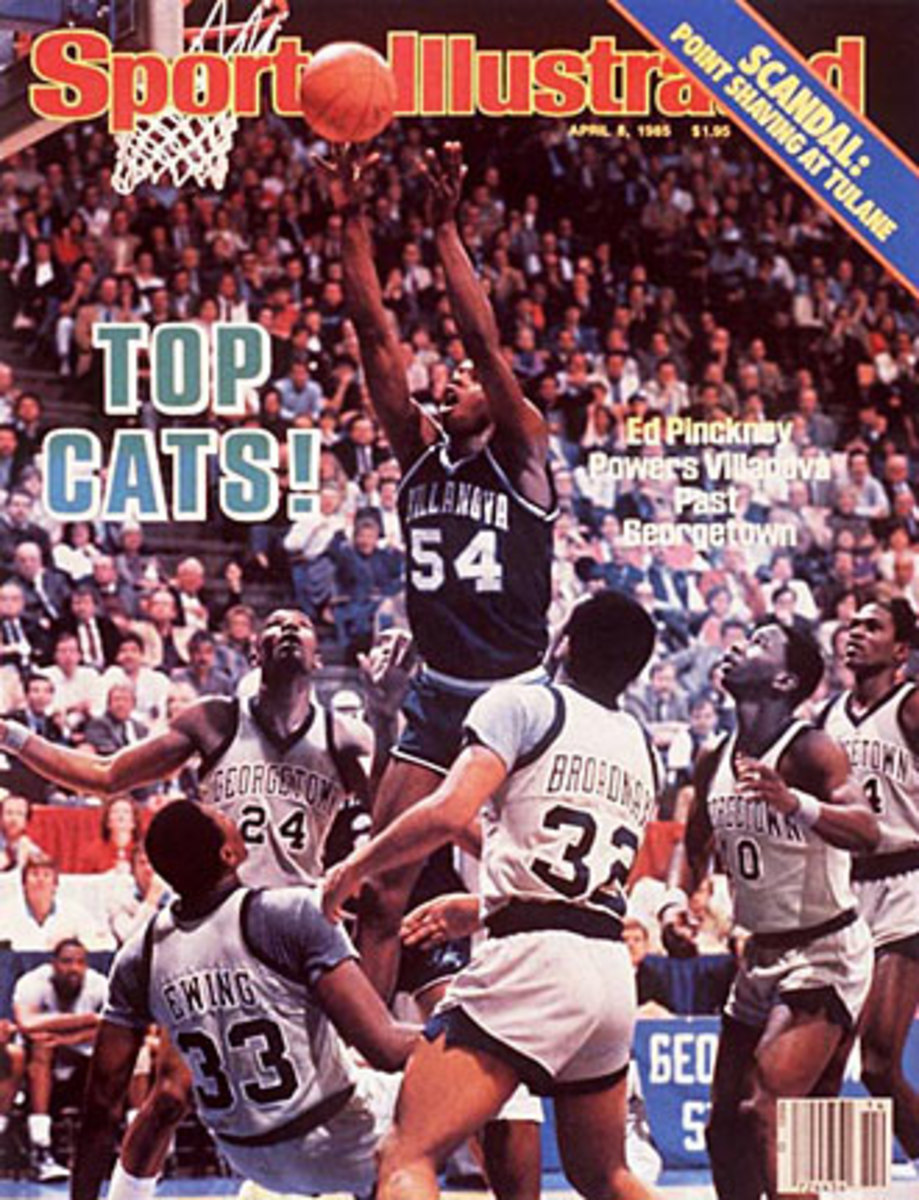
April 1, 1985, 40 years ago: Someone who had been following the college basketball season, but had been unable to watch the game, might have seen the final score, and thought it was an April Fool's joke. After all, this was mere days after Sports Illustrated's article "The Curious Case of Sidd Finch." But it was real, and it remains the biggest upset in the history of the NCAA's men's basketball tournament.

In Philadelphia college basketball, the "Big Five," an unofficial group, are the University of Pennsylvania, Temple University, La Salle University, St. Joseph's University, and Villanova University. Temple is secular. Penn is Ivy League. La Salle and St. Joe's are Catholic. Villanova is Catholic, likes to pretend that it is Ivy.

While St. Joe's straddles the City Line and the western "Main Line" suburbs, Villanova, is 11 miles to the northwest, well into the Main Line. While the other 4 schools, especially Temple, are more racially diverse (yes, even Penn), the Wildcats are mocked as "Vanilla-nova," and with claims that half the black people on campus are on the basketball team.

One season, as the seconds ticked down in a win over St. Joe's, allowing them to clinch the best overall record in the Big 5, their fans chanted, "We own Philly!" The St. Joe's fans chanted back, "You ain't Philly!" They do seem, of the 5 student bodies, the least likely to eat a cheesesteak and then work it off by running up the steps of the Philadelphia Art Museum -- but then, their track and field program has been among the nation's best for decades.

In 1972, Chuck Daly, later to coach the Detroit Pistons to back-to-back NBA Championships, hired Rollie Massimino as an assistant coach. In 1973, trying to move on from the scandal that got their 1971 Final Four berth stricken from the record, Villanova needed a young man of integrity. The fact that the 38-year-old Rollie was Catholic, and had the endorsement of the admired Daly, helped a lot.

Burdened by NCAA sanctions that the previous regime had brought on, his 1st 2 seasons were bad. But in 1976, he went 16-11. In 1977, he got them into the NIT. In 1978, he got them into the NCAA Tournament.

In 1982, he won the Big East Conference, and got 'Nova to the Elite Eight. In 1983, he did that again, tying Georgetown for the title. In 1984, he finished 2nd in the Big East, to Georgetown.

The Wildcat players were believing in the man they called Daddy Mass, and they were giving him something to believe in. In other words, what happened in the 1984-85 season, while worthy of expressions of surprise, should not have been considered an outright shock.

The big rivalry in the Big East was between 2 big-city Catholic schools: St. John's in New York, and Georgetown in Washington, D.C. Almost nobody was paying attention to the one in between, where Rollie had made the Wildcats big enough that the 1,500-seat Villanova Field House (shortly thereafter, renamed the Jake Nevin Field House) was woefully inadequate, and even the 6,500-seat Pavilion that was then under construction wasn't enough: 'Nova played nearly every game at the 18,000-seat Spectrum, the South Philly home of the 76ers and Flyers, 14 miles from campus.

Villanova went just 9-7 in Big East play, and were 19-10 going into the NCAA Tournament. They were seed 8th in their region, and their game against 9th seed Dayton was, uncharacteristically, on Dayton's home court. The Wildcats won anyway. Then they best 1st seed Michigan, 4th seed Maryland (with Len Bias), and 2nd seed North Carolina.

The Big East had 3 of the Final Four berths: Lou Carnsecca's St. John's, John Thompson's Georgetown, and Rollie Massimino's Villanova. Dana Kirk's Memphis State had the other one.

The Final Four was set for Rupp Arena in Lexington, Kentucky. On spite of being named the Wildcats and wearing blue, like the venue's home team, most observers didn't give Villanova a chance. Even if they beat Memphis in the Final, the other Semifinal, between defending National Champion Georgetown and St. John's, who had split their regular-season meetings, was being considered "the real final."

But Villanova did beat Memphis, and when Georgetown beat St. John's rather easily, it seemed to set Monday, April 1, 1985 up as a coronation for the defending National Champion Hoyas.

Instead, Villanova pulled off one of the biggest upsets of all time. They shot 22-for-28 from the field, 78 percent, the highest in Final Four history. Georgetown hardly folded, but Villanova won, 66-64. It was April Fool's Day, but there was no joke in Rupp Arena.

It was the 1st NCAA men's basketball National Championship won by a Philadelphia-area team since La Salle in 1954. And, with the 9th seed in their region, the 1985 Villanova team remains the lowest seed ever to win the Tournament.

"I still never saw the Championship Game replay in its entirety," Massimino said in 2015, at a 30th Anniversary reunion. "I still think we might lose."

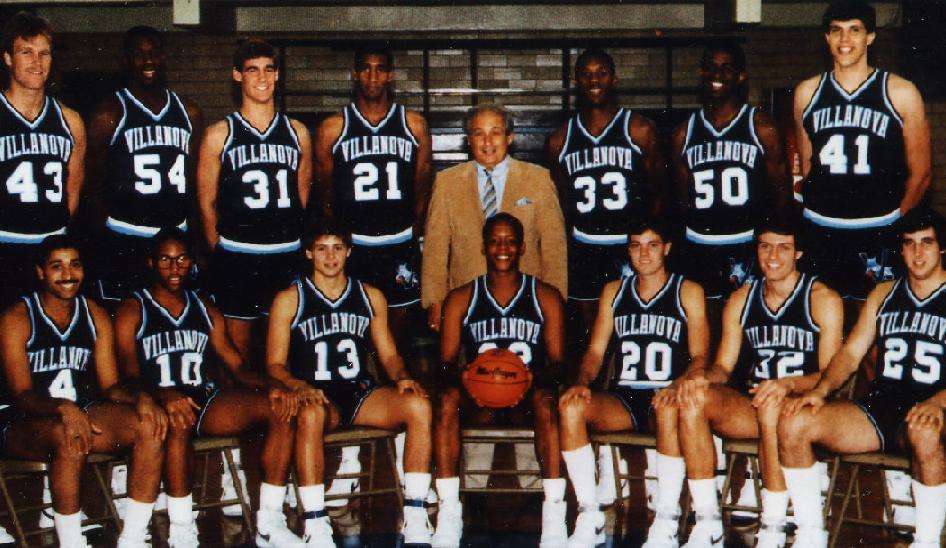
But they won. Hail the Champions:
Top row, left to right: Center Wyatt Maker; forward Ed Pinckney,
forward Mark Plansky, forward Howard Pressley,
head coach Rollie Massimino, forward Dwayne McClain,
forward Connally Brown, center Chuck Everson.
Bottom row: Guard Dwight Wilbur, guard DeAlvin Phillips,
guard R.C. Massimino, guard Gary McLain,
guard Brian Harrington, guard Harold Jensen, forward Steve Pinone.

Pretty much all of them went on to do good things. Ed Pinckney played 12 seasons in the NBA, mostly for the Phoenix Suns. He went back to Villanova, on Jay Wright's staff, and has been an assistant coach for 3 NBA teams. Dwayne McClain played 12 seasons of pro ball, mostly in Europe, but did have 1 season with the Indiana Pacers. He went into coaching, and now runs a financial firm in Florida.

Harold Pressley played for the Sacramento Kings, and is now a TV announcer in Sacramento. Connally Brown became an FBI Agent. And R.C. Massimino, 1 of 5 kids Rollie had with his wife, now runs a construction management company in the Philadelphia suburbs.

Rollie stayed at Villanova until 1992, when he got an offer that spoke to his integrity, and mirrored his arrival at Villanova. The University of Nevada at Las Vegas, reeling from NCAA sanctions after their failure to defend their 1990 National Championship, a 1991 Semifinal loss to Duke nearly as shocking as Georgetown's 1985 loss to Villanova (a win by Duke could still be considered a big upset then), had fired crooked head coach Jerry Tarkanian.

But maybe, just maybe, Vegas corrupts everyone eventually. Just 2 years later, Rollie's own integrity was impeached. It was revealed that he and UNLV President Robert Maxson cut a deal to lift Rollie's salary above the figure that was reported to the State of Nevada, violating ethics rules. He had to go.

He resurfaced in 1996, at Cleveland State University. He did not do well there, and he couldn't control his players, who were involved in substance abuse, other crimes, and academic fraud. He left in 2003.

He moved to Florida, intending to be retired. But in 2005, Northwood University, an NAIA school in West Palm Beach, started a basketball program, and the athletic director asked Rollie to be their 1st coach. He led them to 4 conference titles, getting to the NAIA Semifinal in 2011 and the Final in 2012. In 2014, Northwood was bought by a private corporation, and renamed Keiser University.

He began battling cancer, but in 2016, Villanova got back to the NCAA Final, and coach Jay Wright asked Rollie to come to the Final at NRG Stadium in Houston. He did, and met with the team. Villanova won a thriller against North Carolina, to take their 2nd National Championship. He died the following year.

Villanova won another National Championship in 2018. The Big 5's count currently stands as follows: Villanova 3, Penn 2 (if you count retroactive titles from the pre-NCAA Tournament era), La Salle 1, Temple 1 (if you count NIT titles from the era before the NCAA Tournament became the big one), St. Joseph's none.

April 1, 1950: The Death of Charles Drew

April 1, 1950, 75 years ago: Dr. Charles Drew dies as the result of a car crash in Burlington, North Carolina. He was only 45 years old.

Charles Richard Drew was born on June 3, 1904 in Washington, D.C. He graduated from Amherst College in Massachusetts, playing football and running track. He put himself through medical school by teaching biology and chemistry, and serving as the football coach and the 1st athletic director, at Morgan College, a historically black school in Baltimore, now known as Morgan State University.

He graduated from medical school at McGill University in Montreal, going there because Howard University, in his hometown, and known as "the Black Harvard," thought he hadn't met their academic standards. But after his graduation from McGill, Howard offered him a teaching position. He accepted, but later left to earn his doctorate at Columbia University.

He researched in the field of blood transfusions, developing improved techniques for blood storage, and applied his expert knowledge to developing large-scale blood banks early in World War II. This allowed medics to save thousands of Allied forces' lives during the war.

As the most prominent African-American in the field, Drew protested against the practice of racial segregation in the donation of blood, as it lacked scientific foundation, and resigned his position with the American Red Cross, which maintained the policy until 1950 -- too late for him, as it turned out.

In 1939, Drew married Minnie Lenore Robbins, a professor of home economics at Spelman College in Atlanta. They had 3 daughters and a son. In 1944, the NAACP awarded him its annual Spingarn Medal, for an outstanding achievement by an African-American, for his work in supplying blood for the Allied war effort.

Beginning in 1939, Drew traveled to Tuskegee, Alabama, to attend the annual free clinic at the John A. Andrew Memorial Hospital. For the 1950 Tuskegee clinic, Drew drove along with 3 other black physicians. Drew was driving around 8:00 AM on April 1. Still fatigued from spending the night before in the operating theater, he lost control of the vehicle. After careening into a field, the car somersaulted 3 times. The 3 other physicians sustained minor injuries. Drew was trapped in the car with severe wounds. His foot had become wedged beneath the brake pedal.

When reached by emergency technicians, he was in shock and barely alive, due to severe leg injuries. He was taken to Alamance General Hospital in Burlington, North Carolina. He was pronounced dead a half hour after he first received medical attention -- ironically, from massive blood loss.

A myth arose, repeated on an early episode of the TV show M*A*S*H, that he died because an all-white Southern hospital had refused him admittance because he was black. It wasn't true: The hospital's white doctors examined him, but knew there was nothing that could be done. If there had been a black hospital, or a white hospital, closer to the crash site, they couldn't have saved him, either.