Saturday, March 29, 2025

March 29, 1945: College Basketball's 1st "Game of the Century"

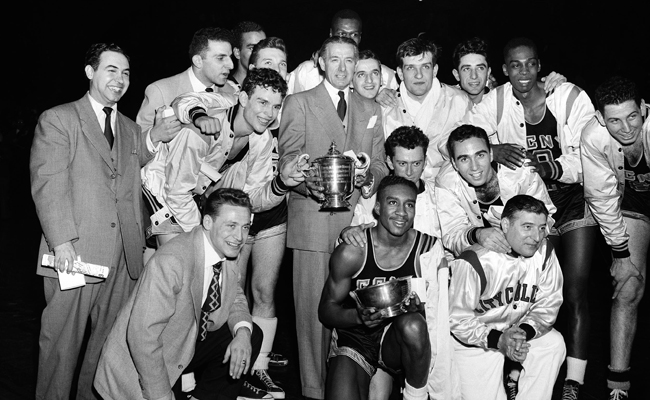
Cappy Lane, game timekeeper at the old Madison Square Garden,
flanked by Bob Kurland (left) and George Mikan

March 29, 1945, 80 years ago: College basketball has its 1st "Game of the Century." It's a benefit for the Red Cross at Madison Square Garden, between the 2 main claimants for the National Championship. NCAA Tournament Champion Oklahoma A&M (now Oklahoma State), coached by Henry Iba, defeats NIT Champion DePaul, coached by Ray Meyer, 52-44. Sadly, there appears to be no surviving footage.

It's also basketball's 1st real "battle of the big men," with Oklahoma State's 7-foot-even Bob Kurland getting the better of DePaul's 6-foot-10 George Mikan. Iba and Kurland would make it back-to-back NCAA titles in 1946.

But while "Foothills" Kurland would only play semipro ball, Mikan would dominate the early NBA, winning 6 league titles in 7 years with the Minneapolis Lakers, from 1948 to 1954.

Both men were among the earliest players elected to the Basketball Hall of Fame, Mikan with the 1st class of inductees in 1959, Kurland in 1961. Mikan lived until 2005, Kurland until 2013. Iba was elected to the Hall in 1969, Meyer in 1979 -- both men while still coaching at their respective schools. In fact, the year he was elected, Meyer finally got to the NCAA Final Four for the 1st time since 1941. He finally retired in 1984. Iba lived until 1993, Meyer until 2006.

March 29, 1945 was a big day in New York basketball for another reason, although it wouldn't be known for many years: New York Knicks Hall-of-Famer Walt Frazier was born.

March 29, 1875: Minor v. Happersett Denies Women the Right to Vote

March 29, 1875, 150 years ago: The Supreme Court of the United States issues a ruling in the case of Minor v. Happersett. It states that, while women are no less citizens than men are, citizenship does not, by itself, confer a right to vote; therefore, State laws barring women from voting are constitutionally valid.

On October 15, 1872, in St. Louis County, Missouri (outside the City of St. Louis), Virginia Minor, a leader of the women's suffrage movement in Missouri, attempted to register to vote. She was refused, on the grounds that she was a woman. Her husband, Francis Minor, was a lawyer, and, together, they sued the registrar who rejected her application, Reese Happersett.

Happersett is not the villain of the story: He was just doing his job, upholding the law as it then stood. If he had registered Mrs. Minor, they would both have been arrested and put in jail.

The Minors' argument was that the provision of the Constitution of the State of Missouri that guaranteed the right to vote only to male citizens of the State was in violation of the recently-ratified 14th Amendment to the Constitution, which guaranteed citizenship to all people born in the United States, saying that citizenship included voting rights. They did not argue under the grounds of the 15th Amendment, which guaranteed the right to vote to all citizens.

The Missouri Supreme Court ruled in Happersett's favor, pointing out that the intent of the 14th Amendment was to give the rights of citizenship to former slaves, and had nothing to do with voting rights or gender. The Minors appealed all the way to the U.S. Supreme Court.

But all 9 Justices upheld the Missouri Supreme Court ruling: Chief Justice Morrison Waite (who wrote the official opinion), Nathan Clifford, Noah Swayne, Samuel F. Miller (who should have known better, as the F stood for "Freeman"), David Davis, Stephen J. Field, William Strong, Joseph P. Bradley and Ward Hunt.

In 1876, just 1 year after the case was decided, Reese Happersett died, only 38 years old. I can find no cause, but, medicine being what it was at the time, it could have been any number of things. Virginia Minor lived until 1894, at the age of 70. Her husband, Francis Minor, had died 2 years previously. The last remaining Justice on the Court who had ruled in Minor was Stephen J. Field, who retired in 1897. The last survivor of those Justices was also Field, who lived until 1899.

The 19th Amendment to the Constitution, guaranteeing America's female citizens age 21 and up the right to vote, was ratified in 1920, after all the participants had died. In 1971, the 26th Amendment lowered the voting age to 18.

Friday, March 28, 2025

Opening Day: That's How You Get In the Mood!

Yesterday, the day the New York Yankees opened their 123rd season of play, I listed the team's various issues, mostly key injuries, and wrote this:

Doesn't seem like there's a lot of reason for optimism, does it?

On top of that, I've had health issues this Winter. All but one are now resolved, but that one, new dentures, are a problem. And Trump has been even worse the 2nd time around.

So, put it all together, and I am not really in the mood for baseball. Today is Opening Day, but I'm not feeling it.

I'm not sure there's even going to be anything to feel.

In the back of my mind, I heard the voice of Jason Alexander, playing George Costanza, a Yankee Fan, on Seinfeld: "You tell me you're not in the mood? Well, you get in the mood!"

*

The Yankees did their part to get me into the mood. After a ceremonial first ball by Andy Pettitte, Carlos Rodón opened the game, against the Milwaukee Brewers, with the real first pitch. In so doing, he became -- by virtue of a tiebreaker over any other player on the field with one -- the 1st Yankee to have a beard in a regular-season game, following Hal's dropping of his father's restriction.

No Yankee player, and no catcher for any team, had ever led off a season with a home run. Austin Wells became the 1st to do either in the 1st inning. Anthony Volpe added a homer in the 2nd. Both were aided by the short porch and a decent wind. As George Costanza would say, "And you know what? Jimmy crack corn, and I don't care!" After all, the short porch is there for the opposition, too; and, yesterday, so was the prevailing wind. The Yankees living up to their "Bronx Bombers" nickname: That's how you get in the mood!

In the 7th, Aaron Judge came up with a rather un-Judge-like play, but it worked: He hit a bouncer down the 3rd base line, and it caromed off the base, allowing a run to score. Cody Bellinger, making his Yankee debut, added a sacrifice fly for another run. Paul Goldschmidt, also making his Yankee debut, did not reach base.

Carlos Rodón pitched 5 1/3rd innings, allowing 1 run on 4 hits and 2 walks striking out 7. The Yankees getting solid starting pitching: That's another good way to get in the mood! Tim Hill worked out of a jam in the 6th, Mark Leiter Jr. was fantastic in the 7th, and Luke Weaver worked out of a jam in the 8th.

Devin Williams, acquired to be the new closer, was sent out to face his former team. But if fans were expecting him not to be as shaky Clay Holmes, or Aroldis Chapman, or any other would-be Yankee closer since the 2013 retirement of Mariano Rivera, they were sorely mistaken. He loaded the bases, and allowed a run, putting the tying and go-ahead runs on base, before working out of it. Whew.

And so, for the 1st time since October 29, 2024, we heard those magic words after a game that counts -- over the Yankee Stadium loudspeakers, if not over the radio, as John Sterling has retired: "Ballgame over! Yankees win! Theeeeeeee Yankees win!" Yankees 4, Brewers 2.

Does this assure a successful season? Not by a long shot. Does it suggest one? Not really. Does it feel good? Oh, hell, yes. Did I need it, after last year's World Series, and the Autumn and Winter I had? You bet your sweet bippy.

The Boston Red Sox and the Baltimore Orioles won. The Toronto Blue Jays lost. And the Tampa Bay Rays did not play. So the Yankees' Magic Number to clinch the American League Eastern Division drops to 161. (That's to eliminate the BoSox, the O's and the Rays; 160 to eliminate the Jays.)

As is traditional -- in case of rainout, the home team doesn't want to lose that Opening Day revenue -- today, the day after Opening Day, has been kept open. The Yankees will face the Brewers again tomorrow, at 1:05 PM.

Let's not expect 162-0, or even a Playoff berth. Let's just enjoy 1-0. While we're in the mood.

March 28, 1950: City College's Double

March 28, 1950, 70 years ago: City College of New York defeats Bradley University, of Peoria, Illinois, 71-68 at Madison Square Garden in New York, to win the NCAA Basketball Tournament. They are the 1st team based in New York City to do so.

On March 18, also at The Garden -- "the Old Garden," at 49th Street and 8th Avenue, replaced in 1968 by "the New Garden," at 32nd Street and 7th Avenue -- they won the Final of the National Invitation Tournament, beating Bradley in that game as well, 69-61. This made them the 1st team ever to win the NCAA and the NIT in the same season.

From its founding in 1938 until 2022, the NIT was played entirely at Madison Square Garden. As a result, in the 1949-50 season, CCNY played 20 of their 29 games at The Garden, going 24-5.

CCNY was coached by Nat Holman, himself a great player in the 1920s, with one of the earliest great professional teams, the Original Celtics. Longtime St. John's University coach Joe Lapchick was a teammate. Aside from the Celtics name, the Boston team that was founded with the NBA in 1946 has no connection to them.

The leading players on the 1950 CCNY team were center Ed Roman, forwards Irwin Dambrot and Ed Warner, and guards Floyd Layne and Alvin Roth. They were a multiracial, multiethnic, multifaith team, truly representative of what was good about New York.

Unfortunately, they were also a part of the seamier side of the City. The following season, they were enmeshed in a point-shaving scandal that could have ruined college basketball, and pretty much wrecked it in New York.

As a result of the scandal, CCNY were banned from ever playing at The Garden again. And the NCAA ruled that teams could only play in the NCAA or the NIT, not both. CCNY's double will remain the only one, forever. And any pretensions the NIT still had to being the bigger of the 2 tournaments were shattered.

CCNY, and their arch-rivals, New York University (NYU, also based in Manhattan), cancelled their programs, only to come back later as NCAA Division III teams. Long Island University (LIU, in Downtown Brooklyn) and Fordham (The Bronx) came back to Division I, but have never really been the same. St. John's (Jamaica, Queens) took about a decade to recover, before Lapchick put together one more good team in the mid-1960s, and Lou Carnesecca brought them back to the national spotlight in the 1980s.

NYU made what would now be called the Final Four in 1960, and St. John's in 1985. These remain, through 2022, the last 2 Final Four berths by New York City teams. From the New York side of New Jersey, Princeton made it in 1965, Rutgers in 1976, and Seton Hall in 1989.

For the record, the following schools have won the NCAA and the NIT, but not in the same season:

* Utah: NCAA 1944; NIT 1947.
* Kentucky: NIT 1946, 1976; NCAA 1948, 1949, 1951, 1958, 1978, 1996, 1998, 2012.
* Holy Cross: NCAA 1947, NIT 1954.
* La Salle: NIT 1952; NCAA 1954.
* University of San Francisco: NIT 1949; NCAA 1955, 1956.
* North Carolina: NCAA 1957, 1982, 1993, 2005, 2009, 2017; NIT 1971.
* Indiana: NCAA 1940, 1953, 1976, 1981, 1987; NIT 1979.
* Louisville: NIT 1956; NCAA 1980, 1986, 2013.
* UCLA: NCAA 1964, 1965, 1967, 1968, 1969, 1970, 1971, 1972, 1973, 1975, 1995; NIT 1985.
* Ohio State: NCAA 1960; NIT 1986, 2008.
* Michigan: NIT 1984, 1997, 2004; NCAA 1989.
* Stanford: NCAA 1942; NIT 1991, 2012, 2015.
* Villanova: NCAA 1985, 2016, 2018; NCAA 1994.
* Connecticut: NIT 1988; NCAA 1999, 2004, 2011, 2014.
* Maryland: NIT 1972; NCAA 2002.
* Virginia: NIT 1980, 1992; NCAA 2019.
* Baylor: NIT 2013; NCAA 2021.

Holman called Dambrot "the greatest player I ever coached." But Dambrot was 1 of 7 players caught up in the scandal in 1951, all pleading guilty to misdemeanor conspiracy charges, and all (including Dambrot) except one receiving suspended sentences.

Dambrot became a dentist, and most of the guilty players also went on to careers that provided some sort of service to their communities, which speaks to the true measure of their character, as well as to Holman's teaching. As of March 28, 2022, Layne and Ron Nadell are still alive. (UPDATE: Layne died in 2024, leaving Nadell as the last survivor.)

An interesting postscript: In 1954, Bradley got back into the NCAA Final, but lost to La Salle University. So now, they had lost to the first team from New York and the first team from Philadelphia to win the NCAA title.

One more note: Later in 1950, the New York Yankees won the World Series. This made New York the 1st city to win the NCAA Tournament and a major league championship in the same calendar year.

Thursday, March 27, 2025

It's Opening Day, and I'm Not Feeling It

Today is Opening Day of the 2025 Major League Baseball season, except for the 2 games played last week in Tokyo, Japan by the Los Angeles Dodgers and the Chicago Cubs. (The Dodgers won both.)

The New York Yankees will open the season at home, at Yankee Stadium II, against the Milwaukee Brewers. The game will be on ESPN, rather than the YES Network. First pitch is set for 3:05 PM.

The Brewers were fellow members of the American League from 1970 to 1997, and fellow members of the AL's Eastern Division from 1972 to 1993. So, while this matchup has been Interleague since the 1998 season, it's an opponent familiar to those of us who have been Yankee Fans since before the Joe Torre, Derek Jeter, Mariano Rivera era.

Carlos Rodón will be the Yankees' starting pitcher. The reason for this is that their 3 pitchers from last season's starting rotation are injured.

The annual injury crisis is already well underway -- in order of believed return from injury, not in order of importance:

* Clarke Schmidt. Expected to be part of the starting rotation, he was diagnosed with fatigue in his right (pitching) shoulder. He starts the season on the Injured List "to build stamina," and is expected to return in April.

* Ian Hamilton. Expected to be a key reliever, he was diagnosed with an infection. As with Schmidt, he will start the season on the Injured list "to build stamina," and is expected to return in April.

* Jake Cousins. The righthanded reliever has a right forearm strain. He's expected back in April. Not something to get excited about.

* Tyler Matzek. The Yankees signed this lefthanded reliever as free agent on February 11. And, already, he has a strained right oblique. Formerly with the Colorado Rockies and the Atlanta Braves, he missed the entire 2023 season due to injury, and pitched only 11 games in 2024, mostly without effectiveness. He's 34. He's expected to return in April, but I wouldn't count on him being a key figure in a successful season.

Jonathan Loáisiga. The righthanded reliever was supposed to be key last season, made one appearance, and needed Tommy John surgery. Had he been available in last year's World Series, who knows? He has been throwing off a mound since March 4. For the moment, the Yankees are thinking he might be back in late April or early May.

* DJ LeMahieu. The infielder has a left calf strain. He's expected back in early May. He'll be approaching his 37th birthday.

* Giancarlo Stanton. A heavy hitter when healthy, he has torn tendons in both elbows, and is also dealing with what's being called "a minor calf issue." (To paraphrase the late basketball legend Bill Walton, a minor issue is what happens to somebody else.) He is expected back sometime in May. He is 35.

* JT Brubaker. The Yankees got the righthanded starting pitcher from the Pittsburgh Pirates in last year's Spring Training. Due to various injuries, he has not appeared in a regular-season game since October 4, 2022. That's the last 2 whole seasons that he's missed. He pitched in a Spring Training game on February 21, tried to dodge a comebacker, and broke 3 ribs. He's 31. He might be back in May, but, to channel the spirit of Yogi Berra, even when he could pitch, he couldn't pitch.

* Luis Gil. Last season's AL Rookie of the Year was expected again, to be a big part of the starting rotation. He was diagnosed with a right (throwing) latissimus strain, and is not expected back before June. In other words, the Yankees will be without their ace from last season all this season, and without their top 2 pitchers from last season for at least the 1st 1/3rd of this season.

* Scott Effross. Much has the righthanded reliever been hyped. But injuries have meant that he's made just 3 regular-season major league appearances since October 3, 2022. He was diagnosed with a left hamstring strain after leaving a Spring Training game on February 25, after throwing one pitch. All we know is what manager Aaron Boone told us: "It's going to take some time." He's 31. Anybody who was ever counting on him has been kidding themselves.

* Clayton Beeter. The righthanded reliever reached the major leagues last season, making 3 appearances for the Yankees. He's 26. General manager Brian Cashman says only, "It's going to be a while." Sounds like someone we shouldn't be counting on, anyway.

* Gerrit Cole. The Yankees' starting ace had Tommy John surgery on his right (pitching) elbow on March 11. He is definitely out for the entire 2025 season, and may miss time in 2026 as well. For a team that reached, but lost, the World Series last year, and hoped to win it this year, this is a devastating blow. What's more, when he comes back, Cole will be approaching his 36th birthday. He may never be ace-level quality again.

* Chase Hampton. The righthanded starter made 7 appearances last season, topping out with the Class AA Somerset Patriots. He has never thrown a pitch even as high as in Class AAA. He had Tommy John surgery. They're talking about May 2026 as his earliest return. He'll be 25, and will probably spend whatever time he's active back at AA. I'm not sure why he's even mentioned on this list.

This is the projected Yankee starting lineup until LeMahieu and Stanton can come back -- presuming, that is, no other new injuries:

1. Catcher: Austin Wells.

2. Right Field: Aaron Judge. The best player in baseball, at least in the regular season. And yet, Cashman is still ordering Judge to bat his best slugger in the 2 spot in the order. This has been established as monumentally stupid. He moves from center field back to his natural position because right fielder Juan Soto crossed town and turned coat, signing with the New York Mets.

3. Center Field: Cody Bellinger. Fills the center field gap caused by Judge moving back to right. He's already won a Rookie of the Year, a Most Valuable Player award, and a Gold Glove. He's a 2-time All-Star. However, he also has an injury history. He will never again be the 47-homer, 115-RBI player he was with the 2019 Dodgers. And, like several other Yankees, but current and recent, he strikes out too much. But if he can put up the 26 homers and 97 RBIs that he put up with the 2023 Cubs, I will gladly take it. He is the son of Clay Bellinger, a reserve on the Yankees' 1999 and 2000 World Champions.

4. First Base: Paul Goldschmidt. He's a 7-time All-Star, a 4-time Gold Glove, and a former MVP (with 3 other top-3 finishes), with 362 career home runs and a 139 career OPS+. So, he's an upgrade on LeMahieu, anyway. The downside: He's 37, and, over the last 3 seasons, his on-base percentage has dropped from .404 to .362 to .303.

5. Second Base: Jazz Chisholm Jr. The reason we will not miss Gleyber Torres. That, and the fact that Torres no longer has a million-dollar bat, but still has a buck-ninety-five glove and a five-cent head.

6. Shortstop: Anthony Volpe. He came into his own last season. He's ready to be a championship-level shortstop.

7. Left Field: Jasson Domínguez. He can hit the ball a long way, but he's had a lot of fielding woes, and is already injury-prone.

8. Designated Hitter: Ben Rice. He has been hitting very well in Spring Training. He is also Wells' main backup as catcher.

9. Third Base: Oswaldo Cabrera. Good fielder, not a good hitter, and LeMahieu's return might not mean he goes back to 3rd base, anyway.

Last season, Soto had 41 home runs; Bellinger and Goldschmidt, combined, had 40. Soto had 109 RBIs; Bellinger and Goldschmidt, combined, had 143. So making up what he produced might not be that hard. But, again, both men have declined a bit the last 2 seasons.

The starting rotation: Carlos Rodón, Max Fried, Marcus Stroman, Will Warren and Carlos Carrasco. Rodón and Fried are lefthanded, the rest are righthanded. The Yankees signed Fried as a free agent. In 8 seasons with the Braves, he went 73-36 with a 3.07 ERA and a 1.164 ERA. Sounds great. Except he only appeared in 7 games in 2020 (about half as many as he should have in that COVID-shortened season), and only 14 in 2023. He's 31. Sounds like a classic, "Yes, but... " situation.

The Yankees acquired Devin Williams from the Milwaukee Brewers, in a package that included Nestor Cortés. In other words, Rodón and the terribly inconsistent Stroman are the only regular starters from last season who are ready to go this Opening Day. But Williams is intended as the new closer. The bullpen will also have, in decreasing order of my confidence in them, Luke Weaver, Mark Leiter and Tim Hill.

Boone is still the field boss. Cashman is still the roster manager. Hal Steinbrenner, who, unlike his father, values profit over winning, is still the controlling owner. Doesn't seem like there's a lot of reason for optimism, does it?

On top of that, I've had health issues this Winter. All but one are now resolved, but that one, new dentures, are a problem. And Trump has been even worse the 2nd time around.

So, put it all together, and I am not really in the mood for baseball. Today is Opening Day, but I'm not feeling it.

I'm not sure there's even going to be anything to feel.

*

I haven't done a countdown in 4 months. Here goes:

Hours until the Yankees open the 2025 regular season: 8.

Days until the next New York Red Bulls match: 2, this Saturday afternoon, at 2:30 PM, vs. the New England Revolution, at Gillette Stadium in the Boston suburb of Foxborough, Massachusetts.

Days until the Red Bulls again play a nearby rival: See the previous answer.

Days until the next Arsenal match: 5, on Tuesday, at 2;45 PM New York Eastern Time, home to West London team Fulham.

Days until the New Jersey Devils again play a local rival: 9, at 12:30 PM on Saturday, April 5, against the New York Rangers, a matinee at the Prudential Center.

Days until the Yankees' next series against the Boston Red Sox begins: 71, on Friday night, June 6, 2025, at Yankee Stadium. Just 10 weeks.

Days until the next game of the U.S. National Soccer Team: 72, on Saturday, June 7, at 3:30 PM, vs. Turkey, at Pratt & Whitney Stadium at Rentschler Field in East Hartford, Connecticut. The team looked very bad in the recent CONCACAF Nations League, under their new manager, former Tottenham and Chelsea boss Mauricio Pochettino.

Days until the new Superman movie premieres: 106, on July 11. Just 15 weeks.

Days until the next North London Derby: Unknown, as Arsenal and Tottenham have already played both Premier League games against each other this season. The next season begins on August 16, and the opening weekend almost never features major rivalries, so we're looking at no earlier than August 23. That's 149 days, or under 5 months.

Days until the next Rutgers University football game: 154, on Thursday night, August 28, home to Ohio University. Just 5 months. That's Ohio University. Not to be confused with "The... Ohio State University." Unfortunately, Rutgers has to play the defending National Champions away. A week after playing Ohio University, Rutgers will host Miami University of Ohio, not to be confused with the University of Miami in Florida.

Days until the next East Brunswick High School football game: Unknown. The 2024 season began earlier, and ended earlier, than ever before, as we went 2-8. If the schedule works out the same way as this season, then the opener will be on Friday night, August 29, 2025. That's 155 days.

Days until the next East Brunswick-Old Bridge Game: Unknown. If the 2025 schedule is a reverse of the 2024 edition, with the teams flipping to the other's home field, it will be at home on September 26, 2025. That's 183 days, or just under 6 months.

Days until the next elections for Governor of New Jersey and Mayor of New York City: 222, on Tuesday, November 4, 2025. A little over 7 months.

Days until the next Rutgers-Penn State football game: 247, on Saturday, November 29, in Piscataway, at what's currently named SHI Stadium. (The naming rights could be sold to someone else by then.) 

Days until the next Winter Olympics open in Milan, Italy: 316, on Friday, February 6, 2026. Under a year.

Days until the next World Cup opens: 438, on Monday, June 8, 2026. Under a year and a half, or under 15 months. I wonder what team Trump will be rooting for: Ours, or Russia's.

Days until the World Cup Final in New Jersey: 479, on Sunday, July 19, 2026. Under a year and a half, or under 16 months.

Days until the next Summer Olympic Games: 1,205, on Friday, July 14, 2028, in Los Angeles. Under 3 1/2 years, and under 40 months. What shape America will be in at the time, God only knows.

Days until the next Presidential election: 1,321, on Tuesday, November 7, 2028. A little over 3 1/2 years, under 44 months. This, of course, presumes that the Trump Administration doesn't suspend the Constitution of the United States and cancel all future Presidential elections.

Sunday, March 23, 2025

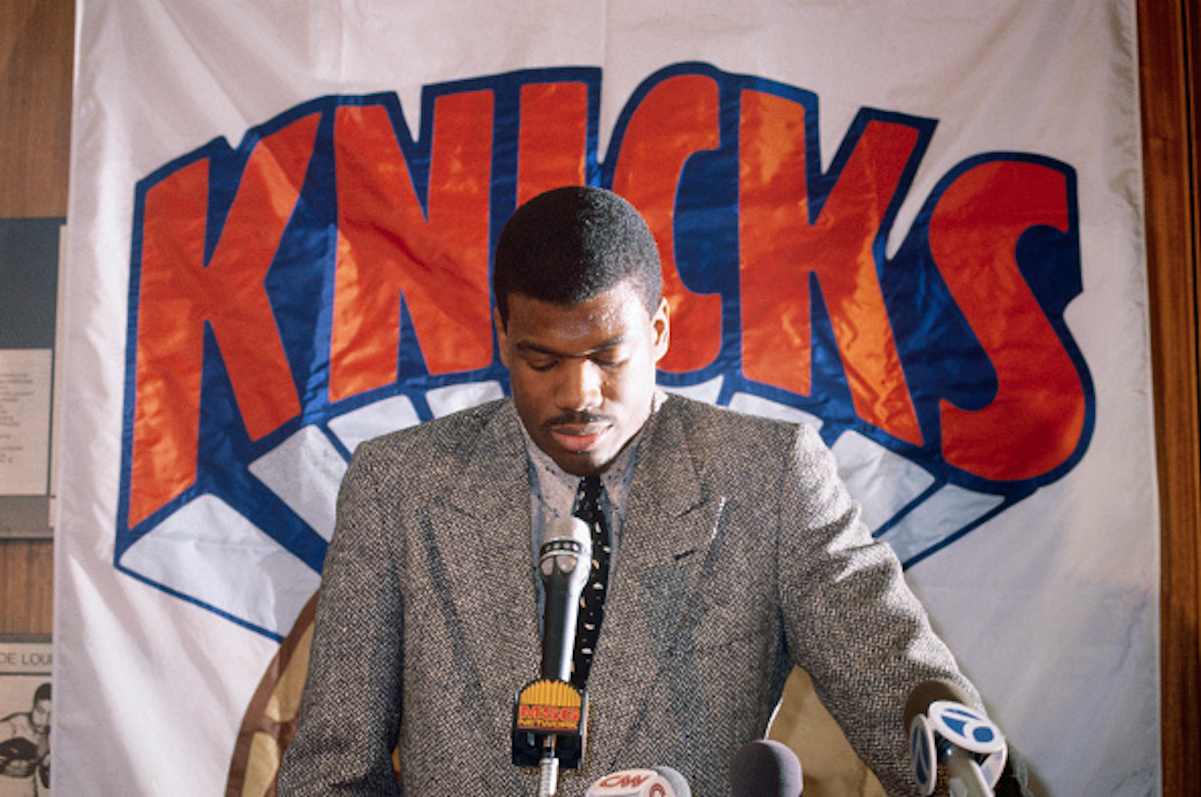
March 23, 1985: Bernard King's Injury

March 23, 1985, 40 years ago: The man who may have been the best player in the NBA at the time sees that status came to a most painful end.

Bernard King and his brother Albert King came out of Fort Hamilton High School in Brooklyn to become basketball stars. Bernard had starred at the University of Tennessee, Albert at the University of Maryland. Each began his NBA career with the New Jersey Nets, but Bernard was 3 years older: By the time Albert arrived with the Nets, Bernard had been traded to the Utah Jazz.

In 1982, Bernard was traded to the New York Knicks. In the 1983-84 season, he caught fire. He scored 50 points away to the San Antonio Spurs. The next day, he scored 50 again, away to the Dallas Mavericks. He averaged 34.8 points per game in the Playoffs, helping the Knicks reach the Eastern Conference Semifinals.

On Christmas Day, December 25, 1984, the Knicks lost to the Nets, 120-114 at Madison Square Garden, but Bernard scored 60 points. At the time, he was only the 10th player in NBA history to do so. His brother Albert was still with the Nets, but was injured, and did not play. Micheal Ray Richardson, whom the Knicks traded to get Bernard, scored 36; Mike Gminski scored 27; and Kelvin Ransey scored 24.

'Nard kept going in that 1984-85 season. He was leading the league with 32.9 points per game, at a time when it had Kareem Abdul-Jabbar, Magic Johnson, Larry Bird, George Gervin, Isiah Thomas, and a rookie named Michael Jordan. But the Knicks themselves were struggling, especially with injuries. 

They were 24-46 when they went into the Kemper Arena in Kansas City, just on the Missouri side of the State Line with Kansas, to play the Kansas City Kings, who were not much better at the time, going 27-43. Only 4,554 fans bothered to show up for a game that started with little meaning, but ended with a tremendous amount of meaning for the Knicks, and Bernard in particular, going forward.

The Knicks were trailing with 1:34 left in the game, and Bernard already had 37 points. Reggie Theus of Kansas City attempted a dunk. Bernard jumped to try to block it. But as he jumped, he yelled, "Oh!" As he came down, he yelled, "Oh, damn!" He crumpled to the floor, and started slapping it, in an immense amount of pain.

Knick broadcaster Marv Albert said, "Look out! King hurt himself as he gave the foul!" The crowd was small enough, and shocked into a level of sound so low, that not only the sound of Bernard shouting, "Oh, damn!" but the sound of his hand slapping the court was picked up by the MSG Network microphones. Hubie Brown, then the head coach of the Knicks, actually heard the injury, saying in an interview years later, "You could hear the crack. It was like a gun sound."

Ernie Grunfeld, who had been his teammate at Tennessee (where the media called them "The Bernie and Ernie Show"), and now was again with the Knicks, said, "It was devastating. My heart stopped, and I think everybody else's heart on the bench stopped, also."

The Kings won the game, 113-105, but hardly anybody cared. The most exciting player in the NBA was diagnosed with a broken tibia, a torn anterior cruciate ligament (ACL), and torn knee cartilage. No player, in any of North America's "Big Four sports," had ever come back from an injury like that before. As far as anyone could tell at the time, Bernard King, only 28 years old, was done.

The game was the 1st of 12 straight that the Knicks lost to close out the season. It put them into a much better position to win the NBA's 1st-ever Draft Lottery. They did -- and there are still people who believe this was fixed, to give the New York team the advantage and the NBA better TV ratings -- and selected Georgetown University center Patrick Ewing. Ewing kept the Knicks relevant as they climbed back up into the NBA's elite, and took them to 2 NBA Finals, but lost them both.

The Kings were not so fortunate. At the end of the season, they left Kansas City, and moved to Sacramento. The Kemper Arena was renamed the Hy-Vee Arena, and, though it still stands in 2025, was replaced by the Sprint Center in 2007. That building has been renamed the T-Mobile Center. The NBA has never returned to Kansas City.

But Bernard King returned to the NBA. He missed the entire 1985-86 season, and, through a lot of hard work by himself and the medical professionals around him, finally returned on April 10, 1987, a Knick loss away to the Milwaukee Bucks. He played just 6 games that season, and was released by the Knicks.

He was signed by the Washington Bullets, and played 69 of a possible 82 games in the 1987-88 season. He played all but 1 game in 1987-88, all but 1 game in 1988-89, and all 82 with the 1989-90 Bullets. He missed 1991-92 due to injury, then played out the string with the Nets in 1992-93, and retired.

He was elected to the Basketball Hall of Fame in 2013, and it's not clear that he would have made it had he retired right after his injury. He is now 68 years old, a studio analyst for the Knicks and for NBA TV, and remains beloved in Knoxville, Washington, and especially New York.

March 23, 1775: "Give Me Liberty!" Or...

March 23, 1775, 250 years ago: Patrick Henry, considered the finest orator (public speaker) among America's Founding Fathers, makes his most famous statement. Except he might not have said it.

He was born on May 29, 1736, at Studley, his family's farmhouse outside Hanover, Virginia. The town, and its surrounding Hanover County, were named for the for House of Hanover, the royal family of Great Britain, then the rulers of British America.

Because of his uncle, a prominent minster named Patrick Henry, he frequently used the name "Patrick Henry Jr." until the uncle's death in 1777. Uncle Patrick, and American religion's "Great Awakening," inspired him to become a public speaker. But his dissatisfaction with the Church of England led him to not consider the ministry, so he turned to the law. He also became a talented violinist, and this, along with his Virginia law practice, led to his introduction to a younger Virginia lawyer and violinist, Thomas Jefferson. They would serve together in the House of Burgesses, the forerunner of the Virginia House of Delegates, and thus the oldest continuously-meeting legislative body in the Western Hemisphere.

Patrick Henry married twice. In 1754, he married Sarah Shelton. But she fell victim to mental illness, and died shortly after his famous speech of 1775. In 1777, he married Dorothea Dandridge (as far as is known, not related to 20th Century actress Dorothy Dandridge), and that marriage lasted the rest of Patrick's life. Between the two marriages, he had 17 children.

Henry was a lifelong slaveholder from the time of his first marriage, at age 18. Henry professed that slavery was wrong, and expressed hopes for its abolition; but he had no plan for doing so, nor for the multiracial society that would result. He wrote in 1773, two years before his famous speech about liberty, "I am the master of slaves of my own purchase. I am drawn along by the general inconvenience of living here without them. I will not, I cannot justify it."

He was elected to the House of Burgesses in 1765. That year, Britain imposed the Stamp Act on its American colonies. On May 29, his 29th birthday, he gave a speech protesting it. Jefferson was in attendance. So was John Tyler Sr., later a Governor of Virginia and the father of John Tyler, the 10th President of the United States. Henry invoked murdered tyrants, and compared King George III to them: "Caesar had his Brutus, Charles the First had his Cromwell, and George the Third... "

Some members yelled out, "Treason!" Henry continued: "George the Third may profit by their example. If this be treason, make the most of it!" Jefferson and Tyler both remembered the speech well, Tyler later calling it "one of the trying moments which is decisive of character."

Henry was not charged with treason, or any other crime, in regard to the speech. He remained a member of the House of Burgesses until its dissolution in 1776. He was named a Delegate from Virginia to the First Continental Congress in 1774. He was not a member of the Second Continental Congress, and was not directly involved in the declaration of independence -- upper- or lower-case.

Hanover County elected Henry as a delegate to the Second Virginia Convention, which convened at St. John's Episcopal Church in Richmond on March 20, 1775. (Williamsburg was still the capital of Virginia until 1780, when it was moved to Richmond, as it was further inland and on higher ground.) Once again, Jefferson was in attendance. So was George Washington.

The Convention debated whether Virginia should adopt language from a petition by the planters of the Colony of Jamaica. This document contained complaints about British actions, but admitted the King could veto colonial legislation, and it urged reconciliation. (Jamaica remained a British colony until 1962, and, while independent, it remains within the British Commonwealth, with the British monarch as its head of state, and represented in-country by a Governor-General.)

Henry offered amendments to raise a militia independent of royal authority in terms that recognized that conflict with Britain was inevitable, sparking the opposition of moderates. On March 23, he defended his amendments, concluding with the statement he is well known for:

If we were base enough to desire it, it is now too late to retire from the contest. There is no retreat but in submission and slavery! Our chains are forged! Their clanking may be heard on the plains of Boston! The war is inevitable, and let it come! I repeat it, sir: Let it come!

It is in vain, sir, to extenuate the matter. Gentlemen may cry, "Peace, Peace!" But there is no peace! The war is actually begun! The next gale that sweeps from the north will bring to our ears the clash of resounding arms! Our brethren are already in the field! Why stand we here idle?

What is it that gentlemen wish? What would they have? Is life so dear, or peace so sweet, as to be purchased at the price of chains and slavery? Forbid it, Almighty God! I know not what course others may take. But, as for me, give me liberty!

At this, the assembled men leapt to their feet and cheered. So, if Henry said anything after "Give me liberty," they were in no position to hear him.

In 1817, William Wirt, a Virginia politician who later served as U.S. Attorney General -- but was 2 years old at the time of the speech, and was in no position to know anything other than secondhand information -- published a biography of Henry, in which he claimed Henry said, "I know not what course others may take. But, as for me, give me liberty, or give me death!" And he then took an ivory paper cutter, simulated plunging it into his chest, in imitation of the 46 BC suicide of Cato the Younger, a patriot of the Roman Republic and a defeated enemy of Julius Caesar.

The Founding Fathers had something like a fetish for the statesmen of Ancient Rome, and to a lesser extent for those of Ancient Greece. Jefferson frequently peppered his letters with quotations from Greek historian Thucydides. Roman politicians like Cicero and Seneca, both of them martyred, were often quoted in speeches and cited in letters and newspaper articles. Latin names like "Publius" became pen names for activists who did not want to be identified. And George Washington was frequently compared to Lucius Quinctius Cincinnatus, a Roman general who was called away from his farm to be dictator in 458 BC. He straightened things out, then gave up power and went back to his farm. The City of Cincinnati was named for him.

In 1713, the British playwright Joseph Addison wrote the play Cato, a Tragedy, about Cato the Younger. The play includes the line, "Chains or conquest, liberty or death." It was popular in British America, and Henry knew it. Going back even further is the opera Artemisia, written by Nicolò Minato in 1657, which contains an aria called "Give me death or freedom." But that was about a woman's heartbreak, not political freedom.

So, while we can't be absolutely certain that Patrick Henry followed up "Give me liberty" with "or give me death," the available evidence suggests that he did.

Henry's speech carried the day, and the Convention narrowly adopted his amendments. Just 27 days later, Massachusetts militiamen and a unit of the British Army exchanged gunfire at Lexington and Concord. The War of the American Revolution was underway.

On June 29, 1776, Henry was elected Governor of Virginia by the House of Burgesses. Jefferson's Declaration of Independence was approved 5 days later. Henry remained in constant written contact with Washington, his fellow Virginian and now commander of the Continental Army, standing up for him against the Conway Cabal of early 1778. He left office in 1779, and Jefferson was elected to succeed him.

Henry was returned to the House of Delegates in 1779, from a County that was cut out of Pittsylvania County. It was named Patrick Henry County, and was later split into Patrick County and Henry County. With the war won, he was returned to the Governorship in 1784, serving 2 years.

He was an opponent of the Constitution of the United States ratified at Philadelphia in 1787, as he didn't think it went far enough. He wanted a Bill of Rights to protect individual rights, and spoke against the Constitution at the Virginia Ratifying Convention. Nevertheless, on June 25, 1788, the Convention ratified it. Congress passed a Bill of Rights the next year.

Patrick Henry died on June 6, 1799, at Red Hill, his home in Brookneal, Virginia, now a National Historic Site, about 100 miles southwest of Richmond. He was 63 years old.

Along with Benjamin Franklin, Samuel Adams, John Hancock and Thomas Paine, Patrick Henry was among the leading non-military figures of the American Revolution who didn't get to be President of the United States -- regardless of whether he actually said, "Give me liberty, or give me death!"

There's a joke dating back to World War II. A ship's captain is telling his crew that they had misbehaved, and so they would not be permitted "liberty," another term for shore leave, when they got to their next port. A sailor yells out, "Give me liberty, or give me death!" The captain yells, "Who said that?" And the sailors yells back, "Patrick Henry!"