Showing posts with label wild west. Show all posts

Monday, September 7, 2026

September 7, 1876: The Great Northfield, Minnesota Raid

The James Brothers: Jesse (left) and Frank

September 7, 1876, 150 years ago: Jesse James, his brother, and his friends decide to rob a bank. It doesn't go so well.
Jesse James and his brother Frank were from Kearney, Missouri, outside Kansas City. During the American Civil War, when Missouri remained in the Union but had Southern sympathies, the James Brothers joined William Quantrill and his group, Quantrill's Raiders. They called themselves "bushwhackers," but, in modern terms, they were terrorists. Shortly after the war ended, Union troops shot Quantrill, who took nearly a month to die as a result of his wound.
The James brothers made it back to Missouri, and brought Cole Younger into their operations. He brought in his brothers, Bob and John. They robbed banks and trains all over what would now be called the Midwest. In modern terms, they were an organized crime family. Not Italian, but a Missouri Mafia, a Confederate Cosa Nostra.
The Younger Brothers
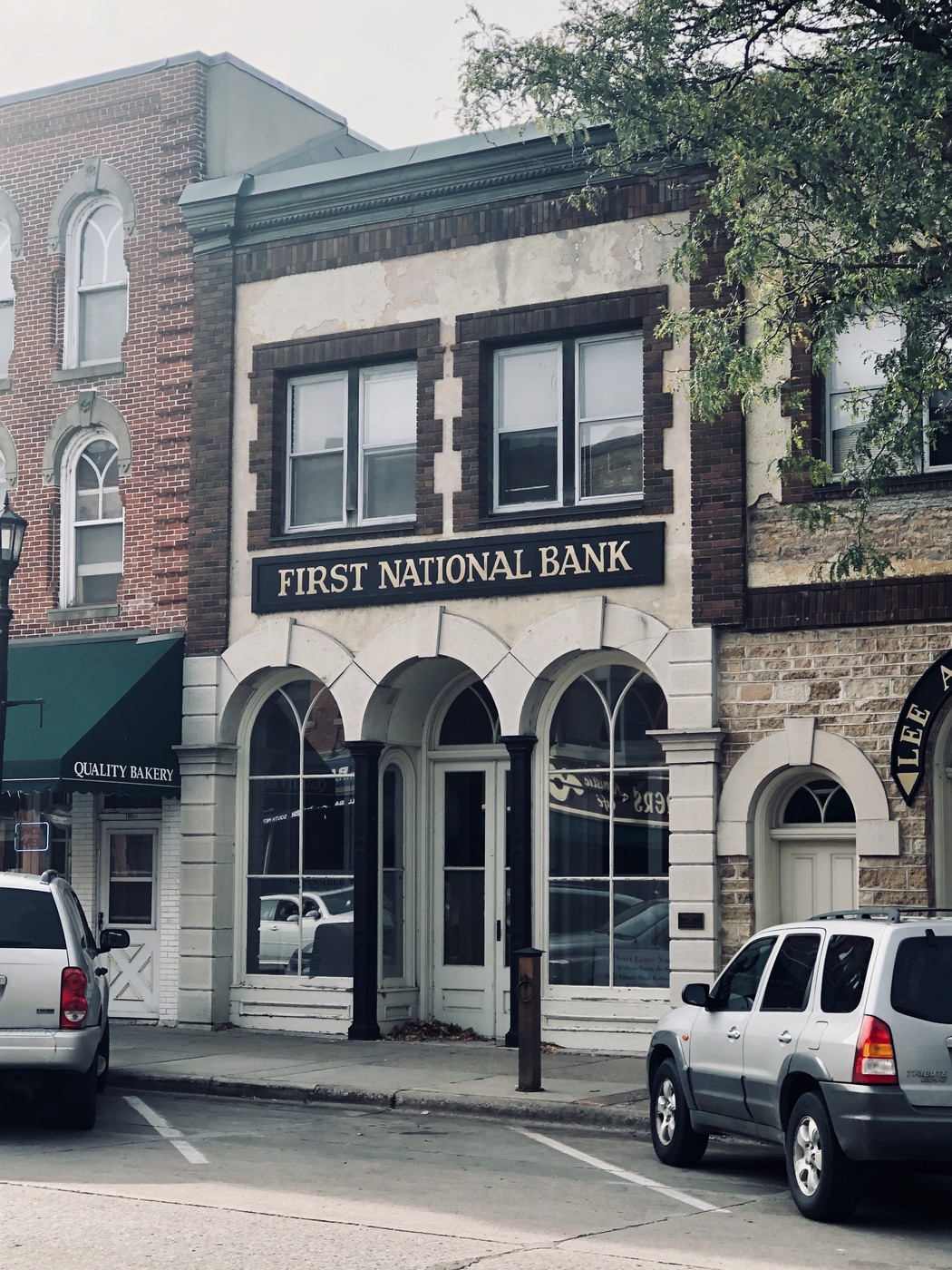
John Younger had already been killed in an ambush in 1874. In 1876, Bob Younger wanted to go well outside the James-Younger Gang's usual territory, to the First National Bank in Northfield, Minnesota, about 40 miles south of Minneapolis.
His explanation was its connection to 2 Union Generals who had become Republican politicians: Benjamin Franklin Butler, a Congressman from Massachusetts (and later its Governor), who had famously insulted the women of New Orleans during the war; and Governor Adelbert Ames of Mississippi, who supported civil rights for black people, including freed slaves.
Ames had married Butler's daughter, and his father owned the Ames Mill in Northfield. There was a rumor that the elder Mills had deposited $50,000 in cash in that bank. (About $1.56 million in 2026 dollars, a very tempting sum.)
The bank building, preserved
Cole tried to talk his brother out of the plan, thinking it too risky. But Bob refused to back down. Reluctantly, Cole agreed to go, writing to their brother Jim, then in California, to come home. Jim had never wanted anything to do with Cole's outlaw activities, but he agreed to go, out of family loyalty.
Hardware store merchant J.S. Allen saw the outlaws, figured out what was happening, and yelled, "Get your guns boys, they're robbing the bank!" That spurred Northfield men into action, arming themselves with long guns in a street shootout that lasted around 7 minutes, leaving 2 gang members dead in the street: Clell Miller and Bill Caldwell. Bob Younger's horse was killed, and Frank James murdered First National Bank acting cashier Joseph Lee Heywood. Swedish immigrant Nicolaus Gustafson was shot in the head by Cole Younger, and died of his injuries four days later. Bank teller Alonzo Bunker was shot in the shoulder as he tried to escape, but survived.
The James brothers escaped west into the Dakota Territory, while the remaining gang members were killed or taken into custody. The Younger brothers pleaded guilty on November 20, 1876, and were sentenced to life terms in prison.
Jesse James was killed by a supposed ally in 1882. Bob Younger died in prison, of tuberculosis, in 1889. Cole and Jim Younger were paroled in 1901. Jim committed suicide in 1902. Cole traveled to Missouri, where he joined a "Wild West" show with Frank James. Frank died in 1915, and Cole the following year.
The raid has been portrayed, with varying levels of accuracy, in 3 films: The True Story of Jesse James in 1957, The Great Northfield Minnesota Raid in 1972, and The Long Riders in 1980.

Sunday, August 2, 2026

August 2, 1876: The Death of Wild Bill Hickok

August 2, 1876, 150 years ago: James Butler Hickok is shot and killed in Deadwood, Dakota Territory, now in the State of South Dakota. He was 39 years old.

He grew up on the Illinois plains, in what's now the Chicago suburb of Troy Grove. At age 18, he thought he'd killed a man in a fight, and fled, taking his father's name, William Hickok. Knowing that his father had used the family house as part the Underground Railroad, assisting fleeing slaves, he joined the Union Army, and later served as a U.S. Army scout. "Wild Bill" served several towns as a lawman, but his chief means of income appears to have been gambling, especially cardplaying.

There are so many legends about the Wild West, including the belief that any saloon you could walk into would have a poker game going on. Poker was Hickok's favored game, but the most common card game in the Wild -- or "Old" -- West was a different game played with a standard deck of cards, faro.

To play bridge in the Wild West was to risk ridicule, as that was considered a game for gentlemen -- and gentlemen were considered more "gentle" than "men," in the West, and had to work harder to prove themselves to the men, as Theodore Roosevelt would eventually find out. Faro, a game dating to 17th Century France, was popularly with manly men, but poker overtook it as such in the early 20th Century, around the time that "the frontier closed," and "dime novels" telling tales of the Wild West began to surpass reality.

Hickok was good at poker, better than he was at enforcing the law. Fortunately for him, he was also a good marksman. Nevertheless, the English writer Joseph G. Rosa (1932-2015), who published They Called Him Wild Bill: The Life and Adventures of James Butler Hickok in 1974, and is considered the foremost authority on him, has been able to document "only" 6 kills. (Among Rosa's other books are The Gunfighter: Man Or Myth?, and books about the guns such men used.)

On August 1, 1876, having had a run of bad luck, Hickok went to Deadwood, home of Nuttal & Mann's saloon. There, he had a good game, taking a gambler named Jack McCall for all he had. As McCall turned to leave, Hickok gave him back the money, and suggested that McCall get something to eat.

Instead of comforting McCall, as it could have, it infuriated him, and he had Hickok set up. Knowing how many enemies he had made, Hickok always sat with his back to the wall when he played cards. But on his visit to Nuttal & Mann's for another poker game the next day, every chair with a back to the wall was taken. So he couldn't see who was coming in.

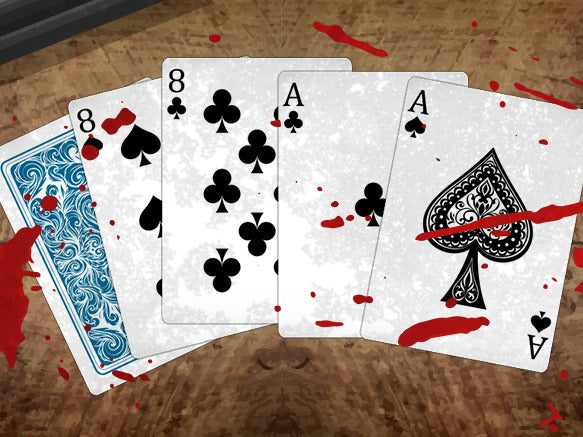
McCall came in. He shot Hickok in the back of the head, killing him instantly, and freezing his face in a smile. Hickok was holding two pairs: The aces and eights of spades and clubs, all black. This became known as "The Dead Man's Hand."
(In my hometown in New Jersey, I once saw a car with a personalized license plate: "ACESN8S.")

Hickok was a friend of Martha Jane Canary, the frontierswoman and scout known as Calamity Jane. Those who love the legends of the Wild West like to imagine that they were lovers, and that Wild Bill was the father of at least one of Jane's children. Certainly, she cared enough about him to try to avenge him, going after McCall with a meat cleaver, later claiming it was because she had left her guns at her rooming house and it was the only weapon available.
Calamity Jane at Wild Bill's grave, sometime in the 1890s

A native of Kentucky, McCall was hanged for the crime on March 1, 1877. He was 24 years old. Calamity Jane, a native of Missouri, and also 24 at the time of Wild Bill's death, later joined Buffalo Bill Cody's Wild West Show, and died from the effects of her drinking in 1903, at 51.

In 1941, a woman named Jean Hickok Burkhardt McCormick came forward, claiming to be the daughter of Wild Bill and Calamity Jane. The documentation she came up with -- which gave September 25, 1873 as both the date of their marriage and the date of her birth, making her almost 68 years old at the time of her claim -- have been disputed ever since, and she got no government benefits from it.

James Butler Hickok, a.k.a. Wild Bill, has been played by William S. Hart in the 1923 silent film Wild Bill Hickok, Wild Bill Elliott in the 1940 film Prairie Schooners, Guy Madison and later Andy Devine in the 1951-58 CBS series The Adventures of Wild Bill Hickok, Lloyd Bridges on a 1964 episode of The Great Adventure, Jeff Corey in the 1970 film Little Big Man, Charles Bronson in the 1977 film The White Buffalo, Josh Brolin in the 1989-92 ABC series The Young Riders, William Russ in a 1995 episode of Legend, Sam Shepard in the 1999 TNT film Purgatory, and Luke Hemsworth in the 2017 film Hickok.

Martha Jane Canary, a.k.a. Calamity Jane, has been played by Jane Russell in the 1948 film The Paleface, Norma Crane on an 1961 episode of Have Gun -- Will Travel, Stefanie Powers on a 1963 episode of Bonanza (which pairs her up with not Wild Bill but John "Doc" Holliday, whom she appears never to have met in real life), and Catherine O'Hara in the 1995 Disney film Tall Tale: The Unbelievable Adventures of Pecos Bill. (Pecos Bill was a fictional cowboy and folk hero, something of a Wild West version of Paul Bunyan.)

And, together, they were portrayed in the 1936 film The Plainsman by Gary Cooper and Jean Arthur, in the 1940 film Young Bill Hickok by Roy Rogers and Sally Payne, in the 1953 film Calamity Jane by Howard Keel and Doris Day, on a 1966 episode of Death Valley Days by Rhodes Reasons and Fay Spain, in the 1984 CBS movie Calamity Jane by Frederic Forrest and Jane Alexander, in the 1995 film Wild Bill by Jeff Bridges (Lloyd's son) and Ellen Barkin, in the 1995 CBS movie Buffalo Girls by Sam Elliott and Anjelica Huston, and by Keith Carradine and Robin Weigert in the 2004-06 HBO series Deadwood (and Jane by Weigert again in its 2019 film sequel).

Stephen Amell, who played Oliver Queen, a.k.a. the superhero Green Arrow, and Emily Bett Rickards, who played his crimefighting associate and later wife Felicity Smoak, on the TV show Arrow, played Hickok and Canary in the 2024 film Calamity Jane.

*

August 2, 1876 was a Wednesday. Only one game was played that day, in the National League. The Hartford Dark Blues beat the Philadelphia Athletics, 15-5 at the Hartford Ball Club Grounds in the Connecticut capital. Neither of these teams would survive the 1877 season, and the A's founded in Philadelphia in 1901, who have been in Oakland since 1968, have no connection to them besides name.

But, thus far, "Wild Bill" has been a nickname for 14 Major League Baseball players, most notably William Edward Donovan, who won 185 games, pitching mostly for the 1900s and 1910s Detroit Tigers; and William Anthony Hallahan, who won 102 games, and was with the St. Louis Cardinals when they won the World Series in 1926, 1931 and 1934. 

Wednesday, February 7, 2024

February 7, 1974: "Blazing Saddles" Premieres

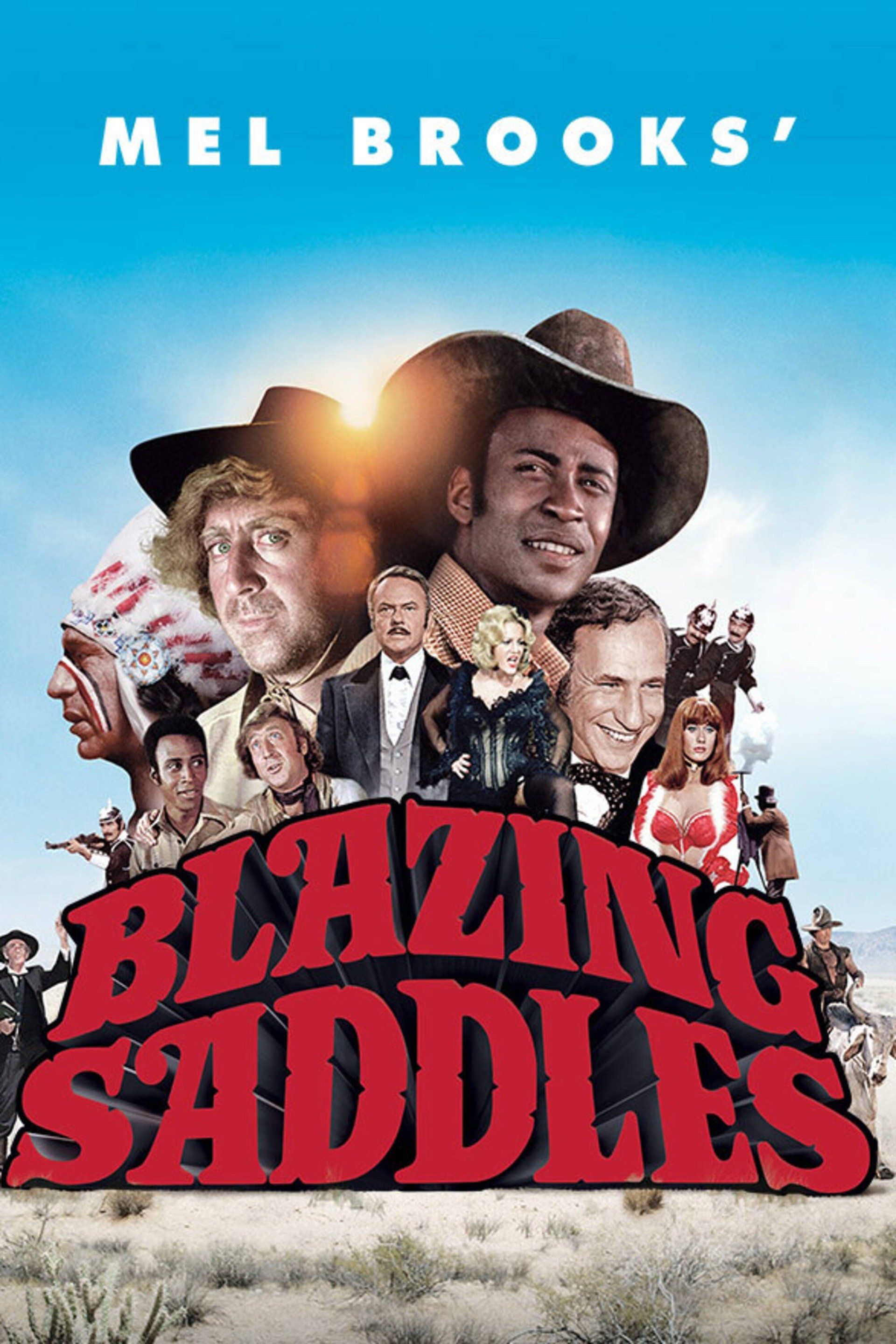
February 7, 1974, 50 years ago: Blazing Saddles premieres, director Mel Brooks' tribute to, and parody of, classic Western movies.

Hedley Lamarr (played by Harvey Korman) is a railroad executive, and the Attorney General of an unidentified Western territory of the United States. His name always gets turned into that of Hedy Lamarr, a popular actress of the 1930s and '40s. He gets told, "This is 1874: You can sue her!" He wants to build his railroad through the town of Rock Ridge, but the residents (who all seemed to be named Johnson) won't leave.

So he sends his flunky Taggart (Slim Pickens) and his goons there, to, as Taggart, says, "go ridin' into town, whompin' and a-whompin'," until the terrified citizens leave. But the move backfires: They are willing to fight for their town, and demand that the Territorial Governor, William J. Le Petomane (Brooks) appoint a Sheriff to protect them.

Lamarr figures out a way around this: Since Le Petomane is an idiot, and Lamarr is clearly the power behind the throne, he convinces Le Petomane to appoint a Sheriff that the people of Rock Ridge will never accept: A black man named Bart (Cleavon Little -- the character's last name is never mentioned).

Sure enough, at first, they are repulsed. As Jim (Gene Wilder), a former hired gun known as the Waco Kid, explains: "You've got to remember that these are just simple farmers. These are people of the land. The common clay of the new West. You know: Morons." (The ending was an ad-lib by Wilder. Little cracked up, and Brooks left it in, because it was funny. As Brooks has said, "The only true sin is not being funny.")

In a flashback, where Bart tells Jim his backstory, he mentions his family being the only black family in a wagon train, and thus at the back of it, as if it was a segregation-era bus. When they're attacked by Indians, the chief, also played by Brooks, tells his braves to give them a break: "They're even darker than we are!"

Jim helps Bart win the town over. So Lamarr sends in his doomsday weapon: Mongo (former football star Alex Karras), a gigantic man of limited intelligence and words. Lamarr figures Bart wouldn't be able to handle him. As Jim says, when Bart suggests shooting him, "Don't do that. It'll only make him mad!" Well, not only does Bart find a way to handle Mongo, but Mongo defects to Bart's side, respecting him as the only man ever to stand up to him.

This not having worked, Lamarr sends in another secret weapon: Lili von Shtupp, an overtly sexy German singer (Madeline Kahn, in an obvious homage to Marlene Dietrich), who is meant to seduce Bart. But Bart is a lover as well as a fighter, so she defects to his side, too.

So Lamarr decides he needs total war, telling Taggart, "I want you to round up every vicious criminal and gunslinger in the west. Take this down. I want rustlers, cutthroats, murderers, bounty hunters, desperados! Mugs, pugs, thugs! Nitwits, halfwits, dimwits! Vipers, snipers! Con men, Indian agents, Mexican bandits! Muggers, buggerers! Bushwhackers, hornswogglers, horse thieves, bull dykes! Train robbers, bank robbers! Asskickers, shitkickers! And Methodists!"

The final brawl breaks the fourth wall. Well, it breaks a wall, as the fighting Wild Westerners crash through the set of a movie musical, directed by Buddy Bizarre (Dom DeLuise). Then it breaks into the commissary at Warner Brothers' studio. Finally, it spills out onto the streets of Hollywood, where Bart shoots Lamarr in front of the famous Chinese Theatre. Back in 1874, the townspeople thank Bart for his service, and he and Jim start to ride off into the sunset, as Western heroes tend to do. Then they get off their horses and into a limousine, and are driven off into the desert -- possibly to Las Vegas.

Brooks wrote the screenplay with black comedy legend Richard Pryor, who was supposed to play Sheriff Bart. But Pryor's cocaine habit was out of control at the time, and he became unreliable: The insurance company for the film wouldn't insure him. So it became a starmaking role for Little.

Brooks also wrote the songs for the film, including the title song. Thinking of Frankie Laine's singing of the theme to the TV show Rawhide, and his big Western-themed hit song "Mule Train," both with the sound effect of a cracking whip, Brooks placed an ad in the trade paper Variety, calling for "a Frankie Laine type." Laine himself answered the ad. Brooks didn't tell him the film was a comedy, and he sang it absolutely straight, and it's a great performance.

(There was precedent for this: Ten years earlier, Stanley Kubrick directed Dr. Strangelove, and told half the cast that the film was a comedy, and the other half that it was a drama, with equally stunning results.)

The studio had a lot of problems with the film. There was a lot of usage of "The N-word." In a 2012 interview, Brooks said, "If they did a remake of Blazing Saddles today, they would leave out the N-word. And then, you've got no movie." The purpose was to satirize racism, to show how rotten it is, and how stupid it is. And Brooks got support on it from both Pryor and Little.

There were also objections to Karras punching a horse. And to the beans scene. Brooks pointed out that, in pretty much every movie with cowboys in it, they're eating beans, but nobody hears the sounds that result. But Brooks' contract gave him final content control, and he refused to make any substantive changes.

Times change. When the film is shown on TV today, the N-word is blanked out. And there's a scene near the beginning where Taggart accuses some of the rail workers of "jumping around like a bunch of Kansas City faggots!" That word is often called the gay version of the N-word, but the TV version could have used a better rewrite than "a bunch of Kansas City dummies!"

And Kahn's German singer? Her name is Lili von Shtupp. "Schtup" is, basically, "fuck" in Yiddish. So the TV version blanks it out, so it sounds like her name is "Lili von Sh." And yet, her name can be seen on the poster for the concert. But they left in the Indian chief's reaction upon seeing Bart's family, the single word "Schwarzes!" (German, or in Brooks' case, Yiddish, for "Blacks!" In the vampire parody Love at First Bite, George Hamilton's Dracula said it, but, for the TV version, it was replaced with, "Good evening!")

Wilder, who had previously worked with Brooks in The Producers, agreed to be in Blazing Saddles on one condition: He had a special project he wanted to do, and he asked Brooks to direct. So they made that movie next: Young Frankenstein. Brooks has said that Blazing Saddles is his funniest movie, but Young Frankenstein is his best.

In 1995, I had a terrible cold, a cough that lasted for weeks, and kept me up nights. One night, I saw that Blazing Saddles was going to be on TV. I'd never seen it before, so I figured, what the heck. Big mistake: Every time I laughed, I started coughing again. I began to wonder who would die first, me or Hedley Lamarr. (I didn't see Young Frankenstein until 2021. Shame on me for waiting until then to get over the hump.)

Slim Pickens died in 1983, Jack Starrett (Gabby Johnson, a parody of Western actor Gabby Hayes) in 1989, Cleavon Little in 1992, Madeline Kahn in 1999, Richard Pryor in 2005, Frankie Laine in 2007, Harvey Korman in 2008, Dom DeLuise in 2009, Alex Karras in 2012, Gene Wilder and David Huddleston (Olson Johnson) in 2016, and John Hillerman (Howard Johnson) in 2017.

Amazingly, as of February 7, 2023, Mel Brooks is still alive, at age 96. Also of note in the film and still alive on that date are Robyn Hilton, who played Miss Stein, the Governor's top-heavy secretary; and Rodney Allen Rippy, the former hamburger spokeskid who played young Bart, who grew up and left acting for a successful career in marketing.