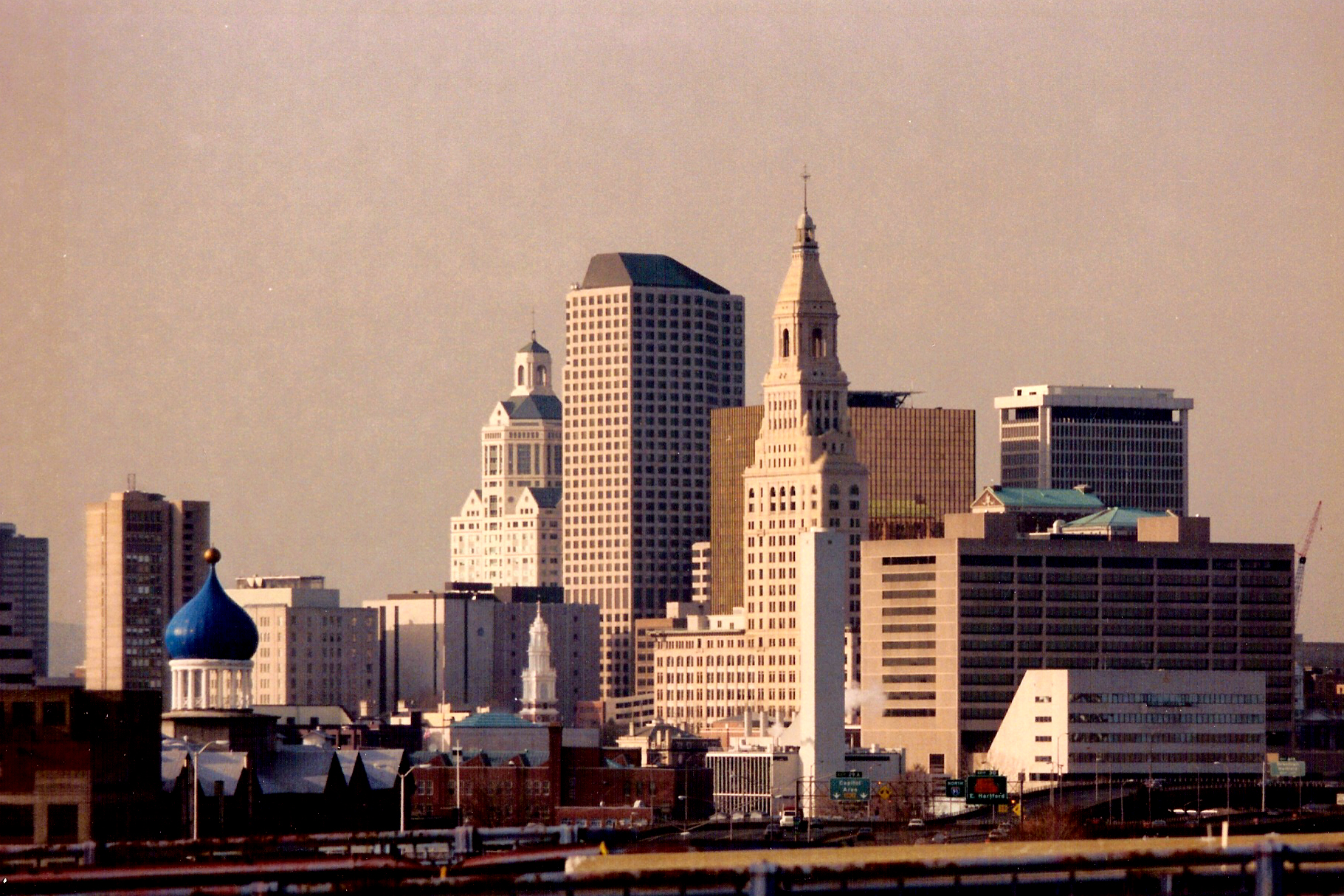
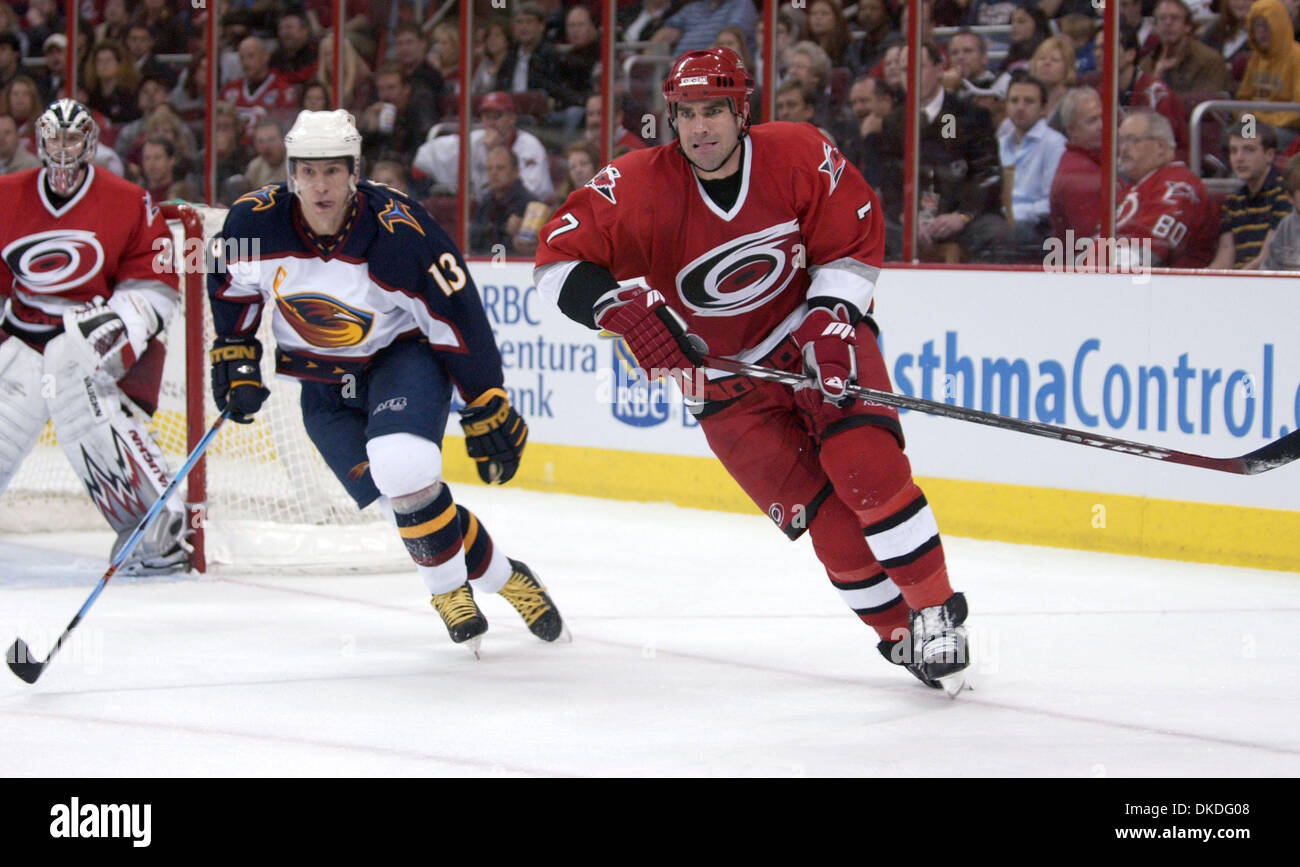
Downtown Hartford
This past Saturday, the University of Connecticut opened its 2021 football season in ignominious fashion, losing 45-0 away to Fresno State University. This Saturday, they play their home opener, against the College of the Holy Cross, making the short trip from Worcester, Massachusetts to East Hartford, Connecticut.
Before You Go. Hartford is a bit to the north of New York and New Jersey, but the weather won't be appreciably different from home on the same day. This game will be played in late September, so no jacket will be necessary. The Hartford Courant is currently predicting the low 80s for Saturday afternoon, and the low 60s for the evening.
Hartford is in the Eastern Time Zone, so you won't have to adjust your timepieces.
Tickets. NYCFC have been averaging 23,428 at Yankee Stadium, but this game is a one-off, so as for how hard it will be to get tickets, your guess is as good as mine. But the club have said that all fans who had tickets to the match before the move will have those tickets honored.
In the lower level, midfield tickets are $30. In the upper level, they're $25. In both levels, corner seats are $15, and end seats are $10.
Getting There. Hartford is too close to fly, and doesn't have much of an airport, anyway. If you're driving, it's 124 miles from Midtown Manhattan to Pratt & Whitney Stadium. Take Interstate 95 to New Haven. Take Exit 48 to Interstate 91 North, to Exit 29, bypassing downtown Hartford. Take State Route 15 North to State Route 502 East, that's Silver Lane, and the stadium will soon be on your right.
Greyhound runs 13 buses per day between Port Authority Bus Terminal in New York and Union Station in Hartford. The fare is $98, but can drop to $52 with advanced purchase.
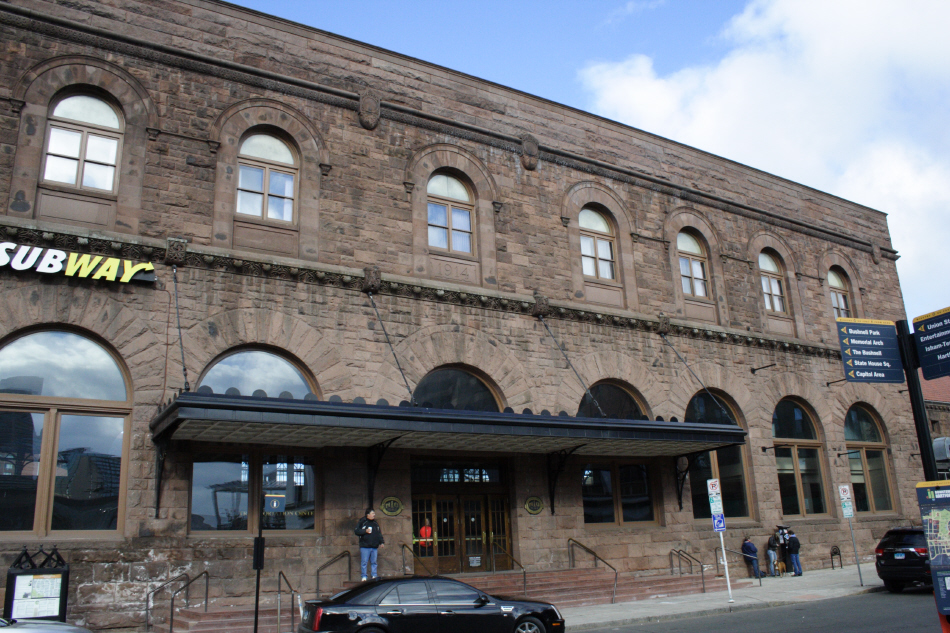
Union Station
Once In the City. Connecticut is named for a Native word meaning "long tidal river." The Connecticut River bisects the States of Connecticut and Massachusetts, and serves as the border between Vermont and New Hampshire.
Hartford, named for the English country of Hertfordshire, is home to about 125,000 people, making it around the same size as New Haven and Bridgeport, each competing to be the largest city in the State of Connecticut. When the Hartford metropolitan area is separated from the Boston metropolitan area, it's got about 1.5 million. Hartford is the State capital.
 It is known for being the home of the Colt Firearms Company, Stanley Tools, and several insurance companies. (Hence "Hardware City" and "Insurance City.") The sales tax in Connecticut is 6.35 percent. It does not rise within the County or the City of Hartford. The Hartford Courant is the largest-circulating newspaper in Connecticut, and the oldest continuously-published daily newspaper in America.

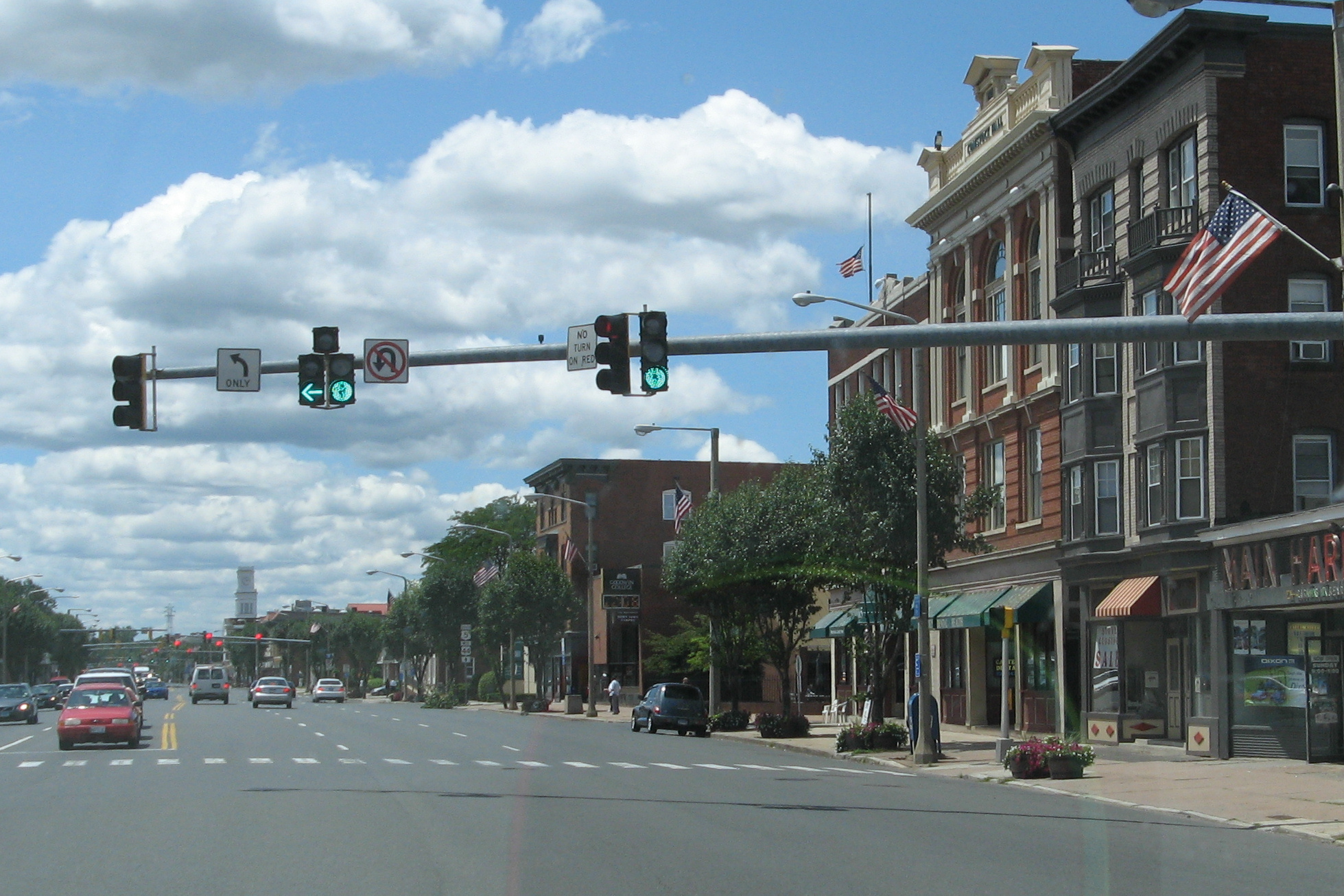
Hartford doesn't seem to have a centerpoint, from which street addresses increase. However, the addresses do seem to increase from south to north, and from east to west. This is also true of the City of East Hartford, across the Connecticut River. CT Transit runs the area's buses, and a 1-Day Pass is $3.00. Hartford Electric Light Company runs the area's electricity. "White flight" after the 1960s led to a de facto segregation: The city's North Side is mostly black, the South Side mostly Hispanic, and the West Side and suburban East Hartford mostly white. The city was about 64 percent white in 1970, but is now about 43 percent Hispanic, 39 percent black, 15 percent white, 3 percent Asian.
East Hartford is home to about 51,000 people, and is quite diverse. Pratt & Whitney, maker of aircraft engines, is the city's largest employer.
ZIP Codes in Connecticut begin with the digits 06. They're 060 to 062 around Hartford, 063 and 064 in the South, 065 around New Haven, 066 around Bridgeport, 067 around Waterbury, and 068 and 069 around Stamford, in the part closest to New York. Area Code 203 serves the part of the State that tilts toward New York, including New Haven, with 475 overlaid. In 1995, Area Code 860 was split off of 203, to serve the part of the State that tilts toward Boston, including Hartford, with 959 overlaid. The city does not have a "beltway."
Built in 2003, Rentschler Field was meant to be the 60,000-seat new home of the New England Patriots, thus enabling them to keep their regional name. But team owner Robert Kraft merely used the Connecticut capital as a pawn to get a new stadium from Massachusetts, next-door to the old one in Foxborough. As a result, the East Hartford stadium was replanned, and seats 40,642. (Foxborough is 99 miles northeast of Hartford.)
 "The Rent" was built on the site of an airfield, also named Rentschler Field. Frederick B. Rentschler founded Pratt & Whitney, and later its now-parent company, United Technologies. P&W bought the naming rights in 2015.
The field has always been natural grass, and runs northwest-to-southeast. It is home to University of Connecticut football and the high school State Championships. The U.S. national soccer team is 4-1-2 while playing there, most recently in a 1-1 tie with Peru on October 16, 2018. This includes a 1-0 win over Costa Rica, 1 of 2 games played there as part of the 2013 CONCACAF Gold Cup. The U.S. women's team is 6-02 ties there, including a pair of 4-0 wins over Mexico this past July. A crowd of 15,000 attended Whalers Hockey Fest 2011, which featured games of the UConn men's and women's hockey teams, a game between alumni of the Hartford Whalers and the Boston Bruins (a 4-4 tie), and a regular-season game between the Connecticut Whale and the Providence Bruins.
Food. P&WS@RF is not kidding around: Roma Pizza, Hot Dog Nation at Sections 100 & 129; Fresh Classics (including loaded baked potatoes) at 102, 118 & 130; Tamales (including Mexi Bratwurst and Bacon Jalapeño Mac & Cheese) at 108 & 136; Chicken Fry Fry (including fried pickle chips) at 109 & 139; Grill Masters (including "gourmet burgers") at 110 & 137; Chef Express (including New England-style clam chowder) at 125 & 145; Bears Smokehouse Barbeque at 126.
Team History Displays. UConn have only been Division I-A/Football Bowl Subdivision since 2000, although they did win co-championships in the Big East in 2007 and 2010, and 24 titles in minor conferences before that. The Huskies won the Lambert-Meadowlands Trophy, annually awarded to "the best college football team in the East," in 2010. There is no notation for these titles in the fan-viewable areas of the stadium.

If you get into Hartford early enough to watch your favorite European soccer team, your best bet is the home bar of the local branch of the U.S. national team supporters' group, the American Outlaws: The Tavern Downtown, at 210 Ann Uccello Street, across the street from the west side of the Civic Center. (Uccello was the 1st female Mayor of Hartford, and the street was previously Pleasant Street.)
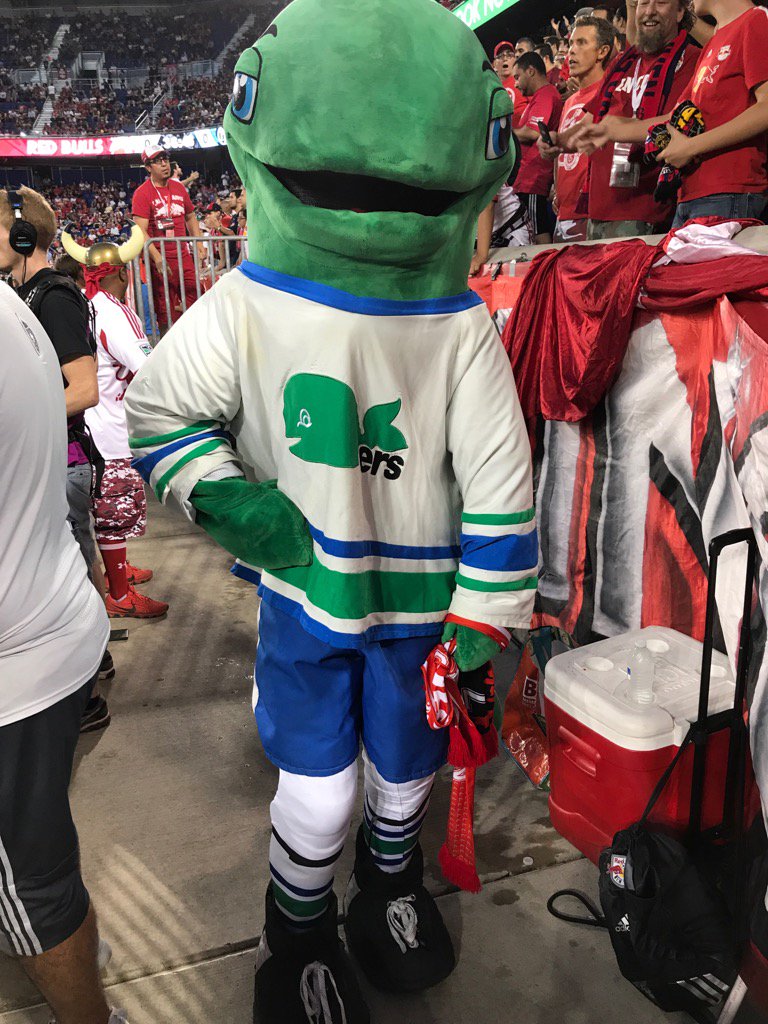
Sidelights. Hartford's sports history isn't much, and is even less since Peter Karmanos took the Whalers away 20 years ago. But there is some.
The official address of the Hartford Civic Center Coliseum is 1 Civic Center Plaza. It's bounded by Church Street (north), Trumbull Street (east), Asylum Street (south) and Pleasant Street (west). The name of the arena was changed to the XL Center in 2007, after XL Group, an insurance company.
 Known simply as "The Civic Center" or "The Mall," because it's attached to one, it opened on January 9, 1975, seating 10,507, and the New England Whalers of the World Hockey Association moved right in.
The University of Connecticut (UConn) basketball team, based 25 miles to the east in Storrs, also began playing selected home games there. The Boston Celtics played an average of 8 games a year there from 1975 to 1978 and again from 1980 to 1995, until the FleetCenter opened. Elvis Presley sang there on July 28, 1976. (The Beatles never played a concert in Connecticut.)
On January 17, 1978, UConn played the University of Massachusetts in basketball, in a game sparsely attended due to snowfall. It kept on snowing, and, just 6 hours after the final horn -- in the middle of the night, fortunately, when the arena was empty, so no one was hurt -- the roof collapsed. The building was just 3 years old. (In contrast, the Boston Garden stood for 70 years before it was finally demolished, and it never had a structural issue.) It took 2 years for the building to be repaired, while the Whalers played 25 miles to the north in Springfield, Massachusetts, and UConn and the Celtics returned to Storrs and Boston, respectively.

On January 17, 1980, the Civic Center reopened, with a new seating capacity of 14,460. It is now 15,635. The Whalers moved back in, and UConn and the Celtics resumed their partial home schedules there.
The New England Blizzard of the all-women's American Basketball League played 2 seasons there, 1996-98, before the league folded. The now-defunct Connecticut Coyotes of the Arena Football League played there. The Civic Center has also hosted both men's and women's NCAA basketball tournament games.
 Immediately after the Whalers moved, in 1997, a minor-league team was brought to the Civic Center, named the Hartford Wolf Pack. Although they were named the Connecticut Whale from 2010 to 2013, as a tip of the hat (or helmet) to the Whalers, they remain at the XL Center, having reclaimed the Wolf Pack name. And the Civic Center Mall was redeveloped in the mid-2000s, creating residential, office and retail space.


When the Civic Center roof collapsed, the Whalers went back north, and played the rest of the 1977-78 season, all of 1978-79, and the first part of 1979-80 at the Springfield Civic Center. Opening in 1972, it hosted the Springfield Indians until 1994, and the Springfield Falcons since then. It seats 6,866. Elvis sang there on July 14 and 15, 1975; and July 29, 1976.
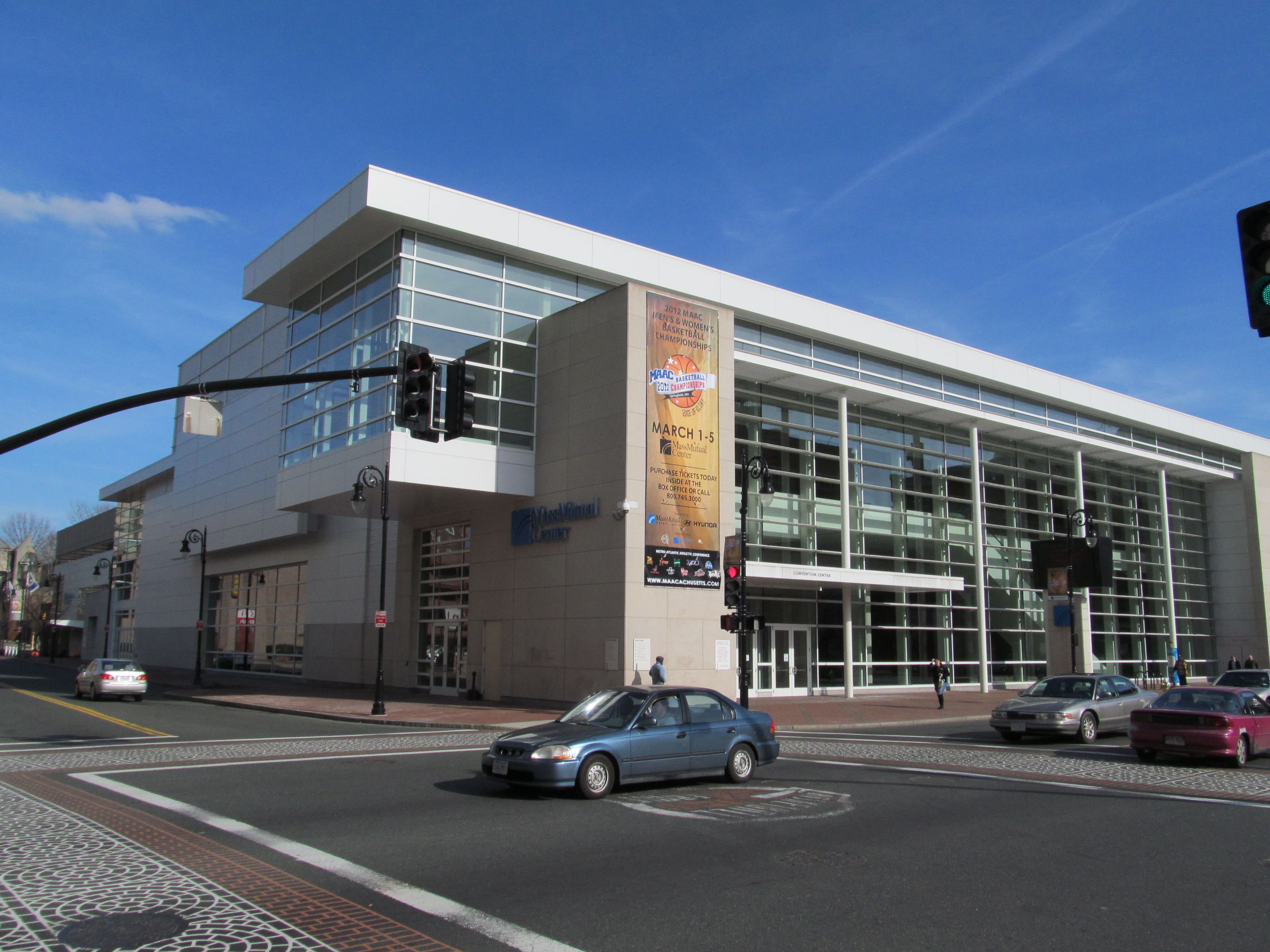
The Springfield Civic Center is now known as the MassMutual Center. It still hosts minor-league hockey. The Big E does not, but it is still open for various events.
Boston Bruins legend Eddie Shore long ran the Springfield Indians, and is buried in Springfield, at Hillcrest Park Cemetery, 895 Parker Street.
Of course, Springfield's biggest connection to sports is as the definitive birthplace of basketball. Dr. James Naismith invented the game at the International YMCA Training School, which grew into Springfield College. That's why the Basketball Hall of Fame is located in the city, at 1000 Hall of Fame Avenue, on the Connecticut River.

The best way to reach any site in or around Springfield from Hartford is by Amtrak. Fortunately, it's one of their cheapest runs, since it's not on the Boston-New York-Washington Northeast Corridor.
The New Britain Red Sox, a Class AA team in the Eastern League, played at the 4,700-seat Beehive Field from 1983 to 1995.
 In 1996, they became a Minnesota Twins farm team, and changed their name to the New Britain Rock Cats, playing at the 6,146-seat New Britain Stadium, which was built next door, at 230 John Karbonic Way, 13 miles southwest of downtown Hartford. Bus 101 to New Britain Station, then transfer to Bus 510 or 512.
The "BritSox" won the Pennant in 1983, but the Rock Cats have yet to win a Pennant in their new stadium. The Rock Cats were in the EL Championship Series in 2001 when the 9/11 attacks occurred, with the series being canceled and co-champions being declared.
 In 2014, it was announced that the Rock Cats would move to Hartford for the 2016 season. They are now the Hartford Yard Goats, a farm team of the Colorado Rockies, playing at Dunkin' Donuts Park, at 1214 Main Street at Trumbull Street, just a walk over I-84 from the XL Center. In the meantime, the former Camden Riversharks of the Atlantic League moved into New Britain Stadium, to become the New Britain Bees.
 According to an April 23, 2014 article in The New York Times, the Yankees are actually the most popular MLB team in Hartford proper, with about 49 percent of those polled, to about 35 percent for the Red Sox. However, when you get into Hartford's eastern suburbs, the Sox take over, about 44 to 40 percent.
In spite of the Yankees' strength in the area, the Bruins are easily the most popular NHL team now (probably because of Bobby Orr, who gave them a toehold even before the Whalers came along), the Celtics are far more popular than the Knicks (due to their "home games" at The Mall as much as to their 1980s success), and the Patriots (who do, after all, call themselves "New England") are more popular than the Giants.
Veterans Memorial Stadium is a football field at 635 South Main Street in New Britain. The U.S. soccer team played 4 games there between 1973 and 1996, going 3-1. Dillon Stadium is a football stadium at 250 Huyshope Avenue at Curcombe Street, near Charter Oak Landing, a mile and a half southeast of downtown Hartford. The U.S. soccer team beat Bermuda there on September 9, 1973.
Hartford briefly had a major league team in the early days of baseball. The Hartford Dark Blues played at the Hartford Ball Club Grounds in the seasons of 1874 and 1875 in the National Association, and 1876 in the National League, before finances led them to move to Brooklyn. Good Shepherd Church was built on the site. 155 Wyllys Street at Osten Blvd., about a mile southeast of downtown.

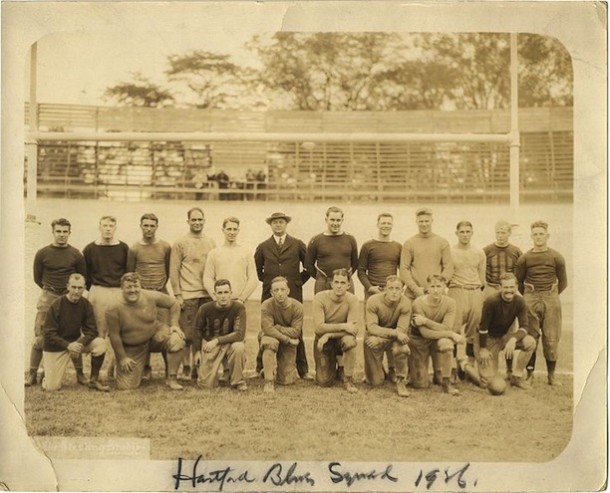
There was also a Hartford Blues playing in the NFL, albeit only in the 1926 season, finishing just 3-7. They had Harry Stuhldreher of Notre Dame's Four Horsemen at quarterback, and future Giants legend Steve Owen as a two-way tackle. They played at the East Hartford Velodrome, at a site bounded by Pitkin Street, Founders Plaza, Hartland Street and East River Drive. Albertus Magnus College and a Hampton Inn were built on the site.
Don't get any ideas about major league teams returning to Hartford, with the possible exception of in the NHL. The area's low population base would rank it 31st and last among MLB markets, 32nd in the NFL (ahead of only New Orleans), 28th in the NBA (ahead of New Orleans, Oklahoma City and Memphis), and 27th in the NHL (ahead of only Ottawa, Calgary, Edmonton and Winnipeg, and last among U.S. cities). Hartford has no professional soccer team.
Since 2003, the Connecticut Sun of the WNBA have played at the 10,000-seat Mohegan Sun Arena. This Arena also hosted a Heavyweight Championship fight, with Lennox Lewis defending the title by beating Zeljko Mavrovic on September 26, 1998.
The Arena is at Casey Plaza, in Uncasville, 46 miles southeast of Hartford, 106 miles southwest of Downtown Boston, and 132 miles northeast of Midtown Manhattan. Mohegan Sun advertises itself as "closer to New York than Atlantic City." This is true: Caesar's Atlantic City is 128 miles from Times Square. What Mohegan Sun doesn't tell you is that it's closer to Boston than to New York, and will have as many Chowdaheads as Pinstripers.
 Nearby is Foxwoods Resort in Mashantucket, 139 miles from New York, 97 miles from Boston, and 48 miles from Hartford. Neither Mohegan Sun nor Foxwoods is reachable by public transportation from Hartford, but private bus companies run service from Hartford, New York and Boston.
The Sun won the WNBA's Eastern Conference in 2004 and 2005, but lost in the Finals both times. Despite being a natural attraction for players from the University of Connecticut -- UConn's Harry A. Gampel Pavilion is just 30 miles northwest of Mohegan Sun -- they've never won a title.
They've retired 3 numbers: 12, for Margo Dydek; 23, for Katie Douglas; and 42, for UConn graduate Nykesha Sales. Former Sun player Lindsay Whalen was named to the WNBA Top 20 at 20 in 2016 -- in the 20th Season, rather than at the 20th Anniversary.
Hartford isn't all that close to any beach towns. Old Saybrook, Connecticut is 43 miles to the southeast; Newport, Rhode Island, 86 miles to the east; and Cape Cod, Massachusetts a minimum of 140 miles to the east.
The Travelers Tower, headquarters of the insurance company of the same name, opened in 1919, and is Hartford's most familiar landmark besides the State House. It is 527 feet tall. In 1980, it was surpassed as the tallest building in the State of Connecticut by City Place I, at 185 Asylum Street, a short walk from the Civic Center: 534 feet.
Hartford is home to the nation's oldest public art museum, the Wadsworth Atheneum, at 600 Main Street at Gold Street. The Connecticut Science Center is at 250 Columbus Blvd. at Grove Street. The Mark Twain House, the last home of the author born Samuel Langhorne Clemens, is at 351 Farmington Avenue at Forest Street, adjacent to Hartford Public High School, about a mile west of downtown. Bus 60.
No President has ever been born in Connecticut, although George Bush grew up in Greenwich and attended Yale University in New Haven. William Howard Taft also graduated from Yale, and, like Gerald Ford and Bill Clinton, went to Yale Law School. But New Haven is 36 miles from Hartford.
Yale is also the only Connecticut-based school to win hockey's National Championship, in 2013.
His son, George W. Bush, was born at Yale-New Haven Hospital in 1946, and, like his father and grandfather, is a Yale graduate (however the hell that happened). But you'll never be able to convince him that he's anything other than Texas through and through.
The 1st Presidential Debate of 1996, between Clinton and Bob Dole, was held at the Bushnell Performing Arts Center. 166 Capitol Avenue, across Trinity Street from the State House.
There's another Presidential site nearby: Calvin Coolidge, although from Vermont, was Mayor of Northampton, Massachusetts before being elected that State's Governor, and Vice President, and becoming President in 1923 when Warren Harding died. His Presidential Library and Museum is there, at 20 West Street, a 10-minute walk west of the bus terminal. 45 miles north of Hartford, and 17 miles north of Springfield.
In addition to Hartford, Elvis Presley sang at the 11,171-seat New Haven Veterans Memorial Coliseum on July 16 and 17, 1975; and July 30, 1976. State and George Streets. The Coliseum replaced the 4,000-seat New Haven Arena, which stood from 1926 to 1974 at State and Grove Streets, 5 blocks away. Like its successor, it hosted minor-league sports, especially hockey, and concerts, including the one on December 3, 1967 when Jim Morrison of The Doors got arrested onstage. Built in 1972, the New Haven Coliseum was demolished in 2007. It has not been replaced.
Lots of movies have been filmed in Connecticut, but none that I can find were shot in Hartford. The play and film Who's Afraid of Virginia Woolf? were set at Hartford's Trinity College, but not filmed there. Same with TV shows: Bewitched was set in Westport and Who's the Boss? in Fairfield, but neither in Hartford. I guess the capital city simply isn't glamorous enough for Hollywood honchos.
Various versions of Mark Twain's story A Connecticut Yankee in King Arthur's Court include Connecticut scenes. Mr. Blandings Builds His Dream House had the house in Connecticut, but considerably closer to Manhattan than to Hartford (or Boston). Eugene O'Neill's play Long Day's Journey Into Night and its film versions have been set in a seaside community in Connecticut, although the best-known version, from 1962, was filmed on City Island in The Bronx.
Holiday Inn, the 1942 film that debuted Bing Crosby singing "White Christmas," has its "country" scenes set in Connecticut, although the 1955 film White Christmas takes place in Vermont. Orson Wells played a Nazi war criminal turned prep school teacher in fictional Harper, Connecticut, in The Stranger.
Rally Round the Flag, Boys! takes place in fictional Putnam's Landing. Beetlejuice takes place in fictional Winter River. Mystic Pizza actually was filmed and set in Mystic. The Ice Storm was set in New Canaan, but that's closer to New York than Hartford. So is Stepford, the fictional setting of Ira Levin's novel The Stepford Wives and its film versions.
Christmas in Connecticut was filmed twice, in 1945 with a fraudulent food writer played by Barbara Stanwyck and a returning World War II hero played by Dennis Morgan; and in 1992 with Dyan Cannon as the host of a TV cooking show and Kris Kristofferson as a hero fireman. The remake was the 1st movie directed by Arnold Schwarzenegger, who has a brief cameo. Until I learned of the 1945 version, I presumed the remake was a parody of Martha Stewart, who famously lives in Westport.
Judging Amy took place in Hartford, running on CBS from 1999 to 2005. Gilmore Girls, which ran on The WB from 2000 to 2007, did some filming in Hartford, but was set in the fictional town of Stars Hollow, said to be half an hour's drive away. Late in the run of I Love Lucy, the Ricardos and the Mertzes moved to the New York suburb of Westport, Connecticut, which also became the setting of Bewitched, and the hometown of Josh Lyman on The West Wing.
New York suburbs of Connecticut also include Fairfield, the setting of Who's the Boss?; and Stamford, the setting of My Wife and Kids. In addition to Stars Hollow, Connecticut's fictional TV settings include Castleberry, established as the hometown of Sex and the City's Carrie Bradshaw in the prequel series The Carrie Diaries; and Dunn's River, the setting of Soap. Benson established that Gene Gatling was a cousin of Soap's Jessica Tate, but it didn't specifically say that the State of which Gatling was Governor was Connecticut, or any other.
*


The State House
Hartford doesn't seem to have a centerpoint, from which street addresses increase. However, the addresses do seem to increase from south to north, and from east to west. This is also true of the City of East Hartford, across the Connecticut River. CT Transit runs the area's buses, and a 1-Day Pass is $3.00.

East Hartford is home to about 51,000 people, and is quite diverse. Pratt & Whitney, maker of aircraft engines, is the city's largest employer.
Main Street, East Hartford
ZIP Codes in Connecticut begin with the digits 06. They're 060 to 062 around Hartford, 063 and 064 in the South, 065 around New Haven, 066 around Bridgeport, 067 around Waterbury, and 068 and 069 around Stamford, in the part closest to New York. Area Code 203 serves the part of the State that tilts toward New York, including New Haven, with 475 overlaid. In 1995, Area Code 860 was split off of 203, to serve the part of the State that tilts toward Boston, including Hartford, with 959 overlaid. The city does not have a "beltway."
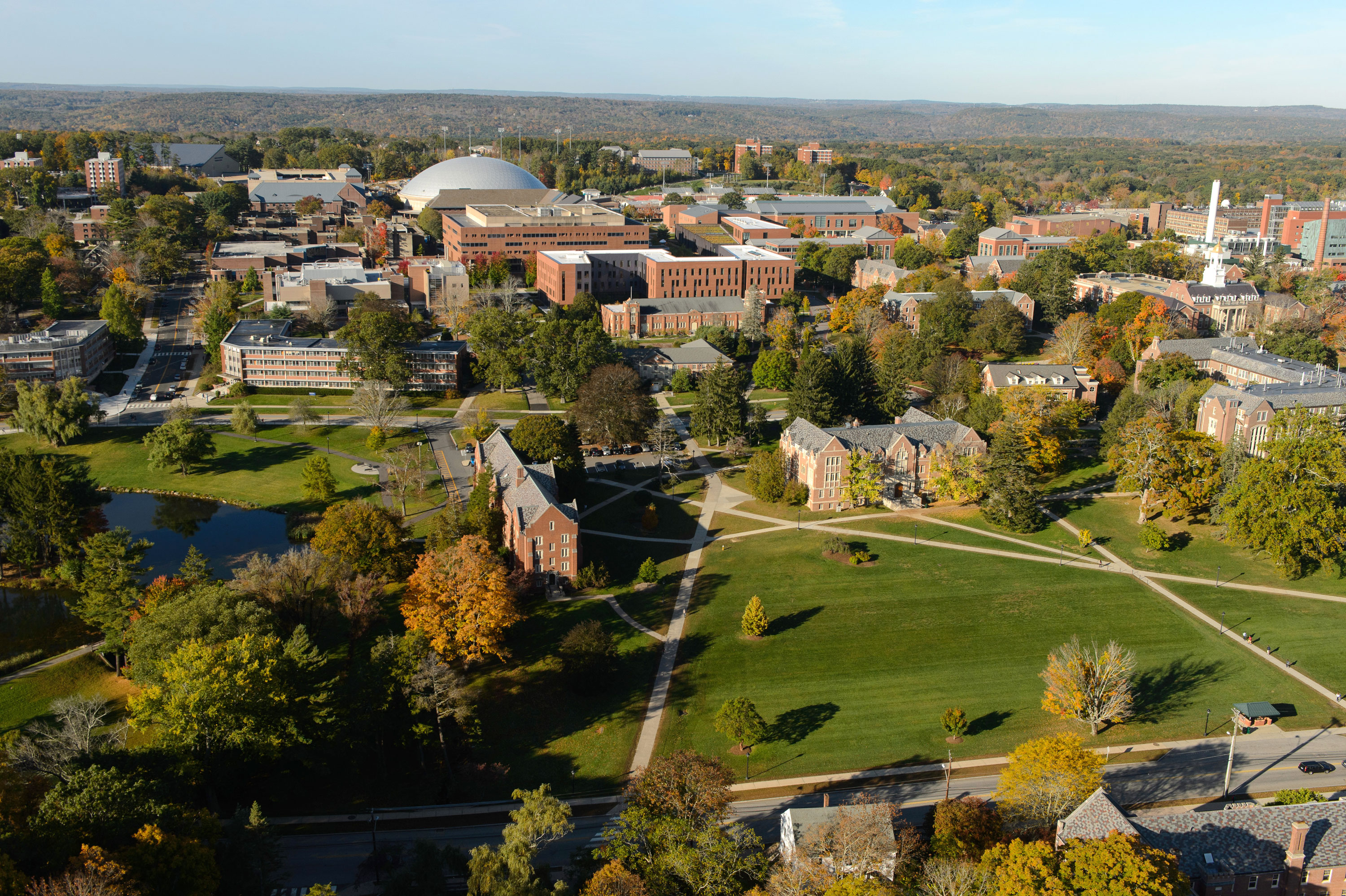
Once On Campus. The University of Connecticut is not in Hartford, or even in East Hartford. It's in Storrs, a town of 15,000 people in Tolland County, 25 miles east of downtown Hartford, 22 miles east of the stadium, 80 miles southeast of Boston, and 133 miles northeast of Midtown Manhattan. Make no mistake: This is Red Sox, Patriots, Celtics and Bruins country. Pinstripes, Gang Green, Blue & Orange, and Scarlet & Black need not apply.
The University of Connecticut, or "UConn" (pronounced "YOU-konn") for short, was founded in 1881 by Charles and Augustus Storrs, brothers in the manufacturing business. It was the Storrs Agricultural School until 1899, then the Connecticut Agricultural College until 1933, then Connecticut State College until 1939. In other words, if the UConn identity hadn't been adopted then, we might now be calling them "Conn State."
Notable graduates from outside the world of sports include:
* Entertainment: Welcome Back, Kotter actor Ron Palillo, Saturday Night Live performer Bobby Moynihan, and Real Housewife of Atlanta Kim Zolciak.
* Journalism: Leigh Montville, David Ushery and Randall Pinkston.
* Business: Special Olympics chairman and Kennedy family member Tim Shriver, and Bob's Discount Furniture founder Bob Kaufman.
* Politics: U.S. Senator Chris Murphy, Connecticut State Senator Edward M. Kennedy Jr.
In sports, UConn is especially known for its basketball programs, men's and women's. The names are legendary: Tate George 1990, Donyell Marshall 1994, Scott Burrell 1995, Ray Allen 1996, Richard Hamilton 1999, Caron Butler 2002, Emeka Okafor 2004, Rudy Gay 2006, Kemba Walker 2011, Andre Drummond 2012; Rebecca Lobo 1995, Jennifer Rizzotti 1996, Kara Wolters 1997, Nykesha Sales 1998, Sue Bird 2002, Swin Cash 2002, Ashja Jones 2002, Diana Taurasi 2004, Tina Charles 2010, Maya Moore 2011, Breanna Stewart 2016.
UConn is also the alma mater of baseball notables Walt Dropo, Rollie Sheldon, Charles Nagy, Rajai Davis, George Springer, Matt Barnes.
Going In. The official address of Pratt & Whitney Stadium at Rentschler Field is 615 Silver Lane. Parking costs $15. It is about 3 1/2 miles east of Union Station, across the Connecticut River. Bus 83 or 121 from downtown.
Built in 2003, Rentschler Field was meant to be the 60,000-seat new home of the New England Patriots, thus enabling them to keep their regional name. But team owner Robert Kraft merely used the Connecticut capital as a pawn to get a new stadium from Massachusetts, next-door to the old one in Foxborough. As a result, the East Hartford stadium was replanned, and seats 40,642. (Foxborough is 99 miles northeast of Hartford.)

The field has always been natural grass, and runs northwest-to-southeast. It is home to University of Connecticut football and the high school State Championships. The U.S. national soccer team is 4-1-2 while playing there, most recently in a 1-1 tie with Peru on October 16, 2018. This includes a 1-0 win over Costa Rica, 1 of 2 games played there as part of the 2013 CONCACAF Gold Cup. The U.S. women's team is 6-02 ties there, including a pair of 4-0 wins over Mexico this past July.
Food. P&WS@RF is not kidding around: Roma Pizza, Hot Dog Nation at Sections 100 & 129; Fresh Classics (including loaded baked potatoes) at 102, 118 & 130; Tamales (including Mexi Bratwurst and Bacon Jalapeño Mac & Cheese) at 108 & 136; Chicken Fry Fry (including fried pickle chips) at 109 & 139; Grill Masters (including "gourmet burgers") at 110 & 137; Chef Express (including New England-style clam chowder) at 125 & 145; Bears Smokehouse Barbeque at 126.
Team History Displays. UConn have only been Division I-A/Football Bowl Subdivision since 2000, although they did win co-championships in the Big East in 2007 and 2010, and 24 titles in minor conferences before that. The Huskies won the Lambert-Meadowlands Trophy, annually awarded to "the best college football team in the East," in 2010. There is no notation for these titles in the fan-viewable areas of the stadium.
They belonged to the Athletic League of New England State Colleges from 1897 to 1922, the New England Conference from 1923 to 1946, the Yankees Conference from 1947 to 1996, the Atlantic-10 from 1997 to 1999, the Big East from 2004 to 2012, and the American Athletic Conference from 2013 to 2019. Since 2020, as they were from 2000 to 2003, they have been an independent.
They have been in 6 bowl games: They won the 2004 Motor City Bowl, the 2008 International Bowl and the 2009 PapaJohns.com Bowl; and lost the 2007 Meineke Car Care Bowl, the 2010 Fiesta Bowl, and the 2015 St. Petersburg Bowl.
They have no retired numbers. Probably the most notable UConn football players are known for coaching elsewhere: Sam Rutigliano, who got the Cleveland Browns to the 1980 AFC Central Division title; and Kirk Ferentz, the longtime head coach at the University of Iowa. They have 16 current players in the NFL, including Giant offensive tackle Matt Peart, and Jet tight end Ryan Griffin and defensive tackle Foley Fatukasi.
In spite of their promotion to FBS, UConn have maintained rivalries with the Universities of Massachusetts and Rhode Island. UMass moved up to FBS in 2012, making a continuation of the rivalry make more sense. They lead UConn, 37-35-2. UConn played URI every year from 1919 to 2000, but only 3 times since, the last in 2018. UConn leads, 52-34-8.
Had the football version of the Big East lasted, UConn and Rutgers could have been a good rivalry. But it didn't, so it's not. Rutgers leads, 6-3.
On campus, the Husky Heritage Sports Museum is at 2384 Alumni Drive in Storrs, a 3-block walk from Gampel Pavilion.
Stuff. UConn do not own the stadium, so there is no team store, just souvenir stands. Your best bet may be to head for the UConn campus, and go to the bookstore, at 2075 Hillside Road in Storrs.
There are books and DVDs about UConn basketball, men's and women's, but not about the football team.
During the Game. Hartford does not have a reputation for a crime problem. East Hartford, even less so. You should be safe. If you drove in, so should your car.
The University of Connecticut Marching Band is nicknamed "The Pride of Connecticut." No word on whether they play the old Hartford Whalers' theme song, "Brass Bonanza."
The mascot is Jonathan the Husky, named for Jonathan Trumbull, the last colonial and 1st State Governor of Connecticut. They have a live mascot, currently Jonathan XIV, and a costumed one.
After the Game. You should be safe walking back to your car or the bus, but if you're looking for a postgame meal, or just a pint, you'll have to go back to downtown Hartford. There are several places around Union Station and the Civil Center. I don't know of any that are known hangouts for New York or New Jersey teams' fans.
If you get into Hartford early enough to watch your favorite European soccer team, your best bet is the home bar of the local branch of the U.S. national team supporters' group, the American Outlaws: The Tavern Downtown, at 210 Ann Uccello Street, across the street from the west side of the Civic Center. (Uccello was the 1st female Mayor of Hartford, and the street was previously Pleasant Street.)
Sidelights. Hartford's sports history isn't much, and is even less since Peter Karmanos took the Whalers away 20 years ago. But there is some.
The official address of the Hartford Civic Center Coliseum is 1 Civic Center Plaza. It's bounded by Church Street (north), Trumbull Street (east), Asylum Street (south) and Pleasant Street (west). The name of the arena was changed to the XL Center in 2007, after XL Group, an insurance company.

The University of Connecticut (UConn) basketball team, based 25 miles to the east in Storrs, also began playing selected home games there. The Boston Celtics played an average of 8 games a year there from 1975 to 1978 and again from 1980 to 1995, until the FleetCenter opened. Elvis Presley sang there on July 28, 1976. (The Beatles never played a concert in Connecticut.)
On January 17, 1978, UConn played the University of Massachusetts in basketball, in a game sparsely attended due to snowfall. It kept on snowing, and, just 6 hours after the final horn -- in the middle of the night, fortunately, when the arena was empty, so no one was hurt -- the roof collapsed. The building was just 3 years old. (In contrast, the Boston Garden stood for 70 years before it was finally demolished, and it never had a structural issue.) It took 2 years for the building to be repaired, while the Whalers played 25 miles to the north in Springfield, Massachusetts, and UConn and the Celtics returned to Storrs and Boston, respectively.
January 18, 1978. It could have been a whole lot worse.
On January 17, 1980, the Civic Center reopened, with a new seating capacity of 14,460. It is now 15,635. The Whalers moved back in, and UConn and the Celtics resumed their partial home schedules there.
The New England Blizzard of the all-women's American Basketball League played 2 seasons there, 1996-98, before the league folded. The now-defunct Connecticut Coyotes of the Arena Football League played there. The Civic Center has also hosted both men's and women's NCAA basketball tournament games.

The Whalers played their 1st 2 seasons in Boston, alternating between the Boston Garden and, when the Bruins (who owned the Garden and now own the new arena) shut them out of available dates, the Boston Arena (Matthews Arena at Northeastern University). Fed up with this, they signed the deal to move to Hartford as soon as the Civic Center opened.
Except it wasn't ready for the start of the 1974-75 season, so the Whalers moved to the Eastern States Coliseum, better known as the Big E, longtime home of the AHL's Springfield Indians. It was old (built in 1926), it was small (just 6,000 seats), it wasn't in Hartford (28 miles to the north), and it wasn't even the best arena in town anymore, but they had something they'd never had before: First choice of scheduling in an arena. 1305 Memorial Avenue, West Springfield, Massachusetts.

The Big E. Already, by this point,
they should've stopped calling themselves the Whalers,
and started calling themselves the New England Wanderers.
When the Civic Center roof collapsed, the Whalers went back north, and played the rest of the 1977-78 season, all of 1978-79, and the first part of 1979-80 at the Springfield Civic Center. Opening in 1972, it hosted the Springfield Indians until 1994, and the Springfield Falcons since then. It seats 6,866. Elvis sang there on July 14 and 15, 1975; and July 29, 1976.
The Springfield Civic Center is now known as the MassMutual Center. It still hosts minor-league hockey. The Big E does not, but it is still open for various events.
The MassMutual Center
Boston Bruins legend Eddie Shore long ran the Springfield Indians, and is buried in Springfield, at Hillcrest Park Cemetery, 895 Parker Street.

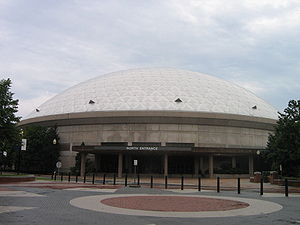
It sort of resembles the "Trylon and Perisphere"
centerpiece of the 1939-40 New York World's Fair.
The New Britain Red Sox, a Class AA team in the Eastern League, played at the 4,700-seat Beehive Field from 1983 to 1995.

The "BritSox" won the Pennant in 1983, but the Rock Cats have yet to win a Pennant in their new stadium. The Rock Cats were in the EL Championship Series in 2001 when the 9/11 attacks occurred, with the series being canceled and co-champions being declared.
In spite of the Yankees' strength in the area, the Bruins are easily the most popular NHL team now (probably because of Bobby Orr, who gave them a toehold even before the Whalers came along), the Celtics are far more popular than the Knicks (due to their "home games" at The Mall as much as to their 1980s success), and the Patriots (who do, after all, call themselves "New England") are more popular than the Giants.
Veterans Memorial Stadium is a football field at 635 South Main Street in New Britain. The U.S. soccer team played 4 games there between 1973 and 1996, going 3-1. Dillon Stadium is a football stadium at 250 Huyshope Avenue at Curcombe Street, near Charter Oak Landing, a mile and a half southeast of downtown Hartford. The U.S. soccer team beat Bermuda there on September 9, 1973.
Hartford briefly had a major league team in the early days of baseball. The Hartford Dark Blues played at the Hartford Ball Club Grounds in the seasons of 1874 and 1875 in the National Association, and 1876 in the National League, before finances led them to move to Brooklyn. Good Shepherd Church was built on the site. 155 Wyllys Street at Osten Blvd., about a mile southeast of downtown.

Best picture of it that I could find.
There was also a Hartford Blues playing in the NFL, albeit only in the 1926 season, finishing just 3-7. They had Harry Stuhldreher of Notre Dame's Four Horsemen at quarterback, and future Giants legend Steve Owen as a two-way tackle. They played at the East Hartford Velodrome, at a site bounded by Pitkin Street, Founders Plaza, Hartland Street and East River Drive. Albertus Magnus College and a Hampton Inn were built on the site.
This team photo was the best picture of the Velodrome that I could find.
Don't get any ideas about major league teams returning to Hartford, with the possible exception of in the NHL. The area's low population base would rank it 31st and last among MLB markets, 32nd in the NFL (ahead of only New Orleans), 28th in the NBA (ahead of New Orleans, Oklahoma City and Memphis), and 27th in the NHL (ahead of only Ottawa, Calgary, Edmonton and Winnipeg, and last among U.S. cities). Hartford has no professional soccer team.
Since 2003, the Connecticut Sun of the WNBA have played at the 10,000-seat Mohegan Sun Arena. This Arena also hosted a Heavyweight Championship fight, with Lennox Lewis defending the title by beating Zeljko Mavrovic on September 26, 1998.
The Arena is at Casey Plaza, in Uncasville, 46 miles southeast of Hartford, 106 miles southwest of Downtown Boston, and 132 miles northeast of Midtown Manhattan. Mohegan Sun advertises itself as "closer to New York than Atlantic City." This is true: Caesar's Atlantic City is 128 miles from Times Square. What Mohegan Sun doesn't tell you is that it's closer to Boston than to New York, and will have as many Chowdaheads as Pinstripers.
The Sun won the WNBA's Eastern Conference in 2004 and 2005, but lost in the Finals both times. Despite being a natural attraction for players from the University of Connecticut -- UConn's Harry A. Gampel Pavilion is just 30 miles northwest of Mohegan Sun -- they've never won a title.
They've retired 3 numbers: 12, for Margo Dydek; 23, for Katie Douglas; and 42, for UConn graduate Nykesha Sales. Former Sun player Lindsay Whalen was named to the WNBA Top 20 at 20 in 2016 -- in the 20th Season, rather than at the 20th Anniversary.
Gampel Pavilion
Hartford isn't all that close to any beach towns. Old Saybrook, Connecticut is 43 miles to the southeast; Newport, Rhode Island, 86 miles to the east; and Cape Cod, Massachusetts a minimum of 140 miles to the east.
The Travelers Tower, headquarters of the insurance company of the same name, opened in 1919, and is Hartford's most familiar landmark besides the State House. It is 527 feet tall. In 1980, it was surpassed as the tallest building in the State of Connecticut by City Place I, at 185 Asylum Street, a short walk from the Civic Center: 534 feet.
Hartford is home to the nation's oldest public art museum, the Wadsworth Atheneum, at 600 Main Street at Gold Street. The Connecticut Science Center is at 250 Columbus Blvd. at Grove Street. The Mark Twain House, the last home of the author born Samuel Langhorne Clemens, is at 351 Farmington Avenue at Forest Street, adjacent to Hartford Public High School, about a mile west of downtown. Bus 60.
No President has ever been born in Connecticut, although George Bush grew up in Greenwich and attended Yale University in New Haven. William Howard Taft also graduated from Yale, and, like Gerald Ford and Bill Clinton, went to Yale Law School. But New Haven is 36 miles from Hartford.
Yale is also the only Connecticut-based school to win hockey's National Championship, in 2013.
His son, George W. Bush, was born at Yale-New Haven Hospital in 1946, and, like his father and grandfather, is a Yale graduate (however the hell that happened). But you'll never be able to convince him that he's anything other than Texas through and through.
The 1st Presidential Debate of 1996, between Clinton and Bob Dole, was held at the Bushnell Performing Arts Center. 166 Capitol Avenue, across Trinity Street from the State House.
There's another Presidential site nearby: Calvin Coolidge, although from Vermont, was Mayor of Northampton, Massachusetts before being elected that State's Governor, and Vice President, and becoming President in 1923 when Warren Harding died. His Presidential Library and Museum is there, at 20 West Street, a 10-minute walk west of the bus terminal. 45 miles north of Hartford, and 17 miles north of Springfield.
In addition to Hartford, Elvis Presley sang at the 11,171-seat New Haven Veterans Memorial Coliseum on July 16 and 17, 1975; and July 30, 1976. State and George Streets. The Coliseum replaced the 4,000-seat New Haven Arena, which stood from 1926 to 1974 at State and Grove Streets, 5 blocks away. Like its successor, it hosted minor-league sports, especially hockey, and concerts, including the one on December 3, 1967 when Jim Morrison of The Doors got arrested onstage. Built in 1972, the New Haven Coliseum was demolished in 2007. It has not been replaced.
Lots of movies have been filmed in Connecticut, but none that I can find were shot in Hartford. The play and film Who's Afraid of Virginia Woolf? were set at Hartford's Trinity College, but not filmed there. Same with TV shows: Bewitched was set in Westport and Who's the Boss? in Fairfield, but neither in Hartford. I guess the capital city simply isn't glamorous enough for Hollywood honchos.
Various versions of Mark Twain's story A Connecticut Yankee in King Arthur's Court include Connecticut scenes. Mr. Blandings Builds His Dream House had the house in Connecticut, but considerably closer to Manhattan than to Hartford (or Boston). Eugene O'Neill's play Long Day's Journey Into Night and its film versions have been set in a seaside community in Connecticut, although the best-known version, from 1962, was filmed on City Island in The Bronx.
Holiday Inn, the 1942 film that debuted Bing Crosby singing "White Christmas," has its "country" scenes set in Connecticut, although the 1955 film White Christmas takes place in Vermont. Orson Wells played a Nazi war criminal turned prep school teacher in fictional Harper, Connecticut, in The Stranger.
Rally Round the Flag, Boys! takes place in fictional Putnam's Landing. Beetlejuice takes place in fictional Winter River. Mystic Pizza actually was filmed and set in Mystic. The Ice Storm was set in New Canaan, but that's closer to New York than Hartford. So is Stepford, the fictional setting of Ira Levin's novel The Stepford Wives and its film versions.
Christmas in Connecticut was filmed twice, in 1945 with a fraudulent food writer played by Barbara Stanwyck and a returning World War II hero played by Dennis Morgan; and in 1992 with Dyan Cannon as the host of a TV cooking show and Kris Kristofferson as a hero fireman. The remake was the 1st movie directed by Arnold Schwarzenegger, who has a brief cameo. Until I learned of the 1945 version, I presumed the remake was a parody of Martha Stewart, who famously lives in Westport.
Judging Amy took place in Hartford, running on CBS from 1999 to 2005. Gilmore Girls, which ran on The WB from 2000 to 2007, did some filming in Hartford, but was set in the fictional town of Stars Hollow, said to be half an hour's drive away. Late in the run of I Love Lucy, the Ricardos and the Mertzes moved to the New York suburb of Westport, Connecticut, which also became the setting of Bewitched, and the hometown of Josh Lyman on The West Wing.
New York suburbs of Connecticut also include Fairfield, the setting of Who's the Boss?; and Stamford, the setting of My Wife and Kids. In addition to Stars Hollow, Connecticut's fictional TV settings include Castleberry, established as the hometown of Sex and the City's Carrie Bradshaw in the prequel series The Carrie Diaries; and Dunn's River, the setting of Soap. Benson established that Gene Gatling was a cousin of Soap's Jessica Tate, but it didn't specifically say that the State of which Gatling was Governor was Connecticut, or any other.
*
University of Connecticut football is not at the level of UConn basketball, men's or women's. But it can still be a nice adventure.