Showing posts with label smu mustangs. Show all posts

Thursday, December 19, 2019

Hayden Fry, 1929-2019

If you watched the situation comedy Coach on ABC from 1989 to 1998, you knew the character of Hayden Fox: A high-strung man's man who happened to be a pretty good football coach, struggling with a changing society that included his highly capable girlfriend, who eventually became his 2nd wife; and his daughter, who attended the university where he coached. He was such an old-school macho man that he infuriated viewers, but he was also such a likable goofball that you couldn't stay mad at him.

The show's creator was Barry Kemp, a graduate of the University of Iowa, whose campus, including its Kinnick Stadium, was used for exterior shots of the fictional Minnesota State University. He named the character of Hayden Fox after the head coach at Iowa at the time, Hayden Fry. But aside from a name and a job, they didn't share much. Hayden Fry was the kind of man that Hayden Fox should have been.

John Hayden Fry Jr. -- he would eventually drop his first name, perhaps to differentiate himself from his father -- was born on February 28, 1929 in Eastland, Texas. He grew up in Odessa, in West Texas, which was too dry to get good farming, and there seemed to be nothing a boy could but play football and hope to get a job in the oil fields.

When Fry was 14, his father died, and he stepped up to be the head of the family, working in the oil field in the Summer, and, in the Autumn, quarterbacking the Odessa High School football team, winning a State Championship in 1946. He went on to Baylor University, and was mostly a backup quarterback, graduating in 1951 with a psychology degree.

He returned to Odessa High, taught history, and served on the football coaching staff. In 1952, with the Korean War raging, he enlisted in the U.S. Marine Corps. He led the team at the Quantico, Virginia base to the Corps championship and the Poinsettia Bowl. He was discharged with the rank of Captain in 1955.

He returned to Odessa High, and a year later was named head coach. One of his history students would go on to the Hall of Fame -- not College or Pro Football, but Rock and Roll: Roy Orbison.

He was hired as an assistant coach at Baylor in 1959, and the University of Arkansas in 1961. When Arkansas won the Southwest Conference Championship, another SEC school, Southern Methodist University (SMU) in Dallas, hired him as head coach for 1962.

He got the Mustangs to the Sun Bowl in El Paso in his 1st season. He was then named athletic director, and that gave him the authority to desegregate the team. He found the 1st black SMU player in 1966, Jerry LeVias, making him the 1st black player to receive an athletic scholarship from a Southwest Conference school, in any sport.

The way the schedule worked out, though, it was Fry's alma mater, Baylor, who fielded the 1st black varsity player to take the field in the SWC, John Westbrook. On September 10, 1966, Baylor shocked then-Number 7 Syracuse, 35-12. SMU's season opened a week later, on September 17, and they beat Illinois 26-7, a foreshadowing of Fry's later Big 10 success. On November 19, the same day as the famous 10-10 tie between Notre Dame and Michigan State, LeVias' SMU and Westbrook's Baylor played each other at the Cotton Bowl stadium, and SMU won 24-22.
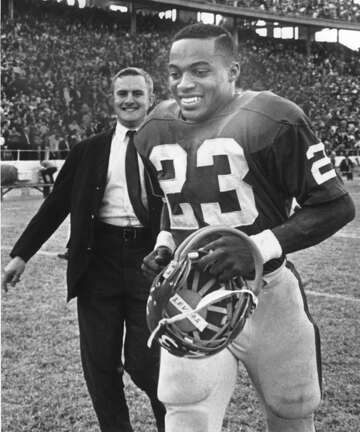
Fry and LeVias at SMU

Fry got SMU an 8-2 record in 1966, and its 1st SWC title in 18 years, with LeVias making the All-Conference team. They lost the Cotton Bowl to Georgia. In 1968, he won his 1st bowl game, the Bluebonnet Bowl in Houston.

That year, LeVias became a 3-time All-American. He would go on to play for the San Diego Chargers (making the AFL All-Star Game as a rookie in 1969) and the Houston Oilers. At 73, he now works in the Houston Texans' front office, and is a member of the College Football and Texas Sports Halls of Fame.

In 1969, Hayden married Shirley Griffin, and they were together for the rest of their lives. The marriage produced 4 sons: Randy, Zach, Kelly and Adrian; and a daughter, Robin. Shirley bought daughter Jayme and son Bryan from her 1st marriage. Hayden lived to see 4 grandchildren and a great-grandchild.

SMU went on a downturn: From 1969 to 1972, they went 3-7, 5-6, 4-7 and 7-4, and Fry was fired. He finished his SMU tenure 49-66-1. Fry would later say that, due to having the 2nd-smallest enrollment in the SWC, some SMU boosters thought they couldn't compete honestly, and wanted to put up a slush fund to pay players, but Fry wouldn't allow it:

For several years some of SMU’s big contributors had been trying to get me to buy players. They wanted me to use their money to recruit illegally, and I wouldn’t do it. Every time I was approached on the matter I told them absolutely no. I believe they used a new president who wasn’t strong enough to stand up to them to get to me.

The boosters convinced the new administration to fire Fry. But he was right: From 1973 to 1986, under head coaches Dave Smith, Ron Meyer and Bobby Collins, SMU got better through the slush fund. Meyer got them to the 1980 Holiday Bowl, but they got caught and were put on probation, so their 1981 team went 10-1 but were ineligible for the SWC title or a bowl game.

In 1982, his 1st season in charge, Collins got the Mustangs to an 11-0-1 record and a Cotton Bowl win. Maybe the team's recent probation stuck in people's minds, because, despite having a slightly better record, they only finished Number 2 in the polls to 11-1 Penn State, where Joe Paterno was said to be running "a clean program." (Little did we then know.)

From 1982 to 1984, Collins' "Pony Express" went 29-3-1 in regular-season play, also winning an Aloha Bowl and losing a Sun Bowl. But they got caught again, and were put on probation. The NCAA told them that if they got caught again, their program would be suspended: It was being called "the death penalty." Bumper stickers began to be seen around Texas, reading, "Support pro football: Watch the SMU Mustangs."

Collins was 6-5 in both 1985 and 1986, ineligible for bowl games... and SMU got caught yet again. The NCAA showed them they weren't bluffing: The 1987 SMU football season was canceled. During the preparations to restore and clean up the program, SMU decided they couldn't be competitive in 1988, either, so they canceled it themselves.

From 1975 to 1986, at the University of Southern Mississippi and SMU, Collins had a record of 91-44-3 -- but we can guess he probably cheated at USM, just as he did at SMU. He is now 86 years old. In the 33 seasons since the cancellation, he has never held another job in college sports. Nor has he held one in any professional football league. When even the XFL (2001 or 2020) won't hire you, you're radioactive.

SMU alumnus and Green Bay Packer legend Forrest Gregg was brought in to be head coach and athletic director. After going 2-9 in 1989 and 1-10 in 1990 -- 0-16 in SWC play -- he remained as AD and hired Tom Rossley as head coach. They went 1-9 in 1991, got up to 5-6 in 1992, but won just 4 games over the next 3 seasons.

When the SWC collapsed in 1996, with Arkansas having left for the Southeastern Conference, and Texas, Texas A&M, Texas Tech and Baylor joining the Big 8 to form the Big 12, SMU joined the Western Athletic Conference. Joining the less-rough WAC didn't help much: A 6-5 season in 1997 under new coach Mike Cavan was their only winning season between 1986 and 2009. But in 2008, switching to the even less-competitive Conference USA helped: Starting in 2009, they went 30-23 and went to 4 straight bowl games, winning 3. Under current coach Sonny Dykes, they were 10-3 this year.

On the field, SMU was better off for having fired Hayden Fry. But the price they paid was too high.

*

In 1973, Hayden Fry was hired as head coach and athletic director at North Texas State University, now the University of North Texas. In his 1st season, he got them a share of the Missouri Valley Conference title. They went 10-1 in 1977 and 9-2 in 1978, but weren't invited to a bowl game -- probably because Fry took them out of the MVC in the hope of joining a bigger conference, but none would take them.

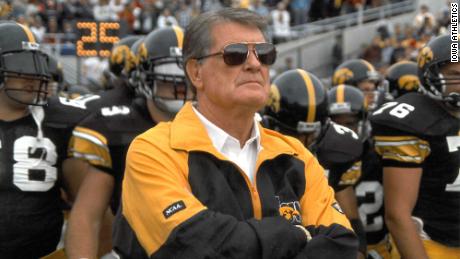
In 1979, he was hired as the head coach at the University of Iowa. They hadn't had a winning season in 17 years, but they still filled Kinnick Stadium in Iowa City for every home game. He knew he had a better chance to go to bowl games, and that he wouldn't have to also be the athletic director: That would be Chalmers "Bump" Elliott, a former Michigan star halfback and head coach who was already a friend of his. (By a sad coincidence, Bump died earlier this month, at age 94.)
Fry and Elliott

Iowa had been 2-9 in 1978. In his 1st game, Iowa lost 30-26 to Indiana, which seemed like progress. In his 2nd game, they went to Oklahoma, then ranked Number 3, and were losing only 7-6 midway through the 4th quarter, but fell apart, losing 21-6. Fry said he would "punch any player in the mouth if he was smiling."

They must have listened. The next week, they hosted Number 7 Nebraska, and lost only 24-21. The week after, he got his 1st win, defeating cross-State rival Iowa State 30-14, starting a 3-game winning streak. They finished 5-6, but fell back to 4-7 in 1980.

But Hayden Fry was changing things at Iowa. He wasn't just changing the program, he was changing the culture. Not the fan support: That was already amazing. Rather, he was changing what it was that they were supporting, into something worthy of that support.

He commissioned a new logo for the Hawkeyes, known as the Tigerhawk, designed by Bill Colbert of Cedar Rapids. Since the Pittsburgh Steelers, winners of 4 recent Super Bowls, also wore black and gold, he asked the Steelers for permission to copy their exact uniform design, and got it. He had stickers affixed to the helmets reading "ANF," for "America Needs Farmers" -- agriculture keeping Iowa alive, and the University letting the country know that farming itself had to be kept alive. He had his players walk onto the field holding hands -- seen as sissy by some, but as solidarity by others.
Fry's (and Colbert's) redesigned Iowa uniform

His Baylor degree having been in psychology, Fry knew that jails and psychiatric wards sometimes painted walls pink to relax and pacify the residents, so he had the visiting team's locker room at Kinnick Stadium painted pink. Michigan coach Bo Schembechler was particularly angered by this, and covered the pink walls with paper.

Fry also assembled a great coaching staff, some of whom would later rebuild other programs as head coaches: Bill Snyder at Kansas State, Bob Stoops at Oklahoma, Mike Stoops at Oklahoma, Barry Alvarez at Wisconsin, and the man who ended up succeeding Fry at Iowa, and is still there, Kirk Ferentz. (Bret Bielema would play at Iowa for Fry, and later, Alvarez would make him an assistant at Wisconsin, and Bielema would succeed him there.)

It took until the 3rd season, 1981, for Iowa to have a winning season under Fry. But it was more than that. Up until then, the joke was that the Big Ten Conference (often written as "Big 10") was really "The Big Two and the Little Eight": From 1968 to 1980, of the 13 Big 10 titles, either Ohio State or Michigan won it every year. The only breakthrough came in 1978, when Michigan State tied Michigan for the title, and beat Michigan in Ann Arbor to win what should have been a tiebreaker, except they were already on probation, eligible for the Conference's title but not its Rose Bowl berth.

Today, the University of Iowa vs. the Unviersity of Nebraska is considered a rivalry. The States border each other, and both are in the Big 10. But back then, Nebraska was in the Big 8, and they didn't play each other every year. This was a good thing, since Nebraska had become a dominant team in college football, and Iowa hadn't. In 1980, Nebraska beat Iowa 57-0. But Iowa opened the 1981 season by beating the Cornhuskers, then ranked Number 7, 10-7, a 60-point swing.

Iowa lost their next game, to in-State rival Iowa State, but followed that by beating Number 6 UCLA. The Hawkeyes were on their way, following this with wins over Northwestern and Indiana. On October 17, they went to Number 5 Michigan and didn't score a touchdown -- but beat them, 9-7. Losses to Minnesota and Illinois hurt them, but nobody else seemed to want to win the Big 10, and they beat Purdue, Wisconsin and Michigan State.

The last of these came on November 21, allowing them to tie Ohio State for the title, the 1st time they'd even shared the title since 1960. Since Ohio State had gone to the Rose Bowl more recently, Iowa got the Rose Bowl berth, but lost to the University of Washington.

The 1982 season got off to an 0-2 start, but Iowa rebounded to earn a Peach Bowl berth, and their win over Tennessee was their 1st bowl game win in 23 years. In 1983, they went 9-2 and got to the Gator Bowl, but lost to Florida. An injury plague struck near the end of the 1984 season, causing an 0-2-1 finish, which they followed with a win over Texas in the Freedom Bowl, 55-17. Quarterback Chuck Long engineered an offense that scored the most points the Longhorns had allowed in a single game in 80 years.

Long and the Hawks were just getting warmed up. They began the 1985 season ranked Number 5, and beat Drake (also an Iowa school, in Des Moines) 58-0. They beat Northern Illinois 48-20 and Iowa State 57-3. They had risen to the nation's Number 1 ranking.

It was at this point that ABC broadcaster Keith Jackson -- whose Georgia accent made Iowa's team name sound like "the Huckeyes" -- could have used an expression I heard him use years later: "The social portion of the Big 10 schedule is over. From here on in, it's strictly meat and potatoes."

Fry and his Hawkeyes did not flinch: They beat Michigan State 35-31, and went to Wisconsin and beat them 23-13. On October 19, Number 1 Iowa hosted Number 2 Michigan on CBS, and won 12-10 thanks to 4 field goals by Rob Houghtlin, one on the last play of the game. Since the rest of the Big 10 hates Michigan, everybody else was grateful to the Hawkeyes.

They followed this with a 49-10 win at Northwestern. But then they faltered, losing 22-13 at Number 8 Ohio State. It would be their only regular-season loss: They beat Illinois 59-0, won away to Purdue 27-24, and won the Floyd of Rosedale trophy by beating Minnesota 31-9.

For the 2nd time in 5 years, Hayden Fry had led Iowa to the Big 10 Championship, their 1st outright win since 1958. They went to the Rose Bowl, but lost 45-28 to UCLA. In a very close vote, quarterback Chuck Long finished 2nd for the Heisman Trophy to Auburn running back Bo Jackson. (This matched the aforementioned 1958 season, in which Iowa quarterback Randy Duncan finished 2nd to Army running back Pete Dawkins. No Iowa player has ever won the Heisman.
Chuck Long

Long may have been born in Norman, Oklahoma, seat of one of the greatest college football programs; and he may have grown up in Wheaton, Illinois, hometown of one of the all-time football greats, Illinois and Chicago Bears legend Red Grange; but he turned both Oklahoma and Illinois down for Iowa. He played for the Detroit Lions from 1986 to 1991, except for 1990 with the Los Angeles Rams. He later coached under Fry at Iowa, and under Bob Stoops at Oklahoma, and was San Diego State's head coach from 2006 to 2008. He is now on the staff of the XFL's St. Louis BattleHawks, and is an analyst for the Big Ten Network.

In 1986, Iowa went 8-3, and beat San Diego State in the Holiday Bowl, despite the game being played at SDSU's home field, Jack Murphy Stadium. In 1987, Iowa went 9-3, and returned to the Holiday Bowl, beating Wyoming.

*

In his book Big Ten Country, Bob Wood, a history teacher and Michigan State graduate, wrote of going to a game at each of the Big 10 Conference schools in the 1988 season, which was also Iowa football's 100th Anniversary season. Wood had just published Dodger Dogs to Fenway Franks, his story of going to all 26 Major League Baseball parks in one season, so when he contacted the University press office The night before his Iowa game, he attended an I-Club dinner at which Fry spoke, and told the story of the Stoops family and its connection to Iowa.

Ron Stoops was the head coach at Cardinal Mooney High School in Youngstown, Ohio. He and his wife Evelyn, a.k.a. Dee Dee, had 4 sons, all of whom played football for him: Ron Jr., Bob, Mike and Mark. Ron Sr. was impressed by Fry, and all 4 of his sons went to Iowa to play. All 4 wore the same number, 41. Every weekend, Ron Sr. would coach Mooney on a Friday night, then packed and drove all night to see his son(s) play for Iowa. And all 4 sons went into coaching.

Earlier in that 1988 season, Ron Sr. and Ron Jr. were coaching against each other. Mooney won in overtime. It must have been too much for the old man, because he had a heart attack and died. At the funeral, someone walked in with an Iowa jersey, Number 41. The sons propped their father up in his coffin, and put the jersey on him. Bob had 2 Big 10 Championship rings, and put one on his father's finger. Dee Dee leaned over to her husband and said, "Now, you'll always be warm."

Fry concluded the story by telling the I-Club, "I told you this because I wanted you to know there are a lot of people out there who love Iowa football." According to Wood, Fry's story got a standing ovation, Fry stayed to shake hands, and was the last one out the door.

It was a weird season for Iowa, as they finished with 6 wins, 4 losses and 3 ties, their only Conference loss a 45-34 shootout at Indiana. Their other 2 regular-season losses, to Hawaii and Colorado, were each by a field goal. As in 1985, they had a nationally televised showdown with Michigan in Iowa City in mid-October, and it ended 17-17. It was the only blot on Michigan's Conference record, so, had Iowa gotten so much as 1 more field goal in that game, they would have won the Big 10 again. They ended up losing the Peach Bowl to North Carolina State.

They were just 5-6 in 1989, but won 7 of their 1st 8 in 1990, with only a non-conference loss away to then-Number 10 Miami disturbing their record. They beat both Michigan teams and Illinois away. Then they lost at home to Ohio State. On the final day, Michigan beat Ohio State, clinching at least a share of the Big 10 title for Iowa, but they lost away to arch-rival Minnesota, 31-24, forcing a rare 4-way tie for the title between Iowa, Michigan, Michigan State and Illinois. Iowa had the tiebreakers to get the Rose Bowl berth, and trailed Washington 33-8 at the half before a comeback fell short, 46-34. Fry had now gotten them 3 Big 10 titles in 10 seasons, but they'd lost the Rose Bowl every time.

They should have won the whole thing in 1991, but a home loss to Michigan cost them the Big 10 title. They were 10-1 before finishing with a tie against Brigham Young in the Holiday Bowl. By this point, Fry was becoming a victim of his own success, as his assistants began to get better offers, head coaching jobs, and assistants' jobs at bigger schools. Iowa finished only 5-7 in 1992, and started 1993 only 2-5 before making it 6-5, getting them into the Alamo Bowl, where they lost to the University of California.

Ironically, 1993 was the year on Coach when Hayden Fox got his Minnesota State team into a de facto National Championship Game. Before the show's writers knew where Iowa, Kemp's alma mater, would play their bowl game, or even if they would get into one, they wrote Minnesota State's destination as the Pioneer Bowl -- at the Alamodome in San Antonio.

(The writers, Judd Pillot and John Peaslee, eventually wrote 4 bowl games for Fox's Screaming Eagles, all starting with P like their own names: The 1991 Pineapple Bowl in Honolulu, which Minnesota State won over equally fictional South Texas; the 1992 Patriot Bowl in Valley Forge, Pennsylvania, which they lost to Iowa 71-7 in a blizzard following a flu outbreak; the 1993 Pioneer Bowl in San Antonio, which they won over fictional West Texas to win the National Championship, which Florida State won in real life that season; and the 1994 Popcorn Bowl in Los Angeles, which they lost to a real school, but I've forgotten which one.)

Iowa finished 5-5-1 in 1994, and, as Fry was now 65, people began to wonder if the end was near. Not just yet: In 1995, they went 704 and then won the Sun Bowl in El Paso, in Fry's native Texas, beating Washington, who had beaten him in 2 of his Rose Bowls. They went 8-3 in 1996, and went back to the Alamo Bowl, beating Texas Tech 27-0.

Now, the opposite feeling took hold, that Fry might coach and win at Iowa indefinitely. But this also turned out to be untrue. They went 7-4, losing by 4 points away to Michigan, by 3 away 2 Wisconsin (the Badgers' 1st win ever over Fry), and by 1 away to a resurgent Northwestern. (Only a 23-7 loss away to Number 7 Ohio State was a bad one.) They lost the Sun Bowl to Arizona State.

In 1998, Fry developed prostate cancer. His mind, fairly, was not fully on his work, and he finished 3-8, including his 1st loss to Iowa State in 15 years. On November 21, he lost to Minnesota 49-7 at the Metrodome, and announced his retirement the next day, after 20 seasons in Iowa City. Assistant coach Kirk Ferentz succeeded him, and has now surpassed him as Iowa's longest-lasting and winningest coach.

Fry outlasted the TV show Coach, which was canceled in 1997. However, the fictional Hayden Fox had done something that the real Hayden Fry had not done: He had gotten an NFL head coaching job, with a fictional expansion team, the Orlando Breakers. After an awful 1st season at 1-15, Fox got them into the Playoffs in 1996, but, mirroring Minnesota State's flu-and-snow-aided Patriot Bowl beatdown, the team came down with food poisoning and lost badly to the Buffalo Bills. Fox then retired, while Fry coached 2 more seasons.

Fry was 143-89-6 at Iowa, including 96-61-5 in Big 10 play; and 232-178-10 overall, in 37 consecutive seasons as a head coach. He won 3 Conference Championships, and coached in 17 bowl games, winning 7 of them. In 2003, he was elected to the College Football Hall of Fame -- along with Jerry LeVias, whom he'd made the 1st black scholarship athlete in the Southwest Conference.

In 2009, First Avenue in Coralville, Iowa, which leads from Interstate 80 to the University of Iowa campus, was renamed Hayden Fry Way. A state of him was erected along the street.
At his statue's dedication

But his cancer returned, and on December 17, 2019, Hayden Fry died at age 90. He was successful, and, as football people in his native Texas found out -- to the dismay of some of them -- he was incorruptible. He turned Iowa football from a native institution but a regional, never mind national, afterthought into something admired from coast to coast.

As was he.

Sunday, April 14, 2019

Forrest Gregg, 1933-2019

"The finest player I ever coached." That's how Vince Lombardi, in his book Run to Daylight, described Forrest Gregg. It's not surprising that Lombardi, who had played guard at Fordham University, would have chosen a fellow offensive lineman for that honor. It's also not surprising that the one he chose was Gregg, who might have been the greatest offensive tackle who ever lived.

Alvis Forrest Gregg was born on October 18, 1933 in Birthright, Texas, with Dallas the closest major city. His birthright appears to have been football, and, in Texas, football is said to be a religion. "I always knew I wanted to play, after hearing the games on the radio," he once said in an interview. He grew up in nearby Sulphur Springs, and played tackle on both sides of the ball at Dallas' Southern Methodist University (SMU), serving as Captain in 1955.
One of his teammates was Raymond Berry, later a great receiver for the Baltimore Colts. But despite having 2 future members of the Pro Football Hall of Fame, the Mustangs didn't do very well.

Gregg was drafted by the Green Bay Packers in 1956, but spent the 1957 season in the U.S. Army. When he returned in 1958, the Packers went 1-10-1. Head coach Ray "Scooter" McLean was out, Vince Lombardi was in. Lombardi told his players many things. One was, "We may not win, but we won't be losing with the same people," and cleared a few comfortable players out.

Another thing he told his players was, "Those who stay will be champions." He was right. In 1959, he got the Packers to a 7-5 record. In 1960, they won the NFL Western Division, but lost the NFL Championship Game to the Philadelphia Eagles.

The dynasty was on: With perhaps the greatest offensive line the football world had ever seen -- center Jim Ringo, guards Jerry Kramer and Fred "Fuzzy" Thurston, and tackles Forrest Gregg and Bob Skoronski -- blocking for quarterback Bart Starr, running backs Paul Hornung and Jim Taylor, tight end Gary Knafelc, and receivers Max McGee and Boyd Dowler, the offense was as strong as any in NFL history.

The defense was equal to the task: Ends Willie Davis and Ben Davidson, tackles Henry Jordan and Dave Hanner; linebackers Ray Nitschke, Dan Currie and Bill Forester; cornerbacks Herb Adderley and Jesse Whittenton, and safeties Willie Wood and Hank Gremminger.

The Packers, in their 1st season wearing the familiar G monogram on their yellow helmets, went 11-3, won the Division again, and clobbered the New York Giants 37-0 in the Championship Game, their 1st title in 17 years. The following year, they were even better, going 13-1, losing only a trip to Detroit to play the Lions on Thanksgiving Day, and beating the Giants in the Championship Game again, 16-7.

Gregg would make 9 Pro Bowls, including every season from 1959 to 1968, except for 1965. That season, the Packers lost 21-10, away to the Los Angeles Rams. At a practice the next week, Lombardi began ranting at his 8-3 team, finally yelling, "I'm the only one who gives a damn if we win or lose!"

And Forrest Gregg, the man he had already publicly called "the finest player I ever coached," yelled back at him: "Excuse the language, coach, but it makes me sick to hear you say something like that! We lay it on the line for you every Sunday! We live and die the same way you do! And it hurts!"

According to center Bill Curry, himself later a college head coach, Gregg was "bright red, with a player on either side, holding him back by each arm, and he was straining forward." Other players stood up, claiming a will to win.

Curry said, "We did not lose another game that year." Which is true: They closed the regular season with wins at home to the Minnesota Vikings, away to the Baltimore Colts, and a tie away to the San Francisco 49ers. They tied the Colts for the Western Division title (why Baltimore was in the West, who knows), beat them at Lambeau Field in a playoff, and then hosted the Cleveland Browns in the NFL Championship Game, winning 23-12 in what turned out to be Browns star Jim Brown's last game.

Gregg played in 188 consecutive games, an NFL record at the time, earning him the nickname "Iron Man." He would help the Packers become the only team ever to win 3 straight NFL Championship Games: 1965, over the Browns; 1966, 34-27 over the Dallas Cowboys at the Cotton Bowl; and 1967, again over the Cowboys, this time in the miserable cold of Green Bay, 21-17, a game known as the Ice Bowl.

After those latter 2, the Packers were in the 1st 2 installments of the "AFL-NFL World Championship Game." It wasn't called the "Super Bowl" until the 3rd one, and it didn't get the Roman numerals until Super Bowl V. So the games played on January 15, 1967, with the Packers beating the Kansas City Chiefs 35-10, and January 14, 1968, with the Packers beating the Oakland Raiders 33-14, were retroactively labeled Super Bowl I and Super Bowl II, respectively.

After the 1970 season, Gregg and Adderley were acquired by the Dallas Cowboys. They helped the Cowboys win their 1st title, Super Bowl VI. This allowed them to join former teammate Thurston, also a member of the 1958 Baltimore Colts as players to win 6 NFL Championships. They remain the only ones ever to do this without cheating.
Jethro Pugh wore 75 with the Cowboys,
so Gregg switched to his high school number.

Shut up, Tom Brady: You had your chance to do it right. You never would have lasted on Vince Lombardi's Packers. Maybe on Tom Landry's Cowboys.

Gregg then retired. He was named to the Pro Football Hall of Fame, the NFL's 1960s All-Decade and 75th Anniversary teams, and the Green Bay Packers Hall of Fame. The Packers don't retire many numbers, so his 75 remains in circulation, but SMU retired his 73. In 1999, The Sporting News named its 100 Greatest Football Players. Gregg was ranked 28th, making him 2nd behind Ray Nitschke among Lombardi players, 2nd behind Anthony Munoz (one of his Cincinnati Bengals players) among offensive tackles, and 3rd behind Munoz and John Hannah among all offensive linemen.

*

With Lombardi and Landry as his head coaches, it's not surprising that Gregg went into coaching himself. In 1972, he was hired as the offensive line coach for the San Diego Chargers. He got the same job with the Cleveland Browns in 1974, and was promoted to head coach in 1975. The Browns didn't do too well with him, and he was fired after 3 seasons.

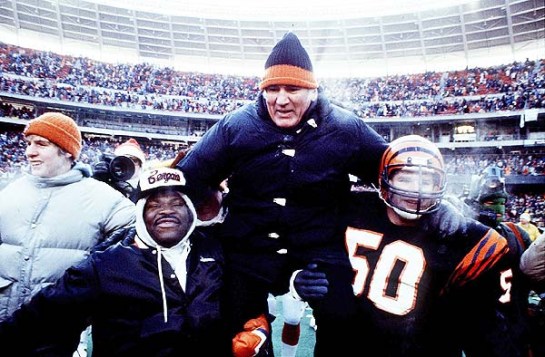
After coaching in the Canadian Football League, with the 1979 Toronto Argonauts, he was taken back into the NFL, by the Cincinnati Bengals, whose owner, Paul Brown, remembered him well from his days as Browns coach.

Just as the Packers, with Gregg as a player, won their 1st title in 17 years in their 1st year with the G monogram, so, too, did a uniform switch help the Bengals. 1980 was the last year with their original helmet design: Brown's old Browns orange helmet, with "BENGALS" in black letters across. For 1981, Brown introduced the tiger stripes.

Gregg got them into their 1st AFC Championship Game, and it was bitterly cold at Riverfront Stadium -- nearly as cold as it had been in the Ice Bowl 14 years earlier. The opponent was the 1st pro team to hire him, the Chargers, used to beautiful weather all year 'round in San Diego, and just coming off the heat and humidity of "The Kellen Winslow Game" against the Miami Dolphins at the Orange Bowl. In a game known as the Freezer Bowl, the Bengals beat the Chargers 27-7, and advanced to their 1st Super Bowl.
How cold was it? Straight, 9 degrees below zero.
With the wind chill, on the current scale, -37.
The Ice Bowl? At kickoff, -15 straight,
-36 with the wind chill. By the end, -55.

Super Bowl XVI was held in a cold-weather city, Detroit -- or, more accurately, the suburb of Pontiac, Michigan. Of course, it was indoors, at the Silverdome. The Bengals fell well behind the San Francisco 49ers in the 1st half, but nearly came back, losing 26-21.

When the Packer coaching job opened up in 1984, with the firing of former quarterback Starr, Brown let Gregg take it, but he couldn't get them into the Playoffs. But he had another "homecoming" that would prove more important.

SMU had won a share of the National Championship in 1982, going 11-0-1 with their "Pony Express" backfield of Eric Dickerson and Craig James, both of whom went on to good NFL careers (in Dickerson's case, the Hall of Fame), and both of whom have become fine studio analysts. But the Mustangs got put on NCAA probation for several rules violations. They continued to violate the rules, including paying players, to the point where fans of other Texas schools printed up bumper stickers that said, "SUPPORT PRO FOOTBALL: WATCH THE SMU MUSTANGS."

Finally, the NCAA decided that, for the 1st time in its 80-year history -- and it has never happened since -- a program had to be canceled for an entire season. This became known as "the death penalty." They canceled SMU's 1987 season. Knowing that nearly every letterman from the 1986 team had transferred elsewhere -- those not involved in the pay-for-play scandal were allowed to keep their full eligibility, and transfer to another Division I-A school without having to sit a season out -- the school canceled their 1988 season, too.

They pretty much had to start from scratch. And, given the reasons for the penalty, they needed to have their program run by a man of unimpeachable integrity. In January 1988, SMU President William Stalcup asked Forrest Gregg to come in and straighten everything out. He accepted.

Gregg was taller and heavier than nearly every player on his team, which was down to 70 men -- well short of the 90+ that most teams had at the time. His former place on the team, the offensive line, was particularly shorthanded, so he had some receivers bulk up and switch. Since the 1988 season had been canceled, anyway, it was essentially a season of practice only. Lots of practice, and lots of recruiting, trying to get players to come to a school whose reputation had been destroyed, and play on a team that had little to no chance of winning over the next 4 years -- and, in the process of getting such players, staying within the rules, since no team was ever under so much scrutiny.

Instead of their usual home, the 72,000-seat Cotton Bowl, which he knew they wouldn't come close to filling, Gregg moved all games back onto campus, to the 23,783-seat Ownby Stadium. The 1st game went as expected: Rice University of Houston, known to have good programs in several sports but not in football, beat the Mustangs 35-6. But then, the University of Connecticut, then a Division I-AA program, came into Ownby on September 16, 1989, and the Mustangs won, 31-30. It was their 1st win since November 15, 1986.

It was still rough: 45-13 home to Texas, 28-10 away to arch-rival Texas Christian University (TCU), 49-3 home to Baylor, and a shocking 95-21 loss to the University of Houston at the Astrodome. (To be fair, Houston was then ranked Number 16 in the country, and their "run-and-shoot" offense was lighting several teams up.) But North Texas, then a Division I-AA school, came into Ownby, and SMU won 35-9.

Under the circumstances, a 2-5 record was considered miraculous. Certainly, it was better than the fictional Texas State team faced in the 1991 film Necessary Roughness, a story obviously based on late 1980s SMU, but with a few comedic absurdities thrown in (such as supermodel Kathy Ireland playing a soccer star who became the team's placekicker).

But that was as good as it got: SMU lost 63-14 away to Texas A&M, 59-6 away to then-Number 1-ranked Notre Dame, and 48-24 home to Texas Tech, before closing with a very respectable 38-24 loss to Number 9 Arkansas, at the Razorbacks' secondary home in Little Rock.

"I never coached a group of kids that had more courage," Gregg said. "They thought that they could play with anyone. They were quality people. It was one of the most pleasurable experiences in my football life, period."
He was named athletic director, a position where the school probably needed him more than they did as head coach. After going 1-10 in 1990, he resigned as head coach to focus on his AD duties. He stayed until 1994, and took one last coaching job, with the Shreveport Pirates, during the CFL's ill-fated American experiment, retiring after the 1995 season.

That was the same year that the Southwest Conference broke up. SMU moved to the Western Athletic Conference (the WAC) for the 1996 season, Conference USA for 2005, and the American Athletic Conference (AAC) in 2013.

In 1997, coached by Mike Cavan, SMU finally had another winning season, going 6-5. And yet, in what can only be called the stupidest move in college football history, they violated NCAA rules yet again. In 1998, on the field, they went 5-7; but most of their games were stricken from the record, and it officially became 1-1.

June Jones, a run-and-shoot coach, took over in 2008, and in 2009, he got them to 8-5, their best season in 24 years, and they won the Hawai'i Bowl. In 2010, he led them to the C-USA West Division title, their 1st 1st-place finish in 26 years. They've since won the BBVA Compass Bowl in the 2011 season, and the Hawai'i Bowl again in 2012. Under Sonny Dykes, they were 5-7 last year. The program isn't back to greatness, but it's back to respectability, on and off the field.

And, more than anyone else, they have native son Forrest Gregg to thank for that.

*

Gregg moved to Colorado Springs, Colorado, with his wife of 59 years, Barbara Dedek. They had a son, Forrest Gregg Jr., and a daughter, Karen Gregg Spehar.

He briefly worked in football one more time, again in the CFL, and again with a "startup": Former Shreveport Pirates owner Bernard Glieberman bought a piece of the Ottawa Renegades, a team attempting to take the place of a longtime, but defunct, CFL team, the Ottawa Rough Riders. He appointed Gregg, by then 72 years old, vice president of football operations. Through little (if any) fault of his, the Renegades didn't last long, folding after the 2006 season.

He survived melanoma in 1976, and colon cancer in 2001. In 2011, he was diagnosed with Parkinson's disease. The natural thought in this era is that it was caused by the blows to the head he took as a football player, but he never blamed the game. He refused to join the lawsuits against the NFL: "I don't need anything from anybody, but what I earned."
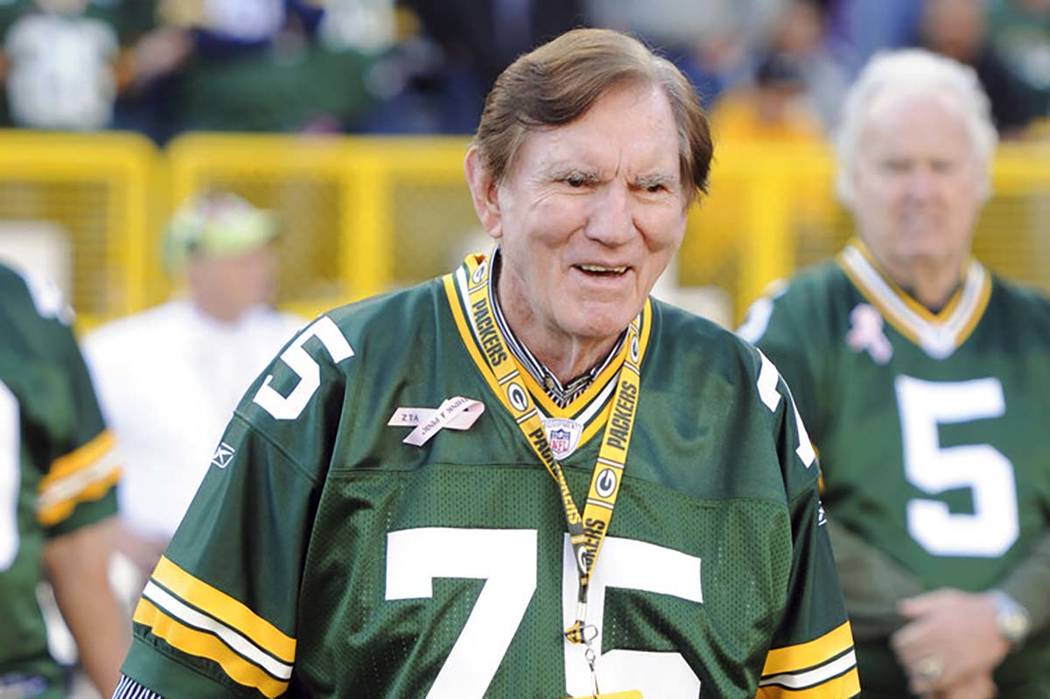
Gregg at the Packers' 100th Anniversary ceremony last season.
The blurry Number 5 in the background is Paul Hornung.

He said that if he'd known as a boy that he would eventually pay a heavy price for playing, he would still have played. That sounds like the attitude of a Vince Lombardi player. Then again, Lombardi also had colon cancer, and didn't survive it, dying in 1970, only 57 years old.

Gregg lasted until this past Friday, April 12, 2019, at the age of 85. There are still a few guys left from the era that helped to establish the NFL as "America's Game," and he was as evocative of that era -- of cold weather, muddy fields, poor protective equipment, and guys playing with more heart than talent, and sometimes with more heart than sense -- as anybody.

UPDATE: His final resting place is not publicly known.

Saturday, April 17, 2010

Top 10 Reasons to Hate Dallas

The Yankees swept the Texas Rangers, the Dallas-Fort Worth "Metroplex" area's team, this weekend.

On Friday night, the Yankees won a rain-shortened 5-1 game over the Texas Rangers. Yesterday, the Yankees won, 7-3. Alex Rodriguez hit his 584th career home run, surpassing Mark McGwire for 8th on the all-time list. Next up is Frank Robinson at 586, Sammy Sosa at 609, Ken Griffey Jr. at 630 (and "counting"), Willie Mays at 660, Babe Ruth at 714, Hank Aaron at 755, and Barry Bonds at 762.

Of course, a lot of those are steroid-aided... including the ones A-Rod hit from 2001 to at least 2003, possibly thereafter. At least we know he hasn't been caught using steroids as a Yankee.

It was only A-Rod's 1st homer of the season. Today, Mark Teixeira hit his 1st homer of the season, in a 5-2 Yankee win. Imagine that: The Yankees are 9-3, kicking some serious tush, and it took until this weekend for their2 best power hitters to hit their 1st homers.

Last night, Red Bull New York -- or, if you prefer the New York Red Bulls, still called "Metro" by some fans who remember them as the New York/New Jersey MetroStars -- also played a Dallas-area team, FC Dallas, which play at Pizza Hut Park in the suburb of Frisco. The Red Bulls won, 2-1, on two goals by captain Juan Pablo Angel, including a penalty kick in the 89th minute.

*

Now, like all sports fans with taste, I hate Dallas. Can I come up with 10 reasons why? How about limiting it to 10: That might be tougher.

Top 10 Reasons to Hate Dallas

Dishonorable Mention: The Weather. It's too damn hot!

10. FC Dallas. Why would anyone hate a soccer team from Dallas? (Well, except for fans of the Houston Dynamo.) Mostly the name. "Football Club Dallas"? Where's the imagination? The baseball team is the Texas Rangers, the football team the Dallas Cowboys, the basketball team the Dallas Mavericks...

Okay, the hockey team, formerly the Minnesota North Stars, became the Dallas Stars, when they should have become the Dallas Lone Stars. But look at the 2 major colleges: SMU is the Mustangs, TCU the Horned Frogs. Now that's imagination.

Dallas was previously home to the Dallas Tornado, a pretty successful team in the North American Soccer League (NASL), including winning its 1971 championship. There was also a Dallas Sidekicks in the Major Indoor Soccer League (MISL).

The team now known as FC Dallas was the Dallas Burn from the 1996 founding of Major League Soccer (MLS) until the name change in 2005. What's wrong with "Tornado" -- or, better yet, "Tornados or "Tornadoes"? What's wrong with "Burn"? (Okay, "Burn" might confuse people, what with MLS also having a Chicago Fire.) But... "FC Dallas"? Come on!

9. What They Did to David Clyde. In 1973, their 2ond season, the Texas Rangers had the 1st pick in the Major League Baseball Draft. They chose a Texas kid, David Clyde, a recently graduated 18-year-old high school pitcher from the Houston suburb. Desperate for attendance, they put him on the mound at Arlington Stadium without ever having appeared in a minor-league game, let alone a college one.

Unfortunately, the worst thing that could have happened to him was that he won his 1st major league start. And his 2nd one. So they kept sending him out there, and, as it turned out, he was far from ready. When the year was over, he was 4-8 with a 5.01 ERA. By 1975, he had arm trouble and was in the minors. He pitched his last professional game in 1981, at age 26, going just 18-33 in the majors.

He began drinking heavily, and ruined 2 marriages with it. He stopped, married a 3rd time, worked for his father-in-law's lumber business, and eventually ran it and coached a youth baseball team, before retiring to take care of his ailing father. He turned out all right, no thanks to his initial bosses.

8. Texas Stadium. Cowboy fans liked to say that the ridiculous facility in the northern suburb of Irving had a hole in the roof "so God could look down on his favorite team." Since when can God not look through a stadium's dome?

It had awful artificial turf. It had what we would now call skyboxes pushing the upper deck way too far back, well before most stadiums did -- in fact, the post-1971 stadium that most resembled Texas Stadium in terms of seating positioning was the much-maligned Metrodome in Minneapolis.

According to a column in today's Fort Worth Star-Telegram, the Hole Bowl is also the forerunner of "personal seat licenses," another reason to hate it. And longtime Cowboys executive Gil Brandt said this was also a reason why the dump never hosted a Super Bowl, as its replacement, Cowboys Stadium in Arlington, will do this coming February:

<< In a forerunner to today's seat licenses, the Cowboys sold what were called seat bonds, for $250 a pop. Season-ticket holders could buy bonds that gave them ownership of their seats for any and all events at the stadium.

Although the bonds were not interest-bearing, the seats increased significantly in value as the team became a perennial winner, meaning the Cowboys could never regain control of them.

Super Bowl crowds are comprised largely of out-of-towners -- officials, dignitaries, corporate types and players, coaches and team executives -- and Brandt said the Cowboys "couldn't guarantee the NFL seats."

"People had those seats for any event, no exceptions, even the Super Bowl," said the 77-year-old Brandt. "Clint borrowed money from people going to the stadium so it would help pay for it.

"He wouldn't have done it that way again. Consequently, it wasn't about not trying to get the Super Bowl, but not being able to." >>

If that's what caused the Cowboys to never play a Super Bowl on their home field, good.

7. Norm Green. He bought the North Stars in 1991, and moved them to Dallas. To this day, Minnesotans call him "Norm Greed."

6. Bob Short. In 1960, he moved the greatest basketball franchise the world had yet seen, the Minneapolis Lakers, to Los Angeles. In 1971, he became the first man to rip the hearts out of two sets of fans, by moving the Washington Senators to the Dallas area, where they became the Texas Rangers.

At the Senators' last home game, a banner hung from the upper deck at Robert F. Kennedy Stadium, reading, "SHORT STINKS." I guess it wasn't yet acceptable to use the word "sucks" in that context.

Going back to the previous point, Rangers manager Whitey Herzog said that Short was desperate to keep up the attendance that Clyde brought that he told Herzog to leave him in games longer than he should have. In only his 1st big-league managing job, Herzog didn't have the confidence to stand up to the bastard, and by the end of the season, Short fired Herzog, hiring Billy Martin.

Dishonorable Mention: What Dallas did to Billy Martin. Made him feel like a cowboy. Made him want to be a cowboy. Fed his already unpleasant drinking problem. Made him even more of a paranoiac than he already was. If Billy had never managed in Texas, he might not have killed himself in a drunk-driving accident at age 61.

5. Southern Methodist University. The football edition of the SMU Mustangs are the only college sports program ever to have been given the "death penalty." In 1987, following nearly a decade of dominating the Southwest Conference, and with SMU already on probation for recruiting violations, they were caught doing it again. Their 1987 season was cancelled, and due to what they would have lost through players not involved in the scandal being allowed to transfer out without losing any eligibility, they cancelled their 1988 season as well.

At the time, there were bumper stickers all over the Lone Star State: "Support Pro Football. Watch the SMU Mustangs." They have since rebuilt their program in the lower-profile Conference USA.

4. The Cowboys Cheat. Lee Roy Jordan knocking out Philadelphia Eagle running back Timmy Brown's teeth in 1967. Drew Pearson with the most blatant offensive pass interference in history in that 1975 Playoff game with the Minnesota Vikings, and getting away with it. And I'm still not sure the way they managed to get the top pick in the 1977 NFL Draft, enabling them to get Heisman Trophy winner Tony Dorsett, was on the up-and-up.

3. "America's Team"/"God's Team." The Cowboys decided that all by themselves. There was no election, and, if there had been, they would have been easily outvoted.

If God is such a Cowboy fan, why did He not tell "God's Coach," Tom Landry, to get his drug-addicted, boozing, philandering players off the field and into treatment? And why, then, did He let Jerry Jones buy the team, and hire a corrupt college coach, Jimmy Johnson, and turn Texas Stadium into a bigger Sodom & Gomorrah Southwest than Dallas' Southfork Ranch ever was?

2. Conspicuous Consumption. Nine years before Michael Douglas, in the film Wall Street, gave his "Greed is good" speech (and 12 years before Douglas broke my heart by snagging Catherine Zeta-Jones), the CBS-TV drama Dallas, starring Larry Hagman as J.R. Ewing, paved the way for the Reagan era of presuming that being rich was noble and being poor was your own fault.

Which is insane, because most of the rich people on Dallas were incredibly immoral. Heck, even Bobby Ewing (Patrick Duffy) wasn't always angelic. Kristin Shepard (Mary Crosby) should've gotten a medal for shooting J.R.

Of course, the TV show was a case of art imitating life. Dallas, as a city, is despised in Houston, the State Capital of Austin, and especially in nearby Fort Worth. In fact, there are those who like to say, "Dallas is not in Texas." The city is hated for being a center of oil, of banking, of insurance, things that are often hated by the general populace. And those industries are usually controlled by...

1. Right-Wing Fanaticism. Cowboys owner Clint Murchison was an out-and-out flake. So was oil baron H.L. Hunt -- thankfully, his son, Lamar Hunt, kept his politics quiet, and can be praised as the founder of the American Football League and the Kansas City Chiefs (formerly the Dallas Texans), the co-founder of the Super Bowl and the Chicago Bulls, and a key figure in the history of American soccer (the American equivalent of the FA Cup is named the Lamar Hunt U.S. Open Cup).

This link will send you to a handbill that was handed out in Dallas on November 21, 1963. President John F. Kennedy saw it, and told his wife Jacqueline, "We're headed into nut country tomorrow." Anybody who thinks Lee Harvey Oswald acted alone is a fucking fool -- if, that is, Oswald had anything to do with it:

Dallas and the surrounding area also sent to Congress Richard K. Armey. In 1994, Dick Armey, then the Republican Party's 3rd-ranking member in the House of Representatives, stood in the well of the House and told the Democrats, "Your President isn't that important to us." Your President? Our President, Dickhead. Yours, too.

From 1995 to 1998, Armey was the House Majority Leader. He once opposed a bill raising the minimum wage by telling of his days as a college professor, and finding out that the retarded janitor who worked there was laid off because the school couldn't afford the rise in the minimum wage. A reporter checked out the story and found it to be a big fucking lie. Dick Armey, a man who would rather lie about a retarded janitor than give people a living wage -- this is the kind of politician Dallas calls a "moderate."

Oh yeah: The SMU campus in Dallas is also going to be home to the George W. Bush Presidential Center. Notice they're not calling it a "library," even though his wife was a professional librarian. The most right-wing President ever, and they love him in Dallas.

I'm sure the vast majority of people in the Dallas-Fort Worth Metroplex are reasonable people, with at least some intelligence, and don't deserve to be hated or told that they suck.

But, in the words of Angelo Cataldi, the morning man on Philadelphia's all-sports station 610 WIP, "I've seen it, fathers with three, four, five-year-old kids, and the kids know four, five, maybe six words, and two of them, taught to them by their fathers, are, 'Dallas sucks!'"

Angelo is a wacko, but he knows what he's talking about: DALLAS SUCKS. And for reasons that go well beyond sports.