Showing posts with label norm green. Show all posts

Sunday, April 24, 2016

Top 5 Reasons You Can't Blame Norm Green for Moving the Minnesota North Stars to Dallas

The Dallas Stars have advanced to the NHL Western Conference Semifinals, defeating the Minnesota Wild.

This has not gone over well in Minnesota, and not just because they don't like to lose there. Nor just because they don't like losing to Dallas. (See the 1975 NFC Divisional Playoff, where the Cowboys cheated their way to a win over the Vikings.)

It's because, from 1967 to 1993, the Dallas Stars were the Minnesota North Stars. Under that name, in 26 seasons, they won 2 Division titles, reached the last 4 of the Stanley Cup Playoffs 5 times, and the Stanley Cup Finals twice, but never won the Cup.

Then came Norm Green, a mall developer and telecom investor from Calgary. He'd already had experience in moving a hockey team, as part of the Harley Hotchkiss-led group that bought the Atlanta Flames in 1979, and moved them to Calgary in 1980.

But that was different. Atlanta never really took to hockey, and the Thrashers, expanded into existence in 1999, would fail in 2011.

In 1990, at the NHL's request, Green sold his shares in the Flames, and the brothers George and Gordon Gund sold the North Stars to Green, because they preferred to own a team in the San Francisco Bay Area. This enabled the Gunds to found the San Jose Sharks.

In 1991, the North Stars reached the Finals, but lost to the Pittsburgh Penguins. In 1993, he moved the team.

He could have changed the name to the Dallas Lone Stars, which would have enabled him to keep the new Star logo, as opposed to the North Stars' N topped by a Star logo, he made them just the Dallas Stars.

That was the dumbest thing he did, but moving the team was worse than that. He cited attendance as the reason for the move. So you think you can't get enough hockey fans in cold Minnesota, but you can in hot Dallas?

Well, the team has done well in attendance in Dallas, regularly filling the Reunion Arena from 1993 to 2001, and the American Airlines Center from 2001 to 2010, before a downturn in performance led to one in attendance, but it picked up again in 2015 and remains up.

It was suggested at the time that he wanted to move to get away from the Minnesota media, which was writing unflattering things about him, in the wake of a sexual harassment lawsuit.

Green was vilified as "Norm Greed" in Minnesota, but he was a hero in Dallas. Since the move, in 23 years, the Stars have won 8 Division titles (including this year), reached the Western Conference Finals 4 times, reached the Stanley Cup Finals twice, and won the Stanley Cup in 1999.
Norm Green. This guy is a secret underground lair away
from being a villain in a James Bond movie.

Despite the founding of the Minnesota Wild and the opening of the Xcel Energy Center in St. Paul, both on the Autumn of 2000, Green has not been forgiven by Minnesotans. Should he be?

Top 5 Reasons You Can't Blame Norm Green for Moving the Minnesota North Stars to Dallas

First, a few reasons that didn't make the cut: The Best of the Rest.

The Early 1990s Recession. Contrary to what conservatives said in 1993, as new President Bill Clinton was enacting the economic plan that restored America to prosperity, the recession that hit in 1990 really was bad. That drove down attendance to the kind of level that made Green complain.

Burnout. From March 1991 to April 1992, just a shade over 1 year, the Twin Cities hosted the Frozen Four, the World Series, the Super Bowl and the Final Four. They were scheduled to host the NBA All-Star Game in 1994, hosted by the NBA team they'd just gotten. As a result, Minneapolis-St. Paul felt more "major league" than it ever had. Maybe losing the North Stars really didn't matter that much.

The Softenings of the Blow. Maybe Minnesotans thought that losing their NHL team was a tragedy. But was it, really? Losing baseball teams crushed New York in 1957 (especially the Borough of Brooklyn, which has never recovered emotionally), Milwaukee in 1965, Seattle in 1970, and Washington in 1971. Losing NFL teams was a blow to Oakland in 1982, Baltimore in 1984, St. Louis in 1987 (though not so much in 2016), Los Angeles and Cleveland in 1995, and Houston in 1996. Each of those cities felt a little less "major league."

But losing an NHL team? It didn't hurt the Bay Area and Kansas City much in 1976, or Cleveland in 1978, or Colorado in 1982. It did hurt Quebec City in 1995 and Winnipeg in 1996, because that hurt Canada's psyche as much as losing an MLB or NFL team would to an American city's. It hurt Hartford in 1997, but that was because the Whalers were all they had.

Minnesotans still had high school and college hockey, and teams in MLB, the NFL, the NBA, and college football and basketball. And they did get the announcement of the Wild in 1997, just 4 years later, to take the ice in 2000, just 7 years after the North Stars were taken away.

So was it really all that bad? It's better than Cleveland got with the new Browns, New York (at first) got with the Mets, and much less of a wait than Baltimore had until the Ravens, Winnipeg with the reborn Jets, Colorado with the Avalanche, or Quebec City, which still doesn't have a replacement team. The wait has now also been exceeded by that of Seattle for a replacement for the SuperSonics.

Okay, the '99 Cup being won by the same franchise in Dallas must've stung. But there's no guarantee they would have won it had they stayed in Minnesota.

Now for the Top 5:

5. The Attendance Really Was Bad. Green may have been a greedy jerk and a womanizer, but on this subject, he was not a liar. In 1982, in the wake of the previous season's trip to the Finals, Stars fans filled the Metropolitan Sports Center to capacity, averaging 15,220 fans per home game. But it declined: From 1985 to 1993, it never again topped 14,000.

By 1988, it was under 12,000. In the Finals year of 1990-91, it was a mere 7,838. That is not a typographical error: Seven thousand, eight hundred thirty-eight. The Chicago Blackhawks get nearly 3 times that now. Even in the final season, believing that increased attendance could change Green's mind and get him to keep the team in what's now known as "The State of Hockey," it was only 13,910 fans per game.

Much like the Brooklyn Dodgers and the Baltimore Colts before them, and the Cleveland Browns after them, North Stars fans didn't support their team in the kind of numbers that their enthusiasm then and their angst shortly thereafter would suggest.

Green could have been a decent man who wasn't getting sued for bad behavior toward women, and he still would have had a great reason to move the team. If Minnesotans who were already salaried adults in the George H.W. Bush years want to blame someone for their team moving, the 1st place they need to look is in the mirror.

4. The Golden Gophers. The University of Minnesota had the State's, and the Twin Cities', most popular hockey team. By 1993, they'd already reached what's now known as the NCAA Frozen Four 14 times (they've since raised that number to 21), and won National Championships in 1974, 1976 and 1979. They have added them in 2002 and 2003, for 5 titles. The women's team has won 7 titles.
Mariucci Arena, with banners

The Gophers could be counted on to win more often than not. The North Stars couldn't. So a local hockey fan was more apt to spend his hard-earned dollars on a winning team.

3. New Buildings. The NBA's expansion Minnesota Timberwolves got a new arena, the Target Center, in 1990, after playing their 1st season in the Metrodome. And the Twins and Vikings had gotten the Metrodome only a few years earlier, in 1982. The City of Minneapolis was willing to build new venues for them, but not for the North Stars. Nor was the City of Saint Paul. Nor was Hennepin County (where Minneapolis is). Nor was Ramsey County (where St. Paul is). Nor was the State of Minnesota. Why couldn't the North Stars get a new arena?

Why did the North Stars need a new arena? The Met Center was in suburban Bloomington, 9 miles south of downtown Minneapolis. Today, the Metro Blue Line light rail connects downtown with the Mall of America, built in stages on the sites of Metropolitan Stadium and the Met Center. But it didn't open until 2004, long after the Twins, Vikings, and North Stars left.
Some sports venues have their naming rights bought by a bank.
This one looked like it was a bank.

At the time, it wasn't so easy to get there from Minneapolis without a car. It was even harder from St. Paul, 12 miles away. In contrast, the Metrodome site, now nearly fully converted into U.S. Bank Stadium, the new home of the Vikings, and the Twins' new home of Target Field, and the Target Center are all adjacent to light rail stations downtown. The Xcel Energy Center in downtown St. Paul has public transit access as well.

So why didn't Green simply negotiate to move the North Stars into the Target Center? Because it was built with basketball specifically in mind. As Islander fans are now finding out at the Barclays Center in downtown Brooklyn, when you try to squeeze a hockey rink into a venue built for basketball, the sight lines don't work out very well.

This was also true of old NHL arenas like the 1925-68 version of Madison Square Garden, the Boston Garden, Chicago Stadium, the Olympia in Detroit, and the Buffalo Memorial Auditorium: Unlike the Montreal Forum and Maple Leaf Gardens in Toronto, these arenas weren't built for hockey, with its 200 feet by 85 feet rink, or even for basketball, with its 94 feet by 50 feet court; but for boxing, at the time a much bigger sport than either, with its ring being between 16 and 20 feet square. As Celtics boss Red Auerbach said of the Boston Garden, "The seating's all cockeyed."

So moving the North Stars into a basketball-specific arena would have created a problem that might well have outweighed all the problems it solved.

2. Dallas. It's a sports-crazy city with a lot of transplants from hockey areas, and lots and lots of money. Dallas was rolling in it in the early Nineties, from the energy, insurance and banking industries. Minneapolis may have been an agribusiness, pharmaceutical and technological giant once upon a time, but by the Daddy Bush years, its business glory days were long gone.
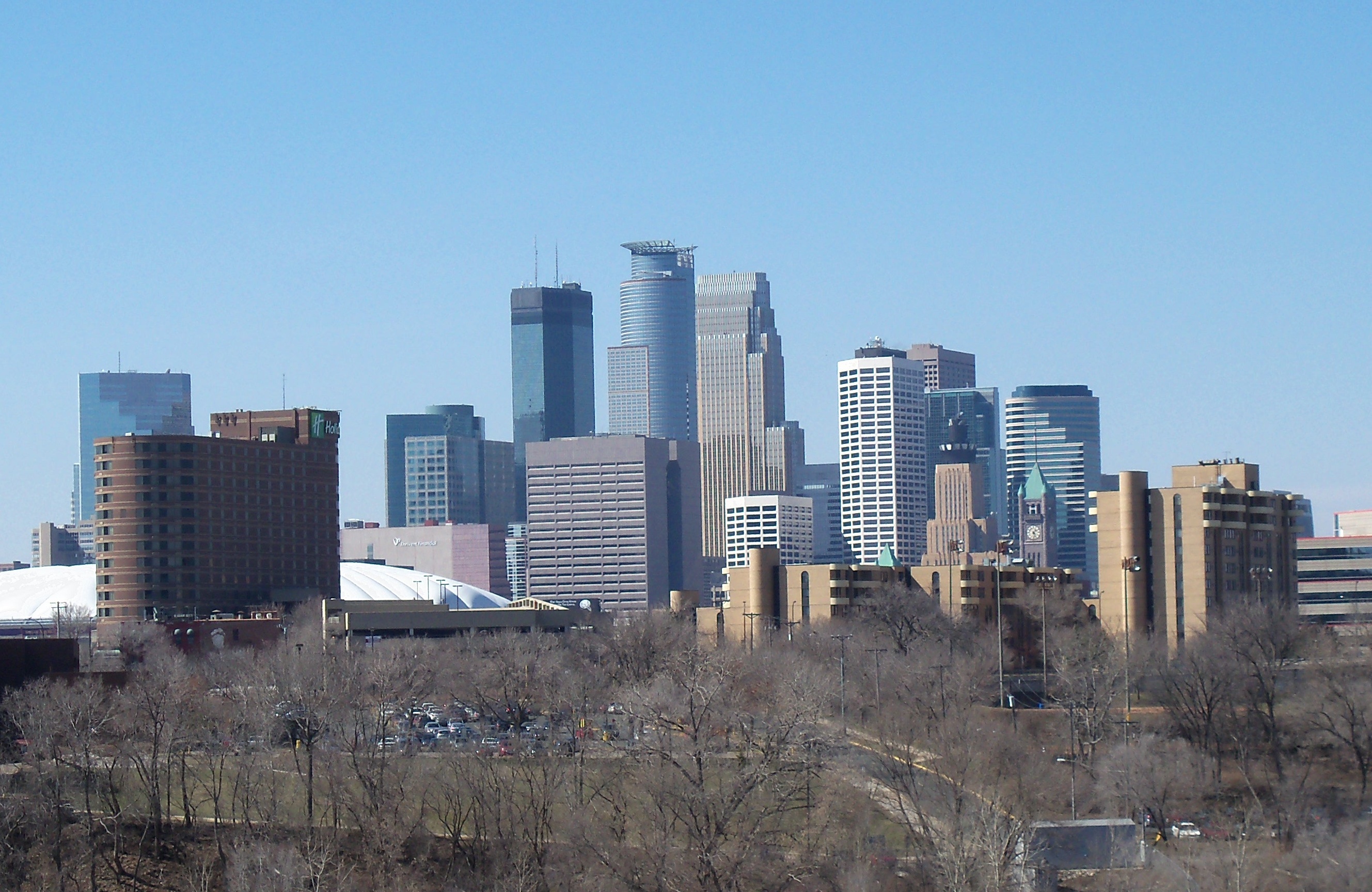
Downtown Minneapolis, as seen from
the University of Minnesota campus.
Photo taken in 2013. Note the Metrodome still standing.

And, as we've seen, the Stars have done well in Dallas, both on the ice and at the box office. Hockey in Texas may never feel quite right, but this "marriage" has stood the test of time thus far.
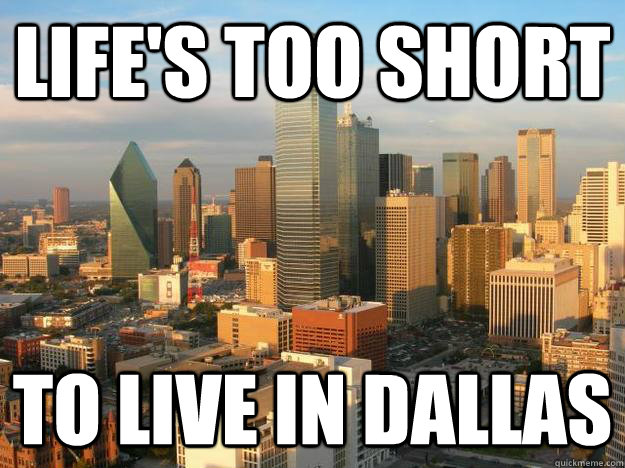
Downtown Dallas

1. Gary Bettman. Whatever the Commissioner of the National Hockey League wants, he gets. He wanted fewer teams in the Snow Belt, and more teams in the Sun Belt. The fact that he had to give Minnesota an expansion franchise shortly thereafter shows that he was wrong. But it is also a fact that, if he had wanted the North Stars to stay in Minnesota, they'd still be there, probably playing at the Xcel Center in St. Paul, while Dallas, rather than Minnesota, would have gotten an expansion franchise.

VERDICT: Not Guilty. Norm Green may have been Norm Greed, but he had legitimate reasons for moving the team, and for where.

Hopefully, with the NHL now long restored to the Twin Cities, and the Wild having been good more often than not, the statute of limitations has expired, and Minnesota hockey fans can focus on the future, not on the past.

Saturday, April 17, 2010

Top 10 Reasons to Hate Dallas

The Yankees swept the Texas Rangers, the Dallas-Fort Worth "Metroplex" area's team, this weekend.

On Friday night, the Yankees won a rain-shortened 5-1 game over the Texas Rangers. Yesterday, the Yankees won, 7-3. Alex Rodriguez hit his 584th career home run, surpassing Mark McGwire for 8th on the all-time list. Next up is Frank Robinson at 586, Sammy Sosa at 609, Ken Griffey Jr. at 630 (and "counting"), Willie Mays at 660, Babe Ruth at 714, Hank Aaron at 755, and Barry Bonds at 762.

Of course, a lot of those are steroid-aided... including the ones A-Rod hit from 2001 to at least 2003, possibly thereafter. At least we know he hasn't been caught using steroids as a Yankee.

It was only A-Rod's 1st homer of the season. Today, Mark Teixeira hit his 1st homer of the season, in a 5-2 Yankee win. Imagine that: The Yankees are 9-3, kicking some serious tush, and it took until this weekend for their2 best power hitters to hit their 1st homers.

Last night, Red Bull New York -- or, if you prefer the New York Red Bulls, still called "Metro" by some fans who remember them as the New York/New Jersey MetroStars -- also played a Dallas-area team, FC Dallas, which play at Pizza Hut Park in the suburb of Frisco. The Red Bulls won, 2-1, on two goals by captain Juan Pablo Angel, including a penalty kick in the 89th minute.

*

Now, like all sports fans with taste, I hate Dallas. Can I come up with 10 reasons why? How about limiting it to 10: That might be tougher.

Top 10 Reasons to Hate Dallas

Dishonorable Mention: The Weather. It's too damn hot!

10. FC Dallas. Why would anyone hate a soccer team from Dallas? (Well, except for fans of the Houston Dynamo.) Mostly the name. "Football Club Dallas"? Where's the imagination? The baseball team is the Texas Rangers, the football team the Dallas Cowboys, the basketball team the Dallas Mavericks...

Okay, the hockey team, formerly the Minnesota North Stars, became the Dallas Stars, when they should have become the Dallas Lone Stars. But look at the 2 major colleges: SMU is the Mustangs, TCU the Horned Frogs. Now that's imagination.

Dallas was previously home to the Dallas Tornado, a pretty successful team in the North American Soccer League (NASL), including winning its 1971 championship. There was also a Dallas Sidekicks in the Major Indoor Soccer League (MISL).

The team now known as FC Dallas was the Dallas Burn from the 1996 founding of Major League Soccer (MLS) until the name change in 2005. What's wrong with "Tornado" -- or, better yet, "Tornados or "Tornadoes"? What's wrong with "Burn"? (Okay, "Burn" might confuse people, what with MLS also having a Chicago Fire.) But... "FC Dallas"? Come on!

9. What They Did to David Clyde. In 1973, their 2ond season, the Texas Rangers had the 1st pick in the Major League Baseball Draft. They chose a Texas kid, David Clyde, a recently graduated 18-year-old high school pitcher from the Houston suburb. Desperate for attendance, they put him on the mound at Arlington Stadium without ever having appeared in a minor-league game, let alone a college one.

Unfortunately, the worst thing that could have happened to him was that he won his 1st major league start. And his 2nd one. So they kept sending him out there, and, as it turned out, he was far from ready. When the year was over, he was 4-8 with a 5.01 ERA. By 1975, he had arm trouble and was in the minors. He pitched his last professional game in 1981, at age 26, going just 18-33 in the majors.

He began drinking heavily, and ruined 2 marriages with it. He stopped, married a 3rd time, worked for his father-in-law's lumber business, and eventually ran it and coached a youth baseball team, before retiring to take care of his ailing father. He turned out all right, no thanks to his initial bosses.

8. Texas Stadium. Cowboy fans liked to say that the ridiculous facility in the northern suburb of Irving had a hole in the roof "so God could look down on his favorite team." Since when can God not look through a stadium's dome?

It had awful artificial turf. It had what we would now call skyboxes pushing the upper deck way too far back, well before most stadiums did -- in fact, the post-1971 stadium that most resembled Texas Stadium in terms of seating positioning was the much-maligned Metrodome in Minneapolis.

According to a column in today's Fort Worth Star-Telegram, the Hole Bowl is also the forerunner of "personal seat licenses," another reason to hate it. And longtime Cowboys executive Gil Brandt said this was also a reason why the dump never hosted a Super Bowl, as its replacement, Cowboys Stadium in Arlington, will do this coming February:

<< In a forerunner to today's seat licenses, the Cowboys sold what were called seat bonds, for $250 a pop. Season-ticket holders could buy bonds that gave them ownership of their seats for any and all events at the stadium.

Although the bonds were not interest-bearing, the seats increased significantly in value as the team became a perennial winner, meaning the Cowboys could never regain control of them.

Super Bowl crowds are comprised largely of out-of-towners -- officials, dignitaries, corporate types and players, coaches and team executives -- and Brandt said the Cowboys "couldn't guarantee the NFL seats."

"People had those seats for any event, no exceptions, even the Super Bowl," said the 77-year-old Brandt. "Clint borrowed money from people going to the stadium so it would help pay for it.

"He wouldn't have done it that way again. Consequently, it wasn't about not trying to get the Super Bowl, but not being able to." >>

If that's what caused the Cowboys to never play a Super Bowl on their home field, good.

7. Norm Green. He bought the North Stars in 1991, and moved them to Dallas. To this day, Minnesotans call him "Norm Greed."

6. Bob Short. In 1960, he moved the greatest basketball franchise the world had yet seen, the Minneapolis Lakers, to Los Angeles. In 1971, he became the first man to rip the hearts out of two sets of fans, by moving the Washington Senators to the Dallas area, where they became the Texas Rangers.

At the Senators' last home game, a banner hung from the upper deck at Robert F. Kennedy Stadium, reading, "SHORT STINKS." I guess it wasn't yet acceptable to use the word "sucks" in that context.

Going back to the previous point, Rangers manager Whitey Herzog said that Short was desperate to keep up the attendance that Clyde brought that he told Herzog to leave him in games longer than he should have. In only his 1st big-league managing job, Herzog didn't have the confidence to stand up to the bastard, and by the end of the season, Short fired Herzog, hiring Billy Martin.

Dishonorable Mention: What Dallas did to Billy Martin. Made him feel like a cowboy. Made him want to be a cowboy. Fed his already unpleasant drinking problem. Made him even more of a paranoiac than he already was. If Billy had never managed in Texas, he might not have killed himself in a drunk-driving accident at age 61.

5. Southern Methodist University. The football edition of the SMU Mustangs are the only college sports program ever to have been given the "death penalty." In 1987, following nearly a decade of dominating the Southwest Conference, and with SMU already on probation for recruiting violations, they were caught doing it again. Their 1987 season was cancelled, and due to what they would have lost through players not involved in the scandal being allowed to transfer out without losing any eligibility, they cancelled their 1988 season as well.

At the time, there were bumper stickers all over the Lone Star State: "Support Pro Football. Watch the SMU Mustangs." They have since rebuilt their program in the lower-profile Conference USA.

4. The Cowboys Cheat. Lee Roy Jordan knocking out Philadelphia Eagle running back Timmy Brown's teeth in 1967. Drew Pearson with the most blatant offensive pass interference in history in that 1975 Playoff game with the Minnesota Vikings, and getting away with it. And I'm still not sure the way they managed to get the top pick in the 1977 NFL Draft, enabling them to get Heisman Trophy winner Tony Dorsett, was on the up-and-up.

3. "America's Team"/"God's Team." The Cowboys decided that all by themselves. There was no election, and, if there had been, they would have been easily outvoted.

If God is such a Cowboy fan, why did He not tell "God's Coach," Tom Landry, to get his drug-addicted, boozing, philandering players off the field and into treatment? And why, then, did He let Jerry Jones buy the team, and hire a corrupt college coach, Jimmy Johnson, and turn Texas Stadium into a bigger Sodom & Gomorrah Southwest than Dallas' Southfork Ranch ever was?

2. Conspicuous Consumption. Nine years before Michael Douglas, in the film Wall Street, gave his "Greed is good" speech (and 12 years before Douglas broke my heart by snagging Catherine Zeta-Jones), the CBS-TV drama Dallas, starring Larry Hagman as J.R. Ewing, paved the way for the Reagan era of presuming that being rich was noble and being poor was your own fault.

Which is insane, because most of the rich people on Dallas were incredibly immoral. Heck, even Bobby Ewing (Patrick Duffy) wasn't always angelic. Kristin Shepard (Mary Crosby) should've gotten a medal for shooting J.R.

Of course, the TV show was a case of art imitating life. Dallas, as a city, is despised in Houston, the State Capital of Austin, and especially in nearby Fort Worth. In fact, there are those who like to say, "Dallas is not in Texas." The city is hated for being a center of oil, of banking, of insurance, things that are often hated by the general populace. And those industries are usually controlled by...

1. Right-Wing Fanaticism. Cowboys owner Clint Murchison was an out-and-out flake. So was oil baron H.L. Hunt -- thankfully, his son, Lamar Hunt, kept his politics quiet, and can be praised as the founder of the American Football League and the Kansas City Chiefs (formerly the Dallas Texans), the co-founder of the Super Bowl and the Chicago Bulls, and a key figure in the history of American soccer (the American equivalent of the FA Cup is named the Lamar Hunt U.S. Open Cup).

This link will send you to a handbill that was handed out in Dallas on November 21, 1963. President John F. Kennedy saw it, and told his wife Jacqueline, "We're headed into nut country tomorrow." Anybody who thinks Lee Harvey Oswald acted alone is a fucking fool -- if, that is, Oswald had anything to do with it:

Dallas and the surrounding area also sent to Congress Richard K. Armey. In 1994, Dick Armey, then the Republican Party's 3rd-ranking member in the House of Representatives, stood in the well of the House and told the Democrats, "Your President isn't that important to us." Your President? Our President, Dickhead. Yours, too.

From 1995 to 1998, Armey was the House Majority Leader. He once opposed a bill raising the minimum wage by telling of his days as a college professor, and finding out that the retarded janitor who worked there was laid off because the school couldn't afford the rise in the minimum wage. A reporter checked out the story and found it to be a big fucking lie. Dick Armey, a man who would rather lie about a retarded janitor than give people a living wage -- this is the kind of politician Dallas calls a "moderate."

Oh yeah: The SMU campus in Dallas is also going to be home to the George W. Bush Presidential Center. Notice they're not calling it a "library," even though his wife was a professional librarian. The most right-wing President ever, and they love him in Dallas.

I'm sure the vast majority of people in the Dallas-Fort Worth Metroplex are reasonable people, with at least some intelligence, and don't deserve to be hated or told that they suck.

But, in the words of Angelo Cataldi, the morning man on Philadelphia's all-sports station 610 WIP, "I've seen it, fathers with three, four, five-year-old kids, and the kids know four, five, maybe six words, and two of them, taught to them by their fathers, are, 'Dallas sucks!'"

Angelo is a wacko, but he knows what he's talking about: DALLAS SUCKS. And for reasons that go well beyond sports.