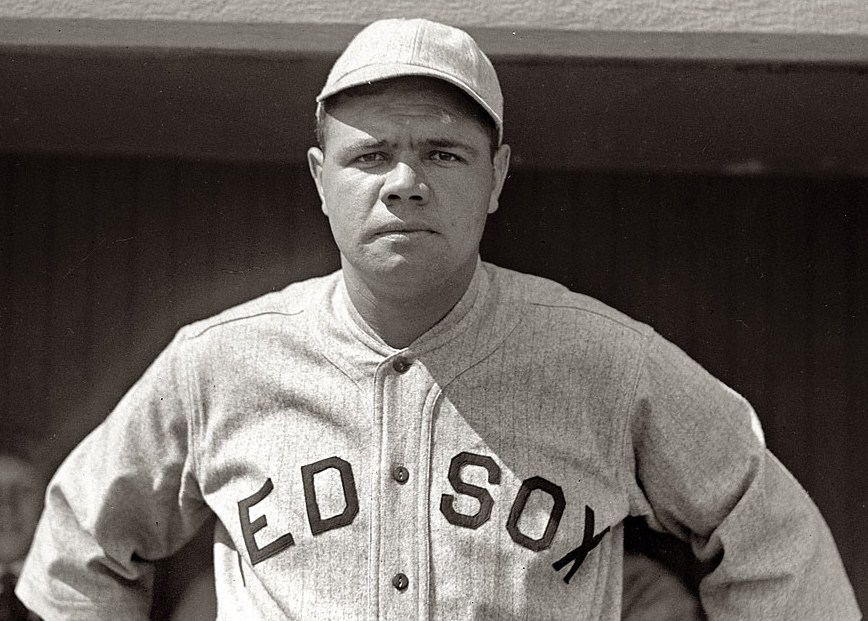
September 11, 1918, 100 years ago today: The Boston Red Sox win the World Series. They beat the Chicago Cubs 2-1 in Game 6 at Fenway Park. A 3rd inning error by Max Flack gave the Sox their runs, and Carl Mays pitched very well to gain the win. The Sox won the Series despite the lowest batting average ever for a Series-winning team: .186.
World War I was ongoing. The U.S. Secretary of War, Newton D. Baker, had issued the "work or fight order," meaning that anyone in "non-essential" jobs (like sports) had to either enlist in the armed forces, take a job with some connection to the war effort, by June 1, or be subject to the draft.
As a result, baseball had to be shut down a month early, although the World Series was still allowed to be played. Unlike in the later World War II, there was no Commissioner of Baseball at the time, and thus no letter from the Commissioner to the President of the United States, asking what baseball should do; and thus no "green light letter" from the President, saying that baseball should continue.
September 11 was a date fraught with difficult history in America long before al-Qaeda's destruction of the World Trade Center in 2001: The Battle of Brandywine outside Philadelphia in 1777, the Sugarloaf Massacre in Pennsylvania in 1780, the threat to Fort McHenry in Baltimore (the battle would be 2 days later), the Mountain Meadows Massacre in Utah in 1857, the leadup to the Battle of Antietam in Pennsylvania in 1862, the Ninth Avenue Elevated derailment in New York in 1905, Charles Lindbergh's anti-Semitic speech in Des Moines in 1941, Hurricane Edna in New England in 1954, Hurricane Carla in Texas in 1961, a plane crash in Charlotte in 1974, a bomb killing a policeman at Grand Central Terminal in 1976, Hurricane Iniki in Hawaii in 1992. All that before 2001 -- and the Benghazi attack in 2012.
On September 11, 1918, no one knew if there would be a 1919 season, or when baseball would ever start up again. It was not widely known that the war would be over in 2 more months. So many other sports competitions had been canceled for the duration in 1914. England's Football League and FA Cup had been canceled for the duration in 1915. There was no 1916 Olympics.
But the war did end on November 11, 1918. On April 19, 1919, the next season started on time. By the end of that year, most major sports competitions had been resumed, even in war-torn Europe. The 1920 Olympics were granted to hard-hit Belgium, and the 1924 Olympics to France: Summer to Paris, and the 1st Winter Olympics to Chamonix in the Alps.
As for the 1918 World Series: Babe Ruth pitched and won Games 1 and 4 for the Sox, although, in Game 4, his streak of consecutive scoreless innings in World Series play ended at 29 2/3rds. That would remain a record until 1961. (It would not be the only record to be set by Ruth and broken that year.)
Let me address the elephant in the room: How did the Babe respond to the work or fight order? Until the World Series was over, he didn't respond to it at all. He kept on playing, exposing himself to the draft -- which he had every legal right to do.
Once it ended, he gained exemption from the war draft by accepting a nominal position with a Pennsylvania steel mill. The end of the war in November set Ruth free to play baseball without such contrivances. I will leave it to the individual reader to decide whether Ruth's method of avoiding military service, while completely legal, was moral.
*
Over the next few years, Sox owner Harry Frazee began to break up his team. He really couldn't keep Ruth, leading to the myth of "The Curse of the Bambino." But the real problem was that he broke up a really good pitching staff.
As a result, the Red Sox did not get into another American League Pennant race until 1938. They didn't win another Pennant until 1946. They lost the ensuing World Series with Game 7 tied in the 8th. They lost a single-game Playoff for the Pennant in 1948. They blew the last 2 games of the 1949 season, only needing to win 1 to win the Pennant.
They lost the 1967 World Series in 7 games. They blew the 1972 AL Eastern Division title in the last week. They blew another Division title in 1974. They lost the 1975 World Series despite leading Game 7 3-0 after 5 innings. They blew another Division title in 1977. They blew a 9-game Division lead in July 1978 (remember, the Yankees were 14 games back, but they weren't the 2nd place team), and lost a 1-game Playoff for the title.
They lost the 1986 World Series despite leading Game 6 5-3 and needing 1 more strike in the 10th inning, and leading Game 7 3-0 going to the bottom of the 6th. They got swept in the AL Championship Series in 1988, and again in 1990. They got swept in the AL Division Series in 1995, and again in 1998. They got to the ALCS in 1999, and clowned their way through another loss. They nearly pulled off a "reverse choke" for the 2000 Division title, but didn't quite make it. They lost the 2003 ALCS despite leading Game 7 5-2 going to the bottom of the 8th.
"The Curse of the Bambino is not, 'The Red Sox can't beat the Yankees.' The Curse of the Bambino is, 'The Red Sox can't win the World Series.'" -- Dan Shaughnessy, Boston Globe. You'll notice that, of those 17 defeats starting in 1946, the Yankees were involved in only 6 of them. The problem wasn't the Yankees. If the Sox wanted to know what was wrong, they needed to look in the mirror.
*
It took one more year to do it. The Boston Red Sox stunned the Yankees in the ALCS, and, on October 27, 2004 -- 86 years, 1 month and 16 days after they last did so -- won the World Series. To do so, they beat the St. Louis Cardinals, who had beaten them in the 1946 and 1967 World Series.
This win, of course, was bogus, as were the World Series they won in 2004 and 2007. And we know why: Performance-enhancing drugs.
David "Big Papi" Ortiz and Manny Ramirez, by far their 2 most significant hitters in 2004 and 2007, used PEDs. Ortiz was still there when they won again in 2013.
He used PEDs.
He was tested for them.
He failed the test.
He said he never used them. He lied.
He was exposed. Exposed as a cheater and a liar.
He still lies about it.
For all we know, he still cheated until he retired at the end of the 2016 season.
And yet, he was not only still permitted to play professional baseball, he was allowed to be crowned the Most Valuable Player of the 2013 World Series.
So even with these 3 tainted titles, the Red Sox have still not won the World Series without cheating since...
September 11, 1918. Exactly 100 years. How long has that been?
*
The 1918 Boston Red Sox included some interesting names: Babe Ruth, Wally Schang, Everett Scott, Carl Mays, Bullet Joe Bush and Sad Sam Jones. All of these men would be on the Yankees by the time they won their first World Series in 1923.
Indeed, thanks to the friendship of theatrical producer and Red Sox owner Harry Frazee, and brewer and Yankee owner Jacob Ruppert, of the 25 men on the Yankee roster that season, 12 had previously played for the Red Sox, including the legendary Babe and the triad of Mays, Bush and Jones, the bulk of the Sox pitching staff in their 1915, '16 and '18 title seasons -- along with Ruth, who, due to the wartime manpower shortage, had been appearing more and more as an outfielder.
Harry Hooper, the Hall of Fame center fielder who was sold off to a different team, the Chicago White Sox, said that the 1920s Yankee Dynasty was effectively the 1910s Red Sox champions, including a previous title in 1912. He had a point.
Major League Baseball -- only nobody called it that back then, it was just "baseball," or maybe "Organized Baseball" -- had 16 teams in 10 cities: New York (the Yankees, the Giants and the Brooklyn Dodgers), Boston (the Red Sox and the Braves), Philadelphia (the Athletics and the Phillies), Washington (the Senators), Pittsburgh (the Pirates), Cleveland (the Indians), Cincinnati (the Reds), Detroit (the Tigers), Chicago (the Cubs and the White Sox), and St. Louis (the Cardinals and the Browns).
Of those 16, only the Yankees, the Red Sox, the Phils, the Pirates, the Indians, the Reds, the Tigers, the Cardinals and the Chicago teams are playing in the same cities today.
There were no major league teams south of Washington, Cincinnati or St. Louis; and no teams west of St. Louis. Milwaukee, Baltimore, Kansas City, Los Angeles, the San Francisco Bay Area, the Twin Cities of Minnesota, Houston, Atlanta, Seattle, San Diego, Dallas-Fort Worth, Toronto, Denver, Miami-Fort Lauderdale, Phoenix, Tampa Bay? At the time, those cities had, between them, 23 minor league teams; they now have 18 major league teams.
The Red Sox' Fenway Park and the Cubs' Weeghman Park, which became Wrigley Field in 1926, are the only stadiums used by MLB teams in 1918 that are still standing, let alone still being used by an MLB team, today. There were no ballparks with lights, domes, or electric scoreboards or public-address systems.
The players wore no numbers or names on their backs. There were no batting helmets, and gloves were a lot smaller, thus error totals were a lot higher. There were a few white Cubans playing in the majors, but no nonwhite players: No African-Americans, no black Hispanics, no Asians. The spitball and its ball-doctoring siblings like the mudball and the shineball were legal. The designated hitter was not even an idea.
And the reserve clause was in effect: The average major league salary was $4,000, and the highest-paid player was Ty Cobb at $20,000. In 2018 dollars, the average would be $64,000, and Cobb's capper $321,000. This season, Mike Trout will make $35.8 million, or about 111 times what Cobb made with inflation factored in.
The National Hockey League was about to start its 2nd season, with 4 teams: The Montreal Canadiens, the Toronto Arenas (who became the Maple Leafs in 1927), the Ottawa Senators and the Quebec Bulldogs. There was professional football, but, as yet, no National Football League. If there was professional basketball at all, it was kept out of the newspapers.
Old-time baseball legends like 1869 Cincinnati Red Stocking George Wright, professional pioneer Joe Start, and Jim "Orator" O'Rourke, legend of the 1872-75 National Association Champion Boston Red Stockings and the 1888-89 National League Champion New York Giants, were still alive. John L. Sullivan, the man regarded as the first true Heavyweight Champion of the World, a.k.a. The Boston Strong Boy, had died earlier in the year. (The current champ was Jess Willard, but he would soon lose the belt to Jack Dempsey.) Joe DiMaggio was about to turn 4. Bob Feller was born 2 months later, Jackie Robinson 3 months after that.
The Olympic Games have since been held in America 7 times, France 4 times; 3 times each in Germany, Japan, Italy and Canada; twice each in Switzerland, Austria, Norway, Britain, Australia, Russia and Korea; and once each in Belgium, the Netherlands, Finland, Mexico, Bosnia, Spain, Greece, China and Brazil.
The World Cup had not yet been founded. It has since been held twice each in Mexico, Italy, France, Germany and Brazil; and once each in America, Uruguay, Switzerland, Sweden, Chile, England, Argentina, Spain, Japan, Korea, South Africa and Russia.
(Counting the previous Olympics, held in Greece, France, America, England and Sweden, that means the following 13 countries have hosted both the Olympics and the World Cup, in chronological order: France in 1938, Switzerland in 1954, Italy in 1956, Sweden in 1958, England in 1966, Mexico in 1970, Germany in 1974, Spain in 1992, America in 1994, Japan in 2002, Korea in 2002, Brazil in 2016, and Russia in 2018. Canada will join them in 2026.)
There were States in the Union, and 17 Amendments to the Constitution. There was no Federal Deposit Insurance Corporation, Securities & Exchange Commission, National Labor Relations Board, Social Security, 40-hour work week, G.I. Bill, Civil Rights Acts, Medicare,
Medicaid, Environmental Protection Agency, OSHA or Title IX.
Segregation in public schools and public accommodations and enforced prayer in public schools had not yet been struck down. Nor had birth control, abortion or same-sex marriage been legalized. On the other hand, marijuana and cocaine had not yet been criminalized, and could be purchased at your local pharmacy, no questions asked.
The President of the United States was Woodrow Wilson. Former President Theodore Roosevelt was still alive, but was dying. Former President William Howard Taft was also still alive.
Segregation in public schools and public accommodations and enforced prayer in public schools had not yet been struck down. Nor had birth control, abortion or same-sex marriage been legalized. On the other hand, marijuana and cocaine had not yet been criminalized, and could be purchased at your local pharmacy, no questions asked.
The President of the United States was Woodrow Wilson. Former President Theodore Roosevelt was still alive, but was dying. Former President William Howard Taft was also still alive.
Warren Harding was a U.S. Senator from Ohio, Calvin Coolidge the Governor of Massachusetts, Herbert Hoover the director of a food relief service that was easing the starvation conditions of war-torn Europe, Franklin Roosevelt the Assistant Secretary of the Navy. Harry Truman and Dwight D. Eisenhower were both Captains in the U.S. Army; ironically, Truman saw combat in "The Great War," while Ike was never transferred overseas. Lyndon Johnson was 10 years old, Ronald Reagan 7, Richard Nixon and Gerald Ford 5, John F. Kennedy a year and a half.
The Governor of the State of New York was Charles S. Whitman, but he was about to be defeated for re-election by Alfred E. Smith. The Governor of New Jersey was Walter Edge, and the Mayor of New York was John Hylan. The Mayor of the city in question, Boston, was Andrew J. Peters. The Governor of Massachusetts was Samuel W. McCall.
The monarch of Great Britain was King George V, the Prime Minister of Britain was David Lloyd George, and the Prime Minister of Canada was Robert L. Borden. Britain's Football League, and its FA Cup competition, were suspended for the duration of the war after the 1914-15 season, and would resume for 1919-20.
There have since been 12 Mayors of Boston -- counting 4-time Mayor James Michael Curley only once -- 27 Governors of Massachusetts, 18 Presidents of the United States, 4 monarchs of Great Britain, and 9 Popes.
Organized crime was still trying to get a foothold in America. Of New York City's "Five Families," what we now know as the Genovese and the Gambino crime families had been established. Within 10 years, the Lucchese, Bonnano and Colombo families would follow. Al Capone and Lucky Luciano were just getting started in New York, and Capone had yet to go to Chicago. According to the fictional history of The Godfather, Vito Corleone had yet to start his crime empire as well.
The International Committee of the Red Cross was the holder of the Nobel Peace Prize. There were still living veterans of the Mexican-American War of the 1846-47, the European Revolutions of 1848, and the Crimean War of the 1850s. There were still living survivors of the Battle of the Alamo in 1836, the Seneca Falls Convention of 1848, and the Jesse James Gang. Wyatt Earp, the last survivor of the Gunfight at the OK Corral, was still alive. (Whether Butch Cassidy and the Sundance Kid were still alive has been debated, but the evidence is not conclusive.)
Major novels of 1918 included My Antonia by Willa Cather, The Magnificent Ambersons by Booth Tarkington, and, with the war in mind, The Marne by Edith Wharton and The Return of the Soldier by Rebecca West. British poet-soldier Siegfried Sassoon published Counter-Attack and Other Poems.
There have since been 12 Mayors of Boston -- counting 4-time Mayor James Michael Curley only once -- 27 Governors of Massachusetts, 18 Presidents of the United States, 4 monarchs of Great Britain, and 9 Popes.
Organized crime was still trying to get a foothold in America. Of New York City's "Five Families," what we now know as the Genovese and the Gambino crime families had been established. Within 10 years, the Lucchese, Bonnano and Colombo families would follow. Al Capone and Lucky Luciano were just getting started in New York, and Capone had yet to go to Chicago. According to the fictional history of The Godfather, Vito Corleone had yet to start his crime empire as well.
The International Committee of the Red Cross was the holder of the Nobel Peace Prize. There were still living veterans of the Mexican-American War of the 1846-47, the European Revolutions of 1848, and the Crimean War of the 1850s. There were still living survivors of the Battle of the Alamo in 1836, the Seneca Falls Convention of 1848, and the Jesse James Gang. Wyatt Earp, the last survivor of the Gunfight at the OK Corral, was still alive. (Whether Butch Cassidy and the Sundance Kid were still alive has been debated, but the evidence is not conclusive.)
Major novels of 1918 included My Antonia by Willa Cather, The Magnificent Ambersons by Booth Tarkington, and, with the war in mind, The Marne by Edith Wharton and The Return of the Soldier by Rebecca West. British poet-soldier Siegfried Sassoon published Counter-Attack and Other Poems.
Nonfiction works published that year included Eminent Victorians by Lytton Strachey, The Decline of the West by Oswald Spengler, and The Education of Henry Adams, published posthumously, as Adams had died earlier in the year.
C.S. Lewis had been wounded in the Somme. J.R.R. Tolkien had also served at the Somme, but was stricken by illness and sent home -- and most of his unit was wiped out afterward. Both were recuperating back in England, and hadn't met yet. Ian Fleming was 10 years old, Jerry Siegel and Joe Shuster were 4, Bob Kane almost 3, and Gene Roddenberry and George Lucas hadn't been born yet. In spite of the fiction of Jules Verne and H.G. Wells, no one had yet launched a rocket toward space.
The tallest building in the world in 1918 was the Woolworth Building in Lower Manhattan. There were no credit cards or automatic teller machines. There was no radio broadcasting. There was no television, either. No Internet. No computers. Alan Turing was 6 years old. There were no ZIP Codes. Telephone numbers
were still based on "exchanges," and fewer than half of all Americans had a telephone in the home. Hardly anyone had air-conditioning. There was no birth-control pill, and no Viagra.
There were, however, records, and hits included a lot of songs that had, or seemed to have, a war theme: "A Good Man Is Hard to Find," "Hello, Central, Give Me No Man's Land," "Hinky Dinky Parlay Voo," "If He Can Fight Like He Can Love, Good Night Germany," "Mammy's Chocolate Soldier" (this was as respectful as race relations got in 1918), "Oh! Frenchy!" "Oui Oui Marie," "The Rose of No Man's Land," "Those Draftin' Blues," "Till We Meet Again," "We'll Do Our Share While You're Over There," "When Tony Goes Over the Top" (I'm guessing a song for Italian-Americans), "Without You," "Would You Rather Be A Colonel With An Eagle On Your Shoulder Or A Private With A Chicken On Your Knee?" and "You'll Find Old Dixieland In France."
There were, however, records, and hits included a lot of songs that had, or seemed to have, a war theme: "A Good Man Is Hard to Find," "Hello, Central, Give Me No Man's Land," "Hinky Dinky Parlay Voo," "If He Can Fight Like He Can Love, Good Night Germany," "Mammy's Chocolate Soldier" (this was as respectful as race relations got in 1918), "Oh! Frenchy!" "Oui Oui Marie," "The Rose of No Man's Land," "Those Draftin' Blues," "Till We Meet Again," "We'll Do Our Share While You're Over There," "When Tony Goes Over the Top" (I'm guessing a song for Italian-Americans), "Without You," "Would You Rather Be A Colonel With An Eagle On Your Shoulder Or A Private With A Chicken On Your Knee?" and "You'll Find Old Dixieland In France."
But, along with earlier classics like "Over There," "Pack Up Your Troubles" and "It's a Long Way to Tipperary," the definitive World War I song may have been "How Ya Gonna Keep 'Em Down On the Farm" -- "after they've seen Par-ee" -- by Sam M. Lewis, Joe Young and Walter Donaldson. With Pete Wendling, Lewis and Young wrote "Oh How I Wish I Could Sleep Until My Daddy Comes Home." And with Jean Schwartz, they wrote the non-war song "Wedding Bells, Will You Ever Ring For Me?" All in 1918.
Al Jolson, the biggest Broadway and recording star of the time, sang of war ("On the Road to Calais" and "Tell That to the Marines") and Peace ("Rock-A-Bye Your Baby With a Dixie Melody"). The biggest non-war songs of the year, aside from Jolson's "Rock-A-Bye Your Baby... ," were "Somebody Stole My Gal" and "Tiger Rag" (a.k.a. "Hold That Tiger").
Duke Ellington was just starting out in the music business. Louis Armstrong was 17 years old, Bing Crosby 15, Roy Acuff about to turn 15; Jimmy Dorsey, Glenn Miller and Count Basie 14; Tommy Dorsey 12; Cab Calloway, Ethel Merman and Lionel Hampton 10; Benny Goodman 9; Artie Shaw and Howlin' Wolf 8; John Mills Jr., oldest of the Mills Brothers, Robert Johnson, Big Joe Turner, and Laverne Andrews, the oldest of the Andrews Sisters, 7; Woody Guthrie was 6; Frankie Laine and Muddy Waters were 5; Billie Holiday and Willie Dixon were 3; Frank Sinatra and Harry James were 2; Ella Fitzgerald and Lena Horne 1; and Thelonious Monk and Dizzy Gillespie 11 months.
Nat King Cole, Pete Seeger and Liberace would all be born within the next 1 year; Charlie Parker and Charles Mingus within the next 5 years; Hank Williams Sr., Bill Haley, B.B. King, Miles Davis, Tony Bennett, John Coltrane, Chuck Berry, Patti Page, Fats Domino and Rosemary Clooney within the next 10.
There were movies, but they were black and white, and silent. Buster Keaton and Roscoe "Fatty" Arbuckle were the leading comedians of the day, while Charlie Chaplin was just getting rolling. Sisters Lillian and Dorothy Gish starred together in D.W. Griffith's Hearts of the World. Elmo Lincoln starred in the 1st Tarzan film, Tarzan of the Apes. Pola Negri starred in a film version of Carmen -- although the film being silent kind of defeats the purpose of opera.
Mary MacLane, a bisexual feminist writer who became a sensation in 1902, only 21 years old at the time -- making her the Miley Cyrus of her day -- adapted her 1910 syndicated articles "Men Who Have Made Love to Me" into a silent film, in which she starred. The title, and the content, describing 6 affairs, 1 with a married man, were incredibly scandalous for the 1910s -- they would have been risqué even for the 1950s -- and the film has been lost. She died in 1929, from tuberculosis, only 48, and has been mostly forgotten since.
While we're on the subject of early death: There were no antibiotics. An infection could kill, and an epidemic of influenza would end up killing about 50 million people -- around 3 times as many as died as a result of the war, military and civilian combined.
Most of the warring countries, in order to remove this potential blow to morale, hid the true extent of the epidemic, but Spain, neutral and not in the war, published the details of how the flu hit their country. Even King Alfonso XIII fell victim, although he survived. Thus, it became known as the Spanish Flu Epidemic.
It would continue into 1919, striking down several Montreal Canadiens and Seattle Metropolitans players, making it impossible to bring the 1919 Stanley Cup Finals to a conclusion -- the only time the Cup has been competed for, but not awarded. Canadiens defenseman Joe Hall, known as "Bad Joe" for his dirty play, died from the flu, and so his reputation was obscured by his martyrdom, as he became the 1st active NHL player to die.
Artificial organs were not yet possible. Transplantation of organs was not possible. There was no polio vaccine. Insulin was not yet used to treat diabetes. There was no birth control pill, but there was no Viagra, either.
Inflation was such that what $1.00 bought then, $16.05 would buy now. A U.S. postage stamp cost 3 cents, and a New York Subway ride 5 cents. The average price of a gallon of gas was 15 cents, a cup of coffee 10 cents, a burger 15 cents, a movie ticket 10 cents, a new car $2,000, and a new house $3,200. The Dow Jones Industrial Average closed that day at 80.46.
In the Autumn of 1918, in events not directly related to World War I, Vladimir Lenin was shot by Fanya Kaplan; he survived, but his health never fully recovered. London policemen went on strike for increased pay and union recognition. Mayaguez, Puerto Rico was nearly destroyed by an earthquake and its resulting tsunami. Cloquet, Minnesota was destroyed by a fire that killed 453 people.
American poet Joyce Kilmer, and British poet Wilfred Owen, and French pilot Roland Garros, for whom the French Open's main stadium would be named, died -- all in combat. American actors True Boardman and Harold Lockwood also died, in the Spanish Flu Epidemic. Leonard Bernstein, and Nipsey Russell, and Ted Williams were born.
September 11, 1918. The Boston Red Sox won the World Series.
It took them 86 years to win another. They have now won 3 World Series since 1918.
None honestly.
And they, and their fans, damn well know it.


