Showing posts with label orlando magic. Show all posts

Saturday, October 16, 2021

How to Be a New York Basketball Fan In Orlando -- 2021-22 Edition

The New York Knicks visit the Orlando Magic this coming Friday, and again on April 3. The Brooklyn Nets do so on November 10 and March 15.

Before You Go. Florida must be where the saying, "It's not the heat that's so bad, it's the humidity" was first used. Indeed, when Miami got its expansion baseball team in 1991, someone joked that, since they already had the Heat, a basketball team that was then so bad, the baseball team should be named the Miami Humidity. (It was named the Florida Marlins instead, and is now the Miami Marlins.)

Orlando isn't as far south as Miami, but I've been there in November, and the place simply doesn't recognize what the calendar says for the Northeast. It can be 85 degrees and 100 percent humidity. It can be unbearable. The Orlando Sentinel website is predicting temperatures to be in the mid-80s during daylight, and in the high 60s at night. So don't dress as you would for a chilly, blustery November day weekend in N'Yawk or N'Jersey: Prepare for Summer.

Orlando is in the Eastern Time Zone, so you won't have to fool with your timepieces. Florida was part of the Confederate States of America, and Central Florida (outside of Disney World itself, which is its own fiefdom under "Uncle Walt," who was very conservative) is still very much Southern, but you won't need to bring your passport or change your money (although Disney World does use "Disney Dollars" as coupons).

Tickets. The Magic averaged 16,882 fans per home game last season, only about 89 percent of capacity, before COVID shut everything down. It is possible that, despite the growth of the Central Florida market, Orlando simply can't support a major league team in any sport. (The soccer team Orlando City SC has done well at the box office, but that may be due to the novelty of having an expansion team, and some people don't count MLS as "major league" anyway.)

It's why Tampa Bay got a baseball team in 1998 and a hockey team in 1992, and Jacksonville got an NFL team in 1995, and Orlando got none of those. Most of the single-team markets have an NBA team. (Jacksonville is the only metropolitan area with only an NFL team.)

Seats in the lower level, the 100 sections, are $80 between the baskets and $58 behind them. In the upper level, the 200 sections, they're a lot cheaper, $20 between and $17 behind.

Getting There. It's 1,080 miles from Times Square to downtown Orlando. Reading this, your first thought is going to be to fly.

Amazingly, you can get a round-trip nonstop flight on United Airlines, going down this Friday, and the day of the game, and coming back on Saturday, for just $168. This turns out to be a bargain by anyone's standards, especially when you see the Orlando airport and its fantastic monorail. The only problem is, you've got to start at Newark Airport. At least they've finally built their monorail. (Most likely, though, the fare will be higher.)

Okay, there's a 2nd problem: It's Florida, a.k.a. The COVID State. Take whatever precautions you have to.

(Orlando International Airport's airport code of MCO comes from its former status, up until 1975, as McCoy Air Force Base, named for Colonel Michael Norman Wright McCoy, a hero pilot of World War II who was killed in a crash at what was then named Pinecastle Air Force Base in 1957.)

Amtrak's Silver Meteor leaves New York's Penn Station at 3:15 PM, and arrives in Orlando at 12:49 the following afternoon, a 21-and-a-half hour trip. It's $355 round-trip -- this time, it could be more than flying. Be advised that the Florida trains, the Silver Meteor and the Silver Star, are notoriously late on their returns to the Northeast Corridor. So flying is the better option. The Amtrak station is at 1400 Slight Blvd. at Copleand Drive, downtown.

Greyhound runs 5 buses a day from New York's Port Authority Bus Terminal to Orlando, with a round-trip fare of $422, but it can drop to $271 with advanced purchase. This trip takes 25 hours, with a change of buses and an hour-and-a-half layover in Richmond, which is not fun. So far, flying remains the better option, which is a rarity on these Trip Guides. The Greyhound station is at 555 N. John Young Parkway. 2 miles west of downtown. Number 25 bus.

If you do prefer to drive, see if you can get someone to split the duties with you. Essentially, you'll be taking Interstate 95 almost all the way down. At Exit 260, take Interstate 4 West, and Exit 82B for downtown Orlando.

It should take about 2 hours to get through New Jersey, 20 minutes in Delaware, an hour and a half in Maryland, 3 hours in Virginia, 3 hours in North Carolina, 3 hours in South Carolina, 2 hours in Georgia, and about 2 hours and 45 minutes in Florida. Given proper 45-minute rest stops – I recommend doing one in Delaware, and then, once you're through the Washington, D.C. area, doing one when you enter each new State, and then another around Orlando, for a total of 7 – and taking into account city traffic at each end, your entire trip should take about 23 hours -- faster than Greyhound, but not faster than Amtrak.

Once In the City. Founded as Jernigan in 1875, and home to about 287,000 people with a metropolitan area of over 3.1 million, Orlando was named for Orlando Reeves, an American soldier who was killed within what is now the city limits during the Second Seminole War in 1835.

There's just one problem: It never happened. There was no fighting in said war in what's now the Orlando area, and the only Orlando Reeves who lived nearby owned a plantation with a sugar mill on it. He carved his name in a tree, and somebody presumed later on that he must have been buried there. How he became a war hero, who knows. Maybe it was Southern pride, something the locals tried to cling to after General William Tecumseh Sherman kicked the Confederacy's redneck ass.

The sales tax in Florida is 6 percent, and an additional 6 percent is placed on all hotel rooms. ZIP Codes in the Orlando area start with the digits 321, 327, 328, 329 and 347. The Area Code is 407, with 321 overlaid. Central Blvd. divides city addresses into North and South, and Orange Avenue divides them into East and West. Orlando has no "beltway."

The Orlando Utilities Commission runs the electricity. The city's population is about 41 percent white, 29 percent Hispanic, 25 percent black, and 4 percent Asian. The city's white and Hispanic neighborhoods are fairly well mixed, but the black population is mostly on the city's west side.

Just 12 miles west of Orlando is Ocoee, site of the Ocoee Massacre of November 2, 1920. When black people tried to vote in that day's Presidential election, won by Warren Harding, they were attacked, and most of their owned homes and businesses were burned down. There were an estimated 35 deaths, and it has been called "the single bloodiest day in modern American political history." I learned about it in... 2020, on its 100th Anniversary. It wasn't taught to me in any school.

More recently, on February 26, 2012, 17-year-old black high school student Trayvon Martin was murdered by 28-year-old George Zimmerman, who is half-Hispanic but identifies as white. He said that Martin attacked him. The evidence proved otherwise, but Zimmerman was acquitted, and has filed lawsuits for defamation against those who have called him a murderer.

The cunt can sue me if he wants: He is a murderer. The murder occurred in front of 1241 Twin Trees Lane, in Sanford, Florida, about 20 miles north of downtown Orlando. Too difficult to reach by public transportation to recommend any method of reaching it other than a car.

More recently still, on June 12, 2016, Omar Mateen shot 112 people, with 49 of them dying, at Pulse, a gay dance club that was hosting a Latino Night, thus affecting both the gay and Hispanic communities of Central Florida, as well as anybody who'd ever previously been affected by gun violence.

A memorial has been placed at the site, and the building itself is being converted into a museum of tolerance. 1912 S. Orange Avenue, about a mile and a half south of downtown. Bus 11.

Lynx is the local bus service. A single ride is $2.00. In 2014, Orlando began their SunRail commuter service, which, in late 2017, will extend, north-to-south, from DeLand in the north to Poinciana in the south. (For the moment, it runs from DeBary to Poinciana.) They also want to expand to the airport, and to Daytona Beach; the former is expected to open in 2019, but the later remains only a plan.
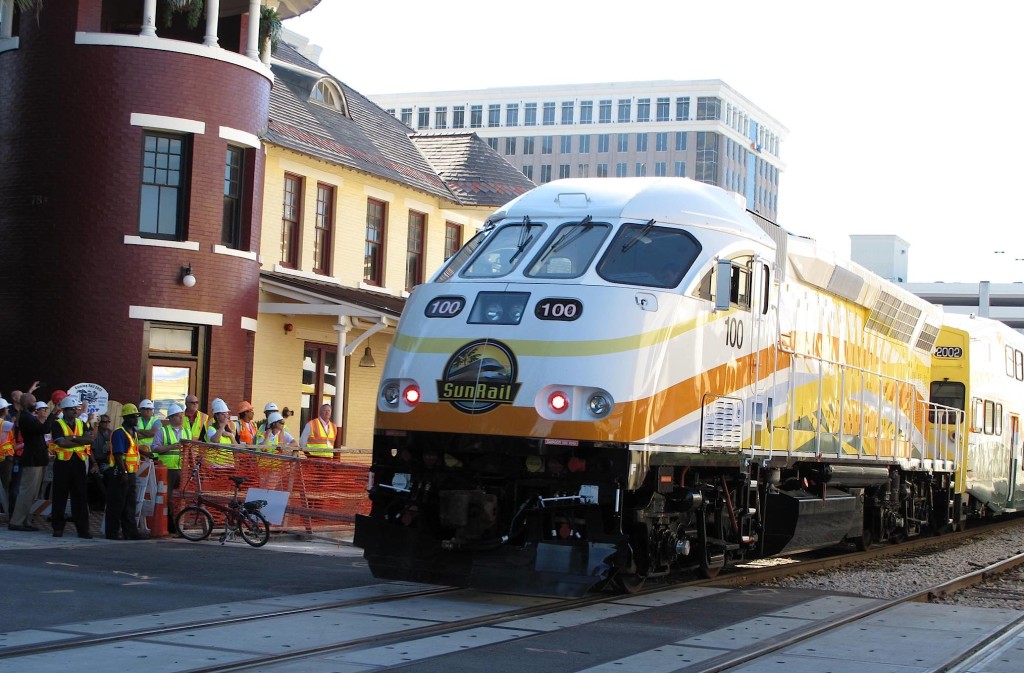
A SunRail train in downtown Orlando

Brightline service, which now connects Miami with Fort Lauderdale and West Palm Beach, is planning an extension to Orlando, hoping to open it in 2022.

While the Florida metro areas of Miami-Fort Lauderdale, Tampa Bay and Jacksonville are known for their beaches, Orlando is considerably inland. The closest beach town is Cocoa Beach, 60 miles to the east, near Cape Canaveral.

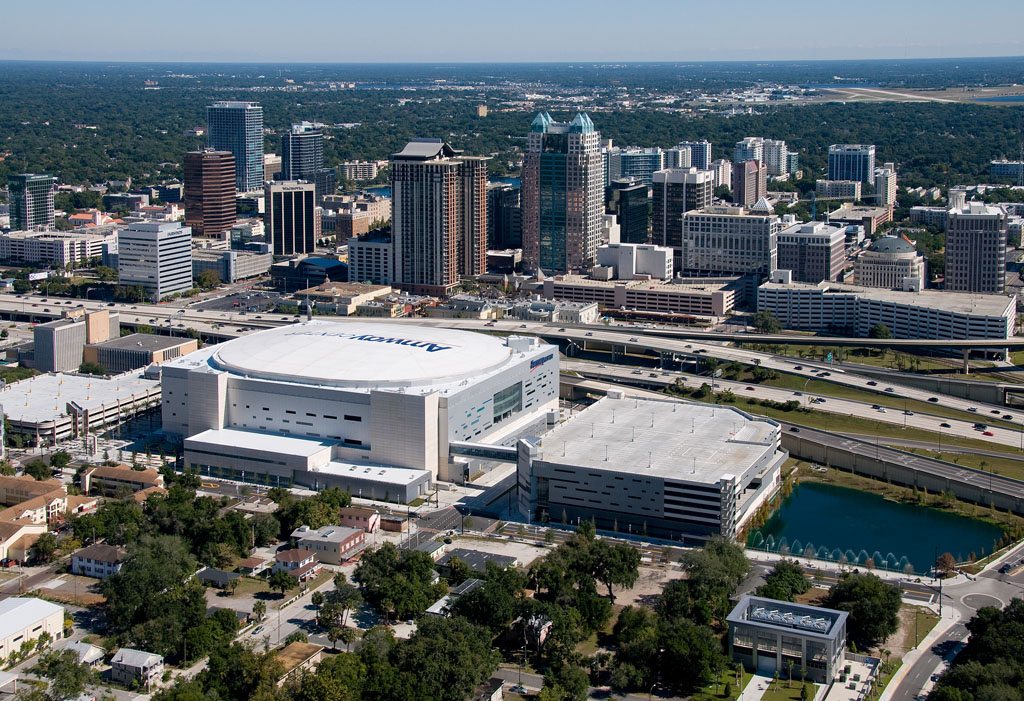
Going In. The official address of the Amway Center is 400 W. Church Street. It is bordered by Church Street, Hughey Avenue, South Street and Division Avenue. Parking can be as little as $5.00.
The arena opened in 2010, with a concert by Vicente Fernandez, "the King of Ranchero Music." It is also home to the Orlando Solar Bears of minor-league hockey, and was also the home of the now-defunct Orlando Predators of arena football.

The court is laid out north-to-south. Like the Boston Celtics, the Magic use a "parquet" floor. The Magic are owned by Amway chairman Rich DeVos, hence his company's name on both this arena and its predecessor.
Food. Florida is Southeastern Conference territory, where tailgating is a holy rite. Unfortunately, I had trouble accessing the arena website to get details. Here's the link, and you can check for yourself. According to Google Maps, Magic Grill is in the northwest corner of the arena.

Team History Displays. The Magic's history is short: They've only been playing since 1989 -- and yet, they're already on their 2nd arena. They won the Eastern Conference Championship in 1995, but after getting beaten by the Houston Rockets in the NBA Finals and the Chicago Bulls in the next season's Eastern Conference Finals, they were broken up. The dynasty that Shaquille O'Neal, Anfernee "Penny" Hardaway and Scott Skiles (now their head coach) were supposed to build never happened.

History repeated itself in the late 2000s: The Magic reached the Finals again, but lost to the Los Angeles Lakers, didn't get back in 2010, and the team of Dwight Howard and J.J. Redick was soon broken up.

The Magic hang banners for their 1995 and 2009 Conference titles, and for their Division titles of 1995, 1996, 2008, 2009, 2010 and 2019.
The Magic have retired just 1 number. It's not 32 for center Shaquille O'Neal. (Although no one currently wears that number.) It's not 1, worn by both guard Anfernee "Penny" Hardaway and guard Tracy McGrady. (Jonathan Isaac wears it.) It's 6, for the fans, as "The Sixth Man."

There aren't a whole lot of options. The only Hall-of-Famers they've got are Shaq, who played his 1st 4 seasons with the Magic; Tracy McGrady, who played 4 seasons with them; Dominique Wilkins and Patrick Ewing, each of whom played just 1 season for them, at the ends of their careers; Grant Hill, who played 7 seasons for them but is better remembered as a Detroit Piston; the newly-elected Ben Wallace, early in his career, and also better known as a Piston; and Chuck Daly, whose 2 years with them were the last of his coaching career -- and, again, also better known for his work with the Pistons. Ewing and O'Neal are the only members of the NBA's 50th Anniversary 50 Greatest Players to have played for the Magic.

(UPDATE: Ewing, O'Neal, and Dominique Wilkins, briefly with the Magic in 1999, were named to the 75th Anniversary 75 Greatest Players.)

The Magic do have a team Hall of Fame. It includes Shaq, Penny, McGrady, guards Nick Anderson (Number 25) and Darrell Armstrong (10), team founders Jimmy Hewitt and Pat Williams, broadcaster David Steele, and the late owner Richard DeVos, father-in-law of former U.S. Secretary of Education and Trump toady Betsy DeVos.

As is often the case with intrastate matchups in Florida, the Magic's biggest rivalry is with the Miami Heat. The Magic trail, 71-58. They've played each other in the Playoffs once, with the Heat eliminating the Magic in the 1st Round in 1997.

The Florida Sports Hall of Fame is located at Lake Myrtle Sports Park in Auburndale, 44 miles southwest of the Amway Center. From the Magic, they have honored Nick Anderson and Pat Williams.

Stuff. The Magic Team Shop is in the northeast corner of the arena. The usual NBA team paraphernalia can be found there.

With a short and weak history, there aren't many books written about the Magic. Pat Williams' the team's 1st general manager, wrote Making Magic: How Orlando Won an NBA Team, published in 1989, a few weeks before the team played its 1st regular-season game.

But plug "Orlando Magic" into the Books section of Amazon.com, and the only other book you'll get (not counting team calendars) is Brian Schmitz' tale of the 2008-10 team that didn't quite make it falling apart, Dwightmare: Dwight Howard, the Orlando Magic, and the Season of Dysfunction. Part of the problem is the reason the team is named the Magic: Disney World is known as the Magic Kingdom, and that's how the team got its name. Aside from Believe: The Remarkable Run of the 1995 Eastern Conference Champion Orlando Magic, there aren't any worthwhile vidoes about the team, either.

During the Game. A November 13, 2014 article on DailyRotoHelp ranked the NBA teams' fan bases, and listed the Magic's fans as 26th -- 5th from the bottom. It says the arena is "as quiet as a golf course," cites a senior-citizen fan base (ex-New Yorkers hoping to find the new Clyde & Pearl, and their hopes aren't realized?), and tourists to Central Florida not having the time or the money to also squeeze in a pro basketball game.

This is the South, but it's not football. And it's not the Miami Heat: There is no rivalry between the Knicks and the Magic. Or the Nets and the Magic. You're not going to be in physical danger unless you provoke someone. So don't do that.

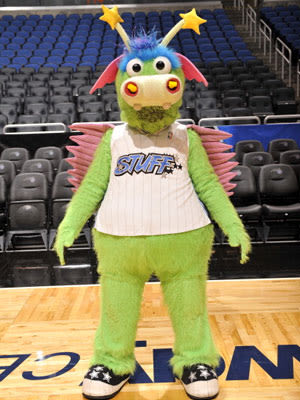
Neither of the Knicks' visits this season, nor either of the Nets' visits, will feature a promotion. The Magic's mascot has (sort of) a magic theme: Stuff the Magic Dragon. He's won the NBA Mascot of the Year award in 2016 and 2017.

They hold auditions for singing the National Anthem, instead of using a regular singer. Their theme song is "We Will" by Team Takeoff. The fans' main chant is a takeoff on a Florida State chant: "O-R-L-A-N-D-O M-A-G-I-C (WHAT WHAT) MAGIC! MAGIC! MAGIC! WOOOO!"
After the Game. Orlando is not known as a high-crime city. You should be safe going out, and, if you drove to the game, you car should be in one piece.

A block west of the arena, at Church Street and Terry Avenue, there are 3 restaurants that should be open after the game: Chef Eddie's, Johnson's Diner, and Flamingo's Coffee Shop. But I was not able to find any place to eat or drink that is known to cater to New York teams' fans.

If you visit Orlando during the European soccer season, your best bet is The Harp and Celt, 25 S. Magnolia Avenue, downtown.

Sidelights. Orlando doesn't have much of a sports history. And if you're not interesting in going to the nearby theme parks, there's not a whole lot to do there except experience serious humidity in late November.

* Site of Orlando Arena. "The O-rena" was the Magic's home from their 1989 beginnings until 2010, and also hosted the Solar Bears, the Predators, and, from 1999 to 2002, the Orlando Miracle of the WNBA. (The team moved to become the Connecticut Sun. Funny how they became the Sun after moving from Florida to New England, instead of the other way around.)
The Magic played the 1995 and 2009 NBA Finals at this building, later renamed the TD Waterhouse Center and the Amway Arena. It was a major venue for Arena Football, hosting the ArenaBowl in 1992, 1994 and 2000. The Orlando Predators won the ArenaBowl in 1998 and 2000.

But it opened right before the design of Baltimore's Camden Yards rewrote the rules for sports venues. The skyboxes had the worst sightlines in the arena, and many of them went unleased, denying the Magic precious megarevenues.

As early as 2000, Rich DeVos started whining to the City of Orlando about building him a new arena, even though he's worth $6 billion and could have funded building the $480 million arena he eventually got all by himself -- 12 times over. The O-rena was imploded in 2012, and the site is being redeveloped for both residential and office space. 600 W. Amelia Street at Alexander Place, downtown, about 7 blocks north of its replacement.

* Citrus Bowl and Tinker Field. This complex includes an old football stadium and an old baseball park. Opened in 1936 as Orlando Stadium, the horseshoe, open at the north end, became the Tangerine Bowl in 1946, and from 1947 onward (with the exception of 1973, when it was held at the University of Florida) hosted the game of the same name, often on New Year's Day, which was renamed the Florida Citrus Bowl in 1983.

It seated a mere 8,900 people at its opening, and just 15,900 as late as 1975. But a major expansion boosted it to 52,000 the next year, and 65,438 in 1989. A 2014 renovation, complete with wider seats, brought the total down to 60,219, which still gives in more seats than 1 current NFL stadium, the Oakland Coliseum.
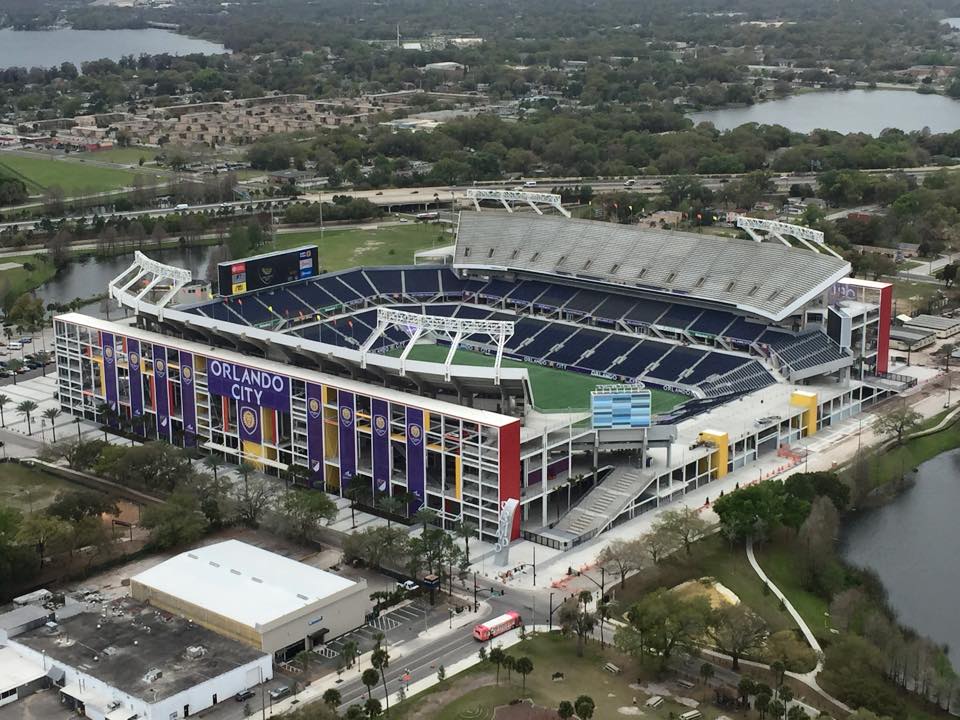
The stadium actually hosts 3 bowl games: The Citrus Bowl, the Russell Athletic Bowl, and, starting this year, the AutoNation Cure Bowl, raising money for breast cancer research. Since 1997, it's hosted the Florida Classic, between historically black schools Florida A&M and Bethune-Cookman -- a copy of New Orleans' Bayou Classic between Grambling State and Southern University. It has been selected by the U.S. Soccer Federation as a finalist to be one of the host venues for the 2026 World Cup.

Orlando has never had a team in the NFL, unless you count the Orlando Breakers on the sitcom Coach in the 1995 and 1996 seasons. Real pro football teams that have played there include the Orlando Broncos of the Southern Football League (1962-63), the Orlando Panthers of the Continental Football League (1966-70), the Florida Blazers of the World Football League (1974), the Orlando Renegades of the USFL (1985), the Orlando Thunder of the World League of American Football (1991-92), and the Orlando Rage of the XFL (2001).

According to the September 2014 issue of The Atlantic, even though the Tampa Bay Buccaneers are 88 miles from downtown Orlando and the Miami Dolphins are 222 miles away, and the Buccaneers won the Super Bowl last season while the Dolphins are now 48 seasons without a title, the Dolphins remain the most popular NFL team in the Orlando area. (The Tampa Bay Lightning, 85 miles away and coming off a Stanley Cup Finals berth, are the closest and most popular NHL team.)

Orlando City Soccer Club played there from 2011 to 2016. The Bowl hosted 5 games of the 1994 World Cup, and 8 matches -- 5 men's, 3 women's -- in the 1996 Olympics (mostly based in Atlanta). It hosted the 1998 MLS All-Star Game, and 3 games of the U.S. national team, most recently in 1998, resulting in a win and 2 draws.

Just to the west of the Bowl, Tinker Field opened in 1914. It was the longtime spring training home of the Washington Senators/Minnesota Twins franchise, and when the stadium was rebuilt in 1963, seats from Griffith Stadium were added to it, since the Senators had moved to Minnesota and the new Senators had moved into RFK Stadium.
Pennants in the Class A Florida State League were won by the 1919 and 1926 Sanford Celeryfeds; the 1921 Orlando Tigers; the 1923 Orlando Bulldogs; the 1927 Orlando Colts; the 1938 and 1941 Leesburg Anglers; the 1939 Sanford Lookouts; the 1940 Sanford Seminoles; the 1946, 1948 and 1950 Orlando Senators; the 1951 and 1952 DeLand Red Hats; the 1955 Orlando C.B.s; the 1968 Orlando Twins; and the 1999 Kissimmee Cobras.

Pennants in the Class AA Southern League were won by the 1981 Orlando Twins, the 1991 Orlando Sun Rays, and the 1999 Orlando Rays. That's 20 Pennants for Orlando.

The Orlando Rays moved to Alabama after the 2003 season, becoming the Montgomery Biscuits. Despite metropolitan Orlando having a population greater than 8 MLB markets (St. Louis, Tampa Bay, Baltimore, Denver, Pittsburgh, Kansas City, Cincinnati and Milwaukee), it has been without professional baseball since the Aaron Boone Game.

Rumors of the Tampa Bay Rays moving to Orlando if they can't get a new stadium either in Tampa or St. Petersburg continue to swirl, but if they ever do move, it probably won't be to Orlando, not to the Tinker Field site or to the 9,500-seat Champion Stadium on the Disney World campus.

Unfortunately, the recent renovation of the Citrus Bowl meant that the 100-year-old Tinker Field ballpark would have a right field that was much too short, and it was torn down earlier this year. It seated 5,100 people at the end. 1610 W. Church Street at Rio Grand Avenue, 12 blocks west of the Amway Center.

According to an April 24, 2014 article in The New York Times, despite being 106 miles away -- or, perhaps, because they aren't much closer -- the Rays only get about 10 percent of MLB fandom in the Orlando area. The Boston Red Sox get about 15 percent. And the Yankees average about 30 percent.

Despite its growing metropolitan area population, Orlando would still rank only 24th in MLB, 21st in the NFL, and 20th in the NHL.

* Exploria Stadium. Known from its February 24, 2017 opening until June 4, 2019 as Orlando City Stadium, the new home of Orlando City SC and their sister club the Orlando Pride hosted the 2017 NCAA women's soccer Final Four.

It is also a regular outpost for the national teams: The men's team beat Panama 4-0 there in a World Cup Qualifier on October 6, 2017 (for all the good it did), and beat Ecuador 1-0 on March 21, 2019. The women's team beat England 1-0 there in the SheBelieves Cup on March 7 of this year. 655 W. Church Street at Glenn Lane, downtown, between the Amway Center and the Citrus Bowl complex.
* Bounce House. This 44,206-seat stadium, now named for the cable TV company (and having no connection to the old Philadelphia 76ers and Flyers arena) opened on the University of Central Florida campus in 2007.
Formerly named Bright House Networks Stadium and Spectrum Stadium, it has a flexible seating section that can safely allow students to bounce, similar to the effect of the metal seating in the west end zone at RFK Stadium in Washington, giving it the nicknames the Bounce House and the Trampoline.

4465 Knights Victory Way at Plaza Drive, 16 miles northeast of downtown. Any bus that goes to Lynx Central Station Terminal, then Bus 104.

* Site of Orlando Sports Stadium. Like the Chicago Stadium and the Olympia Stadium in Detroit, this "stadium" was actually an arena, opening in 1967. It was later renamed the Eddie Graham Sports Complex, after a pro wrestler and promoter, since pro wrestling was its main feature. But it was also a major concert venue, hosting Led Zeppelin in 1971, Bob Dylan's Rolling Thunder Revue in 1976, and, on February 15, 1977, Elvis Presley.

The building was not well maintained, and was demolished in 1995. A housing development named Econ River Estates is now on the site.

In addition to the preceding, Elvis sang in the Orlando area at the Orlando Municipal Auditorium on May 11, July 26 and 27, 1955,  and August 8, 1956; at the Peabody Auditorium in Daytona Beach on May 7 and July 30, 1955, and August 9, 1956; and at the Southeastern Pavilion in Ocala on May 10, 1955.

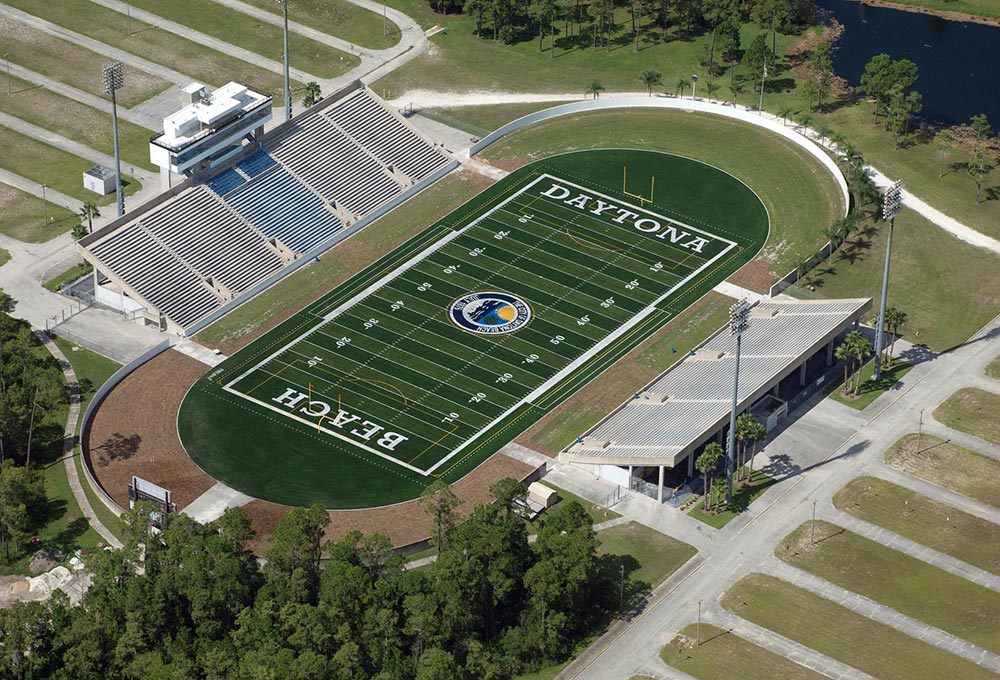
Speaking of Daytona Beach, it has an importance in sports. No, not NASCAR: Auto racing is not a sport. Daytona is the home of Bethune-Cookman University, one of the leading football programs among historically black colleges and universities (HCBUs). The Wildcats have won 4 black college National Championships: 2002, 2010, 2012 and 2013. They've produced a few NFL players, including Miami Dolphins Super Bowl and Hall of Fame guard Larry Little. They play at the 10,000-seat Daytona Beach Municipal Stadium.
* Theme Parks. Disney World is 17 miles southwest of downtown Orlando, and, like its counterpart Disneyland in Anaheim, California, is a bit of a walk from the nearest public transportation. It's definitely a car place, although it does have a monorail on the grounds.

Sea World can be reached by public transit: SunRail from Lynx Central Station Terminal to Bus 50. 7007 Sea World Drive, 14 miles southwest. Universal Orlando Resort (formerly Universal Studios Orlando) can be reached from downtown via Bus 40: 6000 Universal Blvd., 8 miles southwest.

Orlando isn't big on museums, but there are 3 that may be worth a look. The Orange County Regional History Center is at 65 E. Central Blvd. at Court Avenue. The Orlando Science Center and the Mennello Museum of American Art are both in Loch Haven Park, at 777 E. Princeton Street. SunRail to Florida Hospital Health Village.

No President has ever come from Florida. Two men who served as Governor ran for the Democratic Party's nomination for the office, but neither came particularly close to the nomination: Reubin Askew dropped out after the 1984 New Hampshire Primary, and Bob Graham didn't even make it to calendar year 2004, much less the Iowa Caucuses.

The Beatles never performed in Orlando, but, as I said, Elvis did, toward the end. Toward the beginning, on May 11, 1955, Elvis did 2 shows at the Municipal Auditorium. He performed there again on July 26 and 27, 1955, and twice on August 8, 1956. The building is now named the Bob Carr Theaer, for the Mayor who desegregated the city in the 1960s. 401 W. Livingston Street at Hughey Avenue, downtown, about 5 blocks north of the Amway Center.

The University of Florida is in Gainesville, 113 miles northwest of downtown Orlando. Florida State University is in the State capital of Tallahassee, 258 miles northwest.

Miami has several skyscrapers. Tampa has a few. Orlando really doesn't. The tallest building in town is the SunTrust Center, 441 feet high, at 200 S. Orange Avenue at Church Street, 3 blocks (counting I-4) east of the Amway Center. A 450-foot building called the Orlando Starflyer is now under construction, but is not expected to open before 2022.

Outside of the Orlando-area theme parks, the biggest tourist attraction in Central Florida is the John F. Kennedy Space Center at Cape Canaveral, 45 miles east of Orlando, on the Atlantic Coast. You'll have to drive: Public transportation simply isn't available.

Aside from Coach, which used stock footage of the Citrus Bowl (as it had with the University of Iowa, standing in for the fictional Minnesota State) but was filmed in Southern California, there haven't been many TV shows set in Orlando, aside from sitcoms doing the trope of the family going to Disney World for a two-parter. Fresh Off the Boat, a period-piece sitcom based on the late 1990s youth of Taiwanese-American chef Eddie Huang, is set in Orlando.

A few movies have been set at Disney World, including the recent George Clooney film
Tomorrowland, but the only movie I know of filmed and set in Orlando proper, rather than in Mickeystan, is Ernest Saves Christmas, part of Jim Varney's Ernest P. Worrell ("Hey, Vern!") franchise. Christmas in Orlando? Could be worse: Could be Christmas in Miami. Or Christmas in Vegas.

*

So if you're going to Orlando, take in a Knicks vs. Magic, or Nets vs. Magic, game. Who knows, you might have a good time even if you never set foot in "The Happiest Place On Earth." 

Tuesday, July 14, 2020

Top 10 Sports Teams That Should Change Their Names (Following the Decision to Do So By the Washington Redskins)

Yesterday, with bigotry still very much in the news following the murder a few weeks ago of George Floyd, a black man in Minneapolis, by an officer of that city's police department, the NFL's Washington Redskins released a statement announcing that their team name and logo, often considered offensive to Native Americans would be changed.

They are doing so in reflection of this atmosphere, but also noting that one of their minority owners is Frederick W. Smith, founder and CEO of Federal Express, who owns the naming rights to their current stadium, FedEx Field. He said he would cancel his sponsorship of the team and the stadium if the name was not changed.

Smith is from Memphis, about to turn 76. When an old white man from the city where Dr. Martin Luther King was shot and killed by (it is widely, but not universally, believed) a white supremacist says something is bigoted and needs to be changed, that says something.

Nike and PepsiCo have also urged the name change, and Target and Walmart have removed Redskins merchandise from their stores. Those companies, and also Amazon, have removed Redskins merch from their websites.

Daniel Snyder, who bought the team from the family of the late owner Jack Kent Cooke in 1999, said he wouldn't change the name, that it was too tied into the history of both the NFL and the Washington, D.C. area, and that there were Native American groups supporting the name.

Some changes had already been made. The 'Skins are one of the few NFL teams with a well-known fight song, "Hail to the Redskins." There was a line in it, "Scalp 'em," which was replaced by "Beat 'em." Many fans had gone to games wearing "Indian headdresses" and war paint, but this has decreased in recent years.

(So has the wearing of plastic pig masks and rubber pig snouts, as we get further away from the 1980s, when the team's excellent offensive line was known as the Hogs. The man who coached that line, Joe Bugel, died a few days ago. He had also once been the head coach of the Arizona Cardinals.)

But such names have fallen by the wayside in recent years. In 1972, Stanford University dropped Indians as its name in favor of Cardinal -- the color, not the bird, so no S on the end. In 1974, Dartmouth College dropped "Indians" for a color as well: The Big Green. In 1996, Miami University of Ohio dropped Redskins for RedHawks.

And in 2018, after decades of disapproval, Major League Baseball's Cleveland Indians dropped Chief Wahoo, a mascot with bright red skin (unlike the Washington Redskins' logo, which had dark red skin that at least resembled something biologically possible). Terry Pluto, the great columnist for The Plain Dealer, Cleveland's largest newspaper, wrote last week that he expects the Indians to drop that name entirely after the 2021 season, as soon as it's contractually allowable.

(UPDATE: Pluto turned out to be right. In 2021, the Indians announced that their new name for 2022 onward would be the Cleveland Guardians. Because this was anticipated, I did not include them on this list.)

Some Native-themed team names don't face the same pressure. Florida State University has a working agreement with the Seminole tribe, so their Seminoles name and Chief Osceola live mascot are staying put. But the University of Illinois, which calls its teams the Fighting Illini, have had to alter their Chief Illiniwek mascot to make him more authentic, and still face calls for the character's retirement.

The National Hockey League's Chicago Blackhawks released a statement saying that their name honors Black Hawk, a Native chief of the early 19th Century, who waged war against the U.S. Army, but was considered an honorable warrior. The Kansas City Chiefs are the reigning NFL Champions, and they aren't dropping their name, because a Chief suggests leadership. Nor are the Atlanta Braves changing theirs, because "Brave" suggests a noble warrior.

It's been suggested that no one would put up with the name "New York Jews," "Philadelphia Paisans," or "Chicago Negroes." This is certainly true. But what about the National Basketball Association's Boston Celtics? And there's an old joke: What do you call 6 black guys, 3 Italians and 2 Poles playing football? "The Fighting Irish." No organized group is telling the University of Notre Dame to drop that name.

And the NFL's Minnesota Vikings were named in honor of the Upper Midwest's large Scandinavian community. Should that name be changed? As the sign in this photo suggests, maybe not.
Disclaimer: I went to a junior high school in East Brunswick, New Jersey, which opened in 1961, around the time that Dag Hammarskjöld, the Swedish diplomat then serving as Secretary-General of the United Nations, was killed in a plane crash. So the school was named for him, and, in reflection of his nationality, the teams were named the Vikings. Nearby, South Brunswick High School is also the Vikings, but my alma mater, East Brunswick, is the Bears.

But the pressure on Snyder to change the Redskins name had grown intense. Accepting this, Snyder announced "a thorough review of the name." Yesterday, this announcement was made:

On July 3rd, we announced the commencement of a thorough review of the team’s name. That review has begun in earnest. As part of this process, we want to keep our sponsors, fans and community apprised of our thinking as we go forward.
Today, we are announcing we will be retiring the Redskins name and logo upon completion of this review.
Dan Snyder and Coach Rivera are working closely to develop a new name and design approach that will enhance the standing of our proud, tradition rich franchise and inspire our sponsors, fans and community for the next 100 years.
Almost immediately, this decision was praised by one of the biggest sports sponsors in the world, Anheuser-Busch Breweries; and ripped by the usual conservatives who get so easily offended while simultaneously talking about how liberals are so easily offended.

The Redskins name will stay throughout the 2020 season -- assuming, given the Coronavirus situation, there is one. The new name will be in place for the 2021 season. They will, however, be keeping the team's familiar burgundy and gold color scheme.

(UPDATE: Instead, they immediately dropped "Redskins," and became simply "The Washington Football Team." They didn't decide on a new name going into the 2021 season, and remained "The Washington Football Team." Similarly, the Canadian Football League's Edmonton Eskimos dropped their name, briefly becoming "The Edmonton Football Team," before adopting "Edmonton Elks," allowing them to express a sense of strength and the great Canadian outdoors, and to keep their "EE" helmet logo.)

Already, the favorites for the new name seem to be Redwolves and Redtails -- not least because it would keep the R initial. Redwolves suggests strength in the pack, and has connotations of being wild and independent.
A sample Redwolves logo

It would also be fairly easy to change the fight song: Instead of "Braves on the warpath," it could be "Beasts on the prowl."

Redtails is seen as a tribute to the planes flown by the Tuskegee Airmen, the all-black flying unit of World War II. But this would be a bad idea: It would make people think of an old sports term, "Red Ass," sometimes abbreviated to "R.A.," meaning a player who's always in a bad mood.

It also occurred to me that, once this name change takes effect, the oldest team name in D.C. major league sports will be the NHL's Washington Capitals. They've had that name since their inception in 1974. When the Montreal Expos moved to Washington after the 2004 season, they didn't take the name of the previous team that had moved in 1971, the Washington Senators. They became the Washington Nationals.

The NBA's Washington team began in 1961, as the Chicago Packers. But, given the rivalry between the NFL's Chicago Bears and Green Bay Packers, this was seen as silly. So, after just 1 season, they became the Chicago Zephyrs. But they lost money, and after just 1 more year, they moved to Baltimore, taking the name of that city's former NBA team, the Baltimore Bullets. It was alliterative, and spoke of speed and damage-causing ability.

But in 1973, they moved down the Baltimore-Washington Parkway. In 1997, tired of hearing that Washington was "the murder capital of the world," dropped the name Bullets and became the Washington Wizards.

*

Top 10 Sports Teams That Should Change Their Names

Dishonorable Mention: Every team in Major League Soccer whose "mascot" is simply "FC" (for "Football Club") or "United." I know it's hard coming up with a good one, but show some imagination.

Also, in many cases in England, where the practice began, calling a team "United" meant it was a merger of two different teams. That is not the case in any team currently in MLS.

Dishonorable Mention: The Boston Red Sox, the Houston Astros and the New England Patriots. These teams' names have been forever tainted by the organization's blatant cheating.

10. Orlando Magic. I get it: The Orlando area is most famous for being the home of Walt Disney World, "The Magic Kingdom." But what was wrong with "Magicians"? The Washington NBA team hadn't yet adopted "Wizards," and even if they had, the existence in the NFL of "Raiders" didn't stop a football team in Florida from taking the name "Buccaneers." (More about that a little later.) Nor did the existence of the Baltimore Colts prevent the Denver Broncos, nor multiple names for cats and birds.

One of the offshoots of the Harlem Globetrotters was named the Harlem Magicians, but the Globies' organization, which also owns the rights to the name of the team's official usual opponents, the Washington Generals, didn't sue the USFL when it named a team the New Jersey Generals.

When the team name was announced in 1987, along with the other 1988 and '89 expansion teams, including their Florida arch-rivals, the Miami Heat, Rick Reilly wrote in Sports Illustrated that, given that the biggest star in the NBA at the time was Earvin "Magic" Johnson, there should be a player named Magic Orlando.

(He also joked about the Heat name: Instead of the very sharp logo of a flaming basketball going through a hoop, he said the logo might be a fat guy sunning himself on a beach. Also, he asked, What is one "Heat" called? He imagined a woman telling a friend, "I met the cutest guy. He plays basketball in Miami. He says he's a Hot.")

9. Brooklyn Nets. Renaming the American Football League's New York Titans the Jets made sense: It rhymed with Mets, and, for the foreseeable future, they were going to be sharing a stadium that was located near LaGuardia Airport.

Naming a basketball team the Nets, just so that it rhymed, was stupid. And, given that all 3 teams have been joke franchises -- since 1986, the teams are 0-4 in finals between them -- why would the NBA team want to be associated with the Mets and the Jets?

It was even worse with World Team Tennis, which began in 1974: The local team was named the New York Sets. This was dumped in 1977, in favor of New York Apples, since New York City is "The Big Apple." But the league folded in 1978.

8. Buffalo Bills. The AFL team that began in 1960 was actually the 2nd team with the name. The 1st was in the All-America Football Conference of 1946-49. At that point, there were still living people who remembered William F. Cody, a.k.a. Buffalo Bill. And the musical based in part on his Wild West Show, Annie Get Your Gun, included a song titled "Colonel Buffalo Bill."

But he got that name from hunting buffaloes. He had no connection to the city of Buffalo, New York, whose name also has nothing to do with buffaloes. It's an English corruption of "beau fleuve," the French name for the Niagara River. So calling a team "the Buffalo Bills" is stupid. So is the name used for their minor-league baseball team and for former teams in basketball and hockey: "The Buffalo Bisons."

7. Philadelphia Phillies. What the hell is a "Phillie"? It makes it sound like "filly," a young female horse. Even their longstanding Class AA team, formerly the Reading Phillies, has dropped that name, in favor of "The Reading Fightins," for the major league team's occasional nickname, the Fightin' Phils.

6. Indianapolis Colts. The name "Colts" belongs to Baltimore. Also, just as a "filly" is a young female horse, a "colt" is a young male horse. It suggests speed, but also immaturity. And, while we're at it...

5. Chicago Cubs. A young bear? True, it inspired the name of the football team, the Chicago Bears. That sounds strong and fearsome. "Cubs" does not.

4. Collectively, the Pirate Teams. The Pittsburgh Pirates, the Tampa Bay Buccaneers, and the Whatever City They're In This Year Raiders. Pirates had to be tough just to survive. But they tended to be vicious killers and thieves. Not something to celebrate.

3. The Los Angeles Lakers. They started in 1947 as the Minneapolis Lakers, as Minnesota is "The Land of 10,000 Lakes." That made sense. But they moved to Los Angeles in 1960, and there's no notable lake anywhere near Los Angeles. The Pacific Ocean, yes; a notable lake, no.

2. The Utah Jazz. They started in 1974 as the New Orleans Jazz. That made sense, if you can get past the idea of ending a team name with a Z instead of an S, and being named after a form of music rather than something that fights and wins.

But they moved to Salt Lake City in 1979. Basketball has been compared to jazz by people like Woody Allen and Wynton Marsalis, because of its use of improvisation and quick thinking. Basketball star Bill Walton, a fan of The Grateful Dead, made an interesting comparison of them to a basketball team in his memoir, including the improvisation angle. But the only music acts Utah is known for are the Mormon Tabernacle Choir and the Osmond family. Great skill, but not much in the way of improvisation or individuality.

Frank Layden, who coached the Jazz from 1981 to 1988, noted that Utah has the Great Salt Lake, and Los Angeles is the West Coast's jazz hub, and suggested that the teams simply switch names: The Los Angeles Jazz and the Utah Lakers. Neither team's management took him up on it.

1. Los Angeles Dodgers. It was bad enough that team owner Walter O'Malley moved them out of Brooklyn in 1957. But he took the Dodgers name with him. Yes, it was the 2nd-most familiar team name in baseball at the time, behind the Yankees. But it was universally identified with Brooklyn. It was short for "Trolley Dodgers." What does anybody dodge in L.A.? The cops? Drive-by shootings by gangs?

Maybe we should call them "The Los Angeles Baseball Team." And if the Los Angeles Angels have a problem with that, well, they're in neither the City of Los Angeles nor the County of Los Angeles.

But then, in November 1986, I visited Orlando, and the football picks guy in the Orlando Sentinel referred to the "East Rutherford Giants" and the "East Rutherford Jets." He said, "It's funny how these East Rutherford teams always end up on television. It must be some town."

Thursday, November 15, 2018

How to Be a New York Basketball Fan In Orlando -- 2018-19 Edition

The New York Knicks visit the Orlando Magic this coming Sunday, and again on April 3. The Brooklyn Nets do so on January 18 and February 2.

Before You Go. Florida must be where the saying, "It's not the heat that's so bad, it's the humidity" was first used. Indeed, when Miami got its expansion baseball team in 1991, someone joked that, since they already had the Heat, a basketball team that was then so bad, the baseball team should be named the Miami Humidity. (It was named the Florida Marlins instead, and is now the Miami Marlins.)

Orlando isn't as far south as Miami, but I've been there in November, and the place simply doesn't recognize what the calendar says for the Northeast. It can be 85 degrees and 100 percent humidity. It can be unbearable. The Orlando Sentinel website currently has (at this writing) temperatures ranging from 81 to 89 throughout the metro area.

For this week, the temperature is expected to be in the low 80s during daylight, and in the low 60s at night. So don't dress as you would for a chilly, blustery November day weekend in N'Yawk or N'Jersey: Prepare for Summer, maybe early Autumn.

Orlando is in the Eastern Time Zone, so you won't have to fool with your timepieces. Florida was part of the Confederate States of America, and Central Florida (outside of Disney World itself, which is its own fiefdom under "Uncle Walt," who was very conservative) is still very much Southern, but you won't need to bring your passport or change your money (although Disney World does use "Disney Dollars" as coupons).

Tickets. The Magic averaged 17,893 fans per home game last season, only about 95 percent of capacity. It is possible that, despite the growth of the Central Florida market, Orlando simply can't support a major league team in any sport. (The soccer team Orlando City SC has done well at the box office, but that may be due to the novelty of having an expansion team, and some people don't count MLS as "major league" anyway.)

It's why Tampa Bay got a baseball team in 1998 and a hockey team in 1992, and Jacksonville got an NFL team in 1995, and Orlando got none of those. Most of the single-team markets have an NBA team. (Jacksonville is the only metropolitan area with only an NFL team.)

Seats in the lower level, the 100 sections, are $207 between the baskets and $62 behind them. In the upper level, the 200 sections, they're a lot cheaper, $43 between and $17 behind.

Getting There. It's 1,080 miles from Times Square to downtown Orlando. Reading this, your first thought is going to be to fly.

Amazingly, you can get a round-trip nonstop flight on United Airlines, going down this Sunday, and the day of the game, and coming back on Monday, for just $209. This turns out to be a bargain by anyone's standards, especially when you see the Orlando airport and its fantastic monorail. The only problem is, you've got to start at Newark Airport. At least they've finally built their monorail. (Most likely, though, the fare will be higher.)

(Orlando International Airport's airport code of MCO comes from its former status, up until 1975, as McCoy Air Force Base, named for Colonel Michael Norman Wright McCoy, a hero pilot of World War II who was killed in a crash at what was then named Pinecastle Air Force Base in 1957.)

Amtrak's Silver Meteor leaves New York's Penn Station at 3:15 PM, and arrives in Orlando at 12:49 the following afternoon, a 21-and-a-half hour trip. It's $390 round-trip -- this time, it could be more than flying. Be advised that the Florida trains, the Silver Meteor and the Silver Star, are notoriously late on their returns to the Northeast Corridor. So flying is the better option. The Amtrak station is at 1400 Slight Blvd. at Copleand Drive, downtown.

Greyhound runs 5 buses a day from New York's Port Authority Bus Terminal to Orlando, with a round-trip fare of $348, but it can drop to $243 with advanced purchase. This trip takes 25 hours, with a change of buses and an hour-and-a-half layover in Richmond, which is not fun. So far, flying remains the better option, which is a rarity on these Trip Guides. The Greyhound station is at 555 N. John Young Parkway. 2 miles west of downtown. Number 25 bus.

If you do prefer to drive, see if you can get someone to split the duties with you. Essentially, you'll be taking Interstate 95 almost all the way down. At Exit 260, take Interstate 4 West, and Exit 82B for downtown Orlando.

It should take about 2 hours to get through New Jersey, 20 minutes in Delaware, an hour and a half in Maryland, 3 hours in Virginia, 3 hours in North Carolina, 3 hours in South Carolina, 2 hours in Georgia, and about 2 hours and 45 minutes in Florida. Given proper 45-minute rest stops – I recommend doing one in Delaware, and then, once you're through the Washington, D.C. area, doing one when you enter each new State, and then another around Orlando, for a total of 7 – and taking into account city traffic at each end, your entire trip should take about 23 hours -- faster than Greyhound, but not faster than Amtrak.

Once In the City. Founded as Jernigan in 1875, and home to about 277,000 people with a metropolitan area of over 3.1 million, Orlando was named for Orlando Reeves, an American soldier who was killed within what is now the city limits during the Second Seminole War in 1835.

There's just one problem: It never happened. There was no fighting in said war in what's now the Orlando area, and the only Orlando Reeves who lived nearby owned a plantation with a sugar mill on it. He carved his name in a tree, and somebody presumed later on that he must have been buried there. How he became a war hero, who knows. Maybe it was Southern pride, something the locals tried to cling to after General Sherman kicked the Confederacy's redneck ass.

The sales tax in Florida is 6 percent, and an additional 6 percent is placed on all hotel rooms. ZIP Codes in the Orlando area start with the digits 321, 327, 328, 329 and 347. The Area Code is 407, with 321 overlaid. Central Blvd. divides city addresses into North and South, and Orange Avenue divides them into East and West. Orlando has no "beltway."

The Orlando Utilities Commission runs the electricity. The city's population is about 41 percent white, 29 percent Hispanic, 25 percent black, and 4 percent Asian. The city's white and Hispanic neighborhoods are fairly well mixed, but the black population is mostly on the city's west side.

Lynx is the local bus service. A single ride is $2.00. In 2014, Orlando began their SunRail commuter service, which, in late 2017, will extend, north-to-south, from DeLand in the north to Poinciana in the south. (For the moment, it runs from DeBary to Poinciana.) They also want to expand to the airport, and to Daytona Beach; the former is expected to open in 2019, but the later remains only a plan.
A SunRail train in downtown Orlando

Virgina Trains USA service, which now connects Miami with Fort Lauderdale and West Palm Beach, is planning an extension to Orlando, hoping to open it in 2020.

Going In. The official address of the Amway Center is 400 W. Church Street. It is bordered by Church Street, Hughey Avenue, South Street and Division Avenue. Parking can be as little as $5.00.
The arena opened in 2010, with a concert by Vicente Fernandez, "the King of Ranchero Music." Within the last year, it has hosted concerts by James Taylor, the Black Keys, Linkin Park, Fleetwood Mac, Arian Grande, Janet Jackson, and the tour of Demi Lovato and Nick Jonas. It is also home to the Orlando Solar Bears of minor-league hockey, and the Orlando Predators of arena football.

The court is laid out north-to-south. Like the Boston Celtics, the Magic use a "parquet" floor. The Magic are owned by Amway chairman Rich DeVos, hence his company's name on both this arena and its predecessor.
Food. Florida is Southeastern Conference territory, where tailgating is a holy rite. Unfortunately, I had trouble accessing the arena website to get details. Here's the link, and you can check for yourself. According to Google Maps, Magic Grill is in the northwest corner of the arena.

Team History Displays. The Magic's history is short: They've only been playing since 1989, so this is their 30th Anniversary season. (Oddly, they're already on their 2nd arena.) They won the Eastern Conference Championship in 1995, but after getting beaten by the Houston Rockets in the NBA Finals and the Chicago Bulls in the next season's Eastern Conference Finals, they were broken up. The dynasty that Shaquille O'Neal, Anfernee "Penny" Hardaway and Scott Skiles (now their head coach) were supposed to build never happened.

History repeated itself in the late 2000s: The Magic reached the Finals again, but lost to the Los Angeles Lakers, didn't get back in 2010, and the team of Dwight Howard and J.J. Redick was soon broken up.

The Magic hang banners for their 1995 and 2009 Conference titles, and for their Division titles of 1995, 1996, 2008, 2009 and 2010.
The Magic have retired just 1 number. It's not 32 for center Shaquille O'Neal. (Although no one currently wears that number.) It's not 1, worn by both guard Anfernee "Penny" Hardaway and guard Tracy McGrady. (Jonathan Isaac wears it.) It's 6, for the fans, as "The Sixth Man."

There aren't a whole lot of options. The only Hall-of-Famers they've got are Shaq, who played his 1st 4 seasons with the Magic; Tracy McGrady, who played 4 seasons with them; Dominique Wilkins and Patrick Ewing, each of whom played just 1 season for them, at the ends of their careers; the newly-elected Grant Hill, who played 7 seasons for them but is better remembered as a Detroit Piston and Chuck Daly, whose 2 years with them were the last of his coaching career. Ewing and O'Neal are the only members of the NBA's 50th Anniversary 50 Greatest Players to have played for the Magic.

The Magic do have a team Hall of Fame. It includes Shaq, Penny, McGrady, guard Nick Anderson (Number 25), founders Jimmy Hewitt and Pat Williams, and the late owner Richard DeVos, father-in-law of the current U.S. Secretary of Education, Betsy DeVos.

As is often the case with intrastate matchups in Florida, the Magic's biggest rivalry is with the Miami Heat. The Magic trail, 67-53. They've played each other in the Playoffs once, with the Heat eliminating the Magic in the 1st Round in 1997.

The Florida Sports Hall of Fame is located at Lake Myrtle Sports Park in Auburndale, 44 miles southwest of the Amway Center. As yet, there are no Magic players inducted.

Stuff. The Magic Team Shop is in the northeast corner of the arena. The usual NBA team paraphernalia can be found there.

With a short and weak history, there aren't many books written about the Magic. Pat Williams' the team's 1st general manager, wrote Making Magic: How Orlando Won an NBA Team, published in 1989, a few weeks before the team played its 1st regular-season game.

But plug "Orlando Magic" into the Books section of Amazon.com, and the only other book you'll get (not counting team calendars) is Brian Schmitz' tale of the 2008-10 team that didn't quite make it falling apart, Dwightmare: Dwight Howard, the Orlando Magic, and the Season of Dysfunction. Part of the problem is the reason the team is named the Magic: Disney World is known as the Magic Kingdom, and that's how the team got its name. Aside from Believe: The Remarkable Run of the 1995 Eastern Conference Champion Orlando Magic, there aren't any worthwhile vidoes about the team, either.

During the Game. A November 13, 2014 article on DailyRotoHelp ranked the NBA teams' fan bases, and listed the Magic's fans as 26th -- 5th from the bottom. It says the arena is "as quiet as a golf course," cites a senior-citizen fan base (ex-New Yorkers hoping to find the new Clyde & Pearl, and their hopes aren't realized?), and tourists to Central Florida not being able to squeeze in a pro basketball game.

This is the South, but it's not football. And it's not the Miami Heat: There is no rivalry between the Knicks and the Magic. Or the Nets and the Magic. You're not going to be in physical danger unless you provoke someone. So don't do that.

The Knicks' visit this Sunday will be Latin Faith Night, with a postgame concert on the court by award-winning Puerto Rican Christian singer Ezequiel Colon. The Nets' visit on February 2 will be India Day, with tributes to the culture of the Indian subcontinent. And the Knicks' visit of April 3 will be Classic Night, as the Magic wear their throwback uniforms. The Magic are wearing mourning bands on their uniform, in memory of owner Richard DeVos, who died this past September 6.
The Magic's mascot has (sort of) a magic theme: Stuff the Magic Dragon. He's won the last 2 NBA Mascot of the Year awards. They hold auditions for singing the National Anthem, instead of using a regular singer. Their theme song is "We Will" by Team Takeoff. The fans' main chant is a takeoff on a Florida State chant: "O-R-L-A-N-D-O M-A-G-I-C (WHAT WHAT) MAGIC! MAGIC! MAGIC! WOOOO!"
After the Game. Orlando is not known as a high-crime city. You should be safe going out, and, if you drove to the game, you car should be in one piece.

A block west of the arena, at Church Street and Terry Avenue, there are 3 restaurants that should be open after the game: Chef Eddie's, Johnson's Diner, and Flamingo's Coffee Shop. But I was not able to find any place to eat or drink that is known to cater to New York teams' fans.

If you visit Orlando during the European soccer season, unless you're a fan of a very big club, you're probably out of luck. Aces, at 825 Courtland Street, about 6 miles north of downtown, is an Arsenal pub. Two possibilities for other English clubs are The Harp and Celt, 25 S. Magnolia Avenue, downtown, both known to cater to the Merseyside clubs, Liverpool and Everton, and is also claimed by Manchester United fans; and The George & Dragon, 6314 International Drive, about 9 miles southwest of downtown, across from Universal's theme parks. Dewey's Sports Bar also touts its soccer match showings. 7720 Turkey Lake Road, 9 miles southwest of downtown, near Universal Orlando.

Sidelights. Orlando doesn't have much of a sports history. And if you're not interesting in going to the nearby theme parks, there's not a whole lot to do there except experience serious humidity in late November.

* Site of Orlando Arena. "The O-rena" was the Magic's home from their 1989 beginnings until 2010, and also hosted the Solar Bears, the Predators, and, from 1999 to 2002, the Orlando Miracle of the WNBA. (The team moved to become the Connecticut Sun. Funny how they became the Sun after moving from Florida to New England, instead of the other way around.)
The Magic played the 1995 and 2009 NBA Finals at this building, later renamed the TD Waterhouse Center and the Amway Arena. It was a major venue for Arena Football, hosting the ArenaBowl in 1992, 1994 and 2000. The Orlando Predators won the ArenaBowl in 1998 and 2000.

But it opened right before the design of Baltimore's Camden Yards rewrote the rules for sports venues. The skyboxes had the worst sightlines in the arena, and many of them went unleased, denying the Magic precious megarevenues.

As early as 2000, Rich DeVos started whining to the City of Orlando about building him a new arena, even though he's worth $6 billion and could have funded building the $480 million arena he eventually got all by himself -- 12 times over. The O-rena was imploded in 2012, and the site is being redeveloped for both residential and office space. 600 W. Amelia Street at Alexander Place, downtown, about 7 blocks north of its replacement.

* Citrus Bowl and Tinker Field. This complex includes an old football stadium and an old baseball park. Opened in 1936 as Orlando Stadium, the horseshoe, open at the north end, became the Tangerine Bowl in 1946, and from 1947 onward (with the exception of 1973, when it was held at the University of Florida) hosted the game of the same name, often on New Year's Day, which was renamed the Florida Citrus Bowl in 1983.

It seated a mere 8,900 people at its opening, and just 15,900 as late as 1975. But a major expansion boosted it to 52,000 the next year, and 65,438 in 1989. A 2014 renovation, complete with wider seats, brought the total down to 60,219, which still gives in more seats than 1 current NFL stadium, the Oakland Coliseum.
The stadium actually hosts 3 bowl games: The Citrus Bowl, the Russell Athletic Bowl, and, starting this year, the AutoNation Cure Bowl, raising money for breast cancer research. Since 1997, it's hosted the Florida Classic, between historically black schools Florida A&M and Bethune-Cookman -- a copy of New Orleans' Bayou Classic between Grambling State and Southern University. It has been selected by the U.S. Soccer Federation as a finalist to be one of the host venues for the 2026 World Cup.

Orlando has never had a team in the NFL, unless you count the Orlando Breakers on the sitcom Coach in the 1995 and 1996 seasons. Real pro football teams that have played there include the Orlando Broncos of the Southern Football League (1962-63), the Orlando Panthers of the Continental Football League (1966-70), the Florida Blazers of the World Football League (1974), the Orlando Renegades of the USFL (1985), the Orlando Thunder of the World League of American Football (1991-92), and the Orlando Rage of the XFL (2001).

According to the September 2014 issue of The Atlantic, even though the Tampa Bay Buccaneers are 88 miles from downtown Orlando and the Miami Dolphins are 222 miles away, and the Buccaneers won a Super Bowl 13 seasons ago while the Dolphins are now 42 seasons without a title, the Dolphins remain the most popular NFL team in the Orlando area. (The Tampa Bay Lightning, 85 miles away and coming off a Stanley Cup Finals berth, are the closest and most popular NHL team.)

Orlando City Soccer Club played there from 2011 to 2016. The Bowl hosted 5 games of the 1994 World Cup, and 8 matches -- 5 men's, 3 women's -- in the 1996 Olympics (mostly based in Atlanta). It hosted the 1998 MLS All-Star Game, and 3 games of the U.S. national team, most recently in 1998, resulting in a win and 2 draws.

Just to the west of the Bowl, Tinker Field opened in 1914. It was the longtime spring training home of the Washington Senators/Minnesota Twins franchise, and when the stadium was rebuilt in 1963, seats from Griffith Stadium were added to it, since the Senators had moved to Minnesota and the new Senators had moved into RFK Stadium.
Pennants in the Class A Florida State League were won by the 1919 and 1926 Sanford Celeryfeds; the 1921 Orlando Tigers; the 1923 Orlando Bulldogs; the 1927 Orlando Colts; the 1938 and 1941 Leesburg Anglers; the 1939 Sanford Lookouts; the 1940 Sanford Seminoles; the 1946, 1948 and 1950 Orlando Senators; the 1951 and 1952 DeLand Red Hats; the 1955 Orlando C.B.s; the 1968 Orlando Twins; and the 1999 Kissimmee Cobras.

Pennants in the Class AA Southern League were won by the 1981 Orlando Twins, the 1991 Orlando Sun Rays, and the 1999 Orlando Rays. That's 20 Pennants for Orlando.

The Orlando Rays moved to Alabama after the 2003 season, becoming the Montgomery Biscuits. Despite metropolitan Orlando having a population greater than 8 MLB markets (St. Louis, Tampa Bay, Baltimore, Denver, Pittsburgh, Kansas City, Cincinnati and Milwaukee), it has been without professional baseball since the Aaron Boone Game.

Rumors of the Tampa Bay Rays moving to Orlando if they can't get a new stadium either in Tampa or St. Petersburg continue to swirl, but if they ever do move, it probably won't be to Orlando, not to the Tinker Field site or to the 9,500-seat Champion Stadium on the Disney World campus.

Unfortunately, the recent renovation of the Citrus Bowl meant that the 100-year-old Tinker Field ballpark would have a right field that was much too short, and it was torn down earlier this year. It seated 5,100 people at the end. 1610 W. Church Street at Rio Grand Avenue, 12 blocks west of the Amway Center.

According to an April 24, 2014 article in The New York Times, despite being 106 miles away -- or, perhaps, because they aren't much closer -- the Rays only get about 10 percent of MLB fandom in the Orlando area. The Boston Red Sox get about 15 percent. And the Yankees average about 30 percent.

Despite its growing metropolitan area population, Orlando would still rank only 24th in MLB, and 21st in the NFL.

* Orlando City Stadium. The new home of Orlando City SC and their sister club the Orlando Pride opened this past February 24. The stadium hosted the 2017 NCAA women's soccer Final Four. It also appears to be the new outpost for the national teams: The men's team beat Panama 4-0 there in a World Cup Qualifier on October 6, 2017 (for all the good it did), and the women's team beat England 1-0 there in the SheBelieves Cup on March 7 of this year. (UPDATE: The U.S. men's team beat Ecuador 1-0 there on March 21, 2019.)

655 W. Church Street at Glenn Lane, downtown, between the Amway Center and the Citrus Bowl complex.

(UPDATE: On June 4, 2019, the naming rights were bought, and it's now Exploria Stadium.)
* Spectrum Stadium. This 44,206-seat stadium, now named for the cable TV company (and having no connection to the old Philadelphia 76ers and Flyers arena) opened on the University of Central Florida campus in 2007.
Formerly named Bright House Networks Stadium, it has a flexible seating section that can safely allow students to bounce, similar to the effect of the metal seating in the west end zone at RFK Stadium in Washington, giving it the nicknames the Bounce House and the Trampoline.

4465 Knights Victory Way at Plaza Drive, 16 miles northeast of downtown. Any bus that goes to Lynx Central Station Terminal, then Bus 104.

* Site of Orlando Sports Stadium. Like the Chicago Stadium and the Olympia Stadium in Detroit, this "stadium" was actually an arena, opening in 1967. It was later renamed the Eddie Graham Sports Complex, after a pro wrestler and promoter, since pro wrestling was its main feature. But it was also a major concert venue, hosting Led Zeppelin in 1971, Bob Dylan's Rolling Thunder Revue in 1976, and, on February 15, 1977, Elvis Presley.

The building was not well maintained, and was demolished in 1995. A housing development named Econ River Estates is now on the site.

In addition to the preceding, Elvis sang in the Orlando area at the Orlando Municipal Auditorium on May 11, July 26 and 27, 1955,  and August 8, 1956; at the Peabody Auditorium in Daytona Beach on May 7 and July 30, 1955, and August 9, 1956; and at the Southeastern Pavilion in Ocala on May 10, 1955.

Speaking of Daytona Beach, it has an importance in sports. No, not NASCAR: Auto racing is not a sport. Daytona is the home of Bethune-Cookman University, one of the leading football programs among historically black colleges and universities (HCBUs). The Wildcats have won 4 black college National Championships: 2002, 2010, 2012 and 2013. They've produced a few NFL players, including Miami Dolphins Super Bowl and Hall of Fame guard Larry Little. They play at the 10,000-seat Daytona Beach Municipal Stadium.
* Theme Parks. Disney World is 17 miles southwest of downtown Orlando, and, like its counterpart Disneyland in Anaheim, California, is a bit of a walk from the nearest public transportation. It's definitely a car place, although it does have a monorail on the grounds.

Sea World can be reached by public transit: SunRail from Lynx Central Station Terminal to Bus 50. 7007 Sea World Drive, 14 miles southwest. Universal Orlando Resort (formerly Universal Studios Orlando) can be reached from downtown via Bus 40: 6000 Universal Blvd., 8 miles southwest.

Orlando isn't big on museums, but there are 3 that may be worth a look. The Orange County Regional History Center is at 65 E. Central Blvd. at Court Avenue. The Orlando Science Center and the Mennello Museum of American Art are both in Loch Haven Park, at 777 E. Princeton Street. SunRail to Florida Hospital Health Village.

No President has ever come from Florida. Two men who served as Governor ran for the Democratic Party's nomination for the office, but neither came particularly close to the nomination: Reubin Askew dropped out after the 1984 New Hampshire Primary, and Bob Graham didn't even make it to calendar year 2004, much less the Iowa Caucuses.

The Beatles never performed in Orlando, but, as I said, Elvis did, toward the end. Toward the beginning, on May 11, 1955, Elvis did 2 shows at the Municipal Auditorium. He performed there again on July 26 and 27, 1955, and twice on August 8, 1956. The building is now named the Bob Carr Theaer, for the Mayor who desegregated the city in the 1960s. 401 W. Livingston Street at Hughey Avenue, downtown, about 5 blocks north of the Amway Center.

The University of Florida is in Gainesville, 113 miles northwest of downtown Orlando. Florida State University is in the State capital of Tallahassee, 258 miles northwest.

Miami has several skyscrapers. Tampa has a few. Orlando really doesn't. The tallest building in town is the SunTrust Center, 441 feet high, at 200 S. Orange Avenue at Church Street, 3 blocks (counting I-4) east of the Amway Center. A 450-foot building called the Orlando Starflyer is now under construction. A project called the Skyplex has been approved, with a 570-foot tower. Neither of these is expected to open before 2020.

Outside of the Orlando-area theme parks, the biggest tourist attraction in Central Florida is the John F. Kennedy Space Center at Cape Canaveral, 45 miles east of Orlando, on the Atlantic Coast. You'll have to drive: Public transportation simply isn't available.

Aside from Coach, which used stock footage of the Citrus Bowl (as it had with the University of Iowa, standing in for the fictional Minnesota State) but was filmed in Southern California, there haven't been many TV shows set in Orlando, aside from sitcoms doing the trope of the family going to Disney World for a two-parter. Fresh Off the Boat, a period-piece sitcom based on the late 1990s youth of Taiwanese-American chef Eddie Huang, is set in Orlando.

A few movies have been set at Disney World, including the recent George Clooney film
Tomorrowland, but the only movie I know of filmed and set in Orlando proper, rather than in Mickeystan, is Ernest Saves Christmas, part of Jim Varney's Ernest P. Worrell ("Hey, Vern!") franchise. Christmas in Orlando? Could be worse: Could be Christmas in Miami. Or Christmas in Vegas.

*

So if you're going to Orlando, take in a Knicks vs. Magic, or Nets vs. Magic, game. Who knows, you might have a good time even if you never set foot in "The Happiest Place On Earth."

Thursday, October 19, 2017

How to Be a New York Basketball Fan In Orlando -- 2017-18 Edition

The Brooklyn Nets visit the Orlando Magic this coming Tuesday, and again on March 28. The New York Knicks do so on November 8 and February 2.

Before You Go. Florida must be where the saying, "It's not the heat that's so bad, it's the humidity" was first used. Indeed, when Miami got its expansion baseball team in 1991, someone joked that, since they already had the Heat, a basketball team that was then so bad, the baseball team should be named the Miami Humidity. (It was named the Florida Marlins instead, and is now the Miami Marlins.)

Orlando isn't as far south as Miami, but I've been there in November, and the place simply doesn't recognize what the calendar says for the Northeast. It can be 85 degrees and 100 percent humidity. It can be unbearable. The Orlando Sentinel website currently has (at this writing) temperatures ranging from 81 to 89 throughout the metro area.

For this week, the temperature is expected to be in the mid-80s during daylight, and in the mid-60s at night. So don't dress as you would for a chilly, blustery December day weekend in N'Yawk or N'Jersey: Prepare for summer, maybe early autumn.

Orlando is in the Eastern Time Zone, so you won't have to fool with your timepieces. Florida was part of the Confederate States of America, and Central Florida (outside of Disney World itself, which is its own fiefdom under "Uncle Walt," who was very conservative) is still very much Southern, but you won't need to bring your passport or change your money (although Disney World does use "Disney Dollars" as coupons).

Tickets. The Magic averaged 17,753 fans per home game last season, only about 94 percent of capacity. It is possible that, despite the growth of the Central Florida market, Orlando simply can't support a major league team in any sport. (The soccer team Orlando City SC does well at the box office in 2016, but that may be due to the novelty of having an expansion team, and some people don't count MLS as "major league" anyway.)

It's why Tampa Bay got a baseball team in 1998 and a hockey team in 1992, and Jacksonville got an NFL team in 1995, and Orlando got none of those. Most of the single-team markets have an NBA team. (Jacksonville is the only metropolitan area with only an NFL team.)

Seats in the lower level, the 100 sections, are $212 between the baskets and $36 behind them. In the upper level, the 200 sections, they're a lot cheaper, $25 between and $12 behind.

Getting There. It's 1,080 miles from Times Square to downtown Orlando. Reading this, your first thought is going to be to fly.

Amazingly, you can get a round-trip nonstop flight on United Airlines, going down this Tuesday, and the day of the game, and coming back on Wednesday, for just $379. This turns out to be a bargain by anyone's standards, especially when you see the Orlando airport and its fantastic monorail. The only problem is, you've got to start at Newark Airport. At least they've finally built their monorail.

(Orlando International Airport's airport code of MCO comes from its former status, up until 1975, as McCoy Air Force Base, named for Colonel Michael Norman Wright McCoy, a hero pilot of World War II who was killed in a crash at what was then named Pinecastle Air Force Base in 1957.)

Amtrak's Silver Meteor leaves New York's Penn Station at 3:15 PM, and arrives in Orlando at 12:49 the following afternoon, a 21-and-a-half hour trip. It's $292 round-trip. Be advised that the Florida trains, the Silver Meteor and the Silver Star, are notoriously late on their returns to the Northeast Corridor. So flying is the better option. The Amtrak station is at 1400 Slight Blvd. at Copleand Drive, downtown.

Greyhound runs 5 buses a day from New York's Port Authority Bus Terminal to Orlando, with a round-trip fare of $450, but it can drop to $219 with advanced purchase. This trip takes 25 hours, with a change of buses and an hour-and-a-half layover in Richmond, which is not fun. So far, flying remains the better option, which is a rarity on these Trip Guides. The Greyhound station is at 555 N. John Young Parkway. 2 miles west of downtown. Number 25 bus.

If you do prefer to drive, see if you can get someone to split the duties with you. Essentially, you’ll be taking Interstate 95 almost all the way down. At Exit 260, take Interstate 4 West, and Exit 82B for downtown Orlando.

It should take about 2 hours to get through New Jersey, 20 minutes in Delaware, an hour and a half in Maryland, 3 hours in Virginia, 3 hours in North Carolina, 3 hours in South Carolina, 2 hours in Georgia, and about 2 hours and 45 minutes in Florida. Given proper 45-minute rest stops – I recommend doing one in Delaware, and then, once you’re through the Washington, D.C. area, doing one when you enter each new State, and then another around Orlando, for a total of 7 – and taking into account city traffic at each end, your entire trip should take about 23 hours -- faster than Greyhound, but not faster than Amtrak.

Once In the City. Founded as Jernigan in 1875, and home to about 277,000 people with a metropolitan area of over 3.1 million, Orlando was named for Orlando Reeves, an American soldier who was killed within what is now the city limits during the Second Seminole War in 1835.

There's just one problem: It never happened. There was no fighting in said war in what's now the Orlando area, and the only Orlando Reeves who lived nearby owned a plantation with a sugar mill on it. He carved his name in a tree, and somebody presumed later on that he must have been buried there. How he became a war hero, who knows. Maybe it was Southern pride, something the locals tried to cling to after General Sherman kicked the Confederacy's redneck ass.

The sales tax in Florida is 6 percent, and an additional 6 percent is placed on all hotel rooms. ZIP Codes in the Orlando area start with the digits 321, 327, 328, 329 and 347. The Area Code is 407, with 321 overlaid. Central Blvd. divides city addresses into North and South, and Orange Avenue divides them into East and West. Orlando has no "beltway."

The Orlando Utilities Commission runs the electricity. The city's population is about 41 percent white, 29 percent Hispanic, 25 percent black, and 4 percent Asian. The city's white and Hispanic neighborhoods are fairly well mixed, but the black population is mostly on the city's west side.

Lynx is the local bus service. A single ride is $2.00. In 2014, Orlando began their SunRail commuter service, which, in late 2017, will extend, north-to-south, from DeLand in the north to Poinciana in the south. (For the moment, it runs from DeBary to Sand Lake Road.) They also want to expand to the airport, and to Daytona Beach; the former is expected to open in 2019, but the later remains only a plan.
A SunRail train in downtown Orlando

Starting in early 2018, Brightline service will connect Miami with Fort Lauderdale and West Palm Beach, with an extension to Orlando, hoping to open it in 2020.

Going In. The official address of the Amway Center is 400 W. Church Street. It is bordered by Church Street, Hughey Avenue, South Street and Division Avenue. Parking can be as little as $5.00.
The arena opened in 2010, with a concert by Vicente Fernandez, "the King of Ranchero Music." Within the last year, it has hosted concerts by James Taylor, the Black Keys, Linkin Park, Fleetwood Mac, Arian Grande, Janet Jackson, and the tour of Demi Lovato and Nick Jonas. It is also home to the Orlando Solar Bears of minor-league hockey, and the Orlando Predators of arena football.

The court is laid out north-to-south. Like the Boston Celtics, the Magic use a "parquet" floor. The Magic are owned by Amway chairman Rich DeVos, hence his company's name on both this arena and its predecessor.
Food. Florida is Southeastern Conference territory, where tailgating is a holy rite. Unfortunately, I had trouble accessing the arena website to get details. Here's the link, and you can check for yourself. According to Google Maps, Magic Grill is in the northwest corner of the arena.

Team History Displays. The Magic's history is short: They've only been playing since 1989. (Oddly, they're already on their 2nd arena.) They won the Eastern Conference Championship in 1995, but after getting beaten by the Houston Rockets in the NBA Finals and the Chicago Bulls in the next season's Eastern Conference Finals, they were broken up. The dynasty that Shaquille O'Neal, Anfernee "Penny" Hardaway and Scott Skiles (now their head coach) were supposed to build never happened.

History repeated itself in the late 2000s: The Magic reached the Finals again, but lost to the Los Angeles Lakers, didn't get back in 2010, and the team of Dwight Howard and J.J. Redick was soon broken up.

The Magic hang banners for their 1995 and 2009 Conference titles, and for their Division titles of 1995, 1996, 2008, 2009 and 2010.
The Magic have retired just 1 number. It's not 32 for center Shaquille O'Neal. (Although no one currently wears that number.) It's not 1, worn by both guard Anfernee "Penny" Hardaway and guard Tracy McGrady. (Jonathan Isaac wears it.) It's 6, for the fans, as "The Sixth Man."

There aren't a whole lot of options. Until Shaq gets in, the only Hall-of-Famers they've got are Shaq, who played his 1st 4 seasons with the Magic; Tracy McGrady, who played 4 seasons with them; Dominique Wilkins and Patrick Ewing, each of whom played just 1 season for them, at the ends of their careers; and Chuck Daly, whose 2 years with them were the last of his coaching careerj. Ewing and O'Neal are the only members of the NBA's 50th Anniversary 50 Greatest Players to have played for the Magic.

The Magic do have a team Hall of Fame. It includes Shaq, Penny, guard Nick Anderson (Number 25), founders Jimmy Hewitt and Pat Williams, and owner Richard DeVos, father-in-law of the current U.S. Secretary of Education, Betsy DeVos.

The Florida Sports Hall of Fame is located at Lake Myrtle Sports Park in Auburndale, 44 miles southwest of the Amway Center. As yet, there are no Magic players inducted.

Stuff. The Magic Team Shop is in the northeast corner of the arena. The usual NBA team paraphernalia can be found there.

With a short and weak history, there aren't many books written about the Magic. Pat Williams' the team's 1st general manager, wrote Making Magic: How Orlando Won an NBA Team, published in 1989, a few weeks before the team played its 1st regular-season game.

But plug "Orlando Magic" into the Books section of Amazon.com, and the only other book you'll get (not counting team calendars) is Brian Schmitz' tale of the 2008-10 team that didn't quite make it falling apart, Dwightmare: Dwight Howard, the Orlando Magic, and the Season of Dysfunction. Part of the problem is the reason the team is named the Magic: Disney World is known as the Magic Kingdom, and that's how the team got its name. Aside from Believe: The Remarkable Run of the 1995 Eastern Conference Champion Orlando Magic, there aren't any worthwhile vidoes about the team, either.

During the Game. A November 13, 2014 article on DailyRotoHelp ranked the NBA teams' fan bases, and listed the Magic's fans as 26th -- 5th from the bottom. It says the arena is "as quiet as a golf course," cites a senior-citizen fan base (ex-New Yorkers hoping to find the new Clyde & Pearl, and their hopes aren't realized?), and tourists to Central Florida not being able to squeeze in a pro basketball game.

This is the South, but it's not football. And it's not the Miami Heat: There is no rivalry between the Knicks and the Magic. Or the Nets and the Magic. You're not going to be in physical danger unless you provoke someone. So don't do that.

The Magic's mascot has (sort of) a magic theme: Stuff the Magic Dragon. He's won the last 2 NBA Mascot of the Year awards. They hold auditions for singing the National Anthem, instead of using a regular singer. Their theme song is "We Will" by Team Takeoff. The fans' main chant is a takeoff on a Florida State chant: "O-R-L-A-N-D-O M-A-G-I-C (WHAT WHAT) MAGIC! MAGIC! MAGIC! WOOOO!"
After the Game. Orlando is not known as a high-crime city. You should be safe going out, and, if you drove to the game, you car should be in one piece.

A block west of the arena, at Church Street and Terry Avenue, there are 3 restaurants that should be open after the game: Chef Eddie's, Johnson's Diner, and Flamingo's Coffee Shop. But I was not able to find any place to eat or drink that is known to cater to New York teams' fans.

If you visit Orlando during the European soccer season, unless you're a fan of a very big club, you're probably out of luck. Aces, at 825 Courtland Street, about 6 miles north of downtown, is an Arsenal pub. Two possibilities for other English clubs are The Harp and Celt, 25 S. Magnolia Avenue, downtown, both known to cater to the Merseyside clubs, Liverpool and Everton, and is also claimed by Manchester United fans; and The George & Dragon, 6314 International Drive, about 9 miles southwest of downtown, across from Universal's theme parks. Dewey's Sports Bar also touts its soccer match showings. 7720 Turkey Lake Road, 9 miles southwest of downtown, near Universal Orlando.

Sidelights. Orlando doesn't have much of a sports history. And if you're not interesting in going to the nearby theme parks, there's not a whole lot to do there except experience serious humidity in late November.

* Site of Orlando Arena. "The O-rena" was the Magic's home from their 1989 beginnings until 2010, and also hosted the Solar Bears, the Predators, and, from 1999 to 2002, the Orlando Miracle of the WNBA. (The team moved to become the Connecticut Sun. Funny how they became the Sun after moving from Florida to New England, instead of the other way around.)
The Magic played the 1995 and 2009 NBA Finals at this building, later renamed the TD Waterhouse Center and the Amway Arena. It was a major venue for Arena Football, hosting the ArenaBowl in 1992, 1994 and 2000. The Orlando Predators won the ArenaBowl in 1998 and 2000.

But it opened right before the design of Baltimore's Camden Yards rewrote the rules for sports venues. The skyboxes had the worst sightlines in the arena, and many of them went unleased, denying the Magic precious megarevenues.

As early as 2000, Rich DeVos started whining to the City of Orlando about building him a new arena, even though he's worth $6 billion and could have funded building the $480 million arena he eventually got all by himself -- 12 times over. The O-rena was imploded in 2012, and the site is being redeveloped for both residential and office space. 600 W. Amelia Street at Alexander Place, downtown, about 7 blocks north of its replacement.

* Citrus Bowl and Tinker Field. This complex includes an old football stadium and an old baseball park. Opened in 1936 as Orlando Stadium, the horseshoe, open at the north end, became the Tangerine Bowl in 1946, and from 1947 onward (with the exception of 1973, when it was held at the University of Florida) hosted the game of the same name, often on New Year's Day, which was renamed the Florida Citrus Bowl in 1983.

It seated a mere 8,900 people at its opening, and just 15,900 as late as 1975. But a major expansion boosted it to 52,000 the next year, and 65,438 in 1989. A 2014 renovation, complete with wider seats, brought the total down to 60,219, which still gives in more seats than 2 current NFL stadiums, the Oakland Coliseum and the Minnesota Vikings' temporary home of TCF Bank Stadium.
The stadium actually hosts 3 bowl games: The Citrus Bowl, the Russell Athletic Bowl, and, starting this year, the AutoNation Cure Bowl, raising money for breast cancer research. Since 1997, it's hosted the Florida Classic, between historically black schools Florida A&M and Bethune-Cookman -- a copy of New Orleans' Bayou Classic between Grambling State and Southern University.

Orlando has never had a team in the NFL, unless you count the Orlando Breakers on the sitcom Coach in the 1995 and 1996 seasons. Real pro football teams that have played there include the Orlando Broncos of the Southern Football League (1962-63), the Orlando Panthers of the Continental Football League (1966-70), the Florida Blazers of the World Football League (1974), the Orlando Renegades of the USFL (1985), the Orlando Thunder of the World League of American Football (1991-92), and the Orlando Rage of the XFL (2001).

According to the September 2014 issue of The Atlantic, even though the Tampa Bay Buccaneers are 88 miles from downtown Orlando and the Miami Dolphins are 222 miles away, and the Buccaneers won a Super Bowl 13 seasons ago while the Dolphins are now 42 seasons without a title, the Dolphins remain the most popular NFL team in the Orlando area. (The Tampa Bay Lightning, 85 miles away and coming off a Stanley Cup Finals berth, are the closest and most popular NHL team.)

Orlando City Soccer Club played there from 2011 to 2016. The Bowl hosted 5 games of the 1994 World Cup, and 8 matches -- 5 men's, 3 women's -- in the 1996 Olympics (mostly based in Atlanta). It hosted the 1998 MLS All-Star Game, and 3 games of the U.S. national team, most recently in 1998, resulting in a win and 2 draws.

Just to the west of the Bowl, Tinker Field opened in 1914. It was the longtime spring training home of the Washington Senators/Minnesota Twins franchise, and when the stadium was rebuilt in 1963, seats from Griffith Stadium were added to it, since the Senators had moved to Minnesota and the new Senators had moved into RFK Stadium.
Pennants in the Class A Florida State League were won by the 1919 and 1926 Sanford Celeryfeds; the 1921 Orlando Tigers; the 1923 Orlando Bulldogs; the 1927 Orlando Colts; the 1938 and 1941 Leesburg Anglers; the 1939 Sanford Lookouts; the 1940 Sanford Seminoles; the 1946, 1948 and 1950 Orlando Senators; the 1951 and 1952 DeLand Red Hats; the 1955 Orlando C.B.s; the 1968 Orlando Twins; and the 1999 Kissimmee Cobras.

Pennants in the Class AA Southern League were won by the 1981 Orlando Twins, the 1991 Orlando Sun Rays, and the 1999 Orlando Rays. That's 20 Pennants for Orlando.

The Orlando Rays moved to Alabama after the 2003 season, becoming the Montgomery Biscuits. Despite metropolitan Orlando having a population greater than 8 MLB markets (St. Louis, Tampa Bay, Baltimore, Denver, Pittsburgh, Kansas City, Cincinnati and Milwaukee), it has been without professional baseball since the Aaron Boone Game.

Rumors of the Tampa Bay Rays moving to Orlando if they can't get a new stadium either in Tampa or St. Petersburg continue to swirl, but if they ever do move, it probably won't be to Orlando, not to the Tinker Field site or to the 9,500-seat Champion Stadium on the Disney World campus.

Unfortunately, the recent renovation of the Citrus Bowl meant that the 100-year-old Tinker Field ballpark would have a right field that was much too short, and it was torn down earlier this year. It seated 5,100 people at the end. 1610 W. Church Street at Rio Grand Avenue, 12 blocks west of the Amway Center.

According to an April 24, 2014 article in The New York Times, despite being 106 miles away -- or, perhaps, because they aren't much closer -- the Rays only get about 10 percent of MLB fandom in the Orlando area. The Boston Red Sox get about 15 percent. And the Yankees average about 30 percent.

Despite its growing metropolitan area population, Orlando would still rank only 24th in MLB, and 21st in the NFL.

* Orlando City Stadium. The new home of Orlando City SC and their sister club the Orlando Pride opened this past February 24. The stadium hosted the 2017 NCAA women's soccer Final Four. It also appears to be the new outpost for the national teams: The men's team beat Panama 4-0 there in a World Cup Qualifier on October 6, 2017 (for all the good it did), and the women's team beat England 1-0 there in the SheBelieves Cup on March 7 of this year.

655 W. Church Street at Glenn Lane, downtown, between the Amway Center and the Citrus Bowl complex.
* Spectrum Stadium. This 44,206-seat stadium, now named for the cable TV company (and having no connection to the old Philadelphia 76ers and Flyers arena) opened on the University of Central Florida campus in 2007.
Formerly named Bright House Networks Stadium, it has a flexible seating section that can safely allow students to bounce, similar to the effect of the metal seating in the west end zone at RFK Stadium in Washington, giving it the nicknames the Bounce House and the Trampoline.

4465 Knights Victory Way at Plaza Drive, 16 miles northeast of downtown. Any bus that goes to Lynx Central Station Terminal, then Bus 104.

* Site of Orlando Sports Stadium. Like the Chicago Stadium and the Olympia Stadium in Detroit, this "stadium" was actually an arena, opening in 1967. It was later renamed the Eddie Graham Sports Complex, after a pro wrestler and promoter, since pro wrestling was its main feature. But it was also a major concert venue, hosting Led Zeppelin in 1971, Bob Dylan's Rolling Thunder Revue in 1976, and, on February 15, 1977, Elvis Presley.

The building was not well maintained, and was demolished in 1995. A housing development named Econ River Estates is now on the site.

In addition to the preceding, Elvis sang in the Orlando area at the Orlando Municipal Auditorium on May 11, July 26 and 27, 1955,  and August 8, 1956; at the Peabody Auditorium in Daytona Beach on May 7 and July 30, 1955, and August 9, 1956; and at the Southeastern Pavilion in Ocala on May 10, 1955.

* Theme Parks. Disney World is 17 miles southwest of downtown Orlando, and, like its counterpart Disneyland in Anaheim, California, is a bit of a walk from the nearest public transportation. It's definitely a car place, although it does have a monorail on the grounds.

Sea World can be reached by public transit: SunRail from Lynx Central Station Terminal to Bus 50. 7007 Sea World Drive, 14 miles southwest. Universal Orlando Resort (formerly Universal Studios Orlando) can be reached from downtown via Bus 40: 6000 Universal Blvd., 8 miles southwest.

Orlando isn't big on museums, but there are 3 that may be worth a look. The Orange County Regional History Center is at 65 E. Central Blvd. at Court Avenue. The Orlando Science Center and the Mennello Museum of American Art are both in Loch Haven Park, at 777 E. Princeton Street. SunRail to Florida Hospital Health Village.

No President has ever come from Florida. Two men who served as Governor ran for the Democratic Party's nomination for the office, but neither came particularly close to the nomination: Reubin Askew dropped out after the 1984 New Hampshire Primary, and Bob Graham didn't even make it to calendar year 2004, much less the Iowa Caucuses.

The Beatles never performed in Orlando, but, as I said, Elvis did, toward the end. Toward the beginning, on May 11, 1955, Elvis did 2 shows at the Municipal Auditorium. He performed there again on July 26 and 27, 1955, and twice on August 8, 1956. The building is now named the Bob Carr Theaer, for the Mayor who desegregated the city in the 1960s. 401 W. Livingston Street at Hughey Avenue, downtown, about 5 blocks north of the Amway Center.

The University of Florida is in Gainesville, 113 miles northwest of downtown Orlando. Florida State University is in the State capital of Tallahassee, 258 miles northwest.

Miami has several skyscrapers. Tampa has a few. Orlando really doesn't. The tallest building in town is the SunTrust Center, 441 feet high, at 200 S. Orange Avenue at Church Street, 3 blocks (counting I-4) east of the Amway Center. A 450-foot building called the Orlando Starflyer is now under construction. A project called the Skyplex has been approved, with a 570-foot tower. Neither of these is expected to open before 2020.

Outside of the Orlando-area theme parks, the biggest tourist attraction in Central Florida is the John F. Kennedy Space Center at Cape Canaveral, 45 miles east of Orlando, on the Atlantic Coast. You'll have to drive: Public transportation simply isn't available.

Aside from Coach, which used stock footage of the Citrus Bowl (as it had with the University of Iowa, standing in for the fictional Minnesota State) but was filmed in Southern California, there haven't been many TV shows set in Orlando, aside from sitcoms doing the trope of the family going to Disney World for a two-parter.

A few movies have been set at Disney World, including the recent George Clooney film Tomorrowland, but the only movie I know of filmed and set in Orlando proper, rather than in Mickeystan, is Ernest Saves Christmas, part of Jim Varney's Ernest P. Worrell ("Hey, Vern!") franchise. Christmas in Orlando? Could be worse: Could be Christmas in Miami. Or Christmas in Vegas.

*

So if you're going to Orlando, take in a Knicks vs. Magic, or Nets vs. Magic, game. Who knows, you might have a good time even if you never set foot in "The Happiest Place On Earth."