Showing posts with label new york herald tribune. Show all posts

Saturday, August 15, 2026

August 15, 1966: The New York Herald Tribune Folds

The July 15, 1953 edition

August 15, 1966, 60 years ago: The New York Herald Tribune publishes its last edition, ending a great tradition of journalism.

New York had been a newspaper city for over 100 years. Even the growth of radio hadn't stopped that. Nor had the 1924 merger of the Herald, once the paper of James Gordon Bennett Sr. and Jr., with the Tribune, once the paper of Horace Greeley and the leading voice of the drive to abolish slavery in America prior to the Civil War.

Nor had the merger of the morning American and the afternoon Journal, both owned by William Randolph Hearst's company, in 1937. Nor had the merger of the World, once the paper of Joseph Pulitzer and the publisher of The World Almanac, with the Telegram in 1931, or the 1950 merger of the combined "World-Telly" with The Sun, the paper that declared in an 1897 editorial, "Yes, Virginia, there is a Santa Claus."

Nor had radio really hurt the newspaper business. Quite the contrary: Many of the early radio stations were founded by newspapers, and provided a great new source of revenue for them. Indeed, Chicago's best-known radio station, WGN, was founded by The Chicago Tribune, which named the station for the nickname it had chosen for itself: "The World's Greatest Newspaper."

But what radio didn't do, or even try to do, television, however inadvertently, did: It killed the institutions of the afternoon newspaper and the evening newspaper. It was bad enough for papers that there was a 6:00 news broadcast on local TV stations every night. But with the addition of an 11:00 news for when people were going to bed, and the promos throughout prime-time programming of a story they could watch on the news, with the tagline, "Film at 11," the need for an afternoon or an evening paper was gone.

Then came the newspaper strike of late 1962 and early 1963. New York has had newspaper strikes since, but no strike in the history of the American labor movement has hurt an industry more than this one. Several of the papers never recovered. The Mirror published its last edition on October 16, 1963.

The remaining papers did whatever they could to survive, from cutting costs by laying off famous columnists to appealing to the rising Baby Boom generation. The Journal-American, in particular, had gambled on gaining younger readers with heavy coverage of The Beatles' visits in 1964 and 1965, something you wouldn't expect a conservative broadsheet to do.

They even hired the famed "pop psychologist," Dr. Joyce Brothers, to analyze the Beatles from a distance. And they had the top entertainment columnist in New York, Dorothy Kilgallen, "The Voice of Broadway" and one of the panelists on CBS' What's My Line?, write about rock and roll for the first time.

But they lost their biggest asset on November 8, 1965, when Kilgallen died, apparently from an accidental overdose of pills, at the age of 52. The next year, a long-running power struggle between Hearst company CEO Richard Berlin and the Hearst family did the paper in. The paper's last edition was published on April 24, 1966.

The E.W. Scripps Company gave up on the World-Telegram & Sun the day before, April 23, 1966. The Daily News bought the rights to The World Almanac, and its parent company still publishes it today, although it's really a waste of money, given how easy it is to look things up on the Internet.

The Herald Tribune, long the beacon of America's "liberal Republicans," with one of the finest sports sections in the country, hung on a little longer, until August 15, 1966. It was the most direct competitor to The New York Times, which eulogized:

The death of The New York Herald Tribune stills a voice that for a century and a quarter exerted a powerful influence in the affairs of nation, state and city. It was a competitor of ours, but a competitor that sought survival on the basis of quality, originality and integrity, rather than sensationalism or doctrinaire partisanship.

For a while, the 3 papers that failed that year tried to band together: The World Journal Tribune began publishing on September 12, 1966. But instead of combining the best aspects of all 3 papers, it seemed to combine the worst ones, and the money problems of all 3. The WJT, or "Widget," never caught on, and Scripps (W-T&S) and Hearst (J-A) pulled the plug on May 5, 1967.

And so, New York City, which had 10 daily newspapers as recently as 1924, and 7 as recently as the Summer of 1963, was down to 3: The Times, the Daily News and the Post. The Daily News and the Post have each survived 2 existential crises since then, as well as their ideological flip-flop of 1976: Rupert Murdoch bought the Post, turning it from a paper for liberal intellectuals, especially Jewish ones, to a populist conservative paper, as the Daily News had been; and the News then became a liberal paper, though still taking conservative positions on crime in New York (helping Ed Koch and Rudy Giuliani get elected Mayor), the Israeli-Arab conflict, and Cuba.

I like to say that the Times is the face that New York City likes to show the rest of the world, the Daily News is the face it likes to show to itself, and the Post is a face only a mother could love. But not my mother, nor hers. Grandma, a Queens native, had nothing good to say about any New York paper except the Times. In particular, she said the Mirror was "lousy."

Sunday, February 9, 2020

Roger Kahn, 1927-2020


Why do I love New York? It's not just because of my family origins there. It's that no other place on Earth so intertwines pursuits both intellectual and athletic. You can be the brain and still work your way into the world of the jocks, and they can like it. And, sometimes, you can get them to show that they belong in your world as well, and the ones who will want to will seek you out.

No one did that better than Roger Kahn.

He was born on October 31, 1927 in Brooklyn. He was descended from Jews who escaped the European revolutions of 1848, and his parents -- both teachers, Gordon taught history and Olga taught English -- encouraged him in intellectual pursuits, studying the classics.

Gordon loved baseball and their home-Borough Dodgers. Olga had no use for sports, but, toward the end of her life, Roger introduced her to some of the players he'd covered, and she realized they were well-developed people, not just athletes.

(For those of you who may recognize the name from Kahn's, sellers of hot dogs at Shea Stadium lo those many years: As far as I can tell, Roger's family was not connected to that company.)

Roger graduated from Brooklyn's Erasmus Hall High School, and they were happy that he went to New York University. His parents didn't care that NYU then had a great basketball program. They cared that it was a great school. He then got a copyboy job at the New York Herald Tribune.

The Trib was the classic old-time "liberal Republican" newspaper, taking stands in favor of civil rights at home and abroad, but sticking with the old-money men (as it was run by) to the point of sticking with the GOP all through the Great Depression and beyond: Herbert Hoover even in 1932, Alf Landon, Wendell Willkie, Thomas Dewey, Dwight D. Eisenhower, and Richard Nixon in 1960.

But it also had an exceptional sports department, run by an exceptional man, Stanley Woodward. In 1933, he became the 1st writer to call the collection of universities that included Harvard, Yale and Princeton "the Ivy League," and the name stuck until an official league with that name was founded in 1955. Woodward himself went to Amherst College, which could have been admitted to that League, but wasn't.

Being a respectable broadsheet, not a loud tabloid like the Daily News, the Post or the Mirror, the Trib's big competition was The New York Times, which had twice as many people working in its sports department. When Woodward became sports editor of the Trib in 1938, he said, "They've got a lot of people, so we can't outcrap 'em, but we sure as hell can outwrite 'em."

And they did: It took a long time -- probably until 1966, when the Trib, the Journal-American and the World-Telegram & Sun all folded due to escalating costs -- before the Times had the best sports section in town. Woodward hired Red Smith away from the Philadelphia Record, and he became perhaps the greatest sportswriter who ever lived, moving on to the Times after the Trib folded.

Woodward also hired John Lardner, son of the great Chicago-based sportswriter Ring Lardner, and brother of Ring Lardner Jr., a screenwriter blacklisted for his leftist leanings, the last survivor of "The Hollywood Ten."

Incidentally, there was another blacklisted screenwriter, named Gordon Kahn, also from New York City, although born in Hungary. As far as I can tell, he wasn't related to Roger.

Woodward was fired as editor in 1948, due to internal politics at the paper, but not before he had recognized Roger Kahn's writing ability and promoted him. In 1952, just 24 years old, and Brooklyn-raised yet cultured -- certainly not the image of the crusty, cigar-chomping old sportswriter -- he was named the beat writer for the Brooklyn Dodgers, his boyhood team.

In the 1952 and '53 seasons, he got close to the players, including future Baseball Hall-of-Famers Jackie Robinson, Roy Campanella, Edwin "Duke" Snider, and the team Captain, Harold "Pee Wee" Reese; All-Stars Gil Hodges, Carl Furillo, Carl Erskine, Billy Cox and Elwin "Preacher" Roe; and role players George "Shotgun" Shuba, Andy Pafko, Clem Labine and Joe Black.

It's worth noting that the man generally thought of as the Dodgers' ace pitcher, Don Newcombe, was serving in the Korean War, and thus was not with the team in either of those seasons. Therefore, there is no profile on him for The Boys of Summer.

Being Jewish and having faced discrimination, he had sympathy, if not a full understanding, for what black players Robinson, Campanella and Black were going through. They found that they could trust him to write about them fairly. Some people didn't like that: Dodger manager Charlie Dressen called him "Robinson's bobo."

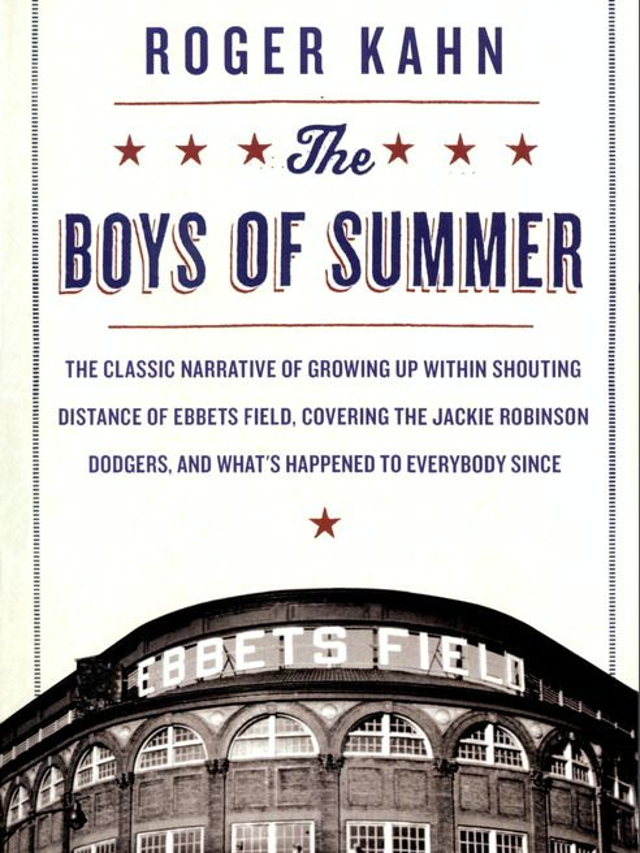
Kahn began The Boys of Summer with these words:

At a point in life when one is through with boyhood, but has not yet discovered how to be a man, it was my fortune to travel with the most marvelously appealing of teams. During the early 1950s, the Jackie Robinson Brooklyn Dodgers were outspoken, opinionated, bigoted, tolerant, black, white, open, passionate: in short, a fascinating mix of vigorous men. They were not, however, the most successful team in baseball.

The Dodgers won the National League Pennant in 1952, and again in 1953, but lost the World Series to the Yankees each time. A few days after the '53 Series, Roger's father died, only 52 years old.

Another change came the following season: The Trib transferred Roger away from the team he loved, to cover the team he, like all Dodger fans, hated, the New York Giants. He enjoyed covering their players, especially young superstar Willie Mays. He did not enjoy covering their manager, the corrupt, profane, egomaniacal Leo Durocher, who had once played shortstop for, and then managed, the Dodgers, before the team had finally had enough of him, and let him cross town to the "Jints."

The Giants won the 1954 World Series, which is not the same thing as "getting Kahn his ring," but at least he got to cover a World Champion. The Dodgers finally won it all the next year. By that point, he was on the staff of a new magazine, Sports Illustrated. He didn't like it, and when Newsweek offered to make him their sports editor in 1956, he jumped at the chance. In 1963, he moved on to The Saturday Evening Post.

By that point, his personal life was in turmoil. In 1950, he married Joan Rappaport. They had a daughter, Elizabeth, in 1954, but she died the day after her birth. In 1957, they had a son, whom they named for his grandfather. Roger would eventually dedicate a book "to a pair of aces," his father and his son, both named Gordon Jacques Kahn.

But in 1963, Roger began an affair with Alice Lippincott Russell, and she became pregnant. His 1st marriage ended in a very nasty divorce, and he married Alice. Their son, Roger Laurence Kahn, was born in 1964. They also had a daughter, Alissa Avril Kahn, in 1967.

In this period, Roger stepped away from sports to write on other subjects. He wrote a book about his faith, but was disappointed when his publisher chose the title The Passionate People: What It Means to Be a Jew in America. He also wrote about the 1968 student demonstrations at Columbia University: The Battle for Morningside Heights: Why Students Rebel.

*

The world was changing, and people of Kahn's generation, who grew up in the Great Depression, fought in World War II (although he was too young to do so, turning 18 after V-J Day), and built the great suburban postwar economy, had trouble handling it.

They began to look back, and the 1950s nostalgia wave began. It produced the musical Grease, and the film American Graffiti -- which took place in in 1962, but the early '60s were ,culturally, an extension of the '50s. Together, these 2 led to the TV sitcom Happy Days (which, like American Graffiti, starred Ron Howard). It also produced Richard Nader's "Garden Party" shows at Madison Square Garden, as the hits of the Eisenhower and Kennedy years became "oldies," and this led to "oldies" stations like New York's WCBS-FM, founded in 1972.

It led Paul Simon, one of the era's big singers and songwriters, to look to baseball as an exemplar of a simpler, more innocent time, which it really wasn't: In "Mrs. Robinson," he wrote, "Where have you gone, Joe DiMaggio? A nation turns its lonely eyes to you."

That song was Number 1 in America on June 6, 1968, when Robert F. Kennedy died from an assassin's bullet. The student unrest at Columbia was still ongoing, as was that in Paris. Martin Luther King had been assassinated 2 months before RFK, and a racist backlash against the Civil Rights Movement was in full gear. No one could think of a way to end the Vietnam War. The present seemed hopeless. (It was a time not unlike the present, although the details are considerably different.)

Roger Kahn, too, began to think of baseball again. Specifically, his team, which had been moved to Los Angeles by its greedy owner, Walter O'Malley, after the 1957 season, 11 years earlier -- just as the Yankees' last title and the hopeful beginning of the Obama Administration now is for us:

The team grew old. The Dodgers deserted Brooklyn. Wreckers swarmed into Ebbets Field and leveled the stand. Soil that had felt the spikes of Robinson & Reese was washed from the faces of mewling children. The New York Herald Tribune writhed, changed its face and collapsed. I covered a team that no longer exists in a demolished ballpark for a newspaper that is dead.

Remembering and appreciating the time which was not so very long ago, I found myself wondering more and more about the ball players. They are retired athletes now, but not old. They are scattered wide, but joined by a common memory. How are the years with them? What past do they remember? Have they come at length to realize what they had?

Unlike most, a ball player must confront two deaths. First, between the ages of thirty and forty he perishes as an athlete. Although he looks trim and feels vigorous and retains unusual coordination, the superlative reflexes, the major league reflexes, pass on. At a point when many of his classmates are newly confident and rising and other fields, he finds he can no longer hit a very good fast ball or reach a grounder four strides to his right. At thirty-five he is experiencing the truth of finality. As his major league career is ending, all things will end. However, he sprang, he was always earthbound. Mortality embraces him. The golden age has passed as in a moment. So, will all things. So will all moments. Memento Mori.

And so, on December 15, 1968, he placed a phone call to Newport, Pennsylvania, outside Harrisburg, to reach a man he hadn't spoken to in 14 years, not because he didn't want to, but because he had no professional reason to. A bartender. Who happened to be, in Kahn's opinion, the greatest 3rd baseman he ever saw, Billy Cox. Cox was surprised that someone from New York would want to come all the way out there just to talk to him.

Thus began the process of writing The Boys of Summer, Kahn's look back at his childhood as a Dodger fan, his look back at his professional start covering the team, and his quest to see how his old heroes were doing. He took the title from a poem by Dylan Thomas, who died in New York in 1953, a few days after Kahn's father Gordon also did so, in his case even younger, at 39, a result of massive drinking:

I see the boys of summer in their ruin Lay the gold tithings barren, Setting no store by harvest, freeze the soils; There in their heat the winter floods Of frozen loves they fetch their girls, And drown the cargoed apples in their tides.

The poem continues, 9 stanzas of 6 lines each, pointing out that time takes its toll, until so does death.

In his preface to the book, Kahn said, "I mean to be less concerned with curve balls than with the lure of the team." He spoke of the connection of the people of Brooklyn with the team, with the players, and with the ballpark, Ebbets Field. He cited Brooklyn's multiethnic nature and its distinctive accent.
And he wrote of Jackie Robinson, and how his acceptance -- first by the Dodger organization, eventually by his teammates, and finally by the baseball establishment -- gave the Dodgers a nobility that no other team could reach.

And then, after '57, they were gone. A few of the Dodger stars he wrote about would help the Los Angeles edition of the team win the World Series in 1959. A few of the players who replaced them and helped the Brooklyn edition win in 1955 would still be there on the title teams of 1963 and 1965. (Sandy Koufax debuted in '55, but he did not became an effective, let alone sensational, major league pitcher until '61.)

As with the 1969 Seattle Pilots -- written about in the other "greatest book ever written about baseball," pitcher Jim Bouton's Ball Four -- the Brooklyn Dodgers don't seem possible. They seem like a literary construction -- which, I suppose, Kahn would have appreciated, had he not been there to watch, love, and report on them.

Like Ball Four, The Boys of Summer often seems less like reporting on true events and more like a novel, especially since, in the style of what was becoming known as "the new journalism," Kahn, as with Norman Mailer in The Armies of the Night and Tom Wolfe in The Electric Kool-Aid Acid Test, had made himself a character in the book.

It was published on February 25, 1972, to mixed reviews, with those who didn't like it citing it as mawkish and too sentimental (as if sentiment wasn't the damn point); and with those who did like it going overboard, with the reviewer for Sports Illustrated calling it "a baseball book the same way Moby-Dick is a fishing book."

That same year, another New Yorker named Roger, Roger Angell, published The Summer Game, the 1st collection of his baseball-themed essays for The New Yorker magazine, which would eventually include the magisterial Five Seasons -- the seasons in question being 1972 to 1976, years of huge changes in the sport.

In spite of their common given name and their common profession, there are tremendous differences. Angell is from Manhattan instead of Brooklyn, Protestant instead of Jewish, an Ivy Leaguer (Harvard) instead of an NYU man, and was 7 years older, old enough to have served in World War II.

Most notably, he was a fan of the Dodgers' arch-rivals, the Giants. But while he has written extraordinary pieces on the game, including collaborating with David Cone on the memoir A Pitcher's Story, and spoke of the Giants' move, also to California in 1957, to San Francisco, as "Absolutely heartbreaking" when interviewed for Ken Burns' miniseries Baseball, he's never written a book about the New York edition of the Giants.

Several good books about those Giants have been written. But they have no Boys of Summer. Peter Golenbock, a Yankee Fan, wrote Dynasty about the 1949-64 Yankees, as a response to The Boys of Summer. And Angell and many others had the talent to write about the Giants, but didn't make the corresponding attempt that Kahn did for his Dodgers.

Noel Hynd wrote The Giants of the Polo Grounds, but that was about the team's entire history, 1883 to 1957. Good books have been written about the John McGraw era, 1902 to 1932 (including the tenure of Christy Mathewson, 1900 to 1916). Good books have been written about the 1951 Pennant race between the Giants and the Dodgers, which ended with the Bobby Thomson home run, including Thomson's own memoir. And good books have been written about Willie Mays, particularly about the Giants' 1954 World Series triumph, highlighted by Mays' stunning catch in Game 1 of the World Series.

But because the 1950s Giants have no loving nostalgic look on the scale of The Boys of Summer, they have practically been forgotten. Today's young baseball fans know about Thomson's home run and Mays' catch. I've shown my older nieces, now 12, both highlights. They know the Giants and Dodgers were once in New York City, and have been in California since 1958. But they don't know about McGraw, Mathewson, Fred Merkle, Frankie Frisch, Bill Terry, Mel Ott or Carl Hubbell. Some of these guys played 100 years ago, or more, and for kids today, it might as well have been 1,000 years.

Somebody should have written about the 1950s Giants. And I do mean the baseball team. The football version of the New York Giants has had nice looks back written about it. But the baseball team? Never mind McGraw and Mathewson: Today's fans need to know about not just Thomson and Mays, but also about Monte Irvin, Sal Maglie, Alvin Dark, Don Mueller, Dusty Rhodes and Johnny Antonelli.

(Roger Angell is still alive: If he makes it to September 19, he will be 100 years old. Hopefully, I'll get to write a Centennial tribute and post it on that day, instead of having to write an obituary and do it sooner.) (UPDATE: I was able to write that tribute. As of the Inauguration of President Joe Biden on January 20, 2021, Angell is still alive.)

In the 2nd edition of The Boys of Summer, Kahn noted that lots of people were able to identify with the middle-aged Dodger players. Roy Campanella had been paralyzed in a car crash. Jackie Robinson saw his son Jackie Jr. come back from Vietnam with what we would now call post-traumatic stress disorder, turn to drugs, get in legal trouble, get clean, and then be killed in an auto accident of his own. Several of them, without college degrees and a good off-season work history to fall back on, had to turn to manual labor. Clem Labine had to care for a developmentally disabled child.

But Kahn rejected the "ill-fated" label for them:

Any random group of thirteen Americans turning fifty might show equivalent whips and scorns of time. That was a comfortable response and possibly accurate. Besides, one could add, all the old Dodgers were still alive. Then on April 2, 1972, Gil Hodges fell backward onto a sidewalk in West Palm Beach, Florida, where the Mets had gone to play an exhibition game. A second coronary had hit the old first baseman. He was forty-seven.

Hodges, who had managed the Mets to their "Miracle" World Championship season in 1969, and was 2 days short of his 48th birthday. He remains the last manager or head coach of a major league sports team in the New York Tri-State Area to die in office.

Jackie Robinson, wracked with diabetes, giving him heart trouble, robbing him of most of his sight, and threatening amputation of the most famous legs in baseball history, was quoted by Kahn as saying he was surprised that Gil would be the first to go, thinking that he, himself, would be the first. A few months later, on October 24, 1972, Jackie was the next to go. 

*

The Boys of Summer made Kahn a legend at age 44. He could have rested on his laurels and never written another book, becoming another J.D. Salinger -- or, since the real Salinger was still alive, and didn't want to be portrayed in Field of Dreams, as he had been in the novel based on it, Shoeless Joe, another Terence Mann.

Instead, he kept writing. He continued to put out collections of essays. He wrote novels. He wrote A Flame of Pure Fire, a biography of 1920s Heavyweight Champion Jack Dempsey. He wrote Joe & Marilyn: A Memory of Love, taking a big risk writing about the DiMaggio-Monroe relationship while Joe was still alive. He ghost-wrote Pete Rose's post-ban memoir.

And he wrote October Men: Reggie Jackson, George Steinbrenner, Billy Martin, and the Yankees' Miraculous Finish in 1978. It may have seemed sacrilege to his original fans, Dodger fans, to see Kahn write about not just a team from the next generation, but a Yankee team, one that was not particularly lovable -- unless you were an 8-year-old kid in Jersey, like I was, or something close to that.

But he continued to focus on the period that began his career. He published The Era: 1947-1957, When the Yankees, the Giants and the Dodgers Ruled the World. This idea would be reinforced when Ken Burns made Baseball, titling his chapter on the 1950s Seventh Inning: The Capital of Baseball. Unfortunately, Burns did not interview Kahn for it. (He did interview Angell; Jackie's widow, Rachel Robinson; Clyde Sukeforth, the scout who brought Jackie to the Dodgers; and Hall-of-Fame players Bob Feller, Ted Williams, Mickey Mantle and Hank Aaron.)

In 1987, on the 40th Anniversary of Jackie Robinson's debut, Kahn was invited to speak on the subject on ABC News' Nightline. Another guest on that program was the general manager of the Los Angeles Dodgers, Al Campanis, who also knew Jackie well.

Host Ted Koppel asked Campanis why there weren't more black men as managers or in front offices, and Campanis gave an answer that showed that he was racist and didn't even realize it. Koppel gave him 2 chances to get out of the hole, and he only dug himself in deeper. Kahn pointed out that Campanis' answers were a succession -- not a "progression," and hardly an "evolution" -- of the things the opponents of integration had said in 1947.

The year 1987 would get harder for Kahn. His son Roger battled depression and drugs, tried rehab, and took his own life. Later that year, his mother Olga reached the close of a long and interesting, but not famous, life.

He would include a tribute to his mother, along with pieces on various baseball figures, in Memories of Summer: When Baseball was an Art and Writing About it a Game in 1993. That book also included profiles of Mays, whom Kahn called the greatest ballplayer he ever saw; and of Mantle, who was a terrible interview subject back then, never seemed to learn his lessons until it was too late, and led Kahn to say, "No, you couldn't possibly approve of Mickey Mantle. What you could do was love him."

It would take until 2006, and Into My Own: The Remarkable People and Events That Shaped a Life, before Roger Kahn the father could publish something about Roger Kahn the son. It also included chapters about Robert Frost, Stanley Woodward, Jackie Robinson, Pee Wee Reese, and 1968 Presidential candidate Senator Eugene McCarthy, who had all been friends of his. He also wrote of his 2 failed marriages, and having found love one more time, with psychotherapist Katharine Colt Johnson, in 1989, possibly as a result of dealing with his grief over his son.

Together, they lived in Stone Ridge, Ulster County, New York, on the west side of the Hudson River, nearly 100 miles north of Midtown Manhattan, and seemingly a planet away from his Brooklyn youth. He taught journalism at the nearby New Paltz campus of the State University of New York.

Recently, he had to be moved to an assisted-living facility in Mamaroneck, Westchester County, and he died there this past Thursday, February 6, 2020. He was 92 years old.

He outlived all of the subjects of The Boys of Summer, except for one: Carl Erskine, the Indiana-born curveball master who pitched 2 no-hitters from Brooklyn, 1 of them against the hated Giants, thrilled Dodger fans by striking out 14 Yankees in Game 4 of the 1953 World Series (then a Series record), and enjoyed reciting poetry with Kahn on roadtrips. "Oisk," as he was called in the Brooklyn accent, recently turned 93, still lives in Anderson, Indiana, and, last I heard, was in good health.

(UPDATE: Roger Kahn was cremated, and so there is no gravesite for his fans to visit.)

I close with the words that Washington Post reviewer Andrew Ervin wrote in his review for Into My Own, which, I have no doubt, were very satisfying to Roger Kahn: "It proves that Kahn's not only a great baseball writer but also something rarer: a great writer whose subject happens to be baseball."

Sunday, March 19, 2017

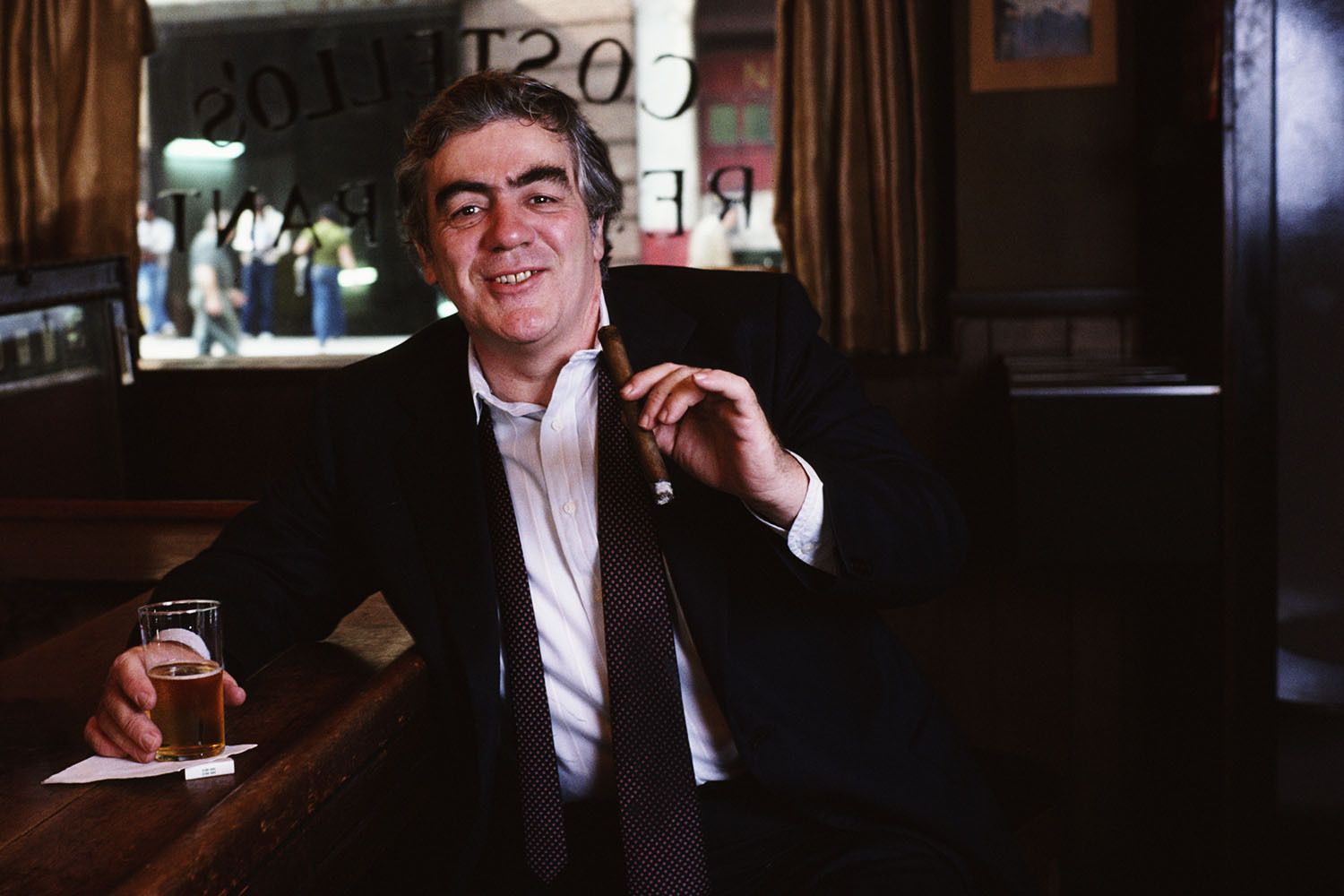
Jimmy Breslin, 1928-2017

We can debate who was America's greatest writer. But, beyond any doubt, America's greatest newspaper writer was Jimmy Breslin.

There is no other choice. As with Babe Ruth, there was a way to do it before him, and after he made his mark, there were ways to do it that weren't his, all of them wrong.

He'd have been the first to tell you. He didn't believe in false bravado. He believed in honest bravado: "I'm the best person ever to have a column in this business. There's never been anybody in my league."

He was more than that. As much as anyone – not a word, fans of the late Ed Koch; shut up, Rudy Giuliani; put a sock in it, Donald Trump; sorry, Regis Philbin – Jimmy Breslin has been the voice of New York City.

James Earle Breslin was born on October 17, 1928 (some sources incorrectly had 1930) in Jamaica, Queens. He grew up in the adjoining neighborhood of Richmond Hill, in the Great Depression, and he and his sister Deirdre were raised by a single mother after their alcoholic father walked out on them.

He graduated from John Adams High School in Ozone Park, something my grandmother didn't do, having to drop out in her senior year because she was orphaned and had to go to work. Breslin was already working: In 1946, shortly after turning 16, he was hired by the Long Island Daily Press, a newspaper whose offices were in Queens. (It went out of business in 1977.)

He went to Long Island University in Brooklyn, but left without graduating in 1950. He returned to the Press, and became a reporter. He hung around Queens Borough Hall in Kew Gardens, and found the bars/gin mills/watering holes where the necessary dramatis personae celebrated their victories and drowned their sorrows: Cops, crooks, lawyers.

More than that, he spoke to the people they pushed around. Guys who busted their asses doing jobs they hated. And he wrote about them, and championed them. And did it supremely well. Unlike them, he loved his job.

He was hired by the New York Journal-American as a sportswriter. He covered the New York Mets in their awful 1st season, 1962. In time for the 1963 season, his book about them came out, titled after a question that manager Casey Stengel asked: Can't Anybody Here Play This Game?

The reaction to it got the attention of one of the best newspapers in the world, the New York Herald Tribune. They hired him as a regular columnist. He was 34 years old.

Shortly thereafter, President John F. Kennedy was assassinated. Breslin got on a plane to Dallas, and interviewed Dr. Malcolm Perry, who oversaw the failed attempt to save JFK at Parkland Hospital. And he interviewed Father Oscar Huber, the 70-year-old priest who performed the last rites. And he interviewed Vernon B. O'Neal, whose funeral home was contacted by the Secret Service for a casket.
It was 53 years and 4 months ago. With the passing of the writer, now they are all gone.

Breslin wrote his column, including describing the look of the room, and the people working in it, and the stricken President and his watching wife. He dictated it over the phone back to the Trib, and it appeared in the Sunday, November 24, 1963 edition under the title, "A Death in Emergency Room One."

Breslin flew back to Washington on Sunday, and found a new interview subject: Clifton Pollard, a gravedigger at Arlington National Cemetery, who was preparing JFK's grave. He was being paid $3.01 an hour -- about $24 in today's money -- an extraordinary wage, given that he was a black man and that Arlington is in Virginia, a Southern State. But then, he was working for the federal government, and JFK had not only banned racial discrimination in federal government hiring, but ordered equal pay for blacks and whites.

Pollard called it an honor, not just because JFK was the President, but because of what kind of President he was. He was not invited to the funeral. It had nothing to do with him being black in the South. It was a Monday, and he had to go to work.

As an Army veteran of World War II, Pollard was entitled to burial at Arlington. In 1992, he died, and was buried about 100 feet from the Kennedy family plot.

Breslin may have been an Irish Catholic himself, and he may even have admired JFK, and the columns in question certainly show his admiration for Jackie. But the gravedigger, the priest, the mortician, even the highly-educated doctor... these were his people.

The image from the JFK funeral, 6 years before I was born, that sticks with me, is that of the Army bugler who played "Taps" at the end. His name was Keith Clark, and he botched one note. He insisted that it was just a mistake, not a result of any sadness he was feeling. I'm surprised Breslin didn't interview him. Maybe he tried, and the Army wouldn't let him. Clark died in 2002, and he is also buried at Arlington. His bugle is on display there.

*

By 1965, the Herald Tribune was losing cash by the bucket, in spite of being owned by John Hay "Jock" Whitney, a member of several prominent old-money families. That Summer, Breslin was sent to Vietnam to cover the war there, while his stablemate Dick Schaap was sent to Los Angeles to cover the Watts race riot.

Schaap would write in his memoir that he heard gunshots coming from several directions, and imagined that Breslin was probably not witnessing combat, but sitting in an officers' club, drinking with officers and getting their stories that way, safe and sound. Well, as the Tet Offensive proved in early 1968, Vietnam was one war where being away from the battlefield might not mean all that much.

The Trib folded in 1966, as did the Journal-American. So did the World-Telegram & Sun. They never recovered from the New York newspaper strike of late 1962 and early 1963. Nor did the New York Mirror, which published one last edition when the strike ended, and closed up shop.

The City was left with 3 papers: The New York Times (a broadsheet like the Trib, the Journal-American and the World-Telly), the Daily News (a tabloid like the Mirror), and the New York Post (also a tabloid).

Breslin stayed with the one remnant of the Trib, its Sunday supplment, which in 1968 became the weekly New York magazine. That year, he covered the Presidential campaign of New York's Senator, the late President's brother, Robert F. Kennedy. Breslin was only a few feet away from Bobby when he was shot.

In 1969, the most literary political ticket in American history was formed. Norman Mailer ran for Mayor of New York, and as his running mate, for the office of City Council President (who would be next in line if something happened to the Mayor -- that title is now called "Public Advocate"), he chose Breslin. 

Mailer's campaign slogan could not be said in public in those days, but he came up with it anyway -- or, maybe, Breslin did: "No more bullshit." Part of their platform was that New York City would secede from New York State and become the 51st State. (Nobody seemed to agree on what the remainder of New York State would be called.) In a 5-man Democratic Primary, Mailer finished 4th. Despite being not as famous as Mailer at that point, Breslin got more votes than Mailer.

Breslin's investigative journalism led him to meet many organized crime figures, helping him to write The Gang That Couldn't Shoot Straight in 1969. The following year, Breslin was dining at The Suite, a restaurant owned by Henry Hill, the Lucchese crime family associate who was later played by Ray Liotta in Goodfellas. Breslin had written an article about Hill's friend, Paul Vario (Paul Sorvino in the movie). And Jimmy "the Gent" Burke (Robert De Niro in the movie) came in and beat the crap out of him. He survived with only a concussion. (Burke and Vario both died in prison, Hill in witness protection. Breslin, older than Hill and Burke but not Vario, outlived all of them.)

*

In 1976, he published a book about how the system worked in the nation's favor in Watergate: How the Good Guys Finally Won. That year, New York newspapering changed forever. Rupert Murdoch, the brash right-wing Australian, bought the Post, and turned it from what it was, a hard-hitting paper favored by liberal intellectuals, especially Jewish ones, to a conservative rag that cared a lot for flashy headlines and not a damn for journalistic accuracy and ethics. In response, the Daily News shifted from center-right to center-left, and brought Breslin in.

On May 30, 1977, a letter showed up at Breslin's office at the Daily News Building on East 42nd Street. It was from a man claiming to be the Son of Sam, who had already pulled off 6 shootings, wounding 9 people, killing 5 of them and paralyzing another. It was full of lurid prose, and Breslin said, "This guy could take my job."

He conferred with the police, and they agreed with him that the letter should be published. After all, at the time, the Daily News had the highest circulation (most individual papers bought) of any newspaper in the country, over 2 million. (Today, with the high cost of ink and paper, and the Internet, both having rewritten the rules, the Times gets about 1.8 million, no other single-city paper in America gets even 700,000, and the Daily News and the Post both about 500,000.)

The Daily News did publish the letter, on Sunday, June 5, along with an editorial written by Breslin. Here's that front page:
After 2 more shootings -- totaling 13 victims, 6 dead, 1 paralyzed and 1 blinded -- the NYPD figured out the killer was David Berkowitz, a mailman with a Bronx route, living in neighboring Yonkers. Breslin and his former Trib teammate Schaap then collaborated on a novel based on the case, titled .44.

I saw the Son of Sam case play out on TV news, as a 7-year-old kid in Central Jersey. I wasn't reading the Daily News or any other paper's account of it. I first saw Breslin doing a commercial for Piels beer, filmed in a bar, probably in his beloved Queens, which he closed (the commercial, not the bar) by saying, "That's what I like about Piels: It's a good drinkin' beer!"

On December 8, 1980, at 10:50 PM, former Beatle John Lennon was shot and killed outside his home, the Dakota Apartments on Central Park West. He was pronounced dead at Roosevelt Hospital at 11:15. At 11:20, Breslin was in bed when he got a call about it. When he got to Roosevelt Hospital, he interviewed the cops who had arrested Mark David Chapman for the murder.

In 1981, his wife, whom he called "the former Rosemary Dattolico," died of cancer at age 50. A year later, he married Ronnie Eldridge, a City Councilwoman. He had 6 children, all Catholic like him. She had 3 children, all Jewish like her. "Everybody hated each other," he said. "It was beautiful."

In 1984, he broke the news that Bernhard Goetz, the "subway vigilante," had shot 4 of his victims in the back, proving that he'd gone beyond any understandable self-defense, and was, in fact, as much of a coward as the young men who tried to rob him.

In 1986, Breslin wrote that cops had used stun guns on jailed suspects, a major no-no. Then he blew open the Parking Violations Bureau scandal, dethroning 2 Borough Presidents, Stanley Friedman of The Bronx and Donald Manes of Queens. Friedman went to prison. Manes committed suicide before he could go to trial.

"Of course I would betray a friend for the biggest story of the year," Breslin said. Apparently, he would also have done it for the Pulitzer Prize for Journalism, because he got it for his columns on the PVB scandal.

He thought he was the greatest city reporter ever, but he didn't let the Pulitzer go to his head. He still got up early, calling judges, politicians, cops, and other journalists, starting with a question: "What's doin'?" Eldridge explained, "He just keeps calling, until he has a column in his head. But then, he has to go see it." And, despite reporting from New York to Vietnam, from Dallas to Selma, Alabama, he never learned to drive.

*

Unfortunately, like his Daily News stablemate Dick Young, and his Chicago counterpart Mike Royko, he got crochety and conservative in his later years, taking his image as the voice of his city's common man too seriously.

In 1988, he left for New York Newsday, the paper covering Long Island and Queens. In 1990, an Asian-American woman working at the paper told him a column he'd written was sexist. He responded by hurling sexist and racist slurs at her. He was suspended for 2 weeks, and wrote an apology to the staff, saying, "I am no good and once again I can prove it."

On August 19, 1991, he hailed a cab and headed to Brooklyn to cover the Crown Heights riot. When his cab arrived, rioters pulled him out and beat him. He was left with only his underwear and his NYPD press card.

In 1994, he developed a brain aneurysm. He had to have surgery, a hole drilled into his head, to fix it. He had survived the Great Depression, an absent father, World War II (though he was too young for combat), McCarthyism, New York smog, the New York Mob, Vietnam, the Son of Sam, a lot of smoking, a lot of drinking, and charges that he had outlived a society in which racism and sexism were seen as okay. But he survived this, too, and wrote a book titled I Want to Thank My Brain for Remembering Me.

His good friend and fellow Jamaica, Queens native, former Governor Mario Cuomo, father of the current Governor, Andrew Cuomo, once said, "Think of it: He still works every day. Writing, or thinking about writing, and he has done it for 60 years, nearly 22,000 days and nights, except for the short hiatus when doctors were forced to drill a hole in his head to let out of his congested brain some of his unused lines. Then he wrote a book about it!"

He left Newsday in 2004, to pursue other writing projects. He would return to the Daily News in 2011, and his columns showed that he remembered that it's liberals, not conservatives, that are for the little guy. He would eventually receive 4 Pulitzer Prizes. He wrote an exposé of the priestly-abuse scandal titled The Church That Forgot Christ, and biographies of racehorse trainer Sunny Jim Fitzsimmons, sportswriter Damon Runyon, and, most recently, baseball executive Branch Rickey.

He also wrote 2 books about Rudolph Giuliani, Mayor from 1994 to 2001. They were not complimentary. Giuliani first loved him, then hated him. The same was true of Ed Koch, Mayor from 1978 to 1989. Koch once told people he would give the eulogy at Breslin's funeral. People wondered whether that was a promise or a threat. Koch never got the chance to show them, because Breslin outlived him, too.

And, just as he'd covered the biggest story of the 20th Century, the JFK assassination, in his own way, so, too, did Breslin cover what is, so far, the biggest story of the 21st Century, writing a book titled American Lives: The Stories of the Men and Women Lost on September 11.

He introduced and closed Spike Lee's 1997 film Summer of Sam. He served as a consultant for another film based on life in New York in 1977, The Bronx Is Burning, and was interviewed for the DVD commentaries. In the film, he was very convincingly played by Michael Rispoli, better known as Jackie Aprile Sr. on The Sopranos.

*

In 2004, his daughter Rosemary, also a writer, died of a rare blood disease at age 47. In 2009, his other daughter, Kelly, a public relations executive, suffered a cardiac arrhythmia in a Manhattan restaurant and died at 44.

He died this morning, March 19, 2017, from pneumonia. He was 88. He was survived by his 2nd wife, Ronnie Eldridge; 4 sons, Kevin, James, Patrick and Christopher; a stepson, Daniel Eldridge; his sister, Deirdre Breslin; 12 grandchildren... and 5 Boroughs.

Pete Hamill, the Daily News veteran who perhaps inherits the title of greatest living New York newspaperman, said that the state of the country in his final days left him wanted to say more: "He was a bit addled by Trump. He knew Trump's father, because Trump's father was a Queens guy, and Jimmy was the poet laureate of Queens."

According to Hamill, Breslin saw Trump as the kind of guy from his old neighborhood who "is all mouth, and couldn't fight his way out of an empty lot."

Whatever was wrong with Breslin at the end, clearly, his brain was still working.

Hamill said, "It feels like 30 people just left the room."
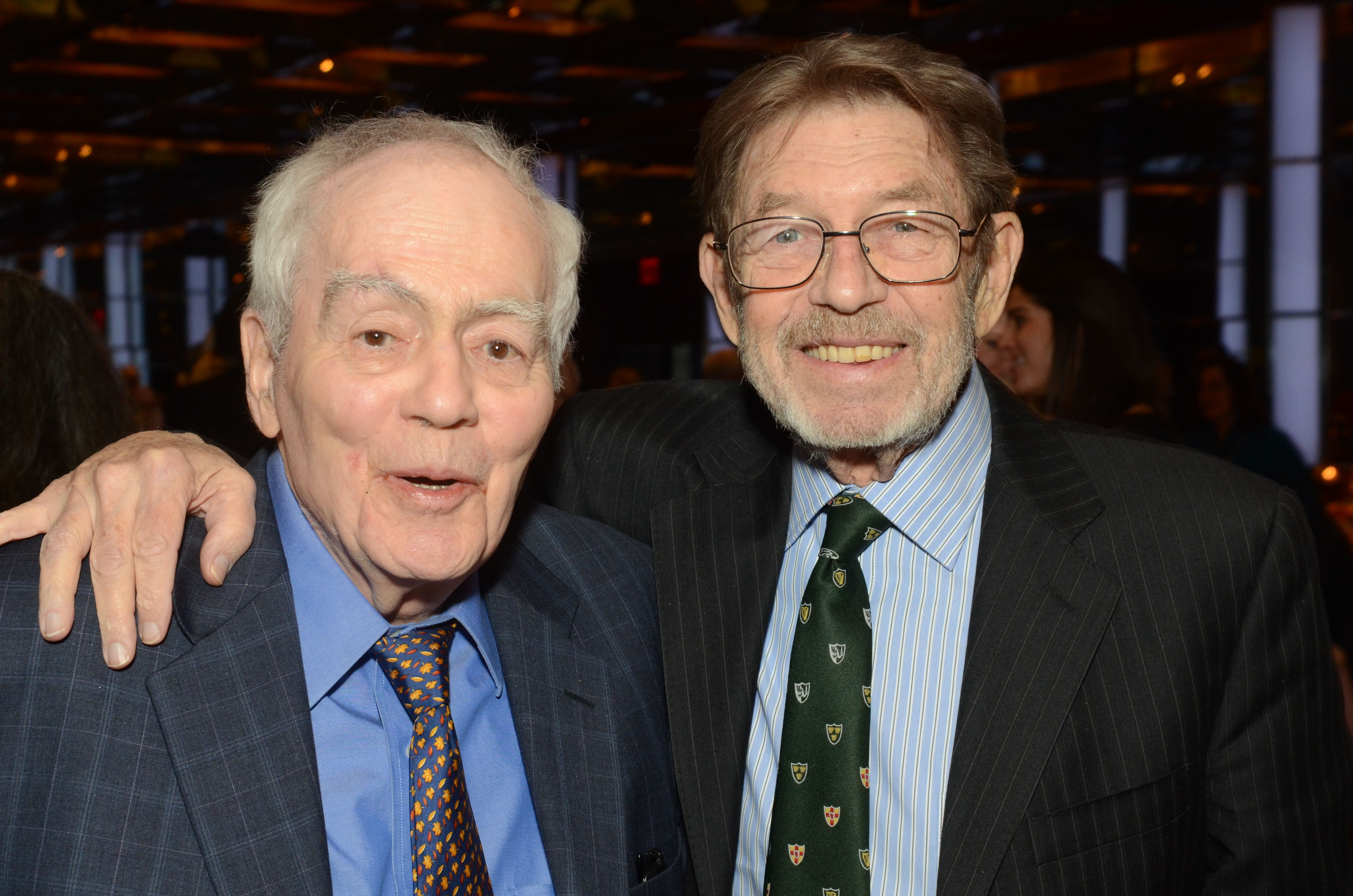
Jimmy Breslin and Pete Hamill, 2014

Breslin would have agreed. As he once put it, "If you don't toot your own horn, there's no music." Jimmy Breslin could write the prose equivalent of a fox trot and make it sound like it belonged in Carnegie Hall.

He was a New York character. He was a real piece of work. There will never be another like him. We can be nicer. But in terms of writing like he did, the best we can do is come close.

Jimmy Breslin will never truly leave the room.

Saturday, November 24, 2012

Oh, Oscar, Oscar, Oscar

So today I had lunch with one of the legends of New York sports, the ageless columnist of the New York Herald, the one and only Oscar Madison.

Okay, he's not quite ageless. He's 90 years old, and all that cigar smoking has long since robbed him of one of his vocal chords, reducing his voice to a raspy version of his old-time New Yawk tawk. But time has not dimmed his mind, nor dulled his wit. The guy has still got it, and still cranks out a column once a week.

And he still uses a typewriter. And not an electric one. Forget a computer: "I don't need a computer to do word processing," he says. "I can process my own words."

I met him at the Blind Pig on East 14th Street, which I introduced him to, even though it's quite far from his apartment on the Upper East Side. With its Prohibition-era decor, I figured he'd like it, and I was right. ("Blind pig" and "blind tiger" were both synonyms for a speakeasy, an illegal bar run during Prohibition, 1920 to 1933.)

Over a couple of beers, and with the Ohio State-Michigan game on TV (Ohio State won, 26-21), I asked him to give me his current thoughts on local sports.

On the NHL lockout: "What's the matter with the owners? They think they got leverage over the players? Like they were NFL team owners? They're idiots. The players can go off and play in Europe, and make lots o' money there. The owners are just shootin' themselves in the foot. And that can hurt. I know, my old buddy, retired cop Murray Greschler, did that once."

On the Knicks: "Boy, oh boy, I like the way the Knicks are playing. Carmelo Anthony is putting his ego in check, and the team is just cruising. I just hope nobody gets hurt. Knick players have a nasty habit of getting hurt at just the wrong time.

On what the Knicks mean to him: "I've covered the Knicks from the beginning, when the NBA began in 1946. I was the first Knicks beat writer for the Herald.  I loved covering basketball at the old Madison Square Garden. And when the new Garden really was the new Garden, it seemed so outta this world, and the Knicks were, too. You shoulda seen Walt Frazier back then. He was the coolest man in the galaxy, never mind the world. Even Joe Namath wasn't as cool as Frazier. I loved those Knicks. And, you know, they were a big thing to help get me through my recovery from cancer in 1993, with Ewing and Oakley and Starks. They really helped me bounce back. Them, and my old buddy, Felix Unger. Except the Knicks weren't hypochondriac neat freaks. And I never, ever heard Pat Riley honk with bad sinuses!"

On the Yankees: "Aw, you talk about Felix, that Derek Jeter reminds me of him. He's gotta be Mr. Perfect. And yet, sometimes I think Alex Rodriguez is more like Felix. All those, whatta ya call 'em, neuroses. A-Rod is ridiculous! All that money, and the Yankees can't hit in the postseason? What were they waiting for, an engraved invitation?"

On the Mets: "Let me tell you something, the Mets wish they had the Yankees' problems, and not their own! I coulda told ya from a mile away that Bernie Madoff was a no-good lousy bum! But Fred Wilpon? He couldn't see it. He always wants to see the good in people. But you gotta watch out, at all times. And now, the Mets can't see the Pennant from a mile away. They couldn't see the Pennant if they were in the Giants' new ballpark."

On the Jets: "You know, Mike, I read that piece you did on Rex Ryan, why you think he's failed. I'm not sure if he's the reason, or if the general manager, Mike Tannenbaum, is the real problem. But these Jets were so close to a Super Bowl, and they blew it. And now, they got no confidence. And it doesn't help that Darrelle Revis went out for most of the season with an injury. There's no way the Patriots woulda hung 49 on the Jets if he was out there. Maybe 35."

On Tim Tebow: "No. No way. He's not the answer. Unless the Jets are playing the University of Tennessee. Then, Tebow can win. He's not an NFL quarterback. He's not a guy with a million-dollar arm and a five-cent head. He's a guy with a minimum-wage arm and a five-cent head! And it ain't the religion, either. Terry Bradshaw talked about having faith all the time. He still does. And people thought he was dumb. But you know what? Terry got the job done. He had the skills. Tebow doesn't have Terry's skills, and he never will. No matter who the coach is. Firing Ryan and replacing him with somebody else isn't gonna turn Tebow into another Bradshaw, or another Steve Young, if you wanna use a lefty as an example, and a successful one. Firing Ryan might help Mark Sanchez, but it won't do squat for Tebow."

On college football: "I don't know much about college football. Ask me about college basketball."

On college basketball: "I think these kids who are doing the 'one and done' thing are hurting everybody. The NBA, 'cause they're gettin' there and they're not ready for it, so they end up sittin' on the bench, doin' nothin'. Their college teams, 'cause they get left in the lurch. Themselves, 'cause they're not getting the right training. And I'm not even talking about their time in class. I'm talking about listening to their coaches. You think Krzyzewski and Pitino and Calipari are teaching a kid everything he should know in one year? Baloney! Oh, that reminds me, I think I left a sandwich on the sofa. Or was it on my bed? No, that was a tuna fish sandwich on my bed. The baloney's definitely the one on the sofa."

You left two sandwiches out? Oh, Oscar, Oscar, Oscar...

"What are you, Felix's grandson?"

Well, one of my Grandpas was a bit of a neat freak. And a photographer. And a clothes horse. And a hypochondriac. But he liked sports, not opera. He and Felix probably wouldn't have gotten along.

"Yeah? Maybe I woulda liked him."

Oh yeah, you would've.

Just out of curiosity, Oscar, how did Felix die?

"You don't wanna know."

No, really, I do.

"Well, it was May 17, 2004. He was 84. He'd been slowing down for a while. Anyway, he lost his balance in the kitchen."

Yeah, that's right, he was a really good cook. So, what happened, he fell on his own knife?

"No. He was carrying a pot of gravy from the stove to the table. And when he lost his balance, he spilled the gravy all over himself."

You mean, he scalded himself to death?

"No! He got so angry at himself for spilling the gravy that he gave himself a heart attack. Boom, that was it.  No more Felix."

Felix died as the result of a mess that he made?

"Yeah. Talk about your irony."

*

In case you're wondering, I've been watching the DVDs of The Odd Couple. Felix was played by Tony Randall, who did die on the date in question, from pneumonia, resulting from heart bypass surgery. Oscar was played by Jack Klugman, whose own throat surgery and cancer recovery were written into The Odd Couple: Together Again, the 1993 TV-movie that was a sequel to the 1970-75 ABC series.

Oscar worked for the New York Herald. In real life, a paper by that name existed from 1835 to 1924, published by James Gordon Bennett Sr. and Jr. Its 1895 headquarters, across from the main Macy's store at the intersection of 34th Street, 6th Avenue and Broadway gave the intersection its name: Herald Square. That building was torn down in 1921.

When Bennett Jr. died in 1924, the sensationalist Herald was purchased by the far more sedate New York Tribune, and the resulting New York Herald-Tribune was one of the most admired papers of its time, the nation's leading mouthpiece of Northeastern-style liberal-to-moderate Republican politics, the kind espoused by New York State's Governor Nelson Rockefeller and U.S. Senators Kenneth Keating and Jacob Javits.

The 1962-63 New York newspaper strike doomed it (and also the broadsheets Journal-American and World-Telegram & Sun, and the tabloid Mirror), and on April 24, 1966, it published its final edition. But in 1968, its weekly New York magazine was revived, and is published under that name to this day.

The show's producers used the Herald name for their fictional paper because the real paper's former style seemed to fit Oscar's personality. (The New York Ledger, the tabloid shown on the current ABC series Castle, is also fictional.)

Tony Randall appeared on The Tonight Show more than any other performer, 105 times.

Jack Klugman is still alive, having turned 90 this past April 27. In fact, he is the only remaining one of the Twelve Angry Men from the 1957 film to still be alive. John Fiedler was the only other actor from that film to have also appeared on The Odd Couple.

Oddly enough, the show was not the first time Randall and Klugman had acted together: In 1955, when anthology series were all the rage on television, they both appeared on an episode of Appointment with Adventure.  In real life, they were great friends without, as the show's famed opening suggests, driving each other crazy.

All of Oscar's lines in this post are what I would imagine him saying, and are partly based on things Klugman said on the show.

And, no, I've never actually met Jack Klugman. Nor did I ever meet Tony Randall. I'm not sure I would have wanted to meet him. I don't carry a coaster. "Oh, rings, rings, rings!"

The DVD collection includes an appearance they made on The Mike Douglas Show to promote The Odd Couple, shortly after its 1970 debut. Turns out that Klugman was going bald, and wore a toupee for most of the show's run. That's why he was so often wearing a Mets cap: He didn't like wearing the toupee. But he wore one for his later series, the NBC crime/medical drama Quincy, M.E., so maybe he'd gotten a better one -- perhaps in consultation with Charles Nelson Reilly, who had a great hairpiece, and who was on Match Game with Klugman's then-wife, Brett Somers. (In fact, Jack was on the 1st episode of the 1970s revival of Match Game, on July 2, 1973, and occasionally appeared with Brett, although the nastiness that led to their breakup came through on the show.) Randall would also later appear on an NBC series, the sitcom Love, Sidney.

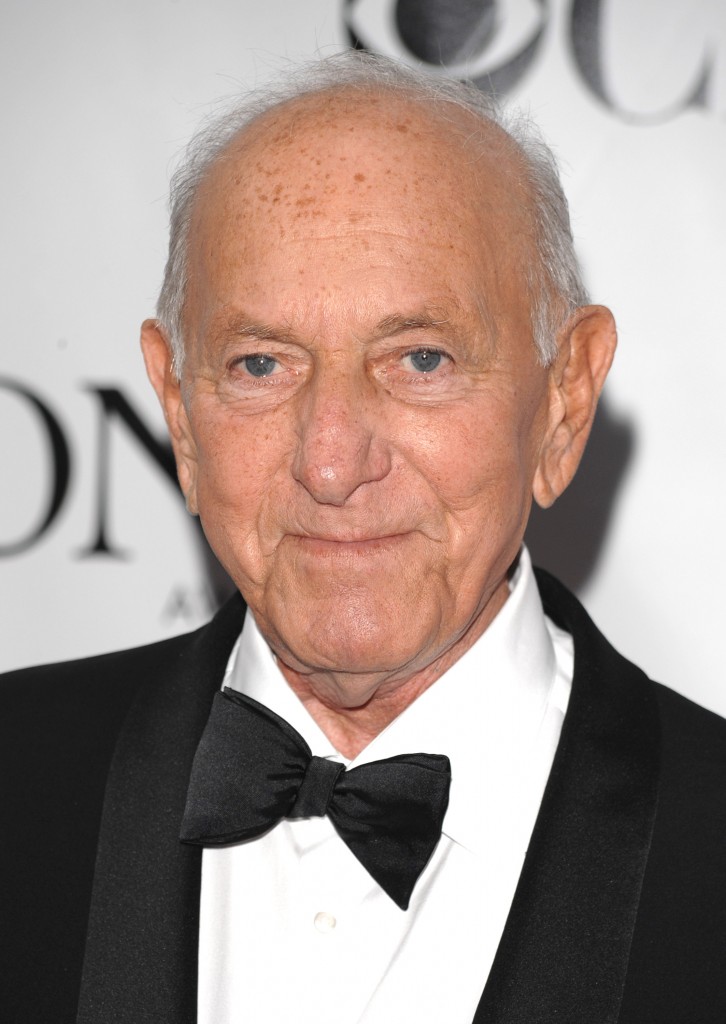
Here's a recent photo of Klugman.  In spite of his age, and surviving cancer nearly 20 years ago, he's doing fine.
UPDATE: Or so I thought. He died just a month after I posted this.