
No one did that better than Roger Kahn.
He was born on October 31, 1927 in Brooklyn. He was descended from Jews who escaped the European revolutions of 1848, and his parents -- both teachers, Gordon taught history and Olga taught English -- encouraged him in intellectual pursuits, studying the classics.
Gordon loved baseball and their home-Borough Dodgers. Olga had no use for sports, but, toward the end of her life, Roger introduced her to some of the players he'd covered, and she realized they were well-developed people, not just athletes.
(For those of you who may recognize the name from Kahn's, sellers of hot dogs at Shea Stadium lo those many years: As far as I can tell, Roger's family was not connected to that company.)
Roger graduated from Brooklyn's Erasmus Hall High School, and they were happy that he went to New York University. His parents didn't care that NYU then had a great basketball program. They cared that it was a great school. He then got a copyboy job at the New York Herald Tribune.
The Trib was the classic old-time "liberal Republican" newspaper, taking stands in favor of civil rights at home and abroad, but sticking with the old-money men (as it was run by) to the point of sticking with the GOP all through the Great Depression and beyond: Herbert Hoover even in 1932, Alf Landon, Wendell Willkie, Thomas Dewey, Dwight D. Eisenhower, and Richard Nixon in 1960.
But it also had an exceptional sports department, run by an exceptional man, Stanley Woodward. In 1933, he became the 1st writer to call the collection of universities that included Harvard, Yale and Princeton "the Ivy League," and the name stuck until an official league with that name was founded in 1955. Woodward himself went to Amherst College, which could have been admitted to that League, but wasn't.
Being a respectable broadsheet, not a loud tabloid like the Daily News, the Post or the Mirror, the Trib's big competition was The New York Times, which had twice as many people working in its sports department. When Woodward became sports editor of the Trib in 1938, he said, "They've got a lot of people, so we can't outcrap 'em, but we sure as hell can outwrite 'em."
And they did: It took a long time -- probably until 1966, when the Trib, the Journal-American and the World-Telegram & Sun all folded due to escalating costs -- before the Times had the best sports section in town. Woodward hired Red Smith away from the Philadelphia Record, and he became perhaps the greatest sportswriter who ever lived, moving on to the Times after the Trib folded.
Woodward also hired John Lardner, son of the great Chicago-based sportswriter Ring Lardner, and brother of Ring Lardner Jr., a screenwriter blacklisted for his leftist leanings, the last survivor of "The Hollywood Ten."
Incidentally, there was another blacklisted screenwriter, named Gordon Kahn, also from New York City, although born in Hungary. As far as I can tell, he wasn't related to Roger.
Woodward was fired as editor in 1948, due to internal politics at the paper, but not before he had recognized Roger Kahn's writing ability and promoted him. In 1952, just 24 years old, and Brooklyn-raised yet cultured -- certainly not the image of the crusty, cigar-chomping old sportswriter -- he was named the beat writer for the Brooklyn Dodgers, his boyhood team.
In the 1952 and '53 seasons, he got close to the players, including future Baseball Hall-of-Famers Jackie Robinson, Roy Campanella, Edwin "Duke" Snider, and the team Captain, Harold "Pee Wee" Reese; All-Stars Gil Hodges, Carl Furillo, Carl Erskine, Billy Cox and Elwin "Preacher" Roe; and role players George "Shotgun" Shuba, Andy Pafko, Clem Labine and Joe Black.
It's worth noting that the man generally thought of as the Dodgers' ace pitcher, Don Newcombe, was serving in the Korean War, and thus was not with the team in either of those seasons. Therefore, there is no profile on him for The Boys of Summer.
Being Jewish and having faced discrimination, he had sympathy, if not a full understanding, for what black players Robinson, Campanella and Black were going through. They found that they could trust him to write about them fairly. Some people didn't like that: Dodger manager Charlie Dressen called him "Robinson's bobo."
Kahn began The Boys of Summer with these words:
At a point in life when one is through with boyhood, but has not yet discovered how to be a man, it was my fortune to travel with the most marvelously appealing of teams. During the early 1950s, the Jackie Robinson Brooklyn Dodgers were outspoken, opinionated, bigoted, tolerant, black, white, open, passionate: in short, a fascinating mix of vigorous men. They were not, however, the most successful team in baseball.
The Dodgers won the National League Pennant in 1952, and again in 1953, but lost the World Series to the Yankees each time. A few days after the '53 Series, Roger's father died, only 52 years old.
Another change came the following season: The Trib transferred Roger away from the team he loved, to cover the team he, like all Dodger fans, hated, the New York Giants. He enjoyed covering their players, especially young superstar Willie Mays. He did not enjoy covering their manager, the corrupt, profane, egomaniacal Leo Durocher, who had once played shortstop for, and then managed, the Dodgers, before the team had finally had enough of him, and let him cross town to the "Jints."
In the 1952 and '53 seasons, he got close to the players, including future Baseball Hall-of-Famers Jackie Robinson, Roy Campanella, Edwin "Duke" Snider, and the team Captain, Harold "Pee Wee" Reese; All-Stars Gil Hodges, Carl Furillo, Carl Erskine, Billy Cox and Elwin "Preacher" Roe; and role players George "Shotgun" Shuba, Andy Pafko, Clem Labine and Joe Black.
It's worth noting that the man generally thought of as the Dodgers' ace pitcher, Don Newcombe, was serving in the Korean War, and thus was not with the team in either of those seasons. Therefore, there is no profile on him for The Boys of Summer.
Being Jewish and having faced discrimination, he had sympathy, if not a full understanding, for what black players Robinson, Campanella and Black were going through. They found that they could trust him to write about them fairly. Some people didn't like that: Dodger manager Charlie Dressen called him "Robinson's bobo."
Kahn began The Boys of Summer with these words:
At a point in life when one is through with boyhood, but has not yet discovered how to be a man, it was my fortune to travel with the most marvelously appealing of teams. During the early 1950s, the Jackie Robinson Brooklyn Dodgers were outspoken, opinionated, bigoted, tolerant, black, white, open, passionate: in short, a fascinating mix of vigorous men. They were not, however, the most successful team in baseball.
The Dodgers won the National League Pennant in 1952, and again in 1953, but lost the World Series to the Yankees each time. A few days after the '53 Series, Roger's father died, only 52 years old.
Another change came the following season: The Trib transferred Roger away from the team he loved, to cover the team he, like all Dodger fans, hated, the New York Giants. He enjoyed covering their players, especially young superstar Willie Mays. He did not enjoy covering their manager, the corrupt, profane, egomaniacal Leo Durocher, who had once played shortstop for, and then managed, the Dodgers, before the team had finally had enough of him, and let him cross town to the "Jints."
The Giants won the 1954 World Series, which is not the same thing as "getting Kahn his ring," but at least he got to cover a World Champion. The Dodgers finally won it all the next year. By that point, he was on the staff of a new magazine, Sports Illustrated. He didn't like it, and when Newsweek offered to make him their sports editor in 1956, he jumped at the chance. In 1963, he moved on to The Saturday Evening Post.
By that point, his personal life was in turmoil. In 1950, he married Joan Rappaport. They had a daughter, Elizabeth, in 1954, but she died the day after her birth. In 1957, they had a son, whom they named for his grandfather. Roger would eventually dedicate a book "to a pair of aces," his father and his son, both named Gordon Jacques Kahn.
But in 1963, Roger began an affair with Alice Lippincott Russell, and she became pregnant. His 1st marriage ended in a very nasty divorce, and he married Alice. Their son, Roger Laurence Kahn, was born in 1964. They also had a daughter, Alissa Avril Kahn, in 1967.
In this period, Roger stepped away from sports to write on other subjects. He wrote a book about his faith, but was disappointed when his publisher chose the title The Passionate People: What It Means to Be a Jew in America. He also wrote about the 1968 student demonstrations at Columbia University: The Battle for Morningside Heights: Why Students Rebel.
*
The world was changing, and people of Kahn's generation, who grew up in the Great Depression, fought in World War II (although he was too young to do so, turning 18 after V-J Day), and built the great suburban postwar economy, had trouble handling it.
They began to look back, and the 1950s nostalgia wave began. It produced the musical Grease, and the film American Graffiti -- which took place in in 1962, but the early '60s were ,culturally, an extension of the '50s. Together, these 2 led to the TV sitcom Happy Days (which, like American Graffiti, starred Ron Howard). It also produced Richard Nader's "Garden Party" shows at Madison Square Garden, as the hits of the Eisenhower and Kennedy years became "oldies," and this led to "oldies" stations like New York's WCBS-FM, founded in 1972.
It led Paul Simon, one of the era's big singers and songwriters, to look to baseball as an exemplar of a simpler, more innocent time, which it really wasn't: In "Mrs. Robinson," he wrote, "Where have you gone, Joe DiMaggio? A nation turns its lonely eyes to you."
That song was Number 1 in America on June 6, 1968, when Robert F. Kennedy died from an assassin's bullet. The student unrest at Columbia was still ongoing, as was that in Paris. Martin Luther King had been assassinated 2 months before RFK, and a racist backlash against the Civil Rights Movement was in full gear. No one could think of a way to end the Vietnam War. The present seemed hopeless. (It was a time not unlike the present, although the details are considerably different.)
Roger Kahn, too, began to think of baseball again. Specifically, his team, which had been moved to Los Angeles by its greedy owner, Walter O'Malley, after the 1957 season, 11 years earlier -- just as the Yankees' last title and the hopeful beginning of the Obama Administration now is for us:
The team grew old. The Dodgers deserted Brooklyn. Wreckers swarmed into Ebbets Field and leveled the stand. Soil that had felt the spikes of Robinson & Reese was washed from the faces of mewling children. The New York Herald Tribune writhed, changed its face and collapsed. I covered a team that no longer exists in a demolished ballpark for a newspaper that is dead.
Remembering and appreciating the time which was not so very long ago, I found myself wondering more and more about the ball players. They are retired athletes now, but not old. They are scattered wide, but joined by a common memory. How are the years with them? What past do they remember? Have they come at length to realize what they had?
Unlike most, a ball player must confront two deaths. First, between the ages of thirty and forty he perishes as an athlete. Although he looks trim and feels vigorous and retains unusual coordination, the superlative reflexes, the major league reflexes, pass on. At a point when many of his classmates are newly confident and rising and other fields, he finds he can no longer hit a very good fast ball or reach a grounder four strides to his right. At thirty-five he is experiencing the truth of finality. As his major league career is ending, all things will end. However, he sprang, he was always earthbound. Mortality embraces him. The golden age has passed as in a moment. So, will all things. So will all moments. Memento Mori.
And so, on December 15, 1968, he placed a phone call to Newport, Pennsylvania, outside Harrisburg, to reach a man he hadn't spoken to in 14 years, not because he didn't want to, but because he had no professional reason to. A bartender. Who happened to be, in Kahn's opinion, the greatest 3rd baseman he ever saw, Billy Cox. Cox was surprised that someone from New York would want to come all the way out there just to talk to him.
Thus began the process of writing The Boys of Summer, Kahn's look back at his childhood as a Dodger fan, his look back at his professional start covering the team, and his quest to see how his old heroes were doing. He took the title from a poem by Dylan Thomas, who died in New York in 1953, a few days after Kahn's father Gordon also did so, in his case even younger, at 39, a result of massive drinking:
I see the boys of summer in their ruin Lay the gold tithings barren, Setting no store by harvest, freeze the soils; There in their heat the winter floods Of frozen loves they fetch their girls, And drown the cargoed apples in their tides.
The poem continues, 9 stanzas of 6 lines each, pointing out that time takes its toll, until so does death.
In his preface to the book, Kahn said, "I mean to be less concerned with curve balls than with the lure of the team." He spoke of the connection of the people of Brooklyn with the team, with the players, and with the ballpark, Ebbets Field. He cited Brooklyn's multiethnic nature and its distinctive accent.
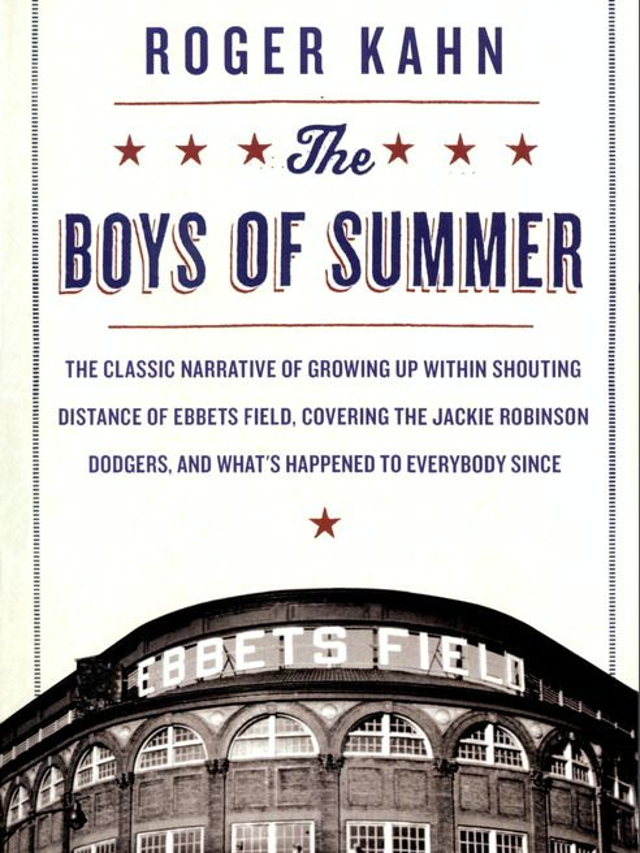 And he wrote of Jackie Robinson, and how his acceptance -- first by the Dodger organization, eventually by his teammates, and finally by the baseball establishment -- gave the Dodgers a nobility that no other team could reach.
And then, after '57, they were gone. A few of the Dodger stars he wrote about would help the Los Angeles edition of the team win the World Series in 1959. A few of the players who replaced them and helped the Brooklyn edition win in 1955 would still be there on the title teams of 1963 and 1965. (Sandy Koufax debuted in '55, but he did not became an effective, let alone sensational, major league pitcher until '61.)
As with the 1969 Seattle Pilots -- written about in the other "greatest book ever written about baseball," pitcher Jim Bouton's Ball Four -- the Brooklyn Dodgers don't seem possible. They seem like a literary construction -- which, I suppose, Kahn would have appreciated, had he not been there to watch, love, and report on them.
Like Ball Four, The Boys of Summer often seems less like reporting on true events and more like a novel, especially since, in the style of what was becoming known as "the new journalism," Kahn, as with Norman Mailer in The Armies of the Night and Tom Wolfe in The Electric Kool-Aid Acid Test, had made himself a character in the book.
It was published on February 25, 1972, to mixed reviews, with those who didn't like it citing it as mawkish and too sentimental (as if sentiment wasn't the damn point); and with those who did like it going overboard, with the reviewer for Sports Illustrated calling it "a baseball book the same way Moby-Dick is a fishing book."
That same year, another New Yorker named Roger, Roger Angell, published The Summer Game, the 1st collection of his baseball-themed essays for The New Yorker magazine, which would eventually include the magisterial Five Seasons -- the seasons in question being 1972 to 1976, years of huge changes in the sport.
In spite of their common given name and their common profession, there are tremendous differences. Angell is from Manhattan instead of Brooklyn, Protestant instead of Jewish, an Ivy Leaguer (Harvard) instead of an NYU man, and was 7 years older, old enough to have served in World War II.
Most notably, he was a fan of the Dodgers' arch-rivals, the Giants. But while he has written extraordinary pieces on the game, including collaborating with David Cone on the memoir A Pitcher's Story, and spoke of the Giants' move, also to California in 1957, to San Francisco, as "Absolutely heartbreaking" when interviewed for Ken Burns' miniseries Baseball, he's never written a book about the New York edition of the Giants.
Several good books about those Giants have been written. But they have no Boys of Summer. Peter Golenbock, a Yankee Fan, wrote Dynasty about the 1949-64 Yankees, as a response to The Boys of Summer. And Angell and many others had the talent to write about the Giants, but didn't make the corresponding attempt that Kahn did for his Dodgers.
Noel Hynd wrote The Giants of the Polo Grounds, but that was about the team's entire history, 1883 to 1957. Good books have been written about the John McGraw era, 1902 to 1932 (including the tenure of Christy Mathewson, 1900 to 1916). Good books have been written about the 1951 Pennant race between the Giants and the Dodgers, which ended with the Bobby Thomson home run, including Thomson's own memoir. And good books have been written about Willie Mays, particularly about the Giants' 1954 World Series triumph, highlighted by Mays' stunning catch in Game 1 of the World Series.
But because the 1950s Giants have no loving nostalgic look on the scale of The Boys of Summer, they have practically been forgotten. Today's young baseball fans know about Thomson's home run and Mays' catch. I've shown my older nieces, now 12, both highlights. They know the Giants and Dodgers were once in New York City, and have been in California since 1958. But they don't know about McGraw, Mathewson, Fred Merkle, Frankie Frisch, Bill Terry, Mel Ott or Carl Hubbell. Some of these guys played 100 years ago, or more, and for kids today, it might as well have been 1,000 years.
Somebody should have written about the 1950s Giants. And I do mean the baseball team. The football version of the New York Giants has had nice looks back written about it. But the baseball team? Never mind McGraw and Mathewson: Today's fans need to know about not just Thomson and Mays, but also about Monte Irvin, Sal Maglie, Alvin Dark, Don Mueller, Dusty Rhodes and Johnny Antonelli.
(Roger Angell is still alive: If he makes it to September 19, he will be 100 years old. Hopefully, I'll get to write a Centennial tribute and post it on that day, instead of having to write an obituary and do it sooner.) (UPDATE: I was able to write that tribute. As of the Inauguration of President Joe Biden on January 20, 2021, Angell is still alive.)
In the 2nd edition of The Boys of Summer, Kahn noted that lots of people were able to identify with the middle-aged Dodger players. Roy Campanella had been paralyzed in a car crash. Jackie Robinson saw his son Jackie Jr. come back from Vietnam with what we would now call post-traumatic stress disorder, turn to drugs, get in legal trouble, get clean, and then be killed in an auto accident of his own. Several of them, without college degrees and a good off-season work history to fall back on, had to turn to manual labor. Clem Labine had to care for a developmentally disabled child.
But Kahn rejected the "ill-fated" label for them:
Any random group of thirteen Americans turning fifty might show equivalent whips and scorns of time. That was a comfortable response and possibly accurate. Besides, one could add, all the old Dodgers were still alive. Then on April 2, 1972, Gil Hodges fell backward onto a sidewalk in West Palm Beach, Florida, where the Mets had gone to play an exhibition game. A second coronary had hit the old first baseman. He was forty-seven.
Hodges, who had managed the Mets to their "Miracle" World Championship season in 1969, and was 2 days short of his 48th birthday. He remains the last manager or head coach of a major league sports team in the New York Tri-State Area to die in office.
By that point, his personal life was in turmoil. In 1950, he married Joan Rappaport. They had a daughter, Elizabeth, in 1954, but she died the day after her birth. In 1957, they had a son, whom they named for his grandfather. Roger would eventually dedicate a book "to a pair of aces," his father and his son, both named Gordon Jacques Kahn.
But in 1963, Roger began an affair with Alice Lippincott Russell, and she became pregnant. His 1st marriage ended in a very nasty divorce, and he married Alice. Their son, Roger Laurence Kahn, was born in 1964. They also had a daughter, Alissa Avril Kahn, in 1967.
In this period, Roger stepped away from sports to write on other subjects. He wrote a book about his faith, but was disappointed when his publisher chose the title The Passionate People: What It Means to Be a Jew in America. He also wrote about the 1968 student demonstrations at Columbia University: The Battle for Morningside Heights: Why Students Rebel.
*
The world was changing, and people of Kahn's generation, who grew up in the Great Depression, fought in World War II (although he was too young to do so, turning 18 after V-J Day), and built the great suburban postwar economy, had trouble handling it.
They began to look back, and the 1950s nostalgia wave began. It produced the musical Grease, and the film American Graffiti -- which took place in in 1962, but the early '60s were ,culturally, an extension of the '50s. Together, these 2 led to the TV sitcom Happy Days (which, like American Graffiti, starred Ron Howard). It also produced Richard Nader's "Garden Party" shows at Madison Square Garden, as the hits of the Eisenhower and Kennedy years became "oldies," and this led to "oldies" stations like New York's WCBS-FM, founded in 1972.
It led Paul Simon, one of the era's big singers and songwriters, to look to baseball as an exemplar of a simpler, more innocent time, which it really wasn't: In "Mrs. Robinson," he wrote, "Where have you gone, Joe DiMaggio? A nation turns its lonely eyes to you."
That song was Number 1 in America on June 6, 1968, when Robert F. Kennedy died from an assassin's bullet. The student unrest at Columbia was still ongoing, as was that in Paris. Martin Luther King had been assassinated 2 months before RFK, and a racist backlash against the Civil Rights Movement was in full gear. No one could think of a way to end the Vietnam War. The present seemed hopeless. (It was a time not unlike the present, although the details are considerably different.)
Roger Kahn, too, began to think of baseball again. Specifically, his team, which had been moved to Los Angeles by its greedy owner, Walter O'Malley, after the 1957 season, 11 years earlier -- just as the Yankees' last title and the hopeful beginning of the Obama Administration now is for us:
The team grew old. The Dodgers deserted Brooklyn. Wreckers swarmed into Ebbets Field and leveled the stand. Soil that had felt the spikes of Robinson & Reese was washed from the faces of mewling children. The New York Herald Tribune writhed, changed its face and collapsed. I covered a team that no longer exists in a demolished ballpark for a newspaper that is dead.
Remembering and appreciating the time which was not so very long ago, I found myself wondering more and more about the ball players. They are retired athletes now, but not old. They are scattered wide, but joined by a common memory. How are the years with them? What past do they remember? Have they come at length to realize what they had?
Unlike most, a ball player must confront two deaths. First, between the ages of thirty and forty he perishes as an athlete. Although he looks trim and feels vigorous and retains unusual coordination, the superlative reflexes, the major league reflexes, pass on. At a point when many of his classmates are newly confident and rising and other fields, he finds he can no longer hit a very good fast ball or reach a grounder four strides to his right. At thirty-five he is experiencing the truth of finality. As his major league career is ending, all things will end. However, he sprang, he was always earthbound. Mortality embraces him. The golden age has passed as in a moment. So, will all things. So will all moments. Memento Mori.
And so, on December 15, 1968, he placed a phone call to Newport, Pennsylvania, outside Harrisburg, to reach a man he hadn't spoken to in 14 years, not because he didn't want to, but because he had no professional reason to. A bartender. Who happened to be, in Kahn's opinion, the greatest 3rd baseman he ever saw, Billy Cox. Cox was surprised that someone from New York would want to come all the way out there just to talk to him.
Thus began the process of writing The Boys of Summer, Kahn's look back at his childhood as a Dodger fan, his look back at his professional start covering the team, and his quest to see how his old heroes were doing. He took the title from a poem by Dylan Thomas, who died in New York in 1953, a few days after Kahn's father Gordon also did so, in his case even younger, at 39, a result of massive drinking:
I see the boys of summer in their ruin Lay the gold tithings barren, Setting no store by harvest, freeze the soils; There in their heat the winter floods Of frozen loves they fetch their girls, And drown the cargoed apples in their tides.
The poem continues, 9 stanzas of 6 lines each, pointing out that time takes its toll, until so does death.
In his preface to the book, Kahn said, "I mean to be less concerned with curve balls than with the lure of the team." He spoke of the connection of the people of Brooklyn with the team, with the players, and with the ballpark, Ebbets Field. He cited Brooklyn's multiethnic nature and its distinctive accent.
And then, after '57, they were gone. A few of the Dodger stars he wrote about would help the Los Angeles edition of the team win the World Series in 1959. A few of the players who replaced them and helped the Brooklyn edition win in 1955 would still be there on the title teams of 1963 and 1965. (Sandy Koufax debuted in '55, but he did not became an effective, let alone sensational, major league pitcher until '61.)
As with the 1969 Seattle Pilots -- written about in the other "greatest book ever written about baseball," pitcher Jim Bouton's Ball Four -- the Brooklyn Dodgers don't seem possible. They seem like a literary construction -- which, I suppose, Kahn would have appreciated, had he not been there to watch, love, and report on them.
Like Ball Four, The Boys of Summer often seems less like reporting on true events and more like a novel, especially since, in the style of what was becoming known as "the new journalism," Kahn, as with Norman Mailer in The Armies of the Night and Tom Wolfe in The Electric Kool-Aid Acid Test, had made himself a character in the book.
It was published on February 25, 1972, to mixed reviews, with those who didn't like it citing it as mawkish and too sentimental (as if sentiment wasn't the damn point); and with those who did like it going overboard, with the reviewer for Sports Illustrated calling it "a baseball book the same way Moby-Dick is a fishing book."
That same year, another New Yorker named Roger, Roger Angell, published The Summer Game, the 1st collection of his baseball-themed essays for The New Yorker magazine, which would eventually include the magisterial Five Seasons -- the seasons in question being 1972 to 1976, years of huge changes in the sport.
In spite of their common given name and their common profession, there are tremendous differences. Angell is from Manhattan instead of Brooklyn, Protestant instead of Jewish, an Ivy Leaguer (Harvard) instead of an NYU man, and was 7 years older, old enough to have served in World War II.
Most notably, he was a fan of the Dodgers' arch-rivals, the Giants. But while he has written extraordinary pieces on the game, including collaborating with David Cone on the memoir A Pitcher's Story, and spoke of the Giants' move, also to California in 1957, to San Francisco, as "Absolutely heartbreaking" when interviewed for Ken Burns' miniseries Baseball, he's never written a book about the New York edition of the Giants.
Several good books about those Giants have been written. But they have no Boys of Summer. Peter Golenbock, a Yankee Fan, wrote Dynasty about the 1949-64 Yankees, as a response to The Boys of Summer. And Angell and many others had the talent to write about the Giants, but didn't make the corresponding attempt that Kahn did for his Dodgers.
Noel Hynd wrote The Giants of the Polo Grounds, but that was about the team's entire history, 1883 to 1957. Good books have been written about the John McGraw era, 1902 to 1932 (including the tenure of Christy Mathewson, 1900 to 1916). Good books have been written about the 1951 Pennant race between the Giants and the Dodgers, which ended with the Bobby Thomson home run, including Thomson's own memoir. And good books have been written about Willie Mays, particularly about the Giants' 1954 World Series triumph, highlighted by Mays' stunning catch in Game 1 of the World Series.
But because the 1950s Giants have no loving nostalgic look on the scale of The Boys of Summer, they have practically been forgotten. Today's young baseball fans know about Thomson's home run and Mays' catch. I've shown my older nieces, now 12, both highlights. They know the Giants and Dodgers were once in New York City, and have been in California since 1958. But they don't know about McGraw, Mathewson, Fred Merkle, Frankie Frisch, Bill Terry, Mel Ott or Carl Hubbell. Some of these guys played 100 years ago, or more, and for kids today, it might as well have been 1,000 years.
Somebody should have written about the 1950s Giants. And I do mean the baseball team. The football version of the New York Giants has had nice looks back written about it. But the baseball team? Never mind McGraw and Mathewson: Today's fans need to know about not just Thomson and Mays, but also about Monte Irvin, Sal Maglie, Alvin Dark, Don Mueller, Dusty Rhodes and Johnny Antonelli.
(Roger Angell is still alive: If he makes it to September 19, he will be 100 years old. Hopefully, I'll get to write a Centennial tribute and post it on that day, instead of having to write an obituary and do it sooner.) (UPDATE: I was able to write that tribute. As of the Inauguration of President Joe Biden on January 20, 2021, Angell is still alive.)
In the 2nd edition of The Boys of Summer, Kahn noted that lots of people were able to identify with the middle-aged Dodger players. Roy Campanella had been paralyzed in a car crash. Jackie Robinson saw his son Jackie Jr. come back from Vietnam with what we would now call post-traumatic stress disorder, turn to drugs, get in legal trouble, get clean, and then be killed in an auto accident of his own. Several of them, without college degrees and a good off-season work history to fall back on, had to turn to manual labor. Clem Labine had to care for a developmentally disabled child.
But Kahn rejected the "ill-fated" label for them:
Any random group of thirteen Americans turning fifty might show equivalent whips and scorns of time. That was a comfortable response and possibly accurate. Besides, one could add, all the old Dodgers were still alive. Then on April 2, 1972, Gil Hodges fell backward onto a sidewalk in West Palm Beach, Florida, where the Mets had gone to play an exhibition game. A second coronary had hit the old first baseman. He was forty-seven.
Hodges, who had managed the Mets to their "Miracle" World Championship season in 1969, and was 2 days short of his 48th birthday. He remains the last manager or head coach of a major league sports team in the New York Tri-State Area to die in office.
Jackie Robinson, wracked with diabetes, giving him heart trouble, robbing him of most of his sight, and threatening amputation of the most famous legs in baseball history, was quoted by Kahn as saying he was surprised that Gil would be the first to go, thinking that he, himself, would be the first. A few months later, on October 24, 1972, Jackie was the next to go.
*
The Boys of Summer made Kahn a legend at age 44. He could have rested on his laurels and never written another book, becoming another J.D. Salinger -- or, since the real Salinger was still alive, and didn't want to be portrayed in Field of Dreams, as he had been in the novel based on it, Shoeless Joe, another Terence Mann.
Instead, he kept writing. He continued to put out collections of essays. He wrote novels. He wrote A Flame of Pure Fire, a biography of 1920s Heavyweight Champion Jack Dempsey. He wrote Joe & Marilyn: A Memory of Love, taking a big risk writing about the DiMaggio-Monroe relationship while Joe was still alive. He ghost-wrote Pete Rose's post-ban memoir.
And he wrote October Men: Reggie Jackson, George Steinbrenner, Billy Martin, and the Yankees' Miraculous Finish in 1978. It may have seemed sacrilege to his original fans, Dodger fans, to see Kahn write about not just a team from the next generation, but a Yankee team, one that was not particularly lovable -- unless you were an 8-year-old kid in Jersey, like I was, or something close to that.
But he continued to focus on the period that began his career. He published The Era: 1947-1957, When the Yankees, the Giants and the Dodgers Ruled the World. This idea would be reinforced when Ken Burns made Baseball, titling his chapter on the 1950s Seventh Inning: The Capital of Baseball. Unfortunately, Burns did not interview Kahn for it. (He did interview Angell; Jackie's widow, Rachel Robinson; Clyde Sukeforth, the scout who brought Jackie to the Dodgers; and Hall-of-Fame players Bob Feller, Ted Williams, Mickey Mantle and Hank Aaron.)
In 1987, on the 40th Anniversary of Jackie Robinson's debut, Kahn was invited to speak on the subject on ABC News' Nightline. Another guest on that program was the general manager of the Los Angeles Dodgers, Al Campanis, who also knew Jackie well.
*
The Boys of Summer made Kahn a legend at age 44. He could have rested on his laurels and never written another book, becoming another J.D. Salinger -- or, since the real Salinger was still alive, and didn't want to be portrayed in Field of Dreams, as he had been in the novel based on it, Shoeless Joe, another Terence Mann.
Instead, he kept writing. He continued to put out collections of essays. He wrote novels. He wrote A Flame of Pure Fire, a biography of 1920s Heavyweight Champion Jack Dempsey. He wrote Joe & Marilyn: A Memory of Love, taking a big risk writing about the DiMaggio-Monroe relationship while Joe was still alive. He ghost-wrote Pete Rose's post-ban memoir.
And he wrote October Men: Reggie Jackson, George Steinbrenner, Billy Martin, and the Yankees' Miraculous Finish in 1978. It may have seemed sacrilege to his original fans, Dodger fans, to see Kahn write about not just a team from the next generation, but a Yankee team, one that was not particularly lovable -- unless you were an 8-year-old kid in Jersey, like I was, or something close to that.
But he continued to focus on the period that began his career. He published The Era: 1947-1957, When the Yankees, the Giants and the Dodgers Ruled the World. This idea would be reinforced when Ken Burns made Baseball, titling his chapter on the 1950s Seventh Inning: The Capital of Baseball. Unfortunately, Burns did not interview Kahn for it. (He did interview Angell; Jackie's widow, Rachel Robinson; Clyde Sukeforth, the scout who brought Jackie to the Dodgers; and Hall-of-Fame players Bob Feller, Ted Williams, Mickey Mantle and Hank Aaron.)
In 1987, on the 40th Anniversary of Jackie Robinson's debut, Kahn was invited to speak on the subject on ABC News' Nightline. Another guest on that program was the general manager of the Los Angeles Dodgers, Al Campanis, who also knew Jackie well.
Host Ted Koppel asked Campanis why there weren't more black men as managers or in front offices, and Campanis gave an answer that showed that he was racist and didn't even realize it. Koppel gave him 2 chances to get out of the hole, and he only dug himself in deeper. Kahn pointed out that Campanis' answers were a succession -- not a "progression," and hardly an "evolution" -- of the things the opponents of integration had said in 1947.
The year 1987 would get harder for Kahn. His son Roger battled depression and drugs, tried rehab, and took his own life. Later that year, his mother Olga reached the close of a long and interesting, but not famous, life.
He would include a tribute to his mother, along with pieces on various baseball figures, in Memories of Summer: When Baseball was an Art and Writing About it a Game in 1993. That book also included profiles of Mays, whom Kahn called the greatest ballplayer he ever saw; and of Mantle, who was a terrible interview subject back then, never seemed to learn his lessons until it was too late, and led Kahn to say, "No, you couldn't possibly approve of Mickey Mantle. What you could do was love him."
It would take until 2006, and Into My Own: The Remarkable People and Events That Shaped a Life, before Roger Kahn the father could publish something about Roger Kahn the son. It also included chapters about Robert Frost, Stanley Woodward, Jackie Robinson, Pee Wee Reese, and 1968 Presidential candidate Senator Eugene McCarthy, who had all been friends of his. He also wrote of his 2 failed marriages, and having found love one more time, with psychotherapist Katharine Colt Johnson, in 1989, possibly as a result of dealing with his grief over his son.
Together, they lived in Stone Ridge, Ulster County, New York, on the west side of the Hudson River, nearly 100 miles north of Midtown Manhattan, and seemingly a planet away from his Brooklyn youth. He taught journalism at the nearby New Paltz campus of the State University of New York.
Recently, he had to be moved to an assisted-living facility in Mamaroneck, Westchester County, and he died there this past Thursday, February 6, 2020. He was 92 years old.
He outlived all of the subjects of The Boys of Summer, except for one: Carl Erskine, the Indiana-born curveball master who pitched 2 no-hitters from Brooklyn, 1 of them against the hated Giants, thrilled Dodger fans by striking out 14 Yankees in Game 4 of the 1953 World Series (then a Series record), and enjoyed reciting poetry with Kahn on roadtrips. "Oisk," as he was called in the Brooklyn accent, recently turned 93, still lives in Anderson, Indiana, and, last I heard, was in good health.
The year 1987 would get harder for Kahn. His son Roger battled depression and drugs, tried rehab, and took his own life. Later that year, his mother Olga reached the close of a long and interesting, but not famous, life.
He would include a tribute to his mother, along with pieces on various baseball figures, in Memories of Summer: When Baseball was an Art and Writing About it a Game in 1993. That book also included profiles of Mays, whom Kahn called the greatest ballplayer he ever saw; and of Mantle, who was a terrible interview subject back then, never seemed to learn his lessons until it was too late, and led Kahn to say, "No, you couldn't possibly approve of Mickey Mantle. What you could do was love him."
It would take until 2006, and Into My Own: The Remarkable People and Events That Shaped a Life, before Roger Kahn the father could publish something about Roger Kahn the son. It also included chapters about Robert Frost, Stanley Woodward, Jackie Robinson, Pee Wee Reese, and 1968 Presidential candidate Senator Eugene McCarthy, who had all been friends of his. He also wrote of his 2 failed marriages, and having found love one more time, with psychotherapist Katharine Colt Johnson, in 1989, possibly as a result of dealing with his grief over his son.
Together, they lived in Stone Ridge, Ulster County, New York, on the west side of the Hudson River, nearly 100 miles north of Midtown Manhattan, and seemingly a planet away from his Brooklyn youth. He taught journalism at the nearby New Paltz campus of the State University of New York.
Recently, he had to be moved to an assisted-living facility in Mamaroneck, Westchester County, and he died there this past Thursday, February 6, 2020. He was 92 years old.
He outlived all of the subjects of The Boys of Summer, except for one: Carl Erskine, the Indiana-born curveball master who pitched 2 no-hitters from Brooklyn, 1 of them against the hated Giants, thrilled Dodger fans by striking out 14 Yankees in Game 4 of the 1953 World Series (then a Series record), and enjoyed reciting poetry with Kahn on roadtrips. "Oisk," as he was called in the Brooklyn accent, recently turned 93, still lives in Anderson, Indiana, and, last I heard, was in good health.
(UPDATE: Roger Kahn was cremated, and so there is no gravesite for his fans to visit.)
I close with the words that Washington Post reviewer Andrew Ervin wrote in his review for Into My Own, which, I have no doubt, were very satisfying to Roger Kahn: "It proves that Kahn's not only a great baseball writer but also something rarer: a great writer whose subject happens to be baseball."
I close with the words that Washington Post reviewer Andrew Ervin wrote in his review for Into My Own, which, I have no doubt, were very satisfying to Roger Kahn: "It proves that Kahn's not only a great baseball writer but also something rarer: a great writer whose subject happens to be baseball."


