Showing posts with label jeffrey loria. Show all posts

Monday, May 23, 2016

Top 5 Reasons You Can't Blame Jeffrey Loria for the Montreal Expos Moving to Washington

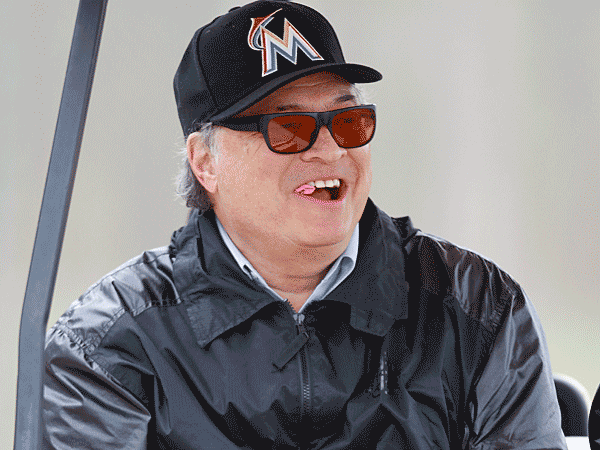
Nope, that M stands for Miami, not Montreal.

This week, the Mets are in Washington, District of Columbia to play the Washington Nationals

The Mets should be playing these games in Montreal, Quebec, Canada, against the Montreal Expos, the team the Nationals were from 1969 to 2004.

Washington is a great city. Of course, it deserves to have a Major League Baseball team. But so does Montreal, and they got screwed.
Downtown Montreal

Most frequently blamed for the Expos' move is Jeffrey Loria. In 1999, the New York-based art dealer, former owner of the minor-league Oklahoma City 89ers, and unsuccessful bidder for the Expos in 1991 and the Baltimore Orioles in 1994, bought the Expos for $12 million (U.S.).

He demanded a new ballpark to replace the 1976 Olympic Stadium -- which still wasn't paid off (and, as it turned out, wouldn't be until 2006). But the City of Montreal wouldn't pay for it. Nor would the Province of Quebec. To make matters worse, Loria didn't get a TV contract for the Expos for the 2000 season -- on either an English station or a French one.

In 2002, a musical chairs of ownership saw Loria sell the Expos to the other 29 MLB owners, Florida Marlins owner John W. Henry sell his team to Loria, and Henry buy the Boston Red Sox from the Yawkey Trust. Then Loria moved the Expos' entire front office staff, on-field staff, and even broadcast staff (including Hall of Fame broadcaster Dave Van Horne) to Miami to join the Marlin organization. He even took the Expos' office equipment (which, to be fair, he did legally own), leaving them with, essentially, nothing but the players and the coaching staff.

Near the end of the 2004 season, Baseball Commissioner Bud Selig (effectively, the Expos' controlling owner) announced that the team had been purchased by a group that would move it out of Canada and into America's capital, becoming the Washington Nationals.

Montreal has had preseason exhibitions at the Olympic Stadium in 2014, '15 and '16, but has been without an MLB team for 12 seasons now. And, despite speculation and jokes about the Oakland Athletics and the Tampa Bay Rays moving in the next few years, the odds of Montreal getting a replacement team are long. It took Washington 33 years to get a new team, and it may take Montreal longer than that.

And to really add insult to injury, in 2003, the Marlins won the World Series. In 2012, Loria got what he wanted in Montreal, but got it in Miami: A new stadium with a retractable roof, close to downtown.

Montreal still has a weird and empty stadium, not well-suited to baseball, and no baseball team to play in it (although the CFL's Alouettes and MLS' Impact do play some home games there).
So, Loria is the biggest reason the Expos moved, right? It would seem that way. But, as ESPN host Brain Kenny said on their series The Top 5 Reasons You Can't Blame... , "Things aren't always what they seem."

Note that Loria's ownership of the Marlins has nothing to do with the following. How he's mishandled them is a whole other debate.

Top 5 Reasons You Can't Blame Jeffrey Loria for the Montreal Expos Moving to Washington

5. Quebec Separatists. Jacques Parizeau led the separatist Parti Quebecois to victory in Quebec's 1994 Provincial election, making him the Premier of the Province, equivalent to the Governor of one of our States -- and, with about 8 million people, Quebec has more people than all Provinces except Ontario, and all but 12 of our States.

Parizeau immediately set about putting a referendum on independence on the ballot. On October 30, 1995, with Quebec nationalists led by Parizeau and Canadian nationalists led by Prime Minister Jean Chretien, himself a Quebec native, both having advertised heavily and having held massive rallies, the Non side just barely triumphed over the Oui side. The number of spoiled ballots was actually larger than the margin of victory.
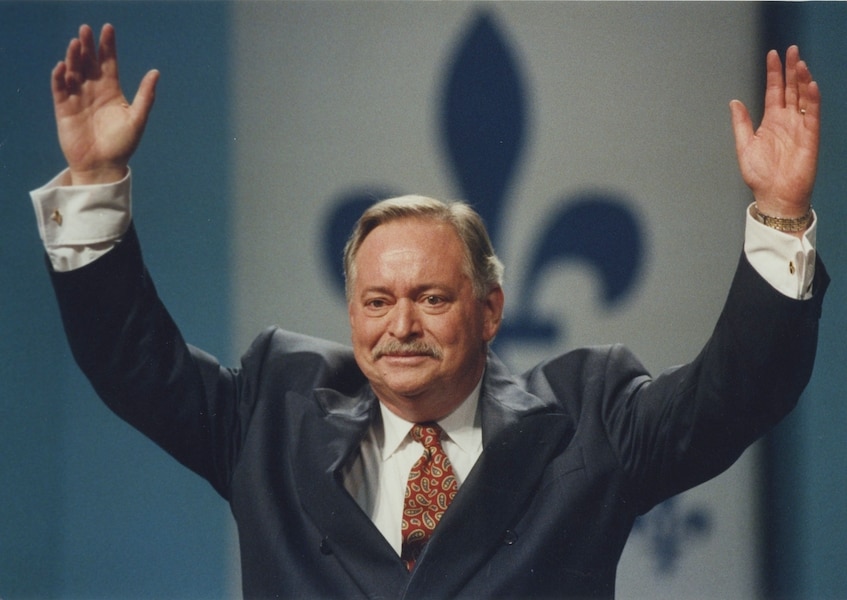
Jacques Parizeau. He looks like a businessman putting
 profits before people in a 1980s TV drama, doesn't he? The kind
who would have been a villain on Quincy, M.E. or Knight Rider.

Having failed by the slimmest of margins, Parizeau (not exactly slim himself, one critic called him "the Elephant Seal") resigned as Premier. Lucien Bouchard, leader of the federal Parliament's version of the PQ, the Bloc Quebecois (that's right, the federal government had a party devoted to taking 1/4 of its people away), was elected the new Premier.

And when Loria demanded a new ballpark, Bouchard told the National Assembly, Quebec's Provincial legislature, that they shouldn't pay for it. His successor, Bernard Landry, also refused. Even when the Liberal Party won the 2003 election, and installed Jean Charest as a Premier that wanted to keep Quebec in Canada, the NA wanted to focus on things that a Provincial/State government should focus on. Considering Quebec's high standard of living, in 2004 and in 2016, I can't say they were wrong.

In addition, the Quebec separatists cast the Province in a very bad light for the rest of Canada. Independence would have cut the Maritime Provinces (New Brunswick, Nova Scotia, Prince Edward Island, and Newfoundland and Labrador), all of them considerably closer in road and air miles to the Expos than to the Toronto Blue Jays, off from the rest of Anglophone Canada. Lots of people began to assume that the Pequistes would keep trying until they finally got what they wanted, calling it "The Never-endum."

There had been an earlier referendum in 1980, but it lost 60-40. It is now believed that the current PQ government won't schedule another until they think they can win with room to spare, as they don't want another loss, which would be humiliating in ways that 1980 and 1995 were not.

The 1995 referendum depressed attendance. When you don't know for sure what country you're going to be living in this time next year, even though you have no intention of moving out of your current building, your next thought is not likely to be, "Hey, the Cubs are in town, let's go to the ballpark and watch the local nine toss the ol' horsehide around!"

More likely, it could be, "What if I want to visit my brother in Ottawa? My Canadian passport is going to be no good anymore!" Or, "Les Anglais in Toronto and New York won't trade with us, so our economy is in tatters, and my Banque du Québec $5 bill is worth more as toilet paper than as currency!" (At least, at the time, Russia was run by Boris Yeltsin rather than Vladimir Putin, so not being part of NORAD anymore wasn't going to be a problem if Quebec separated.)

Then, of course, there was the question of what the Montreal Canadiens would call themselves.

4. The Exchange Rate. On January 18, 2002, I was in Montreal. It was a good day to be there. Not because of the weather -- it was very cold and snowing, as you might expect of Montreal in mid-January -- but because this was the day in history on which the U.S.-Canada exchange rate most favored Americans: US$1.00 = C$1.60, or C$1.00 = US 62 cents.
That, plus Canada's taxes (see, they actually pay for social services, instead of demanding said services but also demanding low taxes, and, as any idiot knows, and any non-asshole accepts, you can't have both high services and low taxes), meant that it was harder for the Expos (and the Blue Jays) to pay for anything, including player salaries, than it was for U.S.-based teams.

In 1994, the Expos had Pedro Martinez, Jeff Fassero, Ken Hill and John Wetteland on their pitching staff. Their lineup had Larry Walker, Marquis Grissom, Rondell White and Moises Alou. And they had the best record in baseball before the Strike of '94 hit. But they couldn't afford to keep those guys.

In contrast, in their last season in Montreal, 2004, they had a Cabrera (the decent Orlando, not the superstar Miguel or the steroid-aided star Melky), a Hernandez (a washed-up Livan, not a still-serviceable Orlando), 2 Beltrans (pitchers Francis and Rigo, neither of them a hitter like Carlos), a Cordero (Chad, not Wil), a Tony Armas (Jr., a decent but not great pitcher, instead of Sr., once a very good hitter), a Hill (Shawn, not Ken), a relief pitcher from Korea named Kim (Sun Woo, not Byung-hyun), a catcher named Diaz (Einar, not the late Phillies All-Star Bo), a Batista (Tony, not Jose Bautista), a Chavez (slick-fielding outfielder Endy, not good-hitting 3rd baseman Eric), a Rivera who once played for the Yankees (outfielder Juan, not pitcher Mariano), a banged-up Nick Johnson, a genuine All-Star in Jose Vidro, and an all-time great in Frank Robinson (a 68-year-old manager, not a 25-year-old Pennant-winning MVP or a 30-year-old World Series-win-captaining Triple Crown winner).

3. The Strike of '94. The Expos never really recovered from it. Not on the field, and not at the box office. Fans began to get the idea of, "What's the point?" And this was a few years before Loria bought the team.

2. Claude Brochu. The owner before Loria is hardly blameless. He could have managed the fallout from the Strike better, and he could have pushed for a new ballpark anytime between his June 14, 1991 purchase of the team -- by which point Camden Yards in Baltimore was under construction, and changing the rules for stadium and arena construction -- and the August 12, 1994 date of the Strike. He didn't.
It wasn't that he didn't want to. It was that he couldn't. He and his investors simply didn't have the money. They stepped in to stop the Expos from being moved to Phoenix, but it only delayed what might have been an inevitable. It's worth asking if a completed 1994 season, with the Expos winning the World Series, would have made a difference.

(Maybe not. The Boston Braves won a Pennant in 1948; 5 years later, they were in Milwaukee. They finished only 5 games out of 1st in 1964; after 1 more season, they moved to Atlanta. The Brooklyn Dodgers won a Pennant in 1956; after 1 more season, they moved to Los Angeles. And those are just examples from baseball.)

And if you still think Loria is more to blame than Brochu, just remember that it was Brochu who sold the team to Loria. Brochu wasn't a bad guy, he just seriously miscalculated his ability to run the team. He certainly wasn't as malicious about it as Loria -- the old saying is, "Never ascribe to malice that which can be blamed on incompetence "-- but he's at least as much to blame.

1. Bud Selig. Allan Huber Selig was the Commissioner of Baseball -- Acting Commissioner after Fay Vincent was fired in 1992, and then full Commissioner from 1998 to 2015. Theoretically, the owners could have ganged up on him and demanded something, and, if they didn't get it, fired him.

That was never going to happen, because, for 28 years, from 1970 when he purchased the Seattle Pilots and moved them to his hometown so that they could become the Milwaukee Brewers, until 1998 when he was named full Commissioner (including 1992 until 1998, making him a walking conflict of interest), he was one of them. The owners rarely turn on one of their own. Bill Veeck and Charlie Finley were the last exceptions, and they both sold out in 1980.
Kind of looks like a James Bond villain, doesn't he?

If Selig wanted the Expos to stay in Montreal, he would have made it happen. Instead, he wanted Montreal out of MLB, and Washington in, and both happened.
Or maybe Charles Gray's take on Bond's nemesis
Ernst Stavro Blofeld in Diamonds Are Forever,
filmed during the Brewers' 1st season of 1970,
made him look like a baseball team owner.

The Verdict: Not Guilty. On the lesser charge of being a jerk, Loria is unquestionably guilty. But the Expos were probably doomed before he came along.

I hope MLB returns to Montreal soon. If it's the Rays, who are probably never getting a replacement for their stupid dome in St. Petersburg, a real dome somewhere in the Tampa Bay area, at least they wouldn't have to be moved out of the American League Eastern Division. It would make scheduling easier, and there would be the built-in rivalry with Toronto.

Saturday, December 29, 2012

Year-End Awards 2012

The following is taken from the 4 major North American sports -- baseball, football, basketball and hockey -- plus boxing and the Olympic Games.

It does not count any other sports, including soccer (which is, nonetheless, an occasional topic on this blog). If you're looking for Lance Armstrong or any golfer, you're not going to find him here.

It goes from January 1 to December 31 (well, December 29, but what are the odds of anything huge happening in what's left of the 29th, or on the 30th or the 31st?), and is not limited to the seasons that began in 2012.

The envelope, please:

Best Clutch Athlete of the Year: Eli Manning, quarterback, New York Giants.  Keep in mind, that, while the Giants seem unlikely to get into the Playoffs for the season whose regular season is about to close, at the beginning of this calendar year, he led the Giants to defeat the Atlanta Falcons, an achievement which looks even better now that the Falcons have the best record in the NFL this season.

Then he hung 37 points on the Green Bay Packers in Lambeau Field in January (the Pack had never allowed more than 27 in a home postseason game before), including 17 in the 4th quarter. Then he led an overtime drive that brought the Giants victory in overtime over the San Francisco 49ers at Candlestick. And then, for the 2nd time in 5 years, led a game-winning drive over a favored New England Patriots team to win the Super Bowl.

Worst Clutch Athlete of the Year: Robinson Cano, 2nd baseman, New York Yankees. In the regular season, his OPS was .929, good enough to get him 4th in the American League's Most Valuable Player voting. In the postseason, he reached base in only 4 out of 41 plate appearances -- a single, 2 doubles and a walk. That's an OPS of .244. In fact, Robbie's career postseason OPS is .686, hardly enough. In other words, Alex Rodriguez is not alone in postseason failures for the Yankees.

Best Coach (including baseball managers): Jim Harbaugh, San Francisco 49ers. Last season, he got the Niners into the NFC Championship Game. This year, he has them one win against a pathetic Arizona Cardinal squad away from another NFC West title. And he has done this in spite of a quarterback controversy. I wonder if Rex Ryan has noticed.

Worst Coach: Bobby Valentine, Boston Red Sox. Sure, he got a pig in a poke. But it's hard to imagine a manager taking a situation that bad and making it worse. He did.

In 1961, singer Robert Velline, under the name Bobby Vee, hit Number 1 with the Gerry Goffin-Carole King "Take Good Care of My Baby." In 2012, Bobby V proved he couldn't take good care of crybabies.

Best Coaching Decision: Tom Coughlin, New York Giants. His decision: Sticking to the plan that beat the Patriots 5 years earlier.

Worst Coaching Decision: Davey Johnson, Washington Nationals. His decision: Letting the Nats' management's decision to put Stephen Strasburg on the shelf stick. Washington hadn't had a team in MLB's postseason in 79 years -- since Franklin Roosevelt's New Deal was new, since Kong was King, since well before the foundation of the NBA and before most American sports fans cared about the NFL and the NHL.

The Nats lost the National League Division Series to the St. Louis Cardinals, 3 games to 2. In the 3 games the Nats lost, they allowed 12, 8 and 9 runs. Davey and the Nats' brass could have limited Strasburg to relief duty. I wonder what they would, now, give to have Strasburg pitch just one inning. Specifically, the top of the 9th of Game 5, in which Drew Storen allowed a double, 2 walks and 2 singles, to turn the game from 7-5 Nats to 9-7 Cards.

The Nats were 1 out away from winning the series. But they chose not to risk Strasburg, not even for one inning, and thus did they throw away what would have been the 1st postseason series won by a Washington team since 1924. Since Calvin Coolidge was elected President!

Best Executive (not owner): John Elway, executive vice president of football operations, Denver Broncos. He brought in Peyton Manning, and made the Broncos AFC West Champions, and dumped off Tim Tebow on the hapless Gang Green.  he Broncos now look as good as they have since Elway himself was last taking snaps for the Broncos.

Worst Executive: Mike Tannenbaum, general manager, New York Jets. Now, I don't know if Mark Sanchez would have had a better season if Tim Tebow wasn't hanging over him like the Sword of Damocles. But Tebow should never have been brought to the Jets, and that decision destabilized the team terribly.

Best Transaction (includes trades, waiver pickups, free agent signings and "addition by subtraction"): The Detroit Tigers trading 2 guys you don't need to know about and a draft pick to the Miami Marlins for Anibal Sanchez and Omar Infante. That trade made the Tigers American League Pennant winners.

Worst Transaction: A collective award to the Miami Marlins, owner Jeffrey Loria and his stepson/lackey David Samson. They had a new ballpark, a big new acquisition in Jose Reyes, and with the New York Mets in disarray and the Philadelphia Phillies going through an injury crisis, there was a fantastic chance for the Marlins to finish first in the National League Eastern Division for the 1st time. (They have won 2 World Series, but got in as a Wild Card team both times.)

Instead, the Marlins took all the money and ran their best players out of town -- including, last month, to the Toronto Blue Jays, Reyes. Loria & Samson are not the sole reason, or even the biggest reason, that the Montreal Expos no longer exist, but they have now broken up the Marlins twice. At least, the first time, they waited until they'd won the World Series.

Best Rookie: Robert Griffin III, quarterback, Washington Redskins. No rookie quarterback has led a team to an NFL Championship, ever, with one exception 75 years ago: Slingin' Sammy Baugh of the 1937... Washington Redskins. Griffin is playing like a seasoned veteran, with poise and sense. Maybe he won't lead the 'Skins to this season's title, but if he doesn't finish his career with a ring, I will be shocked. (UPDATE: He didn't, and I'm shocked.)

Worst Rookie: Austin Rivers, guard, New Orleans Hornets. He forewent his last 3 years of eligibility at Duke University to enter the NBA Draft, thus forfeiting at least part of a pretty good education he could have gotten from Mike Krzyzewski, and also forfeiting as many as 3 decent shots at the Final Four and the National Championship. Just because a man has the right to do something doesn't mean he should do it.

Drafted by the New Orleans Hornets, he's shooting 35 percent. Per game, he's got 7.8 points, 2.6 assists and 2.5 rebounds (that's offensive and defensive combined). I don't want to pile on a kid who's only 20, and who could still turn out okay -- he's certainly got the genes for it, being the son of Doc Rivers, the Boston Celtics coach and previously a pretty good player -- but I've seen 2 websites that have called him the worst rookie in NBA history. NBA history goes back 66 years, nearly 2/3rds of a century.

Best Comeback: Peyton Manning, quarterback, Denver Broncos. From not playing at all in 2011 to playing in 2012 as if he'd never missed a game from a Hall of Fame career. I was thinking that, due to his injury being to his neck, it would be better for him to retire rather than risk worsening the injury. Looks like I was wrong -- and I hope I stay wrong.

Worst Comeback: Bobby Valentine. His comeback made that of Davey Johnson, the only other man to manage the Mets to a Pennant in the last 39 years, look like genius.

Biggest Collapse: Texas Rangers. As bad as the Yankees going from 10 games up to tied was, they still won the Division; as bad as their postseason debacle was, it was still in the postseason. After back-to-back Pennants, the Rangers led the AL Western Division by 5 games with 9 to play. And they had a "Borg losing streak": They lost 7 of 9, including losing the last 3 to the team that was chasing them, the Oakland Athletics, failed to win the Division, and then lost the Wild-Card play-in game to the Baltimore Orioles.

Turncoat of the Year: Barry Zito, pitcher, San Francisco Giants. He pitched very well for the Oakland Athletics, but they didn't win a Pennant while he was there.  He went to the cross-bay Giants for big money. He was awful, and although he got a ring when they won the 2010 World Series, he was really just along for the ride.

That was not the case in 2012: The Giants would have won the NL Western Division without him, but not the World Series.

Dishonorable Mention: Hank and Hal Steinbrenner, who seem to have betrayed their father George's commitment to winning, because the cost is always worth it and comes back. (Since I've excluded soccer, I can't give this to Robin van Persie.)

Most Original Thinker: Josh Gorges, defenseman, Montreal Canadiens. You may not have heard of him, but you should. An alternate captain for Les Habitantes, he went on Twitter to ask hockey fans to join him at an ice rink in the Montreal suburb of Verdun this past Wednesday afternoon -- being a part of the British Commonwealth, Canada celebrates the day after Christmas as a holiday, Boxing Day.

Dozens of people came out, and that greatest of all hockey cities, starved for their sport, got a taste of what they were looking for. For them, Josh Gorges was Santa Claus. Or, since it was a Commonwealth country, I should say "Father Christmas." Or, since it's a majority-Francophone city, "Père Noël."

Most Stagnant Thinker: Gary Bettman, Commissioner, National Hockey League. You would think that the only Commissioner ever to cancel an entire season, thus bringing universal scorn upon him, would have learned to never, ever do that again. Alas...

Best Sports Theater: Daniel Craig, in character as James Bond, and Queen Elizabeth II making their way from Buckingham Palace to the London Olympic Stadium during the Opening Ceremonies.

No, that wasn't actually one of the world's most famous actors and an 86-year-old head of state paratrooping out of a helicopter... but Craig just might be the toughest 007 ever. And the Queen, then Princess Elizabeth, was in the British Army in World War II, serving in a motor pool. I'll bet she's still handy with a toolbox.  She could, quite literally, fix your wagon and clean your clock.

I have to hand it to her: At an age that "Ol' Perfesser" Casey Stengel didn't live to be, and at which "The Grand Old Man of Baseball" Connie Mack was hopelessly senile, and at which Queen Victoria (whose record of 64 years on the English throne she could surpass in 4 years) was dead for 5 years, Elizabeth not only still does her job, she seems to still love her job.

Worst Sports Theater: The New York Yankees' postseason. It is still difficult to believe that the Yanks actually won a postseason series. The Yankees, as a team, were their usual Bronx Bomber selves in the regular season, with an OPS of .790. That dropped to .611 in the AL Division Series and .488 in the AL Championship Series.

If the old song is wrong, and in Heaven there is beer, Babe Ruth and Mickey Mantle have got to be downing some brews and discussing what the hell happened.

Most Bang for the Buck: The Oakland Athletics. At $55,372,500 dollars, they were only $128,000 ahead of the San Diego Padres for lowest payroll in MLB. This was after a salary dump. Lots of people, myself included, thought they were headed for a historically bad season, which I would define as the kind of season an expansion team might have, 107 or more losses, without actually being an expansion team. This, I thought, might be the nail in the coffin for the A's staying in the Bay Area long-term.

Instead, the A's won 94 games and the AL West, and pushed the Tigers to the 5-game limit in their AL Division Series. Had they won that series, I have no doubt that they, too, would have beaten the Yankees in the ALCS. Alas, they still haven't won a Pennant since 1990, meaning general manager Billy Beane is still looking for his first flag. "Moneyball" worked again, but it still hasn't done what every baseball team should be trying to do: Get into the World Series, and maybe win it.

Least Bang for the Buck: The Philadelphia Eagles. True, the Red Sox got 93 losses for their $173 million. But after what happened the preceding fall, they were expected to be dysfunctional. The Eagles? Hell, they're always dysfunctional, but I don't think anyone expected the kind of talent they supposedly had to put up a 4-12 season. (They're 4-11 going into the final game, away to the Giants, and I'm guessing that, even though the Giants need a lot of help in addition to winning this game to make the Playoffs, it will be ugly for the Broad Street Birds.)

Best Sports Writing: Bill Madden, for his New York Daily News column last week showing why the Yankees should still be the favorites for the AL East title in 2013. He's right: The Red Sox are still a mess, the Orioles have already downgraded, the Blue Jays are unlikely to go from 89 losses to 89 or more wins even with their new acquisitions, and the Tampa Bay Rays are still letting key players go to cut costs.

Meanwhile, the Yankees still have the Division's best attack, its best defense, its best starting rotation, and, if Mariano Rivera is anything like he was at the start of the 2012 season before he got hurt, its best bullpen.

Worst Sports Writing: Joe Posnanski, currently of Sports On Earth. He's probably still distraught that his hagiography of Penn State football coach Joe Paterno had its ending rewritten without his consent. He still managed to write a book that made Ratface look like a hero. Which he most certainly was not.

Most Overreported Story: The fuss over the Jets' quarterback situation. I know, it's the biggest position in the biggest sport, and in the biggest city/metro area, but, come the heck on. If the Jets were imploding, going from a Playoff contender to a team on the verge of not making it, it would be different. But this is way too much hype for a 6-9 team.

Most Underreported Story: The San Francisco Giants. They're not even the most-reported team named Giants that won a World Championship in the calendar year. With all the talk about the 49ers' quarterback situation, and the Golden State Warriors getting a deal for a new arena a short walk from the Giants' AT&T Park, the Giants were, for most of the year, not even the most-talked-about team in the Bay Area. Or even, with the situation with the A's, their payroll slash, their bad ballpark situation, their possible need to move, and their amazing comeback, the most-talked-about baseball team in the Bay Area.

And what about all the talk about basketball legend Magic Johnson buying the Los Angeles Dodgers, and all the money he's spent on them, and all the talking he's done about them? That may pay off next year, or the year after, but this year, the Dodgers were the most-talked-about team in the NL West, maybe the whole NL, in the regular season. And you know what? The Dodgers didn't make the Playoffs. The Giants did, and won the whole thing. For the 2nd time in 3 years.

That's not a dynasty, but it's something the Yankees last achieved in 2000, and it's something not achieved by any other team, including the Red Sox in their recently-ended period of glory, since the Blue Jays won back-to-back titles in 1992-93. And not in the NL since the back-to-back titles of the Cincinnati Reds in 1975-76.

The Giants deserve our praise. At the least, to borrow the words of their greatest-ever player, Willie Mays, they deserve a "Say Hey!"

Bummest Rap: That Alex Rodriguez is the reason the Yankees have (except for 2009) failed in the postseason since 2004. True, he's blown it in many at-bats, but he's had lots of help, from guys whose regular seasons suggested that they should have done far better. And in the games that he didn't play in this October, nobody else picked up much slack.

Fairest Rap: That Davey Johnson and Dusty Baker are great regular-season managers but lousy postseason managers. Between them, in 35 seasons as managers, they have reached the Playoffs 12 times, but won only 2 Pennants. Their won-lost records in postseason games? Davey, 25-26; Dusty, 19-26. (In both cases, that doesn't count the canceled 1994 Playoffs that both were on course to reach, Davey with the Reds and Dusty with the Giants; but it does count the Giants' loss to the Chicago Cubs in the 1998 play-in game required when those teams tied for the NL Wild Card.)

If the Mets hadn't pulled out that 1986 NLCS Game 6 in Houston, or if John McNamara hadn't screwed the pooch in the bottom of the 10th in Game 6 of the World Series, they'd be 35 combined seasons as managers with no rings. As I've said before, the 1986 Mets won it all in spite of Davey, not because of him, and the Nats aren't going to win it all with him. Dusty? The Reds are a good team, but they're not going to win it with him.

Most Shocking Moment, On-Field: Juan Manuel Marquez, and his knockout of Manny Pacquiao. It's been said that all great boxing champions must one day hit the canvas, and the Pacman is 34, hardly young in boxing. But I don't think anybody, even Marquez, expected the demolition that Marquez laid on him.

Most Shocking Moment: Off-Field: Jovan Belcher, linebacker, Kansas City Chiefs, killing his girlfriend, the mother of his baby daughter; then driving to the Chiefs' practice facility adjoining Arrowhead Stadium, thanking head coach Romeo Crennel and general manager Scott Pioli for what they'd done for them, and then killing himself in front of them. As the Chiefs and their fans have found out, there are worse things than finishing a season 2-14.

My Favorite Moment: Adam Henrique's overtime goal to beat the New York Rangers and send the New Jersey Devils to the Stanley Cup Finals for the 5th time -- all in the 18 years since the Rangers last got that far. That the Devils were so weak in the Finals against the Los Angeles Kings (and somehow still stretched it to a Game 6) does nothing to diminish the fact that we beat The Scum!

My Least Favorite Moment: The only reference to college sports in these awards, aside from the Posnanski book about Paterno. It's the Rutgers football team's huge choke against the University of Louisville, at home, with sole possession of the Big East Conference title in their grasp.

And, just last night, they blew a 10-point 4th quarter lead against former Big East opponent Virginia Tech in the Whatever The Hell Sponsor's Name Is On This Game Bowl in Orlando. Oy vey.

Most Defining Moment in Sports in 2012: The Mets letting R.A. Dickey go. All he did was give them their 1st 20-win season for a pitcher in 22 years, their 1st Cy Young Award in 27 years, and belief from their fans every 5th game all season long.

And when he wanted a contract that would, essentially, be the last of his career and have properly rewarded his services, what did they do? They collaborated with the media to publicly question his character, and they traded him to a team in Canada. (Toronto may be the 2nd-largest city in North America -- the 3rd-largest if you count Mexico City -- but in baseball publicity terms, they might as well have been sending him down to Triple-A.) It's like they were saying, "Thanks for everything you did, sucker, now here's your hat, what's your hurry?"

Sports Personality of the Year: LeBron James, forward, Miami Heat. He got the ring, he got the Gold Medal, he got the historical validation, he got the monkey off his back, and he got the publicity that comes with all of it. Like him or not, he was the year's biggest story.

Sports Person of the Year: Bruce Bochy, manager, San Francisco Giants. As I said a few days ago, he has been both a World Series-winning manager and a charitable person, figuratively and literally, and hardly anybody notices.

Wednesday, November 17, 2010

Top 10 Crooks In Baseball

November 17, 1973, 37 years ago today: Richard Nixon proved he was the father of the modern Republican Party. Reagan, both Bushes, Gingrich, Cheney, Boehner... they're not just crooks, they're all arch-criminals. America cannot trust them. So often, we soon forget... but we always figure it out.

Who are the top 10 crooks in baseball history?

10. Hal Chase. Probably no player ever "threw" more games, or did so over a longer period, than "Prince Hal," who played from 1905 to 1919. He even used his reputation as baseball's best-fielding 1st baseman of the time to make errors, and thus cast doubt not on his own honesty but on the fielding ability of the infielders throwing to him. And he confessed it all.

9. Carl Pavano. If you're talking who is the biggest crook ever among players, there can be no other candidate, not even Chase. Pavano got a $39.95 million contract to play for the Yankees for 4 years. He faced 542 batters for the Yankees in those 4 years. That's $73,708.49 per batter.

He went 9-8 (and the Yankees were a bit more than a .500 team at the time), his ERA+ was 89 (11 percent worse than the AL average), his WHIP was 1.455, and, oh yeah, he crashed his Corvette and broke some ribs -- and didn't tell Yankee management for 2 weeks.

Little wonder he was nicknamed "American Idle." Thief! Fraud! Crook!

8. Walter O'Malley. Face it: If he could have made more money staying in Brooklyn than going to Los Angeles, the Dodgers would still be in Brooklyn today. If he could have made more money in London, in Tokyo, in Antarctica, or the freakin' Moon, that's where Dodger Stadium would be today.

Let's not forget that he offered the city of Los Angeles a deal: In return for giving him the 300 acres of land on which Dodger Stadium and its parking lots sit, he would accept only 77 games' worth of parking revenue. In other words, half of the season's games. The city fathers were stupid: It never occurred to him that, in the other half of the games, the Dodgers would be on the road.

Let's remember also that he got the people living on the site of Dodger Stadium evicted from their homes. He'd already done that in his pre-baseball life, as an attorney for landlords. Walter O'Malley was scum. And he was a crook.

7. Charlie Comiskey. No, not the 8 Chicago White Sox players under his employ who took money from gamblers to throw the 1919 World Series. The man who drove them to it. And knew about it. And did nothing to stop it.

6. Scott Boras. His clients have included Alex Rodriguez, Manny Ramirez, Iván Rodríguez and Éric Gagné -- steroid cheats. (Magglio Ordonez, another of Boras' Bonus Babies, has also been suspected.)

They have also included several guys who got huge contracts and didn't pan out: Todd Van Poppel, Barry Zito (at least, since he's left Oakland, the Giants won this year's World Series despite him), Kevin Millwood (much less successful as a Phillie and an Oriole than as a not-yet-fabulously-paid Brave), both Jeff Fucking Weaver and his brother Jared Weaver, Kenny (Coward of the County) Rogers, and, with the current Mets, Carlos Beltrán and Oliver Perez.

Then, of course, there were the $252 million contract he negotiated for A-Rod with the Texas Rangers, which eventually plunged the team into bankruptcy; and the extension of said contract to $275 million with the Yankees. All this before A-Rod had won so much as a Pennant.

I suppose we can blame A-Rod for, until October 2009, not living up to the contract, but we sure can't blame him for getting a lot of money that no mere athlete deserves. Not even Derek Jeter. Scott Boras is a thief.

5. Jeffrey Loria. First he bought the Montreal Expos, and promised he would never move them. Then he made that come true, but only because he so seriously defunded them that they couldn't compete in MLB. Then, with assistance from Commissioner Bud Selig and his fellow owners, he was allowed to sell the Expos back to MLB at a massive profit, and buy the Florida Marlins (whose owners then bought the Boston Red Sox). This led to MLB taking the team out of unprofitable Montreal.

And whose fault was it that the city was unprofitable for baseball? Not all Loria's, but mainly Loria's -- and move them to Washington, D.C. Washington deserved a team, but not that team.

Now willing to spend a little money (but not that much), Loria bought himself a World Championship in 2003. Being a Yankee Fan, I certainly can't fault him for trying that. But then he broke up that team to save money, and the Marlins have barely been competitive since.

He's getting a new ballpark in 2012, but does he really deserve it? He doesn't deserve a luxury suite at Your Corporation's Name Goes Here Field. He deserves a different suite, like at Sing Sing.

4. Arthur Soden. The owner of the franchise best known as the Boston Braves from 1876 to 1907, and acting President of the National League in 1882 and '83, he decided to move the Troy Trojans (across the river from Albany) to New York where they became the Giants, and the Worcester Ruby Legs (possibly eliminating competition for his "Beaneaters") to Philadelphia where they became the Phillies. So I guess we should thank him for that.

But he was also the man who suggested the reserve clause to his fellow owners, keeping players bound for life to one club (or so the owners wanted the players to believe) unless they were traded or outright released, not to mention a back-door way to what we would now call a salary cap.

It gets worse: In 1890, he practically kept the NL in business by funding several teams, enabling them to crush the Players League and the 1st players' union.

And he capped his career by responding to the founding of the American League in 1901, including another team in Boston, the one that became known as the Red Sox, by... raising ticket prices. The "Royal Rooters," Boston's biggest baseball fan club, deserted the NL club en masse and moved to the AL club.

That, as much as anything else, is the reason why Boston was a Red Sox town continuously from 1901 onward. In the 52 seasons in which both teams played in Boston, 1901 to 1952, the Braves only had the higher per-game attendance 7 times -- all between 1921 and 1933, starting after Sox owner Harry Frazee sold Babe Ruth, and ending the year Tom Yawkey bought the Sox and started rebuilding them. Even as the Braves won their last 2 Boston Pennants, the Red Sox had higher attendance: 6,055 to 5,055 (a 20 percent advantage for the Sox) in 1914, and 20,000 to 19,000 (a 5 percent advantage for the Sox) in 1948.

I suppose that if someone other than Yawkey had bought the Sox from 1933 onward, the Braves might have been the team that survived in Boston, and the Red Sox might have been the one that moved. But Arthur Soden certainly ended the era when the Braves were the unquestioned most popular sports team in New England. And all because he was a greedy crook.

It's just as well, I suppose: As bad as the Yankee-Red Sox rivalry is, can you imagine if the Mets and Braves were a New York-New England rivalry?

3. Allan H. Selig Jr. Before becoming Commissioner, or Acting Commissioner, or a powerful force among the owners, or the owner of the Milwaukee Brewers, or even the man trying the hardest (and eventually succeeding) to bring Major League Baseball back to Milwaukee after the Braves left town, "Bud" Selig was... a used-car salesman. He even sold a rookie Braves catcher named Joe Torre his first car.

All jokes about "Would you buy a used car from this man?" (which brings us back to Nixon) aside, Selig went on to become the 1st Commissioner in the history of major league sports, anywhere on this planet (including soccer in any country) to cancel a postseason in order to save money for the team owners. (That was on September 12, 1994, a date which lives in infamy. Unfortunately, he was not the last: Gary Bettman canceled an entire NHL season 10 years later.)

And he tore down and replaced Milwaukee County Stadium, one of the most fun ballparks ever, and replaced it with Miller Park, for one reason and one reason only: To make more money.

As a team owner, becoming Commissioner was a conflict of interest of epic proportions. And he looked the other way on steroids, although he certainly had help on that matter from the Players' Association and its director Don Fehr (who could also have made this list). He also looked the other way on the Red Sox' pitchers targeting the Yankees with headhunting pitches -- because he knew that publicity generated by the Yanks-Sox rivalry meant more television revenue, and thus more money for Major League Baseball and the team owners.

I have to issue a disclaimer: In 1993, before most of these reason for my anger toward him developed, anticipating the realignment of MLB's divisions to prepare for the added round of Playoffs, I wrote a letter (this was before the era of e-mail) to Selig, making suggestions as to how the divisions should be aligned. Exactly what my realignment plan was at the time, I can't remember.

But Selig sent me a very nice return letter, thanking me for my idea. This was clearly not a form letter: This required thought in composition. And it was actually signed, not by a robo-pen (or whatever they call signature-writing machines). I really liked him after that: He seemed a Commissioner in touch with the thoughts of the fans. Little did I know that, just a year later, he would commit the greatest crime in baseball history.

2. Rupert Murdoch. Okay, he wasn't that crooked as owner of the Los Angeles Dodgers from 1997 to 2004. But this isn't the Top 10 Baseball Crooks, it's the Top 10 Crooks In Baseball. And it takes a special kind of person to buy the Dodgers from the O'Malley family, and become the worst human being ever to own that franchise.

Number 1? Easy choice, especially when you consider who I chose for Number 2.

1. George W. Bush. Okay, he wasn't that crooked as owner of the Texas Rangers from 1989 to 1998 (with his ownership in a blind trust after his 1994 election as Governor, hence the team technically didn't reach the postseason while he was the man controlling the team)...
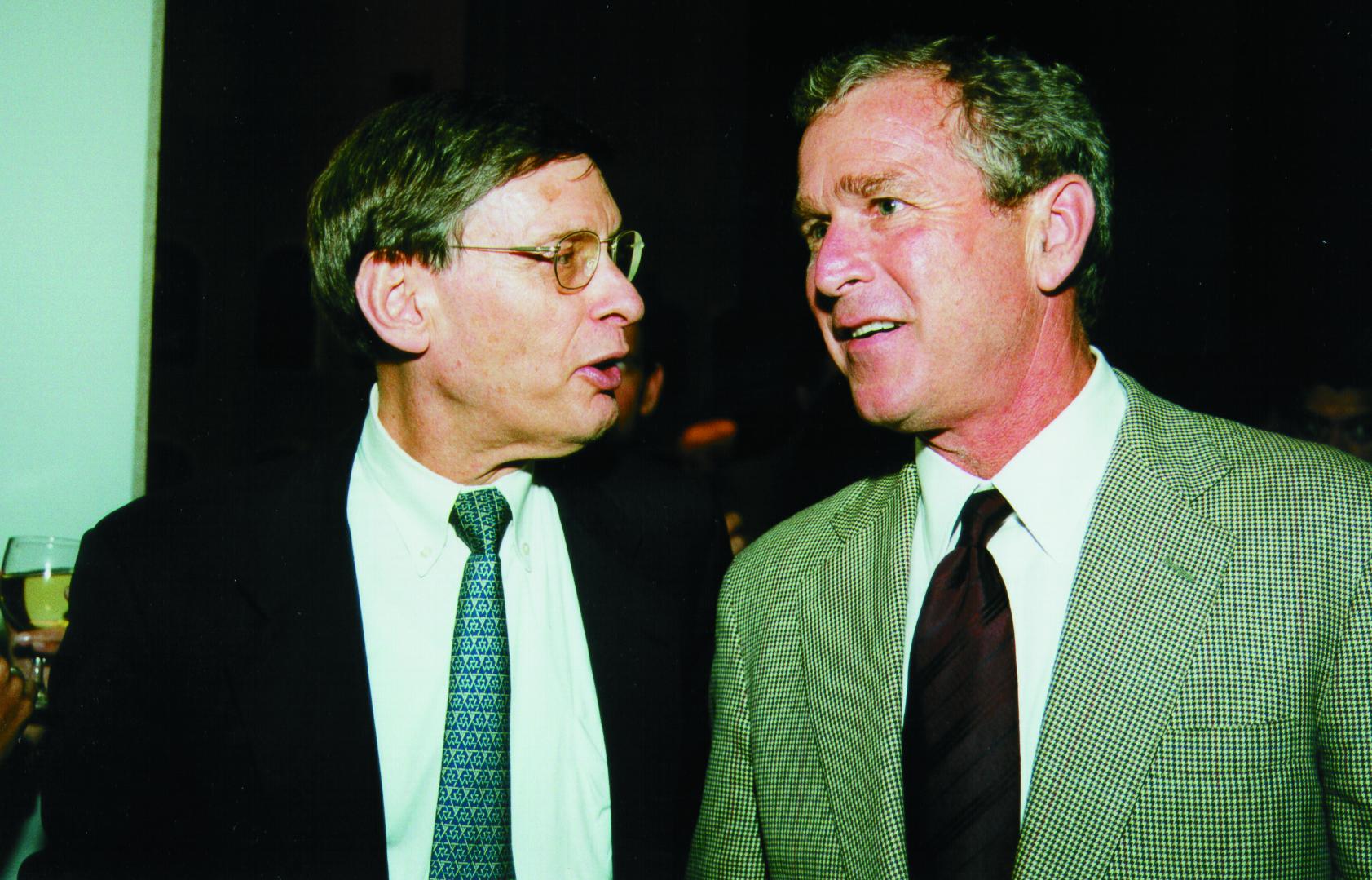
Crook Number 3 and Crook Number 1, in happier times.

But has there ever been a bigger criminal in American history? Nope, not even Richard Nixon himself -- even if he did sort of steal the Presidential election in 1968 by sending Madame Chennault to Paris to sabotage the Vietnam peace negotiations. But he didn't actually steal votes like Bush did.

"Were it within my power to forgive you, I would. But your forgiveness will have to come from someone other than me."
-- Joseph N. Welch