Showing posts with label graig nettles. Show all posts

Wednesday, May 20, 2026

May 20, 1976: The Yanks-Sox '76 Brawl

Left: Lou Piniella and Carlton Fisk. Right: Bill Lee.

May 20, 1976, 50 years ago: The New York Yankees and the Boston Red Sox begin a 4-game series at Yankee Stadium in The Bronx.

In 1967, there had been an exchange of beanballs there that led to a bench-clearing brawl. In 1973, at Fenway Park in Boston, a home-plate collision between the teams' All-Star catchers, Carlton Fisk at the plate and baserunner Thurman Munson, led to another big brawl. Now, as the Sox were defending American League Pennant winners, and the Yankees were trying to start a new dynasty, the old rivalry was well and truly back on.

In the bottom of the 6th, with the Yankees leading, 1-0, Lou Piniella on 2nd base and Graig Nettles on 1st base, Otto Vélez singled to right field. Piniella came around to score, but Fisk got the throw from Dwight Evans in right. "Sweet Lou" barreled into "Pudge," hoping to make him drop the ball, but it's no use: Fisk hung on, and Piniella was, unquestionably, out.

In retaliation, Fisk shoved Piniella, and here we go again. This one was even nastier than the brawls of '67 at The Stadium and '73 at Fenway -- or the one in 2004 at Fenway. Being a Red Sox catcher and starting a fight with Alex Rodriguez is one thing; starting one with Lou Piniella is another, because Lou didn't take any crap: He shoved it back.

The combatants were separated, but Sox reliever Bill Lee -- who may have hated the Yankees more than any Red Sock ever, at least until the Roid Sox of 2003-16 -- started yelling at Nettles, claiming that Nettles had hurt his shoulder. Spewing obscenities like a typical drunken lout Sox fan, "the Spaceman" (may NYPD Detective Sam Tyler of Life On Mars, wherever he is, forgive me) called Nettles out.

Lee was a pretty good pitcher up until this point, but this incident may have been the effect of drugs on his brain. (He has occasionally expressed his liking of marijuana, which usually leaves one much mellower than this.) If you call Graig Nettles out, he's going to clobber you. He did. Yeah, it was a sucker punch, but then, Lee was a sucker.

The Sox went on to win the game, 8-2, but lost the fight, only split that 4-game series, and were well back of the Yankees, who went on to win the Pennant.
Lee later said, "The Yankees fought like hookers swinging their purses." First of all, How would he know how hookers fight? And second of all, What does it say about him that he still lost the fight?

Sox fans like to say that Nettles ruined Lee, a great pitcher until then, but who never recovered. Actually, Lee was only a pretty good pitcher until then, and Lee did recover -- after yet another brilliant Sox trade, sending Lee to the Montreal Expos for Stan Papi. Not the Papi that Sox fans like to remember.

Friday, June 28, 2019

Yankees vs. Red Sox, The Defining Moments, Part III, 1967-1982

April 14, 1967, Yankee Stadium. The Yankees hold their home opener, and the Sox start a rookie, Billy Rohr. He comes within 1 strike of a no-hitter, partly thanks to an amazing 9th-inning catch of a Tom Tresh line drive by Carl Yastrzemski, the kind of play that makes you think, "If he wasn't going to lose the no-hitter on that play, he's not going to lose it."

But Elston Howard -- ironically, to join the Sox late in the season to help with their Pennant race -- singled to right to break it up. Rohr finishes it up, and the Red Sox win, 3-1. Five days later, at Fenway, Rohr beats the Yankees again. But he would win only 1 more game in his career, wash out, and become a lawyer. He got a huge hand at the Fenway Park Centennial celebration in 2012.


June 21, 1967, Yankee Stadium. Thad Tillotson beans Sox 3rd baseman Joe Foy, later to be a part of one of the biggest bonehead trades in history -- not surprisingly, by the Mets. 

When Tillotson comes up to bat (there will be no designated hitter in the American League until 1973), Jim Lonborg beans Tillotson. The benches empty, and all hell breaks loose. It becomes one of the nastiest brawls in baseball history, and it may be the earliest one preserved in any kind of video. The fight is, more or less, a draw. The game is a Boston win: Red Sox 8, Yankees 1.

Despite the acrimony from this brawl, this was an anomaly in the teams' relationship in the era. It was not the beginning of the modern Yanks-Sox rivalry. That was still to come.

October 1, 1967, Fenway Park. Lonborg, putting together a 22-win season that will win him the AL Cy Young Award, goes the distance. Yastrzemski ties the game with a bases-loaded single to clinch the Triple Crown, MLB's last until 2012. The Red Sox beat the Minnesota Twins 5-3. When the Detroit Tigers only split a doubleheader against the California Angels, the Sox have won their 1st Pennant in 21 years, only their 2nd in 49 years.
Yaz '67

While the Sox were putting together their "Impossible Dream" season, the one that gets remembered as the one that began "Red Sox Nation," the Yankees finished 9th in the 10-team AL. The Sox took the World Series to 7 games, before losing to the St. Louis Cardinals.
Fenway Park, 1967

September 28, 1968, Fenway Park. Mickey Mantle pops up to shortstop Rico Petrocelli in the top of the 1st inning, and is replaced at 1st base by Andy Kosco. The Boston crowd gives him a standing ovation, suspecting, as they had with Babe Ruth in 1934, that this was the last time they would see him. Indeed, it was the last game of his career, as he did not enter the next day's game, the regular season finale.

Joe Pepitone hits a home run in the top of the 9th inning off Lonborg, who tailed off considerably this season due to an off-season injury, and the Yankees win, 5-4.

April 7, 1970, Yankee Stadium. This was Opening Day, and, at first glance, it might not have any more significance than that. But it was the 1st Yankee game of my lifetime. It didn't end so well for the Good Guys, as only 21,379 came out to the big ballyard in The Bronx to see Mel Stottlemyre give up an RBI double to opposing pitcher Gary Peters. Red Sox 4, Yankees 3.

The Yanks did finish 2nd, with 93 wins, far ahead of the Sox, but the Baltimore Orioles ran away with the AL Eastern Division and won the World Series.

September 15, 1970, Yankee Stadium. Curt Blefary's time with the Yankees wasn't as good as his preceding time with the Orioles, but he did hit a pinch-hit walkoff homer in this game, against Mike Nagy. Yankees 3, Red Sox 2.

March 22, 1972, Fort Lauderdale Stadium, Fort Lauderdale, Florida. The Yankees and Red Sox complete what remains the biggest trade between the teams since Harry Frazee's selloff in the late 1910s and early 1920s. The Sox send wacky relief pitcher Albert "Sparky" Lyle to the Yankees, in exchange for Danny Cater and a player to be named later, who turns out to be Mario Guerrero.
The Sox didn't know how to handle Lyle, and their reasoning for obtaining Cater was that he hit well at Fenway Park, so why not let him play there 81 times a year? It didn't work, as Cater's batting average dropped from .276 in 1971 to .237. You see, the reason that Cater hit so well at Fenway is that he was batting against Red Sox pitchers. Now, he wasn't doing that anymore. Guerrero was never more than the stereotypical "good-field-no-hit" middle infielder.

Sparky, in 1972, set an American League record (though it was broken a year later) with 35 saves, and set the standard for Yankee relievers that was followed by Goose Gossage,Dave Righetti, John Wetteland and Mariano Rivera.


Sparky Lyle. Along with Reggie Jackson, 
Thurman Munson, Chris Chambliss, Mickey Rivers,
Willie Randolph, Dick Tidrow,  and eventually Goose Gossage,
Yankee opponents in the late 1970s had to fear the 'stache.

April 6, 1973, Fenway Park. Opening Day. Ron Blomberg bats for the Yankees, and becomes the 1st official player to come to bat as a designated hitter. He draws a walk. It doesn't help: The Red Sox win, 15-5.

This was also the 1st game as Yankee owner for George Steinbrenner, a Cleveland-born, Tampa-based shipbuilding tycoon. He said, "I won't be active in the day-to-day operations of the club at all. I've got enough headaches with my shipbuilding company." 

It would soon be clear that he was lying. But he would also do whatever it took, including going with the new rules of free agency and big spending, to build the Yankees back into World Champions.

August 1, 1973, Fenway Park. In 1972, the Yanks and Sox were both still in the Pennant race as late as August for the 1st time since 1953. But it would not be the 1st time since 1951 that both were still in it as late as September. That would have to wait until 1974.

On this day, with the game tied 2-2 in the top of the 9th, Yankee catcher Thurman Munson leads off with a double, and is sacrificed to 3rd. With Gene Michael at the plate, manager Ralph Houk orders a suicide squeeze. (You see, Houk was a smart man, and he knew "Stick" Michael couldn't hit a beach ball with a telephone pole.)

Michael misses the pitch anyway, and Munson, a dead duck at home, tries the only thing that might save him, to dislodge the ball from the mitt ofnSox catcher Carlton Fisk, only to have Fisk flip him aside. The two catchers already don't like each other, and they go at it, clearing the benches. A rivalry is reborn, and the Sox win this battle. Red Sox 3, Yankees 2.
Neither team won the Division (the Orioles did). In 1974, the Yanks and Sox would chase each other into September as the top 2 teams. Then the Orioles got into the act again, and smacked the Sox, who collapsed to 3rd place. The O's then swept a doubleheader at Shea Stadium (the Yanks had to play '74 and '75 at the Flushing Toilet while The Stadium was being renovated) in late September to take the Division. The Sox did win the Pennant in '75, losing an epic World Series to the Cincinnati Reds in 7 games. And then...

May 20, 1976, Yankee Stadium. Bottom of the 6th. Lou Piniella comes around to score, but Fisk gets the ball. Sweet Lou barrels into Pudge, but it's no use, he's out. Fisk shoves Piniella, and here we go again. This one was even nastier than the brawls of '67 at The Stadium and '73 at Fenway.

The combatants are separated, but Sox reliever Bill Lee -- who may have hated the Yankees more than any Red Sock ever, at least until the Roid Sox of 2003-present -- starts yelling at 3rd baseman Graig Nettles, claiming that Nettles had hurt his shoulder. Spewing obscenities like a typical drunken lout Sox fan, "the Spaceman" (may NYPD Detective Sam Tyler, wherever he is, forgive me) calls Nettles out.

Lee was a pretty good pitcher up until this point, but this incident may have been the effect of drugs on his brain. (He has occasionally expressed his liking of marijuana, which usually leaves one much mellower than this.) If you call Graig Nettles out, he's going to clobber you. He did. Yeah, it was a sucker punch, but then, Lee was a sucker.
The Sox won the game, 8-2, but lost the fight, only split that 4-game series, and were well back of the Yankees, who went on to win the Pennant.
Lee later said, "The Yankees fought like hookers swinging their purses." First of all, How would he know? Second of all, what does it say about him that he still lost the fight?

Sox fans like to say that Nettles ruined Lee, a great pitcher until then, but who never recovered. Actually, Lee was only a pretty good pitcher until then, and Lee did recover -- after yet another brilliant Sox trade, sending Lee to the Montreal Expos for Stan Papi. Not the Papi that Sox fans like to remember.
July 9, 1976, Boston. Tom Yawkey dies of leukemia at the age of 73. His widow Jean inherits the team. From this point onward, the tenor of the Sox organization changes. Tom was always willing to spend big in the hope of winning. But the money was Jean's now, and she was going to keep as much of it as she could. Which helped the Sox' opponents.

July 25, 1976, Yankee Stadium. Chris Chambliss turns a 5-3 Sox lead in the bottom of the 9th into a 6-5 Yankee win with a home run off Tom House -- known today as a pitching coach and as the man who, standing in the Atlanta Braves' bullpen in 1974, caught the ball Hank Aaron hit for his 715th career home run. 

This was foreshadowing of the Pennant-winning walkoff Chambliss would hit against the Kansas City Royals less than 3 months later.

June 18, 1977, Fenway Park. Jim Rice was a great power hitter, but was also slow as molasses. Yet Reggie Jackson misplays his looper, and Rice ends up on 2nd base. Manager Billy Martin pulls Reggie out of the game in mid-inning, and they end up shouting at each other in the dugout. Billy says something that ticks Reggie off, and Reggie tells Billy that all the alcohol he's has been ingesting has been getting into his brain.

How many Yankee catching legends turned coaches does it take to restrain Billy Martin? Two, apparently: Yogi Berra and Elston Howard. And the whole country (well, anyone in the country who wanted to watch baseball) sees this on the NBC Game of the Week. Red Sox 10, Yankees 4.

Oddly, the Red Sox did not score in the inning, and there was no play in the remainder of the game where having Blair in the field would have made a difference. It was a complete waste on Billy's part.

The Sox finish a series sweep the next day, and it takes several players, including Captain Thurman Munson and even Reggie himself -- who knows that Billy getting fired would be the worst thing for him, public-relations-wise -- to talk Steinbrenner out of firing Billy.

June 24, 1977, Yankee Stadium. The Yanks need a win over these guys. Real bad. They trail in the bottom of the 9th. But Roy White, the senior Yankee at this point, knocks one out to send it to extra innings. In the bottom of the 11th, Reggie gets his first real chance to prove his clutch bona fides in New York, and singles home Nettles with the winning run. Yankees 6, Red Sox 5. This begins a Yank sweep, and the race is back on.

September 14, 1977, Yankee Stadium. The Yanks already won last night, and the Sox need this one badly if they want to win the Division. This was the only way to make the Playoffs from 1969 to 1993 -- no Wild Cards.

Going into the bottom of the 9th, Ed Figueroa and Reggie Cleveland are both pitching shutouts. (Yes, kids, they both went the whole way.) Munson opens the inning with a single up the middle, and Reggie cranks one. Yankees 2, Red Sox 0.

The Sox win the next night, but as soon as the ball left Reggie's bat on this night, the American League Eastern Division race was effectively over. After a very nasty year, Reggie had won over his teammates and the New York fans. He did some hitting in the postseason, too.
It's easy to find a photo of Billy Martin smiling.
Same with Reggie Jackson. But smiling together? That's a bit harder.

This was Reggie's 2nd walkoff homer for the Yankees. He would make it 4, but this was the only one against the Sox.
After leading the AL East for most of the season, the Sox ended up finishing 2 1/2 games behind the Yankees, tied with the Orioles for 2nd place. But this blowing of a Division lead was just foreshadowing for the next year.
Yankee Stadium, after the 1973-76 renovation

November 23, 1977, Fenway Park. Mike Torrez signs as a free agent with the Sox. He had won 17 games in the regular season, including 14 after being traded from the Oakland Athletics to the Yankees. This did not include losing the game in June where Reggie and Billy set it off in the Fenway dugout. But then, nor did it include his wins in Games 3 and 6 in the World Series.
In spite of Sox fans' love of Luis Tiant and Bill Lee, it was actually Torrez, with 16 wins, who was 2nd on the '78 Sox in wins, behind the 20 of another off-season pickup, Dennis Eckersley, who had won 14, including a no-hitter, for the '77 Cleveland Indians. 

(Incidentally, Torrez wore Number 21 for the Sox, a number that had previously been worn by 1946 Pennant hero Tex Hughson, and would later be worn by Roger Clemens. He had worn 24 for most of his career, including with the Yankees, but Dwight Evans was wearing that number in Boston.)

Taking such a key pitcher off the Yankees, let alone bringing him in to themselves, should have been a big boost for the Sox and a big blow for the Yanks. And for a long time, it sure looked that way: As Billy Martin said, "Torrez is a hoss," and he was every bit the hoss for the '78 Sox that he was for the '77 Yanks -- and the '76 A's, for whom he won 16; and the '75 Orioles, for whom he won 20; and the '72 and '74 Montreal Expos, for whom he won 16 and 15, respectively.

And yet, there had to be a reason that Torrez kept changing teams. He won another 16 for the Sox in '79, but never won that many again.  In 1983, they let him get away to the Mets (wearing Number 30 for them, as did Nolan Ryan), where in 1984 he (accidentally, I think) beaned Houston Astro shortstop Dickie Thon, curtailing what was shaping up to be a very good career. His own ended that season, and although he won 185 games, he also lost 160, and has never been seriously considered for the Hall of Fame.

If he was a bad teammate, it's never been publicized, and he's always been invited back to Yankee Stadium for Old-Timers' Day -- which has often included him pitching to Bucky Dent. More on that in a moment.

June 27, 1978, Yankee Stadium. The Sox are flying. The Yanks are reeling and hurting.  The Yanks need a win, very badly. Graig Nettles gives it to them, hitting a 2-run shot off Dick Drago to win it in the bottom of the 9th. Yankees 6, Red Sox 4.

July 4, 1978, Fenway Park. The Sox are still flying. The Yanks are still reeling and hurting. The Sox won last night. The Fenway Faithful are cackling with glee, as it looks like the Sox will run away with the AL East title. The Yanks are desperate.

And the game is rained out. This turns out to be tremendously important, as the game is rescheduled for September 7, the beginning of what will now be a 4-game series, instead of a 3-gamer.

This was also the day after NewsChannel 4's Dr. Frank Field predicted beautiful weather for the 4th of July, claiming it would be perfect for the beach, the boardwalk, and fireworks, and the rain that soaked New England also soaked the New York Tri-State Area. The only fireworks that day were on the NBC switchboard, from furious viewers, and Field shows up for the 6:00 news with a noose around his neck. It was meant as a joke. I think.

I was 8 years old, and so upset over the postponement of the fireworks at Point Pleasant Beach, New Jersey. Little did I know how much this would end up benefiting the Yankees...

July 17, 1978, Yankee Stadium. Billy gives Reggie a bunt sign in the bottom of the 9th. He hasn't bunted in 6 years. After strike 1, Billy takes the bunt sign off. Reggie decides he's been shown up, so he's going to show Billy up in return -- almost exactly the reverse of what happened at Fenway the previous year. He bunts foul with 2 strikes, and thus strikes out. The Yankees lose 9-7 to the Kansas City Royals in 11 innings.

The Yankees are now in 4th place, 14 games behind the Red Sox. Overall, the Sox lead by 9 games over the Milwaukee Brewers. Billy suspends Reggie for 5 games -- and the Yankees win all 5, in Minnesota against the Twins and Chicago against the White Sox.

July 23, 1978, O'Hare International Airport, Chicago. Reggie's suspension ends. While boarding the plane that will take the Yankees to Kansas City, Billy is asked by a reporter how he'll handle Reggie. Having already visited an airport bar, he mumbles something about Reggie, and something about George Steinbrenner, and then says, "You know, they're made for each other. One's a born liar, the other's convicted." 

Billy was referencing George's conviction for violating campaign finance laws as the director of Ohio Democrats for Nixon in 1972, for which he avoided jail time, and was pardoned by a later Republican President, Ronald Reagan.

George flies out to Kansas City, and word of this fact gets to Billy. Once he sobers up, Billy knows that, like Nixon, he'll be "impeached" if he doesn't resign. He does. 

George hires Bob Lemon, the Hall of Fame Cleveland Indians pitcher who'd recently been fired as manager of the White Sox. He calms the team down, tells them to just go out and play, and sees them get healthy.

August 3, 1978, Yankee Stadium. After playing 14 innings the night before, a rule that is no longer in place, that no inning may start in an American League game after 1:00 AM, is invoked. The game is restarted, and the Sox win 7-5 in 17 innings. The Sox are leading the regularly-scheduled game 8-1 after 7 innings when it starts raining, and it's called.

The Yankees were now 8 1/2 games back, with 55 to play. It looks like it's over. But, as Yankee coach and catching legend Yogi Berra (though managing the Mets at the time, in 1973) said, "It ain't over 'til it's over." The Yankees' injuries have begun to clear up. Jim "Catfish" Hunter had briefly recovered from shoulder woes, and went on to win 6 straight decisions. And the Sox developed injuries, and, unlike the Yankees, they did not have a bench equal to the task.

September 7, 1978, Fenway Park. The Yanks got healthy and got hot, and had turned a 14-game deficit on July 20 into a 4-game deficit. Little-known fact: The Sox actually led the AL East by 10 games over Milwaukee on July 8, 9 on August 13, and 7 as late as August 31. So, while the Yankees gained 14 games, technically, the Sox "only" blew a 10-game lead.
Now it was the Sox were hurting and slumping, and their bench was to be tested. As the kids are saying these days, "Epic fail."
The 1st game was played on the night that Keith Moon, drummer for The Who, died from a drug overdose. Some Sox fans began to wish they could join him. Willie Randolph got 3 hits before Butch Hobson, the Sox' badly injured 3rd baseman and Number 9 hitter, even came to bat. Yankees 15, Red Sox 3.

September 8, 1978, Fenway Park. The 2nd game is a near-repeat performance, as Mickey Rivers got 3 hits before Hobson, elbow bone chips and all, could reach the plate. Yankees 13, Red Sox 2.

September 9, 1978, Fenway Park. The 3rd game is an NBC Game of the Week, and it is each team's ace, Ron Guidry (having the greatest season any Yankee pitcher has ever had) against Dennis Eckersley (having the greatest season any Sox pitcher had between Jim Lonborg in '67 and Roger Clemens in '86). Sox fans were confident that all they had to do was take these last 2 games, and the Yanks would have wasted all those runs and hits for nothing.
But the Yanks smacked the Eck around. Yankees 7, Red Sox 0. Someone wrote, "This is the first time a first-place team has been eliminated from the race."

September 10, 1978, Fenway Park. The Sox come close in the series finale, getting the tying run to the plate late, but... Yankees 7, Red Sox 4.

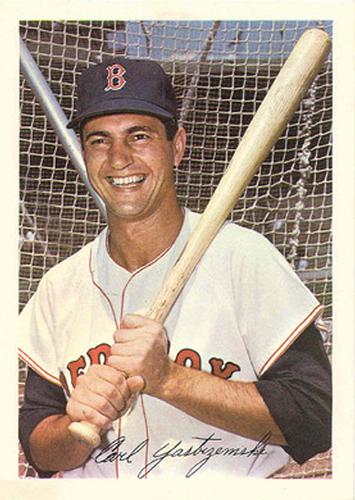
Tied for 1st. The defining image of the series is of Sox Captain and legend Carl Yastrzemski leaning against the scoreboard at the base of the Green Monster, head bowed, as if to say, "Please... I'll do anything you say... Just don't hurt us anymore... " (Sadly, I can't find a copy of that photo to put here.)
But I did find this one of Yaz. 
I think it's from the 2nd game.

An urban legend said that someone got on top of a bar somewhere in New England, and said, "The sons of bitches killed our grandfathers, they killed our fathers, and now they've come for us."

Except it wasn't over. In 1904 and 1949, it took 154 games to decide a Yanks-Sox race.  In 1977, it took 161 out of the 162 games. This time, it would require a Game 163, as the Sox won 12 of their last 14, including their last 8, while the Yankees lost their Game 162.

October 2, 1978, Fenway Park. I like to call it the Boston Tie Party. Red Sox fans like to call it something else. This game had so many twists and turns, and, with the possible exception of the 1951 Dodger-Giant Playoff (the Bobby Thomson Game), it has probably had more books written about it than any single game in the history of baseball.

What can I say about this game that hasn't already been said, including by myself? Probably nothing, so I'll simply say, "Bucky Blessed Dent."
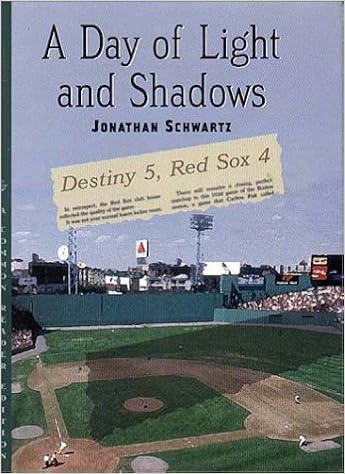
"Destiny 5, Red Sox 4" -- that's what the headline in the next day's Boston Herald-American said. Well, of course: "DESTINY" ends with "NY." The Yanks went on to win the World Series again.
One of the aforementioned books

The difference between this Sox loss to the Yankees and the one 25 years later is stark. When Nettles caught Yaz's popup for the final out, the Sox, as can be seen on the videotape, sort of slink back into their dugout, looking as if they were thinking, "If we couldn't do it this time, we'll never be able to do it." And, sure enough, the next time they got close, in 1986, only 8 years later, only 3 players were left from '77 and '78: Rice, Evans and Bob Stanley. And only Rice and Evans were still there from the '75 World Series.
They had won 196 games in 2 seasons -- just as they had won 192 in 1948-49 -- and, as in that 1940s instance, they hadn't even made baseball's official postseason, partly because they'd lost a one-game playoff at home. (In '48, it was to the Indians.)
November 13, 1978, Yankee Stadium. A year after letting the Sox sign Torrez, the Yanks turn the tables, and sign free agent pitcher Luis Tiant.
Tiant was, and remains, one of the most popular players in Sox history -- he is their "barbecue stand guy," the way Boog Powell is in Baltimore and Greg Luzinski is in Philadelphia -- and, with a 229-172 career record, a 1.199 WHIP and 2,416 strikeouts, is one of the best pitchers not in the Hall of Fame.
Was he a good pickup for the Yankees, even at age (we think) 38? Well, in 1979, he went 13-8 for a team that didn't do too well. He pitched a 2-hit shutout against the A's that included a grounder that went up the middle, right to his foot, which he kicked up and caught, and threw to 1st for an out. But in 1980, age finally caught up with him, and he was just 8-9, and his ERA went up by a full run. The Yanks chose not to re-sign him after that. Still, he pitched 2 more seasons in the majors before hanging 'em up.
Although his Yankee teammates liked him, and he has occasionally returned to New York for Old-Timers' Day, and had some of his best years in Cleveland, it's easy to forget now that he played for anyone other than the Red Sox.
When the Yanks fell apart in 1979, the Sox were unable to take advantage: They won 91 games, but that was 11 behind the Orioles.

September 14, 1980, Fenway Park. The Yankees complete another 4-game sweep on the Sox' turf: 8-5 in 10 innings, 4-2, 4-3 and, today, 5-3. They now lead the AL East by 5 games over the Orioles, and will end up winning 103, with the O's winning 100 and, without a Wild Card, missing the Playoffs.

The Sox? They finished the season only 83-79, and, through a bureaucratic mixup, they let Carlton Fisk and Fred Lynn get away after the season.

Part IV follows.

Wednesday, October 17, 2018

How Long It's Been: The Yankees Won a World Series Without the "Core Four"

It's bad enough that Yankee management -- both Aaron Boone and Brian Cashman -- didn't think enough of winning the American League Eastern Division to go for it, thus putting themselves in the best possible position to win the Pennant. But they got knocked out of the AL Division Series, at home, by the Red Sox.

The Yankees have won a World Series without Bernie Williams, Paul O'Neill, Tino Martinez, Chuck Knoblauch, Scott Brosius and David Cone. That was in 2009. But without the "Core Four"?

The last one was 40 years ago today, October 17, 1978, in Game 6 at Dodger Stadium in Los Angeles. Reggie Jackson got revenge on Bob Welch for Game 2, Catfish Hunter pitched well, Graig Nettles made yet another key defensive play, and Goose Gossage closed it out, by getting Ron Cey to pop up behind the plate, where Thurman Munson caught it.

October 17, 1978: 40 years.  How long has that been?

(This is an update of a piece I did in 2012.)

*


We didn't know it yet, but it was the last Yankee title for 18 years. Munson would never see another October Yankee game. He would never see another October. Or another September. He barely saw another August.

The Yankees had gotten to that title by overcoming both internal strife, in the form of the feud between manager Billy Martin and star slugger Reggie Jackson, leading to Billy's firing and the hiring of Hall of Fame pitcher Bob Lemon as manager; and a 14-game lead over them by the Boston Red Sox. It was mostly on the left arm of Ron Guidry, 25-3, 1.74 ERA, and a Yankee single-season record that still stands of 248 strikeouts.

This led to a Playoff for the AL Eastern Division title, which we know as the Bucky Dent Game or the Boston Tie Party. Then came a 3rd straight defeat of the AL West Champion Kansas City Royals, before the Yankees dropped the 1st 2 World Series games in L.A., and then won the next 4 straight, thanks to the fielding of Graig Nettles, Reggie's "Sacrifice Thigh" play, and the unexpected hitting of Dent and Brian Doyle.

The Yankees averaged 28,661 fans per home game, the club's highest total since 1949. Apparently, in spite of the New York crime wave, people liked braving it all to come to a comfortable new (or, rather, renovated) Stadium to watch championship baseball, just as they risked everything to get their entertainment at places from Broadway theaters to Studio 54 to CBGB.

The record would be topped in 1979 and '80, when a team-record 32,437 per game would come out.  That record would stand until 1988, and that would stand until 1998, broken in '99, 2001, '02, '03, '04, '05, '06, '07, and, in the last year of the old Yankee Stadium, 2008, top out at 53,069, a City record now unbreakable, given the current capacities of the new Yankee Stadium and Citi Field.

The Colorado Rockies, the Miami Marlins, the Arizona Diamondbacks and the Tampa Bay Rays did not yet exist. The Marlins, the Diamondbacks, the Philadelphia Phillies, the Kansas City Royals, the Minnesota Twins since moving from Washington, the Toronto Blue Jays, the Atlanta Braves since moving from Milwaukee, the California Angels (as they were then called), the San Francisco Giants since moving from New York, and the Houston Astros had yet to win their 1st World Series.

The Marlins, the Diamondbacks, the Rockies, the Rays, the Blue Jays, the Royals, the Braves since moving to Atlanta, the Astros, the Milwaukee Brewers, the San Diego Padres and the Texas Rangers had yet to win their 1st Pennant. The Marlins, the Diamondbacks, the Rockies, the Rays, the Angels, the Royals, the Astros, the Brewers, the Padres, the Blue Jays, the Rangers, the Montreal Expos and the Seattle Mariners had yet to make the Playoffs for the 1st time.

The Chicago Cubs had not won the World Series since 1908, the Chicago White Sox since 1917, the Boston Red Sox since 1918. The Expos were still in Montreal. The Brewers were still in the American League. The Astros were still in the National League. There was no Interleague play, no retractable roofs, and, with 1 exception back in the mid-1960s, there had never been an Asian player in the major leagues.

All of those facts are no longer true.

Only 6 MLB ballparks in use in 1978 are still in use in 2018: Fenway Park in Boston, Wrigley Field in Chicago, Royals (now Kauffman) Stadium in Kansas City, the Oakland Coliseum, and both Los Angeles-area stadiums: Dodger Stadium and Anaheim Stadium (now Angel Stadium of Anaheim). The Twins and Braves have actually opened and closed new stadiums in that 40-year stretch.

Some of the stars of the 1960s were still active: Pete Rose, Johnny Bench, Carl Yastrzemski, Lou Brock, Willie McCovey, Rusty Staub, Willie Horton, Mickey Lolich, Tom Seaver, and the Yankees' own Bobby Murcer – still in his "exile," playing for the Cubs.

Rivera was 8 years old, Posada 7, Pettitte 6, Jeter 4, Alex Rodriguez and R.A. Dickey 3, David Ortiz 2, and Johan Santana, Robinson Cano, Albert Pujols, Miguel Cabrera, Justin Verlander, Tim Linecum, Kris Bryant, Jose Altuve and Mookie Betts weren't born yet.

There was an NFL team in Baltimore, but it was the Colts, not the Ravens. There was one in St. Louis, but it was the Cardinals, not the Rams. There was one in Houston, but it was the Oilers, not the Texans. The NFL was still a League where the high-profile teams were the Oakland Raiders, the Pittsburgh Steelers, the Miami Dolphins and the Dallas Cowboys.

The Yankees, of course, succeeded themselves as World Series winners. The Cowboys had won the calendar year's Super Bowl. The Washington Bullets were the defending NBA Champions, having beaten the Seattle SuperSonics in the Finals. This result would be reversed in the season about to start, and neither team is known by that name anymore – and these would be the only titles, through 2012, that either franchise has ever won.

The Boston Celtics, Los Angeles Lakers and Philadelphia 76ers would be back, however. Kareem Abdul-Jabbar, Bill Walton, Julius "Dr. J" Erving and Elvin Hayes were the big names. Magic Johnson and Larry Bird were still in college, and had yet to face each other in the National Championship Game that made them legends without ever playing an NBA game. Michael Jordan was cut from the basketball team at Emsley A. Laney High School in Wilmington, North Carolina. The Knicks and Nets were both nondescript teams, although the Knicks still had Earl "the Pearl" Monroe, with Willis Reed as their coach.  Walt "Clyde" Frazier was playing out the string with the Cleveland Cavaliers.

The New York Rangers were about to start a season that would end with them in the Stanley Cup Finals, having beaten the nearby Islanders in a thrilling series to get there. But the Rangers would lose to the Montreal Canadiens, who thus won their 4th straight Stanley Cup.

The Islanders hadn't yet won any. The Edmonton Oilers of Wayne Gretzky and Mark Messier were still in the World Hockey Association. The Devils were still the NHL version of the Colorado Rockies, and had just made the franchise's only appearance in the Playoffs between their 1974 establishment and their 1988 trip to the Conference Finals.

The Heavyweight Champion of the World? In February, Muhammad Ali lost the undisputed title to Leon Spinks, but the WBC, seeing that the 1976 Olympic Gold Medalist didn't have enough pro fights, recognized Ken Norton as champ. Norton was then beaten by Larry Holmes. Ali beat Spinks in September, to regain the title, then retired. The WBA then recognized Holmes as well.

The current Yankee manager, Aaron Boone, was 5 years old. So was Jesse Marsch of the Red Bulls. Todd Bowles of the Jets, Barry Trotz of the Islanders, and Domènec Torrent of NYCFC were in high school. Pat Shurmur of the Giants was in junior high school. David Quinn of the Rangers was 12. Kenny Atkinson of the Nets was 11. David Fizdale of the Knicks 4. Mickey Callaway of the Mets and John Hynes of the Devils were 3. 

The Olympic Games have since been held in America 4 times; Canada, Russia and Korea twice, and once each in Bosnia, France, Spain, Norway, Japan, Australia, Greece, Italy, China, Britain and Brail. The World Cup had recently been won on home soil by Argentina, and has since been held in America, Spain, Mexico, Italy, France, Japan, Korea, Germany, South Africa, Brazil and Russia.

There were then 26 Amendments to the Constitution of the United States. The President of the United States was Jimmy Carter. Ronald Reagan had run for President in 1976, but lost the nomination to incumbent Gerald Ford, who then lost to Carter. Reagan was now 67, and the idea of him ever becoming President was considered to be ludicrous.

George H.W. Bush was out of public office, teaching at Rice University in Houston. Ford, Richard Nixon, their wives, and the widows of Harry Truman, Dwight D. Eisenhower, John F. Kennedy and Lyndon Johnson were all still alive.

Bill Clinton was the Attorney General of the State of Arkansas, and was about to be elected Governor at age 32. George W. Bush was running for Congress from a district in north Texas, but would lose.  Barack Obama was attending the Punahou School. In his native Honolulu. Native Honolulu. Donald Trump was getting sued for racist practices in the slums he owned.

The Governor of the State of New York was Hugh Carey, the Mayor of the City of New York was Ed Koch, and the Governor of New Jersey was Brendan Byrne. Andrew Cuomo was attending Fordham University, Bill de Blasio was in high school, and Phil Murphy was at Harvard University.

There were still surviving veterans of the Spanish-American War, the Boer War, the Boxer Rebellion, the Philippine Campaign, and the Russo-Japanese War. The current Pope, Benedict XVI, then Joseph Cardinal Ratzinger, was Archbishop of Munich. The Prime Minister of Canada was Pierre Trudeau, and of Britain, James Callaghan. The head of state of both nations was Queen Elizabeth II -- that hasn't changed. John Paul II had just been crowned Pope the day before. There have since been 7 Presidents of the United States, 7 Prime Ministers of Britain and 3 Popes.

Nottingham Forest, of the East Midlands, had won the Football League for the 1st time, still their only title ever – completing the comeback of their manager, Brian Clough, who had previously won the 1972 title with Forest's nearby arch-rivals, Derby County, before a disastrous spell in charge of Yorkshire's Leeds United.

Liverpool FC had won the European Cup, but Forest were about to take it away. Arsenal had lost the FA Cup Final to Suffolk club Ipswich Town, managed by Bobby Robson, but were about to take it in the season that had just begun – and along the way, 2 days before Christmas, would travel to their North London arch-rivals, Tottenham Hotspur, and beat them 5-0, on a hat trick by Alan Sunderland, and Liam Brady feeding a header to his Dublin childhood pal Frank Stapleton and then scoring a goal that made broadcaster John Motson yell, "Look at that! Oh, look at that! What a goal by Brady!"

John Irving published The World According to Garp, Stephen King Children of the Corn, Richard Matheson What Dreams May Come, Ken Follett Eye of the Needle, and, a book many would come to regret by 1995, William Luther Pierce published The Turner Diaries.

Ira Levin moved away from the grimness of Rosemary’s Baby, The Boys from Brazil and The Stepford Wives, and wrote Deathtrap, a comedy like his first play, No Time For Sergeants, which, in 1955, made stars of Roddy McDowall and Don Knotts. Douglas Adams hadn't yet published any of his Hitchhiker's Guide to the Galaxy books. George R.R. Martin was best known for writing science fiction and fantasy short stories. J.K. Rowling was 13 years old.

No one had yet heard of Jason Bourne, Hannibal Lecter, Celie Harris, Kinsey Millhone, Jack Ryan, Forrest Gump, John McClane, Alex Cross, Bridget Jones, Robert Langdon, Bella Swan, Lisbeth Salander or Katniss Everdeen.

Major films released in October 1978 included Midnight Express, the original Halloween, and, well, this wasn't exactly "major," but it has become legend: Attack of the Killer Tomatoes. Roger Moore was still basking in the glow of perhaps the best James Bond film of them all, The Spy Who Loved Me, released late the previous year, and was now killing his momentum by filming Moonraker, an attempt to link Agent 007 with the sci-fi movie craze.

Christopher Reeve was about to debut as Superman, and Lynda Carter was still starring on TV as Wonder Woman, but Adam West was still the last live-action Batman. Tom Baker was The Doctor. Gene Roddenberry was filming Star Trek: The Motion Picture, trying to show everyone enamored with Star Wars that the future in our own galaxy was better than "A long time ago, in a galaxy far, far away." On that occasion, he did not succeed. George Lucas was preparing to film The Empire Strikes Back. Steven Spielberg had filmed Close Encounters of the Third Kind.

No one had yet heard of Mad Max, Jason Voorhees, Ash Williams, John Rambo, the Terminator, the Ghostbusters, Freddy Kreuger, Marty McFly, Roboco, John McClane, Jay & Silent Bob or Austin Powers.

In the television season that had just begun, ABC had premiered Taxi, Mork & Mindy and the original version of Battlestar Galactica; NBC would soon premiere Diff’rent Strokes; CBS had premiered WKRP in Cincinnati, and would soon premiere The White Shadow, probably the best sports-themed TV show ever.

That week, the panelists on Match Game 78 were: Country singer Bill Anderson, regular Brett Somers, regular Charles Nelson Reilly, actress Donna Pescow, Brett's ex-husband Jack Klugman, and actress Betty White.

Robert Kardashian had just married Kris Houghton. Bruce Jenner was trying to turn his Olympic Gold Medal into an acting career, and hadn't yet met either one of them.

No one had yet heard of Bo & Luke Duke, Blake Carrington, Michael Knight, Christine Cagney & Mary Beth Lacey, Sam Malone, Cliff Huxtable, Balki Bartokomous, the Tanner family, Zack Morris, Hayden Fox, Dale Cooper, the Seinfeld Four, Buffy Summers, Fox Mulder & Dana Scully, Andy Sipowicz, Ross Geller & Rachel Greene, Dr. Doug Ross, Xena, Carrie Bradshaw, Tony Soprano, Jed Bartlet, Jack Bauer, Omar Little, Leroy Jethro Gibbs, Michael Bluth, Michael Scott, Don Draper, Walter White, Jax Teller, Richard Castle, the Pritchett family, Rick Grimes, Leslie Knope, Sarah Manning, Wynonna Earp, Jane "Eleven" Hopper or Maggie Bell.

That month, the Number 1 song in America was "Kiss You All Over" by Exile. Sid Vicious, formerly bass guitarist (I'm being loose with the language here) of the Sex Pistols, murdered his girlfriend, Nancy Spungen, at Manhattan's Chelsea Hotel. Keith Richards of the Rolling Stones pleaded guilty to a heroin possession charge. Dire Straits released their debut album. Chaka Khan released her 1st solo album. Billy Joel released 52nd Street, containing "Big Shot," "Honesty" and "My Life."

Paul McCartney was still having hits with Wings. George Harrison's and Ringo Starr's runs of hits seemed to be over. John Lennon was still in self-imposed "househusband" exile. Priscilla Presley was busy trying to put her late ex-husband Elvis' estate back together. Bob Dylan was in the process of converting to evangelical Christianity -- temporarily, as it turned out. A week after the Yankees won the World Series, a film version of The Wiz, the all-black musical based on The Wizard of Oz, premiered, with Diana Ross as Dorothy and Michael Jackson as the Scarecrow.


Inflation has been such that what $1.00 would buy then, $3.76 would buy now. A U.S. postage stamp cost 15 cents, and subway ride in New York 50 cents. The average price of a gallon of gas was 65 cents, a cup of coffee 74 cents, a McDonald's meal (Big Mac, fries, shake) $1.65, a movie ticket $2.33, a new car $4,645, and a new house $66,400. The Dow Jones Industrial Average closed that day at 866.34.

The tallest building in the world was the Sears Tower in Chicago. Desktop computers and mobile telephones had been developed, but hardly anybody had them, and they were both still very bulky and very slow. There was not much of an Internet, and hardly anybody knew about it. America was in the middle of a 6-year spaceflight drought. Automatic teller machines were still a relatively new thing, and many people had never seen one. The leading home video game system was the Atari VCS (later renamed the Atari 2600).

There were heart transplants, liver transplants and lung transplants, and artificial kidneys, but no artificial hearts. There were birth control pills, but no Viagra.

In the early Autumn of 1978, President Carter convinced Israeli Prime Minister Menachem Begin and Egyptian President Anwar Sadat to sign the Camp David Peace Accords, ending the 30-year official state of war between their countries. Begin and Sadat would share the Nobel Peace Prize; Carter would have to wait a bit longer.

Pope John Paul I died of a heart attack after only a month on the job. The day before the Yankees won the Series, it was announced that Karol Wojtyla of Krakow, Poland, would be the 1st non-Italian Pope in over 450 years: Pope John Paul II. Britain granted independence to their South Pacific colony of the Ellice Islands, which became Tuvalu.

Jacques Brel (no longer "alive and well and living in Paris"), and Norman Rockwell, and Gene Tunney died. Usher Raymond IV (the singer Usher), and Jason Bay, and John Lackey were born.

October 17, 1978. The New York Yankees won a World Series. And Derek Jeter, Mariano Rivera, Andy Pettitte and Jorge Posada had nothing to do with it.

It hasn't happened since. At the rate Brian Cashman is going, I may have to update this again on the 50th Anniversary, on October 17, 2028.

Monday, March 21, 2016

Top 10 Yankee Third Basemen

Bobby Cox played 3rd base for the Yankees in the 1968 and '69 seasons, and he's in the Baseball Hall of Fame. But these 2 things are not linked, by any means. However, he did coach for the Yankees in the 1970s, including as 1st base coach in the 1977 World Championship season, and that got him his 1st managing job, with the Atlanta Braves, in 1978.

Honorable Mention to Joe Dugan, 1922-28. "It's always the same," Jumpin' Joe, the 7th-place hitter on the "Murderer's Row" Yankees, said: "Combs walks. Koenig singles. Ruth hits one out of the park. Gehrig doubles. Meusel singles. Lazzeri triples. Then Dugan goes in the dirt on his can."

Actually, while hardly as fearsome as his teammates, Dugan wasn't a bad hitter, batting .280 lifetime, and reaching 60 RBIs 3 times, decent totals for a 3rd baseman in his era. He was a slick fielder, and helped the Yankees win 5 Pennants (1922, '23, '26, '27 and '28) and 3 World Series (1923, '27 and '28). He also had the "honor," along with Hall of Fame pitcher Herb Pennock, of being sold off by both Connie Mack of the Philadelphia Athletics and Harry Frazee of the Boston Red Sox.

Had he still been with the Yankees when they started wearing uniform numbers in 1929, he would have gotten Number 7 for his place in the batting order. He closed his career with the 1931 Detroit Tigers, wearing Number 25, the only number he ever wore.

Honorable Mention to Aaron Boone, 2003. He did more for the Yankees with one swing of the bat at 12:16 AM on October 17, 2003 than Alex Rodriguez did in his 1st 5 seasons as a Yankee -- and then made a mistake in the offseason, resulting in the acquisition of A-Rod.

10. Mike Pagliarulo, 1984-89. A native of the Boston suburb of Medford, Massachusetts, "Pags" grew up as a Red Sox fan. He used to wear a T-shirt that had "Boston Red Sox, World Champions 1903 1912 1915 1916 1918" on the back and the Yankees' titles on the front.

He was nearly as good a glove as the man he replaced, Graig Nettles, and, also like Nettles, he seemed to have that sweet lefty swing meant for Yankee Stadium. In his 4 full seasons in Pinstripes, he hit 94 home runs, and topped out at 87 RBIs.

Unfortunately, he went too far in mirroring Nettles' biggest flaw: He didn't make contact enough, striking out 510 times in what amounted to 5 seasons in The Bronx. He batted in the .230s, then dropped to .216 in 1988 and was at .197 in '89 when he was traded, like Nettles, to the Padres.

In 1991, playing for the Minnesota Twins, he had his best average, .279, and won a World Series. In that Twin infield with him was Chuck Knoblauch, just as he'd once been in an infield with Willie Randolph. So Pags is linked to both the 1976-81 dynasty and the 1996-2003 dynasty… but not closely enough: The Yanks got very close to the AL East title in '85 and '88, and made strong runs in '86 and '87, but he had to go to Minnesota to win a Pennant and a ring.

He started out wearing Number 46, then switched to 6, then to 13. 46 and 6 have been retired, and 13 might be, but not for him. He now runs a baseball-themed website, dugoutcentral.com. His son Mike helped Dartmouth's baseball team win the 2009 Ivy League Championship.

9. Billy Johnson, 1943-51. Batting .280 with 94 RBIs as a rookie on the 1943 World Champion Yankees, the Montclair, New Jersey native missed the next 2 years in World War II, then came back and helped the Yankees win the Series again in 1947, '49 and '50. A solid hitter, he was an All-Star in 1947. He started out wearing Number 7, then switched to 24. The former is retired by the Yankees, but not for him.

8. Scott Brosius, 1998-2001. He was only a Yankee for 4 years, but what a 4 years, just 3 outs away from being 4 straight World Championships. A .203 hitter with an OPS+ of 53 in his last season with the Oakland Athletics, the Yankees sent the hopeless Kenny Rogers (the choking pitcher, not the country singer) to the East Bay for the Oregonian, to replace the man at Number 7 on this list. Joe Torre said he just wanted him to field his position and not worry about hitting.

Turned out, in 1998, it was pitchers who had to worry about his hitting: Not only did he give the Yankees yet another great glove at the position, but he batted a career-high .300, posted a 121 OPS+, hit 19 homers, had a career-high 98 RBIs, made the All-Star Team, hit 2 home runs in Game 3 of the World Series, including a 410-foot game-winner to dead center off the San Diego Padres' supposedly invincible closer Trevor Hoffman, fielded the last out of the Series the next night, and was awarded the Series MVP.

He was hardly done, even in October. The Yankees won again in 1999, aided in part by Brosius' only Gold Glove season and 2 homers against the Red Sox in the ALCS. He hit another homer in the 2000 Series against the Mets, and in Game 5 of the 2001 Series, he tied the game in the bottom of the 9th with a homer, leading to a Yankee win in the 12th. Although he was only 34 and had just batted .287, he retired after that Series. He thus appeared in 4 World Series with the Yankees, and hit at least 1 home run in all of them.

He went on to become the assistant coach, and then the head coach, at his alma mater, Linfield College in McMinnville, Oregon. He was recently hired as the hitting instructor for the Tacoma Rainiers, the Triple-A affiliate of the Seattle Mariners. He is a member of his State's Sports Hall of Fame. He wore Number 18 as a Yankee, although it is unlikely to be retired for him, or anyone else, in the near future.

7. Wade Boggs, 1993-97. He was already a Hall-of-Famer-in-waiting for what he'd done with the Red Sox. This ranking is based solely on what he did with the Yankees. And what he did was help to bring the team back from its 1982-92 doldrums, including its 1989-92 dark age.

Upon arriving in 1993, he instantly became a good influence on the team's young hitters, and the Yankees finished 2nd, their highest finish since '85. Indeed, he may have provided a more important service to the club as an extra hitting instructor than he did as a player.  Nevertheless, he was hardly done: He batted .302, .342, .324, .311 and .292 in his 5 seasons in Pinstripes. He was the starting 3rd baseman on the 1996 World Champions, won both of his Gold Gloves as a Yankee, and made 4 of his 12 All-Star appearances as a Yankee.

Overall, he batted .328 lifetime, with a 130 OPS+, 3,010 hits including 578 doubles, reached postseason play 6 times, winning 3 Pennants and a World Series – and that doesn't count the 1994 season when the Yankees had the AL's best record when the strike hit and didn't get to find out what would happen.

The image of him, his face puffy and pink with tears, in the Shea Stadium dugout after the Red Sox blew the 1986 Series will live forever. The image of him equally pink with tears of joy on the Yankee Stadium mound in '96, and then riding that police horse along the outfield track, will also stick in our minds. As actor-comedian Denis Leary, a Worcester, Massachusetts native and huge Red Sox fan, has said, "If you had told my father that, one day, Wade Boggs would win the World Series with the Yankees, his head would have blown up."

Boggs returned to his native Tampa Bay, and became the Devil Rays' 1st retired number, 12, which he also wore with the Yankees, rather than the 26 he wore with the Red Sox, which they've announced that they will retire this coming May 26. The Yankees may never retire 12 for him, but a Plaque in Monument Park would be nice. After all, Reggie Jackson is there, and he, too, played 4½ seasons as a Yankee starter.

6. Gil McDougald, 1951-60. Yet another part of in the Yankees' old-time San Francisco connection, he was AL Rookie of the Year in 1951, ahead of teammate Mickey Mantle. A 5-time All-Star, he played 10 seasons, winning 8 Pennants and 5 World Series (1951, '52, '53, '56 and '58).

Unfortunately, he may be best remembered for an accident: On May 7, 1957, he hit a line drive right back at Cleveland Indians pitcher Herb Score, hitting him in the eye. Gil was so upset, he said he'd quit baseball if Herb lost the use of the eye. Herb did recover (although he wore glasses thereafter), and insisted unto the end of his life that it was an injury in the next year's spring training that really cut his career short. But Gil was never the same player again, either, although he did hit a key home run in the 1958 World Series.

Although just 32 years old, he retired after the 1960 season, expecting to be left unprotected in the expansion draft and not wanting to play for a considerably lesser team. He wore Number 12 throughout his Yankee career, and was later the baseball coach at Fordham University.

5. Frank Baker, 1916-22. John Franklin Baker was nicknamed "Home Run" Baker due to 2 homers he hit for the Phildelphia A's in the 1911 World Series, off New York Giants, and fellow future Hall-of-Famers, Rube Marquard and then Christy Mathewson. And he did lead the AL in homers 4 times… peaking at 12. It was the Dead Ball Era. Still, his career OPS+ was 135, meaning he was 35 percent more productive a hitter than the average player of his time.

A member of Connie Mack's first A's dynasty, 1910-14, the native of Maryland's Eastern Shore formed "The $100,000 Infield" with shortstop Jack Barry, Hall of Fame 2nd baseman Eddie Collins, and 1st baseman Stuffy McInnis. He sat out the 1915 season in a contract dispute, and, having already broken the dynasty up, Mack sold him to the Yankees for $37,500 – as sports historian Bert Randolph Sugar would say, these were Woodrow Wilson dollars. The year off hurt Baker, but he did hit .308 for the Yankees in 1918 and help them win their 1st 2 Pennants, in 1921 and '22, after which he retired.

4. Clete Boyer, 1959-66. Debuting in the major leagues with the Kansas City Athletics in 1955, the same year Brooks Robinson debuted with the Baltimore Orioles, it was impossible for Clete to win a Gold Glove as long as he stayed in the AL – and, in fact, he only won 1, and that was in 1969, with the NL's Atlanta Braves.

But, at his peak, he was every bit as good a fielder as Robinson, his performance in the 1961 World Series nearly as amazing as those of Robinson in the 1970 edition and Nettles in 1978. He used to dive for balls, come up only to his knees, and throw runners out.

He wasn't a great hitter, not topping 20 homers until he was traded and went to Atlanta-Fulton County Stadium, a.k.a. the Launching Pad. But he did hit 162 homers, 95 as a Yankee, and probably would have hit a lot more had he not been a righthanded hitter aiming for Death Valley at the pre-renovation old Stadium. A member of the Yankees’ 5 straight Pennant winners of 1960-64, he won World Series in 1961 and '62.

In 1964, he and his brother Ken, Captain of the St. Louis Cardinals, became the only brothers to both homer in the same World Series game. Their brother Cloyd pitched for the Cards a few years before Ken got there, and was briefly Clete's teammate on the A's, near their hometown of Alba, Missouri. Clete wore Number 6 through most of his Yankee career, and it has been retired, though not for him.

3. Robert "Red" Rolfe, 1934-42, after a 1-game callup in '31. The New Hampshirean is not in the Hall of Fame or Monument Park, but in an interview in 1980, broadcaster Mel Allen called him the best 3rd baseman he’d ever seen. Mel was biased (there's a shock), because Rolfe was the Yankee hot-corner man when he became "the Voice of the Yankees" in 1939.

But Rolfe did provide some justification for Mel's hyperbole. He was a fantastic fielder, who would have won several Gold Gloves had the award been around then. He also batted .289 lifetime, with 4 .300 seasons. He led the AL in triples in 1936 and in hits, doubles and runs in 1939.

He helped the Yankees win 6 Pennants (1936, '37, '38, '39, '41 and '42) and 5 World Series (all but the last). Oddly, he retired after the 1942 season, only 34. And it wasn’t to serve in World War II, either, but to become baseball coach at Yale University. He was a Dartmouth graduate, and later served as their athletic director and as manager of the Detroit Tigers. He wore Number 2 throughout his Yankee career, and it will be retired, though not for him.

2. Graig Nettles, 1973-83. He was the last player obtained, from the Cleveland Indians for Charlie Spikes, by the CBS regime before George Steinbrenner and Gabe Paul took over – and, with their Cleveland connections, it may have been a setup. But he hit 71 homers in 3 full seasons playing in what was usually called "Cavernous Cleveland Stadium," so what could he do at Yankee Stadium with its short right-field porch?

It took a while to find out, as he hit "only" 22 homers in '73, but he hit another 22 in '74 and 21 in '75, despite playing in Shea Stadium, a pitcher's park, while Yankee Stadium was being renovated. In the refurbished Stadium, with the RF pole being 310 feet from home plate and straightaway right just 353, Nettles hit 32 homers in '76 to lead the AL.

He hit 37 in '77, although it wasn't enough to lead the League with Jim Rice hitting 39; nevertheless, it was the highest home run total for a Yankee, at any position, between 1961 and 1980. He had a .248 lifetime batting average, lower than that of any nonpitcher in the Hall, but he hit 390 homers and had a 110 career OPS+.

It's for his fielding that he's best known. His stops in Game 3 of the '78 World Series saved the Yankees' bacon, and that was just what he did when the whole country was watching. He made plays like that all the time when it was only the Tri-State Area watching on WPIX-Channel 11. Starting his career when Brooks Robinson was still around, and playing at the same time as Aurelio Rodriguez and George Brett, limited him to 2 Gold Gloves, but he was at least as good a fielder as the former and better than the latter.

In 1984, the Yankees traded him to the San Diego Padres. Playing for his hometown team, alongside former Yankee teammate Goose Gossage, he helped them win their 1st Pennant. It was his 5th career Pennant, after 4 with the Yankees (1976, '77, '78 and '81) and 2 World Series wins (1977 & '78).

Should he be in the Hall, despite that .248 average? Baseball-Reference.com's Hall of Fame Monitor has him at 63 out of 100, and their HOF Standards has him at 31 out of 50. Their 10 Most Similar Batters is loaded with really good 3rd basemen and others who weren't quite good enough to get in: Darrell Evans, Gary Gaetti, Ron Santo, Dale Murphy, Brian Downing, Chili Davis, Don Baylor, Ron Cey, Joe Carter and Andruw Jones.  Santo is now in; of the rest, a case can be made for Evans, Carter and Jones, but that's about it.

But, until recently, Nettles was the greatest 3rd baseman in Yankee history. Though it should be noted that, when he was traded, the Yankees retired his Number 9 not for him, but for Roger Maris. And he has never received a Plaque in Monument Park. No Hall of Fame, no Monument Park, no number retirement. Just a Yankeeography and a big cheer every Old-Timers’ Day.

1. Alex Rodriguez, 2004-present. Someone check on Lisa Swan of Subway Squawkers, just to make sure my choice of A-Rod as the all-time greatest Yankee 3rd baseman hasn't shocked her into unconsciousness or hysteria. She and I have debated his greatness and his status as a "winner," a "clutch player," and a "real Yankee" for a few years now.

Sure, he's had his difficulties in the postseason, but with him, the Yankees 9 times, and he was the biggest reason the Yankees won the 2009 ALDS and ALCS, and he came through in the World Series as well. No one can say he was "just along for the ride."

Whether he will become the game's all-time home run leader with 763 or more, we don't know. But he goes into the 2016 season 687, plus 2,055 RBIs, and 3,070 hits. It remains to be seen what honors he receives in the future, possibly including the retirement of his Number 13, and a Plaque in Monument Park.

David Ortiz has been far less honest about his use of performance-enhancing drugs, and far below A-Rod in quality of play and in career statistics: On Baseball-Reference.com, A-Rod is a 390 on their HOF Monitor and a 78 on their HOF Standards; Ortiz is at 154 and 49. If Ortiz gets into the Hall of Fame, and A-Rod doesn't, then the people who vote for Big Papi and not A-Rod need to get slapped.

Tuesday, October 13, 2015

October 13, 1775: Happy Birthday, U.S. Navy!

October 13, 1775, 240 years ago: The Continental Congress orders the creation of the Continental Navy, the forerunner of the United States Navy. As they would say, "Hooyah!" (The Army and Air Force equivalent is "Hooah!" The Marine equivalent is "Oorah!" 

This would seem to have nothing to do with baseball, but, during World War II, it would be the Navy that would have, arguably, the 3 greatest catchers in baseball history: Mickey Cochrane, Bill Dickey and Yogi Berra. (I had thought Johnny Bench served in the Army Reserve during Vietnam, but this appears not to have been the case.)

The WWII Navy would also have Phil Rizzuto, Pee Wee Reese and, through the Marine Corps which is officially part of the Navy, Ted Williams, Jerry Coleman, and broadcasters Jack Brickhouse and Ernie Harwell. The Army would have Hank Greenberg, Warren Spahn, Jackie Robinson, and, through the Army Air Corps, forerunner of the U.S. Air Force, Joe DiMaggio.


On December 24 and 25, 2000, Fox Sports would broadcast their NFL studio show live on the flight deck of the aircraft carrier USS Harry S Truman, giving those sailors on board one heck of a Christmas present. On November 11, 2011, Veterans Day, "The Carrier Classic" was held on the flight deck of the USS Carl Vinson, with President Barack Obama in attendance, with the University of North Carolina defeating Michigan State University, 67-55, before an official attendance of 8,111, all of them sailors and dignitaries.

October 13, 1862: In a game against Unions of Morrisania (now part of The Bronx), Jim Creighton of the Brooklyn-based Excelsiors hits a 6th-inning home run, after doubling in each of 1st 4 times to plate.

When he crosses home plate, the 21-year old Brooklynite complains of having broken his belt. It turns out to be a suspected ruptured inguinal hernia, caused by the torque created by his all upper-body hard swing with the bat. Medicine being what it was during the years of the American Civil War, he dies in agony 5 days later.

Creighton was the first true baseball superstar, and his monument in Brooklyn’s Green-Wood Cemetery is rather outlandish. Had this not happened to him, he could have lived to see baseball in the 20th Century.

Also buried in Green-Wood are pioneer sportswriter Henry Chadwick, Dodger owner Charles Ebbets, actor DeWolf Hopper (famed for his recitings of “Casey at the Bat), “New York, New York” lyricist Fred Ebb, conductor Leonard Bernstein, pianomaker Henry Steinway; Theodore Roosevelt’s parents, uncle and first wife; minister Henry Ward Beecher; publishers Horace Greeley, Henry J. Raymond and James Gordon Bennett (on whose land the 1st Polo Grounds was built), and reporter Nellie Bly; artists Nathaniel Currier and James Ives, Louis Comfort Tiffany and Jean-Michel Basquiat; inventors Samuel Morse and Elias Howe; New Jersey’s first Governor William Livingston; the people for whom the male and female components of New Jersey’s State University are named, Henry Rutgers and Mabel Smith Douglass; New York Governor DeWitt Clinton and “Boss” William Marcy Tweed; actors Lola Montez, Laura Keene (onstage when Lincoln was shot) and Frank Morgan (the title role in The Wizard of Oz); and mob boss Albert Anastasia and the man often suspected of killing him, “Crazy” Joey Gallo.


October 13, 1876: George Edward Waddell is born in Bradford, Pennsylvania. It's hard to describe Rube Waddell, as he was one of a kind, and that's probably a good thing.

Early in his career, he left the pitcher's mound mid-game to go fishing. He had a longstanding fascination with fire trucks and had run off the field to chase after them during games. He performed as an alligator wrestler in the offseason. He was easily distracted by opposing fans who held up puppies and shiny objects, which seemed to put him in a trance on the mound. An alcoholic for much of his short adult life, Waddell reportedly spent his entire first signing bonus on a drinking binge -- The Sporting News called him "the sousepaw." Waddell's eccentric behavior led to constant battles with his managers and scuffles with bad-tempered teammates. Explanations for all this have ranged from him being retarded to austism to his having, as one more recent reviewer of his work put it, the worst case of attention-deficit disorder he'd ever known.

But, on the mound, he was a genius. He pitched 6 seasons for the Philadelphia Athletics, 1902 to 1907, and led both Leagues in strikeouts all 6 times. In 1904, he struck out 349 batters, a major league record until Sandy Koufax got 382 in 1965, and an American League record until Nolan Ryan got 383 in 1973. (For many years, it was recorded as 343, making Bob Feller's 348 in 1946 the presumed record.) The A's won the Pennant in 1902, and again in 1905, a season in which he led the AL in wins, ERA and strikeouts, a feat now considered the Triple Crown of pitching. 

But in 1908, even the kindly and pitching-concerned Connie Mack could no longer ignore his players' inability to handle Rube's eccentricities, and he sold Rube to the St. Louis Browns for $5,000. That season, Rube struck out 16 batters in a game, an AL record until Feller fanned 17 in a 1936 game. But his drinking got worse, and he last pitched in 1910, finishing 193-146, with 2,316 strikeouts, then more than any pitcher except Cy Young.

It wasn't alcoholism or non-understanding teammates or even a jealous husband or boyfriend -- he said he'd lost track of how many women he'd married, but it was at least 3 -- but tuberculosis. He died on the eve of the 1914 season, just 37 years old.

More than half a century later, Casey Stengel, who'd batted against him, used him and Walter Johnson as the templates for comparison with Koufax: "You can forget about Feller. You can forget Waddell. The Jewish kid is the greatest of them all." That Casey was willing to remind people of how great Rube was, so long after he was gone, says something. He was elected to the Baseball Hall of Fame in 1946.

October 13, 1885, 130 years ago: The Georgia School of Technology is founded in Atlanta. It was renamed the Georgia Institute of Technology in 1948. "Georgia Tech" is renowned for its engineering school, and frequently for its sports. Its teams are called the Yellow Jackets and the Rambling Wreck, which is also the nickname for a 1930 Ford Model A that leads the players onto the field at Bobby Dodd Stadium at Historic Grant Field.

Although it's been modernized so many times that it no longer looks like an old stadium, Grant Field is the oldest stadium in the Football Bowl Subdivision (formerly Division I-A): 1913. Their fight song is also regarded as one of the most popular: "I'm a Ramblin' Wreck from Georgia Tech." And its rivalry with the University of Georgia, 62 miles away in Athens, is one of the nastiest in the game, usually played on the Saturday after Thanksgiving, sometimes even on T-Day itself.

October 13, 1895, 120 years ago: Michael Gazella (no middle name) is born in Olyphant, Pennsylvania, outside Scranton. A 3rd baseman, his career was unremarkable, other than that he played on 3 straight Pennant winners, the historic 1926, '27 and '28 Yankees. But of the 3 World Series the team played in, he played in only the '26 edition, which the Yankees lost. Still, Mike Gazella gets remembered as one of the '27 and '28 Yankees, and he was invited to a 50th Anniversary celebration at Old-Timers' Day at Yankee Stadium in 1977. He was killed in a car crash in Texas the next year, age 82.

October 13, 1896: For his contributions to the game, the National League, already notorious for its penny-pinching, awards the 1st real sportswriter in America, Henry Chadwick, a pension of $50 a month -- about $1,200 in today's money, or $14,400 a year.

Chadwick died on April 20, 1908, at the age of 83. So the NL ended up paying him $6,900 -- about $165,000 in today's money.

October 13, 1899: The Louisville Colonels score 4 runs in the 9th to take a 6-5 lead over the Pirates‚ but heavy black smoke from the Pittsburgh steel mills spills over the field, and the game is called because of poor visibility. The score reverts to what it was at the end of the previous inning: Pirates 5, Colonels 2. The Colonels, led by shortstop Honus Wagner, end the season today in 9th place at 75-77.

This turns out to be their last game, as the NL contracts from 12 to 8 teams. The Pirates’ owners buy the Colonels franchise, lock, stock and Honus, and will win 4 of the next 10 NL Pennants and be in the race for most of the rest. Louisville has since been one of the top minor-league cities of the last 115 years, but it has never returned to the major leagues.

Charlie Emig, a lefthanded pitcher from Cincinnati, who started 1 game for the Colonels in 1896, was not only the club's last surviving player, but also the last surviving man who had played a Major League Baseball (as we would now call it) game in the 19th Century. He died on October 2, 1975, age 100.  

*

October 13, 1903: The Boston Americans, forerunners of the Red Sox, win the 1st World Series, 5 games to 3, defeating the Pittsburgh Pirates, 3-0 in Game 8. Hobe Ferris singles home 2 runs in the 4th, and Bill Dineen, pitching his 3rd win of the Series, outduels Deacon Phillippe, pitching his 5th complete game. Boston is the champion of the baseball world.

As with my previous mention of the 1904 Americans/Red Sox, the last survivor was shortstop Freddy Parent, who lived on until 1972. Right fielder Tommy Leach was the last surviving 1903 Pirate, living until 1969.


October 13, 1914 The Boston Braves defeat the Philadelphia Athletics, 3-1, at Fenway Park in Game 4, and complete the first-ever sweep of a World Series. The “Miracle Braves” completed one of the most amazing seasons any baseball team had ever had, although it is nearly forgotten now, partly because of the passage of time, meaning that just about everybody who attended a game of theirs is now dead (if not, he would probably be at least 105 years old), and partly because the Braves have since moved twice. 

The Braves -- so named because team owner James Gaffney was a "Brave," an official in New York's Tammany Hall Democratic political machine -- were in last place on July 4, but went on a tear, and won the Pennant by 10 1/2 games over the 3-time defending Champion New York Giants. Then they demolished the A's, who had won 3 of the last 4 World Series.

They were managed by George Stallings, and had 2 future Hall-of-Famers: Johnny Evers, the 2nd baseman who had starred on the Chicago Cub Pennant winners of 1906-07-08-10, and Walter "Rabbit" Maranville, a rookie who would go on to be known for slick fielding and heavy drinking. Catcher Hank Gowdy was also considered a star. Their leading hitters were 1st baseman Butch Schmidt and left fielder Joe Connolly, while their top pitchers were Dick Rudolph, Bill James (no relation to the baseball stats guru of the same name) and Cuban star Adolfo "Dolf" Luque.

The Braves had abandoned their 43-year-old home field, the antiquated and too-small South End Grounds, in August 1914, choosing to rent Fenway from the Sox while awaiting construction of Braves field, which would seat 40,000 when it opened in August 1915. When the Sox won the Pennant in 1915, 1916 and 1918, the Braves returned the favor of 1914 by letting the Sox play their Series games at Braves Field. Despite the Sox winning 3 Pennants in 4 years, there were no World Series games played at Fenway between 1912 and 1946.

Fighting the rise of salaries caused by the Federal League, A’s owner-manager Connie Mack sold off most of his stars after this Series, ending a run of 4 Pennants and 3 World Championships in 5 seasons. In fact, he had won 6 of the first 14 AL Pennants and was in the race nearly every year. In 1915, the A’s would collapse to last place, and in 1916 they would produce a record of 36-117, the most losses in the major leagues between the 1899 Cleveland Spiders and the 1962 New York Mets, and still the lowest winning percentage since 1899, .235.

The Braves would not be unable to maintain their prosperity, either. They finished 2nd in 1915 and 3rd in ’16, but in ’17, Gowdy became the 1st big-leaguer to enlist in World War I. (In fact, he would go on to become the only big-leaguer to serve in that war and World War II.) 


Like the A’s, the Braves would go on to become symbolic of baseball frustration: From 1917 to 1932, the Braves would have one season above .500, and 4 seasons of at least 100 losses. A 4th-place finish in 1933 was followed by a 38-115 season in 1935, a .248 winning percentage that’s the lowest in baseball in the last 98 years and the lowest in the NL in 115, even less than the 40-120 ’62 Mets’ .250. Not until 1947 would they get back into a Pennant race, not until 1948 would they win another Pennant, and by the time they won another World Series, 1957, they would be in Milwaukee, and the Red Sox would be in Boston all alone.

Braves Field saw only 1 more Series, in 1948. It has not been totally demolished: The right field pavilion is now Nickerson Field, the sports stadium for Boston University, and the iconic Spanish-style ticket booth is now BU's police headquarters. Like Fenway, it can be seen from the Massachusetts Turnpike.


The last survivor from the 1914 Braves was shortstop Jack Martin. A native of Plainfield, New Jersey, he later lived in the Shore town of Brick, and died in 1980, a few days after attending Old-Timers' Day at Yankee Stadium. At the time of his death, he was also the last living New York Highlander (as the Yankees were called until 1912), and the oldest living Phillie.
 
The Atlanta Braves hardly even acknowledge their Boston past, as none of the Braves’ 4 National Association and 11 National League Pennants, including the 1914 World Series title, are acknowledged with the Pennants on the façade of the left-field stands at Turner Field. (Nor are their 1957 World Series and 1958 Pennant win from Milwaukee.) The closest the Braves come to honoring their Boston history in any way is the retired Number 21 of Warren Spahn, who debuted with Boston 28 years after the last Boston title.

From 1871 (the founding year of the National Association) through 1914, the Boston Red Stockings/Beaneaters/Rustlers/Doves/Braves won 13 Pennants in 44 years, an enviable achievement that marked them as the most successful sports franchise in North America to that point. In the 100 years since, they've won a grand total of 8 -- only 3in the 76 seasons from 1915 to 1990. In Boston, Milwaukee, and Atlanta, they have been one of the more underachieving sports franchises of the last 100 years. Maybe their World Series wins of 1957 and 1995 were the real "miracles."

*

October 13, 1915, 100 years ago: The Red Sox beat the Phillies 5-4 in Game 5, and win the World Series. The Sox would get to the next World Series, and another 2 years later. The Phillies would not get to another for 35 years.

This would be the last game in a Boston uniform for their superstar center fielder, Tris Speaker, who is soon traded to the Cleveland Indians. The trade doesn’t hurt the Sox much, though, as a new star had his first full season in 1915, although he did not appear in the Series: Babe Ruth.

The last survivor of the 1915 Red Sox was pitcher Smokey Joe Wood, who lived until 1985.


October 13, 1920: La Raine Johnson is born in Roosevelt, Utah. By the late 1930s, she was acting under various names settling on "Laraine Day." Her 2nd husband was baseball manager Leo Durocher, and hosted the TV pregame show Day With the Giants.

Despite marrying 3 times, and being married to Durocher with his myriad immoralities, she remained a devout Mormon until her death in 2007. She had 5 children, none with Leo the Lip. Leo died in 1991, and when he was elected to the Hall of Fame in 1994, she gave his induction speech. By this point, her all-but retirement from acting to raise her children with her 3rd husband, and her long support for Richard Nixon and other Republican causes, meant that anybody who attended that ceremony -- including myself, there for Phil Rizzuto -- knew her only as a former Mrs. Durocher.

October 13, 1921: For the last time, the World Series is a best-5-out-of-9 affair. Game 8 is played at the Polo Grounds, home for one more season after this of both the National League’s Giants and the American League’s Yankees. George “Highpockets” Kelly of the Giants hits a ball through the legs of Yankee shortstop Roger Peckinpaugh in the 1st, scoring a run. It is the 1st time Peckinpaugh has blown it in a Series game, but it will not be the last.

The game is still 1-0 in the 9th, when Aaron Ward draws a walk with one out. Frank “Home Run” Baker, previously a Series star for Connie Mack’s A’s against the Giants, hits a line shot that Giant 2nd baseman Johnny Rawlings snares, and throws to 1st to get Baker with the 2nd out. Ward, thinking the ball had gone through, heads for 3rd base, and Kelly throws across the infield to Frankie Frisch, and Ward is out. That’s the game and the first “Subway Series” (although the term wouldn’t be used for another few years), as the Giants win, 5 games to 3.

For the Giants, it is their 2nd World Series win, their first since 1905. For Giants manager John McGraw, it is proof that his scrappy, run-scratching, pitching-and-defense-leading style of baseball, is better than the Yankee style, which is to get guys on base and wait for someone (most likely Babe Ruth, who was ineffective in this Series) to hit a home run. For the Yankees, their 1st World Series ends in disappointment. They will, however, be back.

The last survivor of the ’21 Giants was Kelly, who died in 1984, 31 years ago today, exactly 63 years after this triumph.

Also on this day, Louis Henry Saban is born in Brookfield, Illinois, a suburb of Chicago. He played linebacker for Paul Brown on the Cleveland Browns, winning all 4 All-America Football Conference titles, 1946 to ’49.

He did not play in the NFL. Rather, when the Browns joined in 1950, Saban was offered the head coaching job at Cleveland’s Case Western Reserve University. Like later coaches Larry Brown in basketball and Harry Redknapp in soccer, he would be known for never staying at a single job for very long. His last head coaching job was at Chowan University, a Division II school in North Carolina. In between, he would be the head coach at Northwestern, Western Illinois, Maryland, Miami University (of Ohio), Army, Central Florida, SUNY-Canton, the Boston Patriots, the Denver Broncos, and the Buffalo Bills on 2 separate occasions.

He is the only man ever to coach the Bills in a season in which they went as far as the rules would allow them to go, winning the 1964 and ’65 American Football League Championships. Typical Bills luck, these would be the last 2 AFL Champions who would not face the NFL Champions in a world championship game, a.k.a. the Super Bowl. 

Lou died in 2009. You may know him best as the father of Nick Saban, winner of National Championships at Louisiana State and Alabama.


October 13, 1923: Game 4 of the World Series. A 6-run 2nd inning leads the Yankees to an 8-4 win over the Giants, and ties up the Series.

October 13, 1925, 90 years ago: Leonard Alfred Schneider is born in Mineola, Long Island, New York. We knew him as Lenny Bruce. According to sportswriter Dick Schaap, who collaborated with Lenny on a book, Lenny attended only 1 Major League Baseball game in his short life (he died from drugs in 1966). It was as Schaap's guest, as a birthday present. It was October 13, 1960, and it was Game 7 of the World Series, the Bill Mazeroski Game. Lenny wasn't a baseball fan, but he told Schaap he liked the drama.


Also on this day, Margaret Hilda Roberts is born in Grantham, Lincolnshire, England. How about that: Lenny Bruce and Margaret Thatcher were born on the exact same day. He didn't live long enough to have heard of her. If he had, with his sick sense of humor, I suspect there would have been a few jokes about her sex life (possibly suggesting that she had none), and about Bobby Sands (possibly, "For letting him starve, she can eat me!") and the Brighton Bombing.

One thing's for sure: "The Iron Lady" treated all English soccer fans as if they were hooligans. She is widely believed to have been involved in the cover-up of the police's actions, both the negligent ones and the intentionally harmful ones, at the Hillsborough Stadium Disaster on April 15, 1989.

When her friend and fellow 1980s conservative icon, Ronald Reagan, died in 2004, most of his political opponents maintained a respectful silence. When the Iron Bitch died in 2013, a majority of Great Britain cheered, and was more than willing to say what a horrible person she was.

October 13, 1926: Edward Frederick Joseph Yost is born in Brooklyn. Best known as a 3rd baseman for the Washington Senators (the ones who became the Minnesota Twins), Eddie batted just .254 lifetime, but drew so many walks that his on-base percentage was .394. He was an All-Star in 1952, and closed his career as an original member of the Los Angeles Angels in 1961 and '62. He hit 139 home runs, 28 of them to lead off a game, a record at the time. He also set American League records for chances, putouts and assists by a 3rd baseman, all later broken by Brooks Robinson.

He coached with the new Senators (the ones who became the Texas Rangers), managing them for 1 game in 1963, and when Gil Hodges, the new manager, was named manager of the Mets in 1968, he took Yost with him. He stayed with the Mets through 1976, including their World Champions of 1969 and Pennant winners of 1973. He coached on the Red Sox under Don Zimmer and Ralph Houk from 1977 to 1984, meaning he was in the Boston dugout for the Bucky Dent Game. He died in 2012.

Also on this day, Edward Władysław Spulnik is born in Windsor, Ontario, across the river from Detroit. He later anglicized his name (sort of) to Walter Kowalski, and became pro wrestler Killer Kowalski. He wrestled from 1947 to 1977, becoming one of the best-known villains (or "heels") in the business.

In 1952, he tore Yukon Eric's ear off at the Montreal Forum -- an ear that was already badly damaged, as it turned out. The 2 Canadian mat icons remained friends outside the ring. In 1958, he accidentally kicked the referee in the stomach at the Boston Garden, sending him to the hospital. The referee was boxing legend Jack Dempsey.

At 6-foot-7, Killer was one of the tallest wrestlers of his time. In 1972, he pinned Andre the Giant at the Colisée de Quebec -- but a photo of the 2, showing the 7-foot-4 Andre towering over the Killer, helped make Andre famous in North America.

After his retirement, Killer established a wrestling school in the Boston suburbs, producing, among others, Paul "Triple H" Levesque and Joanie "Chyna" Laurer. Killer died in 2008.

*

October 13, 1931: Edwin Lee Mathews is born in Texarkana, Texas. The Hall-of-Famer is the only man to have played for the Braves in Boston (his rookie season, 1952, was their last there), Milwaukee (all 13 years the franchise played there) and Atlanta (their first season there, 1966, was his last with the team).

His 47 home runs in 1953 was a franchise record, tied by teammate Hank Aaron in 1971, until Andruw Jones broke it with 51 in 2005. Mathews hit a 10th-inning walkoff home run to give the Braves Game 4 of the 1957 World Series, which they would win in 7 games. He hit his 500th career home run as a Houston Astro in 1967, finished his career as a World Champion with 512 home runs with the 1968 Detroit Tigers, and managed Aaron when he became the all-time home run leader in 1974.

The Braves retired Mathews’ Number 41, and along with Mike Schmidt, George Brett and Brooks Robinson, he is one of the top 4 3rd basemen of all time -- or one of the top 5, if you count Alex Rodriguez as a 3rd baseman.

As great as Eddie was, he was not the greatest sports legend born on that day. That would be Raymond Kopa (no middle name), born in Nœux-les-Mines, Pas-de-Calais, France. A son of Polish immigrants, he became an attacking midfielder, and helped Stade Reims win France's top division of soccer in 1953 and 1955. He helped them win the Latin Cup, the closest thing there was at the time to a European Cup/Champions League, in 1953. In 1956, he led them into the 1st European Cup Final, against Real Madrid, but lost.


Real must have seen something they liked, because they bought Kopa, and he helped them win La Liga in 1957 and 1958, and the European Cup in 1957, 1958 and 1959. In 1958, he helped France reach 3rd place at the World Cup (their best finish until winning it 1998), and was awarded the Ballon d'Or (Golden Ball, for world player of the year). Real sold him back to Reims, and he led them to League titles in 1960 and 1962. France awarded him its Legion d'honneur, and he is still alive, at age 84.

October 13, 1932: Richard Anthony Barone is born in San Jose. A shortstop, he played all of 3 games in the major leagues, for the Pittsburgh Pirates in 1960. He came to bat just 6 times, and didn't get a hit. But he still made the World Series roster. And on his 28th birthday, although he didn't get into the game, the Pirates won the Series on Bill Mazeroski's home run. He is still alive.

October 13, 1935, 80 years ago: Bruce Meyerowitz is born in Brooklyn. You may not know his real name, and you may not know his face, but you know his voice.

He knew that having a Jewish name would hurt him in his chosen business, radio. (Maybe: Burton Mitchell Goldberg became B. Mitchell Reed. But maybe not: Jacob Spector became Jack Spector, and it didn't seem to hurt him.) He told his then-girlfriend's mother that he was going to change his name for radio, and she told him to at least pick one with the same initial. So he opened a phone book to M, closed his eyes, and pointed. His finger landed on "Morrow." So he became Bruce Morrow.

That became his legal name, but it's not the name by which people would know him. In 1958, soon after joining legendary New York rock station WINS (they went all-news in 1964), a woman asked him, "Do you believe all people are related?" He said yes. She said, "Well, cousin, could you give me 50 cents for the bus?" He did. The word "cousin" stood out to him, and he started calling himself "Cousin Brucie" on the air. Best 50 cents he ever spent.

From 1961 to 1974, he had the evening show on WABC, becoming the best-known disc jockey in the Eastern U.S. (In 1971, afternoon host Dan Ingram complained that WABC was "only the 13th-ranked station... in Pittsburgh!) When competitor WNBC hired the best-knowing DJ in the Western U.S., Wolfman Jack, it was with the expressed purpose of breaking Brucie's stranglehold on the ratings. It failed. But Brucie was having problems with WABC, so WNBC struck while the iron was hot, and lured him away, keeping him until 1977.

From 1982 to 2005, he hosted a show on oldies station WCBS-FM on Saturday nights. Since then, he's been on Sirius Satellite Radio, and shows no sign of slowing down. So, as in the 1950s, '60s, '70s, '80s, '90s and 2000s, if you've got a request, "Give the Cuz a buzz."

What does he have to do with sports? Not much, although disc jockeys are sometimes called "jocks." In the 1960s, WABC called their DJs "the All-Americans," in response to rival WMCA (featuring the aforementioned Reed and Spector) calling theirs "The Good Guys." When the Mets started in 1962, they did a cross-promotion with the WABC jocks, including Brucie. Always a Brooklynite (though he has long lived in the northern suburbs of The City), he was a Dodger fan, and made the adjustment to the Mets, though giving the Yankees their due when they win.

*

October 13, 1941: Paul Frederic Simon is born in Newark, New Jersey, and grows up in Forest Hills, Queens. In 1967, looking around at a world seemingly falling apart, he wrote a song that was used in the film The Graduate: "Mrs. Robinson." A Yankee Fan, he included a tribute to a Yankee player who exemplified a seemingly (but hardly) simpler, more innocent time: "Where have you gone, Joe DiMaggio? A nation turns its lonely eyes to you."

Simon later met DiMaggio, who was puzzled by the reference, saying, "I haven’t gone anywhere." Simon explained that the line was a longing for what DiMaggio represented. When Mickey Mantle asked Simon why his name wasn't used, Simon, who turned 10 as DiMaggio was replaced by Mantle, said that the rhythm and the syllables of the song wouldn't have worked for Mantle’s name.

Simon recorded it with his singing partner, Art Garfunkel. "Mrs. Robinson" hit Number 1 in June 1968, and it was on top of the charts when Robert Kennedy was assassinated, making its search for meaning and hope even more poignant than it already was.

In 1972, now gone solo, Simon released "Me and Julio Down By the Schoolyard." In 1988, he made a video of the song, and it shows him pitching to kids in a stickball game. And Mantle shows up. I guess Paul had to make it up to Mickey, and while Mickey whiffs on Paul's 1st pitch, Mickey blasts the next one, and then lip-synchs the title (though it's still Simon's voice we hear).

In 1999, after DiMaggio's death, his Plaque in Yankee Stadium's Monument Park was replaced by a Monument, and Simon stood in Joe's former position of center field, and, with Joltin' Joe truly having "left and gone away," played "Mrs. Robinson" before a sellout crowd.

Simon is a good friend of longtime Saturday Night Live executive producer Lorne Michaels. The 1st time Simon & Garfunkel appeared together after their 1970 breakup was on one of the 1st SNL episodes in 1975. Later that season, he appeared with former Beatle George Harrison. Together, they sang Harrison's "Here Comes the Sun" and Simon's "Homeward Bound." He has appeared on the show more times than any other musical guest, and, to this day, SNL's closing theme is his 1976 hit "Still Crazy After All These Years."

October 13, 1942: Robert Sherwood Bailey is born in the Los Angeles suburb of Long Beach, California. Bob Bailey was a 3rd baseman, batting .257 over 17 seasons, playing his peak years with the Montreal Expos, winning the World Series with the 1976 Cincinnati Reds, and closing his career with the 1978 Red Sox -- so, like Eddie Yost, he was in the Boston dugout during the Bucky Dent Game.


He later became a coach, and was the last manager of the Hawaii Islanders as the franchise went bust in 1987. He is still alive, but, as far as I can tell, is not working in baseball.

Also on this day, Jerral Wayne Jones is born in the Los Angeles suburb of Inglewood, California, but grows up in North Little Rock, Arkansas. Jerry was an offensive lineman and a co-captain of the University of Arkansas team that won a share of the 1964 National Championship, and one of his teammates was Jimmy Johnson.

Surprisingly, he was not drafted by a team in either the NFL or the AFL. Oh, how things might have been better if he had. After graduation, he worked for his father's insurance company, and quickly made enough money to buy the AFL's San Diego Chargers, but he passed up the chance (changing football history a 2nd time), and hotel titan Barron Hilton (Paris' grandfather) sold them to insurance executive and former auto dealer Gene Klein. He founded an energy company, and became perhaps the richest man in Arkansas not to be a member or an in-law of the Walton family of Walmart.

In 1989, he paid $140 million for the Dallas Cowboys, about $269 million in today's money. The team had just about bottomed out, and head coach Tom Landry probably should have retired, but he wouldn't. Jerry angered fans by firing Landry, but rebooting the organization was the right thing to do. He hired Jimmy Johnson as head coach, and, together, they built a champion in just 4 seasons, the team that won Super Bowls XXVII, XXVIII and XXX, although Johnson wasn't around for the 3rd.

They squabbled intensely, Jimmy accusing Jerry of meddling in his player personnel decisions, and it's still not clear whether Jimmy was fired or resigned. They later patched things up. The 3rd title? Won by an assistant coach on that 1964 Arkansas team, Barry Switzer. Jimmy had won a National Championship at Miami, and Switzer 2 at Oklahoma. They remain the only head coached officially listed as winning both a college National Championship and an NFL Championship, under any name. (Pete Carroll won a Super Bowl, but the National Championship he won at USC has been stricken from the record.)

Despite all of Jerry's money, and the gigantic new AT&T Stadium he built in suburban Arlington -- some have nicknamed it Jerry World, others Jerrasic Park -- the Cowboys are now in their 20th season without having won another Super Bowl. Indeed, they haven't even gone to an NFC Championship Game in that time, having won just 3 Playoff games. Yet, today, the team is worth about $3.2 billion, making it the 3rd-wealthiest sports franchise in the world, behind Real Madrid and the Yankees. With inflation, that's about 12 times what he paid for it. Jerry is having too much fun to sell the team.

October 13, 1953: Patrick Alan Day is born in Brush, Colorado. A Hall of Fame jockey, Pat Day (not to be confused with the old Auburn football coach Pat Dye) won the 1992 Kentucky Derby about Lil E. Tee, 5 Preakness Stakes, 3 Belmont Stakes (including the 1989 race aboard Easy Goer, whom he called his favorite horse), and 4 Breeders' Cup Classics, including the inaugural aboard Wild Again in 1984. He retired in 2005, having won 8,804 races, still the 4th-most all-time.

October 13, 1954: George Allen Frazier is born in Oklahoma City. He pitched for the Yankees, winning the 1981 AL Pennant, but ended up losing 3 games in the World Series. He is the only pitcher ever to do so, aside from Eddie Cicotte, and that should be discounted because he was one of the 1919 Black Sox.

George would reach the postseason again with the 1984 Chicago Cubs, and win a World Series in his last year in the majors, with the 1987 Minnesota Twins. He is now a broadcaster for the Colorado Rockies. His son Parker was drafted by the Rockies, but did not make the majors. His daughter Georgia is the reigning Miss Oklahoma.

October 13, 1957: The Philadelphia Eagles beat the Cleveland Browns, 24-7 at Connie Mack Stadium. A feud that had been brewing for 4 years between the Eagles' Chuck Bednarik and the Browns' Chuck Noll (later to coach the Pittsburgh Steelers to 4 Super Bowl wins) came to a boil.

When the final whistle blew, Noll, having had enough of Bednarik's manhandling, came at him -- with his helmet off. Big mistake. Noll said, "Are you ready, you... " And before Noll could call Bednarik whatever he was going to call him, Bednarik took advantage of the unprotected head, and flattened Noll with one punch.

The result was a brawl that got the attention of NFL Commissioner Bert Bell. Due to a quirk in the schedule, the same 2 teams were to meet again the very next week, at Cleveland Municipal Stadium. Bell hauled Bednarik into his Philadelphia office, and told him that, before taking the field in Cleveland, he had to go into the Browns' locker room, and apologize to Noll in front of his teammates, or face what would have been, for that era, a huge fine.

Bednarik did as Bell asked: "I want to apologize for what happened in Philadelphia." Noll thought this over for a minute, and said, "Bullshit." Bednarik turned and began to walk off, having done his duty, for all the good it had done. But Noll then said, "All right, I accept your apology." The Browns won the game, 17-7.


Also on this day, Reginald Wayne Theus is born in Inglewood, California. A 2-time All-Star with the Chicago Bulls, he played the 1990-91 season with the New Jersey Nets, and is now the head coach at California State University at Northridge. But his best-known coaching role is as Bull Fuller on the NBC kids' show Hang Time.

*

October 13, 1960: The Mazeroski Game. I've discussed it in a separate post this year.

October 13, 1961: Glenn Anton Rivers is born in Chicago, and grows up in neighboring Maywood, Illinois. He attended Marquette University in Milwaukee, where he was coached in basketball by Al McGuire. One of McGuire's assistants, Rick Majerus (later to build the program at the University of Utah), saw Glenn Rivers wearing a T-shirt with a picture of Julius "Dr. J" Erving, and started calling him Doc. He's been Doc Rivers ever since.


Doc was an All-Star point guard with the Atlanta Hawks in 1988, and a member of the Knicks team that reached the NBA Finals in 1994. He went on to a broadcasting career, but is best known as a coach, winning the NBA Championship with the 2008 Boston Celtics. He is now the head coach and president of basketball operations for the Los Angeles Clippers. In this role, he is the 1st NBA coach ever to coach his own son, point guard Austin Rivers.
 
October 13, 1962: Jerry Lee Rice is born in Starkville, Mississippi. He may be the greatest player in the history of American football. Certainly, he is the greatest receiver. He's in the Hall of Fame, the San Francisco 49ers (with whom he won Super Bowls XXIII, XXIV and XXIX) have retired his Number 80, and in 1999 -- while he was still at the peak of his career -- The Sporting News listed him at Number 2 on its list of the 100 Greatest Football Players, trailing only Jim Brown. With the stats he added afterward, he could now be Number 1.

Also on this day, Kelly Preston is born in Honolulu, Hawaii, and grows up there and in Adelaide, Australia. A high school classmate of Barack Obama, the actress played Kevin Costner’s love interest in the film For Love of the Game. And, of course, she is married to John Travolta.

Hmmmm, Hawaiian-born, Australian-raised, married a goofy Scientologist… Ah, but Kelly is still married to Travolta, whereas Nicole Kidman is no longer married to Tom Cruise.

October 13, 1965, 50 years ago: Jim “Mudcat” Grant wins Game 6 of the World Series, pretty much all by himself: He pitches a 1-hitter, and hits a 3-run home run. The Minnesota Twins beat the Los Angeles Dodgers, 5-1, and the Series goes to a Game 7.

October 13, 1967: The Seattle SuperSonics make their NBA debut. Walt Hazzard scores 30 points, but they lose 144-116 to the San Francisco Warriors at the Cow Palace. They will recover from a bad 1st season, and become a perennial contender, winning the 1979 NBA Championship, and reaching the Finals in 1978, 1979 and 1996, before being moved in 2008, becoming the Oklahoma City Thunder. From March 1917 to February 2014, they were the only Seattle team to win a World Championship in any sport.


Also on this day, the American Basketball Association has its 1st game, at the Oakland Coliseum Arena (now known as the Oracle Arena). The host Oakland Oaks defeat the Anaheim Amigos, 134-129.

The ABA will last 9 seasons, and 4 of its franchises will be absorbed into the NBA in 1976: The 2-time ABA Champion New York (now Brooklyn) Nets, the 3-time ABA Champion Indiana Pacers, the Denver Nuggets (who lost to the Nets in the last ABA Finals) and the San Antonio Spurs (who never won anything in the ABA but have been consistently successful in the NBA, winning 5 titles).

Also on this day, Trevor William Hoffman is born in Bellflower, California, outside Los Angeles. Having spent most of his career with the San Diego Padres, he finished his career as baseball’s all-time saves leader with 601.

Sports Illustrated dedicated their May 13, 2002 issue to Hoffman, calling him “the greatest closer in MLB history.” I guess they forgot about Mariano Rivera: Not only did Mo go on to break Trevor’s record, but the question was settled in the 1998 World Series, when Rivera got 3 saves and Hoffman blew one against… Scott Brosius?

Still, Hoffman is a class act, and a sure Hall-of-Famer; he will be eligible in January 2016. The Padres have retired his Number 51. His brother Glenn Hoffman was also a big-league player, and briefly managed the Dodgers.

Also on this day, Javier Sotomayor Sanabria is born in Limonar, Cuba. He didn't get to compete in the 1984 or 1988 Olympics because his homeland boycotted them. But in 1992 in Barcelona, he won the Gold Medal in the high jump.


On July 28, 1989, he became the 1st man ever to high-jump 8 feet. On July 27, 1993, he made 8 feet, 1/2 inch. That remains the world record, 22 years later, and, to this day, Javier Sotomayor is the only human being to high-jump at least 8 feet. However, at times, he tested positive for cocaine and steroids, so perhaps we should take that achievement with a grain of salt.

October 13, 1969: As the World Series has a travel day from Baltimore to New York, Billy Martin is fired as manager of the Twins after just 1 season -- a season in which they won the AL Western Division title.

What gives? Apparently, Twins owner Calvin Griffith was going to fire Billy no matter what, due to an August fight with 2 of his players, outfielder Bob Allison and pitcher Dave Boswell. Billy was out of baseball in the 1970 season, and in mid-1971 was hired to manage the Tigers.


Also on this day, Nancy Ann Kerrigan is born in the Boston suburb of Woburn, Massachusetts. She won the Bronze Medal in women's figure skating at the 1992 Winter Olympics. This was when the Winter Olympics were moved to off-years from the Summer Olympics, and there would be another in 1994, instead of 1996. She won the Silver Medal, but the competition incredibly hyped because of the drama between Nancy and fellow American Tonya Harding. So much was made of it that I began to ask the same question Nancy asked when she was purposely injured: "Why? Why? Why?"

She retired from competition immediately after the Olympics, and was invited to throw out the ceremonial first ball on Opening Day at Fenway Park. She later married her agent, has 3 children, and still skates in professional ice shows.

*

October 13, 1970: In Game 3 of the Fall Classic played at Memorial Stadium, Dave McNally goes deep with the bases loaded in the bottom of the 6th inning off the Reds right-hander Wayne Granger, to become the first pitcher to hit a grand slam in World Series history. The Oriole hurler’s offensive output contributes to the Birds’ 9-3 victory over Cincinnati, and gives Baltimore a commanding 3-0 game advantage in the seven-game series.

October 13, 1971: The 1st night game in World Series history is played. The Orioles blow a 3-0 lead, and the Pirates win 4-3, on a pinch-hit single in the 8th by backup catcher Milt May. The Pirates have tied the Series at 2 games apiece.

Also on this day, Stafford Smythe dies of a bleeding ulcer in Toronto, at the age of 50, while awaiting trial on a charge of income tax evasion. His death was the worst thing that could have happened to the Toronto Maple Leafs, as he was the largest stockholder in the company that owned both the team and Maple Leaf Gardens, having been part of a group with John Bassett and Harold Ballard that bought the team from his father, longtime head coach and general manager Conn Smythe. In 1932, at age 11, he was the Leafs' mascot, making him the youngest person whose name has ever appeared on the Stanley Cup.


Stafford had been part of the group that, with head coach George "Punch" Imlach, built the Cup winners of 1962, 1963, 1964 and 1967. After his death, Ballard -- despite already being convicted of tax evasion -- bought Bassett's shares, and convinced the Smythe family to sell Stafford's shares to him, making him sole owner, and plunging the Leafs into a decline from which they have never recovered. Despite reaching the last 4 of the Stanley Cup Playoffs (under various names) in 1978, 1993, 1994 and 1999, they have never again reached the Finals. Ballard ended up serving a little over a year in prison, and his death in 1990 ended a period of Leaf mediocrity, but they've rarely been Cup contenders since.

October 13, 1972: The World Hockey Association's Quebec Nordiques play their 1st home game at Le Colisée de Québec. But, for the 2nd time in their 2-game history, they get shut out, losing to the Alberta Oilers 6-0. They will, however, reach the WHA Finals in 1975 and win the title in 1977.

Also on this day, Summer Elisabeth Sanders is born in the Sacramento suburb of Roseville, California. The swimmer won 2 Gold Medals at the 1992 Olympics. She now works as a sportscaster for NBC, and is married to former Olympic skier Erik Schlopy.

October 13, 1973: The Houston Aeros beat the Los Angeles Sharks, 4-3 at the Los Angeles Sports Arena.  This WHA is notable for the debut of the main forward line for the Aeros, consisting of Mark Howe at left wing, Marty Howe at center, and their father Gordie Howe on right wing.

The Detroit Red Wings legend, now 45 years old, had come out of retirement to play with his sons, because the Red Wings weren’t listening to his personnel and strategy suggestions, and, thinking they just wanted his historic name on their letterhead, he said, “I was tired of being vice president in charge of paper clips.”

When the Aeros win the 1974 WHA Championship, Gordie will be awarded the Gary Davidson Trophy as league Most Valuable Player -- and the trophy, named for the league’s founder (Davidson was also a founder of the ABA and the WFL), will be renamed for him.

The Aeros would win the 1975 WHA title and reach the Finals again in 1976, but money woes forced them to sell the 3 Howes to the New England Whalers. When the NHL took on 4 WHA teams in 1979, the renamed Hartford Whalers were one of them, and all 3 Howes were still there, as Gordie embarked on 1 last season, his 32nd in the major leagues and his 26th under the NHL banner. Mark would later become a defenseman, and join Gordie in the Hockey Hall of Fame.

Also on this day, Brian Patrick Dawkins is born in Jacksonville, Florida. A devastating safety, he made 9 Pro Bowls, and the Philadelphia Eagles have retired his Number 20. He will be eligible for the Pro Football Hall of Fame in January 2017.

October 13, 1974: Hall of Fame outfielder Sam Rice dies at Rossmor‚ Maryland‚ at age 84‚ leaving a letter at Cooperstown-confirming his controversial catch in the 1925 World Series. The letter‚ dated July 26‚ 1965‚ details the entire play and ends with Rice's punchline‚ "at no time did I lose possession of the ball."


Also on this day, Ed Sullivan dies of cancer in New York. Having made his name as the Broadway columnist for the Daily News, he hosted the Toast of the Town variety show on CBS, starting in 1948. It was renamed The Ed Sullivan Show in 1955, and lasted until 1971. Rather than changing tastes, it was Ed's mental and physical decline that brought it to an end: Some have speculated that his erratic behavior toward the end was advancing Alzheimer's disease.

Ed was always fond of sports, especially baseball and boxing, and frequently brought sports stars onto "this great stage" on "this really big shew." If any were in the audience, he would ask them to stand and receive applause from the rest of the crowd. Early in 1969, he introduced Mickey Mantle, and asked him to explain why he was retiring: "The young kids are just gettin' too fast for me." Later in the year, he brought the World Series-winning Mets onstage to sing "You Gotta Have Heart," ironically from the musical Damn Yankees. The players' names were shown in graphics on the screen, including "G. Thomas Seaver" and "L. Nolan Ryan."

That same day, Game 2 of the World Series is played in Los Angeles. A 6th-inning home run by Joe Ferguson gives the Dodgers a 3-2 win over the Oakland Athletics. Don Sutton gets the win over Vida Blue.

The big story, though, is Herb Washington. A track star signed by A's owner Charlie Finley to be a "designated runner," he made 92 appearances in the 1974 season, all as a pinch-runner. He made 92 appearances, stealing 29 bases and scoring 29 runs, without ever coming to the plate. In Game 2, Dodger reliever Mike Marshall embarrassed him (and Finley) by picking him off 1st base. He would make 3 more appearances the next season, before Finley released him. He started buying McDonald's franchises, and is now one of the most successful black fast-food restaurant owners -- as is later A's World Champion Dave Parker (through Popeye's).

Also on this day, the Cardinals trade Joe Torre to the Mets for pitchers Ray Sadecki and Tommy Moore. This trade will be a wash for both teams, and none has much left. But it will lead to the beginning of Torre's managing career in 1977.


October 13, 1975, 40 years ago: Claude August "Swede" Risberg dies in Red Bluff, California at age 81. The shortstop was the last survivor of the “Eight Men Out” who threw the 1919 World Series, 56 years earlier. Since his ban, he had worked on a dairy farm, in a tavern, and at a lumber mill.

October 13, 1977: Antonio Di Natale is born in Naples, Italy. The striker is Captain of Italian soccer team Udinese, and was Serie A top scorer in 2010 and '11. He played on the Italy teams that won the 2006 World Cup and reached the Final of Euro 2012.

October 13, 1978: Game 3 of the World Series. Joe DiMaggio throws out the ceremonial first ball at Yankee Stadium. The Dodgers lead the Yankees 2 games to none. The Yankees are desperate for a win. They send out Ron Guidry, who has already won 26 games (including the Divisional Playoff against Boston and the Pennant-clincher against Kansas City) against only 3 losses, but is exhausted. And he doesn’t have his best stuff: He strikes out only 4 and walks 7.

But… Graig Nettles puts on a fielding clinic at 3rd base, much as Brooks Robinson did 8 years to the week (including the day) earlier. He makes 6 sensational plays, including 2 scintillating stops that end innings with forceouts at 2nd base.

Roy White’s 1st-inning home run gets the Yankees going, and, somehow, Guidry goes the distance in a 5-1 win, striking out the dangerous Ron Cey for the final out. The Yankees are still alive in the Series.

Also on this day, Billy Joel releases his album 52nd Street. It includes the songs "Big Shot," "Honesty" and "My Life," the last of these becoming the theme song to the ABC sitcom Bosom Buddies, which launched Tom Hanks to stardom.


Just 11 days earlier, Billy Joel played the Boston Garden, mere hours after the Bucky Dent Game. I wonder if he sang, "Miami 2017 (Seen the Light Go Out On Broadway)," with its line about the apocalypse in New York, and the Yankees getting picked up for free.

Also on this day, Jermaine Lee O'Neal is born in Columbia, South Carolina. From his 1996 debut with the Portland Trail Blazers until  2005, he held the record for youngest player to appear in an NBA game. 


A 6-time All-Star with the Indiana Pacers, he had some rotten luck: He got to the Pacers right after their 1 and only appearance to date in the NBA Finals, was traded from the Miami Heat to the Boston Celtics in 2010 just in time to miss both teams' glory days, and was cut by the Golden State Warriors last year, missing out on their NBA title this year. He has not officially retired, but is currently a free agent, having missed the 2014-15 season.

October 13, 1979: Wesley Michael Brown is born in Manchester, England. As a centreback for Manchester United, he won 7 League titles from 1999 to 2011, the FA Cup in 1999 and 2004, and the UEFA Champions League in 1999 and 2008. Strangely, he only made 23 appearances for England. Gee, maybe he wasn't that good -- or maybe Man U players can't win without the officials fixing things for them. He now plays for North-East club Sunderland.

*

October 13, 1980: Scott Michael Parker is born in Lambeth, South London. One of the most-hyped English soccer players of the last few years, he's also one of the most underwhelming if you actually, you know, watch him play.

The midfielder helped South London side Charlton Athletic win promotion to the Premier League, West London's Chelsea win the League and the League Cup in 2005, and Newcastle United win their last trophy to date, the Intertoto Cup, in 2006. With East London's West Ham, North London's Tottenham, and West London's Fulham, his career has been a joke ever since. The fact that he was still being selected for England as recently as Euro 2012 shows just how bad English soccer has become. And to think, Arsenal fans wanted this guy...

Also on this day, David Deron Haye is born in Bermondsey, making him the far better athlete to come from South London. "The Hayemaker" was WBA Heavyweight Champion from November 7, 2009 to July 2, 2011.

October 13, 1981: Taylor Buchholz (no middle name) is born in the Philadelphia suburb of Lower Merion, Pennsylvania. Not to be confused with distant cousin Clay Buchholz, he was a member of the Colorado Rockies' 2007 Pennant winners, and last pitched in the majors with the Mets in 2011.

October 13, 1982: Ian James Thorpe is born in Sydney, New South Wales, Australia. "The Thorpedo" won 3 Gold Medals in swimming at the 2000 Olympics in his hometown, and 2 more in the 2004 Olympics in Athens. Although he is now openly gay, he remains Australian sports' endorsement leader, and is also enormously popular in East Asia.

October 13, 1984: Franklin Michael Simek is born in St. Louis, once considered the capital of American soccer.  He was the 1st American ever to play for Arsenal Football Club, the pride of London. It was just 1 game, at right back, wearing Number 51, in the League Cup against Wolverhampton Wanderers at Highbury on December 2, 2003. Arsenal won, 5-1, although he had neither a goal nor an assist.

He would later play for Queens Park Rangers, Bournemouth, Sheffield Wednesday and Carlisle United, and, oddly for an American, is now playing for a club in Vietnam. He played 5 times for the U.S. national team, all in 2007.

Only 2 other Americans have ever played for Arsenal. Danny Karbassiyoon, a forward from Roanoke, Virginia who played 3 League Cup matches for the Gunners in the 2004-05 season, scoring a goal on his debut. He is now Arsenal’s chief North American scout. And Gedion Zelalem, now 18 years old, born in Germany of Ethiopian parents, lived in the Washington, D.C. area as a teenager, has earned his American citizenship, and has played for America at the U-20 and U-23 levels, though not yet at the senior level.


October 13, 1985, 30 years ago: The Cardinals rout the Dodgers 12-2, to even the NLCS at 2-2‚ but also lose rookie sensation Vince Coleman to one of the most bizarre injuries in sports history. Coleman is stretching before the game when his left leg becomes caught in Busch Memorial Stadium’s automated tarpaulin as it unrolls across the infield‚ trapping him for about 30 seconds. He is removed from the field on a stretcher and will not play again this year.

This will turn out to be a critical injury – not for Coleman’s life, or even for his career, but for the Cards’ lineup, as they will not have their leadoff man and sparkplug for the World Series, in which they put up one of the most pathetic batting performances in postseason history.

Also on this day, Chicago Bears coach Mike Ditka sends 320-pound defensive tackle William Perry in... as a running back. So full of food, he's known as "The Refrigerator" (or "The Fridge" for short), he gets the ball twice, rushes for 4 yards, and blocks for Walter Payton on a touchdown. 
The Bears beat the San Francisco 49ers, 26-10 at Candlestick Park.

October 13, 1986: Gabriel Imuetinyan Agbonlahor is born in Birmingham, West Midlands, England. Except for a couple of brief early-career loanouts, the striker has played his entire career for hometown club Aston Villa. But he has never won a major trophy reaching the Finals of the League Cup with Villa in 2010 and the FA Cup earlier this year, losing both.

*

October 13, 1993: The combined pitching of Tommy Greene and Mitch Williams gives the Phillies a 6-3 win over the heavily-favored Atlanta Braves and the NL Pennant, only the 5th flag in Fightin’ Phils history. Dave Hollins hits a 2-run homer for the winners‚ while Mickey Morandini and Darren Daulton also drive in 2 runs each. Curt Schilling is named the NLCS MVP despite no victories: He gave up just 3 earned runs and struck out 19 in 16 innings, 2 no-decisions.

And, lest Phils fans forget, they would not have gotten that far if Williams hadn’t been a terrific closer all year long, including getting the final out tonight at Veterans Stadium. I was at a Phillies game in August 2011, when John Kruk was inducted into the Philadelphia Baseball Hall of Fame. Williams was one of the guests, and he got a nice hand. So Philadelphia sports fans do have some class, and some understanding.

With long hair, chewing tobacco, in a few cases being well overweight, and some bad manners, the 1993 Phillies were known as “Macho Row,” and remain, despite the dream ending a little sourly in the World Series, one of the most popular teams in the history of Philadelphia sports. And, while they share Lenny Dykstra with the similarly slobbish 1986 Mets, any resemblance to the 2004 Red Sox “Idiots” is strictly coincidental.

October 13, 1996: The Yankees defeat the Orioles‚ 6-4 at Camden Yards‚ giving them the Pennant, 4 games to 1. The Yanks score all of their runs in the 3rd inning‚ which features homers by Jim Leyritz‚ Cecil Fielder‚ and Darryl Strawberry. Scott Erickson gives up all 3 homers in one inning‚ a first in LCS play. Bobby Bonilla‚ Todd Zeile‚ and Eddie Murray homer for the O's.

The last out of the game is a bit of a torch-passing moment: Cal Ripken, the face of the Oriole franchise for the last few years and possibly for the rest of his life, hits a ground ball to the Yankee shortstop, a rookie named Derek Jeter, who goes on to become the face of the Yankee franchise. Jeter throws to Tino Martinez at 1st, and Ripken, desperate to keep the series alive, slides head-first. He’s too late, and the Yankees have their 1st Pennant in 15 years.

There’s another torch-passing fact: The Orioles’ manager is Davey Johnson, who, 10 years ago, managed the Mets to New York baseball’s most recent Pennant; while the Yankees’ manager is Joe Torre, who, after 4,279 combined games as a player and a manager, more than anyone who’s never participated in a World Series in either role, has finally made it.

I’ll never forget (and this is another torch-passer) Reggie Jackson, in the Yankee dugout, with a big smile, giving Joe a big hug, and Joe trying to maintain his composure as Mr. October gives him his long-worked-for due. However, after the game, Reggie is interviewed in the locker room, and he speaks a truth he knows full well: “They’ve got another leg to go. They’ve got another lap to make. Not done yet.” He is right: There’s still the matter of winning 4 more games against either the Cardinals or the Braves.

The Orioles, who last won a Pennant 13 years earlier, are frustrated, not in the least because of the Jeffrey Maier incident in Game 1. However, they lost all 3 home games in the series, and a team that can’t defend its home field in the Playoffs needs to zip their lips. Especially since that Oriole team had Rafael Palmeiro (proven steroid user), Brady Anderson (almost certainly a steroid user, because the 50 homers he had that year far outpaced his previous high of 21 and his next-best later total of 24), and Bobby Bonilla (never proven a steroid user but the guy had some incidents that suggest “roid rage”).

October 13, 1998: The Yankees win Game 6 of the ALCS over the Indians, 9-5 at Yankee Stadium, to take their 35th Pennant. Chuck Knoblauch, in his 1st game back in The Bronx after his Game 2 “brainlauch,” leads off the bottom of the 1st, and gets a big hand from the fans, who’ve seen the big double plays he started late in both Game 4 and Game 5. “Apparently, all is forgiven,” says Bob Costas on NBC.

October 13, 1999: Bernie Williams, who had previously hit one to win Game 1 of the ’96 ALCS (the Jeffrey Maier Game), becomes 1st first Yankee to have hit 2 walkoff home runs in postseason play. His drive off Rod Beck goes over the center field fence to lead off the bottom of the 10th, and the Yankees win the 1st official postseason Yankees-Red Sox game, 4-3. (The 1978 “Boston Tie Party,” a.k.a. the Bucky Dent Game, is counted by MLB as a regular season game.)

Red Sox fans, buoyed by the success of Pedro Martinez and Nomah Gahciahpawhah – or, at least, that’s how Nomar Garciaparra’s name sounded in their New England accents – were sure that this was The Year that the Red Sox were finally going to “Reverse the Curse” and stick it to the Yankees. But Bernie remembered the script handed to him earlier that day by Yankee legend Yogi Berra: “We’ve been playing these guys for 80 years. They cannot beat us.” Not yet, anyway.

*

October 13, 2000: Extending his streak to 33 1/3 innings, Mariano Rivera breaks the 38-year-old record of Whitey Ford for consecutive scoreless frames in postseason play when the Yankees defeat the Seattle Mariners, 8-2 in Game 3 of the ALCS. The Yankees’ Hall of Fame lefty had established the record from 1960 to 1962 with 33 innings as a World Series starter, and still holds the record as far as the World Series is concerned.

October 13, 2001: The Yankees enter Game 3 at the Oakland Coliseum (or whatever corporate name the “Mausoleum” had at the time) down 2 games to none against the A's, and are desperate for a victory.

Jorge Posada homers in the top of the 5th, to give the Yanks a 1-0 lead. That lead holds in the 7th, but Terrence Long drives one into the corner. Right fielder Shane Spencer heaves the ball home, but it’s off the line. Jeremy Giambi, brother of star Oakland slugger Jason Giambi, will score for sure.

Except… out of nowhere comes Jeter, who sprints in, grabs the ball, and, holding it for less than half a second, flips it to Posada at the plate, and Posada juuuust barely tags Giambi on the back of the knee, before his foot touches the plate, completing one of the most amazing defensive plays in baseball history.

“The Flip” allows Mike Mussina and, in the 9th, Rivera to preserve the 1-0 shutout, and keep the Yankees from being eliminated. The Yankees would win the series in Game 5 at the old Yankee Stadium, with Jeter making another amazing play, tumbling into the stands to catch a foul pop, also off the bat of Terence Long.

Has it really been 14 years? Jeter retired in 2014, making him the last man who played in that game still active.


October 13, 2002: The Anaheim Angels – as they are officially known at the time – score 10 runs in the 7th inning on their way to a 13-5 win over the Minnesota Twins, winning the 1st Pennant in the team’s 42-season history. Adam Kennedy is the hero for Anaheim with 3 homers and 7 RBIs. Scott Spiezio also homers for the Angels‚ with Francisco Rodriguez getting the win in relief.

Prior to the Angels’ 1st Pennant, they were considered “cursed”: The Curse of the Cowboy was legendary entertainer Gene Autry, who founded the team and died without them ever winning a Pennant. This one wasn’t funny, as men had died while still active with the Angels, in addition to their 1979, ’82 and ’86 ALCS collapses, and their late-season swoon that cost them the ’95 AL Western Division title.

Between 1959 and 1988, their rivals up Interstate 5, the Los Angeles Dodgers, had won 9 Pennants in a 30-year stretch, including 5 times winning the World Series. Since 2002, both the Dodgers and the Angels have been in the postseason 7 times in the last 14 seasons, but while that includes a World Championship for the Angels, the Dodgers still have no Pennants in the last 27 years.

It’s premature to say that the Angels have surpassed the Dodgers as Southern California’s most popular baseball team, but they are certainly the more successful one now, even though the Dodgers are in this year's Playoffs and the Angels aren't.

October 13, 2003: Game 4 of the ALCS, delayed a day by rain. This gives the players time to calm down after the riotous Game 3. Tim Wakefield knuckleballs his way to 3-2 win over the Yankees, and the Red Sox tie the series at 2 games apiece.


October 13, 2004: Game 2 of the ALCS. Jon Lieber outpitches Pedro Martinez, as chants of "Who's your Daddy?" rain down from the stands at Yankee Stadium. Trailing 1-0 in the 6th, Pedro surpasses the 100-pitch mark, at which he becomes useless, walks Jorge Posada, and gives up a home run to John Olerud. The Yankees go on to win 3-1, and take a 2-0 lead in the series.

October 13, 2006: Mark Kiger becomes the first player in history to make his big league debut during the postseason. The 2nd baseman for the A's enters Game 3 of the ALCS as a defensive replacement in the bottom of the eighth inning for D'Angelo Jimenez, who has been filling in for the injured starter Mark Ellis.

Kiger appears in tomorrow's Game 4 as well, but that's it. The A's released him. He played in the Mets' system in 2007, the Seattle Mariners' in 2008, the Mets' again in 2009, and retired. He's only 35 now: He could still be playing somewhere, but I can find no reference as to what he's doing now, only that he's living in his hometown of San Diego.

He is the only player in the history of Major League Baseball to play in the postseason, but not in the regular season. As far as I know, there's only 1 other such example in all of sports: There was a career minor-league hockey player who played 1 game for the Boston Bruins, in the 1955 Playoffs. He would, however, make a name for himself in coaching, and again in broadcasting. It's Don Cherry.

October 13, 2012: Game 1 of the 2012 ALCS. Derek Jeter breaks his ankle trying to field a grounder in the top of the 12th inning, and that was the beginning of the end of the Yankee "dynasty" that never quite happened starting in 2009, as well as the beginning of the end of the Jeter-Rivera Era in Yankee history. The Tigers beat the Yankees, 6-4, and the Yankees don’t win another game that counts until April 4, 2013.