Showing posts with label barry bonds. Show all posts

Wednesday, April 29, 2026

All Right, You Primitive Screwheads...

In the words of the immortal Bruce Campbell, playing Ash Williams in the 1993 film Army of Darkness...

All right, you primitive screwheads, listen up!

An innocent man does whatever it takes to prove his innocence. He does not do whatever it takes to gain immunity from prosecution.

A President who has just faced an assassination attempt does not worry about his shoes, pump his fist, yell, "Fight! Fight! Fight!" or promote a ballroom project. A President who staged an assassination attempt does that.

When people tell you, "The Supreme Court is on the ballot," believe them.

Bernie Sanders was not robbed by the Democratic National Committee. Quite the opposite: Just by letting him into their Primaries, they bent over backwards to accommodate him. He wasn't robbed by the DNC. He was rejected by Democratic voters, who knew that he had been talking trash about their Party for half a century.

What Israel is doing is Gaza is bad, but it is not genocide. It is in response to an act of genocide.

What Russia is attempting in Ukraine is an attempt to not only conquer the country, but to wipe out its culture and impose its own. That is genocide.

The new Yankee Stadium is not a "little league park." The proof of this is that the Yankees can hit anywhere.

Derek Jeter was an excellent defensive shortstop. Your "defensive metrics" are meaningless.

Large amounts of money were never going to be enough to save the Mets.

"Wins Above Replacement" has no value. Actual winning has value.

No one has ever proven that Roger Clemens used steroids, and David Ortiz and Barry Bonds did each fail a steroid test.

The two biggest wastes of time that ESPN covers happen practically back-to-back: The Masters and the NFL Draft.

Aaron Rodgers may still be talented, but in the ways that matter, he is a bum.

The Liberty Mutual commercials -- both the ones at the Statue of Liberty and the LiMu Emu & Doug ads -- have run their course, and it's time to retire them.

Speaking of TV commercials: If it takes longer to mention the side effects of a drug than its benefits, and you need people to dance in your commercial, it's time to pull the drug. And the commercial. And do more testing on both.

That said, Zepbound has worked for me. I've lost 20 pounds. That said, I don't know if it, or any other drug, is right for you. Talk to your doctor.

Charles Barkley has lost over 100 pounds on a different GLP-1 drug, but just because a celebrity uses a product doesn't mean it's good. Shaquille O'Neal endorses Icy Hot, but it did nothing for me.

East Brunswick needs a Wegmans. I'll settle for New Brunswick, North Brunswick, Sayreville or Old Bridge. Manalapan, Woodbridge, Bridgewater and West Windsor are just too far.

It's "I couldn't care less," not "I could care less."
 
The past tense of "slay" is "slew," not "slayed."
 
Some of you literally don't know what "literally" means.
 
I'll relax when I'm ready. Telling me to relax makes me less relaxed.
 
And Dunkin tastes better than Starbucks. And it's cheaper, too.

As you were!

Monday, December 8, 2025

Mattingly, Murphy, Baines and Kent

Yesterday, the Baseball Hall of Fame's Contemporary Era Ballot -- a piece of what used to be known as the Committee on Veterans -- elected Jeff Kent to the Hall.

The main argument for Kent is that he hit 351 of his 377 career home runs at the position of 2nd base, and that's a record for the position. The main arguments against him are that, even taking his position into account, it's not good enough; and that he's a jerk, as if there aren't plenty of those in the Hall.

As with the vote for recently-retired players taken annually by the Baseball Writers Association of America, 75 percent of the vote is necessary to gain election. This committee had 16 members, so 12 votes were needed. Here was the vote, as published last night:

Jeff Kent: 14
Carlos Delgado: 9
Don Mattingly: 6
Dale Murphy: 6
Barry Bonds: "Less than 5"
Roger Clemens: "Less than 5"
Gary Sheffield: "Less than 5"
Fernando Valenzuela: "Less than 5"

For the record: Bonds, Clemens and Sheffield still have, at the least, the suspicion of steroids. Kent, Delgado, Mattingly, Murphy and Valenzuela never have.

Getting less than 5 votes mean that Bonds, Clemens, Sheffield and Valenzuela will not be included on future "Contemporary Era Ballots." 

The next Contemporary Era Ballot will be in December 2028. The Contemporary Baseball Era Committee Managers/Executives/Umpires ballot will be considered in December 2026. The Classic Baseball Era Committee, which considers player, manager, umpire and executive candidates whose primary contributions to the game came prior to 1980, will consider candidates in December 2027.

If I'm doing the math right, Valenzuela, Bonds, Clemens and Sheffield will have to wait for their next consideration until, respectively, 2024, 2054, 2054 and 2056. Valenzuela is already dead. Bonds would be 90 years old, Clemens 92, and Sheffield 88. And guys who use steroids tend not to live that long.

*

Yankee Fans not old enough to remember the Reggie Jackson era believe Mattingly should be in. People who became Atlanta Braves fans by watching "SuperStation WTBS" in the 1980s believe Murphy should be in. They don't think Kent should be in, just as they didn't think Harold Baines should be in. Baines has become the "poster boy" for players who shouldn't be in the Hall of Fame.

Let me explain this, so that even my 9-year-old niece -- who, sadly, has no interest in baseball, unlike her 18-year-old sisters -- can understand it:

Kent was a 2nd baseman, a position that generally produces lower hitting stats than 1st base, which Mattingly played; and both generally produce lower hitting stats than the outfield, which both Murphy and Baines played.

Mattingly played his entire career in a stadium perfect for his swing. Murphy played most of his career in the most hitter-friendly stadium in the National League at the time. Kent played most of his career in pitcher-friendly stadiums. Baines played the majority of his career in one of the most pitcher-friendly stadiums in the majors.

Mattingly had 7,722 career plate appearances. Murphy had 9,041. Kent had 9,537. Baines had 9,908. Kent had a season's worth more than Murphy, and Baines had 2 more. Compared to Mattingly, Baines had 5 more, Kent 4 more, Murphy 2 more.

Murphy got 2,111 hits, Mattingly 2,153, Kent 2,461, Baines 2,866. Kent had 2 more good seasons' worth than Murphy and Mattingly, Baines 4 more.

Mattingly hit 222 home runs, Kent 377, Baines 384, Murphy 398. Given the difference in ballparks, Murphy should have had considerably more than the others. Baines hit 2 more, and Kent 5 fewer, than Jim Rice, for whom home runs were his thing, and who had the Green Monster to hit to, and nobody is questioning Rice's worthiness.

Mattingly had 1,099 RBIs, Murphy 1,266, Kent 1,518, Baines 1,628. That's about 3 more good seasons' worth over Murphy for Kent, 4 for Baines. Over Mattingly, it's 3 more for Murphy, 4 for Kent, 6 for Baines.

At the age of 40, Baines batted .312, hit 25 home runs, and had 103 RBIs. At 39, Kent batted .302, with 20 homers and 79 RBIs. Murphy played his last game at 37, and had his last good season at 35. Mattingly played his last game at 35, and had his last full season at 32. Yes, he had a back injury, but peak performance should only be taken into account as, for all intents and purposes, a tiebreaker. Mattingly is not tied with the other 3. He is noticeably behind them.

Does fielding matter? It should. Mattingly was an exceptional fielder, but not enough to boost him to Hallworthiness. Murphy and Baines were good fielders, but not great ones. Kent was not a very good fielder, and that might have cost him until now.

Mattingly helped his team reach the postseason once -- and the Yankees won the Pennant in both the year before he arrived and the year after he left. Murphy helped his teams reach the postseason once -- and both the Braves and the Phillies won the Pennant the season after he left. Baines helped his teams reach the postseason 6 times, although they only won 1 Pennant. Kent helped his teams reach the postseason 7 times, albeit also with just 1 Pennant.

If Harold Baines and Jeff Kent don't belong in the Hall of Fame, then supporting Don Mattingly or Dale Murphy for it is a joke. If Mattingly and Murphy do belong, then you need to shut up about Baines and Kent.

Monday, March 17, 2025

March 17, 2005: Congress vs. Baseball's Steroid Cheats

Rafael Palmeiro: Slugger, Cheater, Perjurer

March 17, 2005, 20 years ago: The Government Reform Committee of the U.S. House of Representatives holds a hearing on the topic of performance-enhancing drugs in Major League Baseball.

A few weeks earlier, former Oakland Athletics slugger Jose Canseco published a book titled Juiced: Wild Times, Rampant 'Roids, Smash Hits & How Baseball Got Big. In addition to details about his career and his personal life, he named names, revealing that some of the biggest stars in the game -- some already having been suspected as having done so, some not yet widely suspected -- used steroids.

He also gave the opinions that steroid use is not in and of itself a bad thing, as long as the person using them is being monitored by a physician and the dosages are small; that steroids cannot only improve the game of baseball, but also improve and lengthen lives; and that more research needs to be done on the topic.

Canseco himself testified before the Committee, and asserted that his opinions on steroids were sincere, and that the facts he had given in the book were true. Among the other players who were called to testify were 3 players that Canseco named in the book as having used PEDs: Mark McGwire, Sammy Sosa and Rafael Palmeiro.

McGwire had been Canseco's teammate on the Oakland Athletics' American League Pennant winners of 1988, 1989 and 1990. Palmeiro had been his teammate with the Texas Rangers in 1992 and 1993. He was never a teammate of Sosa.

In the 1998 season, McGwire and Sosa both surpassed Roger Maris' single-season record of 61 home runs, with McGwire finishing with 70 and Sosa with 66. In 1999, they both surpassed Maris again, with McGwire hitting 65 and Sosa 63.

Palmeiro, like Canseco born in Cuba and taken to Miami by his family as a boy, had twice hit 47 in a season, hardly an outrageous total, and never topped that. But, entering the 2005 season, he had 551 career home runs, while Sosa had 574, and McGwire had retired after the 2001 season with 583. Even with the advantage of steroids, Canseco last played in 2001, and had "only" 462 homers, hitting 46 in that homer-happy season of 1998.

In his testimony, Sosa, a native of the Dominican Republic, played dumb, pretending that his ability to speak proper English had declined. His attorney read a statement: "To be clear, I have never taken illegal performance-enhancing drugs. I have never injected myself, or had anyone inject me, with anything. I have not broken the laws of the United States, or the laws of the Dominican Republic. I have been tested as recently as 2004, and I am clean."

McGwire avoided the question as best he could: "My lawyers have advised me that I cannot answer these questions without jeopardizing my friends, my family, and myself. I will say, however, that it remains a fact in this country that a man, any man, should be regarded as innocent unless proven guilty." He added, "I'm not here to talk about the past. I'm here to be positive about this subject."

Except the Committee was there to talk about the past.

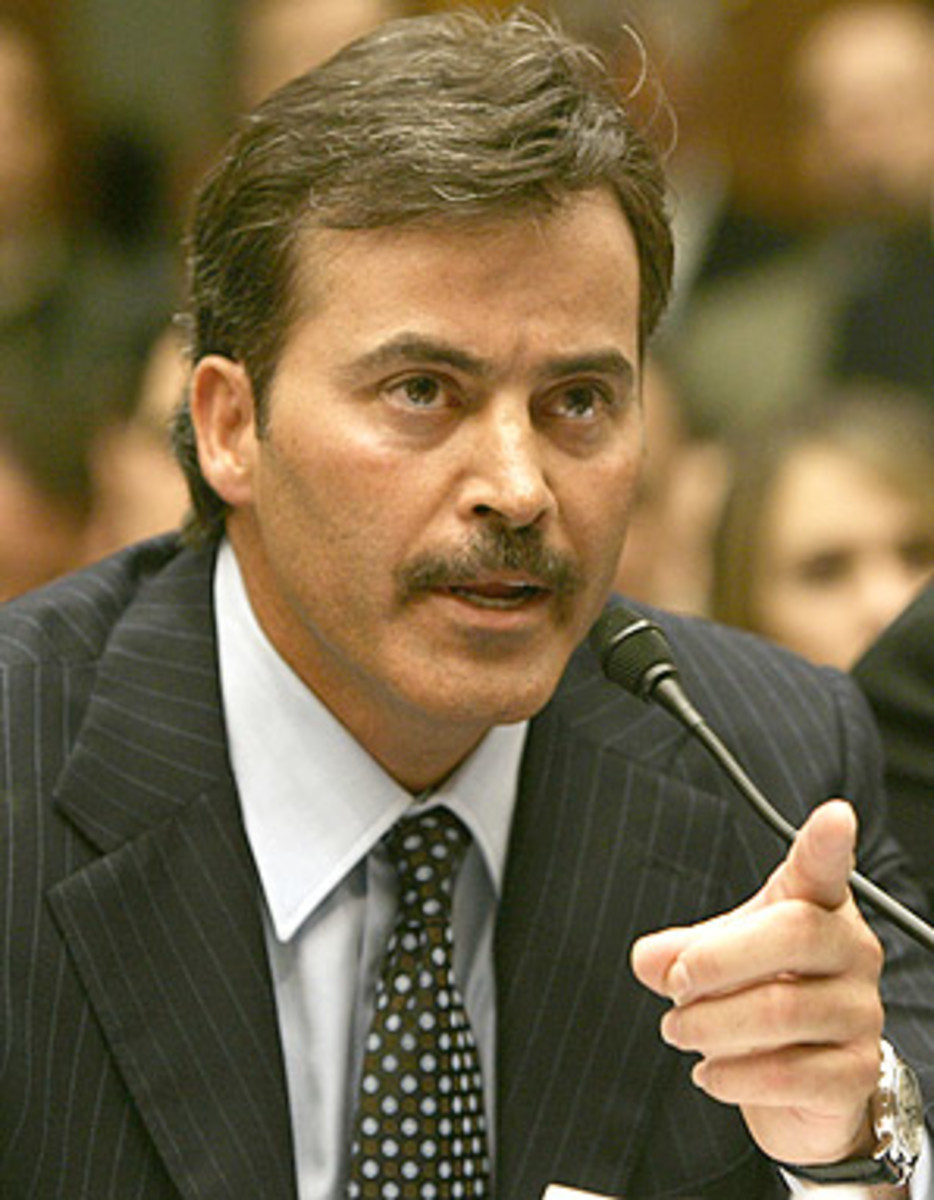
Palmeiro did not avoid the question the way McGwire and Sosa did. He pointed his finger at the Committee members, and said, "Let me start by telling you this: I have never used steroids, period. I don't know how to say it any more clearly than that. Never."

Not called to testify at that time was Barry Bonds, who had already broken McGwire's record by hitting 73 home runs in 2001, and was on his way to surpassing Hank Aaron's career record, finishing with 762 after the 2007 season.

On July 15, 2005, playing for the Baltimore Orioles, Palmeiro collected his 3,000th career hit. At the time, the only players to have previously achieved that milestone and 500 home runs were Hank Aaron, Willie Mays and Eddie Murray.

But on August 1, it was revealed that Palmeiro had tested positive for steroids, and he was suspended for 10 games. Upon his return, he was heavily booed by the Baltimore fans, and was held out of the lineup after August 30, and was released after the season. He was just short of turning 41, and was still a productive player. But he was now unhireable, and never played in the major leagues again. He was never charged with perjury for lying to Congress under oath.

In 2009, by then retired with 609 home runs, Sosa was exposed as having failed a steroid test in 2003. He was not prosecuted for perjury, either.

In 2010, offered a coaching position, McGwire knew he had to finally come clean, and talk about the past: "I wish I had never touched steroids. It was foolish, and it was a mistake. I truly apologize. Looking back, I wish I had never played during the Steroid Era."

Major League Baseball cracked down on steroids more heavily after 2005. Nevertheless, some exposed steroid cheats were allowed to continue to play. In 2022, David Ortiz was elected to the Baseball Hall of Fame. Bonds, McGwire, Sosa, Palmeiro, Alex Rodriguez, and Gary Sheffield -- like Ortiz, all members of the 500 Home Run Club who were caught using performance-enhancing drugs -- have not been.

Wednesday, July 24, 2024

Barry Bonds: A 60th Birthday Assessment

July 24, 1964, 60 years ago: Barry Lamar Bonds is born outside Los Angeles in Riverside, California. The son of baseball All-Star Bobby Bonds, he had all the tools to become the greatest player of his generation.

Through the 1998 season, the left fielder had been to 8 All-Star Games, and had won 8 Gold Gloves and 3 National League Most Valuable Player awards. Had nothing changed, he probably would have had over 3,000 career hits, maybe 600 of them home runs, and would now, following the death of his godfather, Willie Mays, be regarded as baseball’s greatest living player.

But he was jealous. He saw the love that fellow sluggers Mark McGwire, Sammy Sosa and Ken Griffey Jr. were getting. And he had heard the rumors that McGwire and Sosa had achieved their shockingly high home run totals through the use of steroids.

So after that "Long Gone Summer," he began using steroids. He bulked up -- even his head seemed to grow more than one size -- and went on to set new records: For home runs in a season, 73 in 2001; home runs in a career, 762; highest slugging percentage in a single season, .863, also in 2001; highest on-base percentage in a single season, .609, in 2004; largely because pitchers, angry at his cheating, intentionally walked him so much that he set records for walks in a season, 232 that year; and in a career, 2,558. Oddly, he fell short of 3,000 hits, ending with 2,935.

Because he used steroids, and got caught, he has not been elected to the Baseball Hall of Fame. If his steroid use doesn't bother you, remember this: You have the right to have your own opinion, but you do not have the right to have your opinion taken seriously. And if you believe Bonds should be in, but Alex Rodriguez (who never failed a test) and Roger Clemens (whom they've never even proven used) shouldn't be in, then your opinion simply cannot be taken seriously.

One more thing. In 1974, Hank Aaron set a new career home run record, with 715. I was 4 years old, it was 9:07 PM, and my mother wouldn’t let me stay up to watch. She didn’t have to: I didn't ask, because, at 4, I didn't know it was happening.

In 2007, Bonds set a new career home run record, with 756. I was 37 years old, it was 11:49 PM (Eastern Time), and I was asleep. This time, it was my own choice: I didn't want to see it.

Thursday, June 20, 2024

Who Is Baseball's Greatest Living Player?

At a dinner to honor the 100th Anniversary of professional baseball in 1969, 2 all-time teams were named: The Greatest Players, and the Greatest Living Players. Babe Ruth was named the Greatest Player, and Joe DiMaggio was named the Greatest Living Player -- and, for the rest of his life, he insisted upon being introduced as "Baseball's Greatest Living Player."

When he died in 1999, the title of "Baseball's Greatest Living Player" was, for most fans, passed to Willie Mays. Willie died this week. So who holds the title now?

By looking at the list of the 100 Greatest Baseball Players compiled in 1999 by The Sporting News, we can say that, with the death of Willie Mays, ranked 2nd behind Babe Ruth, the greatest living player is the man then ranked 16th, Johnny Bench.

It was a bad ranking. They had him ahead of his fellow Oklahoman, Mickey Mantle (17th, and dead in 1995), and ahead of the actual greatest catcher who ever lived, Yogi Berra (40th, still alive then, died in 2015).

Next on that list among players still alive: At 25th, Pete Rose. No. Just no. And that's got nothing to do with the reason he was banned from baseball -- or with the other reason he has become a pariah.

Next, at 26th, is Sandy Koufax. I have a hard time accepting a pitcher as the greatest living player, especially one whose legend is essentially based on just 5 seasons, maybe 6.

Next, at 28th, is Mike Schmidt. Here we go. Almost certainly, the greatest player ever to play 3rd base. Definitely the greatest player in Phillies history, and, given how many of the old Philadelphia Athletics' legends split their careers with other teams, probably also the greatest player in Philadelphia baseball history. 548 home runs. 10 Gold Gloves. 3 Most Valuable Player awards. Led his team to 6 Playoff berths, 2 Pennants, and its 1st World Series win.
You want another candidate? The next one still alive, at 30th, is Schmidt's Phillies teammate, Steve Carlton. A pitcher. Let's move on. The next living player, and the top player then active, at 34th, was Barry Bonds. This was before Bonds started setting records like crazy. This was also before we knew he had started using steroids. So, he's disqualified, even if he was "a Hall-of-Famer before he started cheating." After all, the appearance that he didn't need to cheat to be great, and then cheated anyway, makes things worse.

Next, at 39th, is Greg Maddux. Another pitcher. Next living, at 41st, is Nolan Ryan. Another pitcher. Next living, at 48th, is Reggie Jackson. He's my favorite athlete of all time, and he has been known to show some ego. But I don't think even Reggie would call himself "baseball's greatest living player."

Next, at 51st, is Rickey Henderson. Here is another legitimate candidate, even if he surpassed Reggie, DiMaggio, Ty Cobb and everybody else as baseball's supreme egotist. Baseball's greatest base stealer (1,406), he collected over 3,000 hits (3,055), had a surprising amount of power (297 home runs), and is baseball's all-time leader in runs scored (2,295).
His lifetime batting average is just .279, but, A, that's higher than Schmidt (.267), Bench (also .267) or Reggie (.262); and, B, his on-base percentage is .401 (higher than Schmidt at .380, Reggie at .356 and Bench at .342), because he was once the all-time leader in walks (2,190, surpassed by Bonds, mainly due to the intentionals, a backlash against his cheating). And he was a winner, reaching the postseason 8 times with 5 different teams. (In 1985, the Yankees fell just short, so it was almost 9 times with 6 teams.) This also includes 3 Pennants, which includes World Series wins with 2 different teams.

In 2022, ESPN had an updated list. Their top 10 players who are alive as of Mays' death are: Bonds, 8th; Pedro Martinez, 11th; Ken Griffey Jr., 13th; Maddux, 14th; the still-active Mike Trout, 15th; Roger Clemens, 17th; Schmidt, 18th; Henderson, 23rd; Randy Johnson, 24th; and Alex Rodriguez, 26th.

After that: Derek Jeter, 28th; Bench, 29th; Albert Pujols, 30th; Mariano Rivera, 31st; Koufax, 32nd; Rose, 34th.

First, let's dump the pitchers: Pedro (11th among all players? A damn joke), Maddux, Clemens, Johnson, Rivera, Koufax. Next, let's dump the steroid cheats, Bonds and A-Rod. Finally, add those we've already considered: Schmidt, Henderson, Bench.

Not yet considered: Griffey, Trout, Jeter and Pujols. All 4 of whom, as far as we know, were, or, in the case of the still-active Trout, are, clean.

Okay, let's get serious: Trout doesn't make the Top 100 players. If, for whatever reason, he never plays another game, he leaves with 1,648 hits, 378 of which are home runs. That's fewer home runs than Frank Howard and Dale Murphy, for whom home runs were kind of their thing, and neither one is in the Baseball Hall of Fame. I don't care that he already has 3 MVPs: Trout is not a Hall-of-Famer yet.

That leaves Griffey, Jeter and Pujols. Jeter has more hits than any human being who, today, is both alive and eligible to be in baseball: 3,465. He had a .310 lifetime batting average and 358 stolen bases. And, in his time, he was baseball's biggest winner. But he only hit 260 home runs, and never won an MVP, although he was robbed of at least 2 and maybe a 3rd.

That leaves Griffey, with 630 home runs, and Pujols, with 3,384 hits (not that far behind Jeter), 703 of which were home runs. Griffey had 10 Gold Gloves, Pujols 2. Pujols had the postseason success, Griffey didn't. (Remember the 1995 ALDS all you want, but he never played in a World Series.)   
Is it just me, or does this picture look like
one of those baseball cards of players who recently changed teams,
which we used to call "Topps airbrush jobs"?

So, I would say that, for the title of Baseball's Greatest Living Player, there are 4 legitimate candidates. In chronological order, they are: Mike Schmidt, Rickey Henderson, Ken Griffey Jr. and Albert Pujols.
If Junior hadn't tailed off a bit when he went to the Cincinnati Reds in 2000, he could have made the question easy to answer. Same for Phat Albert, if he hadn't tailed off a bit when he went to the Los Angeles Angels in 2012: He could have put it away. If Junior hadn't had so many injuries, and if Albert hadn't gone to Anaheim, one of them might have hit 763 home runs to surpass Bonds, and make this an easy answer.

So, of the four, which one is Baseball's Greatest Living Player? Henderson would tell you it's him. The other 3 wouldn't claim that for themselves. Perhaps that's another reason why each of them might deserve it.

UPDATE: Pete Rose died on September 30, 2024, removing him from anyone's discussion; and Rickey Henderson followed on December 20, 2024, removing him from this discussion. That leaves Mike Schmidt, Ken Griffey Jr. and Albert Pujols.

Friday, September 8, 2023

September 8, 1998: Mark McGwire Hits His 62nd Home Run

September 8, 1998, 25 years ago: The St. Louis Cardinals beat their arch-rivals, the Chicago Cubs, 6-3 at Busch Memorial Stadium in St. Louis. Ray Lankford and Ron Gant hit home runs for the Cardinals. Nobody remembers those. What they remember is the home run hit by Mark McGwire. It is his 62nd of the season, setting a new single-season record.

Babe Ruth had raised the record to 29 in 1919, 54 in 1920, 59 in 1921 and 60 in 1927. Another right fielder for the New York Yankees, Roger Maris, raised it to 61 in 1961. In spite of the media, especially in New York, seeming to not want Maris to break the record, he ended up holding it longer than Ruth did: 37 years to 34.

While there were serious challenges to Ruth's 60 before Maris' 61 -- Hack Wilson hit 56 in 1930, Jimmie Foxx 58 in 1932, and Hank Greenberg 58 in 1938 -- challenges to Maris' 61 were fewer. In 1969, Reggie Jackson, in his 2nd full season with the Oakland Athletics, had 41 home runs through August 2, and, in his memoir, said, "People were now saying I was dating a lady named Ruth Maris." But he only hit 6 more the rest of the way, and didn't even lead the American League: Harmon Killebrew topped him, 49 to 47.

Willie Mays hit 52 in 1965, but no other National Leaguer hit 50 again until George Foster hit 52 in 1977. And no American Leaguer hit 50 after Maris until 1990, when Cecil Fielder hit 51. When the Strike of '94 hit, Matt Williams was leading the majors with 43, and Ken Griffey Jr. led the AL with 40. Both were thought to have a chance at 61, but that went out the window.

And despite accusations of a "juiced ball" in 1987, no player hit 50 that season. Each League's leader hit 49: Andre Dawson of the Chicago Cubs and... Mark McGwire of the Athletics. McGwire thus set a record for home runs in a season by a rookie.

The 1st baseman was 6-foot-5 and 215 pounds, and had an even taller younger brother, Dan McGwire, who played quarterback for 5 seasons in the NFL, mostly as a backup for the Seattle Seahawks. Still, at the time, Mark was seen as big and solidly built, but not out of regular human proportions. He didn't look like a superhero, or a bodybuilder such as Arnold Schwarzenegger.

He and Jose Canseco became known as the Bash Brothers, helping the A's win 3 straight Pennants and the 1989 World Series. Through the 1992 season, he was 29 years old, and had hit 220 home runs, making 6 All-Star Games, and had even won a Gold Glove. He looked like he was headed for the Hall of Fame. So did Canseco, who was 28 and already had 231 home runs.

But between the A's perennial cash flow problems and his bad attitude, Canseco became expendable, and was traded after that season. McGwire wasn't, falling victim to injuries, making only 279 plate appearances in '93 and '94 combined.

The fact that Canseco used steroids wasn't publicly known, but it was one of the worst-kept secrets in baseball. McGwire found out that a steroid called androstendione, or "andro" for short, could make it easier to return from injury and regrow lost muscle. He came back with a bang in 1995 -- 39 bangs, in fact, and made the All-Star Game again.

In 1996, now with a goatee and his arms bulging like the cartoon character Popeye's, he led the AL with 52 home runs, the most any AL player had hit since Maris. And he was doing this while playing his home games at the Oakland Coliseum, a pitcher's park. Suddenly, the idea that Maris' record could fall was taken seriously for the 1st time.

But, again, A's management was losing money, and on July 31, 1997, with McGwire having hit 34 home runs already, he was traded to the Cardinals for pitchers Eric Ludwick, T.J. Mathews and Blake Stein. Ludwick won just 1 game for the A's, and was traded after the season. Stein did poorly, and was traded in 1999. Mathews pitched well in relief for them, but they traded him in 2001. None of these men appeared in a major league game after the 2002 season. Still, the A's had Jason Giambi coming up, and he replaced McGwire at 1st base, so the trade was pretty much a wash for them.

McGwire was warmly embraced by Cardinal fans. He seemed just the kind of wholesome player that fit in with the Midwest, and "the Best Baseball City in America." He finished the season with 58 homers, while Griffey, with the Seattle Mariners, finished with 56. Now, the national media seemed to treat the breaking of Maris' record no longer as an "if," but as a "when." In cheering on McGwire, and to a lesser extent (because he was black, of course) Griffey, it was as if the media was once again rooting against Maris, who died in 1985, and could not speak up on his own behalf.

And it wasn't just that McGwire and Griffey were hitting so many home runs, it was how far they were going. Griffey was the only batter who ever reached the upper deck of the Kingdome in Seattle, and he had now done it a few times. McGwire was hitting balls 500 feet. Not since Mickey Mantle -- not even Killebrew or Jackson -- had a guy hit the ball that far that often. McGwire may have been a righthanded batter, playing outside New York, and hadn't pitched since he was at USC, but he really was treated as if he was the closest thing to Ruth since Ruth. He was a folk hero.

As it turned out, 1998 became not only "The Year of the Home Run," but it was a 3-way race: McGwire and Griffey were joined by Sammy Sosa of the Cubs. A Dominican, Sosa had never hit more than 40 in a season, and had made just 1 All-Star Game by age 29. But he kept pace with McGwire and Griffey. In June, he topped both of them, and everybody else, too: He hit 20 home runs, still a record for a single player in a single month. When June was over, it was McGwire 37, Sosa 33, Griffey 33.

Neither McGwire nor Sosa added any homers by the All-Star Break on July 7, while Griffey had overtaken Sosa with 35. But all 3 got going after the Break: July ended with McGwire 45, Sosa 42, Griffey 41. McGwire got to 50 on August 20, Sosa on August 23. Griffey went into a slump, so, when August ended, it was McGwire 55, Sosa 55, Griffey 47.

August was also the month that the scandal surrounding President Bill Clinton and his affair with former White House intern Monica Lewinsky got more serious, with Special Counsel Kenneth Starr and the Republican-controlled Congress amping up the pressure. The general consensus was that Clinton had done something immoral, but there didn't appear to be anything illegal, and that Starr and Congress were going too far in trying to prove it. The home run race provided a distraction, much as Hank Aaron's pursuit of Babe Ruth's career record of 714 helped to distract from Richard Nixon and Watergate in 1973 and '74.

By this point, the scoreboard at Busch Memorial Stadium was keeping a running total of McGwire's and Sosa's totals -- but not Griffey's. Also by now, Steve Wilstein, a reporter for the Associated Press, had made public the fact that he had seen a bottle of andro in McGwire's locker. McGwire said it was legal -- which, at the time, it was. He said it was no big deal -- which, at the time, the public accepted.

Indeed, fans turned on Wilstein for reporting it: How dare he ruin this wonderful story with an accusation that "Big Mac" was cheating! What next? Was "Slammin' Sammy" also cheating? Was Junior cheating?

On September 5, McGwire hit his 60th, Sosa hit his 58th, and Griffey hit his 48th. Griffey was having a historic season, and yet was hopelessly behind the Southern Californian and the Dominican. On September 7, Griffey hit Numbers 49 and 50. That same day, McGwire hit Number 61, and Cardinal broadcaster Jack Buck said, "Flight 61, now leaving for Planet Maris!"

Fox Sports broadcast the September 8 Cardinals-Cubs game at Busch live, figuring that it would be the night that the record was broken. The Cardinals, for whom Maris had played his last 2 seasons, 1967 and '68, invited his widow, Pat Maris, and their 5 now-grown children to attend. Pat felt ill and couldn't go, but the kids all did.

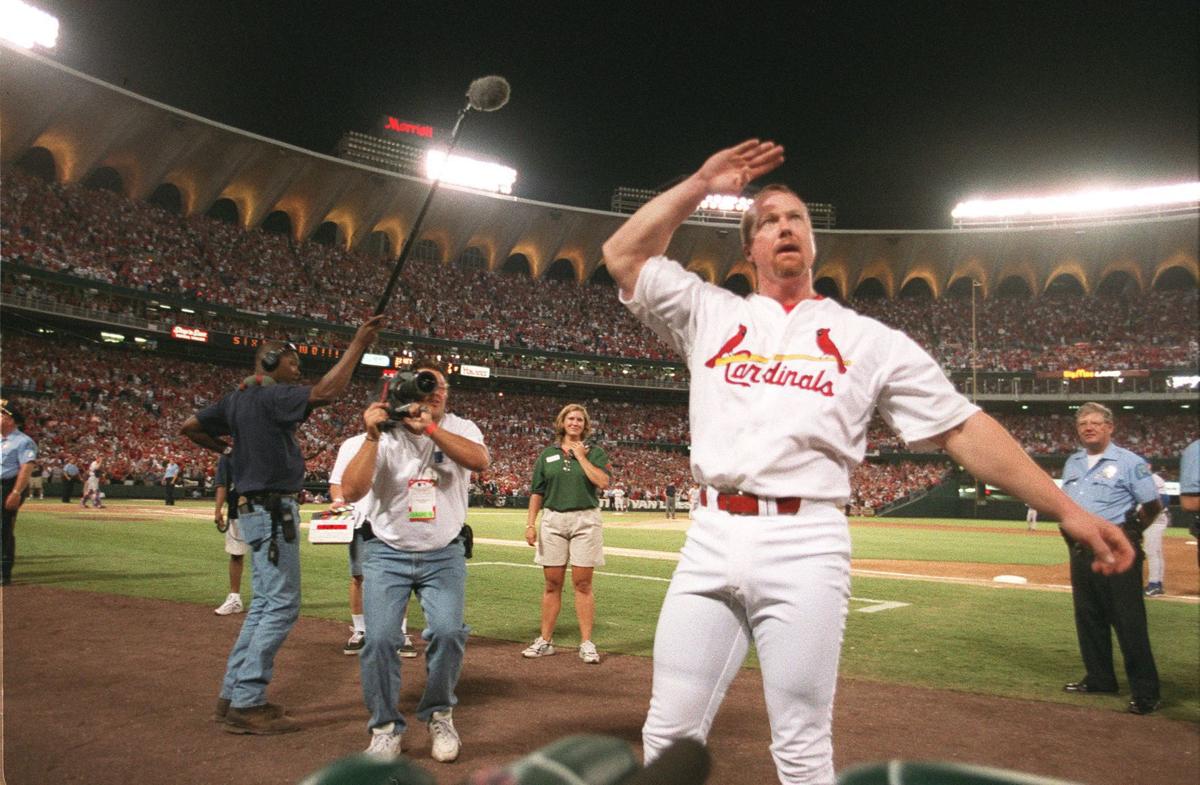
McGwire grounded to short in the 2nd inning. With 2 out in the 4th, he again came up against Cub pitcher Steve Trachsel. He hit a screaming liner down the left-field line. Joe Buck, Jack's son, had the call: "Down the left field line! Is it enough? Gone! Number 62! Touch first, Mark: You've made history!" In his excitement, McGwire rounded 1st base without touching it, and had to go back to do so. At 341 feet, it was his shortest home run of the season.

Greeting him at home plate was his 11-year-old son Matt, a Cardinal batboy, whom he gave a huge hug. Sosa had run in from right field, and he hugged McGwire as well. McGwire then went over to where the Marises were sitting, and hugged them, too. With those andro-boosted arms.

But the home run race wasn't over: There was no guarantee that McGwire would even end up leading the NL in homers. Sosa hit his 59th on September 11 and his 60th on September 12. A week earlier, in the entire history of Major League Baseball, there had been only 2 men ever to hit 60 home runs in a season. Now, that total had doubled. On September 13, Sosa hit his 61st and his 62nd. He and McGwire were now tied. Griffey was at 51.

McGwire hit his 63rd on September 15, Sosa his the next day. McGwire hit his 64th on September 18, and his 65th on September 20. On September 23, Sosa hit his 64th and 65th. Griffey was up to 55. On September 25, against José Lima of the Houston Astros at the Astrodome, Sosa hit his 66th, making him the all-time single-season leader -- for a few minutes. This was shortly followed by McGwire's 66th.

Nobody knew it yet, but Sosa wouldn't hit another homer that season, finishing with 66. Griffey would finish with 56. On September 26, the next-to-last day of the season, back at Busch, McGwire hit his 67th off Dustin Hermanson, giving him the lead for good; and hit his 68th later in the game. On the last day, September 27, he hit his 69th, and finally, he cracked a barrier that nobody thought was possible, hitting Number 70 off Carl Pavano, then a rookie with the Montreal Expos. Joe Buck had the call: "Into left field! Number 70! How much more can you give us, Big Mac?"

The answer, at least for that season, was, "No more." The Cardinals finished 73-89, and were nowhere near the NL Pennant race. But the Cubs had finished in a tie with the San Francisco Giants for the NL's Wild Card berth, and won a Playoff at Wrigley Field. Sosa did not hit a homer, which, since this was officially a regular-season game, would have counted as his 67th. But the starting and winning pitcher for the Cubs? Steve Trachsel. That, not giving up McGwire's 62nd, was his most important moment of the year.

And, since the Cubs made the Playoffs, and the Cardinals didn't, Sosa was named the NL's Most Valuable Player, not McGwire. Nevertheless, Sports Illustrated named them joint Sportsmen of the Year -- not their first retroactively problematic choice for that title, and not their last.

In 1999, McGwire hit 65 home runs, while Sosa hit 63. Griffey led the AL with 48. Both McGwire and Sosa had, by comparison, off-seasons in 2000: Sosa 50, still enough to lead the NL; McGwire, 32. Griffey had been traded to the Cincinnati Reds, and hit 40. In 2001, Sosa hit 64. But McGwire battled injuries, hit 29 homers, and retired after the season, with 583 for his career. Griffey also faced injuries, and was limited to 22 homers.

In 2001, the Fox TV show Dark Angel, set in a dystopian future of 2020 -- the dystopia being due to an electromagnetic pulse in 2009 having led to an economic depression and a fascist government, not an epidemic and a nearly-fascist government, as actually happened -- had a story about the theft of the ball that Sosa hit for his 756th home run, breaking Hank Aaron's career record.

Barry Bonds of the San Francisco Giants hit 37 home runs in 1998, having reached a career high, to that point, of 46 in 1993. He became intensely jealous of the attention heaped on McGwire, Sosa and Griffey, and knowing he was a better all-around player than any of them (well, maybe not Griffey), and began using steroids after the 1998 season.

In 1999, he hit 34 homers. In 2000, he hit a new career high, 49. In 2001, he set a new single-season record, with 73. That record still stands. Sosa, who again led the NL in 2002, with 49, would end up with 609. Griffey would finish with 630, and, as far as is publicly known, he did that without ever using steroids. Bonds would be the one to break Aaron's record, finishing with 762 in 2007.

By then, McGwire and Sosa had already irreparably damaged their reputations: The 2005 Congressional hearings into steroid use in baseball had made them both look foolish. Sosa has never confessed to using steroids. McGwire has, and this admission allowed him to get back into baseball's good graces, as he has served as a hitting instructor for the Cardinals and the San Diego Padres. However, the section of Interstate 70 -- a convenient number -- running through St. Louis had been named the Mark McGwire Highway. In 2010, the signs were changed to honor an earlier local hero, who was a baseball fan: It became the Mark Twain Highway.

Through the 2022 election, neither McGwire, nor Sosa, nor Bonds has ever been elected to the Baseball Hall of Fame. Griffey was elected in his 1st year of eligibility. However, with known steroid cheats David Ortiz, Mike Piazza and Iván Rodríguez already in, keeping McGwire, Sosa, Bonds, Alex Rodriguez, and any other player known to have used steroids -- or, like Roger Clemens, widely believed to have used them -- out of the Hall on the basis of steroid use seems stupid: Either cheating matters, or it doesn't. If it doesn't bother you, let all of them in; if it does, keep all of them out. Be consistent.

Jose Canseco would finish his career with 462 home runs. In other words, he's a borderline candidate for the Hall of Fame even with his admission of cheating.

The Summer of '98 has been called baseball's best season, for all the home run heroics. Certainly, Yankee Fans, getting to watch a team go 114-48 in the regular season and 11-2 in the postseason, loved it. But the knowledge that McGwire and Sosa cheated to reach and pass 61 home runs taints it, irrevocably. The U.S. Senate may have acquitted Clinton, but history has convicted McGwire, Sosa and Bonds.

Tuesday, January 25, 2022

Ortiz the Only One In: We Deserve an Explanation

Looks like my attempt at a "reverse jinx" didn't work.

The vote has been announced for the 2022 election of the Baseball Writers Association of America for players to the Baseball Hall of Fame. A player needed to have retired between 2007 and 2016, and then 75 percent of the vote, to get in. Here are the names on the ballot, and their percentages:

David Ortiz, the only one in, with 77.9
Barry Bonds, 66.0
Roger Clemens, 65.2
Scott Rolen, 63.2
Curt Schilling, 58.6
Todd Helton, 52.0
Billy Wagner, 51.0
Andruw Jones, 41.4
Gary Sheffield, 40.6
Alex Rodriguez, 34.3
Jeff Kent, 32.7
Manny Ramirez, 28.9
Omar Vizquel, 23.9
Sammy Sosa, 18.5
Andy Pettitte, 10.7

Ortiz cheated, and he's in. Bonds, Sheffield, A-Rod, Manny and Sosa cheated, and they all had at least 500 home runs, and all but Sheffield had more home runs than Ortiz, yet they're not in.

Or, to put it another way, using the number of total votes, rather than the percentages:

Ortiz got 307 votes, Clemens 260, Bonds 257, Sheffield 160, A-Rod 135. What this means is, there were 47 writers who thought Ortiz deserved election, but not Clemens; 50 who voted for Ortiz, but not Bonds; 147 who voted for Ortiz, but not Sheffield; and 172 who thought Ortiz deserved election, but not A-Rod.

Why? What makes Ortiz more worthy of election than the others? What makes him 18 percent worthier than Clemens, the most dominant pitcher of a generation; 19 percent worthier than Bonds, the all-time home run leader and the only man to top 400, let alone 500, in both home runs and stolen bases; 92 percent worthier than Sheffield, who had 217 more hits and was a good defensive player; and 127 percent worthier than A-Rod, who (being 12 years younger than Bonds) was the arguably the best all-around player of his generation?

Yes, they were all accused of cheating. So why brush aside what we know about Ortiz, and not what we know, or think we know, about the others?

It could safely be argued that, while they didn't cheat (as far as we know), Rolen, Helton, Wagner and Kent just don't have the stats to get in. And Schilling and Vizquel each has a cloud of character, albeit different kinds, hanging over them, meaning that, while their on-field reputations suggest they should get in, they won't, at least for a while.

Jones didn't cheat, as far as we know. It is ridiculous that he is not in. The claim that Pettitte cheated has only the slimmest basis in reality. He should be in. And Clemens is the one and only player ever to beat the rap. How can you vote for Ortiz, and not them?

The BBWAA members who voted knew all of this. And still, they voted for David Ortiz, and not for Alex Rodriguez, or Roger Clemens, or anyone else.

As I said in my previous post, the attempted reverse jinx: One of the main arguments against Pete Rose getting reinstated to baseball, and thus becoming eligible for the Hall of Fame, is that, on top of his initial offense, he lied about it for 15 years after getting caught.

A-Rod got caught twice. After trying to avoid it, he admitted it, fairly quickly, both times.

Papi failed that test 19 years ago. He lied about it. He still lies about it. He's been lying about what he did longer than Rose lied about what he did.

But Papi is in, and A-Rod is out, and Rose doesn't even get the chance to get voted in or out.

Note: I am not advocating for Rose to be reinstated. He should remain banned. I am simply comparing his situation to those of the players on the ballot today.

I guess, like politically-themed comedian Bill Maher said about the word "Republican," the words "Red Sox" begin with "The Magic R," which, when coming after your name, means you can get away with anything.

True, Clemens pitched the bulk of his career with the Red Sox, and he's not in. And Manny Ramirez had his best-known years with the Red Sox, and was at least as responsible for Boston's tainted World Series wins of 2004 and 2007 as Ortiz was (though he was gone by their tainted win of 2013). And he's not in.

Maybe, as has been suggested, it is all about whether a player is "likable." Papi is likable. Clemens, Bonds and Manny are not.

But, wait: The media love A-Rod now. Or is that only as an announcer that he's likable, not as a player?

Will we ever know the truth? I'm not holding my breath.

Here's the truth: Either all of the players with sufficient stats deserve to get in, or none of the players you suspect of cheating should get in.

Known PED users who are now in: David Ortiz, Mike Piazza, Ivan Rodriguez.

Known PED users who have the stats to get in, but aren't in: Alex Rodriguez, Barry Bonds, Mark McGwire, Sammy Sosa, Rafael Palmeiro, Gary Sheffield.

Accused of PED use, but never proven, and yet thus far denied election: Roger Clemens, Andy Pettitte.

Known PED users who don't have the stats to get in: Jose Canseco and Jason Giambi, among others. So, take them out of the equation, and you've got the preceding 11 players.

Either all of them should be in, or none.

If you believe that any of them should be in, and the others not, then you owe baseball fans an explanation.

And that explanation cannot be, "I don't care about his cheating," or, "His cheating didn't matter: He's a Hall-of-Famer anyway."

Because the only reason to vote for David Ortiz, and not any of the others, is that you believe he didn't cheat. And if you believe that, then you are what President Joe Biden called Fox "News" reporter Steve Doocy at the White House yesterday: "What a stupid son of a bitch."

Sunday, August 22, 2021

The 500 Home Run Club, In Perspective, with Miguel Cabrera Joining

Congratulations to Miguel Cabrera, who hit his 500th career home run today.

For the record, here's the 28 current members of the 500 Home Run Club, in chronological order of when they reached it:

1. George Herman "Babe" Ruth, "the Sultan of Swat," Baltimore, Maryland, 1895-1948, right field, New York Yankees, off Willis Hudlin of the Cleveland Indians, at League Park in Cleveland, August 11, 1929.

The 1st player with 138 career home runs, and the 1st to 200, 300, 400, 500, 600 and 700. Held the career home run record from 1921 to 1974. Finished with 714. Hit 659 of them as a Yankee, easily the team's all-time leader. Won the 1915, '16 and '18 World Series with the Boston Red Sox; and the 1923, '27, '28 and '32 World Series with the Yankees. One of the 1st 5 members of the Baseball Hall of Fame. All-Century Team. Number 3 retired and Monument dedicated by the Yankees. East 161st Street outside new Yankee Stadium co-named Babe Ruth Plaza.

2. James Emory Foxx, "Double X" or "the Beast," Sudlersville, Maryland, on the Eastern Shore, 1907-1967, 1st base, Boston Red Sox, off Bill Beckmann of the Philadelphia Athletics, at Shibe Park in Philadelphia (where he'd previously played for the A's), September 24, 1940.

The 1st righthanded hitter to do it, his name was nearly always written as "Jimmie," not "Jimmy." He was 32 when he hit Number 500, making him the youngest to do it until A-Rod. (Ruth was 34.) Finished with 534, and remained 2nd behind Ruth until surpassed by Willie Mays in 1966. Won the 1929 and '30 World Series with the A's. Hall of Fame. Neither the Athletics (who don't do it for players from their Philadelphia period) nor the Red Sox have retired a number for him (his most common number was 3), but the Red Sox have elected him to their team Hall of Fame.

3. Melvin Thomas Ott, "Master Melvin," Gretna, Louisiana, outside New Orleans, 1909-1958, right field, New York Giants, off Johnny Hutchings of the Boston Braves, at the Polo Grounds in New York, August 1, 1945.

The 1st National League player to do it, Mel was the NL's all-time leader until surpassed by Mays in 1966. Finished with 511. Won the 1933 World Series with the Giants. Hall of Fame. Number 4 retired by the Giants.

4. Theodore Samuel Williams, "The Splendid Splinter," "The Thumper" and "The Kid," San Diego, California, 1918-2002, left field, Boston Red Sox, off Wynn Hawkins of the Cleveland Indians, at Cleveland Municipal Stadium, June 17, 1960.

Finished with 521, including a home run in his final career at-bat. Won the 1946 American League Pennant with Red Sox, but never a World Series. Hall of Fame. All-Century Team. Number 9 retired and statue outside Fenway Park dedicated by the Red Sox. Lansdowne Street outside Fenway renamed Ted Williams Way.

5. Willie Howard Mays Jr. (not "William"), "the Say Hey Kid," Fairfield, Alabama, outside Birmingham, born 1931, center fielder, San Francisco Giants, off Don Nottebart of the Houston Astros, at the Astrodome in Houston, September 13, 1965. The 1st to do it indoors, although it wouldn't be until the next year that the Astrodome got baseball's 1st artificial turf. (I don't have footage of his 500th, but here's his 600th.)

Finished with 660. Had been 2nd all-time from 1966 to 1972, when Hank Aaron passed him with Number 649. Became the 2nd player, after Aaron, to have 500 homers and 3,000 hits. Won the 1954 World Series with the New York edition of the Giants, including his legendary catch that saved Game 1. Hall of Fame. All-Century Team. Number 24 retired officially by the Giants, and unofficially (with a few brief exceptions) by the Mets. Statue dedicated by the Giants outside Oracle Park, whose official address is 24 Willie Mays Plaza.

6. Mickey Charles Mantle (not "Michael"), "the Commerce Comet," Commerce, Oklahoma, 1931-1995, center fielder, New York Yankees, off Stu Miller of the Baltimore Orioles, at the original Yankee Stadium in New York, May 14, 1967.

Finished with 536, still the all-time leader among switch-hitters. Hit Number 500 lefthanded. Won the 1951, '52, '53, '56, '58, '61 and '62 World Series with the Yankees, 12 Pennants total. Hall of Fame. All-Century Team. Number 7 retired by the Yankees.

7. Edwin Lee Mathews, "Eddie," born in Texarkana, Texas but grew up in Santa Barbara, California, 1931-2001, 3rd base, then with the Houston Astros, off Juan Marichal of the San Francisco Giants, at Candlestick Park in San Francisco, July 14, 1967.

Eddie finished with 512. Won the 1957 World Series with the Milwaukee Braves, and also the 1958 NL Pennant. He and Aaron hit 863 home runs while teammates, an all-time record. Hall of Fame. Number 41 retired by the Braves after they moved to Atlanta. 

8. Henry Louis Aaron, "Hammerin' Hank" or "Bad Henry," Mobile, Alabama, 1934-2021, right fielder, Atlanta Braves, off Mike McCormick of the San Francisco Giants, at Atlanta Stadium (later renamed Atlanta-Fulton County Stadium), July 14, 1968, exactly 1 year to the day after Mathews did it (and against the same team).

Hank ended up with 755, making him the all-time leader from 1974 to 2007. His 733 home runs with the Braves franchise (albeit in 2 different cities) are the most with 1 single team. He just edged Willie Mays by 2 months to become the 1st player to have both 500 home runs and 3,000 hits. Finished with 3,771 hits. This means that even if you took away all 755 of Hank's home runs, he still had over 3,000 hits (3,016). As I said, he and Mathews still hold the record for most home runs hit by teammates: 863.

I don't have footage of his 500th home run, but I do have footage of his 715th home run. Won the 1957 World Series with the Milwaukee Braves, winning the Pennant-clinching game (not the season finale) with an 11th-inning home run. Won another Pennant in 1958, and the NL Western Division title in 1969. Hall of Fame, All-Century Team, Number 44 retired by Braves and their successors in Milwaukee, the Brewers. Both teams have also dedicated statues of him. The address of Turner Field was 755 Hank Aaron Drive, and that of its replacement, Truist Park, is 755 Battery Avenue Southeast, also a tribute to Aaron.

9. Ernest Banks (no middle name), "Ernie" or "Mr. Cub," Dallas, Texas, 1931-2015, shortstop and later 1st baseman, Chicago Cubs, off Pat Jarvis of the Atlanta Braves, at Wrigley Field, May 12, 1970.

Finished with 512. Never reached the postseason. Hall of Fame. All-Century Team. Number 14 retired and statue dedicated by the Cubs.

10. Harmon Clayton Killebrew, "Harm" or "The Killer" (actually, was renowned as a nice guy), Payette, Idaho, 1936-2011, 3rd baseman and later 1st baseman, Minnesota Twins, off Mike Cuellar of the Baltimore Orioles, at Metropolitan Stadium, August 10, 1971.

Finished with 573, still the leader among righthanded hitters in American League play. Helped the Twins win the 1965 AL Pennant, and the 1969 and '70 AL Western Division titles. Hall of Fame. Number 3 retired and statue dedicated outside Target Field by Twins. The street that separated Metropolitan Stadium from the Metropolitan Sports Center was named Killebrew Drive, and it still exists, as part of the Mall of America complex.

11. Frank Robinson (no middle name), "Robbie" or "The Judge," born in Beaumont, Texas but grew up in Oakland, California, 1935-2019, right fielder, Baltimore Orioles, off Fred Scherman of the Detroit Tigers, at Memorial Stadium, September 13, 1971, just 34 days after Killebrew reached the mark.

Finished with 586. Won the 1961 NL Pennant with the Cincinnati Reds (and nearly another in 1964). Won the AL Pennant with the Orioles in 1966, 1969, 1970 and 1971, winning the World Series in 1966 and 1970. NL Most Valuable Player in 1961, AL MVP in 1966, making him the only man to win the MVP in both Leagues. Hall of Fame. Number 20 retired by the Reds, who dedicated a statue of him outside Great American Ball Park, and also by the Orioles, and the Indians, who made him MLB's 1st black manager for the 1975 season.

12. Willie Lee McCovey, "Stretch," Mobile, Alabama, 1938-2018, 1st baseman (also played some left field), San Francisco Giants, off Jamie Easterly of the Atlanta Braves, at Atlanta-Fulton County Stadium, June 30, 1978

Finished with 521. Won the 1962 NL Pennant and the 1971 NL West title with the Giants. Hall of Fame. NL MVP in 1969. Number 44 retired by the Giants, who also dedicated a statue of him outside Oracle Park, and named the body of water beyond the right field fence McCovey Cove.

13. Reginald Martinez Jackson, "Reggie," "Jax," "Buck," "Candyman" or "Mr. October," Wyncote, Pennsylvania, outside Philadelphia, born 1946, right fielder, California Angels, off Bud Black of the Kansas City Royals, At Anaheim Stadium (now Angel Stadium), September 17, 1984. It came 17 years to the day after his 1st home run.

Finished with 563. With the Oakland Athletics, won the World Series in 1972, 1973 and 1974, and the AL West in 1971 and 1975. With the Yankees, won the World Series in 1977 and 1978, the AL Pennant in 1981, and the AL East in 1980. With the Angels, won the AL West in 1982 and 1986. MVP of the AL and the World Series in 1973. In 1977, became the 1st man, and is still the only one, to win the World Series MVP with 2 different teams.

Number 9 retired by the A's, Number 44 retired by the Yankees. With Graig Nettles wearing 9 on the Yankees, Reggie wanted to switch to 42 in honor of Jackie Robinson, but that was already worn, too, so he chose 44 in honor of the aforementioned Hank Aaron. Hall of Fame, Monument Park.

14. Michael Jack Schmidt, "Schmitty" or "Schmitter," Dayton, Ohio, born 1949, 3rd baseman, Philadelphia Phillies, off Don Robinson of the Pittsburgh Pirates, at Three Rivers Stadium, April 18, 1987.

Finished with 548. Won the 1980 World Series, the 1983 NL Pennant, and the 1976, 1977 and 1978 NL East titles with the Phillies. Won the NL MVP in 1980, 1981 and 1986. Won 10 Gold Gloves.

Grew up as a fan of the Cincinnati Reds, and wore Number 20 in honor of the aforementioned Frank Robinson. Number 20 retired and statue outside Citizens Bank Park dedicated by the Phillies. On the Phillies' 100th Anniversary in 1983, their fans voted him the franchise's greatest player ever -- and he still had 5 more full seasons, 1 of them an MVP season, to go.

15. Eddie Clarence Murray (not "Edward"), Los Angeles California, born 1956, 1st baseman, Baltimore Orioles, off Felipe Lira of the Detroit Tigers, at Oriole Park at Camden Yards, September 6, 1996

Finished with 504. Murray is the only player with 3,000 hits and 500 home runs to get to 3,000 hits first. Won the 1979 AL Pennant and the 1983 World Series with the Orioles. Also won the 1995 AL Pennant with the Cleveland Indians, in between his tenures in Baltimore, and was with them when he got his 3,000th hit. Hall of Fame, Number 33 retired by the Orioles.

16. Mark David McGwire, "Big Mac," from the Los Angeles suburb of Pomona, California, born 1963, 1st baseman, St. Louis Cardinals, off Andy Ashby of the San Diego Padres, at Busch Memorial Stadium in St. Louis, August 5, 1999.

Finished with 583. Had he not taken steroids, injuries may well have ended his career in the mid-1990s, with about half as many homers. Won the AL Pennant with the Oakland Athletics in 1988, 1989 and 1990, and another AL West title with them in 1992. Won the NL Central Division with the Cardinals in 2000. But 1989 remained his only World Series win.

He was voted to the All-Century Team while still active, before his humiliation before Congress and his eventual confession. He has never come close to election to the Hall of Fame. His Number 25 has not been retired by either of his teams, although the Cardinals withheld it from circulation until David Bell arrived as a coach, since his father Buddy and grandfather Gus both wore it as players. And the Missouri legislature, which had previously voted to name the St. Louis area's section of Interstate 70 the Mark McGwire Highway, has renamed it the Mark Twain Highway.

17. Barry Lamar Bonds, born in the Los Angeles suburb of Riverside, California but grew up in the San Francisco suburb of San Carlos, California, born 1964, left fielder, San Francisco Giants, off Terry Adams of the Los Angeles Dodgers, at AT&T Park in San Francisco, April 17, 2001.

Finished with 762, the most in major league history. The only man with at least 400 home runs and 400 stolen bases, and has over 500 of both. He probably would have reached all of those milestones even if he hadn't used steroids, making his use of them even less excusable.

He won the NL Eastern Division titles with the Pittsburgh Pirates in 1990, 1991 and 1992; and NL Western Division titles with the Giants in 1997, 2000 and 2003. The Giants won the NL Wild Card and then the Pennant in 2002, but he never won a World Series.

He has never come close to election to the Hall of Fame. Number 25 retired by the Giants.

18. Samuel Kelvin Peralta Sosa, "Slammin' Sammy," San Pedro de Macoris, Dominican Republic, born 1968, right fielder, Chicago Cubs, off Scott Sullivan of the Cincinnati Reds, at Great American Ball Park in Cincinnati, April 4, 2003.

Finished with 609. He might have had half of that had he never used steroids. Won the NL's Wild Card in 1998 and its Central Division in 2003, but never won a Pennant. He has never come close to election to the Hall of Fame. His Number 21 is not currently being worn by a Cubs player, but it has never been seriously considered for retirement.

19. Rafael Palmeiro Corrales, "Raffy," born in Havana, Cuba but grew up in Miami, Florida, born 1964, 1st baseman, Texas Rangers, off Dave Elder of the Cleveland Indians, at what's now named Globe Life Park in Arlington, Texas, May 11, 2003, only 37 days after Sosa did it.

Finished with 569. The 4th man to have both 500 home runs and 3,000 hits, and easily the least legitimate to have both. Without steroids, he might have reached 400 home runs and 2,700 hits. Had 3,020 hits when he was released by the Orioles following the public release of the fact that he had failed a steroid test -- thus proving that he had lied to Congress when he said he never used them -- and while he hasn't gone to jail for perjury, neither has he ever been employed in professional baseball again.

Reached the postseason with the Orioles in 1996 and '97, and the Texas Rangers in 1999 before returning to the O's. He has never come close to election to the Hall of Fame, and his Number 25 has not been retired by any team.

20. George Kenneth Griffey Jr., "Ken" or "Junior," born outside Pittsburgh in Donora, Pennsylvania (as were his father, who hit 152 in his career, and Stan Musial, who finished with 475) but grew up in Cincinnati, Ohio, born 1969, center fielder, Cincinnati Reds, off Matt Morris of the St. Louis Cardinals, at Busch Memorial Stadium in St. Louis, June 20, 2004.

Finished with 630, and, as far as is publicly known, they were all legit. He won AL Western Division titles with the Seattle Mariners in 1995 and 1997, but never won a Pennant. But he has a very special legacy that may be more important than any postseason achievement: More than any single person, he saved Major League Baseball in the Pacific Northwest with his performance in 1995. If not for what he did that season, the bond issue to fund Safeco Field would not have passed, and the Mariners would have moved to Tampa Bay for the next season. 

He was elected to the All-Century Team while only halfway through his career. Hall of Fame. Number 24 by the Mariners, and they and the Reds have elected him to their team Halls of Fame.

21. Frank Edward Thomas Jr., "the Big Hurt," Columbus, Georgia, born 1968 (on May 27, the same day as Jeff Bagwell, who finished with 449), 1st baseman, Toronto Blue Jays, off Carlos Silva of the Minnesota Twins, at the Metrodome in Minneapolis, June 28, 2007.

Finished with 521, and, as far as is publicly known, they were all legit. Won Division titles with the Chicago White Sox in 1993 and 2000, but was hurt for most of their 2005 World Championship season, and did not appear in the postseason, but was given a World Series ring. Won another Division with the 2006 Oakland Athletics. Hall of Fame, and the White Sox have retired his Number 35 and dedicated a statue to him at Guaranteed Rate Field. 

22. Alexander Emmanuel Rodriguez, "Alex" or "A-Rod," born in Manhattan, New York, New York, but grew up in Miami, Florida, born 1975, shortstop and later 3rd baseman, New York Yankees, off Kyle Davies of the Kansas City Royals, at the old Yankee Stadium, August 4, 2007, only 37 days after Thomas did it.

He is the youngest player to achieve the milestone, and the only one to do it with me in the ballpark: I was in the upper deck in right field, and had the perfect view of it. He is the 5th player to have 500 homers and 3,000 hits, and the 3rd, after Aaron and Mays, to have 600 homers and 3,000 hits. He finished with 696 homers -- more than anyone except Bonds, Aaron and Ruth -- and 3,115 hits. How many he'd have if he hadn't used performance-enhancing drugs -- or hadn't been caught, or if MLB had decided it wasn't worth pursuing -- is open to speculation.

Won the World Series with Yankees in 2009, 1 of 11 postseason berths in his career. It seems unlikely he'll ever get into the Hall of Fame, and with the Yankees giving his Number 13 to Joey Gallo, it now seems unlikely that the retirement of that number for him, and the dedication of a Plaque in Monument Park for him, will happen in the foreseeable future.

23. James Howard Thome, "Jim" or "the Thomenator," Peoria, Illinois, born 1970, 1st baseman, Chicago White Sox, off Dustin Moseley of the Los Angeles Angels of Anaheim, at U.S. Cellular Field in Chicago, September 16, 2007, only 41 days after A-Rod did it. He was the 1st player to do it with a walkoff home run.

Finished with 612, and, as far as is publicly known, they were all legit. Reached the postseason with the Cleveland Indians in 1995, '96, '97, '98, '99 and 2001; the White Sox in 2008; the Los Angeles Dodgers in 2009; the Minnesota Twins in 2010; and the Baltimore Orioles in 2012. Won AL Pennants with the Indians in 1995 and '97. Seemed to especially enjoy going deep against the Yankees, especially in the '97 and '98 Playoffs.

Hall of Fame. The Indians have dedicated a statue to him at Progressive Field. They've retired his Number 25, and they and the Philadelphia Phillies have elected him to their team Halls of Fame.

24. Manuel Aristides Ramirez Onelcida, "Manny" or "ManRam," born in Santo, Domingo, Dominican Republic, went to high school in Manhattan, New York, New York, born 1972, left fielder, Boston Red Sox, off Chad Bradford of the Baltimore Orioles, at Oriole Park at Camden Yards in Baltimore, May 31, 2008.

Finished with 555. He might have finished with 500 without the steroids. Reached the postseason with the Cleveland Indians in 1995, '96, '97, '98 and '99; the Red Sox in 2003, '04, '05 and '07; the Los Angeles Dodgers in 2008 and '09; and the Tampa Bay Rays in 2011. Won AL Pennants in 1995, '97, 2004 and '07. Won the World Series in 2004 and '07. We may never know when he started cheating, thus we may never know which of his Cleveland achievements are legit; none of his Boston achievements are.

He will be eligible for the Hall of Fame in the election whose results will be announced this January. He will not get in this time, and he should never get in. The Indians have given Number 24 to a pitcher. The Red Sox haven't given it out, and have elected him to their team Hall of Fame, which the Indians have not done.

25. Gary Antonian Sheffield, "Sheff," Tampa, Florida, born 1968, right fielder, New York Mets, off Mitch Stetter of the Milwaukee Brewers, April 17, 2009. He is the only player to do it as a pinch-hitter.

Finished with 509. He probably would have had at least 400 without the steroids. Reached the postseason with the 1997 Florida Marlins (his only Pennant and his only World Series ring); the 2002 and '03 Atlanta Braves; and the 2004, '05 and '06 Yankees.

He is eligible for the Hall of Fame, but has not gotten in. He has usually wore Number 10 or 11, but no team has retired one for him. Nor has any team elected him to their team Hall of Fame. 

26. Jose Alberto Pujols Alcantara, "Albert," "Phat Albert" or "El Hombre" (a not to Musial's nickname "Stan the Man"), born and raised in Santo Domingo, Dominican Republic, went to high school in New York, New York and in Independence, Missouri (outside Kansas City), born 1980, 1st baseman, Los Angeles Angels of Anaheim, off Taylor Jordan of the Washington Nationals, at Nationals Park in Washington, April 22, 2014.

He now plays for the Los Angeles Dodgers, and is the active leader with 677, trailing only Bonds, Aaron, Ruth, Mays and A-Rod. He has 3,295 hits. He is 
in the discussion with Aaron, Mays and Musial -- and Bonds, if you don't care that he used -- as the greatest offensive force the National League has ever known. He says he has never used steroids. A previous slugging St. Louis Cardinals 1st baseman, Jack Clark, accused him of it on a radio show, and Pujols sued him. Clark retracted his accusation and apologized, and Pujols dropped the suit. Reached the postseason with the Cardinals in 2001, '02 '04, '05, '06, '09 and '11; and with the Angels in 2014. Won the NL Pennant with the Cards in 2004, and the World Series with them in 2006 and 2011.

He is still active, so he is not yet eligible for the Hall of Fame. Without serious evidence of steroid use, he will probably get in. The Cardinals have not given out Number 5 since he left, so it will likely be retired for him after he retires as a player.

27. David Americo Ortiz Arias, Santo Domingo, Dominican Republic, born 1975, designated hitter, Boston Red Sox, off Matt Moore of the Tampa Bay Rays, at Tropicana Field in St. Petersburg, September 12, 2015.

Retired with 541. Had he not used steroids, he'd have been lucky to get half that many. Reached the postseason with the Minnesota Twins in 2002; and with the Red Sox in 2003, '04, '05, '07, '08, '09, '13 and '16, winning both the Pennant and the World Series in 2004, '07 and '13. Was caught cheating in 2003, therefore every achievement in Boston, and possibly the one in Minnesota, is fraudulent.

He cheated. He got caught. He lied about it. He got exposed as a cheater and a liar about it. He still lies about it. But all his achievements have been allowed to stand. And he will almost certainly be elected to the Hall of Fame when he becomes eligible in 2022. The Red Sox have retired his Number 34, and elected him to their team Hall of Fame. They'll probably put up a statue of him outside Fenway Park. I wonder if the inscription will include his "Our Fuckin' City!" quote?

28. Jose Miguel Cabrera, Maracay, Venezuela, born 1983, 1st baseman and 3rd baseman, Detroit Tigers, off former Met Steven Matz of the Toronto Blue Jays, at the Rogers Centre in Toronto, August 22, 2021.

He is the 1st native of South America to reach 500 homers, and the 1st to reach the milestone in a stadium outside the United States. As far as we know, he's clean. Reached the postseason with the Florida Marlins in 2003, winning the World Series; and with the Detroit Tigers in 2011, '12, '13 and '14, winning the AL Pennant in 2012. Won the AL Triple Crown that year, the only man to win the Triple Crown since Carl Yastrzemski (who finished with 452) in 1967. Won the AL MVP that year and in 2013.

For much of this season, he looked terrible, much as Pujols had the last few years. Both have caught fire this season. Cabrera has 2,955 hits, and has a chance to reach 3,000 this season.

*

Lou Gehrig, who had to retire due to illness, and Fred McGriff both finished with 493, coming the closest to 500 without going over. The only active player between 400 and 500 is Nelson Cruz with 443, and at age 40, I don't think he's going to make it. Edwin Encarnacion is not on any team's active roster, but hasn't officially retired. He has 427, and he won't make it.

The active players between 300 and 400 are Robinson Cano with 334, Giancarlo Stanton with 332, Justin Upton with 324, Joey Votto with 323, Evan Longoria with 314 and Mike Trout with 310. Given their ages, if they can stay healthy, Stanton and Trout could make it, but the others are unlikely.

The position with the most players with at least 500 home runs is 1st base, with 10 counting Cabrera. There have been 7 right fielders, 3 center fielders, 3 left fielders, 3 3rd basemen, 1 shortstop and 1 designated hitter. No 2nd baseman has done it. Nor has any catcher.

Ruth, Mantle, Jackson, A-Rod and Sheffield played for the Yankees, but only Ruth, Mantle and A-Rod did it as Yankees. Reggie hit his 300th as a Yankee, and he and Sheff each hit his 400th in Pinstripes.

Ott hit his 500th with the New York Giants. Mays did it with the Giants, but after the move to San Francisco. No player has 500 with the Dodgers, in Brooklyn or Los Angeles, or both. The Dodgers' all-time leader is Duke Snider, with 389 of his 407 as a Dodger. He is also the Brooklyn leader with 316. Eric Karros is their leader in Los Angeles, with 270.

Mays, Murray and Sheffield have over 500 and have played for the Mets, but only Sheff, who spent the least time as a Met of the 3, did it as a Met. The Mets' career home run leader is Darryl Strawberry with 252. David Wright, already the club's all-time hits leader, had 242.

A-Rod hit his 500th in the city where he was born, but not in the one where he grew up. Bonds and Thome did it near, if not actually in, their hometowns. Bonds, Griffey, A-Rod and Thome all, in one way each, did it for their "hometown teams."

Ruth, Ott, Williams, Mays, Mantle, Aaron, Banks, Killebrew, Schmidt and Bonds each hit at least 500 home runs for one team. But only Ott, Williams, Mantle, Banks and Schmidt did it for only one team.

Of the 28, 10 grew up (or "were trained as players," if you prefer, a better gauge of "where they were from" than "were born") in the Southeast: Mays, Aaron and McCovey from Alabama; Palmeiro, A-Rod and Sheffield from Florida; Ott from Louisiana, Mantle from Oklahoma, Banks from Texas, and Thomas from Georgia. If you count Texas and Oklahoma as part of the Southwest, that's 2, and 8 from the Southeast.

California has 6: Williams, Mathews, Robinson, Murray, McGwire and Bonds. The Caribbean has 4: Sosa, Ramirez, Pujols and Ortiz from the Dominican Republic. The Northeast has 3: Ruth and Foxx from Maryland, and Jackson from Pennsylvania. (All from the Middle Atlantic States. New England has produced none.) The Midwest has 3: Schmidt and Griffey from Ohio, and Thome from Illinois. Killebrew, from Idaho, is the only one from the Rocky Mountains. And, as I said, Cabrera is the 1st from South America to do it.

Eleven of them were black Americans: Mays, Aaron, Banks, Robinson, McCovey, Jackson, Murray, Bonds, Thomas, Griffey and Sheffield. Seven were Hispanics: Sosa, Palmeiro, A-Rod, Ramirez, Pujols, Ortiz and Cabrera. Williams was Mexican on his mother's side, but he refused to accept this, so, as we would say today, he "self-identified" as a non-Hispanic white man. Of the non-Hispanic white players, 4 were of German descent (Ruth, Ott, Schmidt and Thome), 3 were English (Foxx, Williams and Mathews), 1 was Welsh (Mantle), 1 was Irish (McGwire) and 1 was French (Killebrew).

Fourteen were righthanded: Foxx, Mays, Aaron, Banks, Robinson, Killebrew, Schmidt, McGwire, Sosa, A-Rod, Thomas, Ramirez, Pujols and Cabrera. Twelve were lefthanded: Ruth, Ott, Williams, Mathews, McCovey, Jackson, Bonds, Palmeiro, Griffey, Thome, Sheffield and Ortiz.

Two were switch-hitters: Mantle and Murray. Both hit many more home runs lefty, since there are far more righty pitchers than lefty ones, but Mantle always insisted he had more power righty. He may have been right: He hit the longest home run ever hit in Washington, and may have hit the longest ones ever in Philadelphia and St. Louis, all within a few days of each other in April 1953; and may have hit he longest in Chicago, in 1955; and all of these were hit righthanded. All 3 of his confirmed home runs off the old Yankee Stadium's frieze (usually erroneously called "the facade") were lefty.

Of the 28, 14 did it at what was then their current home field, 14 on the road. Mathews, Schmidt, Thomas, Ortiz and Cabrera are the only ones to do it on artificial turf; Mathews, Thomas, Ortiz and Cabrera did it in domes.

Of the 28, 15 hit 500 home runs all or mostly in the AL, 11 in the NL. Robinson (343 to 243 NL) and McGwire (363 to 220 AL) were split close to the middle.

Numbers most commonly worn by these players: Ruth, Foxx and Killebrew 3; Ott 4, Pujols 5, Mantle 7, Williams 9, Sheffield 11, A-Rod 13, Banks 14, Robinson and Schmidt 20, Sosa 21; Mays, Griffey, Ramirez and Cabrera 24; McGwire, Bonds, Palmeiro and Thome 25; Murray 33, Ortiz 34, Thomas 35; Mathews 41; Aaron 44, McCovey and Jackson 44.

The player with the most career home runs who's eligible for the Baseball Hall of Fame, but not yet in -- and not tainted by steroids -- is the aforementioned Fred McGriff, with 493. Considering how many he has, and there being no serious accusation against him, it's ridiculous to keep him out.

Also with 400 to 499, eligible and not seriously accused are: Carlos Delgado with 473 (he might deserve election), Adam Dunn with 462 (he doesn't), Dave Kingman with 442 (he doesn't), Paul Konerko with 439 (he doesn't), Andruw Jones 434 (yes, his defense should make the difference), Darrell Evans with 414 (he doesn't) and Alfonso Soriano with 412 (no, baserunning will help, defense certainly won't).

Retired but not yet eligible: Adrian Beltre with 477 (having over 3,000 hits will put him in), and Mark Teixeira with 409 (he won't make it).

Jose Canseco has 462, Jason Giambi 440, Carlos Beltran 435, Juan Gonzalez 434. Good luck, you cheats.

Between 400 and 499 and in are: Lou Gehrig with 493, Stan Musial and Willie Stargell with 475, Chipper Jones with 468, Dave Winfield with 465, Carl Yastrzemski with 452, Jeff Bagwell with 449, Vladimir Guerrero Sr. with 449, Andre Dawson with 438, Cal Ripken with 431, Mike Piazza with 427 (but he is tainted) and Billy Williams with 426.

Among Yankee Legends not yet mentioned: Joe DiMaggio only played 13 seasons, and finished with 361; Yogi Berra had 358, Graig Nettles had 390 (but that total and his great fielding haven't offset a .248 lifetime batting average which is keeping him out of the Hall), Tino Martinez 339, Bernie Williams 287, Paul O'Neill 281, Roger Maris 275, Derek Jeter 260, Bobby Murcer 252. It seems like Aaron Judge is approaching those numbers, but he only has 146, and, at 29 and with a lot of time missed due to injury, he now seems like a longshot for 500, or even 400.

A neat quirk, if a sad one due to injury ending the son's career: Cecil Fielder and his son Prince Fielder both retired with 319 career home runs. But Bobby and Barry Bonds still have the most of any father-son combination: 1,094 (Barry 762, Bobby 332). The most home runs by brothers is 768, by Hank and Tommie Aaron. Tommie, who also played for the Braves, hit 13.

Between them, these men won 41 World Series: Ruth 7 (1915, '16, '18, '23, '27, '28 and '32), Mantle 7 (1951, '52, '53, '56, '58, '61 and '62), Jackson 5 (1972, '73, '74, '77 and '78), Ortiz 3 (2004, '07 and '13), Foxx 2 (1929 and '30), Robinson 2 (1966 and '70), Ramirez 2 (2004 and '07), Pujols 2 (2006 and '11), and 1 each for Ott (1933), Mays (1954), Mathews and Aaron (both 1957), Schmidt (1980), Murray (1983), McGwire (1989), Sheffield (1997), Cabrera (2003), Thomas (2005) and A-Rod (2009).

Here's the career hit totals of the club's members: Aaron 3,771, Pujols 3,295 and counting, Mays 3,283, Murray 3,255, A-Rod 3,115, Palmeiro 3,020, Cabrera 2,955, Robinson 2,943, Bonds 2,935, Ott 2,876, Ruth 2,873, Griffey 2,781, Sheffield 2,689, Williams 2,654 (remember, he lost 5 years due to military service), Foxx 2,646, Jackson 2,584, Banks 2,583, Ramirez 2,574, Ortiz 2,472, Thomas 2,468, Mantle 2,415, Sosa 2,408, Thome 2,328, Mathews 2,315, Schmidt 2,234, McCovey 2,211, Killebrew 2,086, McGwire 1,626 -- easily the fewest of the club.

There are 17 members still alive: Mays, Jackson, Schmidt, Murray, McGwire, Bonds, Sosa, Palmeiro, A-Rod, Thomas, Griffey, Ramirez, Sheffield, Thome, Pujols, Ortiz and Cabrera.

While a shocking 128 pitchers have given up 3,000 or more hits in major league play, only 2 have given up 500 or more home runs: Jamie Moyer gave up 522, to 319 different hitters; and Robin Roberts gave up 505. It didn't stop Roberts from getting into the Hall of Fame, and it won't be what keeps Moyer out, as he wasn't quite good enough.