This Summer, there will be 3 "friendlies" -- what soccer fans call exhibition games -- featuring legendary teams in the New York Tri-State Area. The schedule is as follows:
* June 1, Thursday, 8:00 PM, at MetLife Stadium: Mexico vs. the Republic of Ireland.
* July 22, Saturday, 6:00 PM, at MetLife Stadium: FC Barcelona vs. Juventus FC.
* July 25, Tuesday, 8:00 PM, at Red Bull Arena: Tottenham Hotspur vs. AS Roma.
I've been doing "How to Be a Yankee Fan In (Name of City/Metro Area)" for the various roadtrips that Yankee Fans make. Now, I turn it around, and offer European soccer fans a guide as to how to get through their visit with a minimum of fuss.
Please note: This post will use American English. A coach is a sports team's guide, not a long, tubular means for getting around town, or from one town to another, above ground: That's a bus. A truck is a truck, not a lorry. If you ride in either one on a freeway (not a motorway), I admit, calling a rest stop a "motorway services" makes more sense than calling it a "rest stop" or a "rest area," but that's what we call them.
That thing you ride in to get between floors is an elevator, not a lift. I'll be spelling words like "color" and "flavor" with no U, "realize" won't have an S, and "defense" won't have a C. The last letter of the alphabet will be pronounced "Zee" (although Canada, with its British influence, uses "Zed," and "U" in words like "honour"). And after what our respective countries did in the last World Cup, I'm calling the sport "soccer." You don't have to like that, but this is my blog, so you do have to live with it.
*
Before You Go. Make sure you've got everything: Passport, plane tickets, hotel reservations and game tickets. (Don't even think of buying them on the spot: They're sold out, and scalpers (what we call touts) will demand prices higher than Per Mertesacker's hair.
If you've never traveled to see your team play abroad, the best thing you can do is contact a group that has, and is doing so again. Failing that, find a travel package offering the trip, and let them make the arrangements.
If you haven't already found lodging, well, good luck. But the easier hotels to get into may be the cheaper ones in the Outer Boroughs (Brooklyn, Queens, The Bronx and Staten Island) or New Jersey. So that might well be a stroke of luck for you. But, unless you're going for one of the Red Bull Arena games and getting a hotel in New Jersey, you're not likely to be staying close to the game site, no matter when you ordered.
Get your money changed before you get on the plane. At this writing, £1.00 = $1.30 (it was $1.42 before the stupid Brexit vote, though it's up from its low of $1.22), €1.00 (for Ireland, Spain & Italy) = $1.12, and 1 peso = a shade over 5 cents. In reverse, $1.00 = 77 pence, 89 euro-cents, and 18.70 pesos.
U.S. coins come in denominations of 1 cent (a.k.a. the penny, copper, the only one that doesn't appear as silver, portrait of Abraham Lincoln), 5 cents (nickel, Thomas Jefferson), 10 cents (dime, Franklin Roosevelt), 25 cents (quarter, George Washington), 50 cents (half-dollar, John F. Kennedy, you probably won't see this one) and 1 dollar (currently with portraits of various U.S. Presidents, or, if older, of Sacajawea, a Native American figure from our early history).
U.S. bills come in denominations of $1 (Washington), $2 (Jefferson, you probably won't see this one as it's rarely printed), $5 (Lincoln), $10 (Alexander Hamilton, an early political figure), $20 (Andrew Jackson), $50 (Ulysses S. Grant) and $100 (Benjamin Franklin).
If you have any issues, with preparing for your visit or during it, the Consulate General for your country in New York is as follows (with street address and telephone number):
* Mexico: 27 East 39th Street (between Madison & Park Avenues), 212-217-6400.
* Ireland: 345 Park Avenue (at 52nd Street), 212-319-2555.
* Spain (Barcelona): 150 East 58th Street (between Lexington & 3rd Avenues), 30th Floor, 212-355-4080.
* Italy (Juve & Roma): 690 Park Avenue (at 69th Street), 212-737-9100.
* United Kingdom (Spurs): 845 3rd Avenue (at 51st Street), 212-745-0200.
The weather in New York can be quite hot during the Summer, and we're already into a heat wave. Those of you from Mexico, Spain and Italy will probably be fine, as you're used to it. Those of you from Britain and Ireland, less so. Remember to stay hydrated -- and not with alcohol: Being drunk in that kind of heat is dangerous. When your visit is complete, I want you to return to your country in an airplane seat, not in a coffin in the cargo hold.
New York is in a time zone 5 hours behind the British Isles, and 6 hours behind most of continental Europe. It's 1 hour ahead of most of Mexico.
Tickets. The sellouts make any explanation of seating and pricing, in these cases, problematic. If you don't have your tickets already, you're almost certainly out of luck; if you do, then you don't need this particular help anyway. However, the games are still listed as having some tickets available.
MetLife Stadium has a listed seating capacity of 82,500. This makes it larger than any stadium in Mexico except the Estadio Azteca, larger than any in Britain except for Wembley Stadium, and larger than any in the Eurozone except the Camp Nou in Barcelona. (It's slightly more than both Croke Park in Dublin and the Estadio Santiago Bernabeu in Madrid.) Red Bull Arena is considerably smaller, with 25,219 seats, though that does put it in the top half for Major League Soccer.
* For Mexico vs. Ireland: Upper deck tickets are available for $33. That's €29.49, or 616.52 pesos.
* For Barca vs. Juve: Tickets are much more expensive. The lower level is available for $145 (€129.58), and the upper deck for $128 (€114.40), $92 (€82.22), or $75 (€67.02).
* For Spurs vs. Roma: The only seats left are in the upper decks of the end zones, going for $40. That's £30.72 or €35.74.
Getting There. You're flying. True, those of you coming from Mexico could drive to New York. But that's over 2,600 miles (about 4,200 kilometers), over 40 hours without counting rest stops. And that's without factoring in the dangers of driving through northeastern Mexico.
Once across the border at Brownsville, Texas, take Interstate 69 North to Houston, Interstate 10, 12 and 10 again East to Mobile (Alabama), Interstate 65 North to Montgomery (Alabama), Interstate 85 North to Petersburg (Virginia), and then Interstate 95 North to New York.
As for those of you from Britain, Ireland, Spain and Italy: Let's face it, there's no central point in the middle of the Atlantic Ocean where the New York Subway and the London Underground (or the Metros of Barcelona, Rome or Turin) meet. Besides, think of the delays you'd get. And by the time a transatlantic bridge is built (I suppose it's theoretically possible to design and build one now, if not for anyone to afford the construction), they'll have to name it for Prince George's grandson.
Most likely, you'll be flying into John F. Kennedy International Airport (known as Idlewild Field or New York International Airport until President Kennedy was assassinated in 1963). Do yourself a favor, and hire a car service to take you to your hotel. It might be more expensive than a taxi -- which currently runs $52 -- but you might have a smoother ride. It should take just under an hour.
There is a bus service from the International Terminal to the Subway system, which will then take you to Midtown Manhattan, but it will take about an hour and a half. If you return to JFK via subway, make sure to take the A train marked Far Rockaway or Rockaway Park,
not Lefferts Blvd.
International Terminal, JFK Airport
Once In the City. The City of New York, which is within the State of New York, has an estimated population of 8.4 million -- making it roughly the same size as London. It was founded by the Dutch in 1624, as New Amsterdam, in the colony of New Netherland. On September 8, 1664, the English took it from the Dutch without firing a shot. It was named after the brother of King Charles II, the Duke of York -- later King James II.
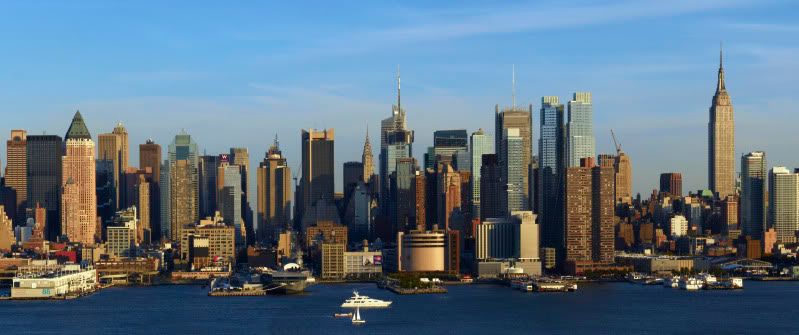
Midtown Manhattan, as seen from New Jersey.
The Empire State Building is to the right.
When the British occupied Manhattan after driving George Washington's Continental Army out in 1776, they burned it, and this is why there are very few remaining pre-19th Century buildings anywhere in the City (unlike such other Revolutionary-era cities as Boston and Philadelphia). After the British went home, the City's port, and location between two rivers, made it the richest in the Western Hemisphere, and was a big reason why America became a world power over the next 200 years.
New York City is divided into 5 Boroughs:
* Manhattan, or New York County, is the central island, named for the natives' name for it, "place of many hills." Often called "The City" by people from New Jersey, and sometimes even from the Outer Boroughs, which are as follows:
* The Bronx, or Bronx County (otherwise always "The"), named for an early Dutch settler, Jonas Bronck).
* Brooklyn, or Kings County, named for the Dutch city of Breukelen, and, as Kings County, named for Charles II.
* Queens, or Queens County, named for Charles' wife, Catherine of Braganza.
* Staten Island, the former Dutch name, or Richmond County, named for Charles Lennox, 1st Duke of Richmond, one of King Charles' many contributions to illegitimacy.
The City is also part of "the New York Metropolitan Area" or "the New York Tri-State Area," which includes parts of New York State not in the City (such as Long Island, Nassau and Suffolk Counties; and the Lower Hudson Valley, such as Westchester County) and the States of New Jersey and Connecticut.
Lower Manhattan, as seen from Brooklyn Heights.
That's the Brooklyn Bridge in the foreground,
with the new World Trade Center, the Freedom Tower,
behind it. 1883 meets 2014.
Most likely, you won't need to visit The Bronx (Yankee Stadium will host MLS games this summer, but no international club matches or national team matches), Brooklyn, Queens, Staten Island, the Lower Hudson Valley, or Connecticut; or New Jersey except for the games in question, so I'll spare you the descriptions. However, both MetLife Stadium (East Rutherford) and Red Bull Arena (Harrison) are actually in the State of New Jersey -- close to New York City, but not actually in it. Those of you from England, think of it like Essex -- indeed, there is an Essex County in New Jersey.
Aside from your time at the games, most of your time in the City will be spent in Manhattan. North of 14th Street, streets will be a bit easier to navigate, as they will follow the grid plan laid out in 1811.
South of 14th Street, you may end up as confused as a foreigner would be in London, as this oldest part of the City doesn't always pay attention to the grid. If you're a comic book fan, there's a running gag that Metropolis, hometown of the optimistic superhero Superman, is Manhattan north of 14th Street on a beautiful spring day; while Gotham City, hometown of the brooding crimefighter Batman, is Manhattan south of 14th street, a few minutes after midnight, on a cold rainy day in November.
In the grid, Manhattan has (almost exclusively) numbered streets running (more or less) east-west, and (mostly) numbered avenues running (more or less) north-south. The numbered streets go up to 264th Street in The Bronx. Brooklyn and Queens also have numbered streets and numbered avenues, but they're a lot more confusing; when someone in New York says, "34th Street" or "5th Avenue," 95 percent of the time, they'll mean the one in Manhattan.
"Lower Manhattan" or "Downtown" is pretty much everything south of 14th Street, including Houston Street (pronounced HOW-stin, not HYOO-stin like the Texas city), which is, effectively, Zero Street. "Uptown" is pretty much everything in Manhattan north of 59th Street, from the southern edge of Central Park upward.
"Midtown" is between 14th and 59th, and is where, aside from the games, most of the touristy stuff is. If you're a Londoner, think of the postal codes beginning with EC, WC, SW1 and W1; if you're Irish, D1 and D2; if you're from Barcelona, 08001 and 08002; if you're from Turin, 10121; and if you're from Rome, the 00180s.
From the East River to the west-bounding Hudson River, the avenues run: 1st, 2nd, 3rd, Lexington, Park, Madison, 5th, 6th, 7th, 8th, 9th, 10th, 11th and 12th. There is a 4th Avenue, but it only runs from 8th Street to 14th Street, becoming Park Avenue South at Union Square and then Park Avenue at 32nd Street.
The outlier is Broadway, which starts at the southern tip of Manhattan (known as The Battery), and remains more or less straight until 10th Street, at which point it curves to (more or less) the northwest, until 78th Street, at which point it straightens out again.
Where Broadway intersects with the numbered avenues, there are frequently "squares," although this does not accurately reflect the actual shapes of the intersections. These include:
* Union Square, at 14th Street and Park Avenue.
* Madison Square, at 23rd Street and 5th Avenue.
* Herald Square, at 34th Street and 6th Avenue.
* Times Square, New York's version of Piccadilly Circus, at 42nd Street and 7th Avenue.
* Columbus Circle, at 59th Street and 8th Avenue.
Times Square
Union Square is not named for a labor union (though many labor rallies have been held there), or even for the nation (a.k.a. "The Union," although it was home to parades before the era of "ticker-tape" parades Downtown), but for the "union" of Broadway and 5th Avenue. Madison Square, and Madison Avenue, were named for early President James Madison. Herald Square and Times Square were named for newspapers (though the
Herald, and its successor the
Herald Tribune, are long gone). And Columbus Circle is named for Christopher Columbus.
The delineator between the East Side and the West Side is Broadway from 8th Street on down, and 5th Avenue from 8th Street on up.
6th Avenue is also known as Avenue of the Americas, and 7th as Fashion Avenue due to its going through the Garment District. 6th and 7th Avenues stop at 59th Street, where Central Park begins. The Park is bordered by 5th and 8th Avenues, and 59th and 110th Streets. West of Central Park, 8th Avenue becomes Central Park West, 9th Avenue becomes Columbus Avenue, 10th Avenue becomes Amsterdam Avenue, and 11th Avenue becomes West End Avenue.
North of Central Park, in Harlem, America's most famous black neighborhood, 6th Avenue resumes as Lenox Avenue, but all 3 are also named for civil rights leaders: 6th/Lenox is Malcolm X Blvd., 7th is Adam Clayton Powell Jr. Blvd., and 8th is Frederick Douglass Blvd.
You may hear a reference to "the Lower East Side." Between Houston and 14th Streets, east of 1st Avenue, you'll find Avenues A, B, C and D. This gave the neighborhood the nickname Alphabet City, and was long a haven for Eastern European immigrants, especially Jewish ones, but it fell victim to crime and drugs by the 1970s. Eventually Hispanics and gentrifiers combined to clean it up, and now, it's reasonably safe. In the Latin-New York accent, "Lower East Side" has become "Loisaida" (LOW-ees-SIGH-da).
On 1st, 3rd, Madison, 6th, 8th and 10th Avenues, traffic runs one way, Uptown. On 2nd, Lexington, 5th, 7th, 9th and 11th Avenues, and on Broadway, traffic runs only Downtown. Park Avenue is the one avenue on which traffic runs in both directions. The major cross streets, such as 14th, 23rd, 34th, 42nd and 59th have two-way traffic, but most of the numbered streets run in only one direction.
The Subway system is going to sound complicated. And it is. I won't go into the difference between the IRT, the BMT and the IND, because the separate companies that ran them have long since been superseded by the Metropolitan Transportation Authority (MTA).
There are lettered lines, and there are numbered lines. The 1, 2 and 3 trains have red logos, and go under 7th Avenue until Times Square (42nd Street), then go under Broadway. The N, Q and R trains have yellow logos, and they're the reverse, going up Broadway until Times Square, and then under 7th Avenue, before curving and heading Crosstown to Queens. The outlier among the yellow-logoed trains is the Q, which I'll get to in a moment.
The A, C and E trains have blue logos, and go under 8th Avenue, although the E curves at 53rd Street and heads to Queens. The B, D and F trains have orange logos, and go under 6th Avenue, until the F curves at Central Park and heads for Queens, where it eventually joins the E.
The 4, 5 and 6 trains have green logos, and go under Lafayette Street, then Park Avenue, then Lexington Avenue. This was the only north-south line on the East Side, until the long-delayed Second Avenue Subway finally opened this past New Year's Day. It's the Q train, going under Broadway, then 7th Avenue, and then turning right on the same track as the F, until diverting at 2nd Avenue, with stops at 72nd, 86th and 96th Streets. But that won't relieve overcrowding on the Lexington Line until the Second Avenue Subway is extended north, to meet the Lexington Line at 125th Street (the MTA says it won't open until 2027 at the earliest), and south, to Hanover Square in Lower Manhattan (the MTA isn't even hazarding a guess as to an opening date).
The 7 has a purple logo, and runs under 42nd Street to Queens, where, due to its going through several ethnic neighborhoods in that Borough, is known as the International Express (but only runs express trains during rush hours). And the L has a gray logo, and runs under 14th Street to Brooklyn.
Note that some trains are express (2, 3, 4, 5, A, D and Q, only making the most-used stops), while the others are local (making all stops). And don't worry about the G, J, M and S trains, because, most likely, you won't need them. (The G is the only line on the entire system that does not go through Manhattan at all.)
The Subway fare is $2.75 (£2.11, €2.46, or 51.46 pesos). Free transfers can be made from train to bus, or vice versa. However, there's a $1.00 fee for every new MetroCard. You're better off getting a 7-Day card for $30, since you're almost certainly staying for a few days.
New York has 3 main daily newspapers, not counting ethnically-aimed smaller ones. The broadsheet
New York Times is the face that New York City prefers to show the world. The tabloid
Daily News is the face that The City prefers to show itself. And the tabloid
New York Post -- like
The Sun, a right-wing rag owned by Rupert Murdoch -- is, as the old saying goes, a face only a mother could love.
For those of you visiting from Britain, and need your fix of your papers (and for whom reading online isn't enough), there are newsstands that sell them. The Hudson News stand at Grand Central Terminal is your best bet. It also has foreign magazines, including from Britain, Ireland, Mexico, Spain and Italy.
For those of you coming to watch the ROI team play Mexico,
The Irish Echo is a weekly paper focusing on Ireland and the Irish people of America. For those of you coming to watch Mexico or Barcelona, the largest Spanish-language paper is
El Diario. For those of you coming from Italy to watch Juve or Roma,
America Oggi is the largest Italian-language newspaper in America. And
First Touch, America's largest soccer-themed newspaper, is published every Thursday, and is available for free from certain bars, including Legends on West 33rd Street.
Going In. This is where I tell travelers how to get to the stadium, how to get into it, and what they're likely to see when they do: Distances from home plate to certain key points in the outfield, whether the field is real grass or artificial turf (a.k.a. a "plastic pitch"), whether the stadium favors hitters or pitchers. But since soccer doesn't have varying field dimensions, that won't matter here.
For those going to see Mexico vs. Ireland or Barcelona vs. Juventus:
What was originally named New Meadowlands Stadium opened in 2010, and became MetLife Stadium the following year, named for an insurance company. If you're driving from inside New York City (never a good idea), take the Lincoln Tunnel into New Jersey, then U.S. Route 3 West, crossing both the Eastern Spur and the Western Spur of the New Jersey Turnpike. The stadium will be on your right. If your hotel is in New Jersey, take the Turnpike to Exit 16W. Parking is a whopping $30.
Despite the fact that the Meadowlands Sports Complex, which also includes a horse-racing track and a now-abandoned arena, is just 8 miles from Times Square, if you're in the City, getting to there by public transportation has never been easy. It used to be that the only way to do it was to get to the Port Authority Bus Terminal at 41st Street & 8th Avenue (A, C or E train to 42nd Street), and then take the New Jersey Transit 320 bus in.
This is still possible, and, theoretically, you can get from bus station to stadium gate in 20 minutes. But, as I said, the traffic will be bad, so make sure you leave Port Authority no later than an hour before kickoff. Round-trip fare is $9.00.
The new option, established with the new Stadium, is by rail. You can get to Penn Station, at 32nd Street & 7th Avenue (1, 2, 3, A, C, or E train to 34th Street), and then switch to New Jersey Transit rail. Even then, you'll have to change trains at Secaucus Junction. At least then, it will only be one more stop, although why the rail spur goes around the Stadium, and not right to it, I'll never know. NJ Transit makes no sense whatsoever. But if you do it right, it should take about half an hour.
Round-trip rail fare from New York's Penn Station is $11, and from Newark's Penn Station (from which you would also transfer at Secaucus Junction) it's $8.75. Service usually begins 3 1/2 hours before stadium events, with departures every 10 to 20 minutes, and every 10 minutes afterwards for 1 to 2 hours after events.
However, at the moment, NJ Transit's website is not mentioning any service to the Meadowlands on June 1 or July 22. It may turn out to be that the bus is your only option. As your date gets closer, you should consult the site for information.
Meadowlands Station
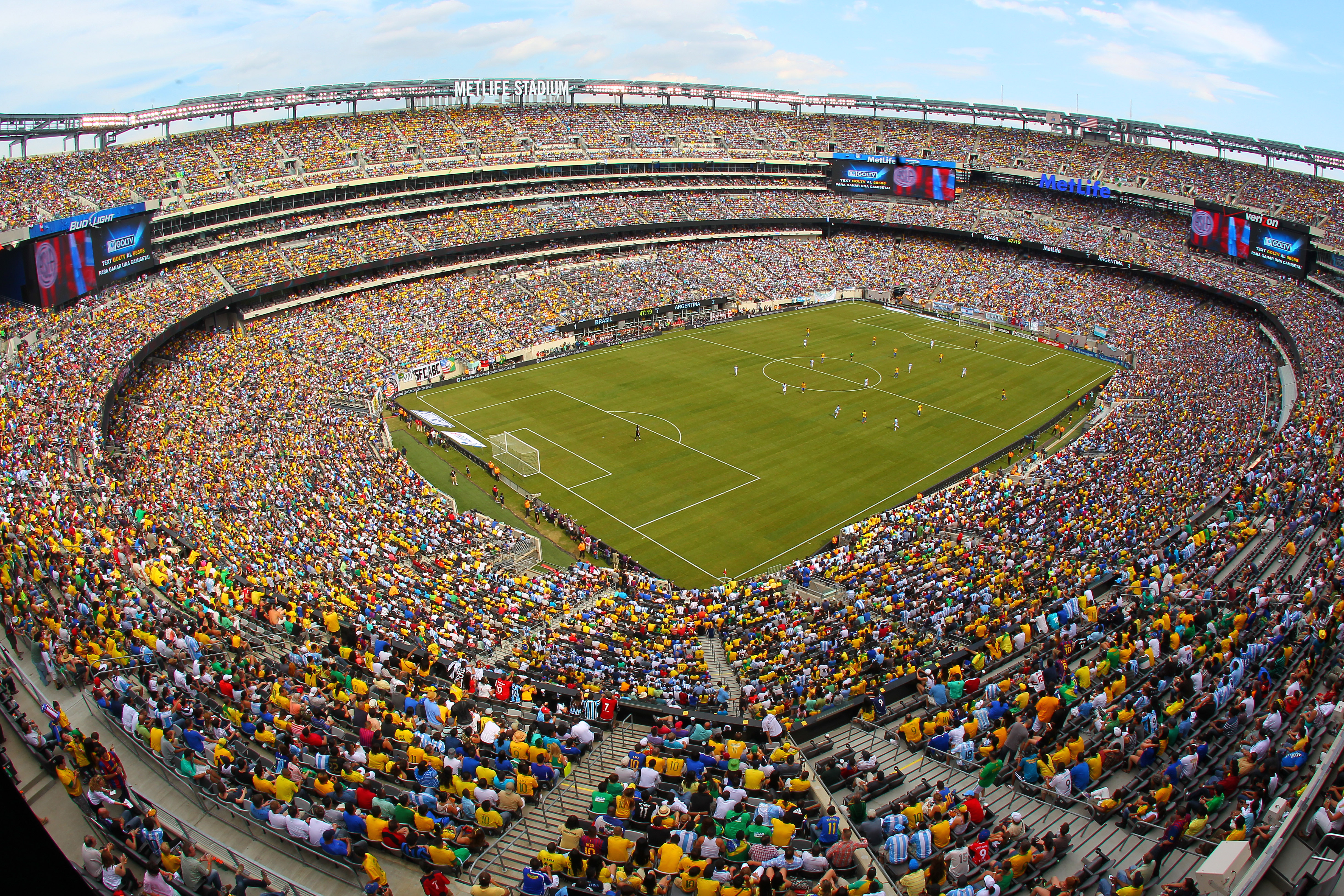
The official address of the Stadium is 1 MetLife Stadium Drive. The Stadium has 5 gates, all named for corporations: MetLife (an insurance company, in case you didn't know), Bud Light, SAP, Verizon and Pepsi. The SAP Gate is the closest one to the train station.
There are large video boards at each of the four corners of the stadium. The field is artificial turf. The U.S. national soccer team lost to Brazil 2-0 at MetLife on August 10, 2010, and tied Argentina 1-1 on March 26, 2011, in front of 78,926 (myself included). Last Summer, it hosted a preseason friendly between European club giants Real Madrid and Bayern Munich, with Los Blancos beating Die Roten 1-0.
If you're going to Red Bull Arena (which, like the team, is named for the Austrian soft drink), home of MLS' New York Red Bulls, to see Spurs play Roma: It's in the city of Harrison, across the Passaic River from Newark.
Driving, you would take the New Jersey Turnpike to Exit 15W, to Interstate 280 West, to Exit 16. This would put you on Essex Street. Make a right on 5th Street, a left on Bergen Street, and a left on Frank E. Rodgers Blvd. (Rodgers was Mayor of Harrison for, believe it or not, 49 years). Go under the freeway and the railroad, and the Arena will be on your left.
The official address is 600 Cape May Street (about 13 miles southwest of Midtown), even though Cape May -- often called America's 1st shore resort, effectively our "Brighton" -- is over 150 miles to the south, and the southern tip of New Jersey.
Parking at Red Bull Arena is $10.
Your best bet to get there from Midtown is to take the A, C or E train to World Trade Center, and then switch to the PATH (Port Authority Trans-Hudson) line, and ride that to Harrison station. Another option is to go to Herald Square, 33rd Street and 6th Avenue, and take the PATH system in, but you'll have to change trains at Journal Square in Jersey City. Either one would take you almost an hour.
The PATH fare is $2.75, just like the Subway's. If you're transferring from the Subway to PATH, the cards from one
can be used on the other, but it will be separate fares,
not a free transfer, so it's $5.50 each way, or $11 round-trip.
There is another way, and if you prefer the English pubgoing experience, it may be more to your liking. New Jersey Transit, a commuter rail and bus service, runs trains between the New York and Newark versions of Penn Stations. (Before the advent of Amtrak and commuter-rail service, this was the Pennsylvania Railroad, which was used as a purchasable property in the American version of the board game Monopoly.) It takes 20 minutes and costs $5.50 each way -- the same as using both the Subway and PATH.
Once you arrive at Newark's Penn Station, you can walk out the east entrance onto Market Street. This is the Ironbound section of Newark, so named because it's ringed by railroads and the Passaic River. It is mainly a Portuguese neighborhood, but with a few Brazilians due to the language. It's got a bit of an old-country touch (Iberia Restaurant was built to look like a castle), but if you're friendly, the people will gladly return that.
A number of bars (we usually don't call them "pubs") on Market Street cater to Red Bulls fans, including Bello's Pub, Titanic Bar and Catas. (R.I.P. El Pastor, which, sadly, closed shortly after Arsenal's 2014 visit to Red Bull Arena.) Lots of beer, lots of sangria, lots of glorious meat. (The Portuguese are big on barbecue.)
Bello's
The neighborhood also has lots of seafood restaurants and bakeries. It's a special place: It was these people that turned me on to the game after a youth of thinking soccer was "boring" and that people who said, "You don't understand the nuances" were full of shit. They showed me how wrong I was. They showed me just how exciting the game can be.
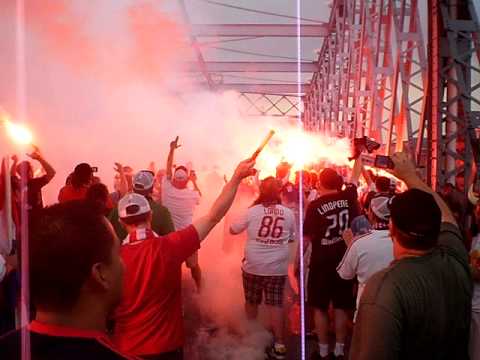
It's 9 blocks down Market Street from Penn Station to Jackson Street. The walk across the Jackson Street Bridge, over the Passaic River, is a Red Bull fans' sacrament. (This shouldn't be a problem for you unless you're
really afraid of heights.) Once over the Bridge, you will enter the city of Harrison, and the Arena will be on your right. Just follow the crowd. The entire walk from Penn Station down Market, over the Bridge, and into the Arena is one mile. It should take about 20 minutes if you don't stop at any of the bars (ha ha).
Red Bulls fans on the Jackson Street Bridge
Upon arrival at Red Bull Arena, entry gates are as follows: Gate A, southwest; Gate B, northwest; Gate C, northeast; and Gate D, southeast.
The Arena also opened in 2010, with a match against Brazilian club Santos, and is billed as "The Cathedral of American Soccer." Please don't laugh. That Summer of 2010 also featured a visit from Juventus, and "The New York Football Challenge," also including Spurs, Manchester City, and, due to the Portuguese community, Sporting Clube de Portugal (the name they prefer to the more familiar "Sporting Lisbon"). Spurs returned in 2012, and so this will be their 3rd visit. It's also hosted Manchester United, and France's Olympique Lyonnais and Montpellier. For those of you coming from Ireland for the Mexico match, Ireland's rugby team will play the U.S. team at Red Bull Arena on Saturday, June 10, 9 days later.
The field is natural grass, and runs north-to-south. The South Ward is where the Red Bull ultras sit, although that may not be an issue, since this isn't a Red Bulls match. (Newark's political subdivisions are called "wards," and this carried over into the Arena, even though it's not in Newark.) Visiting fans are usually put in the upper deck in the northeast corner.
The view from the South Ward
Food. Little of the food available at any of these stadiums is especially nutritious, less of it is on a short line, and still less of it is cheap. Much of it, if you're willing to spend the cash, is good, though. But you're better off eating (and drinking) both before and after you head into the stadium.
The concession stands at MetLife Stadium are much better than at the old Giants Stadium, and are so varied that I won't list them out one by one.
Click this link instead, and you'll have an idea.
At Red Bull Arena, most of the good concession stands are on the East Stand. Do yourself a favor and get the "chips," or "fries" as we call them. At each stadium, beer is served, but there are restrictions.
As in London and Rome -- and, for all I know, Mexico City, Dublin, Barcelona and Turin as well -- street food is a key part of New York life. Pushcart hot dogs are a guessing game: I've had really good ones, really bad ones, and everything in between. But at $3.00 (when even the smallest entrée at a fast-food place will likely be twice that), it's cheap, it's fast, and it's hot. Most of the hot dogs are beef, but I can't rule out that they may be pork.
Which brings me to the question of religion. If you are Jewish, look on the pushcart for the logo of Hebrew National beef franks. Their slogan is, "We answer to a higher authority." Also, many of the pushcarts will be manned by Muslims, who won't handle pork, but they will sell Hebrew National for the very reason that their hot dogs won't have pork, or non-meat fillers for that matter.
Likewise, if you are Muslim, there are pushcarts labeled "The Halal Guys." They will have food that caters to your needs. The Halal Guys also have 3 stores in Manhattan: 307 East 14th Street off 2nd Avenue (L Train to 3rd Avenue), 102 West 53rd Street off 6th Avenue (E Train to 7th Avenue), and 720 Amsterdam Avenue off 95th Street (1, 2 or 3 Train to 96th Street). And, of course, there are lots of restaurants in New York that serve only kosher or only halal food.
Stuff. There may be stalls outside the stadium selling gear of the teams playing inside, but inside the stadium it will be all about the usual home team. So don't expect to see Spurs or Roma memorabilia inside Red Bull Arena, for example.
The top soccer-gear store in America is Upper 90 Soccer, at 697 Amsterdam Avenue at 94th Street. They have it all, and, after a recent expansion, they now have room for it all, and they even have a big-screen TV with a couple of sofas to show games. 1, 2 or 3 Train to 96th Street.
During the Game. This is the part of the post where I describe visiting New York sports fans' potential for interaction with the fans, and the atmosphere of the home team. How much of that will be an issue for you, since none of your teams will be facing a "home team"?
Mexico vs. Ireland: This was, on paper, a great matchup for New York and New Jersey, as both countries have huge numbers of immigrants, and descendants of immigrants, from those countries. Mexican soccer fans tend to use bigoted language (a favorite word is "puto," meaning "homosexual"), but those of you who are Irish are unlikely to be fluent in Mexican slang, so it shouldn't bother you. And neither side tends to fight, except in self-defense.
Barcelona vs. Juventus: Barcelona fans tend not to get nasty, unless the opponent is Real Madrid. Juventus may be many things, but they are not Real Madrid. And the recent Champions League upset of Juve over Barca will probably not be an issue. Like most of the bigger Italian teams, Juventus are known for having ultras who can get rough, but, since this is just a glorified friendly, and the opposition isn't Torino or either of the Milan clubs, they'll be unlikely to try anything.
Spurs vs. Roma: Roma have their ultras, but since Spurs aren't Lazio, it won't be the Roma fans starting anything. As I said, this is Spurs' 3rd visit to Red Bull Arena, and while their fans can be truly obnoxious, they know from experience that New Jersey cops do not mess around, and they will keep the abuse to the verbal.
In other words, no matter who you're rooting for, your safety will probably not be an issue. Don't provoke a physical confrontation, and you won't get one.
Both teams' national anthems, and "The Star-Spangled Banner," will be played before the game. Make sure to stand and respect the other anthems as you do your own.
After the Game. It's a perennial issue in large stadiums: Gates usually open an hour and a half before the scheduled start, and so the stadium operators and safety personnel have that long to get tens of thousands of people inside, but these people all want to get out within 10 minutes of the game's end.
I realize that it's a tradition in European football to treat the police as a necessary annoyance. But with the many rivalries in New York sports (usually between New York teams in the same league, or between New York and Philadelphia teams, or between New York and Boston-area teams), they're used to the possibility of violence.
Therefore, you should not treat the stadium security officers, or the NYPD, or the New Jersey local police, as if they're "the Old Bill." These men (and a few women) are seriously trained, they know what they're doing, and
they do not fuck around. If you follow their instructions, you'll be able to get both in and out of the stadium area safely.
What you do once you are out is up to you. If you feel like getting a postgame meal, or just a pint (or a few), you are free to do so for the extent of your money, so long as you don't cause a disturbance. The cops will arrest people for D&D (drunk and disorderly conduct), and vandalism will not be tolerated under any circumstances. But if you don't make a nuisance of yourself, they'll leave you alone.
That said, there is hardly anything on the grounds of Red Bull Arena or the Meadowlands Sports Complex that could be called a postmatch pub. At the Arena, you could get out of the stadium's West side, to Rodgers Boulevard, and turn either right to get to eateries and bars in Harrison, or left to get over the Jackson Street Bridge and to the Ironbound bars. But you're probably better off getting back on your train (either NJT at the Meadowlands or PATH at the Arena), and heading back into The City.
Sidelights. This is the part of the trip guide where I talk about other sports-related sites in the city's metropolitan area, and then move on to other noted tourist attractions.
During the weeks in question:
* Mexico vs. Ireland: On Wednesday, May 31, New York City FC will be home to the New England Revolution. On Saturday, June 3, the New York Red Bulls will be away to the Montreal Impact.
* Barca vs. Juve and Spurs vs. Roma: On Wednesday, July 19, the Red Bulls will be home to the San Jose Earthquakes, while NYCFC will be home to Toronto FC. On Saturday, July 22, the day of Barca vs. Juve, NYCFC will have a 2:00 start, home to the Chicago Fire, meaning you could, theoretically, go to both games; while the Red Bulls will be away to Minnesota United.
If you're going to Yankee Stadium, home of NYCFC and MLB's New York Yankees: It's in The Bronx, specifically the South Bronx. Once, this was one of the most notorious, most crime-ridden parts of the City, but it rebounded in the 1990s. By the time the Yankees started winning Pennants again in 1996, it could be truthfully reported that 96 percent of the crime in and around the old Yankee Stadium (which, like the Mets' ballpark, was replaced in 2008-09) was ticket scalping.
The intersection is the same: 161st Street and River Avenue, with the elevated "Subway" line over River Avenue. The old Stadium, which opened the same month as the original Wembley Stadium, April 1923, was on the south side of 161st, and a City Park ballfield is now on the site; the new one is on the north side of it. The Subway stop is also the same: 161st Street-Yankee Stadium.
If you're coming up from the West Side, take the D train, which should take about 25 minutes from Midtown; from the East Side, the 4 train (which becomes elevated just before reaching the Stadium), and it'll take about 20.
I should mention that the old Yankee Stadium was home to many great events besides baseball. It hosted many championship prizefights, most notably Joe Louis defending the heavyweight title against Max Schmeling, the unwilling stand-in for Nazi Germany, in 1938. In 1965, Pope Paul VI visited, and delivered the first Papal Mass anywhere in the Western Hemisphere. As for soccer:
* Glasgow Celtic, aware of New York's strong Irish heritage, came in 1931.
* Hapoel Tel Aviv, with New York's strong Jewish heritage in mind, came in 1947, not so much to play soccer as to raise funds for Israel's independence. When Israel's national team was formed in 1948, they played their 1st match at the old Yankee Stadium, losing 3-1 to the team the U.S. had sent to the recent Olympics.
* In 1952, Liverpool played Swiss side Grasshopper Club Zurich, and Tottenham walloped Manchester United 7-1.
* In 1953, shortly after being embarrassed by Hungary at Wembley, and 3 years after their World Cup defeat to the U.S., England salvaged some pride by beating the U.S. 6-3.
* In 1966, Pele and his Brazilian club, Santos, beat Inter Milan.
* In 1968, a local team, the New York Generals, beat Pele's Santos and lost to Real Madrid, while Santos beat Napoli there.
* In 1969,
Barcelona beat Juventus, Inter beat Sparta Prague, AC Milan beat Panathinaikos, and a Milan derby was held, with AC Milan beating Inter.
* The original version of the New York Cosmos played their 1971 and 1976 seasons there -- for reasons I won't get into here, they bounced around the Tri-State Area before moving to the Meadowlands in 1977.
* And in 1976, England beat Italy there.
In the summer of 2012, the new Stadium hosted Chelsea vs. Paris Saint-Germain (attendance: 38,202), and Real Madrid vs. AC Milan (attendance: a sellout of 49,474, including myself). In 2013, Chelsea returned to face Man City (attendance: 39,462), which was beginning its partnership with the Yankees to help build NYCFC. So the people running the Stadium know what they're doing with this sport.
Having seen a match at Yankee Stadium, I can tell you that there really isn't a bad seat in the house. My seat for Madrid-Milan, in the upper deck, which would have been way up in left field for baseball, was right over one of the goals, and I got to see Iker Casillas make some sick saves for Madrid. (And I got to see Cristiano Ronaldo score a hat trick, and Kaka get cheered by both sets of fans, for both of whom he'd played.)
The New York Cosmos, who are in the North American Soccer League (the U.S. pyramid's "second division"), will be playing home to the San Francisco Deltas on the Saturday before Mexico-Ireland, but will be in the middle of their league's break during the week of Barca-Juve and Spurs-Roma.
They play at MCU Park, home of minor-league baseball's Brooklyn Cyclones. 1704 Surf Avenue, right on the Boardwalk, near the roller coaster for which the baseball team was named. No longer functioning as an amusement ride, but restored and still towering over right field, is the legendary Parachute Jump. D, F, N or Q Train to Coney Island-Stillwell Avenue.
MCU Park, set up for soccer
The New York area has a team in the National Women's Soccer League, called Sky Blue FC. They play at Yurcak Field, which is the 5,000-seat soccer and lacrosse stadium of Rutgers University, a three-minute walk from its 52,000-seat football stadium, on its Busch Campus in Piscataway, New Jersey. You'd have to take New Jersey Transit rail from Penn Station to New Brunswick, then a campus bus from the station to the stadium.
They'll be home to the Orlando Pride on the Saturday before Mexico-Ireland, and home to the Portland Thorns on the Saturday after it. They'll be away to the Seattle Reign on the day of Barca-Juve, and won't play again until August 4.
Yurcak Field
Most of you won't be interested in baseball. If you're curious, let me tell you that the resemblance to cricket is superficial at best, and any Englishman who calls it "rounders" or "a schoolgirl's game" doesn't know what the hell he's talking about, and, to use a phrase you'll recognize, baseball fans will get the right hump with you.
When one of the City's baseball teams is at home, the other is usually on the road, so they don't eat into each other's attendance. The Yankees will be on a roadtrip to play the Baltimore Orioles and the Toronto Blue Jays while the Mexico-Ireland game is played, while the Mets will be hosting the Milwaukee Brewers that afternoon (so, theoretically, you could attend both games), and will start a new home series with the Pittsburgh Pirates the next night.
The weekend of Barca-Juve, the Yankees will be away to the Seattle Mariners, while the Mets will be home to the Oakland Athletics, the Saturday game being played at the same time as Barca-Juve, but home the following afternoon.
The week of Spurs-Roma, the Mets will be away to the San Diego Padres, but the Yankees will be home to the Cincinnati Reds, the Tuesday game played at the same time as Spurs-Roma, but home the following night.
I would suggest avoiding the area's other sports teams that are in-season: Minor-league baseball's Staten Island Yankees and Brooklyn Cyclones ("farm teams" of the Yankees and Mets, respectively), and the WNBA's (women's basketball's) New York Liberty. Although tickets are cheap compared to Major League Baseball and the NBA, respectively, the experience probably won't be worth the effort. And the NFL won't even play any preseason games until August 11, so you won't get the chance to see the Giants or the Jets in even the most meaningless of contests.
Citi Field (named for Citibank), home of the Mets, is in Queens, between the neighborhoods of Corona and Flushing, on Roosevelt Avenue between 123rd and 126th Streets. You'll take the 7 train (which becomes elevated, or "the el," upon entering Queens) to the stop labeled "Mets-Willets Point." If you're leaving from Midtown Manhattan, the ride should take about 35 minutes.
Across Roosevelt Avenue is Flushing Meadow-Corona Park, where the U.S. Open tennis tournament is held every late August and early September, and where the 1939-40 and 1964-65 New York World's Fairs were held. If you saw the
Men In Black movies, you'll recognize the Unisphere globe, which is one of the surviving structures from the 1964 Fair.
The name "Flushing" comes from the Dutch "Vlissingen," and, no matter how much the Mets stink, has nothing to do with plumbing, although Citi Field's predecessor, Shea Stadium, was often nicknamed the Flushing Toilet.
The Mets were founded in 1962, to take the place of a pair of teams that moved to California for the reason of greed after the 1957 season: The New York Giants (who played in upper Manhattan) and the Brooklyn Dodgers. The Giants moved to San Francisco, the Dodgers to Los Angeles, and have maintained their nasty rivalry to this day, thought separated by 389 miles instead of 14.
The move of the Giants was upsetting to many, that of the Dodgers to many more, as they were the only team that Brooklyn could then claim as its own, and they moved to the untapped market of the California, and took their rivals with them.
The analogy would not be to Wimbledon FC moving to Milton Keynes. Think, instead, of Brooklyn as New York's answer to the East End (complete with docklands), and imagine that, near the peak of their success in the mid-1960s, West Ham had moved to India -- and took Tottenham with them. (Not Millwall. Millwall would be considered "minor league" by U.S. standards.) Then imagine that Chelsea really did have "no history," and only started a few years after the move, and started as a joke, until they had a couple of titles, and their fans became obnoxious far beyond what their success had yet earned. That would be the Mets. (Except that the Mets are shit now. Would that Chelsea would become the same!)
Citi Field holds about 41,000 people, opened in April 2009, and has hosted soccer already, with Greece playing Ecuador, which made sense, as Queens has lots of Greek and Hispanic immigrants.
Both New York baseball parks allow tours.
Yankee Stadium: $25.
Citi Field: $13.
MetLife Stadium, site of Barca-Juve and the home of the NFL's Giants and Jets, also holds tours: $17.
Madison Square Garden, home of the NBA's Knicks and the NHL's Rangers, and the site of some legendary prizefights and concerts, allows tours, for $27. This is the 4th in a series of buildings with the name, opening in 1968, on top of Penn Station, after the original Roman-inspired Station, built in 1910, was demolished in 1963. Between 31st and 33rd Streets, between 7th and 8th Avenues. 1, 2, 3, A, C or E train to 34th Street-Penn Station. Across 8th Avenue is the main post office, with its columns inspiring comparisons to the old Penn Station, and a move to make it the next Penn Station is in the planning stages. (Because of lease issues, the Madison Square Garden Corporation may have to build a new arena in the next few years, despite already having seriously renovated the current Garden both in 1992 and again completing a 2-year renovation job this year. Location to be determined.)
Barclays Center, home of the NBA's Brooklyn Nets since it opened in 2012, offers tours for $24. 2, 3, 4, 5, B or Q train to Atlantic Avenue-Barclays Center. It's built across the street from the Long Island Rail Road's Atlantic Terminal, one of 3 major rail stations in the City.
The
Prudential Center in Newark, home of the NHL's New Jersey Devils since it opened in 2007, will host Adam Lambert with the surviving members of Queen on July 26, the day after Spurs-Roma. However, I can find no reference to tours of the arena being available. It's a 5-minute walk from Newark's Penn Station.
As I said, the current Madison Square Garden and the current Penn Station are in the same complex, Pennsylvania Plaza. Penn Station is the City's hub for Amtrak, and is the main terminal for both New Jersey Transit and the Long Island Rail Road (LIRR), which provides service to "Lawn Giland," New York's Nassau and Suffolk Counties, America's classic suburban region. Unlike its predecessor under the name, Penn Station is not a tourist attraction into and of itself.
That is not the case with the City's other major rail center, Grand Central Terminal, at 42nd Street and Park Avenue. It is truly a spectacular sight, and like Penn Station and a few other locations, can truly be called "a city within a city." Like the old Penn Station, it was threatened with demolition, because its Midtown real estate was so valuable. But a group led by former First Lady Jacqueline Kennedy Onassis saved it, got it cleaned up and renovated, and last year it celebrated its Centennial in grand fashion. Although Amtrak no longer operates out of it -- you can no longer take trains from Grand Central to Boston, Montreal and Chicago -- it is still the main commuter hub for people from the Lower Hudson Valley and Connecticut, through the Metro-North Commuter Railroad. 4, 5, 6 and 7 trains to 42nd Street-Grand Central.
As for the City's main tourist attractions: If your secondary goal, beyond the primary goal of seeing your match, is to see a "Broadway play," I would advise against it, as you may well be very disappointed. Tickets are expensive and not easy to get, and may not be worth it. This is hardly a golden age for Broadway: Nearly every show is either a borrow from London's West End, a stage adaptation of a movie you may already have seen, or a revival of a classic musical featuring performers whose names are not especially well-known. (And are not likely to be, either: Although a few major actors got their start on Broadway, the days when
The Ed Sullivan Show -- which helped the Beatles rise to superstardom here -- could, thanks to Sullivan's status as a Broadway columnist for the
Daily News, raise performers and songs from nearby theaters to iconic status are long gone.)
An
NY CityPass will be expensive, but it will save you a large amount if your goal is to cram in as many tourist attractions as possible. You can tailor your pass to the sites you want to see. For example: The $109 version gets you the Empire State Building, The Metropolitan Museum of Art, the American Museum of Natural History, the Museum of Modern Art, the Statue of Liberty & Ellis Island or a Circle Line Cruise around Manhattan Island, and the Top of the Rock observation deck at Rockefeller Center or the Guggenheim Museum. With CityPASS, you'll skip most ticket lines.
As for the museums: While London's are free, New York's are not. They have "donations" -- or "suggested general admissions" -- running from $15 to $22.
The two best-known New York Museums are opposite Central Park from one another, a mile apart. The American Museum of Natural History is at 79th Street and Central Park West (8th Avenue). C train to 81st Street. And the Metropolitan Museum of Art -- a.k.a. The Met, not to be confused with the opera house, the baseball team, or the London police -- is at 82nd Street and 5th Avenue. This stretch of 5th is known as Museum Mile, and also includes, among others, the egg-shaped, Frank Lloyd Wright-designed Solomon R. Guggenheim Museum. 4, 5 or 6 train to 86th Street, 4 blocks down Lexington, and then 3 blocks west to 5th Avenue.
The
Lincoln Center for the Performing Arts is New York's center for classical performances, with several venues, most notably the current edition of the Metropolitan Opera House. 63rd Street and Broadway. 1 train to 66th Street-Lincoln Center. The other major classical venue is
Carnegie Hall. How do you get to Carnegie Hall? "Practice, my boy, practice!" The old joke is wrong: Anyone who can afford to rent Carnegie Hall's main auditorium may do so, regardless of level of talent. It's at 881 7th Avenue at 57th Street. 1, A, B, C or D train to 59th Street-Columbus Circle, or F train to 57th Street.
Sadly, the legendary Carnegie Deli, at 854 7th Avenue at 55th Street, home of the giant (and expensive) sandwiches named for legendary entertainers and athletes, and that wonderful chocolate and seltzer drink known as the egg cream, closed late last year. So did the similar Stage Deli, a block south, in 2012.
The Russian Tea Room, a famous restaurant mere steps away from Carnegie Hall at 150 West 57th, is to be avoided: The service is only passable, and the food would be mediocre at half the price. In fact, I would avoid the best-known restaurants altogether. It's been said that New York offers the best cheap meals and the worst expensive meals in the world. So if you have the bucks to blow, and you want to be able to say, "I ate at (fill in the blank: Smith & Wollensky's, Gallagher's, Peter Luger's, or wherever else)," go ahead, but you have been warned. (The famous Italian restaurant Mamma Leone's has been gone for many years.)
The closest thing you may get to a true British pub experience is the Atlantic Chip Shop, at 129 Atlantic Avenue at Henry Street in Brooklyn. The place is decked out in British memorabilia, and when there's no football or rugby match on TV, they usually have a British film on -- the last time I was there, it was
Monty Python and the Holy Grail. 4 or 5 train to Borough Hall, then 4 blocks down Court Street, then turn right on Atlantic and walk 2 blocks.
The owners also run the Park Slope Chip Shop, which is closer to a genuine chippy. 383 5th Avenue at 6th Street -- remember, that's Brooklyn's 5th Avenue, not Manhattan's. R train to 9th Street, walk up 4th Avenue to 6th Street, and 1 block over to 5th.
North America's premier soccer bar/football pub is The Football Factory at Legends, at 6 West 33rd Street, across from the Empire State Building. Many of the big European clubs have supporters' clubs that watch matches there, and the atmosphere can be quite intense (but never violent). B, D or F train to 34th Street-Herald Square, then one block over on 33rd Street.
It is one of several places in the City where you can pick up copies of
First Touch, the area's free weekly newspaper dedicated to the sport. Despite this being the off-season, it is still being published.
However, if you're in town for Mexico-Ireland on June 1, and you want to watch the Champions League Final 2 days later, don't go the The Football Factory. It will be packed well before kickoff. Fortunately, pretty much any bar in The City will show it.
A Salt and Battery is a good fish and chips place. Next-door is another English-themed place, Tea and Sympathy. 112 Greenwich Avenue at 13th Street. 1, 2, 3, A, C or E train to 14th Street.
If your taste runs more to the Irish or the Scottish, one place I like is The Parlour, at 250 West 86th Street. It's the home of the New York Bhoys, a Celtic FC supporters' group. The people and the food there are both superb. 1 train to 86th Street. Of course, with the Auld Sod planted deeply in New York's bedrock, choices of Irish-themed bars is just about endless.
If you're interested in something strictly Scottish, Caledonia Scottish Pub is at 1609 2nd Avenue at 83rd Street. 4, 5 or 6 train to 86th Street. And if you're Welsh, Longbow Pub & Pantry is in the Bay Ridge section of Brooklyn. 7316 3rd Avenue at 74th Street. R train to either Bay Ridge Avenue or 77th Street, then walk a block from 4th Avenue to 3rd.
The City has many Mexican restaurants. If you're Italian, your choices are seemingly endless; but if you're supporting Juve and are looking for genuine Northern Italian food, San Carolo Osteria Piemonte advertises as an "elegant, contemporary restaurant specializing in refined fare from Italy's Piedmont region." 90 Thompson Street. C or E Train to Spring Street.
If you're supporting Barca and are looking for genuine Catalan, rather than Spanish, food, Boqueria Flatiron advertises "Barcelona-style tapas & a deep menu of Spanish wines." 53 West 19th Street. F or M Train to 23rd Street.
The Freedom Tower at the new World Trade Center, the tallest building in the Western Hemisphere, looks over the site of the original Twin Towers, at Liberty and Greenwich Streets. Expect long lines for both tickets to both its observation deck and the 9/11 Memorial. E train to World Trade Center, or R train to Cortlandt Street.
Because of security concerns after the 9/11 attacks, it is no longer possible to tour the New York Stock Exchange building at Wall and Broad Streets. However, it doesn't cost anything to walk down Wall Street, the center of the financial world. 2, 3, 4 or 5 train to Wall Street.
The South Street Seaport area is one of the City's last remaining bastions of pre-Civil War (1861-65) architecture. However, the Pier 17 shopping center, which had lots of goodies, was demolished in 2014 to make way for a new one, is currently scheduled to open in Summer 2018.
*
This is usually where I close the blog post by telling you what a terrific city you'll be visiting, and hoping that you'll have fun.
Well, whatever you might think of London, or Dublin, or Rome, or Turin, or Barcelona, or Mexico City, there is no better city on Earth than New York. While it is very easy for things to go wrong there, if you follow these directions, you should be fine, and be able to enjoy yourself immensely. Good luck.




/cdn.vox-cdn.com/uploads/chorus_image/image/60469923/180418_10_41_48_5DS_5675.0.jpg)








.jpg)