Showing posts with label 1994 world cup. Show all posts

Wednesday, July 17, 2024

July 17, 1994: The World Cup Final On American Soil

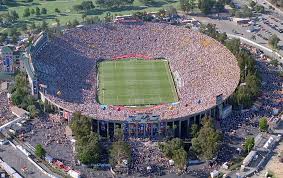
The Rose Bowl, Pasadena, California, July 17, 1994.
Attendance: 94,194.

July 17, 1994, 30 years ago: For the 1st time, the Final of soccer's World Cup is held on American soil.

There were 9 venues. From East to West:

* Foxboro Stadium, built in 1971, in the Boston suburb of Foxboro, Massachusetts, home of the NFL's New England Patriots. It had been the home of the North American Soccer League's Boston Minutemen and New England Tea Men, and would become the home of Major League Soccer's New England Revolution.

* Giants Stadium, 1976, in the New York suburb of East Rutherford, New Jersey, home of the NFL's New York Giants and New York Jets. It had been the home of the NASL's New York Cosmos, and would become the home of MLS' New York/New Jersey MetroStars, who became the New York Red Bulls.

* Robert F. Kennedy Memorial Stadium, known as District of Columbia Stadium from 1961 to 1969, in Washington, D.C., home of the NFL's Washington Redskins (now the Washington Commanders). It had been the home of the NASL's Washington Darts and Washington Diplomats, and would become the home of MLS' D.C. United.

* The Citrus Bowl, 1936, now named Camping World Stadium, in Orlando, Florida, the only venue not then the regular home of a professional or college football team. It was home of college football's annual Florida Citrus Bowl. It would later become the home of MLS' Orlando City Soccer Club.

* The Silverdome, 1975, in the Detroit suburb of Pontiac, Michigan, home of the NFL's Detroit Lions. It had been the home of the NASL's Detroit Express. Alone among these 9 metropolitan areas, Detroit has never had an MLS team.

* Soldier Field, 1924, in Chicago, home of the NFL's Chicago Bears. It had been the home of the NASL's Chicago Sting, and would become the home of MLS' Chicago Fire.

* The Cotton Bowl, 1930, in Dallas, home of the annual Cotton Bowl game, and the former home of the NFL's Dallas Cowboys. It had been the home of the NASL's Dallas Tornados, and would become the home of MLS' Dallas Burn, who became F.C. Dallas.

* The Rose Bowl, 1922, in the Los Angeles suburb of Pasadena, California, home of the football team at the University of California at Los Angeles (UCLA) and the annual Rose Bowl game. It had been the home of the NASL's Los Angeles Wolves and Los Angeles Aztecs, and would become the home of MLS' Los Angeles Galaxy.

* And Stanford Stadium, 1921, in the San Francisco suburb of Palo Alto, California, home of the football team at Stanford University.

Thus, the Silverdome, Soldier Field, the Rose Bowl and Stanford Stadium became the only stadiums to host both a Super Bowl and a World Cup match -- and the Rose Bowl would become the only one to host both a Super Bowl and a World Cup Final. 

This tournament remains the World Cup with the highest per-game attendance: 68,991. And what an array of talent, not dampened in the slightest by England, which still thinks of itself as the country in world "football," failing to qualify for the 1st time since 1978:

* From finalists Brazil: Romário, Ronaldo, Cafu, Bebeto, Dunga, Leonardo, and Claudio Taffarel.

* From finalists Italy: Franco Baresi, Paolo Maldini, Gianfranco Zola, Mauro Tassotti, Roberto Donadoni, Antonio Conte, and Roberto and Dino Baggio (not related).

* From semifinalists Sweden: Henrik Larsson and Tomas Brolin.

* From semifinalists Bulgaria: Hristo Stoichkov.

From quarterfinalists the Netherlands: Frank Rijkaard, Ronald Koeman, Dennis Bergkamp, Marc Overmars, Danny Blind, Edwin van der Sar, and the twins Frank and Ronald de Boer. (Marco van Basten had already had to retire due to injury.)

* From quarterfinalists Germany: Lothar Matthäus, Jürgen Klinsmann, Jürgen Kohler, Rudi Völler, Thomas Häßler, Andreas Brehme, Matthias Sammer and Oliver Kahn.

* From quarterfinalists Romania: Gheorghe Hagi and Gheorghe Popsecu.

* From quarterfinalists Spain: Pep Guardiola and Luis Enrique.

* From the Round of 16: From Argentina: Diego Maradona (who ended up getting suspended for drugs), Gabriel Batistuta and Claudio Caniggia. From Ireland: Roy Keane, Paul McGrath, Ray Houghton, John Aldridge, Steve Staunton, Ronnie Whelan, Tony Cascarino and Packie Bonner. From Nigeria: Jay-Jay Okocha.

* From teams that didn't make it to the knockout round: Roger Milla from Cameroon, and Carlos Valderrama and his hair from Colombia.

* And from our own team, which did make it past the Group Stage for the 1st time since 1930: Alexi Lalas, Eric Wynalda, Cobi Jones, Marcelo Balboa, Paul Caligiuri and Jersey Boys Tony Meola, John Harkes, Tab Ramos and Claudio Reyna.

True, we got knocked out by Brazil, on home soil, on the 4th of July no less, at the old Stanford Stadium in the San Francisco suburb of Palo Alto, California. And we wore horrid uniforms. But it was still a big boost for American soccer, just what the upcoming founding of Major League Soccer (MLS) needed going into 1996.
Yes, we actually wore these things.

Certainly, we got the pageantry right. Having America play on the 4th of July worked out well, despite the loss. And the New York market got lucky, as 2 of the country's, and particularly the Tri-State Area's, biggest ethnic groups ended up having their ancestral homelands playing each other at the Meadowlands: The Republic of Ireland and Italy.
Ireland vs. Italy, Giants Stadium, June 18, 1994.
Attendance: 75,338. Ireland pulled the upset, winning 1-0.

But, from the American perspective, the 2 worst things that could have happened did happen. Someone got killed. Not in the stadium, or in the streets; it wasn't a fight between hooligans. Not even in the country. After his own goal sent Colombia down to defeat against us, Andrés Escobar of Atlético Nacional went back home to Medellín, and was shot and killed. He was only 27 years old.

The other was that the Final ended scoreless. There were the 2 best teams in the world, Brazil and Italy, and, after a full 90 minutes, plus extra time making it 120 minutes, the final score was 0-0. Nil-nil. Nothing to nothing. Americans like scoring, and any American watching this Final, not knowing all that goes into a soccer game, would have found it boring as hell. It probably set American interest in the sport back several years.

Roberto Baggio blasted a penalty kick over the crossbar, and Brazil won the penalty phase, 3-2. And Americans not already into soccer shrugged their shoulders, and either went back to watching baseball or began preparing for a new NFL season.
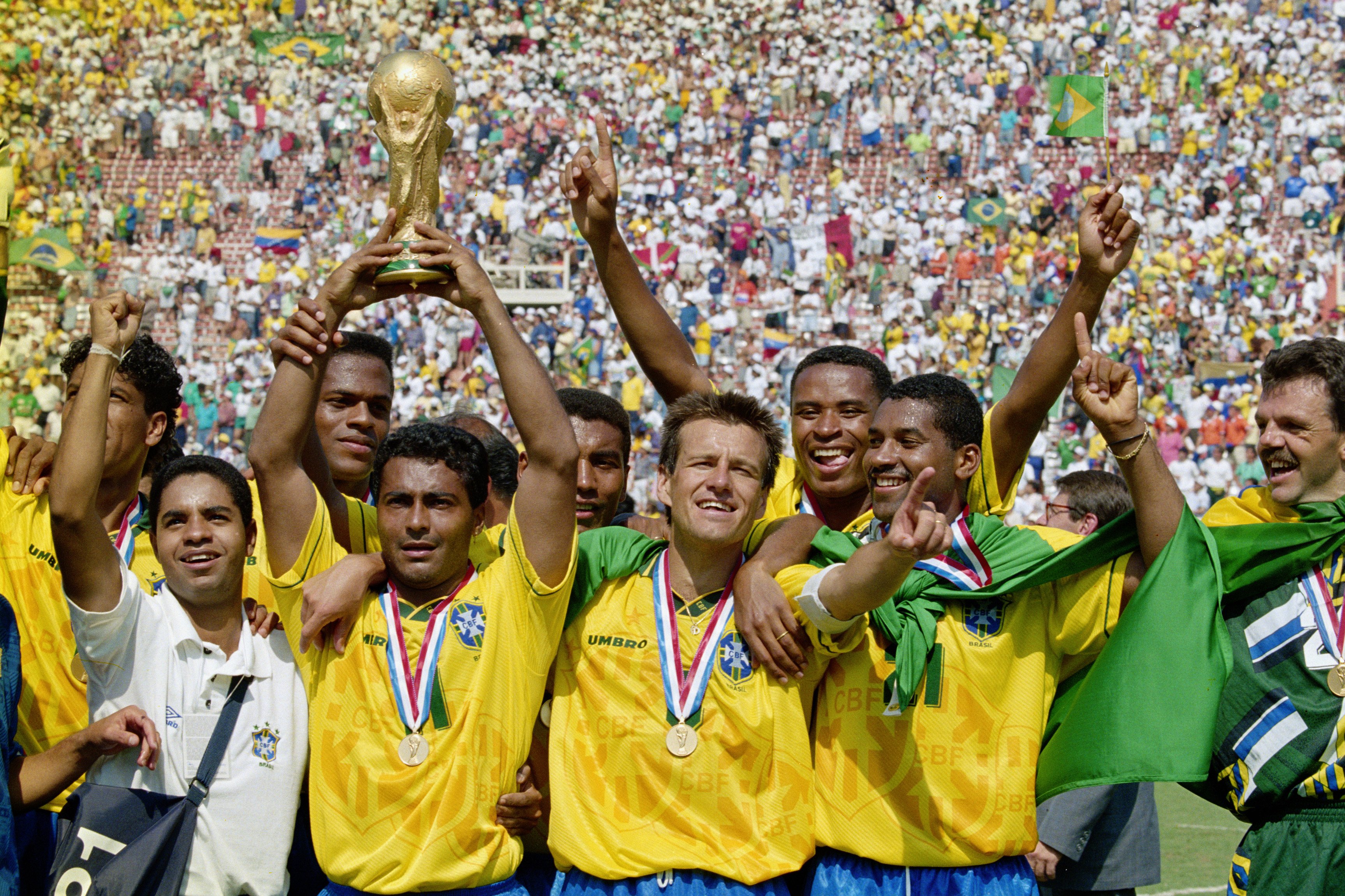
Romário (Number 11) lifts the Jules Rimet Trophy,
next to Dunga (8), the Captain

Foxboro Stadium was torn down in 2002, having been replaced by the next-door Gillette Stadium. Soldier Field was torn down in 2002, and replaced by a new stadium on the same site. Stanford Stadium was torn down in 2004, and replaced by a new stadium on the same site. Giants Stadium was torn down in 2010, having been replaced by the next-door MetLife Stadium. The Silverdome was torn down in 2017. RFK Stadium was torn down in 2023.

The 2026 World Cup was awarded jointly to all 3 North American nations: The United States, Canada (which has never hosted), and Mexico (which hosted in 1970 and 1986). Most of the host stadiums from 1994 are unlikely to host again in 2026, since they've been replaced. The Final was awarded to New York, and to MetLife Stadium. SoFi Stadium, outside Los Angeles, got a Quarterfinal; while the Semifinals went to Mercedes-Benz Stadium in Atlanta and AT&T Stadium outside Dallas.

Thursday, June 28, 2018

Top 10 Moments When America Could Have Embraced Soccer, But Didn't -- and Why

The World Cup is underway, and the United States of America is, well, not playing in it. We didn't win the games we needed to win in order to be 1 of the 3 teams from the CONCACAF region to qualify. Those 3 turned out to be Mexico, Costa Rica and Panama.

Of course, this saves Donald Trump the trouble of having to decide between his favorite country, the host country, and the country he was "elected" to lead, ours.

America has never truly embraced soccer. There have been 10 occasions when we could have, but didn't:

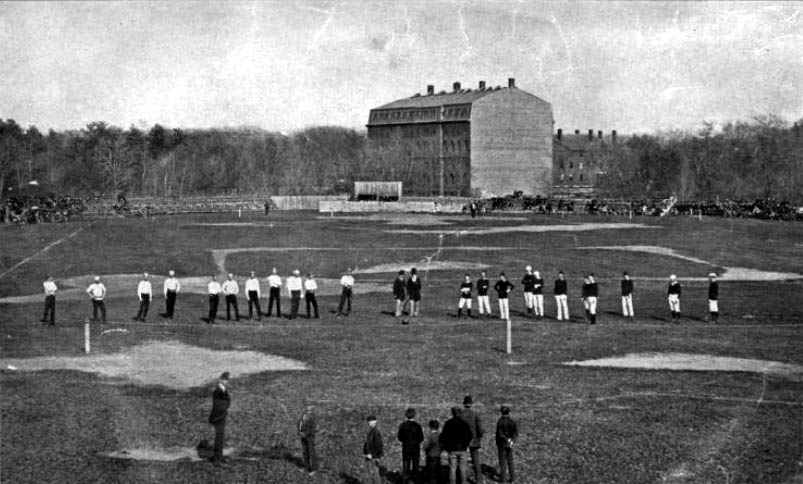
1. 1874: Harvard vs McGill. Essentially, McGill University, in Montreal, is Canada's answer to Harvard University, right down to the Crimson color. Both Harvard's men and McGill's men believed themselves to be sporting gentlemen, in the tradition of the Victorian Era that was pretty much at its peak in the 1870s.

As citizens of the British Empire, McGill's men believed themselves to be honest, brave, and examples for the youth of the world to follow. The University's motto is Grandescunt Aucta Labore, Latin for "By work, all things increase and grow."

As citizens of the United States of America, Harvard's men believed the same things of themselves, with the added touch of being the inheritors of the American Revolution. The University's motto is Veritas, Latin for "Truth."

Having heard that Harvard had one the best football teams in America, McGill invited Harvard to come up and play "football." It would be the 1st-ever "football" games between American and Canadian teams. Wishing to maintain their appearance as honorable sportsmen, Harvard happily accepted.

But when the McGill men got to Harvard's Jarvis Field on May 14, they discovered that the game they'd been invited to play was soccer -- which got shortened to "assoc." and eventually to "soccer." They'd expected that they would be playing rugby (which has frequently been called "rugger").

Being "sportsmen" and "gentlemen," the team captains met to discuss the discrepancy with civility. There may have been tea involved, or perhaps a stronger beverage.

They came up with a compromise: They would play a game under Harvard's "Boston game" rules, and another game under the "code" of "rugby union," the version of football most familiar to Canada at the time. (Indeed, the predecessor to the CFL, the Canadian Football league, was the CRU, the Canadian Rugby Union.)

On May 14, Harvard won the soccer game 3-0. The following day, they met for the rugby match, which ended 0-0.
The Harvard men liked the rugby version, including the "try." When they returned to the U.S., their officials met with officials from other schools, and the rules were combined with those of the soccer generally considered "football" in America, and carrying the ball was officially allowed, and the "try" became the "touchdown."

So if you want to know why America plays the gridiron game instead of "football," blame Harvard and McGill.

You could also blame another Harvard man, the Rough Rider himself:

2. 1905: Theodore Roosevelt. On October 7, 1905, the University of Pennsylvania hosted nearby Swarthmore College in a football game at the original Franklin Field. (Built in 1895, it was replaced by the current structure in 1923.) Penn won the game, 11-4.

Swarthmore guard Robert Maxwell, known as Tiny for being so big and fat, got his nose broken, but played both ways the whole game. It was the only game Swarthmore lost all season, and it would probably be forgotten today, especially since Swarthmore is now a Division III school.

Except a photograph was taken of Maxwell's bloody face, and the wire services put it on the front pages of newspapers all over the country. One of them made its way to President Theodore Roosevelt. A former athlete himself -- he had been on the Harvard boxing team in 1880, and played tennis even while President -- he requested figures, and found out that 18 young men had died playing college football in 1904.

So the Rough Rider hauled the presidents of Harvard, Yale and Princeton -- then the nation's leading football-playing universities -- into the White House, and, in a meeting on October 9, told them point-blank: Either you do something to make football safer, or I will take action.
You want to tell him he's bluffing? I don't.

TR -- he did not like the nickname "Teddy" -- didn't have to actually threaten to ban the sport. Given his reputation as a man who got things done and didn't let anything stand in his way, just the possibility that he would be taking over their sport, taking their power away, was enough to spur them into action. The safety measures they took over the next year are now considered the founding of the National Collegiate Athletic Association (NCAA).

Had the gridiron game been stopped at this time, in the Progressive Era, the world's game might have caught on, and, like so many other things that began elsewhere, been given an American touch, so it wouldn't have carried the "foreign" label.

One of the rule changes that the proto-NCAA recommended was widening the field. This might have made a football field, 160 feet (53 1/3rd yards) wide, as wide as a soccer field, usually around 222 feet (74 yards).

But, again, Harvard is involved. Harvard Stadium was built in 1903, and it was the first modern football stadium. The field could not be widened without tearing down half the stadium and essentially starting over. Harvard was not willing to do that and, at the time, the influence of Harvard was roughly the same as the influence of Notre Dame, Michigan, Alabama, Texas, and USC combined. In other words, if Harvard wanted something, it usually got it. So the field was not widened. Instead, the forward pass was legalized, which made the game considerably safer.

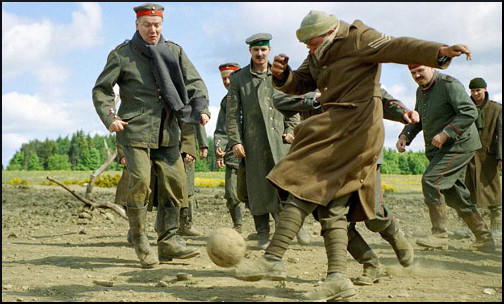
3. 1918: World War I. There are many stories of impromptu soccer games being played between teams of British and German soldiers in the "No Man's Land" stretches between the trenches in France and Belgium during the Christmas Truce on December 25, 1914.
A re-enactment

Then known as The Great War, The World War, and, erroneously, The War To End All Wars, this conflict was the first chance for many Americans to not merely see a foreign land, but to meet foreigners, not merely immigrants from those places, and to get to know them and their ways.

A popular song of 1918 expressed the question that many Americans had on the effects of the boys they sent off to battle: "How ya gonna keep 'em down on the farm after they've seen Paree?" (Paris.)

Well, the American authorities of a century ago had 2 answers, 1 they thought of, and 1 that they stumbled onto. They one they came up with themselves was to point out that America won the war, whipping the Germans after a combined force of British, French and Russians hadn't.

This was the real beginning of the concept of "American exceptionalism," and the dismissiveness of everything foreign: Why should we give a damn about what the Limeys, the Frogs, the Russkies and the Krauts like, when we're better? American stuff should be good for our boys. Be a "100 percent American," and ignore foreign things. In other words, ignore British and French clothing styles, art, music... and sports. Baseball and football are your games, not cricket and soccer.

And so, despite the foundation in 1913 of the United States Soccer Federation (USSF) and the establishment of teams on what we would call the minor-league level, most Americans chose to ignore the sport as "foreign," and not "100 percent American." This was among the things that led the Irish writer George Bernard Shaw to say, "The 100 Percent American is a 99 percent idiot."

Yes, Shaw was Irish, not English. And there was the solution that dropped into the laps of the the hyper-patriots. A lot of the boys who went overseas were of Irish descent, and identified with the people trying to separate from the United Kingdom and found the Republic of Ireland. And so, they wanted nothing to do with English things, like soccer.

This was true not just of the Irish-Americans, but of the natives of the Emerald Isle themselves. To this day, the most popular sports in Ireland are rugby, Gaelic football (which closer to rugby than to soccer, and remains all-amateur), and hurling (sort of a cross between field hockey and lacrosse, and not to be confused with the iceborne sport of curling).

There had always been a few Irish players in England's Football League, but it was the growth of television that led to Irish boys overruling their adults in large numbers and saying, "We want to beat the English at their own game, just like we do in rugby."

So while American soldiers, Irish and otherwise, coming home were ready to help start and play in a new football league, it was going to be "American football." On September 17, 1920, the American Professional Football Association was founded in Canton, Ohio. It was renamed the National Football League in 1922.

4. 1929: The Great Depression. There were 12 teams in the NFL at the start of the 1929 season. In late October, the stock market crashed. There were 10 teams in 1933 -- but only 4 of them were in the League just 4 years earlier: The Chicago Bears and Cardinals, the Green Bay Packers and the New York Giants.

The Depression killed off teams in the smaller markets, except for the Packers, who were saved due to the friendship between their boss Earl "Curly" Lambeau and Bears owner-coach-GM and former end George Halas.

Oddly, American soccer survived. But it's possible the NFL might not have. If it hadn't, then it wouldn't have still been there from September through December. And, with hockey not yet big business in America, and pro basketball still very much minor-league, as American soccer still was, something else could have stepped in for October through April, to fill in the gap between baseball seasons.

And soccer could have been it. After all, it was a poor boy's game in the rest of the world. All you needed in terms of equipment was a ball, or something to substitute for it, something soft enough to kick.

5. 1945: World War II. American troops were in Britain, France, Belgium, the Netherlands, Germany and Italy, all soccer-mad countries. They could have absorbed the culture and taken it back, just as they could have after World War I.

But, just as after World War I, they didn't. By this point, the problem wasn't a disdain for foreign things. We now valued our alliances too much for that.

No, this time, the issue was that there were too many big sports: Baseball, college football, pro football, college basketball, hockey, boxing and horse racing. On June 6, 1946, pro basketball joined them, with the founding of the Basketball Association of America. In 1949, the Eastern-based BAA merged with the Midwestern-based National Basketball League to form the NBA. There was no place for soccer in America. Yet.

6. The 1950 World Cup. America stunned England 1-0 at Belo Horizonte, Brazil. The whole world was shocked. Except us: There was only 1 American reporter covering it. It should have shaken us up, and we didn't even know it happened.
Even as late as 2002, when the famous "Dos a Cero" win over Mexico happened, Jay Leno could joke on The Tonight Show, "Half of California went into mourning! And the other half said, 'There was a game?'"

7. The 1966 World Cup. This was the 1st one to be broadcast on worldwide satellite TV. And it was in England, a country America knew and liked. 

And there were heroes that America could have embraced. England's Bobby Moore, Bobby Charlton and Geoff Hurst. Brazil's Pelé. Portugal's Eusébio. Spain's Luis Suárez (not related to the current Uruguay star of the same name). West Germany's Uwe Seeler. Italy's Gianni Rivera and Sandro Mazzola. Even the political arch-nemesis, the Soviet Union, had the charismatic goalkeeper Lev Yashin.

But only 16 teams qualified for the World Cup at the time. In qualification from CONCACAF, the region covering North America, Central America, and the Caribbean, only the winners of the 3 groups advanced to a round-robin, and only the winner of that went to the World Cup.

The U.S. was placed in a group with Mexico and Honduras. We got a 1-0 win and a 1-1 draw with Honduras, but only a 2-2 draw and a 2-0 loss with Mexico. Had that 2-2 draw with Mexico in Los Angeles on March 7, 1965 -- which was also "Bloody Sunday" in Selma, Alabama -- been a 3-2 win, we would have advanced to the round-robin with Costa Rica and Jamaica. Could we have won that? We'll never know.

Here's what Mexico did: Drew 1-1 with France, lost 2-0 to England, and drew 0-0 with Uruguay, playing all 3 of their Group Stage games at the old Wembley Stadium in London. They did not advance to the knockout round.

If the U.S. had matched that, the difference would have been the draw with Uruguay: A 1-0 win would have put us in the Quarterfinal with -- West Germany, which ended up taking England to extra time of the Final, before losing on the controversial goal by Geoff Hurst. (I've seen the replay many times, and I think it was legit.)
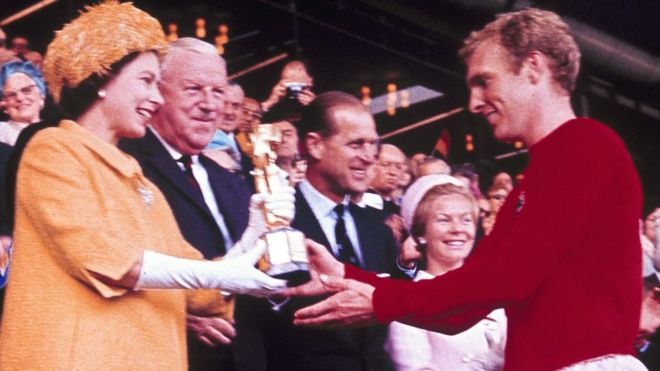
Queen Elizabeth II -- with Prime Minister Harold Wilson,
Prince Philip, and Katharine, Duchess of Kent, a big "football" fan -- 
awards the Jules Rimet Trophy to England Captain Bobby Moore,
at the old Wembley Stadium in London, July 30, 1966.

8. The 1970 World Cup. The world got turned on by the 1966 World Cup -- and by the 1970 edition, the 1st to be broadcast worldwide in color, with Brazil's bright yellow shirts standing out against the green of the field.

America didn't qualify for that one, either, despite the fact that Mexico was the host meant that they qualified automatically, and a 2nd CONCACAF place was opened.

The U.S. won its group in the Autumn of 1968, thanks to a 1-0 win over Canada (but also a 4-2 loss to them), and 6-2 and 2-0 wins over Bermuda. But we lost both legs of the Semifinal to Haiti, 2-0 in Port-au-Prince on April 20, 1969 and 1-0 in San Diego on May 11, and that was that. After a series that literally resulted in a 2-day war between El Salvador and Honduras, El Salvador beat Haiti in the Final to qualify.

If we had beaten Haiti, and then El Salvador? We would have been put in a group with the host nation, Mexico; and with the Soviet Union, each a major rival in a different way; and Belgium. If we had matched El Salvador's results, that would have been a 3-0 loss to Belgium, a 4-0 loss to Mexico, and a 2-0 loss to the Soviets, all at the Estadio Azteca in Mexico City. And there would have been no one-goal loss, or draw, that altering by 1 goal that would have made a difference.

That might have being a depressing set of results, especially the last one, that could have set American soccer back so much that we didn't make the World Cup again until... 1990, which is exactly what happened, anyway.

9. 1977: Pelé. For a brief time, O Rei do Brasil was filling American football stadiums with people who wanted to watch the greatest player in the history of futebol. Even after he retired, the original North American Soccer League did fairly well.
But his successor as the leading player of the New York Cosmos, Giorgio Chinaglia, had an even bigger ego than Pelé, and saw himself as the man who could make soccer's destiny as America's next great sport come true. When he found out one of the Cosmos' owners was ready to sell his share, Chinaglia bought it. Soon, he was, while still a player, essentially controlling everything.
And he ran the team into the ground. They lost gobs of money, and began to lose. Attendance had been 47,856 per game at Giants Stadium in 1978, the year after Pelé retired. Even in 1983, it was still 27,242. In 1984, it was 12,817. The team had to fold. Without its New York team, so did the League.

This did incalculable damage to American soccer. Somehow, we were still awarded the 1994 World Cup. But we had to establish a new top division. To do that, we had to find people willing to ignore how badly the NASL was run, and commit their money and their time. That wasn't easy.

Surely, the World Cup was going to help. Right?

10. The 1994 World Cup. At first, it looked like it would. It remains the World Cup with the highest per-game attendance, 68,991. And what an array of talent, not dampened in the slightest by England failing to qualify for the 1st time since 1978.

From finalists Brazil: Romário, Ronaldo, Cafu, Bebeto, Dunga, Leonardo, and Claudio Taffarel. From finalists Italy: Franco Baresi, Paolo Maldini, Gianfranco Zola, Mauro Tassotti, Roberto Donadoni, Antonio Conte, and Roberto and Dino Baggio (not related). From semifinalists Sweden: Henrik Larsson and Tomas Brolin. From semifinalists Bulgaria: Hristo Stoichkov.

From quarterfinalists the Netherlands: Frank Rijkaard, Ronald Koeman, Dennis Bergkamp, Marc Overmars, Danny Blind, Edwin van der Sar, and the twins Frank and Ronald de Boer. (Marco van Basten had already had to retire due to injury.) From quarterfinalists Germany: Lothar Matthäus, Jürgen Klinsmann, Jürgen Kohler, Rudi Völler, Thomas Häßler, Andreas Brehme, Matthias Sammer and Oliver Kahn. From quarterfinalists Romania: Gheorghe Hagi and Gheorghe Popsecu. From quarterfinalists Spain: Pep Guardiola and Luis Enrique.

From the Round of 16: From Argentina: Diego Maradona (who ended up getting suspended for drugs), Gabriel Batistuta and Claudio Caniggia. From Ireland: Roy Keane, Paul McGrath, Ray Houghton, John Aldridge, Steve Staunton, Ronnie Whelan, Tony Cascarino and Packie Bonner. From Nigeria: Jay-Jay Okocha.

From teams that didn't make it to the knockout round: Roger Milla from Cameroon, and Carlos Valderrama and his hair from Colombia.

And from our own team, which did make it past the group stage for the 1st time since 1930: Alexi Lalas, Eric Wynalda, Cobi Jones, Marcelo Balboa, Paul Caligiuri and Jersey Boys Tony Meola, John Harkes, Tab Ramos and Claudio Reyna. True, we got knocked out by Brazil, on home soil, on the 4th of July no less, and we wore horrid uniforms. But it was still a big boost for American soccer, just what the upcoming founding of Major League Soccer (MLS) needed going into 1996.
Yes, we actually wore these things.

Certainly, we got the pageantry right. Having America play on the 4th of July worked out well, despite the loss. And the New York market got lucky, as 2 of the country's, and particularly the Tri-State Area's, biggest ethnic groups ended up having their ancestral homelands playing at the Meadowlands: The Republic of Ireland and Italy.
Ireland vs. Italy, Giants Stadium, June 18, 1994. Attendance: 75,338.
Ireland pulled the upset, winning 1-0.

But the 2 worst things that could have happened did happen. Someone got killed. Not in the stadium, or in the streets; it wasn't a fight between hooligans. Not even in the country. After his own goal sent Colombia down to defeat against us, Andres Escobar went back home, and was shot and killed.

The other was that the Final ended scoreless. There were the 2 best teams in the world, Brazil and Italy, and, after a full 90 minutes, plus extra time making it 120 minutes, the final score was 0-0. Nil-nil. Nothing to nothing. Americans like scoring, and any American watching this Final, not knowing all that goes into a soccer game, would have found it boring as hell. It probably set interest in the sport back several years.
The Rose Bowl, Pasadena, California, July 17, 1994. Attendance: 94,194.

Roberto Baggio blasted a penalty kick over the crossbar, and Brazil won. And Americans not already into soccer shrugged their shoulders, and either went back to watching baseball or began preparing for a new NFL season.

Friday, March 1, 2013

Remembering the NASL

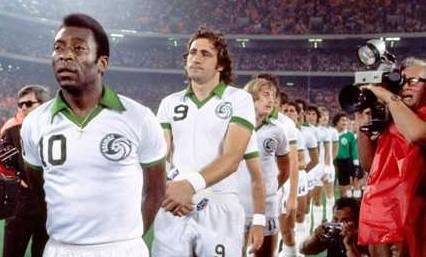
10: Pelé. 9: Chinaglia.

Tomorrow, the 18th season of MLS, Major League Soccer begins. My "local club," the New York Red Bulls -- known as the New York/New Jersey MetroStars from the league's founding in 1996 until 2004 -- open the season on Sunday night, at 7:30 Eastern Time (4:30 local), away to the Portland Timbers in Oregon.

MLS has now lasted as long as the last major attempt to make soccer "major League" in North America. The North American Soccer League lasted from 1967 to 1984. (A league of that name is now North America's "second division.") Essentially, it was a merger of 2 leagues that began play in 1967, trying to ride the wave of interest brought about by England's home-soil World Cup win the year before, and the subsequent documentary about it, Goal!

The United Soccer Association had teams that ran a summer schedule in between the European winter seasons, importing entire teams from elsewhere. From England, Wolverhampton Wanderers became the Los Angeles Wolves, Sunderland became the Vancouver Royal Canadians, and Stoke City (then featuring England World Cup heroes Gordon Banks and George Eastham, and not yet the thugs they've become under current manager Tony Pulis) became the Cleveland Stokers.

From Scotland, Aberdeen became the Washington Whips, Hibernian (a.k.a. Hibs) became Toronto City, and Dundee United became the Dallas Tornado. From the Republic of Ireland, Shamrock Rovers became the Boston Rovers. From Northern Ireland, Glentoran became the Detroit Cougars.

From the Netherlands, The Hague's ADO Den Haag became the San Francisco Golden Gales. From Italy, Cagliari (featuring the great Gigi Riva) became the Chicago Mustangs. From Brazil, Bangu became the Houston Stars. And from Uruguay, Cerro became the New York Skyliners.

Nearly every USA team had a well-known owner. New York was owned by the Madison Square Garden Corporation, who was paying most of its attention at the time to building the new Garden on top of Penn Station.

Boston was owned by Weston Adams, owner of the Boston Bruins. Chicago was owned by Arthur Allyn, who owned the White Sox. Cleveland was owned by Vernon Stouffer and Gabe Paul of the Indians. Dallas was owned by Lamar Hunt, of the Dallas Hunt oil family, and Lamar also owned the Kansas City Chiefs and had founded the AFL. Detroit was owned by William Clay Ford, of the Detroit Ford auto family, and William also owned the Lions (and still does). Houston was owned by Roy Hofheinz, the federal Judge and former Mayor who owned the Astros. Los Angeles was owned by Jack Kent Cooke, who then owned the Lakers and Kings and was building the Forum for them, well before he sold it all and bought the Washington Redskins. San Francisco was owned by George Fleharty, who ran the Ice Follies. Toronto was owned by Steve Stavro, a Maple Leafs executive. Vancouver was owned by a Canadian Army general, E.G. Eakins.

And Washington was owned by Earl Foreman, who owned various franchises over the course of his career, including the nearby Baltimore Bullets in the NBA and the Washington Caps in the ABA, who became the Virginia Squires, and it was Foreman who was the first man to sign Julius Erving to a pro contract, and then sold him to the New York Nets.

In spite of these magnates, the USA did not do well. They couldn't sell out the facilities, as nearly every team played in an MLB or an NFL stadium. The Skyliners drew an average of 8,766 to the original Yankee Stadium, which in its pre-renovation configuration had 67,224 seats.

The Championship Game drew only 17,842 to the 93,000-seat Los Angeles Coliseum. Los Angeles (Wolves) won the Western Division, and Washington (Aberdeen) the Eastern, and faced each other for the title. L.A. led 3-2 going into the 89th minute, but Frank Munro -- who, ironically, would later star for Wolves in England -- scored to send the game to extra time. Derek Dougan (later to become a much bigger star for Wolves) seemed to clinch it in the 113th, but in the 120th and last minute of regular time, Munro scored again.

There were no ties in this league, so it looked like the game would go to more extra time.  But in stoppage time, in the 122nd minute, Ally Shewan scored an own goal, and L.A. won, 6-5. It didn't seem to bother Shewan much: He continued to play for Aberdeen and is a member of their Hall of Fame.

The other league was the National Professional Soccer League. Unlike the USA, the NPSL had mainly North American players. In most cases, the owners were owners of other local teams: The Atlanta Chiefs were owned by the Braves' William Bartholomay, the Baltimore Bays by the Orioles' Jerry Hoffberger, the Los Angeles Toros by the Rams' Dan Reeves (no relation to the Cowboys running back of the time who became a successful coach), the St. Louis Stars by Bill Bidwill of the football Cardinals, the Pittsburgh Phantoms by Peter Block and Richard George of the Penguins, and the Philadelphia Spartans by John Rooney, a son of Pittsburgh Steelers owner Art Rooney.

There were also the New York Generals, owned by RKO, which owned WOR-Channel 9 (now WWOR), and thus had an easy time getting TV rights; the Chicago Spurs, named for London's Tottenham Hotspur, who were very successful at the time (this was a long time ago); the Toronto Falcons, and the Oakland Clippers, who ended up winning the title.

Not much could be said for the New York Generals. Like the Skyliners, they couldn't sell out the old Garden, with its 18,496 seats, let alone the old Yankee Stadium, with 67,224. But they had 2 players whose names you should know. Cesar Luis Menotti played for a number of clubs in Argentina, including Buenos Aires giants Boca Juniors, and in 1978 would manage his country to win the World Cup on home soil. And Gordon Bradley, a midfielder from Sunderland, would play in New York again.

The NPSL had the advantage of not taking entire teams from elsewhere, teams that were emotionally committed to other places on other continents. So they could get the jump on the USA and start earlier, on April 16. But CBS didn't really know what they were doing on their TV broadcasts. Jack Whitaker (later on ABC) didn't know soccer, and his color commentator, former Tottenham captain Danny Blanchflower, went out of his way to say that the standard of play was poor. In addition, referees were told to call fouls when there weren't any, so play could be stopped long enough to put in TV commercials, as opposed to the running clock that "football matches" usually have.

There was also the issue of each league putting a team not just in one city, but in some cases both in one stadium. Both leagues' New York teams played at Yankee Stadium, both L.A. teams played at the Coliseum, and both Toronto teams played at old Varsity Stadium rather than the new Exhibition Stadium.

In addition, each league had a Chicago team and a Toronto team -- this at a time when Toronto did not have teams in either MLB or the NBA; indeed, no foreign teams would enter any U.S.-based league until the Montreal Expos began MLB play in 1969. (True, the NHL had the Maple Leafs and the Montreal Canadiens, but it was still based in Toronto, not New York like today.)

*

Clearly, having 2 leagues wasn't working, so they merged to form the NASL. But there are certain things that make American sports fans different from the rest of the world.  For one thing, we don't like ties. So a penalty shootout was instituted, and additional "team points" in the standings were given depending on how many goals were scored. A college draft was instituted, which solved the problem of how to stock the teams.

Unfortunately, the need for attention clashed with the need for competitiveness. As a result, the NASL made the mistake that the Mets had already made in 1962, and that the New Jersey Devils would make 20 years after that: Get big names that the locals would already know.

Since it wasn't really possible to get big-name soccer players who had already played in the respective cities -- the average age of the best-known U.S. soccer team to date, the 1950 team that shocked England in the World Cup, was 43, and the man who scored the only goal, Joe Gaetjens, was already dead -- this meant going after stars from the British leagues, and from the popular national sides of the era: 1970 Champions Brazil and runners-up Italy, and 1974 Champions West Germany and runners-up the Netherlands.

In some cases, this worked. The New York Cosmos got the greatest of them all, Pelé. They also got Pelé's Brazil and Santos teammate Carlos Alberto, Germany and Bayern Munich legend Franz Beckenbauer, Netherlands and Ajax Amsterdam stars Johan Neeskens and Wim Suurbier, Dennis Tueart of Manchester City, and striker Giorgio Chinaglia, who led Lazio to its 1st Italian league title in 1974. (They've only won one other scudetto, or shield, in 2000.) They also got Rick Davis (though, like singer Rick Nelson, most people called him "Ricky"), probably the best American player of the time.

Beckenbauer's club and country teammate Gerd Müller had enough left to star for 3 years with the Fort Lauderdale Strikers. From PSV Eindhoven's 1978 Dutch titlists and UEFA Cup winners, goalie Jan van Beveren gave his all for Fort Lauderdale and then the Dallas Sidekicks, and remained in Texas to coach for the rest of his life.

In 1979, the Los Angeles Aztecs signed the greatest Dutch player, maybe the greatest European player, of all time, Ajax and Barcelona wizard Johan Cruyff; a year later, he began a 3-year stint with the Washington Diplomats. In between, he also played 2 exhibition games, or "friendlies," with the Cosmos.

(Note: In the Netherlands, his name was spelled "Cruijff," but most English sources spelled it "Cruyff." So I'm going to stick with "Cruyff" for simplicity's sake.)

The problem was, just as the nascent Mets got Gil Hodges, Duke Snider, Richie Ashburn, and eventually Yogi Berra and Warren Spahn in the waning days of their career, most of the stars in the NASL were well past their prime:

* Bobby Moore and Geoff Hurst, heroes of West Ham's 1964 FA Cup and 1965 Cup Winners' Cup, and England's 1966 World Cup, were well past it when they played for the Seattle Sounders. And while men from England would not have been fazed by the gray "sky" of the Kingdome roof, that awful, pale green, hard-as-a-rock artificial turf couldn't have been good for them. Harry Redknapp, while not yet in the starting XI by the time the Hammers won those cups, did play 7 years for them, and both closed his playing career and started his coaching career with the Sounders.

* Also from the '66 England team, and Everton's 1970 League Champions, Alan Ball played for the Philadelphia Fury and the Vancouver Whitecaps.

* Also from the '66 England team, and Stoke City's 1972 League Cup winners, goalkeeper Gordon Banks had played with Stoke as the Cleveland Stokers in 1967, and then tried to revive his career after a 1972 car crash blinded him in one eye, and he played for the Strikers in 1977 and '78, before hanging up his boots (which is what they call cleats in English soccer).

* From Benfica of Lisbon, winners of the 1962 European Cup, and the Portugal team that finished 3rd in the '66 World Cup behind England and West Germany, the legendary Eusébio played in 1975 with the Boston Minutemen, 1976 with the Toronto Metros, 1977 with the Las Vegas Quicksilvers, and 4 games in 1978 with the New Jersey Americans. They played at Memorial Stadium in New Brunswick, just 8 miles from the house where I grew up, and I never knew this all-time legend was that close to me, until 2011.

* From Everton's 1963 League Champions and 1966 FA Cup winners, Jimmy Gabriel played 5 seasons, none spectacular, with Seattle, including with Moore and Hurst.

* From Queens Park Rangers' 1967 League Cup winners, Rodney Marsh played the last 3 seasons of his career with the Tampa Bay Rowdies. Which sounds less like the name of a soccer team, and more like the name of a hooligan firm supporting it.

* From Tottenham's 1967 FA Cup winners, Mike England (who, despite his name, was from Wales) and Jimmy Robertson wound down with Seattle, including playing with Moore, Hurst, Gabriel and Redknapp. (England, unlike Robertson, stayed with Spurs long enough to win the 1971 and '73 League Cup and the 1972 UEFA Cup.)

* From Manchester United's 1967 League Champions and 1968 European Cup winners, George Best played for the Los Angeles Aztecs from 1976 to '78, the Strikers in '78 and '79, and the San Jose Earthquakes from '80 to '82. Also from that Man U team, Brian Kidd played for the Atlanta Chiefs and the Strikers (including the Strikers' last season, in Minnesota).

* From Manchester City's 1968 League Champions, 1969 FA Cup, and 1970 Cup Winners' Cup, Colin Bell played with San Jose as Best's teammate in 1980. Bell and Best, together at last... although, at 34, Bell had nothing left (5 games, no goals); and, at the same age, Best had not much more (26 games, 8 goals, although he pumped in 13 more the next year). Debuting with City in '70 was Willie Donachie, and following 2 League Cup Finals with them, he played with the Portland Timbers in 1982.

* From Leeds United's 1969 and '74 League Champions and 1972 FA Cup winners, Peter Lorimer played for the Toronto Blizzard, Johnny Giles with Alan Ball in Philly, and David Harvey with Ball in Vancouver.

* From Chelsea's 1970 FA Cup and 1971 Cup Winners' Cup teams, Peter Osgood played with Ball and Giles in Philly, Charlie Cooke with Best (but not Cruyff) in the Los Angeles area for the Aztecs and the Anaheim-based California Surf, Peter Bonetti for the St. Louis Stars, and Alan Hudson for Seattle (though after Moore and Hurst were gone).

* From Huddersfield Town's 1970 Second Division Champions, Frank Worthington played for Philly, before returning to England and playing for the Southampton team that very nearly beat out Liverpool for the 1984 League title.

* From Arsenal's 1971 League and FA Cup "Double," Charlie George played for the Minnesota Kicks, future manager George Graham for the Surf (but not at the same time as his former Chelsea teammate Cooke), Bob McNab for the San Antonio Thunder (where he was a teammate of Bobby Moore in 1976) and in Vancouver, Peter Simpson for the New England Tea Men. Ball played for Arsenal, starting the next season, for 5 years, before moving on to the NASL.

(The Tea Men, named in honor of the Boston Tea Party, shared Foxboro Stadium with the New England Patriots. Kind of odd that Englishmen would play for a team with that connotation. Even worse, in 1980 the club went broke, and moved to North Florida. "New England Tea Men" made a little sense; "Jacksonville Tea Men" made none.)

* From Derby County's 1972 and '75 League titlists, Alan Hinton played for the Dallas Tornado alongside Serbian star Ilija Mitic. He, Colin Todd and Kevin Hector played for Vancouver. Archie Gemmill, who would later follow Derby manager Brian Clough to Nottingham Forest and win the League in 1978 and the European Cup in '79 and '80, played the 1982 season for the Jacksonville Tea Men. (I can type it as many times as I want, it will still look stupid.)

Roger Davies was an exception: He had plenty left after leaving Derby, playing for the Tulsa Roughnecks, winning the NASL's Most Valuable Player award with Seattle in 1980, and also playing the '83 season with the Strikers. Bruce Rioch arrived at Derby in time for the '75 title, and played 2 years for Seattle. Charlie George also played for Derby, between Arsenal and Minnesota, but arrived after the '75 title.

* From Wolverhampton's 1972 UEFA Cup runners-up and 1974 League Cup winners, Captain Mike Bailey played for Minnesota alongside Charlie George; Derek Wagstaff, like the aforementioned Derek Dougan, had played for Wolves in Los Angeles, and went on loan to Kansas City in 1969; and Kenny Hibbitt was on loan to Seattle in 1982.

* From Liverpool's 1973, '76, '77, '79 and '80 League Champions, their 1974 FA Cup, their 1973 and '76 UEFA Cups, and their 1977, '78 and '81 European Cups, Steve Heighway played for Minnesota, arriving after Liverpool's '81 European Cup, after they had already released Charlie George, who, like Heighway, had scored in extra time of the '71 FA Cup Final.

* From Legia Warsaw and the Poland team that knocked England out of qualifying for the 1974 World Cup, and then finished 3rd in that World Cup behind West Germany and the Netherlands, Kazimierz "Kaz" Deyna played for the San Diego Sockers.

The Vancouver Whitecaps seemed to specialize in past-their-prime legends: Ball, Lorimer, Harvey, McNab, Hinton, Todd, Hector, Phil Parkes, Frans Thijssen, David Watson.

There were some notable examples of "footballers" playing in the NASL before rising to stardom in British leagues:

* Unlike Wagstaffe, Derek Dougan had quite a bit left when he arrived in the U.S. He had already made his name at Blackburn Rovers, Aston Villa and Peterborough before playing with Wolves in Los Angeles and on loan with Kansas City, before reaching his peak with Wolverhampton.

* Graeme Souness played 10 games for Montreal Olympique in 1972, while on loan from Tottenham (for whom he never played a senior match but was on their 1969 team that won the FA Youth Cup), before heading back, winning the Second Division with Middlesbrough in 1974, 5 First Division titles with Liverpool between 1979 and '84, and the European Cup in '78, '81 and '84.

Later, he led Glasgow Rangers to 3 Scottish titles as player-manager, before going back to Liverpool as manager. The joke among Liverpool fans, who hate Manchester United, is that, while United boss Alex Ferguson said he had achieved his goal of  "knocking Liverpool off their fucking perch," it was really Souey who did that, through poor managing.

* Brian Talbot played for Ipswich Town, who loaned him to the Toronto Metros in 1971 and '72. He returned to Ipswich, and helped them win the FA Cup in 1978, defeating Arsenal in the Final. Arsenal then bought him, and he helped them win the Cup in 1979, making him the 1st man to win back-to-back FA Cups for different teams.

* Trevor Francis was a high-scoring but frustrated striker for Birmingham City, but was loaned to the Detroit Express. He helped them win a division title in 1978, and then caught Clough's attention: Ol' Big 'Ead signed him for defending League Champions Forest, and he helped them win their 1979 and '80 European Cups, later starring for Sampdoria in Italy, Rangers in Scotland and Sheffield Wednesday in England.

* Peter Beardsley played for Carlisle United before going to Vancouver, and later starred for Newcastle and both major Merseyside teams, Liverpool and Everton.

* And Bruce Grobbelaar, probably the greatest player ever to come from the nation of Rhodesia (now Zimbabwe), washed out with a few South African clubs, before gaining notice in goal for Vancouver, leading to Liverpool signing him, and he starred for them in their greatest period, including with Souness as teammate at the beginning and as manager at the end.

*

But the NASL didn't know what it was doing. Like so many other startup leagues -- the early AFL, the ABA, the WHA, the WFL, the USFL and the XFL -- league and team management was such that the right hand (or should that be the right foot?) didn't know what the left one was doing. Clubs frequently moved because they were short on cash, and winning titles didn't seem to help.

Typical of this was its signature franchise, the New York Cosmos. They didn't even start until 1971, and played that season at the old Yankee Stadium, with an average attendance of 4,517 -- meaning 63,000 empty seats. They played 1972 and '73 at Hofstra Stadium, across the Jericho Turnpike from the Nassau Coliseum, and 1974 at Downing Stadium on Randall's Island in the East River. Attendance didn't get noticeably better.

They opened the vault for Pelé in 1975, and attendance picked up a little. But Downing Stadium was a crumbling relic of Franklin Roosevelt's Works Project Administration, built in 1936 and not improved since -- unless you count getting the lights from Ebbets Field in 1960, which remained in place when Downing was torn down in 2002 to make way for the new Icahn Stadium. It only seated 22,000, and even with Pelé, they could only half-fill it. The field was in such bad shape that there were dirt spots where there should have been grass, and the spots were painted green. Pelé complained about the hardness of the surface.

The Cosmos knew they had to get a new place to play, or else the greatest player in the history of their sport would, himself, be history -- and so would the club and the league, in all likelihood. They couldn't use Yankee Stadium because it was being renovated, and as a result both New York baseball teams and both New York football teams were using Shea Stadium in 1975, so there was no room for on the schedule for the Cosmos.

When Yankee Stadium reopened in 1976 after its renovation, the Cosmos moved back, and attendance picked up. So while the House That Ruth Built was home to Babe Ruth, Lou Gehrig, Joe DiMaggio, Mickey Mantle, Frank Gifford and Sam Huff -- and would be to Reggie Jackson and Derek Jeter -- it was also, oh so briefly, home to Pelé, who appeared in a Pepsi ad on the inner back page of the 1978 Yankee Yearbook.
Giants Stadium opened at the Meadowlands in 1976, too late for the NASL season of that calendar year, but the Cosmos came in for 1977, and finally, they began to sell seats. The aforementioned Gordon Bradley, who had played for the Cosmos and managed them, returned to manage them, and, having already won the League title in 1972, won it again in '77.

In that year's playoffs, they played the Fort Lauderdale Strikers, and drew a crowd of 77,691, a sellout and still the largest crowd ever to attend a competitive club soccer game in North America. (Unless you count Mexico as "North America," as the Estadio Azteca in Mexico City has topped that many times.)

Pelé then retired, and his testimonial match, against his former club Santos, drew another sellout. He played a half for each club, scoring for the Cosmos in the 1st half and nearly doing so for Santos in the 2nd, and the Cosmos won, 2-1. President Jimmy Carter attended and gave a speech. Heavyweight Champion Muhammad Ali, who loved to tell people, "I am the greatest of all time!" was also there, and had to admit, "Now I understand: He is greater than me."

From 1977 to 1979, the Cosmos' manager was Eddie Firmani, a South African of Italian descent, who played as a forward in England for Charlton Athletic and Southend United; and in Italy for Sampdoria, Internazionale, Genoa and their national team. Before managing the Cosmos, he managed Charlton and Tampa Bay, including 1 game as player-manager, and taking them to the 1975 NASL title. After the Cosmos, he managed the Philadelphia Fury, the Montreal Manic, and a pair of minor-league teams in Montreal, before becoming the 1st manager of the MetroStars/Red Bulls in 1996.

In 1980, I got The Book of Sports Lists. Somebody (I forget who) made a list of the 10 Best and the 10 Worst Dressed People in Sports. One of his 10 Worst (again, I forget who), was said to have a fashion sense so bad, "He thinks Giorgio Armani plays for the Cosmos." Clearly, a play on both Giorgio Chinaglia and Eddie Firmani. (It was the 1970s. How he could find 10 well-dressed people, especially in sports, I'll never know.)

Despite Pelé's retirement, the Cosmos stayed at the top, winning the title again in 1978, '80 and '82. The biggest reason was Giorgio Chinaglia, the hot-tempered Italian striker. But while Giorgio was the Cosmos' greatest asset, he was also their downfall. He got in good with Steve Ross, who ran the club under the banner of Global Soccer, Inc. for owners Warner Communications.

Warner was trying to fight off a hostile takeover from Rupert Murdoch (yes, that Rupert Murdoch), and as a result, sold off Global Soccer... to Chinaglia. In other words, Chinaglia was player, owner, and string-puller for whoever he wanted as owner. And as owner, Chinaglia didn't know what the hell he was doing. The club missed the Playoffs in 1984, and he had to fold them. The NASL itself folded soon after, unable to survive without a New York franchise.

The Major Indoor Soccer League had been doing well, with Steve Zungul starring for the New York Arrows at the Nassau Coliseum, and Julie Veee (yes, 3 E's, that's not a typo) for the San Diego Sockers. But it wasn't the same game, as a plastic pitch that was small enough to be laid over a hockey rink, with hockey boards to keep the ball from going out of bounds so easily, led to higher-scoring games. Essentially, the MISL was a cross between soccer and pinball.

Some people loved it, but soccer purists hated it, and the target audience was never going to see the early 1980s' big international stars -- France's Michel Platini, Brazil's Sócrates, Italy's Paolo Rossi, and Argentina's Diego Maradona -- playing in the MISL.

But a generation of kids from Kearny, New Jersey, who had grown up watching the Cosmos as their "local club," would revive American soccer, playing several years for the U.S. national team and getting it to the 1990 World Cup, its 1st in 40 years.

Kearny produced goalie Tony Meola, midfielder John Harkes, Uruguayan-born midfielder Tab Ramos, and midfielder Claudio Reyna, although unlike those 3 graduates of Kearny High School he played nearby for St. Benedict's Prep of Newark. Defender Mike Windischmann was born in Germany but grew up in New York City, and defender Peter Vermes was from Delran in South Jersey and played for Rutgers.

This led to the U.S. getting to host the 1994 World Cup. The big reason was money, not just how much could be made, but how much would be saved, since America already had the infrastructure: No new stadiums or hotels had to be built.

The World Cup was played at American football stadiums like the Meadowlands, Soldier Field in Chicago, the Cotton Bowl in Dallas, Robert F. Kennedy Stadium in Washington, Foxboro outside Boston, Stanford outside San Francisco, the Silverdome outside Detroit, the Citrus Bowl in Orlando, and the Final at the Rose Bowl outside Los Angeles.

The U.S. advanced to the Knockout Stage, the Round of 16, where they lost (on the 4th of July, with some irony) to eventual winners Brazil. With so many Irish-Americans and Italian-Americans in the New York Tri-State Area, Giants Stadium was a natural to host the Group Stage match between Italy and the Republic of Ireland, which brought in 75,338 fans and was won 1-0 on a goal by Liverpool star Ray Houghton (by then playing for Aston Villa).

The tournament featured Brazil's Romário, Dunga and Bebeto; Italy's Paolo Maldini, Franco Baresi and Roberto Baggio; Germany's Lothar Matthäus, Rudi Völler and Jürgen Klinsmann, now the U.S. national team manager; Argentina's Maradona (banned during the tournament due to a failed drug test) and Gabriel Batistuta); Irleand and Liverpool stars Houghton and John Aldridge; Sweden's Henrik Larsson, Kennet Andersson and Martin Dahlin; Romania's Michel Preud'homme and Gheorghe Hagi; surprise team Bulgaria's Hristo Stoichkov; Russia's Oleg Salenko; Spain's Fernando Hierro and Josep "Pep" Guardiola; Cameroon's Roger Milla; Colombia's Andrés Escobar, whose own goal guaranteed the U.S. would advance and led to his murder when he returned home; and the Netherlands' Dennis Bergkamp, later to star for Arsenal.

England did not qualify for the tournament. In fact, none of the British Isles "Home Nations" did. They refused to participate int he World Cups of 1930, 1934 and 1938, due to a dispute with FIFA, but everything was straightened out for 1950, the 1st one since World War II ended. So this was the 1st time in 56 years that no British "nation" took part.

It was the best-attended and most-profitable World Cup ever staged, and it still is. It made MLS financially and promotionally possible. It took a few years for some of MLS' clubs to get out of American-football-specific stadiums that were really bad for soccer atmopshere, including Giants Stadium; but once they did, it got going.

The Red Bulls, Washington's DC United, the Los Angeles Galaxy, the New England Revolution, the Philadelphia Union, the Columbus Crew, Sporting Kansas City, the Colorado Rapids, and clubs taking the old names of the San Jose Earthquakes, the Portland Timbers, the Seattle Sounders and the Vancouver Whitecaps have been resounding successes. Canada has gotten into it with the 'Caps, the Montreal Impact, and Toronto FC.

MLS has lasted this long because the people behind the league and its individual clubs have learned from the mistakes of the NASL. True, MLS has adopted the NASL pattern of "This is where soccer legends come to die," bringing in aging stars like Matthäus (a 16-game, no-goals flop with the MetroStars in 2000), Manchester United's David Beckham (LA), Arsenal's Thierry Henry (New York) and Freddie Ljungberg (Seattle, Chicago Fire), Brazil and Real Betis' Denílson (FC Dallas, not to be confused with the Arsenal flop of the same name), Mexico and Barcelona's Rafa Márquez (New York), and Tottenham's Robbie Keane (LA).

But it's also been a springboard for American players to star, to make their places on the national team, and to play in Europe: Landon Donovan (LA, Everton), Tim Howard (New York, Manchester United and Everton), DaMarcus Beasley (Chicago, PSV Eindhoven), Clint Dempsey (New England, Fulham and now Tottenham), and Michael Bradley (New York, currently with AS Roma in Italy).

Tomorrow, MLS begins its 18th season -- as many as the NASL played (or 1 more, if you don't count that 1st season, when it was technically 2 leagues, not 1). And it's in better shape than the NASL ever was.

But we shouldn't forget the NASL. Without it, MLS wouldn't have been possible. And the fans know this, bringing the passion: The Empire Supporters Club and the Garden State Ultras here in Jersey, the Sons of Ben in Philly (named for Franklin), the Screaming Eagles and La Barra Brava in D.C., the Midnight Riders in New England, Section 8 Chicago, Centennial 38 in Colorado, the L.A. Riot Squad, the 1906 Ultras in San Jose, the Emerald City Supporters in Seattle, U-Sector in Toronto. These people know and love the game, and that wouldn't have happened if the NASL hadn't happened first.

Who knows, if the NASL had been able to generate fans like that, it might have survived, and I would still be a Cosmos fan -- instead of waiting for the new group trying to bring the Cosmos back to get their act together and become the kind of rivals for the Red Bulls that "the DC Scum," Philly and New England are standing in as.

Forza Metro! Come on you Boys in White!

Friday, October 23, 2009

Top 10 Giants Stadium Moments, 1976-2010

My memories of Giants Stadium are mostly second-hand. I am not a fan of either the Giants or the Jets. I never saw any of the "home games" played there by Rutgers, or by Army, or any of the four Army-Navy Games played there. I never saw a high school State Playoff game, a Kickoff Classic or a Whitney M. Young Urban League Classic there. I never saw a Cosmos game or an international soccer match there. I never attended a concert or a religious gathering there.

The grand total of my inside experience is 1 Giants game, and the recent Red Bulls-L.A. Galaxy game, where the point was not to cheer the Red Bulls on to victory (as if), but to heckle the mercenary the Gals hired, David Beckham. My mission was accomplished, if not the Red Bulls'.

It's not a good place to drive to. The access roads and parking lots are bad. Public transporation was a joke: Until the building of New Jersey Transit's new rail spur, you had to go to Port Authority Bus Terminal and take the Number 320 bus to get there. Which wasn't so bad if you were a Giants or Jets fan, but if you were a Nets fan who didn't like the Knicks (yo), or a Devils fan who despised the Rangers (guilty as charged again), did you really want to change at Port Authority? You were 7 blocks from Madison Square Garden, close enough to smell the Rangers. And, boy do they smell! (Old joke. So are the Rangers.) And you know that rail spur wouldn't have been built if the replacement stadium wasn't being built.

Once inside, you could that Giants Stadium has good sight lines, but that upper deck is far from the action. The wind, my God, calling it "The Hawk" does not do it justic. It is spine-tingling, rib-shivered, teeth-rattling. There has been no stadium in the NFL that quarterbacks hated more to throw the ball in, and none that placekickers hated more to kick in, than The House That Mara Built. And those concourses, so dark and dingy. And the food isn't very good.

Tim Green, a former Atlanta Falcons defensive end, now a Fox NFL commentator and a novelist, wrote The Dark Side of the Game: My Life in the NFL, in which he wrote about a few of the NFL stadiums, the good ones and the bad ones. About Giants Stadium, he said, "Football in a tin can. Curse the Giants for ever leaving Yankee Stadium." (I've called the place "the tin can" ever since.)

Hey, Tim, I understand completely. But as a Yankee Fan, and as a lifelong New Jerseyan, I say it was a good thing the Giants built the tin can.

But without Giants Stadium, the Giants and Jets might still be playing in the New York Tri-State Area, but God only knows where. (Wellington Mara and Leon Hess might have had an idea, but these gentlemen are now deceased and not talking.) Maybe Ed Koch or Rudy Giuliani would have been able to get that West Side Rail Yards stadium built, and offered it to George Steinbrenner as well, thus bringing the original Yankee Stadium to a close 20 or so years earlier.

Without Giants Stadium, capacity then about 77,000 compared to Rutgers Stadium, then having a capacity of 23,000, the Scarlet Knights would not have been able to play bigger schools like Penn State in the big tin can on the Hackensack River, and might have had to take the opposite choice they made in 1978, going into Division I-AA, and continuing to play the Ivy League, Lafayette, Lehigh, Bucknell, Colgate, William & Mary, schools like that. (At least the rivalry with Princeton would have continued in football, as it has in several other sports. Check that, at most that rivalry would have continued.) Surely, Rutgers would not have built the new Rutgers Stadium that opened in 1994, and would not now be playing in a stadium newly expanded to 52,000 seats.

Without Giants Stadium, there never would have been a Meadowlands Arena, under any of its various official names and unofficial nicknames. The Nets would have been stuck at the Rutgers Athletic Center until deciding that the 9,000-seat chunk of concrete in the middle of nowhere was no good, and they would have moved. The Colorado Rockies hockey team might still have moved, but it would not have been to New Jersey, and the Devils would never have been born, and the Stanley Cup would likely have been won by the Flyers in 1995, the Dallas Stars in 2000 and the Mighty Ducks of Anaheim in 2003. And, of course, the Prudential Center never would have been built.

Without Giants Stadium, and thus without the Meadowlands Arena, New Jersey wouldn't have been seen as a viable place to expand when the minor-league baseball boom began. The Trenton Thunder, the Newark Bears, the Somerset Patriots, the New Jersey Jackals, the Lakewood BlueClaws, the Camden RiverSharks, the New Jersey Cardinals -- now known as the Sussex Skyhawks -- and The SandCastle/Bernie Robbins Stadium, formerly home of the Atlantic City Surf and hopefully to host another pro team someday, all would have been highly unlikely had Giants Stadium not been built.

And without Giants Stadium, and thus without the Meadowlands Arena and the Prudential Center, the leading concert facilities in the State of New Jersey would have remained the Garden State Arts Center (I refuse to use the corporate name in this case) and the Atlantic City Convention Hall (now Boardwalk Hall), and without the comparatively modern Meadowlands Arena and the already-planned Prudential Center, who knows if the Convention Hall, built in 1926, would have been modernized in 2001, making it suitable.

So a posthumous "Thank you" to Governor William T. Cahill and Giants owner Wellington Mara for getting Giants Stadium built, and my thanks to the still-living Governor Brendan Byrne for extending the project to the Arena that once bore his name.

*

Brenda Flanagan of WWOR's "My 9 News" (or is "My9" treated as one word?) is doing a feature story on Giants Stadium, and soliciting fans' memories. She wrote to me that she's particularly interested in prices, for things like tickets, parking and concessions, from the opening in 1976 to the Giants' glory years in the latter half of the 1980s.

She can be reached at Brenda.flanagan@FOXTV.COM. Who knows, you could end up on TV because of your times at Giants Stadium. And in a good way, unlike that lunkhead from Bridgewater who threw the iceball that knocked out the San Diego assistant coach on Christmas weekend 1995. (Good job by the Maras, revoking that dope's season tickets.)

*

Top 10 Giants Stadium Moments, 1976-2010

Note that this list does not include the Playoff games that may be played there by the Giants and/or the Jets this season. If they get that far, I may revise this list. But, as of right now, the last Giants home game at Giants Stadium is set for Sunday, December 27, 2009, against the Carolina Panthers; and the last Jets "home" game there is set for Sunday, January 3, 2010, against the Cincinnati Bengals, and will someone please tell me why the last regularly-scheduled game at Giants Stadium is a Jets game?

Anyway, here are my Top 10:

10. December 16, 1978, Garden State Bowl. Rutgers had to create its own bowl game to get into one. And what happened? Of course, they lost, 34-18 to Arizona State. The GSB ran for three more seasons, until 1981, and was discontinued, and replaced the next season by a start-of-the-season neutral-site game, the Kickoff Classic.

9. August 27, 1984, Kickoff Classic. Defending National Champion Miami, led by Bernie Kosar, won a 20-18 thriller over Bo Jackson's Auburn.

8. November 19, 1978, the Miracle of the Meadowlands. Giant fans won't like seeing this one here, but it may just be the all-time NFL blooper.

Imagine you're the quarterback of the New York Giants. You're leading your arch-rival -- or the closest divisional opponent, the team you should consider your arch-rival -- the Philadelphia Eagles, 17-12, with less than 30 seconds remaining in regulation. If you win this game, you have a shot at making the Playoffs, and you'll also be effectively knocking your rivals out of Playoff contention.

So what do you do? Easy: You snap the ball, step back, and kneel down on the artificial turf and let the clock run out. You don't run the kind of play that would risk losing the ball and giving the other team a chance to win. After all, as a man who would later coach the Jets in the same stadium would say, "You play to win the game!"

Yes, that's what you would do if you were the quarterback of the Giants that day. Certainly, that's what Giants coach John McVay wanted his quarterback to do. Ah, but on this day, the quarterback was Joe Pisarcik, and he thought, "Duuuuh, I got the great Larry Csonka in the backfield, I think I'll hand off to him." The Zonk told Pisarcik, "Don't give me the ball." What did Pisarcik do? He tried to give Csonka the ball, when he was not expecting it.

As Merrill Reese, then a new broadcaster for the Eagles, put it:

Under 30 seconds in the game, the Giants can just run out the clock, and there is nothing the Eagles can do about it.

And Pisarcik -- fumbles the football! It's picked up by Herman Edwards! 15! 10! 5! Touchdown, Eagles! I don't believe it! I don't believe it!

I do not believe what has occurred here, ladies and gentlemen. As Pisarcik came forward, he fumbled the football, Charlie Johnson hit him, and Herman Edwards picked up and ran for a touchdown! The Eagles take the lead, 18-17, in front of a shocked crowd at the Meadowlands!

Reese pronounced it "MED-il-unz" instead of the usual "MED-oh-lands." I think he can be excused, as nobody saw this coming.

The extra point made the final score 19-17 to the Eagles. The Eagles made the Playoffs for the 1st time in 18 years. The Giants missed for the 15th season in a row, and the Maras cleaned house, firing the coach and the general manager, and beginning the rebuilding process that would result in the 2 Super Bowl wins in the 1986-87 and 1990-91 seasons.

Oh, and that Jets coach of 2002, who reminded us to do what it takes to win? "Hello! You play to win the game!" It was Herman Edwards.

7. January 14, 2001, NFC Championship Game. The Giants lived up to their nickname of "the Big Blue Wrecking Crew," demolishing the Minnesota Vikings, 41-0. The "Purple People Eaters" went hungry that day. The Giants lost the ensuing Super Bowl, though.

Prior to the 1986-87 NFC Championship Game, at home, the Giants had hosted NFL Championship Games at the Polo Grounds in 1934 (beating the Chicago Bears), '38 (beating the Green Bay Packers), '44 (losing to the Packers) and '46 (losing to the Bears).

They'd hosted NFL Championship Games at Yankee Stadium in 1956 (beating the Bears), '58 (the loss to the Baltimore Colts known as "The Greatest Game Ever Played") and '62 (losing to the Packers).

They played NFL Championship Games on the road in 1933 (losing to the Bears at Wrigley Field), '35 (losing to the Lions at the University of Detroit's Titan Stadium), '39 (losing to the Packers at Marquette University Stadium), '41 (losing to the Bears at Wrigley) and '59 (losing to the Colts at Memorial Stadium in Baltimore).

The Giants have won their other two NFC Championship Games, for the 1990-91 and 2007-08 seasons, but those games were at Candlestick Park in San Francisco and Lambeau Field in Green Bay, respectively.

6. October 23, 2002, the Monday Night Miracle. There had to be at least one moment here for the J, E, T, S, Jets, Jets, Jets. They trailed the Miami Dolphins 30-7 on Monday Night Football, but scored 30 points in the 4th quarter to send the game to overtime. John Hall kicked the winning field goal, and the Jets won, 40-37. It is probably the greatest Jets victory since Super Bowl III.

5. June 18 to July 13, 1994, World Cup. Seven matches were played at Giants Stadium: A 1-0 Republic of Ireland victory over Italy (which certainly perked up ethnic interest in New York and New Jersey), Italy bouncing back with a 1-0 win over Norway, Saudi Arabia's 2-1 win over Morocco, Ireland and Norway's scoreless draw to close out the Group Stages; Bulgaria stunning Mexico through penalty kicks in the Round of 16, and coming from behind to beat usual World Cup power Germany 2-1 in the Quarterfinals; and Roberto Baggio's brace to beat Bulgaria in the Semifinals. Italy then went on to lose the Final to Brazil on penalty kicks at the Rose Bowl in Pasadena.

Several major European club teams have come to Giants Stadium, including England's Manchester United, Liverpool and Chelsea; Scotland's Celtic and Rangers; and Spain's Barcelona.

In 2005, the SuperCoppa Italiana -- Italian Super Cup -- was held there instead of in Italy, as Serie A (national league) champions Juventus of Turin and Coppa Italia (national tournament) champions AC Milan were both touring the U.S. in their league's off-season. Considering the sizable Italian communities in New York and New Jersey, the Meadowlands was an excellent place for it. A crowd of 54,128 saw a 1-1 draw, won 5-3 on penalty kicks by Juve.

This past June, Giants Stadium was supposed to host All-Stars for Hope, which would have featured several African and black European stars, including several current and former star of England's Premier League, and the proceeds would go to building housing, schools and hospitals in Africa. But because of the worldwide credit crunch, sponsors could not be lined up and it had to be cancelled.

4. August 18 to September 1, 1985, the Born In the U.S.A. Tour. From August 5 to 20, 1984, Bruce Springsteen and the E Street Band had played the Arena. On the return leg, Bruce did 6 shows at Giants Stadium -- squeezing in 2 shows at Exhibition Stadium in Toronto in the middle of it.

Some have said his 10-show stop on The Rising Tour in 2003 was better, and his recent shows that marked the stadium's final concerts, just after his 60th Birthday, also got great reviews. But it was the '85 shows in his home State, after his biggest-selling album, that cemented The Boss as one of rock and roll's all-time legends.

3. October 5, 1995, Papal Mass. A crowd of 82,948 came out in a rainstorm for a Mass delivered by Pope John Paul II. If a 75-year-old man with Parkinson's disease could take it, so could they.

The Pope's trip to the New York area also included a speech at the United Nations, and a Mass at Cathedral of the Sacred Heart in Newark, New Jersey's largest house of worship. The attendance figure has been topped only once, by the 84,472 that came to the U2 concert last month.

2. October 1, 1977, Pele's Farewell. It was a testimonial match, in which the player being honored, if he is fit to play, usually plays a half for both teams. Prior to the game, Pele spoke to the fans, and asked, "Say it with me, three times: Love! Love! Love!" No one could resist.

He played the 1st half for the New York Cosmos, who had just won the North American Soccer League's "Soccer Bowl," the 2nd of 5 NASL Championships they would win (and their only one with Pele on the roster). Pele's last goal was a 1st-half equalizer.

In the 2nd half, while Pele played for his former club team, Santos Futebol Clube of Santos, City of Sao Paulo, Brazil, Ramon Mifflin, who took Pele's place in the Cosmos lineup, scored the game-winner. Cosmos 2, Santos 1.

(Incidentally, today's is Pele's 69th Birthday, so he was 37 when he hung up his boots.)

1. January 11, 1987, NFC Championship Game. Of course this is Number 1 one on the list. After all, the place is called "Giants Stadium." And, since Super Bowls are always played at neutral sites, and the Meadowlands would never be chosen as such a site because of the frigid New Jersey winter weather, the NFC Championship Game is as far as the Giants can go on their home field.

They beat the Washington Redskins, 17-0, as the wind swirled around the place. Bill Parcells, Phil Simms, Lawrence Taylor and the rest were headed to Pasadena to play the Denver Broncos in Super Bowl XXI, which, despite trailing at the half, they won.

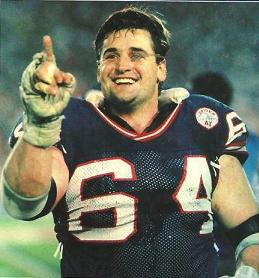
The dominant image of this game is of defensive tackle Jim Burt, Number 64, dancing around the field at the end, with the wind blowing trash all around him. That's Giants Stadium: It may have been a mess, but within the mess there was glory.
UPDATE: The new MetLife Stadium was chosen as the site for Super Bowl XLVIII, to be played in early 2014. There was no snow, no rain, hardly any wind, and while winter coats were necessary, it wasn't as cold as it was for the 1986-87 NFC Championship Game. The Seattle Seahawks crushed the Denver Broncos.