August 11, 1984, 40 years ago: President Ronald Reagan is preparing for his weekly Saturday morning radio address, with a remote hookup from his home-away-from-home, his Rancho del Cielo (Ranch in the Sky) in Goleta, California.
He was scheduled, as usual, to go on the air at 12:00 Noon, Eastern Time. Since he was in California, on Pacific Time, this meant the address would begin at 9:00 AM. Usually, since Reagan started the weekly tradition in 1982, it started a few minutes late, to give the national networks time to give a short introduction.
Sure enough, this address began at 9:06. It wasn't especially memorable. It began, "My fellow Americans: I'm pleased to tell you that today I signed legislation that will allow student religious groups to begin enjoying a right they've too long been denied: The freedom to meet in public high schools during nonschool hours, just as other student groups are allowed to do."
It was typical Reagan garbage: Pandering to the religious right with something that was blatantly unconstitutional. After all, the Republican was running for re-election, with the Democratic nominee being former Vice President Walter Mondale.
What was not typical was what happened a few minutes before the broadcast. A live feed was being transmitted to radio stations around the country. Many rebroadcasters were already recording the feed, to be ready for the official transmission. Many in the media heard Reagan's impromptu remarks as he gave them, but they were not broadcast live.
Reagan, known for his sense of humor, decided to have a little fun. He said, "All right. My fellow Americans, I'm pleased to tell you today that I've signed legislation that will outlaw Russia forever. We begin bombing in five minutes."
Laughter could be heard. It's not clear who in the room was laughing. Maybe it was everyone.
Ironic: The 1st former actor to become President, the most media-savvy President ever, failed to notice that this joke was being recorded.
He also failed to notice that it wasn't funny at all. War is not funny. Nuclear destruction is not funny. And this son of a bitch was joking about starting World War III.
It took 2 days for the recording to reach the outside world. Mondale took the high road, saying, "A President has to be very, very careful with his words." He did not suggest that Reagan was mentally unstable, or in the throes of dementia. But Reagan's 1994 admission of Alzheimer's disease seemed to confirm what many people were already suspecting 10 years earlier.
On August 14, the Soviet government announced that Reagan's remarks were "unprecedentedly hostile." Soviet forces were placed on high alert, and it took some very careful words from the U.S. Department of State to calm the Soviets down.
I was 14 years old. I couldn't vote for another 4 years. I was convinced that there might not be an election in 4 years. I was hoping that America would recognize that a 73-year-old man either evil enough, crazy enough, or impaired enough to make just such a joke was unacceptable, and that they would then vote for Mondale.
When I went to bed on November 6, 1984, every State except Minnesota had been called, all for Reagan. Minnesota was Mondale's home State, and it hadn't yet been called for him. Only the majority-black District of Columbia had. Or, as comedian Jay Leno put it, "When I went to bed, Mondale had only 3 more Electoral Votes than I did, and I wasn't even running!" Mondale eventually won the State by just 4,000 votes. I have had a great deal of respect for Minnesota ever since.
But Reagan had won, and I was very, very scared.
As it turned out, Reagan's 2nd term was terrible, full of scandal and a hollow prosperity, but did not include a World War III.
Rancho del Cielo is 124 miles northwest of Los Angeles, 90 miles northwest of Reagan's Presidential Library in Simi Valley, 30 miles northwest of Santa Barbara, and 6 miles north of the Pacific Ocean at Refugio Beach. The house was built in 1871, and Reagan bought the ranch in 1974, as his 2nd term as Governor of California was winding down. (While Governors of California are now limited to 2 terms, that was not the case then, but he didn't run for a 3rd term, anyway.)
Reagan had signed his disastrous 1981 tax cut there, and had also entertained many world leaders there, including Britain's Queen Elizabeth II and Prime Minister Margaret Thatcher, and Soviet President Mikhail Gorbachev.
Friends would say of Ronald and Nancy Reagan that the ranch was his house, while any home they had near Hollywood was her house. Due to Reagan's advancing Alzheimer's disease, Nancy sold the property in 1998, to the Young America's Foundation, a conservative group, which maintains it and holds conferences there. It is now open by appointment.
After Reagan, both George Bushes, Bill Clinton and Barack Obama continued the weekly radio address. After 9 months in office, Donald Trump stopped doing it. He thought he was too good to speak to us one Noon a week, every week. Joe Biden resumed the tradition.
*
August 11, 1984 was also the day of one of the most anticipated matchups of the 1984 Olympic Games, at the Los Angeles Memorial Coliseum. The result was one that no one could have anticipated.
Mary Decker, a 26-year-old native of the suburbs of L.A., had been one of the top middle-distance runners in the world, winning a Gold Medal in the 1979 Pan American Games. Unable to compete in the 1980 Olympics in Moscow because of the U.S. boycott, she just kept going.
At the 1983 World Championships of Track & Field, she won Gold in both the 1,500 meters and the 3,000 meters. Sports Illustrated named her its Sportswoman of the Year -- before the adoption of the title "Sportsperson," this meant that she was named ahead of all male athletes as well -- and, with the Olympics coming to America the next year, she was considered a favorite to win Gold.
And yet, there was an unexpected foreshadowing on that cover.
The Dreaded SI Cover Jinx?
Zola Budd was only 18. Early in 1984, she set the women's world record in the 5,000 meters. But it was not accepted as a world record by the IAAF, the world governing body for track & field, because she was from South Africa, which had been excluded from various sports competitions due to its apartheid government. And she would be excluded from the Olympics as well.
That wasn't Budd's fault, but, due to her grandfather being a British citizen, the International Olympic Committee's rules allowed her to apply for British citizenship and compete for Great Britain in Los Angeles. She did, and this angered many people.
It shouldn't have: She wasn't breaking any rules by doing this. Instead, she was a victim of the rules, who was now using the rules to allow herself to compete. Not to guarantee victory, but just to be allowed to compete. After all, she was, thus far, too young to have even voted in a South African election, so she had nothing to do with their evil racist government.
There was also an element of weirdness in that she competed barefoot. At the time, this was legal, but has since been banned. Imagine, in 1984, the year that Nike first began offering huge sneaker contracts, competing in the Olympic Games, and its preparatory events, without even wearing shoes! But she did, including setting an officially-recognized world record in the 2,000 meters. As the renowned British sportscaster David Coleman put it, "The message will now be flashed around the world: Zola Budd is no myth."
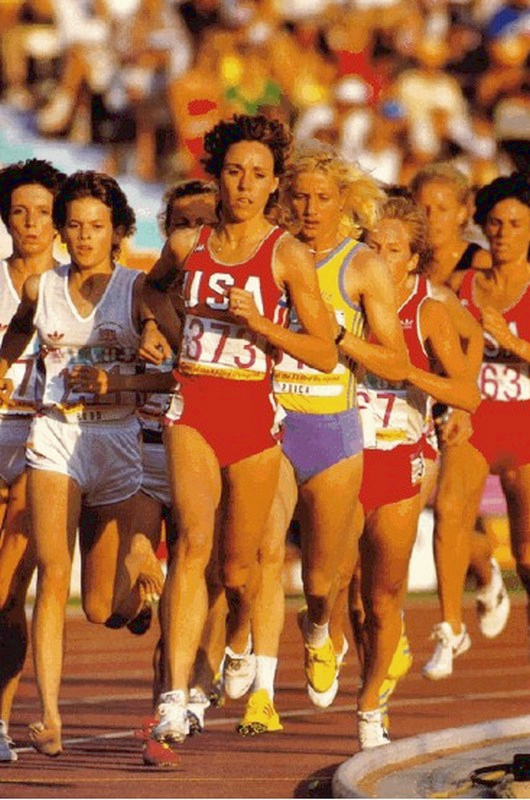
Decker and Budd were entered into one race together, the 3,000 meters. Decker had specialized in shorter distances, Budd in longer ones. Decker led early, but after the 1,500-meter mark, Budd took the lead. Running as a group was an unusual situation for both of them, as they were each used to running in front and well ahead of other competitors.
Decker at center, Budd to the left
At 1,700 meters, the first collision occurred. Decker came into contact with one of Budd's legs, knocking Budd slightly off balance. However, both women maintained their close position. Five strides on, at the race time of 4:58, Budd and Decker again made contact, with Budd's left foot brushing Decker's thigh, causing Budd to lose her balance, and sending her into Decker's path.
Decker's spiked running shoe came down hard into Budd's ankle, just above the heel, drawing blood. Videotapes later examined by Olympic officials showed Budd visibly in pain. However, she maintained equilibrium and kept stride.
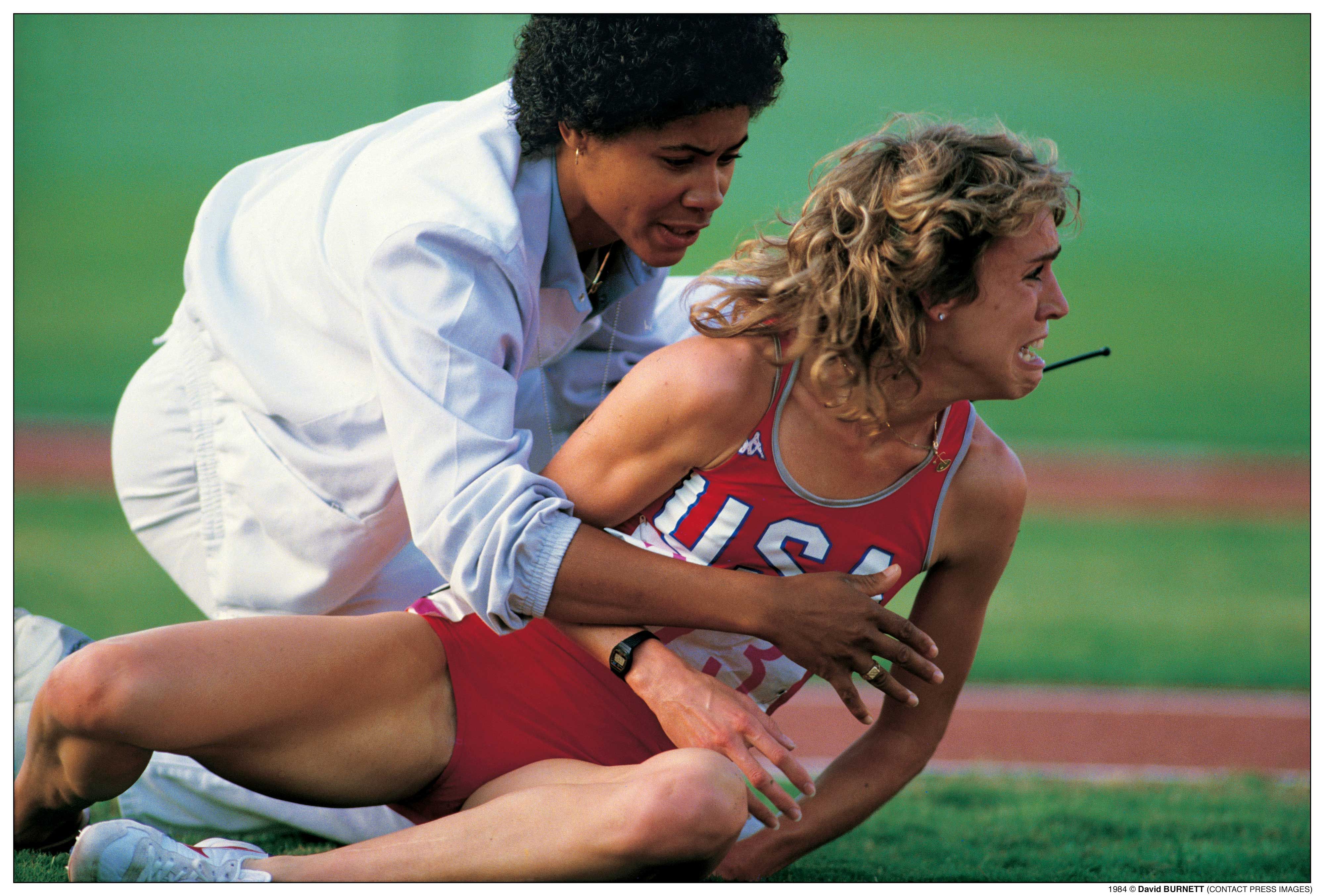
Decker did not: She fell to the curb, injuring her hip. The fall ended her race, and she was carried off the track in tears by her boyfriend and later, husband, British discus thrower Richard Slaney.
Budd, deeply affected by the occurrence, continued to lead for a while, but faded, finishing 7th. Her finishing time of 8:48 was well outside her best of 8:37. The race was won by of Maricica Puică of Romania, who also won a Bronze Medal in the 1,500 meters. Wendy Sly of Britain won the Silver Medal, and Lynn Williams of Canada won the Bronze Medal.
Budd tried to apologize to Decker in the tunnel after the race, but Decker was upset, and replied, "Don’t bother!" She was now unable to compete in any other races.
Having married Slaney, Decker gave birth to a daughter in 1986, and missed the 1987 World Championships due to injury. She ran in the 1,500 and 3,000 meters in the 1988 Olympics in Seoul, Korea, but was past her prime, and wasn't close. She retired without ever winning an Olympic Medal.
Budd returned to South Africa in 1989, and, with its eligibility restored after the release of Nelson Mandela the next year, was able to represent her home country at the 1992 Olympics in Barcelona. (Unlike soccer, for most of FIFA's history, anyway, there is no rule against competing for 2 different countries in the Olympics.) But she never won an Olympic Medal, either. She married and had 3 children.
In 2016, Decker and Budd reunited, and collaborated on a documentary about the event, The Fall. "Looking back on it now, I see it as an unlucky accident," Decker said. She also apologized to Budd for shunning her in the tunnel and after the race, and in a separate interview she said, "I was hurting, both physically and emotionally."
Budd is now coaching at her local university, and still runs long distance. She and Decker got along well when making the documentary and, as well as still sharing a passion for running, they discovered their respective husbands share a birthday.
Budd (left) and Decker, 2016
"Looking back at both our lives," she said, "neither of us had a fair chance of achieving what we really wanted to. Both of us were victims of something that was beyond our control."