Showing posts with label 1865. Show all posts

Saturday, November 6, 2021

Who Was President the Last Time Your Team Won a Title?

Every so often, I point out that the Yankees haven't won a World Series under a Republican President since 1958, when Dwight D. Eisenhower was in office. "The Ike Age."

Then again, having Joe Biden in office will matter for many things, but perhaps not this one: It's not who's running the country that matters to the Yankees' success, but who's running the team. As long as Brian Cashman is the Yankees' chief executive, they're not going to win another Pennant.

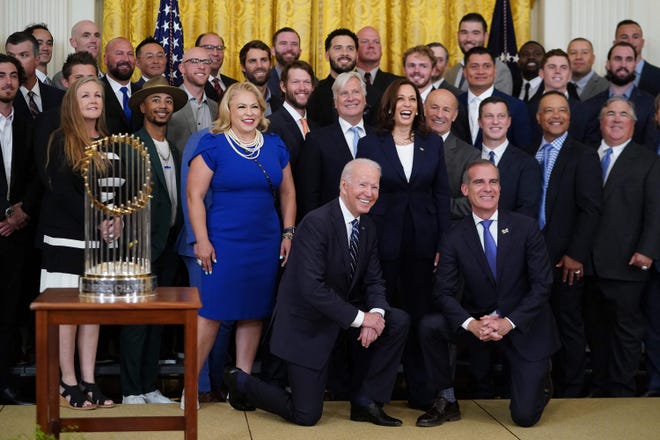
Major League Sports Teams that won their last World Championship when Joe Biden was President: The Atlanta Braves, the Milwaukee Bucks, the Tampa Bay Lightning, the Tampa Bay Buccaneers.

Donald Trump: The Los Angeles Dodgers, the Los Angeles Lakers, the Kansas City Chiefs, the Washington Nationals, the Toronto Raptors, the St. Louis Blues, the New England Patriots, the Boston Red Sox, the Golden State Warriors, the Washington Capitals, the Philadelphia Eagles, the Houston Astros, the Pittsburgh Penguins.

Barack Obama: The Chicago Cubs, the Cleveland Cavaliers, the Denver Broncos, the Kansas City Royals, the Chicago Blackhawks, the San Francisco Giants, the San Antonio Spurs, the Los Angeles Kings, the Seattle Seahawks, the Miami Heat, the Baltimore Ravens, the New York Giants, the St. Louis Cardinals, the Dallas Mavericks, the Boston Bruins, the Green Bay Packers, the New Orleans Saints, the New York Yankees, the Pittsburgh Steelers.

George W. Bush: The Philadelphia Phillies, the Boston Celtics, the Detroit Red Wings, the Anaheim Ducks, the Indianapolis Colts, the Carolina Hurricanes, the Chicago White Sox, the Detroit Pistons, the Miami Marlins, the New Jersey Devils, the Los Angeles Angels, the Arizona Diamondbacks, the Colorado Avalanche.

Bill Clinton: The St. Louis (now Los Angeles) Rams, the Dallas Stars, the Chicago Bulls, the Dallas Cowboys, the Houston Rockets, the San Francisco 49ers, the New York Rangers, the Toronto Blue Jays, the Montreal Canadiens.

George H.W. Bush: The Washington Redskins (now the Washington Football Team), the Minnesota Twins, the Cincinnati Reds, the Edmonton Oilers, the Oakland Athletics, the Calgary Flames.

Ronald Reagan: The New York Mets, the Chicago Bears, the Detroit Tigers, the Los Angeles (now Las Vegas) Raiders), the Baltimore Orioles, the Philadelphia 76ers, the New York Islanders.

Jimmy Carter: The Pittsburgh Pirates, the Seattle SuperSonics, the Washington Bullets, the Portland Trail Blazers.

Gerald Ford: The Philadelphia Flyers.

Richard Nixon: The Miami Dolphins, the New York Knicks.

Lyndon Johnson: The New York Jets, the Cleveland Browns.

Dwight D. Eisenhower: The St. Louis (now Atlanta) Hawks, the Detroit Lions.

Harry Truman: The Rochester Royals (now the Sacramento Kings), the Cleveland Indians (now the Cleveland Guardians), the Chicago (now Arizona) Cardinals.

If you don't see your favorite team in a particular sport here, it's because they've never won a World Championship. I didn't include MLS, its predecessor the NASL, or the WNBA.

*

November 6, 1816: James Monroe is elected President. Secretary of State to outgoing President James Madison, also formerly Secretary of War, Governor of Virginia, U.S. Ambassador to Britain and France, and Colonel in the Continental Army -- he's the young man seen holding the flag in the famous, if erroneous, painting Washington Crossing the Delaware -- the nominee of the Democratic-Republican Party wins 68 percent of the popular vote, and 183 Electoral Votes.

The Federalist Party disintegrated during the War of 1812, due to its having agitated the country into the war, and its feckless peace offerings during it. They had nominated Senator Rufus King of New York, who won just 31 percent of the vote, and 34 Electoral Votes. He turned out to be the last Federalist nominee for President. Soon, the Democratic-Republicans would split into the Democratic Party and the National Republican Party, later to become the Whig Party.


November 6, 1854: John Philip Sousa is born in Washington, D.C. Perhaps the most famous American of Portuguese descent, he conducted the U.S. Marine Band, playing for Presidents, then formed his own band. The Sousa Band toured from 1892 until 1931, and he died the next year.

"The March King" composed and conducted songs that are still remembered today, most notably "The Stars and Stripes Forever" (1897). In 1923, his band played "The Star-Spangled Banner" before the 1st game at Yankee Stadium. 

November 6, 1860: Abraham Lincoln is elected the 16th President of the United States. He is the 1st nominee of the Republican Party to win the Presidency, making the Republicans the 1st, and to this day the only, "third party" to elect a President.

Thanks to a split in the Democratic Party, and the Whig Party (to which Lincoln once belonged) totally dissolving, he wins with 39 percent of the vote, the lowest percentage of any winner in the election's history.

But the former Congressman from Illinois did win a majority of the Electoral Votes: 180. Vice President John C. Breckinridge of Kentucky won 72, Senator John Bell of Tennessee won 39, and Senator Stephen A. Douglas of Illinois -- who had beaten Lincoln for that office just 2 years earlier -- won 12. Douglas finished 2nd in the popular vote, with 29 percent. Breckinridge had 18, and Bell 12.

In spite of the fact that Lincoln said, at the time, that he didn't want to abolish slavery entirely, only stop it from spreading to new States and Territories, the Southern States began to secede the next month. Outgoing President James Buchanan, a moral coward who thought the Constitution didn't allow him to do anything to stop it, did nothing to stop it. The American Civil War began on April 12, 1861. It would take Lincoln 4 years to win it.

You've heard the saying, "Suppose they gave a war, and nobody came?" Well, in February 1861,
Douglas held a peace conference at Willard's Hotel in Washington, and nobody came. Despite their disagreements on several issues, including slavery, once the war began, Douglas took a train tour of the Midwest, rallying support for the Union cause. But he was stricken with typhoid fever, and died on June 3. He was only 48 years old, 4 years younger than Lincoln was.

Breckinridge was appointed to the U.S. Senate, but enlisted in the Confederate Army, and was expelled from the Senate. He was a terrible General, but President Jefferson Davis appointed him Secretary of War in February 1865. He urged Davis to surrender, but was refused. He escaped after the fall of Richmond, and lived abroad for 3 years, until Lincoln's successor Andrew Johnson extended amnesty to all former Confederates. Breckinridge died in 1875, at 54: He was 12 years younger than Lincoln, but died 2 years younger.

Bell was the only one who outlived Lincoln both in calendar years and in actual years. He supported the Union until the war began, then switched sides. He lived until 1869, age 73.

*

November 6, 1861, 160 years ago: James Naismith (no middle name) is born in Almonte (now part of Mississippi Mills), Ontario, outside the Canadian capital of Ottawa. He graduated from Montreal's McGill University, where he lettered in lacrosse, gymnastics, soccer, rugby, and the Canadian version of gridiron football. He was hired as McGill's athletic director in 1890, but just a year later, he was hired by the YMCA International Training School in Springfield, Massachusetts, what is now Springfield, College.

He was asked to invent a game that could be played indoors in the Winter, when baseball and football couldn't be played. He knew he should start with a ball, but a large, soft one, like a soccer ball, not a small, hard one like a baseball, which would be dangerous in the confined space of a gymnasium. He noted that most of the rough action took place around the goal: The goal in soccer, hockey or lacrosse, the end zone in football or rugby, or home plate in baseball. So he thought he could reduce the danger by raising the goal.

He asked the custodian to get him a box, because he had invented boxball. The custodian could only find a peach basket. So Dr. Naismith had invented basketball instead. The date was December 21, 1891.

Through the influence of the YMCA's worldwide organization, the word was spread. Naismith became the head coach at the University of Kansas, which became one of the great college basketball programs. He died in 1939, at the age of 78, at their Lawrence campus. Within the last 4 years of his life, he had seen the debut of sold-out doubleheaders involving national powers at Madison Square Garden, the debut of basketball as an official medal sport at the Olympic Games, and the foundation of the NIT and NCAA Tournament.

November 6, 1865: The last "grand match" of the baseball season takes place at the Capitoline Grounds in Brooklyn, before 15‚000. The Atlantics lead all the way to defeat fellow Brooklynites the Eckfords, 27-24‚ and claim the 1865 championship with a record of 17-0.

Henry Chadwick, America's 1st real sportswriter: "Is there another sport attractive enough to draw such attendance under such circumstances? In the summer it is not surprising as the weather is pleasant... but on a cold November day‚ in the busiest time of the year‚ it must be indeed an attractive sport to collect such an assemblage that is present on this occasion." 

Named for a famed hill in Rome, the Capitoline Grounds, a 5,000-seat wooden stadium opened in 1864, was meant to rival and surpass the Union Grounds. The Atlantics made it their home, and, like the Union Grounds, it became a skating rink in the winter.

But it was demolished in 1880. It was on a plot of land bounded by what's now Halsey Street, Marcy Street, Putnam Avenue and Nostrand Avenue, in Bedford-Stuyvesant. To visit, take the A or C train to Nostrand Avenue. While this neighborhood, notorious for crime not that long ago, should be safe during the day, definitely do not visit at night. 

November 6, 1869: What is generally recognized as the 1st college football game is played. Rutgers College plays the College of New Jersey, on Rutgers' campus in New Brunswick.

The game is essentially a very large soccer game, with a round leather ball, and 25 men on a side. The Rutgers men, finding the color inexpensive to obtain, wrap scarlet red cloth around their heads like turbans, so that they can tell each other apart on the field. Thus did they invent school colors and, in a way, the football helmet.

The men of Old Queens must have had less trouble telling team from team than did the men of Old Nassau, as Rutgers won, 6-4 -- that's 6 goals to 4, or 42-28 under today's scoring system.

The next week, the CNJ men returned the favor in Princeton, and won, 8-0. There was supposed to be a 3rd game, but the college presidents got together and decided that too much emphasis was being placed on athletics, and forbade it.

The field where "the first football game" was played is now the parking lot for Rutgers' College Avenue Gym. Rutgers played at College Field until 1891, then opened Neilson Field across the street, playing there until 1938, when Rutgers Stadium opened across the River in Piscataway. The Alexander Library, the school's main library, was built on the site of Neilson Field in 1953. Rutgers Stadium was replaced on the same site by what's now named SHI Stadium in 1994, while they played their 1993 home games, and many others from 1976 to 2009, at Giants Stadium.

George Large of Rutgers was the last surviving player from this game, living until August 15, 1939, age 88. The native of Readington, Hunterdon County played on the Rutgers side, and in 1888 served as President of the State Senate, making him the Acting Governor on a few occasions.

In 1874, Harvard University would accept a challenge from McGill University in Montreal, and discover on their arrival that by "football," McGill meant "rugby," not "soccer." Adjustments were made, Harvard liked the results, and convinced the other "football"-playing schools to join them in this adaptation of "football." In 1906, the forward pass was legalized and hashmarks prevented dangerous scrimmages close to the sideline. "Football" as America knows it now was on its way.

In 1896, the College of New Jersey changed its name to Princeton University, while a nearby school would later be founded as Trenton State College, and change its name to The College of New Jersey. Rutgers College would become, and remains, the centerpiece of the larger system of Rutgers, The State University of New Jersey.

Princeton's nickname, the Tigers, would inspire 2 professional team names: Baseball's Detroit Tigers and the Canadian Rugby Union's Hamilton Tigers, now the Canadian Football League's Hamilton Tiger-Cats.

Rutgers was known as "The Queensmen" until 1925, when they became the Chanticleers, after a fighting rooster. The school's literary magazine was already called The Chanticleer. But this carried the connotation of "chicken" -- and, as the University of South Carolina has found out with their similarly-named Gamecocks, they can be called "Cocks." In 1955, head coach Harvey Harman recommended the change to the Scarlet Knights, and such they have been ever since.

Rutgers and Princeton did not always play once a year, sometimes missing years, sometimes playing twice a year. But Rutgers did not beat Princeton again until 1938, the dedication game for the original Rutgers Stadium in Piscataway. breaking a 33-game losing streak over 69 years. Princeton still dominated until Rutgers won 4 straight from 1958 to 1961, the latter an undefeated season. Then, Princeton won another 6 straight.

Then Rutgers began to make what it called a commitment to big-time football. From 1968 onward, they went 9-3-1 against Princeton, which included winning the last 5 games by scores of 17-0, 10-6, 24-0, 38-14 and 44-13. This further included the 1st appearance by either school on national television, the 100th Anniversary Game at Rutgers Stadium on September 27, 1969, a 29-0 Rutgers win; and Rutgers' 1976 undefeated season.

Princeton decided that they couldn't remain in the Ivy League and also compete on the same level as Rutgers and the other schools that had formed the Big East Conference for all sports but football, and eventually would for football as well. (Most of those are now in the Atlantic Coast Conference, but Rutgers is in the Big Ten, and West Virginia is in the Big 12.) So Princeton called off the series, still holding an enormous 53-17-1 edge. The rivalry does continue in other sports.

Rutgers continues to bill itself as "The Birthplace of College Football," or simply "The Birthplace." You know the joke: Rutgers invented football in 1869, and they haven't done a damn thing since. It's not quite true, but it's bad enough. For example: On November 6, 2021, at home, Rutgers lost to Wisconsin 52-3.

November 6, 1888: Benjamin Harrison is elected the 23rd President of the United States. The former U.S. Senator from Indiana, and grandson of 9th President William Henry Harrison, wins 233 Electoral Votes, defeating incumbent President Grover Cleveland, who had 168.

But Cleveland won the popular vote, 48.6 percent to 47.8. Matthew Quay, Republican boss of Pennsylvania, practically came out and admitted that he had the State's 30 Electoral Votes stolen for Harrison. If true (and it probably is), then the vote should have been 203-198 in Harrison's favor. Meaning that, if 1 more State was "stolen," then Cleveland should have been re-elected.

Indeed, 4 years later, after a hard Presidency with recession and labor strife, Harrison lost his bid for re-election, and Cleveland became the only former President ever to regain the office.

*

November 6, 1900: President William McKinley is re-elected. As in 1896, he defeats Nebraska Congressman William Jennings Bryan, 51.6 percent of the popular vote to 45.5, and 292 Electoral votes to 156.

Garret Hobart, McKinley's 1st Vice President, had died in office in 1899, so he needed a new one. He chose Governor Theodore Roosevelt of New York, because his svengali, Ohio Republican boss Mark Hanna, though TR was making too much noise as Governor, thinking he'd be silenced as Vice President. He told McKinley he had to live, to keep "that damned cowboy" out of the White House.

On September 6, 1901, at the Pan-American Exposition, a World's Fair in Buffalo, McKinley was shot. He died 8 days later, and TR was President of the United States. In 1904, Hanna died, and TR won a term of his own.

November 6, 1927: Martin Nicholas Pavelich is born in Sault Sainte Marie, Ontario. A left wing, he played for the Detroit Red Wings, and was assigned as a "shadow," to shut down opposing teams' best attackers, particularly Maurice "The Rocket" Richard of the Montreal Canadiens.

He won 4 Stanley Cups with the Wings, and is the last surviving player from the 1950 Cup team, 1 of 4 surviving players from 1952, 1 of 4 from 1954, and 1 of 5 from 1955.

He appears not to be related to Mark Pavelich, a native of Eveleth, Minnesota who won the Olympic Gold Medal with the 1980 U.S. hockey team, and later played for the Rangers and Minnesota North Stars, and was an original 1991-92 San Jose Shark.

November 6, 1928: Secretary of Commerce Herbert Hoover is elected President, with a whopping 58 percent of the vote, and 444 Electoral Votes. The Democrats had nominated Governor Alfred E. Smith of New York, the 1st Catholic ever nominated by a major party. He won just 40.8 percent, a figure exceeded by all but 2 Democratic nominees since (George McGovern in 1972 and Walter Mondale in 1984), and took just 8 States, worth 87 Electoral Votes.

In his nationally-syndicated newspaper column, humorist Will Rogers wrote that Smith's supporters "are going to be shocked at how much of the country lives west of the Hudson River." He was right, as Smith was too New Yorky for the rest of the country, including most of New York State.

Indeed, New York was not 1 of the 8 States he won. He won the 2 most Catholic States in the nation, Massachusetts and Rhode Island; and 6 "Solid South" States that, at the time, would never go for a Republican, still thought of as "the Party of Lincoln": South Carolina, Georgia, Alabama, Mississippi, Arkansas and Louisiana. Smith didn't even get the entire South: Hoover won Virginia, North Carolina, Florida, Kentucky, Tennessee, Oklahoma and Texas.

Had Smith been a Protestant, from a small town rather than the biggest city, with a pleasant voice instead of a N'Yawk accent, in favor of keeping Prohibition rather than repealing it, and not connected to the corrupt Tammany Hall political machine that dominated New York State and especially New York City, he still would have lost, as Hoover rode the Republican prosperity of the Roaring Twenties.

Despite the Hoover landslide, Franklin D. Roosevelt, former Assistant Secretary of the Navy, 1920 Democratic nominee for Vice President, and cousin of the late former President Theodore Roosevelt, is narrowly elected to succeed Smith as Governor. Someone asked Smith if FDR, one of his biggest backers, was going to be a rival that would prevent him from getting the Democratic nomination again in 1932. Smith, noting that Roosevelt had been dealing with the effects of polio since 1921, said, "No, he will be dead within a year."

Within a year of the 1928 election, the stock market had crashed, and, barring a major scandal, the Democratic nominee was going to win in 1932. Smith tried for that nomination. He lost it. To FDR. FDR became President. Smith became one of his fiercest critics. And, in the end, in spite of FDR's health difficulties, Smith died 6 months before he did.

Also on this day, William Donald Wilson is born in Central City, Nebraska. A center fielder, Bill Wilson started with the Chicago White Sox, and was with the Philadelphia Athletics when they moved, hitting the 1st home run in Kansas City Athletics history on April 12, 1955. But that was to be his last season in the major leagues. He, Bobby Shantz and Bill Harrington are the last 3 living former Philadelphia Athletics.

November 6, 1929With the field at the Cycledrome -- a 10,000-seat bicycle racing track with a football field almost fully squeezed into it -- so waterlogged that the referees will not permit play, the Providence Steam Roller, defending NFL Champions, move their scheduled game with the Chicago Cardinals to their former home, Kinsley Park. This 6,000-seat stadium has floodlights, and so, this becomes the 1st night game in NFL history.

The Cardinals win, 16-0, but the gate receipts from the sellout crowd count the same. And, with the stock market having crashed a few days ago, the Steam Roller need all the help they can get. As it turns out, it's not enough: The team gets through the 1930 and '31 NFL seasons, drops out, holds on in another league through 1933, and folds, a victim of the Great Depression. Kinsley Park was torn down in 1933, and no trace of it remains.

*

November 6, 1946, 75 years ago: Edward John DeBartolo Jr. is born in Youngstown, Ohio. He and his father Edward Sr. developed the Edward J. DeBartolo Group, which, under Eddie's leadership, became the Simon Property Group. It built in 1972, and still maintains, the Brunswick Square Mall in my native East Brunswick, New Jersey.

Also in New Jersey, it runs the Menlo Park Mall in Edison, Newport Centre in Jersey City, The Mills at Jersey Gardens in Elizabeth, the Ocean County Mall in Toms River, the Quaker Bridge Mall in Lawrence, Jersey Shore Premium Outlets in Tinton Falls, and Jackson Premium Outlets near Great Adventure. On Long Island, it runs Roosevelt Field in Garden City, and the Walt Whitman Mall in Huntington. In the Hudson Valley, it runs The Westchester in White Plains, The Shops at Nanuet, and Woodbury Common Premium Outlets.

But the DeBartolos are better known for their sports teams. Edward Sr. owned the NHL's Pittsburgh Penguins, and let his daughter Denise DeBartolo York run them, winning their 1st 2 Stanley Cups. Eddie owned the San Francisco 49ers, seeing them win 5 Super Bowls. A 1998 controversy led him to sell the team to his sister, her husband John York, and their son Jed York. (NFL rules prevent a majority owner of a team in another sport from being majority owner of an NFL team, so she had to sell the Penguins to become the 49ers' operational owner.)

Despite the troubles he got into, "Mr. D" is still one of the few NFL owners who was truly beloved by his players, and was recently elected to the Pro Football Hall of Fame. He is the only living current or former NFL team owner in the Hall. He is also a member of the Bay Area Sports Hall of Fame.

Also on this day, Sally Margaret Field is born in the Los Angeles suburb of Pasadena, California. We like her. We really, really like her.

November 6, 1947: Meet the Press debuts on NBC. It is still on the air after 74 years, making it the longest-running program in television history, anywhere in the world.

Oddly for its era, the 1st moderator was a woman, Martha Rountree. She was succeeded in 1953 by Ned Brooks, who held the post until 1965, Lawrence Spivak until 1975, Bill Monroe (not the country singer) until 1984, Marvin Kalb until 1987, Chris Wallace until 1989, Garrick Utley until 1991, and then its longest-running host, Tim Russert, until his death in 2008. He was succeeded by David Gregory, and then Chuck Todd was named host in 2014.

Herbert Hoover appeared on the show as an old man in 1955. Franklin Roosevelt, Harry Truman and Dwight D. Eisenhower never did. But every President since John F. Kennedy has, although as the incumbent President, only Jimmy Carter, Bill Clinton, George W. Bush and Barack Obama have. So far, Donald Trump has not, and I suspect it will stay that way, although he made 5 appearances before taking office, including in 1999, before he began to worm his way into politics.

Athletes do not usually appear on the show, often mocked as Meet the Depressed and Press the Meat.
But Russert, a Buffalo native, loved to interview them. During Autumn, he would conclude the show's usual tagline with a reference to his hometown team: "If it's Sunday, it's Meet the Press. Go Bills."

Russert liked to challenge Democrats and Republicans alike, and, with a graphic or a clip ready to go, made, "Senator, let me show you... " the 5 scariest words in Washington. Today, Todd shows an obvious favoritism toward conservatives, which has earned him the nickname "Chuck Toad."

*

November 6, 1951, 70 years ago: Louise Williams (no middle name) is born in Scranton, Pennsylvania. The actress, known professionally as Liberty Williams, got her start as Debbie Morgenstern, Rhoda's sister, on a 1973 episode of The Mary Tyler Moore Show. She was a regular on the short-lived series Bustin' Loose, 13 Queens Boulevard and Baby Makes Five. She appeared in 2 different episodes of Three's Company, in 2 different roles, 3 years apart.

She is best known as the voice of Jayna, the Wonder Twin who could take the form of any animal, on the Super Friends cartoons. Although she has had no acting credits since 1990, she is still alive.

November 6, 1956: President Dwight D. Eisenhower is re-elected. Despite concerns over his health (he'd had a heart attack in September 1955, and had been hospitalized again in June, possibly for another heart attack that the White House didn't want to talk about), the fitness for office of Vice President Richard Nixon, and how "Ike" had handled the recent crises in Hungary and Egypt, he wins 57 percent of the popular vote, and 457 Electoral Votes.

Former Governor Adlai E. Stevenson of Illinois fares no better in the rematch than he did in 1952, winning just 42 percent, and 73 Electoral Votes. Stevenson won only 7 States: North Carolina, South Carolina, Georgia, Alabama, Mississippi, Arkansas and Missouri. In the other 41 States, he comes close only in Tennessee.

November 6, 1981, 40 years agoLarry Holmes defends the Heavyweight Championship of the World at the Civic Arena in Pittsburgh, against Renaldo Snipes. Snipes knocks Holmes down in the 7th round, but Holmes gets up at the count of 4, and knocks Snipes out in the 11th.

Snipes was 22-0 going into the fight, with his last 2 fights being wins over former WBA Light Heavyweight Champion Eddie Mustafa Muhammad and eventual WBA Heavyweight Champion Gerrie Coetzee.

But from here on out, he went just 17-8-1, fighting 3 future partial Heavyweight Champions, beating Trevor Berbick (WBC), but losing to Tim Witherspoon (WBC and WBA, though not at the same time, and who would, in 1983, come closer to beating Holmes) and Greg Page (WBA). He was supposed to fight Mike Tyson in 1990, but broke his hand, and it never happened. He was replaced as Tyson's opponent by James "Buster" Douglas, and the rest is history.

Snipes is now 65, and a charity fundraiser. He says, "I had a good career. I made good friends. I keep in contact with my friends, and I'm healthy." That's more than a lot of ex-boxers can say.

November 6, 1983: This is the date on which the sci-fi/fantasy series Stranger Things begins, with an attack from the dimension known as "The Upside Down" on the lab in Hawkins, Indiana that opened a portal to it.

November 6, 1991, 30 years agoArsenal host Benfica at Highbury in North London, in the 2nd leg of the 2nd round of what turns out to be the last European Cup tournament under that name. The following season, 1992-93, it was rebranded as the UEFA Champions League. Since the Heysel Ban kept defending Football League Champions Arsenal from playing in the 1989-90 edition, this was only their 2nd time in it, following a run to the Quarterfinal in 1971-72.

Two weeks earlier, Arsenal had gone to Lisbon, Portugal, and held Benfica, that country's most storied sports team, to a 1-1 draw (with Kevin Campbell scoring) in front of 120,000 people in their Estádio da Luz. In order to have a playing facility that met modern safety standards (no standing terraces, with dangerous overcrowding), that stadium was demolished and rebuilt on the same site in 2003, and its current capacity is 64,642. The English translation of the name, "Stadium of Light," was applied to North-East club Sunderland's new stadium built in 1997. The new Benfica stadium's design would eventually inspire the design of Arsenal's new Emirates Stadium, which opened in 2006.

With the tie level, and with an away goal, and this being a Benfica squad far beneath their European Cup winners of 1961 and 1962, Arsenal fans were confident of victory and advancement. But after a 1-1 halftime score (2-2 on aggregate, 1-1 on away goals), Arsenal's defense leaked twice, and Benfica won 3-1, to advance 4-2.

This was one of the most humiliating defeats in Arsenal's history, in literally the biggest game that George Graham ever managed. (Any European Cup/Champions League match is bigger than a European Cup Winners' Cup Final.) Ironically, the only Arsenal goal on this night was scored by Colin Pates, taking the Number 4 place in midfield vacated by Graham's foolish sale of Michael Thomas (to Liverpool, of all teams to send the 1989 title-clinching goalscorer to) the preceding off-season.

Fans who came of age in the Graham years (1986-95) loved to compare his record in European play with that of Arsène Wenger (1996-2018), who consistently kept the team in the Champions League, reaching the Final in 2006 and the Semifinal in 2009, but never won a European trophy, while Graham won the Cup Winners' Cup in 1994 -- a tournament so insignificant that UEFA folded it into the UEFA Cup (now the Europa League) in 1999.

But this game had everything they loved to hate about Wenger: An Arsenal side weakened due to selling off one of the team's best players, a poor defense, "shit tactics," and a spectacular failure in European competition, which could be called a loss to "farmers."

Just 9 weeks later came the 3rd Round of the FA Cup, a trip to North Wales that became known as "The Wrexham Disaster." That game, a loss to a team then in Division Four, has often been cited as Graham's most disgraceful defeat. Yes, it was bad. But it wasn't as bad as blowing a 2nd-leg home tie in a European Cup knockout round.

Graham was lucky that this happened before the Internet Age, before the dawn of social media, and before the starting of Arsenal Fan TV.

November 6, 1999: Conseco Fieldhouse opens in Indianapolis, replacing the Market Square Arena. The Indiana Pacers beat the Boston Celtics, 115-108, and go on to win the NBA Eastern Conference title for the 1st time. But they will lose the NBA Finals to the Los Angeles Lakers.

The building was renamed Bankers Life Fieldhouse in 2011, and Gainbridge Fieldhouse this year.

*

November 6, 2001, 20 years ago: Major League Baseball votes to contract its number of teams, something that hasn't happened in 102 years. The vote to contract from 30 teams to 28 is 28-2. It is not revealed who the 2 teams to vote against it were, but the rumor is that it's the 2 teams most often mentioned as the ones to be dropped: The Minnesota Twins and the Montreal Expos.

The 30-team setup remains in place, pending a new collective bargaining agreement, as the old one runs out in the 2002 season. But the CBA that is approved keeps all 30 teams. MLB ends up getting rid of the Expos anyway: After the 2004 season, they are moved, to become the Washington Nationals.

But the Twins make the most of their reprieve: They win the American League Central Division the next 3 seasons, and in 6 of the next 9, concluding in 2010, their 1st season in Target Field, after moving out of the oft-mocked Metrodome.

Today, both franchises are as strong as ever, at least business-wise, and MLB has again begun to consider expansion, from 30 teams to 32.

November 6, 2002: The West Wing airs the episode "Election Night." President Jed Bartlet (Martin Sheen) is re-elected, but shows signs that his multiple sclerosis will be an issue in his 2nd term. Also, Deputy White House Communications Director Sam Seaborn (Rob Lowe) discovers that he will have to keep a promise he made to the widow of the Democrat running for Congress in his home district in Southern California.

This episode debuts Joshua Malina as Will Bailey, and Danica McKellar as his half-sister and campaign assistant Elsie Snuffin.

This episode should not be confused with the episode "Election Day," which resolves the storyline from this next entry:

November 6, 2005: The West Wing airs the episode "The Debate." It is a live episode, and the only episode of the show that is broadcast on videotape instead of film. Running to replace Bartlet are Republican Senator Arnold Vinick of California (M*A*S*H's Alan Alda) and Democratic Congressman Matthew Santos of Texas (L.A. Law's Jimmy Smits).

This occurs only 3 years after the episode showing Bartlet's re-election, because in the 2003-04 TV season, the show jumped from the middle of Year 5 of his Administration to the middle of Year 6, due to the fact that the actors' contracts all ran out after the show's 7th season.

Tuesday, July 4, 2017

America's Top 10 Greatest Moments

These are in chronological order.

1. July 4, 1776: The Declaration of Independence. Thomas Jefferson explained that the British government -- not its people in Britain -- had betrayed its people in America, and had betrayed its stated ideals of freedom. He explained how. He explained how the people of British America had petitioned them to stop, and were answered with tyranny.

And so, in a profoundly liberal act -- conservatives of the time demanded continued loyalty to Britain -- the 56 men of the Continental Congress at Philadelphia -- including Jefferson himself, Benjamin Franklin, John Hancock and John Adams -- told the Parliament at Westminster, and King George III, essentially, "Enough. You have abused your authority over us, and so, we no longer recognize it. This land is our country now, not yours. Get your troops out of our country, or we will get them out for you."

Which turned out to be easier said than done. The War of the American Revolution was very nasty.

2. October 19, 1781: The Battle of Yorktown. We needed help. We got military assistance from Britain's ancient enemy, France. We got financial assistance from France, Spain and the Netherlands. But in southeastern Virginia on this day, General George Washington accepted the surrender of General Charles Cornwallis. It was not the end of the war, but it was the engagement that proved to Britain that we weren't giving up, so it was time to start peace talks.
George III and Cornwallis are both regarded as bad guys of American history, and they kind of get bad raps from our side. Since the "Glorious Revolution" of 1688-90, British monarchs have had very little actual power. If George III had wanted to keep the war going, Parliament could have told him they wouldn't do it. And he is regarded as one of Britain's better monarchs, in spite of the mental illness that would eventually incapacitate him. He was also the only British King between the execution of Charles I in 1649 and the accession of George VI in 1936 that appears not to have had a mistress.

As for Cornwallis, he was far less responsible for the British Army losing that battle than his superiors, whom he practically begged for reinforcements and supplies. He was later elevated to the rank of Marquess, and was appointed Governor-General of India, Lord Lieutenant of Ireland, and Governor-General of India again, and was highly-regarded in those posts.

3. April 9, 1865: The Surrender at Appomattox. After General Ulysses S. Grant and his Army of the Potomac finally flushed General Robert E. Lee and his Army of Northern Virginia out of their protection of the Confederate capital of Richmond, Lee took his men further and further west, until, finally, he knew that his men, tired and hungry, could take no more. To borrow a phrase from Star Trek, resistance was futile.
Because Lee was willing to accept that the game was up, slavery could be abolished in America, and the process of establishing the equality of the races could begin. And let's be clear about this: The Union, the North, were the good guys; the Confederacy, the South, were the bad guys. The right side won, and the right side lost.

It's also worth pointing out that, at the time, the Republican Party was the liberal party of America, while the Democratic Party was the conservative party. This was a long time ago.

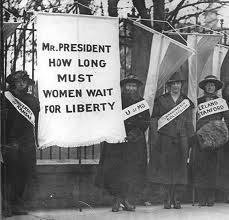
4. August 18, 1920: The 19th Amendment. Amending the Constitution of the United States requires a 2/3rds vote of each house of Congress, the House of Representatives and the Senate; and the approval of 3/4s of the State legislatures. Since there were 48 States in 1920, that meant 36 States. On the date in question, 35 States had ratified this Amendment, which guaranteed women the right to vote. Tennessee became the 36th.
As it turned out, 144 years (1776 to 1920).

5. August 14, 1935: The Social Security Act. Most of the "New Deal" measures of President Franklin D. Roosevelt could have been considered temporary measures, designed to deal with the emergency of the Great Depression, but some of them were so successful that they are still in place today, over 80 years later.

Social Security was different. Giving a national pension to people age 65 and up, after they'd worked all their adult lives (and possibly longer), was considered a gesture of mercy, especially since, while the average life expectancy was then 67, many people lived longer. (Ironically, the pressures of World War II and his own heavy smoking meant that FDR only lived to be 63.) And it's not just for old people: It also benefits children and the handicapped.
Today, the average life expectancy is 79, and living to be 100 is no longer a rarity. And many of the Baby Boomers, the largest generation ever produced, are now past age 65, some past 70, and millions more will soon surpass those ages. But Social Security is not "going broke."

The Social Security Act was amended in 1965, to create Medicare (health care for all, age 65 and up) and Medicaid (health care for the poor).

6. August 14, 1945: V-J Day. You can argue for any number of moments in America's role in World War II: The 1940 Republican Convention nominating Wendell Willkie, thus guaranteeing that, no matter who won the election, Willkie or FDR, America would have a President willing to stop Nazi Germany; FDR's measures to assist Britain without joining The War, such as Lend-Lease and the Atlantic Charter; and America's battles in The War, including "Thirty Seconds Over Tokyo," Midway, Guadalcanal, the invasion of North Africa, the liberation of Italy, D-Day, the liberation of the Philippines, Iwo Jima, V-E Day and Okinawa.

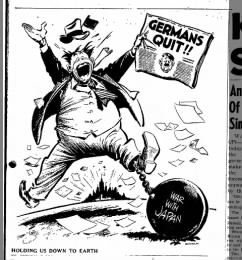
But the point was to win, and even defeating the Nazis, made official on V-E Day (Victory in Europe), May 8, 1945, was not the end. I still remember seeing a variation on this cartoon in 1979, when my local newspaper, then named The Home News, included it as part of their front page collection in their 100th Anniversary edition.
The War was won by the Allies, however, as America, Britain, the Soviet Union, and the various exiled governments finished the job on August 14, V-J Day (Victory over Japan). Granted, it didn't mean freedom for the whole world -- far from it -- but it did mean the end of 2 enemies that had threatened the freedom of that part of the world that was already free. And that was worth the greatest celebration in human history.
7. July 2, 1964: The Civil Rights Act. It took him 2 1/2 years, but President John F. Kennedy recognized the need, and demanded it from Congress. A coalition of conservatives, Republicans and Southern Democrats, fought it tooth and nail -- for "Constitutional reasons," they said. Yeah, surrrre.

But a coalition of liberal Democrats, led by House Speaker John McCormack and Senate Majority Whip Hubert Humphrey, and enough Republicans, including Senate Minority Leader Everett Dirksen, passed the bill, and put it on the desk of President Lyndon B. Johnson, who signed it in the presents of JFK's brother, Attorney General Robert F. Kennedy, and Dr. Martin Luther King.
The Civil Rights Act of 1964 followed the much-weaker Civil Rights Acts of 1957 and 1960, and made possible the Voting Rights Act of 1965 and the Fair Housing Act of 1968. It's strange how Republicans forgive all the harm done by their Presidents, and embrace their achievements; while Democrats overlook these Civil Rights Acts, and the aforementioned Medicare and Medicaid, and other achievements of LBJ, and still hold the Vietnam War against him, when he didn't start it, and did more to end it (if in vain) in 1968 alone than Richard Nixon did over the next 4 years.

8. July 20, 1969: Apollo 11. JFK insisted on it. LBJ, who as Senate Majority Leader wrote the bill that created NASA and continued to support it as President, funded it. Unfortunately, it was Richard Nixon who made the big phone call to Houston that was patched through to the lunar lander Eagle, for Neil Armstrong and Edwin "Buzz" Aldrin to hear.

But when Armstrong stopped onto the surface of the Moon at 10:56 PM Eastern Time on that magical night, and said, "That's one small step for a man, one giant leap for mankind," it felt like the ultimate achievement. Like we could do anything.
And then, as Jerry Seinfeld pointed out in 1994, on the 25th Anniversary, everything we've done since, or failed to do since, "is measured against that one momentous act." You know the saying: "If we can put a man on the Moon, why can't we (do some far simpler act)?"

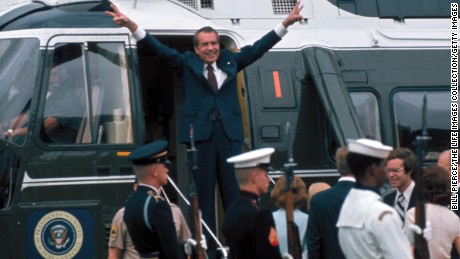
9. August 8, 1974: Nixon Announces His Resignation. No person is beneath the protection of the law, and no person is above the responsibility of the law. Not even the President of the United States. As late as April 1977, 3 months after his 2nd term would have ended, Nixon still believed, as he told interviewer David Frost, "When the President does it, that means it is not illegal."

But on August 7, 1974, following the release of tapes from the Oval Office, unanimously ordered by the U.S. Supreme Court, that proved, beyond a reasonable doubt, that Nixon was guilty of the impeachable offense of obstruction of justice, he was visited at the White House by the House Minority Leader, John Rhodes; the Senate Minority Leader, Hugh Scott; and the leader of the conservative movement, Senator Barry Goldwater. They told him that the game was over: They didn't have the votes to prevent the majority in the House needed to impeach him, and they didn't have the votes to prevent the 2/3rds majority in the Senate needed to remove him from office, and the only way to prevent those actions was to become the 1st President to resign the office.
The next night, in a nationally televised speech from the Oval Office, he announced that he would resign the next day. He did. When Vice President Gerald Ford was sworn in as the new President, he told the nation, "My fellow Americans, our long national nightmare is over. Our Constitution works. Our great republic is a government of laws, and not of men. Here, the people rule."

And, as Donald Trump ignores at his own peril, Nixon's recognition of that fact proved it. As did...

10. November 4, 2008: A Black Man Is Elected President. The candidacy of Barack Obama, then a 47-year-old U.S. Senator from Illinois, brought out the best in millions of Americans, and the worst in millions of others.

The fact that he defeated a Democratic primary field that included Senator Hillary Clinton (whom he asked to be his Secretary of State), Senator Joe Biden (whom he asked to be his Vice President), and other Party heavyweights such as Senators Chris Dodd and Evan Bayh, and Bill Richardson, who had been a Governor, a Senator, and a Cabinet official, showed that he was able to handle the Republican nominee, Senator and war hero John McCain, on any issue, from the crumbling economy to the seemingly never-ending War On Terror and Iraq War.

As President-elect Obama took the stage that night -- as a fan of the film V for Vendetta, I noticed that, while it was 11:00 PM in Chicago, the Hawaiian's adopted hometown, where his rally was held, it was midnight in New York and New Jersey, turning to the 5th of November, the moment when V's posthumous victory was achieved -- I was just happy that 8 years of Republican malfeasance and incompetence were coming to an end, and that the Democrats could begin to, to coin a phrase, make America as great as it always should have been.

But as the TV cameras scanned the crowd, there was Oprah Winfrey, who had worked hard to make this moment happen, even when Hillary was the overwhelming favorite in the Democratic primaries. She was still going to be alive and rich and comfortable regardless of whether Obama or McCain (or, in what would have been a massive fluke, another candidate) won. And yet, she had tears in her eyes, overwhelmed by the moment.

And, a few feet away from her, there was the Reverend Jesse Jackson, like Oprah a native of the South who had made his national fame in that great City of Chicago, and who had run for President himself in 1984 (coming in 3rd in Democratic delegates) and 1988 (coming in 2nd). It would have been easy for him to stand there, and remember his old line, "If not me, who? If not now, when?" It would have been easy, now that he had the answers to those questions, a generation later, to think, "Damn, that should have been me up there, 20 years ago." Instead, he stood there, moved to tears, knowing that, to borrow Halle Berry's phrase from her Oscar acceptance speech, that moment was so much bigger than him.

It was only then that I got it: This was the greatest moment in American history. This is what the preceding 400 years of colonial, revolutionary, and national history had led to. Yes, it took a nasty recession and a stupid war, and millions of Americans would never accept this half-black Ivy League lawyer from Chicago with the Arabic name as their President.

But it had happened: The American people, as a whole, had chosen a man who, though he had so many factors and so many people against him, deserved the Presidency, on merit. They chose not to ignore their history, but to change it, to fulfill it.
Someday -- it wasn't to be for Hillary Clinton in 2016, but it will happen someday -- America will elect a female President. Someday, a Hispanic one. Someday, an Asian one. Someday, a Jewish one. Someday, a Muslim one. Someday, a gay one. Hell, someday, we might even elect a Polish Yankee Fan from New Jersey. (It won't be me. I would be only a little more appropriate for the office than the current halftime occupant of it.)

But none of those will have the same meaning as the election of Barack Hussein Obama as our President. Wherever they were on that night, Crispus Attucks, Sally Hemings, Benjamin Banneker, Nat Turner, Frederick Douglass, Harriet Tubman, George Washington Carver, A. Philip Randolph, Jesse Owens, Joe Louis, Jackie Robinson, Rosa Parks and Martin Luther King were saying, "You were right, Barack: And now, YES WE DID."

And their white allies, and perhaps a few of those who had opposed them, could now accept that it was right.

Wednesday, October 28, 2015

Mets, Not Surprising Me, Choke in Game 1

In the 1st World Series game they ever attended, let alone played in...

* Matt Harvey, nicknamed "The Dark Knight" by Met fans, disproved the fanboy assertion that "Batman always wins." As George Steinbrenner would say, he spit the bit. In the 6th inning, he blew a 3-1 lead, and left after a mere 80 pitches. This is an "ace"? Ace, my ass.

* Yoenis Cespedes, on the 1st pitch Harvey threw, misjudged a fly ball hit by the Kansas City Royals' Alcides Escobar, and it resulted in an inside-the-park home run, the 1st in Series play since Mule Haas of the 1929 Philadelphia Athletics. 1929. That's 86 years. The stock market hadn't crashed yet. Sound film was brand-new. Uniform numbers were new. Herbert Hoover was still popular.

* Jeurys Familia blew a 4-3 lead in the bottom of the 9th, allowing a game-tying homer to Alex Gordon. This is much more embarrassing than Jeff Weaver vs. Alex Gonzalez in 2003: Weaver was not the closer, Familia is; while Gonzalez was a decent hitter with some power, while Gordon is the Royals' Number 8 hitter.

* And David Wright, the Mets' Captain, the man the Flushing Heathen called "the face of New York baseball" after the retirement of Derek Jeter, made an error in the 14th inning, which led to the Royals winning, 5-4.

In other words, the Royals did what no one -- save for the Yankees in April and September, and Chase Utley of the Dodgers in Game 2 of the National League Championship Series -- did all season long: They stood up to the Mets. And what happens when you stand up to the Mets? They fold like a cheap deck chair.

You know what the 2015 Mets are? They're Mike Tyson. The Yankees may not have been Muhammad Ali this season, but they were Buster Douglas, showing everyone the way. The Cubs were Michael Spinks. The Royals? Maybe they're Evander Holyfield, exposing the opponent as a strong puncher, but not a good fighter, vastly overrated, and beatable if you don't fear him.

It's too soon to tell you all that I told you so. But, so far, so good.

The Mets are now 0-5, all-time, in World Series Game 1. They are 2-2 in Game 2, 4-0 in Game 3, 2-2 in Game 4, 2-2 in Game 5, 1-1 in Game 6 and 1-1 in Game 7. If the pattern continues to hold, then punching ahead in tonight's Game 2 is crucial.

*

October 28, 1865, 150 years ago: Arthur Wharton is born in Jamestown, Gold Coast – now the African nation of Ghana. He moved to England to train as a missionary, but abandoned it for sports. He starred in sprinting, cycling and cricket, but is best remembered for soccer.

A goalkeeper, he was the 1st black professional player in the sport, though England did have black amateurs before him. He played from 1885 to 1902, including for the mighty Preston North End team of the late 1880s, just before the Football League was formed. In 1894, his appearances for Sheffield United made him the 1st black player in the League’s top division.

He died in 1930, and is now honored with a statue at St. George’s Park, the Staffordshire training ground for the England national team, though he never played for it.

October 28, 1879: Jimmy Hallinan, a former National Association and National League shortstop born in Ireland and grown up in Chicago, dies at age 30. The official cause of death was "inflammation of the bowels." Sounds painful, but it also sounds like something that could have been treated with modern antibiotics. It's been suggested that his actual death was due to alcoholism.

In 1877, split between the Cincinnati Red Stockings (not to be confused with the current Reds franchise) and the Chicago White Stockings (forerunners of the Cubs, not the White Sox), he batted .321. His career OPS+ was 122, meaning he was 22 percent better than the average player of his time at producing runs. But, even by the standards of the time (no gloves, and a much heavier ball than in the 20th Century), he was an atrocious fielder, equally inept at shortstop, 2nd base and the outfield.

Whatever his illness was, it forced him to quit baseball in 1878, and it killed him in 1879.

October 28, 1882: The Philadelphia Athletics reveal that, in the 1st season of the American Association, they reaped a $22‚000 profit‚ more than any National League team earned. This helps convince the NL that the AA is a viable league.

However, within 10 years, both the league and this version of the Philadelphia Athletics will be gone anyway. But within 12 years of that, the AA name and the A’s name will be revived (but not in the same league).

October 28, 1886: The Statue of Liberty is dedicated in New York Harbor, on Bedloe's Island, soon to be renamed Liberty Island. As the men who officially dedicated it dock at The Battery at the southern tip of Manhattan afterward, and walk back up to City Hall, men working in the buildings overlooking Broadway throw tape from stock tickers out the window, thus spontaneously inventing the ticker-tape parade.

Ticker-tape parades would be given many times over the next 129 years, mainly for heroes, such as Atlantic Ocean flier Charles Lindbergh (1927), other pioneer pilots, returning war heroes, and the Apollo 8 and 11 astronauts (both in 1969). They would also be given for visiting dignitaries, such as Presidents (including South Africa's Nelson Mandela), Prime Ministers, monarchs (including Queen Elizabeth II and her father, King George VI) and Popes. By the late 1960s, ticker-tape became obsolete, and shredded paper and confetti has been used instead.

Oddly, New York did not give its championship teams ticker-tape parades for decades. But Brooklyn did it for the Dodgers for each of their Pennants. Finally, Mayor Robert Wagner Jr., who had been a fan of the baseball Giants, decided to give the brand-new Mets a parade on April 12, 1962, the day before their 1st home opener. Somebody must've pointed out that the Yankees had won the World Series the year before, while the Mets had literally done nothing (although they would play 1 game, in St. Louis, and lose it, before coming home) to deserve a parade. So the Yankees got a parade on April 9, before their home opener. The Mets got a lot more people at theirs, so maybe Wagner had a point. But then, the Mets were getting 2 teams' worth of fans, even though they'd done nothing to earn them.

The Mets would get parades for winning the World Series on October 20, 1969 and October 28, 1986; the Yankees on October 19, 1977, October 19, 1978, October 29, 1996, October 29, 1998, October 29, 1999, October 30, 2000, and November 6, 2009; the Rangers for winning the Stanley Cup on June 17, 1994; and the Giants for winning the Super Bowl on February 5, 2008 and February 7, 2012.

When the Giants got into Super Bowl XXI in 1987, Mayor Ed Koch refused to give them a parade if they won, calling them "this foreign team" for having moved to New Jersey in 1976, also citing the fact that they had an "ny" monogram: "They took it off!" He was right, and the Giants simply had their Super Bowl XXI and XXV celebrations inside Giants Stadium. They took the "GIANTS" logo off their helmets and put the old "ny" back on in 2000, and Mayor Michael Bloomberg gave them their parades after Super Bowls XLII and XLVI.

Likewise, when the New Jersey Devils won their 3 Stanley Cups, they had a "parade" around the Brendan Byrne Arena. When they win their next one, they'll be able to have a parade down Broad Street in Newark. What the New York Islanders did when they won their 4 Stanley Cups from 1980 to 1983, I don't know.

In 2000, Mayor Rudy Giuliani offered to have a parade for both the Yankees and the Mets before their Subway Series, but both clubs turned it down: It was a victory parade or nothing. The Yankees, fittingly, got the parade; the Mets, fittingly, got nothing.

Mayor John Lindsay gave the Mets a parade in 1969, and some people think his glomming onto the "Miracle" team saved his bid for re-election a few days later. But he only gave the Jets a City Hall celebration on January 22, 1969, for their Super Bowl win 10 days earlier. Giants owner Wellington Mara told Lindsay that if he gave the Jets a parade, the Giants would move to New Jersey.

Lindsay backed down -- and, in 1972, Mara signed a deal to move the Giants to New Jersey anyway, leading to Koch's refusal to give them a parade in 1987, and Mayor David Dinkins' backing that up with his own refusal when presented with the chance in 1991. The Knicks didn't get a parade when they won the NBA title in 1970 or 1973, either.

Female athletes had been honored, including Althea Gibson for becoming the 1st black person of either to win Wimbledon and the U.S. Open, and as part of celebrations for Olympic athletes in general. But until July 5, 2015, when the U.S. national team that had just won the Women's World Cup, no individual team from women's sports had been honored, not even the celebrated team that won the same tournament in 1999. This is also the most recent New York ticker-tape parade for anyone.

*

October 28, 1890, 125 years ago: The American Association's Louisville Colonels beat the National League's Brooklyn Bridegrooms, 6-2 at Washington Park in Brooklyn. This ties their postseason series at 3 games apiece, with Game 3 having ended in a tie.

The weather had gotten progressively colder and wetter as the series went on, and the teams agreed that this would be the last game, and, if Louisville won to tie it, a "championship game" would be played the following spring.

Unfortunately for that plan, the championship game was never held. Disputes arose between the National League and the American Association during the winter about the redistribution of players following the dissolution of the Players' League. The Association ended its relationship with the League before the spring of 1891, so the anticipated championship game was canceled, and no postseason series was held in 1891.

This makes the 1890 Colonels the most successful team in the history of Kentucky sports -- keeping in mind that all those National Championships won by the University of Kentucky and University of Louisville basketball teams don't matter as much as any professional championship. Since the Colonels, who were brought into the NL in 1892, were contracted after the 1899 season, the only Kentucky-based team that has been remotely "major league" was the American Basketball Association's Kentucky Colonels, who played at Freedom Hall in Louisville and won the 1975 ABA title, coached by Hubie Brown, with players like Dan Issel, Louis Dampier and Playoff MVP Artis Gilmore. They were not, however, invited to join the NBA after the following season.

And as for the Bridegrooms, named for an offseason in which 4 of their players got married, who later became the Dodgers? They would win "World Championships" that they would not have to share in 1899 and 1900, before going 0-6 in World Series play until finally winning in 1955.

The last survivor of the 1890 Bridegrooms was New Jersey native Harry Howell, a pitcher who was also the last survivor of the original 1903 New York Highlanders (Yankees). He lived on into 1956.

*

October 28, 1904: After a 4th-place finish‚ the Cleveland Blues fire Bill Armour, and name Nap Lajoie manager. Armour takes over the Tigers‚ where Ed Barrow and Bobby Lowe split the season‚ as Detroit falls to 7th.

But with their star 2nd baseman, one of the game’s best hitters, as manager, the Cleveland team – now nicknamed the Naps for him – becomes a contender. After he leaves in 1914, they will jump on a bandwagon, seeing the team called the Braves as World Champions, and rename themselves the Cleveland Indians.

October 28, 1913: In the only time the 2 greatest pitchers of their time face each other‚ Walter Johnson and Christy Mathewson square off at South Main Park in Tulsa‚ Oklahoma. Johnson‚ the Washington Senators pitcher backed, in this case, by the Chicago White Sox‚ wins the battle‚ 6-0 over the New York Giants‚ pitching the distance‚ while Matty exits after 4 innings.

Johnson strikes out 8. Tris Speaker of the Boston Red Sox and White Sox regular Buck Weaver do the hitting for the Sox‚ while Oklahoma native, Sac and Fox Indian and fan favorite Jim Thorpe has 2 hits for the Giants off Johnson.

The game is delayed for nearly 2 hours when the stands collapse‚ injuring 52 people and killing a soldier. Governor R.L. Williams of Oklahoma narrowly escapes injury in the tragedy.

October 28, 1914: Jonas Edward Salk is born in Manhattan. In 1952, 58,000 cases of polio were reported in America; 21,000 people were left with some paralysis, and 3,145 people died -- more than at Pearl Harbor, and more than would die on 9/11.

In 1955, Salk announced that his polio vaccine worked. Two years later, Albert Sabin's oral vaccine hit the market, making prevention even easier. In 1994, a year before Salk's death and a year after Sabin's, the World Health Organization declared that North and South America were polio-free.

Salk could have made billions of dollars by patenting his vaccine. He decided that it belonged to the world, not to him.

October 28, 1922: Willem Hendrik van Breda Kolff is born in Glen Ridge, New Jersey, and grows up in neighboring Montclair. "Butch" was an original member of the New York Knicks, playing from 1946 to 1950. He coached Princeton University to the 1st Final Four appearance of any New Jersey school, in 1965 with future Knick star and Senator Bill Bradley.

But, like a lot of good college coaches in basketball and football, he wasn't so good in the pros. He’s best remembered as the coach of the Los Angeles Lakers in 1969, who saw Wilt Chamberlain come out for an injury with 5 minutes left in Game 7 of the NBA Finals, then ask to go back in with 2 minutes left. VBK refused to let him back in, and the Lakers lost Game 7 and the World Championship to the Boston Celtics by 2 points.

He was fired soon thereafter by Laker owner Jack Kent Cooke (who also owned the L.A. Kings and the Washington Redskins), and spent the rest of his career in the college ranks before dying in 2007. His son Jan van Breda Kolff was Southeastern Conference Player of the Year with Vanderbilt in 1974, played for the Nets in both New York and New Jersey, and was also a college coach, including at his alma mater.

October 28, 1926: Bowie Kent Kuhn is born in Takoma Park, Maryland, outside Washington, D.C. He was Commissioner of Baseball from 1969 to 1984 – though he often seemed like a puppet to Dodger owners Walter and later Peter O’Malley.

He frequently acted, in his own words, “to preserve the integrity of the game,” but all too often he seemed more like the lawyer he was than the fan he should have been. He was prudish, moralistic, unimaginative, and a tool of the owners. That he, and not the leader of the players’ union, Marvin Miller, is now in the Hall of Fame is deeply disturbing – but not all that surprising. Like Butch van Breda Kolff, he died in 2007.

Although he was a native of the suburbs of Washington, during his stewardship Major League Baseball left Washington for a third of a century.

*

October 28, 1933: Manuel Francisco dos Santos is born in Mane, in the state of Rio de Janeiro, Brazil. Known as Garrincha, while not the 1st great Brazilian soccer player, he was the 1st to be widely known outside South America.

He starred for Rio club Botafogo from 1953 to 1965, and led Brazil to victory in the 1958 and 1962 World Cups, mentoring a young Pele along the way. Sadly, his drinking curtailed his health, and he died in 1983.

October 28, 1937: Leonard Randolph Wilkens is born. One of New York City’s greatest basketball players, Lenny Wilkens starred for Brooklyn’s Boys High, where he was a basketball teammate of future baseball star Tommy Davis, before moving up to New England (Seriously, Lenny?) to play for Providence College.

"I learned my basketball on the playgrounds of Brooklyn," he once said. "Today, being a 'playground player' is an insult. It means all you want to do is go one-on-one. It means your fundamentals stink and you don't understand the game. But the playgrounds I knew were tremendous training grounds."

He played for the St. Louis Hawks in the now-Atlanta franchise’s last NBA Finals appearance in 1961, and starred for the early Seattle SuperSonics before coaching the franchise to its only NBA Title in 1979. He was a 9-time All-Star, and at his retirement had more career assists than any player except Oscar Robertson.

He’s also coached the Hawks, his hometown Knicks, the Cleveland Cavaliers and the Toronto Raptors, first coaching while still a player with the Sonics in 1969 and last (for now?) with the Knicks in 2005. He was the 1st NBA coach to win 1,000 games – and the 1st to lose 1,000. He has been surpassed by Don Nelson as the NBA's winningest coach. His final (?) coaching record is 1,332-1155, a .536 winning percentage. He coached the U.S. team to the 1996 Olympic Gold Medal.

One of the oddities of his career is that the Hawks traded him immediately before moving to Atlanta, and he resigned his executive’s position with the Sonics as they moved to become the Oklahoma City Thunder. Providence retired his Number 14, and the Sonics retired his Number 19, and in each case he was the 1st on the team to be so honored.

Along with John Wooden and Bill Sharman, he is one of just 3 people elected to the Basketball Hall of Fame as player and elected again a coach. But he tops them both, and everyone else, by having been elected a 3rd time, as an assistant coach on the 1992 U.S. Olympic "Dream Team," which in 2010 was elected to the Hall in its entirety.

He was also named, as part of the NBA’s 50th Anniversary celebrations, as one of its 50 Greatest Players and one of its 10 Greatest Coaches, the only man to receive both honors. He is now a basketball analyst for Fox Sports.

October 28, 1938: David L. Budd is born in Woodbury, Gloucester County, New Jersey. A forward, Dave Budd played for Wake Forest, and then for the Knicks from 1960 to 1965. It was not one of their better periods, the "highlight" being the night of March 2, 1962 in Hershey, Pennsylvania, when Wilt Chamberlain scored 100 points against them. He is still alive.

*

October 28, 1944: Dennis Franz Schlachta is born in Maywood, Illinois, a suburb of Chicago. He served in the 82nd Airborne in Vietnam, and became an actor upon his discharge from the Army, dropping his last name.

Best known as Detective Andy Sipowicz on NYPD Blue, Dennis Franz previously starred in the original Chicago production of Bleacher Bums, a play about Cub fans, of which he is one. You wanna make somethin' of it?

October 28, 1946: Two European soccer legends are born on this day. Wim Jansen is born in Rotterdam, the Netherlands. The midfielder played most of his soccer career with his hometown club, Feyenoord, helping them to win 4 Eredivisie (Dutch 1st division) titles, and the KNVB Beker (national cup) in 1969, having also won the League that year, therefore having done The Double.

In 1970, he helped them to become the 1st Dutch team to win the European Cup, immediately preceding the 3 straight wins by their arch-rivals, Ajax Amsterdam. He also helped them win the UEFA Cup in 1974, defeating that other North London team, Tottenham Hotspur, despite the "Spurs" fans rioting in the stadium and in the streets of Rotterdam, resulting in them getting banned from European play for 2 years.

He played on the Netherlands teams that reached the Finals of the 1974 and 1978 World Cups, each time losing the Final to the host nation (Germany in 1974, Argentina in 1978). He also played in America, for the Washington Diplomats, alongside the superstar formerly of Ajax, Johan Cruyff. He returned to the Netherlands, and joined Cruyff at Ajax, winning the 1982 Eredivisie title.

He managed Feyenoord to KNVB Cups in 1991 and 1992, and, ironically, the team Feyenoord beat to win the European Cup, Glasgow club Celtic, to the Scottish title and the Scottish League Cup in 1998. He is now back at Feyenoord as an assistant coach.

Jan Andrzej Domarski is born in Rzeszów, Poland. Also a midfielder, he starred for Stal Rzeszów
and Stal Mielec. His 57th-minute goal for the Polish national team against England at London's Wembley Stadium on October 17, 1973 led to a 1-1 draw in the final group qualifying match for the 1974 World Cup. This allowed the Polish team to win the group and qualify, and prevented England for qualifying -- their 1st-ever failure to qualify. (They refused to participate in 1930, '34 and '38, but had qualified for each since it resumed in '50 and won it in '66.) Poland finished 3rd in the World Cup, and won many plaudits for their fine play.

In the 1984-85 season, Jan Domarski was allowed to play in America, for SAC Wisła Chicago. He later managed Stal Rzeszów, and is still alive.

October 28, 1949: William Bruce Jenner is born in Tarrytown, Westchester County, New York. Bruce won the decathlon at the 1976 Olympics in Montreal, becoming an international hero and the man on the Wheaties cereal box.

But he became better-known as the weird, desperately trying to hang onto his youth husband of Kris Jenner; and the stepfather of Kim, Kourtney and Khloe Kardashian; and the father of Burton and Cassandra Jenner with 1st wife Chrystie Crownover; Brandon and Brody Jenner with 2nd wife Linda Thompson; and Kendall and Kylie Jenner with Kris.

Last year, he and Kris split up. This year, he decided to accept the reality of his identity, and made the transition to a woman. She now calls herself Caitlyn Marie Jenner, or "Cait," and has faced both praise for her courage and anger from people who are too bigoted to understand.

*

October 28, 1953: Fed up with the meddling of Brooklyn Dodger owner Walter O’Malley, Red Barber leaves the Dodgers’ broadcast booth, and signs with the crosstown Yankees. During his time in Brooklyn, O’Malley chased off Branch Rickey in 1950, Red Barber in 1953, and Jackie Robinson in 1956. And he shortchanged his players in contract negotiations.

In other words, O'Malley was already a dirty bastard, and would have remained one even if he had kept the Dodgers in Brooklyn as God intended it.

October 28, 1957: Singer Bing Crosby sells his shares of the Pittsburgh Pirates. Even he couldn’t stand all the losing anymore. In the 1951 film Road to Bali, Dorothy Lamour asked him, “Do they still have pirates in America?” He said, “Yes, but they’re in the basement.”

Strangely, the Pirates start to get a lot better after Der Bingle sells them. But the Cleveland Indians didn’t get any better after his pal Bob Hope sold his shares in them.

October 28, 1959: Randy Scott Wittman is born in Indianapolis. A guard, he was a member of Bob Knight's Indiana team that won the 1981 National Championship. In the NBA, he played for the Atlanta Hawks, the Sacramento Kings, and his hometown Indiana Pacers. He is now the head coach of the Washington Wizards.

*

October 28, 1961: Ground is broken for Flushing Meadow Park, the stadium that will later bear the name of the attorney, activist and baseball fan who made it possible, William A. Shea.

October 28, 1962: The Cuban Missile Crisis is resolved as Soviet leader Nikita Khrushchev announces that he has ordered the removal of Soviet missile bases in Cuba. In a secret deal between Khrushchev and President John F. Kennedy, JFK agrees to the withdrawal of U.S. missiles from Turkey. The fact that this deal is not made public makes it look like the Soviets have backed down, rather than that the deal was a true compromise.

Much of the world thought that this was it, that World War III was assured, that the NFL and AFL games of this day might be the last sporting events that they'd ever see, or even that they would be prevented. They weren't, and the world moved on.

Also on this day, Daphne Eurydice Zuniga is born in Berkeley, California, across the Bay from San Francisco, and grows up in Woodstock, Vermont. After a brief guest run on Family Ties, and appearing as the Princess Leia analogue in Mel Brooks' sci-fi spoof Spaceballs, she played Jo Reynolds on Melrose Place. She later played Victoria Davis on One Tree Hill, and recently co-starred in the short-lived VH1 series Hindsight.

October 28, 1963: James Jarrett Miller is born in Havre de Grace, Maryland, hometown of baseball's Ripken family. He was a parachutist and paraglider pilot from Henderson, Nevada, outside Las Vegas, known for his outrageous appearances at various sporting events.

His most famous appearance was the November 6, 1993 boxing match between Evander Holyfield and Riddick Bowe at Caesars Palace on the Las Vegas Strip. He used his powered paraglider to fly into the arena, eventually crashing into the ring. The fan on the device got him nicknamed Fan Man. "It was a heavyweight fight," Miller would joke later, "and I was the only guy who got knocked out."

Heart disease and mounting medical bills led him to commit suicide in 2002, and the age of 29.

October 28, 1966: Stephen Dennis Atwater is born in Chicago. The safety bridged the eras of Denver Bronco glory, playing for them in Super Bowl XXIV before appearing on the winning side in Super Bowls XXXII and XXXIII, retiring after the latter. Known as the Smiling Assassin, his 1990 tackle of Christian Okoye, the Kansas City Chiefs’ huge fullback known as the Nigerian Nightmare, is regarded as one of the greatest hits in NFL history.

Steve is a member of the Broncos’ Ring of Honor, but he has not yet received his rightful induction into the Pro Football Hall of Fame.

Also on this day, Paul Andrew Richter is born in Grand Rapids, Michigan. He was the sidekick for Conan O’Brien when he took over as host of NBC’s Late Night, and is back with Conan as the announcer for TBS' Conan. In between, he starred in the Fox sitcoms Andy Richter Controls the Universe (in which he, well, didn’t) and Quintuplets (in which he was the father of the eponymous teenagers).

*

October 28, 1970: After playing their 1st 7 games on the road, and losing them all, the expansion Cleveland Cavaliers finally make their home debut, the 1st NBA game played in Cleveland since the Rebels failed at the end of the league's 1st season, 1946-47.

The Cavs lose, 110-99 to the San Diego Rockets at the Cleveland Arena. In fact, they will start their history 0-15, the worst of any team in the history of North American major league sports to that point, since topped only by the 1976 and '77 Tampa Bay Buccaneers, who went 0-26 before finally winning an NFL game.

The "Cadavers" (a.k.a. the Cavalosers) will finally win for the 1st time on November 12, 1970, 125-110, away to the Portland Trail Blazers. They will be 1-18 when they finally win at home for the 1st time, beating fellow expansion team the Buffalo Braves 108-106 on December 6. They finish 15-67.

October 28, 1972: Terrell Lamar Davis is born in San Diego. One in a long line of star running backs at the University of Georgia, in Super Bowl XXXII he fought a literally blinding headache to become the only player (through SB XLIX) to score 3 touchdowns in a Super Bowl, leading the Broncos to victory. He also starred in the Broncos’ victory the next year in Super Bowl XXXIII.

A knee injury cut his career short, and, like Atwater, he is in the Broncos’ Ring of Honor, and the San Diego Sports Hall of Fame, but not yet the Pro Football Hall of Fame.

One of my favorite sports oddities is that, in calendar year 1998, the football season ended with the Broncos winning the Super Bowl, and the baseball season ended with the Yankees winning the World Series, and since the Super Bowl is always held at a neutral site, and the Yankees beat the Padres, both contests ended at Jack Murphy/Qualcomm Stadium in San Diego, and each had a San Diego native who was key to the victory: The Broncos had Davis, and the Yankees had David Wells. (However, Wells’ lone appearance in the Series was in Game 1 at Yankee Stadium. The Yanks swept, and had it gone to a Game 5, Wells was scheduled to start in San Diego). "The Murph"/"The Q" is the only stadium ever to host a Super Bowl and the clinching game of a World Series in the same calendar year. The Los Angeles Coliseum, Sun Life Stadium in the Miami suburbs, and the now-demolished Metrodome have hosted both, but not in the same calendar year.

Also on this day, Brad Douglas Paisley is born in Glen Dale, West Virginia. The country singer, married to actress Kimberly Williams, had one of those songs that you figure has to got to be a parody, but it was all real: “Alcohol.”

October 28, 1974: Braden LaVerne Looper is born in Weatherford, Oklahoma. Now retired, the reliever won World Series with the Florida Marlins in 2003 and the St. Louis Cardinals in 2006. In between those titles, he pitched for the Mets. He was considerably less successful with them.

Also on this day, Joaquin Rafael Bottom is born in San Juan, Puerto Rico. Formerly acting under the name Leaf Phoenix and now Joaquin Phoenix, he is a member of the Phoenix acting family. He is best known for having played Emperor Commodus in Gladiator and Johnny Cash in Walk the Line. Or he was, before growing a beard and becoming a rapper, leading to him becoming an object of ridicule.

Also on this day, also in San Juan, Dayanara Torres Delgado is born. She was Miss Universe in 1993, but is best known for her marriage to singer Marc Anthony, who cheated on her interminably, and, while she was pregnant, left her for Jennifer Lopez. Look, I love J-Lo, too, but I wouldn’t leave a woman who looks like Dayanara for anyone. Not even if Catherine Zeta-Jones came up to me wearing a Hillary campaign button on a Yankee cap, and nothing else.

October 28, 1975, 40 years ago: I underwent surgery at the Hospital for Joint Diseases, then located at 123rd Street and Madison Avenue in Manhattan's Spanish Harlem, to correct a problem in my legs that made walking difficult. The surgery was successful, to an extent, although I still limp, and I still have pain in my legs that sometimes makes walking a chore.

My 2 weeks in that hospital are a blur, as I was almost 6. What I do remember from the experience, I wouldn't wish on anyone. (I've been a hospital patient on Halloween Night at age 5 and on Thanksgiving Day at 17. Halloween at 5 in a hospital is worse.)

Those 2 weeks included the Daily News' “FORD TO CITY: DROP DEAD” headline and the Rangers’ trade of Eddie Giacomin and his well-received return to The Garden, but I don’t remember those things happening at the time. Nor do I remember, the week before, the 1975 World Series, including Carlton Fisk's "Fenway Twist."

Also on this day, Georges Carpentier dies of a heart attack in Paris at age 81. A hero who helped to save France from the invading Imperial Germans in World War I, he was Light Heavyweight Champion of the World from 1920 to 1922, beating Battling Levinsky to take the title.

But he's better known for the fights he lost. In 1921, he challenged Jack Dempsey for the heavyweight title, at a huge, 90,000-seat temporary stadium in Jersey City called “Boyle’s Thirty Acres.” Dempsey knocked him out. He lost his title to Battling Siki, a Senegalese (and thus, then, legally a fellow Frenchman) and the 1st black African to win any boxing title. He then lost to Tommy Gibbons (whom Dempsey had defended his title against), Tommy Loughran (a later light heavyweight champion) and Gene Tunney (who took the heavyweight title from Dempsey).

October 28, 1979: George Steinbrenner officially fires Billy Martin for the 2nd time, following his barroom brawl with a man described as a "marshmallow salesman." (It always sounded ridiculous.  Was this a guy walking around yelling, like a ballpark vendor? "Marshmallows! Get yer marshmallows here!" He was probably a businessman who simply negotiated contracts to sell something in bulk, and it just happened to be marshmallows.)

Also on this day, Martin Škoula (no middle name) is born in Litoměřice, in what is now the Czech Republic. The defenseman won a Stanley Cup with the 2001 Colorado Avalanche, and is now playing in his homeland's Extraliga.

*

October 28, 1980: Alan Smith is born in Rothwell, West Yorkshire, England. He is not to be confused with Alan "Smudger" Smith, the former striker for Arsenal and now TV soccer pundit, who was an Arsenal teammate of David O'Leary, who was this Alan Smith's 1st manager, at Leeds United.

In between Leeds and Newcastle, each of which was relegated while he played for them, this Alan Smith played for Manchester United in their Premier League Championship season of 2007 -- earning the eternal hatred of Leeds fans, who despise Man U more than any other team. He now plays for Notts County.

October 28, 1981: A dark day in my life, even darker for me than the same day in 1975. One might even say a blue day... Dodger Blue.

The L.A. Bums finally beat the Yankees in the World Series, after 2 failed attempts in 1977 and '78. Pedro Guerrero drives in 5 runs, and Burt Hooton and the Dodgers beat the Yankees 9-2 to win the World Series in 6 games. In a remarkable postseason‚ the Dodgers came from behind to win 3 series (down 2-0 to Houston and 2-1 to Montreal in the best-of-5 NL Division Series and League Championship Series).

Guerrero‚ Ron Cey‚ and Steve Yeager (2 home runs) are named co-MVPs‚ while Dave Winfield and relief pitcher George Frazier are the goats for New York. Winfield was just 1-for-21‚ while Frazier tied a Series record by losing 3 games. The record was set by the White Sox Lefty Williams in 1919‚ but Williams‚ one of the 8 "Black Sox‚" was losing on purpose. Frazier was trying to win, and didn't.

The long-term effects on the Yankees were as follows:

* This was the last game that Reggie Jackson ever played for the Yankees, and George Steinbrenner refused to exercise the option for a 6th year on his contract, and Reggie happily accepted an offer from Gene Autry to return to the West Coast and play for the Angels.

* Winfield’s performance contrasted so much with Reggie’s Mr. October persona that George eventually nicknamed him Mr. May, never gave him the respect he deserved, and ended up chasing Dave out of town – coincidentally, also to the Angels, although Reggie was retired by that point – and getting himself in trouble with how he did it. While George gave Dave a "Day" after he was elected to the Hall of Fame, to this day, Dave's Number 31 has not been retired, along with those of his Yankee teammates Jackson (44), Ron Guidry (49) and Don Mattingly (23) and his occasional manager Billy Martin (1). Nor has he gotten a Plaque in Monument Park like those 4, and also like teammates Willie Randolph and Goose Gossage.

* George went through various experiments in managers and styles of play (booming bats one year, speed the next, and so on) to get the Yankees back on top, but they wouldn’t reach the World Series again for 15 years, giving the new ownership of the Mets the chance to become from 1984 to 1992 what they have not been since ’92, New York’s first team. (Despite their 2015 Pennant, they still aren't.)

Blowing that lead, to the evil O'Malley Bums and their fat hypocritical slob of a manager, Tommy Lasorda, losing the Series at home, and when I was just 11 going on 12...

More than any other Yankee defeat, this one sticks in my craw. As bad as the 2001 and 2003 World Series losses were (I don't really remember the 1976 sweep loss); or the 1980 and 2012 ALCS sweeps or the 2010 ALCS fold; or the ALDS losses of 1995, 1997, 2006 and 2011; or the 1985 and 1988 regular-season near-misses; or this year's complete bottle-job in the Wild Card game; even the 2004 ALCS collapse doesn't bother me as much as the 1981 World Series. And, unlike with the 2004 Red Sox, I can't even rationalize it away by saying the Dodgers cheated! (That I know of. There are some people who have alleged that the mound at Dodger Stadium was actually less than 60 feet 6 inches from home plate, but I don't think this was ever seriously challenged.)

Also on this day, Nathan Richard McLouth is born in Muskegon, Michigan. In 2008, the center fielder for the Atlanta Braves was named to the All-Star Team and won a Gold Glove. In 2012, he drove the Yankees crazy for the Baltimore Orioles. Now with the Washington Nationals, he helped them win the NL East in 2014.

Also on this day, Milan Baroš is born in Valašské Meziříčí, in what is now the Czech Republic. A member of the Liverpool team that (as their fans never cease to remind us) won the UEFA Champions League in that remarkable Final comeback against AC Milan in 2005, he also helped Olympique Lyonnais win France's Ligue 1 in 2007, Portsmouth the FA Cup in 2008, and Istanbul's Galatasaray with the Turkish Super Lig in 2012. 

Playing for the Czech national team, top scorer at Euro 2004, and was part of the squad that knocked the U.S. out of the 2006 World Cup. He is now playing in the Czech league once again.

*

October 28, 1982: Jeremy Allen Bonderman is born in Kennewick, Washington, a suburb of Seattle. His 1st season in the majors, at age 20, was with the 2003 Detroit Tigers, a horrible team, and he was 6-19 before being benched for the final week of the season, in order to avoid becoming the 1st pitcher since Brian Kingman of the ’80 A’s – but this same courtesy was not extended to his Tiger teammate, Mike Maroth, who went 9-21.

But while Maroth dealt with injury issues that kept him off the 2006 postseason roster (he's now a coach in their minor league system), Bonderman bounced back, helping the Tigers win the Pennant. But he was injured for nearly all of the 2008 and 2009 seasons, and all of the 2011 and 2012 seasons. After being released by the Tigers, he started 2013 with the Mariners, and the Tigers were impressed enough to reacquire him. But he didn't pitch for them in the postseason, and was released again. He retired at age 31, and has returned to the Seattle suburbs with his wife and children.

Also on this day, Matthew Robert Smith is born in Northampton, England. From 2009 to 2013, he played the Eleventh Doctor on Doctor Who.

October 28, 1983: Jarrett Matthew Jack is born in Fort Washington, Maryland. The guard helped get Georgia Tech into the 2004 National Championship game, and now plays for the Brooklyn Nets.

October 28, 1984: Obafemi Akinwumi Martins is born in Lagos, Nigeria. The striker played for Internazionale Milan in their 2006 “Double” season, and starred for Newcastle United, helping them win what remains their most recent trophy, the 2006 Intertoto Cup. He also helped Rubin Kazan win the 2012 Russian Cup.

Twice, he bedeviled North London club Arsenal: In the fall of 2003, with a Champions League goal for Inter when he was not quite 19, followed by celebrating by doing handsprings; and with the winning goal for Birmingham City following a defensive miscue in the 2011 League Cup Final.

He now plays for the Seattle Sounders, and helped them to win the 2014 U.S. Open Cup (American version of the FA Cup) and Supporters' Shield (regular-season champions).

October 28, 1989: The Oakland Athletics take an 8-0 lead, and beat the San Francisco Giants 9-6 at Candlestick Park, to complete a 4-game sweep of the Bay Bridge World Series‚ the first Series sweep since 1976. Oakland native Dave Stewart‚ who won Games 1 and 3‚ is named MVP. However, with the Loma Prieta Earthquake only 11 days prior, it may be the most subdued World Series celebration ever.

*

October 28, 1995, 20 years ago: In a pitcher's duel‚ the Braves win Game 6 of the Series‚ 1-0‚ on a combined 1-hitter by Tom Glavine and Mark Wohlers. David Justice's 6th-inning homer accounts for the game's only run.

In winning‚ the Braves become the 1st team to win World Championships representing three different cities: Boston in 1914‚ Milwaukee in 1957‚ and Atlanta in 1995. Catcher Tony Pena's leadoff single in the 6th is Cleveland's only hit. The Indians, who led the majors in homers and runs scored‚ bat just .179‚ the lowest average for a 6-games series since 1911.

October 28, 1998: Nolan Gould (no middle name) is born in Manhattan, and grows up in the Los Angeles area. He plays Luke Dunphy on Modern Family. Contrary to his character, he is actually brilliant, enough to be admitted to Mensa, and enough to get a high school diploma by passing a GED course at age 13.

As far as I know, he has nothing to do with sports. If he ever does, he could find away to leave his opponents in serious trouble.

October 28, 2000: Andujar Cedeno dies in a car crash in his native Dominican Republic. He was 31, and the shortstop had been playing in the Dominican league. Previously, he had played in the majors, including for the Houston Astros, who previously had pitcher Joaquin Andujar and center fielder Cesar Cedeno – both with nasty tempers, unlike Andujar Cedeno, but also considerably more talented.

October 28, 2001: The Arizona Diamondbacks jump out to a 2-0 Series lead on the Yankees, as Randy Johnson hurls a 3-hit shutout. Matt Williams hits a 3-run homer for the Diamondbacks. Andy Pettitte takes the loss for New York. This makes Williams the 1st player to hit Series home runs for 3 different teams, having also done so for the 1989 Giants and the 1997 Indians. (He would later confess to having used steroids.)

Also on this day, Commissioner Bud Selig says it is possible that 2 major league teams could be eliminated by the start of next season. The Montreal Expos‚ Florida Marlins‚ Minnesota Twins‚ and Tampa Bay Devil Rays are the teams mentioned as most likely to be eliminated.

The ensuing furor results in a 2002 collective bargaining agreement that leaves all 30 current teams in place, although the Expos will be moved to Washington after the 2004 season. Since then, the Marlins won the 2003 World Series, the Rays have made the Playoffs 4 times including winning the 2008 AL Pennant, the Twins have won 6 AL Central titles, and the Nationals have won 2 NL East titles. Looks like Bud was looking at the wrong teams.

October 28, 2002: The Mets name former Houston Astros 2nd baseman, and former Oakland Athletics manager, Art Howe as their new skipper. Howe had just led the A’s to their 3rd straight Playoff berth. His tenure in Flushing will be significantly less successful.

October 28, 2004: Jimmy McLarnin dies in Richland, Washington at age 96. The Irish-born Canadian boxer was Welterweight Champion of the World from May 29, 1933 to May 28, 1934, dethroning Young Corbett III at Los Angeles' Wrigley Field and losing the title to Barney Ross at the Madison Square Garden Bowl in Long Island City.

He returned to the MSG Bowl on September 17, 1934, and beat Ross in a rematch to regain the title. Both of those fights were split decisions. On May 28, 1935, they fought a 3rd time, at the Polo Grounds, and Ross won a unanimous decision.

McLarnin fought only 3 more times, all at the old Madison Square Garden, losing to Tony Canzoneri, then beating Canzoneri, and beating Lou Ambers on November 20, 1936. He retired at age 29, with a record of 52-11-3, and, unlike many boxers, kept his retirement vow the 1st time. He didn't have to get back in the ring: Again, unlike many boxers, he was careful with his money, and had enough to open an electrical goods store. He also appeared in several movies that required fight scenes -- in the ring and on the street.

October 28, 2005, 10 years ago: Bob Broeg dies at age 87. The longtime baseball writer for the St. Louis Post-Dispatch was elected to the sportswriters’ wing of the Baseball Hall of Fame, and later sat on its board of directors and on its Veterans’ Committee.

Hearing Brooklyn Dodger fans, with their 1940s rivalry with the Cardinals, say of Stan Musial, noted for hitting the Dodgers hard, “Uh-oh, dat man is back in town,” he started calling him “Stan the Man” in his columns, and the name stuck. I’d like to know who gave 1970s Baltimore Oriole pitcher Don Stanhouse the oh-so-appropriate nickname “Stan the Man Unusual.”

October 28, 2006: Arnold Jacob Auerbach dies at age 89, and finds out that, in Heaven, you can eat all the Chinese food you want, and not have to worry about calories, cholesterol, or monosodium glutamate. As the leading figure in the history of professional basketball, he rarely had to worry about the other MSG, Madison Square Garden.

A native of Williamsburg, Brooklyn, “Red” Auerbach starred in basketball at Eastern District High School, before moving on to George Washington University in Washington, D.C., later coaching in that city at the high school, college and professional levels, taking the Washington Capitols to the NBA Finals in 1949. When they didn’t reach the Finals the next season, owner Mike Uline fired him. Within another year, the Caps folded, and the NBA would not return to the D.C. area until 1973. Still, Red would live in Washington for the rest of his life.

He would, of course, go on to become the head coach, general manager, and eventually president of the Boston Celtics, leading them to 9 NBA Championships as coach and 16 while he was involved with them. While still running the team, in 1985, a statue of him, on a bench, with a basketball by his side and a trademark “victory cigar” in his hand, was dedicated at Boston’s Quincy Market. The accompanying plaque says he won 15 Championships. The 16th came a year later. Rubbing the statue’s bald head is said to be good luck. I have a picture of the statue wearing one of my Yankee caps. I’m a wiseass, but then, so was Red.

When Celtics founder Walter Brown died, leaving Red in charge of the franchise, Red ordered the Number 1 retired for Brown. At the time of the statue’s dedication, the Celtics held an old-timers’ game, with Red coaching a team in green Celtic road jerseys, and his star pupil and successor as head coach, Bill Russell, coaching a team in white Celtic home jerseys – Red’s team won of course – and the Number 2 was retired for Red, even though, like Brown, he never played for the team.

Also on this day, Trevor Berbick is killed. The Jamaican boxer, the last man to fight Muhammad Ali, knocked out Pinklon Thomas to win the WBC version of the heavyweight title in 1986, but lost it later that year when Mike Tyson knocked him out. Brain damage from boxing left him impaired, and though he became a minister, he was murdered inside his church in Kingston, Jamaica, by his own nephew and an accomplice. He was just 51.

October 28, 2007: The Boston Red Sox hold off a late comeback by the Colorado Rockies, and win Game 4, 4-3, to sweep the World Series. After 86 years of never winning a Series, the Sox now have 2 in the last 4 years, 7 total. When Boston Globe columnist, now WEEI radio show host, Michael Holley writes a book about this group of Red Sox, and titles it Red Sox Rule, many people fume over the the wording, but, for now, few can put up much of a complaint about its essential truth.

Also on this day, sports agent Scott Boras announces that his client, Alex Rodriguez, has exercised the opt-out clause in his contract with the Yankees, and will become a free agent. Both A-Rod and Bore-Ass are criticized as classless for making the announcement during a World Series game -- the deadline was not for another few days -- and for looking like a couple of greedy bastards who didn't give a damn about the player's team.

The Yankees would, essentially, tell A-Rod, "You don't want to sign with us? Good luck getting anybody else to pay you what you want." Essentially, he came back groveling -- and the Yankees paid him more anyway! They would not have won the 2009 World Series without him, but he flopped again in the postseason in 2010, 2011, 2012 and 2015. So was it really worth it? Could the Yankees have spent the money they spent on him better, and won, if not in 2009, then in 2 or more seasons between 2010 and 2015? I think so.

Also on this day, Porter Wagoner dies. The country singer known as “Mr. Grand Ole Opry,” who discovered and did many fine duets with Dolly Parton, was 80. He had the 1st hit version of “The Green, Green Grass of Home.” Clearly, the inventor of artificial turf wasn’t listening.

October 28, 2009: For the 1st time, a World Series game is played at the new Yankee Stadium. However, as with the 1st at the old Stadium in 1923, and the 1st after that Stadium's reopening following the renovation in 1976, the home team loses. Chase Utley hits 2 homers off CC Sabathia, and Cliff Lee pitches lights-out, and the Phillies beat the Yankees 6-1.

*

October 28, 2010: Game 2 of the World Series. Matt Cain pitches a 4-hit shutout, Edgar Renteria hits a home run, and the San Francisco Giants beat the Texas Rangers 9-0. The Series heads for Texas with the Giants up 2 games to none.

October 28, 2011: Game 7 of the World Series. After being down by 10 1/2 games on August 25 for the NL Central Division lead, the Cardinals beat the Texas Rangers at Busch Stadium 6-2, to win their 11th World Championship, easily the most of any NL team. (Next best is the Giants with 8, although only 3 of those were in San Francisco; if we're talking about the most in 1 city, the Los Angeles Dodgers and Cincinnati Reds are next with 5.)

David Freese, the 9th and 11th inning hero of the night before, gets his 21st RBI of the postseason, setting a new record. (Keeping in mind there was no Division Series before 1995, and no League Championship Series before 1969.) He is named Series MVP.

The Rangers were 1 strike away from winning the World Series in both the 9th and 10th innings of Game 6. They had already clowned their way to a World Series defeat in 2010, and have since choked away an AL West title and the Wild Card play-in game in 2012, and lost in the AL Division Series in 2015. It doesn't look like they're going to win the 1st World Series in franchise history anytime soon.

October 28, 2012: Game 4 of the World Series. The Giants complete a sweep of the Detroit Tigers, with Marco Scutaro's 10th inning single scoring Ryan Theriot to give San Francisco a 4-3 win at Comerica Park.

Through the 2015 season, the Giants have won 8 World Series in New York and San Francisco combined -- but they haven't clinched a Series at home since 1922. They clinched in Washington in 1933, in Cleveland in 1954, in Dallas (well, Arlington) in 2010, in Detroit in 2012, and in Kansas City in 2014.

October 28, 2013: Game 5 of the World Series. David Ortiz ties Billy Hatcher's 1990 World Series record, reaching base in his 9th consecutive plate appearance, with a 4th-inning single to extend the streak that began in Game 3. Of course, Hatcher didn't need to use steroids to set his record. The Red Sox win, 3-1, behind a strong pitching effort from Jon Lester, and need just 1 more win to take the Series.

October 28, 2014: Game 6 of the World Series. Needing to win at home to stay alive, the Kansas City Royals do just that, getting a 6-hit shutout starting with Yordano Ventura, and a 10-0 win highlighted by a home run from Mike Moustakas.