Sunday, June 22, 2025

June 22, 1945: The Battle of Okinawa

June 22, 1945, 80 years ago: The Battle of Okinawa ends. It is an American victory. But it is a hard one, perhaps a "Pyrrhic victory."

U.S. troops had been "island-hopping" all across the Pacific Ocean, taking one piece of territory after another from Japan. But as they got closer to Japan's "home islands" -- Hokkaido, Honshu, Shikoku and Kyushu -- the Japanese fought harder. The Battle of Iwo Jima, ending in March, was brutal, to the point where it remains the defining victory of the U.S. Marine Corps.

Okinawa would be as close to the home islands as could be gotten without getting all the way there, about 400 miles from Kyushu, and 1,300 miles from Tokyo. It had an airstrip, and it was close enough that, should the battle be won, U.S. planes could take off from there, attack the home islands, and fly back without having to refuel.

But the Japanese fought harder than ever. The U.S. invaded on April 1, and it took 83 days to secure the island. There were over 12,500 American troops killed, including the overall commander, Lieutenant General Simon Bolivar Buckner Jr. The Japanese lost 77,000. For comparison's sake, in the Vietnam War, America lost 59,000 in 8 years. This was in less than 3 months.

The phrase "Pyrrhic victory" originates from a quote from Pyrrhus of Epirus, whose triumph against the Romans in the Battle of Asculum, in what is now Southern Italy, in 279 BC destroyed much of his forces, forcing the end of his campaign. According to legend, he said, "If we are victorious in one more battle with the Romans, we shall be utterly ruined." The more common translation is, "Another such victory, and I am undone."

So President Harry Truman knew that an invasion of Japan's home islands would be even worse. The study he commissioned suggested that the U.S. would lose 500,000 men -- half a million -- while their Allies would lose at least as many, and the Japanese would lose twice that, over a full million, and that wasn't even counting civilians.

Truman knew that, if he had the atomic bomb, and he didn't use it, and half a million American soldiers were dead when the war could be ended quickly -- almost literally in a flash -- the backlash would be horrible. He was willing to trade however many Japanese lives that the bomb would kill to save those American and Allied men. And he did. And so, Okinawa became the site of the last major American battle of World War II.

The U.S. returned control of Okinawa to Japan in 1971, although it maintains a military base there. Today, the Okinawa Prefecture -- Japan calls their State equivalents "Prefectures" -- includes 160 islands, 49 of them inhabited, with about 1.4 million people living on them.

Saturday, June 21, 2025

June 21, 1975: The 1st Cricket World Cup Final

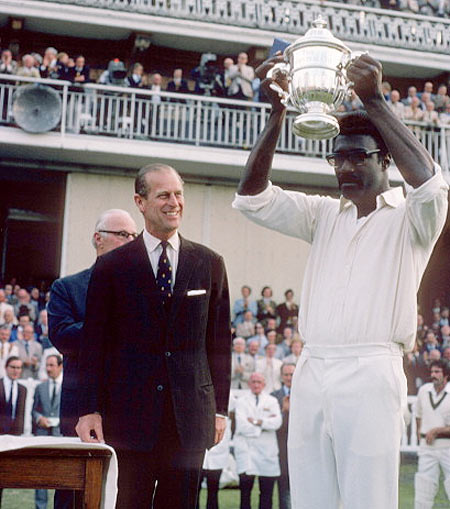
Prince Philip, Duke of Edinburgh,
and Clive Lloyd, Captain of the West Indies team

June 21, 1975, 50 years ago: The 1st Cricket World Cup Final is held, at Lord's Cricket Ground, a.k.a. "The Home of Cricket," in North-West London. To the dismay of English cricket fans, England isn't in the Final.

The International Cricket Conference (ICC) put the tournament together, with 8 teams. England, of course, hosted. Their colonial legacy led to India, Pakistan, Sri Lanka, Australia and New Zealand coming to love the sport, and they were also in the tournament. It also included an East Africa team representing Kenya, Uganda and Tanzania, and it would later include Zambia.

And the tournament was rounded out by a West Indies team, a.k.a. "Windies," representing the former British colonies, by then independent nations, of Antigua and Barbuda, Barbados, Dominica, Grenada, Guyana, Jamaica, Saint Kitts and Nevis, Saint Lucia, Saint Vincent and the Grenadines, and Trinidad and Tobago; the still-British territories of Anguilla, the British Virgin Islands and Montserrat; a constituent country of the Kingdom of the Netherlands, Sint Maarten; and an American territory, the U.S. Virgin Islands.

Matches got underway on June 7. Venues were Lord's, The Oval in South London, Edgbaston Cricket Ground in Birmingham, Old Trafford Cricket Ground in Manchester (a mile south of the more familiar soccer stadium of the same name), Trent Bridge in Nottingham, and Headingley Cricket Ground in Leeds.

England won all 3 of their matches in Group A. New Zealand also advanced from the Group. The West Indies and Australia advanced from Group B. Having the home-field advantage, England were expected to win their Semifinal with Australia at Headingley, but England could only score 93 runs. Gary Gilmour led Australia to victory with 94. West Indies won the other Semifinal, beating New Zealand 159-158.

The Final was held on June 21, at Lord's, in front of a full house of 26,675. Australia won the toss, but, hoping to make use of ideal bowling (pitching) conditions, invited the West Indies to bat first. That may, in this most gentlemanly of sports, have been the sporting thing to do, but it may also have been a mistake. The West Indies rolled up 291 runs, and that's a lot to make up.

Australia gave it a good shot. They got to 80 runs before their 1st wicket, and to 162 after only 3 wickets. But some mishaps in running the bases proved costly, and they could only get to 274. The West Indies had won. Lloyd accepted the trophy from Prince Philip, Duke of Edinburgh, representing his wife, Queen Elizabeth II, as the head of state of both the host nation and the winning team.

The West Indies would repeat in 1979, and won a 3rd title in 2007. Australia have won the most, 5: 1987, 1999, 2003, 2015 and 2023. India have 2: 1983 and 2011. Pakistan won in 1992, Sri Lanka in 1996, and England in 2019.

For the record, the United States has never qualified for this tournament.

The next one will be held in South Africa, Zimbabwe and Namibia, in October and November 2027.

Friday, June 20, 2025

June 20, 1975: "Jaws" Premieres

June 20, 1975, 50 years ago: Jaws premieres, turning Steven Spielberg into a star director, and inventing the "Summer blockbuster film."

It was based on the novel of the same title, by Peter Benchley, grandson of Robert Benchley of Algonquin Round Table fame. He later regretted writing the book, because the movie led people to go out and kill sharks who had done nothing wrong.

Steven Spielberg was only 27 years old during filming, but he was already a genius, capable of out-Hitching Alfred Hitchcock for fear, suspense and characterization.

The movie was filmed on Martha's Vineyard, off the coast of Massachusetts, and "The Vineyard" stood in for the fictional Amity Island.

Roy Scheider, having previously played a second banana in The French Connection, proved that you didn't have to look like Steve McQueen, Paul Newman or Robert Redford to be an action hero.

Richard Dreyfuss, having played teenagers in American Graffiti and The Apprenticeship of Duddy Kravitz, was so much better playing a young, thoughtful scientist like Hooper than being a rotten old man. It's one thing to play a mean old Republican, like he did in The American President and W., and he was damn good at both. It's another thing to be one.

English actor Robert Shaw played Quint, who became a shark-hunter after surviving the shark attack on the survivors of the Japanese attack on the USS Indianapolis in the waning days of World War II. Surviving a harrowing wartime experience should make a man less of a jerk, not more. Quint never figured this out.

Murray Hamilton played Mayor Larry Vaughn, a coward who pandered to local businesses. He would have made a great modern Southern Republican. In contrast, as Chief Brody, Scheider gives off serious "I'm a Republican of conscience, and that's why I'm now a guest on MSNBC at least 3 times a week" vibes.

Look, I get why some people root for the shark. Frankly, I wept not at all when it chomped Quint up. I would have cheered if it had gotten that useless Mayor, the real villain of the movie. But you're not supposed to root for the shark, any more than you root for the witch in The Wizard of Oz, or Barzini in The Godfather, or Darth Vader in Star Wars, or Thanos in the Marvel movies.

"Smile, you son of a bitch!" is a better "I'm about to kill you!" line than was ever delivered by John Wayne, and neither Clint Eastwood, nor Sylvester Stallone, nor Arnold Schwarzenegger, nor Bruce Willis has ever topped it, either. Nor will they, in whatever time is left to them.

There were 3 sequels by 1987. The less said about them, the better.

Shaw died in 1978, Hamilton in 1986, Scheider in 2008. As of June 20, 2022, Spielberg, Dreyfuss, and Lorraine Gary, who played Ellen Brody, the Chief's wife, are still alive.

I don't like horror movies, and Jaws has too much screaming for me to buy some people's argument that it's a "perfect movie." But it's a great movie, one proven by both the post-9/11 hysteria and COVID to have stood the test of time.

June 20, 1945: "Who's On First?"

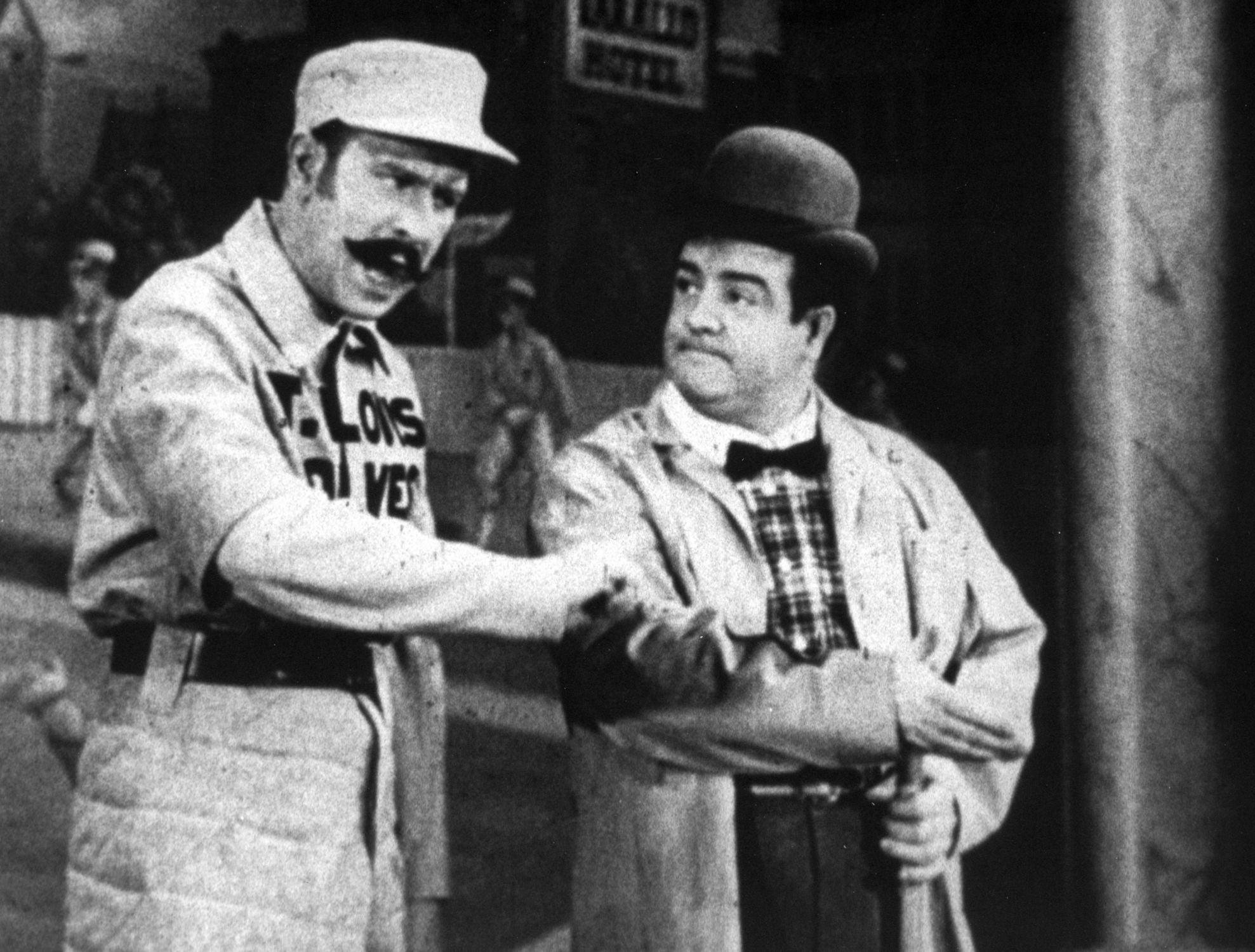
June 20, 1945, 80 years ago: The film The Naughty Nineties premieres, starring the comedy team of Bud Abbott (left in the photo above) and Lou Costello (right). The plot, centered around trying to regain ownership of an 1890s riverboat/entertainment venue from con artists, is forgettable. What is remembered about this movie is Abbott & Costello's performance of the baseball-themed comedy routine "Who's On First?"

William Alexander Abbott (born on October 2, 1897 in Asbury Park, Monmouth County, New Jersey) and Louis Francis Cristillo (born on March 6, 1906 in Paterson, Passaic County, New Jersey) had both gotten their starts in vaudeville, which had similar routines. There was "The Baker Scene," with a bakery located on Watt Street; and "Who Dyed," with the dye shop's owner being named "Who."

In the 1930 film Cracked Nuts, Bert Wheeler and Robert Woolsey look at a map of a mythical kingdom, where towns have names like that: "What is next to Which." At the same time, in British music halls, comedian Will Hay interviewed a schoolboy named Howe, who came from Ware, but now lives in Wye.

Abbott said that "Who's On First?" came from an older routine called "Who's the Boss?" His wife, Betty Smith, recalled him doing a similar baseball-themed routine with another comedian, before he started working with Costello in 1936. They had done similar routines, one about a racehorse that Abbott owned, which was good as running on muddy tracks: "I'm gonna feed my mudder his fodder." And there was a cow-milking scene:

Abbott: You put the pail under the cow's udder.
Costello: The cow's udder what?

Abbott & Costello first performed the Who's On First? sketch for a national audience on March 24, 1938, on CBS' The Kate Smith Hour. It became a regular routine, and they performed it for President Franklin D. Roosevelt several times. Their 1st film together was One Night in the Tropics, in 1940, and they did a short version of it. But the best-known version, and the first time most people saw it as well as heard it, was in The Naughty Nineties, as follows:

Abbott: Oh, I'll tell you their names, but you know it seems to me they give these ball players now-a-days very peculiar names.
Costello: You mean funny names?
Abbott: Strange names, pet names, like Dizzy Dean.
Costello: His brother, Daffy.
Abbott: Daffy Dean.
Costello: And their French cousin.
Abbott: French?
Costello: Goofé.
Abbott: Goofé Dean. Well, let's see, we have on the bags, Who's on first, What's on second, I Don't Know is on third...
Costello: That's what I want to find out.
Abbott: I say, Who's on first, What's on second, I Don't Know's on third.
Costello: Are you the manager?
Abbott: Yes.
Costello: You gonna be the coach too?
Abbott: Yes.
Costello: And you don't know the fellows' names?
Abbott: Well I should.
Costello: Well then who's on first?
Abbott: Yes.
Costello: I mean the fellow's name.
Abbott: Who.
Costello: The guy on first.
Abbott: Who.
Costello: The first baseman.
Abbott: Who.
Costello: The guy playing first!
Abbott: Who is on first!
Costello: I'm asking YOU who's on first.
Abbott: That's the man's name.
Costello: That's who's name?
Abbott: Yes.
Costello: Well go ahead and tell me.
Abbott: That's it.
Costello: That's who?
Abbott: Yes.
PAUSE
Costello: Look, you gotta first baseman?
Abbott: Certainly.
Costello: Who's playing first?
Abbott: That's right.
Costello: When you pay off the first baseman every month, who gets the money?
Abbott: Every dollar of it.
Costello: All I'm trying to find out is the fellow's name on first base.
Abbott: Who.
Costello: The guy that gets...
Abbott: That's it.
Costello: Who gets the money...
Abbott: He does, every dollar. Sometimes his wife comes down and collects it.
Costello: Who's wife?
Abbott: Yes.
PAUSE
Abbott: What's wrong with that?
Costello: Look, all I wanna know is when you sign up the first baseman, how does he sign his name?
Abbott: Who.
Costello: The guy.
Abbott: Who.
Costello: How does he sign...
Abbott: That's how he signs it.
Costello: Who?
Abbott: Yes.
PAUSE
Costello: All I'm trying to find out is what's the guy's name on first base.
Abbott: No. What is on second base.
Costello: I'm not asking you who's on second.
Abbott: Who's on first.
Costello: One base at a time!
Abbott: Well, don't change the players around.
Costello: I'm not changing nobody!
Abbott: Take it easy, buddy.
Costello: I'm only asking you, who's the guy on first base?
Abbott: That's right.
Costello: Ok.
Abbott: All right.
PAUSE
Costello: What's the guy's name on first base?
Abbott: No. What is on second.
Costello: I'm not asking you who's on second.
Abbott: Who's on first.
Costello: I don't know.
Abbott: He's on third, we're not talking about him.
Costello: Now how did I get on third base?
Abbott: Why, you mentioned his name.
Costello: If I mentioned the third baseman's name, who did I say is playing third?
Abbott: No. Who's playing first.
Costello: What's on first?
Abbott: What's on second.
Costello: I don't know.
Abbott: He's on third.
Costello: There I go, back on third again!
PAUSE
Costello: Would you just stay on third base and don't go off it.
Abbott: All right, what do you want to know?
Costello: Now who's playing third base?
Abbott: Why do you insist on putting Who on third base?
Costello: What am I putting on third.
Abbott: No. What is on second.
Costello: You don't want who on second?
Abbott: Who is on first.
Costello: I don't know.
Abbott & Costello Together: Third base!
PAUSE
Costello: Look, you gotta outfield?
Abbott: Sure.
Costello: The left fielder's name?
Abbott: Why.
Costello: I just thought I'd ask you.
Abbott: Well, I just thought I'd tell ya.
Costello: Then tell me who's playing left field.
Abbott: Who's playing first.
Costello: I'm not... stay out of the infield! I want to know what's the guy's name in left field?
Abbott: No, What is on second.
Costello: I'm not asking you who's on second.
Abbott: Who's on first!
Costello: I don't know.
Abbott & Costello Together: Third base!
PAUSE
Costello: The left fielder's name?
Abbott: Why.
Costello: Because!
Abbott: Oh, he's center field.
PAUSE
Costello: Look, You gotta pitcher on this team?
Abbott: Sure.
Costello: The pitcher's name?
Abbott: Tomorrow.
Costello: You don't want to tell me today?
Abbott: I'm telling you now.
Costello: Then go ahead.
Abbott: Tomorrow!
Costello: What time?
Abbott: What time what?
Costello: What time tomorrow are you gonna tell me who's pitching?
Abbott: Now listen. Who is not pitching.
Costello: I'll break your arm, you say who's on first! I want to know what's the pitcher's name?
Abbott: What's on second.
Costello: I don't know.
Abbott & Costello Together: Third base!
PAUSE
Costello: Gotta a catcher?
Abbott: Certainly.
Costello: The catcher's name?
Abbott: Today.
Costello: Today, and Tomorrow's pitching.
Abbott: Now you've got it.
Costello: All we got is a couple of days on the team.
PAUSE
Costello: You know I'm a catcher too.
Abbott: So they tell me.
Costello: I get behind the plate to do some fancy catching, Tomorrow's pitching on my team and a heavy hitter gets up. Now the heavy hitter bunts the ball. When he bunts the ball, me, being a good catcher, I'm gonna throw the guy out at first base. So I pick up the ball and throw it to who?
Abbott: Now that's the first thing you've said right.
Costello: I don't even know what I'm talking about!
PAUSE
Abbott: That's all you have to do.
Costello: Is to throw the ball to first base.
Abbott: Yes!
Costello: Now who's got it?
Abbott: Naturally.
PAUSE
Costello: Look, if I throw the ball to first base, somebody's gotta get it. Now who has it?
Abbott: Naturally.
Costello: Who?
Abbott: Naturally.
Costello: Naturally?
Abbott: Naturally.
Costello: So I pick up the ball and I throw it to Naturally.
Abbott: No you don't, you throw the ball to Who.
Costello: Naturally.
Abbott: That's different.
Costello: That's what I said.
Abbott: You're not saying it...
Costello: I throw the ball to Naturally.
Abbott: You throw it to Who.
Costello: Naturally.
Abbott: That's it.
Costello: That's what I said!
Abbott: You ask me.
Costello: I throw the ball to who?
Abbott: Naturally.
Costello: Now you ask me.
Abbott: You throw the ball to Who?
Costello: Naturally.
Abbott: That's it.
Costello: Same as you! Same as YOU! I throw the ball to who. Whoever it is drops the ball and the guy runs to second. Who picks up the ball and throws it to What. What throws it to I Don't Know. I Don't Know throws it back to Tomorrow, Triple play. Another guy gets up and hits a long fly ball to Because. Why? I don't know! He's on third, and I don't care!
Abbott: What?
Costello: I said I don't care!
Abbott: Oh, that's our shortstop!

No right fielder is mentioned in the routine.

This version of the routine is played on TV screens in a continuous loop at the National Baseball Hall of Fame and Museum in Cooperstown, New York. This has given rise to the incorrect perception that Abbott & Costello have been elected to the Hall of Fame.

After doing several films together, including a series of "Abbott & Costello Meet... " movie monsters like the Frankenstein Monster, their films became progressively less popular, and they split up in 1957. Costello died of a heart attack in Los Angeles on March 3, 1959, just before his 53rd birthday. An urban legend says that Abbott was watching the "Who's On First?" routine on television when he got the phone call telling him that Costello had died. Abbott died on April 24, 1974 in the Los Angeles suburb of Woodland Hills, California. He was 76.

The parodies of the routine have been many. Occasionally, it's done with rock groups: The Who, The Guess Who, Yes, The Band, Chicago. A version of this on SCTV featured a final exchange with a character saying, "This is for the birds!" and the other, thinking he'd said, "The Byrds," responding, "Ah, they broke up a long time ago!" More recent versions have included U2 and No Doubt.

The 1980 movie Airplane! had an exchange with pilot Clarence Oveur (Peter Graves), co-pilot Roger Murdock (basketball legend Kareem Abdul-Jabbar), and navigator Victor Basta (Frank Ashmore):

  • Victor: Request vector, over.
  • Clarence: What?
  • Tower voice: Flight 2-0-9'er cleared for Vector 324.
Roger: We have clearance, Clarence.
  • Clarence: Roger, Roger. What's our vector, Victor?
  • Tower voice: Tower's radio clearance, over!
  • Clarence: That's Clarence Oveur. Over.

On a 1982 Tonight Show, Johnny Carson played President Ronald Reagan, being briefed for an upcoming press conference by Chief of Staff James Baker, played by Fred Holiday of the group of actors Carson had dubbed "The Mighty Carson Art Players."

Carson, as Reagan, figured he'd get a question about his controversial Secretary of the Interior, James Watt. They were scheduled to go swimming the next day, at the YMCA, or "The Y." He also figured he'd get questions about the Middle East, and he was trying to remember the name of the Palestinian leader: "That Arafat guy." When Baker said, "Yassir," Reagan thought he was saying, "Yes, sir." And then the phone rang, and it was a Chinese leader, with a name made up for the sketch, and Baker said, "Mr. President, Hu is on the phone." This was 20 years before Hu Jintao became the leader of China.

Wednesday, June 18, 2025

Most Popular Sport In Each City

U.S. cities only, no Canadian cities, because they would all be hockey, except for Hamilton and Regina, which have CFL teams but not NHL teams. Cities/metro areas listed in alphabetical order. 

Baseball: Boston/New England, New York/New Jersey/Long Island, St. Louis, San Diego.

Football: Atlanta, Baltimore, Buffalo/Western New York, Charlotte/Carolina, Chicago, Cincinnati, Cleveland, Dallas/Metroplex, Denver, Houston, Indianapolis, Jacksonville/North Florida, Kansas City, Las Vegas, Miami/South Florida, Milwaukee/Green Bay, Minneapolis/Twin Cities, Nashville, New Orleans, Philadelphia, Phoenix, Pittsburgh, San Francisco (Bay Area), Seattle, Tampa (Bay), Washington/DMV.

Basketball: Los Angeles, Oklahoma City, Orlando, Portland, Sacramento, Salt Lake City/Utah, San Antonio.

Hockey: Detroit.

Recent titles won don't always change these things. The Phillies may have won 3 recent Pennants and a World Series, but they'll never be more popular in Philadelphia and environs than the Eagles. No matter what they win, the Dodgers will not be more popular in Los Angeles than the Lakers, even though the Dodgers arrived first. If the Lions finish the job and win the Super Bowl, they might overtake the Red Wings in Detroit; but the Pistons didn't despite nearly winning back-to-back titles in 2004-05.

The Athletics' temporary stay in West Sacramento won't make them more popular in California's capital than the Kings. If the Pacers come from behind and beat the Thunder to win the NBA title, it still won't make them more popular in Indianapolis than the Colts. Basketball as a whole may be more loved in Indiana as a whole, but, in Indianapolis, the Colts have taken over.

Tuesday, June 17, 2025

June 17, 2015: The Charleston Church Massacre

June 17, 2015, 10 years ago: A white supremacist opens fire during a Bible study at a black church in Charleston, South Carolina. It was the deadliest mass shooting at a place of worship in American history.

To make matters worse, that record stood for only 3 years.

Emanuel African Methodist Episcopal Church, known as Mother Emanuel, was founded in 1817. Though not the oldest continuously-operating black church in America -- that would be First Bryan Baptist Church, founded in 1788 in Savannah, Georgia -- it is the oldest AME church in America. In 2015, its pastor was Clementa C. Pinckney, who was also a member of the State Senate.

Dylann Roof, a 21-year-old native of the State capital of Columbia, espoused racial hatred in both a website manifesto which he published before the shooting, and a journal which he wrote from jail afterward. On his website, Roof posted photos of emblems which are associated with white supremacy, including a photo of the Confederate battle flag.

Pinckney had held rallies after the shooting of Walter Scott by a white police officer two months earlier, in nearby North Charleston. As State Senator, Pinckney pushed for legislation requiring police to wear body cameras.

During the hour preceding the attack, 13 people, including the shooter, participated in the Bible study. According to the accounts of people who talked to survivors, when Roof walked into the historic African-American church, he immediately asked for Pinckney, and sat down next to him, initially listening to others during the study. He disagreed with some of the discussion of Scripture.

After other participants began praying, he stood up, and aimed a gun he pulled from a fanny pack at 87-year-old Susie Jackson. Jackson's nephew, 26-year-old Tywanza Sanders, tried to talk him down and asked him why he was attacking churchgoers. The shooter said, "I have to do it. You rape our women, and you're taking over our country. And you have to go." 

In the aftermath, Jamelle Bouie wrote in Slate"Make any list of anti-black terrorism in the United States, and you'll also have a list of attacks justified by the specter of black rape." He cited the Tulsa Race Massacre of 1921, the Rosewood Massacre in Florida in 1923, and the murder of 14-year-old Emmett Till in Mississippi in 1955 as examples.

When Roof said he intended to shoot them all, Sanders dove in front of Jackson and was shot first. Roof fired at the other victims, shouting racial epithets. He reportedly said, "Y'all want something to pray about? I'll give you something to pray about." Roof reloaded his gun five times. Sanders' mother and his five-year-old niece, who also attended the study, survived the shooting by pretending to be dead on the floor. In total, 9 people were killed, and 1 other was injured.

The day after the shooting, President Barack Obama visited Charleston, and said, "Once again, innocent people were killed in part because someone who wanted to inflict harm had no trouble getting their hands on a gun... We as a country will have to reckon with the fact that this type of mass violence does not happen in other advanced countries."

Nothing was done about gun control, of course. But on July 9, the South Carolina legislature passed a bill to remove the Confederate flag from display outside the State House, and Governor Nikki Haley signed the bill. The flag was taken down the next day.

Roof was found to have targeted members of this church because of its history and status. On December 15, 2016, Roof was convicted of 33 federal hate crime and murder charges. On January 10, 2017, he was sentenced to death. He was separately charged with nine counts of murder in State court. He pleaded guilty to all nine state charges in order to avoid receiving a second death sentence, and as a result, he was sentenced to life imprisonment without the possibility of parole.

As of June 17, 2025, he remains in United States Penitentiary Terre Haute in Indiana. Oklahoma City bomber Timothy McVeigh was executed there in 2001. Dzhokhar Tsarnaev, the surviving bomber of the 2013 Boston Marathon, is also there. So is Robert Bowers, who broke Roof's record with 11 shooting deaths at a Pittsburgh synagogue in 2018, joined him on Death Row at Terre Haute in 2023.

June 17, 1775: The Battle of Bunker Hill

Bunker Hill Monument

June 17, 1775. 250 years ago: The Battle of Bunker Hill is fought, the 1st battle of the War of the American Revolution after the opening battles of Lexington and Concord. It is remembered as a great heroic triumph for the American Patriots.

In fact, it was a case of "They lost the battle, but won the war." Or, as the ancient Greek King Pyrrhus of Epirus would have said, "If we are successful in one more battle with them, we shall be utterly ruined."

The battle isn't even correctly named. Although there is a Bunker Hill in Charlestown, across the Charles River from Boston and since incorporated as a neighborhood of the city proper, most of the action took place at adjacent Breed's Hill, a mile and a half from what's now known as Downtown Crossing.

On June 13, Colonel William Prescott took 1,200 colonial troops, and occupied both hills. On June 17, the British troops, under the command of General William Howe, became aware of the presence of colonial forces on the Peninsula, and mounted an attack against them. Two assaults on the colonial positions were repulsed with significant British casualties, but the redoubt was captured on their third assault, after the defenders ran out of ammunition. The colonists retreated over Bunker Hill, leaving the British in control of the Peninsula.
William Prescott

The battle was a tactical victory for the British, but it proved to be a sobering experience for them: They lost 226 men, while the colonials lost 115. The battle had demonstrated that inexperienced militia were able to stand up to regular army troops in battle.

The battle led the British to adopt a more cautious planning and maneuver execution in future engagements, which was evident in the subsequent New York and New Jersey campaign. The costly engagement also convinced the British of the need to hire substantial numbers of auxiliaries from the German province of Hesse -- the infamous Hessian mercenaries -- to bolster their strength in the face of the new and formidable Continental Army.

William Prescott served as part of the U.S. victory at the Battle of Saratoga in 1777. He lived on until 1795, at the age of 69. He has a statue on the grounds of the 221-foot-high Bunker Hill Monument, erected in 1843.

The colonials lost the battle because they ran out of ammunition. This supposedly led to the ammo-conserving order: "Don't shoot 'til you see the whites of their eyes!" But the available evidence shows that no one -- not Prescott, nor anyone else -- said this during the Battle of Bunker Hill. The saying goes back to Gustavus Adolphus, King of Sweden in the early 17th Century, at that country's peak of power.