Tuesday, October 22, 2024

October 22, 1974: The Murcer-Bonds Trade

October 22, 1974, 50 years ago: The Yankees and the San Francisco Giants swap popular star outfielders: Bobby Bonds goes to New York, and Bobby Murcer heads to San Francisco. Bonds hit 32 home runs and stole 32 bases in 1975‚ becoming only the 2nd member of "the 30-30 Club" for any of The City's baseball teams. (The 1st was Willie Mays of the 1956 Giants.)

Bonds got off to a rough start, before adjusting to the different style of pitching in the American League. He went on a tear in May. But a knee injury in Chicago on June 7 wrecked his season. He later admitted that he should have gotten surgery, missed the rest of the season, and come back stronger in 1976.

Instead, he played on, and never quite adapted to New York. After just the 1 season, he was traded to the California Angels for outfielder Mickey Rivers and pitcher Ed Figueroa. They turned out to be 2 major figures in the Yankees' revival, so Bonds' greatest value to the Yankees was as trade bait.
Today, Bonds is known 3rd for his amazing combination of power and speed, 2nd for being traded so many times, and 1st for being the father of Barry Bonds. That really isn't fair, as Bobby was a fantastic player, one of the best of the 1970s.

As for Murcer, he felt betrayed. Team owner George Steinbrenner had promised him he would be "a Yankee for life." But Steinbrenner had been suspended from operation of the team, and wasn't reinstated until 1976. So general manager Gabe Paul made the call.

Murcer loved the city of San Francisco, but hated playing in cold, windy Candlestick Park, both as a batter and as an outfielder. He was traded to the Chicago Cubs in 1977, and he enjoyed Wrigley Field a lot more. (Sure, Wrigley also has wind issues, but it is also much more of a hitter's park.)

Still, Murcer was heartbroken to be traded by the Yankees, to whom he had given as much as anybody could in those dark years between 1964 and 1976, and swore he would never forgive them for trading him. But in 1979, Steinbrenner traded to get him back, and Bobby jumped at the chance, and he remained a part of the Yankee family, as a player until 1983, and then as a broadcaster until his death in 2008. He titled his autobiography Yankee For Life. It made sense, because, as much as he could, Steinbrenner kept his word.

October 22, 1954: Ford Introduces the Thunderbird

October 22, 1954, 70 years ago: Ford Motor Company introduces the Ford Thunderbird, as part of its 1955 models. Originally a 2-seat sports coupe, a convertible with a removable hardtop with "portholes," a rear seat was added in 1958, making it more of a luxury car.

From 1968 to 1998, Ford's Lincoln-Mercury Division marketed "rebadged" variants, as the Mercury Cougar; and the Lincoln Continental Marks III, IV, V, VI, VII and VIII. Ford stopped making the Thunderbird after the 1997 models, but brought it back in 2002. In 2005, in celebration of the car's 50th Anniversary, Ford brought it back as a special edition, complete with the '55 original's "portholes." This remains the last model year for the Thunderbird.

The "T-bird" was popular enough to become a watchword in popular culture. In 1962, in his song "Oh, Boy!" (to the tune of "Las Chiapanecas"), Thunderbirds and Cadillacs as the kind of cars that made parodist Allan Sherman give an enthusiastic, "Oh, boy!"

The Beach Boys mentioned the car in 2 songs: In "Little Deuce Coupe," they said the title car would "walk a Thunderbird like she's standing still"; and in "Fun, Fun, Fun," that's what the narrator's girlfriend will have, "'til her daddy takes the T-bird away." And a 1966 Thunderbird was the roadtrip/getaway car in the 1991 film Thelma & Louise.

Sunday, October 20, 2024

Yankees Win Pennant On Soto Blast!

Yesterday was one of those days. There was (and, as of this writing, there remains) a problem with my computer. As a result, I have to do this on my phone, which is always a pain in several body parts.

And I got a loss from Rutgers football, and I got a very bad loss from Arsenal. The night before, the football team at my Alma Mater, East Brunswick High School school, got clobbered.

In other words, yesterday, it would have taken something as big as the Yankees winning the Pennant for me to think of it as a good day.

Well, they did.

*

First, the American League Division Series, where the Yankees faced a name from Playoffs past, the Kansas City Royals. They had dispatched the Baltimore Orioles, who had given the Yankees trouble in the regular season. 

The winner of Yankees vs. Royals would face the winner of Cleveland Guardians vs. Detroit Tigers. The Tigers went in as the hottest team in baseball, having eliminated the Houston Astros, who had given the Yankees so much cheat-aided trouble since 2015. And the Boston Red Sox, who had given the Yankees so much cheat-aided trouble since 2003, weren't even in the Playoffs. So there was reason for optimism.

But the Royals got a split at Yankee Stadium: After the Yankees won Game 1, 6-5, the Royals win Game 2, 4-2. Things were looking down as we went to Kauffman Stadium for Game 3.

But a Giancarlo Stanton home run was key to winning Game 3, 3-2. And Gerrit Cole pitched like an ace in Game 4, which the Yankees won, 3-1. The Guardians beat the Tigers, so it was on to the AL Championship Series.

*

I was worried about Carlos Rodón, but in Game 1, he pitched the way I figured Cole would. With Stanton and Juan Soto hitting home runs, the Yankees won, 5-2.

But in Game 2, Cole pitched the way I feared Rodón would. And still, the Yankees won, 6-3, thanks to a strong bullpen and Aaron Judge finally homering out of his postseason funk.

The series shifted to Progressive Field in Cleveland. Game 3 was a classic. The Yankees trailed 3-1 in the top of the 8th, but back-to-back homers by Judge and Stanton, off the Guardians' dominant closer, Emmanuel Clase, made that 4-3 New York.

A sacrifice fly by Gleyber Torres made it 5-3 in the 9th. Torres is one of the most frustrating players I've ever seen, but he has really come up big in September and October.

But the Yankee bullpen couldn't hold it. In the bottom of the 9th, Luke Weaver, who succeeded Clay Holmes as the closer, gave up a double to Lane Thomas and a game-tying home run to Jhonkensy Noel, who has a great nickname, based on his surname: Big Christmas.

Thankfully, there's no "ghost runner" in the postseason, but in the 10th, Aaron Boone brought Holmes in, and he gave up a 2-run homer to David Fry. Guardians 7, Yankees 5.

The consensus in the media and in baseball fans online was that this was the start of another Yankee choke, that there was no way they could come back from a "gut punch" like that.

Well, Game 3 may have been a great game with a lousy result, but Game 4 was a sloppy game with a great result. Luis Gil pitched well for 4 innings, and then Boone took him out. Huh? Another Stanton home run -- the Yankees are now calling him "our other captain," and Judge doesn't seem to mind -- made it 6-2 going to the bottom of the 6th.

Again, the bullpen blew it, and the Guardians tied it in the bottom of the 8th. But in the 9th, an error by Cleveland shortstop Bryan Rocchio made it 7-6, and a Torres single made it 8-6. Again, the usually untouchable Clase was the victim. This time, Boone trusted Tommy Kahnle to finish it, and he did. One win away.

Rodón pitched well in Game 5, but the Yankees had trouble breaking through. It was 2-0 Guardians in the top of the 6th, when Stanton struck again, with a 2-run finger. Weaver shook off his Game 3 mistakes by pitching a 1-2-3 9th, and it was off to extra innings again.

Austin Wells drew a walk with 1 out in the top of the 10th. Cliché Alert: Walks can kill you -- or save you. Alex Verdugo grounded up the middle. Guardian 2nd baseman Andrés Giménez flipped to Rocchio to start a double play, which would have been the 4th turned on the Yankees on the night. But, for the 2nd night in a row, Rocchio made a key error, and both runners were safe.

That's when Soto stepped to the plate against Hunter Gaddis. This was exactly the kind of situation for which he was acquired. As Reggie Jackson said of himself when he signed with the Yankees, Soto didn't come to New York to be a star, he brought his star with him.

There was a ball, a called strike, and 4 straight foul-offs, before Soto hit a drive to straightaway center field. I thought it would be caught. But this ball just kept carrying, until it was out. A Pennant-winning home run. A home run that will probably force Hal Steinbrenner to pay through the nose, maybe several noses, to re-sign him. 5-2 Yankees.

Weaver finished the Guardians off, with the last put, fitting lyrics, caught by Soto. The New York Yankees had won the series, 4 games to 1, and won their 41st American League Pemnant.

*

It's the 1st Pennant in 15 years, since general manager Brian Cashman broke up the 2009 World Champions. It's the 1st Pennant since 1981 with no players acquired by the late Gene Michael, the 1st built entirely by Cashman. Finally.

And while Soto won a World Series in 2019 with the Washington Nationals, defeating an Astro team with Cole on it, this is the 1st Pennant for most of the players, including Judge, Stanton and Torres. "Gutless Wonders" no more: This was a hard season, and they showed a lot of guts.

Tonight, Game 6 of the National League Championship Series will be played. The Los Angeles Dodgers will try to close out the New York Mets, who still have dreams of a Subway Series against the Yankees. As if that worked out well for them in 2000.

The Yankees will wait.

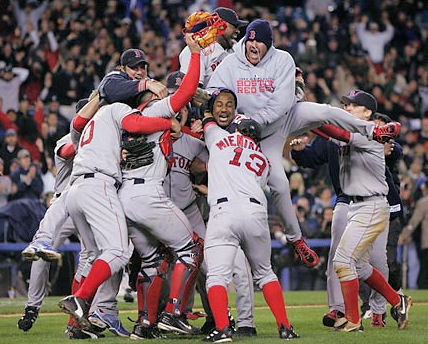
October 20, 2004: The Boston Red Sox Slay the Pinstriped Dragon

October 20, 2004, 20 years ago: The Red Sox ruin the anniversary of Mickey Mantle's birth. Unlike the 2003-18 Red Sox, Mickey didn't need no steroids to win baseball games. The chemicals he ingested were, most definitely, not performance-enhancing.

Having dropped 3 straight to the Sox to force a Game 7 at Yankee Stadium, the Yankees had nothing left, at least not emotionally. The Red Sox led 6-0 after 2 innings. It was 8-1 after 4. The final was 10-3.

Having let Andy Pettitte and David Wells get away, the Yankees had no lefthanded starting pitchers to counter the Boston lefthanders: David Ortiz (who hit a home run in the 1st inning), Johnny Damon (who hit one in the 2nd and another in the 4th), Trot Nixon (limited to a single in 5 at-bats), and the switch-hitting Mark Bellhorn (who homered lefthanded in the 8th) and Bill Mueller (who hit 2 singles).

Instead, manager Joe Torre had a choice of Kevin Brown, a great pitcher not that long ago but now unreliable; and Javier Vázquez, who, as his later career would confirm, seemed to pitch well for everybody but the Yankees. Torre removed Brown after loading the bases in the 2nd, already down 2-0 because of the steroid-aided homer of Ortiz. He brought in Vázquez, who gave up the 1st of Damon's homers, a grand slam.

This was not the kind of loss that crushes you because you apparently had it won at the end, and blew it. We got beat early. From the 1st inning onward, we knew the Red Sox were going to win the game. We knew it, and their fans knew it. There was nothing that could be done. And we had to stick it out, all 9 innings, and hear those Red Sox fans give us the business in our house for, as it turned out, 3 hours and 31 minutes. Never mind what the clock said: This was the longest game in Yankee history.

To paraphrase the movie GoodfellasIt was revenge for Bucky Dent, and a lot of other things. And there was nothing that we could do about it. The Red Sox were beloved in the national media, and the Yankees weren't. And we had to sit still and take it. It was among the New Englanders. It was real chowderhead shit.

It was 12:01 AM, October 21, when Ruben Sierra grounded to 2nd for the final out. So not only had the Sox ended the Curse of the Bambino, they had ruined the birthdays of both Mickey Mantle and Whitey Ford.

Finally, after losing the Pennant to the Yankees on the final day in 1949, blowing the Division title to the Yankees in 1977 and 1978, losing the ALCS to the Yankees in 1999, and the shock of 2003, the Red Sox and their fans had their revenge over the Yankees. They had slain the big Pinstriped Dragon. 
But, as Dan Shaughnessy of The Boston Globe, who knows more about the Red Sox than anyone, pointed out, it wasn't over: "The Curse of the Bambino is not that the Red Sox can't beat the Yankees. The Curse of the Bambino is that the Red Sox can't win the World Series." They lost the 1946, 1967, 1975 and 1986 World Series; the 1948 AL Playoff game; fell a little short of the AL Eastern Division title in 1972, 1974, 1979 and 1991; and lost the ALCS in 1988 and 1990. And some of those losses were crushing. But none of those defeats had anything to do with the Yankees, although the 1986 World Series loss, the most crushing of them all, was to a New York team.

Shaughnessy's Globe teammate, columnist Bob Ryan, was asked if only the Pennant, even with a win over the Yankees, would have been enough. He was emphatic: "Let's get this out of the way, right now: Would it have been enough for the Red Sox to beat the Yankees, without winning the World Series? The answer is, 'No!'"

It would take 7 more days for the Sox to truly break the Curse, beating the St. Louis Cardinals in the World Series. The Cards had beaten them in the Series in 1946 and '67. The Sox have since beaten them again, in 2013.

Lost in the excitement of the Red Sox' revenge over the Yankees, Jim Edmonds hit a home run in the bottom of the 12th inning, to give the Cardinals a 6-4 win over the Houston Astros at Busch Memorial Stadium, and send the NLCS to a decisive Game 7. The Cards won the next day. But the Red Sox swept them in the World Series, and finished the job.

On July 30, 2009, it was revealed that David Ortiz and Manny Ramirez, the 2 biggest reasons the Red Sox won the World Series in 2004 and again in 2007, had failed steroid tests. They hadn't earned a fucking thing. They'd cheated. Ortiz was still there when they won it all again in 2013. Those 3 titles are fake, and they goddamned well know it. 1918 * Forever.

The baseball media, of course, will never give the Yankees the same benefit of the doubt that they give the Red Sox. Well, to hell with them. The world knows the truth, whether they accept it or not. They would say the Yankees "cheated" to win their titles. Really? The evidence against the 1996-2003 Yankees is incredibly flimsy. The evidence against the 2003-2013 Red Sox is overwhelming. The evidence against the 2018 Red Sox, while separate, is also pretty strong.

Saturday, October 19, 2024

October 19, 1999: Kenny Rogers Walks Andruw Jones

Historically, October 19 has been a bad day for New York baseball teams:

* October 19, 1976: Game 3 of the World Series, the 1st Series game at the renovated Yankee Stadium. The Yankees lost to the Cincinnati Reds, and were swept.

* October 19, 1986: Game 2 of the World Series, and the Mets fall 2 games to 0 behind the Boston Red Sox. But they came from behind to win.

* October 19, 2004: Game 6 of the American League Championship Series. Alex Rodriguez and the Slap Play. The Red Sox complete the comeback, and set up the Game 7 embarrassment.

* October 19, 2006: Game 7 of the National League Championship Series. Yadier Molina hits a home run, and Carlos Beltrán leaves the bat on his shoulder, and the Mets lose the Pennant.

* October 19, 2010: Game 4 of the ALCS. The Yankees lose at home to the Texas Rangers.

* October 19, 2019: Game 6 of the ALCS. Jose Altuve vs. Aroldis Chapman. 

This one stands out as much as any of them:

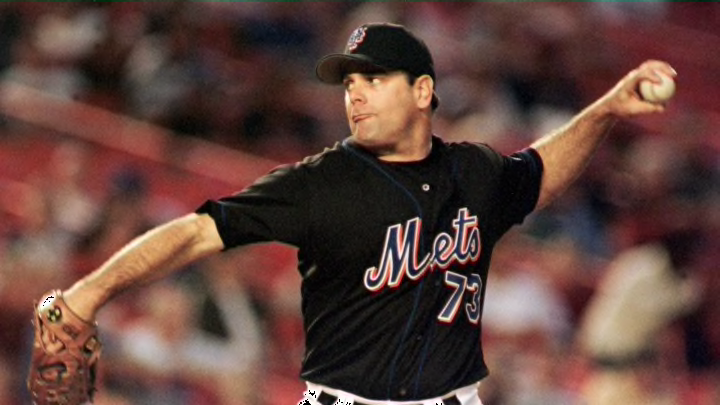
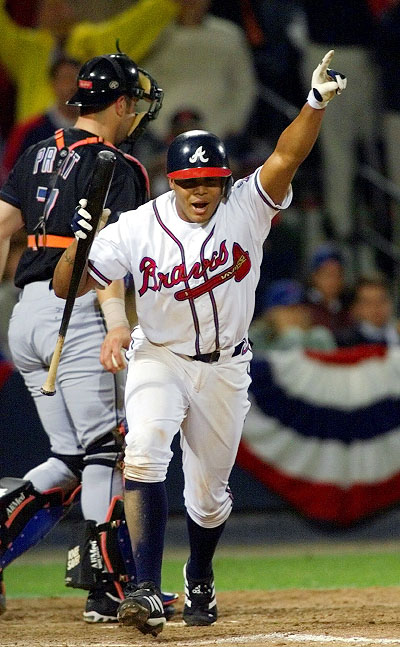
October 19, 1999, 25 years ago: A wild National League Championship Series, just 2 days after Robin Ventura's "Grand Slam Single" won Game 5 at Shea Stadium, moves on to an even wilder Game 6 at Turner Field in Atlanta. (The stadium is now known as Center Parc Stadium.) The Atlanta Braves blow Al Leiter off the mound with 5 runs in the 1st inning, and later lead the Mets, 7-3. But the Mets storm back, with Mike Piazza tying the game with a home run. The Braves take an 8-7 lead late, but the Mets tie it. The Mets take a 9-8 lead in the 10th, but the Braves tie it.

In the bottom of the 11th inning, the Braves load the bases, and Met manager Bobby Valentine, instead of bringing in righthanded reliever Octavio Dotel to pitch to righthanded hitter Andruw Jones, brings in lefthander Kenny Rogers. Rogers has been one of the top pitchers in baseball in regular-season play the last few years, but his postseason experience has been limited to some terrible outings for the Yankees in 1996 and '97. For whatever reason, Valentine brings him in to face the Braves'
kinderwonder from the Netherlands Antilles.
I watched this game on TV with my father, who was a nominal Met fan (the only sports team he really cared about was Rutgers football), and it was this series, with all its twists and turns, that led him to finally understand what lunatics like me see in the game of baseball.

And I remember telling him, late in the game, that this game and this series deserved to end with a hero, and that it would be a shame if it ended with a goat.

With a 3-2 count on Jones, Rogers threw a pitch low and outside. Jones would not swing at it. Ball 4. 10-9 Braves. Winning run forced home. Pennant dream over.
If Jones had gotten a hit, to drive home the Pennant-winning run, he would have been a hero, and you couldn't really criticize anyone on the Mets. They had fought gallantly, at moments even brilliantly, from a 3-games-to-none deficit.

Of course, no one had ever come back from such a deficit to win a postseason series. Not in baseball, anyway. None had even forced a Game 7. None had even forced a Game 6 until the Braves themselves did it the year before against the San Diego Padres in the NLCS.

Back from 3-0 to win the series? That was never going to happen in baseball. Everybody who had ever watched baseball was thinking that in October 1999. If only it had stayed that way for 5 more years, plus a couple more days.

Was the goat Rogers, for pitching poorly when his team needed him to get one more out and get out of the 11th-inning jam? Or was the goat Valentine, for yet another dimwitted bullpen move? (Paging Mel Rojas, and that was in a game with far less significance.)

Did this move convince him to leave Leiter in to face Luis Sojo in Game 5 of the next year's World Series after 141 pitches? Who knows. Bobby V himself probably doesn't know.

What is known is that the Mets had taken their fans on a thrilling ride, their first October ride in 11 years, and provided them with treasured moments on the ride... and then they crashed. What a way for the Mets and their fans to end the 20th Century.

One more thing: In the 2010s, in sports, "goat" ceased to be short for "scapegoat," someone or something you blamed for a defeat; and became an abbreviation: "GOAT," meaning "Greatest Of All Time." It even became a verb: A player who had reached elite status was said to have been "goated." To those of us old enough to remember earlier times, this sounds really stupid.

Friday, October 18, 2024

October 18, 1954: The Transistor Radio

October 18 is a great anniversary:
1753: Joseph Bloomfield, Revolutionary War General, early Governor of New Jersey, and namesake of my original hometown, was born.
1859: John Brown's raid on Harper's Ferry, Virginia (now in West Virginia).
1867: The Alaska Purchase is finalized.
1898: America took possession of Puerto Rico.
1918: Czechoslovakia declared independence.
1919: Pierre Trudeau, longtime Prime Minister of Canada and father of the current Prime Minister, was born.
1922: The British Broadcasting Corporation (the BBC) begins radio broadcasting.
1924: Two of the most famous games in college football history are played. Notre Dame beats Army at the Polo Grounds thanks to their backfield, "The Four Horsemen." And the University of Illinois dedicates its Memorial Stadium with 6 touchdowns by Red Grange in a win over Michigan.
1926: Rock and roll pioneer Chuck Berry was born.
1928: The great sportscaster Keith Jackson was born.
1933: Forrest Gregg, the Green Bay Packer offensive tackle that Vince Lombardi called "the finest player I ever coached," was born.
1939: Chicago Bears legend, as player and as coach, Mike Ditka was born. (Unfortunately, also born on this day was Lee Harvey Oswald.)
1940: Cynthia Weil, who wrote a bunch of hit rock and roll songs with her husband, Barry Mann, was born.
1941: The film The Maltese Falcon premiered.
1953: Willie Thrower, aptly-named, became the 1st black quarterback in the NFL, for the Bears. They lost to the San Francisco 49ers, anyway.
1954: Mort Walker and Dik Browne debuted the comic strip Hi & Lois. Separately, Walker created Beetle Bailey (Lois Flagston was Beetle's sister), and Browne created Hagar the Horrible.
1955: The Community War Memorial Arena opened in Rochester, New York. It is now known as the Blue Cross Arena at the War Memorial. And the Winnipeg Arena opened. It was demolished in 2006.
1956: Tennis legend Martina Navrátilová was born.
1958: Boxing champion Thomas Hearns was born. So was New York Attorney General Letitia James.
1959: Radio sports-talk host Chris "Mad Dog" Russo was born.
1961: The film version of West Side Story premiered.
1968: Bob Beamon wins the long jump at the Olympics, with a record of 29 feet, 2 1/2 inches.
1977: Reggie Jackson hits 3 home runs in Game 6 of the World Series, and the Yankees win the Series over the Los Angeles Dodgers.
1984: Gold Medal-winning American skier Lindsey Vonn is born.
1990: Basketball star Brittney Griner is born.
1999: The Yankees beat the Boston Red Sox in Game 5 of the American League Championship Series at Fenway Park, and win the Pennant.
2007: The football team at Rutgers University beat the University of South Florida, then ranked Number 2.
But one particular milestone stands out, and you have almost certainly enjoyed its effects:
October 18, 1954, 70 years ago: Texas Instruments announces it has begun production of the 1st transistor radio, the Regency TR-1. Baseball fans everywhere rejoice, for now they can listen to ballgames almost anywhere, from the office to the beach.
Well, they'll have to wait until April 1955 to listen to them, and until Summer 1955 to listen to them on the beach. Maybe they can listen on the beach in April 1955, if they live in California and can get Pacific Coast League broadcasts.

October 18, 1924: Red Grange & the Four Horsemen

This photo of Red Grange is colorized, but is otherwise real.

October 18, 1924, 100 years ago today: Two of the most iconic games in the history of college football are played.

Harold Edward Grange was born on June 13, 1903, in Forksville, in the mining country of Northeastern Pennsylvania -- 6 days before Lou Gehrig was born 200 miles to the southeast in East Harlem, Manhattan. He was born 15 days after entertainer Bob Hope, 5 days before early film singer Jeannette MacDonald, 9 days before Baseball Hall of Fame pitcher Carl Hubbell and bank robber John Dillinger, and 12 days before British writer George Orwell.

His father was the foreman on a lumber camp, and eventually moved the family to Wheaton, Illinois, about 30 miles west of Chicago, where 4 of his brothers lived, and he became that small city's Chief of Police. His son Harold, nicknamed Red because of his hair, got a job delivering ice, a hard job because ice is heavy. (A gallon of water weighs over 8 pounds. Now imagine it hard as a rock.) It made him strong, and he was fast, too. He was nicknamed "The Wheaton Iceman" well before "The Galloping Ghost." He made $37.50 a week -- about $590 in today's money.

Red lettered in football, baseball, basketball and track at Wheaton High School, all 4 years, 16 varsity letters. He was a State Champion in the high jump, the long jump and the 100-yard dash.

The school is now known as Wheaton Warrenville South High School, and also counts astronomer Edwin Hubble, journalist Bob Woodward, and the comedian brothers John and Jim Belushi among its alumni. The colors are orange and black -- not quite the same colors as Red would wear for the Illini and the Bears, but close. The school's stadium is named Red Grange Field.

In his 1st game at the University of Illinois, in Champaign in the east-central part of the State, on October 6, 1923, Grange scored 3 touchdowns against Nebraska, a very strong team at the time. Coached by Bob Zuppke, Illinois went 8-0, beating teams by an average score of 17-3. After a 9-6 win away to Iowa, they didn't allow a point for the rest of the season.

The Helms Athletic Foundation awarded Illinois the National Championship. This notoriety allowed Illinois to raise the money to build a new stadium, as a memorial to the school's alumni who had fallen in World War I a few years earlier.

On October 18, 1924, Red Grange led the Illini onto the field at Memorial Stadium in Champaign for its dedication game against the University of Michigan. A player now largely forgotten outside Michigan, Bennie Oosterbaan, led the Wolverines, who were favored to win the National Championship. (Michigan and Notre Dame did not play each other that season. They have not always played, occasionally feuding, and this was during one of the feuds.)

Grange returned the opening kickoff 95 yards for a touchdown. He ran 67 yards for a touchdown. He ran 56 yards for a touchdown. He ran 44 yards for a touchdown.

All this was accomplished in the 1st 12 minutes of the ballgame.

He later passed for another touchdown, and returned a kick for another. He accounted for 6 touchdowns in Illinois' 39-14 victory.

Keep in mind: Michigan was already the most honored college football program west of the Ivy League. In spite of the achievements of Knute Rockne and George Gipp, Notre Dame was not yet Notre Dame. But Michigan, under the guidance of legendary coach Fielding Yost (and, this season, George Little, was already Michigan, which, despite their recent struggles to beat arch-rival Ohio State, remains the defining football school of that league.

*

Grange's performance is often called the best one-man game in college football history. But it wasn't even the most talked-about game played that day. There was another game that made this day, as far as college football was concerned, the peak of the "Roaring Twenties." Did I mention Notre Dame? Yes, yes, I did:

At the Polo Grounds in New York, the South Bend, Indiana-based University of Notre Dame beats Army -- the U.S. Military Academy at West Point, New York -- 13-7. The Fighting Irish were led by their 4-man backfield: Quarterback Harry Stuhldreher, left halfback Jim Crowley, right halfback Don Miller and fullback Elmer Layden. Layden scored a touchdown in the 2nd quarter, Crowley in the 3rd.

Army were favored to win, but there was precedent: Notre Dame had shocked them in 1913, with quarterback Gus Dorais and end Knute Rockne, for all intents and purposes, introducing the passing game to a wide audience, and making Notre Dame more than just what we would now call a "mid-major" Catholic school in the Midwest like DePaul or Marquette. Now, with Rockne as head coach, the Fighting Irish -- although Miller was of English descent, and Stuhldreher, German -- pulled off a much less surprising upset.

George Strickler, a Notre Dame student, was what we would now call a publicity director. At halftime, he mentioned Rudolph Valentino's 1921 silent film epic The Four Horsemen of the Apocalypse (although that term comes from the Bible's Book of Revelation), in the press box. The great syndicated sports columnist Grantland Rice, based out of the New York Herald Tribune, ran with it, and wrote this opening paragraph, the most famous piece of sportswriting ever:

Outlined against a blue-gray October sky, the Four Horsemen rode again. In dramatic lore their names are Death, Destruction, Pestilence, and Famine. But those are aliases. Their real names are: Stuhldreher, Crowley, Miller and Layden. They formed the crest of the South Bend cyclone before which another fighting Army team was swept over the precipice at the Polo Grounds this afternoon as 55,000 spectators peered down upon the bewildering panorama spread out upon the green plain below.

They don't write 'em like that anymore: Not only was the 1920s, as Rice himself later billed it, the Golden Age of Sports, it was the golden age of sportswriting, with Rice joined by such men as Ring Lardner, Paul Gallico, Jimmy Cannon and Damon Runyon.

To further plant the idea of the Four Horsemen in people's minds, the 4 of them were posed on horseback, wearing full uniforms and holding footballs. From left to right: Miller, Layden, Crowley, Stuhldreher. A set of statues representing that photo is now at Notre Dame's Guglielmo Athletic Complex.
(As far as I know, nobody ever asked Red Grange to pose as a ghost, or with a man dressed as a ghost, or on a galloping horse.) 

Over the Horsemen's 3 seasons -- freshmen were not eligible to play varsity football at the time -- Notre Dame won 27 games and lost only 2, both away to Nebraska, plus a tie in an earlier game with Army. They won the 1924 National Championship, defeating Ernie Nevers' Stanford squad in the 1925 Rose Bowl, with Layden returning 2 interceptions for touchdowns. (Notre Dame would then refuse all bowl invitations until the 1969 season.)

None of the Four Horsemen was over 6 feet tall, and none was listed as weighing more than 162 pounds. But this was typical of football players of the Roaring Twenties. And no one today can question their toughness: In their 30 games together, they played in primitive protective equipment, played offense and defense, excelling on both sides, and played all 60 minutes, with no substitutions. The offensive line that protected them was nicknamed the "Seven Mules," to emphasize their crucial but less glamorous function.

(The Mules didn't become famous in their own right, with one exception: The center, Adam Walsh, would go on to coach the Cleveland Rams to the 1945 NFL Championship, and then become their 1st head coach in Los Angeles the following season.)

It was the Four Horsemen, and Rockne's subsequent publicity campaigns through the beginnings of mass media in the 1920s, that made Notre Dame iconic. Even George Gipp wasn't as famous in life as the 1928 Notre Dame-Army game, in which Rockne made up the "Win one for the Gipper" story, and the later film Knute Rockne, All-American, with Pat O'Brien as Rockne and young Ronald Reagan as Gipp, would make him in death.

*

Having made legends out of the Four Horsemen, Grantland Rice took pen in hand (or, more likely, tapped out on his typewriter), and wrote this about Grange:

A streak of fire, a breath of flame
Eluding all who reach and clutch;
A gray ghost thrown into the game
That rival hands may never touch;
A rubber bounding, blasting soul
Whose destination is the goal

Red Grange of Illinois!

Although Rice had called Grange "a gray ghost" (and he certainly appears as such in the few surviving film clips of him playing, all black and white, of course), Warren Brown, writing for the Chicago American, gave him the nickname "the Galloping Ghost."

A year later, on Halloween, October 31, 1925, Illinois traveled to Philadelphia to play the University of Pennsylvania at Franklin Field. The playing surface was a muddy mess, and few expected Grange to move well on it. He did, scoring 3 touchdowns and setting up the Illini's other touchdown, in a 24-2 win. Rice covered this game as well, and wrote:

There are two shapes now moving
Two ghosts that drift and glide
And which of them to tackle
Each rival must decide.
They shift with spectral swiftness
Across the swarded range
And one of them's a shadow
And one of them is Grange.

Runyon added, "This man Red Grange of Illinois is three or four men and a horse rolled into one for football purposes. He is Jack Dempsey, Babe Ruth, Al Jolson, Paavo Nurmi and Man o' War. Put them all together, they spell Grange."

Zuppke would later say, "An All-American consists of a fast back, weak opposition, and a poet in the press box." But he also said, "I will never have another Grange, but neither will anyone else. They can argue all they like about the greatest football player who ever lived, but I was satisfied I had him when I had Red Grange." A statue of Grange now stands outside Memorial Stadium -- essentially, the house than Zuppke and Grange built.

Grange's 77 became the 1st celebrated uniform number in American sports -- especially since Major League Baseball wouldn't have uniform numbers until 1929, and the National Hockey League until 1926. When asked how he got the famous double-digit, he said, "The guy in front of me got 76, and the guy behind me got 78." It wasn't a choice, and it's not like Wheaton had uniform numbers at the time. (In case you're wondering about the Four Horsemen, I looked it up: Layden wore 5, Miller 16, Crowley 18 and Stuhldreher 32.)

*

How did the Four Horsemen do in the pros? Not especially well. Pro football was then still frowned upon, as a backwater game at best, and as outright dishonorable at worst. Zuppke himself was of two minds about it: George Halas, who had helped Illinois gain a share of the 1918 Big Ten title (before going into the U.S. Navy and helping the Chicago-based Great Lakes Naval Training Center team win the 1919 Rose Bowl), remembered him lamenting that players graduated just as they were really learning how to play. But Zuppke also stopped speaking to Halas and Grange for many years after they turned pro, eventually reconciling with both of them.

The Horsemen only played 1 professional game together, at the end of the 1925 season, for the Waterbury Blues against a team from Adams, Massachusetts, at Hartford, Connecticut (about halfway between), and won 34-0. (Imagine Patrick Mahomes passing to Stefon Diggs, with Derrick Henry and Dalvin Cook in his backfield, and the other 7 players on his own team and the 11 on the other side being college players, and you'll get the idea of what it was like.) The Horsemen were paid $5,000 apiece -- about $90,000 in today's money, for a little over 2 hours' performance. Then as now, nice work if you can get it.

Stuhldreher, from the football-crazy town of Massillon, Ohio (also hometown of Yankee Legend Tommy Henrich), and Layden, from Davenport, Iowa (part of the "Quad Cities" that were then represented in the NFL by Illinois' Rock Island Independents), had a team built around them and named for them, the Brooklyn Horsemen. They played in the original American Football League in 1926. When that league folded, the Brooklyn Horsemen were absorbed into the NFL, which still needed the publicity, and played 3 games in that league's '26 season.

Stuhldreher ended his playing career after that season, and was named head coach at Villanova, and later at the University of Wisconsin, managing a decent record but no conference titles in 24 years. He then worked for U.S. Steel, and wrote a couple of books about football. He died in 1965, only 63 years old.

Layden went on to be the head coach at Pittsburgh's Duquesne University, getting them into the 1934
Festival of Palms Bowl, the forerunner of Miami's Orange Bowl. He then became head coach at Notre Dame, and in 1941 was offered the post of Commissioner of the NFL, serving 5 seasons and guiding them through the difficulties caused by the manpower shortage from the World War II draft. He then went into business in Chicago, and died in 1973, age 70.

Miller, from Defiance, Ohio, about halfway between Toledo and Fort Wayne (and the only 1 of the 4 from anywhere near South Bend), coached at Georgia Tech, and then practiced law. He was appointed a U.S. Attorney for the Cleveland area by President Franklin D. Roosevelt, and died in 1979, age 77.

Crowley, from the football-crazy town of Green Bay, Wisconsin -- Packer co-founder Earl "Curly" Lambeau had played for Rockne at Notre Dame -- became an assistant coach at Georgia, and head coach at Michigan State and Fordham.

At Fordham, in The Bronx, he coached a team that challenged for the National Championship in 1937 and '38, with a line known as the Seven Blocks of Granite, including 2 future Pro Football Hall-of-Famers. Alex Wojciechowicz starred for the Philadelphia Eagles and the Detroit Lions. The other never played a down of pro ball, and is in the Hall as a coach: Vince Lombardi. (Longtime Giants owner Wellington Mara didn't play, but was also a student at Fordham at this time.)

Crowley enlisted in the Navy in World War II, and coached the Navy's renowned North Carolina Pre-Flight School team at Chapel Hill, with Paul "Bear" Bryant and Johnny Vaught, later to become coaching legends at Alabama and Mississippi, respectively, as assistant coaches.

Crowley then coached the Chicago Rockets of the All-America Football Conference, including receiving legend Elroy "Crazy Legs" Hirsch. He later became chairman of the Pennsylvania State Athletic Commission, and was the last survivor of the Four Horsemen, living until 1986, at the age of 83.

Grange played his last college game on November 21, 1925, a 14-9 Illinois win away to Ohio State. His collegiate obligation complete, he signed with Halas' Chicago Bears. At the time, there was no NFL Draft, nor any rule preventing it. Five days after his college finale, he suited up for the Bears against the Chicago Cardinals at Wrigley Field (in its last season under the name Cubs Park) on Thanksgiving Day, resulting in a 0-0 tie.

The Bears went to New York to play the Giants on December 6, and the gate receipts from that full house at the Polo Grounds -- New Yorkers coming to see Grange, not the home team -- may have saved the Giant franchise, and possibly even the League. He would play in the NFL until 1934, helping the Bears win the NFL Championship in 1932 and 1933, teaming with Bronislau "Bronko" Nagurski.

Grange became the template for the speedy halfback, Nagurski that for the big bruising fullback. Think of Grange's "descendants" as being Steve Van Buren, Doak Walker, Lenny Moore, Paul Hornung, Gale Sayers, Walter Payton, Barry Sanders and Christian McCaffrey; and Nagurski's as being Marion Motley, Tank Younger, Jim Brown, Jim Taylor, Larry Csonka, Franco Harris, John Riggins, Emmitt Smith, Terrell Davis, Jerome Bettis, Adrian Peterson and Derrick Henry.

Grange went on to become a broadcaster. In 1963, he was a charter inductee into the Pro Football Hall of Fame. He died on January 28, 1991, at the age of 87.