Thursday, November 25, 2021

Happy Thanksgiving from Uncle Mike

Happy Thanksgiving. We've been through a lot these last few years, and that's above and beyond sports. We deserve better. May today, the holiday season now beginning, and life in general be better.

*

I haven't done a countdown in over 2 months. Here goes:

Days until the next Arsenal game: 2, on Saturday, at 7:30 AM New York time, home to Newcastle United.

Days until the next Rutgers University football game: 2, this Sunday at noon, home to the University of Maryland.
Days until the New Jersey Devils again play a local rival: 13, on Wednesday, December 8, home to the Philadelphia Flyers.
Days until the next game of the U.S. National Soccer Team: 23, on Saturday, at 8:00 PM Eastern Time, a friendly against Bosnia & Herzegovina (that's 1 country), at Dignity Health Sports Park, in the Los Angeles suburb of Carson, California, home of MLS' Los Angeles Galaxy.
Days until the next North London Derby: 51, on Saturday, January 15, 2022, at 10:00 AM New York time, at the new Tottenham Hotspur Stadium. About 7 weeks. TV programming might move the game to a different time that day, or maybe to the day before, or maybe to the day after.
Days until the 1st Baseball Hall of Fame election for which Alex Rodriguez and David Ortiz will be eligible, and we will know for sure whether steroid use keeps a player out, or if it's only perception that does: 61, on Tuesday, January 25, 2022. Exactly 2 months.
Days until the next Winter Olympics open in Beijing, China: 71, on Friday, February 4, 2022. A little over 10 weeks.
Days until the next New York Red Bulls game: 93, on February 26, 2022, away to the San Jose Sharks. About 3 months. As is usually the case, MLS has released the 1st 3 games of each team's next season schedule, before the full schedule.
Days until the Red Bulls again play a nearby rival: As yet unknown. None of the 1st 3 games are against New York City F.C., or the Philadelphia Union, or D.C. United, or the New England Revolution.
Days until the Yankees play another game that counts: 124, on March 31, 2022, away to the Texas Rangers.
Days until the Yankees' home opener: 131, on Thursday, April 7, 2022, against the Boston Red Sox.
Days until the next Yankees series against the Boston Red Sox begins: See the previous answer.
Days until the next East Brunswick High School football game: 288, on Friday, September 9, at 7:00 PM, against arch-rival Old Bridge. Hopefully, our home field, under renovation through the entire 2021 season, will be ready, so we don't have to go back to the purple pit.
Days until the next East Brunswick-Old Bridge football game: See the previous answer.
Days until the next elections for Congress and for Governor of most States, including New York and Pennsylvania: 348, on Tuesday, November 8, 2022. A little under a year.
Days until the next World Cup opens: 361, on Friday, November 21, 2022, in Doha, Qatar. Just under a year.
Days until the next Rutgers-Penn State football game: 366, on the Saturday after Thanksgiving, November 26, at 12:00 noon, at SHI Stadium in Piscataway, New Jersey. Exactly 1 year. Wouldn't you know it, they lost to the Nittany Scum again this year, 28-0. Still haven't beaten them since 1988.
Days until the next Women's World Cup opens: 592, on Friday, July 10, 2023, jointly held in the neighboring nations of Australia and New Zealand. Under a year and a half.
Days until the next Summer Olympic Games: 974, on Friday, July 26, 2024, in Paris, France. Under 2 years.
Days until the next Presidential election: 1,076, on Tuesday, November 5, 2024. Under 3 years.
Days until the next election for Governor of New Jersey and Mayor of New York City: 1,440, on Tuesday, November 4, 2025. Under 4 years.

Wednesday, November 24, 2021

November 24, 1971: The D.B. Cooper Hijacking

November 24, 1971, 50 years ago: The legend of D.B. Cooper begins. Like Jack the Ripper, he was a mysterious figure who committed a shocking crime -- although, in his case, he didn't kill anybody -- and was never caught, and may not even have come up with the name by which he became known on his own.

It was the day before Thanksgiving, traditionally the busiest travel day of the year. At Portland International Airport in Oregon, a flight counter attendant for Northwest Orient Airlines reported that a man identifying himself as "Dan Cooper" walked up and used cash to buy a one-way ticket on Flight 305 to Seattle, a flight intended as being only 30 minutes. "Mr. Cooper" boarded the plane, which was a Boeing 727-100, took his seat, and ordered a bourbon and soda.

The flight attendant backed up the counter attendant's description of Mr. Cooper: Wearing a business suit with a black tie and a white shirt, appearing to be in his mid-40s, and looking like the composite sketch above.

The plane took off at 2:50 PM Pacific Standard Time, on time. Shortly thereafter, Cooper handed a note to the flight attendant, Florence Schaffner. Flight attendants -- they were usually still called "stewardesses" at this point, or "stews" for short -- often got handed notes, usually from men who were lonely from their travels. This one dropped it in her purse without reading it. Cooper spoke up: "Miss, you'd better look at that note. I have a bomb."

She read it. It asked her to sit next to him. She asked to see the bomb. He opened his briefcase, and convinced her that what was inside really was a bomb. The he gave her his demands: $200,000 (about $1.36 million in today's money), 4 parachutes, and a fuel truck standing by in Seattle, to refuel the plane after it landed.

Schaffner went to the cockpit, and told the pilots. When she got back, Cooper was wearing sunglasses. The flight's captain, William A. Scott, contacted Seattle-Tacoma International Airport (a.k.a. "Sea-Tac"). The authorities there contacted local and federal authorities. The other 35 passengers were told only that their arrival would be delayed because of "a minor mechanical difficulty."

Donald Nyrop, president of the airline, was reached. He ordered that the ransom be paid, and that all employees should cooperate completely with Cooper. The plane circled Puget Sound for 2 hours, to give the police and the FBI time to get the money and the parachutes.

Flight attendant Tina Mucklow recalled that Cooper appeared familiar with the local terrain; at one point he remarked, "Looks like Tacoma down there," as the aircraft flew above it. He also correctly mentioned that McChord Air Force Base was only a 20-minute drive (at that time) from Sea-Tac. He didn't match the profile of men engaged in air piracy at the time: Enraged, hardened criminals or "Take this plane to Cuba!" political dissidents.

"He wasn't nervous," she told investigators. "He seemed rather nice. He was never cruel or nasty. He was thoughtful and calm all the time." He even ordered a refill of his drink, paid his tab, and offered to request meals for the flight crew during the stop in Seattle. He was very much the stereotype not of the "air pirate," but that of the "gentleman bandit."

His motive? It wasn't clear. Mucklow asked Cooper if he had a grudge with Northwest Airlines. He said, "I don't have a grudge against your airline, Miss. I just have a grudge."

The FBI got 10,000 $20 bills from the Federal Reserve Bank of San Francisco, thus making the serial numbers easier to track.

At 5:39 PM, the plane landed at Sea-Tac. A backpack with the money and the parachutes was delivered to Mucklow. Cooper then released the passengers, Schaffner, and another flight attendant, Alice Hancock -- but not Mucklow. He then told the cockpit crew to take off again, toward Mexico City.

At 7:40, the plane took off again. The only people on board were Cooper, Scott, Mucklow, first officer William Rataczak, and flight engineer Harold E. Anderson. Two F-106 fighter jets from McChord and a Lockheed T-33 training jet followed. At 8:00 PM, having been shown how while on the ground, Cooper opened the plane's rear staircase. At 8:13, there was a sudden, unexpected change in altitude. It has been presumed that this was when he jumped. At 10:15, the plane landed at Reno, Nevada, and it was determined that Cooper was no longer on board.

The FBI found fingerprints and Cooper's tie, but the prints were not in their system, and the tie gave them no hints as to his identity. They looked for men in the region with a criminal record, and an Oregon man named D.B. Cooper stood out. The Portland police quickly ruled him out as a suspect, but the wire service picked up the story, and "D.B. Cooper" has been the name attached to the hijacker ever since.

As far as can be determined, Cooper was never seen again. An extensive search was made of Washington State and Oregon. It enabled the FBI to solve one crime: A skeleton was found, but of a teenage girl, determined to be one murdered weeks earlier. In 1980, Brian Ingram, a boy on a camping trip, found some weather-damaged bills with serial numbers matching the ransom money, $5,880 worth. This was near the Columbia River, which separates Washington from Oregon.

This has led to the leading theory: Cooper died in his attempt to escape, either through being unable to open his parachute in time, or landing too hard anyway, on impact with either the ground or a tree, or drowned in the river, possibly before he could get the heavy parachute off of himself.

In 1986, the FBI gave a cash award worth half the money to Ingram, by then in high school; and half to Northwest Orient Airlines' insurer. Like Cooper himself, none of the other money has ever been found.

As with Jack the Ripper, multiple guesses as to the perpetrator's identity have been made. As with the Ripper, most are easily dismissible. One of the more fascinating ones was that Cooper was John List, who had murdered his family in a religious-fanatic rage in Westfield, New Jersey just 15 days before the hijacking, and hadn't been seen since. He did bear a facial resemblance to the sketch, and, at 46, was age-consistent. He was captured in 1989, and confessed to the slayings, but denied any connection to the Cooper case, and maintained that denial until his death in prison in 2008. The FBI have dropped him from their list of suspects.

Also as with the Ripper, the fact that the Cooper case was unsolved has led to an unending public fascination with it. In 1975, James M. Cain, author of the crime novels turned film noirs The Postman Always Rings Twice, Mildred Pierce and Double Indemnity, published the novel Rainbow's End, an imagination of what happened to Cooper after he jumped.

In 1980, J.D. Reed published a novel titled Free Fall. The following year, it was made into a film, The Pursuit of D.B. Cooper, starring Treat Williams. (The story takes a lot of liberties, including the fact that Cooper jumped in daylight, when he actually jumped at night.)

In 1991, Scott Adams published an issue of his Dilbert comic strip suggesting that Cooper died due to sabotage: "He learned that you should never get your parachutes from the same people you're robbing."

The TV series In Search of... (in 1979) and Unsolved Mysteries (1988) examined the Cooper case. TV shows suggesting in-universe solutions to the case have included NewsRadio in 1998, Prison Break in 2006, Numbers in 2009, Leverage in 2012, and Loki in 2021 (The Marvel Cinematic Universe makes the suggestion that Loki, played by Tom Hiddleston, was Cooper).

And the series Twin Peaks, set in Washington State, has a lead character, an FBI Agent, named Dale Bartholomew Cooper. (The name is only a tribute: Agent Cooper was too young to have been the hijacker, but he could have been his son, and thus became an FBI agent as an act of rebellion.)

How to Be a New York Football Fan In Houston -- 2021 Edition

The New York Jets are a bad football this year. So are the Houston Texans. They will play each other this coming Sunday, in Houston. A tie is possible, but they can't both lose, can they?

Before You Go. It's Texas. If you're still concerned about COVID, don't go. If you do, and anybody gives you trouble for wearing a mask, ignore them. Don't even tell them that they're the idiots.

Most Americans hear "bayou" and think "Louisiana." But Houston is known as, among other things, the Bayou City. It can get hot, it can get humid, and it gets a lot of rain. Why do you think the world's 1st indoor stadium designed for baseball and football was built there? So while the Texans play in a stadium with a retractable roof, the weather could still be a factor.

The Houston Chronicle is predicting daytime temperatures in the mid-60s, and nighttime temperatures in the high 40s, plus rain for much of the day. So even though the roof will probably be closed, this is not going to be fun.

Houston is in the Central Time Zone, so you'll be an hour behind New York time. Although Texas is a former Confederate State, you will not need your passport, and you won't need to change your money.

Tickets. The Texans averaged 71,793 fans per game in 2019, the last pre-COVID season, close to a sellout. Being the NFL's newest team (whether you count moved teams as "new" or not), they don't having much of a tradition. But getting tickets may still be tough.

Seats in the lower level, the 100 sections, are $197 on the sidelines and $121 in the end zone. Seats in the upper level, the 600 sections, are $95 and $59. Every level in between is club seating, and prohibitively expensive.

Getting There. Remember: This is Thanksgiving weekend. Due to increased travel demand, the usual rules and prices might not apply.

It's 1,665 miles from Times Square in New York to downtown Houston, and 1,668 miles from MetLife Stadium to NRG Stadium. You're probably thinking that you should be flying.

Flying nonstop to Houston George Bush Intercontinental Airport (That's named for the father, not the son) can be done for as little as $587. Considering how far it is, that is a bargain. Bus 102 will get you from the airport to downtown in an hour and 20 minutes.

Getting to Houston by train is like the old saying about catching the knuckleball: There are 2 ways to do it, and, unfortunately, neither of them work. One is to change trains in Chicago, and then change to a bus in Longview, Texas. The other is to change trains twice, in Washington and New Orleans, and then stay overnight in New Orleans. No, I'm not making that up. You don't want that -- and don't be fooled by the fact that Houston's Union Station and the ballpark are next-door to each other, because Amtrak uses a different station a mile away, at 902 Washington Street. 

Ordinarily, round-trip fare would be around $500. This time, it's already sold out. So, let's move on.

Greyhound has 8 runs a day from Port Authority Bus Terminal to Houston, averaging 42 hours, and requiring you to change buses in Atlanta and New Orleans. It's a whopping $884 round-trip, but it can drop to $662 with advanced purchase -- in other words, flying could be less. The Houston Greyhound station is at 2121 Main Street, a mile from the arena.

If you actually think it's worth it to drive, get someone to go with you so you'll have someone to talk to and one of you can drive while the other sleeps. You'll be taking Interstate 78 across New Jersey and into Pennsylvania to Harrisburg, where you'll pick up Interstate 81 and take that through the narrow panhandles of Maryland and West Virginia, down the Appalachian spine of Virginia and into Tennessee, where you'll pick up Interstate 40, stay on that briefly until you reach Interstate 75, and take that until you reach Interstate 59, which will take you into Georgia briefly and then across Alabama and Mississippi, and into Louisiana, where you take Interstate 12 west outside New Orleans. Take that until you reach Interstate 10. Once in Texas, Exit 770 will get you to downtown Houston.

If you do it right, you should spend about an hour and a half in New Jersey, 3 hours in Pennsylvania, 15 minutes in Maryland, half an hour in West Virginia, 5 and a half hours in Virginia, 3 hours and 45 minutes in Tennessee, half an hour in Georgia, 4 hours in Alabama, 2 hours and 45 minutes in Mississippi, 4 hours and 30 minutes in Louisiana and 2 hours in Texas. Including rest stops, and accounting for traffic, we're talking about a 40-hour trip.

Even if you're only going for one game, no matter how you got there, get a hotel and spend a night. You'll be exhausted otherwise. Trust me, I know: Trains and buses are not good ways to get sleep.

Once In the City. Houston was founded in 1836 as Allen's Landing, and was renamed for Sam Houston, "the Father of Texas." It would take until December 29, 1845 for Texas to be admitted to the Union as the 28th State. It seceded from the Union on February 23, 1861, and was readmitted on March 30, 1870.

There are 2.2 million people in Houston proper, making it the 4th-largest in America, and 6.3 million in the metropolitan area, making it 5th. But with multiple teams, it's only the 10th-largest market in the NBA, and the 7th-largest in MLB and the NFL.

The weather in Houston is so bad! (How bad is it?) A "bayou" (BYE-yoo) is a body of water, typically found in a flat, low-lying area, and can be either an extremely slow-moving stream or river, often with a poorly-defined shoreline, or a marshy lake or wetland. And Houston is known as the Bayou City.

When people talk about "the bayou," they usually mean Louisiana. But Southeast Texas is also bayou country, and it frequently leaves Houston hot, humid and muggy. It's a breeding ground for mosquitoes. The Astrodome had to be built not just to promote Houston, or to protect people from the heat, but to protect them from the bugs. Baseball legend Sandy Koufax said, "Some of those mosquitoes are twin-engine jobs."

Fortunately, just as there's an overhead walkway system in Minneapolis, and an "Underground City" in Montreal, in their cases to protect pedestrians from their cities' notoriously cold Winter, there is a "Houston Tunnel System," begun in the 1930s, and inspired by New York itself, by the system under Rockefeller Center. Regardless of how much this may help, remember to stay hydrated.

The sales tax in the State of Texas is 6.25 percent, but in the City of Houston it goes up to 8.25 percent. The city doesn't appear to have a "centerpoint," where the address numbers start at 1, but there is a Main Street, running northeast/southwest. ZIP Codes in the Houston area start with the digits 77. The Area Codes are 713, with 281, 346 and 832 as overlays.

Houston has not 1, not 2, but 3 beltways: Interstate 610, a.k.a. the Inner Loop; Beltway 8, a.k.a. the Sam Houston Tollway; and State Highway 99, a.k.a. the Grand Parkway.

Like most Texas cities now, Houston has a Hispanic plurality, if not yet a majority: 44 percent. It's about 26 percent white, 24 percent black, and 6 percent Asian. It's mostly white on the west side; mostly black on the south, northwest and northeast sides; and mostly Hispanic on the north, east and southeast sides.

Houston, and South Texas, have had some racial disturbances. On August 13, 1906, in Brownsville on the Rio Grande (the border between Texas and Mexico), a white bartender was killed and a Hispanic policeman was wounded by gunshots. The blame fell on a segregated unit of black soldiers at nearby Fort Brown.

Following a U.S. Army Inspector General's report, President Theodore Roosevelt, in his role as Commander-in-Chief, ordered dishonorable discharges for 167 of those soldiers, costing them pensions and the right to serve in federal service jobs. This is a blot on TR's record, and in 1972, President Richard Nixon pardoned them and rewrote their discharges as honorable.

There were 21 deaths in a riot in Houston on August 23, 1917, when members of the all-black 24th United States Infantry Regiment at Camp Logan fought back against the all-white Houston Police Department. After a series of courts-martial that could only have been a kangaroo court, there were 19 executions, and 41 soldiers were sentenced to life imprisonment.

There was a race riot in Beaumont, about 85 miles east of Houston, on June 15, 1943, with 3 deaths. On May 17, 1967, there was a riot on the campus of the historically-black Texas Southern University, leading to the death of a police officer and the arrests of 500 students. But once it was found that the officer had died from "friendly fire," the ricochet of a fellow officer's bullet, all charges against the students were dropped. And there was a race riot in the Moody Park neighborhood of north Houston on May 7, 1978, with no deaths.

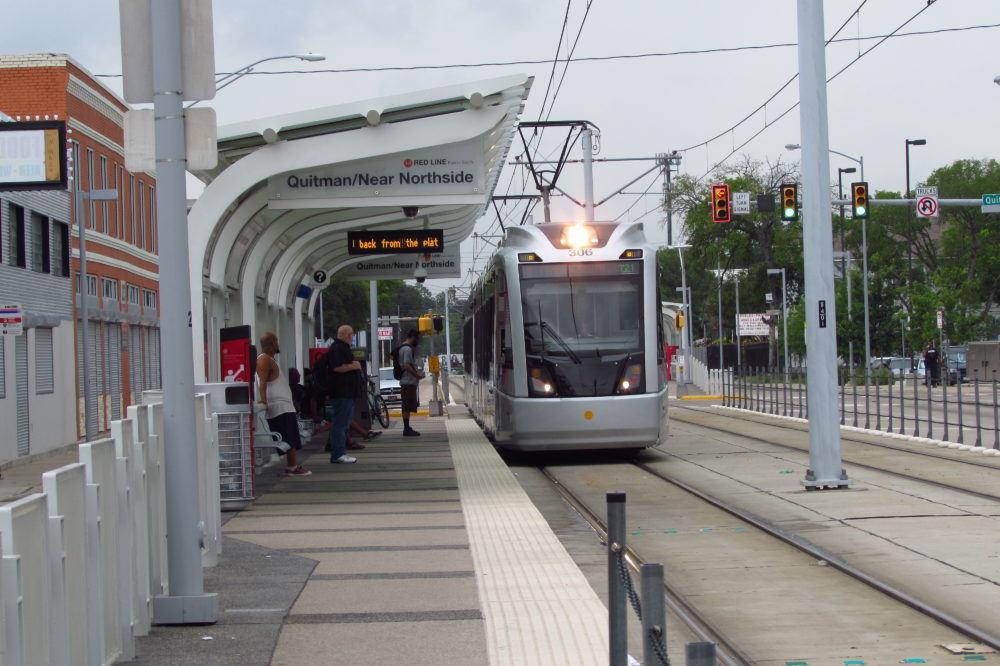
There is a light rail system, called METRORail, but you probably won't need it to get from a downtown hotel to the arena. One zone is $1.25, and the price rises to $4.50 for 4 zones, so a daypass is a better bargain at $3.00.
Going In. In 1965, the Astrodome opened, and was nicknamed "The Eighth Wonder of the World." It sure didn't seem like an exaggeration: The first roofed sports stadium in the world. (Supposedly, the Romans built stadia with canvas roofs, but that's hardly the same thing.) The Astros played there until 1999, and then moved into Enron Field/Minute Maid Park for the 2000 season.

The AFL/NFL's Oilers played at the Astrodome from 1968 to 1996, when, with the "Luv Ya Blue" days long over and the "House of Pain" era already concluded, they moved to Tennessee to become the Titans. The 1st team named the Houston Texans played the 1974 World Football League season there. And the USFL's Gamblers played there in 1984 and 1985.

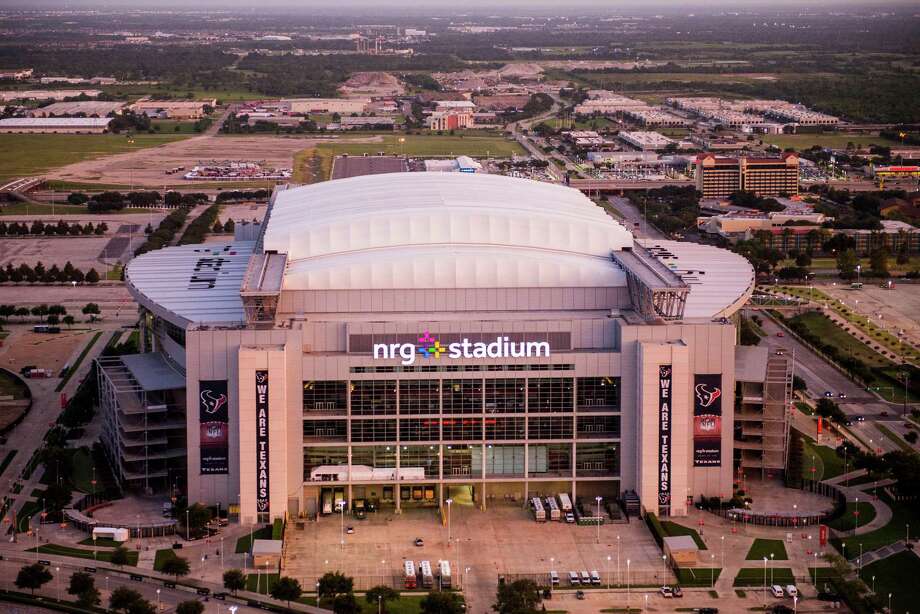
In 2002, the new NFL team, the Houston Texans, began play next-door to the Astrodome, just to the west, at Reliant Stadium, renamed NRG Stadium for the Houston-based energy company in 2014. Like Minute Maid Park, it has a retractable roof. Suddenly, the mostly-vacant Astrodome seemed, as one writer put it, like a relic of a future that never came to be. (This same writer said the same thing of Shea Stadium and, across Roosevelt Avenue, the surviving structures of the 1964 World's Fair.)
As you can see, the new stadium dwarfs the old one.

The NRG complex, including the Astrodome, is at 8400 Kirby Drive at Reliant Parkway -- about 9 miles southwest of downtown -- although the stadium's official address is One NRG Parkway. Reliant Park station on METRORail.

Once, the Astrodome was flashy enough to be the site of movies like The Bad News Bears in Breaking Training and Murder at the World Series. (Both were released in 1977. In the latter, the Astros, who had never yet gotten close to a Pennant, played the Series against the Oakland Athletics, who had just gotten fire-sold by owner Charlie Finley.)

The Astrodome also hosted the legendary 1968 college basketball game between Number 1 UCLA (with Kareem Abdul-Jabbar, then still Lew Alcindor) and Number 2 University of Houston (whose Elvin Hayes led them to victory, before UCLA got revenge in that year's Final Four); the 1971 NCAA Final Four, with UCLA defeating Villanova in the Final; and the cheese-tastic 1973 tennis match between Billie Jean King and Bobby Riggs, the "Battle of the Sexes."

The Astrodome hosted 3 fights for the Heavyweight Champion of the World, with the defending Champion winning all 3 by knockout: Muhammad Ali over Cleveland Williams on November 14, 1966; Ali over Ernie Terrell on February 6, 1967; and Larry Holmes over Randall "Tex" Cobb on November 26, 1982.

Elvis Presley sang there on February 27, 28 and March 1, 1970 and on March 3, 1974. It hosted Selena's last big concert before her murder in 1995, and when Jennifer Lopez starred in the film Selena, it was used for the re-creation. In 2004, the same year NRG (then Reliant) Stadium hosted the Super Bowl (which was won by... Janet Jackson, I think), the Astrodome was used to film a high school football playoff for the film version of Friday Night Lights; the old Astros division title banners can be clearly seen.

Today, though, the Astrodome seems, like the Republican Party that held a ridiculously bigoted Convention there in 1992, stuck in the past, and not just because they renominated failed President George H.W. Bush.

The former Eighth Wonder of the World is now nicknamed the Lonely Landmark, and while it served as a shelter for people displaced from New Orleans by Hurricane Katrina in 2005, since 2008, when it was hit with numerous code violations, only maintenance workers and security guards had been allowed to enter. With Harris County's recent decision to scrap of the Astrodome Revitalization Project, there is no current plan as to what to do with the Astrodome.

NRG Stadium was built roughly on the site of Colt Stadium, which was the baseball team's home in their first 3 seasons, 1962, '63 and '64, when they were known as the Houston Colt .45's (spelled with the apostrophe), before moving into the dome and changing the name of the team. Astrohall, built in 1971, was torn down in 2002 to make way for parking for the new stadium (which, after all, was built on Astrodome parking).

The climate-controlled Astrodome was necessary because of not just the heat and the humidity, but because of the mosquitoes. Later, seeing the artificial turf that was laid in the Astrodome for 1966 after the grass died in the first season, due to the skylights in the dome having to be painted due to the players losing the ball in the sun, Koufax, he of the mosquito quip, said, "I was one of those guys who pitched without a cup. I wouldn't do it on this stuff." And Dick Allen of the Philadelphia Phillies, looking at the first artificial field in baseball history, said, "If a horse can't eat it, I don't want to play on it."

The Astrodome hosted a 1988 match between the national soccer teams of the U.S. and Ecuador, which Ecuador won. NRG Stadium has hosted 2 such matches, a 2008 draw with Mexico and a 2011 win over Panama. The Mexico team has made it a home-away-from-home, playing 10 matches there between 2003 and 2013. The stadium hosted the 2010 MLS All-Star Game, in which a team of MLS players lost to Manchester United.

NRG Stadium hosts the annual Texas Bowl, which more or less replaced the Bluebonnet Bowl, formerly an Astrodome fixture. It hosted the Final Four in 2011, when Connecticut beat Butler in the Final. It hosted the Final Four again in 2016, with Villanova beating North Carolina in a thriller of a Final.

NRG Stadium hosted the Final Four in 2011 (Connecticut beating Butler in the Final), and earlier this year (Villanova beating North Carolina). It hosted Super Bowl LI in 2017, with (take your pick: The Atlanta Falcons choking, or the New England Patriots cheating). It hosted 4 games each in the CONCACAF Gold Cups of 2005 and 2007, and 2 games each in that tournament in 2009, 2011, 2019 and 2021.

It will host the 2023 NCAA Final Four and the 2023-24 College Football National Championship Game, and it has been selected by the U.S. Soccer Federation as a finalist to be one of the host venues for the 2026 World Cup. (UPDATE: FIFA approved it as a venue.)

Since the Astrodome is to the east of NRG Stadium, that's the side of the stadium on which you are least likely to enter. If you come in from METRORail, you will have a half-mile walk west on Reliant Parkway, and you will most likely enter from the north gate. And I recommend METRORail, because parking is a whopping $33. Tailgating is permitted, within the rules as spelled out on the Texans' website.
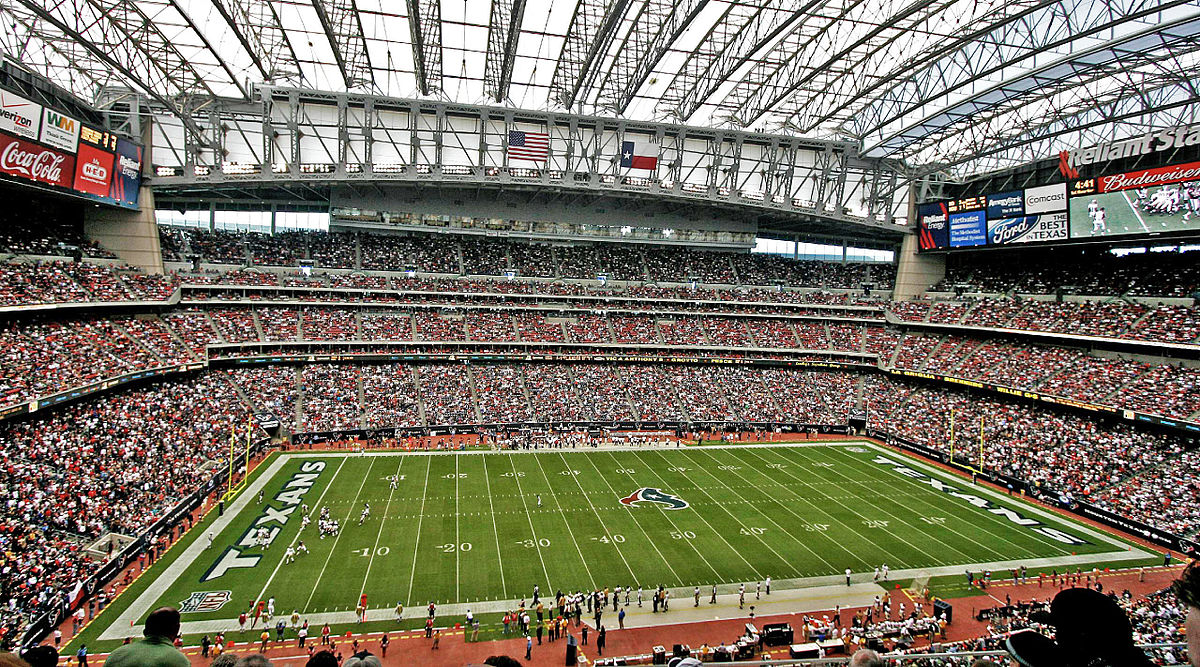
The field has always been artificial, despite the retractable roof, and is laid out north-to-south, like most football fields, even though closing the roof makes this due-to-the-sun setup unnecessary.
On September 12, 2017, Thrillist had an article ranking all 31 NFL stadiums. NRG Stadium ranked 14th, in the top half:

Built to function as an intimate indoor arena but have the feel of the open air, the stadium rocks open-to-the-field concourses... Two colossal, 50-feet-by-277-feet HD screens sit pretty above each end zone, pumping up a crowd that admittedly plays home to a mixed bag of NFL fans (is anyone actually from Houston?). You’ll find the loudest home-team crew in the "Bull Pen," a raucous bleacher section behind the north end zone.

Food. Being a "Wild West" city, you might expect Houston to have Western-themed stands with "real American food" at its stadium. Being a Southern State, you might also expect to have barbecue. And you would be right on both counts.

Unfortunately, a major feature of NRG Stadium concessions is Papa John's Pizza. I understand Texas not caring that Papa John is a racist, and a bastard to his employees, but they should at least care enough not to promote Peyton Manning, an AFC South Division rival quarterback!

They also have several stands each for Quizno Subs, Menchie's Frozen Yogurt, 5 Star Dogs (hot dogs), and a few other chains whose logos I can't quite make out on their map.

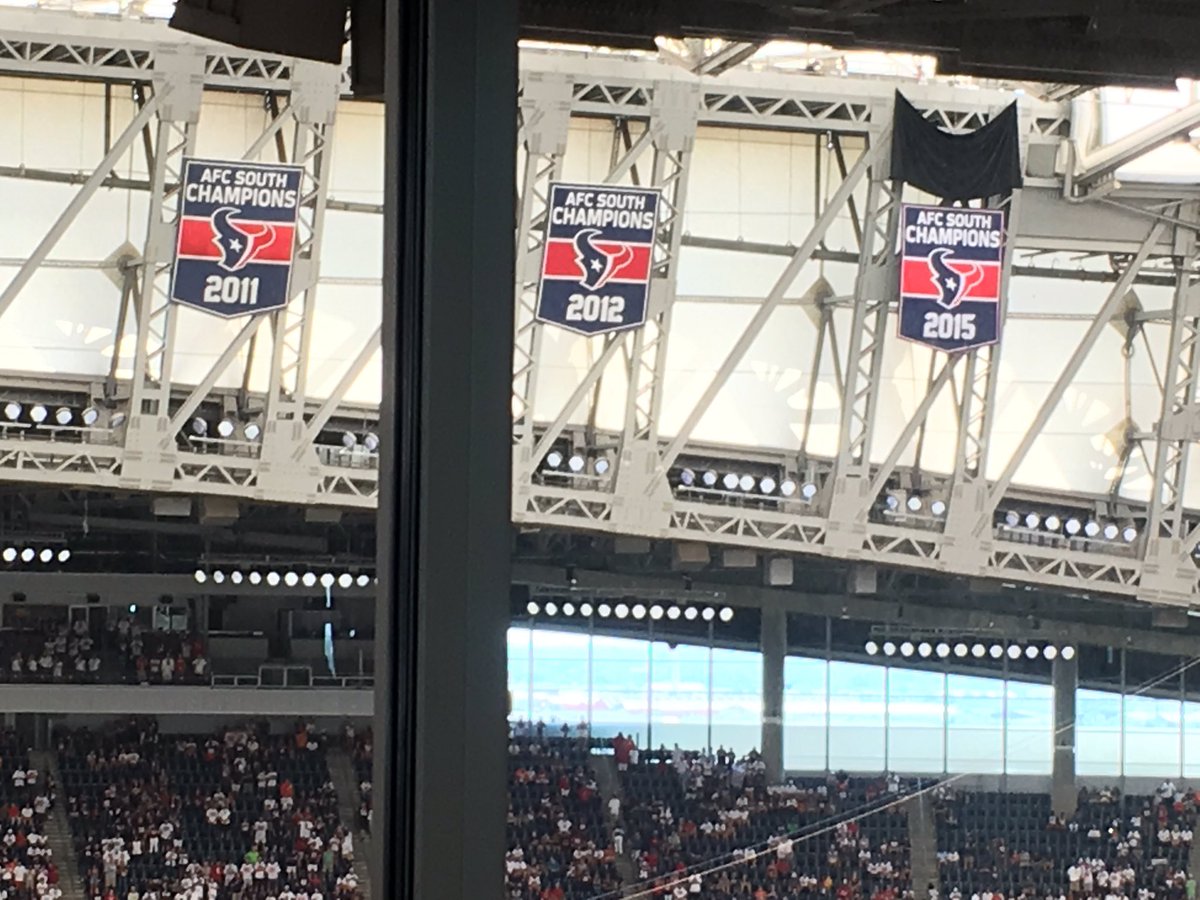
Team History Displays. The Texans were founded in 2002. Barring a move in the next few years, they will remain, by any way you measure it, the NFL's newest team. So there isn't much history to display. They won the AFC South Division 6 times in a 9-year span: 2011, 2012, 2015, 2016, 2018 and 2019, but fell apart last year, and are doing poorly this season as well.
So far, though, they haven't had any players good enough to get their uniform numbers retired or be elected to the Pro Football Hall of Fame (except for Ed Reed, who only played his last season, 2013, in Houston), nor named to the NFL Network's 2010 broadcast of its 100 Greatest Players. Maybe J.J. Watt, Number 99, will be the 1st. Shane Lechler, a punter, was named to the NFL's 100th Anniversary Team, but he spent considerably more seasons with the Oakland Raiders.

They did establish a Ring of Honor in 2017, and their 1st honoree was 2003-14 wide receiver Andre Johnson, though his Number 80 remains in circulation. Founding owner Bob McNair (1999-2018) has also been added.
Most of Houston's pro football history is wrapped up in the Oilers. George Blanda, Charlie Hennigan, George Webster, Miller Farr and Bob Talamini were named to the AFL's All-Time Team. Ken Houston and Billy "White Shoes" Johnson were named to the NFL's 75th Anniversary Team in 1994. Blanda, Ken Houston and Earl Campbell were named to The Sporting News' 100 Greatest Football Players in 1999. Campbell and Bruce Matthews were named to the aforementioned NFL Network's 100 Greatest Players. Campbell, Mathews, Houston and Johnson were named to the NFL's 100th Anniversary Team.

The Pro Football Hall of Fame includes Oilers Blanda, Ken Houston, Campbell, 1970s defensive end Elvin Bethea, early 1970s receiver Charlie Joiner (later to star with the San Diego Chargers), 1970s defensive tackler Curley Culp, late 1970s and early '80s linebacker Robert Brazile, early 1980s tight end Dave Casper (better remembered as a Raider), 1980s guard Mike Munchak, 1980s and early '90s offensive lineman Bruce Matthews, and late '80s and early '90s quarterback Warren Moon. And Jim Kelly, later to reach the Hall of Fame as the quarterback for the Buffalo Bills, starred for the USFL's Houston Gamblers. But there is no display at NRG Stadium honoring ex-Oilers or ex-Gamblers.

Despite being the NFL's newest franchise, the Texans have already had 3 Heisman Trophy winners: Running back Ron Dayne (1999 Wisconsin, with the Texans in 2006 and '07), quarterback Matt Leinart (2004 USC, 2010 and '11), and running back Mark Ingram (2009 Alabama, 7 games in 2021).

The Oilers had 4 before moving to Tennessee, all running backs: Billy Cannon (1959 Louisiana State, 1960-63), Texas (but North) native Earl Campbell (1977 Texas, 1978-84), Mike Rozier (1983 Nebraska, 1985-90) and Eddie George (1995 Ohio State, 1996 and moved with them to Tennessee the next year). Dayne (Pine Hill) and Rozier (Camden) are both from Camden County, New Jersey; George is from the other side of Philadelphia, in Abington, Pennsylvania.

The Governor's Cup, formerly awarded to the winner of the Oilers-Cowboys game, has been restored for the winner of the Texans-Cowboys game. The Cowboys lead the regular season series with the Texans, 3-2. Counting games against the Oilers, the count is 18-13 in Dallas' favor.

Stuff. The Go Texans Store is in the southeastern corner of the stadium. The usual NFL fan gear can be found there. Since this is Texas, you might find cowboy hats, boots or belt buckles with the Texans logo on them.

As the NFL's newest team, books about the Texans are few and far between. Museum of Fine Harts Houston curator Anne Wilkes Tucker and legendary Houston sportswriter (first for the defunct Houston Post, now for the Chronicle) Mickey Herskowitz collaborated on First Down, Houston: The Birth of an NFL Franchise in 2002 and '03. Other than that, probably the best you can get is The Story of the Houston Texans by Gordon Pueschner, which came out in time for the 2009 season, thus missing the closest thing the Texans have yet had to "glory days."

As far team videos, you're out of luck: No Super Bowl win means no commemorative highlight video of either the game or the season; and, being a franchise whose last anniversary was their 10th, and whose greatest moment to date is a pair of wins in the Wild Card round of the Playoffs, an anniversary DVD would, for the moment, be a bit silly.

During the Game. A recent Thrillist article on "The Most Obnoxious Fans In the NFL" ranked Texans fans 27th -- that is, the 6th-least obnoxious:

You know that King of the Hill episode where Hank and the gang kinda grudgingly go watch the Texans practice because it’s a lot closer than the Cowboys and they figure, hey, it’s football? There’s your fanbase. No, they’re not America’s Team. No, they’re not Texas’ team -- that one wears burnt orange. Hell, they’re not even Houston’s team, since THAT team plays in Nashville. But, hey, it’s a big city, and it's football, and it’s an excuse to go grill something on a Sunday, so why not? And since you're all just kind of Texans fans by default, nobody gets too worked up about things.

I guess when you've only been around for 14 seasons, and the closest opposing team (the Dallas Cowboys) isn't a Division opponent, and you haven't had a shocking Playoff moment (in your favor or not), it doesn't bring up much nastiness.

From September 1 to 7, 2017, at the beginning of the NFL National Anthem protest controversy,
FiveThirtyEight.com polled fans of the 32 NFL teams, to see where they leaned politically. Texans fans were said to be 5 percent more conservative than liberal, 2nd only to Tampa Bay.

If you were wearing Dallas Cowboy gear, or gear of the ex-Oilers, now the Tennessee Titans (who are an AFC South opponent), to a Houston Texans game, you might be in trouble. But Texans fans aren't especially hostile to New Yorkers, so safety won't be an issue.

The Texans' mascot is Toro the Bull. The Texans hold auditions instead of having a regular National Anthem singer. Their pregame introduction song is "Thunderstruck" by AC/DC. Their theme song is "It's Football Time In Houston" by country-signing native Clay Walker, their fight song is "Battle Red," their defense's theme song is "Bulls On Parade" by Rage Against the Machine (I'll bet that leftist band goes over really well in rural Texas), and an unofficial rap song titled "Houston" was recorded by locals Slim Thug, Paul Wall and ZRo, getting over 1 million YouTube views. But the team does not appear to have a postgame victory song.
Houston's mascots, left to right: Clutch the Bear of the Rockets,
Dynamo the Fox of the Dynamo, Toro the Bull of the Texans,
and Orbit the Alien of the Astros.

The north end zone is the home of the Bull Pen, an attempt to mimic student sections at college football games. (I'd suggest soccer "ultras," but, in spite of back-to-back MLS Cups by the Dynamo, Houstonians might not get the reference.) They shout their players' last names during team introductions, shout, "Houston... Texans!" after each first down, and even have their own Pep Band. I guess, when (to borrow a saying from English soccer) "You ain't got no history," you come up with your own traditions.

After the Game. Houston is a comparatively low-crime city, and as long as you behave yourself, the home fans will probably behave themselves, win or lose.

There's a Starbucks at NRG Center, the convention center, to the northeast of the stadium. Other than that, the closest restaurants are a Denny's at Main Street and South Loop West Freeway (the service road for Houston's beltway, Interstate 610), and, where Old Spanish Trail splits from Main Street, an Olive Garden, a Chipotle and a Sonic.

I had hoped to find a listing for bars for New Yorkers living in the Houston area, but the previous options I had listed have since closed, probably due to COVID.

If your visit to Houston is during the European soccer season (which we are now in), and you want to watch your favorite club play, the best place to do so is Hugh O'Connor's, at the Marq-E Entertainment Center (a mall), 7620 Katy Freeway (Interstate 10), about 8 miles west of downtown. Bus 85 to Northwest Transit Center, then a half-hour walk.

Sidelights. On November 30, 2018, Thrillist published a list of "America's 25 Most Fun Cities," and Houston came in 18th. On February 3, 2017, Thrillist made a list ranking the 30 NFL cities (New York and Los Angeles each having 2 teams), and Houston came in 16th, just on the bottom side of the halfway mark. They wrote: 

If you're going to eat meat, be it steak or ribs or burgers or kolaches filled with sausage, there is nary a better city in this country to get down in. If you're going to sit in traffic in the worst humidity I've ever experienced outside of a rainforest (I went to a rainforest once, NBD) in a city that would give LA a run for its money in sprawl, Houston is also very good at that. 

Houston's sports history is pretty much wrapped up in the decaying corpse of the Astrodome, whose history I've already discussed. But there are other sites worth mentioning.

* Minute Maid Park. The new home of the Astros opened in 2000, at 501 Crawford Street, attached to Union Station. The Astros were able to play on God's own grass for the 1st time since 1965, and under God's own sky for the 1st time since 1964. They have now reached the postseason there 4 times: The 2001 National League Division Series, the 2004 NL Championship Series, the 2005 World Series, and the 2015 American League Division Series. Preston Station on METRORail.

* Site of Sam Houston Coliseum. The Houston Aeros, with Gordie Howe and his sons Mark and Marty, won the World Hockey Association championships of 1974 and 1975, while playing here, before moving into the Summit in 1975 and folding in 1978. Elvis sang there on October 13, 1956, and the Beatles played there on August 19, 1965. It was built in 1937 and demolished in 1998.

It replaced Sam Houston Hall, where the 1928 Democratic Convention nominated Governor Alfred E. Smith of New York, who thus became the 1st Catholic nominated for President by a major party.

The Hobby Center for the Performing Arts is now on the site. 801 Bagby Street, at Rusk Street, downtown.

With even the minor-league Aeros gone, the closest NHL team to Houston is the Dallas Stars, 242 miles away, although some Houstonians would rather vote for a gay black Democrat than root for a Dallas team. If Houston ever did get an NHL team, it would rank 11th in population among NHL markets.

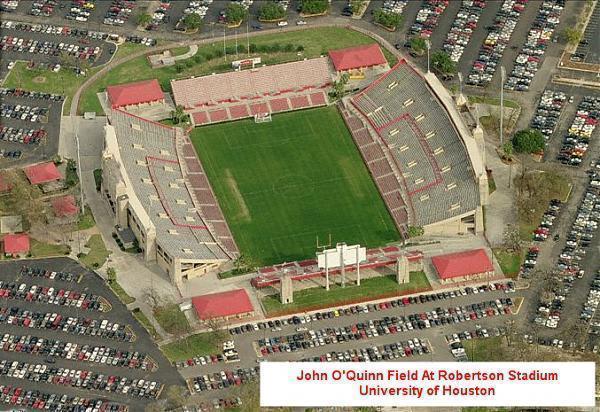
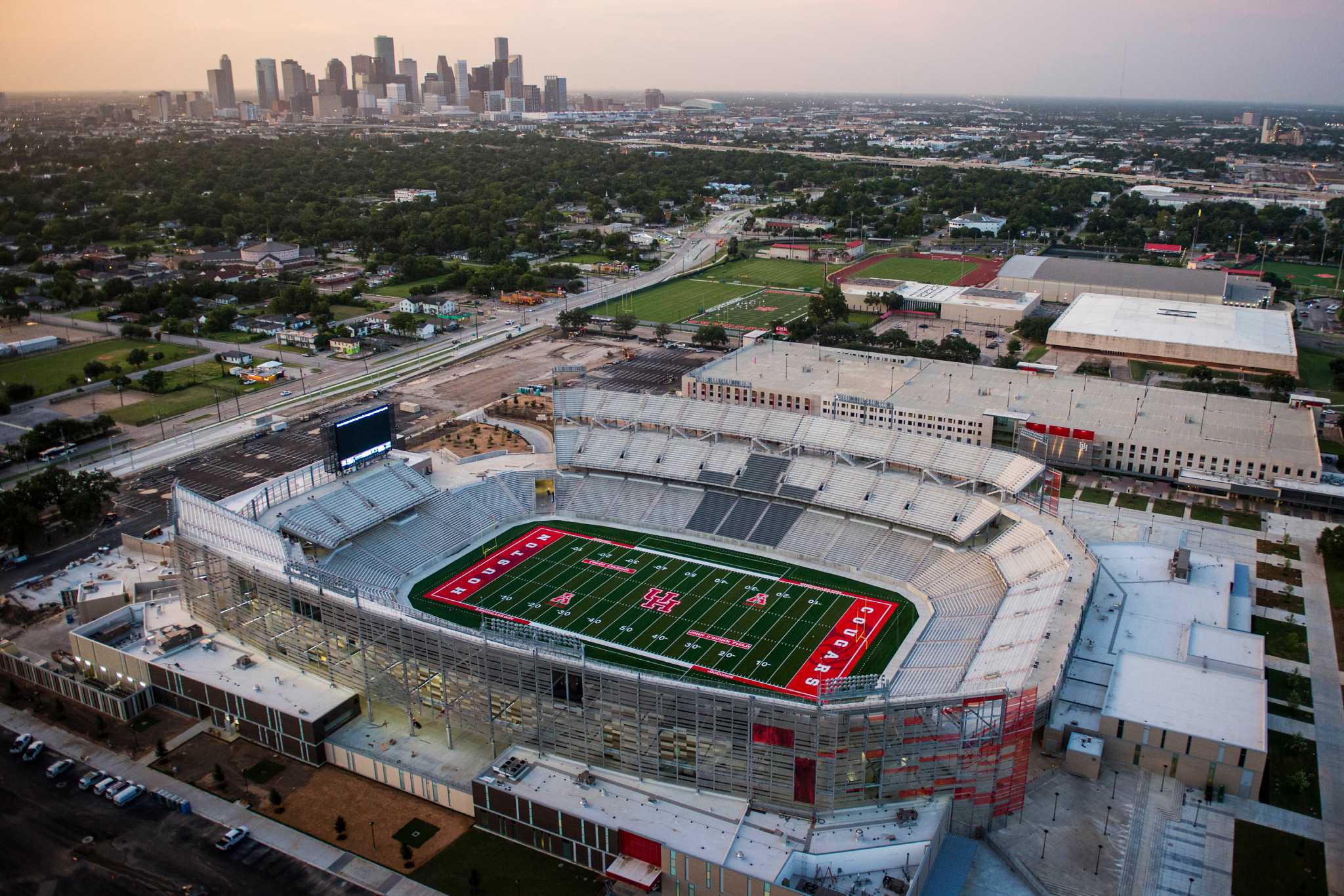
* TDECU Stadium and site of Jeppesen/Robertson Stadium. The Houston Oilers played at Jeppesen Stadium from 1960 to 1964. They won the 1960 AFL Championship Game there, won the 1961 title game on the road, and lost the 1962 title game there -- and, as the Oilers and the Tennessee Titans, haven't gone as far as the rules allowed them to since 1961.
Built in 1942, it became Robertson Stadium, and was the former home of the University of Houston football team and the former home of MLS' Houston Dynamo, who won the 2006 and 2007 MLS Cups while playing there. The new John O'Quinn Field at TDECU Stadium (named for Texas Dow Employees Credit Union) has been built at the site. 3874 Holman Street at Cullen Blvd., 4 miles southeast of downtown. Number 52 bus.
* PNC Stadium. Formerly known as BBVA Compass Stadium, the home of the Dynamo and the National Women's Soccer League's Houston Dash opened in 2012 at 2200 Texas Avenue at Dowling Street, within walking distance of downtown. It is also the home field of the football team at Texas Southern University, which won the National Championship of black college football in 1952 and 2010.

On January 29, 2013, it hosted its first U.S. national team match, a draw with Canada. The U.S. women's team beat Mexico 6-2 there on April 8, 2018. It hosted 2 games of the CONCACAF Gold Cup in 2013 and 2017. The USMNT played there again on March 26, 2019, a 1-1 draw in a friendly with Chile. It hosted 6 games of the 2021 CONCACAF Gold Cup. 

* Rice Stadium. Home of Rice University football since 1950, the Oilers played the 1965, '66 and '67 seasons here. Although probably already obsolete by the 1973 season, it seated a lot more people than did the Astrodome, and so Super Bowl VIII was played there, and the Miami Dolphins won it -- and haven't won a Super Bowl since.
It has been significantly renovated, and now seats 47,000, down from the 71,882 that crammed in for the Super Bowl on January 13, 1974. University Blvd. at Greenbriar Street, although the mailing address is 6100 S. Main Street, 5 miles southwest of downtown. METRORail to Dryden/TMC, then walk or Number 084 bus.

* Site of Buffalo Stadium. Before there were the Astros, or even the Colt .45's, there were the Houston Buffaloes. The Buffs played at Buffalo Stadium, a.k.a. Buff Stadium, for most of their history, from 1928 to 1961, when the Colt .45's made them obsolete.

They were a farm team of the St. Louis Cardinals, and as a result in its last years Buff Stadium was renamed Busch Stadium. The Cardinal teams of the 1930s that would be known as the "Gashouse Gang" came together in Houston, with Dizzy and Daffy Dean, Joe Medwick, Pepper Martin and Enos Slaughter. Later Buff stars included Cleveland Indians 3rd baseman Al Rosen, Pittsburgh Pirates pitcher Wilmer "Vinegar Bend" Mizell, Negro League legend Willard Brown, Cardinal MVP Ken Boyer, and Phillies shortstop Ruben Amaro Sr.

Wanting to lure in more customers but also to beat the infamous Houston heat, lights were installed in 1930, 5 years before any major league park had them. The Buffs won 8 Texas League Pennants: 1928, 1931, 1940, 1947, 1951, 1954, 1956 and 1957. The stadium was at the southwest corner of Leeland Street & Cullen Blvd., about 2 1/2 miles southeast of downtown. A furniture store is on the site now. Number 20 bus.

* Toyota Center. The new home of the NBA's Rockets replaced the Summit. It took 8 years from Rockets owner Les Alexander's demand for a new arena until first tipoff, in which time NBA Commissioner David Stern announced that the Rockets would have to move without a new arena (not that there was anything wrong with the Summit, aside from a low number of luxury boxes), and NHL Comissioner Gary Bettman announced that Houston would not get an NHL team. But tip off the Rockets did, on October 30, 2003.

It's hosted the Rockets ever since, the WNBA's Houston Comets from 2003 until they folded after the 2007 season, and the Houston Aeros of the American Hockey League (not the old WHA team of the same name) from 2003 until 2013, when their parent club, the Minnesota Wild, moved them to Des Moines, where they became the Iowa Wild. It's also hosted wrestling, Ultimate Fighting, concerts (including by Houston native Beyoncé, both with and without the rest of Destiny's Child) and the Latin Grammys.

1510 Polk Street, also bounded by Jackson, Bell and La Branch Streets. It's downtown, 5 blocks east of Main Street and the light rail, with Bell Street the closest station.

* The Summit. Before the Toyota Center, the Rockets played at The Summit, later known as the Compaq Center, from 1975 to 2003, and the Comets from 1997 to 2003. Elvis sang at The Summit on August 28, 1976. It's been converted into the Lakewood Church Central Campus, a megachurch presided over by Dr. Joel Osteen. 3700 Southwest Freeway at Timmons Lane. Number 53 bus.

Before that, between their 1971 move from San Diego and the 1975 opening of The Summit, they played some home games at the Astrodome, some at the Astrohall, some at the Sam Houston Coliseum, and some at the Hofheinz Pavilion.

There's another notable sports site in Houston: The U.S. Military Entry Processing Station, in the Customs House, where Muhammad Ali, then living and training in Houston, had to report to fulfill his draft obligation. He did report there, on April 28, 1967, and refused to be drafted. (To be fair, they did call his birth name, Cassius Clay, not his legal name, Muhammad Ali.) Ali was convicted of draft evasion and stripped of the Heavyweight Title. He stayed out of prison on appeal, and the case went all the way to the Supreme Court, which overturned the conviction.

The Customs House is still standing, and still used in part by the U.S. Department of Defense. 701 San Jacinto Street. Central Station on METRORail.

In addition to the preceding, Elvis sang at Hofheinz Pavilion on November 12, 1971; and June 4 and 5, 1975. He also sang at the City Auditorium on October 8, 1955 and April 21, 1956. It's better known as the venue where R&B singer Johnny Ace mistakenly shot himself before a show on Christmas Day, December 25, 1955. The Jones Hall for the Performing Arts replaced it in 1966. 615 Louisiana Street at Capitol Street, downtown.

Also, early in his career, Elvis sang in Houston at the Paladium Club (8100 S. Main Street, near the Astrocomplex) on November 26, 27 and 28, 1954; Cook's Hoedown (603 Capitol Street, around the corner from Jones Hall) on November 27 and December 28, 1954, and April 24 and August 7, 1955; Magnolia Gardens (12044 Riverside Street, no public transit) on April 24, May 22, June 19 and August 7, 1955; and Eagles Hall at 2204 Louisiana Street on January 1 and March 19, 1955 (2204 Louisiana Street, downtown). All of these have since been demolished.

Elvis sang near the University of Texas campus in Austin, 160 miles to the northwest, at Dessau Hall on March 17, 1955, the Sportscenter on August 25, 1955, the Skyline Club on January 18, 1956, and the Municipal Auditorium on March 28, 1977. And he sang near the Texas A&M campus, 100 miles to the northwest, at the Rodeo Grounds in Bryan on August 23, 1955 and the G. Rolle White Coliseum in College Station on October 3, 1955;

Elvis also sang in South Texas at the City Auditorium in Beaumont, 85 miles to the northeast, on June 20 and 21, 1955 and January 17, 1956; at the football stadium at Conroe High School, 40 miles to the north, on August 24, 1955; in Corpus Christi, 200 miles to the southwest, at the Hoedown Club on July 3, 1955 and the Memorial Coliseum on April 16, 1956; in Galveston, 50 miles to the southeast, at the City Auditorium on January 16, 1956; at the baseball field in Gonzales, 130 miles to the west, on August 26, 1955; at Woodrow Wilson High School in Port Arthur, 90 miles to the east on November 25, 1955; and at Southwest Texas State University (LBJ's alma mater, now "Texas State"), 165 miles to the west, on October 6, 1955.

There are other places that might be considered "South Texas" where he sang, but I'll include them with "West Texas" when I do this for the San Antonio Spurs.

The tallest building in Houston, and in all of Texas, is the JPMorgan Chase Tower, formerly the Texas Commerce Tower. It was built in 1982 at 600 Travis Street at Texas Avenue, downtown, and stands 1,002 feet tall, rising 75 stories above the concrete over the bayou. It is the tallest 5-sided building in the world.

Houston's version of New York's American Museum of Natural History is the Houston Museum of Natural Science, in Hermann Park, at Main Street and Hermann Park Drive. The Sam Houston Monument is a few steps away. The Houston Museum of Fine Arts is at 1001 Bissonnet Street, just 5 blocks away. Both can be reached by the Number 700 bus.

Of course, the name "Houston" is most connected with two things: Its namesake, the legendary Senator, Governor and war hero Sam Houston; and the Johnson Space Center, the NASA control center named after President Lyndon B. Johnson, who, as Senate Majority Leader, wrote the bill creating NASA and the Space Center, because he thought it would bring a lot of jobs and money to Houston (and he was right).

Aside from his Monument, most historic sites relating to Sam are not in the city that bears his name. As for reaching the Johnson Space Center, it's at 1601 NASA Parkway and Saturn Lane. The Number 249 bus goes there, so if you don't have a car, Houston, you won't have a problem.

Although Houston is the post-Presidential home for George H.W. Bush, his Presidential Library is at Texas A&M University, 100 miles away in College Station. I don't know the Bushes' address, and, in the interest of privacy, I wouldn't print it here if I did. Former First Lady Barbara Bush died on April 17, 2018; and George followed on November 30. Both were buried at the Library at TAMU. As a former baseball player, Bush is the only President so far who had his Library designed by HOK, designer of several sports facilities including our own MetLife Stadium.

The Alley Theatre, downtown at 615 Texas Avenue, opened in 1968, and in 1976 hosted the Vice Presidential debate between Senators Walter Mondale and Bob Dole. This is where Dole named World War I, World War II, and the Korean and Vietnam Wars as "all Democrat wars" -- forgetting that the Republicans wanted America to get into all but World War II, and didn't want that one because they liked the Nazis' anti-union status; and that it was actually the Republicans who got us into Vietnam.

There have been a few TV shows set in Houston, but the only one that lasted was Reba, starring country singer Reba McIntire. But it was filmed in Los Angeles, so if you're a fan, you won't find the house in Houston.

Congressman Matthew Santos, a Houston native played by Jimmy Smits, was inaugurated as President on the last episode of The West Wing. Of interest to me was Outlaws, in which a sheriff tried to capture his former gang, but all 5 of them were transported from 1899 to 1986. Realizing they needed each other, they teamed up, and, with the gold that was transported with them, they bought what they needed and formed a private detective agency. It lasted just 1 season.

Films set in Houston, in addition to the sports-themed ones, include Brewster McCloud (which also used the Astrodome), Logan's Run (which used the Houston Hyatt Regency for some scenes),
Telefon (set there but filmed in California), Terms of EndearmentReality Bites, and, perhaps most iconically, Urban Cowboy.

*

Houston can be hot, but it's a good sports town, and, best of all, it's not Dallas. So there can be a good old time in the hot town tonight.

How to Be a New York Basketball Fan In Atlanta -- 2021-22 Edition

The New York Knicks visit the Atlanta Hawks this coming Saturday, November 27; and again on January 15, 2022. The Brooklyn Nets do so on December 10 and April 2.

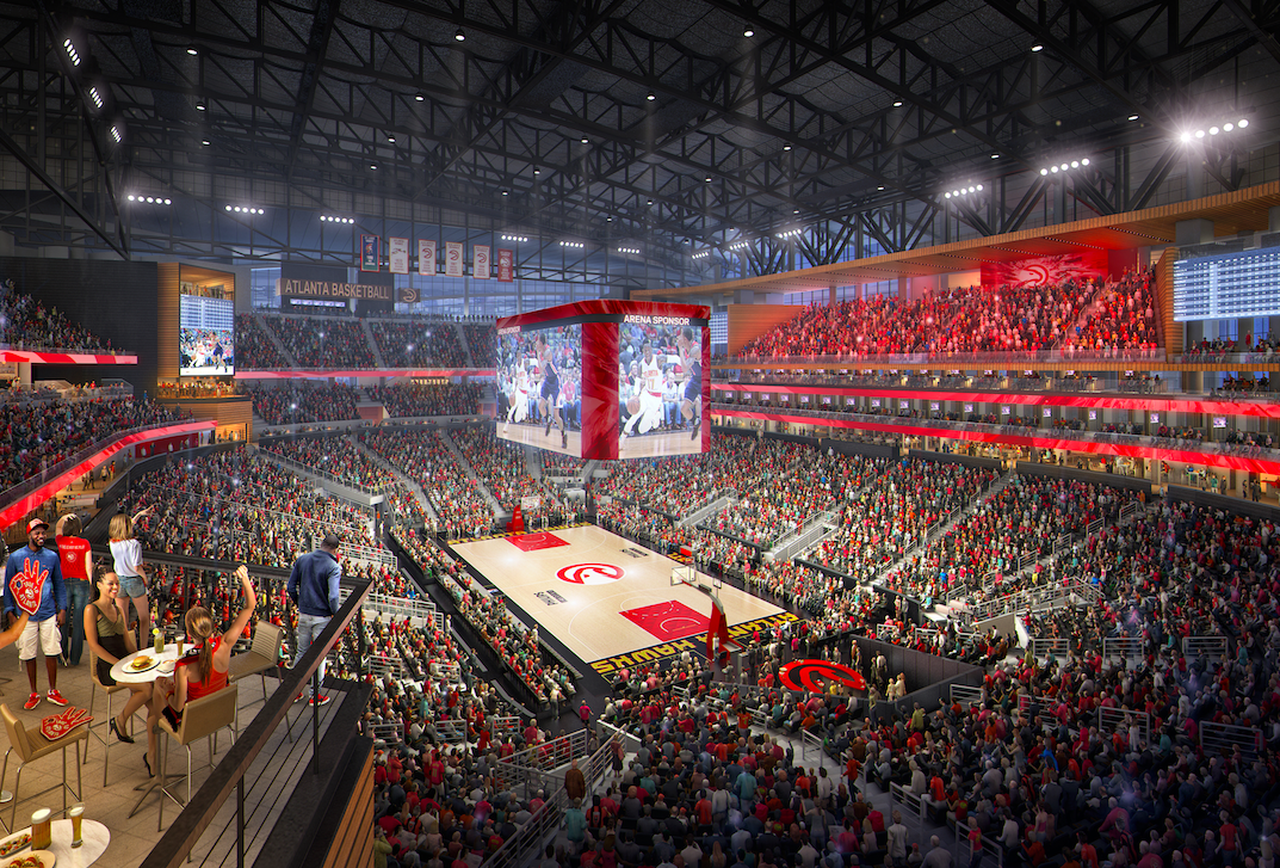
Knicks vs. Hawks isn't much of a rivalry. Nor is Nets vs. Hawks. But, since the Hawks have long struggled at the box office, due to their ineptitude and Atlanta's status as a city with a lot of transplants, this will be a good chance for fans of either New York City team to get another arena under their belts. However, the Hawks' unexpected strong season in 2020-21 makes getting another road win under your belt a little tougher.

Before You Go. Being well south of New York, Atlanta is usually warmer than we are. Granted, this won't make much of a difference during Thanksgiving week, and with an indoor sport, but you should still be aware. Check the website of the Atlanta Journal-Constitution (used to be 2 papers, now 1) before you go. For the moment, they're predicting low 60s for the afternoon, and high 30s for the evening. Bring a jacket, just in case.

Although Georgia, a.k.a. The Heart of the South, seceded from the Union in 1861, it was readmitted in 1870. You do not need a passport, and you don't need to change your U.S. dollars into Confederate money. And it's in the Eastern Time Zone, so you don't have to fiddle with your watch or your phone clock. Do keep in mind, though: They think you talk as funny as you think they do.

Tickets. The Hawks averaged 15,931 fans per home game in 2019-20, about 94 percent of capacity, before COVID shut everything down. Given last season's Playoff run, you can probably throw those figures out the window, and expect a tougher time getting tickets.

In the lower level, the 100 sections, tickets are $265 between the baskets, $155 behind them. In the 200 level, $89 between and $49 behind.

Getting There. Remember: This is Thanksgiving weekend. With increased demand for transit, the regular rules and prices may not apply.

It's 868 miles from Times Square in New York to Five Points, Atlanta's center of attention. Google Maps says the fastest way from New York to Atlanta by road is to take the Holland Tunnel to Interstate 78 to Harrisburg, then I-81 through the Appalachian Mountains, and then it gets complicated from there.

No, the best way to go, if you must drive, is to take the New Jersey Turnpike/I-95 all the way from New Jersey to Petersburg, Virginia. Exit 51 will put you on I-85 South, and that will take you right into Atlanta.

You'll be in New Jersey for about an hour and a half, Delaware for 20 minutes, Maryland for 2 hours, inside the Capital Beltway (Maryland, District of Columbia and Virginia) for half an hour if you're lucky (and don't make a rest stop anywhere near D.C.), Virginia for 3 hours, North Carolina for 4 hours, South Carolina for about an hour and 45 minutes, and Georgia outside I-285 (the beltway known as the Perimeter, the Atlanta Bypass or "the O around the A") for an hour and a half.

Throw in traffic in and around New York at one end, Washington in the middle, and Atlanta at the other end, and we're talking 16 hours. Throw in rest stops, preferably in Delaware, near Richmond, near Raleigh, and in South Carolina, and it'll be closer to 19 hours. Still wanna drive? Didn't think so.

Take the bus? Greyhound has 7 buses a day leaving from Port Authority to Atlanta, but only 2 of them are no-changeover routes. It costs as much as $400 round-trip, though it can be as low as $250 on advanced purchase. And, at 24 hours each way (usually including an hour-and-a-half stopover in Richmond, Virginia), it saves you no time. At least the station is downtown, at 232 Forsyth Street at Brotherton Street, by the Garnett station on the subway.

Take the train? Amtrak's New York-to-New Orleans train, the Crescent, leaves Penn Station at 2:15 PM and arrives in Atlanta at 8:43 the next morning. That's about 18 1/2 hours. It returns at 11:29 PM (meaning you could get in and out of Atlanta in 1 night) and arrives back in New York at 6:00 PM the next day. The round-trip fare is $895, due to the fact that coach seats are sold out and only roomettes are available. The station is at 1688 Peachtree Street NW at Deering Road, due north of downtown. From there, take the 110 bus into downtown.

Perhaps the best way to get from New York to Atlanta is by plane? If you book now, United Airlines can get you from Newark Liberty International Airport to Hartsfield-Jackson International Airport (named for 2 late Mayors of Atlanta), nonstop, for $457 round-trip. True, that's more expensive than the train, but 2½ hours each way beats the hell out of 18. The Metropolitan Atlanta Rapid Transit Authority (MARTA) Gold Line or Red Line subway from Hartsfield-Jackson to Five Points takes just half an hour.

(The airport is named for 2 Mayors. William B. Hartsfield served from 1942 to 1962, and got the airport built. Maynard H. Jackson Jr. was the city's 1st black Mayor, serving from 1974 to 1982, and again from 1990 to 1994, and he got a new terminal built at the airport.)

Once In the City. When you get to your hotel in Atlanta (and, let's face it, if you went all that way, you're not going down for a single 2-hour game and then going right back up the Eastern Seaboard), pick up a copy of the Journal-Constitution. It's a good paper with a very good sports section. The New York Times may also be available, but, chances are, the Daily News and the Post won't be.

Founded in 1837, and originally named "Terminus" because it was established as a railroad center, but later renamed because the railroad in question was the Atlantic-Pacific Railroad, Atlanta is a city of about 500,000 people (slightly more than Staten Island), in a metropolitan area of about 6.4 million (still less than 1/3rd the size of the New York Tri-State Area). The sales tax in Georgia is just 4 percent, but it's 5 percent in the City of Atlanta.
The State House

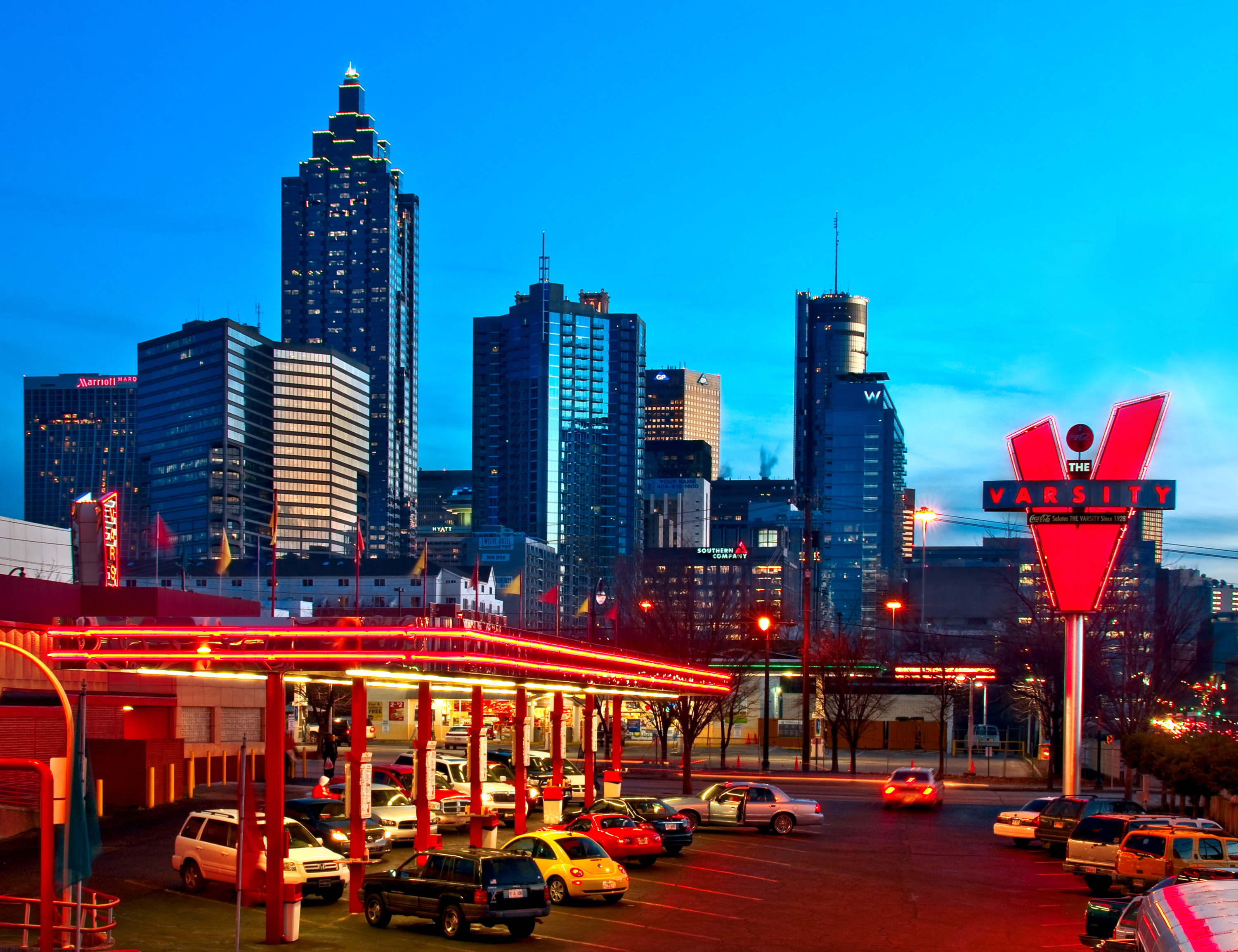
Be advised that a lot of streets are named Peachtree, which can confuse the hell out of you. Even worse, the city uses diagonal directions on its streets and street signs, much like Washington, D.C.: NW, NE, SE and SW. The street grid takes some odd angles, which will confuse you further. Five Points -- Peachtree Street, Marietta Street & Edgewood Avenue -- is the centerpoint of the city.

Coke ad atop the Olympia Building in the Five Points

A building boom in the 1980s gave the city some pretty big skyscrapers, so, while it won't seem quite as imposing as New York or Chicago, it will seem bigger than such National League cities as Cincinnati and St. Louis. The building currently named Bank of America Plaza, a.k.a. the Pencil Building because of its shape, is the tallest in the State of Georgia, at 1,033 feet. It stands at 600 Peachtree Street NE at North Avenue.

ZIP Codes in Georgia start with the digits 30 and 31, with Atlanta and its suburbs using 300 to 307. The Area Code for Atlanta is 404, with 770 surrounding it, and 678 overlaid. Atlanta's electricity is supplied by Georgia Power Company.

Atlanta became majority-black in the 1960, and is now the 4th-largest majority-black city: About 51 percent black, 41 percent white, 4 percent Hispanic and 3 percent Asian. The northern half of the city is mostly white, the southern half mostly black. As a major center for both black filmmaking and hip-hop, Atlanta is, essentially, the Black Hollywood.

Both the Hispanic and the Asian populations of the city have more than doubled since 2000. And, with 12.8 percent of the population willing to classify themselves as gay or bisexual, Atlanta has the 3rd-highest gay percentage of any major city in America, behind San Francisco and Seattle.

Which is not to say that Atlanta, and Georgia in general, have been free from strife. It's still the South. The Camilla Massacre in Camilla, southwest Georgia, on September 19, 1868 resulted in the deaths of 15 people, black and white alike, attempting to assist black people in voting during the post-Civil War period known as Reconstruction. Atlanta was struck by a race riot on September 22, 1906, killing 25 black people and 2 white people. A race riot struck Augusta, the eastern Georgia city that is home to the Masters golf tournament, on May 11, 1970, resulting in 6 deaths.

And, 15 miles east of Atlanta, Stone Mountain Park opened on April 14, 1865 -- 100 years to the day after Abraham Lincoln was shot, and that is no coincidence. In 1972, a sculpture was unveiled on its north face, showing Confederate President Jefferson Davis and Generals Robert E. Lee and Thomas "Stonewall" Jackson on horseback. The carving of these 3 traitors to the United States of America is larger than that of the 4 Presidents on Mount Rushmore in South Dakota.

One thing that people tend to forget: The movie Deliverance, with its psychopathic hillbillies, is often thought to take place in West Virginia. In fact, it's set in Georgia, and was filmed on the Chattooga River, which separates eastern Georgia from western South Carolina, and on both sides of the river.

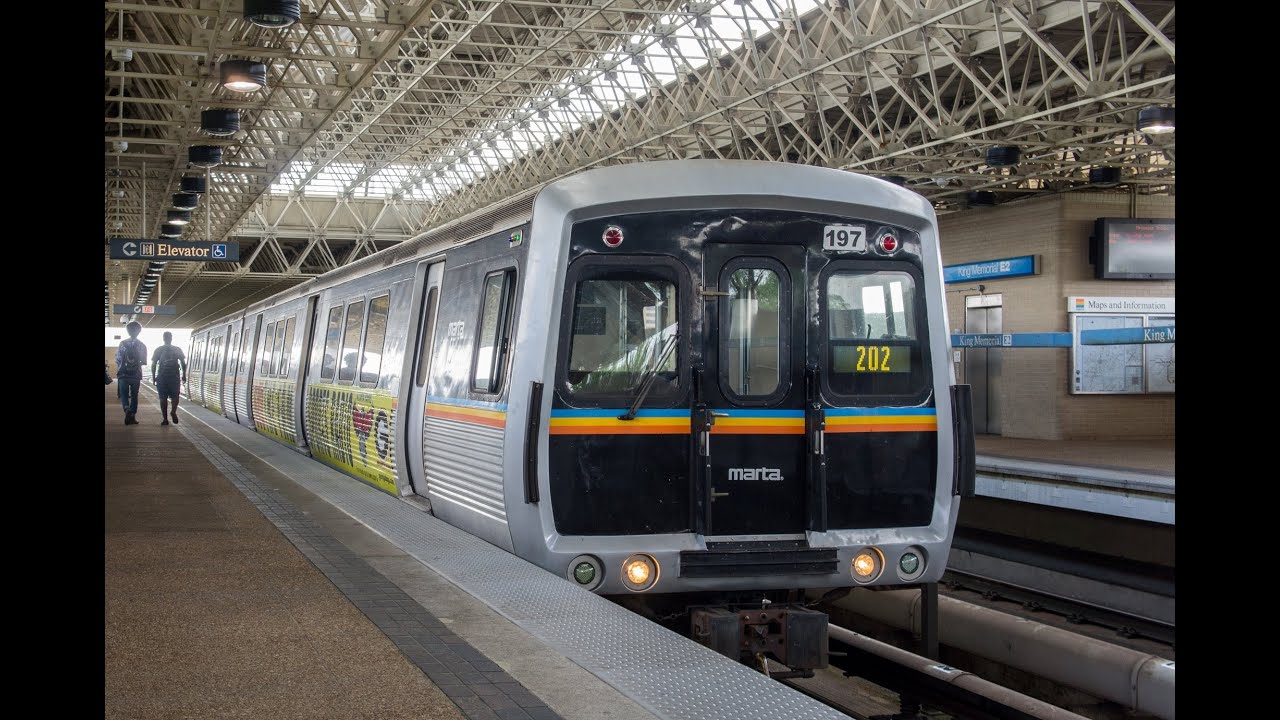
MARTA's 3-stripes logo of blue, yellow and orange is reminiscent of New Jersey Transit's blue, purple and orange. A single trip on any MARTA train is $2.50, now slightly cheaper than New York's. A 10-trip is no bargain at $25. The subway started running with tokens in 1979, and switched to farecards in 2006.
Atlanta has always been the cultural capital of the South, particularly of the "New South." In the 1950s, Mayor Hartsfield, knowing that he couldn't get investors in his city if it was believed to be racist, billed it as "the City Too Busy to Hate." And Atlanta is a majority-black city. Nevertheless, it is still in Georgia, which is still the South. There's still old touches, including the fixation on Gone With the Wind, and the fact that the State Flag, even after several redesigns, still resembles the actual flag of the Confederate States of America, "the Stars and Bars" (not the "Southern Cross," that was the Confederate Battle Flag).
Going In. State Farm Arena, named for the insurance company -- until 2018, named Philips Arena, named for the Dutch electronics company -- and opened in 1999 on the site of the former Hawks arena, The Omni, is part of the Georgia World Congress Center complex, at Marietta Street & Centennial Olympic Park Drive NW, which also includes the Georgia Dome, the site of the new Falcons' stadium and CNN headquarters.
The official address is 1 State Farm Drive, changed from Philips Drive at the same time as the arena. If you're driving, parking costs $13. If you're not, take MARTA's Blue or Green Line to Dome-GWCC-Philips Arena-CNN Station. That's right: The name of the arena has been changed, but the names of the street and the station have not. Hawk Walk is a street that connects the station, the arena and the CNN headquarters.

There are steel columns on the Georgia Dome side of the arena that spell out "ATLANTA," and on the CNN side that spell out "CNN." Other than that, there's not much about it that's remarkable, at least not architecturally.
State Farm Arena was the home of the NHL's Atlanta Thrashers from 1999 to 2011, before they moved to become the new version of the Winnipeg Jets. The WNBA's Atlanta Dream, named for Atlanta native Martin Luther King's 1963 March On Washington speech, also plays there.

Unlike most arenas, the court is laid out on a diagonal, instead of more or less east-to-west or north-to-south: Northeast-to-southwest. The center scoreboard at State Farm Arena is the same one from The Omni, with some modern touches added.
Food. Son, Ah say son, this bein' the South, y'all can expect good eatin' and good hospitality. What the Hawks lack in history and atmosphere, they make up in food. Some arena restaurants are open only to club-seating patrons.

Available to all are RED and Taco Mac. Hawk Walk has stands for Courtside Grill, Fry Baby, Buckhead Diner Express, Backcourt BBQ, Corona Beach Hut Bar, 3 Point Play Pizza, sandwich & salad shop The Works, Nava Taqueria, Peachtree Pretzels, Italian-style sandwich bar Veni Vidi Vici, Delaney's Irish Pub, Crown Royal Bar and Rock and Roll Bar.

In the arena concourses, you can find barbecue stands Buzzer Beaters (Portals 12 and 25) and Full Court Press (3), Slam Dunk Pizza (3, 11, 15 and 26), burger & chicken place Burgers & Birds (2 and 21), chicken stand Fowl Line (27), hot dog stand Hot Diggity Dog (20), Dessert Shoppe (2) and Gluten Free Portable (12).

Team History Displays. The Hawks hang banners for their 1970 Western Division title; their 1980, 1987 and 1994 Central Division titles; and their 2015 and 2021 Southeast Division titles.
The Hawks banners, photo taken during a Thrashers game
prior to their 2011 move and the Hawks' 2015 and 2021 Division titles

The Hawks have officially retired 6 numbers: 9, forward Bob Pettit, 1954-65 (their last season in Milwaukee and their 1st 10 in St. Louis); 21, forward Dominique Wilkins, 1982-94; 23, forward Lou Hudson, 1966-77 (their last 2 seasons in St. Louis and their 1st 9 in Atlanta); 44, guard Pete Maravich, 1970-74; 55, of Dikembe Mutombo, center 1996-2001; and 59, in honor of former Mayor Kasim Reed.

Center Jason Collier played the 2004-05 season with the Hawks, and then died from an enlarged heart at age 28. The Hawks have not retired his Number 40, but they have removed it from circulation. There's also a banner honoring Ted Turner, who owned the team from 1977 to 2001.
Their retired number banners flank their title banners. They do hang a banner for their 1958 NBA Championship, won in St. Louis, complete with the logo the team used at the time.
There are 22 men in the Basketball Hall of Fame who have played for the Hawks, but only 4 played any significant time for them in Atlanta. Wilkins is the only Hall-of-Famer who played more than 5 seasons in Atlanta. Mutombo played 5 seasons for them, Maravich and Walt Bellamy for 4.

Zelmo Beaty played the last 6 seasons in St. Louis, but only the 1st in Atlanta, 1968-69. Richie Guerin played the last 5 seasons in St. Louis, but only the 1st 2 in Atlanta. Lenny Wilkens (note the spelling, so not related to Dominique) played for them in St. Louis and coached them in Atlanta, but there's no mention of him in the banners.

The St. Louis-era players that can be counted as Hawks Hall-of-Famers are Pettit, Wilkens (not Wilkins), Beaty, Guerin, Ed Macauley, Cliff Hagan, Slater Martin, Clyde Lovellette, Bob Houbregs (1 season) and Rod Thorn (2 years as a Hawks player, but elected as an executive). Pettit, Macauley, Hagan and Martin were members of the 1958 NBA Championship team.

That was also the only season as Hawks head coach for Alex Hannum, who is also in the Hall of Fame. He coached the 1967 Philadelphia 76ers and the 1969 Oakland Oaks. He thus became 1 of only 2 men, along with Bill Sharman, to coach both an NBA Champion and an ABA Champion. Martin and Lovellette were on the Minneapolis Lakers titlists earlier in the '50s, and Lovellette would later win a title with the Boston Celtics -- the only man ever to win a title with both the Lakers and the Celtics.

Pettit was named to the NBA's 25th Anniversary Team in 1971, and its 35th Anniversary Team in 1980. He, Wilkens, Maravich and Moses Malone (3 seasons in Atlanta) were named to the NBA's 50th Anniversary 50 Greatest Players in 1996; those 4 and Wilkins were named to the 75th Anniversary 75 Greatest Players in 2021. Swin Cash, who played for the Atlanta Dream in the 2014 season, was named to the WNBA Top 20 at 20 in 2016 -- in the 20th Season, rather than at the 20th Anniversary.

Hall-of-Famer Grant Hill never played for the Hawks, but he is now a part-owner. The majority stake is owned by private equity investor Tony Ressler and his wife, actress Jamie Gertz.

The Hawks do not have a team Hall of Fame. Nor did they select a 50th Anniversary Team in 2018. There is a St. Louis Sports Hall of Fame at the Blues' arena, the ScotTrade Center. It includes 7 St. Louis Hawks: Pettit, Wilkens, Cliff Hagan, Ed Macauley, Chuck Share, Harry Gallatin, and team owner Ben Kerner. There is a Georgia Sports Hall of Fame, but it's in Macon, 85 miles southeast of downtown Atlanta, and only reachable by car. It includes only 3 Hawks: Hudson, Wilkins, and 1980s center Wayne "Tree" Rollins.

Since the Hawks have never done much in Atlanta, they really don't have a rival. Geographically, the teams that would seem to be their rivals are the Charlotte Hornets, the Orlando Magic, the New Orleans Pelicans and the Memphis Grizzlies. They lost in the Playoffs to the Magic in 1996 and 2010, and beat them in 2011. They lost to the Hornets in 1998. But that's it as far as geography and the Playoffs go.

Stuff. Hawksshop stores can be found in the arena and along Hawk Walk, selling pretty much any kind of memorabilia you could find at any other arena.

While there are several good books about Atlanta's favorite team, the Braves, the Hawks have hardly any written about them. In 2016, as part of the NBA's A History of Hoops series, Jim Whiting published The Story of the Atlanta Hawks. That's about as good as it's going to get until the Hawks actually make a serious run at a title. And as for DVDs with the Hawks as the subject, I searched Amazon.com and found exactly none.

It's almost as if the Hawks don't exist. And, at the rate they're going, soon, they won't -- at least, not in the Big Peach.

During the Game. A November 13, 2014 article on DailyRotoHelp ranked the NBA teams' fan bases, and listed the Hawks' as 28th, or 3rd-least-engaged. According to the article, "Everyone loves to talk about them, but once they start doing bad, the fans stop showing up. Even when they make the Playoffs, they still don't sell out games."

NFL Falcons and Georgia Tech college football games might be good places to keep your guard up. But Hawks fans are not going to pick fights with you. As I said, they barely care enough to show up. You do not have to worry about wearing Knicks, Nets, or any other team's, gear in State Farm Arena. Hawks fans will generally not act like New York, Philadelphia or Boston fans and get snippy (or worse, rough) because of it.

None of their games this season against either the Knicks or the Nets will feature a promotion. The Hawks hold auditions for National Anthem singers, rather than have a regular performer. I do not know if Hawks fans follow their Braves-leaning lead by concluding the National Anthem not with " …and the home of the brave" but " …and the home of the Braves!" I hope they don't. It's not as dumb as the Baltimore "O! say does that… " but it's bad enough.

Foster Carson, a.k.a. "Sir Foster," is perhaps the most renowned organist in the NBA. Atlanta-based rapper and minister J4J has recorded a theme song for the Hawks. I don't know if they do the Braves' annoying Tomahawk Chop and its song, the War Chant: "Oh, oh-whoa-oh-oh… whoa-oh-oh… oh-whoa-oh-oh…"

The team's mascot is Harry the Hawk, who, like some other NBA mascots, does trick dunks. They have cheerleaders who perform dance routines -- and, given the Hawks' perennial attendance struggles, I don't envy the ladies or Harry their jobs.
Harry the Hawk

After the Game. You should have no trouble with Hawks fans on your way out, and you may even find a few of your fellow travelers ready to celebrate a Knick (or Net) win – or commiserate with you on a Knick (or Net) loss. But, if it's a night game, be sure to get on the subway and then back to your hotel. Atlanta does have a bit of a crime problem; while you'll probably be safe in the World Congress Center area and on the subway, you don't want to wander the streets late at night.

A recent Thrillist article on the best sports bars in every State called the Midway Pub the best in Georgia. However, it's in East Atlanta, 3 miles east of downtown, and not easily reachable by public transportation. 552 Flat Shoals Avenue SE.

A good way to have fun would seem to be to find a bar where New Yorkers hang out. The Hudson Grille (sure sounds like a New York-style name) is the home of the local Giants fan club, and is only a couple of blocks east of the arena, at 120 Marietta Street NW.

Mazzy's, at 2217 Roswell Road in Marietta, is the home of the local Jets fan club, but it's 20 miles north, and forget about reaching it by public transportation. There used to be a place called Bada Bing's, at 349 Decatur Street SE, just 1 stop east of Five Points on the MARTA Green Line (fitting), but they've gone out of business. Meehan's Public House is also said to be a Jet fans' hangout. 227 Sandy Springs Place, at the CityWalk shopping center, just outside I-285. MARTA Red Line to Dunwoody, transfer to the 87 bus.

A Facebook page titled "Mets Fans Living In Atlanta" was no help. Your best bet may be to research hotel chains, to find out which ones New Yorkers tend to like, and meet up with fellow N'Yawkuhs (or N'Jerseyans) there.

If your visit to Atlanta is during the European soccer season, which is now approaching its climax, your best bet to watch your favorite club is the Brewhouse Cafe, at 401 Moreland Avenue NE. MARTA Blue Line to Inman Park-Reynoldstown.

Sidelights. On November 30, 2018, Thrillist published a list of "America's 25 Most Fun Cities," and Atlanta came in 9th. 

When the Thrashers moved to become the new Winnipeg Jets in 2011, it marked the 2nd time in 31 years that Atlanta had lost an NHL team. They still have teams in MLB, the NFL and the NBA, plus an MLS team about to debut, a Division I-A college which has been successful in several sports, the annual Southeastern Conference Championships for both football and basketball, and an annual college football bowl game, the Peach Bowl.

But that doesn't make Atlanta a great sports town. All of their major league teams have tended to have trouble filling their buildings.

* The Omni. The State Farm Arena was built on the site of the previous Atlanta arena, The Omni, a.k.a. the Omni Coliseum. That arena hosted the Hawks from 1972 to 1997, the NHL's Atlanta Flames from 1972 to 1980 (when they moved to Calgary), the 1977 NCAA Final Four (Queens native and ex-Knick Al McGuire leading Marquette over Dean Smith's North Carolina), a fight by Atlanta's own Evander Holyfield, defending the Heavyweight Championship of the World against Bert Cooper on November 23, 1991.
Elvis Presley sang there on June 21, 29, 30 and July 3, 1973; April 30, May 1 and 2, 1975; and June 4, 5, 6 and December 30, 1976. It also hosted the 1988 Democratic Convention, which nominated Michael Dukakis for President, which didn't work out too well.

The Omni had to be replaced because the architects built it with steel that didn't hold up in Georgia's humid climate, and so, by the late 1990s, they had a 25-year-old arena that was in roughly the condition of one 75 years old. So The Omni had to go. The State Farm Arena is built with more resistant steel, and should last for a while. (Then again, you never know: Following the "death" of The Omni at age 25, Turner Field was converted at 20, and the Georgia Dome was imploded at 26.)

With the Thrashers gone, the closest NHL team to Atlanta is the Nashville Predators, 247 miles away. Atlanta was the 11th-largest market in the NHL, but don't expect it to ever get another team.

* Georgia Dome and Mercedes-Benz Stadium. The Georgia Dome, next-door to State Farm Arena, opened in 1992, and was until 2017 home to the Falcons, the SEC Championship Game, and the Chick-fil-A Bowl (formerly the Peach Bowl). It hosted the 2006 Sugar Bowl due to the Superdome still being unusable after Hurricane Katrina. It hosted Super Bowls XXVIII (Dallas over Buffalo) and XXXIV (St. Louis over Tennessee).

It hosted the NCAA Final Four in 2002 (Maryland beating Indiana), 2007 (Florida beating Ohio State), and 2013 (Louisville over Michigan). It's also hosted the 1996 Olympic basketball games, several SEC basketball tournaments and the 2003 Women's Final Four. It's hosted 7 soccer games, including a recent CONCACAF Gold Cup loss by the U.S. men's team to Panama, a 2014 U.S. women's team win over Russia, and games by legendary club sides AC Milan, Manchester City and Mexican side Club America. And it was "home field" for Atlanta's Evander Holyfield when he defended the Heavyweight Championship of the World against Vaughn Bean on September 19, 1998.

Mercedes-Benz Stadium, the new retractable-roof stadium for the Falcons, the SEC Championship Game, the Peach Bowl and MLS' Atlanta United, has opened just south of the Georgia Dome, which has now been demolished -- like Turner Field, remarkably soon after its construction.

The new stadium hosted the College Football Playoff National Championship on January 7, 2018 (with Alabama not caring about Georgia's near-home-field advantage, beating them in overtime), Super Bowl LIII on February 3, 2019, and the NCAA Final Four in 2020. It has been selected by the U.S. Soccer Federation as a finalist to be one of the host venues for the 2026 World Cup. (UPDATE: It was approved as a venue by FIFA.)

* Atlanta-Fulton County Stadium. Home to the Southern Association's Atlanta Crackers in their last season, 1965; to the Braves from 1966 to 1996; to the NFL Falcons from 1966 to 1991; and to the Atlanta Chiefs of the North American Soccer League (Champions 1968) from 1967 to 1973. Known simply as Atlanta Stadium until 1974, it was in what's now the parking lot north of Turner Field.

The old stadium hosted the World Series in 1991, 1992, 1995 and 1996, the last 3 games there being the Yankees' wins in Games 3, 4 and 5 of the '96 Series. It hosted NFC Playoff games in 1978 and 1991, the Peach Bowl from 1971 to 1991, the 2nd legs of the 1968 and 1971 NASL Finals hosted by the Chiefs, and 2 matches of the U.S. national soccer team: A win over India in 1968, and a win over China in 1977. It also hosted the Beatles shortly after its opening, on August 18, 1965.

In the Green Lot parking area north of the park, where Atlanta-Fulton County Stadium used to be, there is a chain-link fence about where the left-center-field fence was, and, at the approximate location of where it landed, then the Braves' bullpen, is the marker that used to be on the wall behind it, honoring Aaron's record-breaking 715th career home run, hit on April 8, 1974.

Fulton County Stadium was known as "The Launching Pad." Put it this way: If the field conditions there were the same as at Milwaukee County Stadium, Hank Aaron would still have hit over 600 home runs, but he wouldn't have gotten to 715. So the faraway distances at The Ted make it a balanced ballpark.

* Turner Field. The next home of the Braves is at the intersection of Capitol Street SE and Love Street SE, but the official address is 755 Hank Aaron Drive SE. Unfortunately, the MARTA subway doesn't get all that close to Turner Field. To make matters worse, the ballpark is separated from downtown Atlanta by the intersection of Interstates 20 and 75/85, so unless you had a hotel within a 10-minute walk of the ballpark, you weren't going to walk there. the Number 55 bus goes from Five Points Station, the centerpoint of MARTA, to Turner Field.

Turner Field opened in 1996, as the main venue for the Olympic Games held in Atlanta that year. After the Olympics, the north end was demolished, and replaced with the bleachers and main scoreboards, so that the 85,000-seat track & field stadium could become a proper 50,000-seat baseball stadium.

The Braves played the 1999 World Series there, and hosted the 2000 All-Star Game. But it never became as treasured as some of the other neo-retro stadiums, such as those in Baltimore, Cleveland and Philadelphia. And, while much of it retained features from Fulton County Stadium (such as the blue fence with the yellow line on top, and the yellow distance markers), the Braves didn't build up the same kind of history there: 10 Division titles to 7, but only 1 Pennant to its predecessor's 4, and no World Championships.

Instead of being completely demolished, the stadium has, once again, been converted, into a 30,000-seat football stadium for Atlanta-based Georgia State University. Since they won't need as much parking, part of the parking lots are being converted into student housing and retail property. And the school's new baseball field is being built on the site of Fulton County Stadium, so that the Aaron 715 marker will be in the exact same place on the field that it was at the old stadium.

* Alexander Coliseum/McCamish Pavilion. The Georgia Institute of Technology (a.k.a. Georgia Tech) has played basketball here at "the Thrillerdome" since 1956, and recently completed a renovation. This building, named for legendary football coach Bill Alexander, also hosted the Hawks from their 1968 arrival from St. Louis to The Omni's opening in 1972, and again from 1997 to 1999 while State Farm Arena was built on The Omni's site.
After a 2010 renovation, funded in part by the McCamish family, it was renamed the Hank McCamish Pavilion. But everyone still calls it the Alexander Coliseum or the Thrillerdome. The WNBA's Atlanta Dream played their 2017 and '18 seasons there, due to renovations at State Farm Arena. 965 Fowler Street NW. MARTA Gold or Red to Midtown.

* Bobby Dodd Stadium at Historic Grant Field. The oldest stadium in Division I-A college football? It sure doesn't look it, having been modernized several times since its opening a little over 100 years ago, on September 27, 1913. Dodd, who played at the University of Tennessee and coached at Georgia Tech (first as an assistant to Alexander, then as head coach), is 1 of only 3 people elected to the College Football Hall of Fame as both a player and a coach.

Georgia Tech's teams have two nicknames, the Yellow Jackets and the Ramblin' Wreck. There is a 1930 Ford Model A called the Ramblin' Wreck (don't let the name fool you, they love their college traditions in the South and this vee-hicle is kept in tip-top condition) that drives onto the field before every game, carrying the Tech cheerleaders, including Buzz the Yellow Jacket, with the team running behind it.

The Falcons played a game there on October 5, 1969, against the Baltimore Colts, because the Braves unexpectedly qualified for the 1st-ever National League Championship Series against the Mets, and had dibs on what became Fulton County Stadium. (Atlanta lost both.) Atlanta United will also play its inaugural season at Dodd/Grant until at least June, at which point Mercedes-Benz Stadium should open. 177 North Avenue NW (yeah, another one of those). MARTA Gold or Red to North Avenue.

I would advise against going to Dodd/Grant or Alexander when Tech play their arch-rivals, the University of Georgia, as those games not only sell out, but have been known to involve fights. Other than that, the stadium and arena have great atmosphere. UGa is 72 miles east, in Athens. It can be reached by Greyhound.)

A few steps away, over the North Avenue Bridge (over I-75/85) at 61 North Avenue NW, highlighted by a huge neon letter V (as seen in the photo at the top of this post), is The Varsity. No visit to The A-T-L is complete without a stop at The Varsity. Basically, it's a classic diner, but really good. Be careful, though: They want to keep it moving, much like the Soup Nazi on Seinfeld and its real-life counterpart The Original Soup Man, and also Pat's Steaks in Philadelphia.

The place has a language all its own, and, when they ask, "What'll you have?", being a Met fan, you do not want to order what they call a Yankee Dog – or a Naked Dog, which, oddly, is the same exact thing: A hot dog whose only condiment is mustard (which hardly makes it "naked," but that's what they call it). Check out this link, and you'll get an idea of what to say and what not to say.

* Site of Ponce de Leon Park. The Southern Association's Atlanta Crackers played at 2 stadiums with this name, from 1907 to 1923, and then, after a fire required rebuilding, from 1924 to 1964. The second park seated 20,000, a huge figure for a minor league park then -- and a pretty big one for a minor league park now.

"Crackers"? The term is usually applied to a poor white Southerner, and is, effectively, black people's response to what we now call "the N-word." It has also been suggested that the term referred to plowboys cracking a whip over their farm animals, or that it was a shortened version of an earlier team called the Firecrackers, or that it comes from the Gaelic word "craic," meaning entertaining conversation, or boasting, or bantering.

The team won a Pennant in 1895, before the 1st ballpark with the name was built. In the first park, they won Pennants in 1907, 1909, 1913, 1917 and 1919. In the 2nd, they won in 1925, 1935, 1938, 1945, 1954, 1956, 1957, 1960 and 1962. So, 15 in all. After that 1962 Crackers Pennant, Atlanta would not win another until the Braves finally did it 29 years later. All told, Atlanta has won 20 Pennants.

The park was known for a magnolia tree that stood in deep center field, until 1947 when Earl Mann bought the team and moved the fence in a bit, so that the tree was no longer in fair play. Although it never happened during a regular-season professional game, in exhibition games both Babe Ruth and Eddie Mathews hit home runs that hit the tree.

The park also hosted high school football and the occasional prizefight, including the last fight of Jack Dempsey, in 1940, when he was 45 years old and beat pro wrestler Clarence "Cowboy" Luttrell.

The Southern Association, a Double-A League (since replaced by the Southern League) folded in 1961, rather than accept integrated teams. The Crackers, known (ironically, considering their location) as "the Yankees of the Minors," were accepted into the Triple-A American Association, and remained there until their final season, 1965, before the Braves arrived the next year. That last season, 1965, was played at what became Fulton County Stadium for their final season, its 52,000 seats making it the largest stadium ever to regularly host minor-league games, a record that would later be broken by the Denver Bears after Bears Stadium was expanded to 74,000 seats and became Mile High Stadium.

The Midtown Place Shopping Center is now on the site. Unlike the park, and the 1st shopping center that was on the site, before Midtown Place, the magnolia tree has never been torn down. 650 Ponce de Leon Avenue NE. MARTA Gold to North Avenue, then transfer to Number 2 bus.

* Truist Park. The new home of the Braves -- known as SunTrust Park from its 2017 opening until 2019 -- is in Atlanta's northwestern suburbs, in Cumberland, Cobb County, Georgia. The Braves have tried to justify the move by saying that this is "near the geographic center of the Braves' fan base." This may be true.

But the move also got them out of the majority-black City of Atlanta and into the center of mostly-white, Tea Party-country Georgia. Gee, I wonder if there's a connection, especially now that the famously inclusive Ted Turner no longer owns the team? (Ironically, Tea Party groups have opposed the building of the stadium, citing the taxes that would have to be implemented for it.)

It is northwest of the interchange of Interstates 75 and 285, on Circle 75 Parkway, 13 miles northwest of Five Points. MARTA Gold to Arts Center, then transfer to Number 10 bus. The Braves use a "circulator" bus system to shuttle fans to and from the stadium. 

* College Football Hall of Fame. It's just to the north of the stadium and arena complex, at 250 Marietta Street NW. MARTA Gold or Red to Dome-GWCC-Philips Arena stop.

* Dahlberg Hall. Formerly the Atlanta Municipal Auditorium, this structure opened in 1909, and was the longtime home of the Atlanta Symphony Orchestra until 1968, when Woodruff Arts Center opened. In 1970, it was the site of Muhammad Ali's return to boxing, after his legal exile. He knocked Jerry Quarry out in the 3rd round.

In 1979, Georgia State University bought the Auditorium, and converted it into their alumni hall, renaming it for alumnus Bill Dahlberg. Courtland Street & Auditorium Place SE. Just 5 blocks east of Five Points, and within walking distance.

* Gateway Center Arena. This 5,000-seat arena opened in 2019, and since then, has been the home of the WNBA's Atlanta Dream. It's attached to the Georgia International Convention Center. The address is 2000 Convention Center Concourse, in College Park, about 10 miles southwest of downtown, near the airport. MARTA Gold to College Park, then a 1-mile walk.

* Non-Sports Sites. There's the Atlanta Cyclorama and Civil War Museum, 800 Cherokee Avenue SE, which tells the true story of that fire you saw in Gone With the Wind

At the other end of the spectrum, giving all people their equal due, is the Martin Luther King Jr. National Historic Site at 449 Auburn Avenue NE, which includes the house that was Dr. King's birthplace and boyhood home, the Ebenezer Baptist Church where he and his father Martin Sr. preached, and his tomb. The King Memorial stop on MARTA's Blue and Green Lines serves both the King Center and the Cyclorama.

The Carter Center, housing Jimmy Carter's Presidential Library and Museum, and the Carter Center for Nonviolent Social Change, is at 453 Freedom Parkway. Bus 3 or 16 from Five Points stop on MARTA. The Carters have announced that, unlike most recent Presidents, they will not be buried at their Presidential Library, but rather in their hometown of Plains, 158 miles south of Atlanta.

From 1924 onward, Franklin D. Roosevelt had a retreat at Warm Springs, which became known as the Little White House when he became President in 1933. He died there on April 12, 1945. 401 Little White House Road, 73 miles southwest of Atlanta.

Atlanta also has museums honoring Gone With the Wind author and Atlanta native Margaret Mitchell, Atlanta's native drink Coca-Cola, and Atlanta's native news network CNN. And there's the city's major shopping district, Underground Atlanta, in the Five Points area.

Elvis sang at the historic Fox Theater early in his career, giving 6 shows in 2 days, March 14 and 15, 1956. 660 Peachtree Street NE at Ponce de Leon Avenue. MARTA Gold or Red to North Avenue. He topped that from June 22 to 24, giving 10 shows in 3 days (including a personal record 4 on the 23rd -- he was a lot younger then) at the Paramount Theater, next-door to the Loew's Grand Theater, famous for being the site of the world premiere of Gone With the Wind. Both the Paramount and the Loew's Grand (which burned in a suspected insurance scam in 1978) have been demolished, and replaced by the Georgia-Pacific Tower. John Wesley Dobbs Avenue & Peachtree Street NE. MARTA Gold or Red to Peachtree Center.

In addition to the preceding, Elvis played 2 shows at the City Auditorium in Waycross on February 22, 1956. 865 Pendleton Street, 238 miles southeast, actually closer to Jacksonville. He played the Bell Municipal Auditorium in Augusta on March 20 and June 27, 1956. 712 Telfair Street, 148 miles east.

He played 2 shows at the Savannah Sports Arena on June 25, 1956. Since demolished, it stood at 2519 E. Gwinnett Street, 250 miles southeast. He played the Savannah Civic Center on February 17, 1977. 301 W. Oglethorpe Avenue. And he played the Macon Coliseum on April 15, 1972 (2 shows); April 24, 1975; and August 31, 1976 He was supposed to sing there again on April 2, 1977, but his lifestyle was catching up with him, and the show was postponed, and done on June 1. 200 Coliseum Drive, 84 miles south.

The Royal Peacock Club was a longtime hotspot for jazz and rhythm & blues. On November 29, 1964, soul singer Sam Cooke gave what turned out to be his last concert there. Now known as the Royal Peacock Lounge, it is billed as "Atlanta's oldest reggae club," in other words a dance club. 186 1/2 Auburn Avenue NE, at Piedmont Avenue, just northeast of downtown and a block north of the Georgia State campus. Bus 3.

Atlanta is the home base of actor-writer-producer-director Tyler Perry, and all his TV shows and movies are set there. The house that stands in for the home of his most famous character, Mabel "Madea" Simmons, is at 1197 Avon Avenue SW, 3 miles southwest of downtown. MARTA Gold or Red to Oakland City, then a 10-minute walk north. I think it's a private home, so don't bother whoever lives there. Especially if there's somebody living there who's like Madea.

The most famous TV show set in Georgia was The Dukes of Hazzard. The State in which Hazzard County was located was never specified in the script, but the cars had Georgia license plates, and Georgia State Highway signs could be clearly seen. The first few episodes were filmed in Covington, about 37 miles southeast of Five Points; after returning from a Christmas break from filming in 1978-79, new sets were built in Southern California to mimic a small Southern town's courthouse square.

Years later, the 1988-92 TV version of In the Heat of the Night would also film in Covington. The 1967 movie version, like the TV version set in the fictional town of Sparta, Mississippi, was filmed in Tennessee and Illinois, as Sidney Poitier refused to cross the Mason-Dixon Line to film his scenes.

Atlanta has attracted the supernatural, including The Walking Dead, The Vampire Diaries and the TV series version of Teen Wolf. Much of Andy Griffith's ole-country lawyer show Matlock was filmed around the Fulton County Government Center and the State Capitol along MLK Drive, centered on Central Avenue.

But, for the most part, Matlock, like another Atlanta-based show, Designing Women, was filmed in L.A. The house that stood in for Julia Sugarbaker's home, at 1521 Sycamore Street in the show (the address does exist in neighboring Decatur), isn't even in Georgia: It's in Little Rock, Arkansas, hometown of series co-creator and writer Harry Thomason. (His co-creator and writer Linda Bloodworth-Thomason is from Poplar Bluff, Missouri.)

The most famous movie scene ever filmed in Georgia wasn't any scene in Gone With the Wind (that was filmed in Hollywood), but the town square scene in Forrest Gump. That was filmed in Chippewa Square, at Bull and Hull Streets, in Savannah, 250 miles southeast of Atlanta. The bench has been moved to the nearby Savannah History Museum, 303 Martin Luther King Jr. Blvd. Most of the movie was filmed in Beaufort, South Carolina, 42 miles to the northeast, 287 miles southeast of Atlanta, and 71 miles southwest of Charleston.

*

Atlanta is an acquired taste, especially for a New Yorker. Is it worth going? That's up to you to decide.

But if your mission is simply to have a good time in an unfamiliar city, and to "cross one more arena off your list," then, by all means, go, stay safe, and have fun.