UPDATE: This was written shortly before Red Wings and Tigers owner Mike Ilitch died on February 10, 2017.
Next Tuesday night, the New Jersey Devils will play the Detroit Red Wings at Joe Louis Arena. The regular-season finale for both teams will also be at "The Joe," and that will be the last regular-season game there for the Wings. Next season, they move into a new arena.
Since 1995, the Wings have won 4 Stanley Cups, the Devils 3. The Chicago Blackhawks also have 3. The Colorado Avalanche and Los Angeles Kings have 2. All the other teams have 1 or none -- including the big squadoosh carried since 1994 by the New York Rangers.
Detroit calls itself "Hockeytown." Maybe in America -- and, being right across the river from Canada, they do get a lot of Canadians coming through the Detroit-Windsor Tunnel and over the Ambassador Bridge -- but Montreal and Toronto probably think of the term as a joke.
By American standards, no other city comes close. Not New York. Not Boston. Not Chicago. Not the Twin Cities of Minneapolis and St. Paul.
Before You Go. The
Detroit News and
Detroit Free Press (or "Freep") websites should be consulted before you decide whether to go. While the game will be indoors, you will be spending some time outdoors. On Tuesday afternoon, it's forecast to be in the mid-30s, while at night, it should be in the high 20s. Most likely, you'll be staying overnight if you go, so let me add that Wednesday's weather is set to be in the 20s. Snow flurries are predicted for the preceding weekend, but neither precipitation nor ice should be an issue if you visit on Tuesday.
Since the July 1967 race riot, Detroit has become known as a city of poverty, crime, decay, and poor city services, the kind of place where even Batman would fear to tread. The legendary comedian Red Skelton once said, "In Detroit, you can go 10 miles and never leave the scene of the crime." It's no wonder the
RoboCop film series was set there.
There was a Nike commercial a few years back, in which young basketball players were seated, yoga-style, in front of a TV screen, on which their "master," a fat black man with a turban and sunglasses who looked nothing like an athlete, was dispensing wisdom. At the end, after the Swoosh logo was shown, the camera went back to one of the students, who asked, "But, Master, what if we behave badly?" And the Master lowered his shades, looked over them, and said, "You go to Detroit." This was in the early 1990s, when the Pistons had begun to fall from their 1989-90 "Bad Boys" championship teams, and going to Detroit was not a good option in any sport -- indeed, the only Detroit team doing well at the time was, strangely, the Lions, who were then a perennial Playoff team thanks largely to Barry Sanders.
I once saw a T-shirt that read, "I'm so bad, I vacation in Detroit." I have. I'm not saying I'm "bad," or a "hard man," just that I went. I wanted to see a game at Tiger Stadium before it closed, and I did. Newark had a race riot 2 weeks before Detroit's. In May 1999, I saw Detroit, and I realized just how far back Newark had come, by seeing how far Detroit had not.
In the 1950 Census, Detroit was the 4th-largest city in America, after New York, Chicago and Philadelphia, with over 2 million people just within the city limits. "White flight" after the '67 riot has led to the Detroit metropolitan area having roughly the same number of people it had then, about 5.3 million, but within the city limits the number has dropped from over 2 million to just 680,000. The suburbs are beautiful, but the city itself is a hole, and good men (and a few bad ones) have busted their humps trying to get it back on its feet.
One of the good men who's tried is Mike Ilitch, probably the most famous American of Macedonian descent, who runs Little Caesar's Pizza, and owns the Tigers and Red Wings. He rebuilt the city's historic Fox Theater, put Little Caesar's headquarters in the building above it, and had Comerica Park built across the street. He, and many others, including Pistons Hall-of-Famer turned major area businessman Dave Bing, who served a term as Mayor, are trying, they really are. But Governor Rick Snyder, a Tea Party Republican, has ordered a State takeover of Detroit's finances. Apparently, he didn't learn the lesson of Hugh Carey, New York's Governor in 1975, who found another way to get New York City's finances back on their feet. In Detroit's case, as in every other place in which it's tried, austerity hasn't worked.
As for you, the potential visitor, the fear of crime should not keep you away. As with Yankee Stadium during the depth of New York's crime wave from the late 1970s to the early '90s, the arena is probably the safest, best-protected place in town.
I should also note that Detroit is a border city. The Detroit River, connecting Lakes Huron and Erie, is one of the few places where you can cross from north to south and go from America to Canada. Windsor, Ontario -- the closest thing to a "South Detroit," making that line in the Journey song "Don't Stop Believin'" problematic -- is considerably safer, and, like Detroit itself, has a gambling casino. If you want to visit, you'll need to bring your passport. You can use either the Detroit-Windsor Tunnel or the Ambassador Bridge.
Tickets. In spite of Detroit's reputation for crime and poverty, and the team's reputation for ineptitude, the Red Wings averaged 20,027 fans per game last season -- a sellout of one of the NHL's largest arenas. They are maintaining that average this season. They don't call their city "Hockeytown" for nothing. Getting tickets will be difficult, and you may have to go to a ticket exchange.
The Wings can afford to have tickets that are not nearly as expensive as some other big clubs charge. Seats in the lower level, the 100 sections, are $145 between the goals, $120 behind the east goal and $108 behind the west goal. In the upper level, the 200 sections, seats go for $74 between the goals and $72 behind them.
Getting There. Detroit is 616 land miles from New York, and it's 603 miles from the Prudential Center in Newark to the Joe Louis Arena. Knowing this, your first reaction is going to be to fly out there.
Except... Wayne County Metropolitan Airport is 22 miles southwest of downtown. A taxi to downtown will set you back a bundle. There is a bus, SMART (Suburban Mobility Authority for Regional Transportation) bus Number 125, that goes directly from the airport to downtown, but it will take an hour and 20 minutes.
Also, do you remember the
Seinfeld episode where George Costanza had a girlfriend, played by a pre-
Will & Grace Megan Mullaly (using her real voice, you'd never recognize her as
W&G's Karen), and he had to accompany her to a funeral in her hometown of Detroit? "It's kind of an expensive flight," George said. This was not just George being his usual cheap self: At the time, over 20 years ago (wow, it's been that long), it
was expensive, more expensive from New York to Detroit than it was to the further-away Chicago.
It's actually cheaper now: United Airlines can get you there and back, nonstop, for under $600 round-trip.
But if you're afraid to fly, then the news gets bad: There is
no good way to get to Detroit, and that's got nothing to do with the city's reputation. Forget the train. The only Amtrak route in and out of Detroit is to and from Chicago, which in the opposite direction.
To make matters worse, you'll have to go to New York's Penn Station instead of Newark's. The most direct route is the
Lake Shore Limited, formerly known as the
Twentieth Century Limited when the old New York Central Railroad ran it from Grand Central Terminal to Chicago's LaSalle Street Station. It leaves New York's Penn Station at 3:40 every afternoon, and arrives at Union Terminal in Toledo at 5:55 every morning. From there, you have to wait until 6:30 to get on a bus to Detroit's Amtrak station, arriving at 7:35. The station is at 11 W. Baltimore Avenue, at Woodward Avenue, 2 1/2 miles north of Comerica, so walking there is not a good option; the number 16 or 53 bus would take you down Woodward.
In reverse, the bus leaves Detroit at 9:45 PM, arrives in Toledo at 10:50, and then you have to hang around there until the
Lake Shore Limited comes back at 3:20 AM, arriving back in New York at 6:23 PM. Total cost: $382. A lot cheaper than flying, but a tremendous inflammation in the posterior.
How about
Greyhound? Yeah, ride a bus for 14 hours to Detroit, there's a great idea. (Rolleyes.) Actually, having done it, I can tell you that it's not that bad. Two Greyhound buses leave Port Authority every day with connections to Detroit. One is at 5:15 PM, and arrives at 7:20 AM, with a 1 hour and 35 minute stopover in Cleveland in the middle of the night (but you won't have to change buses, in case you want to stay on the bus and sleep). The other leaves Port Authority at 10:15 PM, and you
will have to change buses in Cleveland, arriving 6:50 AM and leaving 7:50, arriving at 11:25 AM. Despite having to change buses, this one is actually faster, taking 13 hours and 10 minutes, as opposed to the single through bus ride, taking 14 hours and 5 minutes.
Compared to most of Detroit, the bus terminal, at 1001 Howard Street, is relatively new and quite clean. It was just about within walking distance of Tiger Stadium, which really helped me in 1999. It's also not a long walk to Ford Field, but I wouldn't recommend this. Better to take a cab, especially if you're getting a hotel. Round-trip fare: $180 if you make an advanced purchase, $276 if you're buying at Port Authority. So Greyhound is also far cheaper than flying, possibly cheaper (and definitely not much more expensive) than Amtrak, and less of a pain than Amtrak.
If you decide to drive, the directions are rather simple, down to (literally) the last mile. You'll need to get into New Jersey, and take Interstate 80 West. You'll be on I-80 for the vast majority of the trip, through New Jersey, Pennsylvania and Ohio. In Ohio, in the western suburbs of Cleveland, I-80 will merge with Interstate 90. I point this out merely to help you avoid confusion, not because I-90 will become important -- though it is for "How to Be a Yankee Fan in Chicago" and some other cities.
In Ohio, you'll take I-80's Exit 64, and get onto Interstate 75 North, known as the Fisher Freeway in Detroit. This will take you into Michigan. Take Exit 47 for Clark Avenue. Make a right on Clark, and, almost immediately, a left on Fort Street. Follow Fort Street past the Ambassador Bridge into downtown, finally making a right on Rosa Parks Blvd., which will make a left-hand curve into Jefferson Avenue. The JLA/Cobo complex will be ahead, with the Wings' arena on your right, and a parking deck is to the left.
If you do it right, you should spend about an hour in New Jersey, 5 hours and 15 minutes in Pennsylvania, 3 hours in Ohio and an hour in Michigan. That's 10 hours and 15 minutes. Counting rest stops, preferably halfway through Pennsylvania and in the Cleveland suburbs, and accounting for traffic in both New York and Detroit, it should be about 12 hours.
I strongly recommend finding a hotel with a good, secure parking garage, even if you're only staying for 1 game.
Once In the City. The city, and its river, were founded in 1701 as Fort Ponchartrain du Detroit du Lac Erie (Day-TWAH, strait of Lake Erie), by Antonie de La Mothe Cadillac, for whom the downtown Cadillac Square and the brand of car was named.
Detroit's centerpoint, in culture and in terms of address numbers, is the Woodward Fountain, where Woodward, Michigan and Gratiot Avenues come together, with Cadillac Square just off to the east. Woodward is the East-West divider.
Once having over 2 million people, making it the 4th-largest city in America, Detroit now has just 680,000 people within its limits. But the metropolitan area has over 5.6 million. The suburbs are nearly all-white; the city itself, nearly all-black. If there is another city on the planet that is so segregated, I'm not aware of it. The sales tax in the State of Michigan is 6 percent, and does not go up in either the County of Wayne or the City of Detroit.
Detroit is a weird city in some ways. It often seems like a cross between a past that was once glorious but now impossible to reach, and a future that never quite happened. (That observation was once made about the remaining structures from New York's 1964-65 World's Fair and the Astrodome in Houston.) Art Deco structures of the 1920s and '30s, such as the Penobscot Building (the tallest building outside New York and Chicago when it opened in 1928, the tallest in Michigan until 1977) stand alongside abandoned, boarded-up or chained-up stores.
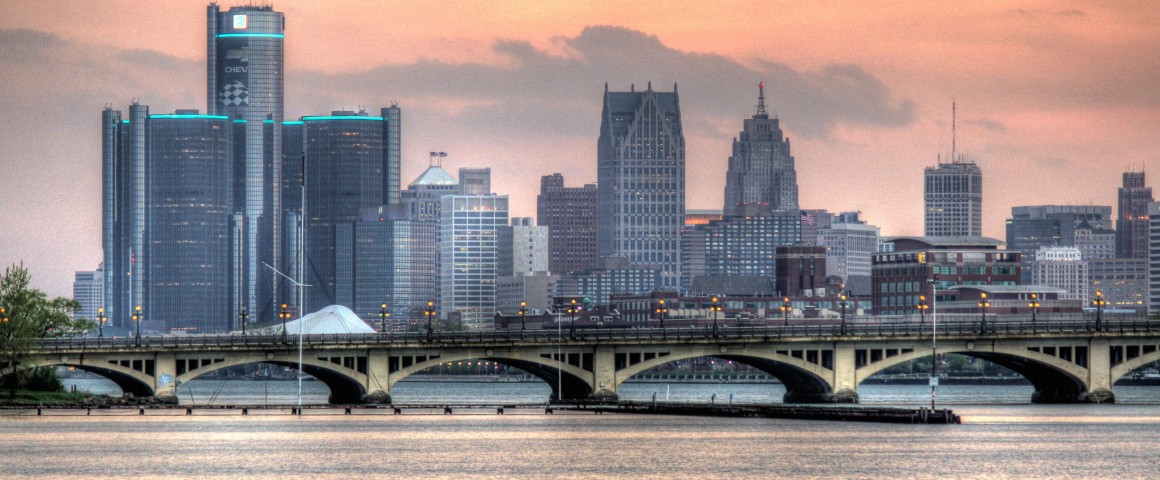
But alongside or across from them, there are glassy, modern structures such as the Renaissance Center, shown in the photo above: A 5-tower complex that includes, at its center, the 750-foot tallest building in Michigan (the tallest all-hotel skyscraper in the Western Hemisphere), and, in one of its 4 outer towers, the headquarters of General Motors (although the RenCen was originally financed by Ford).
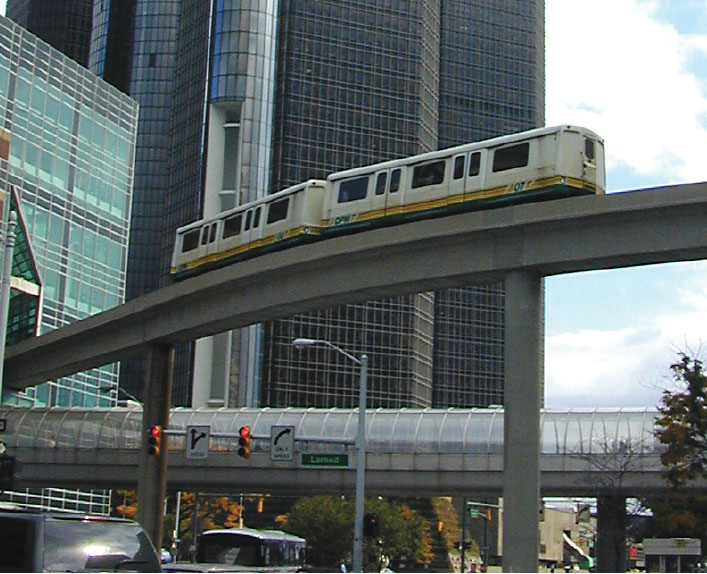
Downtown also has the Detroit People Mover, a monorail system that is part of the suggestion of Detroit trying to get from 1928 to 2028 while jumping over the difficult years in between. Like the Washington and Montreal Metro (subway) systems, the company running it prides itself on the artwork in its stations. It has a stop called Times Square, but it won't look anything like the one in New York. It has a stop called Bricktown, but it won't look anything like Brick Township, the sprawling Jersey Shore suburb off Exits 88 to 91 on the Garden State Parkway. The Grand Circus Park and Broadway Street stations are both 3 blocks from Comerica Park.
It's cheap, only 75 cents, and it still uses tokens, although it also accepts cash. Be advised, though, that it stops running at midnight, except on Fridays and Saturdays, when it runs until 2:00 AM. Bus fare is $1.50.
ZIP Codes in the Detroit area start with the digits 480, 481, 482 and 483, and the Area Code is 313, with 248 (overlaid by 947), 586 and 734 serving the suburbs.
Going In. Parking at the main deck is comparatively cheap, starting at $8.00. This is a far cry from parking at Tiger Stadium, which usually had people boxed in, resulting in tremendous traffic jams both before and after the game (and, every bit as much as the crime and the condition of the stadium, was why the Lions wanted to get out and built the Silverdome). It also involved local kids being willing to "Watch your car, Mister?" for a small fee. Translation: "If you pay me $5.00, I'll make sure nobody damages your car. If you don't pay me, I'll make sure somebody, namely myself, does."
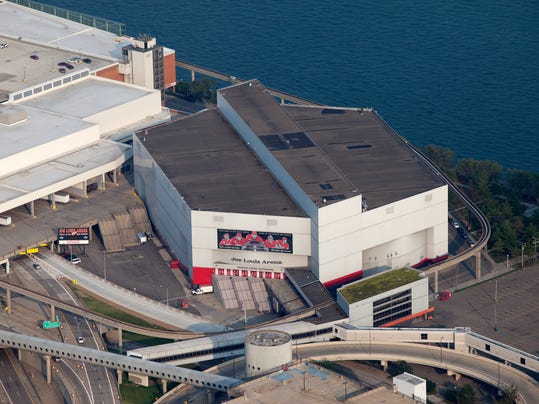
The address of Joe Louis Arena, until recently, was 600 Civic Center Drive. It was recently changed to 19 Steve Yzerman Drive. Named for the Alabama-born, Detroit-raised-and-trained Heavyweight Champion of the World from 1937 to 1949, Joe Louis Arena has its own stop on the People Mover. So, based on that, and on references I found to traffic around the arena on game nights being nightmarish, leads me to suggest parking your car at your hotel and using the People Mover.
A "cheat" recommended by a Detroit sports blogger: Park for free at the Greektown Casino, play the cheapest slot machine you can find (so they know you gambled, and didn't just use them for parking), and then take the People Mover to The Joe.
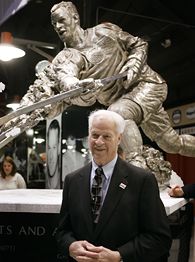
The arena's West Entrance was recently renamed the Gordie Howe Entrance, with a statue of "Mr. Hockey" inside. The East Entrance retains its original name. Many people complain that the stairs at these entrances are very steep, and at certain areas on the outside of the arena, are breaking apart.
The late Mr. Hockey and his statue
To make matters worse, it's the same model as the Meadowlands Arena and the Nassau Coliseum: One level of concourse for two levels of seats. There's also not enough bathrooms, resulting in very long lines, and a drop in atmosphere at the starts of the 2nd and 3rd periods, as many fans haven't made it back in time. So get to the arena early and use the bathroom before puck-drop.
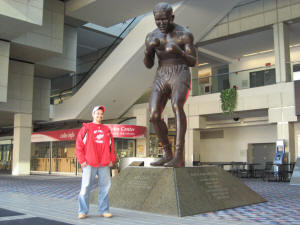
In addition to Howe, the arena also has statues of Wings great Alex Delvecchio, and of its namesake, the Heavyweight Champion of the World from 1937 to 1949, who was born in Alabama but grew up in Detroit.
A Wings fan at the Brown Bomber's statue
The rink is laid out east-to-west, with the south side bordering the Detroit River. The Wings attack twice toward the east goal -- hence, the more expensive tickets on that side.
"The Joe" is also, even more so that Boston's TD Garden with its Beanpot Tournament, the capital of American college hockey. Every year since it opened in 1979 -- the Olympia did so from 1965 to 1978 -- in the week between Christmas and New Year's, it hosts the Great Lakes Invitational, with the University of Michigan, Michigan State and Upper Peninsula-based Michigan Tech participating every season. It hosted the NCAA Frozen Four in 1985, 1987 and 1990.
The 4-team selection has been rounded out by nearby schools such as Western Michigan, Northern Michigan and Lake Superior State; Midwestern powers like Wisconsin and North Dakota (but never, as yet, Minnesota); and even New Jersey's Princeton. Michigan, the defending champion, has won it 16 times, Michigan State 12, and Michigan Tech 10. Northern Michigan, of Marquette in the State's Upper Peninsula, will be this season's 4th participant. It also alternates hosting the Big Ten hockey tournament with the Xcel Energy Center in St. Paul, home of the Minnesota Wild.
The Joe was home to the Detroit Drive of Arena Football from 1988 to 1993. They won as many league championships in 5 seasons as the Lions have won in over 80: 4, in 1988, 1989, 1990 and 1992. In fact, they made the ArenaBowl every season of their existence. The Joe also hosted the ArenaBowl in 1989, 1990, 1991 and 1993. So what happened? Mike Ilitch, who also owned the Red Wings, sold the Drive so that he could buy the Tigers. The Drive were moved to Worcester, Massachusetts, played 1 more season, and folded.
The Joe also hosted the 1980 Republican Convention, which nominated Ronald Reagan for President. Think about it: An arena named for a black heavyweight champion who knocked out a symbol (however unwillingly) of fascism, in a mostly-black city, with heavy union presence in the metropolitan area (it was, after all the hometown of the United Auto Workers and Jimmy Hoffa), hosting the Republican Convention. Then again, the Democrats held their last Convention in Jesse Helms' North Carolina...
The Joe was built next-door to Cobo Center, which was named for Albert E. Cobo, Mayor from 1950 to 1957. Its centerpiece, a building originally known as Cobo Hall, has been Detroit's major convention center since its opening in 1960, and, following the rejection of a plan to demolish it and put a new Pistons-Red Wings arena on the site, it recently underwent a renovation and expansion.
It includes a 12,000-seat arena that was home to the Pistons from 1961 to 1978, the Michigan Stags of the World Hockey Association in the 1974-75 season, and a convention complex that includes the city's famed annual auto show. It is known for some legendary rock concerts, including the KISS album
Alive! and area native Bob Seger's
Live Bullet. Unfortunately, it may be best known for the January 6, 1994 attack on Nancy Kerrigan during a practice session for the U.S. Figure Skating Championships. 600 Civic Center Drive at Jefferson Avenue. Each arena has its own station on the Detroit People Mover.
Food. When I visited Tiger Stadium in its final season, 1999, it had great food, including the very best ballpark hot dog I've ever had. Since they're owned by Little Caesars mogul Ilitch, and before that were owned by Domino's Pizza boss Tom Monaghan, food is taken very seriously by the club. This is, after all, Big Ten Country, where college football tailgate parties are practically a sacrament. One would hope that the same would be true of the Red Wings.
Unfortunately, as with entrances and bathrooms, there aren't enough concession stands. To make matters worse, the Wings' website stinks, and so does the one for Olympia Entertainment, which owns The Joe and other venues. As hockey teams go, they're a big club (only Montreal and Toronto, really, are bigger), but with their website, they think small.
Fortunately, I've seen recommendations from a local sports blogger. Since Ilitch owns the team, there's a Little Caesar's stand. The blogger says, "One suggestion: Do not place it on your lap while eating in the seats. You will sweat while eating, no joke. Eat at one of the standing, circular counters in the concourse. You cannot miss them. Besides typical stadium food (hot dogs, popcorn, peanuts, etc.), there's also a Buffalo Wild Wings (Section 126) and Hockeytown Grill (126), where chicken sandwiches and burgers are served."
This blogger also recommends Mike's Inside Scoop (named for Ilitch, perhaps?) at Section 112, and sub-recommends cherry-dipped, soft-serve vanilla ice cream cones and banana splits.
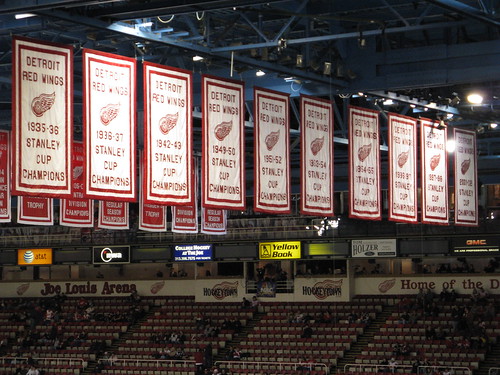
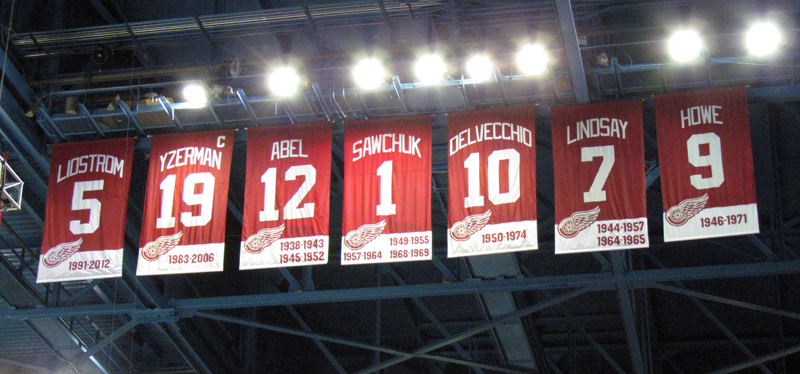
Team History Displays. The Red Wings display more banners than any other NHL team. Their Stanley Cup banners are at the Arena's east end, the other championship banners in the middle, and the retired number banners at the west end.
While the Montreal Canadiens (24) and the Toronto Maple Leafs (13) only display their Stanley Cup banners, the Wings also display Conference and Divisional Championships and President's Trophy wins:
Stanley Cup, 11: 1936, 1937, 1943, 1950, 1952, 1954, 1955, 1997, 1998, 2002 and 2008.
Campbell/Western Conference, 6: 1995, 1997, 1998, 2002, 2008 and 2009. (Their Finals appearances prior to the Cup's semifinal round being renamed the Conference Finals in 1982 aren't counted as such, and they have not yet won their Conference since being moved to the Eastern.)
Division, 19 (either finishing 1st overall in the NHL regular season or 1st in the Divisional Play era), 19: 1934, 1936, 1937, 1988, 1989, 1992, 1994, 1995, 1996, 1999, 2001, 2002, 2003, 2004, 2006, 2007, 2008, 2009 and 2011.
President's Trophy (for best record in the NHL regular season), 6: 1995, 1996, 2002, 2004, 2006 and 2008.
The Cup banners are white with red lettering, while the others are red with white lettering.
Officially, the Wings have retired 7 uniform numbers. From their 1950s Cups, they retired the Number 1 of goaltender Terry Sawchuk, and the numbers of all 3 members of "The Production Line": Right wing Gordie Howe, 9 (who, as I said, has a statue outside the west entrance); left wing Ted Lindsay, 7; and center Sid Abel, 12. When Abel retired in 1952, their main center became Alex Delvecchio, and this new member of the Production Line eventually had his Number 10 retired.
(Delvecchio, too, now has a statue at the arena. Presumably, his statue and Howe's will be moved to the Little Caesars Arena. What happens to Louis' statue, I don't know.)
From their 1990s-2000s Cups, they've retired the Number 19 of center Steve Yzerman and the Number 5 of defenseman Nicklas Lidstrom. These banners are red with white lettering. Yzerman's Number 19 banner has a Captain's C on it.
Not officially retired is the Number 6 of 1930s right wing Larry Aurie, supposedly retired when he hung up his skates in 1939. The current argument is that it's because he's not in the Hockey Hall of Fame. Well, then explain why Number 4 hasn't been retired for 1950s defenseman Red Kelly, the 1st-ever winner of the Norris Trophy for best defenseman, in 1954. Or Number 2, worn by 1940s defenseman Jack Stewart and 1990s defenseman Viacheslav Fetisov. Or Number 3, worn by 1950s defenseman Marcel Pronovost (a former Devils scout). Or Number 8, worn by 1930s center Syd Howe (no relation to Gordie). Or Number 14, for our old pal Brendan Shanahan.
Also not officially retired is the Number 16 of Vladimir Konstantinov, who was paralyzed in a car crash in the aftermath of the 1997 Stanley Cup win. Neither 6 (with 1 exception, for Aurie's cousin Cumming "Cummy" Burton) or 16 has ever been given out to another Wings player.
As I said, the west entrance is named for Gordie Howe, and has a statue of him inside. A new cable-stay bridge over the Detroit River, connecting Detroit and Windsor, is under construction, probably opening in 2020. It has been named the Gordie Howe International Bridge.
Red Wings in the Hockey Hall of Fame include:
* From the team's early days: George Hay and Reg Noble.
* From the 1936 and 1937 Stanley Cup winners: Owners James E. and James D. Norris, head coach and general manager Jack Adams, Herbie Lewis, Ebbie Goodfellow, Syd Howe and Marty Barry. Sort-of retired number honoree Larry Aurie has not been elected.
* From the 1943 Stanley Cup winners: Both James Norrises, Adams, Goodfellow, Syd Howe, Jack Stewart, Sid Abel, Harry Watson and Bill Quackenbush.
* From the 1950 Stanley Cup winners: Both James Norrises, Adams (now just GM), head coach Tommy Ivan, Stewart, Abel, Harry Lumley, Ted Lindsay, Gordie Howe, Red Kelly and Terry Sawchuk.
* From the 1952 Stanley Cup winners: Both James Norrises, Adams, Ivan, Abel, Lindsay, Howe, Kelly, Sawchuk, Alex Delvecchio and Marcel Pronovost.
* From the 1954 and 1955 Stanley Cup winners: James D. Norris, Adams, Ivan (coach for the '54 win only), Lindsay, Howe, Kelly, Sawchuk, Delvecchio, Pronovost and Glenn Hall. Jimmy Skinner, who coached the '55 win, is not in the Hall of Fame.
* From the 1961, 1963, 1964 and 1966 Stanley Cup Finalists: James D. and Bruce Norris, Adams, Abel as head coach and as GM after Adams retired in '62, Howe, Sawchuk (through '64), Delvecchio, Pronovost, Norm Ullman. Team executive John Ziegler was elected, but mainly due to his subsequent tenure as NHL President.
* Marcel Dionne played for the Wings from 1971 to 1975, and is in the Hall of Fame, but didn't win anything there.
* From the 1995 Stanley Cup Finalists, but not the later Cup wins: Mark Howe, Dino Ciccarelli and Paul Coffey.
* From the 1997 and 1998 Stanley Cups: Owner Mike Ilitch, GM Jim Devellano, head coach Scotty Bowman, Steve Yzerman, Sergei Fedorov, Nicklas Lidstrom, Igor Larionov, Viacheslav Fetisov, Brendan Shanahan and (on the '98 win only) Larry Murphy.
* From the 2002 Stanley Cup: Ilitch, Devellano, Bowman, Yzerman, Fedorov, Lidstrom, Larionov, Shanahan, Chris Chelios, Dominik Hasek, Brett Hull and Luc Robitaille. Ilitch, Devellano, Lidstrom, Chelios and Hasek were also on the 2008 Stanley Cup winners. GM Ken Holland and 2008 head coach Mike Babcock have not yet been elected to the Hall.
In 1998,
The Hockey News' 100 Greatest Players included Howe, Abel, Lindsay, Sawchuk, Kelly, Delvecchio, Stewart, Yzerman, Bill Gadsby, Ullman, and 3 players running out the string by helping the Wings win the 2002 Cup: Brett Hull, Hasek and Chelios, a Detroit native and, aside from Howe, the oldest player in NHL history.
Aurie and left wing Lewis were chosen for an All-Star Team to oppose the host Toronto Maple Leafs in the Ace Bailey Benefit Game in 1934. Goalie Normie Smith, defenseman Goodfellow, and center Barry were chosen for the team that opposed a combined Canadiens-Maroons team at the Montreal Forum in the Howie Morenz Memorial Game in 1937. Goodfellow and Syd Howe were chosen for the team that opposed the Canadiens at the Forum in the Babe Siebert Memorial Game in 1939. Lindsay, and defensemen Stewart and Quackenbush were chosen for the 1st official NHL All-Star Game in 1947, as the rest of the NHL took on the defending Champion Leafs in Toronto.
Defenseman Gary Bergman, left wing Red Berenson and right wing Mickey Redmond were chosen for Team Canada against the Soviet Union in the 1972 "Summit Series." So was former Red Wing Paul Henderson, by then with the Toronto Maple Leafs. As such, they were named to Canada's Walk of Fame. For their overall contributions to the sport, so were Gordie Howe and Bowman. From the 1980 U.S. Olympic hockey team, Mike Ramsey and Dave Silk went on to play for the Wings. Henderson, Yzerman, Fetisov, Fedorov, Larionov, Lidstrom and Hasek have been elected to the International Ice Hockey Federation (IIHF) Hall of Fame.
The Lester Patrick Trophy, for contributions to hockey in America, has been awarded to many figures in Wings history: Players Gordie Howe, Lindsay, Sawchuk, Delvecchio, Yzerman, Dionne, Mark Howe, Red Berenson and Reed Larson; head coaches Adams, Ivan and Bowman; general managers Adams and Devellano; and owners James E. Norris, Bruce Norris and Mike Ilitch. (It should be noted that Berenson, Dionne, Larson were honored for contributions elsewhere.)
The following Wings are members of the Michigan Sports Hall of Fame, located at Cobo Hall next to The Joe: James E. Norris (but not James D. or Bruce), Adams, Goodfellow, Stewart, Abel, Gordie and Mark Howe (but not Syd), Kelly, Lindsay, Sawchuck, Delvecchio, Pronovost, Gadsby, Ullman, Mike and Marian Ilitch, Bowman, Devellano, Yzerman, Fedorov, Lidstrom, Shanahan, Lynch, Martyn, and 1990s goaltender Chris Osgood. Detroit area native Mike Modano has also been elected, but only played his last season, 2010-11, with the Wings.
UPDATE: Abel, Lindsay, Gordie Howe (but not Syd Howe), Kelly, Sawchuk, Delvecchio, Dionne, Coffey, Yzerman, Fedorov, Lidstrom, Shanahan, Chelios, Hull and Hasek were named to the NHL's 100th Anniversary 100 Greatest Players in 2017.
Stuff. Not enough entrances/exits, not enough bathrooms, not enough concession stands... The Joe doesn't have much in the way of souvenir stands, either. You may be better off going to a suburban mall, or to Hockeytown Authentics, a store owned by Olympia Entertainment. 1845 E. Big Beaver Road in Troy, next to the Troy Sports Center, 19 miles north of downtown. Car only.
One item sold at The Joe that may be of interest is a funny hat: The Wingnut, a foam red wingnut, with its "tails" marked "left wing" and "right wing." Not as cute as the Green Bay Packers' Cheeseheads, but every bit as manly as those Giants and Jets hard hats.
DVD collections for the 1997, 1998, 2002 and 2008 Cup wins are available, as is
Detroit Red Wings: A Celebration of Champions -- NHL Original Six Series. As yet, though, no "Greatest Games" series for them.
Dr. John Finley and Wings legend Gordie Howe wrote
Hockeytown Doc: A Half-Century of Red Wings Stories from Howe to Yzerman. Specifically about their 1950s team that won 4 Cups in 6 seasons, New York's own "Hockey Maven," Stan Fischler, wrote
Motor City Muscle: Gordie Howe, Terry Sawchuk and the Championship Detroit Red Wings -- published in 1995, after the Devils beat the Wings in the Finals, leaving Wings fans with what one of them called "The 40-Year Itch." About the 1995-2009 Wings Dynasty, Darren McCarty published
My Last Fight: The True Story of a Hockey Rock Star.
Charles C. Avison wrote
Detroit: City of Champions, telling of how the city produced champion after champion in the Great Depression and World War II: The Tigers winning Pennants in 1934, '35, '40 and '45; the Lions debuting in 1934 and winning the NFL Championship in 1935; the Red Wings winning the Stanley Cup in 1936, '37 and '43; and Joe Louis winning the Heavyweight Championship of the World in 1937 and keeping it until his first retirement in 1948. Back then, Detroit was a city where anything was possible.
The 1930s was also the era when Detroit radio station WXYZ debuted 3 legendary fictional characters: The Lone Ranger, the Green Hornet (said to be related), and Sergeant Preston of the Yukon. Now WXYT, SportsRadio 1270, it celebrated its 90th Anniversary this past October.
During the Game. The Red Wings have nasty rivalries with the Chicago Blackhawks and the Colorado Avalanche, but you do not have to worry about wearing Devils gear in Joe Louis Arena. Wings fans may have long memories, but they're over 1995, having won 4 Cups since.
As part of their Farewell Season at The Joe promotional schedule, the 1st 5,000 fans to Tuesday night's game will receive a JLA Retired Jersey Banner Flag. If you can pull off a Michigan Miracle and get into the regular-season finale on April 9, you and all other fans will get a Farewell to The Joe Mini Stick. Coca-Cola is sponsoring both promotions.
When the visiting team's players are announced, Wings fans will shout, "Who cares?" When I first heard this on TV before Game 1 of the 1995 Finals, I thought they were, instead of booing and/or hissing, shouting, "Boo, hiss!" I chuckled. My respect for them went way down when I found out it was the far less witty, "Who cares?" Still, though, it beats following a player's name with, " ...sucks!"
Karen Newman sings the National Anthem. The Wings' goal song is "Hey Hey Hockey Town" by Michigan native Robert "Kid Rock" Ritchie.
During Playoff games only, hanging from the roof is a big purple balloon shaped like an octopus, named Al the Octopus, after Al Sobotka, The Joe's building operations manager, who drives the Zamboni, and whose job it is to pick up any octopi that fans throw onto the ice, a reflection of a tradition that began in 1952, since there were then only 2 Playoff rounds, 8 wins to win the Cup, 8 legs on an octopus. Since it now takes 16 wins, there are 2 Als hanging from the rafters.
This one, obviously, is not hanging from the rafters.
Although, officially, you can be thrown out of the arena for doing it, if the Wings are winning late, Sobotka will pick the octopus up off the ice by hand, and swing it around by the legs over his head, driving the crowd wild. In other words, if the Wings beat the Devils, you'll still walk away having seen a piece of tradition.
After the Game. With Detroit's rough reputation, I would recommend not hanging around downtown after a night game. If you want a postgame drink or meal, you're better off sticking to your hotel.
Nevertheless, there are some recommendations from local fan websites. The Anchor Bar at 450 W. Fort Street (not to be confused with the Buffalo bar of the same name, which invented Buffalo wings 50 years ago this week), Cobo Joe's at 422 W. Congress Street, and Post Bar at 408 W. Congress Street. Post Bar is described as the best post-game Red Wings bar, and a place where the players sometimes drink. Cobo Joe's is said to be the local home of expatriate Jet fans.
Giants gather at the Town Pump Tavern, 100 W. Montcalm Street at Park Avenue, 2 blocks from Comerica Park. Harry's Detroit Bar is also said to be a Giants' fan haven. It's right over the Fisher Freeway overpass from Comerica and the Town Pump, at 2482 Clifford Street, near the famous Cass Tech High School. Be warned, though, that over the freeway is not an area to traverse at night. Cheli's Chili Bar is owned by Chelios, at 47 E. Adams Avenue, across Witherell from Comerica and thus a short walk from Ford Field.
If your visit to Detroit is during the European soccer season, which is now in full gear, most of the better choices to watch games are in the suburbs. Thomas Magee's is the home pub of the Detroit branch of the U.S. national team fan group, the American Outlaws. 1408 East Fisher Service Drive, in the Lafayette Park neighborhood, a 5-minute walk from Comerica Park and Ford Field. SMART Bus 34 to Gratiot and Russell.
Another possibility is the Red Fox English Pub. Definitely not to be confused with the now-defunct Machus Red Fox restaurant, where Jimmy Hoffa was last publicly seen. This one is at 100 S. Main Street in Royal Oak, about 14 miles northwest of downtown. Bus 498 to Woodward & 11 Mile.
Sidelights. For all its problems, Detroit is a great city, not just a great baseball city or even a great sports city. Check out the following – but do it in daylight:
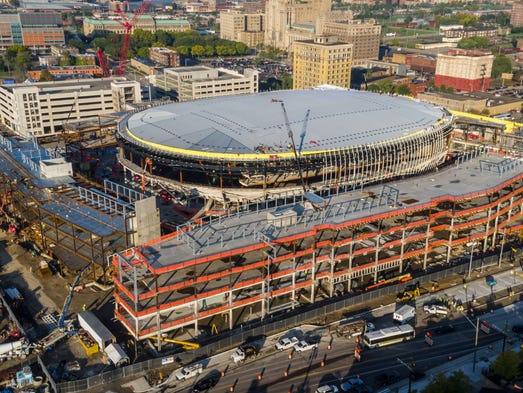
* Little Caesars Arena. Soon, much of the information above will be out of date, as the Wings are moving. Their new arena, originally known as the Detroit Events Center, was, surprising no one, renamed for Mike Ilitch's pizza company.
It will seat 20,000, and is scheduled to open in time for the 2017-18 NHL season. On November 22, 2016, the Pistons announced that they will move in for the 2017-18 NBA season as well -- meaning that not only will all 4 Detroit-area teams be playing in the city for the 1st time since 1974, but that both of the teams that moved out to the suburbs will have moved back: The Lions after 27 seasons, 1975 to 2001; and the Pistons after 39 seasons, 1978 to 2017. So "
Dee-troit
bas-ket-
ball" will again be played
in Detroit, not just sort-of near it.
Computer model of the finished project,
showing its proximity to Comerica Park and Ford Field
In addition to the Wings and the Pistons, it will host the Great Lakes Invitational, rotate with the Xcel Energy Center as host of the Big Ten hockey tournament, and has already been lined up to host 2018 NCAA Tournament basketball games.
66 Sibley Street, or 2501 Woodward Avenue at Henry Street, across Interstate 75 from Comerica Park and Ford Field. Speaking of which...
* Comerica Park and Ford Field. Home to the Tigers since 2000, the team has seen the good (Pennants in 2006 and '12), the bad (a nosedive that cost them the American League Central Division title in 2008), and the ugly (losing an AL record 119 games in 2003) at Comerica Park. The official address is 2100 Woodward Avenue, but Woodward does not border the park; Witherell, Montcalm and Brush Streets, and Adams Avenue, do. The Lions have mostly been terrible at Ford Field, whose address is 2000 Bursh Street.
The area around Comerica Park (named for a Midwest-based bank) and Ford Field (named for the automaker), at the northern edge of downtown Detroit, is called Foxtown, after the Fox Theater, which, as I said, Tigers/Wings/Little Caesars owner Mike Ilitch had restored.
Ford Field hosted Super Bowl XL in 2006, won by the Pittsburgh Steelers in the final game of Detroit native Jerome Bettis; the 2010 NCAA Frozen Four; and the 2009 NCAA Final Four, the only one ever held in the State of Michigan, won by North Carolina, overcoming a "home-court advantage" for Michigan State in the Final. Appropriately, for a city on the U.S.-Canadian border, it hosted a match between the U.S. and Canada soccer teams on June 7, 2011. The U.S. won.
* Site of Tiger Stadium. The first ballpark on the site was called Bennett Park, after Charlie Bennett, a catcher for the NL's Detroit Wolverines, who didn't play there. Bennett Park opened in 1896, for the Detroit team in the Western League, which became the American League in 1901. However, the team we know as the Tigers (so named because the orange stripes on their socks evoked not just tigers but the teams at New Jersey's Princeton University, also called the Tigers) are officially dated from 1901.
After the 1911 season, the wooden Bennett Park was demolished, and replaced with a concrete and steel structure, opening on April 20, 1912 (the same day as Fenway Park in Boston) and named Navin Field, after Tiger owner Frank Navin. He died in 1935, and his co-owner, Walter Briggs, expanded the place to its more familiar configuration in 1938, renaming it Briggs Stadium. In 1961, new owner John Fetzer renamed it Tiger Stadium.
The Tigers played there from 1912 to 1999, and the NFL's Lions did so from 1938 to 1974. The Tigers won the World Series while playing there in 1935, 1945, 1968 and 1984; the Lions won the NFL Championship while playing there in 1952, 1953 and 1957. (The '52 Championship Game was played in Cleveland against the Browns; the '53 and '57 editions, also against the Browns, at Tiger Stadum.) In addition, early NFL teams the Detroit Heralds played there in 1920 and '21, and the Detroit Panthers in 1926.
A youth baseball field is on the site now. Northwest corner of Michigan Avenue and Trumbull Street, 1 mile west of Cadillac Square down Michigan Avenue (U.S. Route 12). Number 29 bus from downtown.
* Site of Olympia Stadium. From the outside, it looked more like a big brick movie theater, complete with the Art Deco marquee out front. But "The Old Red Barn" was home to the Red Wings from 1927 to 1979, during which time they won the Stanley Cup in 1936, '37, '43, '50, '52, '54 and '55.
In 1950, they hosted Game 7 of the Stanley Cup Finals, and Pete Babando's overtime winner defeated the Rangers. In '54, they had another overtime Game 7 winner, as "Tough Tony" Leswick hit a shot that deflected off Doug Harvey, the great defenseman of the Montreal Canadiens. (In hockey, the shooter is still credited; in soccer, this would have been officially listed as an "own goal" on Harvey.)
A rare color photo of a Wings game at the Olympia
The Olympia was also home to the Pistons from 1957 to 1961; the Falcons in the NBA's inaugural season of 1946-47; the NCAA Frozen Four in 1977 and 1979; and the site of some great prizefights, including Jake LaMotta's 1942 win over Sugar Ray Robinson – the only fight Robinson would lose in his career until 1952, and the only one of the 6 fights he had with LaMotta that LaMotta won.
Elvis Presley did 2 shows there early in his career, an afternoon and an evening show on March 31, 1957. (If you think that's a lot for one day, he did 3 shows at the Fox Theater on May 25, 1956.) He returned to the Olympia on September 11, 1970; April 6, 1972; September 29 and October 4, 1974; and April 22, 1977.
The Beatles played there on September 6, 1964 and August 13, 1966. (However, it was in the Detroit area -- specifically, on the University of Michigan's radio station in Ann Arbor -- that a disc jockey started the 1969 rumor that Paul McCartney was dead. In a 1989 interview, Paul said, "'Paul is dead'? I didn't believe that one for a minute.")
It was the neighborhood, not the building, that was falling apart: Lincoln Cavalieri, its general manager in its last years, once said, "If an atom bomb landed, I'd want to be in Olympia." It was not a nuclear attack, but an ordinary demolition crew, that took it down in 1987. The Olympia Armory, home of the Michigan National Guard, is now on the site. 5920 Grand River Avenue, corner of McGraw Street, on the Northwest Side. Number 21 bus. If you're a hockey fan, by all means, visit – but do it in daylight.
* University of Detroit Stadium. Also known as Titan Stadium, this was the Lions' first home, from 1934 to 1937, until what became Tiger Stadium was double-decked. The Lions played and won the 1935 NFL Championship Game there, beating the Giants.
The previous NFL team in the city, the Detroit Wolverines, play there in their lone season, 1928. Built in 1922 and seating 25,000, the University's suspension of its football program in 1964 doomed it, and it was demolished in 1971. The school, now known as the University of Detroit Mercy (it's a Catholic school), has since put a new, multipurpose, artificial turf field on the site. 3801 McNichols Road at Birchcrest Drive. 016 Bus.
* Silverdome. Originally Pontiac Metropolitan Stadium, this stadium was home to the Lions from 1975 to 2001 (after which they moved back downtown to Ford Field), and very nearly became home to the Tigers as well, before owner John Fetzer decided to commit himself to Tiger Stadium. Heisman-winning running backs Billy Sims and Barry Sanders ran wild for the Lions here, but the closest they got to a Super Bowl was reaching the NFC Championship Game in January 1992 – unless you count hosting Super Bowl XVI, 10 years earlier, the beginning of the San Francisco 49er dynasty led by Bill Walsh and Joe Montana.
The Pistons, playing here from 1978 to 1988, had a little more luck, reaching the NBA Finals in their last year there. It seated 80,000 for football, set an NBA attendance record (since broken) of 61,983 between the Pistons and Boston Celtics in 1988, and 93,682 for a Mass by Pope John Paul II in 1987.
In 1994, it hosted 4 World Cup matches, including 1 by the U.S. and 1 by eventual winner Brazil. It hosted 2 games by the U.S. national soccer team, in 1992 win over Russia and the 1994 World Cup draw against Switzerland. Elvis had his biggest crowd ever at the Silverdome, 60,500, on New Year's Eve, December 31, 1975.
It hosted a Don King-promoted boxing card in January 2011, and in August 2010 hosted a friendly between Italian soccer giant A.C. Milan and leading Greek club Panathinaikos – appropriate, considering the area's ethnic makeup. In 2013, the roof was deflated as an energy-saving measure, and it was decided that, if a new tenant is found, a new roof will be put in as part of renovations.
In March of this year, the owners announced that they would be auctioning off the contents of the facility, including seats and fixtures. In October, it was announced that the building would be demolished over the winter, and that the land would be turned over to Oakland County, Michigan for mixed-use development.
1200 Featherstone Road, Pontiac. Getting there by public transportation is a pain: The Number 465 bus takes an hour and 25 minutes, and then you gotta walk a mile down Featherstone from Oakland Community College. So if you didn't drive in (or rent a car at the airport), unless you
have to see everything on this list, or if you're a Lions fan living in New York who has to see it one more time, or if you're a soccer nut on a pilgrimage to all World Cup sites, I'd suggest skipping it.
* The Palace. Home to the Pistons since 1988, they won the 1989, 1990 and 2004 NBA Championships here, and almost won another in 2005. The Detroit Shock won 3 WNBA Championships here, and, as a result, every time a title was won, the address changed: Currently, it's "Six Championship Drive, Auburn Hills, MI 48326." However, the Shock moved to Tulsa in 2010, so unless the arena stays open and becomes the home of a new WNBA team, or the Pistons win a title this Spring, the address will never change to "Seven Championship Drive."
Unfortunately, the 22,000-seat building's best-known event isn't a Pistons title or a rock concert, but the November 19, 2004 fight between the Pistons and the Indiana Pacers that spilled into the stands, becoming known as "the Malice at the Palace." Even the WNBA had a rare brawl there, between the Shock and the Los Angeles Sparks in 2008.
Lapeer Road and Harmon Road, Auburn Hills, off I-75. Don't even think about trying to reach it by public transportation: You'd need 2 buses and
then a half-hour walk. So unless you've got a car, or you're a big sucker for NBA history, I'd suggest skipping it.
* Mack Park. The Negro Leagues' Detroit Stars played here from 1920 to 1929, featuring center fielder Norman "Turkey" Stearnes and pitcher Andy Cooper, who would both be posthumously elected to the Baseball Hall of Fame. A senior citizens' complex, the Fairview Apartments, is on the site now. 3568 Fairview Street at Mack Avenue, about 5 miles east of downtown. Bus 7 will get you within a 15-minute walk.
* Hamtramck Stadium. After Mack Park burned down in 1929, they moved into this nearby facility for the 1930 season. Pronounced "Ham-TRAM-ick," this city is actually completely surrounded by Detroit. But between the Mack Park fire and the start of the Great Depression at the end of the year, the Stars' fate was sealed.
New teams with the name would occasionally be revived. At its peak, Hamtramck Stadium seated over 8,000 people. However, the decline of the Negro Leagues and the "industrial leagues" in the 1950s doomed it to high school use, it hasn't been used at all since 2012, and its sideline wings have been removed, reducing its capacity to 1,500. Nevertheless, it is 1 of 12 Negro League ballparks still standing. 3201 Dan Street.
When the Dodge Brothers (who later sold the car company bearing their name to Chrysler) opened an auto plant in Hamtramck in 1914, it became a hub for Polish immigration. However, the Polish population of the city has dropped from 90 percent in 1970 to 22 percent today. And Arabs and South Asians have moved in, making it Michigan’s most internationally diverse city.
Nevertheless, if you want the best kielbasa, kapusta, golumpkis and paczkis this side of the Oder, this is the place to go. Hamtramck Town Shopping Center, Joseph Campau Street and Hewitt Street.
Detroit City FC plays in the 4th tier of American soccer, at Keyworth Stadium in Hamtramck, a 7,000-seat high school football stadium, 5 1/2 miles north of downtown. All of these Hamtramck locations can be reached via the Number 10 bus.
Detroit is the largest metropolitan area in North America without a Major League Soccer team, although there is a drive to get an expansion team. The closest MLS team to Detroit is the Columbus Crew, 204 miles away. However, the Ohio State-Michigan rivalry may complicate that.
* Motown Historical Museum. As always, I'm going to include some non-sports items. Detroit is generally known for 3 good things: Sports, music and cars. The Motown Historical Museum is the former Motown Records studio, which company founder Berry Gordy Jr. labeled "Hitsville, U.S.A." His sister, Esther Gordy Edwards, now runs it, and it features records and costumes of performers such as the Supremes, the Temptations and the Four Tops. 2648 W. Grand Blvd., on the North Side. Number 16 bus.
* Henry Ford Museum. The centerpiece of the nation's foremost automotive-themed museum is a replica of Independence Hall in Philadelphia. Henry Ford himself established the museum: "I am collecting the history of our people as written into things their hands made and used... When we are through, we shall have reproduced American life as lived, and that, I think, is the best way of preserving at least a part of our history and tradition."
It contains the fascinating, including early cars and bicycles, Henry Ford's 1st car (his 1896 "Quadricycle"), Igor Sikorsky's prototype for the helicopter, the bus Rosa Parks was riding in when she refused to give up her seat to start the 1955-56 Montgomery Bus Boycott, and a Buckminster Fuller "Dymaxion house." It also contains the macabre, with the chair Abraham Lincoln was supposedly sitting in when he was assassinated at Ford's Theater in Washington (the theater owner was no relation to Henry); and the chair, and the rest of the car as well, that John F. Kennedy was definitely sitting in when he was assassinated, the back seat of in the 1961 Lincoln Continental convertible limousine he was riding in through downtown Dallas.
Next door to the museum is Greenfield Village, which Ford imagined as a kind of historical park, a more modern version of Colonial Williamsburg – that is, celebrating what was, in 1929 when it opened, considered modern American life, including a reconstruction of the Menlo Park, New Jersey laboratory of his good friend Thomas Edison. Ford and Edison were both friends of rubber magnate Henry Firestone (whose tires certainly made Ford's cars easier to make), and Firestone's family farm is reconstructed on the site.
Please note that I am
not excusing Henry Ford's control-freak attitude toward his employees' private lives, nor his despicable anti-Semitism, nor his failed union-busting in the 1930s. To be fair, he did give his black auto workers the same pay and benefits as his white ones. But I am recommending the museum. It's a tribute to the role of technology, including the automobile, in American life, not to the man himself. Oakwood Blvd. and Village Road. Number 200 bus to Michigan Avenue and Oakwood Blvd., then a short walk down Oakwood.
* Greektown Historic District. Although Detroit is famed for its Irish (Corktown, including the site of Tiger Stadium) and Italian communities, and has the largest Arab-American community of any major city, its best-known ethnic neighborhoods are Greektown and the Polish community of Hamtramck. New York's Astoria, Queens has nothing on Detroit's Greektown, which not only has some of the country's finest Greek restaurants, but also the Greektown Casino, which is at 555 E. Lafayette Street, at Beaubien Street. Greektown Station on the People Mover.
* Mariners' Church. On my 1999 visit to Detroit, I discovered this church by accident, walking past it without realizing it was there until I saw the historical marker. Every March, it holds a Blessing of the Fleet for every person and ship going to sea. Every November, it holds a Great Lakes Memorial Service for those who have lost their lives at sea within the past year.
The most famous of these ceremonies was for the 29 men lost on the iron ore freighter SS
Edmund Fitzgerald in Lake Superior on November 10, 1975. Built and homeported in Detroit, the Big Fitz was commemorated by Gordon Lightfoot, whose 1976 song "The Wreck of the
Edmund Fitzgerald" mistakenly, but poetically, called the church "The Maritime Sailors' Cathedral." (Edmund Fitzgerald himself was the president of Northwestern Mutual Life Insurance Company, which invested in the ship's construction, because it was heavily invested in the ore industry.)
170 E. Jefferson Avenue, at Randolph Street, across from the Renaissance Center. If you're going to visit the church, be careful, because Randolph Street empties into the Detroit-Windsor Tunnel.
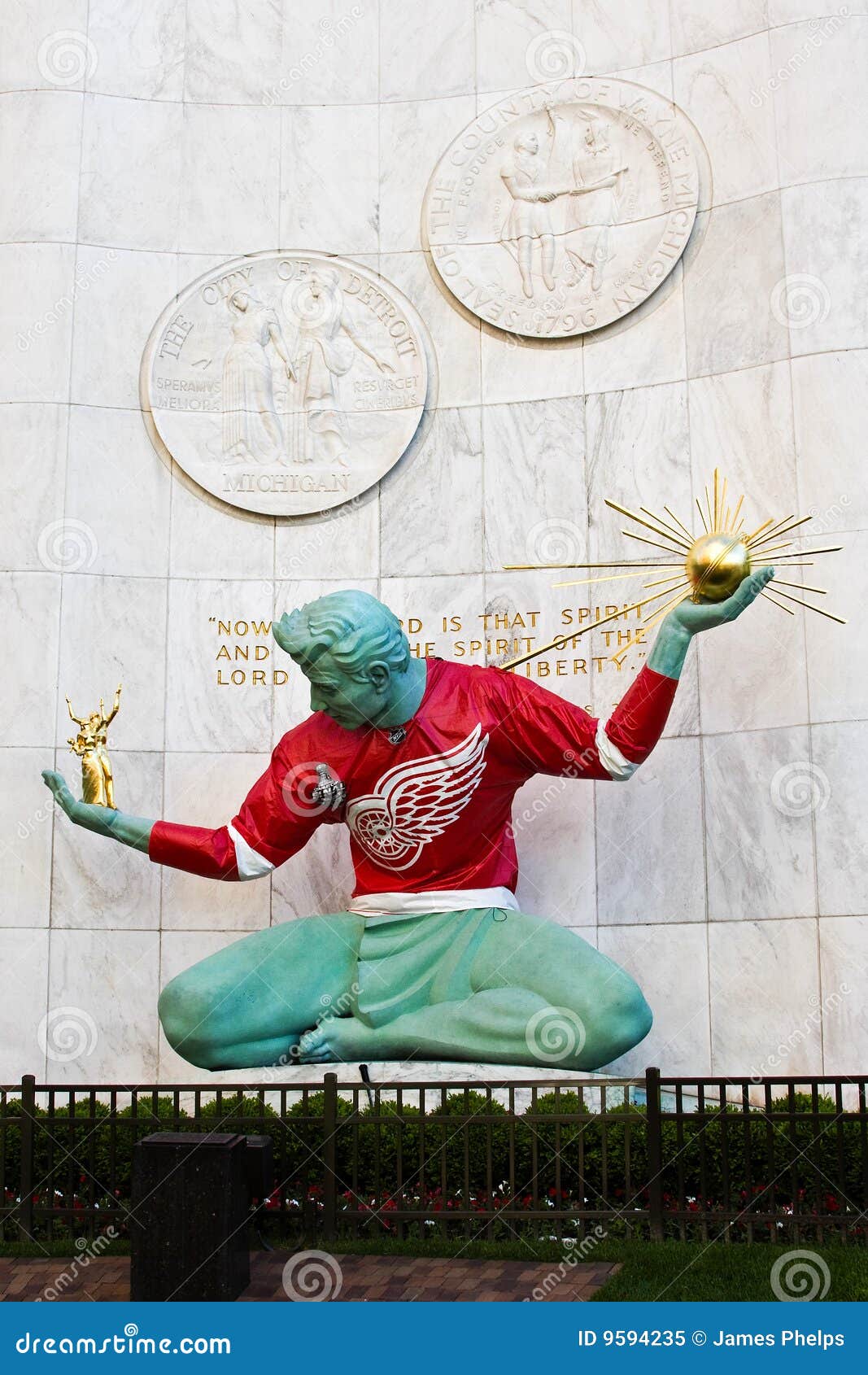
* Spirit of Detroit. In front of the Coleman A. Young Municipal Center, the city hall named for the 1974-93 Mayor, stands a marble monument with a bronze statue of a kneeling man, the seals of the City of Detroit and Wayne County, and a Biblical inscription, from 2nd Corinthians 3:17: "Now the Lord is that spirit, and where the spirit of the Lord is, there is liberty."
In his left hand, the 26-foot-high kneeling figure holds a gilt bronze sphere emanating rays, to symbolize God. The people in the figure's right hand are a family group.
The statue was dedicated in 1958, 4 years after the Municipal Center opened. In recent years, a large jersey has been placed over it when the Tigers, Pistons or Wings have been in their sport's finals. (As yet, this has never been done for the Lions, who haven't been to an NFL Championship Game since 1957, 9 seasons before they started calling it the Super Bowl.) 2 Woodward Avenue at Jefferson Avenue.
The Spirit of Detroit, wearing a Red Wings jersey
in honor of the 2008 Stanley Cup Finals
* Monument to Joe Louis. Erected in 1986, on a traffic island at the intersection of Woodward & Jefferson, it is a 24-foot-long arm with a fisted hand suspended by a 24-foot-high pyramidal framework. Since it is a monument to Louis, the great black heavyweight champion, the arm and fist are black bronze.
The Louis Monument, with the Spirit of Detroit behind it
* Colleges. The University of Michigan is 44 miles west of downtown Detroit, in Ann Arbor. It is possible to reach it from Detroit by bus, but it will take 2 hours: You can take the 851 bus to the airport, and transfer there to the 787.
Gerald Ford was President from August 9, 1974 to January 20, 1977, and was a graduate of (and an All-American football player at) Michigan in the 1930s. His Presidential Library, and a School of Public Policy named for him, are on the Ann Arbor campus, at 1000 Beal Avenue. However, he is the only President whose Library and Museum are separated, and his Presidential Museum is in his hometown of Grand Rapids, at 303 Pearl Street NW, 158 miles northwest of Detroit. You'll need Greyhound if you want to visit Grand Rapids.
Michigan Stadium is at 1201 S. Main Street at Stadium Blvd. "The Big House" has hosted UM football since 1927. Its peak attendance is 115,109 for Michigan's 2013 win over Notre Dame. This past year, it set new records for highest U.S. attendance for soccer (109,318 for Manchester United beating Real Madrid in the International Champions Cup), and for highest attendance anywhere on the planet for hockey (105,491 for the NHL Winter Classic, the Toronto Maple Leafs beating the Detroit Red Wings).
Adjacent is Crisler Arena, named for Herbert "Fritz" Crisler, the UM football coach from 1938 to 1947, who, in another connection between Princeton University sports and the State of Michigan, had previously coached Princeton's Tigers, and brought his "winged" helmet design with him, making Michigan's "maize and blue" helmets among the most famous in college football. Elvis sang at Crisler Arena on April 24, 1977. The other sports facilities, including Yost Arena (hockey) and Fisher Stadium (named for Ray Fisher, who pitched for the Yankees in the 1910s before they got good and then coached at Michigan, including Charlie Gehringer), are adjacent.
Michigan State University is 88 miles northwest of Detroit, in East Lansing, adjacent to Lansing, the State capital. Greyhound runs 4 buses a day from Detroit to East Lansing, at 8:00 AM, 12:10 PM, 2:20 PM and 7:40 PM, and it takes about 2 hours. Two buses go back to Detroit, at 3:40 and 5:55 PM. $38 round-trip.
Spartan Stadium, formerly Macklin Field, is at 325 W. Shaw Lane at Red Cedar Road, which is named for the river that bisects the MSU campus. Jenison Field House (the old basketball arena, where Magic Johnson starred on their 1979 National Champions), Breslin Events Center (their new arena), and Munn Arena (hockey) are a short walk away, at Kalamazoo Street & Birch Road.
According to
an October 3, 2014 article in The New York Times, UM has a decided, though not overwhelming, advantage in fans in the Detroit area. Only around the State capital of Lansing do you get an edge for MSU.
In addition to the preceding, Elvis sang in Michigan at
Wings Stadium (a minor-league hockey arena, now named Wings Event Center) in Kalamazoo on October 21, 1976 and April 26, 1977; and the Saginaw County Event Center (now the Dow Event Center) in Saginaw on April 25 and May 3, 1977.
* Jimmy Hoffa. No, I don't know where Hoffa is buried. All I know for sure is that, when they demolished Giants Stadium in 2010, they found no human remains. Hoffa, who was born in Indiana but lived most of his life in and around Detroit, was last seen alive on July 30, 1975, sitting in his car in the parking lot of Machus' Red Fox.
A fine-dining establishment open from 1965 to 1996, the building is still there, occupied by an Italian restaurant named Andiamo's. 6676 Telegraph Road (U.S. Route 24) at Country Club Drive, Bloomfield, 22 miles northwest of Cadillac Square. As with most sites in Detroit's outer suburbs, getting there by public transportation is a hassle: In this case, you'd need 3 buses.
* Windsor. Across the Detroit River is Windsor, Ontario. Most Americans know it for Caesar's Windsor, one of 4 casinos in the area. Like its namesakes in Las Vegas and Atlantic City, it has a Roman theme. It may be only 2 miles from downtown Detroit, but because it's in Canada, where they have things like sensible gun laws and national health care, it may feel like the other side of the world (if not Rome itself). And, because it's in Canada, you'll need a passport.
377 Riverside Drive East. There is bus service available -- less for Michiganders wanting to gamble, more for Windsorites wanting to go to Red Wings games and concerts -- and you can contact Transit Windsor at tw@city.windsor.on.ca.
The Wings' first home was actually in Windsor: They played their first season, 1926-27, at the Border Cities Arena, which still stands, and is now named Windsor Arena. Like a lot of old arenas (this one was built in 1924), it looks like a barn, and so is nicknamed The Barn. It seats only 4,400 people in its current configuration.
Its long-term tenants, the University of Windsor hockey team and the Windsor Spitfires of the Ontario Hockey League, now play elsewhere. The City of Windsor has approved a plan to tear it down and build the new building for Catholic Central High School on the site. 334 Wyandotte Street East, at McDougall Street.
The University of Windsor Lancers haven't been very successful in sports. Their greatest achievement is their football team winning the Yates Cup, for the championship of Ontario University Athletics, in 1975. The Yates Cup was founded in 1898, and is the oldest football trophy in North America.
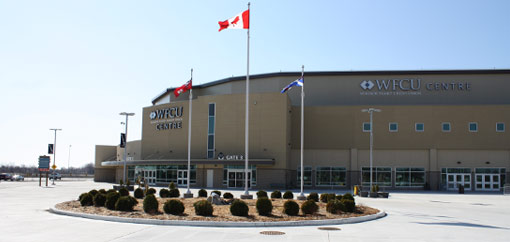
Since 2008, the Spitfires have played at the WFCU Centre. No, that's not named for a radio station: Canadian radio stations' call letters always been with a C. The naming rights are held by the Windsor Family Credit Union. The Spitfires won the Memorial Cup, the championship of Canadian junior hockey, while playing there, in 2009 and '10, and one of the streets bordering is named Memorial Cu Way.
The Lancers also play hockey and basketball there. The Windsor Express play in the National Basketball League of Canada there. 8787 McHugh Street, 8 miles from downtown Detroit and 7 miles east of downtown Windsor. Bus 2 from there.
*
Home Improvement. The 1991-99 ABC sitcom is easily the best-known TV show to have been set in Detroit, with
Tool Time's studio being in the city and the Taylors' house in the suburbs, possibly in Bloomfield Hills. But, as far as I know, there were no location shots, not even in the episode in which the Taylors got to see the Lions' annual Thanksgiving game from a Silverdome skybox. So if you're looking for the Taylors' house, you're not going to find it -- if there was ever a house, not just a studio set, it was likely in or around Los Angeles. Other shows set in or around Detroit have included
Martin, Freaks and Geeks, Sister, Sister, and
8 Simple Rules for Dating My Teenage Daughter.
Several films have been set, but not necessarily filmed, in Detroit. Axel Foley, Eddie Murphy's character in the
Beverly Hills Cop films, was a Detroit police detective, but most of the film, including the Detroit scenes, was shot in Los Angeles. While
RoboCop was set in Detroit, it was filmed in Dallas. (And you thought "Dallas sucks" was just a sports chant.)
Billy Crystal's movie about the 1961 home run record chase,
61*, used Tiger Stadium as a stand-in (with computer-generated help) for the original Yankee Stadium (since the 1973-76 renovation left it looking very little like it did in 1961). Other recent movies set in Detroit include Eminem's
Roman à clef, 8 Mile; and Clint Eastwood's retired autoworker vs. gangs film
Gran Torino.
*
A visit to Detroit does not have to be a scary experience. These people love hockey. And, while they don't necessarily like the Yankees, they don't have a problem with Devils fans. They love hockey more than most Americans do, and their city should be able to show you a good time.