I'm going to have to retitle this blog "A Song of Ice and Fire Joe Girardi."
When you hold your opponents to 2 runs over the 1st 20 innings of a series, you should at least win the 1st 2 games, right?
The Yankees have done that in this series. And it hasn't worked out that way.
Ivan Nova started for the Yankees against the San Francisco Giants yesterday, and was fantastic. He went 7 innings, allowing 1 run on 6 hits and 2 walks, striking out 7. He should have been allowed to stay in the game.
But Girardi looked in his binder, and saw that the still-cruising Nova had thrown 96 pitches, and removed him.
At first, it looked like a good decision: Andrew Miller pitched a perfect 8th, Aroldis Chapman kept the Giants from scoring in the 9th and the 10th, and Dellin Betances -- despite a near-wild pitch on an intentional walk that only failed to lose the game because Angel Pagan, on 3rd base, didn't take enough of a lead and couldn't score -- pitched a scoreless 11th. At which point, it was still 1-1.
But when you're the Yankees, in Yankee Stadium with that short porch in right field, you should score more than 1 run in 11 innings. (That they scored only 3 runs in 21 innings in these 2 games is atrocious, even if they did win the 1st game.)
But aside from a Mark Teixeira single and a Mark Williamson error in right field that got Didi Gregorius home in the 4th inning, the Yankees got nothing. They loaded the bases with 1 out in the 11th, and got nothing. Credit the Giants' pitching, sure, but the Yankees should still do better than that.
Girardi brought Anthony Swarzak in to pitch the top of the 12th, and he allowed a leadoff double by Trevor Brown. After getting a groundout, he allowed a game-winning single to Mac Williamson (whose home run off Nova scored the Giants' 1st run).
The Yankees, of course, went down 1-2-3 in the bottom of the 12th. Giants 2, Yankees 1. WP: Santiago Casilla (2-3). SV: Hunter Strickland (2). LP: Swarzak (1-1).
I don't blame Swarzak. The Yankees should have gotten more than 1 run, more than 9 hits, in 11 innings, to prevent a 12th inning loss.
Blame this one on the cold bats, and blame it on Giardi and his damn binder. They combined to blow it, again.
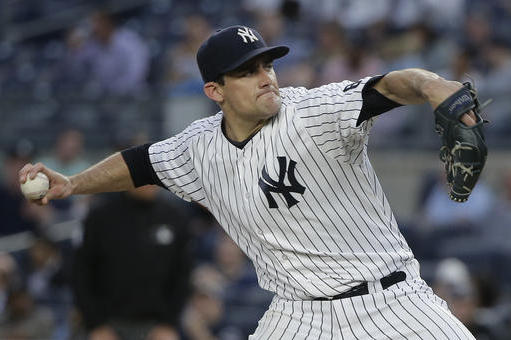
The series concludes this afternoon. Nathan Eovaldi starts against Johnny Cueto. Girardi has already said he won't use Betances, Andrew Miller or Aroldis Chapman today, due to his recent bullpen fuckups. Of course, once Eovaldi reaches 95 pitches, Girardi will panic, and go to the bullpen. Who will it be? Chasen Shreve? Nick Goody? Thank God it won't be Boone Logan, but don't be surprised if the Yankees are close through 6 innings and get blown out thereafter.
Also, rumors are running rampant that Aroldis Chapman is going to be traded. Don't believe them: There is no one the Yankees could get that would equal the value of a lockdown closer. Brian Cashman is short-sighted, but he's not that stupid.
Mike Piazza is inducted into the Hall of Fame today. First time a known steroid user goes in. So I guess it's safe to let David Ortiz in? Fine, but what about Alex Rodriguez? Or Andy Pettitte, whose offense was trivial by comparison? Or Mike Mussina, who was totally clean?
Ken Griffey Jr. also goes in. As far as we know, he was clean.
Sunday, July 24, 2016
Saturday, July 23, 2016
Playoffs? If They Can Beat Baltimore & San Francisco, Yeah, I'm Gonna Talk to You About Playoffs!
Such was the case with the Yankees last night, as they welcomed the San Francisco Giants into Yankee Stadium II for a 3-game Interleague series. The Giants have won the World Series in the last 3 odd-numbered seasons (2010, 2012 and 2014), and they look like they're setting themselves up well for a 4th, having come into last night's game 57-38.
They were also starting Madison Bumgarner, MVP of the 2014 World Series, and who is, counting the postseason, is 50-25 over the last 2 1/2 seasons.
The Yankees started Masahiro Tanaka. For 6 innings, 'Hiro was better than MadBum. Tanaka pitched 6 innings, allowing no runs on 4 hits and 2 walks. And he was staked (or should that be "stoke"? "Stoken"?) to a 2-0 lead, thanks to a Starlin Castro double that drove home Brett Gardner in the 1st, and Carlos Beltran single that drove home Ronald Torreyes in the 2nd.
Tanaka threw only 83 pitches in those 6 innings, The right thing to do would have been to let him pitch the 7th. But Joe Girardi looked into his damn binder, and decided to take him out, and bring in Dellin Betances. And Betances was shaky, letting runners on, and throwing a wild pitch that made it 2-1.
And then Girardi brought Andrew Miller in for the 8th, and he was just as shaky, and let the Giants tie it up. The Giants are the kind of team that will make you pay for your mistakes.
Except Giant manager Bruce Bochy made a similar mistake. Bumgarner threw 115 pitches over 7 innings, and was only trailing 2-1, but Bochy took him out, replacing him with Josh Osich. Chase Headley took advantage of this, leading off the bottom of the 8th by beating out an infield single. (The 3rd baseman who was unable to throw him out was former Yankee Ramiro Pena.)
Osich was clearly not ready for this situation, because, next, he walked Mark Teixeira. And then Austin Romine hit a ground ball to the shortstop, Brandon Crawford. He had made errors that contributed to each of the Yankees' preceding runs. Now, he made a 3rd, making a bad throw that messed up a force play, possibly even a double play. That allowed Headley to score the go-ahead run.
Indeed, bringing in Osich may have been a mistake due to his being hurt: After the error, he was removed for Sergio Romo, who ended the Yankee rally.
Aroldis Chapman shut the Giants down in the 9th. Yankees 3, Giants 2. WP: Miller (6-1, even though he blew a lead). SV: Chapman (20). LP: Osich (1-2).
That's 5 out of 6. And, with the Boston Red Sox losing last night, the Baltimore Orioles jumped back into 1st place, leading the Sox by half a game (even in the loss column), the Toronto Blue Jays by 2 (3), and the Yankees by 6 1/2 (7).
Maybe Girardi was right: Maybe the Yankees are in "Playoff mode."
I can hear Jim Mora Sr.: "Playoffs? Don't talk about... Playoffs? You kiddin' me? Playoffs? I just hope we can win a game!" Well, now, the Yankees have shown they can win games. And against good teams, too: That 5 out of 6 includes 3 out of 4 against Baltimore and 1 against San Francisco.
So, yeah, I'm gonna talk to you about Playoffs.
The Yankees-Giants series continues today, 1st pitch at 4:05 PM (not 7:05 like I said yesterday). Ivan Nova, pitching much better lately, starts against Jeff Samardzija.
Friday, July 22, 2016
Yankees Back In Race, Take 3 of 4 from Birds; Dennis Green, 1949-2016
Everyone who said the Yankees had no chance at the Playoffs: Shame on you.
I have to admit: While I hoped they could take at least 3 out of these 4 games with the 1st-place Baltimore Orioles, I had a feeling that if they only lost 1, it would be the Thursday day-game-after-a-night-game. I was right.
Anyway, after taking the 1st 2, the Yankees needed Michael Pineda to snap out of it. Did he ever: 6 innings, no runs, earned or otherwise, 5 hits, 2 walks, 8 strikeouts. His best performance of the season.
He threw 113 pitches, so, naturally, Joe Girardi panicked and did't let a pitcher who was clearly still cruising pitch the 7th.
But can that decision really be faulted? Not this time, as Dellin Betances, Nick Goody and Chasen Shreve -- yes, Goody and Shreve -- each pitched a perfect inning.
Of course, to paraphrase the late, great Yogi Berra, Good pitching needs good hitting, and vice versa. In the 1st inning Carlos Beltran hit a sacrifice fly that scored Brett Gardner. In the 4th, Mark Teixeira hit a Teix Message, his 8th home run of the season. In the 6th, Teix drew a walk with the bases loaded. In the 7th, Gardner hit a sac fly that scored Ronald Torreyes. And in the 8th, Beltran went deep, his 20th dinger of the year.
One run at a time often isn't enough, but when you get the kind of pitching the Yankees got on Wednesday night, one run is all you need. Yankees 5, Orioles 0. WP: Pineda (4-9). No save. LP: Yovani Gallardo (3-2).
Yesterday's game was hot. Not CC Sabathia weather. And the O's were starting Chris Tillman, who looks headed for the American League's Cy Young Award.
CC allowed 2 runs in the 1st, and the way Britton was pitching, that was all the Birds needed. Starlin Castro had an RBI single in the 2nd, to give CC a run. He cruised after that, still trailing only 2-1, until the 7th, when he ran out of gas, and the O's tacked on 2 more.
Orioles 4, Yankees 1. WP: Tillman (14-2). SV: Zach Britton (30). LP: Sabathia (5-8).
*
So here's how things stand: It is now the Boston Red Sox who lead the AL East, by half a game over the Orioles (1 full game in the all-important loss column), a game and a half over the Toronto Blue Jays (but 3 in the loss column), 7 over the Yankees (8), and 17 over the Tampa Bay Rays (18).
The Rays seem to be proving that, despite all the players they lost, the one guy they simply could not afford to lose was manager Joe Maddon.
As for the Wild Card, the Yankees trail the Jays by 5 1/2 games for the 2nd spot in the AL, 5 in the loss column.
There are 67 games left to play. The next 3 will not be easy, as perhaps the best team in baseball, the San Francisco Giants, comes into Yankee Stadium II. Here's the projected pitching matchups:
* Tonight, 7:05 PM: Masahiro Tanaka vs. Madison Bumgarner.
* Tomorrow, 7:05 PM: Ivan Nova vs. Jeff Samardzija.
* Sunday, 1:05 PM: Nathan Eovaldi vs. Johnny Cueto.
*
Dennis Green died today, of a heart attack at age 67. Born on February 17, 1949 in Harrisburg, Pennsylvania, Dennis Earl Green claimed to have been at what's now the Hersheypark Arena on March 2, 1962, when Wilt Chamberlain scored 100 points for the Philadelphia Warriors against the Knicks. (It's possible: He would have just turned 13, and the arena is only 14 miles east of downtown Harrisburg.)
He went to the University of Iowa, and did well there both in the classroom and on the field. He was planning to be a high school teacher, but played the 1971 season for the British Columbia Lions of the Canadian Football League. He was then hired as an assistant coach at the University of Dayton in Ohio, back at Iowa, and at Stanford University, then coached by Bill Walsh. When Walsh got the head job with the San Francisco 49ers, he took Denny with him as special teams coach.
After just 1 more year, Stanford took him back, as offensive coordinator. Northwestern University, in the Chicago suburb of Evanston, Illinois, was desperate: They had were in the process of forging what is still the longest losing streak in the history of NCAA Division I football. (It's been surpassed by Columbia and Prairie View A&M, but it's still the longest in the history of Division I-A, now the Football Bowl Subdivision or FBS.) It was so bad that somebody found a highway sign saying, "Interstate 94," and added below that, "Northwestern 0."
They were desperate enough that they hired Denny Green as only the 2nd African-American head coach in Division I-A history. (The 1st was Willie Jeffries at Wichita State in 1979. He didn't win there, but won titles at historically black schools South Carolina State and Howard University. He is still alive, age 81.) Denny couldn't stop the Wildcats from losing a 29th straight, to set a new record. But on September 25, 1982, he beat Northern Illinois to end the streak at 34 straight. They finished 3-8, and he was named Big Ten Coach of the Year.
In 1986, Walsh took him back to San Francisco, and he coached the receivers. That means he coached Jerry Rice and John Taylor. He won a ring in Super Bowl XXIII. In 1989, Stanford once again went up the Peninsula and took him from Candlestick Park back down to "The Farm," making him head coach. In 1991, he went 8-3, finishing 2nd in the Pac-10.
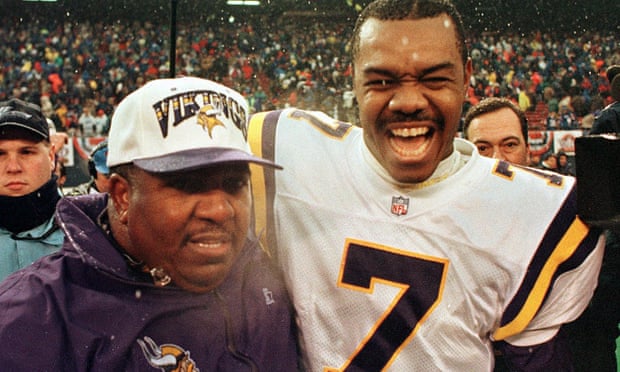
That made the NFL call him again. The Minnesota Vikings named him head coach, and in 10 years he reached the Playoffs 8 times, won 4 NFC Central Division Championships, and got them to the NFC Championship Game in 1998 and 2000.
Unfortunately for him and Minnesota fans, in the former, the 15-1 Vikes lost to the Atlanta Falcons in overtime at the Metrodome when Gary Anderson, who hadn't missed a field goal all season long, missed one from 38 yards with 2 minutes left in regulation; and in the later, the Giants whupped them 41-0 at the Meadowlands.
He was fired at the end of the 2001 season. After 2 seasons as an ESPN analyst, the Arizona Cardinals hired him as head coach in 2004. His 1st 2 years with them were struggles, but the 2006 season began with the opening of the University of Phoenix Stadium, the drafting of Heisman Trophy-winning quarterback Matt Leinart, and the signing of Pro Bowl running back Edgerrin James.
After beating the 49ers in the opening game, Denny must have though the early Northwestern days had returned: The Cards lost 8 straight, 3 of them maddeningly close: 16-14 to the St. Louis Rams, 23-20 to the Kansas City Chiefs, and 24-23 to the Chicago Bears on Monday Night Football.
The Cards forced 6 turnovers, but blew a 20-point lead and lost the game, and Denny, a man who rarely lost his temper, did so in the postgame press conference, making himself a legend for people who might not have even remembered his name, but they remember this tirade:
The Bears are what we thought they were. They're what we thought they were. We played them in preseason. Who the hell takes a third game of the preseason like it's bullshit? Bullshit! We played them in the third game. Everybody played three quarters. The Bears are who we THOUGHT they were! That's why we took the damn field! Now if you want to crown them, then crown their ass! But they are who we thought they were! And we let 'em off the hook!
The Cardinals then lost 3 more games. But after the 8-game losing streak, they went 4-2, and recovered some pride. They finished 5-11, losing 5 games by a total of 18 points. They probably weren't that far from turning it around. But owner Billy Bidwill wasn't willing to trust Denny Green with the turnaround: He fired him, and replaced him with Ken Whisenhunt. In Whiz' 1st season, he got the Cards to 8-8. In his 2nd, he got them to their 1st NFL Championship Game of any kind since 1948 -- 68 years, 2 cities and 4 stadiums earlier.
In 2007, Westwood One hired Denny to be the analyst on their Thursday night NFL radio broadcasts. He held that job through the 2008 season, and then spent 3 years coaching in the United Football League.
Overall, his record as a college head coach was 26-63, though that was mainly due to things that went on at Northwestern well before he got there. In the NFL, he was 113-94.
He is survived by his wife Marie, and 4 children: Patti, Jeremy, Zach and Vanessa.
Denny Green, you were a better coach than you ever got credit for, and a better man, too. You were more than they thought you were.
UPDATE: He was buried at Mission San Luis Rey Cemetery in Oceanside, San Diego County, California.
I have to admit: While I hoped they could take at least 3 out of these 4 games with the 1st-place Baltimore Orioles, I had a feeling that if they only lost 1, it would be the Thursday day-game-after-a-night-game. I was right.
Anyway, after taking the 1st 2, the Yankees needed Michael Pineda to snap out of it. Did he ever: 6 innings, no runs, earned or otherwise, 5 hits, 2 walks, 8 strikeouts. His best performance of the season.
He threw 113 pitches, so, naturally, Joe Girardi panicked and did't let a pitcher who was clearly still cruising pitch the 7th.
But can that decision really be faulted? Not this time, as Dellin Betances, Nick Goody and Chasen Shreve -- yes, Goody and Shreve -- each pitched a perfect inning.
Of course, to paraphrase the late, great Yogi Berra, Good pitching needs good hitting, and vice versa. In the 1st inning Carlos Beltran hit a sacrifice fly that scored Brett Gardner. In the 4th, Mark Teixeira hit a Teix Message, his 8th home run of the season. In the 6th, Teix drew a walk with the bases loaded. In the 7th, Gardner hit a sac fly that scored Ronald Torreyes. And in the 8th, Beltran went deep, his 20th dinger of the year.
One run at a time often isn't enough, but when you get the kind of pitching the Yankees got on Wednesday night, one run is all you need. Yankees 5, Orioles 0. WP: Pineda (4-9). No save. LP: Yovani Gallardo (3-2).
Yesterday's game was hot. Not CC Sabathia weather. And the O's were starting Chris Tillman, who looks headed for the American League's Cy Young Award.
CC allowed 2 runs in the 1st, and the way Britton was pitching, that was all the Birds needed. Starlin Castro had an RBI single in the 2nd, to give CC a run. He cruised after that, still trailing only 2-1, until the 7th, when he ran out of gas, and the O's tacked on 2 more.
Orioles 4, Yankees 1. WP: Tillman (14-2). SV: Zach Britton (30). LP: Sabathia (5-8).
*
So here's how things stand: It is now the Boston Red Sox who lead the AL East, by half a game over the Orioles (1 full game in the all-important loss column), a game and a half over the Toronto Blue Jays (but 3 in the loss column), 7 over the Yankees (8), and 17 over the Tampa Bay Rays (18).
The Rays seem to be proving that, despite all the players they lost, the one guy they simply could not afford to lose was manager Joe Maddon.
As for the Wild Card, the Yankees trail the Jays by 5 1/2 games for the 2nd spot in the AL, 5 in the loss column.
There are 67 games left to play. The next 3 will not be easy, as perhaps the best team in baseball, the San Francisco Giants, comes into Yankee Stadium II. Here's the projected pitching matchups:
* Tonight, 7:05 PM: Masahiro Tanaka vs. Madison Bumgarner.
* Tomorrow, 7:05 PM: Ivan Nova vs. Jeff Samardzija.
* Sunday, 1:05 PM: Nathan Eovaldi vs. Johnny Cueto.
*
Dennis Green died today, of a heart attack at age 67. Born on February 17, 1949 in Harrisburg, Pennsylvania, Dennis Earl Green claimed to have been at what's now the Hersheypark Arena on March 2, 1962, when Wilt Chamberlain scored 100 points for the Philadelphia Warriors against the Knicks. (It's possible: He would have just turned 13, and the arena is only 14 miles east of downtown Harrisburg.)
He went to the University of Iowa, and did well there both in the classroom and on the field. He was planning to be a high school teacher, but played the 1971 season for the British Columbia Lions of the Canadian Football League. He was then hired as an assistant coach at the University of Dayton in Ohio, back at Iowa, and at Stanford University, then coached by Bill Walsh. When Walsh got the head job with the San Francisco 49ers, he took Denny with him as special teams coach.
After just 1 more year, Stanford took him back, as offensive coordinator. Northwestern University, in the Chicago suburb of Evanston, Illinois, was desperate: They had were in the process of forging what is still the longest losing streak in the history of NCAA Division I football. (It's been surpassed by Columbia and Prairie View A&M, but it's still the longest in the history of Division I-A, now the Football Bowl Subdivision or FBS.) It was so bad that somebody found a highway sign saying, "Interstate 94," and added below that, "Northwestern 0."
They were desperate enough that they hired Denny Green as only the 2nd African-American head coach in Division I-A history. (The 1st was Willie Jeffries at Wichita State in 1979. He didn't win there, but won titles at historically black schools South Carolina State and Howard University. He is still alive, age 81.) Denny couldn't stop the Wildcats from losing a 29th straight, to set a new record. But on September 25, 1982, he beat Northern Illinois to end the streak at 34 straight. They finished 3-8, and he was named Big Ten Coach of the Year.
In 1986, Walsh took him back to San Francisco, and he coached the receivers. That means he coached Jerry Rice and John Taylor. He won a ring in Super Bowl XXIII. In 1989, Stanford once again went up the Peninsula and took him from Candlestick Park back down to "The Farm," making him head coach. In 1991, he went 8-3, finishing 2nd in the Pac-10.
That made the NFL call him again. The Minnesota Vikings named him head coach, and in 10 years he reached the Playoffs 8 times, won 4 NFC Central Division Championships, and got them to the NFC Championship Game in 1998 and 2000.
Dennis and the 1998 Vikings' quarterback, Randall Cunningham
Unfortunately for him and Minnesota fans, in the former, the 15-1 Vikes lost to the Atlanta Falcons in overtime at the Metrodome when Gary Anderson, who hadn't missed a field goal all season long, missed one from 38 yards with 2 minutes left in regulation; and in the later, the Giants whupped them 41-0 at the Meadowlands.
He was fired at the end of the 2001 season. After 2 seasons as an ESPN analyst, the Arizona Cardinals hired him as head coach in 2004. His 1st 2 years with them were struggles, but the 2006 season began with the opening of the University of Phoenix Stadium, the drafting of Heisman Trophy-winning quarterback Matt Leinart, and the signing of Pro Bowl running back Edgerrin James.
After beating the 49ers in the opening game, Denny must have though the early Northwestern days had returned: The Cards lost 8 straight, 3 of them maddeningly close: 16-14 to the St. Louis Rams, 23-20 to the Kansas City Chiefs, and 24-23 to the Chicago Bears on Monday Night Football.
The Cards forced 6 turnovers, but blew a 20-point lead and lost the game, and Denny, a man who rarely lost his temper, did so in the postgame press conference, making himself a legend for people who might not have even remembered his name, but they remember this tirade:
The Bears are what we thought they were. They're what we thought they were. We played them in preseason. Who the hell takes a third game of the preseason like it's bullshit? Bullshit! We played them in the third game. Everybody played three quarters. The Bears are who we THOUGHT they were! That's why we took the damn field! Now if you want to crown them, then crown their ass! But they are who we thought they were! And we let 'em off the hook!
The Cardinals then lost 3 more games. But after the 8-game losing streak, they went 4-2, and recovered some pride. They finished 5-11, losing 5 games by a total of 18 points. They probably weren't that far from turning it around. But owner Billy Bidwill wasn't willing to trust Denny Green with the turnaround: He fired him, and replaced him with Ken Whisenhunt. In Whiz' 1st season, he got the Cards to 8-8. In his 2nd, he got them to their 1st NFL Championship Game of any kind since 1948 -- 68 years, 2 cities and 4 stadiums earlier.
In 2007, Westwood One hired Denny to be the analyst on their Thursday night NFL radio broadcasts. He held that job through the 2008 season, and then spent 3 years coaching in the United Football League.
Overall, his record as a college head coach was 26-63, though that was mainly due to things that went on at Northwestern well before he got there. In the NFL, he was 113-94.
He is survived by his wife Marie, and 4 children: Patti, Jeremy, Zach and Vanessa.
Denny Green, you were a better coach than you ever got credit for, and a better man, too. You were more than they thought you were.
UPDATE: He was buried at Mission San Luis Rey Cemetery in Oceanside, San Diego County, California.
Thursday, July 21, 2016
Top 10 Myths About the 1970s
I previously did posts like this, in which I debunked some myths about the 1950s and the 1960s. It's time to do it for the 1970s.
The Baby Boomers, born from 1946 to 1964, but mostly in the late 1940s and early 1950s, have driven American pop culture from the 1960s onward. They moved the nostalgia waves for the Fabulous Fifties and the Sensational Sixties. The Seventies -- whether Silly or Sickening -- were never going to match up, because the kids who were teenagers then were vastly outnumbered by their big brothers and sisters.
Still, the 1970s have their own myths that need to be dispelled.
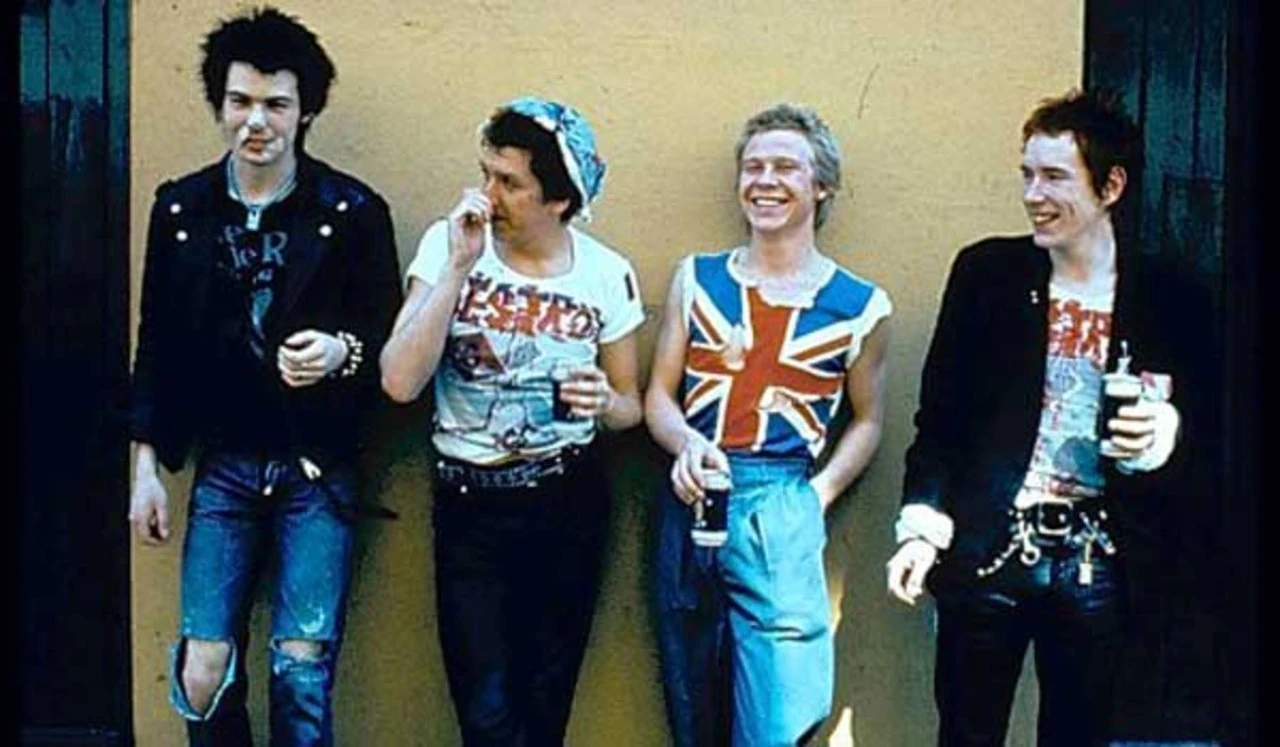
But there's a reason that John Lydon, a.k.a. Johnny Rotten, named his 2nd band Public Image Limited: Because the image of his 1st band, the Sex Pistols, was far from reality.
Punk rock was invented in New York. Not in London, or in any other British city: New York City. And the first punk rockers didn't look anything like the traditional British punks that followed them. New York's The Ramones, The Dictators, and The Patti Smith Group (though Patti herself is from Chicago); San Francisco's the Dead Kennedys, Los Angeles' X... None of these bands' members looked like the British punks.
And while the Dead Kennedys were political in nature, and The Ramones recorded a song titled "Rocket to Russia," American punk really wasn't political. Sure, it began in the wake of Vietnam and Watergate, but it didn't have the political undertones of British punk, with the Sex Pistols' "God Save the Queen" and its refrain "There's no future in England's dreaming," and The Clash's "London Calling," among others.
It was Richard Hell, lead singer of Television, who pioneered the spiked-hair, torn-shirt, safety-pin look that would be appropriated by the Sex Pistols and many of the British bands that followed them.
The Sex Pistols lineup that everybody remembers wasn't even the one that made the group's one and only album, Never Mind the Bollocks, Here's the Sex Pistols. Johnny Rotten sang lead, Steve Jones played guitar, Paul Cook played drums, and the bass guitarist was... Glen Matlock. All were good. The band's 2 best-known songs, "Anarchy in the U.K." and "God Save the Queen," were both recorded by this lineup, and Matlock had a hand in writing them.
On February 15, 1977, Matlock quit the band because he was "sick of the bullshit." Or he was fired, because "he liked the Beatles." Knowing what happened to the group afterward, I believe Matlock's version.
He was replaced by John Simon Ritchie, a.k.a. Sid Vicious, who had next to no talent, but attitude to spare. He was responsible for a lot of the Pistols' image, but for nearly none of its product -- which, you would think, would be the exact opposite of the punk ethos: The message matters, the image doesn't. Indeed, of the 12 songs on the group's one and only album, 10 were credited to "Cook/Jones/Matlock/Rotten." (Note the alphabetical order.) Only 2, "Holidays In the Sun" and "Bodies," were credited to "Cook/Jones/Rotten/Vicious."
Lydon/Rotten, Jones, Cook and Matlock are all still alive at this writing. Ritchie/Vicious, of course, is not: First he killed his girlfriend, Nancy Spungen, at the Chelsea Hotel in New York (where Leonard Cohen, an unwitting forefather of punk, lived); then, while awaiting trial, died of a heroin overdose. He was 21.
In the end, while the Pistols became the symbol of punk, just as the Bee Gees (who started as a British folk-rock group) became the symbol of disco, they weren't even close to being the best of those bands. Most observers would have said The Clash were the best. (Their fans liked to call them "the only band that matters.")
Its also worth nothing that most punk bands, even the British ones, didn't follow the Pistols' example. It's like assuming that all 1950s rockers had pompadours like Elvis Presley, all mid-1960s British rockers had long straight hair and black suits like the Ed Sullivan-era Beatles, all late-1960s rock acts had long, hippie-length hair, all black disco acts had giant Afros, and all white disco acts wore long hair and white suits. And, by the way, not all 1980s metal musicians were blond.
Like every other form of rock and roll, punk wasn't about the clothes or the hair, anyway. Tommy Ramone said it best:
In its initial form, a lot of (1960s) stuff was innovative and exciting. Unfortunately, what happens is that people who could not hold a candle to the likes of (Jimi) Hendrix started noodling away. Soon you had endless solos that went nowhere. By 1973, I knew that what was needed was some pure, stripped down, no bullshit rock 'n' roll.
In other words, it wasn't bad government, or a bad economy, but bad music that they were rebelling against.
Which led to not just punk, but Bruce Springsteen & the E Street Band, and Billy Joel's better stuff, and then The Police. Bruce, Billy and Sting peaked in the Eighties, but had their 1st hits in the Seventies. They took a different route than punk, but were headed in the same direction, and arrived at a better destination. In other words, their bands not only lived, but remained friends.
7. The Mets Were More Popular Than the Yankees. For much of the decade, this was actually true -- but misleading.
In my piece about Sixties myths, I pointed out that the Mets' early success at the box office was based on the fact that they'd brought together the fans of the teams that moved from New York City to California after the 1957 season: The New York Giants and the Brooklyn Dodgers. Their fans weren't really rooting for the Mets as a team, but as a concept, as an extension of the New York National League ideal that they'd hung onto.
Finally, in 1969, it became clear that the Yankees' attendance was based not so much on their legacy of Pennants (they weren't contending for new ones), but on Mickey Mantle: Once he retired, their attendance dropped, and, for the first time, it was less than half the Mets' attendance -- i.e., half the combined attendance of the ex-Giant fans and the ex-Dodger fans going to Flushing Meadow. Of course, that was also the year the Mets stopping stinking and won the World Series.
The Mets were good, but not great, in 1970, 1971 and 1972. As were the Yankees. In August 1973, the Yankees had a shot at the American League Eastern Division title, while the Mets were last in the National League Eastern Division -- but still close enough to have a chance. Then the Mets got hot, and the Yankees went ice cold, and it was the Mets scraping into the Playoffs with an 82-79 record, the worst ever to make the postseason in Major League Baseball, while the Yankees were way off.
The Mets were good, but not great, in 1974, 1975 and 1976. The Yankees were still in the race in the last week in 1974 and the last 2 weeks in 1975. In 1976, they won the Pennant. In 1977, despite not being able to get within 3 games of 1st place most of the season, the Yankees went on a tear starting in early August, and won the whole thing; while the Mets collapsed, thanks in part to dumb trades (made to save money) by team president M. Donald Grant, and attendance at Shea Stadium also collapsed, to the point where it was nicknamed Grant's Tomb. In the meantime, the Yankees' attendance soared with the renovated Yankee Stadium.
Here's the table for their average attendance per home game:
Year Yankees Mets
1970 14,036 < 32,896
1971 13,219 < 27,984
1972 12,550 < 27,361
1973 15,582 < 23,610
1974 15,717 < 21,262
1975 16,513 < 21.365
1976 25,155 > 17,912
1977 25,964 > 13,504
1978 28,838 > 12,592
1979 31,330 > 9,621
The Mets' 1970 figure remained a New York baseball record until the Yankees broke it in 1998, with 36,484. As long as the Yankees were playing first in the pre-renovation Stadium in the South Bronx with a mediocre team, and then in Shea Stadium while Yankee Stadium was being renovated in 1974 and '75, they were going to trail the Mets in attendance. Once Yankee Stadium reopened, they were going to have better attendance no matter what the Mets did.
Indeed, since the old Yankee Stadium reopened in 1976, the only seasons in which the Mets have beaten the Yankees in attendance have been 1984 through 1992 -- when (except for the last season) the Mets were noticeably better than the Yankees, which they haven't been since. (No, not even this year. If the Mets played in this year's AL East, they'd get slaughtered.) The Mets aren't even doing better than the Yankees in attendance this year, in the wake of a Pennant: 38,569 to 35,152 (and if you believe the Mets are getting 35,000 people in the ballpark every home game, then I'd like to sell you the Bronx-Whitestone Bridge).
And 1977 was the year Grant forced Tom Seaver out. Just as the Yankees' attendance took a nosedive when Mantle retired, and that of the Baltimore Orioles a similar drop when Cal Ripken retired, without Seaver, there was really no reason to go to a Met game until they got good again in 1984.
The Mets' current best total ever, and one they will never break as long as they play in 41,000-seat Citi Field, is the 49,902 they got in 2008, the last season at Shea. The Yankees also set their franchise record that year, the last year at the old Yankee Stadium, with 53,070, also a figure that can't be topped at the new Yankee Stadium.
8. Seventies Sports Uniforms Were Cool. There's a reason that the uniforms you occasionally see on "Throwback" nights aren't worn by those teams any longer. It's because they were hideous.
Dan Epstein, author of Big Hair and Plastic Grass (about baseball in the decade) and Stars and Strikes (specifically about 1976), argues that the baseball uniforms of the '70s were part of the decade's charm. Yeah, sure, they were -- if you're looking back from the 2010s and laughing about it.
But suppose you were a Cleveland Indians fan, and, on top of your team not being very good, you had to look at this on TV 81 times a year:
Or, imagine that you were a San Diego Padres fan:
Or, imagine that you were a San Francisco Giants fan, already having to deal with the problems of going to a baseball game at Candlestick Park:
Or imagine that you were an Atlanta Braves fan, and you had to watch the great Hank Aaron break the most hallowed record in sports while wearing a jersey the Babe wouldn't have been caught dead in:
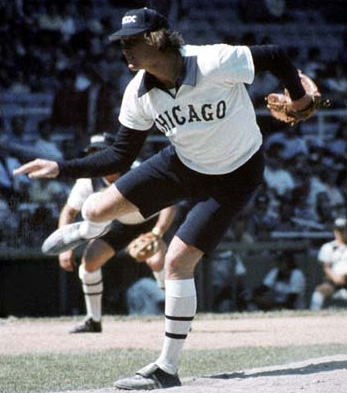
Or, imagine that you were a Chicago White Sox fan, and you loved baseball, but you hated soccer, because (among other reasons) it was a bunch of guys running around in shorts outdoors. And then you see Bill Veeck having the ChiSox decked out in this:
At least the Philadelphia Phillies only it wore this one time, but imagine that you had paid to see a game at Veterans Stadium (not exactly the palace it was promoted as being when it opened in 1971, though it was an improvement over the crumbling Connie Mack Stadium in the decaying North Philly ghetto), and you saw this:
Or, imagine that you were watching the 1979 World Series. It was bad enough that Memorial Stadium in Baltimore had the worst lighting system in baseball (except for Wrigley Field, which still had no lights at all), making the light from the towers trail whenever the camera had to follow a long fly ball. And it was bad enough that Memorial Stadium had those awful yardlines and torn-up grass, which is what happens in September when you play baseball and football in the same stadium, on the same natural-grass field. And it was bad enough that the alternative, artificial turf, looked even worse at Pittsburgh's Three Rivers Stadium. All those seams.
But those uniforms! This is what the Baltimore Orioles wore at home:
And while I had no problem with their wearing of 19th Century-style pillbox caps, or the stars that Willie Stargell awarded as if they were college football helmet decals, the Pittsburgh Pirates would mix-and-match between plain white, white with gold pinstripes, lemon-yellow and black:
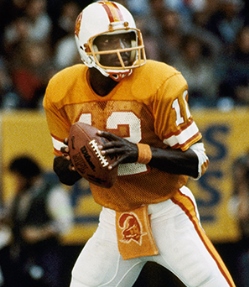
It wasn't just baseball. Ironically, the Super Bowl XLVIII winners, the Seattle Seahawks, looked better when they were expanded into existence in 1976. That was not the case for the other team that started that year, the Tampa Bay Buccaneers. "Bucco Bruce" was an oh-so-'70s logo, but he's not the worst of it. The worst of it was the "Creamsicle jerseys":
The classic Philadelphia Eagles look is white or silver wings on a green helmet. But from 1969 to 1973, they wore green wings on white helmets. They looked like a high school team:
The NBA had some truly hideous togs: The Atlanta Hawks, the Cleveland Cavaliers, and the Knicks' experiment of "NEW YORK" below the numbers thankfully didn't last long:
Remember the Rangers' 1976-77 "shield jerseys"?
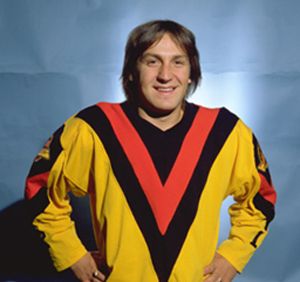
The Vancouver Canucks haven't exactly been known for being well-dressed, but they bottomed out in the late 1970s:
9. The Jimmy Carter Malaise. Conservatives, desperate to keep up the image of Ronald Reagan as a great President in the wake of the successes of liberal Democrats Bill Clinton and Barack Obama, and the failures of both George Bushes, are determined to show that Carter was "a failed President." They endlessly described first Clinton, and then Obama, as "another Jimmy Carter." They still do to this today, even though Carter hasn't been President for 35 years.
Part of the way they point this out is by using the word "malaise." The word is French, and it means "ill ease." In English, it's "A feeling of general bodily discomfort, fatigue or unpleasantness," or, more to this point, "An ambiguous feeling of mental or moral depression." A general feeling that things simply aren't right. And in the 2nd half of 1979, all through the 1980 campaign, and ever since, Carter's opponents -- including Senator Ted Kennedy, who opposed him in the Democratic Presidential Primaries -- used the word "malaise" to describe the feeling that the Carter Administration had given America.
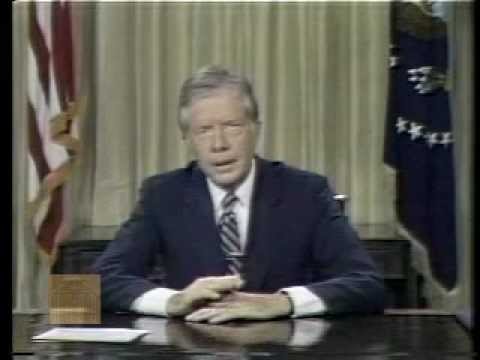
You know who never used the word "malaise"? Jimmy Carter. Here's what he said in what became known as "The Malaise Speech," on July 15, 1979:
I want to talk to you right now about a fundamental threat to American democracy...
I do not refer to the outward strength of America, a nation that is at peace tonight everywhere in the world, with unmatched economic power and military might. The threat is nearly invisible in ordinary ways. It is a crisis of confidence.
It is a crisis that strikes at the very heart and soul and spirit of our national will. We can see this crisis in the growing doubt about the meaning of our own lives and in the loss of a unity of purpose for our nation.
That sure sounds like a malaise. But the President didn't use the word then. Nor did the word appear in any of his public statements during his Administration. So who started using the word "malaise" to describe the situation then? Apparently, it was Hendrik Hertzberg, Carter's chief speechwriter, who wrote the "Crisis of Confidence Speech" (the "Malaise Speech"), in an interview the next day.
Yes, there was a malaise. But Carter sure as hell didn't cause it. It was brought about by a cumulative effect of things that happened under Presidents of both parties, including, to a degree, Carter himself:
* The assassination of Democratic President John F. Kennedy on November 22, 1963.
* Democratic President Lyndon B. Johnson's seeming abandonment of his Great Society principles to spend on the Vietnam War, and his apparent lies about it (which came to be known as "the credibility gap").
* The apparent failure of LBJ's "War On Poverty."
* The race riots of 1964 to 1969.
* The riot at the 1968 Democratic Convention in Chicago.
* Republican President Richard Nixon's failure (or, more accurately, his refusal) to end the Vietnam War in his 1st term (finally doing so at the start of his 2nd).
* Nixon's involvement in the Watergate break-in of June 17, 1972, and his ensuing cover-up thereof. Each of the preceding was cited to Carter by his chief pollster, Patrick Caddell, who gave Carter the phrase "crisis of confidence."
* Republican President Gerald Ford's pardon of Nixon, and his inability to reduce unemployment and inflation.
* The refusal (seen by conservatives) of every President since World War II, from Franklin Roosevelt to Carter (yes, all of them, including the Republicans Dwight D. Eisenhower, Nixon and Ford) to properly stand up to the Communist and terrorist menaces, anywhere in the world.
* Carter's "giveaway" of the Panama Canal to, you know, the country it was actually in, Panama. Never mind that it was Ford's idea. (It was one of the big reasons that Reagan ran against Ford in the 1976 Republican Primaries.)
* Carter's own inability to handle a 2nd round of inflation -- in each case, caused largely by Middle Eastern nations raising the price of oil.
All of this happened before the speech, as well as before the Iran Hostage Crisis that began on November 4, 1979, and the Soviet invasion of Afghanistan on December 27, 1979, and Carter's reaction to each: For the former, his dragged-out negotiations to get the hostages out and the failure of the "Desert One" rescue mission on April 25, 1980, which probably gave his re-election campaign a mortal wound; and for the latter, his boycott of the 1980 Summer Olympics that were scheduled for Moscow, which did more to effectively depict the Soviets as an "Evil Empire" than anything Reagan ever said his life.
When Carter was inaugurated on January 20, 1977, the national unemployment rate was 7.5 percent. That's too high. It inched up to 7.6 percent in February. Then it began to drop. By January 1978, it was 6.4 percent. By January 1979, 5.9 percent. By May 1979, 5.6 percent -- the lowest it had been since August 1974, the month Nixon resigned. I should point out that the factors that would drive it up were already in place by that point. Indeed, unemployment is often a lagging indicator of how good (or bad) the economy is. When Carter gave that speech in July 1979, it was 5.7 percent. Not great, but hardly cause for alarm.
But it jumped to 6.0 percent the next month, was 6.3 percent by January 1980, and then in the Spring, it shot up: 6.9 percent in April, 7.5 percent in May, 7.8 percent in July -- just in time for Reagan to accept the Republican nomination. It was around 7.5 percent for the rest of Carter's Presidency, including when he left office on January 20, 1981 -- in other words, exactly the same as it was when he was inaugurated.
But how was it under Reagan? That's a story I'll get to when I do the 1980s version of this post. But it didn't get back below the 5.6 percent that it was in May 1979 until... April 1988.
However, it wasn't just the unemployment rate. Inflation was high. So were interest rates. And wages had begun to stagnate. The stagnancy and the inflation were combined into a single word: "Stagflation." That, as much as anything else, created the malaise.
And a generation of working people in their 30s and 40s, who had been activists as young people in the 1960s, were used to standing up to those in power and saying, "Enough! We will not put up with this crap anymore!" And they saw the "malaise," and, as they had been trained to do, they blamed the people in power -- except they didn't see big business as part of the problem, the way antiwar activists saw Boeing and McDonnell-Douglas building bombers and Dow making napalm as part of the problem in Vietnam. No, these people looked to the government, and only the government, as the problem.
That's why so many of them sided with Ted Kennedy in the Winter and Spring of 1980. It wasn't so much a vote for the insurgent candidate (many people, as it turned out, had a problem with Ted's private life) as it was a protest vote against the incumbent or establishment candidate, as in for Henry Wallace against Harry Truman in 1948, for Gene McCarthy and then Robert Kennedy against Lyndon Johnson and then Hubert Humphrey in 1968, for Reagan against Ford in 1976, and later for Pat Robertson against George H.W. Bush in 1988, for Pat Buchanan against Daddy Bush in 1992, for Ralph Nader against Al Gore in 2000, for Barack Obama against Hillary Clinton in 2008 (the only one of these that went all the way), and for Bernie Sanders against Hillary this year.
A United Auto Workers official put it this way:
It's a different generation of workingmen. None of these guys came over from the old country, poor and starving, grateful for any job they could get. None of them have been through a depression. They've been exposed, at least through television, to all the youth movements of the last ten years...
They're just not going to swallow the same kind of treatment their fathers did... They want more than just a job for 30 years.
Compared to his successors, Carter did amazingly well at creating jobs. Under his Presidency, jobs increased by an average of 2.58 million per year; Reagan, 2.01 million; Bush 41, 668 thousand (not million, thousand); Bill Clinton, 2.86 million; Bush 43, 160 thousand; Obama so far, 1.40 million.
Annual rate increase? Carter 3.06 percent, Reagan, 2.06 percent; Bush 41, 0.62 percent; Bill Clinton, 2.48 percent; Bush 43, 0.12 percent; Obama so far, 1.11 percent (keeping in mind that he inherited the Dubya meltdown of 2008). Jimmy Carter created jobs at a greater rate per year than any President since LBJ.
Want that in table form? Jobs per year, in millions:
D Clinton 2.86
D Carter 2.58
R Reagan 2.01
D Obama 1.40
R Bush 41 0.67
R Bush 43 0.16
Job growth per year:
D Carter 3.06
D Clinton 2.48
R Reagan 2.06
D Obama 1.11
R Bush 41 0.62
R Bush 43 0.12
In other words, Carter was 23 percent better at creating jobs than "job-creating machine" Clinton, and 48 percent better at it than Reagan who "turned the economy around" and brought about "Morning in America."
You know conservatives: As their avatar, Reagan, said, "Facts are stupid things." He was trying to quote John Adams: "Facts are stubborn things."
Conservatives always want you to believe that everything was just fine until noon on Inauguration Day when the Republican President went home; and then went to hell as soon as the Democratic President-elect says, "So help me, God." And that it works the other way: As soon as the Democratic President gives way to the Republican President-elect, everything became fine.
Never mind that Reagan himself, in his Inaugural Address, said that America's problems "will not go away in days, weeks, or months. But they will go away." Which was true: The only questions were how, and when. And then he preceded to tell the biggest lie any President had ever told to that point: "Government is not the solution to the problem. Government is the problem." And then, he spent the next 8 years proving his point.
Why, a conservative born after 1980, not old enough to really remember Reagan as the sitting President, and raised on the myth more than the man, would probably find it hard to believe that the U.S. hockey team that beat the Soviets at the 1980 Winter Olympics in Lake Placid, New York, could have done so under President Carter, rather than under President Reagan. (Carter wasn't there for that game, but Vice President Walter Mondale, a Minnesotan and a hockey buff, was.)
Or maybe Reagan was just lucky, and Carter wasn't. As someone put it in the Summer of 1981, "If Carter had fired the air-traffic controllers, there would have been a crash the next day."
Reagan ushered in the "Decade of Greed." Which followed the 1970s, a.k.a....
10. "The Me Decade." Tom Wolfe, already a renowned journalist but not yet a novelist, coined the phrase in the cover story of the August 23, 1976 issue of New York magazine. He suggested that the economic boom of the Fifties and Sixties (there were some recessions in there, but nothing like what we got in 1973-76, 1980-83, 1990-93, 2001-04 and 2007-10), combined with the realization of "One man can make a difference" and the drug culture, rather than making Americans more community-oriented or human-race-oriented, made them more self-oriented.
Yes, the decade was excessive, and very self-indulgent: As rock historian Dave Marsh said about Led Zeppelin's biggest hit single, "Whole Lotta Love," which came out just as 1969 was turning over to 1970, "Hey, I didn't say the ape calls were inappropriate, only excessive." That may be the most Seventies statement ever.
The 1970s was the last decade before crack made cocaine cheap, and thus its effects were made so obvious to a wide audience. It was the first full decade of the Sexual Revolution (as I've said before, the early Sixties were really an extension of the Fifties), and the last decade before anyone heard of AIDS, and thus it was the only decade where there seemed to be true "free love." Despite the deaths of Jimi, Janis and Jim near the beginning, the decade seemed to be the last time we had a true time of "Sex, drugs and rock & roll" with no consequences. (Of course, there was never such a time.)
The greasers of the mid-Fifties, the beats of the late Fifties, the folkies of the early Sixties and the hippies of the late Sixties were now adults, and could now afford to indulge themselves in their pleasures the way their parents, the kids of the Great Depression of the Thirties and World War II in the Forties, did with their booze and their tobacco and their swingers' parties.
And, having gone through Vietnam and marching for civil rights, they could now say to their parents, "Yes, we now have paid our dues, just like you paid yours. It's time we were allowed to party, man. And we are gonna boogie all night long!" Or, as KISS put it, "I... wanna rock and roll all night... and party every day!" Redundant? Everyone acted like no one had to care, as if they said, "We did our bit for king and country, we played our brother's keeper, now it's time to have some fun for ourselves."
But it was also the decade of the Concert for Bangladesh; the One-to-One Concert; Wattstax; the S.N.A.C.K. Benefit; and the M.U.S.E. "No Nukes" Concerts. These shows highlighted the issues of world hunger, mental health, inner-city issues, hunger at home, and nuclear proliferation. Just because a few self-indulgent people were carelessly having fun, it didn't mean that idealism had to stop. And it didn't.
That rock and roll idealism was better in the '70s than it was in the '60s is arguable; that it was better-organized is not.
*
I met a girl who sang the blues
and I asked her for some happy news.
But she just smiled and turned away.
I went down to the sacred store
where I'd heard the music years before
but the man there said the music wouldn't play.
And in the streets, the children screamed.
The lovers cried and the poets dreamed.
But not a word was spoken.
The church bells all were broken.
And the three men I admired most
the Father, Son and the Holy Ghost
they caught the last train for the Coast
the day the music died.
Don McLean was wrong. "The music" hadn't died. It had grown up. If the people you admired had "caught the last train for the Coast," it's because that's where they were needed. And they would come back when they were needed where you were. And they did.
In the 1970s, Madison Square Garden hosted 3 NBA Finals and 2 Stanley Cup Finals. It also hosted John Lennon, Muhammad Ali, and a now-sainted Pope.
Time marches on. The good old days weren't as great as you thought they were. But neither were the bad days that followed as bad as you remembered.
The Baby Boomers, born from 1946 to 1964, but mostly in the late 1940s and early 1950s, have driven American pop culture from the 1960s onward. They moved the nostalgia waves for the Fabulous Fifties and the Sensational Sixties. The Seventies -- whether Silly or Sickening -- were never going to match up, because the kids who were teenagers then were vastly outnumbered by their big brothers and sisters.
Still, the 1970s have their own myths that need to be dispelled.
UPDATE: It took me until 2024 to think of this, but...
The 1970s were Schrödinger's Decade. There was too much Republican competence, too much oil, too much crimefighting, too much television, too much overwrought music, disco and otherwise; and, overall, too many ridiculous distractions from it all... and, at the same time, not enough of those things.
1. The Beginning of "The '70s" was the end of "The '60s," and the End of the Dream. On March 6, 1970, Sixties student activism blew up -- literally, as 2 members of the Weather Underground didn't exactly follow the directions in building a bomb in their apartment.
On April 10, 34 days later, Paul McCartney announced that the Beatles had broken up. The Supremes had already done so. Paul Simon & Art Garfunkel were about to do so.
On April 30, just 20 days after the Beatles' breakup was announced, President Richard Nixon, who had run on, among other things, a promise to end the war in Vietnam, announced what became known as the Cambodian Incursion, expanding the war (and, as it turned out, dooming Cambodia to what became known as the Killing Fields).
Four days after that, on May 4, 1970, a date which lives in infamy, the Ohio National Guard fired on demonstrators at Kent State University near Cleveland, wounding 13, 4 of whom died.
Four days after that, on May 8, the very day that the New York Knicks finally won their 1st NBA Championship (and 2 days before Bobby Orr scored his "Flying Goal" to win the Stanley Cup for the Boston Bruins), there was a "Hard Hat Demonstration" in New York: Conservative construction workers marching through the streets, holding up signs supporting Nixon and the war. It was a backlash against the antiwar activists, the hippies, the liberals, the civil-rights activists.
People were now more interested in accepting the establishment than in mocking it: NBC's Laugh-In lost its steam, and CBS had already canceled The Smothers Brothers Comedy Hour the year before.
On April 10, 34 days later, Paul McCartney announced that the Beatles had broken up. The Supremes had already done so. Paul Simon & Art Garfunkel were about to do so.
On April 30, just 20 days after the Beatles' breakup was announced, President Richard Nixon, who had run on, among other things, a promise to end the war in Vietnam, announced what became known as the Cambodian Incursion, expanding the war (and, as it turned out, dooming Cambodia to what became known as the Killing Fields).
Four days after that, on May 4, 1970, a date which lives in infamy, the Ohio National Guard fired on demonstrators at Kent State University near Cleveland, wounding 13, 4 of whom died.
Tin solders and Nixon's comin'. We're finally on our own.
This summer, I hear the drummin': Four dead in Ohio.
-- David Crosby, Stephen Stills, Graham Nash & Neil Young
Four days after that, on May 8, the very day that the New York Knicks finally won their 1st NBA Championship (and 2 days before Bobby Orr scored his "Flying Goal" to win the Stanley Cup for the Boston Bruins), there was a "Hard Hat Demonstration" in New York: Conservative construction workers marching through the streets, holding up signs supporting Nixon and the war. It was a backlash against the antiwar activists, the hippies, the liberals, the civil-rights activists.
"Impeach the Red Mayor." Apparently, somebody
was stupid enough to believe that Mayor John Lindsay,
a very rich Republican, was a Communist.
People were now more interested in accepting the establishment than in mocking it: NBC's Laugh-In lost its steam, and CBS had already canceled The Smothers Brothers Comedy Hour the year before.
On August 1, 1970, R. Dean Taylor released his hit single "Indiana Wants Me," which ends with the narrator surrounded by the police, tapping into the now-pervasive "The Sixties are over, and now, The Man is coming for us" vibe.
On September 18, 1970, Jimi Hendrix died from a combination of alcohol and barbiturates. When asked for a reaction, Janis Joplin said, "There but for the grace of God go I." Just 16 days later, on October 4, she fulfilled her self-fulfilling prophecy, dying from the same thing.
When Jimi died, Jim Morrison of The Doors started asking, "Do you believe in omens?" When Janis died, he told people, "You're drinking with number three." On July 3, 1971, he fulfilled his self-fulfilling prophecy.
Just 30 days after Janis died, on November 3, George Wallace was returned to the Governor's office by the voters of Alabama, and Ronald Reagan was re-elected Governor of California. The idea that Wallace, who had run a 3rd-party campaign for President in 1968, could actually get elected President in 1972 was now in the backs of people's minds. The idea that Reagan could become President someday was still a national joke. But both thus became legitimate possibilities: Neither Governor was a 1st-term fluke any longer.
The Spring of 1970 was the Winter of Discontent for "Sixties People." By the middle of Autumn, it seemed as though the dream was over. It was dead. It was murdered. Or perhaps its fatal wound was self-inflicted. And the "doctors" who could have saved its life, the activists themselves, were growing too weary to try. As James Earl Jones' character Terence Mann said in Field of Dreams, "I gave at the office." Peace, love and civil rights were out; international strife, domestic angst and social stagnation were in.
So the beginning of the Seventies was the end of the Sixties dream, right?
Except that it didn't work out that way. How can I say that?
Let's start with Woodstock, August 15 to 18, 1969, the perceived culmination of the Sixties. You know how many people have said they were there? Millions. You know how many were actually there? Well, nobody knows for sure. Depending on whose figures you believe, it was anywhere from 300,000 (the figure The New York Times cited the next week) to 850,000 (a figure that Richie Havens, who opened the festival, cited on The Oprah Winfrey Show 20 years later -- and that may have reflected the total number of people that had gone through the grounds on the weekend, if not the highest number of people that were there at any one time).
Rolling Stone magazine put the number 450,000 on its next cover. (If you want to go looking for it, let me warn you: That cover is, retroactively, very cringey.) Writing in Rock of Ages: The Rolling Stone History of Rock & Roll in 1985, Geoffrey Stokes said it was 400,000. The figure of 500,000 is generally accepted because of the subsequent song by Crosby, Stills & Nash, who were there: "By the time we got to Woodstock, we were half a million strong." (You know who actually wrote that song? Joni Mitchell -- and she wasn't there.)
Regardless, the population of Buffalo, the 2nd-largest city in the State of New York, was listed in the 1970 Census as 462,000. So Max Yasgur's dairy farm in Bethel, where the Woodstock Festival was held, may have been "the second-largest city in New York State."
Woodstock the film was released on March 26, 1970. It was a safe way to "live the dream," and that's how most people viewed the festival, without having to deal with the traffic, the rain, the mud, and the insufficient food, sanitary and medical provisions. The people who saw the movie sure didn't act like the dream was over.
The Sonny & Cher Comedy Hour filled CBS' Smos-Bros void. Dick Cavett continued to have "Sixties" figures on his show. He had John Lennon and Yoko Ono as guests on September 11, 1971. Mike Douglas had John and Yoko as guest-hosts with him for an entire week, February 7 to 11, 1972. Even Johnny Carson had "Sixties" performers on The Tonight Show.
But it was more than that. What did liberals want in the Sixties? Guess what: Although it didn't seem like those things would ever come, they had gotten most of it by the halfway mark of the Seventies:
* An end to the Vietnam War. Nixon made the announcement on January 23, 1973. Though he waited until after he got re-elected, and even re-inaugurated, to do it, so he doesn't get credit for it from me.
* Gains for minorities. For blacks, Hispanics, Native Americans, and especially women and gays, the Seventies were their "Sixties."
* More attention paid to the environment. Rachel Carson published Silent Spring in 1962, and was praised for it by President John F. Kennedy. Claudia "Lady Bird" Johnson, wife of President Lyndon B. Johnson, was a big advocate for highway beautification and wildflowers. To paraphrase Neil Armstrong, That's one small step for a woman, one nice stride for mankind.
But not until 1970 did we get the Environmental Protection Agency (EPA). Not until 1971 and Marvin Gaye's "Mercy Mercy Me" did we get a hit song about the ecology, long after it became cool to have hit songs about racial equality, the cost of war, and even the dangers of drugs.
* Nixon gone. It took until August 9, 1974, and the catalyst was the Watergate break-in, a catalyst as stupid as the parking ticket that led to David Berkowitz' arrest as the Son of Sam/.44 Caliber Killer, but it happened: We didn't have Nixon to kick around anymore.
* More liberal movies and TV shows. Sure, the Sixties had Laugh-In and The Smothers Brothers on the small screen, and Easy Rider on the big screen. But... well, I'll get to that in my next point.
The point is, so much was made of what was lost in the late Sixties and the early Seventies that, sometimes, people forgot just how much they had gained.
2. The Seventies Were a Cultural Wasteland. It's easy to say that it was all over in terms of music. But, guess what?
* The Beatles broke up, but all 4 former Beatles kept it going. True, by 1975, Paul McCartney was the only one still churning out regular hits, and most of them were, as John Lennon put it, "silly love songs." And, as Paul pointed out, "Some people want to build world out of silly love songs, and what's wrong with that?" But John's Plastic Ono Band, Paul's Band On the Run and George Harrison's All Things Must Pass were great albums, and Ringo Starr had a bunch of good singles.
* Bob Dylan didn't turn out another Freewheelin' Bob Dylan, Highway 61 Revisited or Blonde On Blonde, but, had just about anyone else churned out what he churned out in the Seventies -- including Blood On the Tracks and the simple yet incredible single "Knockin' On Heaven's Door" -- we'd have called that someone else a genius.
* Simon & Garfunkel may have broken up, but they left us with Bridge Over Troubled Water, and Paul did some fantastic work in the decade.
* The founding age of Motown was the Sixties, but the Seventies were its true Golden Age. Berry Gordy finally let Marvin Gaye do a What's Going On -- and he also did Let's Get It On. He finally let Stevie Wonder do a "Higher Ground," and he put together some of the most spectacular albums of the decade. The Temptations did "Ball of Confusion" and "Papa Was a Rollin' Stone." Edwin Starr did "War."
* The Rolling Stones, The Who and Led Zeppelin broke out of the Beatles' shadow.
* The aforementioned Joni Mitchell, Elton John, Billy Joel, Bruce Springsteen and Carly Simon debuted early in the decade. Neil Diamond, James Taylor (Simon's husband for a few years), Harry Chapin and Gordon Lightfoot, all of whom started in the late Sixties, found their voices.
* David Bowie went from a cult figure to a pop-culture phenomenon. Lou Reed went solo from the Velvet Underground and did his best work, including Transformer, an album produced by Bowie. Glam rock was born.
Then there was television. CBS debuted The Mary Tyler Moore Show (which was revolutionary in that it featured as its central character a 30-year-old woman who had never been married, but was dating and then some) in 1970, All In the Family in 1971, M*A*S*H and Maude in 1972, and Good Times in 1974.
The other 2 major networks were a little behind the curve (ABC debuting The Mod Squad in 1968 was an exception), but CBS was innovative enough for all 3. ABC's sitcom version of Neil Simon's play The Odd Couple stepped into the void to satirize swinging city life, making it much more relevant than the play and the movie that preceded it.
Cop shows became more realistic as well. Someone watching Dragnet in the Fifties or Naked City in the Sixties (the title was the only thing naked on it) would get the impression that cases could be tied up in half an hour. But Seventies shows like Adam-12, Kojak, Barnaby Jones, Cannon, Police Woman and CHiPs showed that it wasn't so easy, even in a full hour. Barney Miller and, in a very different way, The Dukes of Hazzard satirized police work.
Actually, Barney Miller did for cops what M*A*S*H did for soldiers: They showed what life in those institutions was really like, and were praised for their realism as well as for their silliness.
Medical shows also showed how much harder it could be, including Marcus Welby, M.D., Medical Center and Emergency! Quincy, M.E. tied the police and medical genres together: Although it showed less blood than M*A*S*H, and no actual (or simulated) dead bodies, it showed a coroner and his allies, both in his department and in the Los Angeles Police Department, using their minds far more than their guns, and struggling -- with the facts, with the system, and with each other -- until they finally solved the mystery.
Having Jack Klugman play a thinking man's crimefighter was a stroke of genius, and proved that he could be more than the sloppy sportswriter Oscar Madison on The Odd Couple, a great Seventies comedy.
3. The Prevalence of Drugs. A few years back, Soul Asylum had a song titled "Summer of Drugs":
We were too young to be hippies.
Missed out on the love.
Turned to a teen in the late 70's
in the summer of drugs.
And, from the 1990s onward, every TV show and movie set in the Seventies has seemed to suggest that drugs, or at least marijuana, were all over the place at the time: Dazed and Confused, That '70s Show, Summer of Sam, 54.
Saturday Night Live hit the airwaves on October 11, 1975, and the legend is that every one of "The Not Ready for Prime Time Players" was either high on marijuana or out of their minds on cocaine. Sadly, this was close enough to the truth to lead to the death of John Belushi. And, let's face it, today, Bill Murray looks like hell, and Chevy Chase turned out to be a rotten person.
But while drug use was on the rise in places where it already existed, such as the inner city and the entertainment industry, statistics show that it didn't spike everywhere. Yes, marijuana use greatly increased, but cocaine, heroin and other drugs did not do so at nearly the same rate.
And the TV shows of the Seventies showed a greater sensitivity to those who were the targets of the drug pushers, showing the pressures that young people, both in and out of the inner city, faced. It helped TV do some of its best work.
So, TV was better in the Seventies, right? As Lee Corso, then coaching at Florida State, would say, "Not so fast, my friend!"
4. Television Was Better Back Then. Yes, there were great shows. There were also massive turkeys:
* The Brady Bunch, 1969-74. I probably shouldn't include this ABC sitcom, because it did debut in the Sixties. But the style (especially the clothes and the hair) is so, so Seventies that I have to include it. I know that there are millions of people who love this show, but it was a piece of crap even by the standards of its own time. And that was before Cousin Oliver. And before The Brady Bunch Hour, the "Bradys do a variety show" show that polluted late 1976 and early 1977 for 9 unctuous episodes.
* Me and the Chimp, 1972, a CBS sitcom involving a former "space monkey." (Chimpanzees don't have tails, so, while they are apes, they not monkeys.) Unlike such other Garry Marshall productions as The Odd Couple and Happy Days, this was no King Kong in either quality or ratings. It lasted 13 episodes.
* Holmes & Yoyo, 1976, an ABC cop sitcom in which one of the police partners was a robot. It was told to turn in its badge after 13 episodes, one of which had the robot detective spend much of his dialogue on his desire to become fully masculine, if you know what I mean.
* Donny & Marie, 1976-79, an ABC variety show featuring siblings Marie Osmond ("I'm a little bit country") and Donny Osmond ("I'm a little bit rock and roll"). It was fairly typical of variety shows, doing skits about current topics, including parodying current TV shows and movies, and showing the leads trying (and usually failing) to be hip. And, as bad '70s fashion goes, it wasn't so bad, although Donny will never live down his purple socks. But the kissing... Anyone not old enough to remember this show owes Angelina Jolie and her brother James Haven an apology.
* The McLean Stevenson Show, 1976-77. Stevenson left M*A*S*H because he wanted to be the top banana on a sitcom. This one turned out to be rotten fruit. He played a hardware store owner in the Chicago suburbs, living with his wife, 2 grown children, his divorced daughter's 2 kids, and his mother-in-law. Despite Let's Make a Deal host Monty Hall being executive producer, it only lasted 12 episodes, 10 of them aired.
* The Gong Show, 1976-80, an NBC game show that was essentially a talent competition. Murray Langston, a.k.a. The Unknown Comic, wasn't the only guy on that show who should have worn a bag over his head: Everybody should have, starting with host-producer Chuck Barris. The funniest thing about it was the way it was mocked on Match Game.
* Carter Country, 1977-79, an ABC sitcom set in a rural part of Georgia, meant to capitalize on President Carter. It was centered on a small-town police department, and it emphasized the worst stereotypes of Southerners, both the white ones and the black ones. It benefited no one, least of all the man in the White House. (Then again, That's My Bush! was no better, whether you liked George W. or not.)
* All That Glitters, 1977, a syndicated sitcom created by Norman Lear in which gender roles were fully reversed -- including the present-day characters accepting the mythology of God being female and having created Eve first. It was supposed to be satire, yet it harped on the worst stereotypes of each gender, and was expelled from the Garden of Eden after just 13 episodes.
* In the Beginning, 1978. McLean Stevenson tried again, but, this time, he was the second banana. He played a conservative priest, a foil to the show's star, Broadway star Priscilla Lopez as a liberal nun, running a ghetto mission in Baltimore. Stevenson was a panelist on Match Game for a week, as CBS liked to allow its stars to appear there and cross-promote their shows. It was 5 appearances -- and that's exactly how many episodes of In the Beginning aired, out of the 9 that were actually taped, before CBS excommunicated it.
* Hee Haw Honeys, 1979 a spinoff of the popular country-themed variety show Hee Haw, based on the "Lulu's Truck Stop" sketch. Instead of emphasizing the best parts of Hee Haw, it modified the worst ones. It could have killed the career of its star, Kathie Lee Johnson. Somehow, she bounced back, met Regis Philbin, and married Frank Gifford, and the rest is history.
* Struck By Lightning, 1979, CBS' sitcom about Dr. Frankenstein's monster, played by Jack Elam (who didn't really have to wear makeup to play the part) coercing the mad scientist's descendant into keeping him alive at age 229. Well, 230: He lies about his age. Joe Cocker's "You Are So Beautiful" was used as the theme song. CBS made 11 episodes, but brought out the pitchforks and torches after 8.
* Hello, Larry, 1979-80, NBC's sitcom for a post-M*A*S*H McLean Stevenson, about a divorced radio talk-show host with 2 live-in daughters. The show was so bad (How bad was it?), its biggest laughs came later when Johnny Carson joked about how the awful show was in his monologue. Incredibly, the Peacock Network stuck with it for a 2nd season, but not a 3rd: 38 episodes.
* Delta House, 1979, ABC's authorized spinoff of the recent early 1960s-set college fraternity film Animal House. It flunked out after 13 episodes.
* Brothers and Sisters, 1979, NBC's attempt at capitalizing on the success of Animal House. It lasted 12 episodes.
* Co-Ed Fever, 1979, CBS' attempt at Animal House. This one was so bad (How bad was it?), they canceled it after 1 episode. That's right: One solitary horrible episode.
* Makin' It, 1979, ABC's attempt at capitalizing on the disco craze, especially Saturday Night Fever. By the time the show debuted on February 1, 1979, disco had already begun to wane, if not yet "die," because people were already beginning to figure out that it sucked. (More on that in #5.) Setting the show not in New York City but in neighboring Passaic, New Jersey didn't help. (The best thing I can say about Passaic is that it's the birthplace of both my sister and Loretta Swit of M*A*S*H.)
* Supertrain, 1979, NBC's truly ridiculous attempt to rip off ABC's The Love Boat. It was the most expensive TV series ever produced in America up to that point. It ran 9 episodes before NBC canceled the train. Let's face it: 1979 was not a good year to air a TV show that was a ripoff of something else.
Speaking of The Love Boat (1977-86): Believe it or not, Charo was only on 10 episodes.
Stevenson may have been the patron saint of 1970s TV: He knew he was part of a great ensemble show, but he wanted more. He wanted to be the star. But he was never made to be a top banana: He failed again with Condo on ABC in 1983, playing a straitlaced, well-meaning but oblivious country-clubber (not unlike Henry Blake) whose son marries the daughter of his lively Mexican-immigrant condo next-door neighbor (played by Luis Ávalos of The Electric Company). It was evicted after 13 episodes.
To recap: Stevenson on M*A*S*H, 72 episodes; 4 sitcoms thereafter, 72 episodes. He later realized, "I made the mistake of believing that people were enamored of McLean Stevenson, when the person they were enamored of was Henry Blake."
5. Disco Sucked. The truth about this myth is, well, a lot of it did. But some of it sounds pretty good in comparison to what we have now.
One major advantage that disco had was that it was inclusive. It was open to men and women, whites and blacks, Anglos and Latinos, straights and gays. All you had to do was be able to fool someone into thinking you were good-looking and able to dance. And, with all the booze and cocaine flying around in the discos, that wasn't that hard.
And at least going out to discos meant that you had to dress up. Unless you were going to a gay disco, in which case you would wear hardly anything. Not that I would know...
On September 18, 1970, Jimi Hendrix died from a combination of alcohol and barbiturates. When asked for a reaction, Janis Joplin said, "There but for the grace of God go I." Just 16 days later, on October 4, she fulfilled her self-fulfilling prophecy, dying from the same thing.
When Jimi died, Jim Morrison of The Doors started asking, "Do you believe in omens?" When Janis died, he told people, "You're drinking with number three." On July 3, 1971, he fulfilled his self-fulfilling prophecy.
Just 30 days after Janis died, on November 3, George Wallace was returned to the Governor's office by the voters of Alabama, and Ronald Reagan was re-elected Governor of California. The idea that Wallace, who had run a 3rd-party campaign for President in 1968, could actually get elected President in 1972 was now in the backs of people's minds. The idea that Reagan could become President someday was still a national joke. But both thus became legitimate possibilities: Neither Governor was a 1st-term fluke any longer.
The Spring of 1970 was the Winter of Discontent for "Sixties People." By the middle of Autumn, it seemed as though the dream was over. It was dead. It was murdered. Or perhaps its fatal wound was self-inflicted. And the "doctors" who could have saved its life, the activists themselves, were growing too weary to try. As James Earl Jones' character Terence Mann said in Field of Dreams, "I gave at the office." Peace, love and civil rights were out; international strife, domestic angst and social stagnation were in.
So the beginning of the Seventies was the end of the Sixties dream, right?
Except that it didn't work out that way. How can I say that?
Let's start with Woodstock, August 15 to 18, 1969, the perceived culmination of the Sixties. You know how many people have said they were there? Millions. You know how many were actually there? Well, nobody knows for sure. Depending on whose figures you believe, it was anywhere from 300,000 (the figure The New York Times cited the next week) to 850,000 (a figure that Richie Havens, who opened the festival, cited on The Oprah Winfrey Show 20 years later -- and that may have reflected the total number of people that had gone through the grounds on the weekend, if not the highest number of people that were there at any one time).
Rolling Stone magazine put the number 450,000 on its next cover. (If you want to go looking for it, let me warn you: That cover is, retroactively, very cringey.) Writing in Rock of Ages: The Rolling Stone History of Rock & Roll in 1985, Geoffrey Stokes said it was 400,000. The figure of 500,000 is generally accepted because of the subsequent song by Crosby, Stills & Nash, who were there: "By the time we got to Woodstock, we were half a million strong." (You know who actually wrote that song? Joni Mitchell -- and she wasn't there.)
Regardless, the population of Buffalo, the 2nd-largest city in the State of New York, was listed in the 1970 Census as 462,000. So Max Yasgur's dairy farm in Bethel, where the Woodstock Festival was held, may have been "the second-largest city in New York State."
Woodstock the film was released on March 26, 1970. It was a safe way to "live the dream," and that's how most people viewed the festival, without having to deal with the traffic, the rain, the mud, and the insufficient food, sanitary and medical provisions. The people who saw the movie sure didn't act like the dream was over.
The Sonny & Cher Comedy Hour filled CBS' Smos-Bros void. Dick Cavett continued to have "Sixties" figures on his show. He had John Lennon and Yoko Ono as guests on September 11, 1971. Mike Douglas had John and Yoko as guest-hosts with him for an entire week, February 7 to 11, 1972. Even Johnny Carson had "Sixties" performers on The Tonight Show.
Mike Douglas, Yoko and John
But it was more than that. What did liberals want in the Sixties? Guess what: Although it didn't seem like those things would ever come, they had gotten most of it by the halfway mark of the Seventies:
* An end to the Vietnam War. Nixon made the announcement on January 23, 1973. Though he waited until after he got re-elected, and even re-inaugurated, to do it, so he doesn't get credit for it from me.
* Gains for minorities. For blacks, Hispanics, Native Americans, and especially women and gays, the Seventies were their "Sixties."
* More attention paid to the environment. Rachel Carson published Silent Spring in 1962, and was praised for it by President John F. Kennedy. Claudia "Lady Bird" Johnson, wife of President Lyndon B. Johnson, was a big advocate for highway beautification and wildflowers. To paraphrase Neil Armstrong, That's one small step for a woman, one nice stride for mankind.
But not until 1970 did we get the Environmental Protection Agency (EPA). Not until 1971 and Marvin Gaye's "Mercy Mercy Me" did we get a hit song about the ecology, long after it became cool to have hit songs about racial equality, the cost of war, and even the dangers of drugs.
* Nixon gone. It took until August 9, 1974, and the catalyst was the Watergate break-in, a catalyst as stupid as the parking ticket that led to David Berkowitz' arrest as the Son of Sam/.44 Caliber Killer, but it happened: We didn't have Nixon to kick around anymore.
And stay out, ya crook!
* More liberal movies and TV shows. Sure, the Sixties had Laugh-In and The Smothers Brothers on the small screen, and Easy Rider on the big screen. But... well, I'll get to that in my next point.
The point is, so much was made of what was lost in the late Sixties and the early Seventies that, sometimes, people forgot just how much they had gained.
2. The Seventies Were a Cultural Wasteland. It's easy to say that it was all over in terms of music. But, guess what?
* The Beatles broke up, but all 4 former Beatles kept it going. True, by 1975, Paul McCartney was the only one still churning out regular hits, and most of them were, as John Lennon put it, "silly love songs." And, as Paul pointed out, "Some people want to build world out of silly love songs, and what's wrong with that?" But John's Plastic Ono Band, Paul's Band On the Run and George Harrison's All Things Must Pass were great albums, and Ringo Starr had a bunch of good singles.
* Bob Dylan didn't turn out another Freewheelin' Bob Dylan, Highway 61 Revisited or Blonde On Blonde, but, had just about anyone else churned out what he churned out in the Seventies -- including Blood On the Tracks and the simple yet incredible single "Knockin' On Heaven's Door" -- we'd have called that someone else a genius.
* Simon & Garfunkel may have broken up, but they left us with Bridge Over Troubled Water, and Paul did some fantastic work in the decade.
* The founding age of Motown was the Sixties, but the Seventies were its true Golden Age. Berry Gordy finally let Marvin Gaye do a What's Going On -- and he also did Let's Get It On. He finally let Stevie Wonder do a "Higher Ground," and he put together some of the most spectacular albums of the decade. The Temptations did "Ball of Confusion" and "Papa Was a Rollin' Stone." Edwin Starr did "War."
* The Rolling Stones, The Who and Led Zeppelin broke out of the Beatles' shadow.
* The aforementioned Joni Mitchell, Elton John, Billy Joel, Bruce Springsteen and Carly Simon debuted early in the decade. Neil Diamond, James Taylor (Simon's husband for a few years), Harry Chapin and Gordon Lightfoot, all of whom started in the late Sixties, found their voices.
* David Bowie went from a cult figure to a pop-culture phenomenon. Lou Reed went solo from the Velvet Underground and did his best work, including Transformer, an album produced by Bowie. Glam rock was born.
Then there was television. CBS debuted The Mary Tyler Moore Show (which was revolutionary in that it featured as its central character a 30-year-old woman who had never been married, but was dating and then some) in 1970, All In the Family in 1971, M*A*S*H and Maude in 1972, and Good Times in 1974.
The other 2 major networks were a little behind the curve (ABC debuting The Mod Squad in 1968 was an exception), but CBS was innovative enough for all 3. ABC's sitcom version of Neil Simon's play The Odd Couple stepped into the void to satirize swinging city life, making it much more relevant than the play and the movie that preceded it.
Cop shows became more realistic as well. Someone watching Dragnet in the Fifties or Naked City in the Sixties (the title was the only thing naked on it) would get the impression that cases could be tied up in half an hour. But Seventies shows like Adam-12, Kojak, Barnaby Jones, Cannon, Police Woman and CHiPs showed that it wasn't so easy, even in a full hour. Barney Miller and, in a very different way, The Dukes of Hazzard satirized police work.
Actually, Barney Miller did for cops what M*A*S*H did for soldiers: They showed what life in those institutions was really like, and were praised for their realism as well as for their silliness.
Medical shows also showed how much harder it could be, including Marcus Welby, M.D., Medical Center and Emergency! Quincy, M.E. tied the police and medical genres together: Although it showed less blood than M*A*S*H, and no actual (or simulated) dead bodies, it showed a coroner and his allies, both in his department and in the Los Angeles Police Department, using their minds far more than their guns, and struggling -- with the facts, with the system, and with each other -- until they finally solved the mystery.
Having Jack Klugman play a thinking man's crimefighter was a stroke of genius, and proved that he could be more than the sloppy sportswriter Oscar Madison on The Odd Couple, a great Seventies comedy.
3. The Prevalence of Drugs. A few years back, Soul Asylum had a song titled "Summer of Drugs":
We were too young to be hippies.
Missed out on the love.
Turned to a teen in the late 70's
in the summer of drugs.
And, from the 1990s onward, every TV show and movie set in the Seventies has seemed to suggest that drugs, or at least marijuana, were all over the place at the time: Dazed and Confused, That '70s Show, Summer of Sam, 54.
Saturday Night Live hit the airwaves on October 11, 1975, and the legend is that every one of "The Not Ready for Prime Time Players" was either high on marijuana or out of their minds on cocaine. Sadly, this was close enough to the truth to lead to the death of John Belushi. And, let's face it, today, Bill Murray looks like hell, and Chevy Chase turned out to be a rotten person.
But while drug use was on the rise in places where it already existed, such as the inner city and the entertainment industry, statistics show that it didn't spike everywhere. Yes, marijuana use greatly increased, but cocaine, heroin and other drugs did not do so at nearly the same rate.
And the TV shows of the Seventies showed a greater sensitivity to those who were the targets of the drug pushers, showing the pressures that young people, both in and out of the inner city, faced. It helped TV do some of its best work.
So, TV was better in the Seventies, right? As Lee Corso, then coaching at Florida State, would say, "Not so fast, my friend!"
4. Television Was Better Back Then. Yes, there were great shows. There were also massive turkeys:
* The Brady Bunch, 1969-74. I probably shouldn't include this ABC sitcom, because it did debut in the Sixties. But the style (especially the clothes and the hair) is so, so Seventies that I have to include it. I know that there are millions of people who love this show, but it was a piece of crap even by the standards of its own time. And that was before Cousin Oliver. And before The Brady Bunch Hour, the "Bradys do a variety show" show that polluted late 1976 and early 1977 for 9 unctuous episodes.
* Me and the Chimp, 1972, a CBS sitcom involving a former "space monkey." (Chimpanzees don't have tails, so, while they are apes, they not monkeys.) Unlike such other Garry Marshall productions as The Odd Couple and Happy Days, this was no King Kong in either quality or ratings. It lasted 13 episodes.
* Holmes & Yoyo, 1976, an ABC cop sitcom in which one of the police partners was a robot. It was told to turn in its badge after 13 episodes, one of which had the robot detective spend much of his dialogue on his desire to become fully masculine, if you know what I mean.
* Donny & Marie, 1976-79, an ABC variety show featuring siblings Marie Osmond ("I'm a little bit country") and Donny Osmond ("I'm a little bit rock and roll"). It was fairly typical of variety shows, doing skits about current topics, including parodying current TV shows and movies, and showing the leads trying (and usually failing) to be hip. And, as bad '70s fashion goes, it wasn't so bad, although Donny will never live down his purple socks. But the kissing... Anyone not old enough to remember this show owes Angelina Jolie and her brother James Haven an apology.
* The McLean Stevenson Show, 1976-77. Stevenson left M*A*S*H because he wanted to be the top banana on a sitcom. This one turned out to be rotten fruit. He played a hardware store owner in the Chicago suburbs, living with his wife, 2 grown children, his divorced daughter's 2 kids, and his mother-in-law. Despite Let's Make a Deal host Monty Hall being executive producer, it only lasted 12 episodes, 10 of them aired.
* The Gong Show, 1976-80, an NBC game show that was essentially a talent competition. Murray Langston, a.k.a. The Unknown Comic, wasn't the only guy on that show who should have worn a bag over his head: Everybody should have, starting with host-producer Chuck Barris. The funniest thing about it was the way it was mocked on Match Game.
* Carter Country, 1977-79, an ABC sitcom set in a rural part of Georgia, meant to capitalize on President Carter. It was centered on a small-town police department, and it emphasized the worst stereotypes of Southerners, both the white ones and the black ones. It benefited no one, least of all the man in the White House. (Then again, That's My Bush! was no better, whether you liked George W. or not.)
* All That Glitters, 1977, a syndicated sitcom created by Norman Lear in which gender roles were fully reversed -- including the present-day characters accepting the mythology of God being female and having created Eve first. It was supposed to be satire, yet it harped on the worst stereotypes of each gender, and was expelled from the Garden of Eden after just 13 episodes.
* In the Beginning, 1978. McLean Stevenson tried again, but, this time, he was the second banana. He played a conservative priest, a foil to the show's star, Broadway star Priscilla Lopez as a liberal nun, running a ghetto mission in Baltimore. Stevenson was a panelist on Match Game for a week, as CBS liked to allow its stars to appear there and cross-promote their shows. It was 5 appearances -- and that's exactly how many episodes of In the Beginning aired, out of the 9 that were actually taped, before CBS excommunicated it.
* Hee Haw Honeys, 1979 a spinoff of the popular country-themed variety show Hee Haw, based on the "Lulu's Truck Stop" sketch. Instead of emphasizing the best parts of Hee Haw, it modified the worst ones. It could have killed the career of its star, Kathie Lee Johnson. Somehow, she bounced back, met Regis Philbin, and married Frank Gifford, and the rest is history.
* Struck By Lightning, 1979, CBS' sitcom about Dr. Frankenstein's monster, played by Jack Elam (who didn't really have to wear makeup to play the part) coercing the mad scientist's descendant into keeping him alive at age 229. Well, 230: He lies about his age. Joe Cocker's "You Are So Beautiful" was used as the theme song. CBS made 11 episodes, but brought out the pitchforks and torches after 8.
* Hello, Larry, 1979-80, NBC's sitcom for a post-M*A*S*H McLean Stevenson, about a divorced radio talk-show host with 2 live-in daughters. The show was so bad (How bad was it?), its biggest laughs came later when Johnny Carson joked about how the awful show was in his monologue. Incredibly, the Peacock Network stuck with it for a 2nd season, but not a 3rd: 38 episodes.
* Delta House, 1979, ABC's authorized spinoff of the recent early 1960s-set college fraternity film Animal House. It flunked out after 13 episodes.
* Brothers and Sisters, 1979, NBC's attempt at capitalizing on the success of Animal House. It lasted 12 episodes.
* Co-Ed Fever, 1979, CBS' attempt at Animal House. This one was so bad (How bad was it?), they canceled it after 1 episode. That's right: One solitary horrible episode.
* Makin' It, 1979, ABC's attempt at capitalizing on the disco craze, especially Saturday Night Fever. By the time the show debuted on February 1, 1979, disco had already begun to wane, if not yet "die," because people were already beginning to figure out that it sucked. (More on that in #5.) Setting the show not in New York City but in neighboring Passaic, New Jersey didn't help. (The best thing I can say about Passaic is that it's the birthplace of both my sister and Loretta Swit of M*A*S*H.)
* Supertrain, 1979, NBC's truly ridiculous attempt to rip off ABC's The Love Boat. It was the most expensive TV series ever produced in America up to that point. It ran 9 episodes before NBC canceled the train. Let's face it: 1979 was not a good year to air a TV show that was a ripoff of something else.
Speaking of The Love Boat (1977-86): Believe it or not, Charo was only on 10 episodes.
Stevenson may have been the patron saint of 1970s TV: He knew he was part of a great ensemble show, but he wanted more. He wanted to be the star. But he was never made to be a top banana: He failed again with Condo on ABC in 1983, playing a straitlaced, well-meaning but oblivious country-clubber (not unlike Henry Blake) whose son marries the daughter of his lively Mexican-immigrant condo next-door neighbor (played by Luis Ávalos of The Electric Company). It was evicted after 13 episodes.
To recap: Stevenson on M*A*S*H, 72 episodes; 4 sitcoms thereafter, 72 episodes. He later realized, "I made the mistake of believing that people were enamored of McLean Stevenson, when the person they were enamored of was Henry Blake."
Abyssinia, Henry.
5. Disco Sucked. The truth about this myth is, well, a lot of it did. But some of it sounds pretty good in comparison to what we have now.
One major advantage that disco had was that it was inclusive. It was open to men and women, whites and blacks, Anglos and Latinos, straights and gays. All you had to do was be able to fool someone into thinking you were good-looking and able to dance. And, with all the booze and cocaine flying around in the discos, that wasn't that hard.
John Travolta in Saturday Night Fever,
which premiered December 14, 1977
And at least going out to discos meant that you had to dress up. Unless you were going to a gay disco, in which case you would wear hardly anything. Not that I would know...
UPDATE: It took me until 2026 to think of this: The reasons that record companies and the media, dominated by white people, promoted disco, in spite of its inclusiveness, was not only that it made them a lot of money, but also that it was a distraction.
If white kids listened to disco, which was all about fun, and not at all about things they had to think about, then they wouldn't listen to punk (mostly white, like The Ramones or The Clash) or funk (mostly black, like George Clinton's "P-Funk Empire"), both of which tended to asked uncomfortable questions -- and also tended to provide interesting answers, answers that the record companies and the media didn't want kids of any race to hear.
Which means we now have to move on.
6. Punk Rock. We look back at the fashions of the 1970s -- the hair (regular and facial), the clothes, the shoes (platform and otherwise), and we laugh. Nobody laughed at the fashion of punk, though. It scared people. Especially the British variety of punk and its fashion.
But there's a reason that John Lydon, a.k.a. Johnny Rotten, named his 2nd band Public Image Limited: Because the image of his 1st band, the Sex Pistols, was far from reality.
Punk rock was invented in New York. Not in London, or in any other British city: New York City. And the first punk rockers didn't look anything like the traditional British punks that followed them. New York's The Ramones, The Dictators, and The Patti Smith Group (though Patti herself is from Chicago); San Francisco's the Dead Kennedys, Los Angeles' X... None of these bands' members looked like the British punks.
The Ramones: Dee Dee, Tommy, Joey and Johnny.
This is a rare photo of them smiling. (Except for Tommy.)
They must have gotten one of their wishes and sniffed some glue.
And while the Dead Kennedys were political in nature, and The Ramones recorded a song titled "Rocket to Russia," American punk really wasn't political. Sure, it began in the wake of Vietnam and Watergate, but it didn't have the political undertones of British punk, with the Sex Pistols' "God Save the Queen" and its refrain "There's no future in England's dreaming," and The Clash's "London Calling," among others.
It was Richard Hell, lead singer of Television, who pioneered the spiked-hair, torn-shirt, safety-pin look that would be appropriated by the Sex Pistols and many of the British bands that followed them.
The Sex Pistols lineup that everybody remembers wasn't even the one that made the group's one and only album, Never Mind the Bollocks, Here's the Sex Pistols. Johnny Rotten sang lead, Steve Jones played guitar, Paul Cook played drums, and the bass guitarist was... Glen Matlock. All were good. The band's 2 best-known songs, "Anarchy in the U.K." and "God Save the Queen," were both recorded by this lineup, and Matlock had a hand in writing them.
On February 15, 1977, Matlock quit the band because he was "sick of the bullshit." Or he was fired, because "he liked the Beatles." Knowing what happened to the group afterward, I believe Matlock's version.
He was replaced by John Simon Ritchie, a.k.a. Sid Vicious, who had next to no talent, but attitude to spare. He was responsible for a lot of the Pistols' image, but for nearly none of its product -- which, you would think, would be the exact opposite of the punk ethos: The message matters, the image doesn't. Indeed, of the 12 songs on the group's one and only album, 10 were credited to "Cook/Jones/Matlock/Rotten." (Note the alphabetical order.) Only 2, "Holidays In the Sun" and "Bodies," were credited to "Cook/Jones/Rotten/Vicious."
Lydon/Rotten, Jones, Cook and Matlock are all still alive at this writing. Ritchie/Vicious, of course, is not: First he killed his girlfriend, Nancy Spungen, at the Chelsea Hotel in New York (where Leonard Cohen, an unwitting forefather of punk, lived); then, while awaiting trial, died of a heroin overdose. He was 21.
The Sex Pistols: Sid Vicious, Steve Jones, Paul Cook and Johnny Rotten.
"No future for you" -- recorded 19 years before "No soup for you"
In the end, while the Pistols became the symbol of punk, just as the Bee Gees (who started as a British folk-rock group) became the symbol of disco, they weren't even close to being the best of those bands. Most observers would have said The Clash were the best. (Their fans liked to call them "the only band that matters.")
Its also worth nothing that most punk bands, even the British ones, didn't follow the Pistols' example. It's like assuming that all 1950s rockers had pompadours like Elvis Presley, all mid-1960s British rockers had long straight hair and black suits like the Ed Sullivan-era Beatles, all late-1960s rock acts had long, hippie-length hair, all black disco acts had giant Afros, and all white disco acts wore long hair and white suits. And, by the way, not all 1980s metal musicians were blond.
Like every other form of rock and roll, punk wasn't about the clothes or the hair, anyway. Tommy Ramone said it best:
In its initial form, a lot of (1960s) stuff was innovative and exciting. Unfortunately, what happens is that people who could not hold a candle to the likes of (Jimi) Hendrix started noodling away. Soon you had endless solos that went nowhere. By 1973, I knew that what was needed was some pure, stripped down, no bullshit rock 'n' roll.
In other words, it wasn't bad government, or a bad economy, but bad music that they were rebelling against.
Which led to not just punk, but Bruce Springsteen & the E Street Band, and Billy Joel's better stuff, and then The Police. Bruce, Billy and Sting peaked in the Eighties, but had their 1st hits in the Seventies. They took a different route than punk, but were headed in the same direction, and arrived at a better destination. In other words, their bands not only lived, but remained friends.
7. The Mets Were More Popular Than the Yankees. For much of the decade, this was actually true -- but misleading.
In my piece about Sixties myths, I pointed out that the Mets' early success at the box office was based on the fact that they'd brought together the fans of the teams that moved from New York City to California after the 1957 season: The New York Giants and the Brooklyn Dodgers. Their fans weren't really rooting for the Mets as a team, but as a concept, as an extension of the New York National League ideal that they'd hung onto.
Finally, in 1969, it became clear that the Yankees' attendance was based not so much on their legacy of Pennants (they weren't contending for new ones), but on Mickey Mantle: Once he retired, their attendance dropped, and, for the first time, it was less than half the Mets' attendance -- i.e., half the combined attendance of the ex-Giant fans and the ex-Dodger fans going to Flushing Meadow. Of course, that was also the year the Mets stopping stinking and won the World Series.
The Mets were good, but not great, in 1970, 1971 and 1972. As were the Yankees. In August 1973, the Yankees had a shot at the American League Eastern Division title, while the Mets were last in the National League Eastern Division -- but still close enough to have a chance. Then the Mets got hot, and the Yankees went ice cold, and it was the Mets scraping into the Playoffs with an 82-79 record, the worst ever to make the postseason in Major League Baseball, while the Yankees were way off.
The Mets were good, but not great, in 1974, 1975 and 1976. The Yankees were still in the race in the last week in 1974 and the last 2 weeks in 1975. In 1976, they won the Pennant. In 1977, despite not being able to get within 3 games of 1st place most of the season, the Yankees went on a tear starting in early August, and won the whole thing; while the Mets collapsed, thanks in part to dumb trades (made to save money) by team president M. Donald Grant, and attendance at Shea Stadium also collapsed, to the point where it was nicknamed Grant's Tomb. In the meantime, the Yankees' attendance soared with the renovated Yankee Stadium.
Shea Stadium. Judging by the colors of both the seats
and the Houston Astros' uniforms, this has to be
between 1975 and 1980.
Year Yankees Mets
1970 14,036 < 32,896
1971 13,219 < 27,984
1972 12,550 < 27,361
1973 15,582 < 23,610
1974 15,717 < 21,262
1975 16,513 < 21.365
1976 25,155 > 17,912
1977 25,964 > 13,504
1978 28,838 > 12,592
1979 31,330 > 9,621
The Mets' 1970 figure remained a New York baseball record until the Yankees broke it in 1998, with 36,484. As long as the Yankees were playing first in the pre-renovation Stadium in the South Bronx with a mediocre team, and then in Shea Stadium while Yankee Stadium was being renovated in 1974 and '75, they were going to trail the Mets in attendance. Once Yankee Stadium reopened, they were going to have better attendance no matter what the Mets did.
And 1977 was the year Grant forced Tom Seaver out. Just as the Yankees' attendance took a nosedive when Mantle retired, and that of the Baltimore Orioles a similar drop when Cal Ripken retired, without Seaver, there was really no reason to go to a Met game until they got good again in 1984.
The Mets' current best total ever, and one they will never break as long as they play in 41,000-seat Citi Field, is the 49,902 they got in 2008, the last season at Shea. The Yankees also set their franchise record that year, the last year at the old Yankee Stadium, with 53,070, also a figure that can't be topped at the new Yankee Stadium.
8. Seventies Sports Uniforms Were Cool. There's a reason that the uniforms you occasionally see on "Throwback" nights aren't worn by those teams any longer. It's because they were hideous.
Dan Epstein, author of Big Hair and Plastic Grass (about baseball in the decade) and Stars and Strikes (specifically about 1976), argues that the baseball uniforms of the '70s were part of the decade's charm. Yeah, sure, they were -- if you're looking back from the 2010s and laughing about it.
But suppose you were a Cleveland Indians fan, and, on top of your team not being very good, you had to look at this on TV 81 times a year:
3rd baseman Buddy Bell
Or, imagine that you were a San Diego Padres fan:
The spitball was only the 2nd-most disgusting thing
about Gaylord Perry in the 1978 season.
Or, imagine that you were a San Francisco Giants fan, already having to deal with the problems of going to a baseball game at Candlestick Park:
Willie McCovey is a legend, but a man that big
should never wear an orange shirt.
Or imagine that you were an Atlanta Braves fan, and you had to watch the great Hank Aaron break the most hallowed record in sports while wearing a jersey the Babe wouldn't have been caught dead in:
Willie Mays didn't look right in a Mets uniform, either.
Or, imagine that you were a Chicago White Sox fan, and you loved baseball, but you hated soccer, because (among other reasons) it was a bunch of guys running around in shorts outdoors. And then you see Bill Veeck having the ChiSox decked out in this:
Yes, Yankee Fans, that is Rich "Goose" Gossage.
At least the Philadelphia Phillies only it wore this one time, but imagine that you had paid to see a game at Veterans Stadium (not exactly the palace it was promoted as being when it opened in 1971, though it was an improvement over the crumbling Connie Mack Stadium in the decaying North Philly ghetto), and you saw this:
You could be excused for thinking that these pajamas
were why Pete Rose was banned from baseball.
Or, imagine that you were watching the 1979 World Series. It was bad enough that Memorial Stadium in Baltimore had the worst lighting system in baseball (except for Wrigley Field, which still had no lights at all), making the light from the towers trail whenever the camera had to follow a long fly ball. And it was bad enough that Memorial Stadium had those awful yardlines and torn-up grass, which is what happens in September when you play baseball and football in the same stadium, on the same natural-grass field. And it was bad enough that the alternative, artificial turf, looked even worse at Pittsburgh's Three Rivers Stadium. All those seams.
But those uniforms! This is what the Baltimore Orioles wore at home:
Catcher Rick Dempsey and pitcher Scott McGregor
And while I had no problem with their wearing of 19th Century-style pillbox caps, or the stars that Willie Stargell awarded as if they were college football helmet decals, the Pittsburgh Pirates would mix-and-match between plain white, white with gold pinstripes, lemon-yellow and black:
"We are Family!" Yeah, and your mother dresses you funny.
It wasn't just baseball. Ironically, the Super Bowl XLVIII winners, the Seattle Seahawks, looked better when they were expanded into existence in 1976. That was not the case for the other team that started that year, the Tampa Bay Buccaneers. "Bucco Bruce" was an oh-so-'70s logo, but he's not the worst of it. The worst of it was the "Creamsicle jerseys":
Doug Williams, later to win a Super Bowl
quarterbacking the Washington Redskins
The classic Philadelphia Eagles look is white or silver wings on a green helmet. But from 1969 to 1973, they wore green wings on white helmets. They looked like a high school team:
Roman Gabriel looked great in Los Angeles Rams blue & gold.
In these togs, not so much.
The NBA had some truly hideous togs: The Atlanta Hawks, the Cleveland Cavaliers, and the Knicks' experiment of "NEW YORK" below the numbers thankfully didn't last long:
Micheal Ray Richardson must have been thinking,
"Anybody who tells me to wear this
must be on stronger drugs than I'm on."
Remember the Rangers' 1976-77 "shield jerseys"?
Phil Esposito thought the Sasson jeans commercial
2 years later was an improvement. Maybe he was right.
The Vancouver Canucks haven't exactly been known for being well-dressed, but they bottomed out in the late 1970s:
Stan Smyl
9. The Jimmy Carter Malaise. Conservatives, desperate to keep up the image of Ronald Reagan as a great President in the wake of the successes of liberal Democrats Bill Clinton and Barack Obama, and the failures of both George Bushes, are determined to show that Carter was "a failed President." They endlessly described first Clinton, and then Obama, as "another Jimmy Carter." They still do to this today, even though Carter hasn't been President for 35 years.
Part of the way they point this out is by using the word "malaise." The word is French, and it means "ill ease." In English, it's "A feeling of general bodily discomfort, fatigue or unpleasantness," or, more to this point, "An ambiguous feeling of mental or moral depression." A general feeling that things simply aren't right. And in the 2nd half of 1979, all through the 1980 campaign, and ever since, Carter's opponents -- including Senator Ted Kennedy, who opposed him in the Democratic Presidential Primaries -- used the word "malaise" to describe the feeling that the Carter Administration had given America.
You know who never used the word "malaise"? Jimmy Carter. Here's what he said in what became known as "The Malaise Speech," on July 15, 1979:
I want to talk to you right now about a fundamental threat to American democracy...
I do not refer to the outward strength of America, a nation that is at peace tonight everywhere in the world, with unmatched economic power and military might. The threat is nearly invisible in ordinary ways. It is a crisis of confidence.
It is a crisis that strikes at the very heart and soul and spirit of our national will. We can see this crisis in the growing doubt about the meaning of our own lives and in the loss of a unity of purpose for our nation.
Carter in his Oval Office address, July 15, 1979
That sure sounds like a malaise. But the President didn't use the word then. Nor did the word appear in any of his public statements during his Administration. So who started using the word "malaise" to describe the situation then? Apparently, it was Hendrik Hertzberg, Carter's chief speechwriter, who wrote the "Crisis of Confidence Speech" (the "Malaise Speech"), in an interview the next day.
Yes, there was a malaise. But Carter sure as hell didn't cause it. It was brought about by a cumulative effect of things that happened under Presidents of both parties, including, to a degree, Carter himself:
* The assassination of Democratic President John F. Kennedy on November 22, 1963.
* Democratic President Lyndon B. Johnson's seeming abandonment of his Great Society principles to spend on the Vietnam War, and his apparent lies about it (which came to be known as "the credibility gap").
* The apparent failure of LBJ's "War On Poverty."
* The race riots of 1964 to 1969.
* The riot at the 1968 Democratic Convention in Chicago.
* Republican President Richard Nixon's failure (or, more accurately, his refusal) to end the Vietnam War in his 1st term (finally doing so at the start of his 2nd).
* Nixon's involvement in the Watergate break-in of June 17, 1972, and his ensuing cover-up thereof. Each of the preceding was cited to Carter by his chief pollster, Patrick Caddell, who gave Carter the phrase "crisis of confidence."
* Republican President Gerald Ford's pardon of Nixon, and his inability to reduce unemployment and inflation.
* The refusal (seen by conservatives) of every President since World War II, from Franklin Roosevelt to Carter (yes, all of them, including the Republicans Dwight D. Eisenhower, Nixon and Ford) to properly stand up to the Communist and terrorist menaces, anywhere in the world.
* Carter's "giveaway" of the Panama Canal to, you know, the country it was actually in, Panama. Never mind that it was Ford's idea. (It was one of the big reasons that Reagan ran against Ford in the 1976 Republican Primaries.)
* Carter's own inability to handle a 2nd round of inflation -- in each case, caused largely by Middle Eastern nations raising the price of oil.
All of this happened before the speech, as well as before the Iran Hostage Crisis that began on November 4, 1979, and the Soviet invasion of Afghanistan on December 27, 1979, and Carter's reaction to each: For the former, his dragged-out negotiations to get the hostages out and the failure of the "Desert One" rescue mission on April 25, 1980, which probably gave his re-election campaign a mortal wound; and for the latter, his boycott of the 1980 Summer Olympics that were scheduled for Moscow, which did more to effectively depict the Soviets as an "Evil Empire" than anything Reagan ever said his life.
When Carter was inaugurated on January 20, 1977, the national unemployment rate was 7.5 percent. That's too high. It inched up to 7.6 percent in February. Then it began to drop. By January 1978, it was 6.4 percent. By January 1979, 5.9 percent. By May 1979, 5.6 percent -- the lowest it had been since August 1974, the month Nixon resigned. I should point out that the factors that would drive it up were already in place by that point. Indeed, unemployment is often a lagging indicator of how good (or bad) the economy is. When Carter gave that speech in July 1979, it was 5.7 percent. Not great, but hardly cause for alarm.
But it jumped to 6.0 percent the next month, was 6.3 percent by January 1980, and then in the Spring, it shot up: 6.9 percent in April, 7.5 percent in May, 7.8 percent in July -- just in time for Reagan to accept the Republican nomination. It was around 7.5 percent for the rest of Carter's Presidency, including when he left office on January 20, 1981 -- in other words, exactly the same as it was when he was inaugurated.
But how was it under Reagan? That's a story I'll get to when I do the 1980s version of this post. But it didn't get back below the 5.6 percent that it was in May 1979 until... April 1988.
However, it wasn't just the unemployment rate. Inflation was high. So were interest rates. And wages had begun to stagnate. The stagnancy and the inflation were combined into a single word: "Stagflation." That, as much as anything else, created the malaise.
And a generation of working people in their 30s and 40s, who had been activists as young people in the 1960s, were used to standing up to those in power and saying, "Enough! We will not put up with this crap anymore!" And they saw the "malaise," and, as they had been trained to do, they blamed the people in power -- except they didn't see big business as part of the problem, the way antiwar activists saw Boeing and McDonnell-Douglas building bombers and Dow making napalm as part of the problem in Vietnam. No, these people looked to the government, and only the government, as the problem.
That's why so many of them sided with Ted Kennedy in the Winter and Spring of 1980. It wasn't so much a vote for the insurgent candidate (many people, as it turned out, had a problem with Ted's private life) as it was a protest vote against the incumbent or establishment candidate, as in for Henry Wallace against Harry Truman in 1948, for Gene McCarthy and then Robert Kennedy against Lyndon Johnson and then Hubert Humphrey in 1968, for Reagan against Ford in 1976, and later for Pat Robertson against George H.W. Bush in 1988, for Pat Buchanan against Daddy Bush in 1992, for Ralph Nader against Al Gore in 2000, for Barack Obama against Hillary Clinton in 2008 (the only one of these that went all the way), and for Bernie Sanders against Hillary this year.
A United Auto Workers official put it this way:
It's a different generation of workingmen. None of these guys came over from the old country, poor and starving, grateful for any job they could get. None of them have been through a depression. They've been exposed, at least through television, to all the youth movements of the last ten years...
They're just not going to swallow the same kind of treatment their fathers did... They want more than just a job for 30 years.
Compared to his successors, Carter did amazingly well at creating jobs. Under his Presidency, jobs increased by an average of 2.58 million per year; Reagan, 2.01 million; Bush 41, 668 thousand (not million, thousand); Bill Clinton, 2.86 million; Bush 43, 160 thousand; Obama so far, 1.40 million.
Annual rate increase? Carter 3.06 percent, Reagan, 2.06 percent; Bush 41, 0.62 percent; Bill Clinton, 2.48 percent; Bush 43, 0.12 percent; Obama so far, 1.11 percent (keeping in mind that he inherited the Dubya meltdown of 2008). Jimmy Carter created jobs at a greater rate per year than any President since LBJ.
Want that in table form? Jobs per year, in millions:
D Clinton 2.86
D Carter 2.58
R Reagan 2.01
D Obama 1.40
R Bush 41 0.67
R Bush 43 0.16
Job growth per year:
D Carter 3.06
D Clinton 2.48
R Reagan 2.06
D Obama 1.11
R Bush 41 0.62
R Bush 43 0.12
In other words, Carter was 23 percent better at creating jobs than "job-creating machine" Clinton, and 48 percent better at it than Reagan who "turned the economy around" and brought about "Morning in America."
You know conservatives: As their avatar, Reagan, said, "Facts are stupid things." He was trying to quote John Adams: "Facts are stubborn things."
Conservatives always want you to believe that everything was just fine until noon on Inauguration Day when the Republican President went home; and then went to hell as soon as the Democratic President-elect says, "So help me, God." And that it works the other way: As soon as the Democratic President gives way to the Republican President-elect, everything became fine.
Never mind that Reagan himself, in his Inaugural Address, said that America's problems "will not go away in days, weeks, or months. But they will go away." Which was true: The only questions were how, and when. And then he preceded to tell the biggest lie any President had ever told to that point: "Government is not the solution to the problem. Government is the problem." And then, he spent the next 8 years proving his point.
Why, a conservative born after 1980, not old enough to really remember Reagan as the sitting President, and raised on the myth more than the man, would probably find it hard to believe that the U.S. hockey team that beat the Soviets at the 1980 Winter Olympics in Lake Placid, New York, could have done so under President Carter, rather than under President Reagan. (Carter wasn't there for that game, but Vice President Walter Mondale, a Minnesotan and a hockey buff, was.)
Or maybe Reagan was just lucky, and Carter wasn't. As someone put it in the Summer of 1981, "If Carter had fired the air-traffic controllers, there would have been a crash the next day."
Reagan ushered in the "Decade of Greed." Which followed the 1970s, a.k.a....
10. "The Me Decade." Tom Wolfe, already a renowned journalist but not yet a novelist, coined the phrase in the cover story of the August 23, 1976 issue of New York magazine. He suggested that the economic boom of the Fifties and Sixties (there were some recessions in there, but nothing like what we got in 1973-76, 1980-83, 1990-93, 2001-04 and 2007-10), combined with the realization of "One man can make a difference" and the drug culture, rather than making Americans more community-oriented or human-race-oriented, made them more self-oriented.
Yes, the decade was excessive, and very self-indulgent: As rock historian Dave Marsh said about Led Zeppelin's biggest hit single, "Whole Lotta Love," which came out just as 1969 was turning over to 1970, "Hey, I didn't say the ape calls were inappropriate, only excessive." That may be the most Seventies statement ever.
The 1970s was the last decade before crack made cocaine cheap, and thus its effects were made so obvious to a wide audience. It was the first full decade of the Sexual Revolution (as I've said before, the early Sixties were really an extension of the Fifties), and the last decade before anyone heard of AIDS, and thus it was the only decade where there seemed to be true "free love." Despite the deaths of Jimi, Janis and Jim near the beginning, the decade seemed to be the last time we had a true time of "Sex, drugs and rock & roll" with no consequences. (Of course, there was never such a time.)
The greasers of the mid-Fifties, the beats of the late Fifties, the folkies of the early Sixties and the hippies of the late Sixties were now adults, and could now afford to indulge themselves in their pleasures the way their parents, the kids of the Great Depression of the Thirties and World War II in the Forties, did with their booze and their tobacco and their swingers' parties.
And, having gone through Vietnam and marching for civil rights, they could now say to their parents, "Yes, we now have paid our dues, just like you paid yours. It's time we were allowed to party, man. And we are gonna boogie all night long!" Or, as KISS put it, "I... wanna rock and roll all night... and party every day!" Redundant? Everyone acted like no one had to care, as if they said, "We did our bit for king and country, we played our brother's keeper, now it's time to have some fun for ourselves."
But it was also the decade of the Concert for Bangladesh; the One-to-One Concert; Wattstax; the S.N.A.C.K. Benefit; and the M.U.S.E. "No Nukes" Concerts. These shows highlighted the issues of world hunger, mental health, inner-city issues, hunger at home, and nuclear proliferation. Just because a few self-indulgent people were carelessly having fun, it didn't mean that idealism had to stop. And it didn't.
That rock and roll idealism was better in the '70s than it was in the '60s is arguable; that it was better-organized is not.
*
I met a girl who sang the blues
and I asked her for some happy news.
But she just smiled and turned away.
I went down to the sacred store
where I'd heard the music years before
but the man there said the music wouldn't play.
And in the streets, the children screamed.
The lovers cried and the poets dreamed.
But not a word was spoken.
The church bells all were broken.
And the three men I admired most
the Father, Son and the Holy Ghost
they caught the last train for the Coast
the day the music died.
Don McLean was wrong. "The music" hadn't died. It had grown up. If the people you admired had "caught the last train for the Coast," it's because that's where they were needed. And they would come back when they were needed where you were. And they did.
In the 1970s, Madison Square Garden hosted 3 NBA Finals and 2 Stanley Cup Finals. It also hosted John Lennon, Muhammad Ali, and a now-sainted Pope.
Time marches on. The good old days weren't as great as you thought they were. But neither were the bad days that followed as bad as you remembered.
Wednesday, July 20, 2016
Nate Is Nasty Again, Beats Birds
The Yankees won the 1st game of their big series against the 1st place Baltimore Orioles, but they had to keep it going in the 2nd game last night.
Nathan Eovaldi was restored to the starting rotation after a bullpen sojourn, itself following 4 bad starts in a row.
Looks like said sojourn was just what the doctor ordered: We got the old Nasty Nate back. Joe Girardi let him pitch into the 6th inning, allowing 1 run on 4 hits and 2 walks, before taking him out as he seemed to be getting into trouble. Anthony Swarzak got out of the jam, then pitched the 7th and the 8th, going 2 2/3rds perfect.
Starlin Castro hit a home run in the 2nd inning, his 11th of the season, driving in Didi Gregorius ahead of him. That's all the Yankees needed, as it turned out, though they did get another home run, from Chase Headley, his 9th.
Sounds to me like, with the trading deadline of July 31 approaching, Headley does not want to be traded. Hey, if he keeps hitting like this, let's keep him.
Nick Goody pitched a perfect 9th to put the bow on the O's. Or should I go for the alliteration instead of the rhyme, and said it put the bow on the Birds?
Either way: Yankees 7, Orioles 1. WP: Eovaldi (8-6). No save. LP: Vance Worley (2-1).
For the 1st time in ages, the Yankees are above .500, at 47-46. They are 6 1/2 games behind the Birds, 7 in the loss column.
The series continues tonight. Michael Pineda starts against Yovani Gollardo. It concludes tomorrow afternoon, with CC Sabathia starting against Chris Tillman. Let's go, Yankees!
Nathan Eovaldi was restored to the starting rotation after a bullpen sojourn, itself following 4 bad starts in a row.
Looks like said sojourn was just what the doctor ordered: We got the old Nasty Nate back. Joe Girardi let him pitch into the 6th inning, allowing 1 run on 4 hits and 2 walks, before taking him out as he seemed to be getting into trouble. Anthony Swarzak got out of the jam, then pitched the 7th and the 8th, going 2 2/3rds perfect.
Starlin Castro hit a home run in the 2nd inning, his 11th of the season, driving in Didi Gregorius ahead of him. That's all the Yankees needed, as it turned out, though they did get another home run, from Chase Headley, his 9th.
Sounds to me like, with the trading deadline of July 31 approaching, Headley does not want to be traded. Hey, if he keeps hitting like this, let's keep him.
Nick Goody pitched a perfect 9th to put the bow on the O's. Or should I go for the alliteration instead of the rhyme, and said it put the bow on the Birds?
Either way: Yankees 7, Orioles 1. WP: Eovaldi (8-6). No save. LP: Vance Worley (2-1).
For the 1st time in ages, the Yankees are above .500, at 47-46. They are 6 1/2 games behind the Birds, 7 in the loss column.
The series continues tonight. Michael Pineda starts against Yovani Gollardo. It concludes tomorrow afternoon, with CC Sabathia starting against Chris Tillman. Let's go, Yankees!
Tuesday, July 19, 2016
Yanks Take 1st Game of Big Series with O's
Last night, the Yankees began their biggest series of the season thus far, a 4-game home series with the 1st place Baltimore Orioles. It was time to find out: Can the Yankees get back into the American League Playoff race, or is this when we finally get proven to be not good enough?
In the 2nd inning, Alex Rodriguez, who's been so quiet for so long as he approaches his 41st birthday, hit a home run off Oriole starter Kevin Gausman. It was his 9th of the season, and the 696th of his career. That's 4 more to 700, 18 to catch Babe Ruth, 59 to catch Hank Aaron, and 66 to catch Barry Bonds. (Yeah, those last 2 are not gonna happen. Even catching the Babe is by no means certain.)
(UPDATE: Little did we know that Number 696 would be the last home run of A-Rod's career.)
The Orioles got a run back in the top of the 3rd, but Brett Gardner led off the bottom of the inning with a single. After Jacoby Ellsbury popped up, Carlos Beltran singled Gardner over to 3rd. Brian McCann flew to center, and that brought Gardner home.
The Yankee pitching went according to plan. Ivan Nova gave us 6 innings, allowing 1 run on 4 hits and 3 walks. Dellin Betances pitched a scoreless 7th. Andrew Miller pitched a scoreless 8th. And Aroldis Chapman pitched a scoreless 9th.
If you had told me before the game that the Yankees would get just 2 runs on 7 hits, with Ivan Nova starting, I would have guessed that we would lose. We did not. Yankees 2, Orioles 1. WP: Nova (7-5). SV: Chapman (19). LP: Gausman (1-7).
The Yankees are back to .500, 46-46. They are 7 1/2 games behind the O's, 8 in the loss column. They are 5 games behind the Toronto Blue Jays, 4 in the loss column, for the 2nd AL Wild Card spot.
The series continues tonight. Nathan Eovaldi starts against Vance Worley. Come on you Bombers!
In the 2nd inning, Alex Rodriguez, who's been so quiet for so long as he approaches his 41st birthday, hit a home run off Oriole starter Kevin Gausman. It was his 9th of the season, and the 696th of his career. That's 4 more to 700, 18 to catch Babe Ruth, 59 to catch Hank Aaron, and 66 to catch Barry Bonds. (Yeah, those last 2 are not gonna happen. Even catching the Babe is by no means certain.)
(UPDATE: Little did we know that Number 696 would be the last home run of A-Rod's career.)
The Orioles got a run back in the top of the 3rd, but Brett Gardner led off the bottom of the inning with a single. After Jacoby Ellsbury popped up, Carlos Beltran singled Gardner over to 3rd. Brian McCann flew to center, and that brought Gardner home.
The Yankee pitching went according to plan. Ivan Nova gave us 6 innings, allowing 1 run on 4 hits and 3 walks. Dellin Betances pitched a scoreless 7th. Andrew Miller pitched a scoreless 8th. And Aroldis Chapman pitched a scoreless 9th.
If you had told me before the game that the Yankees would get just 2 runs on 7 hits, with Ivan Nova starting, I would have guessed that we would lose. We did not. Yankees 2, Orioles 1. WP: Nova (7-5). SV: Chapman (19). LP: Gausman (1-7).
The Yankees are back to .500, 46-46. They are 7 1/2 games behind the O's, 8 in the loss column. They are 5 games behind the Toronto Blue Jays, 4 in the loss column, for the 2nd AL Wild Card spot.
The series continues tonight. Nathan Eovaldi starts against Vance Worley. Come on you Bombers!
Monday, July 18, 2016
How to Be a Yankee Fan In Houston -- 2016 Edition
On Monday, July 25, the Yankees travel to Houston to start a series with the Astros.
It still seems strange to me to see the Houston Astros in the American League, just as it's strange to see the Milwaukee Brewers in the National League. But, that's the way it is now.
Before You Go. The Houston Chronicle is predicting rain for all 3 days of this series. This won't matter during the game, since the retractable roof will likely be closed in order to keep out Houston's infamous heat and humidity anyway.
But you won't be indoors for the entire visit, so bring an umbrella. It gets worse: While nighttime temperatures are being forecast for the high 70s, daytime temperatures are going to be brutally hot by our standards: 93 on Monday, 97 on Tuesday, and possibly reaching 102 on Wednesday. Minneapolis has the Skywalk, and Montreal has the Underground City, to protect people from snow and extreme cold. Surely, Houston, with all its oil money, could have built a walkway system, either above or below ground, to protect people from rain and extreme heat and humidity.
Houston is in the Central Time Zone, so you'll be an hour behind New York time. Although Texas was a Confederate State, you won't need to bring your passport or change your money.
Tickets. The Astros are averaging 28,222 fans per game this season, up about 1,700 from last season's unexpected Playoff run. But then, even at their all-time peak, in 2006 and 2007, in the wake of the preceding 2 seasons being the first one in which they ever won a postseason series and the first one in which they ever won a Pennant, they topped out at 37,000 seats, leaving them nearly 5,000 short of the park's current listed capacity of 42,060 seats. Getting tickets should not be a problem.
In spite of using "Dynamic Pricing," due to it being the Yankees in town, tickets are considerably cheaper than we're used to in New York. Forget the Dugout Boxes, but Field Boxes Are $85, Mezzanine seats are $46, upper "View Deck I" seats are $32, and there is a special "Outfield Deck" section where seats go for only $16.
Getting There. It’' 1,629 miles from Times Square in New York to downtown Houston, and 1,637 miles from Citi Field to Minute Maid Park. You're probably thinking that you should be flying.
The good news: Flying to Houston can be done for as little as $523. Considering how far it is, that is relatively cheap. The bad news: Your flight won't be nonstop: You'll have to change planes in either Dallas or Charlotte to get to Houston George Bush Intercontinental Airport. (That's named for the father, not the son.) Bus 102 will get you from the airport to downtown in an hour and 20 minutes.
There are 2 ways to get there by train. One is to change trains in Chicago, and then change to a bus in Longview, Texas. The other is to take Amtrak's Crescent out of Penn Station in New York at 2:15 PM Eastern Time 2 days before you want to arrive, arrive at Union Station in New Orleans at 7:32 PM Central Time the day before you want to arrive, stay in New Orleans overnight, and then transfer to the Sunset Limited at 9:00 AM, and arrive in Houston at 6:18 PM. (In other words, about 50 minutes before first pitch.) And it would cost you $862 round-trip. No, I'm not making any of that up. You don't want that -- and don't be fooled by the fact that Houston's Union Station and the ballpark are next-door to each other, because Amtrak uses a different station a mile away. So let's just forget Amtrak, and move on.
Greyhound allows you to leave Port Authority Bus Terminal at 8:15 PM tonight, and arrive at Houston at 1:25 on Tuesday, a trip of 42 hours and 10 minutes. But that would require changing buses in Richmond (an hour and 5-minute layover), Atlanta (also 1:05) and New Orleans (45 minutes). It also includes layovers of 25 minutes in Raleigh, 1:10 in Charlotte, and then there's Alabama, with half an hour in Montgomery and an hour and 10 minutes in Mobile. Then 20 minutes in Baton Rouge. And you'd have to leave tonight, Sunday, in order to make it by the Tuesday night game. It's $490 round-trip, but it can drop to as low as $278 with advanced purchase. You're better off spending a little extra and flying. The Houston Greyhound station is at 2121 Main Street, a mile and a half from the ballpark.
If you actually think it’s worth it to drive, get someone to go with you so you’ll have someone to talk to and one of you can drive while the other sleeps. You’ll be taking Interstate 78 across New Jersey and into Pennsylvania to Harrisburg, where you'll pick up Interstate 81 and take that through the narrow panhandles of Maryland and West Virginia, down the Appalachian spine of Virginia and into Tennessee, where you'll pick up Interstate 40, stay on that briefly until you reach Interstate 75, and take that until you reach Interstate 59, which will take you into Georgia briefly and then across Alabama and Mississippi, and into Louisiana, where you take Interstate 12 west outside New Orleans. Take that until you reach Interstate 10. Once in Texas, Exit 770 will get you to downtown Houston.
If you do it right, you should spend about an hour and a half in New Jersey, 3 hours in Pennsylvania, 15 minutes in Maryland, half an hour in West Virginia, 5 and a half hours in Virginia, 3 hours and 45 minutes in Tennessee, half an hour in Georgia, 4 hours in Alabama, 2 hours and 45 minutes in Mississippi, 4 hours and 30 minutes in Louisiana and 2 hours in Texas. Including rest stops, and accounting for traffic, we’re talking about a 40-hour trip.
Even if you’re only going for one game, no matter how you got there, get a hotel and spend a night. You’ll be exhausted otherwise. Trust me, I know: Trains and buses are not good ways to get sleep.
Once In the City. Houston was founded in 1836 as Allen's Landing, and was renamed for Sam Houston, "the Father of Texas." There are 2.2 million people in the city proper, making it the 4th-largest in America, and 6.2 million in the metropolitan area, making it 5th.
The weather in Houston is so bad! (How bad is it?) A "bayou" (BYE-yoo) is a body of water, typically found in a flat, low-lying area, and can be either an extremely slow-moving stream or river, often with a poorly-defined shoreline, or a marshy lake or wetland. And Houston is known as the Bayou City.
When people talk about "the bayou," they usually mean Louisiana. But Southeast Texas is also bayou country, and it frequently leaves Houston hot, humid and muggy. It's a breeding ground for mosquitoes. The Astrodome had to be built not just to promote Houston, or to protect people from the heat, but to protect them from the bugs. Sandy Koufax of the Los Angeles Dodgers said, "Some of those mosquitoes are twin-engine jobs."
The sales tax in the State of Texas is 6.25 percent, but in the City of Houston it goes up to 8.25 percent. The city doesn't appear to have a "centerpoint," where the address numbers start at 1, but there is a Main Street, running northeast/southwest. ZIP Codes in the Houston area start with the digits 77. The Area Codes are 713, with 281, 346 and 832 as overlays.
There is a light rail system, called METRORail, but you probably won't need it to get from a downtown hotel to the ballpark. One zone is $1.25, and the price rises to $4.50 for 4 zones, so a daypass is a better bargain at $3.00.
Going In. Minute Maid Park is in Downtown Houston. The mailing address is 501 Crawford Street. Parking is $15. Crawford Street bounds the left field side, Texas Avenue the 3rd base side, Hamilton Street the 1st base side and Congress Street the right field side. The ballpark points due north, but that won't matter, since its only "open" side, left field, has a window that doesn't face any neat-looking skyscrapers.
Unlike the Astrodome, "the Juice Box" has real grass. Also unlike its infamous predecessor, it is definitely a hitter's park. The left-field pole is just 315 feet from home plate, with the Crawford Boxes (named for the street) above. Left-center is 362, deep left-center is 404, center is 436, right-center is 373, and the right-field pole is 326.
Originally named Enron Field when it opened in 2000, the park was nicknamed Ten Run Field -- before Enron became the largest bankruptcy ever to that point, and Coca-Cola bought the naming rights and stuck the Minute Maid brand name, which it owns, on the stadium.
This change in the stadium name, but not in the propensity for offense, led Yankee broadcaster John Sterling, during an Interleague game there, to tell partner Charlie Steiner, "You know, Charlie, I understand that, at Minute Maid Park, the balls are juiced." To which Steiner said, "Ah, that's just pulp fiction."
Left field features a CITGO sign, but that and the 315-foot distance are the only things that will remind anyone of Fenway Park in Boston. While a rail line does go past Fenway, the Red Sox don't incorporate that into the park. Here, they do, with an old-style steam locomotive chugging past for each Astro home run. It pulls a boxcar loaded with oranges, presumably for Minute Maid production.
As I said, left field is 315 feet from home late; left-center, 362; deep left-center, 404; straightaway center, 436, the deepest current fence in MLB; right-center, 373; and the right-field pole, 326 feet. The ballpark's longest home run is a 486-foot drive by Prince Fielder in 2011. There's some dispute as to who hit the longest home run at the Astrodome: Eddie Mathews, Jimmy Wynn, Doug Rader and Mike Piazza have all been credited with it.
Center field features Tal's Hill, an incline in the mode of Cincinnati's old Crosley Field. It's named for Tal Smith, longtime Astro executive. And, like the pre-renovation old Yankee Stadium and Tiger Stadium in Detroit, the flagpole is on the field and in play. Above the Hill is the Phillips 66 Home Run Pump, a mockup of an old-style gasoline pump that displays how many Astro home runs have been hit there since the 2000 opening.
The foul poles have Chick-fil-A cows on them, reading "EAT MOR FOWL," as opposed to the chain's usual "EAT MOR CHIKN." When an Astro hits one of these "fowl poles" on the fly, every fan in attendance gets a coupon for a free chicken sandwich. Hunter Pence, now with the San Francisco Giants, was the first to hit the left-field pole, and former Met Kazuo Matsui was the first to hit the right-field pole.
The Houston College Classic is a baseball tournament that includes hometown schools the University of Houston and Rice University, and other schools, usually Texas schools. The ballpark has also hosted soccer, boxing and concerts.
Food. Being a "Wild West"” city, you might expect Houston to have Western-themed stands with "real American food" at its ballpark. Being a Southern State, you might also expect to have barbecue. And you would be right on both counts. They have Tex-Mex food at Goya Latin Cafe and La Cantina at Section 119, El Real Fajita at 131, Kickin' Nachos at 114 and 427, Maverick Smokehouse at 124 and 410, Taqueria and Grille at 216, and Rosa's Cantina at 411 (almost certainly named for the place in the Marty Robbins song "El Paso," even if that is on the other side of the State).
They work the train theme with All Aboard at 109, Union Station at 113, Dining Car Grill at 125, Whistle Stop Libations at 218 and Chew Chew Express at 416.
There's also stands with baseball-themed names: Baseball Bar at 207 and Little Biggs Slider Cart at 111. Chinese food is at Larry's Big Bamboo at 118 and Little Bamboo at 422, and there are 5 Papa John's Pizza stands. And there are several Blue Bell Ice Cream stands.
According to a recent Thrillist article, the best thing to eat at Minute Maid Park is the brisket at Texas Smoke, at 125 and 406. The company's owner, celebrity chef Bryan Caswell, is an Astros fan.
Team History Displays. The Astros, like the Mets, celebrated their 50th Anniversary season in 2012, so they now have plenty of history. However, also like the Mets, it's a very hit-and-miss history. They have made the postseason 9 times, but only won 1 Pennant, in 2005. Stanchions representing that Pennant, their NL Western Division titles of 1980 and '86, and their NL Central Division titles of 1997, '98, '99 and 2001 are on the left-field wall, underneath the train.
The club's retired numbers crown the scoreboard in right field. Officially, there are 9 of them: 32, 1960s pitcher Jim Umbricht, who died of cancer while still a young player; 40, 1970s pitcher Don Wilson, who also died while still active; 24, 1960s-70s outfielder Jimmy Wynn; 25, 1970s outfielder Jose Cruz; 49, 1970s pitcher, 1990s manager, and on-again-off-again broadcaster Larry Dierker; 34, 1980s pitcher Nolan Ryan, a Houston-area native; 33, 1980s pitcher Mike Scott; and the 2 men who got the Astros through their 1990s and 2000s postseason berths, 5, 1st baseman Jeff Bagwell, and 7, 2nd baseman Craig Biggio.
The universally-retired 42 for Jackie Robinson, who was already elected to the Hall of Fame before the Astros ever played a game, is also on that wall. This is somewhat appropriate, seeing as how the Astros were the 1st MLB team to play in a former Confederate State, and putting his number with the Astros' retired numbers is an effective acknowledgment that the arrival of Robinson and other nonwhite players was a good thing.
Not on that wall, and not officially retired, but neither have they been reissued, are the 17 of 2000s 1st baseman Lance Berkman, and the 57 of 1990s pitcher Darryl Kile, who died while with the St. Louis Cardinals in 2002. The Astros do not have a team Hall of Fame.
Ryan and Roger Clemens, born in Ohio but grew up in the Houston suburbs with Ryan as his hero, were named to the Major League Baseball All-Century Team in 1999, although Clemens hadn't yet thrown a pitch for the Astros. That same year, they and Joe Morgan were named to The Sporting News' 100 Greatest Baseball Players. Were that list to be done again, Biggio might make it, while Bagwell would have an outside shot. In 2006, Astro fans chose Ryan for the DHL Hometown Heroes poll.
Stuff. Minute Maid Park has a Team Store in the left field corner of the ballpark, selling standard team-store gear. This being Texas, cowboy-style hats with the team logo are available.
A 50th Anniversary (1962-2012) team video is available, and so is a CD of longtime Astro broadcaster Milo Hamilton (who is probably best known not for any of his Astros' calls but for calling Hank Aaron's 715th home run while with the Braves). But since the Astros have only been in 1 World Series (2005), and got swept in it, don't look for the official highlight video. The only way you'll see highlights of their 2005 Pennant run is on the anniversary DVD.
As for books about the team, Sara Gilbert (not the Roseanne actress) has published a 50th Anniversary retrospective, with the not-very-imaginative title of The Story of the Houston Astros. Jose De Jesus Ortiz and former Astro catcher Brad Ausmus commemorated the 2005 Pennant season with Houston Astros: Armed and Dangerous.
During the Game. A recent Thrillist article on "Baseball's Most Intolerable Fans" ranked Astro fans 27th -- that is, the 4th most tolerable. Having played 54 seasons without winning a single World Series game has dampened the traditional Texas arrogance: As the article puts it:
Despite being Texans, and thus genetically predisposed to boasting and scorning other people's brisket, the fanbase that supports the Astros evokes many of the same feelings as the -- gasp -- Brewers fans: long suffering, and non-threatening to opposing fans.
If you were wearing Dallas Cowboy gear to a Houston Texans game, or Texas Longhorns gear to a Texas A&M Aggies game (or vice versa), you might be in trouble. But Astro fans aren't especially hostile to New Yorkers, so safety should't be an issue. (Nor would it be if you were wearing Dallas Mavericks or San Antonio Spurs gear to a Houston Rockets game.)
The only promotion the Astros are holding during the series is on Wednesday night: $1 Hot Dog Wednesday, presented by Nolan Ryan Beef. (Made from cattle on the Express' ranch, perhaps? They won't have traveled far, which should help with freshness.)
Joe Prince, an Air Force veteran of World War II who died this past April, was the Astros' longtime National Anthem singer. Now, they accept applications for Anthem singers, rather than having a regular do it.
The Astros' mascot is Orbit, a "little green man" alien, tying in with the Astrodome's space-age theme. When the new park opened, he was replaced with Junction Jack, a jackrabbit dressed in an old-time railroad engineer's uniform, tying in with the train theme. But fans wanted Orbit back, and in 2013, he returned and Jack was dumped.
During the 7th inning stretch, after playing "Take Me Out to the Ballgame," the Astros play that classic Texan song "Deep in the Heart of Texas." Their postgame victory song is "Celebration" by Kool & the Gang.
After the Game. Houston is a comparatively low-crime city, and as long as you behave yourself, they'll probably behave themselves, win or lose.
Across Texas Avenue at Hamilton Street, opposite the home plate entrance, is -- yet another ordinary name -- Home Plate Bar and Grill. As far as I can tell, it's the only bar around the park with a baseball-themed name.
A block down Hamilton, at Franklin Street, is a place with a much better name: Joystix. Sadly (if you're looking to have drinks and fun after the game), this is a place that sells old pinball machines and video games, not a 1980s nostalgia place (which would tie in with the Astros' most successful period until 1997), not a combination 1980s-style mall (or beach boardwalk) arcade and modern bar. It's probably just as well: Can you imagine the combination of Pac-Man and beer (or worse, Missile Command and whiskey)?
Lucky's Pub appears to be the go-to bar for New Yorkers living in the Houston area. It is at 801 St. Emanuel Street at Rusk Street, 5 blocks from Minute Maid Park, adjacent to BBVA Compass Stadium, the new home of MLS' Houston Dynamo and the National Women's Soccer League's Houston Dash. Stadia Sports Grill, supposedly a haven for Jets fans is at 11200 Broadway Street in Pearland, but that's 15 miles south of the ballpark.
If your visit to Houston is during the European soccer season (which gets underway in about a month), and you want to watch your favorite club play, the best place to do so, because of its early opening, is BarMunich, 2616 Louisiana Street at Dennis Street, just south of downtown. Light Rail to McGowen.
Sidelights. In 1965, the Astrodome opened, and was nicknamed "The Eighth Wonder of the World." It sure didn't seem like an exaggeration: The first roofed sports stadium in the world. (Supposedly, the Romans built stadia with canvas roofs, but that's hardly the same thing.) The Astros played there until 1999, and then moved into Enron Field/Minute Maid Park for the 2000 season. The AFL/NFL's Oilers played at the Astrodome from 1968 to 1996, when they moved to Tennessee to become the Titans.
In 2002, the new NFL team, the Houston Texans, began play next-door to the Astrodome, at NRG Stadium, which, like Minute Maid Park, has a retractable roof. Suddenly, the mostly-vacant Astrodome seemed, as one writer put it, like a relic of a future that never came to be. (This same writer said the same thing of Shea Stadium and, across Roosevelt Avenue, the surviving structures of the 1964 World's Fair.)
Once, the Astrodome was flashy enough to be the site of movies like The Bad News Bears in Breaking Training and Murder at the World Series. (Both in 1977. In the latter, the Astros, who had never yet gotten close to a Pennant, played the Series against the Oakland Athletics, who had just gotten fire-sold by owner Charlie Finley.)
The Astrodome also hosted the legendary 1968 college basketball game between Number 1 UCLA (with Kareem Abdul-Jabbar, then still Lew Alcindor) and Number 2 University of Houston (whose Elvin Hayes led them to victory, before falling to UCLA in that year's Final Four), the 1971 Final Four (UCLA beating Villanova in the Final), and the cheese-tastic 1973 tennis match between Billie Jean King and Bobby Riggs, the "Battle of the Sexes."
Elvis Presley sang there on February 27, 28 and March 1, 1970 and on March 3, 1974. It hosted Selena's last big concert before her murder in 1995, and when Jennifer Lopez starred in the film version, it was used for the re-creation. In 2004, the same year NRG (then Reliant) Stadium hosted the Super Bowl (which was won by... Janet Jackson, I think), the Astrodome was used to film a high school football playoff for the film version of Friday Night Lights; the old Astros division title banners can be clearly seen.
Today, though, the Astrodome seems, like the Republican Party that held a ridiculously bigoted Convention there in 1992, stuck in the past, and not just because they renominated failed President George H.W. Bush. The former Eighth Wonder of the World is now nicknamed the Lonely Landmark, and while it served as a shelter for people displaced from New Orleans by Hurricane Katrina in 2005, since 2008, when it was hit with numerous code violations, only maintenance workers and security guards have been allowed to enter. The stadium's future is not clear: Some officials are worried that demolishing it would damage the new stadium and other nearby structures.
NRG Stadium -- the name was just changed from Reliant Stadium -- hosted the Final Four in 2011 (Connecticut beating Butler in the Final), and earlier this year (Villanova beating North Carolina). It will host Super Bowl LI in February 2017.
It was built roughly on the site of Colt Stadium, which was the baseball team's home in their 1st 3 seasons, 1962, '63 and '64, when they were known as the Houston Colt .45's (spelled with the apostrophe), before moving into the dome and changing the name of the team. The climate-controlled stadium was necessary because of not just the heat and the humidity, but because of the mosquitoes.
Later, seeing the artificial turf that was laid in the Astrodome for 1966 after the grass died in the first season, due to the skylights in the dome having to be painted due to the players losing the ball in the sun, Koufax, he of the mosquito quip, said, "I was one of those guys who pitched without a cup. I wouldn't do it on this stuff. And Dick Allen of the Philadelphia Phillies, looking at the first artificial field in baseball history, said, "If a horse can't eat it, I don't want to play on it."
The Astrodome hosted a 1988 match between the national soccer teams of the U.S. and Ecuador, which Ecuador won. NRG Stadium has hosted 3 such matches, a 2008 draw with Mexico, a 2011 win over Panama, and a 2016 loss to Argentina in the Copa America. The Mexico team has made it a home-away-from-home, playing several matches there.
The NRG complex, including the Astrodome, is at 8400 Kirby Drive at Reliant Parkway. Number 700 bus.
The NBA's Houston Rockets played at the Summit, later known as the Compaq Center, from 1975 to 2003. Elvis sang at The Summit on August 28, 1976. It's been converted into the Lakewood Church Central Campus, a megachurch presided over by Dr. Joel Osteen. 3700 Southwest Freeway at Timmons Lane. Number 53 bus.
The Houston Aeros, with Gordie Howe and his sons Mark and Marty, won the World Hockey Association championships of 1974 and 1975, while playing at the Sam Houston Coliseum, before moving into the Summit in 1975 and folding in 1978. Elvis sang there on October 13, 1956, and the Beatles played there on August 19, 1965. It was built in 1937 and demolished in 1998.
It replaced Sam Houston Hall, where the 1928 Democratic Convention nominated Governor Alfred E. Smith of New York, who thus became the 1st Catholic nominated for President by a major party. The Hobby Center for the Performing Arts is now on the site. 801 Bagby Street, at Rusk Street, downtown.
The nearest NHL team to Houston is the Dallas Stars, 242 miles away. If Houston had an NHL team, its metropolitan area would rank 10th in population in the NHL.
The Houston Oilers played at Jeppesen Stadium from 1960 to 1964. They won the 1960 AFL Championship Game there, won the 1961 title game on the road, and lost the 1962 title game there -- and, as the Oilers and the Tennessee Titans, haven't gone as far as the rules allowed them to since 1961. Built in 1942, it became Robertson Stadium, and was the former home of the University of Houston football team and the former home of MLS' Houston Dynamo. The new Houston Football Stadium has been built at the site. 3874 Holman Street at Cullen Blvd. Number 52 bus.
The Dynamo have moved to BBVA Compass Stadium, at 2200 Texas Avenue at Dowling Street. Within walking distance of downtown. On January 29, 2013, it hosted its first U.S. national team match, a draw with Canada.
The Oilers played the 1965, '66 and '67 seasons at Rice Stadium, home of Rice University. Although built in 1950 and probably already obsolete, it seated a lot more people than did the Astrodome, and so Super Bowl VIII was played there instead of the Astrodome in January 1974, and the Miami Dolphins won it -- and haven't won a Super Bowl since. It has been significantly renovated, and Rice still uses it. University Blvd. at Greenbriar Street, although the mailing address is 6100 S. Main Street. Number 700 bus.
Before there were the Astros, or even the Colt .45's, there were the Houston Buffaloes. The Buffs played at Buffalo Stadium, a.k.a. Buff Stadium, for most of their history, from 1928 to 1961, when the Colt .45's made them obsolete.
They were a farm team of the St. Louis Cardinals, and as a result, in its last years Buff Stadium was renamed Busch Stadium. The Cardinal teams of the 1930s that would be known as the "Gashouse Gang" first came together in Houston, with Dizzy and Daffy Dean, Joe Medwick, Pepper Martin and Enos Slaughter. Later Buff stars included Cleveland Indians 3rd baseman Al Rosen, Pittsburgh Pirates pitcher Wilmer "Vinegar Bend" Mizell, Negro League legend Willard Brown, Cardinal MVP Ken Boyer, and Phillies shortstop Ruben Amaro Sr. (father of later GM Ruben Amaro Jr.).
Wanting to lure in more customers, but also to beat the infamous Houston heat, lights were installed in 1930, 5 years before any major league park had them. The Buffs won 8 Texas League Pennants: 1928, 1931, 1940, 1947, 1951, 1954, 1956 and 1957. The stadium was at the southwest corner of Leeland Street & Cullen Blvd., about 2 1/2 miles southeast of downtown. A furniture store is on the site now. Number 20 bus.
In addition to the preceding, Elvis sang at Hofheinz Pavilion on November 12, 1971; and June 4 and 5, 1975. He also sang at the City Auditorium on October 8, 1955 and April 21, 1956. It's better known as the venue where R&B singer Johnny Ace mistakenly shot himself before a show on Christmas Day, December 25, 1955. The Jones Hall for the Performing Arts replaced it in 1966. 615 Louisiana Street at Capitol Street, downtown.
Also, early in his career, Elvis sang in Houston at the Paladium Club (8100 S. Main Street, near the Astrocomplex) on November 26, 27 and 28, 1954; Cook's Hoedown (603 Capitol Street, around the corner from Jones Hall) on November 27 and December 28, 1954, and April 24 and August 7, 1955; Magnolia Gardens (12044 Riverside Street, no public transit) on April 24, May 22, June 19 and August 7, 1955; and Eagles Hall at 2204 Louisiana Street on January 1 and March 19, 1955 (2204 Louisiana Street, downtown). All of these have since been demolished.
Elvis sang near the University of Texas campus in Austin, 160 miles to the northwest, at Dessau Hall on March 17, 1955, the Sportscenter on August 25, 1955, the Skyline Club on January 18, 1956, and the Municipal Auditorium on March 28, 1977. And he sang near the Texas A&M campus, 100 miles to the northwest, at the Rodeo Grounds in Bryan on August 23, 1955 and the G. Rolle White Coliseum in College Station on October 3, 1955;
Elvis also sang in South Texas at the City Auditorium in Beaumont, 85 miles to the northeast, on June 20 and 21, 1955 and January 17, 1956; at the football stadium at Conroe High School, 40 miles to the north, on August 24, 1955; in Corpus Christi, 200 miles to the southwest, at the Hoedown Club on July 3, 1955 and the Memorial Coliseum on April 16, 1956; in Galveston, 50 miles to the southeast, at the City Auditorium on January 16, 1956; at the baseball field in Gonzales, 130 miles to the west, on August 26, 1955; at Woodrow Wilson High School in Port Arthur, 90 miles to the east on November 25, 1955; and at Southwest Texas State University (LBJ's alma mater, now "Texas State"), 165 miles to the west, on October 6, 1955.
There are other places that might be considered "South Texas" where he sang, but I'll include them with "West Texas" when I do this for the San Antonio Spurs.
The tallest building in Houston, and in all of Texas, is the JPMorgan Chase Tower, formerly the Texas Commerce Tower. It was built in 1982 at 600 Travis Street at Texas Avenue, downtown, and stands 1,002 feet tall, rising 75 stories above the concrete over the bayou. It is the tallest 5-sided building in the world.
Houston's version of New York's American Museum of Natural History is the Houston Museum of Natural Science, in Hermann Park, at Main Street and Hermann Park Drive. The Houston Museum of Fine Arts is at 1001 Bissonnet Street, just 5 blocks away. Both can be reached by the Number 700 bus.
Of course, the name "Houston" is most connected with two things: Its namesake, the legendary Senator, Governor and war hero Sam Houston, and the Johnson Space Center, the NASA control center named after President Lyndon B. Johnson, who, as Senate Majority Leader, wrote the bill creating NASA and the Space Center, because he thought it would bring a lot of jobs and money to Houston (and he was right).
Most historic sites relating to Sam, however, are not in the city that bears his name. As for reaching the Johnson Space Center, it's at 1601 NASA Parkway and Saturn Lane. The Number 249 bus goes there, so if you don't have a car, Houston, you won't have a problem.
Although Houston is the post-Presidential home for George H.W. and Barbara Bush, his Presidential Library is at Texas A&M University, 100 miles away in College Station. I don't know the Bushes' address, and, in the interest of privacy, I wouldn't print it here if I did.
*
Houston can be hot, but it's a good sports town, and, best of all, it's not Dallas. So there can be a good old time in the hot town tonight.
It still seems strange to me to see the Houston Astros in the American League, just as it's strange to see the Milwaukee Brewers in the National League. But, that's the way it is now.
Before You Go. The Houston Chronicle is predicting rain for all 3 days of this series. This won't matter during the game, since the retractable roof will likely be closed in order to keep out Houston's infamous heat and humidity anyway.
But you won't be indoors for the entire visit, so bring an umbrella. It gets worse: While nighttime temperatures are being forecast for the high 70s, daytime temperatures are going to be brutally hot by our standards: 93 on Monday, 97 on Tuesday, and possibly reaching 102 on Wednesday. Minneapolis has the Skywalk, and Montreal has the Underground City, to protect people from snow and extreme cold. Surely, Houston, with all its oil money, could have built a walkway system, either above or below ground, to protect people from rain and extreme heat and humidity.
Houston is in the Central Time Zone, so you'll be an hour behind New York time. Although Texas was a Confederate State, you won't need to bring your passport or change your money.
Tickets. The Astros are averaging 28,222 fans per game this season, up about 1,700 from last season's unexpected Playoff run. But then, even at their all-time peak, in 2006 and 2007, in the wake of the preceding 2 seasons being the first one in which they ever won a postseason series and the first one in which they ever won a Pennant, they topped out at 37,000 seats, leaving them nearly 5,000 short of the park's current listed capacity of 42,060 seats. Getting tickets should not be a problem.
In spite of using "Dynamic Pricing," due to it being the Yankees in town, tickets are considerably cheaper than we're used to in New York. Forget the Dugout Boxes, but Field Boxes Are $85, Mezzanine seats are $46, upper "View Deck I" seats are $32, and there is a special "Outfield Deck" section where seats go for only $16.
Getting There. It’' 1,629 miles from Times Square in New York to downtown Houston, and 1,637 miles from Citi Field to Minute Maid Park. You're probably thinking that you should be flying.
The good news: Flying to Houston can be done for as little as $523. Considering how far it is, that is relatively cheap. The bad news: Your flight won't be nonstop: You'll have to change planes in either Dallas or Charlotte to get to Houston George Bush Intercontinental Airport. (That's named for the father, not the son.) Bus 102 will get you from the airport to downtown in an hour and 20 minutes.
There are 2 ways to get there by train. One is to change trains in Chicago, and then change to a bus in Longview, Texas. The other is to take Amtrak's Crescent out of Penn Station in New York at 2:15 PM Eastern Time 2 days before you want to arrive, arrive at Union Station in New Orleans at 7:32 PM Central Time the day before you want to arrive, stay in New Orleans overnight, and then transfer to the Sunset Limited at 9:00 AM, and arrive in Houston at 6:18 PM. (In other words, about 50 minutes before first pitch.) And it would cost you $862 round-trip. No, I'm not making any of that up. You don't want that -- and don't be fooled by the fact that Houston's Union Station and the ballpark are next-door to each other, because Amtrak uses a different station a mile away. So let's just forget Amtrak, and move on.
Greyhound allows you to leave Port Authority Bus Terminal at 8:15 PM tonight, and arrive at Houston at 1:25 on Tuesday, a trip of 42 hours and 10 minutes. But that would require changing buses in Richmond (an hour and 5-minute layover), Atlanta (also 1:05) and New Orleans (45 minutes). It also includes layovers of 25 minutes in Raleigh, 1:10 in Charlotte, and then there's Alabama, with half an hour in Montgomery and an hour and 10 minutes in Mobile. Then 20 minutes in Baton Rouge. And you'd have to leave tonight, Sunday, in order to make it by the Tuesday night game. It's $490 round-trip, but it can drop to as low as $278 with advanced purchase. You're better off spending a little extra and flying. The Houston Greyhound station is at 2121 Main Street, a mile and a half from the ballpark.
If you actually think it’s worth it to drive, get someone to go with you so you’ll have someone to talk to and one of you can drive while the other sleeps. You’ll be taking Interstate 78 across New Jersey and into Pennsylvania to Harrisburg, where you'll pick up Interstate 81 and take that through the narrow panhandles of Maryland and West Virginia, down the Appalachian spine of Virginia and into Tennessee, where you'll pick up Interstate 40, stay on that briefly until you reach Interstate 75, and take that until you reach Interstate 59, which will take you into Georgia briefly and then across Alabama and Mississippi, and into Louisiana, where you take Interstate 12 west outside New Orleans. Take that until you reach Interstate 10. Once in Texas, Exit 770 will get you to downtown Houston.
If you do it right, you should spend about an hour and a half in New Jersey, 3 hours in Pennsylvania, 15 minutes in Maryland, half an hour in West Virginia, 5 and a half hours in Virginia, 3 hours and 45 minutes in Tennessee, half an hour in Georgia, 4 hours in Alabama, 2 hours and 45 minutes in Mississippi, 4 hours and 30 minutes in Louisiana and 2 hours in Texas. Including rest stops, and accounting for traffic, we’re talking about a 40-hour trip.
Even if you’re only going for one game, no matter how you got there, get a hotel and spend a night. You’ll be exhausted otherwise. Trust me, I know: Trains and buses are not good ways to get sleep.
Once In the City. Houston was founded in 1836 as Allen's Landing, and was renamed for Sam Houston, "the Father of Texas." There are 2.2 million people in the city proper, making it the 4th-largest in America, and 6.2 million in the metropolitan area, making it 5th.
The weather in Houston is so bad! (How bad is it?) A "bayou" (BYE-yoo) is a body of water, typically found in a flat, low-lying area, and can be either an extremely slow-moving stream or river, often with a poorly-defined shoreline, or a marshy lake or wetland. And Houston is known as the Bayou City.
When people talk about "the bayou," they usually mean Louisiana. But Southeast Texas is also bayou country, and it frequently leaves Houston hot, humid and muggy. It's a breeding ground for mosquitoes. The Astrodome had to be built not just to promote Houston, or to protect people from the heat, but to protect them from the bugs. Sandy Koufax of the Los Angeles Dodgers said, "Some of those mosquitoes are twin-engine jobs."
There is a light rail system, called METRORail, but you probably won't need it to get from a downtown hotel to the ballpark. One zone is $1.25, and the price rises to $4.50 for 4 zones, so a daypass is a better bargain at $3.00.
Going In. Minute Maid Park is in Downtown Houston. The mailing address is 501 Crawford Street. Parking is $15. Crawford Street bounds the left field side, Texas Avenue the 3rd base side, Hamilton Street the 1st base side and Congress Street the right field side. The ballpark points due north, but that won't matter, since its only "open" side, left field, has a window that doesn't face any neat-looking skyscrapers.
Unlike the Astrodome, "the Juice Box" has real grass. Also unlike its infamous predecessor, it is definitely a hitter's park. The left-field pole is just 315 feet from home plate, with the Crawford Boxes (named for the street) above. Left-center is 362, deep left-center is 404, center is 436, right-center is 373, and the right-field pole is 326.
With roof open
Originally named Enron Field when it opened in 2000, the park was nicknamed Ten Run Field -- before Enron became the largest bankruptcy ever to that point, and Coca-Cola bought the naming rights and stuck the Minute Maid brand name, which it owns, on the stadium.
This change in the stadium name, but not in the propensity for offense, led Yankee broadcaster John Sterling, during an Interleague game there, to tell partner Charlie Steiner, "You know, Charlie, I understand that, at Minute Maid Park, the balls are juiced." To which Steiner said, "Ah, that's just pulp fiction."
With roof closed
Left field features a CITGO sign, but that and the 315-foot distance are the only things that will remind anyone of Fenway Park in Boston. While a rail line does go past Fenway, the Red Sox don't incorporate that into the park. Here, they do, with an old-style steam locomotive chugging past for each Astro home run. It pulls a boxcar loaded with oranges, presumably for Minute Maid production.
As I said, left field is 315 feet from home late; left-center, 362; deep left-center, 404; straightaway center, 436, the deepest current fence in MLB; right-center, 373; and the right-field pole, 326 feet. The ballpark's longest home run is a 486-foot drive by Prince Fielder in 2011. There's some dispute as to who hit the longest home run at the Astrodome: Eddie Mathews, Jimmy Wynn, Doug Rader and Mike Piazza have all been credited with it.
Center field features Tal's Hill, an incline in the mode of Cincinnati's old Crosley Field. It's named for Tal Smith, longtime Astro executive. And, like the pre-renovation old Yankee Stadium and Tiger Stadium in Detroit, the flagpole is on the field and in play. Above the Hill is the Phillips 66 Home Run Pump, a mockup of an old-style gasoline pump that displays how many Astro home runs have been hit there since the 2000 opening.
The foul poles have Chick-fil-A cows on them, reading "EAT MOR FOWL," as opposed to the chain's usual "EAT MOR CHIKN." When an Astro hits one of these "fowl poles" on the fly, every fan in attendance gets a coupon for a free chicken sandwich. Hunter Pence, now with the San Francisco Giants, was the first to hit the left-field pole, and former Met Kazuo Matsui was the first to hit the right-field pole.
The Houston College Classic is a baseball tournament that includes hometown schools the University of Houston and Rice University, and other schools, usually Texas schools. The ballpark has also hosted soccer, boxing and concerts.
Food. Being a "Wild West"” city, you might expect Houston to have Western-themed stands with "real American food" at its ballpark. Being a Southern State, you might also expect to have barbecue. And you would be right on both counts. They have Tex-Mex food at Goya Latin Cafe and La Cantina at Section 119, El Real Fajita at 131, Kickin' Nachos at 114 and 427, Maverick Smokehouse at 124 and 410, Taqueria and Grille at 216, and Rosa's Cantina at 411 (almost certainly named for the place in the Marty Robbins song "El Paso," even if that is on the other side of the State).
They work the train theme with All Aboard at 109, Union Station at 113, Dining Car Grill at 125, Whistle Stop Libations at 218 and Chew Chew Express at 416.
There's also stands with baseball-themed names: Baseball Bar at 207 and Little Biggs Slider Cart at 111. Chinese food is at Larry's Big Bamboo at 118 and Little Bamboo at 422, and there are 5 Papa John's Pizza stands. And there are several Blue Bell Ice Cream stands.
According to a recent Thrillist article, the best thing to eat at Minute Maid Park is the brisket at Texas Smoke, at 125 and 406. The company's owner, celebrity chef Bryan Caswell, is an Astros fan.
Team History Displays. The Astros, like the Mets, celebrated their 50th Anniversary season in 2012, so they now have plenty of history. However, also like the Mets, it's a very hit-and-miss history. They have made the postseason 9 times, but only won 1 Pennant, in 2005. Stanchions representing that Pennant, their NL Western Division titles of 1980 and '86, and their NL Central Division titles of 1997, '98, '99 and 2001 are on the left-field wall, underneath the train.
The club's retired numbers crown the scoreboard in right field. Officially, there are 9 of them: 32, 1960s pitcher Jim Umbricht, who died of cancer while still a young player; 40, 1970s pitcher Don Wilson, who also died while still active; 24, 1960s-70s outfielder Jimmy Wynn; 25, 1970s outfielder Jose Cruz; 49, 1970s pitcher, 1990s manager, and on-again-off-again broadcaster Larry Dierker; 34, 1980s pitcher Nolan Ryan, a Houston-area native; 33, 1980s pitcher Mike Scott; and the 2 men who got the Astros through their 1990s and 2000s postseason berths, 5, 1st baseman Jeff Bagwell, and 7, 2nd baseman Craig Biggio.
Not on that wall, and not officially retired, but neither have they been reissued, are the 17 of 2000s 1st baseman Lance Berkman, and the 57 of 1990s pitcher Darryl Kile, who died while with the St. Louis Cardinals in 2002. The Astros do not have a team Hall of Fame.
Ryan and Roger Clemens, born in Ohio but grew up in the Houston suburbs with Ryan as his hero, were named to the Major League Baseball All-Century Team in 1999, although Clemens hadn't yet thrown a pitch for the Astros. That same year, they and Joe Morgan were named to The Sporting News' 100 Greatest Baseball Players. Were that list to be done again, Biggio might make it, while Bagwell would have an outside shot. In 2006, Astro fans chose Ryan for the DHL Hometown Heroes poll.
Stuff. Minute Maid Park has a Team Store in the left field corner of the ballpark, selling standard team-store gear. This being Texas, cowboy-style hats with the team logo are available.
A 50th Anniversary (1962-2012) team video is available, and so is a CD of longtime Astro broadcaster Milo Hamilton (who is probably best known not for any of his Astros' calls but for calling Hank Aaron's 715th home run while with the Braves). But since the Astros have only been in 1 World Series (2005), and got swept in it, don't look for the official highlight video. The only way you'll see highlights of their 2005 Pennant run is on the anniversary DVD.
As for books about the team, Sara Gilbert (not the Roseanne actress) has published a 50th Anniversary retrospective, with the not-very-imaginative title of The Story of the Houston Astros. Jose De Jesus Ortiz and former Astro catcher Brad Ausmus commemorated the 2005 Pennant season with Houston Astros: Armed and Dangerous.
During the Game. A recent Thrillist article on "Baseball's Most Intolerable Fans" ranked Astro fans 27th -- that is, the 4th most tolerable. Having played 54 seasons without winning a single World Series game has dampened the traditional Texas arrogance: As the article puts it:
Despite being Texans, and thus genetically predisposed to boasting and scorning other people's brisket, the fanbase that supports the Astros evokes many of the same feelings as the -- gasp -- Brewers fans: long suffering, and non-threatening to opposing fans.
If you were wearing Dallas Cowboy gear to a Houston Texans game, or Texas Longhorns gear to a Texas A&M Aggies game (or vice versa), you might be in trouble. But Astro fans aren't especially hostile to New Yorkers, so safety should't be an issue. (Nor would it be if you were wearing Dallas Mavericks or San Antonio Spurs gear to a Houston Rockets game.)
The only promotion the Astros are holding during the series is on Wednesday night: $1 Hot Dog Wednesday, presented by Nolan Ryan Beef. (Made from cattle on the Express' ranch, perhaps? They won't have traveled far, which should help with freshness.)
Joe Prince, an Air Force veteran of World War II who died this past April, was the Astros' longtime National Anthem singer. Now, they accept applications for Anthem singers, rather than having a regular do it.
The Astros' mascot is Orbit, a "little green man" alien, tying in with the Astrodome's space-age theme. When the new park opened, he was replaced with Junction Jack, a jackrabbit dressed in an old-time railroad engineer's uniform, tying in with the train theme. But fans wanted Orbit back, and in 2013, he returned and Jack was dumped.
During the 7th inning stretch, after playing "Take Me Out to the Ballgame," the Astros play that classic Texan song "Deep in the Heart of Texas." Their postgame victory song is "Celebration" by Kool & the Gang.
After the Game. Houston is a comparatively low-crime city, and as long as you behave yourself, they'll probably behave themselves, win or lose.
Across Texas Avenue at Hamilton Street, opposite the home plate entrance, is -- yet another ordinary name -- Home Plate Bar and Grill. As far as I can tell, it's the only bar around the park with a baseball-themed name.
A block down Hamilton, at Franklin Street, is a place with a much better name: Joystix. Sadly (if you're looking to have drinks and fun after the game), this is a place that sells old pinball machines and video games, not a 1980s nostalgia place (which would tie in with the Astros' most successful period until 1997), not a combination 1980s-style mall (or beach boardwalk) arcade and modern bar. It's probably just as well: Can you imagine the combination of Pac-Man and beer (or worse, Missile Command and whiskey)?
Lucky's Pub appears to be the go-to bar for New Yorkers living in the Houston area. It is at 801 St. Emanuel Street at Rusk Street, 5 blocks from Minute Maid Park, adjacent to BBVA Compass Stadium, the new home of MLS' Houston Dynamo and the National Women's Soccer League's Houston Dash. Stadia Sports Grill, supposedly a haven for Jets fans is at 11200 Broadway Street in Pearland, but that's 15 miles south of the ballpark.
If your visit to Houston is during the European soccer season (which gets underway in about a month), and you want to watch your favorite club play, the best place to do so, because of its early opening, is BarMunich, 2616 Louisiana Street at Dennis Street, just south of downtown. Light Rail to McGowen.
Sidelights. In 1965, the Astrodome opened, and was nicknamed "The Eighth Wonder of the World." It sure didn't seem like an exaggeration: The first roofed sports stadium in the world. (Supposedly, the Romans built stadia with canvas roofs, but that's hardly the same thing.) The Astros played there until 1999, and then moved into Enron Field/Minute Maid Park for the 2000 season. The AFL/NFL's Oilers played at the Astrodome from 1968 to 1996, when they moved to Tennessee to become the Titans.
In 2002, the new NFL team, the Houston Texans, began play next-door to the Astrodome, at NRG Stadium, which, like Minute Maid Park, has a retractable roof. Suddenly, the mostly-vacant Astrodome seemed, as one writer put it, like a relic of a future that never came to be. (This same writer said the same thing of Shea Stadium and, across Roosevelt Avenue, the surviving structures of the 1964 World's Fair.)
Once, the Astrodome was flashy enough to be the site of movies like The Bad News Bears in Breaking Training and Murder at the World Series. (Both in 1977. In the latter, the Astros, who had never yet gotten close to a Pennant, played the Series against the Oakland Athletics, who had just gotten fire-sold by owner Charlie Finley.)
The Astrodome also hosted the legendary 1968 college basketball game between Number 1 UCLA (with Kareem Abdul-Jabbar, then still Lew Alcindor) and Number 2 University of Houston (whose Elvin Hayes led them to victory, before falling to UCLA in that year's Final Four), the 1971 Final Four (UCLA beating Villanova in the Final), and the cheese-tastic 1973 tennis match between Billie Jean King and Bobby Riggs, the "Battle of the Sexes."
Elvis Presley sang there on February 27, 28 and March 1, 1970 and on March 3, 1974. It hosted Selena's last big concert before her murder in 1995, and when Jennifer Lopez starred in the film version, it was used for the re-creation. In 2004, the same year NRG (then Reliant) Stadium hosted the Super Bowl (which was won by... Janet Jackson, I think), the Astrodome was used to film a high school football playoff for the film version of Friday Night Lights; the old Astros division title banners can be clearly seen.
Today, though, the Astrodome seems, like the Republican Party that held a ridiculously bigoted Convention there in 1992, stuck in the past, and not just because they renominated failed President George H.W. Bush. The former Eighth Wonder of the World is now nicknamed the Lonely Landmark, and while it served as a shelter for people displaced from New Orleans by Hurricane Katrina in 2005, since 2008, when it was hit with numerous code violations, only maintenance workers and security guards have been allowed to enter. The stadium's future is not clear: Some officials are worried that demolishing it would damage the new stadium and other nearby structures.
NRG Stadium -- the name was just changed from Reliant Stadium -- hosted the Final Four in 2011 (Connecticut beating Butler in the Final), and earlier this year (Villanova beating North Carolina). It will host Super Bowl LI in February 2017.
It was built roughly on the site of Colt Stadium, which was the baseball team's home in their 1st 3 seasons, 1962, '63 and '64, when they were known as the Houston Colt .45's (spelled with the apostrophe), before moving into the dome and changing the name of the team. The climate-controlled stadium was necessary because of not just the heat and the humidity, but because of the mosquitoes.
Later, seeing the artificial turf that was laid in the Astrodome for 1966 after the grass died in the first season, due to the skylights in the dome having to be painted due to the players losing the ball in the sun, Koufax, he of the mosquito quip, said, "I was one of those guys who pitched without a cup. I wouldn't do it on this stuff. And Dick Allen of the Philadelphia Phillies, looking at the first artificial field in baseball history, said, "If a horse can't eat it, I don't want to play on it."
The Astrodome hosted a 1988 match between the national soccer teams of the U.S. and Ecuador, which Ecuador won. NRG Stadium has hosted 3 such matches, a 2008 draw with Mexico, a 2011 win over Panama, and a 2016 loss to Argentina in the Copa America. The Mexico team has made it a home-away-from-home, playing several matches there.
The NRG complex, including the Astrodome, is at 8400 Kirby Drive at Reliant Parkway. Number 700 bus.
The NBA's Houston Rockets played at the Summit, later known as the Compaq Center, from 1975 to 2003. Elvis sang at The Summit on August 28, 1976. It's been converted into the Lakewood Church Central Campus, a megachurch presided over by Dr. Joel Osteen. 3700 Southwest Freeway at Timmons Lane. Number 53 bus.
The Houston Aeros, with Gordie Howe and his sons Mark and Marty, won the World Hockey Association championships of 1974 and 1975, while playing at the Sam Houston Coliseum, before moving into the Summit in 1975 and folding in 1978. Elvis sang there on October 13, 1956, and the Beatles played there on August 19, 1965. It was built in 1937 and demolished in 1998.
It replaced Sam Houston Hall, where the 1928 Democratic Convention nominated Governor Alfred E. Smith of New York, who thus became the 1st Catholic nominated for President by a major party. The Hobby Center for the Performing Arts is now on the site. 801 Bagby Street, at Rusk Street, downtown.
The nearest NHL team to Houston is the Dallas Stars, 242 miles away. If Houston had an NHL team, its metropolitan area would rank 10th in population in the NHL.
The Houston Oilers played at Jeppesen Stadium from 1960 to 1964. They won the 1960 AFL Championship Game there, won the 1961 title game on the road, and lost the 1962 title game there -- and, as the Oilers and the Tennessee Titans, haven't gone as far as the rules allowed them to since 1961. Built in 1942, it became Robertson Stadium, and was the former home of the University of Houston football team and the former home of MLS' Houston Dynamo. The new Houston Football Stadium has been built at the site. 3874 Holman Street at Cullen Blvd. Number 52 bus.
The Dynamo have moved to BBVA Compass Stadium, at 2200 Texas Avenue at Dowling Street. Within walking distance of downtown. On January 29, 2013, it hosted its first U.S. national team match, a draw with Canada.
The Oilers played the 1965, '66 and '67 seasons at Rice Stadium, home of Rice University. Although built in 1950 and probably already obsolete, it seated a lot more people than did the Astrodome, and so Super Bowl VIII was played there instead of the Astrodome in January 1974, and the Miami Dolphins won it -- and haven't won a Super Bowl since. It has been significantly renovated, and Rice still uses it. University Blvd. at Greenbriar Street, although the mailing address is 6100 S. Main Street. Number 700 bus.
Before there were the Astros, or even the Colt .45's, there were the Houston Buffaloes. The Buffs played at Buffalo Stadium, a.k.a. Buff Stadium, for most of their history, from 1928 to 1961, when the Colt .45's made them obsolete.
They were a farm team of the St. Louis Cardinals, and as a result, in its last years Buff Stadium was renamed Busch Stadium. The Cardinal teams of the 1930s that would be known as the "Gashouse Gang" first came together in Houston, with Dizzy and Daffy Dean, Joe Medwick, Pepper Martin and Enos Slaughter. Later Buff stars included Cleveland Indians 3rd baseman Al Rosen, Pittsburgh Pirates pitcher Wilmer "Vinegar Bend" Mizell, Negro League legend Willard Brown, Cardinal MVP Ken Boyer, and Phillies shortstop Ruben Amaro Sr. (father of later GM Ruben Amaro Jr.).
Wanting to lure in more customers, but also to beat the infamous Houston heat, lights were installed in 1930, 5 years before any major league park had them. The Buffs won 8 Texas League Pennants: 1928, 1931, 1940, 1947, 1951, 1954, 1956 and 1957. The stadium was at the southwest corner of Leeland Street & Cullen Blvd., about 2 1/2 miles southeast of downtown. A furniture store is on the site now. Number 20 bus.
In addition to the preceding, Elvis sang at Hofheinz Pavilion on November 12, 1971; and June 4 and 5, 1975. He also sang at the City Auditorium on October 8, 1955 and April 21, 1956. It's better known as the venue where R&B singer Johnny Ace mistakenly shot himself before a show on Christmas Day, December 25, 1955. The Jones Hall for the Performing Arts replaced it in 1966. 615 Louisiana Street at Capitol Street, downtown.
Also, early in his career, Elvis sang in Houston at the Paladium Club (8100 S. Main Street, near the Astrocomplex) on November 26, 27 and 28, 1954; Cook's Hoedown (603 Capitol Street, around the corner from Jones Hall) on November 27 and December 28, 1954, and April 24 and August 7, 1955; Magnolia Gardens (12044 Riverside Street, no public transit) on April 24, May 22, June 19 and August 7, 1955; and Eagles Hall at 2204 Louisiana Street on January 1 and March 19, 1955 (2204 Louisiana Street, downtown). All of these have since been demolished.
Elvis sang near the University of Texas campus in Austin, 160 miles to the northwest, at Dessau Hall on March 17, 1955, the Sportscenter on August 25, 1955, the Skyline Club on January 18, 1956, and the Municipal Auditorium on March 28, 1977. And he sang near the Texas A&M campus, 100 miles to the northwest, at the Rodeo Grounds in Bryan on August 23, 1955 and the G. Rolle White Coliseum in College Station on October 3, 1955;
Elvis also sang in South Texas at the City Auditorium in Beaumont, 85 miles to the northeast, on June 20 and 21, 1955 and January 17, 1956; at the football stadium at Conroe High School, 40 miles to the north, on August 24, 1955; in Corpus Christi, 200 miles to the southwest, at the Hoedown Club on July 3, 1955 and the Memorial Coliseum on April 16, 1956; in Galveston, 50 miles to the southeast, at the City Auditorium on January 16, 1956; at the baseball field in Gonzales, 130 miles to the west, on August 26, 1955; at Woodrow Wilson High School in Port Arthur, 90 miles to the east on November 25, 1955; and at Southwest Texas State University (LBJ's alma mater, now "Texas State"), 165 miles to the west, on October 6, 1955.
There are other places that might be considered "South Texas" where he sang, but I'll include them with "West Texas" when I do this for the San Antonio Spurs.
The tallest building in Houston, and in all of Texas, is the JPMorgan Chase Tower, formerly the Texas Commerce Tower. It was built in 1982 at 600 Travis Street at Texas Avenue, downtown, and stands 1,002 feet tall, rising 75 stories above the concrete over the bayou. It is the tallest 5-sided building in the world.
Houston's version of New York's American Museum of Natural History is the Houston Museum of Natural Science, in Hermann Park, at Main Street and Hermann Park Drive. The Houston Museum of Fine Arts is at 1001 Bissonnet Street, just 5 blocks away. Both can be reached by the Number 700 bus.
Of course, the name "Houston" is most connected with two things: Its namesake, the legendary Senator, Governor and war hero Sam Houston, and the Johnson Space Center, the NASA control center named after President Lyndon B. Johnson, who, as Senate Majority Leader, wrote the bill creating NASA and the Space Center, because he thought it would bring a lot of jobs and money to Houston (and he was right).
Most historic sites relating to Sam, however, are not in the city that bears his name. As for reaching the Johnson Space Center, it's at 1601 NASA Parkway and Saturn Lane. The Number 249 bus goes there, so if you don't have a car, Houston, you won't have a problem.
Although Houston is the post-Presidential home for George H.W. and Barbara Bush, his Presidential Library is at Texas A&M University, 100 miles away in College Station. I don't know the Bushes' address, and, in the interest of privacy, I wouldn't print it here if I did.
The Alley Theatre, downtown at 615 Texas Avenue, opened in 1968, and in 1976 hosted the Vice Presidential debate between Senators Walter Mondale and Bob Dole. This is where Dole named World War I, World War II, and the Korean and Vietnam Wars as "all Democrat wars" -- forgetting that the Republicans wanted America to get into all but World War II, and didn't want that one because they liked the Nazis' anti-union status; and that it was actually the Republicans who got us into Vietnam.
There have been a few TV shows set in Houston, but the only one that lasted was Reba, starring country singer Reba McIntire. But it was filmed in Los Angeles, so if you're a fan, you won't find the house in Houston.
Films set in Houston, in addition to the sports-themed ones, include Brewster McCloud (which also used the Astrodome, and not to be confused with Dennis Weaver's show McCloud), Logan's Run (which used the Houston Hyatt Regency for some scenes), Telefon (set there but filmed in California), Terms of Endearment, Reality Bites, and, perhaps most iconically, Urban Cowboy.
There have been a few TV shows set in Houston, but the only one that lasted was Reba, starring country singer Reba McIntire. But it was filmed in Los Angeles, so if you're a fan, you won't find the house in Houston.
Films set in Houston, in addition to the sports-themed ones, include Brewster McCloud (which also used the Astrodome, and not to be confused with Dennis Weaver's show McCloud), Logan's Run (which used the Houston Hyatt Regency for some scenes), Telefon (set there but filmed in California), Terms of Endearment, Reality Bites, and, perhaps most iconically, Urban Cowboy.
*
Houston can be hot, but it's a good sports town, and, best of all, it's not Dallas. So there can be a good old time in the hot town tonight.
Subscribe to:
Posts (Atom)