Saturday, March 5, 2011

Top 10 Yankee Right Fielders

And so I close with the last remaining position. Or should I do the Managers as well? Or the Broadcasters?

Two things you'll notice about Yankee right fielders: They won a lot of Pennants, and they had great nicknames. Number 1 on the list having more nicknames than James Brown and Apollo Creed combined.

And, keep in mind, I’ve already included Lou Piniella and Dave Winfield among the left fielders.

10. Jesse Barfield, 1989-92. One of the great embarrassments of my life came when I attended my 1st Opening Day, in 1990 – and not because it was the start of the worst Yankee season in my lifetime. In fact, the Yankees won that day, beating the Cleveland Indians. But there was a point late in the game when Barfield came up, and I yelled, "Come on, Jesse, you can do it!" Guess who was pitching for the Indians: Former Met closer Jesse Orosco. Perhaps not as bad as that night in 1994 when the Yankees were playing Texas in April, and a hockey Playoff score went up on the scoreboard, and the home fans chanted, "Let's go Rangers!" But bad enough.

But there was nothing wrong with cheering for Jesse Barfield. Well, maybe in 1985, when he helped the Toronto Blue Jays reach the postseason for the 1st time, beating the Yankees out for the AL East title as the teams battled in Toronto on the final weekend. In 1986 he had 108 RBIs, led the AL with 40 homers and made the All-Star Team.

In 1986 and '87, he won Gold Gloves. He had one of the best right field arms of his time, along with Winfield and Dwight Evans. George Bell in left, Lloyd Moseby in center and Barfield in right was a fantastic outfield. When the Yankees sent Al Leiter to the Jays for him on April 30, 1989, Barfield was arguably the greatest player the Jays' franchise (then in its 13th season) had yet had.

Unfortunately, as so often happened to the Yankees in the Eighties, injuries prevented a guy who was great elsewhere from being great in The Bronx. Barfield hit 60 homers in what amounted to 3 full seasons in Pinstripes, but by 1992 he was broken-down. Still, despite playing in unfriendly ballparks (Exhibition Stadium was a wind tunnel and Yankee Stadium is bad for righthanded hitters), he managed to hit 241 home runs. He’s now a broadcaster for the Blue Jays, and the father of 2 professional ballplayers: Josh is a second baseman for the Indians, and Jeremy played in Single-A ball last season.

9. Gary Sheffield, 2004-06. I seriously debated whether to include him – after all, he was only a Yankee for 3 seasons, only had 2 good ones, and he did sort of get caught using steroids. But look at the numbers: In 2004 and '05, he batted .291 with 57 doubles, 70 homers and 244 RBIs. That's some heavy production.

And then, in 2006... injuries limited him to 166 plate appearances. He still batted .298, but only 5 doubles, 6 homers and 25 RBIs. And, in postseason play, while he tore it up for the 1997 Florida Marlins (his only World Series win), he was otherwise invisible, both for the Atlanta Braves before he came to the Yankees, and in Pinstripes. In that infamous 4-game flop in the 2004 ALCS (cough-Roid-Sox-cough), he went 1-for-17 (.059 -- 5-for-21 counting walks for an OBP of .238). In the 2006 ALDS, in which the Yankees meekly went down to the Detroit Tigers, 1-for-12, no walks, no XBH, no RBIs.

His career led to some great totals: .292 BA, 140 OPS+, 2,689 hits, 467 doubles and 509 home runs. But will we ever know how much of that was legit?

8. Hank Bauer, 1948-59. Mel Allen, the Voice of the Yankees, gave him a nickname that rhymed with his name: The Man of the Hour. He sure was: From a catch sliding on his knees to make the final out of the 1951 World Series to homering in 1958 to extend his World Series hitting streak to 17 games – still a record – Hank always seemed to be coming through.

He was pretty good in the regular season, too: A 113 OPS+, 2 .300+ seasons, 164 homers despite being a righthanded hitter in the pre-renovation Yankee Stadium, a 3-time All-Star, led the AL in triples in 1957. And nobody messed with this Marine Corps veteran of the battles of Guadalcanal and Okinawa – 2 Bronze Stars and 2 Purple Hearts to go with his 7 World Series rings. In 1966, he managed the Baltimore Orioles to their 1st-ever Pennant and World Series win.

7. George Selkirk, 1934-42. It wasn't easy for the man who would replace Babe Ruth as the Yankees' right fielder. It was harder still because he was given Ruth's Number 3, which was not retired until right before Ruth's death in 1948. But it was worse for Selkirk: His nickname was Twinkletoes. No, he wasn't gay (that I know of): The nickname was because he seemed to be dancing across the outfield to make great plays.

He could hit, too. A 2-time All-Star, he batted .300 5 times, and twice had 100 RBIs. His career OPS+ was 127, so he wasn't just padding stats in the hitting-friendly 1930s. He helped the Yankees win 6 Pennants (1936, '37, '38, '39, '41 and '42) and 5 World Series (all but the last). But he was already in decline by 1940, and after World War II never returned to the majors as a player.

He did serve as a major-league and minor-league manager, and a major-league scout (with the Yankees) and general manager (with the "new" Washington Senators, getting him on the Washington Wall of Stars at Robert F. Kennedy Stadium and now Nationals Park). He was probably the greatest Canadian native in Yankee history, and is a member of the Canadian Baseball Hall of Fame.

6. Willie Keeler, 1903-09. He was the 1st man to play for all 3 of the classic New York City teams. The Brooklyn native actually began his career in 1892 with the New York Giants, but a year later he went to his hometown team – and, yes, until January 1, 1898, the day the consolidation of "Greater New York" took effect, Brooklyn was a separate city. But Wee Willie's sojourn in Brooklyn didn't last long, and in 1894 he went to the original Baltimore Orioles, winning the next 3 NL Pennants.

Unfortunately for him, his best year was the next, 1897, when the Orioles lost to the Boston Beaneaters (forerunners of the Braves) in what author Bill Keller, in A Game of Brawl, called the 1st truly great Pennant race. (If you love baseball and you do not have this book, find it. You’ll thank me later.) Keeler batted .424, had 239 hits (an NL record for years to come), and 74 RBIs (a good total in the Dead Ball Era). He hit no home runs, but had 27 doubles and 19 triples. And he had a 44-game hitting streak, the longest in baseball history for 44 years (Joe DiMaggio), and while it was matched after 81 years (Pete Rose), it has never been topped in the NL (114 years).

And yet, according to Keller's book, the streak was barely even mentioned at the time – hence lots of people's surprise when it was mentioned that Keeler, not George Sisler with 41, had the real record that DiMaggio was going for.

In 1899, he was brought back to Brooklyn, and led the Dodgers (the name was used off and on from 1883 to 1931, but at this time they were officially called the Superbas) to back-to-back Pennants. Since there was no postseason series in either year, the 1899 and 1900 Pennants marked the last World Championship for a Brooklyn sports team until the 1955 Dodgers.

In 1903, Keeler was lured across the City to Manhattan and the brand-new New York Highlanders, forerunners of the Yankees. In 1904, he batted .343, and he, pitching superstar Jack Chesbro, and pitcher-manager Clark Griffith nearly led them to the Pennant. It was not to be, nor was it in 1906 when the team again finished 2nd. In 1910, he played 1 last season for the Giants, and hung 'em up.

His lifetime batting average was .341, his OPS+ 126, and he fell just 68 hits short of 3,000. At 5-foot-4 and 140 pounds, he was not only one of the smallest players in major league history, but the smallest in the Hall of Fame. In 1999 – 89 years after his last game, and 76 years after he died – The Sporting News put him at Number 75 on its list of the 100 Greatest Baseball Players, the smallest, and, aside from Cy Young, the earliest-debuting.

If Wee Willie Keeler is remembered at all today, it is for his nickname, and thus his lack of height, his hitting streak, and his advice to hitters, meaning to not drink so much and to keep the ball away from opposing fielders: "Keep your eye clear, and hit 'em where they ain't."

5. Roger Maris, 1960-66. No player has hit 'em where they really ain't more in a single season than the Rajah -- not honestly, anyway.

A lack of longevity and physical health prevents him from being higher on this list, but make no mistake, he was a great all-around player. He was named AL MVP in 1960 – and deserved it, too, hitting 39 home runs with 112 RBIs. True, Mickey Mantle beat him in both categories, but Roger was the difference between the Yanks' mediocre 3rd-place finish the season before and their Pennant that season.

And everyone talks about the homers he hit, but he took a few away, too. He was probably the best-fielding right fielder the Yankees ever had, and might have been the best-fielding outfielder in team history except for DiMaggio.

Of course, he will always be remembered – usually fondly, but there are some still alive who choose not to – for "61 in '61," the single-season home run record he set on October 1, 1961 (we're approaching the 50th Anniversary), and, if we're being honest, still stands.

Some said he wasn't good enough to break the record of Babe Ruth, and that the 8 extra games that season gave him an unfair advantage. Well, Roger batted against black and Hispanic pitchers, which the Babe didn't have to do – which also counters the argument that, "In 1961, the pitching was watered down by expansion."

The Babe also never batted against the forkball (the predecessor of the split-fingered fastball) like Roger did, and faced very few sliders, knuckleballs and screwballs, unlike Roger who batted in a time when those pitches were well-known. (Then again, Roger faced very few of the pitches that fall into the category of "spitballs," while the Babe faced plenty of them.) And Roger had 698 plate appearances in the 161 games he played in 1961, while the Babe had 691 in his 151 games in 1927 – in other words, those extra 8 (or 10) games gave Roger an average of one extra trip to the plate per extra game.

Roger won 7 Pennants in his career (1960, '61, '62, '63, '64, '67 and '68) and 3 World Series (1961, '62 and '67). He, Johnny Hopp and Enos Slaughter are the only players to win World Series with each of the top 2 teams in terms of most Series won: The Yankees (27) and the St. Louis Cardinals (10).

Injuries limited Roger to what amounted to 10 full seasons, and 275 home runs. But this 4-time All-Star had a 127 career OPS+. To give you an idea, there were 4 right fielders in Roger's generation who made the Hall of Fame. Hank Aaron's was 155. Frank Robinson's was 154. But Al Kaline's was 134, and Roberto Clemente's was 130 – theirs weren't substantially higher than Roger's, and no one questions whether they belong in the Hall of Fame.

But does Roger belong? Baseball-Reference.com's Hall of Fame Monitor has him at 85 out of 100 (a bit short), and their HOF Standards, which are weighted much more toward career totals, have him at 22 out of 50 (well short). Their 10 Most Similar Batters include some interesting names, including ex-Yankees Barfield, Danny Tartabull and Jay Buhner (and also Hank Sauer, not to be confused with Hank Bauer), but not HOFers. In all honesty, I can't say that Roger Maris belongs in the Baseball Hall of Fame.

But he is in Yankee Stadium's Monument Park, his Number 9 is retired, and he has a museum in his memory in his hometown of Fargo, North Dakota, at the West Acres Shopping Center. I should say, "In his honor," because it opened in 1984, while he was still alive. When asked by the man running it if he could, Roger asked 2 conditions: That it be where people could easily get to it (a mall would have parking lots and bus service) and that admission be free. Both requests were granted.

4. Paul O’Neill, 1993-2001. My Man O’Neill. Why him? Why is he one of my 2 favorite athletes of all time? (You'll see the other in a moment.) Because he played the game the way I would have: With desire, with intensity, with a drive to win that would make the fans say, "This is the guy for us." The difference is, Paulie Pinstripes had something I don't have. It's called "talent."

His intensity reminded me a lot of Lou Piniella, who was his manager on the 1990 World Champion Cincinnati Reds. When the Yankees got him for Roberto Kelly in the 1992-93 offseason, I was thrilled. His lefty stroke was perfect for Yankee Stadium, and he could field, too. What I didn't know at the time was that he was also a great opposite-field hitter (in fact, nearly all the 1996-2001 Yankee stars were), that he would win a batting title in 1994, that he would play through pain, that he would hit one of my favorite home runs of all time (the Mel Rojas Game, June 26, 1998), and that he would have the most important plate appearance in Yankee history (his 9th-inning walk that led to him scoring the tying run, saving Game 1 of the 2000 World Series and making possible the most important of Yankee World Series wins, the one over The Other Team).

You know how much this guy is loved, right? Knowing that he had talked about retiring, and that it was probably his last game at Yankee Stadium, the fans chanted his name late in Game 5 of the 2001 World Series – a game the Yankees were losing at the moment. For once, Yankee Fans decided something was more important than winning. They did not, however, give such a salute to Tino Martinez, even though the rumor was already floating that Yankee brass would not re-sign him, but rather would go after Jason Giambi. I wonder what the fans would have done if they'd known Scott Brosius was also retiring. Or if it would be the last home game in The Bronx for Chuck Knoblauch. 

But O'Neill got the kind of reaction that Don Mattingly might have gotten – if he'd gotten that far even once. Yankee Fans knew of his passion for the game. They knew he was what George Steinbrenner called him: "The Warrior."

He had a lifetime batting average .288 (.303 with the Yankees), an OPS+ of 120 (125), 451 doubles (304) and 281 homers (185). He won 6 Pennants (1990, ’96, ’98, ’99, 2000 & ’01, all but the first with the Yankees) and 5 World Championships (all but the last). His Number 21 was briefly given out to pitcher LaTroy Hawkins in 2008, which was received rather poorly at The Stadium. Hawkins, who had not previously worn it (usually wearing 32) and had no attachment to it, wisely gave it up. It is time to give Paulie his retired number and his Monument Park Plaque.

3. Tommy Henrich, 1937-50. Probably the best of the many nicknames Mel Allen thought up was "Ol' Reliable" for the man from Massillon, Ohio – which was already renowned as a football factory, but he is still the greatest baseball player to come from the town.

How reliable was Henrich? In 1941, when DiMaggio's bat was stolen in between games of a doubleheader, right after Joe had tied Sisler's AL record of a 41-game hitting streak, he remembered that the bat that Joe was using was his own model – Louisville Slugger then made them to each player’s specifications – and offered Joe another of his own. Joe took it and broke Sisler's record, and the previous Henrich/DiMaggio bat was recovered in time for Joe to break the Keeler record.

Later that season, seeing that Mickey Owen of the Brooklyn Dodgers had dropped the ball, Henrich was reliable enough (and alert enough) to turn a game-ending strikeout into the start of a rally, and the Yankees won Game 4 of the World Series. On October 5, 1949, in Game 1 of that year's World Series, Henrich broke up a scoreless pitching duel between Allie Reynolds and the Dodgers' Don Newcombe by taking Newk deep, and hitting the 1st walkoff home run (as we would now call it) in the history of postseason baseball.

Henrich missed the 1942 and '43 Series due to serving in the Coast Guard in World War II, but was with the Yankees in their World Championship seasons of 1937, '38, '39, '41, '47, '49 and '50 – and the Yankees won all 7 of those.

When he died in 2009, he was 96 years old, the oldest living Yankee, the last one to have played for Lou Gehrig, and the last player to have won a World Series in the 1930s. As late as 1994, he was still coming to Old-Timers' Day. He wore Number 7 before The War, and Number 15 after it; both are retired, but neither for him. Still, I can't help thinking that Ol' Reliable deserves a Plaque in Monument Park.

2. Reggie Jackson, 1977-81. Did I say a lack of longevity hurts Maris? Yeah, well, this is my list, and this is my favorite athlete of all time. Henrich or Jackson? Old Reliable or Mister October? The difference in the nicknames is negligible, if you think about it.

Reggie was probably a better all-around player when he was younger, with the Oakland Athletics dynasty of the 1970s. Supposedly, when George Steinbrenner was trying to sign him in the 1976-77 offseason, Billy Martin objected, saying he's a bad fielder, strikes out too much, and would "mess up my running game." Billy, you already had Thurman Munson, Graig Nettles, Chris Chambliss and Lou Piniella. You didn’t need a damn running game! And, as Reggie proved (and as another Philly-area native who starred in New York, Mike Piazza, would later say), if you hit the ball far enough, you don't have to run.

Reggie's lifetime batting average is .262, one of the lowest of any nonpitcher in the Hall of Fame. And his 2,597 strikeouts are an all-time record (although Jim Thome comes into the 2011 season only 202 behind him, and will probably play at least 2 more seasons). But his BA rises to .281 if you count only his Yankee seasons, his career OPS+ is a hefty 139 (148 in Pinstripes), he had 2,584 hits, including 463 doubles and 563 homers – among non-cheaters, the only ones with more are Hank Aaron, Babe Ruth, Willie Mays, Ken Griffey Jr., Jim Thome, Frank Robinson and Harmon Killebrew.

He hit 18 homers in postseason play, including 5 in the 1977 World Series (only Chase Utley in 2009 has matched that), including 3 in Game 6 (a 1-game performance preceded only by Ruth, in '26 and again in '28, and not done since).

He was the AL regular-season and World Series MVP in 1973, and was the Series MVP again in 1977. In 21 seasons, with the A’s, Yanks and California Angels (he also had one with the Baltimore Orioles, but they didn’t make the postseason), he reached the postseason 11 times (1971, '72, '73, '74, '75, '77, '78, '80, '81, '82 and '86). He won 6 Pennants (1972, '73, '74, '77, '78 and '81) and 5 World Series (all but the last of those). He was one of those guys about whom it was said, "It's funny how these winning teams keep following him around.:"He says he never said it this, but if he did say it, he wasn't lying: He really was "the straw that stirs the drink."

As I said, he's in the Hall of Fame. His Number 9 was retired by the A's, his Number 44 by the Yankees (on August 14, 1993 – I was there), who also gave him a Plaque in Monument Park (July 6, 2002 – I wasn't gonna miss that day, either). The Angels haven't retired his Number 44 yet, nor have they elected him to their team Hall of Fame – what are they waiting for?

But for the Yankees, Reggie is the symbol of a generation of stars that amazed, shocked, sometimes appalled, and so often thrilled. He helped to bring the excitement back to The Bronx – and away from Flushing Meadow. He was the 1st black man to be a star for the Yankees (in a way that the quiet, good but not spectacular Elston Howard or even the Pennant-clinching Chris Chambliss could never be), thus helping local black fans to see that the Yankees could bring in their people as well.

He was the right man in the right place at the right time: The man who was the biggest star of the team that meant the most to me when I was first seeing what sports was. For that reason, whatever his flaws, Mr. Reginald Martinez Jackson will always be my guy.

In spite of his massive ego, he understands what matters most: In an interview with Tom Seaver shown on WPIX-Channel 11 prior to his number retirement ceremony (which came a few days after his Hall of Fame induction), he said, "It's not important that I did it. What's important is that it was done."

And nobody ever did more for baseball than this last man – not even Jackie Robinson, because, if you think about it, if this guy hadn't done what he did, baseball wouldn't have been big enough of a stage upon which to try an experiment like the one Jackie and Branch Rickey tried.

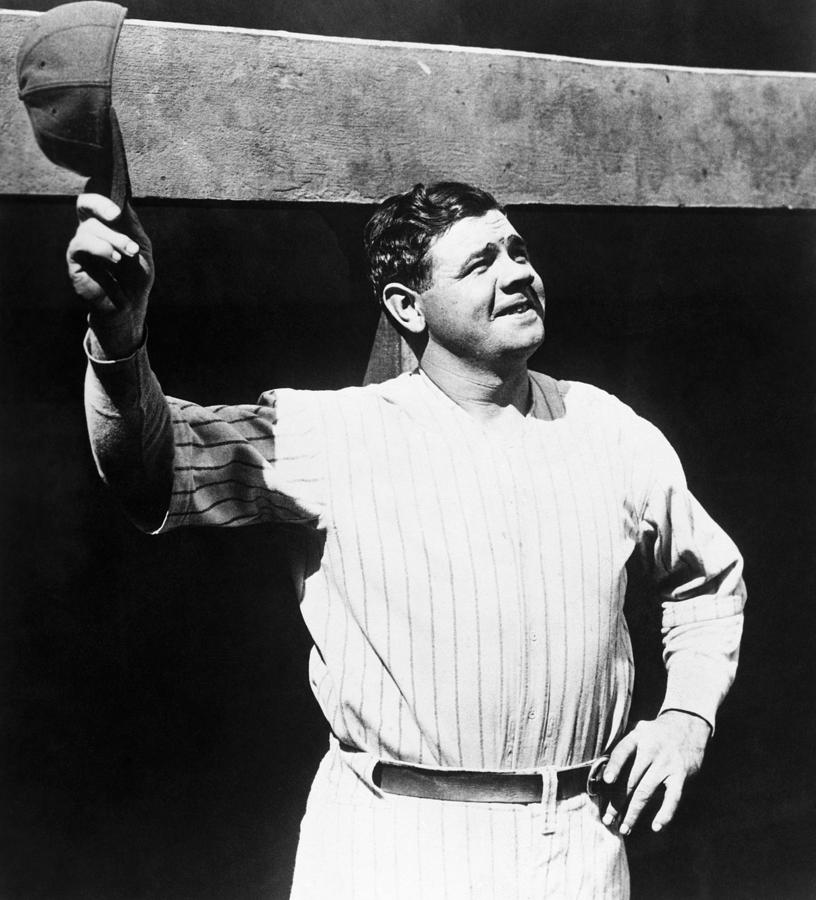
1. Babe Ruth, 1920-34. What can I say about the Big Guy that hasn't already been rehashed a thousand times? Not much. But there is much to say about The Great Bambino that needs to be said, and I'll do that in a later post.

He's not only in the Hall of Fame, but he was one of the 1st 5 inductees when they began voting in 1936, along with Ty Cobb, Christy Mathewson, Honus Wagner and Walter Johnson. A life-size wooden carving, meticulously shaped and painted (right down to the fold of his shirt and the cracks on the leather of his belt), of the Babe, and another of Ted Williams by the same artist, greets you when you walk into the Hall of Fame Gallery in the Hall of Fame building in Cooperstown, New York.

He was elected to the All-Century Team in 1999, 64 years after his last game, by fans whose parents were too young to have ever seen him play. The Yankees retired his Number 3, and put a Monument on the field at Yankee Stadium on Opening Day 1949, a few months after his death, before moving it to the new Monument Park in 1976, and to the new Stadium's MP in 2009.

The new Yankee Stadium is not "The House That Ruth Built." But the Babe Ruth Plaza outside the right-field stands, across 161st Street from the site of the ballpark whose construction his home runs, and the money they made for Colonel Jacob Ruppert, made possible, testifies to his life, his performance, and his legacy.

He played in 10 World Series (1915, '16 and '18 with the Boston Red Sox; 1921, '22, '23, '26, '27, '28 and '32 with the Yankees), winning 7 (1915, '16, '18, '23, '27, '28 and '32). As much as Ruppert's money and Ed Barrow's trades and purchases, Ruth's hitting made the Yankees, and made baseball, more popular than ever before.

"A big, badly flawed, swashbuckling palooka who strides with great spirit - not just talent, but with a spirit of possibility and an enjoyment of life across the American stage. That's an American... You give me Babe Ruth over any king who's ever sat on the throne, and I'll be happy with that trade." – Bob Costas

Except he was a king. The King of Crash. The Sultan of Swat. The Rajah of Rap. The Majarajah of Mash. The High Mandarin of Maul. The Wizier of Wham. The Czar of Clout. (Sometimes it's "the Colossus of Clout," and you can add "the Behemoth of Bust," although neither the Colossus of Rhodes nor the mythological Behemoth was a monarch.)

Some people compare baseball to religion. Well, as with Christianity, in baseball, a babe shall lead them. Then again, Babe Ruth tended to lie in places other than a manger. And he certainly did a lot that required repentance and forgiveness. But has any American ever been loved by more people in his own time? Don't forget, even Washington, Lincoln and FDR had their haters during their public service.

The Babe was one of a kind, and my generation hasn't seen another – and, if the rise and fall of Mark McGwire is any indication, we never will, and neither will any other generation. More than any other player, he was the right man, in the right place, at the right time.

As Art LaFleur, who also played disgraced Chicago White Sox 1st baseman Chick Gandil in Field of Dreams, said when playing the Babe's ghost in The Sandlot, "Heroes get remembered, but legends never die."

Tuesday, March 1, 2011

Top 10 Yankee Center Fielders

There are glamor positions in sports. Quarterback for the San Francisco 49ers. Wide receiver for the Pittsburgh Steelers. Linebacker for the Chicago Bears. Center for the Los Angeles Lakers. Goaltender for the Montreal Canadiens.

Baseball has a few also. The Giants, in both New York and San Francisco, have had several great 1st basemen. The Chicago White Sox have long specialized in shortstops. The Boston Red Sox are renowned for their left fielders.

No position in any sport can compare to center field for the New York Yankees.

Ironically, the very fact of the longevity that some of these players had made it hard for me to get 10 men. And how do you choose between the top 2?

Anyway, Brett Gardner (now mainly a left fielder anyway) and Curtis Granderson, due to lack of longevity, do not make this list. For the same reason, neither does former Yankee Melky Cabrera.

I originally had Claudell Washington, 1986-90, at Number 10. But after I was alerted to a major omission, I had to reduce Claudell to an Honorable Mention. He played for several teams, and was probably better known with the Oakland Athletics, Chicago White Sox and Atlanta Braves. It was with the Braves that he can be seen as the batter Lee Smith faces in the game shown in the film Ferris Bueller's Day Off.

An All-Star in 1975 (A's) and 1984 (Braves), he hit 164 homers in his career, but only 26 of those came as a Yankee. One, though, came in 1988 and was the 10,000th homer hit for the franchise. He also stole 312 bases, although his highest single-season total as a Yankee was 15. He's also remembered for having one of the longest necks in baseball history. He was the anti-Walt Williams.

10. Elmer Miller, 1915-21. Somebody had to be the starting center fielder on the Yankees' 1st Pennant winner, right? Actually... not that much of a somebody. He may have started all 8 games in the 1921 World Series that the Yankees lost to the Giants (that was the last time the Series was not a best-4-out-of-7), but he only made 270 plate appearances in the regular season. The rest of the team's center fielders that season aren't particularly noteworthy, not even Ping Bodie, the man who said, "I don't room with Babe Ruth, I room with his suitcase."  But in that '21 Pennant season, Miller did bat .298.

9. Roberto Kelly, 1987-92. He was the Yankees' starting center fielder from 1989 to '92, and was the best native of Panama to play for the Yankees until Mariano Rivera. (Rod Carew spent his teenage years in New York, but never played for the Yankees, or the Mets for that matter.) He hit 20 home runs with 69 RBIs in 1991 and made the All-Star Team in 1992. In 4 full seasons with the Yankees, he stole 151 bases.

But after the 1992 season, the Yankees traded him to the Cincinnati Reds. I thought it would be a great trade for both teams. As a righthanded hitter in Yankee Stadium, Kelly was hampered by Death Valley in left and center field (not as bad as in the pre-renovation Stadium, but bad enough), while Riverfront Stadium was hand-neutral. Plus, the artificial turf would help his speed, both in the outfield and on the bases. While the player the Yankees got for him seemed perfect for then, with a lefty swing meant for the Stadium's short porch in right, and he was a real hustler and a gamer. 

Unfortunately for the Reds, while Kelly was an All-Star again in 1993, he got hurt, and bounced around the majors, having only 2 more good seasons before finishing his career with a brief comeback with the Yankees in 2000. The player the Yankees got for him? A bit more successful: Paul O'Neill.

8. Lawton "Whitey" Witt, 1922-25. Born Ladislaw Waldemar Wittkowski in Orange, Massachusetts, you might guess he was one of those guys Harry Frazee sent from the 1910s Red Sox to the 1920s Yankees. Instead, he was a direct pickup from the ashes of Connie Mack's Philadelphia Athletics, a rookie on the worst team (still, by winning percentage) in AL history, the 1916 A's that lost 117 -- but he did hit 16 doubles and 15 triples that season.

The Yankees got him in 1922, and he batted .297 and led the AL in walks with 89. The Yankees won the Pennant, and won their 1st World Series the next season with Witt batting .314. But, like Bodie, his hitting dropped off dramatically, and 1926 (with the Dodgers) was his last season in the majors.

7. Mickey Rivers, 1976-79. The 1st Yankee center fielder I can remember – and, to my great shame, I totally forgot to include him when I first made out this list. My thanks to "Captain" Paul Louis for pointing this out.

How could I forget Mick the Quick? Real name John Milton Rivers, named for the English poet, author of Paradise Lost. As the great sportswriter Roger Kahn, schooled in the classics at Erasmus Hall High School in Brooklyn and New York University, put it, Rivers might be the only man named for John Milton who has never heard of Paradise Lost.

In 1974 and '75, playing for the California Angels (as the Anaheim outfit was known at the time), he led the AL in triples. In '75, he stole 70 bases, still a record for any player for an L.A.-area-based team other than Maury Wills. The Yankees picked him up for the '76 season – which turned out to be his only All-Star season, and he was 3rd in the MVP voting behind teammate Thurman Munson and that bastard George Brett, with teammate Chris Chambliss 5th – and in his 3 full seasons in New York the Yankees won 3 Pennants and 2 World Series.

Mick was not an ideal leadoff man – he only drew 73 walks in his 4 Yankee seasons – but his crouch shrank his strike zone, enabling him to post .312 and .326 batting averages in his 1st 2 Yankee seasons. Overall, he was .295 for his career (.299 as a Yankee, .308 in postseason play), and stole 267 bases (93 as a Yankee).

In the 1978 edition of The Complete Handbook of Baseball, perhaps the defining literary work of my childhood, editor Zander Hollander (or somebody working for him) summed Mick up very well: "Walks like an old man, but runs like a scared rabbit." No, not even Billy Martin could make the Yankees a running team, but nobody could turn a single into a double like Mickey Rivers.

He wasn't a Hall-of-Famer, he'll never get into Monument Park, and if Number 17 is ever retired, it won't be for Mick the Quick. He's not even the greatest Mickey ever to play center field for the Yankees. But he deserves to be on this list – and I deserve the proverbial rap across the knuckles with a ruler for forgetting him the first time around.

6. Johnny Damon, 2006-09. It's easy to forget, but before he proclaimed himself and his 2002-05 Red Sox teammates "Idiots," he was already a really good player. In 2000, with the Kansas City Royals, he led the AL in stolen bases (46) and runs. In 2001, he helped the Oakland Athletics reach the Playoffs. Then came his Fenway days, when his hirsuteness suggested breaking The Curse of the Bambino, long thought to be hard, was so easy, a caveman could do it. (Certainly, those Sox had their share of Neanderthals.)

But in 2006, the Yankees decided to try an old, previously successful strategy: If you can't beat 'em, sign 'em. Johnny got the haircut and the shave, and his 4 years in Pinstripes were all good ones, culminating in the 2009 World Championship, including his brilliant baserunning in Game 4, taking advantage of the lefty-pull shift the Philadelphia Phillies had on Mark Teixeira, leaving 3rd base uncovered.

He and reserve Eric Hinske thus joined 1996-2002 Yank pitcher Ramiro Mendoza (who was on the '04 Sox) as the only players to have won a World Series with both the Yankees and the Red Sox since the 1920s.

Unfortunately, he played just 2 more games in a Yankee uniform (Game 5 and the clinching Game 6), and the Yankees didn't re-sign him. He played for the Detroit Tigers last season, and has now signed with the Tampa Bay Rays (he grew up in Orlando, so, for all intents and purposes, that's his hometown team), where he's been reunited with "Idiot" Manny Ramirez.

Is Johnny Damon a future Hall-of-Famer? A .287 lifetime batting average (.285 as a Yankee), a 104 OPS+, 215 homers and 2,571 hits won't get you in. But he's 37, still hitting, could reach 3,000 hits, and he already has 487 doubles. And he is a 2-time World Champion -- with, arguably, baseball's 2 most popular teams.

Baseball-Reference.com's HOF Monitor has him at 90 out of 100, their HOF Standards at 42 out of 50. Their 10 Most Similar Batters had no HOFers until this year, when Roberto Alomar got in, but it also has Tim Raines (should be in), Mickey Vernon, Al Oliver and Kenny Lofton (a good case can be made for each). Except for Pete Rose, who was declared ineligible due to gambling, and Rafael Palmeiro, who was caught using steroids, every player with 3,000 hits and the necessary 5-year waiting period is in the Hall of Fame. If Damon makes it to 3,000, why not him?

5. Bobby Murcer, 1965-83. Or, more accurately, 1965-66, then he spent 2 years in the Army during the Vietnam War (stayed Stateside, no combat), then 1969-74, then he was traded to the San Francisco Giants, then to the Chicago Cubs, then back to the Yankees, 1979-83. Then served as a Yankee broadcaster, 1983-2008.

He was from Oklahoma, like Mantle, so he was the 1st "next Mickey Mantle." Considering the pressure Mickey was under to be "Babe Ruth, Lou Gehrig and Joe DiMaggio all rolled into one," that was totally unfair. Besides, being Bobby Murcer was pretty good.

In 1971, Bobby batted .331, and led the AL in on-base percentage. In 1972 he led in total bases and runs. He was a 5-time All-Star (4 with the Yankees). In what amounted to just 12 full seasons, he hit 252 homers (175 as a Yankee) and 285 doubles (192 as a Yankee). His lifetime batting average was a fair .277, but his OPS+ was a strong 124.

His misfortune was the get to the Yankees right after the old dynasty collapsed, and to be traded away just as the new dynasty was being built. There was no shame in 1974 in being traded, even-up, for Bobby Bonds. But Bonds didn't work out, and after one season was traded to the Angels for the aforementioned Mickey Rivers, and also for Ed Figueroa. So, in a way, Bobby was traded for Mick the Quick and Figgy, 2 indispensable parts of the 1976-77-78 Pennant winners.

Bobby returned in 1979, gave a eulogy at the funeral of his dear friend Thurman Munson, and then, in that night's game, drove in all the Yankee runs with a 3-run homer in the 7th and a 2-run double in the 9th, Yankees 5, Orioles 4 in one of the most emotional games in Yankee history.

He was a member of the 1981 Pennant winners, but never got a ring as a player. In 1983, in order to bring Don Mattingly up to the majors (and to begin his own career as a beloved Yankee who never got a ring), George Steinbrenner asked Bobby to retire and join the broadcast booth. For 25 years, until cancer finished taking its toll, he delighted us alongside Phil Rizzuto, Bill White, Tim McCarver, Michael Kay and Ken Singleton.

Okay, Bobby was not the brightest of men. In 1992, I was watching the Yankees play in Detroit on WPIX-Channel 11. And Bobby said, "The Detroit Tigers are very tough at home, especially when they play at Tiger Stadium." Putting aside the facts -- they lost 87 games that season, and were 38-42 at home -- Uh, Bobby, where else are the Detroit Tigers going to play at home? The Silverdome? Are they gonna go into Ann Arbor and play at Michigan Stadium?

It got worse: In 1999, when the Seattle Mariners left the dreary, gray-roofed Kingdome and got into the retractable-roof Safeco Field, Bobby looked at the unusually beautiful weather in the Pacific Northwest, and said, "Ah, gotta get that sun. Gotta get that Vitamin C." I half-expected Tim to yell, "It's Vitamin D, Bobby! The sun gives you Vitamin D! Vitamin C is what you get from citrus juice!" But Tim was too classy to say that on the air. (Yes, both moments actually happened. I still have them on tape.)

Still, it was a big thrill to meet him. On July 30, 1999, the Yankees beat the Red Sox 13-3 at Fenway Park. I was there, and loved it. On the way out, I unknowingly reached the press entrance, and, quite literally, bumped into Bobby and Tim. Nice guys. Good people. Good for the game, both of them. (Even if Tim's broadcasting does get on our nerves every once in a while.)

Bobby wore Number 1 in his 1st go-around with the Yankees, Number 2 in his 2nd. 1 has been retired for someone else, and 2 will be. But he deserved to get his Monument Park Plaque while he was still alive. There is plenty of room in the new Stadium's Monument Park for more Plaques. What are Hank and Hal waiting for?

4. Earle Combs, 1924-35. The Yankees could afford to lose Witt, because they now had one of several athletes (including a later Yankee, pitcher Jim Turner) known as the Kentucky Colonel. In 1925, his 1st full season, he batted .341, and that would be the 1st of 9 seasons in which he batted at least .300 (he batted .299 in another). He led the AL in triples in 1927, '28 and '30. His lifetime batting average was .325, his OPS+ 125. In what amounted to 10 full seasons, he had 309 doubles.

Those are good stats for a leadoff hitter, which he was, which is why, when the Yankees adopted uniform numbers in 1929, and decided (at least at first) to assign the numbers according to a player's place in the batting order, Earle Combs became the 1st Yankee to wear Number 1. Which, I suppose, made him the 1st Yankee to wear any number. (Well, not quite: The Yanks' 1st game of the '29 season was at home, so the 1st Yankee to be involved in a play would have been the starting pitcher, George Pipgras. The pitchers' numbers were assigned by seniority, and Pipgras wore Number 14, so that's the 1st number worn by any Yankee.)

Combs was also a fine center fielder, but, like Pete Reiser and Lenny Dykstra after him, he had a tendency to crash into outfield walls. Like Reiser but unlike Dykstra, the walls of his era were not padded. On July 24, 1934, in brutal St. Louis heat, he crashed into the wall at Sportsman's Park in a game against the Browns. He fractured his skull and his shoulder, and was hospitalized for 2 months. In spite of a brief comeback the next season, he was done. He did, however, return as a coach in 1936, essentially to teach his successor how to handle center field at Yankee Stadium. That worked out pretty well.

Combs was a member of 4 Yankee Pennant winners (1926, '27, '28 and '32) and 3 World Champions (all but the 1st of those). His Number 1 has been retired, although not for him. Nor does he have a Plaque in Monument Park. However, he was the earliest (if not the 1st) Yankee center fielder elected to the Hall of Fame.

His managers couldn't praise him enough. Miller Huggins said, "If you had men like Combs on your ballclub, you could go to bed every night and sleep like a baby." Joe McCarthy said, "They wouldn't pay baseball managers much a salary if they all presented as few problems as did Earle Combs." And the greatest player of them all, his outfield mate Babe Ruth, said, "Combs was more than a good ballplayer. He was always a first-class gentleman."

3. Bernie Williams, 1991-2006. This guy was so cool, he even got a mention from the President of the United States on the 2002 season finale of The West Wing. He was smooth and graceful in the field and running the bases, just like our grandparents' generation said DiMaggio was. Actually, few players ever looked worse swinging and missing or fouling a ball off, but when he got a hold of one, he had a beautiful swing.

And he got a hold of a few. He had a lifetime batting average .297, including 8 straight .300 seasons, including the 1998 batting title at .339. He had an OPS+ of 125. He collected 2,336 hits, including 449 doubles (2nd on the all-time Yankee list behind Gehrig), 55 triples and 287 home runs.  He had 5 100-RBI seasons, 4 Gold Gloves and 5 All-Star appearances.

He's also the only Yankee to hit 2 walkoff homers in postseason play, both in Game 1 of an ALCS: 1996 vs. Baltimore (11th inning) and 1999 vs. Boston (10th inning). His 80 RBIs and 51 extra-base hits in postseason play are records, and his 22 homers would be if you don't count that cheating steroid freak Manny Ramirez. 12 trips to the postseason (every year from 1995 to 2006, and that doesn't count strike-shortened '94), 6 Pennants (1996, '98, '99, 2000, '01 and '03), 4 World Championships (1996, '98, '99, 2000).

Should Bernie be in the Hall of Fame? Baseball-Reference.com's HOF Monitor has him at 133 out of 100 (absolutely should be in), their HOF Standards has him at 48 out of 50 (could be in). Their 10 Most Similar Batters, however, show no current HOFers, but some interesting players, including former teammates Bobby Abreu, Paul O'Neill and Ruben Sierra; also Edgar Martinez, who a lot of people think should be in, as well as Will Clark and Reggie Smith. I don't think Bernie will ever make it, but he sure had a great career.

Bernie's Number 51 has not yet been officially retired, but neither has it been given back out. Nor has he received his Monument Park Plaque yet. I don't see the point in waiting any longer.

2. Joe DiMaggio, 1936-51. Okay, how do I put DiMaggio at 2 and Mantle at 1? Simple: Mantle was a better ballplayer, and I'll explain why when I get to him.

Joe was named "Baseball's Greatest Living Player" at a special banquet honoring the 100th Anniversary of professional baseball in 1969, and that year, when Joe presented Mickey with his Plaque to hang on the center field wall -- this was the pre-renovation Stadium, no there was no "Monument Park" yet, and Mickey was the 1st living person so honored -- Joe had to be thinking, "What about me?"

Mickey had been told beforehand about this, and he had a Plaque to give to Joe, and he called Joe "the greatest player I ever saw" and added, "His oughta hang just a little bit higher than mine." And so they were hung on the wall, until they were moved into the renovated Stadium's Monument Park in 1976, where they remained until each man died and it was replaced with a Monument.

To look at some of the stats, it's really not clear why Joe is held in that kind of esteem. He played "only" 13 seasons, missing 1943, '44 and '45 in the Army Air Corps (forerunner of the Air Force) during World War II, and retired after the '51 season, having just turned 37, due to injuries catching up with him to the point where he said, "I no longer have it." He hit "only" 361 home runs and got "only" 2,214 hits.

But as Marilyn Monroe, to whom Joe was briefly married after his retirement as a player, could have told you, Statistics are like bikinis: What they reveal can be important, but what they don't reveal can be more important.

Those 361 homers were, at the time he retired, 5th all-time, behind Babe Ruth, Jimmie Foxx, Mel Ott and Lou Gehrig. Which means Joe was 2nd all-time among righthanded hitters, behind Foxx. (Overall, he's now 71st.) It's also important to remember that he was a righthanded hitter at the pre-renovation Yankee Stadium, with its 402 feet to straightaway left, 461 to dead center, and "Death Valley" in between. Mantle said, "In 1951, his last year, my first year, I must've seen him him 30 balls that went over 400 feet that were caught." In a ballpark that was fairer to him, he would have had 450-500 homers. As it was, he had 361, plus 389 doubles and 131 triples.

Only 13 seasons? He was named to the AL All-Star Team in all 13. He had 11 .300 seasons, peaking at .381 in 1939 -- no New York ballplayer has come within .015 of that since. He had 10 100-RBI seasons -- he was 34 before he had a full season with less than 95 RBIs. In 1936, he led the AL in triples; in '37, runs, homers (his 46 were a Yankee record for righthanders until Alex Rodriguez in 2005), slugging and total bases; in '39 and '40, batting average; in '41, RBIs and total bases; in '48, homers, RBIs and total bases.

He was named AL MVP in 1939, '41 and '47, and he deserved all 3: In case Red Sox fans want to speak up for Ted Williams, I remind you that the Yankees won the Pennant and the World Series in all 3 seasons, and the Red Sox were nowhere near contention in any of them (they were 2nd in '39 and '47, but a distant 2nd each time).

The 56-game hitting streak in '41, as amazing as it is, is really just another one of those things that made him Joe DiMaggio. Like his fielding: He was regarded as the best defensive outfielder of his generation, like Tris Speaker before him and Willie Mays after him.

Ten Pennants (1936, '37, '38, '39, '41, '42, '47, '49, '50, '51 -- he was in the service in '43). Nine World Series wins (all of those except '42). He was the man who showed that the Yankees could survive the retirements of Ruth and Gehrig. Number 5 retired. Hall of Fame. All-Century Team. Monument Park Plaque in 1969, replaced with a Monument after his death in 1999.

Joe DiMaggio's greatest legacy is that, late in his career, someone asked him why he went all-out every game in spite of his injuries. He said, "Because there might be somebody out there who's never seen me play before. He deserves my best."

Bob Costas was born in 1952, and Mantle was his guy. "Every man in my father's generation told me the same thing," he said. "'You never saw DiMaggio, kid. You never saw the real thing.'" I never got to see Joe DiMaggio play baseball. But I did get to see Joe DiMaggio, on 4 occasions: Old-Timers' Day in 1987, '91 and '94, and throwing out the first ball on Opening Day in '95.

Most of my generation only knew him as the man who appeared in black-and-white films, did commercials for Mr. Coffee and The Bowery Savings Bank (since bought out a few times, and now under the Capital One name), and was married to Marilyn. And since his death, his reputation has taken a hit, now that he's not still around to cow the scandalmongers into submission. But he remains one of the icons of sport. Besides, a lot of the guys we tend to praise at his expense weren't exactly saints, either.

For example.

1. Mickey Mantle, 1951-68. Joe had the much higher lifetime batting average, .325 to .298, and Joe had the higher slugging percentage, .579 to .557. But Mickey had the higher on-base percentage, .421 to .398. Their OPS's were nearly identical, .977. And since Joe played in a hitting-friendly era and Mickey in a pitching-friendly era, Mickey had the higher OPS+, 172 to 155. In other words, Joe DiMaggio was a 55 percent better hitter than the average hitter in his time, but Mickey Mantle was a 72 percent better hitter than the average hitter in his time.

And while neither man tried to steal many bases, Mickey had one of the best stolen-base percentages ever -- better even than Willie Mays. Mickey wasn't as good a fielder as Joe or Willie, but as his catch to save Don Larsen's perfect game in the 1956 World Series showed, he was damn good out there.

Still think Joe was the better all-around player? I don't. As long as Mickey was alive, the title of "greatest living player" was, much more fairly, the eternal debate between him and Willie than an easy award to Joe.

Mickey also won 3 MVP awards, 1956, '57 and '62. He also won the Triple Crown, in '56, with a .353 batting average, 52 homers and 130 RBIs. Gehrig is the only other Yankee to win it -- Ruth didn't do it, neither did DiMaggio, nor Reggie Jackson, nor Dave Winfield, nor Don Mattingly, nor Derek Jeter, nor A-Rod. Frank Robinson in '66 and Carl Yastrzemski in '67 are the last 2 men to win the Triple Crown, but Mickey is the last man to have led both leagues in the 3 categories.

Gehrig played in 2,130 consecutive games, but, in spite of all his injuries, Mickey played in 2,401 games. "I played in more games as a Yankee than anyone," he liked to say, "and nobody knows that." Barring injury, Jeter will surpass that total this season, but will have to stay on the active roster into the 2013 season to surpass Mickey's record of 18 seasons playing for the Yankees.

Mickey won 12 Pennants (1951, '52, '53, '55, '56, '57, '58, '60, '61, '62, '63 and '64) and 7 World Series (1951, '52, '53, '56, '58, '61 and '62). He and Roger Maris combined for 115 home runs in 1961 (Maris 61, Mantle 54), still a record for any 2 teammates, in spite of the Steroid Era. Others have hit 18 or more homers in postseason play; Mickey hit 18 homers in the World Series, the only round of postseason play available to him, breaking the previous record of 15 by Ruth.

Yes, he drank too much, until he drank himself to death. Yes, he treated women poorly -- although, as of this writing, I know of no record of him ever having hit one, which is not something that can be said of DiMaggio. Yes, he played some goofy pranks. Yes, he was occasionally surly to fans and to the media. No, he wasn't perfect.

But as Costas said in his eulogy to Mickey in 1995, "In his last years, Mickey Mantle, so often hard on himself, began to understand the difference between a role model and a hero. The first, he often was not. The second, he always will be. And, in the end, people got it."

Yes, they did. His original Monument Park Plaque called him "The most popular player of his era." DiMaggio was a hero for the age of newsreels and radio. With the World Series being televised, and he appeared in far more of them than Mays, Mickey was the 1st television superstar of baseball, thus the 1st baseball superstar truly accessible to the entire country, in ways that DiMaggio, Ruth, or anybody else before 1951 simply couldn't be, no matter how good they were.

The Hall of Fame, the All-Century Team, the retirement of his Number 7 and the dedication of first his Plaque and then his Monument, they don't change the facts of the way he goofed off and disappointed people. But the great sportswriter Roger Kahn said it best: "You couldn't possibly approve of Mickey Mantle. What you could do was love him."

Even if you only saw him as an Old-Timer, as I did. When I heard him say, after he stopped drinking, that he was going to follow Whitey Ford's advice and get his knees replaced, "as soon as the doctors tell me my liver's in good enough shape" to do the surgery, I thought, Hey, maybe one of these years, on Old-Timers' Day, I can finally get to see Mickey Mantle play baseball -- live, not on film! That was not to be. But at least I got to see him.

On Joe DiMaggio Day, October 1, 1949, the Yankee Clipper said, "I'd like to thank the Good Lord for making me a Yankee." On Mickey Mantle Day, June 8, 1969, the Mick said, "Playing 18 years in Yankee Stadium for you folks is the best thing that could ever happen to a ballplayer."

Whatever their flaws, we Yankee Fans, including those of us who don't remember them as active players, even those of us who don't even remember them as alive, have been lucky to have had them both.

Sunday, February 27, 2011

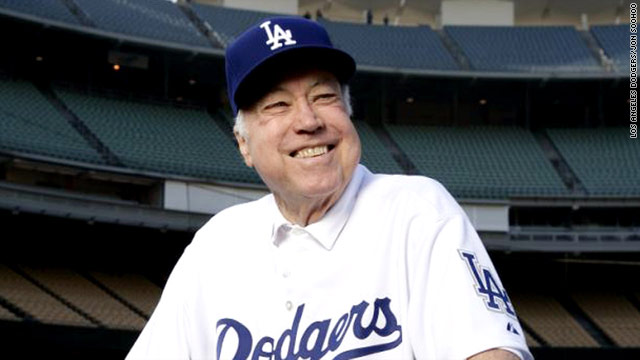
Duke Snider, 1926-2011


I was going to use today's post to show my choices for the Top 10 Yankee Center Fielders.

Instead, I have to pause and bring you the sad news of the passing of a great New York center fielder who was not a Yankee.

Edwin Donald Snider was born on September 19, 1926 in Los Angeles, California. This, along with Jackie Robinson having been raised in nearby Pasadena, forms one of the great ironies in the history of baseball: The 2 greatest players the Brooklyn Dodgers ever had were both from Los Angeles. Throw in the fact that the greatest player the Los Angeles Dodgers ever had, Sandy Koufax, was from Brooklyn, but did nothing for the club until after they moved to L.A., and you've got -- as Johnny Carson, who also moved from New York to L.A., would say -- weird, wild stuff.

It's been suggested that Edwin Donald Snider was nicknamed "Duke" because of his very light hair, just as Edward Charles Ford and Donald Richard Ashburn were nicknamed "Whitey" well before their hair went from light blond to absolutely white. Apparently not, as it seems that Snider's father gave him the nickname at age 5.

He always said that growing up in Southern California, with great weather all year 'round (this was before L.A. became the smog capital of America), gave him the chance to play as much baseball as he wanted, leading him to become a great player. There is something to this: California has produced more players than any other State, and not just because it has the largest population of any State. Sun Belt weather is also why schools in California, Arizona, and the former Confederate States tend to dominate college baseball.

Duke Snider was straight outta Compton. No, I'm not kidding: Compton High School, Class of 1943. Baseball, football quarterback, basketball. He is probably the best athlete the school has ever produced -- I looked it up, Venus and Serena Williams may have lived in Compton, but were home-schooled, and did not attend Compton High. And even if they had, as far as I know they've only played one sport, though they've been playing it as well as anybody, male or female, the last 15 years.

After spending 1945 in the U.S. Army at the end of World War II, the Duke moved up, and debuted in the major leagues on April 17, 1947 -- 2 days after Robinson did and, in so doing, changed the world. He didn't play in the 1947 World Series, but by 1949 he was the Dodgers' starting center fielder.

That 1949 season was the 1st full major league season for Duke and catcher Roy Campanella, the 1st major league season for pitcher Don Newcombe, the 2nd with the Dodgers for 3rd baseman Billy Cox and pitcher Preacher Roe, the 2nd full for 1st baseman Gil Hodges, the 3rd for 2nd baseman Robinson, and the 3rd full for right fielder Carl Furillo.

It was the beginning of the group of players that Roger Kahn, later to cover the team for the New York Herald Tribune, would call "The Boys of Summer," and use that line, from a poem by Dylan Thomas, as the title of his 1972 book that looked at those former Dodgers as they moved through middle age. The only real veteran among them was their shortstop and Captain, Harold "Pee Wee" Reese.

Among them, Kahn also included pitcher Carl Erskine, who had yet to become a regular in the starting rotation; left fielder Andy Pafko, who did not get to the Dodgers until 1951; pitcher Clem Labine, who would not have a full season until 1951; pitcher Joe Black, who would not arrive until 1952; and reserve outfielder George "Shotgun" Shuba. He did not, however, include pitcher Ralph Branca, for whom 1949 was his 3rd full season. Probably had something to do with the fact that Kahn based the book on the 2 years he covered the team for the Trib, 1952 and '53, after Branca threw a rather inopportune pitch to close the '51 season, became an afterthought in '52, and was traded in '53.

Twelve men. Of them, only Newcombe, Erskine, Pafko and Shuba -- and Kahn himself -- are still alive as we close February 2011. So is Branca. Hodges died just after the book came out; Robinson, a few months later.

*

In 1949, '50 and '51, 3 straight seasons, the Dodgers went down to the last day of the season with the National League Pennant still in doubt. In '49, they won, edging the St. Louis Cardinals by 1 game. In '50, they lost on the last day to the team they were chasing, the Philadelphia Phillies. In '51, they blew a 13 1/2-game lead over their arch-rivals, the New York Giants, and finished in a tie for the Pennant, and lost the Playoff. (If you're reading this, you don't need me to remind you of how -- especially since I've already alluded to it.) In '52 and '53, they did win the Pennant.

Yet they didn't win the World Series. In '41, '47, '49, '52 and '53, they lost every time. To the same team, the New York Yankees. The Dodgers had also lost the World Series in 1916 (to the Boston Red Sox) and in 1920 (to the Cleveland Indians). They were 0-for-7 in Series play -- 0-for-5 against the Yankees. Throw in their close loss to the Cards in '42, their Playoff loss to the Cards in '46, their agonizing losses in '50 and '51, and their 2nd-place finish as the hated Giants won the Series in '54, and you can see why Dodger fans were frustrated.

It was no fault of Duke Snider, though. He played a fine center field, and boy, could he hit. In 1950, he batted .321, hit 31 doubles, 10 triples, 31 homers and had 107 RBIs, and led the NL in hits and total bases. He was 24, and just gettin' warmed up.

He would bat .300 7 times, for a .295 career average. His career OPS+ was a sizzling 140. In '53 he led the NL in slugging percentage, on-base percentage and runs. He led in total bases and runs again in '54. He led in runs and RBIs in '55. He led in homers, on-base and slugging in '56. He made 7 All-Star Games. He never won an MVP, but considering that his teammate Robinson won 1 and his teammate Campanella won 3, that's no shame.

Finally, in 1955, the Dodgers slew all the dragons. They won the Pennant by 13 games, and the Duke batted .309, hit 42 homers and had a career-high 136 RBIs. In the World Series against the Yankees, he tied the record with 4 homers (a record he first tied in '52, sharing it with Babe Ruth and Lou Gehrig and later broken by Reggie Jackson) and had 7 RBIs. The Dodgers beat the Yankees in Game 7 at the old Yankee Stadium, October 4, 1955.

It was as cathartic a win as any baseball team ever had, perhaps even more so than the 1969 Mets, certainly more so than the 1977 or 1996 Yankees -- and, unlike the 2004 Red Sox, "Dem Bums" didn't need no steroids.

On September 22, 1957, Snider hit 2 homers off Phillies pitcher Robin Roberts. These turned out to be the last 2 homers ever hit at Ebbets Field. The team moved to Los Angeles. Duke was happy to be going to his hometown, but, like many of the Dodgers, he was sad to leave Brooklyn. He helped the Dodgers win the World Series again in 1959.

After the 1962 season, he went back to New York, traded to the Mets. Duke Snider, playing home games in the Polo Grounds? Not as strange as where he ended up, in the 1964 season: Playing for the Giants, albeit in San Francisco. At the time of his retirement, his 407 home runs were 10th all-time.

He managed in the minor leagues, became a broadcaster for the San Diego Padres (near his Fallbrook, California home) and the Montreal Expos (he was still popular there from his days with the Dodgers' farm team, the Montreal Royals), and raised fruit on land he owned in Fallbrook. In 1980, in his 11th year on the ballot (much too late), he was elected to the Hall of Fame. The Dodgers then retired his Number 4.
The Duke, late in life, at Dodger Stadium

In 1999, Snider was ranked 84th on The Sporting News' list of the 100 Greatest Baseball Players," and was a nominee for the Major League Baseball All-Century Team.

Shortly after his 1980 election to the Hall, Terry Cashman recorded and released one of the iconic baseball songs. Officially titled "Talkin' Baseball," it is best remembered for its chorus, saluting the 3 great New York center fielders of the 1950s: "Willie, Mickey and the Duke."

Actually, while Willie Mays was better in 1951 and '54, and Mickey Mantle had the better seasons by far in '56 and '57, and then Willie and the Duke left for California to leave Mickey all alone, in 1952 and '53, Duke Snider was the best center fielder in New York. Okay, Mays was in the Army for the Korean War for most of '52 and all of '53, but there were no excuses in '55: While Willie and Mickey both had great stats, the Duke was the best that year.

Mickey died in 1995, at the age of 63. The Duke died today, February 27, 2011, of what's currently being called simply "natural causes," at the age of 84. Now, Willie, age 79 and possibly not in the best of health, is the only one of the 3 left.

But as long as people are talkin' baseball, they'll be talkin' about Duke Snider, a true all-time great.

UPDATE: He was buried at Masonic Cemetery in Fallbrook.

Thursday, February 24, 2011

Top 10 Yankee Left Fielders

This is a tough one. Several center and right fielders in Yankee history have also played left field at various times in their careers, including Babe Ruth and Mickey Mantle. I decided to limit this to only players who are best known for playing the position.

That gets harder when you consider that, from 1955 to '58, one of the most dominant stretches in Yankee history, the Yankees' main left fielder was Elston Howard, who was a catcher by trade, but was waiting behind Yogi Berra. In 1959, Yogi's decline began, although he could still hit, and he and Ellie switched positions.

So both Yogi, who remained the starting left fielder until 1962, and Ellie could be among the Top 10 Yankee Left Fielders. But I've already included them in the Top 10 Yankee Catchers, so I won't include either of them here. That means there's going to be a big gap from 1955 to 1962, one of the most successful periods in Yankee history.

This also lets out Johnny Damon and, for the moment, Brett Gardner.

Dishonorable Mention to Ben Chapman (1930-36) and Jake Powell (1936-40). Chapman was a member of the 1932 World Champions, a .302 lifetime hitter, a 4-time All-Star, and one of the few base-stealing threats the Yankees had between the 1920 arrival of Babe Ruth and the 1975 return of Billy Martin.

But as manager of the Philadelphia Phillies in 1947, he led the most vicious bench-jockeying any athlete has ever received, the noxious racial abuse hurled by the Phils at Jackie Robinson. The backlash got so bad that it was recommended that, when the Dodgers got to Philadelphia, the two of them pose for a conciliatory picture. But the Alabama-born Chapman refused to shake hands with Robinson, settling instead for posing with the two of them holding the same bat. The next year, with the Phillies having rising stars like Richie Ashburn and Robin Roberts but still far behind the NL lead, Chapman was fired, and except for a brief tenure as a Reds coach never worked in the game again. Years later, he would admit he had gone too far.

But at least Chapman lived long enough to have, and show, remorse. Powell was, effectively, his replacement as Yankee left fielder, and was a member of the 4 straight World Championship teams of 1936-39.

But in 1938, with the Yankees in Chicago, White Sox broadcaster Bob Elson interviewed him for a pregame radio show, and asked Powell what he did in the off-season. The native of the suburbs of Washington, D.C. said he was a police officer in Dayton, Ohio. Asked what he did to keep in shape, Powell told Elson, "Crack (N-word)s over the head with my nightstick."

Even as notorious a racist as Baseball Commissioner Kenesaw Mountain Landis knew this was too much – and probably also cared that it was a bald-face lie, as there is no record of Powell working in law enforcement, in any capacity, anywhere – and he suspended Powell for 8 games. Two years later, Powell was out of The Bronx, and was out of the game by 1945. In 1948, arrested for public drunkenness, he grabbed the co'’s gun and shot himself, an ironic end considering what he's best known for.

10. William "Birdie" Cree, 1908-15. He got his nickname because he liked to whistle. He twice batted over .300 and helped the Highlanders/Yankees finish 2nd in 1910. In 1911, he batted .348 with 30 doubles, 22 triples, 4 homers and 88 RBIs.

9. Tim Raines, 1996-98. He played just 3 seasons in Pinstripes, but they were all Playoff seasons, and 1996 and '98 were World Championship seasons. "Rock" .321 in '97 and .290 in '98, despite being 37 and 38 years old in those seasons. In Game 3 of the '96 Series, he led off the game with a walk, and scored on Bernie Williams' single to give the Yanks their first lead of the Series, and later started a double play. His 2-out walk in the top of the 10th led to his scoring the winning run in Game 4.

Overall for his career, a 7-time All-Star, .294 average, 123 OPS+, 2,605 hits, and a whopping 808 stolen bases, 5th all-time and most of anybody not in the Hall of Fame. Judging by Baseball-Reference.com's HOF Monitor (90 of 100), HOF Standards (47 of 50), and Top 10 Most Similar Batters (4 of 10 already in), he's got a very good case.

8. Roy White, 1965-79. He was the 1st Yankee (or former Yankee) I ever actually met (if you'll pardon the choice of the word "met"), and all the talk about him being classy was an understatement. His timing was bad, arriving just as the old dynasty was collapsing, but he was a 2-time All-Star, led the AL in walks in 1972 and runs in 1976, and finally got to play in 3 World Series, winning 2. His 1st-inning homer in Game 3 of the '78 Series gave the Yanks their first lead of the Series, and in Game 4 he scored the winning run in the 10th.

He never batted .300, hit 25 homers or had 100 RBIs, although he came close to each. But he won games and he won titles. He wasn't a headline, but he helped make them. Later became a Yankee coach. His Number 6 will be retired someday, although not for him. But he was the first former player introduced at the old Yankee Stadium finale in 2008, and deservedly got a big hand.

7. Gene Woodling, 1949-54. He was from Akron, Ohio – the 1st Yankee star to be born there, but not the last – but became the last Yankee star to be purchased from the San Francisco Seals of the Pacific Coast League. He helped the Yankees win the next 5 World Series, batting over .300 in 1952 and '53. Not that anybody knew it at the time, but he led the AL in on-base percentage in '53, .429. 

He bobbled what should have been the last out of the 1950 Series, costing rookie Whitey Ford a shutout, but in a far tighter situation (ahead by 2 with the winning run at the plate in Game 7, as opposed to the earlier 5-run lead in a sweep-clincher), he caught the last out of the '52 Series.

The Yankees included him in the biggest trade in baseball history, the 18-player deal with the Baltimore Orioles after the '54 season that brought in 2 pitchers who would make their mark in Pinstripe history, Don Larsen (still the only man to pitch a no-hitter in the World Series) and Bob Turley (the 1st Yankee to win the Cy Young Award). It was with the O's that he reached his only All-Star Game, in '59. (A guy named Ted Williams being in the AL and having the one subpar year of his career in '59 had something to do with that.)

6. Tom Tresh, 1961-69. He had a cup of coffee with the M&M Boys' Yankees, then was the AL Rookie of the Year in 1962, playing shortstop while Tony Kubek was spending most of the season in the Army. He moved to the outfield when Kubek came back, and, depending on how big the field was in a ballpark and how much Mickey Mantle's legs were bothering him, spent much of the next 4 seasons switching between left and center with Mickey.

An All-Star in '62 and '63 and a Gold Glove in '65, his homer won Game 5 of the '62 Series, and his homer in Game 1 of '63 broke up a no-hitter by Sandy Koufax (though it didn't stop Koufax from fanning 15 batters, then a Series record and still a Series record for lefties).

He never batted .300 or had 100 RBIs, but topped 20 homers 4 times – and, like Mantle, was a switch-hitter, so he wasn't just taking advantage of the pre-renovation Stadium's short RF porch, and in fact was hurt by its LF and CF Death Valley.

He grew up outside Detroit, where his father Mike Tresh grew up. Unlike his father, who played mostly for the White Sox, he finished his career with their hometown Tigers. His own son, Mickey Tresh (named for Mantle), was a Yankee farmhand, but never got past Double-A ball.

5. Lou Piniella, 1974-84. The 1969 AL Rookie of the Year with the Kansas City Royals, he didn't get along with management there, so they sent him to the Yankees for lefty reliever Lindy McDaniel. That was a great trade for both teams. McDaniel was washed up, but he was practically an extra pitching coach for the Royals' young staff. Piniella, well, let's just say he was called "Sweet Lou" not for his disposition, but for his swing.

At first, he played mostly right field, with White in left. By the time Reggie Jackson arrived for 1977, White was mostly a bench player and Lou was the main man in left, and he became a pretty good left fielder, his catch taking a home run away from Ron Cey of the Dodgers in Game 4 of the World Series. In the 1978 Playoff with the Red Sox, Reggie was the DH, Roy was in left and Lou in right, and he made 2 key plays in that game to save it.

And what a hitter: .291 lifetime average, 109 OPS+, 6 .300 seasons (4 with the Yankees), and always seemed to come through in key situations. As a boy, I enjoyed Nathan Salant's book This Day In Yankee History, and as he wrote of the 1978 "Boston Massacre" series, he mentioned that Reggie had been intentionally walked: "That made no sense at all, because the next batter was the Red Sox killer himself, Lou Piniella." And that was no joke: Piniella went 10-for-16 with 5 RBIs in that series. He also batted .305 with 2 homers and 6 RBIs in his 5 ALCS appearances, and .319 with 10 RBIs (albeit none on homers) in his 4 World Series (and that doesn't count putting the ball in play to begin the Reggie "Sacrifice Thigh" that led to a run in Game 4 in '78). If it was October, and Lou was batting against you, you were not thinking it was sweet.

He became the Yankees' hitting instructor, then, except for a brief 5th term for Billy Martin, was the Yankees' manager from 1985 to '88, getting them in the AL East race 4 straight seasons but never getting that one extra starting pitcher he needed from George Steinbrenner.

He helped make Don Mattingly a great hitter, but had to go to the Cincinnati Reds – where he helped make Paul O'Neill a great hitter, if one with a similarly explosive temper – to win a Pennant and a World Series as a manager. He remains the only manager to lead the Seattle Mariners to a postseason berth, 4 of them. It's unlikely the Number 14 he wore as a Yankee will be retired anytime soon, but Lou was a classic Yankee, and one of my 5 favorite players of my time.

4. Bob Meusel, 1920-29. "Long Bob" and his brother Emil (known as Irish even though the family was of German descent) were among the earliest Californians to reach the majors – or, as the people involved in or rooting for teams in the Pacific Coast League said until 1957, "the eastern leagues." Both went to New York, Irish to the Giants, Bob to the Yankees, and they opposed each other in 3 straight World Series, the Giants winning in 1921 and '22, the Yankees in '23. Bob also helped the Yankees win the '26 Pennant and the '27 and '28 World Series.

Irish was a good hitter, Bob a better one, batting .318 lifetime. He was a perfect fit in the Yankee lineup, a righthanded hitter in the 5th slot, after Babe Ruth batted 3rd and Lou Gehrig 4th – hence, in his last full season, 1929, the 1st season in which the Yankees wore uniform numbers, Meusel was the 1st to wear the Number 5 that would be solely identified with Joe DiMaggio (who, of course, did not always bat 5th). Five times, Meusel drove in at least 100 runs, and led the AL in homers and RBIs in 1925. He played with the Cincinnati Reds in 1930, then headed back west and ended his career in the PCL. He died in 1977, at age 81.

3. Charlie Keller, 1939-49, with a brief return in '52. He was big and strong and hairy, and they called him King Kong – though not to his face, as he hated the nickname. This guy formed one of the greatest outfields ever, with Joe DiMaggio in center and Tommy Henrich in right. His best known hit was a double off the right-field wall at Ebbets Field to complete the rally after Mickey Owen's muff kept the Yanks alive in Game 4 of the 1941 World Series.

He was hitting at a Hall of Fame pace, averaging a .296 batting average, 24 homers and 98 RBIs in his 1st 5 seasons, 4 of which ended with Yankee Pennants (1939, '41, '42 and '43) and 3 with World Series wins (all but '42).

Then he went off to war, and when he got back, a back injury slowed him down. He helped the Yankees win a 4th and 5th Series in '47 and '49, but that was pretty much it for him: His last great year was at age 29, and he packed it in at 35. He returned to his native Maryland and trained racehorses at his Yankeeland Ranch, many of them with "Yankee" in their names.

2. Hideki Matsui, 2003-09. In his 1st home game at a Yankee Stadium, he hit an Opening Day grand slam. In his last home game at a Yankee Stadium, he went 3-for-4 with a homer off Pedro Martinez and 6 RBIs to clinch a World Championship. In between, he gave us a bunch of memories, including 1 of the 4 straight hits off Pedro in 2003 ALCS Game 7, maybe the best game ever played at the old Stadium.

He's with the Oakland Athletics now, and new catcher Russell Martin may end up getting his Number 55. But "Godzilla" was a beast. I wonder if he'll be the 1st Yankee to get a Plaque with part of its next not in English?

1. Dave Winfield, 1981-90. In the strictest sense, Big Dave was the Yankees' main left fielder for only 3 seasons, 1981, '82 and '83, before moving over to right field. (Steve Kemp was the main one in '84, Ken Griffey Sr. in '85, Dan Pasqua in '86, Gary Ward in '87, Rickey Henderson moving from center to left for '88, then Mel Hall taking over after Rickey was traded in '89.)

Big Dave went 1-for-21 in the 1981 World Series, and that led George Steinbrenner to eventually call him "Mr. May." It was totally unfair, and even less fair was how George got rid of him -- which led to baseball temporarily getting rid of George, and Dave getting the hit that clinched the 1992 Series for the Toronto Blue Jays.

He hit 465 home runs, got over 3,000 hits, is in the Hall of Fame, and had most of his great years with the Yankees. Yet his Number 31 has been continually given out (sometimes it's worked, as with the aforementioned Tim Raines; sometimes not, as with several weak pitchers), and he hasn't gotten his Monument Park Plaque. No ring? Don Mattingly has a Plaque but no ring, and he was not a better player than Winfield.

The ovations Dave gets when he comes back for Old-Timers' Day are not enough: Hank, Hal, give him his Plaque! And don't ever let another kid just off the Columbus -- excuse me, Scranton -- Shuttle sully his 31!

Wednesday, February 23, 2011

Top 10 Yankee Third Basemen

Note: Bobby Cox once played 3rd base for the Yankees, and he's going to the Baseball Hall of Fame. But these 2 things are by no means linked.

Honorable Mention to Joe Dugan, 1922-28. "It's always the same," Jumpin' Joe, the 7th-place hitter on the "Murderer's Row" Yankees said. "Combs walks. Koenig singles. Ruth hits one out of the park. Gehrig doubles. Meusel singles. Lazzeri triples. Then Dugan goes in the dirt on his can."

Actually, while hardly as fearsome as his teammates, Dugan wasn't a bad hitter, batting .280 lifetime, and reaching 60 RBIs 3 times, not bad totals for a 3rd baseman in his era. He was a slick fielder, and helped the Yankees win 5 Pennants (1922, '23, '26, '27 and '28) and 3 World Series (1923, '27 and '28). He also had the "honor," along with Hall of Fame pitcher Herb Pennock, of being sold off by both Connie Mack of the Philadelphia Athletics and Harry Frazee of the Boston Red Sox.

Had he still been with the Yankees when they started wearing uniform numbers in 1929, he would have gotten Number 7 for his place in the batting order. He closed his career with the 1931 Detroit Tigers, wearing Number 25, the only number he ever wore.

10. Mike Pagliarulo, 1984-89. A native of Medford, Massachusetts who grew up as a Red Sox fan, "Pags" used to wear a T-shirt that had "Boston Red Sox, World Champions 1903 1912 1915 1916 1918" on the back and the 22 titles the Yankees then had on the front. He was nearly as good a glove as the man he replaced, Graig Nettles, and, also like Nettles, he seemed to have that sweet lefty swing meant for Yankee Stadium. In his 4 full seasons in Pinstripes, he hit 94 home runs, and topped out at 87 RBIs.

Unfortunately, he went too far in mirroring Nettles' biggest flaw: He didn't make contact enough, striking out 510 times in what amounted to 5 seasons in The Bronx. He batted in the .230s, then dropped to .216 in 1988 and was at .197 in '89 when he was traded, like Nettles, to the Padres. In 1991, playing for the Minnesota Twins, he had his best average, .279, and won a World Series. In that Twin infield with him was Chuck Knoblauch, just as he'd once been in an infield with Willie Randolph.

So Pags is linked to both the 1976-81 dynasty and the 1996-2003 dynasty… but not closely enough: The Yanks got very close to the AL East title in '85 and '88, and made strong runs in '86 and '87, but he had to go to Minnesota to win a Pennant and a ring.

He started out wearing Number 46, then switched to 6, then to 13. All 3 numbers are likely to be retired by the Yankees in the next few years, but none for him. He now runs a baseball-themed website, dugoutcentral.com. His son Mike helped Dartmouth's baseball team win the 2009 Ivy League Championship.

9. Billy Johnson, 1943-51. The Montclair, New Jersey native batted .280 with 94 RBIs as a rookie on the 1943 World Champion Yankees. He missed the next 2 years in World War II, then came back and helped the Yankees win the Series again in 1947, '49 and '50. A solid hitter, he was an All-Star in 1947. He started out wearing Number 7, then switched to 24. The former is retired by the Yankees, the latter might be, but neither for him.

8. Scott Brosius, 1998-2001. He was only a Yankee for 4 years, but what a 4 years, just 2 outs away from being 4 straight World Championships. A .203 hitter with an OPS+ of 53 in his last season with the Oakland Athletics, the Yankees sent the hopeless Kenny Rogers (the choking pitcher, not the country singer) to the East Bay for the Oregonian, to replace the man at Number 7 on this list. Joe Torre said he just wanted him to field his position and not worry about hitting.

Turned out, in 1998, it was pitchers who had to worry about his hitting: Not only did he give the Yankees yet another great glove at the position, but he batted a career-high .300, posted a 121 OPS+, hit 19 homers, had a career-high 98 RBIs, made the All-Star Team, hit 2 home runs in Game 3 of the World Series, including a 410-foot game-winner to dead center off the San Diego Padres' supposedly invincible closer Trevor Hoffman, fielded the last out of the Series the next night, and was awarded the Series MVP.

He was hardly done, even in October. The Yankees won again in 1999, aided in part by Brosius' only Gold Glove season and 2 homers against the Red Sox in the ALCS. He hit another homer in the 2000 Series against the Mets, and in Game 5 of the 2001 Series, he tied the game in the bottom of the 9th with a homer, leading to a Yankee win in the 12th. In other words, this guy that the Yankees got for his fielding played in 4 World Series for them, and hit at least 1 home run in all 4.

Although he was only 34 and had just batted .287, he retired after the 2001  World Series. He went on to become the assistant coach, and then the head coach, at his alma mater, Linfield College in McMinnville, Oregon. He is a member of his State's Sports Hall of Fame. He wore Number 18 as a Yankee, although it is unlikely to be retired for him, or anyone else, in the near future.

7. Wade Boggs, 1993-97. He was already a Hall-of-Famer-in-waiting for what he'd done with the Red Sox. This ranking is based solely on what he did with the Yankees. And what he did was help to bring the team back from its 1982-92 doldrums, including its 1989-92 dark age.

Upon arriving in 1993, he instantly became a good influence on the team’s young hitters, and the Yankees finished 2nd, their highest finish since '85. He batted .302, .342, .324, .311 and .292 in his 5 seasons in Pinstripes. He was the starting 3rd baseman on the 1996 World Champions, won both of his Gold Gloves as a Yankee, and made 4 of his 12 All-Star appearances as a Yankee.

Overall, he batted .328 lifetime, with a 130 OPS+, 3,010 hits including 578 doubles, reached postseason play 6 times, winning 3 Pennants and a World Series – and that doesn't count the 1994 season, when the Yankees had the AL's best record when the strike hit and didn't get to find out what would happen.

The image of him puffy and pink with tears in the Shea Stadium dugout after the Red Sox blew the 1986 Series will live forever; the image of him equally pink with joy on the Stadium mound in '96, and then riding that police horse along the outfield track, is what should really be in our minds. As Worcester, Massachusetts native Denis Leary says, "If you had told my father that, one day, Wade Boggs would win the World Series with the Yankees, his head would have blown up."

He returned to his native Tampa Bay, and became the Devil Rays' 1st retired number, 12, which he also wore with the Yankees, rather than the 26 he wore with the Red Sox. The Yankees may never retire 12 for him, but a Plaque in Monument Park would be nice. After all, Reggie Jackson is there, and he, too, played 4½ seasons as a Yankee starter.

6. Gil McDougald, 1951-60. Yet another cog in the Yankees' old-time San Francisco connection, he was AL Rookie of the Year in 1951, ahead of teammate Mickey Mantle. A 5-time All-Star, he played 10 seasons, winning 8 Pennants and 5 World Series (1951, '52, '53, '56 and '58). Although just 32 years old, he retired after the 1960 season, expecting to be left unprotected in the expansion draft and not wanting to play for a considerably lesser team. He wore Number 12 throughout his Yankee career, and was later the baseball coach at Fordham University.

5. Frank Baker, 1916-22. John Franklin Baker was nicknamed "Home Run" Baker due to 2 homers he hit for the A's in the 1911 World Series, off New York Giants, and fellow future Hall-of-Famers, Rube Marquard and then Christy Mathewson. And he did lead the AL in homers 4 times… peaking at 12. It was the Dead Ball Era. Still, his career OPS+ was 135, meaning he was 35 percent more productive a hitter than the average player of his time.

A member of Connie Mack's 1st A's dynasty, 1910-14, he sat out the 1915 season in a contract dispute, and, having already broken the dynasty up, Mack sold him to the Yankees for $37,500 – as sports historian Bert Randolph Sugar would say, these were Woodrow Wilson dollars. The year off hurt Baker, but he did hit .308 for the Yankees in 1918 and help them win their 1st 2 Pennants, in 1921 and '22.

4. Clete Boyer, 1959-66. Debuting in the major leagues with the Kansas City Athletics in 1955, the same year Brooks Robinson debuted with the Baltimore Orioles, it was impossible for Clete to win a Gold Glove as long as he stayed in the AL – and, in fact, he only won 1, and that was in the National League in 1969, with the Atlanta Braves.

But, at his peak, he was every bit as good a fielder as Robinson, his performance in the 1961 World Series nearly as amazing as those of Robinson in the 1970 edition and Graig Nettles in 1978. He used to dive for balls, come up only to his knees, and throw runners out.

He wasn't a great hitter, not topping 20 homers until he was traded and went to Atlanta-Fulton County Stadium, a.k.a. the Launching Pad, but he did hit 162 homers, 95 as a Yankee, and probably would have hit a lot more had he not been a righthanded hitter aiming for Death Valley at the pre-renovation old Stadium. A member of the Yankees' 5 straight Pennant winners of 1960-64, he won World Series in 1961 and '62.

In 1964, he and his brother Ken, also a 3rd baseman, and Captain of the St. Louis Cardinals, became the only brothers to both homer in a World Series game. Their brother Cloyd pitched for the Cards a few years before Ken got there, and was briefly Clete's teammate on the A's, near their hometown of Alba, Missouri. Clete wore Number 6 through most of his Yankee career, and it will be retired, though not for him.

3. Robert "Red" Rolfe, 1934-42, plus a one-game callup in '31. He's not in the Hall of Fame or Monument Park, but in an interview in 1980, Mel Allen called him the best 3rd baseman he'd ever seen. Mel was biased (there's a shock), because Rolfe was the Yankee hot-corner man when he became "the Voice of the Yankees" in 1939. But Rolfe was a fantastic fielder, who would have won several Gold Gloves had the award been around then.

He also batted .289 lifetime, with 4 .300 seasons. He led the AL in triples in 1936 and in hits, doubles and runs in 1939. He helped the Yankees win 6 Pennants (1936, '37, '38, '39, '41 and '42) and 5 World Series (all but the last of those). Oddly, he retired after the 1942 season, only 34. And it wasn't to serve in World War II, either, but to become baseball coach at Yale University. He was a Dartmouth graduate, and later served as their athletic director and as manager of the Detroit Tigers. He wore Number 2 throughout his Yankee career, and it will be retired, though not for him.

2. Graig Nettles, 1973-83. He was the last player obtained, from the Cleveland Indians for Charlie Spikes, by the CBS regime before George Steinbrenner and Gabe Paul took over – and, with their Cleveland connections, it may have been a setup. But he hit 71 homers in 3 full seasons playing in what was usually called "Cavernous Cleveland Stadium," so what could he do at Yankee Stadium with its short right-field porch?

It took a while to find out, as he hit "only" 22 homers in '73, but he hit another 22 in '74 and 21 in '75, despite playing in pitcher's park Shea Stadium while Yankee Stadium was being renovated. In the refurbished Stadium, with the RF pole being 310 feet from home plate and straightaway right just 353, Nettles hit 32 homers in '76 to lead the AL. He hit 37 in '77, although it wasn't enough to lead the League with Jim Rice hitting 39. He had a .248 lifetime batting average, which is lower than that of any nonpitcher in the Hall, but he hit 390 homers and had a 110 career OPS+.

It's for his fielding that he’s best known. His stops in Game 3 of the '78 World Series saved the Yankees' bacon, and that was just what he did when the whole country was watching. He made plays like that all the time when it was only the Tri-State Area watching on WPIX-Channel 11. He may have made broadcaster Phil Rizzuto say, "Holy cow!" more than any other Yankee player, at least defensively. (Phil did broadcast a lot of Mickey Mantle's home runs.)

Starting his career when Brooks Robinson was still around, and playing at the same time as Aurelio Rodriguez and George Brett, limited Nettles to 2 Gold Gloves, but he was at least as good a fielder as the former, and better than the latter. In 1984, the Yankees traded him to the San Diego Padres. Playing for his hometown team, alongside former Yankee teammate Goose Gossage, he helped them win their 1st Pennant. It was his 5th career Pennant, after 4 with the Yankees (1976, '77, '78 and '81) and 2 World Series wins (1977 & '78).

Should he be in the Hall, despite that .248 average? Baseball-Reference.com's Hall of Fame Monitor has him at 63 out of 10, and their HOF Standards has him at 31 out of 50. Their 10 Most Similar Batters is loaded with really good 3rd basemen and others who weren't quite good enough to get in: Darrell Evans, Gary Gaetti, Ron Santo, Dale Murphy, Brian Downing, Chili Davis, Don Baylor, Ron Cey, Joe Carter and Robin Ventura. Of those, a case can be made for Santo and maybe Evans. (UPDATE: Santo has since gotten in. The rest haven't.)

But, until recently, Nettles was the greatest 3rd baseman in Yankee history. Though it should be noted that, when he was traded, the Yankees retired his Number 9 not for him, but for Roger Maris. And he has never received a Plaque in Monument Park. No Hall of Fame, no Monument Park, no number retirement. Just a Yankeeography and a big cheer every Old-Timers’ Day.

1. Alex Rodriguez, 2004-present. Someone check on Lisa Swan of Subway Squawkers, just to make sure my choice of A-Rod as the all-time Yankee 3rd baseman hasn't shocked her into unconsciousness or hysteria.

What can I say now? Sure, he's had his difficulties in the postseason, but he's been with the Yankees for 7 seasons, they've reached the postseason 6 times, and he was the biggest reason the Yankees won the 2009 ALDS and ALCS, and he came through in the World Series as well. No one can say he was "just along for the ride."

Whether he will become the game's all-time home run leader with 763 or more, we don't yet know. But he's a very good bet to at least reach 700, and get 3,000 hits. Even with the little revelations about what he did back in Texas, that probably won't hurt him any more than it hurt George W. Bush. Barring a genuine ethical/legal calamity, he'll make the Hall of Fame. The Yankees will retire his Number 13, and he will get a Plaque in Monument Park.

See what a difference winning one World Series can mean?

Tuesday, February 22, 2011

Top 10 Yankee Shortstops

Back to the top 10 Yankees by position. Unlike most positions, the Yankees' long-term record at shortstop is thin, especially after (or should that be "before"?) the top 2. If you're looking for 1980s or early '90s shortstops like Bobby Meacham, Andre Robertson, Wayne Tolleson, Alvaro Espinoza or Spike Owen, forget it.

But what a top 2.

10. John Knight, 1909-13. Not much information is available about him, but he did help the New York Highlanders (the name "Yankees" was already being used but didn't become official until 1913) finish 2nd in 1910 with a .312 average. Like later Yankee pitcher Waite Hoyt, he was known as "Schoolboy," possibly due to his Ivy League education, attending the University of Pennsylvania in his hometown of Philadelphia. He played every infield position, plus one game in right field.

9. Gene Michael, 1968-74. "Stick" was another "good field, no-hit" middle infielder. His OPS+ was 67, which means, even in that pitching-friendly era, he was 1/3rd worse than the average hitter.

But he redeemed himself by doing just about everything in the organization. Minor league manager. Major league coach (first base coach on the 1977 and '78 World Champs). Major league manager (managed most of the '81 Pennant-winning season but was fired before it ended). General manager (rebuilt the farm system and rearranged the acquisition priorities after the George-induced wreckage of the 1980s). And, since 1996, "superscout." Number 17 will never be retired for him (he wore several other numbers as coach and manager), but he may be deserving of a Monument Park Plaque.

8. Norman "Kid" Elberfeld, 1903-09. The man brought in with the 1st trade the Highlanders/Yankees ever made, he was known as the Tabasco Kid for his temper (and later just "Kid"). He had 2 .300 seasons, and while he wasn't a great hitter he was not terrible by the standards of the Dead Ball Era.

There's not much I can say about his fielding: The gloves used back then were not conducive to shortstops making fewer than 40 errors a season. He did help the Yankees finish 2nd in both 1904 and 1906 (his best season), although by the time the team finished that high again (1910), he was gone.

7. Everett Scott, 1922-25. He wasn't a Yankee for very long, but he was a member of the '22 Pennant winners and the '23 World Champs. Yet another member of the 1910s Red Sox sort-of dynasty that became a part of the 1920s Yankee dynasty, he didn't hit much, but was dependable in the field.

And he set a major league record of 1,307 consecutive games played. Oddly enough, that streak ended on May 5, 1925, when "the Deacon" was pinch-hit for by Paul "Pee-Wee" Wanninger. Just 27 days later, on June 1, Wanninger was taken out for a pinch-hitter named Lou Gehrig. You know the rest of that story, and you should also know Scott's, because he held the record before Gehrig, and long before Cal Ripken was even born.

6. Bucky Dent, 1977-82. With the Chicago White Sox, he nearly won the American League's Rookie of the Year in 1974, and made the All-Star Team the next season. The Yanks picked him up just before the '77 season started, and he made 2 more All-Star Games and won 3 Pennants and 2 World Series.

He was not a great hitter, but got some key hits. For 2 weeks in October 1978, he was touched by God: That home run at Fenway on the 2nd (only his 5th homer of the season), through the ALCS, to the World Series that ended on the 17th with him being named Series MVP with a .417 average and 7 RBIs. And he and Willie Randolph turned some of the best double plays you'll ever see.

5. Mark Koenig, 1925-30. Even before Tony Lazzeri (see Top 10 Yankee Second Basemen), he was a San Franciscan who moved east to play for the Yankees. He batted .285 in a Yankee uniform, including .319 in 1928. He won Pennants in 1926, '27 and '28, and the World Series in the latter 2 years.

He turned out to be the last survivor of the 1927 Yankee team that became known as "Murderer's Row" and "the Greatest Team Ever," living until 1993. In an interview near the end, he joked, "I've got Heinz disease, 57 varieties."

4. Frank Crosetti, 1932-48. A 2-time All-Star, he didn't have many homers, but did hit 260 doubles, an extraordinary number for a shortstop in the 1930s. He helped the Yankees win 8 Pennants (1932, '36, '37, '38, '39, '41, '42 and '43) and 7 World Series (all but '42).

However, he went into a noticeable decline in '39, just 28 years old. In 1940, it made a difference, as, for the 1st time in 5 years, the Yankees did not win the Pennant. This led to Phil Rizzuto, The Sporting News' 1940 Minor League Player of the Year, being called up. The Crow hung on, and became the starter again when Rizzuto was drafted. While his hitting was still weak, his fielding was a key component of the war-stripped 1943 World Champions.

He later became the Yankees' 3rd base coach. In 1969, he became the 3rd base coach for the ill-fated Seattle Pilots, the Milwaukee Brewers-to-be immortalized in former Yankee pitcher Jim Bouton's book Ball Four, in which it was joked that, due to his being the 3rd base coach for the teams of DiMaggio, Berra, Mantle and Maris, Crosetti must have dealt out more pats on the ass to home-run hitters than anyone in history.

Due to his association with the Yankees from the end of the Ruth-Gehrig era to the end of the Mantle era, he earned 17 World Series rings (the 1st in 1932, the last in 1962), which is probably a record for a man in uniform (not counting guys who may have moved into the front office).

3. Tony Kubek, 1957-65. The Milwaukee native ended his 1st 2 big-league seasons playing his hometown's new team, the Braves, in the World Series, losing in 1957 despite his own 2 homers and 4 RBIs in that Series, and winning in 1958.

In 1960, he took a ground ball to the throat in Game 7 that gave the Pittsburgh Pirates the lift they needed to win. The American League and the Cincinnati Reds got no such help in 1961, though, as Kubek's slick defense helped the Yanks win 109 games and the World Series. He wrote about that team in his book Sixty-One: The Team, the Record, the Men.

He was AL Rookie of the Year in 1957, and an All-Star in '58, '59 and '61. He won 7 Pennants (1957, '58, '60, '61, '62, '63 and '64) and 3 World Series (1958, '61 and '62). A back injury forced him to retire in 1965, not even 30 years old.

He went into broadcasting and was one of NBC's main baseball voices, paired with Joe Garagiola in the 1970s and Bob Costas in the '80s. He did Yankee games on MSG Network, but after the Strike of '94 hit, he quit, saying he was sick of what the game had become.

He has been awarded the Hall of Fame's Ford Frick Award, their equivalent to Hall election for broadcasters, but has never gone back to broadcasting, and except for 1986, in connection with the 25th Anniversary of the 61 in '61 season, does not do interviews and does not attend Old-Timers Day ceremonies.

2. Phil Rizzuto, 1941-56. His Monument Park Plaque calls him "the all-time greatest Yankee shortstop." At the time it was dedicated on August 4, 1985 -- along with the retirement of his Number 10, and I was there at The Stadium that day -- it was a pretty solid opinion.

Had there been a Rookie of the Year award in 1941, the Richmond Hill, Queens native almost certainly would have won it, batting .307. He missed 3 years serving in the U.S. Navy during World War II -- getting seasick all the time, admitting, "I was the worst sailor ever" -- but came back strong, and in his 13 seasons the Yankees won 10 Pennants and 8 World Series.

He was released late in the 1956 season, so that one doesn't really count, but he did earn 7 World Series rings. He was a 5-time All-Star, and AL MVP in the 1950 season, collecting 200 hits and batting .324. Contrary to popular belief (and his Plaque), he was not the MVP of the 1951 World Series. Perhaps he would have been had there been such an award, but it was not first awarded until 1955.

On Phil Rizzuto Day in 1985, the Scooter said, "This means more to me than getting into the Hall of Fame ever could." I was also at the old Stadium on Old-Timers' Day 1991, celebrating the 50th Anniversary of Joe DiMaggio's hitting streak, and most of Joe's surviving teammates, including Phil, were on hand. Joe, a man of few words and not one to praise just anyone, told the crowd, "Nobody had a better view than I did of watching him play shortstop... and, Phil, I just want to say that you're my Hall-of-Famer. And I mean that." Huge ovation. In 1994, Phil was finally elected to the Hall, and found out how wonderful it was.

Holy cow, that huckleberry, he was unbelievable. Because of his longevity, he may be the most beloved Yankee ever, having entertained 4 generations of fans. However, Phil's last year in the broadcast booth, 1996, was the 1st full season for the man he would live long enough to call "my favorite player" and admit had surpassed him as the greatest Yankee shortstop:

1. Derek Jeter, 1995-present. What can you say about him that hasn't already been said? He's won 7 Pennants and 5 World Series, the last as Captain of the Yankees. An 11-time All-Star and a 5-time Gold Glove. He is the Yankees' all-time leader in hits, and, barring injury, will reach 3,000 this June. This summer, he will surpass Mickey Mantle's record of 2,401 games in a Yankee uniform.

He has reached the postseason in 13 of his 14 seasons (including his brief callup in 1995, although he wasn't on the roster). His postseason record looks like All-Star stats for a single regular season: .309, .850 OPS, 57 RBIs, and 20 homers. Some of those postseason homers will live forever: The 1996 ALCS Game 1 homer that was, uh, helped by Jeffrey Maier; the one to lead off Game 4 of the 2000 World Series and kill off the Mets' momentum, and another homer in Game 5 to set up the clinch; the walkoff in Game 4 of the 2001 Series. Sports Illustrated magazine named him its 2009 Sportsman of the Year. He has been the face of the Yankees for 15 years, the franchise's most popular player since Mantle, over 40 years ago.

Born in Pequannock, New Jersey, the family lived in North Arlington, New Jersey before moving to Kalamazoo, Michigan. In spite of living halfway between Detroit and Chicago and being surrounded by Tiger fans, he remained a Yankee Fan. He used to kid people about wanting to get a single-digit uniform number before they were all retired; he got Number 2, and unless the Steinbrenners insist upon a tremendous slap in the face to Number 6, Joe Torre, Jeter will be the last to wear a single digit in Pinstripes.

To put Jeter in a historical perspective: Baseball-Reference.com's Hall of Fame Monitor has him at 274 out of 100 (meaning he's an easy choice to get in), and its HOF Standards, which is weighted more toward career numbers, has him at 65 out of 50 (ditto).

Their 10 Most Similar Batters, which is (mostly) weighted toward players of the same or similar positions, to him are Roberto Alomar (just got in), Barry Larkin (now eligible, not yet in but should be), Frankie Frisch (in), Charlie Gehringer (in), Lou Whitaker and Alan Trammell (neither is in but if they could elect Tinker/Evers/Chance then they should do the same for TramWhit), Ryne Sandberg (in), Ted Simmons (not in but a good case can be made), Joe Morgan (in) and Johnny Damon (still active and has a chance).

He'll be 37 on June 26. Contrary to what the Yankee-haters, in the media and out, would want you to believe, he's not done yet.